



Abstract
Background:
We provide historical context for the recently discovered University of Glasgow Library records of Archibald Hewan (1832– 1883), the first Black medical doctor known to have served as a missionary in Africa.
Methods:
An audit of several different manuscript records of the University of Glasgow’s Archives and Special Collections and an analysis of their meaning within the broader historical context of medical libraries during the mid nineteenth century.
Results:
The records offer insight into what kinds of books were borrowed, how they connected to the curricula of Glasgow’s universities, where they were consulted and what kinds of topics caught the attention of students.
Conclusion:
The records of medical libraries offer unique insight into the information sources and learning strategies employed by Hewan and other contemporary university students who later worked in colonial locations.
Introduction
In the Autumn of 1853, the Jamaican medical student Archibald Hewan (1832–1883) borrowed two books from the University of Glasgow Library (Figure 1). 1 Though Hewan would go on to become the first Black physician to serve as a missionary in British West Africa, relatively little is known about his early life as a medical student in Scotland during the mid-1850s. It is a similar story for the other Black physicians who trained in Britain and America during the nineteenth century. 2 Oftentimes their personal ephemera and professional paperwork has not survived and, consequently, reconstructing their early intellectual development requires scholars to diligently identify documentary fragments that offer insight into their lives.
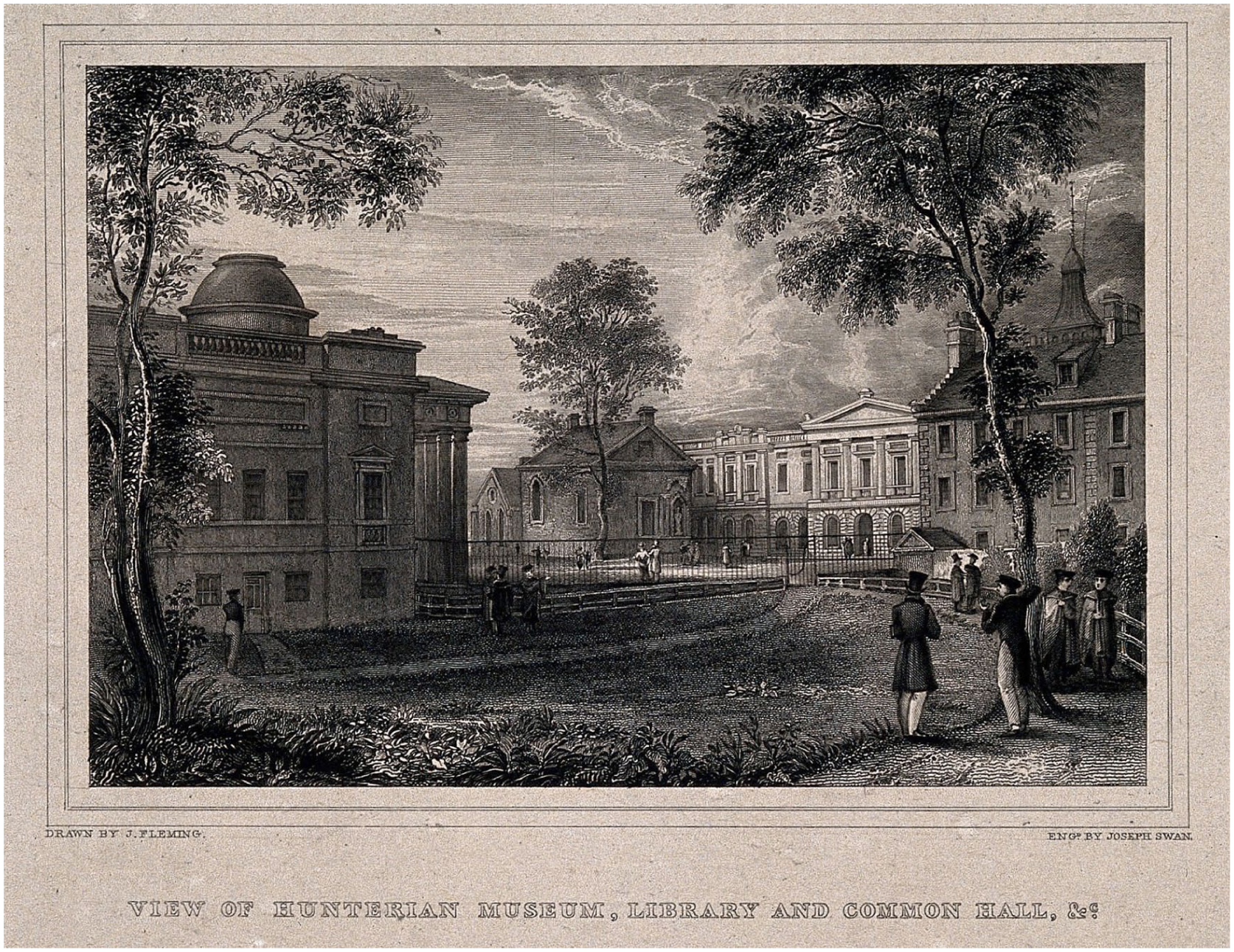
The Library of the University of Glasgow, the small building positioned in the centre of the print between the Hunterian Museum (left) and the Common Hall (right). Select Views of Glasgow (1828), Engraving by Joseph Swan. Wellcome Trust London, No. 17791i.
Fortunately, in the case of Hewan, the University of Glasgow Archives and Special Collections (hereafter UGASC) has preserved its library borrowing record and other associated documents. This essay reveals that these seemingly recondite records provide noteworthy forms of evidence and, though fragmentary, offer a unique window into how Hewan and other Glasgow medical students, many of whom would go on to work in colonial contexts, used the Library during the 1850s. In this essay, which is more of a preliminary note, we explore how Glasgow’s library records can be used to understand the context of Hewan’s 1853 book borrowing and we offer observations on how his experience with libraries and books might be used to consider the parameters of his reading interests as a medical student. We show that, in addition to shedding light on Hewan’s developing medical interests and education prior to his departure for Africa to serve as a missionary doctor, the records offer helpful insight into the benefits and limitations of using mid-nineteenth-century university libraries to reconstruct the lives of students.
Who was Archibald Hewan?
Hewan was born in Jamaica on the Hampden plantation to John (1769–1847) and Sarah Hewan. His father identified as Black and his mother was the daughter of the Scottish plantation owner Archibald Stirling (1769–1847) and an enslaved woman of African descent. 3 Hewan journeyed to Scotland when he was 16. The limited research on his early life indicates that he took medical classes in Edinburgh and Glasgow during the early 1850s and that he received a licence to practice from the Royal College of Surgeons of Edinburgh in 1854. After serving as a Free Church of Scotland medical missionary in Calabar (modern Nigeria), he returned in the mid-1860s to the University of Edinburgh to receive his medical doctorate in 1866, writing his medical thesis on malarial poisoning. 4
During the 1870s, Hewan settled in London and became a medical practitioner. Drawing from his medical expertise and from his travels to, from and around Calabar, he published scientific articles on the diseases and topography of Africa. 5 He wrote on topics ranging from smallpox and the efficacy of quinine to obstetrics and neuralgia. He also published several entertaining articles in 1877 for children about the natural history of Africa. Illustrated with striking woodcuts, the articles appeared in The Messenger for the Children of the Presbyterian Church of England (Figure 2). 6
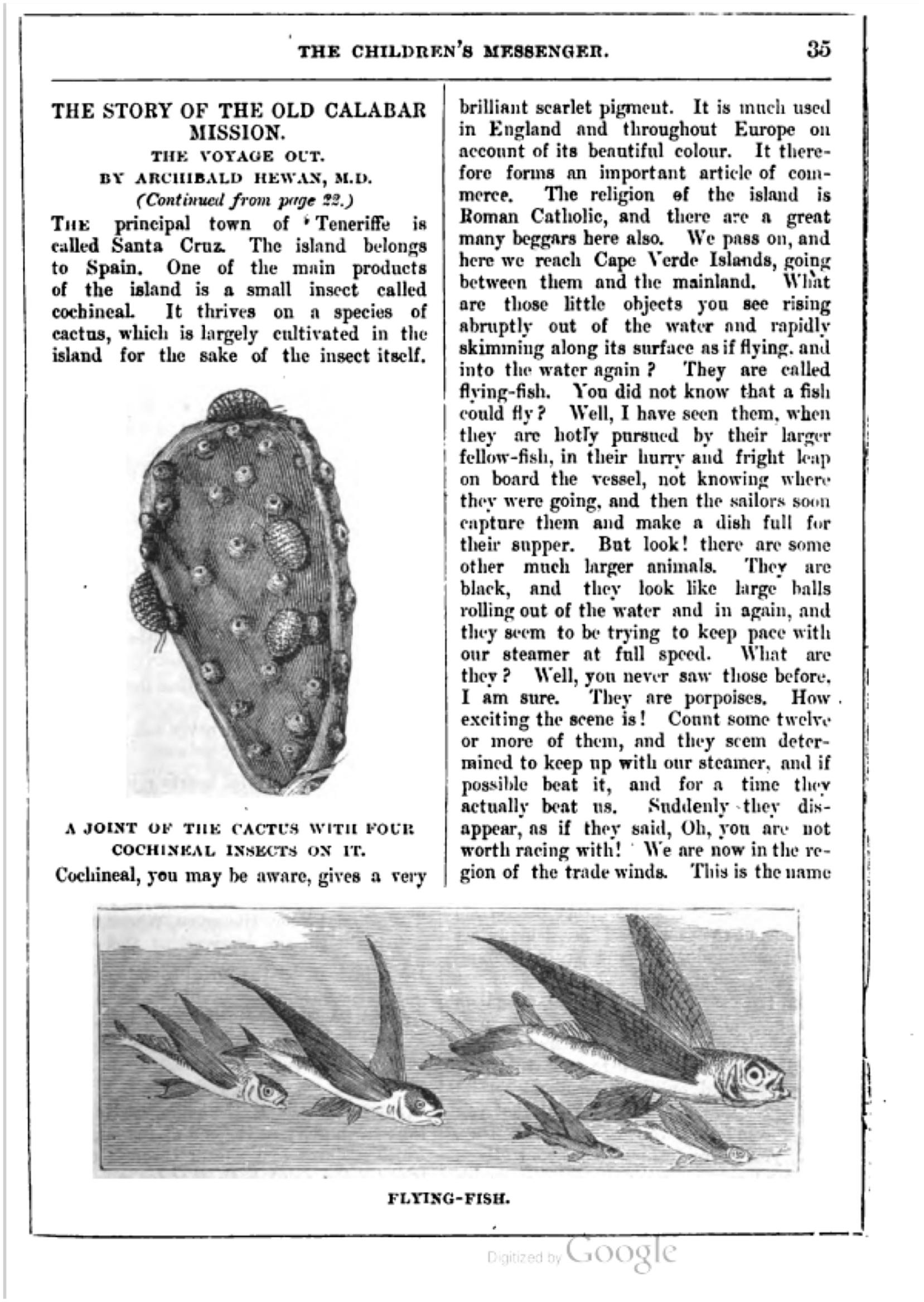
Publication Committee of Presbyterian Church of England, The Messenger for the Children of the Presbyterian Church of England (p.35).
While the basic contours of Hewan’s career are established, little is known about the earliest years of his medical studies in Glasgow or which specific subjects, beyond the courses he took, attracted his attention. Recently located University of Edinburgh archival records indicate that he spent 5 years in Glasgow preceding his surgeon’s licence. There, he took medical courses at Anderson’s University (1849–1854) and then University of Glasgow (1853–1854). 7 Though Hewan spent the bulk of his time at Anderson’s University, the institution’s pre-1854 medical student lists are no longer extant, which eliminates them as potential sources about his early studies. 8 It was for this reason we turned to the records of the University of Glasgow and, to our delight, found his Library records.
Finding Hewan in the archive
The academic life of a medical student at the University of Glasgow during the 1850s was filled with attending lectures and hospital rotations, keeping notes, entering academic competitions and sitting various exams. 9 For all these activities, medical students needed to read books and periodicals. At the time of Hewan’s studies, the University of Glasgow Library was used by students reading divinity, arts, law and medical degrees. Aside from professors who lent books from their personal libraries, the University as an institution offered medical students two options for consulting books. The first was the Medical Class Library collection available to be freely consulted within the Library’s reading room. 10 The borrowing registers for the collection still survive, though, frustratingly not for the dates Hewan attended. 11 This means it is not possible to know whether Hewan chose to consult the books in the Medical Class Library; however, if he did, the collection contained a wide variety of titles, including classic studies on tropical diseases such as fevers that occurred in his native Jamaica and in locations where he would eventually serve as a missionary. 12 Consulting such books would have required him to follow the strict reading room regulations such as ‘No student shall be permitted to take more than two volumes in use at the same time’ and ‘The books borrowed in the Reading Room are on no account whatever to be removed from this apartment but are to be used only there’. 13
When Hewan and other medical students wanted to borrow books, they had to do it via a second option, the University Library. The Library kept two kinds of records, and these shed light on the books he borrowed and his status as a student at the University. First, like most university libraries of the mid-nineteenth century, the Library kept a handwritten student borrowing record. It was called the Students’ Receipt Book and it recorded the name of the student, the course on which the student was enrolled, the student’s address, the titles and call numbers of the borrowed books and the borrow and return dates. 14 Hewan appears in the 1853 Student’s Receipt Book as ‘Arch. Hewan’. 15 The entries were written by the Librarian and his address served as a contact point in the event that he forgot to return the books. When considered in tandem with the months of the borrowing dates given for other students on the register page, the entry confirms that he attended the University of Glasgow in the 1853–1854 academic year.
A second record kept by the Library was another ledger-like manuscript, the Library Register. It recorded students who had paid the mandatory fee required to acquire the ‘library ticket’ that granted access to the Library. The Library Register recorded a student’s name, age and place of origin. Since matriculation was not made compulsory until after the 1858 Universities (Scotland) Act, the Library Register remains one of the most useful sources to confirm who was studying at the University during the time Hewan attended medical courses. 16 Much to our delight, Hewan’s name was entered for the 1853–1854 session. 17 In addition to featuring a specimen of his signature, the Library Register lists him as a medical student who was 21 years old, from Jamaica and in his first year of study, thereby reconfirming Hewan’s time at the University.
Contextualising Hewan’s records
Hewan’s University of Edinburgh records reveal that he attended four courses at the University of Glasgow. 18 During the 1853–1854 academic year addressed by his library records, he took Professor Harry Rainy’s Medical Jurisprudence course, Professor John MacMichan Pagan’s Midwifery course, Professor Moses. S. Buchanan’s Practical Anatomy course, 19 and John Alexander Easton’s Clinical Medicine course, given at the Glasgow Royal Infirmary. But which books associated with these courses did Hewan borrow from the Library? It is here where the Students’ Receipt Book offers insight. At the top centre of the page, the term ‘Med Juris’ is given, indicating it was likely Harry Rainy, his Medical Jurisprudence professor, who authorised him to borrow books (see Figure 3). Hewan’s entry records two books. We will discuss the titles below, but here it is worth considering whether his borrowing pattern of two books was common for other students attending the University’s medical school during the 1850s.
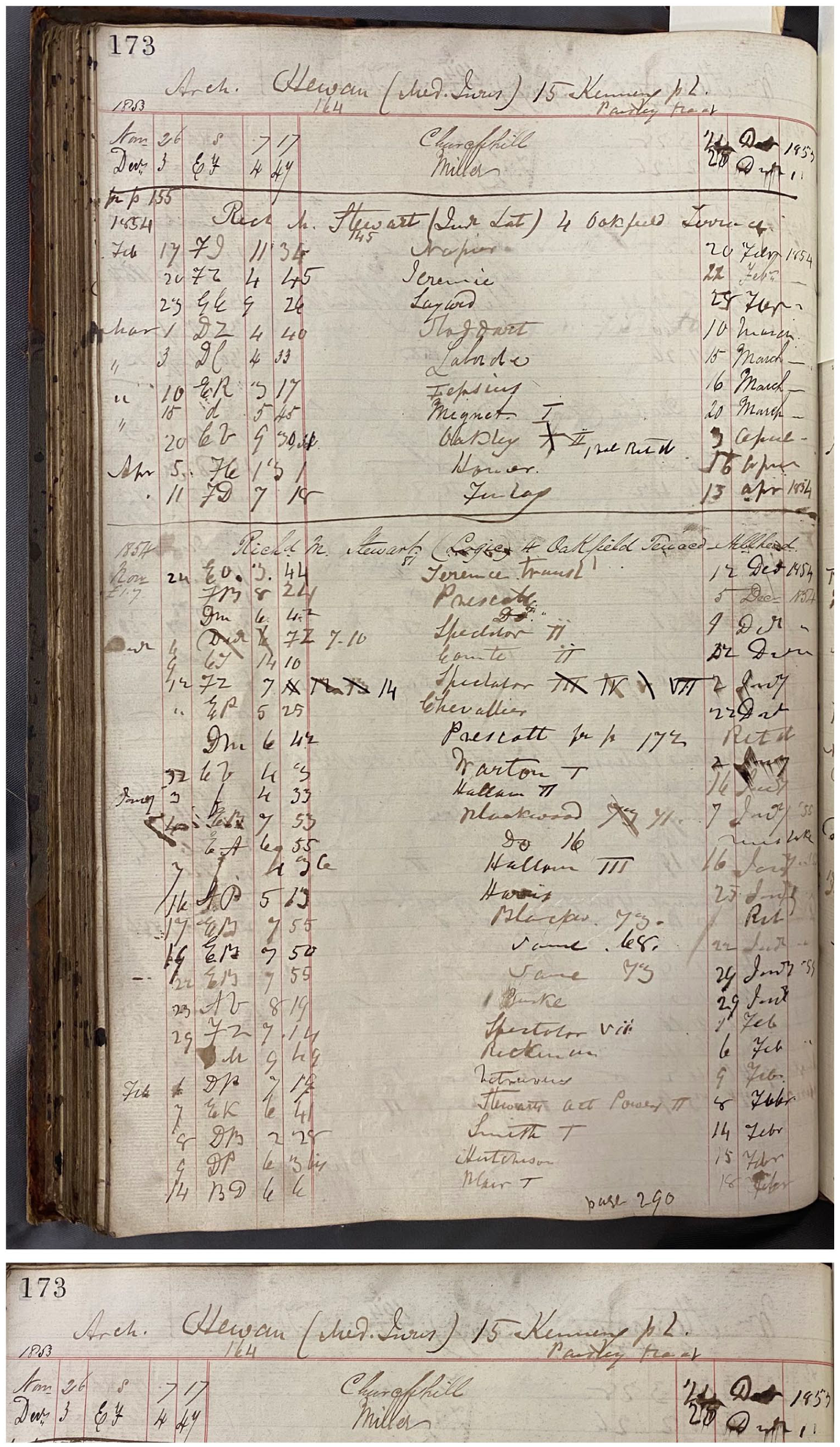
Archibald Hewan’s 1853 borrowing record in the University of Glasgow’s Students’ Receipt Book (1853–1858). (Top) The full page on which Hewan’s record appears at the very top. (Bottom) Hewan’s entry.
There is no study about nineteenth-century medical textbooks used in Scotland (or even Britain), nor on the reading habits of medical students in Scottish universities. 20 Scholars have, however, pointed out that medical books kept in Scottish university libraries were often supplemental to the detailed lecture notes that students kept in the classroom and then spent hours expanding and rewriting every evening. 21 This means that, when a medical student such as Hewan took the time and effort to borrow books from the library, they were likely linked to information he wished to acquire over and above the core topics presented in the curriculum. It is difficult, however, to discern the specific books recommended by his professors because the archives and collections of the University of Glasgow Archives do not hold extant student or professor lecture notes kept between 1850 and 1860 for the courses Hewan attended. 22 Even if extant notes survived, they likely would contain mainly facts and principles without frequent references to published material, a practice evinced in most Scottish medical school notebooks of the time. 23 Added to this is the fact that the medical school syllabi during Hewan’s time in Glasgow are unknown because University calendars, in which they were normally printed, were not produced between 1845 and 1863.
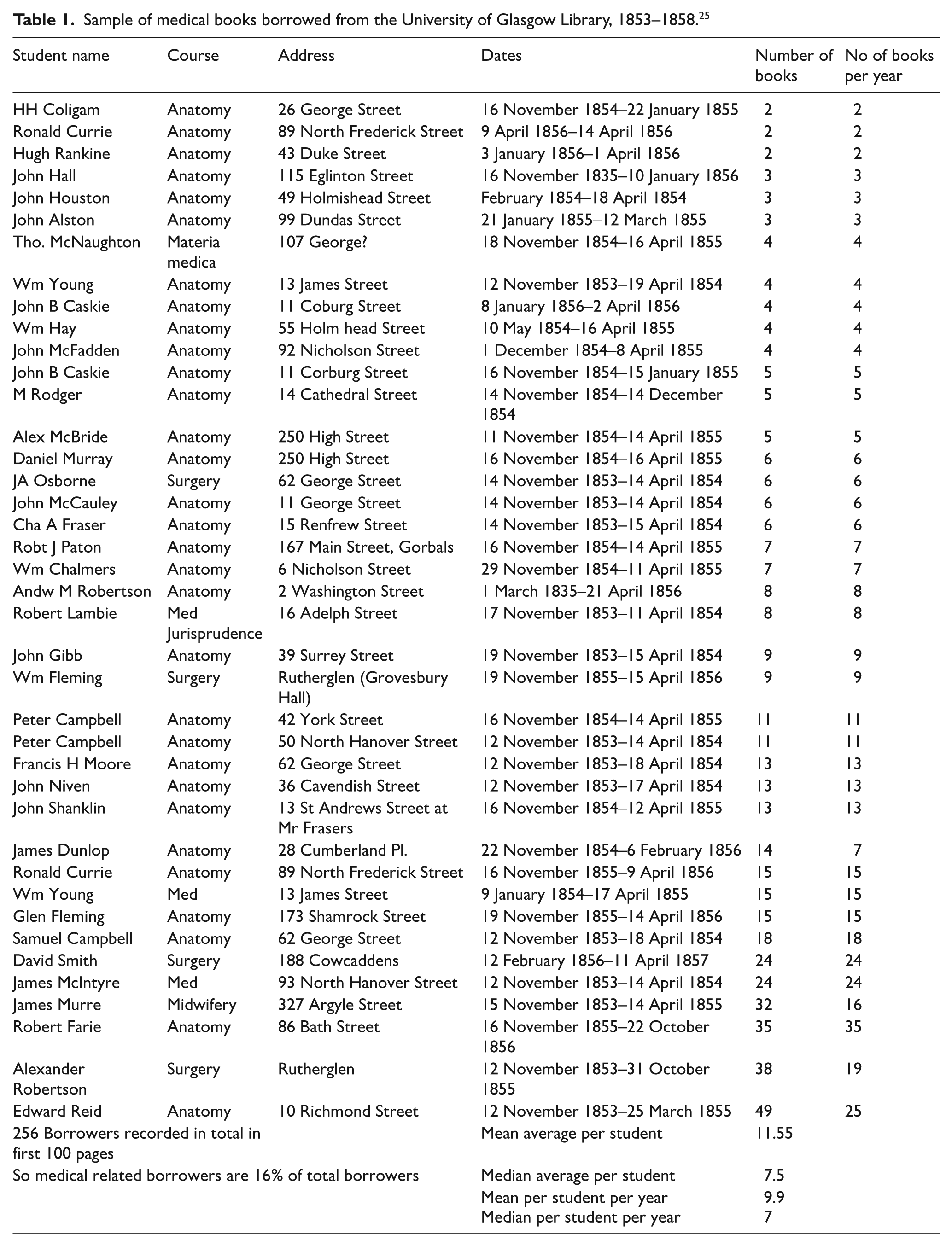
Though primary and secondary literature on the library habits of Scottish medical students is scant, it is possible to use the Students’ Receipt Book to glean information related to the number of books Hewan borrowed. A perusal of its first 100 pages, which has entries for the years 1853–1858, provides helpful context. As shown in Table 1, the students in Hewan’s medical jurisprudence course rarely borrowed books. Instead, it was anatomy students who tended to borrow the most books. The high number was linked to the fact that there were three anatomy courses offered by the University, and anatomy was a core subject for students reading a medical doctorate and for those seeking to meet the minimum criteria for surgical examinations. 24 Most anatomy students borrowed around ten books, but one student, Robert Farie, checked out 35 titles over the course of the 1855–1856 academic year (see again Table 1).
Sample of medical books borrowed from the University of Glasgow Library, 1853–1858. 25
For the medical jurisprudence students who appear on the register for the academic years of 1853–1854, 1854–1855 and 1855–1856, as shown in Table 2, the median number was six borrowed books. The highest number borrowed was ten. Since Hewan only borrowed two books, his rate was the lowest of the medical jurisprudence students. They seem to be the only books he borrowed, as his name does not occur elsewhere in the Students’ Receipt Book under other courses. This of course does not mean he was not consulting medical books in the Library. As noted above, the reference books in the Medical Class Library were available to him, but he would have had to consult them according to its restrictive rules. Hewan’s lower borrowing average was not abnormal. Other medical students had similar rates and did not even use the library at all. Hewan had already taken several courses at Anderson’s University and had reached the stage where using a medical library was likely related to filling gaps on topics he needed to know for the surgeon’s examination he eventually took in Edinburgh later in 1854.
Books borrowed by medical jurisprudence students – November 1853–April 1857. 26
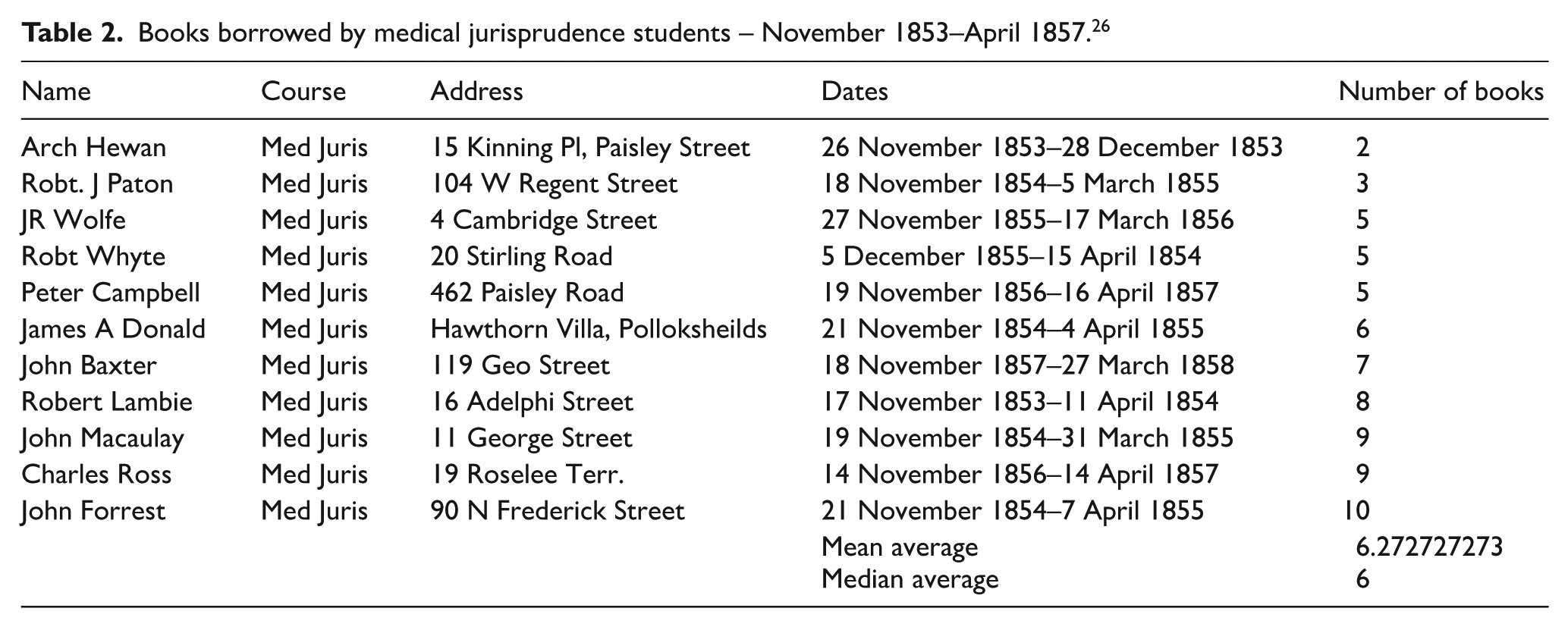
The Students’ Receipt Book also offers future avenues of enquiry related to the atmosphere of student life that surrounded his studies. Robert Lambie, for instance, who, like Hewan, appears under the midwifery course in the Register for the 1853–1854 session (Table 2), was later remembered by John Nichol, Glasgow’s Professor of English Literature as the ‘foremost medical student of his time’. Lambie co-wrote a letter to the Lancet in October 1853 that praised the teaching of the recently departed Robert Dundas Thomson, the University’s Professor of Chemistry. 27 Publishing a piece in an influential medical journal such as the Lancet was of course a noteworthy achievement for a student. But Lambie’s accomplishment reveals that Hewan studied in a context where publishing letters in prestigious journals was an achievable goal of peers interested in gaining a scientific reputation. Such a horizon of experience likely helps us understand why Hewan’s first known publication in the Lancet was, indeed, a letter. 28 It was published a decade later in 1865, the year before he was awarded a medical doctorate from the University of Edinburgh.
Identifying Hewan’s books
So which books did Hewan borrow and how might they offer insight into his reading interests? Since he checked out books under the medical jurisprudence course taught by Professor Rainy, it might at first glance seem that he was following up Rainy’s efforts as an early defender of Dalton’s atomic theory or his cutting-edge chemical experiments that made it possible to determine arsenic poisoning. 29 But, upon closer examination of the books Hewan borrowed, it turns out that Hewan was more interested in topics related to surgery and midwifery. Following the convention used for all the entries in the Students’ Receipt Book, the Librarian did not record the titles of the two books Hewan borrowed. Instead, the Librarian wrote the call numbers in the far-left column and the authors’ names in the centre column (see again Figure 3).
The name of the first author was ‘Churchill’ and the name of the second was ‘Miller’. Using the Library’s Catalogue, the identity of these two books can be firmly established. The Catalogue reveals that the ‘Miller’ book was the second edition of James Miller’s The Principles of Surgery. 30 The Library had two copies, suggesting that it was popular. The review of the 1851 edition in The Edinburgh Medical and Surgical Journal praised it as an exemplary introductory surgical text for students and practitioners alike. 31 The presence of Miller’s book on Hewan’s record offers insight into his diligent efforts to prepare himself for the examination he would successfully take in 1854 for his surgical licence at the Royal College of Surgeons of Edinburgh. Prior to studies at the University of Glasgow during the autumn of 1853, Hewan began to prepare himself by attending Robert Hunter’s surgery course at Anderson’s University during the 1852–1853 session. Likewise, he took the surgery course at Anderson’s University again during the 1853–1854 session, that is, during the same year he was studying at Glasgow. 32 Though Hunter had published an anatomy primer for students in the 1830s and several articles on surgical procedures, he had not published a surgery textbook. 33 These factors indicate that Hewan was using the University of Glasgow Library to supplement his surgical studies at Anderson’s University with a view to augmenting his performance on his forthcoming surgical exams.
Turning to the ‘Churchill’ book, the Library’s Catalogue reveals that it was the 1842 edition of Fleetwood Churchill’s On the Theory and Practice of Midwifery. 34 Churchill’s book was an introductory text that addressed topics related to modern obstetrics and gynaecology. Like Miller’s book, Hewan’s interest in Churchill’s primer probably was linked to a course in which he currently was enrolled. More specifically, during the 1853–1854 session, he took John MacMichan Pagan’s University of Glasgow midwifery course. 35 In addition to not publishing a midwifery textbook, Pagan seems to have published relatively little during his career. 36 Thus, at one level, Churchill’s Midwifery presented Hewan with an opportunity to supplement Pagan’s lecture material. But, at another level, Hewan eventually published an 1865 article about midwifery based on clinical observations he made in West Africa, 37 and his interest in Churchill’s book as a student intimates a longstanding attentiveness to the topic.
Exploring Hewan’s reading spaces
Scholars who research medical and scientific reading practices have pointed out that, beyond the spaces provided within a library, it is sometimes difficult to explore where books were read. 38 In Hewan’s case, the University of Glasgow’s Library records offer useful information on this point. The catalogue of the Medical Class Library, for instance, reveals that the collection held different copies of the same editions of both Churchill’s Midwifery and Miller’s Surgery. 39 Had Hewan wanted to simply use these books as reference sources, he could have used them in the Library (and may have actually done so). However, the fact that he borrowed the other copies from the main collection of the Library at the very least indicates that he wanted to more significantly engage with the books for a longer period of time in a space outside the restrictions of the reading room.
The Students’ Receipt Book confirms that he borrowed both books for several weeks at a time in the first academic session of 1853. More specifically, he borrowed Churchill for 4 weeks (26 November–21 December) and Miller for 3 weeks (3 December–20 December), giving him time to thoroughly consult the books. The most likely place for him to read the books was his accommodation and, fortunately, his library record offers information on this point as well (see again Figure 3). The top right corner of his entry in the Students’ Receipt Book lists ‘15 Kinning Place, Paisley Road’ as his residence. The address was located south of the River Clyde. Studying the books in this student accommodation required him to carry them on around a 45-min walk from the Library in the north part of the city, across one of the Clyde’s bridges and then onward to Kinning Place. 40
Hewan’s room was just around the corner from the Pollock Street United Presbyterian Church, 41 that is, a church which was part of the denomination that would soon send him to West Africa as a missionary. 42 In terms of potential reading space, the church was reconstructed between 1852 and 1856 and an unlikely reading location. 43 Likewise, the building which housed Hewan’s rented room was located on a busy section of the Paisley Road and, according to the 1854 Glasgow Postal Directory, it was surrounded by shops run by merchants, shipmasters, clothiers, bootmakers, grocers and vintners. 44 Such an environment would have produced a noisy atmosphere in the background during the day. Added to this was the sound generated from the trains going to and from the coal depot located one block away. The larger point to draw from the geographic placement of Hewan’s room given in the address featured in his library records is that the information suggests potential limitations to reading library books at home, thereby offering a further glimpse into the larger social and religious context that surrounded his studies.
Conclusion
Archibald Hewan’s status as Britain’s first known Black missionary doctor in Africa offers a wealth of potential connections to scholars interested in the entangled historical interface between colonialism, medicine and religion. Though little work has been done on his career, this essay has suggested that the library records of the University of Glasgow offer a helpful starting point for those seeking to reconstruct his early experience with medical education. In addition to offering more detail about what Hewan and his fellow students read outside the classroom, the records offer a tantalising glimpse of the wider intellectual resources and environment that framed his studies.
Whereas the evidence presently makes it difficult to discern how Hewan read the books he borrowed, the fact that he checked books out on specific topics offers an indication of his early reading preferences, which, as we have suggested, were related to his upcoming surgical examinations and to midwifery interests that endured for the rest of his career. Our research on Hewan’s time in Glasgow also revealed that university library records sometimes offer crucial personal information that can be used to reconstruct the intellectual world of nineteenth-century marginalised colonial actors like him who, despite the odds, found themselves studying at a British university. Overall, we hope our research on Hewan has given a better idea of how library records can be used as a tool to understand his life and the lives of other medical students during the nineteenth century.
Footnotes
Acknowledgements
The authors wish to thank: Claire Daniel at University of Glasgow Archives and Special Collections; Anne Cameron, Archives and Special Collections, University of Strathclyde; John Shepherd, Durham University; Elin Crotty, Heritage Collections, University of Edinburgh; Zachary Kingdon, National Museum of Scotland. The essay also benefitted from advice given by Jim Secord, Cambridge University and Jonathon Topham, Leeds Univresity, and received helpful feedback from the participants of the Royal Society of London’s Libraries of Science conference in 2024.
Declaration of conflicting interests
The authors declared no potential conflicts of interest with respect to the research, authorship and/or publication of this article.
Funding
The authors received no financial support for the research, authorship and/or publication of this article.
