



Abstract
The Hippocratic Oath, written by the father of medicine, Hippocrates in 430 BCE has been sworn for millennia across the world by new doctors. Its nine articles outline how a doctor must treat their patients effectively, abiding by the core ethical principles that underscore Good Medical Practice today, including a focus on beneficence and non-maleficence. Today, the Gods of Olympus are no longer routinely worshipped, and we benefit from vast medical and technological advances, so the question arises whether the principles of Hippocratic medicine are still relevant? On the island of Kos, Hippocrates’ birthplace, there continues the tradition of an annual ‘oath swearing’ ceremony for students that have completed medical school both from Greece and across the world. Whilst this event can be used to celebrate the achievements of the new doctors in training, is there still a need for them to retrace the routes of the profession? This article aims to explore the core principles of the Oath and Hippocratic medicine and determine their relevance in today’s modern society.
Introduction
Since 430 BCE new doctors have pledged to the Hippocratic Oath as a way of abiding to standards of good medical practice. Initially translated to Latin, then modern Greek and then to languages across the globe, this remains one of the most well-known scripts of the ancient world which has survived more than 24 centuries. In the world of ever advancing technology and constant forward thinking, is it relevant to recall the ancient teachings of the father of medicine and apply to today’s society?
The Oath of Hippocrates constitutes a monument of the highest order in the history of civilisation. Whilst the details contained in the Oath may now be outdated, it can still serve as a moral compass to guide doctors in their future practice.1,2 It is therefore perhaps understandable that medical schools across the world still take an oath at the time of graduation which has been adapted to fit into the modern era, whilst still focussing on the core principles as described by father of medicine himself.2 –4
We will proceed to briefly outline the Oath and explore its relevance to 21st century medicine.
The articles of the Oath
Article 1: I swear to Apollo the physician, and to Asclepius and to Hygeia and to all the Gods and Goddess who I name my witnesses, that I shall fulfill, to the best of my ability and judgement, this Oath and covenant
In the time of Hippocrates, swearing an oath to Apollo and the Gods was the ultimate assurance of one’s good intentions. Whilst these Gods may no longer have a prominence in our modern society, the concept of committing to practice with good intention to the best of one’s ability remain a crucial part of Good Medical Practice. It also highlights an aspect of accountability that modern medicine follows today, with doctors across the world having to be registered to regulatory boards like the GMC that hold them account to their oath and commitment.
Article 2: My teacher who instructed me this art to hold equal to my parents and his male descendants to hold as my brothers, to teach them this art and all the medical knowledge should they ask me to without any reward or covenant, and to do so too to all those that have taken the medical Oath and to none other
The wisdom and knowledge that doctors held, was considered so sacred that it should be passed from generation to generation to all those keen to learn. This was not without regulation, as Hippocrates recognised the potential risk of practising beyond one’s capabilities. The importance of this article reflects the life-long learning commitment that mirrors a career in medicine. So highly regarded was the teaching delivered by doctors, that they were considered as equal to one’s family. However, in contrast to the ethos of Hippocrates, medical knowledge has become widely available to those without medical background. Modern society promotes the unrestricted access to information, aided by means of modern technology, and doctors are encouraged to educate the general public in their ways of medical practice. In this way, the scared nature of the medical art as Hippocrates saw it to be, has be compromised. As a result of increased public information, general public health has improved, and has allowed for multiple subdivisions of medical care to be established, reducing the workload and burden on today’s doctors.
Article 3: According to my power and judgement to use the medical knowledge for the benefit of those that suffer, as judged by myself that to be fair, and to avoid from doing any harm or injustice
The ethical principles of beneficence and non-maleficence are taught in medical school curricular across the world. They remain almost completely unchanged from the original words of Hippocrates. Advances in medical treatment happen every day and fundamentally, the values of benefit for patients and first doing non-harm clearly underpin every drug or technology in development with robust ethical processes to allow such research to proceed. In this article, Hippocrates displays himself as the decision-maker in respect to his patients care. Modern medicine has evolved to encourage shared decision-making. However, there are some aspects of practicing medicine that still rely on core decisions of patients’ treatment being made by doctors such as the signing do not resuscitate forms. These are instituted by doctors, in the patients’ best interest.
Article 4: Not to give to anyone any lethal drug, even that he asked of me, and neither to suggest such – Also not to supply any woman with the means for abortion
The exact meaning of this article continues to be debated, due to uncertainty around the translation from the Oath’s original form to Latin. 5 Yet, the concepts explored here have heavily influenced modern day society where the legal principles surrounding euthanasia and abortion remain contentious. The fact that these matters continue to be debated 24 centuries later, demonstrate the complexities of the interface between medicine, law and ethics.
Article 5: But I will keep pure and holy both my life and my art
In Ancient Greece, doctors were held in such high regard that preserving their good character, not only in their work but also in their personal lives was an important part of the Oath. Practicing medicine was considered so complex and expert, that it was considered akin to art. Whilst today most no longer consider medicine a form of art, the belief remains that doctors have an obligation to maintain high personal, as well as professional standards. Such standards are believed to fortify public trust in doctors and have faith in the management decisions made about their care. Perhaps today there is a far greater emphasis on shared decision-making rather than doctors dictating to patients, yet the rapport between patient–doctor is still a crucial part of the treatment journey.
Article 6: I will not use the knife, not even, verily, on sufferers from stone, but I will give place to such as are craftsmen therein
This is another article that over the years has been disputed. Some interpret not using the knife in relation to physicians of the time not performing surgery. The stone may refer to gallbladder or renal stones, which were common presentations of the time due to dietary habits. Further to this, these words may reference the respect for specialisation, with physicians leaving such procedures to surgeons and vice versa. This article remains relevant today, whilst all those with a medical degree are educated on general physiology and have an understanding of treating a range of conditions, most go into some kind of specialisation with a huge value placed on interdisciplinary working for the benefit of an individual patient.
Article 7: Into whatsoever houses I enter, I will enter to help the sick and I will abstain from all intentional wrong-doing and harm, especially from abusing the bodies of man or woman, bond or free
The foremost principle of working as a doctor, both in Ancient Greece and in modern society is to help those in need. Emphasised here in parallel is the equivalent importance of doing no-harm. This section of the Oath is again echoed in two of the four major principles of the GMC’s Good Medical Practice, namely beneficence and non-maleficence. Further to this, the Oath here recognises that men and woman are equal, as are those who are free or bound. This was extremely forward thinking compared to the typical views of the time and highlights the moral, as well as ethical philosophies that were accepted by doctors of the time. In modern society, inequalities continue to be perpetuated. This section of the Oath is a timely reminder that we, as doctors, play a crucial role in actively tackling such disparities.
Article 8: And whatsoever I shall see or hear in the course of my profession, as well as outside my profession in my intercourse with men, if it be what should not be published abroad, I will never divulge, holding such things to be holy secrets
Once again, the values underpinned in this article are echoed in today’s medical practice. This focusses on the importance of confidentiality and the relationship between doctors and their patients, in and outside of the clinical environment. This continues to be at the forefront of good medical practice. In addition, this touches on confidentiality around medical research and maintaining professional discretion when hearing about novel work.
Article 9: Now if I carry out this Oath, and break it not, may I gain for ever reputation among all men for my life and for my art; but if I break it and forswear myself, may the opposite befall me
Perhaps the pinnacle of the Oath, this final sentence cements the standards of both personal and professional responsibility required to practice as a doctor. It emphasises the necessity of accountability required for the life altering art of medicine, introducing the idea of punishment and reward. Breaking such an oath sworn to the Gods of Olympus would have been beyond comprehension in Hippocratic times. Whilst no longer directly relevant, we should still hold the relevant ethical and moral principles within the oath of equivalent importance to today’s doctors.
In summary, the Oath itself is a promise made by a doctor to protect their patient and offer them the best treatment possible whilst first ensuring they cause no-harm. To determine if this should still be used in today’s society, we must next consider the treatment principles to which it refers.
The Hippocratic theory of treatment
No article on the treatment of patients in the time of Hippocrates, would be complete without an overview of the ‘four humours’. This theory states that the human body was composed of four ‘humours’; blood, phlegm, yellow bile and black bile (otherwise considered as melancholy). These four traits not only defined one’s physical and mental health, but also their personality. An imbalance in the humours would result in illness and treatment was possible only after restoring balance. In order to achieve this, a healthy diet and lifestyle was recommended.6,7
Furthermore, Hippocratic medicine encompasses the principles of holistic and personalised medicine. This was through the investigation of finding out what led to the person’s symptoms, by distinguishing lifestyle patterns that predisposed to certain conditions. 8
‘Diata’, literally translated into diet was used to represent the holistic approach to health, focussing on way of life and the influence of nutrition, drinking habits and physical activities. Interestingly the importance of clean water to maintain health was emphasised to all, as Hippocrates prescribed rain water that must be boiled and strained. 9
Modern medicine is now turning towards the rediscovery of the importance of lifestyle in disease and prevention. Lifestyle medicine is an approach that focusses on modifying unhealthy habits and promoting new ones to not only manage but also to prevent chronic disease. This is only considered effectively possible, when all members of the multidisciplinary team are involved. Lifestyle medicine is becoming increasingly popular worldwide as the low-cost approach, makes it accessible to a wide range of patients, from differing backgrounds. 10 This evidence-based approach is growing rapidly through its emphasis of preventative care. 11 Many clinical trials within the field of cardiovascular medicine have shown an improvement in coronary artery disease of patients on a holistic care pathway where diet and lifestyle intervention were used compared to controls.12 –14
Hippocratic medicinal plants and herbs
The Hippocratic Corpus suggest that over 240 plants and herbs were used as medicines at that time. The text has suggested that such ingredients should be used with caution, according to the needs of the individual patient. Whilst developments in drug therapies today are continuously evolving, many of the remedies used by the ancient Greeks have influenced common practice today.
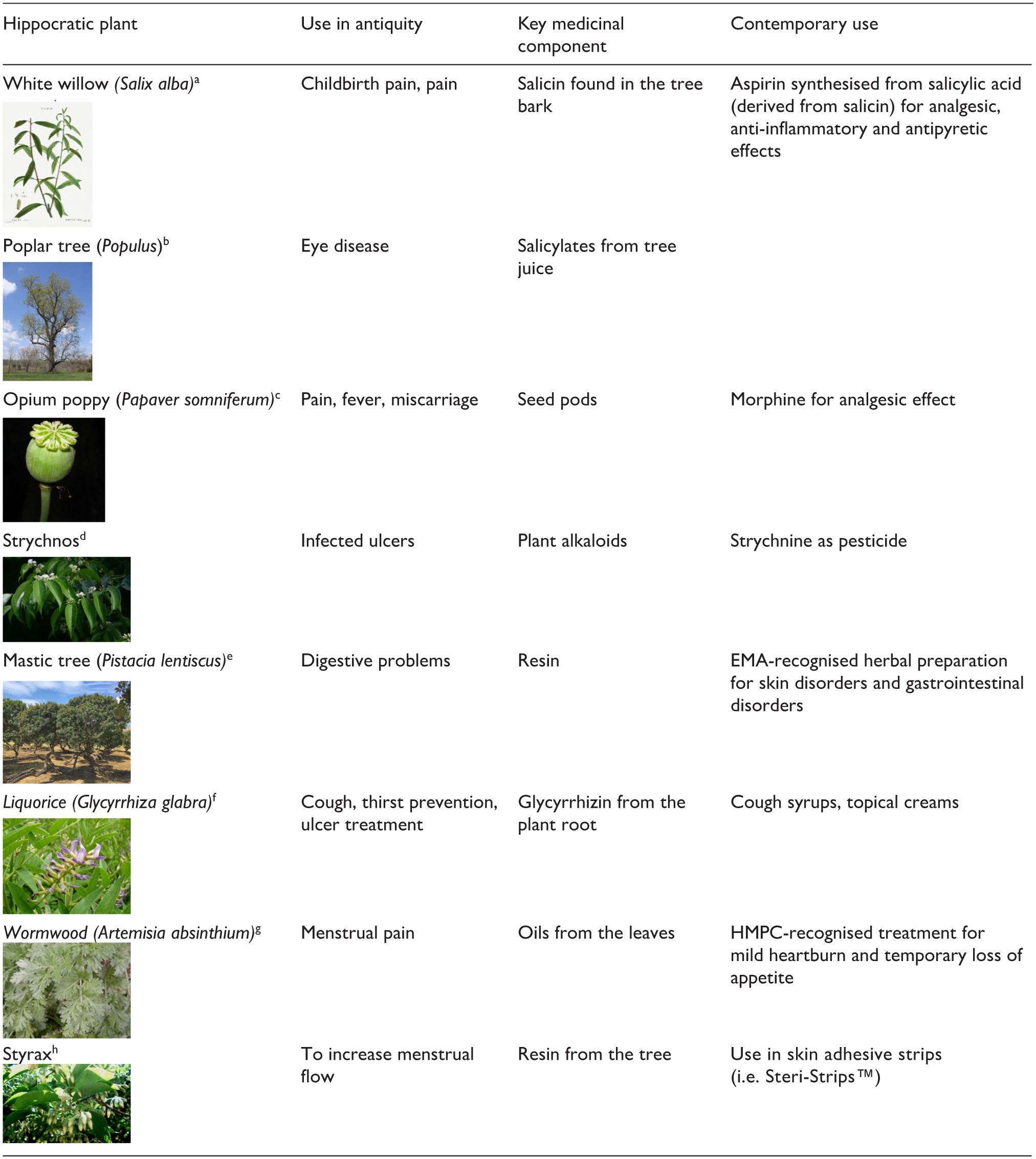
Table 1 highlights some of the Hippocratic plants and herbs that are recognised as treatments (in their different forms) today.
Demonstrates several plants and herbs that are used as treatments today. Some of these treatments derived from Hippocratic plants, such as aspirin and morphine, form fundamental aspects of modern medicine and have a wealth of contemporary evidence supporting their therapeutic effects and mechanism of action.15,16 Others, such as wormwood, are less established in modern clinical practice and their use is restricted to herbal preparations. Nonetheless, several Hippocratic plants have emerging evidence supporting their therapeutic effects, such as Greek Sage for antioxidant activity. 17 With further pre-clinical and clinical studies, it will soon become apparent if these plants have efficacy that warrants consideration for clinical approval.
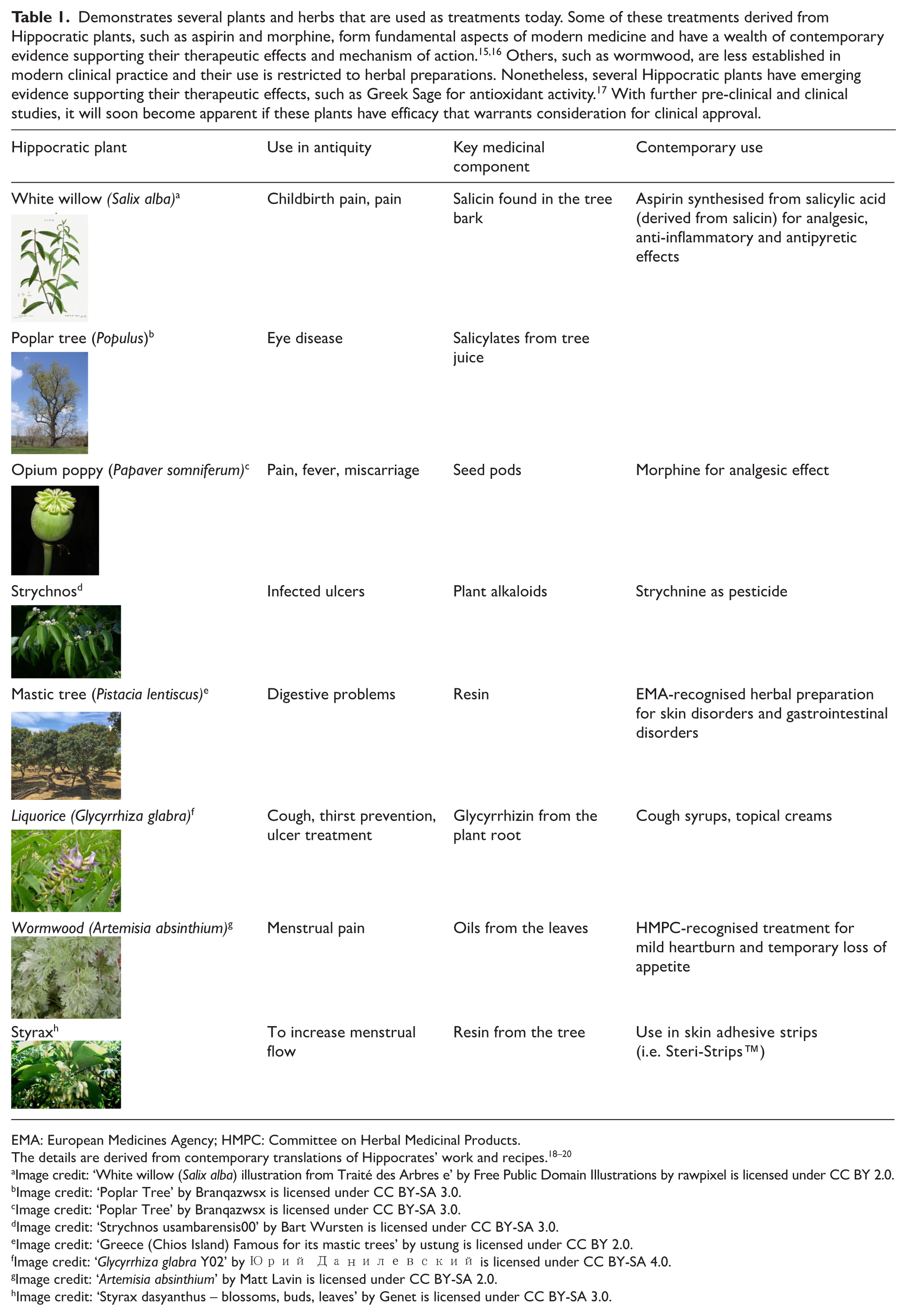
EMA: European Medicines Agency; HMPC: Committee on Herbal Medicinal Products.
Image credit: ‘White willow (Salix alba) illustration from Traité des Arbres e’ by Free Public Domain Illustrations by rawpixel is licensed under CC BY 2.0.
Image credit: ‘Poplar Tree’ by Branqazwsx is licensed under CC BY-SA 3.0.
Image credit: ‘Poplar Tree’ by Branqazwsx is licensed under CC BY-SA 3.0.
Image credit: ‘Strychnos usambarensis00’ by Bart Wursten is licensed under CC BY-SA 3.0.
Image credit: ‘Greece (Chios Island) Famous for its mastic trees’ by ustung is licensed under CC BY 2.0.
Image credit: ‘Glycyrrhiza glabra Y02’ by Юрий Данилевский is licensed under CC BY-SA 4.0.
Image credit: ‘Artemisia absinthium’ by Matt Lavin is licensed under CC BY-SA 2.0.
Image credit: ‘Styrax dasyanthus – blossoms, buds, leaves’ by Genet is licensed under CC BY-SA 3.0.
Conclusion
Whilst the world today has seen many changes since 300 BC, including changes in religious practice and the immense advancements of medical therapeutics and technology, we have shown that the foundations of Hippocratic ethics within healthcare remain relevant to today’s doctors.
The Hippocratic Oath, once the pinnacle of the completion of medical training, still forms the basis of modern medicine’s ethical and philosophical codes such as the GMC’s Good Medical Practice. It is therefore unsurprising that it is still regarded as the ultimate document of medical etiquette and moral. The words of the Oath can help the physicians of today feel connected to their predecessors and future generations, by uniting their common values. Furthermore, the words serve as a timely reminder to ensure patients’ well-being is at the forefront of their daily practice. The wholeness with which Hippocrates aimed to treat patients is mirrored in today’s holistic practices, treating a patient as more than just the specific problem that presents in front of the doctor. Perhaps with today’s trends of super sub-specialisation, the Oath and its extended values are an important reminder for practicing medicine with consideration of wholeness. Now millennia old, these ethical principles are still perpetuated with good reason, it remains that case that a career in medicine is a privilege and the gravity of the role must not be taken lightly. No doctor can successfully serve the public without adequate consideration of the discussed values. We must continue to always aim to do what is right for the patient and above all else, first do no harm.
Footnotes
Declaration of conflicting interests
The authors declared no potential conflicts of interest with respect to the research, authorship and/or publication of this article.
Funding
The authors received no financial support for the research, authorship and/or publication of this article.
