



Abstract
Research on the digital divide in sub-Saharan education needs an overview of its conceptual developments and practices since the studies in the field of the digital divide emerged and were established around the mid-1990s. The present systematic literature review fills such a gap by using mixed methods to analyse three aspects of research on the theme and context. Considering a sample of 54 studies, the selected aspects to analyse were key representations (of regions, areas of education, and focused groups), general elements to influence the exclusion of digital education, and adopted research designs. Results led discussions concerning significant imbalanced representations of subjects, localisation of characteristics of the elements across regions, and hidden spots and limitations of research impact, potentially motivated by theory-ladenness. The present study intends to contribute to the development of digital divide studies contextualising sub-Saharan regions with comments based on thorough examinations of attainments and failures of previous endeavours, contributing to more successful future research as a consequence.
Introduction
The interpretation of a ‘digital divide’ pivoting more and new types of social inequalities has strengthened from the mid-1990s after the concept first appeared in the US over public concerns about access to the Internet and soon became a concept (Dijk, 2020: 7; Peláez-Sánchez et al., 2023). Over the years, populations located in the African continent have been attracting attention among social scientists as they endure digital divide experiences overlaid through historical infrastructural and social challenges to address educational needs (Krönke, 2020: 1), even though some of its regions have been less frequently covered in academic discussions (Ragnedda and Gladkova, 2020: 21). Though the research field has completed its third decade of investigation, there is an absence of a literature review considering research in education across sub-Saharan Africa (SSA), given previous reviews have either explored the digital divide concept generally and detached from SSA contexts or advanced comparative analysis in SSA regions limited to a segment of formal education, such as higher education. The present systematic review is invested in filling the gap on the status of the digital divide in SSA education, with a determination to clarify the disposition given to regions and problematised groups, the local relevance of elements to influence experiences of digital divides, and the display research designs.
This introduction carries a brief dissertation on its chosen theoretical background and a summary of previous correspondent reviews before presenting an overview of general developments and exploring research practices on the concept and context.
The theoretical background of this research expresses the main statement of the digital divide – digital inequalities are sources of new or deepen existent social inequalities (Heponiemi et al., 2023: 2476) – and embeds the three typical levels of divide (physical access, digital skill, and outcomes of use) (Hargittai, 2002; Ragnedda and Ruiu, 2017; Van Deursen and Van Dijk, 2019) within a framework known as resources and appropriation theory (Fang et al., 2018: 2; Lopez-Sintas et al., 2020; Van Deursen and Van Dijk, 2019; Van Dijk, 2005). The framework (Figure 1) has gained recognition and popularity enough to be referenced by scholars as one of the most sophisticated syntheses of the digital divide theory, given that it profitably includes both collective and individual social disparities and safeguards the digital media’s complexity and usability (Lupač, 2018: 94-95). A causal model of the resources and appropriation theory of the digital divide (Dijk, 2020).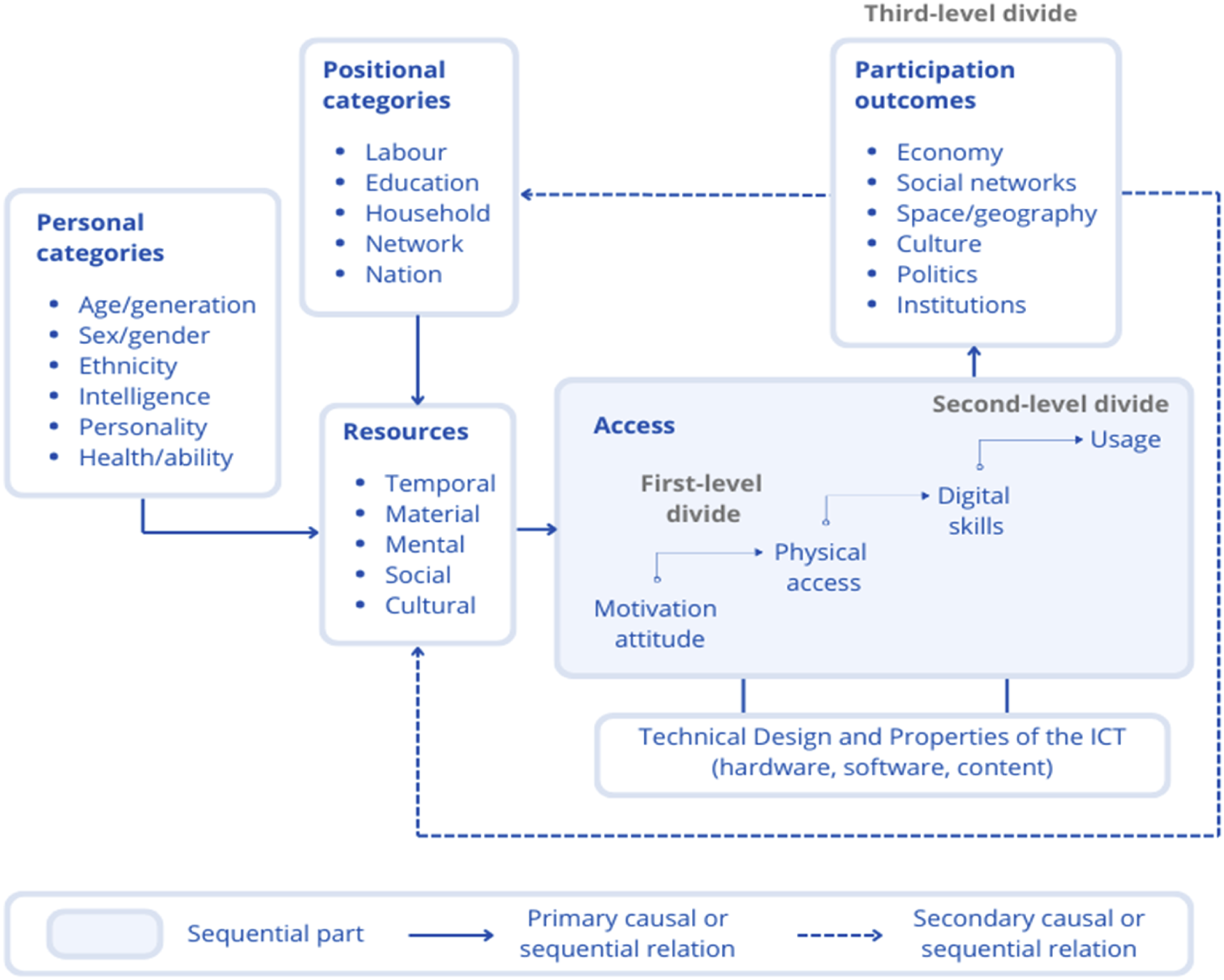
In a nutshell, Dijk’s framework portrayed the relationships between elements of the digital divide. One’s personal categories, in tandem with one’s position in society, drive one’s level of resources. The resulting disposition from the personal and positional categories produces a different nature of access. Since Dijk conceived ICT access to more than physical access, ICT technical design and properties (hardware, software, and content) are recognised as part of the ‘access equation’. One’s access experience relates to participation outcomes at varied levels in the economy, social networks, geography, culture, politics, and institutions. The participation outcomes may lead one to new positional categories and new configurations of resources that interactively reshape former accesses or shape access to new digital media.
Two tenue points of Dijk’s framework deserve attention from those willing to test the model. First, ICT access is separated from the other material resources – which is debatable due to the unequal distribution ICT diffusion tends to implicate. Thus, it could have been treated as a scarce resource as the others clustered in ‘resources’ (Lupač, 2018: 96). Dijk’s consideration of ICT access of more than physical access leads to the second critical point of the framework – Why does it attribute a special status to ICT? The answer lies in the fact that the framework is at the helm of Bell-Castells’ information and network society theories that estipulate a new arrangement of society due to the Internet (Lupač, 2018: 96). This argument is downplayed by some authors who recognise the limitation of the digital divide as a concept, after all, this is another social inequality (Warschauer, 2003: 7).
Along with the tenue points mentioned, another salient aspect of the framework must be observed. Dijk’s framework was not designed to capture the complexities of the digital divide in SSA. Designed from particular methodologies and other contexts, it overlooks unique contextual factors, such as ethnolinguistic mosaics, the institutional composition of populations, unequal development, and racial colonial heritage. These limitations were exposed by the findings related to linguistic diversity and varying levels of infrastructural development of this research.
Although the framework stands well, valid observations are advocating the design of contextualised frameworks for monitoring digital divides in the ‘Global South’ (Heeks, 2022: 688-692). Despite having relevant alternatives applicable to African contexts, frameworks to analyse digital divides within the concerned conjuncture were either antique (Czerniewicz and Brown, 2005) or specific to a device (Forenbacher et al., 2019). While alternative theoretical approaches are currently lacking for digital inequality in SSA education, the potential for developing context-specific frameworks is explored with concrete suggestions further in the ‘Theory-ladenness and research design’ section of this study.
Established and more widely tested, Dijk’s proposition is recommendable for the proposed study also because it compiles elements to allow granular observation alongside an exploratory search of the emergent meaning, which is worthy for sociological studies (Santos, 1990: 102-103). This is why it prevailed concerning Helsper’s corresponding fields model framework for this literature review. Perhaps as broadly accepted in recent years, Helsper’s framework explores how specific areas of digital and social exclusion intertwine, suggesting that access, skills, and attitudinal or motivational aspects mediate the influence of offline exclusion fields on digital exclusion fields (Helsper, 2012). Meanwhile, relevance, quality, and engagement with different digital resources influence experiences of offline exclusion.
In parallel to a lack of local tools to analyse the digital divide in education across SSA, previous literature reviews joining the theme within an African context were not found in peer-reviewed articles. Often, work reviews approaching the digital divide examined the concept of the digital divide itself (Lythreatis et al., 2022), whilst reviews –– and literature in general – in the field of digital divide in education predominantly focused either on schools or universities (Peña-López, 2010: 21). At the same time, studies surrounded a single or some African countries in contrast with more advanced economies, from a global perspective (Khalid and Pedersen, 2016). Thus, previous studies do not specify aspects necessary to observe a clear state of the art in the sought problem of the present review.
Therefore, the current body of knowledge on the digital divide needs a specific systematic observation of the digital divide phenomena registered in the field of education contextualising SSA.
Purpose of this review
The following systematic literature review attempted to discover the most problematised regions, areas of education, and focused groups portrayed in research, the meaning of the most investigated elements of the digital divide, and the properties of the research design used. Without an initial hypothesis, the foundations of the present research aimed at explaining the proportions depicted entities, revealing regional particularities of the general elements of the digital divide, and unearthing patterns within research designs.
This literature review is the first to exclusively focus on the digital divide in education across SSA. It was performed over the longest time span possible and used the broadest definition of education, intending to include both formal and informal education.
For each of the three fronts of investigation – most problematised regions, investigated elements, and properties of the research design – the research encircled a sided timespan of the last five years to enable a more precise view of their recent status of the objects. It stipulated five years as a general remark for media studies age in this case because of the rapid changes provoked by innovation in digital media access and use.
That said, three questions aimed at the intended review: 1. What were the most recurrent regions, areas of education, and focused groups in the research? 2. How did the personal categories, positional categories, resources, levels of divide, and participation outcomes related to the digital divide appear in the research? 3. What were the main research features of the studies (i.e. aims, methodologies, interventionism, and recommendations)?
Guided by these questions, the study intends to contribute to the progression of digital divide studies that approach education in sub-Saharan contexts with an objective critique of achievements and gaps of past valuable efforts, thereby proposing helpful directions for further research.
Materials and method
The present study followed rigid and predetermined material selection criteria and sought a thorough and precise description of procedures that obeyed a mixed method of both inductive and deductive content analysis techniques (Elo and Kyngäs, 2008; Mayring, 2000), occasional thematic analysis (A. Neuendorf, 2018; Vaismoradi et al., 2013), and an adaptive quantitative approach of bibliometric analysis (Ramos-Rodríguez and Ruíz-Navarro, 2004) over the sample’s findings.
This session clarifies the search, selection, sorting, and analysis procedures.
Search and selection
The research collected its data in a single stage from articles found in a series of databases according to a strict selection of criteria. After two screening processes, the final number of 54 articles yielded was achieved.
The author carried out the research data collection in July 2023. The following seven international online databases were selected for the search due to their reputation: ACM, EBSCOhost, ERIC – ProQuest, Elsevier, ProQuest, SAGE, and SpringerLink. After periodic consultations with an information specialist from the university’s library, the research terms and combinations searched in abstracts were as follows: digital divide, digital inequalities, digital inequality, digital equity, digital gap, digital divides with education, adult education, basic education, primary education, primary school, secondary school, secondary education, vocational education, vocational education, training, vocational school, and Africa, African, African countries, East Africa, East African, West Africa West African, South Africa (SA), South African, North Africa, sub-Sahara, sub-Saharan, Saharan, and Sahara, excluding African American.
There were two screening processes until the definitive number of articles was determined. For the first screening phase, the selection criteria considered that the articles should (a) appear from the search terms, (b) appear in a peer-reviewed journal, (c) be written in English, (d) have been published between 1990 and July 2023, and (e) problematise or contextualise the digital divide as a central aspect or influential aspect of an education phenomenon studied in an African country or continental Africa, or problematise or contextualise the digital divide in narratives or discourses within a pan-African or specific African context. The start date was chosen because the term ‘digital divide’ and the formal research tradition started in the early 1990s, as mentioned above. The first screening process resulted in 332 pre-selected papers. The author read the abstracts and keywords of the papers as a second screening process. Considering education beyond formal affairs – that is, undertakings of instructional systems and mediated experiences targeting autonomy and self-determination – the first author postulated that articles having keywords such as ‘information provision’, ‘information literacy’, ‘literacy’, and ‘information resources’ were eligible.
After removing duplicates, the articles were coded into an Excel table containing 63 studies. The final sum dropped to 54, with 9 identified failing to meet the inclusion criteria during the analysis. To have the digital divide in SSA education as the central issue was the most decisive criterion for selecting the studies, excluding those limited to mentioning it or presenting it as findings. Articles without a systematic approach to problems, that is, descriptions of methods and their application, were excluded to avoid the influence of opinions and biases and to further understanding of how research on the theme and context actually frames, targets, and solves their research problems.
Figure 2 summarises the entire search and selection procedure. Overview of the search and selection procedure.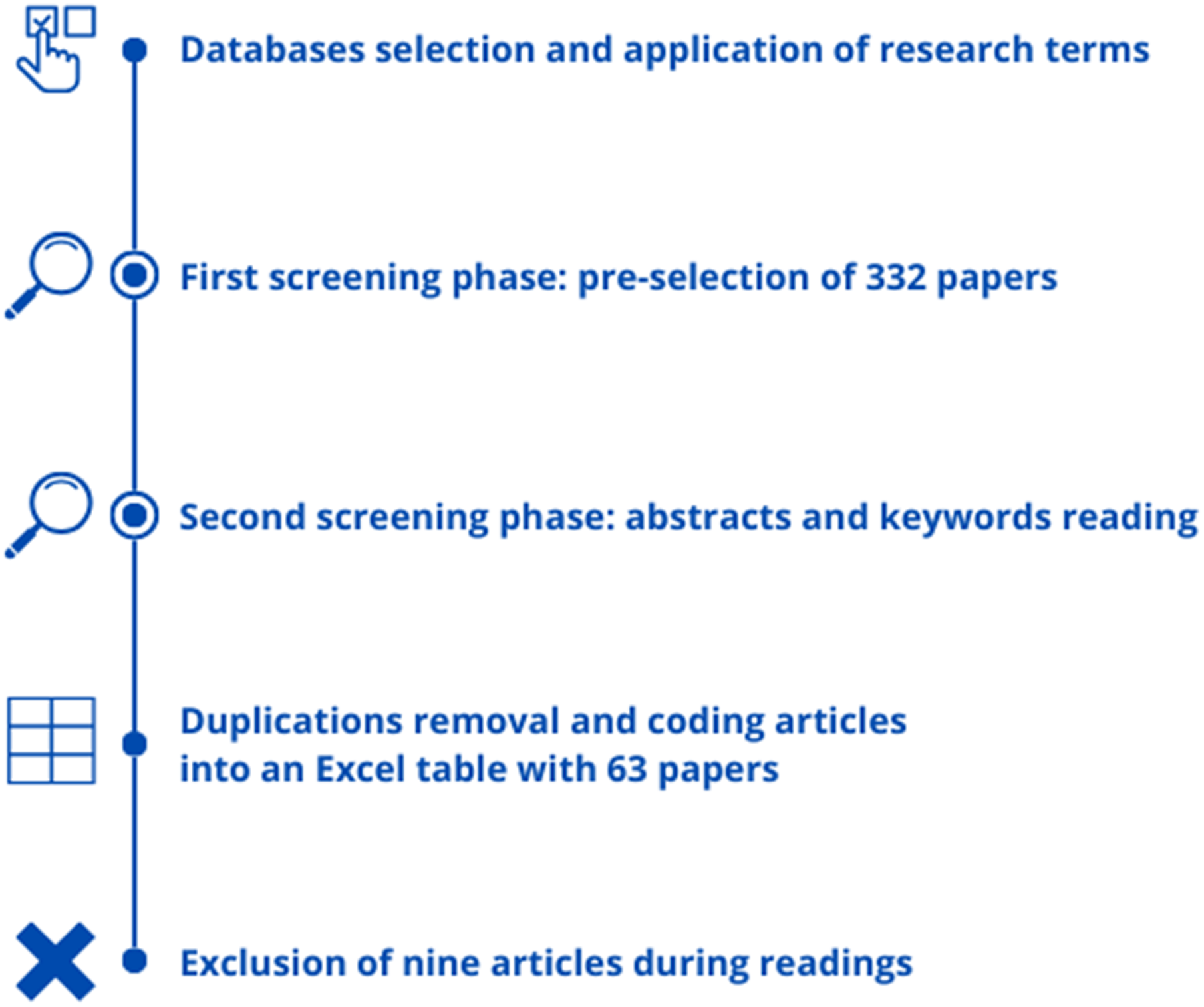
Analytical strategies
The strategies for analysing the research data were conducted in two phases, one of coding and the other of decoding, between July and October 2023.
The author coded all the articles onto an Excel spreadsheet containing columns that referred to the research questions. The columns included year of publication of the articles, focused regions, focused group(s), personal category(ies), positional category(ies), resource(s), type(s) of access, participation outcome(s), level(s) of divide(s), research aim(s), intervention (yes/no), methodology, recommendations (strategy-wise), and recommendations (research-wise). There was also a column to inform the publishing source, which allowed verification of the multidisciplinary research represented, and it showed 45 different journals. All the studies were inspected with a qualitative content analysis that examined content both inductively and deductively – that is, extracting pieces of information or interpreting the texts when no explicit descriptions were found. Cells on the spreadsheet were marked as ‘not given’ when no information was found, given that articles varied in their topics. In parallel to the classifications, the first author also approached the Zettelkasten method (Helbig, 2019: 92-95) for research notes using Obsidian software for each article and a note for general observations. This first analysis phase resulted in 933 cells containing coded data and 55 notes files.
The second part of the analysis focused on decoding and observing the content of the columns and field notes. Each column had its entire content organised into themes to facilitate the extraction of meaning for the analysis, as well as to separate the data related to the last 5 years of research (2019 and 2023). Some columns had predetermined classifications that worked as themes, while others had their themes generated from thematic analysis. At last, quantifications involving articles – for example, number of studies using particular concepts, number of articles within a category, or number of articles during a chosen period – were advanced by counting Excel spreadsheet and counting tagged keywords in the Obsidian’s field notes, which consisted in the bibliometric analysis.
Results
The systematic analysis of the encoded data in the 17 columns has generated information to answer the research questions. The following sessions dissertate the relevant findings without summarising minor parts of the analysis process of each column.
Predominant regions, areas of education, and groups
The analysis of the year of publication, contextualised regions, areas of education, and focused groups allowed one to answer the first research question.
The most recurrent regions represented on the research sample were SA (27, without counting one study that grouped Botswana, Zambia, and SA as a region), Nigeria (8), SSA (5), and Ghana (3) – followed by Uganda (2), Kenya (2), and East Africa (2). Very few articles considered Tanzania (1), Botswana/Namibia/SA (1), and Africa as a whole (1), as Chart 1 shows. Most recurrent regions represented on the research sample.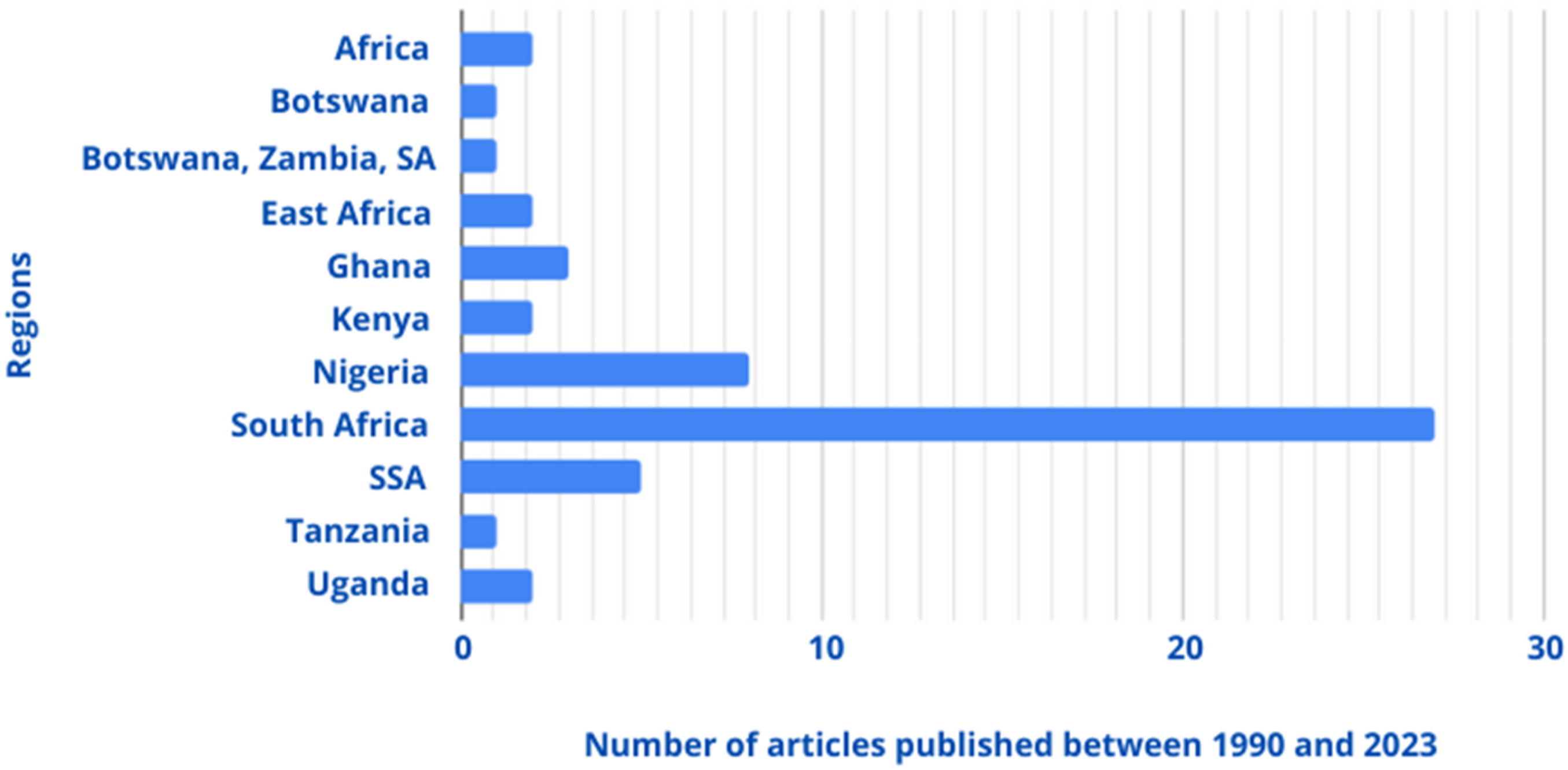
In terms of education, researchers were more interested in Higher Education (HE), Open Education (OE) – that is, free courses, independent educational programmes detached from given specific curricula – and Basic Education (BE) – as Chart 2 depicts. From the total, the majority of 28 articles explored the digital divide phenomena within the universities’ universe – a sum that overcomes the other two themed fields together. There were 12 articles exploring groups in BE and 14 articles exploring people’s experiences within OE. Groups in the HE were also the most studied between 2019 and 2023. Most represented areas of education on the research sample.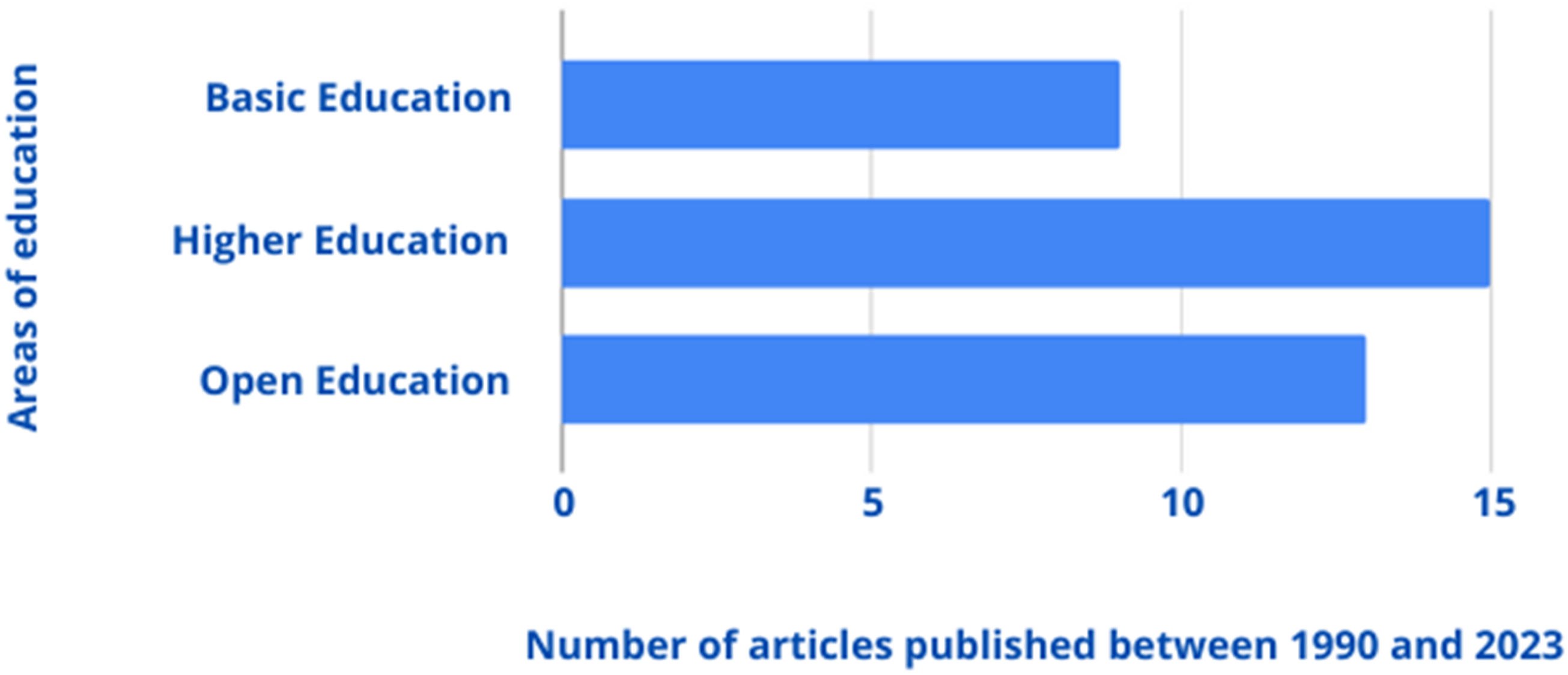
The focused groups emerged from the analysis of areas of education. The HE groups included educators, students, staff, and counsellors. In OE, libraries, adults both in rural communities and urban areas, teenagers (independently from school), and low-income households in urban areas were the groups accompanied. In BE, focused groups were primary school teachers and students, from both private and public schools, however with more recurrence of 12th-grade students and some attention to high school students in rural areas. Presumably, adults (18≤ years old) were the most focused group investigated, given they are the majority of people in the HE and OE of the articles selected.
Elements to influence the digital divides
The data analysis on personal and positional elements, resources, types of access, and participation outcomes allowed one to answer the second research question. The following descriptions enlighten each element.
Personal categories
Age/generation, sex/gender, ethnicity, and language (intelligence) were the personal categories with relevant findings.
Most articles posed generational oppositions as older and younger without being precise about the groups’ actual age, with the old-fashioned stereotypes of ‘digital natives’ and ‘digital immigrants’ punctually appearing in past works (Brown and Czerniewicz, 2010; Mphahlele et al., 2021).
Gaps between males and females were usual, with varied representations of women (young age, pregnant, and mother) among those approaching the female gender. Nigeria was the country with more studies centralising gender.
Ethnicity was investigated mainly in SA, contrasting the black and the white.
Due to the broadness and sensitiveness of its definition (Fletcher and Hattie, 2011: 1-2) and the importance of language to cases described in the studies sampled, this study defined language as an aspect of intelligence to examine. The English language repeatedly appeared as an obstacle to ICT users and an influential element for being on the right side of the divide. Research rarely invested in comparative analysis between literate and illiterate people.
Positional categories
Each positional category examined showed important results.
Labour was approached generally, with comparisons between formal and informal work, employed versus unemployed, and considerations on employment status. Between 2019 and 2023, the most professional occupation was teacher (pre-service, primary school, and university).
The articles inspected education mainly in terms of its levels, establishing comparisons such as high level of education, completed secondary/tertiary, some schooling, and ‘no schooling’.
Studies examined households regarding the number or capacity of computers, access to the Internet, or income.
While general categorisations on networks were common, studies contemplated imminent living standards to edify comparisons, for instance, pointing to one’s reading or sports clubs and private or public universities or schools.
Finally, regarding nation as a positional category, the articles most frequently distinguished the areas as urban, rural, or hinterlands, with nationality as a pertinent element when studies compared global digital divides.
Resources
Three groups of resources emerged from the data analysis: temporal-mental resources, material, and sociocultural.
The human resources and abilities belonging to the subjects that would limit or foster their acquisition of digital skills were grouped as temporal-mental. Previous experience with ICTs, training in these technologies, and availability of specialised human resources to support digital skills development were the three temporal-mental properties that emerged in the articles. Between 2019 and 2023, teachers’ training on digital pedagogies was the most recurrent temporal-mental resource.
In terms of material resources, articles would frequently mention four categories: heavy industry (energy supply, satellites, and maritime cables), sociocultural physical infrastructure (Internet cafés, libraries, and computer labs), electronic infrastructure (such as Internet connection, software, databases, learning management platforms, or LMSs), and devices (smartphones, personal computers, laptops, tablets, feature phones, and keyboards with local characters). Between 2019 and 2023, electricity issues were mentioned several times as a structural factor shaping digital gaps.
Finally, the data collection on social and cultural resources constituted a group of immaterial sociocultural gateways through which the subjects would experience digital education, such as communities’ influential groups peer learning or institutional collaborations between schools, telecentres, and digital libraries.
Type of access
The data collection succeeded in categorising how the studies problematised the types of access described in Dijk’s framework: motivation attitude, physical access, digital skills, and usage.
Elements or indications of reasons for the focused groups to have positive or negative behaviour towards digital media for teaching or learning purposes were classified as motivation attitudes. The most prominent elements or reasons to motivate behaviour among the studies were teachers’ technophobia, financial incentives to staff to develop ICT skills, the direct influence of social networks over one’s adoption of digital technology, the ‘stay-at-home mom culture’ (Kvasny et al., 2008), and other social particularities that reportedly discourage women from seeking access. One article correlated more access to electricity and more tendency to obtain a feature phone or smartphone.
In turn, physical access was reported either as Internet connections (spread, price, and quality) or devices (mobile, PCs, and tablets). From 2019 to 2023, articles would still frequently relate digital inequalities to access to electricity as a starting point for the Internet.
Digital skills were a preponderant matter regarding teachers, given their influence on the outcomes of online education. The most cited digital skills were the capacity to describe components of a computer, information retrieval skills, presentation graphic skills, digital etiquette, programming, and spreadsheet skills. Between 2019 and 2023, teachers’ digital skills for active methodologies topped as the most recurrent digital skill studied by the articles.
Finally, the studies highlighted the usage of file-sharing software, unlicensed items due to costs, MOOCs to learn and access teaching material, online meeting platforms, and the use of interfaces and common data languages.
Participation outcomes
Participation outcomes were found in two forms: participation in digital education, constituted by outcomes that would work as input back to enhance experiences in new forms of education, and participation in society, encompassing outcomes transcending experiences in teaching or learning or providing education – such as employment. The participation outcomes in digital education were about different educational capacities (teaching or learning) and techniques for digital education (flexibility, creativity, teacher’s praxis, integration and cooperation, confidence and preparedness to teach online, administrative workload relief, autonomy to learn, and instant feedback). Participation outcomes leading to more general integration into society appeared as one’s increased chances for employment, networking, and leverage of networked knowledge.
Level of divide
The levels of the digital divide appeared mostly interlaced with at least another level within the articles sampled and analysed, with most of the studies taking a more holistic approach to the digital divide.
Research features of the studies
The data analysis also made it possible to answer the third research question, which involved research aims, methodologies, interventions, and recommendations.
Research aims would mainly investigate known challenges, causes, or consequences of the digital divide, as well as a given hypothesis or a case study. It is important to notice that a minority of articles focused specifically on finding practical and immediate alternatives to overcome the digital divide or opportunities in the face of related constraints in education as their highest venture, whilst a few studies were dedicated to literature review. Between 2019 and 2023, most research aimed at discovering outcomes of the digital divide, with two studies seeking immediate alternatives to overcome them.
The data collection coded methodologies according to the main approaches – quantitative, qualitative, and mixed methods. However, there were no relevant findings.
Three out of fifty-four studies had an interventionist approach, in the sense that they had strived to include people in digital education as their research was taking place.
Regarding recommendations for further research, researchers mostly recommended exploring new contexts, exploring one’s agency, observing outcomes of particular initiatives, or finding new digital inclusion practices for education. A minority of recommendations was addressed to investigate particular initiatives’ outcomes and discover new approaches to digital inclusion. As an intriguing finding, at least five studies recognised local aspects that favour shared practices to optimise resources collectively, spread access, and promote training with less structure and lower costs (Brown and Czerniewicz, 2010; Mokoena and Van Vuuren, 2023; Ojo, 2005: 99; Polikanov and Abramova, 2003: 46; Saleh, 2012). However, these remarkable observations were not their aims or recommendations. Thus, they were not recommending to research constructive approaches.
Finally, the analysis of strategy-wise recommendations suggested that researchers addressed larger and longer-term measures against the digital divide to the concerns of governments and international organisations, such as educational system structure, more focus on training, or more contextualised programmes.
Discussion
The discussion of this literature review’s main findings follows an ascending order of importance – coincidentally, following the same structure as the displayed results.
Imbalance levels of representations in the research
The results on the most recurrent regions, areas of education, and focused groups in the sampled studies suggested imbalanced representations. In fact, different proportions of published research were expected among regions, and they were considered when analysing representation discrepancies. SA, for example, accounted for 28 articles, if considered one study that grouped Botswana, Zambia, and SA. However, the results showed a predominance of areas of education and focused groups were not correlated with SA. If the country was excluded from the literature review, the digital divide in adult education throughout HE and OE would still dominate.
Such a finding matters because the discrepancies of focused groups represented have inflicted disproportions of problematisations and discussions concerning each group along the studies. Using bibliometric analysis, contrasts between two focused groups according to two themes were measured. The theme ‘COVID-19’ was studied in 16 papers, with 14 addressing it to HE and two dealing with BE. As another example, the spread and use of mobiles, discussed in 15 articles, was investigated 12 times in adult education and 3 times in children and youngsters in BE. In addition to the comparisons under these two themes, suspicion about the outcomes of imbalanced representation was amplified due to the lack of other themes convenient for BE. Challenges and opportunities regarding the digital divide in this area were somehow diverse within the articles; however, more popular topics about digital education and inclusion could have appeared. Issues and improvements related to LMS, the impact of instant feedback, and parent and community involvement via digital solutions were crucial matters that should have been investigated.
It is impossible to elaborate on the causation for having more articles about adult education, but the analysis suggested that, in the sample, research within the last three decades of the digital divide in SSA education tended to investigate digital inequalities of certain forms of education when provided to particular groups.
Localisation of elements to influence the digital divide
The conceptualisation of elements achieved through the analysis allowed one to uncover their meanings and, consequently, assess their level of importance for digital education in different parts of SSA and the region. The paramount findings on localisation of elements were related to ethnicity, language, gender, and electricity as a critical element of access.
While research considering other contexts suggests that certain ethnicities may experience the digital divide as minority groups (Dijk, 2012), this study showed that an ethnic majority may be excluded from digital education in SA. Moreover, ethnicity would be blurred between a personal category (black/white/local ethnic group of belonging) and a positional category (rich/poor).
On the localisation of the English language, some of the sampled studies emphasised it as a particularly influential element in an individual’s readiness to use ICT (Gudmundsdottir, 2010a; Gudmundsdottir, 2010b; Gyamfi, 2005: 26-27; Naidoo and Raju, 2012: 34). Two studies, for instance, showed how code-switching from English applications would impair learning processes (Gudmundsdottir, 2010a: 184; Gudmundsdottir, 2010b: 88), with one of them auditing the repercussions of language over digital skills and the consequent participation outcomes (Gudmundsdottir, 2010a: 185). In a similar direction, other research used the concept of ‘epistemological access’ to articulate how English commands allowed one’s academic achievements (Ng’ambi et al., 2016: 6-9), and a last example stressed how the use of the language was essential for mothers to retrieve information and share knowledge for breastfeeding (Idiegbeyan-Ose et al., 2022). Thus, English appeared as a form of intelligence prominently shaping one’s process of digital inclusion in an SSA region, where several educational systems function with foreign languages (Gudmundsdottir, 2010a: 176; Tan et al., 2020: 178).
Regarding gender, studies approached women in their plurality. Different cases of digital divide and inclusion challenges have considered different profiles of women – young age and at university (Eyo, 2014), working life (Kvasny et al., 2008), and during pregnancy and motherhood (Idiegbeyan-Ose et al., 2022; Nsibirano, 2009: 35).
Finally, electricity as part of access as a concept appeared as an element influencing access both in terms of motivation and physical access (Aduwa-Ogiegbaen and Sunday Iyamu, 2005: 109-110; Azubuike et al., 2021: 4-7; Buthelezi et al., 2021: 463; Forenbacher et al., 2019: 2; Gyamfi, 2005: 22-23; Kanyi Wamuyu, 2017: 132; Ojo, 2005: 99). It is important to emphasise that even recent research pointed the lack of electricity as a constant obstacle to digital education through the mobile use – the promise of Africa’s leap forward.
Theory-ladenness and research design
The results generated from the third research question raised concerns regarding potential unnoticed hidden spots and limitations within the studies. It is possible to associate the research aims, research-wise and strategy-wise recommendations, and the low level of interventionism with outcomes of theory-ladenness. Considering the main statement of the digital divide, its theoretical presupposition may have affected the progression of the sampled research in two ways: by leaving in limbo the issues that come along with access and by limiting concrete research impact – with tangible interventions as attainable only by third parties.
Regarding the first potential influence, this systematic literature review over three decades timespan counted one research discussing the disadvantages or complications of being connected. Some studies conjectured on one’s disabilities when connected – such as unawareness of digital footprints, vulnerability to cyberbullying, sexual harassment, and scams – and assimilating fake news as accurate (Laetitia and Nolwandle Nono, 2019: 15). However, most of them have not considered alternatives to escape collaterals of connection, that is, a particular set of digital skills, nor have they clarified digital overuse after adoption. As the analysis showed, the reviewed research mostly aimed at exploring known challenges, causes, or consequences of exclusion instead of aspiring for inclusion. As connections spread worldwide, a growing number of experts on development studies refer to ‘adverse incorporations of digitalisation’ (Oldekop et al., 2020: 3) as critical as digital exclusion (Heponiemi et al., 2023: 2476).
The second point of attention – limited research impact – was based on the analysis of the research aims, recommendations, and level of interventionism. Regarding the aims, a minority of the studies addressed alternatives or opportunities to deal with the digital divide in education. In parallel, research-wise recommendations showed that advice to investigate new practices was among the least delivered, with four cases. Complementarily, as described as ‘an intriguing finding’ in the session ‘Research features of the study’, at least five studies recognised local aspects that would favour shared practices, collective approaches, and optimised solutions without mentioning them as aims or recommendations. Finally, the findings on the studies’ strategy-wise recommendations suggested that they mainly claimed that governments and international organisations should intervene. At the same time, their research designs would not contain engagements with potential small-scale practical solutions.
There is a hypothesis that the presupposition of the digital divide theory would be partially responsible for these two problems, even though the notion of the digital divide has unfolded and expanded to skills and knowledge throughout the strains of personal and positional categories (Heeks, 2022: 689-690), beyond the dichotomy of ‘haves and have-nots’ (Ragnedda and Gladkova, 2020: 69; Vartanova and Gladkova, 2019: 193). Although relativism has been gradually surpassing absolutist views on inequalities, for example, with practitioners and scholars perceiving skill, usage, and outcome divides among those on the right side of the divide, its binary epistemology and linearity seemed fossilised in the sample. As a result, the horizon through which the reviewed papers detected and explained regularities between phenomena would lead to the univocal direction in which one must be connected. Given that the digital divide’s main statement claims that digital inequalities increase existing or create new social inequalities, one’s first step to salvation should be on the right side, connected, and, once there, connect more to learn skills to overcome further thresholds of divides.
The dependence of observation on the theory (Chalmers and Fiker, 1993: 46-55) encourages the association of theory-ladenness with the studies’ research designs. It may be a case in which theory was used to convey meaning to events. Presumably, the digital divide concept fits the research endeavours based on the observable events available in the contexts. It would be unreasonable to expect most reviewed studies to synthesise issues related to connection and usage while electricity and general infrastructure are still significant issues. As perception is influenced by the observer’s experience, expectations, and general inner state (Chalmers and Fiker, 1993: 41-42), the propositions of the studies adhere to the regional status of limitation or prevention of digital access in education. If the most significant issue is material, then it makes sense to approach the problem with an economic dimension of the digital divide (Dijk, 2020: 134-140; Servaes and Oyedemi, 2016: xvi) – which dichotomises ‘haves and have-nots’ – and have issues of digital skills and usage as secondary. According to the studies, however, material access was not the strongest imperative for digital inclusion in education across SSA. The data on levels of the digital divide (material, digital skills, and outcomes) showed that research treated them without prioritising one. Thus, there is a concern that the role of theory-ladenness in the research designs goes beyond the expected dependence of observation on the theory. There is a risk that the theory used to concede meaning to events did not embrace other important aspects.
Would theories with other normativity fix the issues emphasised above? The digital divide theory has a particular referential idea of power underpinning its construct, with its lexicon containing ‘divide’ and ‘exclusion’, often implying the idea of a top-down process imposed by a wealthy and oppressive elite (Helsper, 2021: 8). Such a bipolar view (Warschauer, 2003: 6) may give hints on how this systematic review of 54 articles found a relatively low number of 3 interventionist projects and noticed a majority of studies exploring fewer opportunities to approach issues beyond reporting them to governments and organisations. Constructivist approaches based on perspectives of relative and subjective socio-digital inequalities – instead of absolute and objective digital inequalities – may favour promoting more interventionist and participatory research designs. New forms to close divides and decrease digital inequalities arrive from alternative approaches; given solutions depend on how socio-digital inequalities are framed (Helsper, 2021: 183).
As crucial as structuring scientific claims to be more accurate to reality is to ground them more directly from the problematised environments – that is, to structure Indigenous frameworks. While modification of Dijk’s framework and other existing theories may support endeavours to explore digital divide phenomena within SSA, such as treating language as a resource or paying closer attention to socio-political factors that shape access to digital resources in the regions, for SSA educational contexts, in practical terms, it is preferable to invest in dialogic encounters to design bottom-up grounded theories instead. This is because they would be more capable of detecting tangible particularities and ethical concerns in favour of an adequate research agenda for local educational purposes (Stewart et al., 2017: 55). This research suggests language diversity, unequal structural development, and racial and colonial background as concrete elements for practitioners and researchers to approach when considering new frameworks. As a starting point, the Antipodean style of thinking that emerged in Australia may inspire those engaged in SSA education to interrogate the universality of distant theoretical statements from experiences and epistemologies in lands co-inhabiting both Indigenous and invading peoples (Stewart et al., 2017: 70).
Future research attempting to grasp ‘made in SSA’ frameworks may consider methods capable of bringing incommensurable epistemes together, as the Feyerabendian slogan ‘Anything Goes’ urges (Feyerabend, 1982). An adaptive version of the Critical Pedagogy in the research work, Jesús ‘Pato’ Gómez’s Critical Communicative Methodology is food for thought for those willing to achieve new forms of perceiving social facts (Gómez, 2006) in SSA digital education. In SSA contexts, mixed methods to promote interactions between researcher and subjects while unleashing a ‘fusion of epistemologies’ may successfully develop frameworks for critical theory when founded on elements of ‘Afrocentricity, fantasy, historical fiction, science fiction, speculative fiction, and magic realism with non-Western beliefs’ (Waghid et al., 2022: 2). SSA academia offers multiple environments to use the historically gained competence of accepting contradictions as a living philosophy, where teachers perform a crucial role in creating pedagogical spaces for ‘listening and feeling “with” students’ and researchers to free African knowledge systems from the colonial heritage of subjugation (Arndt et al., 2016; Waghid et al., 2022: 4). Moreover, when conducting research with Indigenous communities, interventionist investigations on the digital divides across SSA education approaching in harmony with local ontologies and epistemologies tend to succeed in their inclusive attempts due to their ethical commitment to avoid the reproduction of potential discrimination, often seen in standardised massive educational projects around the regions (Bertoli et al., 2024: 203). Future research invested in producing Indigenous frameworks on digital inequalities in SSA education may also fill in gaps in socio-political factors shaping access to digital. Helsper’s corresponding field model mentioned in this study’s ‘Introduction’ section may be raw material to support frameworks focused on critically engaging with the broader socio-political landscape, such as policies, economic disparities, and historical inequalities to influence digital inclusion in education.
Finally, the timing is also appropriate for frameworks to explore digital inequalities in SSA education. The moment of ‘re-enchantment of science’ – a post-war paradigm of science inquiry based on extensive datasets and unprecedented means of collaboration friendly to epistemic democracies and holistic philosophies – is favourable to trends and developments of scientific goals in the interest of community values and species awareness. Times often referenced as the ‘Postdigital era’ and ‘New Enlightenment’ come with aspirations to overcome traditional disciplinary divisions while constructing ‘new (collective) subjectivities to which religion, science, and philosophy might contribute’ (Reader et al., 2021: p. 935‐936). Researchers focused on SSA education have an optimal edge to be what Einstein once described as ‘unscrupulous opportunists’ (Schilpp, 1991: 683-684).
Limitations
The limitations of the proposed literature review have four demarcations that are worth emphasising.
First, this review prioritised discovering how researchers investigated the digital divide in education in SSA regions. It excluded studies that detached the digital divide concept from education in SSA regions or considered digital education without the perspective of the divide. Therefore, studies that found interactions or made inferences on the relationship between the digital divide and education were excluded from the methodology if they did not centralise the relationships between the digital divide and education. Likewise, studies on digital education in SSA that did not embed comparative perspectives on inequalities were also left aside.
Another limitation of the proposed study was generated by its chosen theoretical framework. Applying the configuration of elements of Dijk’s framework, educational content was often treated as a personal category, given its approximations to ethnicity, intelligence, and personality. The analysis could have different results if the content was considered a resource, as other views on the digital divide distinguish along with other dimensions such as language and human resources (Bornman, 2016: 11-12; Gudmundsdottir, 2010a: 178).
In addition, it is notable the possibility of nuances in the conceptual elements and descriptions of the analysis, potentially caused either by the study’s methodology or the configuration of the sample. Even though the study’s methodology considered a sided 5-year timespan to give updated status of elements and issues, its formulated concepts and descriptions refer to accumulated meanings, timelessly. Similar nuances may have been caused by the numerical representation of regions, which may have magnified characteristics of elements and descriptions. The forwarded conjectures and refutations considered both issues.
Finally, it is essential to remember that the present research may not have included studies that approached the digital divide without naming it as such and instead treated it as a social inequality.
Conclusion
The present study fills the gap of a literature review dedicated to exploring studies on the digital divide in SSA education. It brings historical aspects of research in terms of represented regions and focused groups, specifications of elements to influence digital divides, and perspectives on research designs.
The findings grounded discussions on the imbalanced levels of representation in the research, alerting to the discrepancy of studies of a given topic, exemplified by ‘COVID-19’ and ‘mobile’ between HE and BE. However, it is unknown if a numerical evenness is necessary to make research topics more plural.
Regarding the elements that influence divides, this study documented when and how personal categories, positional categories, resources, levels of divide, and participation outcomes appeared in research. Such findings allowed one to discuss why certain categories emerged, given that the methodology applied in this study mapped the elements and explored their meanings. The study demonstrated how ethnicity, language, gender, and electricity had particular levels of importance according to their localisation.
The investigation of the aims, methodologies, interventionism, and recommendations resulted in a discussion about general research designs and their relationship with the digital divide’s main statement. There is a hypothetical theory-ladenness that may have contributed to a minority of data on issues that emerged from access and a minority of interventionist research.
Aware of the study’s limitations, the present study reiterates its significance to further research on the theme in SSA contexts. Researchers and practitioners may use its data analysis of concepts and elements of divides to establish comparisons with their respective data on their particular SSA region. In addition, part of the results and discussion of the present study also displayed some less taken roads by research. More research in BE and more varied research in adult education would expand the field of research on the digital divide in SSA education, increasing opportunities to consider media in a broader array of societal domains and parts of everyday life, revealing more effects in terms of type and level of access (Van Dijk, 2017: 9). As importantly, the present study suggests further research to design Indigenous frameworks to comprehend performances of ethnicity/race and language on experiences of digital inclusion or exclusion in education in SSA regions, such as SA, Kenya, and Nigeria, as well as inspiring epistemologies and methodologies emerged in similar contexts.
Footnotes
Declaration of conflicting interests
The author(s) declared no potential conflicts of interest with respect to the research, authorship, and/or publication of this article.
Funding
The author(s) received no financial support for the research, authorship, and/or publication of this article.
Data availability statement
The author encourages using the data collected in this study for further research.