



Abstract
This paper presents the findings from the initial stage of an Economic and Social Research Council (ESRC) funded project which examines the pedagogic practices that embed young children’s participative rights in lower primary classrooms in Wales. An evaluation of relevant legislation and policy in Wales from 2000 to 2022 was undertaken to explicate the positioning of teachers and their responsibilities regarding children’s participative rights. Data analysis detailed here sets out the legislative and statutory context within which teachers work, as well as the curricular and pedagogic framework which steers classroom activity. The Welsh Government has, for two decades, been explicitly sympathetic to embedding children’s rights in policy development, yet there is limited research evidencing the changes in educational curricula and practice. The gap between policy intention and implementation is not unique to Wales and therefore of universal interest. We report that although there is evidence of the increased inclusion of children’s participative rights in more recent legislation and policy, the move to education about, through and for human rights is only significantly pronounced in recent reforms such as the Curriculum and Assessment (Wales) Act 2021. We advocate that the commitment to human rights education made in the Curriculum for Wales is perpetuated and ongoing critical appraisal of legislation and policy is needed, alongside further research to understand how that commitment is being interpreted in Welsh education settings.
Introduction
The research project tackles the ongoing challenge of transitioning policy rhetoric into educational practice. This critical policy analysis forms part of a larger study which aims to establish pedagogic practices that embed young children’s participative rights (often termed ‘participation rights’ and ‘children’s voice and agency’ (Arnott and Wall, 2022; McVeety and Farren, 2020; Sargeant, 2018) in the context of lower primary classrooms in Wales for children aged five to 7 years.
The aim for the initial part of the project was to undertake an in-depth exploration of Welsh Government legislation and policy documents to explicate the positioning of teachers and their responsibilities regarding children’s participative rights within the Welsh education context. Findings will be used to inform subsequent empirical research into the enactment in practice of children’s participative rights, and to contribute to a poorly documented field of knowledge.
The analysis entailed repeated review, examination, and interpretation of this material using Cardno’s (2018) policy analysis framework. Legislation and policy documents included were primarily, but not exclusively, related to young children’s rights, education including curriculum documentation and guidance, and Initial Teacher Education (ITE) provision and/or Continuous Professional Learning and Development (CPLD) provision. The human right to education, and to education aimed at promoting human rights, appears in foundational and specialist human rights treaties. It is fundamental to achieving the goals of the overall human rights project which aims for better protection, promotion and fulfilment of human rights in real lives, places and times. There has been extensive work by the UN within programmes and agencies to develop an understanding of what HRE means in practice. In 1995 the UN declared a decade of HRE and from 2005 proclaimed the World Programme for Human Rights Education, now in its fourth phase and ongoing. Therefore, in addition to Cardno’s (2018) framework, we deployed the three-faceted concept of Human Rights Education (HRE) declared by the United Nations (UN), of education ‘about’, ‘through’ and ‘for human rights. (UN, 2011).
Legislation passed by the UK Parliament in 1998 devolved law-making and executive functions to directly elected governments and legislatures for Wales, Scotland and Northern Ireland. Post-devolution, Wales acquired a reputation for progressive law and policy on children’s rights (Williams, 2013, 2022). According to Murphy and Waters-Davies (2022: 14), legislative innovations such as the Rights of Children and Young Persons (Wales) Measure 2011 ‘reflected the Welsh Government’s commitments to supporting children’s rights through legislation and policy in Wales’. It might therefore be anticipated that examination of law reform and policy on education, a field in which Wales had enjoyed significant separation of governance from England for almost a century before devolution, would reveal a clear and consistent emphasis on children’s rights and their implementation in the classroom.
At the time of writing, the educational policy context in Wales is undergoing significant change with the implementation of the Curriculum for Wales (CfW) (Welsh Government, 2021a) for learners between the ages of three to 16, as well as the introduction of the Additional Learning Needs and Education Tribunal (Wales) Bill (2018) and subsequent ALN Code for Wales Welsh Government, (2017b). A position paper on the new curriculum framework from the Children’s Commissioner for Wales established coherent links with the UNCRC (Convention on the rights of the child, 1989) articles and highlighted the need for education to be provided by a ‘rights-informed, rights-aware and rights-based’ workforce (Children’s Commissioner for Wales, 2018: 9). The detailed analysis undertaken in this project was directed specifically to how education legislation and policy documents position children’s participative rights in lower primary classrooms, rights-based pedagogies and the roles and responsibilities of teachers regarding these rights.
Defining participative rights
In developing our understanding of the ‘participative rights of children’ we recognised the indivisibility, interdependence and interconnectedness of human rights, (UN, 1993: Article 5) and the implication that division of rights by descriptors such as ‘participative’ is artificial. Yet, such categorisation is commonly deployed to explain the UNCRC (Convention on the rights of the child, 1989) and is useful when learning about the background to, and the scope and content of the Convention (Campbell-Barr, 2021). This research is concerned with adults’ positionings including behaviours and attitudes, relative to the child. For that purpose, we resolved upon an understanding of participative rights derived from the text of the UNCRC (Convention on the rights of the child, 1989), including but not limited to the perhaps best-known ‘child right’, that is Article 12.
Our starting point is the recognition of every child as a human being, from birth. This is reflected in Articles 7 and 8 which insist upon recognition through birth registration and respect for the child’s identity signified by name, nationality and family relations. Doek (2007) has referred to this fundamental concept as the Convention’s ‘citizen child’. As such, the child has the civil and political rights set out in Articles 13 to 16 which replicate those already recognised for all people from birth in the foundational Declaration on Human Rights (1948) and later human rights instruments. They are rights to exercise agency, which is inherent in and essential to participation in decision-making. In the UNCRC (Convention on the rights of the child, 1989) they are embellished only to explicitly recognise the rights and duties of parents to provide direction to the child ‘in a manner consistent with the evolving capacities of the child’ in exercise of the right to freedom of thought, conscience and religion (Article 14.2), and to require governments to encourage mass media to enable the child’s access to information and material of benefit to the child’s social, spiritual and moral well-being and physical and mental health (Article 17).
‘Citizen child’ has additional rights in the sphere of education, not only to access education (Article 28) but access to education directed to specified goals reflecting human rights, norms and values (Article 29). Article 42 reinforces this, whereby governments must ensure the ‘principles and provisions’ of the Convention are widely known by adults and children alike. For those ‘citizen children’ facing additional challenges such as disability (Article 23) and refugee status (Article 22), governments must ensure additional support for them to access education. Article 23(1) recognises the need for a disabled child to live in conditions which facilitate the child’s ‘active participation’ in the community, and Article 31 asserts all children’s right to participate ‘freely’ and ‘fully’ in cultural life and the arts.
Within this broader understanding of children’s participative rights, Article 12, too often erroneously referred to as ‘the’ participative right, or the ‘right to participate’, is positioned as an additional requirement of governments to: ‘assure to the child who is capable of forming his or her own views the right to express those views freely in all matters affecting the child, the views of the child being given due weight in accordance with the age and maturity of the child’. (Convention on the rights of the child, 1989: Article 12.1.)
It is essentially a requirement about how decisions should be made. In the drafting stages of the Convention, the requirement was originally enjoined with Article 3, (Cantwell, 2017) which in its final form is also directed at decision-taking by a wide range of bodies: ‘public or private social welfare institutions, courts of law, administrative authorities and or legislative bodies’ and insists that in ‘all actions’ the ‘best interests of the child shall be a primary consideration’. Taken together, these articles require that no factor is to be considered more important than children’s best interests, and that decision-takers must enable (but not compel) children’s involvement in decision-making processes on matters affecting the child, including but not limited to decisions on what is in their ‘best interests’, a principle now absorbed into UK judicial decision-making (e.g. ZH (Tanzania) v Secretary of State for the Home Department, 2011 UKSC 4). What goes on in primary classrooms, with what motivations and for what purposes, are obviously matters affecting the child. However, enabling children to participate in such decisions does not in and of itself fulfil a child’s participative rights in the wider sense we have adopted in this research. In short, it is about Article 12, but not just about Article 12!
Methodology
Ball (2015) depicts policies as ongoing, interactional and unstable processes routed in differing constructions of society’s problems. Policy document analysis can contribute to understandings of educational issues within research and practice through consideration of the forces behind general policy trajectories and the construction of specific policy documents (Cardno, 2018). Thus, interrogating policy history and evaluating policy implementation are essential in informing future iterations of policy (Evans, 2023). This documentary analysis of the Welsh policy context focussed on the position of teachers in relation to young children’s participative rights in primary schools in Wales. The goal was to gain further understandings of the legislative and policy context in Wales, concentrating on the roles and responsibilities of teachers in enacting children’s participative rights in practice in Welsh education.
What was included?
The current analysis used a range of Welsh education and education-related legislative and policy documents and associated reports and evaluations, from 1999 and the devolution of educational policymaking to the Welsh Assembly Government (now Welsh Government), through to the implementation of the CfW (Welsh Government, 2021a).
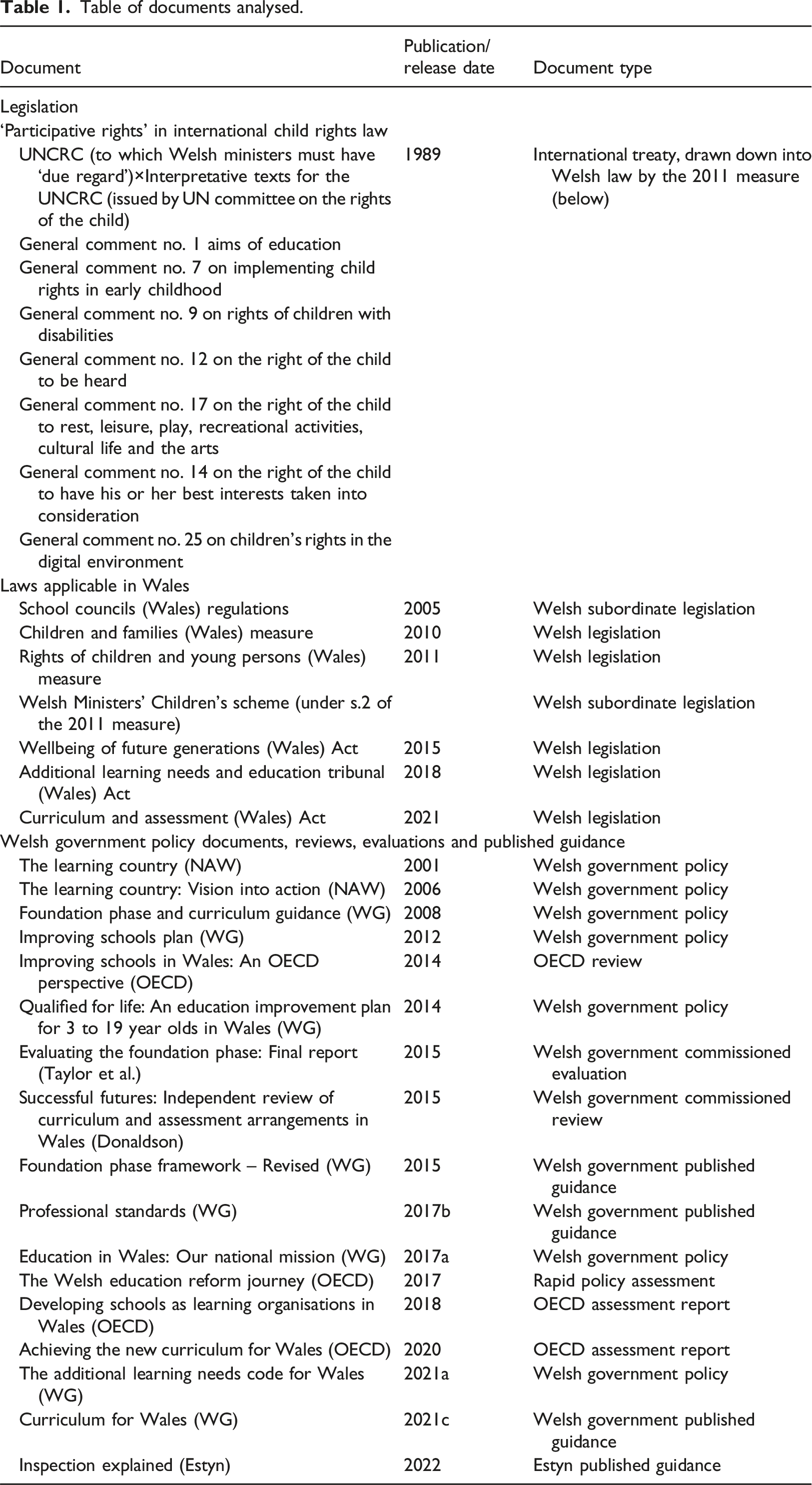
Our starting point was the Learning Country (The National Assembly for Wales, 2001), often considered to be the vision for Welsh education in the first decade of devolution (Murphy and Waters-Davies, 2022). Key legislation pertaining to education and Welsh laws referring to children’s rights such as the Curriculum for Wales Framework: Curriculum and Assessment (Wales) Act 2021 and The Additional Learning Needs and Education Tribunal (Wales) Act 2017 were included. The embodiment of the UNCRC (Convention on the rights of the child, 1989) in Wales through the Rights of Children and Young Persons (Wales) Measure (2011) was central to our analysis. This ‘due regard’ requirement in the Rights of Children and Young Persons (Wales) Measure 2011 incorporates Part 1 of the UNCRC (Convention on the rights of the child, 1989) and Optional Protocols as ratified by the UK Government, into Welsh law. The requirement of due regard to the UNCRC applied from the full commencement of the Measure in 2014 to all Welsh Ministerial functions and including formulating policy, proposing new legislation and exercising executive functions. In line with this we examined the interpretative texts for the UNCRC (Convention on the rights of the child, 1989) of most relevance to our scope of study, issued by UN Committee on the Rights of the Child. These were General Comments 1, 7, 9, 12, 14, 17 and 25, covering the aims of education, child rights in early education, the rights of children with disabilities, the right to be heard, play, best interests and digital environment. For Professional Standards for Teaching and Leadership and for Inspection Guidance the most current versions were used. A Welsh Government commissioned evaluation of the Foundation Phase (Taylor et al., 2015) and a Welsh Government commissioned review of Curriculum and Assessment Arrangements (Donaldson, 2015) were included, as well as key reviews of Welsh Education produced by the Organisation for Economic Co-operation and Development (OECD).
What was not included?
Table of documents analysed.
Frameworks for analysis
Cardno’s (2018) framework also includes an exploration of policy consequences related to the implementation and interpretation of a policy which will be explored in the subsequent project stages including a survey of higher education providers, dialogic workshops with preservice and in service teachers and focus groups with young children. The selected legal and educational documents were reviewed in terms of the policy context which is defined by Cardno (2018: 628) as ‘the forces and values that have driven a policy to come into being’. We therefore considered the author (e.g. is it drafted by WG, passed by National Assembly for Wales?), the audience (the areas of government that the policy was intended for), the purpose (the reason why the policy was created and its main aims) and the policy status/legal basis.
Following the context we examined the document texts, which Cardno (2018) suggests should be the primary focus of the analysis process. The research team identified two key questions to support the examination of the written text: (1) Does the policy specifically refer to participative rights via reference to relevant articles of the UNCRC and/or via references to participation and/or child voice? (2) Is the policy broadly supportive of children’s participative rights?
The documentary analysis identified the presence or absence of references to participative rights as defined in the introduction to this paper. Firstly, where documents were entirely absent of any reference to the UNCRC (Convention on the rights of the child, 1989) children’s participative rights, or child voice, this was included as data. Secondly, explicit references to the UNCRC (Convention on the rights of the child, 1989) but without further detail or explanation of HRE, children’s participative rights or child voice were included as data. Thirdly, data were gathered where explicit references were made to the UNCRC (Convention on the rights of the child, 1989), children’s participative rights, HRE or child voice which were then contextualised or explained in relation to practice in education and what they might mean for children in Wales.
Finally, it was necessary to consider data that reflected differing understandings of participation. For example, participation is commonly used to describe children ‘taking part’ in classroom activities, as opposed to not taking part or not being able to take part. In this sense participation amounts to ‘involvement in life situations’ including educational, social, recreational and physical activities (World Health Organisation, 2007). References to this type of participation were not included as data because they do not reflect participative rights as described in this paper. As discussed, participative rights sit within the broader context of children’s human rights, which include the right to education (Convention on the rights of the child, 1989: Article 28) which is necessarily referred to in education legislation and policy. However, the right to receive an education is distinct from HRE and therefore was not included as data. References reflecting a notion of ‘future participation in society’ were treated with caution. Alderson (2000) shows that children can be positioned as ‘becoming’ citizens who will be able to enact their human rights in their adult futures. ‘Participation in society’ can also be more aligned with being engaged in employment or further education as opposed to individuals’ enactment of their participative rights (Lemke and Zhu, 2018). These kinds of data were included as representative of differing understandings of participation that were not fully aligned with children’s participative rights as defined above. Alongside participation, the ‘voice of the child’ is commonly used to reflect how children’s wishes and feelings might be expressed and how those views can be heard by adults and accounted for in decision-making (Lundy and Cook-Sather, 2015). Therefore, references to the voice of the child were included in the data gathered.
Following the application of Cardno’s (2018) policy analysis framework to the selected documents, the data were considered through the lens of the UN framework for HRE (UN General Assembly, 2011) to assess the extent to which each policy document reflected education about, through and for human rights. Education ‘about’ human rights is explained as providing knowledge and understanding of human rights norms and principles, the values that underpin them and the mechanisms for their protection. Education ‘through’ human rights includes learning and teaching in a way that respects the rights of both educators and learners, and education ‘for’ human rights includes empowering persons to enjoy and exercise their rights and to respect and uphold the rights of others (UN General Assembly, 2011).
Academic models broadly complement this approach, for example, Tibbitts’ (2017) values and awareness, accountability and transformational model, and Becker et al.’s (2023) three components of understanding, embracing and taking action. Bajaj (2011) identifies three different aims of human rights education, each consistent with the overall human rights project, which may be determinative of the content and methods of HRE in different times and places: HRE for global citizenship, HRE for co-existence and HRE for transformative action. The need to take a contextualised approach is emphasised by UN documentation on HRE which repeatedly stresses the need to enable learners to relate human rights to their own real-life experiences and cultural context. (e.g. UN, 2012: 2)
Cumulatively, these discourses suggest that HRE requires not only substantive knowledge of human rights as understood globally and as integrated in national and local laws and policies, but also the adoption of human rights compliant behaviours, systems and practices within educational institutions and in learner/teacher relationships, and practical experience of ‘doing’ human rights in places and communities. In such an environment, it seems reasonable to hypothesise that greater respect for, promotion and protection of children’s participative rights will be achieved.
This framework was deployed in our analysis to help visualise the effects of the legislative and policy documents and their face-value contribution to the implementation in practice of children’s participative rights in education. The ‘about, through and for’ concept is used here as a scale progressing from mere imparting of knowledge, through specific attitudinal and behavioural positions taken by educators, to active support for human rights projects. Our assumption is that enactment in practice of children’s rights is optimised when all three elements are present, based on the following analysis of UN and academic sources.
Findings - legislative analysis
The earliest legislation of relevance to children’s participative rights in the post-devolution educational context in Wales was the School Council (Wales) Regulations 2005 (S.I. 2005/3200 (W.236). Made by Welsh Ministers using powers under the Education Act 2002, these Regulations require maintained schools in Wales to establish and support a school council ‘to enable pupils to discuss matters relating to their school, their education and any other matters of concern or interest’ and ‘to make representations on these to the school’s governing body or head teacher’. (Reg 3(1)) The Regulations do not explicitly refer to children’s rights or the UNCRC (Convention on the rights of the child, 1989), but the central objective is supportive of children’s exercise of their participative rights in schools. School councils are part of a wider policy agenda on ‘pupil voice’ which is, according to Croke et al. (2023) clearly associated with the consistent post-devolution policy theme on children’s rights in Wales.
The School Council (Wales) Regulations (2005) imposes a duty on head teachers and governing bodies of maintained schools to establish a school council with a representative from Year three or above. Interestingly for this study representation from younger year groups is not mandatory, though also not prohibited. Maintained schools operate in a governance context whereby local education authorities exercise significant controls and offer support and guidance. It is therefore noteworthy that legislation enacted in 2010 by the Welsh Assembly imposed on local authorities an obligation to promote and facilitate children’s participation in decisions of the authority which might affect them (Children and Families (Wales) Measure 2010, section 12). The same legislation also introduced a ‘play sufficiency’ duty (section 11 of the 2010 Measure) which did not explicitly refer to the UNCRC (Convention on the rights of the child, 1989) or children’s rights, but the intended effects are wholly supportive of children’s participative rights.
Both the 2005 Regulations and the 2010 Measure were unexceptional in terms of legislative drafting traditions in Wales and England, in that they impose duties rather than declare rights, and their positive intentions in terms of children’s participative rights are left to the reader to discern. A partial break with this tradition can be seen in the Rights of Children and Young Persons (Wales) Measure 2011 which took the bold step of incorporating in Welsh law the substantive requirements imposed by the Convention on member States under the UNCRC (Convention on the rights of the child, 1989). The operative mechanism remains, however, the traditional one of imposing a duty, here placed on Welsh Ministers, in the exercise of their functions. The duty is to pay ‘due regard’ to the requirements of the UNCRC (Convention on the rights of the child, 1989), which are then set out in the Schedule to the Measure.
The dominant message of this Measure is that children’s rights are to be mainstreamed by Welsh Government in the exercise of all its powers and duties, including but not limited to the field of education. Any exercise of functions by Welsh Ministers was thenceforth to be done with ‘due regard’ to the requirements of the UNCRC (Convention on the rights of the child, 1989) meaning in accurate appreciation of those requirements, with ‘rigour and an open mind’ and preferably in a way that makes explicit and adequately records what consideration has been given to those requirements (R (Brown) v Secretary of State for Work and Pensions [2008] EWHC 3158).
To support and demonstrate compliance with the due regard duty, Welsh Ministers are required by the 2011 Measure to prepare, publish and lay before the Senedd a children’s scheme. The current Children’s Rights Scheme (Welsh Government, 2021c) sets out a process for child rights impact assessment to be deployed by Welsh Ministers, in practice acting on advice from departmental officials. It explains that a Children’s Branch within Welsh Government has a key leadership role in, among other things, helping officials to understand the requirements of the UNCRC (Convention on the rights of the child, 1989) and how to ensure the due regard duty is met. The Scheme states that Welsh Government recognises the importance of participation, referring to Article 12 and describes an ‘Engagement model’ where each Welsh Minister to hold annual discussions with children and young people facilitating their engagement with Welsh Government. It adds that Welsh Government must promote the Children and Young People’s National Participation Standards (WG, 2018).
Absent from the Children’s Scheme is a more nuanced appreciation of both children’s participative rights and the full range of UNCRC (Convention on the rights of the child, 1989) requirements. This is left to interpretation, with the assistance of the Children’s Branch and others including a Children’s Rights Advisory Group, which the Scheme explains is a mechanism enabling Welsh Government officials to access external expert advice. The Scheme refers also to a Manual (Welsh Government, N.D.) with a simplified summary of the articles of the UNCRC to support Welsh Ministers to comply with the due regard duty.
The Measure itself sets out what Welsh Ministers must direct their minds to when preparing, remaking or revising the Children’s Scheme. (Section 3 of the Measure) This includes the extensive reports, recommendations and other documents issued by the Committee on the Rights of the Child to help States Parties implement their obligations. Our legislative analysis included the outputs of the Committee of most obvious relevance to participative rights in education. While it is not a legal requirement for the Children’s Scheme to incorporate this extensive and ever-developing body of literature, the legal requirements established by the Measure create a logic pathway for decision-making which necessarily includes ‘accurate appreciation’ of what the Committee regards as effective implementation. It might therefore be expected that the Children’s Scheme would at least acknowledge the existence of this body of knowledge and its relevance for the purpose of ensuring compliance with the due regard duty, but neither the Scheme nor the Manual does so. The cumulative effect of these laws, impacting on governance at school, local authority and Welsh Government levels, is the integration of children’s participative rights (among other rights) in the legal framework for education in Wales.
The ‘due regard’ requirement was deployed again in legislation on social services and well-being (section 7 of the Social Services and Well-being (Wales) Act 2014) and, of more direct relevance to this study, on additional learning needs. The Additional Learning Needs and Education Tribunal (Wales) Act 2017 imposes on decision-makers at all three levels (school, local authority and Welsh Government) a duty of due regard to both the UNCRC (Convention on the rights of the child, 1989) and the UN Convention on the Rights of Persons with Disabilities (UNCRPD) (2006), as well as making specific direct requirements about involvement of children, parents and young people when functions are exercised.
At the same time, the Well-being of Future Generations (Wales) Act 2015, established a major, values-based legislative framework under which most public bodies in Wales must operate, makes no explicit reference to children’s participative rights, or indeed any rights. As is well-rehearsed elsewhere (Croke et al., 2021; Davidson, 2020) this flagship legislation seeks to embed the sustainable development principle via seven goals and four ways of working in all service planning, commissioning and delivery. The Act is not about education as such and not about rights, but by implication cannot be successfully implemented without the education that embraces the underlying principles of children’s rights and enables participation by children as well as adults. As noted by Croke et al. (2021), joint working between the Children’s and Future Generations Commissioners has articulated the symbiosis between children’s rights and sustainable development. The two Commissioners produced detailed guidance and case studies for public bodies on how in practice to progress both agendas, through child rights approaches and integrated child rights impact assessment within decision-making by the public services boards established under the 2015 Act (Children’s Commissioner for Wales and Future Generations Commissioner, 2017).
Returning to the field of education, the purpose of the Curriculum and Assessment (Wales) Act 2021 was to establish a new framework of curriculum and assessment in maintained educational settings in Wales. It enables significant local discretion in curriculum building and explicitly requires educators to have increased knowledge of the UNCRC (Convention on the rights of the child, 1989) and UNCRPD (UN Convention on the Rights of Persons with Disabilities, 2006). Despite the move toward a more local and autonomous approach, Lemke (2018) argues persuasively that this Act could have done far more to advance legislative support for children’s rights. However, the framework established by the Act is one which opens opportunities for schools to enact children’s participative rights in practice. Official documents produced to support the CfW (Welsh Government, 2021a), discussed in the next section, suggest this opportunity being taken seriously in the early phases of implementation.
Findings - policy document analysis
Despite the UK Government ratifying the UNCRC (Convention on the rights of the child, 1989) in 1991, it is significant to note there is scant foregrounding of children’s participative rights in education within The Learning Country (The National Assembly for Wales, 2001) which set out the Welsh Government’s vision for a devolved education system in Wales. Rather the dominant theme is improving standards and whilst there is a clear focus on meeting the needs of individual learners, children’s participative rights are not addressed. It is a further 5 years later in The Learning Country: Vision into Action (Wales Department for Education, Lifelong Learning and Skills, 2006) that children’s participative rights in education are firmly introduced in several ways. The Welsh Government commitment to the UNCRC (Convention on the rights of the child, 1989) is explicitly referenced. Democracy, citizenship, rights and responsibilities are covered within Personal and Social Education, and a commitment is given to providing guidance to governing bodies and Local Authorities on promoting ‘genuine participation’ and developing ‘schools which are truly participative’ (Wales Department for Education, Lifelong Learning and Skills, 2006: 16).
Analysis of the subsequent Foundation Phase Framework (WG, 2008) and the accompanying Curriculum Guidance (WG, 2008) makes visible congruence with UNCRC principles through the introduction of notions of children being creatively involved in their own learning through child-initiated activities and the theme of active citizenship is explored in detail. However, children’s participative rights are not referenced under Learning and Teaching Pedagogy meaning guidance is lacking on how participative rights can be taught and enacted in classrooms.
In 2009, Wales’ notably poor performance in the Programme for International Student Assessment (PISA) was widely acknowledged as contributing to a shift in Welsh educational policy focus back to standards and accountability (Evans, 2022). Documents included in the current analysis that were published between 2012 and 2020 revealed dominant themes of improving literacy, numeracy and science outcomes, the acquisition of skills required for success in employment in adult life and reducing the impact of disadvantage on educational outcomes. Within the Welsh Government Improving Schools Plan (WG, 2012) and Qualified for Life (WG, 2014) there are no references to the UNCRC (Convention on the rights of the child, 1989) to participative rights, or to human rights education.
Despite this noticeable shift towards outcomes and skills acquisition in Welsh educational policy, analysis of the updated Foundation Phase Framework and ongoing Curriculum Guidance (WG, 2015) revealed explicit commitment to education about and through human rights (UN, General Assembly, 2011). Taylor et al.’s (2015) evaluation of the Foundation Phase showed evidence of children initiating and directing their own learning and being involved in the day-to-day running of the Foundation Phase. Child voice was found to vary between classes and schools but was also found to be associated with higher involvement and better well-being (Taylor et al., 2015). Child choice as a pedagogical approach was evidenced, albeit the least observed of 12 pedagogical approaches (Taylor et al., 2015). Seemingly then, whilst the UNCRC (Convention on the rights of the child, 1989), children’s participative rights and child voice, are not prominent in policy documents at this time they are included in the concurrent Welsh Government guidance made available to education professionals in Wales.
The Welsh Government called for a major review of curriculum and assessment arrangements in schools in Wales in 2014. The resulting Successful Futures review (Donaldson, 2015) cited the Welsh Government’s commitment to the UNCRC (Convention on the rights of the child, 1989) through the Rights of Children and Young Persons (Wales) Measure (2011) as a primary positive aspect of Welsh education. In addition, one of the report’s proposed ‘four purposes’ of education is that Wales’ children and young people will be ethical, informed citizens, who can understand and exercise their human and democratic responsibilities and rights (Donaldson, 2015: 30). Despite this, in the review’s 68 recommendations, there are no references to the UNCRC (Convention on the rights of the child, 1989), to participative rights, or to human rights education. Successful Futures (2015) is strongly performance and outcomes oriented, with additional focus on the acquisition of skills needed for future economic participation. There is an absence of inclusion of the UNCRC (Convention on the rights of the child, 1989) and children’s participative rights in the limited explanation of what constitutes an ethical and informed citizen, and no explicit references to human rights education. Our current policy analysis suggests that in Successful Futures (Donaldson, 2015) neither education about, through or for human rights (UN General Assembly, 2011) are afforded any policy rhetoric or practical guidance.
Within the 16 key actions cited in Education in Wales (WG, 2017a) again there are no references to the UNCRC (Convention on the rights of the child, 1989), to participative rights, or to human rights education. The Education in Wales (WG, 2020) update states that ‘universal access to the curriculum … will help ensure that they [children] are supported to discuss and understand their rights and the rights of others’ (WG, 2020: 11) seemingly suggesting that a right to education will result in some form of human rights education.
However, in the CfW (Welsh Government, 2021a), the positioning of children shifts away from the conceptualisations of children as future citizens evident in Successful Futures (Donaldson, 2015), to children as agentic individuals on a learning pathway. The purpose of educators, and therefore education, is framed around working holistically with children to facilitate and support their progress along their individual pathway. This pathway model arguably places equal value on the child in the here and now, wherever they may be on their individual learning pathway, as well as the value placed on progress and potential outcomes. In addition to changed notions of children, educators and education, the CfW (Welsh Government, 2021) is underpinned by five cross-cutting elements, one of which is Human Rights. This demonstrates a new commitment to education not only about and through human rights as we have seen in previous guidance, but for the first time we see explicit commitments to education for human rights (UN General Assembly, 2011). The introduction to the CfW (Welsh Government, 2021) online guidance states that ‘Nothing is so essential as universal access to and acquisition of the experiences, knowledge and skills that our young people need for employment, lifelong learning and active citizenship’ and that the new curriculum enables us to ‘encourage critical and civic engagement’ (Welsh Government, 2021, no page). Active citizenship and encouraging critical and civic engagement sit quite clearly within education for human rights (UN General Assembly, 2011). The ‘ethical and informed citizens’ that were introduced in Successful Futures (Donaldson, 2015) are now explicitly depicted as able to both understand and exercise their human and democratic rights and responsibilities through ‘the motivation of social action and empowerment of active citizenship to advance respect for the rights of all’ (Welsh Government, 2021, no page). Children’s participative rights are expected to underpin curriculum visions that draw on learners’ needs, experiences and input and are extended even to assessment processes where learners are framed as active participants at the heart of how educators assess progression along individualised pathways.
Evans (2022) reflects on three phases of education policy in Wales which are devolution and innovation from 1999 to 2010, accountability for poor PISA performance from 2010 to 2015, and the collaborative approach to the new CfW (Welsh Government, 2021) from 2015 to 2022. Whilst the current analysis was conducted chronologically, using the work of Cardno (2018) initially and then the UN framework for HRE (UN General Assembly, 2011) the policy documents were found to be firstly, almost entirely absent of reference to HRE, secondly containing evidence of focus on education about and through human rights, and thirdly being fully underpinned by education about, through and for human rights (UN General Assembly, 2011). Figure 1 shows the Welsh Government and associated education policy documents analysed for the current study, and the level of inclusion of the UNCRC (Convention on the rights of the child, 1989) and children’s participative rights based on the UN framework (UN General Assembly, 2011). Welsh Education Policy documents’ reflection of the United Nations Framework of Human Rights Education (2011).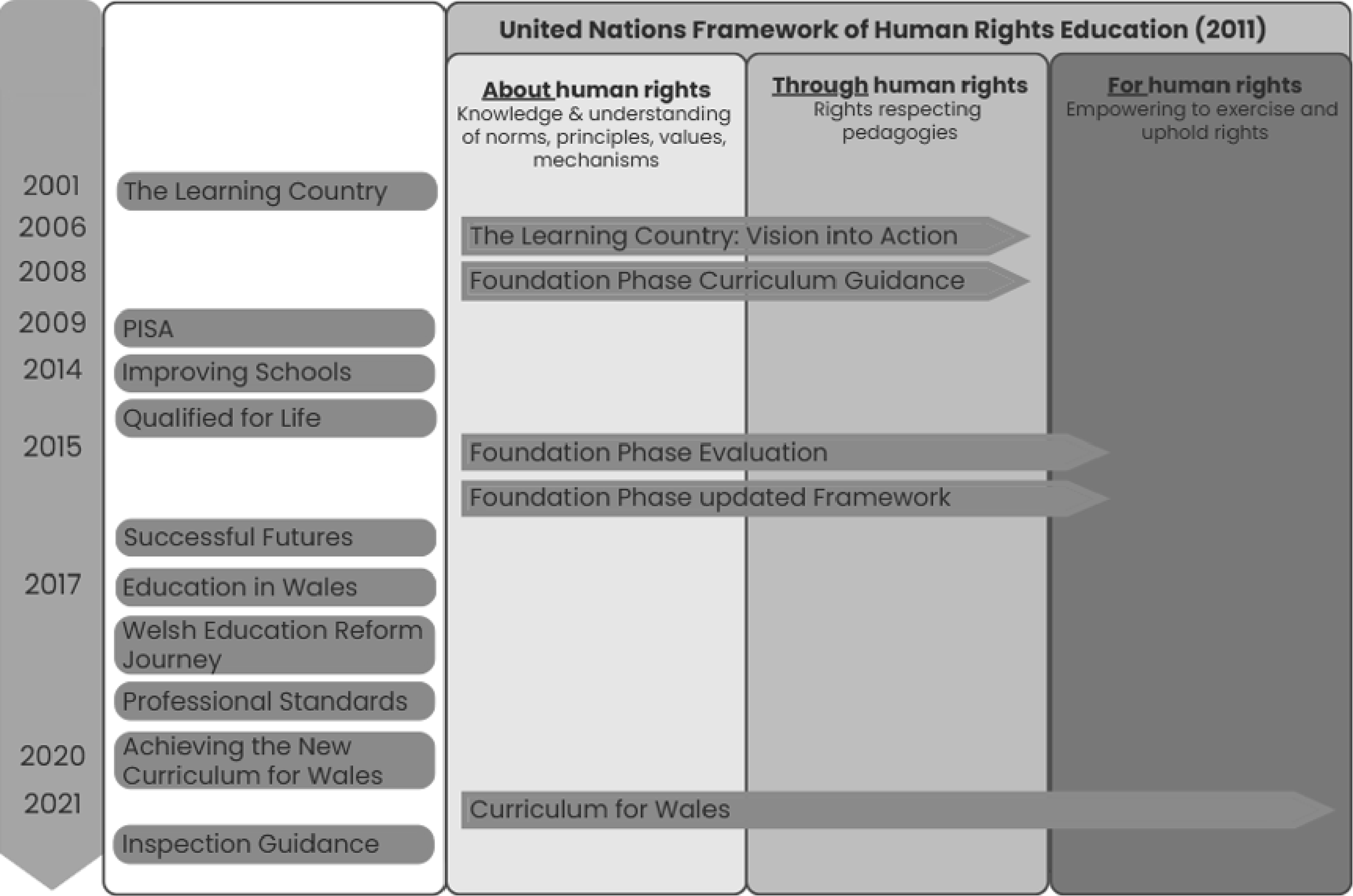
Many documents from the Learning Country (National Assembly for Wales, 2001) through to the OECD update Achieving the New Curriculum in Wales (OECD, 2020) were almost entirely absent of reference to the UNCRC (Convention on the rights of the child, 1989) and children’s participative rights in education. However, alongside these documents, from 2006 to 2015 the Learning Country: Vision into Action (Wales Department for Education, Lifelong Learning and Skills, 2006), and the Foundation Phase Framework and Curriculum Guidance (WG, 2015) all make reference to the UNCRC (Convention on the rights of the child, 1989), reflecting education about and education through human rights (UN General Assembly, 2011). Finally, the new CfW (Welsh Government, 2021) explicitly incorporates education about, through and for human rights (UN General Assembly, 2011).
Discussion
There are some ambiguities in the Welsh legislation and policy documents analysed for this study in relation to participative rights and human rights education. As early as 2005, in The Learning Country: Vision into Action (Wales Department for Education, Lifelong Learning and Skills, 2006: 16) the Welsh Government references ‘genuine’ participation and ‘truly’ participative schools. This reveals an awareness that participation can be complex, may not always be ‘genuine’ or ‘true’, and therefore can sometimes reflect manipulation, decoration or tokenism (Hart, 1992). However, references to participation that are reflective of participative rights as defined here are rarely present in subsequent documents prior to the new CfW (Welsh Government, 2021).
On the face of it, the Rights Measure 2011 should have brought about earlier and more comprehensive change in this regard, because Welsh Ministers, sitting at the top of the supply chain for education policy in Wales, must, since 2012, have ‘due regard’ to the requirements of the UNCRC (Convention on the rights of the child, 1989). As noted above, ‘due regard’, according to judicial interpretation, requires ‘accurate appreciation’ of the matters to which due regard must be had. The absence from the Children’s Scheme of information about the interpretative sources for the UNCRC (Convention on the rights of the child, 1989), and specifically the outputs of the Committee on the Rights of the Child, is a missed opportunity to enable Welsh Governmental decision-makers to acquire an accurate appreciation of what implementation of participative rights entails in terms of policy change.
The notable absence of important descriptions and explanations around participative rights and the commitment to the UNCRC (Convention on the rights of the child, 1989) in some Welsh education policy documents is therefore unsurprising. Whilst the Welsh Government’s commitment to the UNCRC (Convention on the rights of the child, 1989) is often evident in policy texts, the consideration of the impact of that commitment on the development of an education system, or on the positioning of children and teachers in relation to teaching, learning and educational outcomes is not documented. Furthermore, how this commitment can be and should be enacted in classrooms is often not afforded any explanation. This questions the Welsh Government’s commitment to the UNCRC (Convention on the rights of the child, 1989) in that the absence of this guidance impacts on the translation from a legislative act through educational policy and subsequent implementation in classrooms.
Similarly, it is equally unsurprising that the dominant themes of some policy documents provoke tensions with participative rights approaches and human rights education. In Successful Futures (Donaldson, 2015) there is a very strong focus on improving standards and skill acquisition for future employment. This reflects a positioning of children as ‘becoming’, of education as an enabler in an individual’s future participation in the economic activity of their society, and a positioning of the role of teachers to deliver knowledge and develop skill acquisition through primarily didactic pedagogies. Successful Futures (Donaldson, 2015) suggests a curriculum where children will be ethical and informed citizens, and the Welsh Government guidance on Successful Futures (Donaldson, 2015: p.30) states that the curriculum supports learners to become ethical and informed citizens (WG, 2022). Neither state clearly that children are citizens and can be ethically informed in their here and now. Thus, the content of Successful Futures (Donaldson, 2015) does little to reflect notions of children as agentic beings, of an education system where children can actively and genuinely enact their participative rights, or of teachers as facilitators of education about, through and for children’s rights (UN General Assembly, 2011).
The omission of detail combined with broader themes that are dissonant with children’s participative rights is summarised by Lemke and Zhu (2018) who highlight the lack of a thorough and integrated discussion on the child-centred ethos of the UNCRC (Convention on the rights of the child, 1989), a limited focus on respect for and enabling of children’s rights, and the presence of performance-oriented language throughout. Lemke and Zhu (2018) argue that Successful Futures (Donaldson, 2015) therefore fails to touch upon the fundamental reworkings of both curricula and pedagogy that would be required to enact transformational change and as such the positioning of children, teachers and education in Successful Futures (Donaldson, 2015) does not engender child rights consonant with the spirit of the UNCRC (Convention on the rights of the child, 1989).
Ambiguities around children’s participative rights are still evident even as the CfW (Welsh Government, 2021) guidance was developed. In 2020 the Welsh Government released the Education in Wales (WG, 2020) update in which they refer to universal access to the curriculum as, amongst other outcomes, helping to ensure that children are supported to discuss and understand human rights. However, suggesting meaningful HRE will be achieved simply through universal access could be seen as a tokenistic reference to HREin this policy update.
It is the CfW (Welsh Government, 2021) guidance that marks a clear shift towards education about, through and for human rights (UN General Assembly, 2011) in Wales. Indeed, this is the first time in Welsh education policy that education for human rights has been included. Furthermore, there are detailed explanations of what is meant by education about, through and for human rights (UN General Assembly, 2011). It is no small step to have included not just civic engagement but active citizenship, learners’ voice in the design of curricula, and student input in to how their learning is assessed. In this way the CfW (Welsh Government, 2021) addresses what Lemke and Zhu (2018) highlight as a previous failure to consider that ‘children should learn by doing children’s rights and focussing on their own communities to embed through practice the values of tolerance and non-discrimination’ (UN, 2006, cited in Lemke and Zhu, 2018: 264). Thus, an education system and curricula underpinned by human rights education, and where education about, through and for human rights is enacted in practice, and can also be aligned with Biesta’s et al. (2021) call for education that is democratically accountable to the public.
In tandem with the discussion above, the policy analysis also evidences a focus on ‘what’ is taught rather than ‘how’ human rights can be embedded in classrooms. The Foundation Phase Framework and Curriculum Guidance (WG, 2015) adopt a broad child-centred and holistic ethos and in addition detail what should be taught about active citizenship. However, details of how active citizenship can be both taught and enabled in the classroom are arguably lacking. Teachers and children can be seen as social actors in educational settings where systemic and structural power imbalances exist that can prohibit the enactment of children’s participative rights (Foucault, 1988). Positioning school settings as sites where children’s participative rights can be enacted, and positioning teachers as enablers of children’s learning not only about but also through and for their human rights (UN General Assembly, 2011), require a commitment to participative pedagogies that disrupt the deeply entrenched adult-child and teacher-pupil power imbalances (Lundy Cook-Sather, 2015). Even in the CfW (Welsh Government, 2021) with the level of detail included about what constitutes education about, through and for human rights (UN General Assembly, 2011), participative pedagogies are not fully explored. Only two of 12 pedagogies covered; ‘to encourage learners to take responsibility for their own learning’ and ‘to encourage collaboration’, begin to align with participative rights.
The absence of ‘how’ guidance at the Welsh national level does not of course preclude changes in practice to better implement children’s participative rights. But it mitigates against consistency in such practices across the country and leaves educators exposed to criticism where inconsistencies, or instances of non-observance, occur. The extension downwards from Welsh Government to school level of the legal ‘due regard’ duty, at least in respect of children with additional learning needs, brings the duty if not strictly into the classroom, at least into school governors’ decision-making about provision for individual children, with implications for educators whose advice feeds into those decisions.
As well as leading to inconsistency, lack of guidance around the ‘how’ can also lead to differing interpretations of implementation. Although how policies are interpreted by various social actors and how they are implemented in practice can often be hard to establish. As discussed, much Welsh educational policy between 2000 and 2020 lacks detail around participative rights and human rights education, raising questions about how the Welsh Government envisage the commitment to the UNCRC (Convention on the Rights of the Child, 1989) should be enacted in practice. However, despite dominant themes of accountability, performance, and equality of outcomes in some Welsh educational policy from 2009 to 2020, the Welsh Government’s commitment to the UNCRC (Convention on the Rights of the Child, 1989) and children’s participative rights in education remain explicit in the Foundation Phase Framework and ongoing curriculum guidance. It is in practical guidance then, rather than policy rhetoric, that we can see the sound foundations for a more progressive approach to education about, through and for human rights (UN General Assembly, 2011) in the new CfW (Welsh Government, 2021).
The legislative framework for a rights approach is there and presents a certain logic pathway for decision-making. But it is not mapped out clearly in the highest-level rights documents (e.g. the Children’s Scheme) nor in the bulk of high-level education policy documents – until, for whatever reason, the Curriculum Guidance 2021 that has been discussed here. [Even at that high point, there is inadequate connection being made between the rights law and policy and the curriculum and practices in schools].
Conclusion
Wales has been hailed as progressive regarding children’s rights within the UK with the prioritisation children’s rights since devolution with a ‘children first’ approach. Wales was the first nation in the UK to establish a Children’s Commissioner, followed by the ground-breaking Rights of Children and Young Persons (Wales) Measure (2011) (Murphy and Waters 2022). However, although the legislation and policy analysis documented above traces an upward trajectory in terms of the inclusion of children’s participative rights in legislation and policy, the move to education about, through and for human rights (UN General Assembly, 2011) is only evident in recent reforms. Both the Curriculum and Assessment Act and the subsequent CfW (Welsh Government, 2021) include significant emphasis on education for human rights but do not actively discuss how this would be embedded in classroom practices. We argue that there is a further requirement to support teachers to develop participatory pedagogies that scaffold children’s participation rights and agency, and enable children to ‘express and enact their own ideas, perspectives and knowledge’, (Mascadri et al., 2021, 2; Carey-Jenkins, 2018). This support would be articulated through both initial teacher education and through continuing professional development for the existing educational workforce, and contribute to an education system that has human rights as a central tenet
As stated above, central to the development of such pedagogies is teacher education. Although we haven’t fully explored documentation focussed on initial teacher education (ITE) and continuing professional development (CPD), a ‘one level up’ approach (Biesta et al., 2022) could be considered to improve capacity and quality of teaching. This is cited as necessary to raise standards and improve outcomes (Biesta et al., 2022) or in this case as vital to embedding HRE and participatory pedagogies in practice. The next phase of this project aims to establish whether ITE and CPD support the WG vision for pedagogic practice that embeds young children’s participative rights and therefore will develop greater insights into how best to support teachers, teacher educators and teacher education students to do this.
A dominant theme in Welsh educational policy is reducing the impact of disadvantage on education outcomes. Since the PISA results in 2009, there has been a shift in Welsh educational policy focus back to accountability (Evans, 2022) emphasising raising achievement in literacy, numeracy and science. The improvement of standards should work in tandem with a more holistic approach, inclusive of participative rights, rather than being deemed as incompatible. We advocate that an education system underpinned by participative rights can arguably contribute to raising standards, particularly impacting on outcomes for those who are most disadvantaged in mainstream education. Therefore, the pledges to HRE outlined in more recent policies must be translated into practice in order to influence outcomes for all learners in Wales. Educators should be encouraged to do this through policies such as the professional teaching standards and throughout the plethora of preservice and in service teacher education reflecting this.
Considering the above, it is important to ensure the significant commitment to HRE made in the new Curriculum for Welsh Government, (2021a) is maintained through ongoing scrutiny of policy and practice in this area. Ongoing critical appraisal is essential to understand how that commitment is being interpreted in Welsh education settings. Such appraisal must account for differing aspects of education settings such as local geography and community, and levels of deprivation, when considering how participative pedagogical approaches are developing within classrooms, and how young children’s own understandings of their human rights might enable them to enact those rights both in their here and now, and in their futures as Welsh citizens of the world.
Footnotes
Declaration of conflicting interests
The author(s) declared no potential conflicts of interest with respect to the research, authorship, and/or publication of this article.
Funding
The author(s) disclosed receipt of the following financial support for the research, authorship, and/or publication of this article: This work was supported by the Economic and Social Research Council; ES/X002772/1.
Ethical statement

Data availability statement
The dataset for this project is not available open access.