



Abstract
Ghana is one of the few countries with prior cost-sharing funding approaches to upper secondary education to have rolled out a completely free upper secondary education policy. Whilst the empirical foundation of the emerging body of studies on the policy includes policy makers, implementers and a reliance on policy documents, the perspectives of children who are the key beneficiaries of the policy has remained rarely explored. In this paper, I present children’s experiences of access to upper secondary education and how that informs their perspective of the free SHS policy. Using Interpretive Phenomenological Approach as both a method for data collection and analysis, the study argues that children have contrasting views about the ability of the policy to enable equitable access to upper secondary education. Whilst children from wealthy families believe the policy enables equitable access, those from poor homes believe the policy is poor for poor people. Until the policy acknowledges the diversity among children and account for variations in tandem with the context specificity of each student, upper secondary education will remain an elusive goal to several children from poor social backgrounds despite the free and equitable aspiration of the policy.
Keywords
Introduction
If senior high school (SHS) education is free and equitably distributed, shouldn’t we ask the children about it? This quotation is from a parent I interviewed for my research on access to upper secondary education. I conducted extensive interviews with policy makers, implementers, parents, and children who qualified to progress from the Junior High School (JHS) to the Senior High School (SHS) whilst exploring how education policies and family politics structure secondary education access in Ghana. In the cause of my interviews with parents, I drew their attention to the president’s speech during the lunch of the free SHS which states: Today, we throw open the doors of opportunity and hope to our young people. From this day on, we lift the financial burden off our parents, and the heart-rending anxiety that accompanies the beginning of every school term. We have a sacred duty to our children and the generations beyond in ensuring that, irrespective of their circumstances, their right to an education is preserved (Adomonline, 2017, September 12; Akufo-Addo, 2017). One of the parents bemoaned that if we think the policy enables free, equitable education, and hope to children, we should ask the children about their access experiences.
I began reflecting on children and their perspectives of the policy. I realized that since the implementation of the policy, the burgeoning body of literature is empirically grounded in data from policy makers, implementers, policy documents, and interactive media. The policy and the emergent implementation issues has been a subject of debate among diverse stakeholders (Mohammed and Kuyini, 2021). Stakeholders such as private schools, conference of headteachers, teacher union groups, parents, and Civil Society Organization have criticized the inadequate consultation prior to implementation (Amissah, 2019). These group of people have had their say and the body of works on the policy presents their concerns. Addae et al. (2019) also reports on parents’ satisfaction with the policy. At this point, we know little about the perception of children about the policy. The voices of children who are the key focus of the policy have rarely been acknowledged in empirical work. The paper remedies this gap by highlighting the perspectives of children on the policy.
The paper provides an exemplar to how policy affect children whose voices are usually muted because they are not experts in policy and implementation. Whilst this is grounded in the Ghana specific context, it has implication beyond Ghana. Ghana is one of the few countries with prior cost-sharing financing scheme to have implemented an entirely cost-free upper secondary education policy (Johnstone, 2003; Kiprop et al., 2015; Lewin, 2008). Other countries seeking to implement an entirely cost-free upper secondary education in fulfillment of the SDG 4 which entreat countries to provide free secondary education can draw lessons from Ghana’s implementation successes and challenges. Exploring the experiences of children and the meanings they make is a key lesson for policy makers. Children are often relegated to the background and their experiences of access and non-access from their point of view is mostly unaccounted for. This paper, thus, provides an example by foregrounding the voices of children who can subjectively and objectively speak to the nature of access provided in the policy through their experience.
The paper proceeds as follows. First, I present an overview of the literature on secondary education in Sub-Saharan Africa and Ghana. I also pay attention to the free SHS policy. In the next section, I present the interpretive phenomenological analyses, the approach that frames the study and the methods I employed to generate the data that serves as the basis for the findings. I then proceed to present the findings. I highlight the social backgrounds and the differing access experience of two cases, which are typical to the sample; those who transitioned successfully to SHS and those who could not progress to SHS. I also present the themes and patterns in access emanating from the analyses of the 14 sample cases I considered in this paper. I explore these under two broad themes, pathways to secondary school, and access as a constructed concept. I conclude with an exploration of the ways in which the free SHS policy in its current form serves as a needed but an insufficient condition in determining equitable access to SHS. The exploration of the perspectives of children and their subjective access experience is crucial towards the meaning making that occurs at the national policy and implementation levels. It also serves as an exemplar to how children’s experience of the policy engenders their perception of the policy. This departs from papers that aim to achieve representation of findings. It is important for policy makers and implementers to access studies that achieve representation. It is equally crucial to embrace studies that provide an opportunity to understand the subjective meanings their intended beneficiaries make of the policy. They all add to the overall meaning making of the policy, both at the national and hyper local individual levels.
Literature review
Education access across the globe is saddled with resource concerns. Consequently, governments are unable to subsidized education cost across all levels of education. In most countries, primary education is entirely cost free. Secondary education, however, has often had different cost conditions, consequently, only a fraction of people from basic school progress to secondary schools. For example, in some global south contexts like Latin America and East Asia, basic school enrollment does not correspond with enrollment rates in the secondary schools due to different financing schemes or budgetary allocation which require parents to share costs with governments (UNESCO, 2016; World Bank, 2005).
Similarly, in Sub-Sahara Africa, different cost conditions impede access to secondary school. Basic education which entails primary and lower or junior secondary school is universally free and compulsory as compared to upper secondary school or senior high school where parents are required to pay a fraction of the cost (Lockhead, 1991). Apart from cost, other concerns that derail the equitable access to secondary education are school-based disparity, region, spatial or geographical location-based disparity, and gender-based disparity (Atuahene and Owusu-Ansah, 2013).
Sub-Saharan Africa
In recent times however, governments across Africa have increased funding of secondary education. Countries are gradually moving from the cost-sharing approach to a cost-free education in its entirety. The cost-sharing model was bedeviled with challenges including delay in release of government funds across several countries including Kenya, Uganda, and Ghana (Chabari, 2010; Fwya, 2014; Moranga, 2013). Consequently, there was a chunk of students who had completed basic education but only a fraction could progress to secondary schools. In Ghana, for example, free and compulsory universal basic education intervention which was offered to primary and Junior High Schools increased enrollment numbers at the basic school levels (Ministry of Education, 2017; Nsia, 2018). However, only about half of the population who completed JHS went to SHS in Ghana (Business and Financial Times [BFT], 2019).
Cognizant of the number cry in secondary schools, several countries in Sub-Saharan Africa implemented free secondary education schemes. Countries such as Uganda, Kenya, and Tanzania implemented secondary education interventions with different outcomes (Asankha and Takashi, 2007; Brudevold-Newman, 2017; Godda, 2011; Jacob and Lehner, 2011; Otieno and Colclough, 2009; Radoli, 2011; Werner, 2011).
Whilst the free policy bridged the deficit in transitions, free education policies have other unintended outcomes such as challenges in terms of a lack of infrastructure, huge class sizes, and drop in quality of education in each of the countries. Despite the attempt by a few countries to implement free education policies, secondary education has remained an elusive goal to a considerable number of people because direct cost is mostly absorbed; however, indirect cost that is spent in daily amount persist. Without cost-free financing model, secondary education would remain limited to several people. According to Human Rights Watch (2018), millions of children could not access secondary education across the globe. Currently, 264 million children cannot attend secondary school in 65 countries associated with the Global Partnership for Education. Eighty percent of these population are from developing countries (Chanimbe and Dankwah, 2021: 1).
In the light of low enrollment concern, the United Nations General Assembly made secondary education a development imperative. They included secondary education in the new set of global promises on sustainable development goals set in 2015 to be achieved by 2030. The SDG 4 target 4.1 entreat member countries to provide three more years of free education in addition to the 9 years they already provide at the basic school levels. The target 4.5 underscores equity gauged along objectives such as gender, socio-economic status, and location (UNESCO, 2016; UNESCO-UIS, 2018).
Ghana is one of the few countries with prior cost-sharing secondary education financing model to have moved from this global promise into action. Ghana has rolled out the free SHS policy. The goal is to provide free, quality, universal, and equitable secondary education to all children progressing from the Junior High School to the Senior High School.
Secondary education access in Ghana and the free SHS policy implementation
Ghana has a record of implementing education policies. It has almost become a routine that education policies change with every change in government. Secondary education is not an exception as it undergoes changes regularly (Offei, 2018). Whilst basic education has been free due to the implementation of policies such as the free compulsory universal basic education (FCUBE) in 1996 (Akyeampong 2009; Essuman, 2018; Salifu et al., 2018; Takyi et al., 2019), the financing mode of secondary school has been varied across political regimes (Adu-Gyamfi et al., 2016; Aziabah, 2018; Boakye, 2019; Wiafe, 2021). I discuss two of the recent policies under this section.
Ghana introduced the partial free or progressively free SHS policy in 2015 (Nurudeen et al., 2018). Under this policy, direct cost of secondary education was made free for day students. Several community SHS were built to increase accessibility. Hundred and twenty-three out of the two hundred that were proposed by the government had been completed by 2016 (Mohammed and Kuyini, 2021). The southern and northern dichotomy in funding however remained. It is differentiated along the northern-southern lines where northerners received free education covering tuition, feeding, and boarding costs, whilst the southerners continue under the government’s cost-sharing scheme (Asare-Bediako, 2014; Koramoah, 2016). This policy led to an increase in enrollment.
Whilst enrollment rates have increased under this policy, transitions to upper secondary schools remain an elusive goal to many children (Cann, 2019; World Bank, 2017). Inequitable access has persisted along urban and rural communities, northern and southern lines, and rich and poor parts of the country (Cooke et al., 2016; Kuyini, 2013; World Bank, 2010, 2011)
In 2017, the free SHS policy was introduced to replace the progressively free policy. The policy was introduced in September 2017 by the new NPP government in fulfillment of their education campaign promise (Adogla-Bessa and Ayorkor, 2017; Offei, 2018). Under this policy, all cost associated with secondary education was removed for all students regardless of needs. The cost covered included feeding, boarding, core textbooks, and school uniforms (Addae et al., 2019; Adu-Ababio and Osei, 2018; Chanimbe and Prah, 2020; Nurudeen et al., 2018). Senior High School was, thus, made entirely free. To solve the school-based disparities in access to elite SHS, 30% of vacancies in elite SHS are reserved for students from public junior high schools (Free, 2018: 21).
The Government of Ghana, through the Ministry of Education, Ghana Education Service, school regions, school districts, and individual schools implemented the policy. Education implementation occurs both at the local levels and the regional and or national levels. The central implementers at the regional and district levels such as the regional and district directors of education mostly communicated implementation directives from the Ministry of Education to the schools. They also supervised the implementation.
At the upper secondary school levels, headteachers were the implementing officers or street level bureaucrats. They admitted the school children graduating from the Junior High Schools who were placed through computerized placement systems into their schools. Parents were asked to go for the admission letters and school prospectus. Once the school year began, parents and children went to the school with the items on the prospectus for inspection. Once children’s items on the school prospectus were inspected, they were considered enrolled at the school (Chanimbe and Prah, 2020).
The implementation has led to an exponential increase in enrollment figures, for example, in the 2017/2018 academic year, enrollment increased by 11% and 31% in 2017 and 2018 (Ministry of Education, 2017; Tamanja and Pajibo, 2019). A plethora of studies that explore the impacts of the policy in quantitative terms posit that the policy’s provision of interesting relieves that unburdened parents financially explain the exponential increase in enrollment rates (Adu-Ababio and Osei, 2018; Addae et al., 2019; Nurudeen et al., 2018). Some scholars noted that the increase in enrollments rate would lead to inadequate financing of the program (Adomonline, 2017, November 8; Adogla-Bessa and Ayorkor, 2017; Owuraku-Sarpong, 2017; Wemega and Mohammed, 2017).
Other scholarships on the policy have emphasized other implementation concerns. The implementation has been bedeviled with issues such as inadequate infrastructure (Mohammed and Kuyini, 2021). Other concerns include overcrowding, inadequate teachers, delay in payment of school subventions, inadequate provision of elective textbooks, and equity issues (Addo, 2019; Amissah, 2019; Asumadu, 2019; Chanimbe, 2019; Chanimbe and Prah, 2020; Matey, 2020; Partey-Anti, 2017; Public Interest and Accountability Committee, 2020; Tamanja and Pajibo, 2019). These implementation concerns bely the effectiveness of the free SHS and affect children.
The paper relies solely on the experiences and perspectives of children, without any input from parents, teachers, or policymakers. Other studies are empirically grounded in the inputs of teachers, policy makers, parents, and other stakeholders. As the perspectives and concerns of the other stakeholders have already been captured, the goal is not to repeat their perspectives, (Addo, 2019; Amissah, 2019; Asumadu, 2019; Chanimbe, 2019; Chanimbe and Dankwah, 2021; Chanimbe and Prah, 2020; Matey, 2020; Public Interest and Accountability Committee, 2020; Tamanja and Pajibo, 2019). These studies enable us to understand the implementation of the policies and its related concerns.
Exploring the perspectives of children exclusively was to bridge the gap in knowledge that sorely relied on other stakeholders without the input or perception of children whom the policy is meant to help. Delimiting the study to children is to address this gap. A comprehensive understanding of the policy can be gleaned from the simultaneous exploration of the issues from children, parents, teachers, policy makers, etc. as a dialectic process but that is a new research project on its own. Alternatively, one can also explore the literature on specific stakeholders and analyze their take comprehensively. This, however, is not the focus of the paper. The perspectives of children who are the key beneficiary of the policy have remained unchartered. I focus on children who are the direct intended beneficiary of the policy in this paper. The goal is to explore their perspectives and subjective experiences as legitimate, and an addition to the overall meaning making of the policy and its ability to enable access and non-access to upper secondary education.
Theoretical framework and method
I frame the study with the Interpretative Phenomenological Analysis (IPA). This emphasizes the importance of concepts such as phenomenology (the exploration of experience), hermeneutics (the theory of interpretation), and idiographic (how particular persons make sense of their experience of the world) (Smith et al., 2009).
IPA appeals to studies whose central focus is understanding the subjective experience and the meaning participants attach to themselves and their lived experience. This approach was necessary to reveal children’s own shared experiences, how they make sense of the SHS policy, and how that shapes their perception of the education policy. Interpretive phenomenological analysis (IPA) was deployed as a data gathering and analysis tool (Smith and Osborn, 2015). Apart from exploring the detailed personal experience of children, IPA emphasizes the importance of the researcher’s own conception in interpreting the experience of the researched. Ontologically, I recognize that individuals have a set of values that underlies their realities due to the subjective experience of the world. Epistemologically, I view myself as an interpretivist and a constructivist. The belief that reality is subjective undergird the conception I brought to the exploration of the issue. As a constructivist, it is impossible to separate the researched from the researcher and the data is co-constructed or generated.
Thus, my personal conceptions as a constructivist and an interpretivist were brought to make sense of the particular access experience of the participants. This implies a two-stage interpretation process or double hermeneutic process where a researcher makes sense of the subjective world of participants even as the participants make sense of their experiences (Palmer, 1969; Packer and Addison, 1989).
As earlier stated, this paper forms part of a broader study conducted between 2019 and 2022 to explore the intrinsic imbrication of structured education policies and family politics in engendering the education of children in Ghana. Whilst the larger study empirically investigated policy makers, implementers, parents, and children, the methods presented in this paper focused on data collected from 14 children. The grounded theory method was employed as a method of data generation to enable theory construction in the bigger project. I employ the Interpretative Phenomenological Analysis for the set of data grounding the analysis of this paper. IPA is close to versions of thematic analysis and in terms of data analysis because it requires the coding of data and the identification of patterns and themes (Smith et al., 2009).
Consistent with IPA studies, a small sample was considered for this study. A total of 14 children aged 14 to 17 were considered. The UN Convention on the Rights of the Child, 2008 defines children as all persons below the age 18. This definition is consistent with the definition of a child in Ghana (The Children’s Act, 1998 Act 560: 6). I employed purposive sampling. Seven out of the fourteen children were students who have successfully transitioned to SHS under the free SHS policy. The remaining seven did not go to SHS even though they qualified to enroll. A child is qualified to enroll in SHS if they pass the BECE exams (Abakah, 2015; Adu-Gyamfi et al., 2016) and they are placed in their selected public secondary schools (Abakah, 2015; Dauda, 2011) as day or boarding student (Adu-Gyamfi et al., 2016; Koramoah, 2016).
The criteria for inclusion were as follows: • Students who had completed Junior High School and qualified to transition to SHS • Students who transitioned successfully to SHS • Students who could not progress to SHS even though they qualified to transition to SHS
The sample were fairly homogeneous. They were all children, and they had all completed JHS and qualified to transition to SHS under the free SHS system. The topic under investigation defined the boundaries of relevant sample because of the specificity of the issue under investigation.
As in all IPA studies, there is concern with the issue of depth versus breadth. In this paper, I sacrificed breadth for depth (Eatough and Smith, 2006; Smith, 2004). Whilst there is no recommended reasonable number of sample sizes to consider, the guiding principle has been a sample that is necessary to ensure depth. The goal is not to generalize the findings to other contexts. The goal is to provide an example in revealing the particular experiences of children and how that fuels their perception of the policy. The value of this paper is not breath in generalizing to other contexts.
Also, the study was conducted in Ghana. Ghana is one of the few countries in the Sub-Sahara Africa context to implement such financially ambitious upper secondary education policy. Education policies are usually implemented under three financial models cost sharing, partially free, and completely free financing models (Asare-Bediako, 2014; Johnstone, 2003; Koramoah, 2016). With the free SHS policy, Ghana moved from partially free financial model to completely free financial model where upper secondary education is completely free. Thus, Ghana’s case is unique and a focus on Ghana only was necessary.
Through semi-structured interviews and unstructured interviews, data was generated. I use data generation to account for the co-construction of the data generated (Birks and Mills, 2011). I employed semi-structured and unstructured interview to explore the participants’ subjectivity. I asked critical questions to make sense of their experience and whether they understood the issues pertaining to the policy. I also delved into how they constructed the meaning of the policy from their personal world such as how they perceive the situations they are facing with access. For example: • How do you think about the policy? • How did the meaning you attached to the policy change given your access experience? • How does the policy affect your ability to go to SHS? • If you must describe the free SHS and what it means to you, what would you say? • What words came to mind when you think about the free SHS?
These are mostly open-ended questions that enabled the exploration of children’s experience in relation to access without restricting them to specifics such as quality and implementation. This enabled children to narrate their stories as they saw fit through their lived experiences. Implementation concerns, issues of curriculum, and availability of resources from government did not emerge from their narratives. As initially indicated, the issue of policy implementation has been explored in other research particularly the implementation concerns. There was no need to rehash these as I wanted the issues to be about the experiences of children and how they make sense of the policy, their subjective perspective of the policy. Other stakeholders such as teachers, parents, and implementers have complained mentioning the issue of quality and implementation concerns. The children did not broach these issues.
The analysis of the data proceeded as follows. First, I did detailed case by case analyses of individual transcripts. The goal is to serve as a powerful exemplar rather than make general claims about all children. This is an idiographic mode of inquiry as opposed to the nomothetic approach (Haynes and O’Brien, 2000). However, I went further to explore the similarities and differences in the patterns that emerged from the two groups of participants I considered.
IPA involves the coding of data and the identification of themes. The analysis is close to constructivist grounded theory (Smith et al., 2009). Thus, the identification of codes and themes followed the grounded theory approach. I coded the transcribed data line-by-line and per individual case by case, fracturing the data into discrete parts (Glaser and Strauss, 1967). I compared the data with each other, exploring the patterns emerging from the individual cases and noting all the explanations for the observed data. Such constant comparisons for patterns and explanations follow the inductive and abductive logic (Birks and Mills, 2011).
The perspectives of children I present in this paper provide insights into the subjective meaning they make of the policy given their access experience. First, I explore the social backgrounds and access experiences of specific individuals that are typical to the cases selected. I also analyze and explore the patterns that cut across the individual cases paying attention to the similarities and the differences in their access experiences.
Ethics
I received ethical clearance from my institution to conduct the broader research. To ensure anonymity, I have used pseudonyms in place of the actual names of two of the children whose social background were presented in the paper. This does not compromise anonymity because other contextual identifiers such as the school they attended; the names of the secondary schools they selected were concealed. I synthesized the results of the rest of the children to ensure further anonymity.
I reflected on ethical issues relating to conducting research with children. I completed the safeguarding children’s course “An Introduction to Safeguarding” run by Oxfordshire Safeguarding Children’s Board on October 23, 2019. Whilst ethical issues that emanate from research with children are like the ethical issues in most social science research, dealing with ethical issues in child research can be different in practice (Greig et al., 2007; Tisdall et al., 2009). The most important part of engaging respondents is their ability to consent. Children lack the capacity to give adequate informed consent because of the assumption that their decisions are influenced by their legal guidance, teachers, and those they have deferential relationship with (Greig et al., 2007; Tisdall et al., 2009). Their ability to make autonomous decisions is lessened because of deferential vulnerability. Competent youth does not apply. In other jurisdictions, competent youth is applicable for children ages 16 and 17, for example, in the EU; thus, such children can consent to research with approval from their parents. I supplied all children who took part in the study with assent forms and not consent forms.
I followed specific consent procedures. First, I sought the consent of their parents after explaining the purpose, outcomes, and what the research will involve. I asked parents to give consent for their children before they take part. The nature of the study is such that, I interviewed both parents and children as part of the broader research. Therefore, I asked parents to consent for themselves and their children.
After gaining the consent of the appropriate adults, I supplied the children with assent forms. I provided the children with information about the research; what the research was about; and why they were called to participate. I also assured them that it was not compulsory to participate and that they can terminate participation at any time by telling me without giving any reasons.
The literature on parental consent suggests two types of parental consent, passive and active consent (Jason et al., 2001). Parents are required to sign a form indicating that their child can participate in the study in active consent (Ellickson and Hawes, 1989). Active consent is encouraged when children are much younger. In this case, all the children who participated were aged 14 to 17 years. In active consent, participants are required to return the slip only if they do not want their child to participate. I obtained assent from the children after their parents had consented. Assent means that children have given an indication that they are happy and willing to participate in the research. I provided the children with information sheets explaining the research. I also had verbal discussion about the project. I read the assent material to them before commencing all interviews with children. Whilst assent does not have to be signed or written, I prepared a written assent where children were supposed to indicate a yes or no.
I made sure that the children and their parents fully understood the research before they gave consent to be part of it by adequately explaining the research to them. I emphasized that a child or parent who give consent to be part can withdraw consent. I explained to the children that it is all right to say no and that they are not obligated to take part. The children thus had the right to decide about their participation and not feel obligated to participate. I re-iterated to them that they can say no, and it is okay.
I understand that in research with children, respondents may either intentionally or inadvertently disclose safety issues or instances of child abuse and harm during the research process (Furey et al., 2010). I included a child protection and referral protocol that describes how I will respond to these disclosures including instances where I would need to break confidentiality and report the issue via the relevant process. The information sheets and consent forms I provided explained this to both adult and child respondents. No child protection issue was recorded in the cause of the research.
The mere fact of dealing with children aged 14 to 17 may suggest potential unequal relationships. The existence of such relationship can result in conflict of interests. This research, however, is not influenced by considerations of personal gains beyond that of simply accruing from successful research in general. I gained the confidence of the children by building rapport.
Findings
I present the social backgrounds and the access experience of two cases, which are typical to those who transitioned successfully to SHS, and those who could not progress to SHS. I focus on Ama (pseudonym) who did not progress to SHS and Eno (pseudonym) who transitioned to SHS. First, let us consider the case of Ama who could not progress to SHS despite the policy.
The case of Ama: Social background and access experience
Ama is 16 years old. She lives in Biriwa, a fishing town in the Central region with her family. She comes from a family of seven comprising her parents and four siblings. She is the second born. Her father is a fisher folk, and her mother is a fish monger. She has lived in Biriwa all her life. Biriwa is typical of fishing communities in Ghana. Absenteeism from school is alarming because children, particularly boys, go fishing with their fathers and the girls wake up at dawn to help their mothers to sell by the roadside to passengers who ply the highway through their town. Teenage pregnancy is alarming in this community. Ama helps her mother to sell fish but that did not affect her basic education as she managed to complete Junior High School (JHS). She was optimistic of progressing to the secondary school after she passed her Basic Education Certificate Examination (BECE) and had placement in a boarding school.
Ama struggled a bit with buying school suppliers even at the JHS level, but she could still go to school without all the required books. She rarely took money to school; she could go home and eat lunch during the lunch break. She says there were times when she went home for lunch and could not return to school because she must help her mother with chores. She was looking forward to SHS. She dreams of becoming a nurse. Her mother tells her that student nurses are paid to go to school and that it is easier to find a job if she read nursing in school. For her, the free SHS was her take out of the poor economic situation of her family.
Ama’s perception of the policy before her access experience
Although Ama passed the BECE and had placement as a boarder in a secondary school outside of her catchment area, she could not go to school. In the interview, she noted: I studied diligently for my BECE exams. When the results came and I had placement, I was so happy. Finally, I will go to SHS away from home. I would study hard, and I would go to nursing school because my mother said nursing students were paid to study. I will become a nurse and I will help my mother to take care of my younger siblings. I remember when the first batch of students from my JHS went to SHS and they came back, I spoke to two of them who said secondary education was free. Even though I knew that because they have said it on the radio and on the TV, I wanted to confirm. Our teachers also told us secondary education was free, so I was extremely optimistic about progressing to SHS. Finally, everybody can go to school, even me.
Ama’s perception of the policy was that it provided free access to secondary education for everyone. She formed this perception by listening to the radio and watching television. Her teachers also confirmed her perception. Her opinion about the policy also emanated from her encounter with her friends from her JHS who were now at the SHS. At this point, she was hopeful that she could go to school because of the policy provision of the free.
Ama’s perception about the policy has since changed since she completed JHS. She no longer believes the policy provides free and equitable access to secondary education. This is Ama in her words: I do not believe the free SHS policy enables everyone to go to SHS. There is cost involved at every stage of the process. First, I needed to save money to check my result and placement. My father and I had to travel to the school to take the admission which also cost money. At the school, the headteacher gave my father two papers. It contained a lengthy list of items that I needed to get for school. This is the sheet containing the list. The compulsory items included: National health insurance card, one pillow, two pillowcases, one student’s foam or mattress (leather covered), one white bed sheet, one colored bed sheet, one blanket, one Standing broom, one short broom, one scrubbing brush (long handle), short scrubbing brush, one big padlock, one metal box (trunk), check bag (Ghana must go), sleeping cloth, mosquito net, one rubber bucket, one plastic drinking cup, one set of plates, one set of cutleries, one raincoat, one flashlight, one electric iron, one brand-new sharpened cutlass, two pair of socks, a pair of canvas for sports, two white round neck, two all black knee length Physical Education shorts, toiletries, insecticide spray (big size), a big bottle of parazone, school bag (black or brown leather). In addition to the compulsory items, I was supposed to buy (One pair of black shoes for church, two pairs of sandals (one all black, one all brown for classes), two pairs of small earrings (copper), one white dress, two check dresses, one mop, one black slippers and sanitary pads). That is not all, other required items were (Mathematical set, scientific calculator, bible (RSV), Graph books, elective textbooks, school hymn book, additional exercise books and notebooks). There was no way I could go to secondary school. My mother looked at the items and she asked me whether I had any of the items already. My father said he would give me his cutlass, we had two rubber buckets so I could clean one and use, we have one towel in the house. We all use the same towel, so I needed to buy a new one. The list was too long, and we could not afford it.
Despite the extensive list of items on the prospectus, Ama was still hopeful of progressing to SHS. She kept faith alive for a year until she could no longer. Ama revealed: I cried so much when I could not go to school with my cohorts. My mother consoled me. We decided that we would raise the money to enable me to go to school the following academic year. I helped my mother to sell fish. I also sold boiled eggs and pepper by the roadside. Every money I saved was used in buying the items on the list. My friend who is already in SHS and was going to SHS2 by then told me that, I can go to the school and tell the headteacher that I got most of the items and they would let me go to school. My father did not go fishing that day. We went to the school with the items when school reopened. That was when the headteacher told me that there was no vacancy for me. If I did not progress with my cohort, I will need to re-sit the BECE. This was painful. I did better at the BECE than most of my cohorts who were in school. I could not go to school. I gave up. My parents and I are working to save money for my apprenticeship training as a seamstress, and even that also cost money. I do not believe the free SHS if free. It is free for rich people but poor for poor people
Ama’s perception about the policy has changed. She no longer believes the free SHS is totally free. She does not believe the policy would get everybody to school. For Ama, you can only go to secondary school if you are rich, or you have enough money to supplement what the free provision offers. She was hopeful and confident about the ability of the policy to enable equitable access for everyone, but now her perception has completely changed.
The case of Eno: Social background and access experience
Eno is 15 years old. She lives in Accra. She comes from a family of five comprising her parents and two older siblings. Her father works at the education service as a Public Relations Officer and her mother is a primary school teacher. Her older siblings are all in the University. Growing up in such an environment, she knows about the value of education. For Ama, going to school and progressing from one stage to the next is not surprising. She knew she would do well in the BECE, and she knew she would go to SHS whether it was free or not. The cost of her JHS education was more expensive as compared to her secondary school education. She believes the free SHS policy has made education free and unburdened parents who would otherwise be required to pay for SHS. The quotation below is Ama’s perception about the policy before her access experience: When I was in JHS, I heard about the free SHS. Anytime the issue about the policy came in the news, I listened to my parents and my older siblings discuss it. I am awed by the interesting relieves the policy offers. I knew that I would go to school whether there is free SHS policy or not, but I also knew that with the policy, I would have extra money to go to school because all fees related to secondary education has been absorbed by the government.
Eno’s perception about the policy before her access experience shows one of gratitude and confidence. She was confident that she would not just go to school, but the relieves meant that her parents would have enough to provide for her education needs abundantly.
Eno describes how she went to SHS: Oh, it was simple. When our results were released, my brother and I checked my result and placement. I had done so well but I did not like the placement I got. My father went to the regional free SHS secretariat to complain. He was told what to do. Within a month of back and forth, my placement had been changed. We went to the new school to take my admission. My mother and I went to the market to buy my school items. We went to Accra central three times in relation to the prospectus. We got every item on the list. My parents sowed two white dresses instead of the recommended one and three checks instead of the two required. Everything was new. When it was two weeks to reopening, we went to Accra to buy my provisions. I got a lot of provisions. I can show it to you because my brothers took a picture of it. My brother said he did not get many provisions when he was going to SHS. I know I got many provisions because of the free SHS. Parents can now buy provisions for their children. They can now give them enough pocket money for school. My parents gave me GHC 300.00 as pocket money and they gave an extra GHC400.00 to my house mistress to keep for me so that I can go for it anytime I needed money. I thank the government for the free SHS policy. This policy is real, secondary school education is indeed free.
A picture of the provisions Eno sent to school:
The perception of this child has not changed given her access experience. She believes that the policy unburdened her parents who were then able to provide for her education needs. Even though she had placement issues, she did not struggle to change her placement to her desired school (Figure 1).
The two cases above are typical of the 14 sample cases that were selected. I present the themes and patterns in access emanating from the analyses of the 14 cases I considered in this paper. I explore the seven who went to school successfully under the broader theme pathways to schools and sub-themes direct access versus indirect access (negotiated access). Next, I present those who could not progress to SHS under the theme, Access is not policy induced, it becomes. A picture of the provisions Eno sent to school.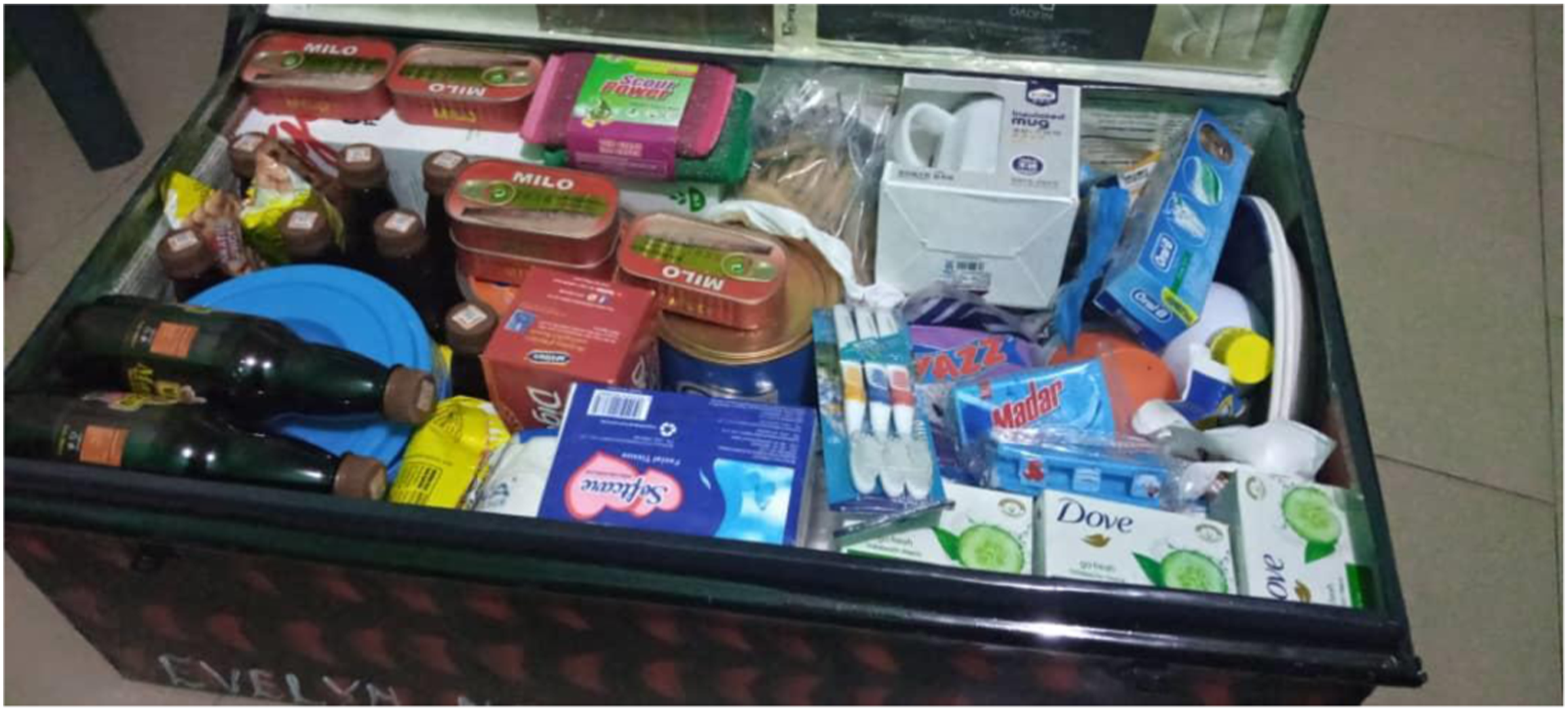
Pathways to schools: Direct and indirect access
There were two pathways accessible to those who progressed to SHS successfully. These are direct and indirect access or negotiated access. Direct access is possible when a family can provide monetary support for the child who qualifies to transition to SHS. Indirect access occurs when the legal guardian or parents are unable to provide access or material support for the child transitioning to SHS, but the child goes to school anyways because relationships are negotiated, and families rely on the networks of support to provide the school needs of the child progressing to SHS.
The quotations below present direct and indirect access situations. First, direct access situation from Alice (pseudonym): I do not know how to feel about the free SHS policy. I guess it has helped people go to school based on the testimonies of those who could go to school because of the policy. For me, it was normal. I checked my placement. My parents followed up to take admission and the prospectus from the school. My mother went to the market to buy the items. My parents bought my provisions and they drove me to school when school reopened. The teacher checked my items and my parents left. That was all.
The quotation below is from Eric (pseudonym), a 16-year-old boy from Greater Accra Region. He comes from a nuclear polygamous family. His father is a construction worker and a farmer with three wives and twelve children: When my results came, I had passed, and I had placement as a day student in a place further away from home. Well, it was in the same district, but I needed to pick two buses to go to school. My stepsister is also fourteen. We completed JHS at the same time and she also had placement in a boarding school. My father did not have the money to sponsor us both. We contacted my uncles and Aunties to help us. Two were helpful, they supported me with the items and GHC 100.00. I also work as a laborer at the construction site, so I had money to top it up. I managed to rent a room closer to the school… it is unfortunate that my stepsister did not get the needed support. She rarely stays at home. She is not closer to my Aunties. They think she is disrespectful that is why she did not get the needed support to go to school… The free SHS is good but in most cases, you need additional support from your family to go to school. I hope the government can help those in my sister’s situation to go to school. It is free but it is less free.
In all situations of access, both direct and indirect, children needed the support of their families to progress to SHS. Whilst the first access situation from Alice is straight forward and did not require negotiation of relationships or wider consultation from extended families to make her enrollment possible, Eric in contrast needed the support of extended relatives. This also informed their perception of the free. For Eric, the policy enables free education, but the free is less free as compared to Alice.
Access is not policy induced it becomes
Those without access have no pathways to secondary education. They are unable to access secondary education under this scheme and they have no family support to enable them to go to school. They do not believe the policy can enable access for everyone who qualifies. For them, the ability to go to secondary school is not policy induced, it is only possible if a child has the support of their families who are willing and able to pay the extra cost to make access possible.
The experiences shared by the seven children who could not progress to SHS paints a picture about the general situation of persons who had placement but could not transition to SHS. They are happy and overly optimistic about their education progress given the interesting reliefs that the policy promises to offer until they experience non-access situations, then they begin to perceive the policy differently. The extracts below were typical of the seven children who could not go to school: I used to think the policy could get everybody who qualifies into SHS, but now I know better. The policy does not necessarily get everybody to school. It depends on whether you have money. This policy is fake. Or maybe it was because of the way they advertised it initially, my mother was not aware that there was additional cost so by the time I checked my results and placement, there was no money to go to school. Sometimes I ask myself, how did a policy which state that SHS is absolutely free become buy this and buy that. My mother and my siblings live in a family house with other extended family members, if my whole family do not have money to rent an accommodation or a room for the family, how do they expect that she would rent a room for only me because I got a day student status at a district where I must rent a room? The painful aspect of it is that, even if you get the accommodation, the property owner will demand a one-year advance payment. For me, this free SHS thing is a hoax. It is not free, having money to pay makes it free.
The non-access situations of those without access despite the policy inform their perspectives of the policy. For them, access is only possible because individuals at the family levels create access not because of the policy provisions. Whilst the policy has created an exponential surge in secondary school enrollment unprecedented in recent times (Asumadu, 2019; Mohammed, 2020; Nurudeen et al., 2018), there are a segment of the population who qualified but are denied access because they are poor. The current situation reveals the policy, and its implementation does a poor job of contextualizing student’s specific needs.
Children’s perspectives of the policy: Access versus non-access
Understanding stakeholders’ views and perceptions of the policy is as important as understanding the policy itself. Even though the perceptions of those who had access and non-access are different, it enables us to understand the challenges from the different points of views of children who are often neglected in the discussion around the policy. The quotations below speak to these perspectives: With the free SHS, all a person needs to worry about is the cost that is not covered by the scheme. I think the free SHS will enable everybody to go to secondary school In fact, the free is free, my parents did not pay any fees. The free SHS is not very free, you must buy the items on the prospectus. I think the free means free, but it is freer for those whose parents can afford it. It is not free. There is cost that parents must bore. Those who cannot afford it do not go to school.
The government’s policy has not been easy to implement, taking place against severe budgetary constraints and a time when the country was struggling with macro-economic issues to improve the educational outcomes of children from low-income families (Tamanja and Pajibo, 2019). With the increasing enrollment figures that have been recorded since the implementation, there is prospect of ensuring equitable access. It is logical to assume that once the government is absorbing practically all the costs at the SHS (Adarkwah, 2022: 305), every child has an opportunity to go to school. However, the one fit for all approach to the distribution of the resources for children regardless of their diverse needs leaves a discouraged child, a possible impending wider education gap between those with access and those without, and a child whose perspective of the policy is that of gloom.
Discussion
Through the lens of IPA, the paper explored the individual children’s subjective perceptions and experience of access. Overall, the study revealed that children’s perception of the free SHS is underscored by their subjective experience of access and non-access. Although the free senior high school policy has granted free access to children who qualify to progress to public senior high schools, the policy ensures freer education to children from wealthy social backgrounds than children from poor social backgrounds.
Rather than linking the inability of the policy to engender equitable access to issues such as resource disparity between schools, diversity of schools, and excesses in individual schools or a meritocracy argument against the 30% elite school placement concession for children from public Junior High Schools, and the dichotomy between day and boarding placements as the literature suggest (Asumadu, 2019; Chanimbe and Prah, 2020), they link their non-access experiences to their personal economic conditions.
Concerning the dichotomy between day status and boarding status as a key inequitable access factor, Mohammed and Kuyini (2021: 18) argues that those who got boarding status had more free secondary education as compared to those who got day student status. This dichotomy was examined in relation to the differential policy provision for day students and boarding students. For example, borders are fed three times daily, they have access to school infrastructure such as library after school hours. They are supervised by teachers in a way that day students are not. Furthermore, boarders did not need to worry about transportation to and from school every day. On the contrary, day students are provided with only one meal a day. They must organize their own transportation to and from school every day if the school is far away. They are not supervised in the same way as the boarders. Despite these differences in resources disbursement for those with boarding and day student status, children did not think about inequity in access in those terms. Additionally, inequality in access is gauged in terms of the dissimilarities between schools’ infrastructure and teacher quality as exemplified in the urban and rural schools’ contrast (Chanimbe and Prah, 2020). Surprisingly, the children did not emphasize this in their attempt to make meaning of the policy. Their subjective personal access or non-access situation influenced their perception of the policy. To them, opportunities are stifled for disadvantaged students because of their personal socio-economic conditions.
The 30% slots in 82 elite schools for students from public basic schools or public junior high school is another area where scholars have raised concerns. They argue that students must earn their places in high performing or elite school because the 30% concession defeats the principle of meritocracy (Chanimbe and Prah, 2020). Again, the children raised no concern about this affirmative action. Quite clearly, children just want to have the opportunity to go to secondary school and they see the inequality in personal or family economic conditions which enables the rich to pay for the extra cost of items on the prospectus and prevents others from doing same as a barrier. Figure 2 is a diagram showing the list of items on a secondary schools’ prospectus that parents must buy. A list of items on SHS prospectus. Source: Authors creation based on newly admitted SHS student’s prospectus.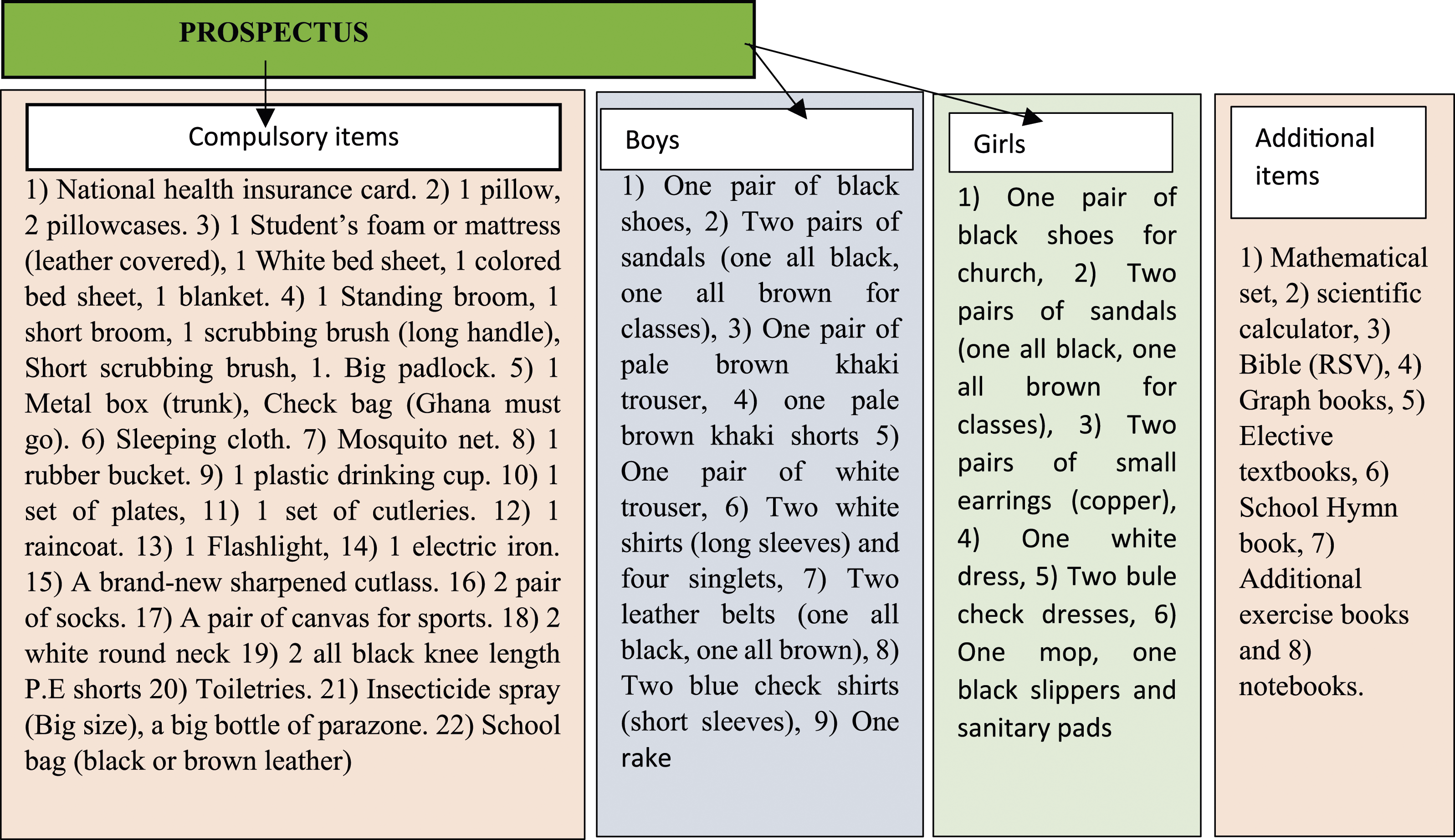
Children’s perception about the ability of the policy to enable free and equitable education centered the buying of these items. Those who could not go to school because they could not buy the items on the prospectus thought the policy did not enable free education. Those who could buy the items without struggle thought the policy was good. In addition to locating the cause of inequity in progression to the buying of items for school, the diverse pathways in which children access secondary education either as direct or negotiated also underlies the meaning and perception they have of the policy. As one of the children suggested it is freer for those who did not need to access secondary education through the generosity of extended family relatives. These experiences undergird their perception of the policy. To the children, entirely free or freer was only defined in terms of the ability to progress to SHS successfully and not because one had placement as a boarding student or day student.
Additionally, their perceptions suggest that the policy offers more opportunity for those who can afford to have a meaningful secondary education where their school needs are abundantly supplied and less opportunity for those without any family support to bear the extra cost of secondary education. The interpretive phenomenological approach that framed the study enabled an understanding that the meanings children make of the policy is contested. Whilst the study is ideographic, it illuminates an issue that is rarely discussed in the burgeoning body of work on the free SHS policy.
It indicates that children do not have equal support to progress to SHS. Since students are unequal, equalizing opportunity to progress to SHS by providing same or equal relives to schools and children with diverse contextual realities do not mitigate the inequalities in secondary education access pathways for students. Without unique and contextual support for diverse children based on individual needs and circumstances, students do not transition to SHS on equal footing. Progressing successfully influence positive perception of the policy. Unsuccessful transitions despite school placement also influence children’s negative perception about the policy. From the everyday access situations of the children, the free financing model which provides for every child equally regardless of needs worsens existing disparity or challenges and erupts new kinds where those with access are now more resourced to go to school and those without access are more likely to stay out of school.
Conclusion
If SHS education is free and equitably distributed, shouldn’t we ask the children about it?
As highlighted in the extract, children have opinions, and perspectives that need to be explored on a policy that directly affects them. Thus, drawing on the often-muted voices of children, the paper explored the perceptions and the meanings they create about the policy based on their subjective experiences.
In the framing of interpretive phenomenological approach, their experiences of access as successfully transitioned students or unsuccessfully transitioned students influenced the meaning they created about the policy. Those who progressed to SHS successfully the direct way commended the policy. Those who negotiated progression to SHS the indirect way through extended family relatives were both optimistic and less sanguine about the ability of the policy to enable free education in its entirety. The inability of those without monetary support to progress successfully served as a damper on their spirits.
I conclude that even though the free SHS policy has led to an exponential surge in the number of students accessing SHS, it has also created a situation where those who are rich and can afford to access secondary education without cost relieves can now doubly afford and those who are poor are left out of SHS. The policy thus offers more opportunity for those who can afford to have a meaningful secondary education where their school needs are abundantly supplied and less opportunity for those without any family support.
I hope this paper has provided a powerful exemplar of children’s perception and insights to the proliferating literature on upper secondary education in Ghana. It is an attempt to bridge the gap in the literature that was grounded in data collected mostly from policy makers and implementers (Adu-Ababio and Osei, 2018; Addae et al., 2019; Nurudeen et al., 2018). It has also highlighted children’s perception of the policy that until now had eluded the literature.
Whilst the study concludes that the provision of extra resources for children in tandem with their diverse needs will shift the negative perception of the policy. Further research is needed to engage with the critical emergent issues that drives the negative perception of children about the policy. Assessing the needs of each student at the point of registering for the BECE would enable government to distribute resources based on needs. This would help students move closer to equity. The current policy where everyone receives the same thing depending on day and boarding status is easier to implement, but this provision would mean more to some students, less to others, and for those who would not be able to transition to SHS under the current scheme, nothing. This leads us to the question, what level of inclusion is fair and appropriate? All students cannot be realistically put on an equal footing; however, providing unique support or resources that vary across students depending on their individual needs is fair. The policy should acknowledge the valuable differences among students and address these diversities by shifting resources based upon the needs of the students. Additionally, the perspectives of children are important to the meaning making that occurs at the policy and implementation levels, even though children are not at the forefront of policymaking. The parent was right when she argued that if the policy enables free and equitable distribution of education access, we should ask the children about it.
The account of children must matter in the conceptualization of policy problems and the analysis of posited solutions, especially policies that has far reaching consequences on their future. This is not to suggest that children are now expert in policy problematization, conceptualization, and solutions; however, capturing the perspective of children is also important towards the legitimization of their subjective experiences in written work.
Whilst the findings cannot be generalized to other contexts, it serves as a powerful example to the meaning making that takes place at the individual levels. It also serves as a lesson for countries with prior cost-sharing upper secondary education financing models who want to commit the SDG 4 promises into action. It shows how children make meanings of their experiences in the context of government education policy.
Recommendation
Fee-free education interventions usually fail to translate into access for everyone. Consequently, a host of scholars have made several recommendations towards enhancing the policy. Some have highlighted the need to delineate schools into categories to enable the exploration of the differences and similarities in the challenges that have bedeviled the implementation in school context specificity (Asumadu, 2019; Public Interest and Accountability Committee, 2020). This paper also advocates for contextualizing implementation to children’s diverse context. To enable policy makers to account for diversity of children in the provisions of the policy, data collection on access and non-access must be broadened to include the backgrounds of children.
Targeting is important to achieve meaningful access for diverse groups (Abdul-Rahaman et al., 2018; Morley et al., 2010; UNESCO Institute of Statistics, 2009). Targeting implies providing selective assistance based on diverse needs. Exploring the social backgrounds of children is important if their diverse needs can be attended to. It is therefore imperative for the data planning officers and Education Management Information System (EMIS) officers to develop a data collection method that considers children’s diverse background. In Ghana, administering and management of education and learning outcomes is exemplified in quantification and standardization by the Education Management Information Systems (EMIS). EMIS is a spread sheet managing administrative educational data, for example, enrollment, attendance, and other access indicators to ascertain progress against set indicators in school districts, regions, and national (UNICEF, 2014).
Capturing data that is not decoupled from the diverse backgrounds of children means exploring the role of measurement in administering the free SHS access policy. Measurement practices today focus on quantitative data. The role of quantification of measurement in implementing policies is replete in education access literature (Bandola-Gill et al., 2022; Espeland and Stevens, 2008; Hacking, 2007; Merry, 2016; Shore and Wright, 2015: 23). For example, administrators and implementers can properly plan and allocate the budget necessary to bring an education policy to life. Notwithstanding, the emphasis on numbers or quantification occludes other important aspect of policy that is best ascertained through capturing the diverse and subjective experiences of children.
How quantification data is produced eschews contextual backgrounds of students. This requires us to revisit the question of measuring and access in education systems and how we conceptualize and measure access. In capturing access issues such as enrollment, gender parity index (GPI), out of school children, etc., data quantification in these terms does not exhaust children’s access experience and the diverse contextual backgrounds. Access issues are many-sided and emphasizing diversity of context necessitates the unpacking and nuance in the investigation of access beyond access indicators. The experiences of children, what their needs are, and whether those with access are accessing education the right way without existing barriers is precluded. It gives no information about the population beyond their being in school or out of school and other indicators related to being in school. Children’s additional needs in the education system are left uncharted.
This paper recommends that the government should take the diversity of schools and children into consideration. The school and child context should be captured in the EMIS data or other hyper local level data to enable the government and implementers to provide targeted support. Alternatively, when children are registering for the examination that gets them placement into upper secondary schools, data can be collected on the diversity of backgrounds of these children to enable the provision of targeted support once they are placed in their selected schools. This is crucial towards improving policies and programs. Background details could include the detailed economic situation such as the average income of the family per year.
Limitation
In this study, I sacrificed breadth for depth as is expected in all interpretive phenomenological analysis. Thus, it is difficult to generalize the findings beyond the sample. That notwithstanding, it serves as a powerful example of how children’s experience of access informs the meaning making and perception they have of the policy and how their understanding of equity differs from that explored in recent studies. The power of a good example should not be underestimated (Flyvbjerg, 2001).
Whilst I accept that generalizability to other contexts poses problems for different schools of thoughts, it is less valuable to critique an IPA approach beyond its value. The value of IPA studies is depth. Equally, the value of random sample studies is breadth. The IPA method helped in understanding the meaning and interpretation of access based on children’s subjective experience of the policy. IPA follows an idiographic approach to analyses (Smith and Osborn, 2015) which makes claiming the results is typical, challenging. Again, the goal is not to claim the result is typical but to serve as a powerful exemplar to how the subjective experiences of the children fuel their perception of the policy. This approach does not mean eschewing generalization but exploring individual cases in depth.
Footnotes
Acknowledgment
The analysis presented in this paper originated from an ongoing DPhil thesis project that addresses the challenges that governments face in expanding education access and distribution in low-resource countries using Ghana as an exemplar. I am grateful to Prof. Heather Hamill of the Department of Sociology, University of Oxford, UK for her guidance throughout this broader research. I also appreciate the anonymous reviewers and the editor for their feedback.
Declaration of conflicting interests
The author(s) declared no potential conflicts of interest with respect to the research, authorship, and/or publication of this article.
Funding
The author(s) disclosed receipt of the following financial support for the research, authorship, and/or publication of this article: The broader research leading to these results received funding from Research England Global Challenges Research Fund (GCRF) QR Fund 2021 to defray some of the cost of my fieldwork data generation and collection. The author received no funding for the submitted manuscript and for the preparation of the manuscript.
Ethical statement

Data availability statement
The research data generated during and/or analyzed during the study are not publicly available but can be made available on reasonable request. This is because this paper forms part of a broader study, consequently, making the data available will also imply making the data associated with other aspects of the broader study such as the negotiation of education access within families, resource dilution, residency, gender, inequality of opportunities and personal conditions, and a range of different factors that shape these negotiations (including religion, rurality, knowledge, etc.) within families of children, also available.