




Abstract
The underlying ambition of fee-free education is to increase school access. This study reflects on decentralisation in the decision-making process and implementation of fee-free policies. We compare two policies at the high school level in Ghana to evaluate the differences and commonalities in how they responded to school access. We used interviews and secondary sources of data for qualitative content analysis. Haddad and Demsky’s rationality framework of education policymaking served as the analytical guide. The results show that Free Senior High School policy (FSHS) increased access to education by responding to the existing problem of low rate of transition from lower secondary to upper secondary education, unlike Progressive Free Senior High School policy (PFSHS). However, the desirability of access is over-prioritised in the current FSHS – unlike in the PFSHS, leaving gaps in administration, educational facilities and resources: challenges attributable to the concentration of centralised administrative decisions during policy formulation and implementation. We propose remedial measures to address these challenges.
Keywords
Introduction
The idea of decentralisation in fee-free education reforms has been one of the dominant themes in the international education discourse (Bray, 2007). The argument is that fee-free education policies work better when policy decisions are made with recourse to a decentralised decision-making model, preferably at the school level (World Bank, 2007, World Bank and UNICEF, 2009). In contemporary Sub-Saharan Africa (SSA), and particularly in Ghana, fee-free education (with the immediate objective to increase access) at the high school level 1 has become a topical debate. The current debate is actually a perpetuation of the previous focus on basic education (Asante, 2022).
In analysing education policy, Haddad and Demsky (1994, 1995) offer an ideal framework from the perspective of developing economies. In this study, we apply Haddad and Demsky’s framework in an ex-post analysis of two fee-free policies implemented in Ghana. We examine the differences and commonalities in how each of the two policies responded to the problem of school access. We also seek to understand how decentralisation in fee-free education plays out in the development of fee-free policies in Ghana, and by extension, the SSA region. The policies are Progressive Free Senior High School (hereinafter: PFSHS) and Free Senior High School (hereinafter: FSHS) policies.
Historically, Ghana has pursued a range of policies at the basic school level (primary and lower secondary level) to promote access. Policies such as Free Compulsory Universal Basic Education (FCUBE), Capitation Grant, and School Feeding Programme have been, and continue to be implemented (Akyeampong, 2009; Ampratwum and Armah-Attoh, 2010; Pajibo and Tamanja, 2017). For example, Akyeampong (2009) argues that capitation grants and school feeding programmes have been used to motivate and drive pupils' interest to attend school regularly. While modest gains in terms of enrolment have been made, the transition to the high school level has been low. Notwithstanding this, Ghana presents a particularly interesting case of education policies to increase enrolment at the high school level in the region. In the past 7 years, new priorities of politicians and policymakers have emerged at the high school level, leading to the adoption of the two fee-free policies – PFSHS and FSHS – to promote Senior High School (SHS) education.
Generally, the educational system and management in Ghana and SSA are argued to be dominated by a top-down approach despite several attempts at encouraging decentralisation (Harber, 2017; Nudzor, 2014). But, have these dynamics changed in the recent fee-free policies at the high school level? Studies on fee-free policies at the high school level in Ghana and elsewhere in SSA have focused on either the evaluation of only FSHS (Chanimbe and Prah, 2020; Essuman, 2018; Mohammed and Kuyini, 2021); FSHS’s effects on quality university education (Adu-Gyamfi et al., 2020); the appropriateness of the replacement of Progressive Free Senior High School policy (PFSHS) with FSHS (Abdul-Rahaman et al., 2018); adherence to the policy process cycle (Adarkwah, 2022; Mohammed, 2020); fee-free policies and crime rate (Asante and Bartha, 2022); or fee-free policies and its effects on teachers and headteachers’ and income of male and female teachers (Chapman et al., 2010; Molyneaux, 2011). The nexus between (de)centralisation and fee-free policies at the upper secondary level, and the resultant effect on access, however, remain unexamined within the current discourse on fee-free policies in the literature.
In this comparative case study design, we collected primary data through field interviews in Ghana with policy actors, civil society organisations, school administrators, international development partners, political agents and staff of the ministry of education. We then corroborated the primary data with secondary sources comprising official documents, media reports and published articles. Content analysis was used as the method of analysis. We find that FSHS responded to the existing problem of low rate of transition from basic school to high school, unlike PFSHS. The idea of decentralisation was, however, not incorporated in the policy decision-making process and implementation of fee-free policies especially in FSHS: the establishment of the FSHS Secretariat heightened the centralisation of school management. We reflect on the implications of the lack of decentralisation and proffer some remedial options later in the paper.
The rest of the paper is organised as follows. The next section provides an overview of the educational system in Ghana, and a description of the two fee-free policies under consideration. This is followed by a brief review of the concept of decentralisation with a focus on education, and the conceptual structure of the education policymaking process from Haddad and Demsky’s (1994, 1995) perspective. Thereafter, the research ambition, research question and research method are discussed. The findings are then presented. The final section discusses and suggests policy implications and avenues for further research.
Overview of Ghana's educational system
The educational system in Ghana follows a 2-6-3-3-4 system. It offers 2 years of kindergarten, 6 years primary, 3 years lower secondary, 3 years upper secondary and 4 years bachelor’s education. Kindergarten, primary and lower secondary constitute basic education. This level of education is free and compulsory. Basic education and upper secondary education constitute pre-tertiary education (Republic of Ghana, 2020). At the end of lower secondary school (also called Junior High School (JHS)), form three students write exit exams for Basic Education Certificate Examination (BECE) in seven subjects. Students are required to select their choice of upper secondary schools (second cycle education) and are placed and enrolled in one of the schools selected through a centralised system called the Computerised School Selection and Placement System, after passing the BECE.
Upper secondary education (High school)
Upper secondary education covers 3 years of SHS or Technical, Vocational Education and Training (TVET). Upper secondary education in Ghana aims ‘to produce individuals with the requisite knowledge, skills and value to become functional and productive citizens for national development’ (Republic of Ghana, 2020: 5). Subjects taught in upper secondary schools include English, Mathematics, Integrated Science and Social Studies. These four comprise the core subjects obligatory for all students to take. Students additionally take three or four elective subjects, in specialised programmes such as General Science, Business and General Arts. Students take exit exams known as the West Africa Senior Secondary School Certificate Examination (WASSCE) at the end of the 3-year period, under the auspices of The West Africa Examinations Council (WAEC).
Agenda-setting and the concept of free senior high school policy in Ghana
According to Kingdon (2014), agenda-setting is the recognition of a problem on the part of the government. The recognition of access to education for Ghanaians is emphasised in the country’s 1992 constitution as a legal requirement. Article 25 (1b) states: (b) Secondary education in its different forms, including technical and vocational education, shall be made generally available and accessible to all by every appropriate means, and in particular, by the progressive introduction of free education (Ghana, 1993).
Beyond the legal framework, the recognition of access to SHS education has sparked a debate between the two leading political parties in the country, namely, the New Patriotic Party (NPP) and the National Democratic Congress (NDC). Putting fee-free high school education on the agenda was ignited by the then ruling party, NPP, during its re-election campaign in the 2008 general elections. The party promised in their manifesto to ‘guarantee access to all children of school-going age to free quality education at the basic school level. This will be extended to cover Senior High School education as well [emphasis added]’ (New Patriotic Party, 2008: 69). The party, however, lost the 2008 presidential elections. The NDC on the other hand focused its debate in the 2012 General Elections on the constitutional provision of ‘progressive introduction’ assuring the electorates that ‘the government of the NDC…is equally committed to the progressive introduction of free secondary education under Article 25(1) (b) [emphasis added]’ (National Democratic Congress, 2012: 20). These focusing events marked the beginning of fee-free education policy in its larger form on the national agenda.
Progressive free senior high school policy
Progressive Free Senior High School policy was implemented in September 2015 by the NDC government. It was a form of partial funding for the reduction of the cost of senior high education for some students. Specifically, students were exempted from paying the following costs of education: examination fees, entertainment fees, library fees, students representative council (SRC) dues, sports fees, culture fees, science development, and mathematics quiz fees, information and communication technology (ICT) fees and co-curricular fees for day students in public senior high schools (Ministry of Finance, 2015).
Free senior high school policy
Free Senior High School Policy replaced PFSHS policy in September 2017 when the NPP was elected to office in January 2017. The policy absorbs all direct costs of schooling and some indirect costs throughout upper secondary school (Abdul-Rahaman et al., 2018). In summary, PFSHS was limited in scope and coverage: full tuition, admission fees and registration fees were not absorbed by the government for all students. FSHS is, however, holistic, absorbing all fees for all students throughout the country.
Literature review and theoretical underpinning
Fee-free education and decentralisation
In this paper, we focus on two key terms: decentralisation and fee-free education. How does decentralisation play a role in the whole decision-making process and implementation of fee-free policies? The World Bank and United Nations Children’s Fund (UNICEF) (2009: 1) define fee-free policies as access-oriented policies designed to offer free education to children and youth at different levels of education. These policies are designed to ensure that charges – mostly tuition fees and registration fees – chargeable at the point of school enrolment are partially or holistically removed. Since the international community promulgated Education for All (EFA) in Dakar, abolishing user fees has long been a key priority for governments and policymakers (Lewin, 2009; Little and Lewin, 2011). Notwithstanding this, the rate of enrolment at the high school level continues to be generally low. Studies on fee-free education policies and their impact on access are also inconclusive. While some argue that fee-free policies increase school enrolment (Asante, 2022; Blimpo et al., 2019; Duflo et al., 2017; Garlick, 2013; Morgan et al., 2014), others contend that such policies have no significant positive effect on enrolment (Branson and Lam, 2017; Ponce and Loayza, 2012). A major weakness in the foregoing debate is the limited attention paid to how different forms of fee-free policies may have different impacts on enrolment. This study accordingly aims, in part, to fill this gap.
Decentralisation is defined as ‘the transfer of authority and responsibility for public functions from the central government to subordinate or quasi-independent government organisations or the private sector’ (Rondinelli, 1998: 2). The concept of decentralisation has three dominant dimensions – political, administrative and fiscal. Political decentralisation aims to provide citizens or elected representatives with more power in decision-making. Administrative decentralisation redistributes authority, responsibility and resources for service provision among different scales. Fiscal decentralisation can include responsibility for revenue collection and management.
An analysis of Ghana’s decentralisation experience shows that, the country’s decentralisation policy since 1988, incorporates all three dimensions: political, administrative and fiscal (Ayee, 2008: 234). Conceived under the regime of the Provisional National Defence Council (PNDC), and underpinned by PNDC Law 207 (Republic of Ghana, 1988) with the mantra of ‘power to the people’, Ghana’s decentralisation policy aimed to: (1) promote participatory democracy, (2) bring governance closer to the people and (3) improve service delivery in ways responsive to local needs and preferences (Ahwoi, 2017). The decentralisation agenda also sought to encourage and advance collective decision-making at the grassroots through the establishment of District Assemblies. However, this idea is argued to have failed to achieve its purpose due to a lack of proper legal basis before the establishment of the District Assemblies (Ayee, 1996).
Currently, the legal framework under the Education Act, 2008 (Act 778) of Ghana emphasises ‘effective decentralisation of executive responsibility for the provision and management of basic and second cycle schools to the District Assemblies’ (Republic of Ghana, 2009: 5). This move seeks to devolve education delivery from national headquarters to the local assemblies. Notwithstanding, the level of empowerment and ownership at the local level continue to be low in practice since the idea was conceived, and this is argued to have affected education service delivery (Essuman and Akyeampong, 2011; Mankoe and Maynes, 1994). Ironically, the current Pre-Tertiary Education Act (Act 1049) did not build on the decentralisation idea conceived in the Education Act, of 2008. It only states the need for collaboration between Education Service and Local Government Service to ‘take measures to ensure that District Education office takes responsibility for the provision of effective and efficient management of basic schools’ while the regional directorate as well as TVET Service are responsible for upper secondary schools (Republic of Ghana, 2020: 6). Clearly, district assemblies had no control on upper secondary schools in the new law.
Even so, scholars are not in a consensus about the role of decentralisation in fee-free policies and their impact. This has resulted in two main arguments. One strand of the argument is that fee-free policies are more likely to be effective to increase access and have a greater impact if accompanied by political and administrative decentralisation principles (World Bank and UNICEF, 2009). This is due to the obvious cooperation and commitment derived from school-level implementers. The other strand of the argument emphasises that the idea of fee-free policies is inherently a centralised policy and follows the top-down rationalist approach (Bray, 2007: 33). This means any attempt at decentralisation in the decision-making process of fee-free education policies is at odds with the fundamentals of the concept (Sasaoka and Nishimura, 2010). Walton (2019) on the other hand argues that fee-free educational policies have both centralisation and decentralisation tendencies contested at different levels in different contexts. He attributes these tendencies to the inherent redistribution of resources among different administrative levels in fee-free policies. Walton asserts, however, that the centralisation of administrative and educational funds after successfully decentralising these components, end up eroding the gains made in fee-free policies. Our study contributes to this broad area of research focusing on fee-free policies at the high school level in Ghana.
Framework for education policymaking process
According to the principles of rational decision theory in education policymaking, policies designed must be wise in the sense that they should not cause new educational problems in the sector (Haddad and Demsky, 1995). Education is hinged on three principles: access, quality and relevance. Education policies that are made must encourage access, quality, and internal and external efficiency (Haddad and Demsky, 1995). Although other frameworks for education policymaking exist, for example, Cooper et al.'s (2004) four frameworks: the normative, structural, constituent and technical. Haddad and Demsky’s (1994, 1995) framework presents a comprehensive context in which education policymaking thrives especially in developing countries. The comprehensive nature and the focus of the framework on developing economies make an appropriate choice for this study. Haddad and Demsky’s sequence of events consists of eight policy processes. 2 These are analysis of the existing situation, generation of policy options, evaluating policy options, making the policy decision, planning for implementation, policy implementation, policy impact assessment and subsequent policy cycles. These eight-policy elements can be grouped under the pre-policy decision, the decision process itself and post-decision activities.
Pre-policy decision
(Haddad and Demsky, 1994, 1995) framework lists analysis of the existing situation (problem) as the first step in education policymaking. A policy in education must be a response to a problem in the sector. This can be analysed by (i) assessing access to educational opportunities, either from the demand side or supply side (Hunt, 2008); (ii) equity in the distribution of educational services, for example, distribution according to region, rural-urban, sex and socio-economic status; (iii) the structure of education; (iv) internal efficiency, for example, the efficiency of teaching and learning systems, utilisation of teachers and physical facilities, and the efficiency of learning (quality of teachers and curricula); (v) external efficiency, that is, the relationship between schooling and the labour market and (vi) institutional arrangement for the management of the sector: for example, whether the distribution of power is centralised or decentralised, and the consequences of each option (Haddad and Demsky, 1994). While some systems are more decentralised, allowing for greater local participation in the process, others are more centralised (Walton, 2019).
The second stage is the generation of policy options. The policy option is generated through the context of a perturbed problem, political decision, or reorganisation scheme paying attention to the interests, beliefs and ideas of important stakeholders and policy implementers. The third step is the evaluation of policy options. This is the stage of ex-ante policy analysis (Bardach, 2012). 3 The imagined outcome of the intended policy option is compared with the present situation, in order to assess its feasibility, desirability and affordability (Haddad and Demsky, 1994, 1995). In the fourth stage, a policy decision is made (adoption) by balancing several factors analysed, including data, finance, time, personnel, interest groups, stakeholders’ demands, and the political capital and cost.
The decision process itself
In the decision process itself, planning for policy implementation is the first step. Financial resources, technical knowledge, schedules, physical resources and administrative system all need to be clearly stated and structured to carry out the policy decision. Here, it is important to decentralise and enable consumers (example parents and students) and providers (example headteachers and teachers) of the policy to embrace the new change through political support. The policy change reaches the implementation stage, which can generate new policies. Policy implementation generates modifications because of circumstances of implementation not anticipated in the planning stage, or the feedback obtained calls for re-assessment and subsequent modification.
Post-decision activities
After policy implementation, an impact assessment is undertaken. The impact assessment is about the policy objectives which are beyond the output of the policy goal. Here, the cost of financing, the quality of students’ outcomes, and the efficiency of the policy are assessed. Subsequent policy cycles arise out of the assessment as the last stage in the cycle. We summarise the eight processes within the three main stages in Figure 1. Conceptual Model for Education Policymaking. Source: Authors' construct, adapted from Haddad and Demsky (1994, 1995).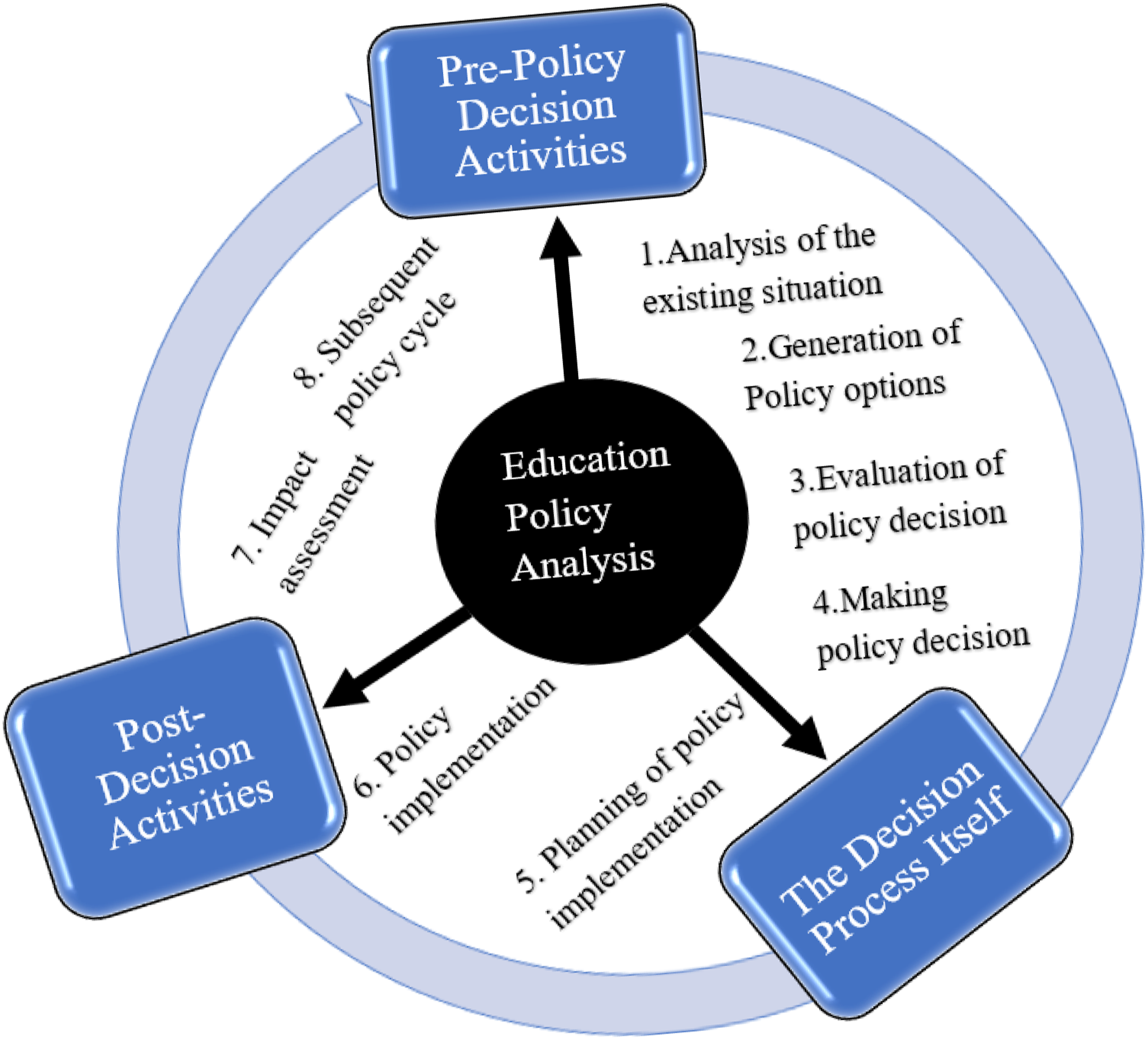
Research ambition and research questions
In this study, we aim to examine the differences and commonalities in two fee-free policies from a comparative perspective along two main dimensions. We examine how each policy responded to school access and the adherence to decentralisation in the policy process. In doing so, the study addresses the following research questions: (1) How did PFSHS and FSHS respond to the existing problem of the low rate of transition from lower secondary to upper secondary school in Ghana? (2) How is the concept of decentralisation reflected in the decision-making process and implementation of fee-free policies in Ghana? (3) What challenges confront the implementation of the current FSHS and how can they be addressed?
Methods
Research design and case selection
The research design is a comparative case study. Comparative case-oriented studies are suitable when researchers want to have a grasp of ‘cases because of their intrinsic value’ (Ragin, 2014: 35). In this comparative case study design, we explain the differences and commonalities in how each fee-free policy change responded to school access, and how the concept of decentralisation reflected in the decision-making process and implementation of these two policies. The unit of analysis is a policy field: fee-free policies at the upper secondary school level with two cases (N = 2) set within one country. The cases are Progressive Free Senior High School (PFSHS) and Free Senior High School (FSHS) policies. We purposively selected these two policies for several reasons. Firstly, although the two policies offered fee-free education to students at the upper secondary level, one of the policies has limited scope and coverage (PFSHS) while the other has wider scope and coverage (FSHS). This allows for a diversity of cases. Secondly, the policies are current (from 2015) and offer a better time horizon option. Information about these policies is also readily available from policy actors, in documents and also on the Internet. Finally, selecting cases with background knowledge allows for a stronger research design. The authors have knowledge of the processes leading to the agenda-setting and adoption of the two policies.
Data
Distribution of interview participants.
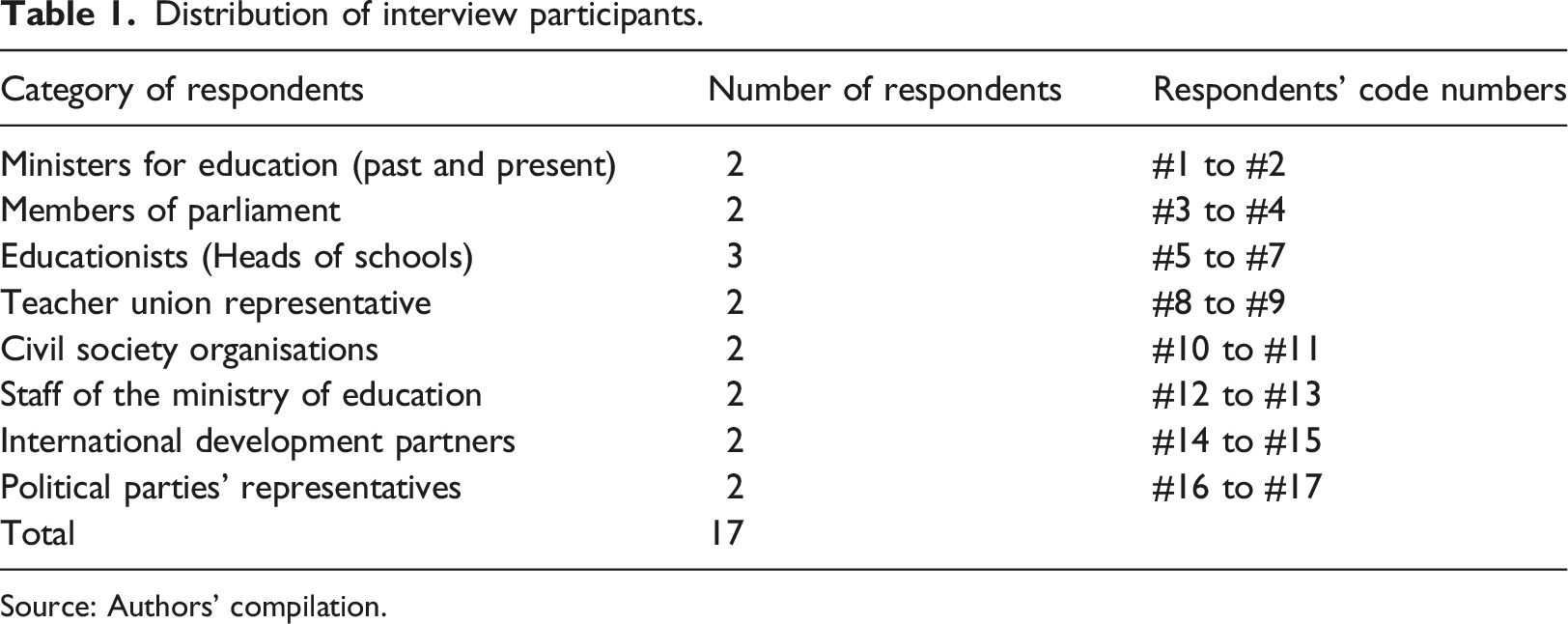
Source: Authors' compilation.
We corroborated the primary data with secondary sources of data. The secondary data sources included scholarly literature, education policy reports, educational coalitions and stakeholders' websites, government budgets and reports, parliamentary debates and documents, and media interviews with government officials. Documents are often used together with interviews as a means of triangulation by ‘researchers [to] make use of multiple and different sources, methods, investigators, and theories to provide corroborating evidence’ (Creswell, 1998: 202). We set inclusion and exclusion criteria in selecting the scholarly literature. We reviewed available evaluation studies on Ghana’s fee-free SHS literature published in English since 2015. We deemed the timeframe appropriate since the first fee-free SHS policy related to the two policies under consideration started in 2015. We reviewed other descriptive statistics from government documents and organisational reports about fee-free education. These included enrolment ratios, the number of candidates sitting for exit examination, and examination results. In this criterion, available reports since 2008, when the agenda of fee-free senior high education was first set were selected, carefully examined and cross-examined with other sources to verify the authenticity of the information. We deemed this source of secondary data appropriate, considering that the available scholarship did not provide all the required information. We did not consider publications and reports that were not in English. This is justified and does not introduce biases or limitations to the study, since the official language of the study area is English, and all relevant publications and reports are in English. For online sources, the search engines used for the study were Google Search, Google Scholar, Scopus database, SAGE, SPRINGER Journals online, JSTOR, Sci-hub database and World Cat. Search words which guided the search were fee-free education, free education, Ghana free SHS, high school education, secondary education, school enrolment, WASSCE results and double track.
Ethics
A letter of authority was obtained from the first author’s institutional affiliation to gather the data. Informed consent was sought from all participants before the interview. To preserve the privacy of the participants, we have removed all names and replaced them with institutional affiliations and codes in the narrations in the results section.
Analysis
The study is underpinned by the constructivist paradigm which allows a researcher to construct meanings through the engagement with real-world happenings (Creswell, 1998). We used content analysis for the study. Content analysis is a systematic way of exploring large amounts of textual information unobtrusively to determine trends and patterns of words used, their frequency, their relationships, and the structures and discourses of communication (Bloor and Wood, 2006; Grbich, 2013). It aims to describe the characteristics of the document’s content by examining who says what, to whom and with what effect, by paying attention to the surface meaning of the information rather than hidden agendas (Bloor and Wood, 2006). For the primary data, we closely read the interview transcripts, organised the responses under themes, and together with the information gathered from our secondary sources of data, examined how they answered our research questions.
There was the inclusion of ‘quasi-statistics’ from the secondary data to be able to make comparative statements. The inclusion of quasi-statistics in qualitative research was deemed helpful to be able to make use of simple figures and make more precise comparative statements instead of relying solely on narratives (Becker, 1990). We comprehensively analysed the information gathered under the three main broad themes of Haddad and Demsky’s (1994, 1995) education policymaking analysis cycle: the pre-policy decision, the decision itself and post-decision activities.
Findings
Pre-policy decision
Analysis of the trend in school access before and during fee-free policies.
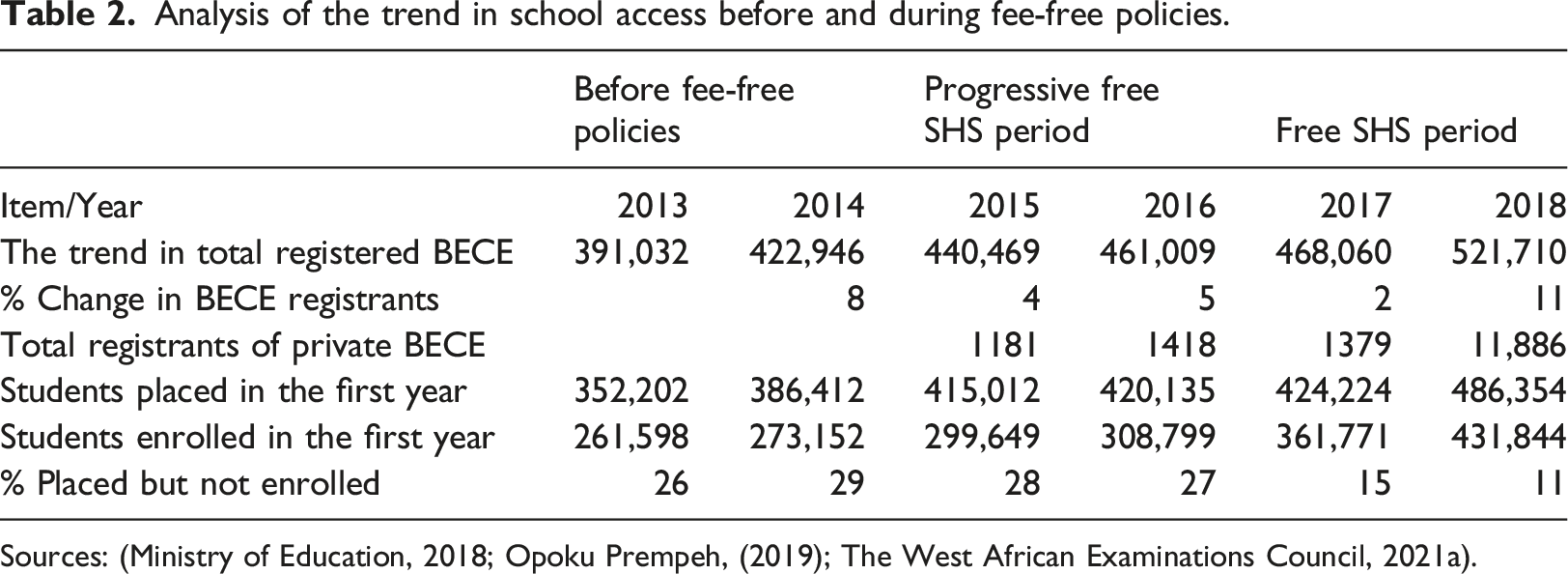
From the historical trend, it seems evident that FSHS responded to the problem of the existing situation in Haddad and Demsky’s (1994) framework, unlike PFSHS. The existing situation was the inability of qualified students placed in high school to enrol (transition from lower secondary to upper secondary) in most cases because of poverty (Amagnya, 2020: 112–113; Duflo et al., 2017). Two factors may explain why many students were enrolled in high school during the introduction of FSHS. The first may be because the policy is holistically fee-free: neither day nor boarding students pay any form of fees, including registration and admission fees. The second could be due to the fact that the data on trends in total registrants for the BECE [the examination which qualifies students into the upper secondary school system] showed an increase of 11% in 2018 from the previous year. This implied the availability of more students for admission to upper secondary school and may also potentially have signalled a growing interest of people to have the opportunity to enrol in high school, compared to previous years.
Population growth may have contributed to the increase in BECE registrants in 2018. This notwithstanding, the percentage change of BECE registrants from 2014 to 2017, as evidenced by percentage increases of eight, four, five and two percentage points, respectively, makes the argument that interest in FSHS in 2018 played a significant role in the 11% points increase particularly plausible. This is further supported by the trend in total private BECE registrants. The programme, implemented in 2015, gives candidates who did not perform well in the examination in previous years an opportunity to improve their grades to continue with their education to SHS. The significant improvement in the total absolute number of registrants from 1379 in 2017 to 11,886 in 2018 shows that there was a particular interest in 2018 for many youths to get the opportunity to be placed and enrol in high school because it is wholly free.
Generating policy options, evaluating policy options and making policy decisions – beyond access
In generating and evaluating policy options, apart from the desirability of the policy, the feasibility and affordability of the policy must be assessed, so that the policy does not lead to further problems in the education system. The policy may be desirable to promote access. However, the unavailability of funds to finance the policy leads to unsuitability and debts to public schools, which create other problems in the education system. Haddad and Demsky (1994, 1995) recommend that during this stage the imagined outcome of the intended policy option needs to be compared with the present situation to assess its feasibility, desirability and affordability. During this stage in PFSHS, decision-makers realised that the cost of financing a holistic fee-free policy – although desirable – was not feasible due to the high cost of financing. A former government official during the NDC government indicated during the interview: The policy came to cabinet for deliberation. We felt that the constitution says that we need to have free secondary education, but we realised that we needed to put up the infrastructure first. The Ministry of Education at the time did an assessment to know the gap before the policy was enrolled. We realised that it would involve a lot of money so we cannot roll it out at once (Respondent #16, Field Interview, 2021).
Conversely, almost all participants were of the view that the adoption of FSHS was not based on the assessment of the previous PFSHS policy. A minister of state indicated: ‘I am not aware of any such linkages [between PFSHS and FSHS]’ (Respondent #2, Field Interview, 2021). Others indicated: ‘No. I would not say it was the PFSHS that informed the adoption of FSHS. It was not based on the assessment of the previous policy’ (Respondent #13, Field Interview, 2021). ‘FSHS was never a catalyst of PFSHS. It was solely a new policy which had no bearing on the previous policy’ (Respondent #3, Field Interview, 2021). These assertions imply that an evaluation of the previous policy, which would have been an ideal avenue to incorporate the ideas and views of decentralised school-level implementers in the new policy, was overlooked. Meanwhile, a key component in the generation and evaluation of policy options is consultation with relevant stakeholders, especially the key implementers of the policy at the school level. In brief, there is a need to assess the desirability and impact of a policy option on various interest groups and stakeholders (Haddad and Demsky, 1994, 1995).
Evidence suggests, however, that (extensive) stakeholder engagement was overlooked during the generation of the policy option for both PFSHS and FSHS. A representative of CSOs indicated: ‘In both policies, we heard of their adoption in the news when the president announced it. We did not see any form of consultation before the adoption. We do not know if there was any form of assessment’ (Respondent #10, Field Interview, 2021). An interview participant from the teacher unions, however, indicated that some consultations with teacher union representatives were held during the planning of PFSHS to know the cost component to be absorbed. ‘With PFSHS, the government consulted us to know which fees components are ideal and necessary to be absorbed. With FSHS, we were informed about the policy but were not consulted’ (Respondent #8, Field Interview, 2021). Importantly, notwithstanding, heads of school – who are the lead school-level implementers of the policies – seemed to have been overlooked in the consultation processes. A headteacher of a SHS indicated: Government does not involve teachers and headteachers in planning and adopting the policies. They normally consult the teacher unions. During PFSHS, there was no specific role we played in the policy adoption. We were just there to manage the school and the policy decision was communicated to us. In FSHS too, we did not have any engagement before the policy was adopted (Respondent #5, Field Interview, 2021).
To corroborate these empirical findings from the interviews are assertions made by participants at a colloquium organised by the Institute of Educational Planning and Administration at the University of Cape Coast (IEPA-UCC). They indicated that fee-free policies are good. However, there was a ‘big gap between the Ministry of Education/GES and the [school] heads’ regarding fee-free policies' implementation (Institute for Educational Planning and Administration, 2019: 10). A study by Mohammed and Kuyini (2021) on FSHS also showed limited stakeholder consultation during the policy formulation stage. We argue, accordingly, that a gap exists in the consultation of school-level implementers on Ghana’s fee-free policies.
Of note, the cabinet, which is the highest decision-making body of government, and is led by the president, was actively involved in both policies at the policy decision-making stage. A government official in the NDC government during the adoption of PFSHS indicated: The president was very passionate about it. He [actually] drove the policy and made sure it came to fruition. In a week he will hold three meetings on the PFSHS to get a proper plan for the policy adoption. He was interested in the design of the infrastructure component of the policy called the E-Blocks buildings. In fact, he coined the name E-Blocks. The policy was a cabinet decision headed by the president (Respondent #1, Field Interview, 2021).
With FSHS, a government official who belongs to the NPP government indicated: The president was very much involved in the decision to adopt the FSHS. He was the first person to speak about it after he was sworn into office. It was a cabinet decision [that] the president himself led (Respondent #3, Field interview, 2021).
An evident insight from the above responses is that there was the centralisation of the decision-making for both policies. The top-down approach to the policy decision and adoption of fee-free policies seemed to be the preferred option and was largely driven by the interest of the political leader. Also, importantly in the case of the PFSHS, while its incremental mode was not very different from the status quo, in terms of cost components absorbed, the government at the time [led by the president] favoured its adoption and implementation because it needed to showcase its commitment to fee-free education. This assertion was opined by a respondent from the CSO during the interview. He indicated: NPP initially put the idea of free education before the people of Ghana. When the NDC had to speak to it, they came up with the excuse that it cannot be funded by tax. [This] means there is not enough money, so they wanted to build the infrastructure first while reducing the cost burden on parents hence the PFSHS. But the truth of the matter is that PFSHS has been with us as a country for all these years because government absorbs certain cost items in schools and so it was not a new thing (Respondent #11, Field interview, 2021).
Free Senior High School policy, on the other hand, took a more radical form in terms of the scope of the cost items covered. This is attributable to the long-held belief of the political leadership – the president – to adopt a holistic fee-free education. This ‘belief’ needed to be operationalised when the political party won power. A respondent shared that: ‘FSHS was purely based on the belief of the political actor to have a holistic free education’ (Respondent #13, Field Interview, 2021). Another averred as follows: ‘I believe the policies took a political twist and political actors played political cards with these policies, to try and show off to the people who think more about the welfare of the Ghanaian child for political advantage’ (Respondent #14, Field interview, 2021). It seems, therefore, that the two political leaders were motivated to make policy decisions to fulfil fee-free campaign promises. We accordingly think that although the constitution stipulates the need for fee-free education, the envisaged political capital from adopting such policies, was the bigger motivator which inspired their incorporation into the manifestoes of political parties and also their subsequent adoption. These interests reinforce the top-down approach in the decision-making process.
The policy decision process itself
To further demonstrate political support and processes in the planning of the policy implementation, each of the policies was launched by the president (head of the executive arm of government) at the time. His Excellency John Dramani Mahama launched PFSHS in 2015 while His Excellency Nana Addo Dankwa Akufo-Addo launched FSHS in 2017. The launch of PFSHS was occasioned by the commissioning of community day SHS infrastructure (which was later called E-blocks). The community day SHS project is a government of Ghana and the World Bank partnership infrastructure project under the Ghana Secondary Education Improvement Project (SEIP) to construct and expand school infrastructure (World Bank, 2014). The launch of FSHS, however, occurred in an existing school setup. The president indicated that the government would continue to expand infrastructure to accommodate students by collaborating with various partners (Republic of Ghana, 2017).
Although the planning of FSHS highlighted the need to expand infrastructure over the course of implementation, enrolment quickly exceeded the number of available seats to accommodate students by the beginning of the second year of implementation. This placed considerable pressure on the existing infrastructure. After 1 year of implementation, the Ministry of Education and Ghana Education Service revealed that additional 13,200 seats were created with total available seats of 290,737, while 472,730 seats were needed, creating a gap of 181,993 (Opoku Prempeh, 2019). Indeed, the decision of the FSHS policy option was put to test at this stage (Haddad and Demsky, 1994: 225–257). The shortcomings identified were attributed to the lack of a bottom-up approach to the policy decision formulation by some respondents. One educationist noted: It [FSHS] has caused a lot of infrastructural problems. Students do not have much room to study…If we were consulted before the government adopted the policy, we could have made a lot of suggestions and inputs into the policy to make it a bit different from what is being implemented now. When the government adopted it and later called all heads of schools for deliberations on how the policy [can] work, we tried to make inputs, but those inputs are not catered for because the government has already decided what to implement and so does not want to change anything even after our advice (Respondent #7, Field Interview, 2021).
This led to re-assessment and modification in FSHS. The Minister of Education indicated that even if the country had all the funds, it could not build quickly enough for 2018 entrants (Ministry of Education, 2018). Clearly, the overwhelming increase in enrolment that outnumbered available seats was not thoroughly considered during the policy evaluation stage (which was considered during the PFSHS), and thus introduced ‘some surprises’ to decision-makers. This was once again corroborated during the field interview. When asked for views about the timing of the introduction of each of the two policies, a respondent indicated: With PFSHS, I think it was the right time because we needed to reduce the cost of education to get more children in school. With FSHS, if it had been progressively free, there could have been more time to build infrastructure. No reliable data was informing the decision of policy actors …the policy actors did not know the enrolment figures will increase so much when they were taking the policy decision because they did not consult us thoroughly to assess the situation. All the decisions were made at the centre (Respondent #6, Field Interview, 2021).
Notwithstanding, it is important to note that the assertion that ‘the policy actors did not know the enrolment figures will increase so much when they were taking the policy decision’ also shows that FSHS, indeed responded to the problem of access. Also, the implementation of FSHS necessitated the need for re-assessment and modification. For instance, the three-term school calendar of senior high schools (single-track system) was replaced by a two-semester calendar (double-track system). The double-track calendar system, according to the ministry of education is an intervention that allows schools to accommodate more students within the same facility. It is also motivated by its potential to reduce overcrowding, as well as save costs, relative to new school construction in the short term (Ministry of Education, 2018). In the double-track system, some students can be on vacation while others are in school, enabling the all-year-round use of the same facilities for large numbers of students. Once again, these major drawbacks of the FSHS were attributed to the top-down approach of the policy decision. One respondent opined about FSHS as follows: If we were involved in the policy planning process, we would have earlier pointed out some of these challenges we are seeing in the implementation stage so that they could have been considered by the decision-makers before the adoption (Respondent #5, Field Interview, 2021).
The over-centralisation of the administrative architecture of FSHS implementation due to the high interest of political actors was further highlighted by one respondent: A whole Free SHS Secretariat has been set up by the political actors with a coordinator to administer the policy. Meanwhile, there are already existing structures at Ghana Education Service which can manage it (Respondent #9, Field Interview, 2021).
The political process in the FSHS was highly emphasised leading to high reliance on a top-down approach in the policy decision and administration.
Post-decision activities
In post-decision activity, a key component to evaluate is the real cost of financing the policy. PFSHS focused on the vulnerable, deprived institutions and mostly day students (Allotey, 2015). Although PFSHS was partial funding, it was later revealed that funds needed to support the policy were not released to schools. The Conference of Heads of Assisted Secondary Schools (CHASS)
6
in 2019 demanded arrears of funds for PFSHS. In a letter to GES, the coalition indicated outstanding arrears from the implementation of PFSHS creating: a backlog of debts in the schools. Hence any funds sent to the schools [subsequently] are met with suppliers coming to the schools to redeem debts we owe them. We would be very happy if these funds are released to the schools without any further delay (Ansah, 2019: 6).
Free Senior High School policy, on the other hand, covered all direct costs of schooling and indirect costs such as feeding fees for all day and boarding students. Consumers of the policy (parents and students) pay no direct cost. Fees for students with boarding status are relatively higher than fees for day students, due to accommodation and the relatively high feeding cost components for students with boarding status (Chanimbe and Prah, 2020). For example, in the 2019/2020 academic year, the summary schedule fees per head for first-year day SHS students were GHS953.45 and GHS1,391.30 for boarding students, and GHS1,069.95 and GHS1,507.80 for TVET students, respectively. Continuing students in SHS and TVET fees were GHS463.45 and 479.95, respectively, for day students. For boarding students, the fee was GHS897.80 for SHS students and GHS914.30 for TVET students (Ministry of Education and Ghana Education Service, 2021). The fees for continuing boarding students are almost two times the fees of a continuing day student. Comparatively, the cost of financing FSHS is higher than PFSHS.
Consequently, and similar to the case of PFSHS, evidence suggests that the release of funds for FSHS is fraught with delays. For example, in the third term of the first academic year of FSHS implementation, school managers reported a delay in the release of funds to schools. In a letter from CHASS on May 28, 2018, entitled ‘Delayed payment of third term (2017/2018) Free SHS grant to Senior High Schools’, they indicated that the delay in the release of funds was ‘creating serious financial challenges for Senior High Schools’ (Yanney, 2018: 1). By the seventh week of re-opening school, out of the 14 weeks schools are supposed to be in session, no funds had been released to schools. One school head indicated during the interview: ‘The subventions to manage FSHS do not come early, and so we suffer a lot to manage the school’ (Respondent #5, Field Interview, 2021).
The Minister for Finance in 2018 hinted at the enormous cost of FSHS to the public purse during the implementation stage, implicitly suggesting that the anticipated cost of the FSHS policy option was not thoroughly assessed based on data at the ex-ante stage. In a television interview, the minister indicated, ‘Free SHS could be targeted instead of wholesale’. The minister continued: True, it may be that there have to be changes in the way we are administering it. I cannot take my child to Achimota [Grade A school] or Odorgonno [SHS] and leave him or her there and drive away and not pay for anything whiles I can pay for ten people (Nyabor, 2019: 11).
The above-corroborated findings of assessments by stakeholders, CSOs, coalitions such as the National Association of Graduate Teachers, and evaluation studies on the policy about the need to adapt to the means-testing scheme, and involve parents to absorb certain cost items, (for example, boarding fees), given the huge cost of the policy to the public (Adogla-Besaa, 2018; Boakye, 2022). Moreover, during the interview, one respondent – a head of school management – indicated: Government brings core textbooks, clothes, and everything but parents do not want to supplement anything. I think those who want to send their kids to Grade A or Grade B boarding schools should at least pay the boarding fees, and those who attend Grade C and B be made holistically free. I think this will reduce the burden on the government. Currently, it looks as if the government is forcing to make the policy work (Respondent #5, Field Interview, 2021).
Furthermore, studies have criticised the reliance on oil revenue as the major source of funding for FSHS due to the inelastic nature of oil resources (Fusheini et al., 2017; Mohammed and Kuyini, 2021). It seems that the problem of funding is a common feature of the two policy options although both policies have different scopes. In the current FSHS policy option, it can be argued that the policy is desirable in increasing access compared to PFSHS. However, its affordability, long-term feasibility and sustainability are in doubt. Haddad and Demsky (1995: 36) rightly pointed out that, ‘implementation is the time when one discovers that schedules are unrealistic and that programmes are over-ambitious’ which calls for re-assessment and re-design. The present state of the implementation of the FSHS policy may accordingly require a re-assessment and re-design in light of the challenges outlined above.
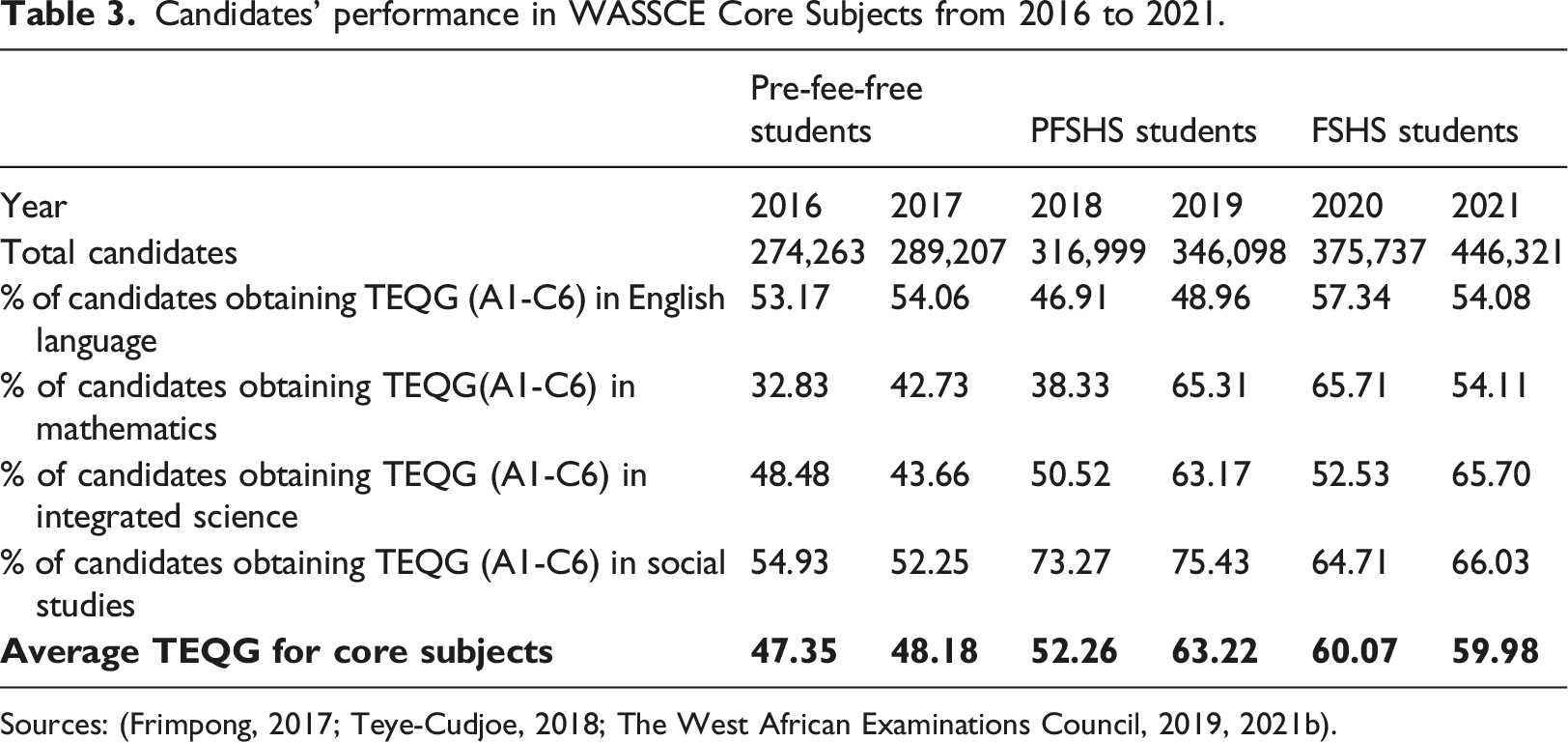
Candidates' performance in WASSCE Core Subjects from 2016 to 2021.
Discussions and conclusions
The study evaluated two fee-free policies implemented in Ghana recently at the high school level to understand the differences and commonalities in how each responded to school access at the high school level. It further examined how the concept of decentralisation reflects in the decision-making and administration of fee-free policies. We relied on Haddad and Demsky’s (1994, 1995) framework in education policymaking to guide the analytical framework of the study. The framework demonstrates its robustness to be sufficient to analyse all the major components of fee-free policymaking.
The results show that PFSHS did not respond to the first stage in the education policymaking process. The low rate of transition from basic education to SHS continued to persist compared with the pre-policy era. This could be attributed to the continuous charging of registration fees (admission fees) to all students and tuition fees to some students. This is because these two cost components are demonstrated to be the major cost barriers to school access (Bray, 2007). Parents may still not be able to afford the other direct cost even after absorbing some costs of education due to the high rate of poverty; a speculation supported by Asante (2022) and Branson and Lam (2017). FSHS, on the other hand, responded to the existing problem by reducing the proportion of students who are placed in SHS but could not enrol. It also raised the interest of many youths to have SHS education. This result is not surprising. Holistic fee-free education policies are identified to increase access to education in other jurisdictions. For example, in the United States, enrolment ratios increased from 7% in 1890 to 80% in 1990 after they introduced a holistic free secondary education (Ngware et al., 2007).
Concerning the concept of decentralisation and fee-free education, both policies paid little attention to decentralising the decision and administration of fee-free policies. Moreover, central control in school administration and decision-making increased in the current FSHS compared to the PFSHS. Existing powers that belonged to the local school administrators were relinquished to the centrally established FSHS Secretariat. This is attributed to emphasis placed on the political dimension of the policy adoption than other considerations in policymaking such as the content or process dimension (Adarkwah, 2022; Mohammed and Kuyini, 2021).
The focus on the political dimension in FSHS is attributed to the over-prioritisation of access above other considerations such as infrastructure, during the evaluation of the policy and the policy decision and planning. How students can get access – as the obvious way to demonstrate the fulfilment of a long-held campaign promise – was the focus. The cost of the FSHS policy option was not thoroughly evaluated during the ex-ante analysis, and accordingly resulted in the introduction of major surprises such as the lack of adequate school infrastructure and huge re-current expenditure during the implementation stage. Obviously, the evaluation of the policy decision – according to Haddad and Demsky (1994, 1995) – which would demand adopting some sort of bottom-up approach in the decision and planning, did not reflect in FSHS. The desirability to maintain legitimacy due to the long-held promise of free education for all, setting the national agenda at the education sub-system, compelled the NPP government to consider a holistic fee-free policy option. This is not surprising because, from a political economy perspective, free education is identified as popular and delivering political capital (Correa et al., 2020). However, the problem of access to education has two sides: demand and supply (Hunt, 2008) and fee-free policies must be formulated and implemented in relation to addressing other demand and supply dimensions.
It is important to mention that although policy actors were quick enough to introduce interventions during the policy implementation stage, as recommended by Haddad and Demsky' (1994, 1995) through leapfrogging strategies such as the double-track system, these strategies introduced other administrative challenges to school administrators. These administrative challenges in the current FSHS policy can be linked to the inadequate consultation in public policymaking in Ghana, a concern shared by Mohammed (2013). As he rightly pointed out, extensive consultation is difficult to attain since it is difficult to identify all competing interests. But in the case of FSHS, as the evidence suggests, even immediate key stakeholders including headmasters and teachers who are the school or local level implementers of the policy were not consulted during the policy formulation and decision stage. We attribute this to the centralisation of the decision-making process, which has reflected in the current legal framework under the Pre-Tertiary Education Act, 2020 (Republic of Ghana, 2020). The Act, enacted by the political administration that adopted FSHS policy, did not build on the decentralisation idea conceived under the Education Act, 2008 (Act 778) (Republic of Ghana, 2009). The centralised control of the school system raised the potential for rapid decision-making and change without obstacles. However, this also has its consequences since the over-centralisation of policy decisions leaves little room for the development of key areas which are peculiar to each institution. This ‘top-down’ decision-making in education policy has been highlighted in the past by Nudzor (2014). He argues that the adoption of education policies in Ghana is characterised by centralisation and a hierarchical structure. Our study shows that this has not changed with the recent fee-free policies. The implication of this seemingly enduring culture of administration is that while a highly centralised fee-free policy may achieve its aims to increase access in the short term, it risks losing the gains made in the long term; a concern similarly echoed by Walton (2019).
Policy implication for FSHS policy
Although the implementation of the current FSHS policy has resulted in an increase in access, the policy would, notwithstanding, require further investments by government in order to sustain the increasing enrolment rates at the high school level. Critical areas of investment should include regular and broader consultations between policymakers and local level implementers (headteachers and teachers), and the adoption of the bottom-up approach particularly in respect of decisions on what costs need to be absorbed and for whom. Also importantly, critical investment is needed for available and safe infrastructure and the timely release of funds for recurrent expenditure. We believe this can be achieved by re-assessing the sources of funding for the policy.
With knowledge of Haddad and Demsky’s (1994: 23–24) framework on evaluation of policy options (affordability - monetary cost) and field interviews, we propose two re-assessment and redesign options. Firstly, the government can create a dedicated revenue source for the policy. This is to ensure consistent revenue generation for the policy for recurrent expenditure on the one hand, and investment in infrastructural development to catch up with the increasing demand for high school education, on the other hand. Low-hanging options in this respect can be the creation of an FSHS levy on, for instance, imported goods, and/or a dedicated percentage of Value Added Tax (VAT) on goods and services for FSHS. Secondly, the government can improve the proximity of school supplies to students and increase the availability of day-school facilities to offer more school choices to students after basic education. In this way, the government can invite consumers of the policy (parents and students) who opt for boarding status to absorb the proportion of boarding fees to enhance the affordability of the policy on the part of the government. Inviting consumers of boarding facilities to absorb the difference in feeding fees due to boarding status extends the concept of equity in the policy. This is because parents of day students currently bear the cost of renting nearby accommodation for their wards, the cost of transportation to school for their wards and the cost of living on their own or in their homes.
Furthermore, empirical evidence suggests that the quality of academic performance on modified school calendars is poor, especially in the first few years of implementation (Cooper et al., 2003; Graves, 2010). The first batch of double track students saw a decline in the overall performance of their exit exams compared to the previous year. In this regard, students' academic performance needs to be monitored and appropriate interventions implemented.
Limitations and implications for further research
Students from the JHS level are inputs for the SHS level. Having the opportunity and the ability to write and pass the BECE exams is the only means to qualify for SHS education. This study could not assess the prevalent conditions surrounding this level of study. Further studies may take a step back about how fee-free policy addresses or is addressing the challenges faced in writing and passing BECE exams. Furthermore, we are aware other studies have looked at the effects of fee-free policies on enrolment across the SSA region (see Asante, 2022). However, it is important to study the trend in individual countries such as Ghana. Since the current study did not focus on quantitative analysis, further studies may use time series analysis to assess the impact of fee-free policies on enrolment before and during the implementation of the two fee-free policies. Also, the study could not delve into the impact assessment in terms of the external efficiency (relevance) of the two fee-free policies. External efficiency here relates to how the policy responded or will respond to job market demands. Beneficiaries of PFSHS could be compared with the previous pre-fee-free policy era to evaluate how each group successfully incorporated or gained access to the job market. This could add to the impact assessment dimension of fee-free policies. Furthermore, many stages of Haddad and Demsky’s framework do not reflect in fee-free policies in Ghana. This presents an opportunity to apply policy change theories to understand the motivations and the drivers that cause major policy shifts in the education sub-sector in Ghana. Finally, researchers can also exploit mechanisms to improve the quality of education amid modified academic calendars.
Footnotes
Acknowledgement
We are grateful to all the interview participants who willingly agreed to take part in the interview. We also thank the Ministry of Education of Ghana for making the necessary secondary data available to us.
Declaration of conflicting interests
The author(s) declared no potential conflicts of interest with respect to the research, authorship, and/or publication of this article.
Funding
The author(s) received no financial support for the research, authorship, and/or publication of this article.
