



Abstract
This article draws on existing research, including publicly available data, to identify changes in Colombian HE which have led to its progressive massification and neoliberalisation. These include the introduction of standardised testing; endogenous and exogenous privatisation (Ball and Youdell, 2007); the expansion of the country’s non-income contingent loan scheme; cost-cutting and cost-sharing; and the Government of Colombia’s prioritisation of technical and technological (T&T) education. The article then explores some implications of this neoliberal massification of Colombian HE for the achievement of the UN’s sustainable development goals in general and more specifically Sustainable Development Target 4.3, which is the only target to explicitly reference inclusion in HE. The analysis suggests that although some neoliberal policies may have broadened access to HE for some Colombians from low-income and rural backgrounds, they are not consistent with a sustainable development agenda. Reasons for this include the large number of student loans recipients who are in arrears; the use of public money to finance students’ courses in private higher education institutions (HEIs); the prioritisation of T&T education which leaves limited room in Colombian HE for the ‘full development of the human personality’ (OHCHR, 2022: article 13.1); and the country’s overreliance on non-renewable resources for its economic prosperity. The paper ends with some proposals for disrupting the ongoing neoliberalisation of higher learning in Colombia such as the replacement of the country’s non-contingent loan scheme with an income-contingent model; improving the efficiency and accountability of state-run T&T programmes; the granting of student loans only for courses at accredited HEIs; the provision of loans to accredited private HEIs only in cases where no public alternative exists; the abolition of tuition fees in public HEIs for the poorest students; the introduction of stipend-supported internships; and the promotion of Civic Education.
Introduction
Traditionally, access to higher education (HE) in low- and middle-income countries was limited to the wealthiest members of society (Schendel and McCowan, 2016). However, in recent decades HE worldwide has experienced unprecedented levels of growth, a great deal of which is occurring in the global South, including in Colombia, the focus of this paper (Altbach, 2013; Marginson, 2018). For example, the participation of 17–21 year olds in post-secondary education in Colombia increased from 25.8% in 2004 to 52% in 2018 (MEN [Ministerio de Educación Nacional de Colombia], 2019), 1 and between 2001 and 2011 the number of programmes on offer doubled (Camacho et al., 2016). The introduction of neoliberal reforms at the urging of intergovernmental organisations such as the World Bank, the OECD and the WTO has played a key role in shaping this process of expansion (Castillo, 2013; Cruz, 2012). This neoliberal massification of Colombian HE has potential consequences for Colombia’s attainment of the UN’s Sustainable Development Goals (SDGs), and particularly for its progress towards Sustainable Development Target (SDT) 4.3, which aims by 2030 to ‘ensure equal access for all women and men to affordable and quality technical, vocational and tertiary education, including university’ (UN, 2015: 21).
In light of the above, the research questions which the current paper seeks to address are as follows: • How has neoliberal ideology shaped the expansion of Colombian HE in recent decades? • How might this impact the country’s progress towards Sustainable Development Target 4.3?
As we seek to make sense of the ways in which neoliberalism shapes HE globally, and given its capacity ‘to transform and adapt to local contexts and culturally situated circumstances’ (Cannella and Koro-Ljungberg, 2017: 156), addressing these questions adds to the existing literature by enhancing our understanding of how this complex and remarkably resilient ideology operates in Colombia. As such, it can inform responses that help interrupt neoliberalism, or, at the very least, mitigate its more harmful effects. In addition, this paper may be the first to consider the potential impact of a neoliberal HE agenda for the attainment of SDT 4.3, which is the only SDT to explicitly reference inclusion in HE. This target is particularly important in the Colombian context for at least three reasons. First, HE in the country is deeply unequal. This is reflected, for example, in the overrepresentation of students from the wealthiest income quintile in private HEIs in Colombia and their underrepresentation in cheaper, lower-quality institutions (UNESCO, 2022a). An even more unequal picture emerges when we consider young people from rural Colombia, who are even less likely to both attend and graduate from HE than the least well-off (UNESCO, 2022a). Second, as stated by the International Covenant on Economic, Social and Cultural Rights, which has been widely ratified and underpins the UN’s Sustainable Development Agenda (UN, 2019), accessible HE can contribute to the ‘full development of the human personality and the sense of its dignity, and shall strengthen the respect for human rights and fundamental freedoms’ (OHCHR, 2022: article 13.1). In a country in which, even after decades of civil war and the signing of the peace accords in 2016, armed violence and human rights abuses continue to be perpetrated by both state and non-state actors, quality HE could play a key role in forging a lasting peace, addressing injustice and consolidating democracy (Carvajal, 2020; Human Rights Watch, 2022; Novelli, 2010). Finally, Colombia was influential in the formulation of the original SDGs and has integrated them into its Plans for National Development (PND) for 2018–2022 and 2022–2026, respectively, thus affirming its commitment to the 2030 Agenda (Departamento Nacional de Planeación 2 [DNP], n.d.; DNP 2023; SEI, 2022). The PNDs, which correspond to the length of a presidential term, establish the newly elected government’s development priorities (OECD, 2016). With the launch of a new Plan for National Development in the offing under the presidency of the country’s first ever left-wing president, Gustavo Petro, an account of the neoliberal massification of Colombian HE and its implications for the SDT 4.3 is therefore particularly timely.
This paper is divided into five main sections. The theoretical framework below outlines key characteristics of the neoliberal turn in HE and introduces concepts which help us to better understand neoliberalism in the Colombian HE context. The third section provides a brief history of HE in Colombia before identifying developments which have facilitated its neoliberalisation. In doing so it draws on existing research, including publicly available data from the World Inequality Database on Education (WIDE), the Colombian Ministry of Education (MEN) and the Instituto Colombiano de Crédito Educativo y Estudios Técnicos en el Exterior 3 (ICETEX), the country’s student loans provider. Following this, the paper explores the implications of these developments for attaining SDT 4.3 in particular and the SDGs more generally. The paper ends by summarising this paper’s conclusions and discussing potential policy options.
Theoretical framework
The origins of neoliberalism can be traced back to the governments of Thatcher and Reagan in the UK and the US, respectively, and the ideas of the Washington consensus (Tight, 2019). These ideas gradually took hold in the rest of the world in large part thanks to steering influence of transnational organisations based in the global North including the Inter-American Development Bank, the IMF, the WTO, the World Bank and the OECD (Maisuria and Cole, 2017; Schugurensky, 2007; Tight, 2019). Put simply, neoliberalism can be viewed as a more pernicious and extreme version of capitalism which places economic imperatives over all other considerations (Cannella and Koro-Ljungberg, 2017; Cole and Heinecke, 2020; Giroux, 2005). However, as Saunders and Ramirez (2017: 189) explain, differing understandings of this ideology ‘reflect the broad reach of capitalism within our world, the uneven development of capitalist projects, and the meaningfully different and changing material contexts in which neoliberalism attempts to operate’. Thus, critics of neoliberalism in different settings will highlight different features of this ideology, depending on their purpose (Cannella and Koro-Ljungberg, 2017; Cannizzo, 2018; Saunders and Ramirez, 2017). Accordingly, this article does not provide a comprehensive account of neoliberalism, but rather focuses on the following overlapping and interrelated aspects of neoliberalism which are particularly useful for enhancing our understanding of the Colombian HE context.
Privatisation
Privatisation is a cornerstone of the neoliberal agenda globally, and has been widely adopted in HE as a way of addressing the massive growth of the sector in recent years (Cannizzo, 2018; Maisuria and Cole, 2017; Mintz, 2021; Schendel and McCowan, 2016). According to Ball and Youdell (2007), privatisation in education tends to be covert and is justified on the grounds that it furnishes students with greater choice while also improving the accountability and efficiency of educational provision. These authors helpfully differentiate between privatisation in and privatisation of public education. The former, which they call endogenous, involves ‘importing ideas, techniques and practices from the private sector in order to make the public sector more like business and more business-like’ (Ball and Youdell, 2007: 8–9); while the latter, which they refer to as exogenous, involves ‘the opening up of public education services to private sector participation on a for-profit basis and using the private sector to design, manage or deliver aspects of public education’ (Ball and Youdell, 2007: 9). Ball and Youdell (2007) highlight how these forms of privatisation, which have become hegemonic in education systems globally, in part as a result of the leverage of global players such as the World Bank, the WTO and the OECD, have their origins in neoliberalism. Not only does privatisation have negative implications for equitable educational access, but it also plays its part in the ‘“commodification” of education whereby it becomes regarded solely in terms of its exchange-value rather than its intrinsic worth, or social purposes’ (Ball and Youdell, 2007: 58). Such privatisation, the authors argue, is increasingly accepted as ‘“common sense” or orthodoxy’ (2007: 35) and helps create state-regulated education markets wherein students are positioned as self-interested clients competing against one another for access. This competitive element, which undergirds the neoliberal project in education, not only pits students against each other, but also HEIs (Maisuria and Cole, 2017).
Cost-cutting and cost-sharing
As Courtney and Lee-Piggott (2022) have noted, the underfunding of public education can serve as a pretext for the imposition of a privatising agenda. As they go on to explain, ‘this may be discursively framed as shrinking the state to enable the private sector to enter and flourish’ (48). Thus, in the interests of cutting costs and balancing the books, many governments under-invest in education, allowing the private sector to step in and fill the breach. In many education systems globally, this has resulted in the introduction of cost-sharing policies in the form of tuition fees often on the premise that, since students stand to personally gain from HE in the form of greater returns for their labour, they should also bear a greater share of the financial burden (Cruz, 2012; Giroux, 2011; Maisuria and Cole, 2017; Rabossi, 2009). Thus, the neoliberal policies of cost-cutting and cost-sharing are mutually supportive and help to position students as client-investors motivated by self-interest (Cannella and Koro-Ljungberg, 2017; Saunders and Ramirez, 2017). As might be expected, this is leading to tuition fee hikes as HEIs seek to generate enough income to cover their costs (Cannizzo, 2018; Mintz, 2021).
Instrumentalisation, human capital theory and responsibilisation
As alluded to above, neoliberal policies of privatisation, cost-cutting, and cost-sharing are also contributing to the instrumentalisation of HE since they encourage a reductive view of education as only valuable insofar as it yields economic benefits (Cannella and Koro-Ljungberg, 2017; Saunders and Ramirez, 2017). This instrumental view is informed by human capital theory which holds that a higher proportion of graduates from post-secondary education in a country’s workforce translates into greater productivity and economic growth for the nation, and increased earnings and employment opportunities for the individual (Cole and Heinecke, 2020; Klees, 2020; Moodie et al., 2019). Thus, in neoliberal HE, the individual is constructed ‘as human capital, as an entrepreneurial self’ (Cannella and Koro-Ljungberg, 2017: 155) with any skills or capacities that do not increase returns or enhance employability seen as having little or no value (Cole and Heinecke, 2020; Klees, 2020). Higher education, in such a panorama, is no longer considered a public good but is instead reconceptualised as a private privilege undertaken for the benefit of the individual rather than society (Giroux, 2011; Maisuria and Cole, 2017; Saunders and Ramirez, 2017). This positions students as client-entrepreneurs who are solely responsible for their own success or failure within the education system (Cannella and Koro-Ljungberg, 2017; Cole and Heinecke, 2020; Mintz, 2021). Following this neoliberal logic, inequality is not located in structural factors, nor in personal circumstances, experiences or attributes, but rather in the actions of the self-interested individual (Saunders and Ramirez, 2017).
Competition ethos
The conceptualisation of the individual as self-interested also extends to HEIs which, in a neoliberal landscape, compete against each other for funding and students (Dougherty and Natow, 2019; Mintz, 2021). This competition ethos is promoted by neoliberalism in the interests of improving the efficiency and thus, by extension, the balance sheets of HEIs (Dougherty and Natow, 2019). This means that the wealthiest students are often preferred by elite institutions as they are unlikely to default on their tuition fees, while poorer students are unable to afford the spiralling costs of attending such institutions (Mintz, 2021). Similarly, student-entrepreneurs compete against each other for access to the most prestigious universities which will help them stand out from their peers when entering the competitive employment market (Mintz, 2021). In such a panorama, entry grades assume greater importance as a means of selecting the most suitable students. All of this is resulting in greater stratification and inequality which is often (falsely) justified on the grounds that this neoliberal competition ethos is meritocratic and allows for greater student choice (Dougherty and Natow, 2019; Mintz, 2021).
Having outlined some key features of neoliberalism which can help us better understand how this ideology has informed HE in Colombia, I now briefly trace the history of HE in the country. Following this, I draw on existing research and publicly available data from WIDE, ICETEX and the MEN a) to show how neoliberalism has undergirded the expansion of Colombia HE in recent years, and b) to highlight potential implications for meeting SDT4.3.
A brief history of HE in Colombia
The first universities in Colombia were established during the colonial period for the benefit of the elites (Levy, 1986; Montenegro, 1994). In this era the Catholic Church played a key role, and many institutions of higher learning were led or organised by religious orders (Levy, 1986; Montenegro, 1994). The post-independence period brought with it the challenge of building an independent Colombian Republic, which would require the assistance of a cadre of educated professionals (Melo et al., 2017). This led to the founding of several public universities, though these remained subject to the influence of the Church until the 1930s (Levy, 1986; Montenegro, 1994). This period also saw the establishment of the first private universities in Colombia, which, in contrast to other countries in Latin America, constituted a secular reaction to religious dominance in the public sector (Levy, 1986). In the 1930s, when the Government of Colombia (GoC) finally decreed a separation of Church and State in public HEIs, the Catholics reacted by founding private universities. The 1930s also marked the beginning of a period of modernisation and urbanisation in Colombia, which was accompanied by a considerable increase in both public and private HE enrolments (Melo et al., 2017; Montenegro, 1994). In response, the ruling classes sought refuge in elite private universities (Levy, 1986). In spite of this expansion, then, as now, the benefits of HE disproportionately accrued to the wealthy (Mendoza et al., 2021; Montenegro, 1994). During this period of growth from the 1930s to the 1970s the Servicio Nacional de Aprendizaje 4 (SENA) and the student loans institute ICETEX were established (Melo et al., 2017). The former, which is part of the Ministry of Labour but operates relatively autonomously, offers free or low-cost apprenticeships and vocational training and is funded by a 2% tax on employers’ payrolls, while the latter is the largest provider of student loans in the country (OECD, 2016; World Bank, 2013).
The neoliberal turn in Colombian HE
As in other countries and education systems, it is hard to say with any certainty exactly when neoliberalism became hegemonic in Colombian HE, in part because several developments together contributed to this neoliberal turn (Maisuria and Cole, 2017). The first of these is the introduction in 1980 of the Saber 11 test for school-leavers (Camacho et al., 2016). While ostensibly used to gauge educational quality, for those aspiring to higher study this test primarily performs a gatekeeping function as results are used by HEIs to select suitable applicants (Bernala and Penney, 2019; Ferreyra et al., 2017). This test has facilitated the neoliberalisation of HE in Colombia by inculcating a competitive ethos into the admissions process. This ethos also permeates Colombian HE as a result of several other developments: the passing of Law 30 in 1992 and the General Law of Education in 1994; and the introduction of compulsory testing of HE students in 2009 by means of the Saber Pro. The first of these, as specified in Law 30 of 1992, not only allowed private sector institutions to compete with the public sector, but also guaranteed greater autonomy to HEIs, allowing them to self-certify the quality of their courses (Melo et al., 2017; MEN, 1992; Mendoza et al., 2021; UNESCO, 2022b). As Henry and Beserra (2022: 3) explain, this relinquishing to educational markets of the ‘state’s historic responsibility for evaluating and accrediting…new institutions’ is a key neoliberal policy in the region, and, as elsewhere in Latin America, has precipitated exogenous privatisation by facilitating the entry of private providers into the HE sector in the country, many of which only meet the less than rigorous minimum quality standards (Ball and Youdell, 2007; Henry and Beserra, 2022; Mendoza et al., 2021; UNESCO, 2023).
The second development, the passing of the General Law of Education in 1994, established education in the country as a profit-generating service rather than a public good, which has led to a retreat of the State from its role as ‘guarantor of the right to quality education’ (Rubiano, 2013: 576). It is perhaps not by chance that this legislation coincided with the introduction in 1995 of the General Agreement on Trade and Services by the WTO, which, undergirded by neoliberal principles, also established HE as a service to be traded (Guimarães-Iosif and Santos, 2016; Schugurensky, 2007).
A third development, the introduction of the Saber Pro exam, made Colombia only the second country in Latin America and the Caribbean after Brazil to introduce compulsory testing of HE students (Camacho et al., 2016; Ferreyra et al., 2017). Performance on this exam is used as a measure of educational quality and has a bearing on the rankings of HEIs as the results are publicly available (Domingue et al., 2017; Ferreyra et al., 2017). This exam has contributed to the neoliberalisation of HE in Colombia since it informs the choices of self-interested student-entrepreneurs regarding where best to invest their tuition fees.
Together these three developments have contributed to the neoliberalisation of HE in Colombia by inculcating the notion of HE as a competitive market wherein operators of varying quality vie for the business of prospective student-customers by offering them a range of differentiated services and educational pathways (Moodie et al., 2019; Pinilla, 2011a).
Massification and endogenous Privatisation in Colombian HE
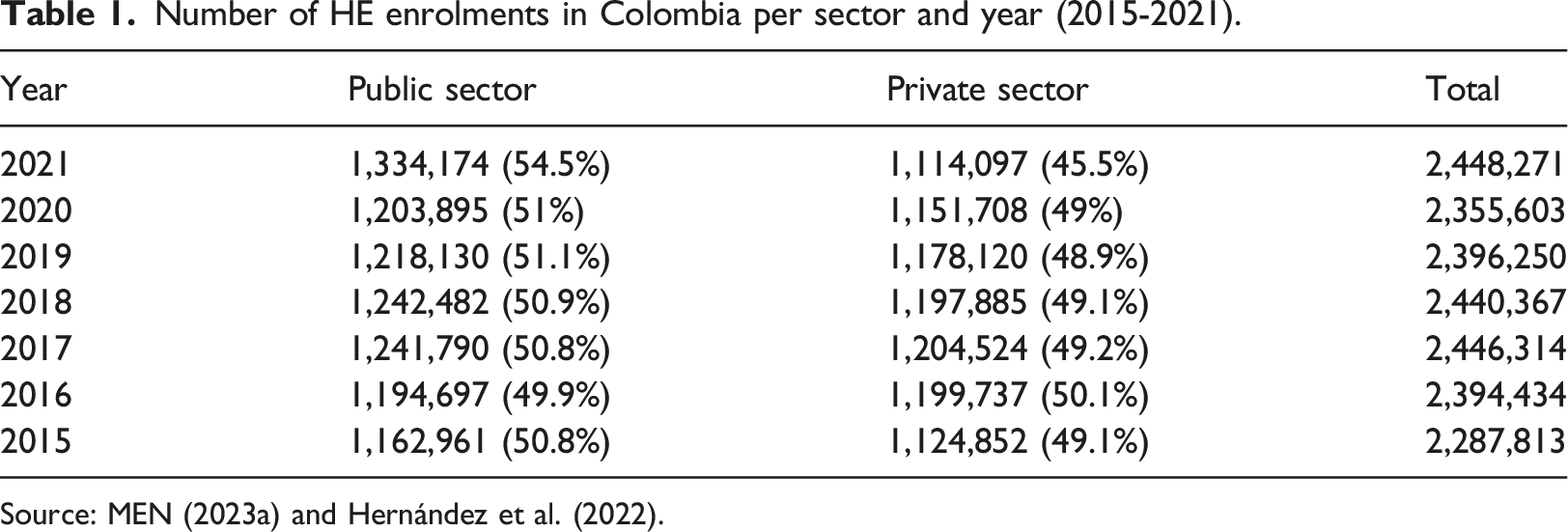
Number of HE enrolments in Colombia per sector and year (2015-2021).
Source: MEN (2023a) and Hernández et al. (2022).
On the face of it, the above figures might suggest that Colombian HE has been shielded from privatisation processes which have characterised neoliberal HE reforms elsewhere (Schendel and McCowan, 2016), but this can be attributed to at least three developments. First, public universities expanded their offering of undergraduate courses to accommodate a growth in admissions, with enrolments more than tripling between 1993 and 2011 (Jaramillo et al., 2012). Second, with a view to expanding coverage in rural areas, the GoC has promoted the growth of virtual or blended programmes such as those offered by the state-funded Universidad Nacional Abierta y Distancia 5 (Ferreyra et al., 2017; Melo et al., 2017). This helps explain the disproportionate increase in distance HE from 8.5% in 2000 to 14.2% in 2013 as well as some of the upsurge in rural enrolments (Ferreyra et al., 2017). However, some of the HE access gains in rural areas in the last two decades are also a result of the GoC’s plan to bring HE to neglected communities through the establishment of Centros Regionales para Educación Superior 6 (CERES) in 2003 (Ferreyra et al., 2017; OECD, 2016; World Bank, 2013). The third development, the passing of Law 30 of 1992, transformed the HE system by broadening the definition of HE 7 to include all academic and professional education completed after secondary school (MEN, 1992). As a result, the free short-cycle vocational courses offered by the public institution SENA are also counted as part of the country’s HE provision (Mendoza et al., 2021). Crucially, this public institution experienced a tenfold increase in enrolments from just under 50,000 in 2003 to nearly 430,000 in 2015, accounting for around half of all students pursuing technical and technological (T&T) post-secondary education in the country (Ferreyra et al., 2017; Melo et al., 2017; OECD, 2016).
Taken together, these developments highlight the important role the State has played in increasing HE enrolments in Colombia. At the same time, compared to the global average of 33%, the level of privatisation of Colombian HE is relatively high, which is a key concern due to the role the private sector can play in reproducing inequality in upper-middle-income countries (Bruckner, 2020; UNESCO, 2022b). Moreover, many of the GoC’s interventions in HE have been in accordance with neoliberal logic. For example, while public university enrolments have soared since Law 30 of 1992 was passed, this law tied HE funding to the country’s economic growth in order to make these institutions more fiscally responsible and thus enable the GoC to service more of its debt (Galindo et al., 2015; Rabossi, 2009). However, this policy failed to take into account key considerations such as rising admissions; internationalisation processes; technical upgrades; and the importance of improving quality standards, including greater professionalisation of the teaching cohort (Castillo, 2013; Jaramillo et al., 2012; World Bank, 2018). As such, public universities in Colombia, as in other parts of Latin America, have been forced to make difficult decisions due to financial deficits which amounted to USD$5.7 billion in 2018 (Henry and Beserra, 2022; WENR, 2020). This, as Courtney and Lee-Piggott (2022) have noted, can serve as a pretext for the imposition of a privatising agenda. Thus, perhaps unsurprisingly, the underfunding of HE in Colombia has led to the closure of some public universities; the implementation of cost-cutting measures; alliances with private enterprises; and increased competition for the limited number of public university places on offer (Galindo et al., 2015; Hylton et al., 2018; Jaramillo, 2010; World Bank, 2018). It has also led to the introduction of tuition fees or cost-sharing in public universities in the country (Ball and Youdell, 2007; Cruz, 2012; Rabossi, 2009). This underfunding of public universities is therefore leading to endogenous privatisation which entails ‘the importing of ideas, techniques and practices from the private sector in order to make the public sector more like business and business-like’ (Ball and Youdell, 2007: 8–9). Given this privatisation in public HEIs in Colombia (Ball and Youdell, 2007), it should come as no surprise that much of the learning content for the state-funded CERES courses was developed by for-profit organisations, and that participants must pay for these courses (World Bank, 2013). This endogenous privatisation is also reflected in the increasing financial autonomy of public universities which generated 45% of their own income in 2010 compared to only 18% in 1993 (World Bank, 2013).
Student finance
Another way in which HE in Colombia is being privatised is through initiatives which have ostensibly aimed to increase the participation of HE students from low-income households. This includes the Ser Pilo Paga 8 (SPP) programme and the credit lines offered by the country’s largest student loans provider, ICETEX. With regards to the former, SPP was launched in 2014 to broaden access to HE by offering scholarships to economically disadvantaged students achieving the highest grades on the high school leaving exam, Saber 11 (Bernala and Penney, 2019). SPP, while financing the studies of roughly 10,000 students of low socio-economic status per year until its discontinuation in 2018, predominantly granted access to private HEIs (Bernala and Penney, 2019; WENR, 2020). This use of the private sector to ‘deliver aspects of public education’ is in line with a neoliberal policy agenda and constitutes an example of exogenous privatisation (Ball and Youdell, 2007) which is hard to justify given the budget deficits of public HEIs. Fortunately, SPP was discontinued in 2018 following mass student demonstrations (WENR, 2020).
With regards to ICETEX, this autonomous financial institution, which is affiliated to the Ministry of Education, aims to ‘guarantee subsidies to enable the access and retention of students from estratos
9
1, 2 and 3 in HE’ (ICETEX, n.d.a). However, such ‘subsidies’ consist of non-income contingent student loans, which must be paid back within a certain time frame regardless of loanees’ earnings (Mackenzie, 2022; MEN, 209). These loans help account for some of the expansion of HE provision to those from the lowest socio-economic strata since, with the help of a World Bank loan, ICETEX was able to reduce interest rates and relax lending requirements on its ‘portfolio of products and services’ (ICETEX, 2016: 11) allowing an additional 400,000 ‘clients’ (ICETEX, 2016: 9) to commence their HE studies during 2012 and 2017 (World Bank, 2020). As Figure 1 below shows, though, the vast majority of ICETEX’s loan beneficiaries since 2015 have chosen to study in the private sector. While this is perhaps understandable given that many public HEIs are under-resourced and are prone to lengthy strikes, devolving responsibility to the individual for investing in their human capital in an HEI of their choice reflects the neoliberal framing of students as self-interested client-entrepreneurs. This neoliberal discourse is evident in the name of the ICETEX loan scheme Tu Eliges (You Choose), which was launched in 2016 to enable loan recipients to cover all their tuition fee costs in either a public or private sector HEI (MEN, 2016). The use of public money to finance individuals’ studies in private institutions, ostensibly in the interests of offering greater choice to student-consumers, constitutes another example of hidden privatisation (Ball and Youdell, 2007). Meanwhile public HEIs are facing a funding crisis which is increasing competition among economically disadvantaged students for the limited number of places available in public sector institutions (Hylton et al., 2018; Mackenzie, 2022). This suggests that in Colombia, as in the rest of Latin America, the private sector may be exacerbating inequalities (Buckner, 2020). ICETEX loan beneficiaries 2015-2022. Source: ICETEX (2022).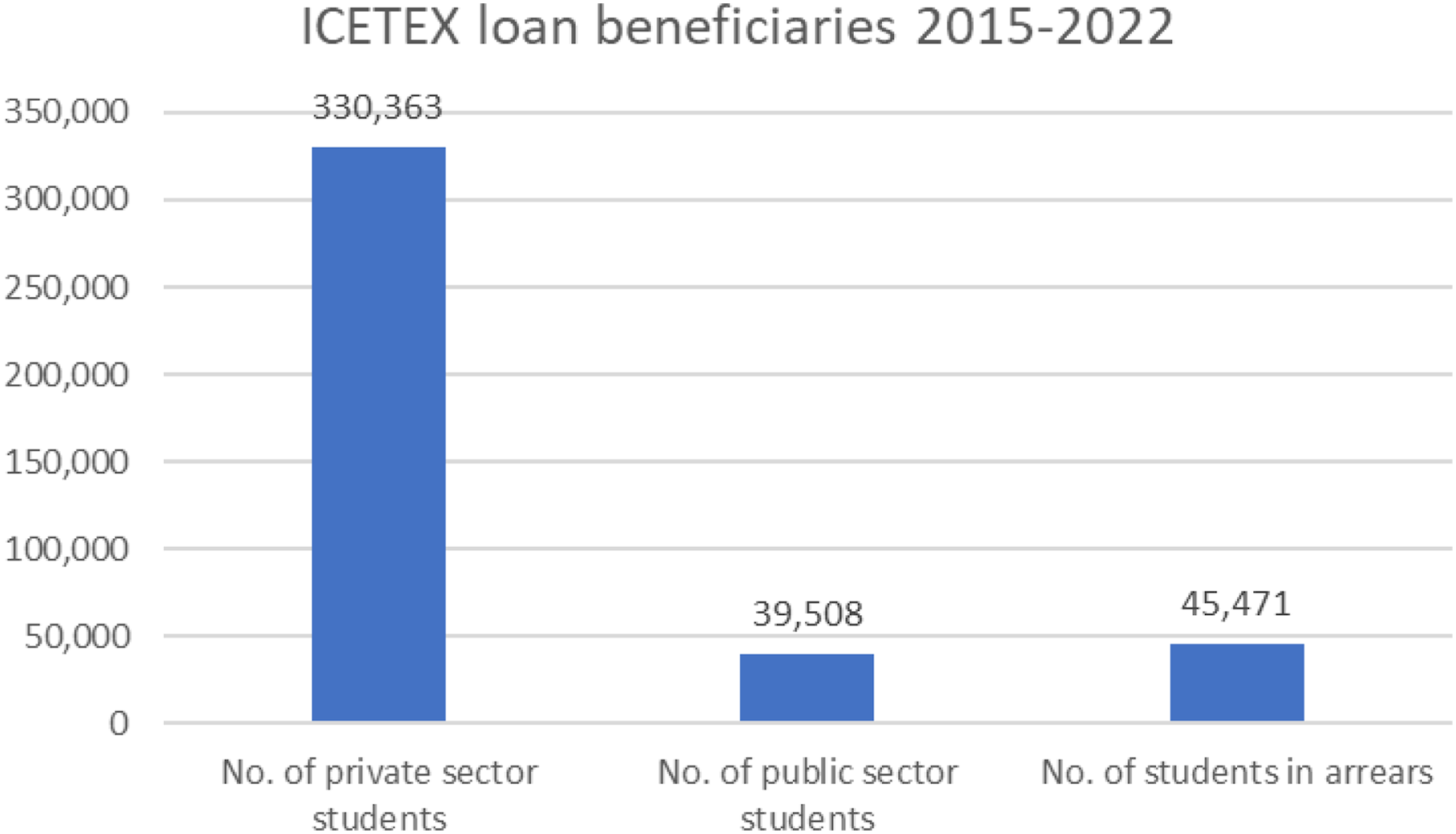
ICETEX supports a neoliberal policy agenda not only by indirectly financing private HEIs in Colombia, but also by positioning students as client-entrepreneurs who aim to maximise returns on their investment upon entering the workplace (Galindo et al., 2015; Mackenzie, 2022). This is evident both in ICETEX’s description of students as ‘clients’ and loans as a ‘portfolio of products and services’ as well as in the stringent conditions loan recipients must meet. These conditions include the endorsement of a financially solvent co-debtor who must have a positive credit history and permanent residence in Colombia; maintaining a grade point average during one’s studies of 0.4 higher than the minimum passing grade; and interest rates which are less advantageous than those offered for mortgages in the country (ICETEX, n.d.b; Mackenzie, 2022). Such conditions help explain why in 2018 270,000 loan recipients reported that they were struggling to keep up with payments (Séptimo Día, 2018). Indeed, as Figure 1 also shows, more than 10% of ICETEX loan recipients since 2015 have defaulted on their loan repayments for a period of more than 30 days, which, although far fewer than the 22.9% of non-performing loans reported in 2013, is still an unsustainable figure (World Bank, 2017). Thus, in line with a neoliberal orientation to HE, the logic underpinning ICETEX appears to be one of fiscal responsibility whereby self-interested individuals are accountable for investing in their own human capital irrespective of structural factors or personal circumstances which may make loan repayments difficult or impossible (Séptimo Día, 2018).
Understandably, the risks involved in taking out such loans may lead some recipients to opt for careers that will enable them to pay off their debt while others may feel that such loans do not represent a sound investment and may simply choose to enter the job market directly without having obtained a relevant HE qualification (Galindo et al., 2015; Mackenzie, 2022; World Bank, 2021). Indeed, as Schugurensky (2007: 62) notes ‘even if some sort of loan system is in place, students from lower-income families are less likely to contract debt in order to attend university’. This view is also shared by the World Bank (2021: 7) who write that in Colombia ‘high reliance on private provision and student loans results in high repayment burdens that limit the demand for student loans for low-income families’. For this reason, they recommend that income-contingent loans be implemented in order to remove ‘remaining access barriers for tertiary education in an equitable and sustainable manner’ (World Bank, 2021: 28). Interestingly, this recommendation implies a tacit acknowledgement of the flaws of the current system and is somewhat at odds both with the Bank’s (2013: 14) own description of ICETEX as ‘a world-class student loan institution’ as well as with their decision in 2017 to grant tens of millions of dollars in loans in support of the non-income contingent Tu Eliges loan scheme (World Bank, 2017).
Human capital and the instrumentalisation of Colombian HE
The introduction of tuition fees in public universities, together with the borrowing conditions and repayment structure of ICETEX ‘products’, may be contributing not only to the endogenous privatisation of higher learning in Colombia, but also to its instrumentalisation. This is because studying in Colombian HE may incur a high cost for the individual, which typically range from less than a hundred dollars per semester at public universities to over ten thousand dollars per semester in the private sector, depending on the institution or programme (Mendoza et al., 2021; WENR, 2020). In light of this, it is understandable that many prospective students opt to pursue careers with greater earning potential, which may partly explain why in 2021 less than 4% of HE students were enrolled in Arts and Humanities subjects (MEN, 2023a). It also stands to reason that poor students in particular may place a greater emphasis on the instrumental value of HE given the role that it can play in fostering social mobility in one of the most unequal societies in the world (Serrano, 2018). This is reflected in the overrepresentation of economically disadvantaged students in fields which serve to advance Colombia’s economic growth (Domingue et al., 2017; MEN, 2023a).
This instrumentalisation is also evident in the GoC’s prioritisation of T&T education as reflected in the huge expansion of SENA courses in recent years (Galindo et al., 2015; Mendoza et al., 2021). While ostensibly bucking the trend towards privatisation, this expansion is also consistent with neoliberal principles, not least because it was largely driven by the spike in demand for technicians following the neoliberalisation of the economy in the 1990s (Ferreyra et al., 2017; OECD, 2016; World Bank, 2013). This neoliberal emphasis on education as training for the workplace, which Ball (2016: 1047) has described as ‘the economisation of education’, is consistent with human capital theory and is supported by transnational organisations such as the OECD and the World Bank (Henry and Beserra, 2022; Moodie et al., 2019; OECD, 2016). For example, the World Bank, which provides more educational funding to developing countries than any other organisation, has stated that the primary purpose of SENA and other technological and technical HEIs is to ‘develop the required human capital for Colombia’s economic growth’ (World Bank, 2013: 168), and urges Colombia to align its HE system with ‘market needs’ (World Bank, 2015: 10). Similarly, the OECD (2016: 274), a key advocate of the neoliberal globalisation agenda, claims that, ‘if efforts to improve TE coverage are to help reduce socio-economic disparities between regions, it will be crucial that programmes meet the demands of local economies’. As this quote demonstrates, a reductive view of HE is rationalised as a key means of addressing inequality. Here, the neoliberal mantra of restructuring HE to meet the needs of the economy is justified on social justice grounds (McCarthy et al., 2009). From this perspective, the assumption is that only HE which satisfies a region’s employment needs, regardless of the quality or type of employment, will lead to a more equitable society. Thus, in line with the dictates of neoliberalism, Colombian HE is increasingly conceptualised as a form of vocational training which undermines non-instrumental forms of learning (Giroux, 2015; McCarthy et al., 2009; Pinilla, 2011b).
Summing up, Colombia has massively expanded its HE provision in recent decades. Parallel to this development, the sector has also undergone a process of neoliberalisation. This has included offering scholarships to economically disadvantaged students to study in private HEIs, which constitutes a form of exogenous privatisation. It also includes the introduction of standardised tests which HE students take prior to commencing their HE studies (Saber 11) and prior to their graduation (Saber Pro). These tests have inculcated an ethos of competition into Colombian HE, which is characteristic of neoliberalism. However, while the former test encourages prospective students to compete for access to HE based on their own performance, the latter encourages competition between HEIs as test scores are publicly available to prospective ‘clients’ who are seeking to make the best return on their investment. In public universities neoliberal policies have included the introduction of economic efficiency measures such as private sector partnerships, cost-cutting and cost-sharing. Such measures are an example of endogenous privatisation, which has generated unsustainable deficits and has led to the closure of some public HEIs. This, in turn, serves to justify exogenous privatisation of the sector as the shrinking state ‘enables the private sector to enter and flourish’ (Courtney and Lee-Piggot, 2022). This highlights an interesting feature of neoliberalism: the sanctioning of state intervention not to promote HE as a public good, but rather to make the sector ‘more business-like and more like businesses’ (Ball, 2016: 1049). Such privatisation has been facilitated by the passing of the General Law of Education in 1994, which established the notion of education as a private service rather than a public good. Yet despite this, as we have seen, the proportion of students in private and public HEIs has remained relatively stable in recent years. One reason for this is the prioritisation of state-funded T&T higher education in order to meet the needs of the globalising Colombian economy, which is consistent with a neoliberal agenda, and is contributing to the ‘economisation of education’ (Ball, 2016) in the country. Another is the GoC’s expansion of its non-income contingent student loan scheme through ICETEX. This scheme has also contributed to the neoliberalisation of the sector as it positions students as client-investors, which, in turn, is instrumentalising the role of HE in Colombia as students opt for careers that are more financially rewarding. Moreover, as ICETEX students often use loans to subsidise their studies in the private sector, this loan scheme further facilitates the privatisation of Colombian HE by siphoning public money into private HEIs. But what are the implications of these neoliberal developments in Colombian HE for the realisation of the SDGs in general, and SDT 4.3 in particular? These are explored below.
Implications for achieving sustainable development
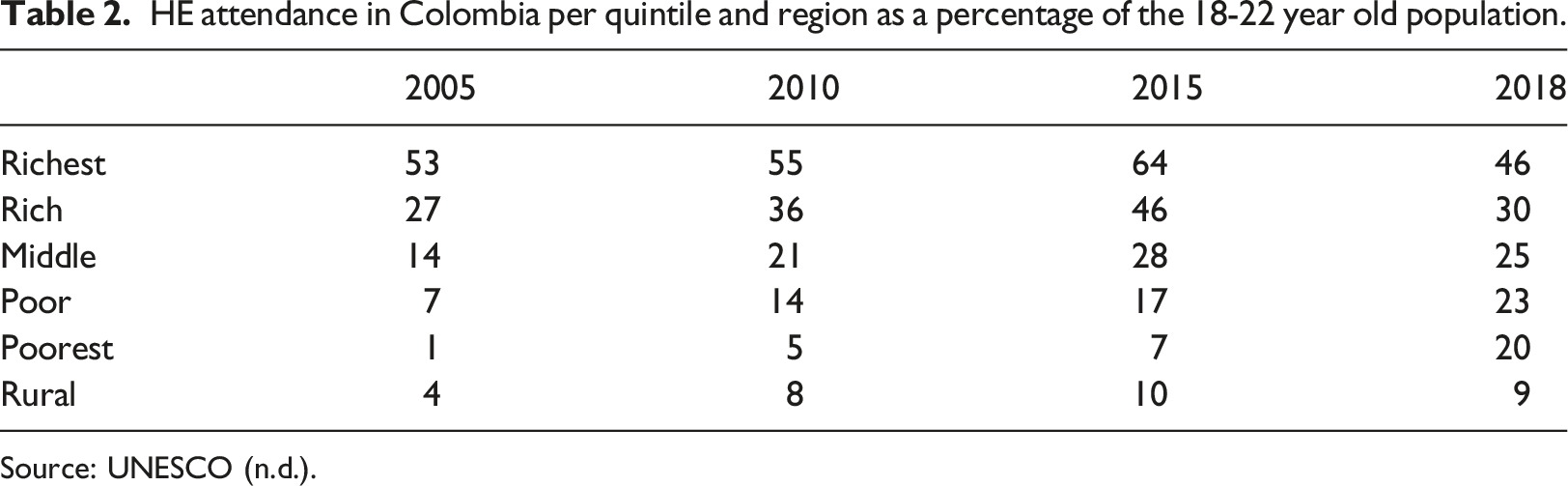
HE attendance in Colombia per quintile and region as a percentage of the 18-22 year old population.
Source: UNESCO (n.d.).
One key reason for the persistence of these inequalities is the much lower upper secondary education (USE) graduation rates in rural and poor communities. For example, according to the World Bank (2022) only 55% of 18–22-year-olds in rural areas have completed USE compared to 73% in rural areas while the most economically deprived 15-year-olds lag two years behind the wealthiest in terms of PISA scores. These figures can, in part, be attributed to more limited access to the internet and technology in poorer regions and rural communities; a lack of available resources in poor and rural households for private tuition and other educational supports; and poor school quality (Bruckner, 2020; UNESCO, 2023; World Bank; 2021; World Bank, 2022). Another key reason for the differential access to HE for different income groups and regions is the selection of HE students based on their performance on the Saber 11, a standardised, multiple choice test. This means that poor students, who are much more likely to attend overcrowded, under-resourced, and underfunded state schools, fare worse on this exam than private school pupils who are typically better prepared for post-secondary education than their poorer peers (Ferreyra et al., 2017; LEE, 2021; World Bank, 2018). As a result, economically disadvantaged applicants, particularly those from rural areas, often lose out to wealthier students in the competition for access to public universities, which are around six times cheaper than private universities (LEE, 2021; Mendoza et al., 2021). There is therefore a danger that by using standardised test results to filter access, public universities in Colombia may be reproducing inequality.
While aspiring students from poor backgrounds also have the option of studying at more expensive private universities, unless they are lucky enough to qualify for one of the limited number of scholarships available, this is only possible by means of ICETEX. As we have seen, though, high-interest rates and the large number of loanees who are in arrears suggest that ICETEX does little to make access to HE affordable. This is acknowledged by the current president of ICETEX, Mauricio Toro: A few years ago ICETEX took out a loan with the World Bank which has proved to be very expensive and some lines of credit are becoming unpayable. Young people don’t see a way of repaying the debt. This situation makes people view this entity as the boogeyman (Suárez, 2022).
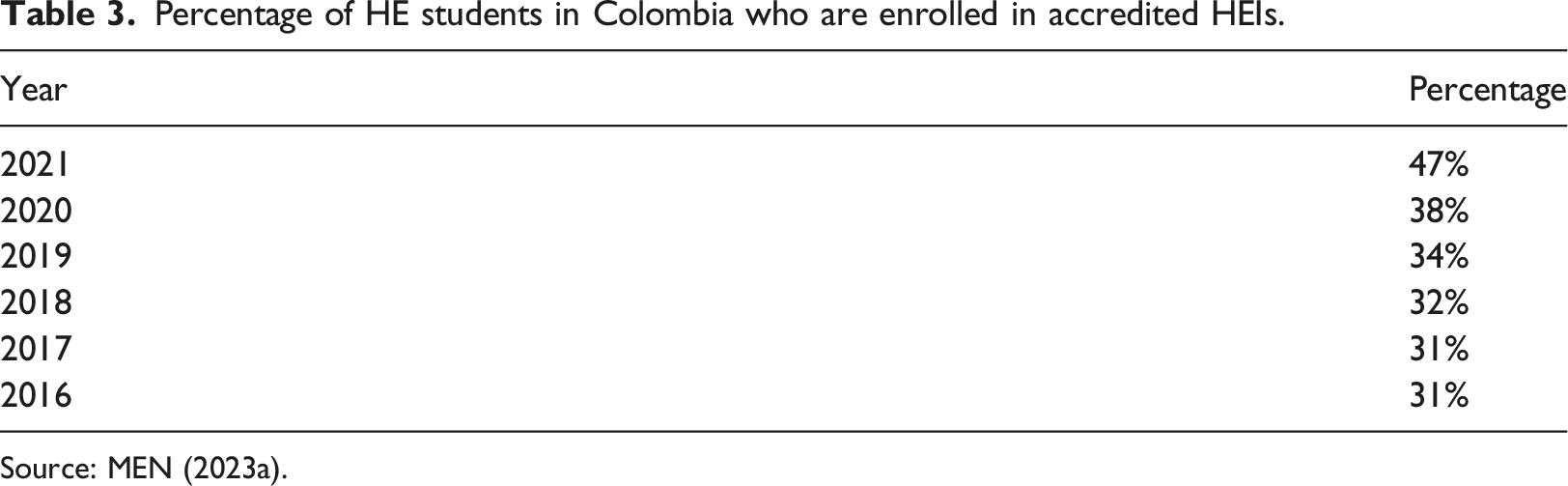
Percentage of HE students in Colombia who are enrolled in accredited HEIs.
Source: MEN (2023a).
Another issue with the ICETEX loan scheme is that it does not facilitate equal access to HE since the stipulation that the co-debtor on any loan must have both permanent residence in Colombia and a positive credit history disproportionately disadvantages the thousands of Venezuelan migrant students who are much less likely to meet this stipulation. Such students, including others who are unable to meet the ICETEX conditions for eligibility, or who may be reluctant to take out a high-interest non-income contingent loan, are thus typically left with no choice but to enrol in either the free T&T courses offered by state provider SENA or in cheap private HEIs if they wish to pursue an HE pathway (Ferreyra et al., 2017; World Bank, 2013, 2018). With regards to the former, funding restraints have resulted in fierce competition for the limited number of places on offer, which means that the vast majority of applications are unsuccessful (World Bank, 2013); while regarding the latter, the lax regulatory context in Colombian HE means that many courses which ostensibly aim to improve coverage have sacrificed quality in order to boost profits (Ferreyra et al., 2017; Galindo et al., 2015; OECD, 2016). As a consequence, Mendoza and colleagues (2021: 3) conclude that in Colombia, ‘the conditions of social origin guide the programme choice in a separable higher education market by quality, price, and field of knowledge’. Thus, neoliberal policies in Colombian HE appear to be doing little to make access to affordable and quality HE in Colombia more equal. This has wider implications for social inclusion since the poor have much higher dropout and repetition rates than their wealthier counterparts, are less likely to be adequately prepared for the workplace, and can expect lower returns for their education when entering the labour market (Ferreyra et al., 2017; UNESCO, 2016; World Bank, 2013). As such, not only is the neoliberalisation of Colombian HE at odds with SDT 4.3, which aims at equal HE access for all, but also with UN’s (2015) broader agenda for sustainable development which aims both to foster ‘just and inclusive societies’ (6), and to ensure that ‘all human beings can enjoy prosperous and fulfilling lives’ (5).
As we have seen, the neoliberalisation of Colombian HE is also leading to its instrumentalisation. This includes a) the instrumentalisation of HE students through their positioning as self-interested ‘clients’ who invest in their human capital in order to increase their earning power in the competitive job market; and b) the instrumentalisation of the role and purposes of HE in Colombia through the GoC’s prioritisation of pathways which serve the needs of the economy. In terms of the latter, pursuing an economic model primarily geared towards the interests of global capital is particularly problematic in Colombia for at least two reasons. First, the informal labour market in Colombia accounts for nearly 60% of all employment in the country, which is above average for Latin America, while the level of youth unemployment is among the highest in the region (DANE, 2023; Ham et al., 2021). These figures suggest a mismatch between the skills young people are learning in HE and those required in the formal employment sector (Ham et al., 2021). Moreover, given that earnings are lower and working conditions worse in the informal employment market (Herrera-Idárraga et al., 2015; Staupe-Delgado and Díaz Villarreal, 2023), these figures also show how far Colombia is from SDG8 which aims to achieve ‘full and productive employment and decent work for all’ (UN, 2015).
A second issue with the orientation of HE to the needs of the economy is that the economic model in Colombia is largely based on the exploitation of non-renewable raw materials which industrialised economies rely on for their continued prosperity (Aviles, 2006; Galindo et al., 2015). Indeed, oil accounts for around 45% of Colombia’s exports and over 30% of foreign direct investment (Aviles, 2006; Hylton and Tauss, 2016). This foreign investment facilitates the transfer of these extracted products to global markets, and is protected by various free trade agreements such as the one Colombia signed in 2011 with the US, its biggest export partner (CIA World Factbook, 2023; World Bank, 2013). Moreover, when commodity prices fall, as they did during 2015, economic side-effects such as currency depreciation and high inflation ensue (World Bank, 2017). This unsustainable model of economic dependency also extends to the field of scientific knowledge, with the Global North historically seen as the source of innovation and technology (Schara, 2006). This view is supported by the World Bank (2013: 241), which concluded in its review of the country’s HE policies that: Colombia’s economy is not likely to become, in the near future, a “knowledge-based economy”...but will continue to be based, in large part, on natural resources, agriculture and low technology industries; and that its higher education institutions, as a whole, will not become research-intensive institutions, but will remain, at best, good places for general and professional education.
As in the rest of Latin America, the benefits of Colombia’s neoliberal economic model have not been shared by all, with increases in rural poverty in particular (Aviles, 2006; Henry and Beserra, 2022). In fact, those who stand to gain most from this model fall into two broad groups: a) the industrialised nations in North America and Western Europe, who have offset the costs of the importation of such raw materials by increasing the export to Colombia of products from their subsidy-dependent industries (Hylton and Tauss, 2016), and b) the political and economic elites in Colombia, who serve the interests of transnational corporations in the global North (Meger and Sachseder, 2020; Novelli, 2010). As a consequence, Colombia’s extractive economic model runs counter to many SDGs including sustainable economic growth (SDG8), reduced inequality within and among countries (SDG10), sustainable consumption and production patterns (SDG12), and climate action (SDG13) (UN, 2015). Thus, Colombia’s instrumentalist HE system which focuses on developing human capital to meet the needs of the global economy is likely neither to foster ‘just and inclusive societies’ (UN, 2015: 5) nor to ensure that ‘all human beings can fulfil their potential in dignity and equality’ (UN, 2015: 6).
This instrumentalisation also puts Colombian HE at odds with the International Covenant on Economic, Social and Cultural Rights (OHCHR, 2022), which underlines the critical role of HE in both the ‘full development of the human personality and the sense of its dignity’, and in the strengthening of ‘respect for human rights and fundamental freedoms’. This is because an instrumentalist education is leading to a reduced focus on subjects which emphasise reflection and personal growth such that HE in Colombia increasingly resembles the banking model of education (Freire, 1972; Galindo et al., 2015). Such an education denies students the opportunity to develop important capabilities such as critical thinking, civic responsibility and democratic debate (Giroux, 2011). These capabilities are particularly important in Colombia, a country which faces a number of threats to its democracy as it emerges from over half a century of civil conflict, including systemic corruption; the militarisation of rural areas; human rights violations; the illicit cultivation and trafficking of coca; and the murder of activists and social leaders (Meger and Sachseder, 2020; UNESCO, 2016).
Conclusion
This paper has examined how the global HE trends of massification and neoliberalisation have played out in the Colombian context and has explored some implications of these developments for attaining SDT4.3 and the SDGs more generally. It has identified several developments which have contributed to the neoliberalisation of HE in the country. These include the privatisation in and of public HEIs, a cornerstone of the global neoliberal agenda; the introduction of standardised testing, which instils a competitive ethos among both students and HEIs; the expansion of the GoC’s non-income contingent student loans scheme, which is also facilitating the privatisation of Colombian HE as most loanees choose to study in private HEIs; the granting of scholarships to enable low-income individuals to study in private HEIs, which is an example of endogenous privatisation; and the ‘economisation of education’ (Ball, 2016) as a result of a) the GoC’s prioritisation of T&T career pathways in order to supply the economy with the requisite human capital, and b) ICETEX’s positioning of students as client-entrepreneurs who are thus more likely to opt for courses which offer sound returns on their investment.
The implications of these neoliberal developments have been discussed in relation to the SDGs, and to SDT4.3 in particular. The analysis suggests that although student finance initiatives and the prioritisation of T&T pathways by the GoC may have broadened access to HE for some Colombians from low-income and rural backgrounds, this has not resulted in ‘equal access…to affordable and quality technical and tertiary education, including university’ (UN, 2015). There are several reasons for this. First, stringent ICETEX loan conditions, together with the high cost of HE in Colombia, burden many loanees with unaffordable levels of debt, may deter poor students from applying, and may exclude others, such as Venezuelan migrants. Consequently, factors such as socio-economic status and geographical location still play a role in the opportunities afforded to prospective HE students. Indeed, the limited opportunities for students from low-income backgrounds and rural communities to freely choose their preferred HE career unmask as a convenient falsehood the neoliberal narrative of the self-interested individual as solely responsible for their own success or failure. In a neoliberal landscape, where the market value of graduates hinges on the extent to which their chosen programme and HEI increases their earning potential (Aronowitz and Giroux, 2003), this lack of choice has important implications for the achievement of the SDGs, especially since, as we have seen, poor graduates can expect lower returns for their education in the employment market. Second, less than half of all HE students in Colombia attend accredited HEIs, including fewer than 60% of ICETEX loan recipients, which not only raises questions about the quality of HE that most students are receiving, but may also help explain the unsustainably high desertion rates. Third, the endogenous and exogenous privatisation of Colombian HE is eroding the value of HE as a public good, and is siphoning public funds to private HEIs while public institutions, which are typically much cheaper than their private counterparts, are facing a funding crisis. This is at odds with SDT4.3 which aims to ensure ‘equal access’ to ‘affordable’ HE (UN, 2015). Finally, the GoC’s promotion of T&T courses is problematic given the mismatch between the skills learnt in such courses and the needs of the Colombian economy as indicated by the high levels of youth either unemployed or informally employed. Thus, the prioritisation of T&T programmes seems unlikely to help Colombia make progress towards SDG8, which aims to achieve ‘full and productive employment and decent work for all’ (UN, 2015). Other issues with a reductive view of HE as supplier of the human capital required to grow the economy include the country’s overreliance on non-renewable resources, which is clearly at odds with the SDGs, and the diminished focus on capabilities such as critical thought, civic engagement and democratic deliberation which such an instrumentalist education entails. This limits the extent to which HE in Colombia can contribute towards the ‘full development of the human personality and the sense of its dignity’ (OHCHR, 2022).
In light of the above, which policy options could be considered to help Colombia meet the SDGs and SDT4.3 in particular? In terms of student finance, several issues with the non-income contingent loan schemes offered by ICETEX have been identified such as high-interest rates, a large number of loanees in arrears, and strict conditions for eligibility which either exclude or deter migrants and students from low-income backgrounds taking up such loans. With this in mind, one policy recommendation, which was actually one of current President Gustavo Petro’s election promises (Suárez, 2022), is to cancel all ICETEX debt, which amounts to around nine billion Colombian pesos 10 (El Tiempo, 2022). However, the Minister of Education has ruled out such an ambitious plan both because of its cost and because of the message it would send to future loan recipients who may simply refuse to pay their outstanding debts (El Tiempo, 2022). Instead, the GoC has opted for an approach to debt forgiveness which targets the most vulnerable within a policy of humanisation (Suárez, 2022). This includes more reasonable interest rates and the prioritisation of student credit for rural inhabitants, indigenous groups and victims of the armed conflict (El Tiempo, 2022; Portafolio, 2022).
While these are steps in the right direction, the World Bank (2021: 7) has also highlighted the importance of implementing income-contingent loan schemes ‘in which repayment depends on income upon graduation’ as a means of addressing access and equity issues. This seems like a reasonable policy option given that the GoC appears to have no plans either to abolish ICETEX or to make HE free for all. However, such a policy fails to address the fact that the vast majority of ICETEX loans are used to access private institutions while public HEIs are starved of finances. As such, unless public HEIs are properly funded, loanees may continue to opt for what they consider to be better quality HE courses in the private sector given the ICETEX loan scheme’s neoliberal emphasis on student choice and individual responsibility. This, in turn, perpetuates existing inequalities rather than equalising access for all. At the same time, the private sector may help meet demand in certain regions in the absence of appropriate course offerings from public providers (UNESCO, 2023). One proposal, then, would be for the GoC to offer ICETEX credit to facilitate access to private institutions only in cases where an individual’s choice of career is not available from a public sector HEI within a reasonable distance from their home. Given that many ICETEX students choose to study in non-accredited institutions which may contribute to higher desertion rates, such loans should also be conditional upon loanees undertaking courses in accredited private HEIs. Not only would this restrict the flow of public funds to the private sector, allowing for the surplus to be reinvested in public institutions, but it would also enable individuals in rural areas to access courses in accredited private sector institutions where no public alternative exists. That said, using private providers can only ever be a stopgap solution as they undermine the status of HE as a public good and contribute to the commodification of the sector. In the longer term, what is needed is a more proactive approach to meeting SDT4.3 which deals with the future now rather than reacting to it after it has already arrived (Klees, 2020; Tesar, 2021). With this in mind, a more sustainable and affordable option for providing equitable access to HE would be to expand free public offerings to underserved areas. In view of this, the GoC’s Zero Tuition Programme (Programa Matricula Cero) which grants free tuition to the poor and vulnerable in public HEIs is to be commended (MEN, 2023b; UNESCO, 2023) as is their plan to establish eight new public universities and eight new branches of SENA in underserved regions of the country (El Observatorio De la Universidad Colombiana, 2023). However, geography, poverty and high tuition fees are not the only barriers to post-secondary education in vulnerable communities in Colombia; significant issues also persist with access to and the use of technology and the internet as well as with school quality, which impacts upper secondary school graduation, dropout and repetition rates (UNESCO, 2023; World Bank, 2021). Thus, if Colombia is to make meaningful progress towards the SDGs in general and towards SDT4.3 in particular, it also needs to close these inequality gaps.
As we have seen, the neoliberal massification of Colombian HE has also led to a greater focus on HE as a means to an end rather than an end in itself. However, the high levels of informality in Colombia together with high rates of youth employment suggest a mismatch between the skills acquired in HE and the demands of the formal employment market. In order to address this, more data should be made available regarding SENA, the largest provider of vocational training in the country, especially with regards to the efficacy of its programmes in supporting the transition of young people into full, productive and decent employment, as there are concerns that some of its course offerings are fragmented and of questionable relevance (OECD, 2016; World Bank, 2013). In addition, given the apparent success of stipend-supported internships in securing formal employment and boosting earnings for out of work young people from poor backgrounds such as the training programme Jóvenes en Acción (Youth in Action), targeted programmes along similar lines could be offered (Attanasio et al., 2017). At the same time, while HE can play a key role in social mobility in Colombia, and can help countries such as Colombia meet the demands of the globalising economy, it is hard to see how equipping workers with the human capital required by industry would be sufficient in itself to address key development challenges facing the country such as the overreliance on unsustainable extractive industries, the strengthening of democracy, and the consolidation of the peace process after decades of civil war. Indeed, as Giroux (2011: 130) has made clear, ‘[c]entral to any viable, democratic view of higher education is the necessity to challenge the notion that the only value of education is to drive economic progress and transformation in the interest of national prosperity’. As such, unless HE in Colombia accords greater value to the Arts and Humanities; shows a greater commitment to social justice; and provides a space for intellectual debate and critical reflexivity based on democratic values, the contribution that HE in Colombia can make to sustainable development will remain limited (Ball, 2016). In this regard, one policy proposal would be for all HEIs to offer courses in Civic Education to be taken alongside students’ core subjects. Given that the Saber Pro includes a component on citizenship abilities (Székely, 2017) such courses would also improve exit results on this exam. One objection to such courses would be the extra time and resources that students may require to complete their studies as a result of taking this additional subject. A potential solution could be to build civic education course content into the compulsory English language classes that the vast majority of HE students in Colombia have to attend. Examples of how this could be done already exist in the literature (e.g. Keogh and Corrales, 2023). Alternatively, students could be given the choice of studying either English or Civic Education as an elective.
In closing, it is important to note the impact of student movements in the country, which have advocated for an end to, inter alia, tuition fee hikes, privatisation, the underfinancing of public HEIs, systemic corruption, and usurious student loan interest rates, and the support for these reforms and others by a broad coalition of groups, including students and staff from private HEIs, the teachers’ union La Federación Colombia de Trabajadores de la Educación, 11 and the trade union federation Central Unitaria de Trabajadores 12 (Alsema, 2019; Henry and Beserra, 2022; Hylton et al., 2018). Such organised struggle contributed to the election of Colombia’s first ever left-wing president whose administration has already introduced several policy initiatives which mitigate some of the more pernicious effects of neoliberalism in HE (Hylton et al., 2018; Manetto, 2018). Thus, activism, especially when aligned with the causes of other groups and interests, can interrupt the neoliberal agenda in Colombian HE and in the wider society more generally. With this in mind, it is hoped that this article may also encourage academics across Latin America and the globe to show solidarity with such de-neoliberalisation efforts and to engage in forms of resistance which are most likely to disrupt the hegemony of neoliberalism in their respective contexts (Shahjahan, 2014). To help in this endeavour, more research which sheds light on the negative effects of neoliberalism on HE systems in a variety of different settings is needed.
Footnotes
Declaration of conflicting interests
The author(s) declared no potential conflicts of interest with respect to the research, authorship, and/or publication of this article.
Funding
The author(s) received no financial support for the research, authorship, and/or publication of this article.

Notes
Dr