




Abstract
This article aims to explore the definitions and approaches of sustainable development (SD) in UK higher education institutions (UKHEI). Specifically, the article investigates how SD and education for sustainable development (ESD) are defined and enacted from the official websites of the 24 Russell Group Universities. The findings reveal that some of these universities disclosed their institutionalised sustainability conceptualisation with specific targets; more than half of these universities did not disclose their institutional definitions. Despite this inconsistency, all of the universities have recognised the importance of sustainability and SDGs and prioritised one or multiple dimensions of sustainability. Sustainability is implemented in UKHEIs mainly through four categories of activity: the learning environment, Research SDGs, external collaboration, and curriculum integration. This article found that sustainability has been routinised and systematically integrated by these universities regardless of their institutionalised sustainability conceptualisation. A more innovative path, however, is needed to ensure that sustainability transitions from being merely a strategic priority to an institutional ethos that drives all actions and decisions in these universities.
Keywords
Introduction
Even before the establishment of the UN Sustainable Development Goals (SDGs) in 2015, a few universities in the UK envisioned sustainability within their institution development strategies. For example, in 2005, the University of Plymouth established one of the earliest sustainability initiatives in the UK, devoted to integrating, innovating, and investigating pedagogy and curricula for sustainable development (Cotton et al., 2009; Sterling & Thomas, 2007). The number of universities taking sustainability into consideration continued to grow during the ‘Decade of Education for Sustainable Development’ from 2005 to 2014 (DESD), and more universities started to integrate sustainable development (SD) and education for sustainable development (ESD) in their institutional missions and strategies. Hence, sustainability has become a high priority within the higher education institution (HEI) policy arena (Wals, 2014).
Under the SDGs agenda, HEIs were expected to undertake systematic transformation towards sustainability by reorienting their institutional strategies in education, research, and operations, in order to spread sustainability’s influence both locally and globally (Wals, 2014). As awareness grew in higher education, in 2014, roughly 17% of UK higher education institutions (UKHEIs) published sustainability reports to demonstrate their institutional commitments to promote sustainable development (Sassen et al., 2018). The establishment of SDGs in 2015 further catalysed the development of sustainability among UKHEIs. By 2022, 132 major universities in the UK had produced institutional strategies on reducing carbon emissions, and 137 had provided sustainability information openly available to the public (Whiteley, 2022). The significant increase of reporting sustainability indicates the rapid growth of SD integration among UKHEIs during recent decades.
Given the increasing trend of reporting sustainability by individual institutions, comprehensive and comparative analyses, examining how these universities articulate and implement their sustainability agendas, have been few. While numerous universities provide open access to information about their sustainability efforts, the depth, focus, and comprehensiveness of such reports vary significantly. These disparities raise questions about the standardization, authenticity, and effectiveness of sustainability initiatives across different institutions. It is therefore crucial to investigate the nuances of how UK universities interpret and implement sustainability, as these variances may reflect distinct institutional priorities, resources, and challenges. Moreover, whereas the rapidly growing numbers of reports, statements, and strategic plans indicate universities’ commitment to sustainability, the quality, depth, and insights of these documents remain largely unexplored in the academic literature. Such an examination is important not only for benchmarking purposes but also for advancing understanding of the potential gaps and challenges involved in improving the sustainability landscape of higher education. This study, therefore, aims to bridge this research gap by reviewing and analysing the sustainability documents of the Russell Group Universities, to offer insights into the current state and future trajectory of sustainability in UKHEIs.
Background
Sustainability and development are closely linked in the modern global policy agenda. The definition of sustainability includes both ecological and economic dimensions. Economists originally used the term in forestry, to mean that in order to maintain long-term production, harvests should not surpass the growth of forests (Ike, 1984). In 1987, the concept was defined as the ability ‘to meet the needs and aspirations of the present without compromising the ability to meet those of the future’ and has since emerged as an urgent global agenda item (WCED, 1987, p. 39). After years of development, the UN established SDGs in 2015. A total of 17 goals, including poverty alleviation, gender equality improvement, and climate change mitigation, were recognised as benchmarks for a sustainable future (English & Carlsen, 2019). Meanwhile, the definition of SD has remained mostly uncontested. For example, QAA (2021) defines SD as ‘an aspirational ongoing process of addressing social, environmental and economic concerns to create a better world’, derived from the four pillars of the overarching SD concept (p. 8).
ESD definitions by QAA and UNESCO.
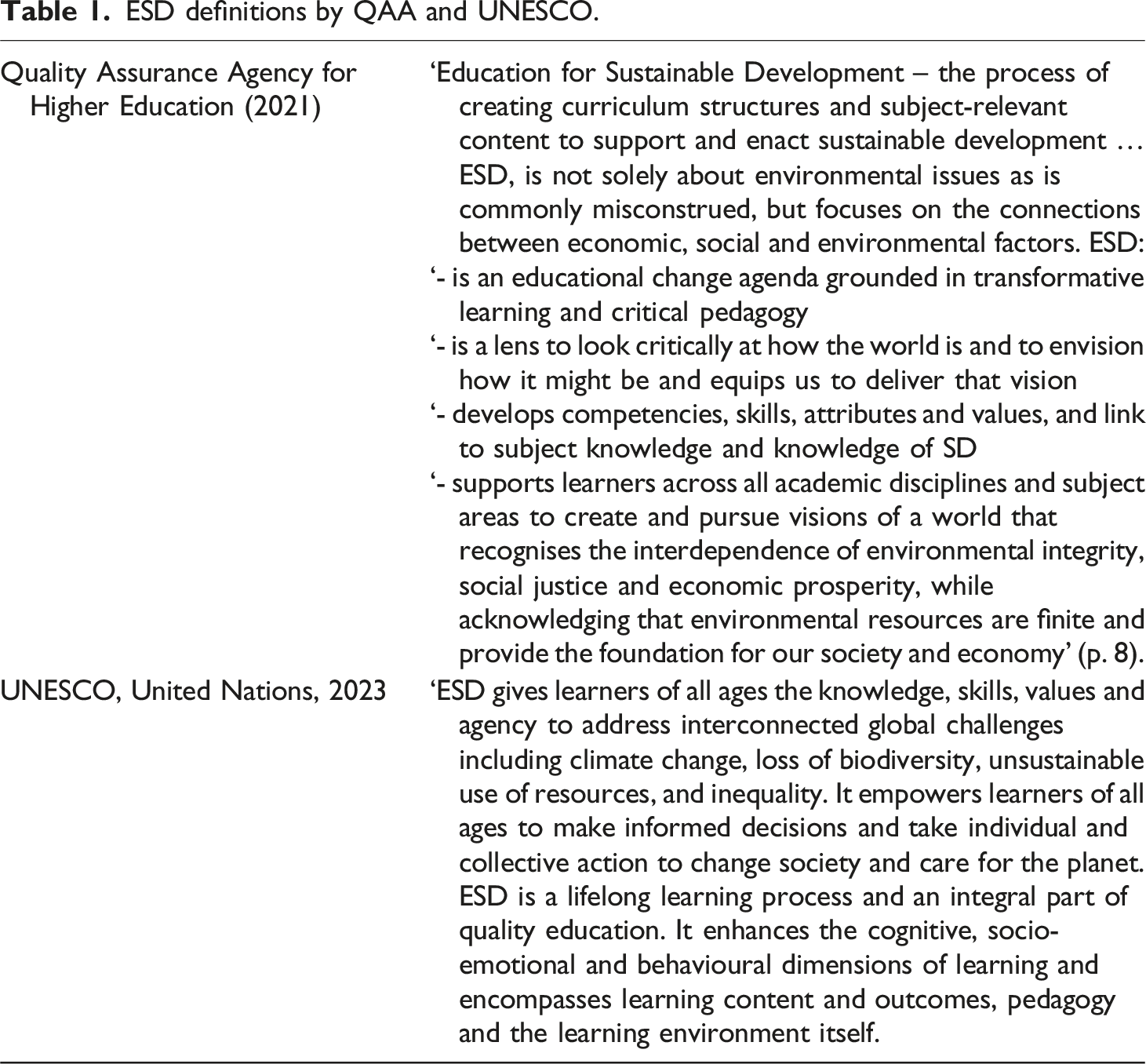
In 2014, the Quality Assurance Agency for Higher Education (QAA) established its ESD guidelines. The guidance was created to help HEIs in the UK improve capacity to think, innovate, and implement the global sustainability agenda into their academic development. The guide underwent a significant update in 2021 to further this purpose. The updated QAA guidance redefines ESD within the academic landscape, highlighting the importance of knowledge and curriculum integration. Notably, it prioritises the three pillars of SD – the economic, social, and environmental dimensions – rather than the holistic framework of ESD. According to QAA (2021), ESD among UKHEIs now has three main missions: (1) Supporting students and staff to develop the knowledge, competencies, and ability to pursue sustainable visions of the future; (2) Supporting students and staff in appreciating the complexity of our world, understanding the ‘wicked problems’ that continuously emerge, and learning how they can personally and professionally contribute to positive change; (3) Challenging, supporting, and enabling students and staff to co-design solutions and drive change for sustainability (QAA, 2021, p. 9).
These differences bear significant weight in understanding the contextualisation of ESD. It is not a single concept, subject to a single definition or trajectory; rather, it is a flexible framework that adapts to the specific circumstances and unique context of each institution. The ESD framework proposed by QAA hence provides each academic institution with the space to develop its own ESD strategies in line with its own ethos, challenges, and aspirations. This inherent flexibility not only respects different academic cultures but also lays a solid foundation for the future implementation of ESD, ensuring it can remain relevant, dynamic, and impactful in an ever-changing educational environment.
Both frameworks above are important references for the ESD development in UKHEIs. The UNESCO framework provides a holistic view of the role of education in SD, while the QAA specifically targets HEIs. They share a similar path to achieve a sustainable future, but carry distinct priorities regarding objectives, approaches, and envisioned learning outcomes. The next section will highlight the existing development of sustainability in UKHEIs.
Sustainability reports among UKHEIs
Universities’ institutional reports, strategies, and even charters and initiatives comprise important evidence showing their commitments to SD implementation (Findler et al., 2019). They are indicative of individual institutions’ reception of the international agenda and crucial to understanding each university’s specific approaches to SD. Furthermore, strong positive linkage has been found between a university’s strategic plan and its SD implementation (Lozano et al., 2015). For example, Godemann et al. (2012) have investigated the sustainability reports of the first 100 business schools who signed the UN Principles for Responsible Management Education (UNPRME) declaring the intention to integrate sustainability in teaching, research, and operation; their study has found that these schools often place more emphasis on teaching than other areas. Meanwhile, Paletta and Bonoli (2019) have reviewed the University of Bologna’s institutional strategy and evaluated its approach to SDGs. While the institution successfully integrated SDGs into its curriculum, teaching, research, campus operations, and external partnership activities, a key challenge was identified: stakeholder and student engagement with Agenda 2030 (Paletta & Bonoli, 2019). Yanez et al. (2019) have conducted similar research, examining the School of Engineering in the Universidad Politécnica de Madrid. Their longitudinal study investigated the impacts of sustainability reporting on the development of the school’s strategies and missions, including but not limited to establishing effective communication with stakeholders, integrating sustainability impact indicators into the management plan, and fostering a shared strategic vision among key personnel (Yanez et al., 2019). Saha et al. (2020) have attempted to examine the determinants of carbon emission disclosures (CEDs) in the sustainability reports which UKHEIs have produced. Their findings indicate that governmental emissions reduction targets and related environmental audits, rather than SDGs, comprise the key determinant of the institutions’ commitments to and production of CEDs (Saha et al., 2020). These findings from Saha et al. (2020) provide important implications regarding the dynamics among institutional reports, government oversight, policies, and other stakeholders within the carbon emission reduction agenda among UKHEIs.
Overall, research has shown the importance of individual universities’ sustainability reporting to demonstrate their efforts and commitments regarding the UN SDGs. However, despite the extensive research on university sustainability reports, mission statements, and other related agenda items, the literature has lacked an overview characterising HEIs’ institutional approaches to sustainability, especially in the UK. In addition, limited research has examined the impacts of SD reception at the institutional level among UKHEIs in shaping the overall development and implementation of SD, including ESD. Therefore, this study attempts to reveal the different approaches to SD among UKHEIs, by investigating their institutional definitions of SD and ESD. This comprehensive review targets institutional plans and aims to identify these institutions’ structural approaches to sustainability. This study aims to explore the following research questions: (1) How do universities in the UK conceptualise SD and ESD? (2) To what extent do these universities structurally integrate and implement sustainability?
Methodology
To better answer the research questions, this study has conducted qualitative content analysis to examine the content from the 24 official websites of the Russell Group Universities. Russell Group Universities, renowned for their leading roles in research and higher education within the UK, possess significant influence and resources that make them pivotal in shaping and advancing the implementation of sustainability across the academic sector. Their commitment to innovation and global collaboration positions them as ideal case studies to understand the integration of sustainability into education, research, and community engagement, thereby offering valuable reflections into the broader role of UKHEIs in contributing to global sustainability efforts.
Unlike the traditional content analysis, qualitative content analysis does not deploy statistical analytic methods; rather, it is a ‘systematic analysis of texts of many kinds, addressing not only manifest content but also the themes and core ideas found in texts as primary content’ (Drisko & Maschi, 2015, p. 82). While undertaken the flexibility of traditional content analysis, such as the use of multiple forms of data, such as documents, reports, and any other written materials (Cohen et al., 2018), qualitative content analysis also highlights the narratives of the data, including the contexts and latent communication through non-statistical analysis (Drisko & Maschi, 2015). This study therefore has adopted qualitative content analysis to explore the content from university websites and provide implications related to the findings. The scope of the analysis includes each university’s sustainability report, mission statement, strategic plan, and additional sustainability-related data on its website.
This analysis has involved two specific targets. The first target was to identify each institution’s conceptions of SD and ESD. The second target was to identify each university’s institutional sustainability agenda – for example, prioritization of one aspect of sustainability – and its institutional commitments to achieving that agenda. The analysis has been conducted in two phases. First, a comprehensive review was conducted, to provide an overview of individual universities’ sustainability agendas, such as the institutional definitions of SD and ESD, by reviewing the institutions’ sustainability reports, mission statements, and strategic plans. Where universities did not make public their official sustainability reports, alternative institutional reports related to sustainability have been considered for analytical purposes. Second, the review continued with searches for specific keywords – ‘Sustainable Development’, ‘Education for Sustainable Development’, ‘SDGs’, ‘Interdisciplinary’, and ‘Sustainability’ – to identify additional data via the website search engine. Preliminary experience from the pilot study has shown these words were effective in attempting to locate sustainability information on the university websites. These keywords are particularly pertinent to identifying themes from the data and are in line with the objectives of this study.
An initial coding framework was developed prior to the data analysis. This framework comprised three codes: ‘definition of ESD’, ‘definition of SD’, and ‘approaches to sustainability’. These codes were developed through a deductive approach initially. Subsequently, the data were systematically coded according to this framework. After the initial round of coding, an inductive approach was employed to review the coded data. This process involved splitting overly broad codes and identifying patterns and themes that emerged from the data, with a particular focus on how universities define and integrate sustainability. The emergent themes were then further analysed to illustrate the varied approaches to integrate sustainability within the university. The review was conducted in June 2022; hence, all findings from this study are based on the data available before that date.
Findings
Sustainability, SD, and ESD Approaches by Russell Group Universities.

Ultimately, the analysis reveals that Russell Group Universities share similar visions regarding the importance and directives of sustainability. Findings show that environmental sustainability, specifically infrastructure emissions reduction, has become a preliminary target for these universities. Some universities, such as Durham University, the University of Manchester, the University of Sheffield, and Queen Mary University of London, provide clear statements on their websites to address the urgency of environmental sustainability, which indicate these institutions’ primary climate concerns. This includes but is not limited to the institutions’ visions for a carbon-zero future, reduction of emissions from transportation and infrastructure, waste management, water and biodiversity conservation, and sustainable consumption and procurement. The remaining universities undertake the holistic approach to sustainability and did not disclose their institutional priority. Embedding SDGs in the curriculum, such as teaching and research, is as important as environmental sustainability. Almost all of the 24 universities identified the key roles SDGs can play in their sustainability agendas and have benchmarked their commitments to integrate SDGs into their curricula. This demonstrates these institutions’ acquaintance with the UNESCO SD and ESD framework; they recognise and integrate SDGs as part of their institutional sustainability strategies.
The acceptance of the UNESCO framework is further shown in these universities’ institutional conceptualisations of SD and ESD. Of the 24 universities, 14 did not disclose their institutional conceptualisations of SD, ESD, or sustainability. Findings show that only two of these Russell Group Universities have shared their institutional SD conceptualisations. The University of Exeter has derived its definition from the UNESCO framework, and highlights the importance of the four pillars for a sustainable future: the economic, environmental, social, and cultural dimensions. The University of New Castle has used the QAA (2021) definition, which addresses the importance of learning and focuses on the three dimensions of the UNESCO framework. In contrast, eight out of the 24 Russell Group Universities have shared their institutionalised ESD conceptualisation, and the majority of these centre on the competencies and knowledge required for a sustainable future. Some of these universities illustrate further details of their ESD approach. For example, the London School of Economics has listed specific competencies, such as critical reflection and systemic thinking, as the core of ESD, and has explained their roles in teaching and learning. The University of Leeds, on the other hand, has focused on the transformative narratives of the learning process, and also specifically on the research-based education approach, to undertake a different direction to prepare students for a sustainable future. Others, such as the University of Bristol, have shared an ESD conceptualisation that targets the interdisciplinary nature of learning, focussing on themes such as innovation and enterprise, global citizenship, and sustainable futures. These different conceptualisations of ESD reflect the diversity of approaches and priorities across the Russell Group Universities. This varying understanding of ESD highlights that SD is not a one-size-fits-all concept, but rather a multifaceted paradigm that is interpreted and applied differently depending on the values, goals, and contexts of different institutions.
Furthermore, this variety of interpretations provides a glimpse into how each institution sees its role in the broader sustainability narrative, and its responsibility to prepare students for addressing global challenges. Theoretically, these different conceptualisations of ESD should subsequently shape each institution’s sustainability agenda, influencing policy development, resource allocation, and engagement strategies. As universities align their missions with the UN global SDGs, their distinctive interpretations of ESD, in theory, will play key roles in determining the direction, depth, and breadth of their responses to SD challenges.
However, such alignment is absent when comparing to the institutions’ strategies for sustainability. When comparing those universities who did not disclose their SD and ESD conceptualisations with those who made them publicly available, no distinguishing differences are evident between the two groups. Universities from both groups share similar visions on prioritizing environmental sustainability and embedding the SDGs. This commonality is also reflected in the systematic sustainability integration across these universities.
Figure 1 below illustrates the characteristics of systematic sustainability integration among the 24 Russell Group Universities. Ultimately, regardless of whether they have publicly disclosed their institutional sustainability conceptualisations, all of the 24 Russell Group Universities follow a similar path. Aside from the institutional strategy, which states a university’s future sustainability direction, these HEIs often establish fourt categories of activities or methods to holistically enact sustainability. The first category is related to the learning environment. This includes illustrating specific numbers and action plans for carbon footprint reduction, upgrading infrastructure for energy and water performance, enhancing the resilience of ecosystems on campus, and so on. The purpose of these learning environment adjustments is to enhance a university’s environmental sustainability performance through measurable efforts, as well as to follow government regulations for emissions reduction. Learning environment adjustments also include promoting sustainability culture and engaging students along with local and international community members. Internally, these universities often incorporate plans with organizations such as student unions; some, such as the University Living Lab at the University of Manchester, formulate new platforms to launch numerous activities, groups, and societies to promote SD initiatives within the student body. Externally, universities have also launched projects and programs with their local communities to spread the influences of sustainability beyond their campuses. The institutional approach to sustainability among Russell Group Universities.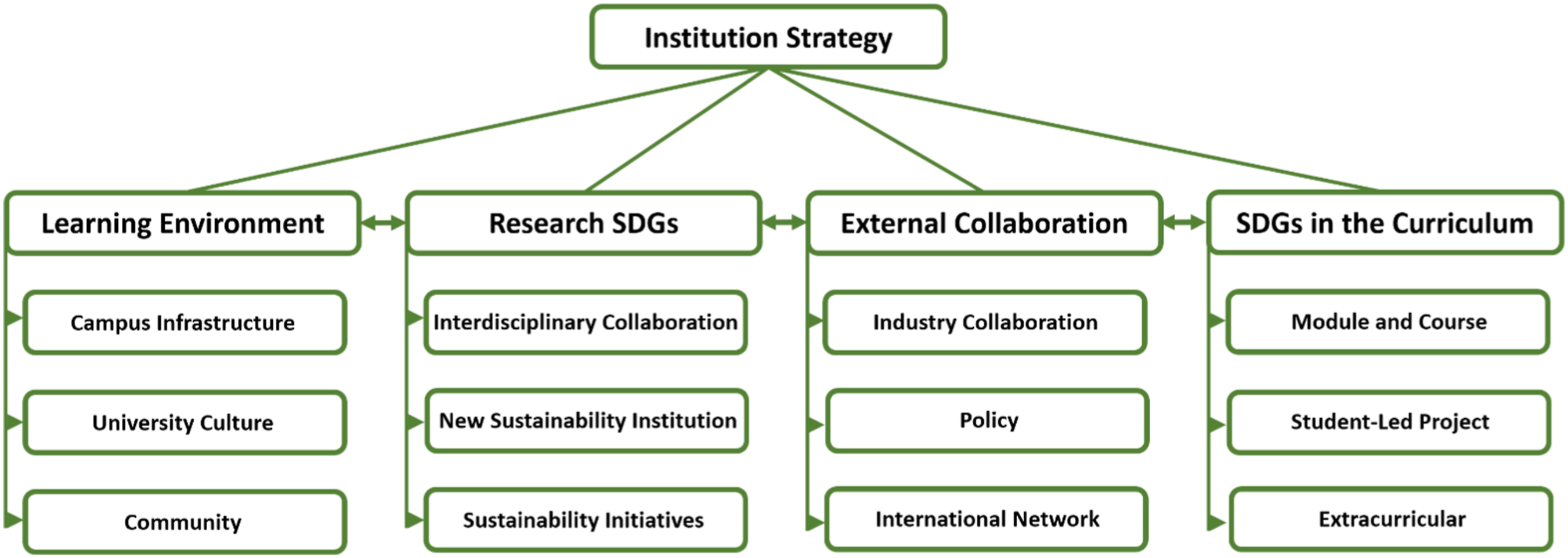
The second category is to connect existing research under the umbrella of SDGs. Many of the universities’ sustainability reports, such as those of the University College of London and University of Warwick, highlight ongoing research projects that are directly associated with one or more SDGs. Another feature to integrate sustainability in the universities’ research agendas is through interdisciplinary collaboration. Cross-departmental and cross-institution collaborations are often observed. For instance, the Water Infrastructure for Schistosomiasisendemic Regions (WISER) project from the Imperial College of London brings together academics from departments or schools of engineering, biology, and social science to tackle SDG 3 (health and wellbeing) and SDG 6 (clean water and sanitation). Numbers of research networks and SDGs initiatives were also invented to tackle SD issues. Most importantly, almost all of the Russell Group Universities have established, either by merging existing departments or by founding novel ones, their own new institutes related to sustainability, such as the Environment and Sustainability Institute at the University of Exeter and the Sustainability Research Institute at the University of Leeds. These research institutes are further direct evidence of the Russell Group Universities’ commitments, as promised in their institutional strategies, to prioritizing the sustainability agenda.
The third category of activities is external collaboration. This includes cooperative efforts with industrial partners to utilise sustainability research to make real impacts in people’s lives; contributions to policymaking or influences on policymakers; and building partnerships with other institutions, including but not limited to governments, universities, NGOs, and international corporations. For example, Cardiff University and the University of Southampton have partnered with local city councils on their environmental sustainability strategic plans, to help the cities achieve their emission reduction targets. The University of Birmingham has more than 20 partners, including other research institutions, companies, and government offices, to improve air quality in the West Midland region of the UK. The key to fostering such external collaboration is to enrich a university’s sustainability strategy by bringing in diverse perspectives, expertise, and resources that might not be available within the confines of the institution. Such partnerships not only amplify a university’s reach and impact, but also provide valuable feedback mechanisms. For example, collaborating with industries can offer insights into market-driven sustainability solutions, while partnerships with governmental agencies can align a university’s sustainability efforts with regional or national policies. Moreover, such collaborations can open avenues for funding, shared research, and policy influence, further embedding a university’s role as a leader in sustainability initiatives.
In addition to these three categories, embedding SDGs in the curriculum is another highlight all Russell Group Universities endorse. This is done mainly through the curriculum innovation on individual module or course, student-led project, and extracurricular activities and initiatives to help students understand SDGs holistically. Although the exact term ‘SDGs’ has not directly appeared in several of the universities’ institutional strategy documentation, the term has frequently appeared elsewhere during the keyword-search phase. In particular, all of the sustainability reports from the Russell Group Universities indicate the presence of individual courses and modules that resonate with one or more objectives of the SDGs. These modules or courses often accompanied with student-led projects. For example, King’s College London has innovatively established three modules for SDG 10 (reduced inequalities) to explore multiple dimensions of inequalities and equip students with the fundamental knowledge and competencies needed to tackle sustainability challenges. Universities also promote SDGs related extracurricular activities and initiatives outside of the classroom. For example, the University of Warwick hosted a competition, the Warwick Sustainability Challenge: Waste, to bring students from different departments and levels of study to innovate new ideas to enhance the recycling performance of the university. These actions demonstrate the universities’ acknowledgment of the SDGs’ significance in contemporary higher education, and their commitments, as promised in their institutional strategies, to fostering sustainable development globally.
However, a notable gap emerges when synthesising these institutional reports: while alignment with SDG themes is evident, an absence is apparent regarding the detailed role of ESD plays in the process of balancing the knowledge and competence approach within a curriculum. This raises questions about the depth and authenticity of the universities’ SDGs integration efforts. Are the SDGs merely being used as jargon, or are they genuinely embedded within learning outcomes, pedagogies, and assessment criteria? Without detailed descriptions, it becomes challenging to acknowledge the depth of SDGs integration and related impacts on students’ learning experiences. Using the King’s College London example from above, the 2021 sustainability report illustrates some specific activities, such as organising a campaign in one of the modules for SDG 10. However, the report itself lacks detailed explanation of the learning outcome, such as the impacts of the campaign, the pedagogical approaches employed, or the assessment criteria related to the SDG-focused module. This lack of detail and lack of transparency might inadvertently suggest superficial engagement with the SDGs, which underscores the need for universities to provide more comprehensive insights into their curricular strategies for sustainable development.
Implications and conclusion
By reviewing all 24 of the Russell Group Universities’ websites, this study has explored these institutions’ conceptualisations of sustainability and their institutional approaches to implementing sustainability in practice. The findings reveal that some of these universities disclosed their institutionalised sustainability conceptualisation with specific targets for integrating sustainability and education; more than half of these universities did not disclose their institutional definitions. Despite this inconsistency, all of the universities have recognised the importance of sustainability and SDGs, and prioritised one or multiple dimensions of sustainability. Sustainability is implemented in UKHEIs mainly through four categories of activity: the learning environment, Research SDGs, external collaboration, and curriculum integration.
This study’s findings carry a few implications. The first is that institutional sustainability conceptualisation, including the definitions of SD, ESD, and sustainability, does not play a significant role in shaping the overall sustainability agenda for an HEI. Findings show that these universities, whether they have their own sustainability conception, follow the QAA guidelines, or do not disclose their sustainability conceptualisation, follow a similar path to implementing sustainability. In other words, the characteristics of their sustainability conceptualisation are not reflected in their actions. Theoretically, ESD serves as the educational pathway to promote the targets and goals of sustainable development. In this regard, a clear display of both concepts is crucial to understanding the specific sustainability targets and may help to innovate clear methods and approaches to achieve these targets within a set timeframe. Hence, this inconsistency or indifference hence brings into question the genuine commitments of these institutions to the global sustainability agenda. If the institutional sustainability conceptions are not evidently shaping the universities’ operational and strategic actions, then the depth and authenticity of their commitments to sustainability are open to scrutiny. This also implies that these universities risk pursuing ad-hoc, disjointed initiatives, lacking a coherent strategic direction for long-term development. Such scattered efforts can dilute the overall impact and efficacy of sustainability initiatives, and engagement in the sustainability agenda.
Second, the routinised institutional approach to sustainability is controversial. On the one hand, a routinised approach can ensure sustainability practices become embedded within a university’s operations, thereby facilitating consistent and predictable actions. This can enhance institutional accountability and provide a clear framework for stakeholders to understand and engage with an HEI’s sustainability efforts. Such consistency also demonstrates feasibility among the UKHEIs, providing a viable pathway to pursue the sustainability agenda. On the other hand, this routinised approach may discourage innovation and limit an institution’s ability to adapt to the constant evolving sustainability challenges and opportunities. By relying heavily on established protocols and procedures, universities may become resistant to adopting novel strategies or exploring unconventional pathways to sustainability. This could result in missed opportunities to leverage emerging technologies, methodologies, or partnerships that could significantly advance an institution’s role in promoting a sustainable future. Given these considerations, while building upon the strengths of a routinised approach, it is imperative for universities to also foster cultures of continuous innovation and adaptability. By doing so, they can ensure they not only maintain the gains achieved through consistent practices, but also remain agile and responsive to the dynamic landscape of sustainability challenges. In essence, blending the stability of routinised actions with the flexibility of innovative thinking will be crucial for universities to truly achieve and champion sustainability in the long run.
Third, the dialogue around how global and national agenda and priorities influence academic freedom, as well as the direction of research fields, especially those not directly tied to climate change agendas, presents a complex landscape for UKHEIs. On one hand, urgent global agenda can steer academic and research priorities towards emerging global challenges, including climate change, thereby fostering a paradigm shift within academia. This alignment can enhance funding opportunities, promote interdisciplinary collaborations, and elevate the importance of sustainability across educational and research agendas. On the other hand, the emphasis on sustainability and climate change agendas might inadvertently narrow the scope of academic freedom, potentially sidelining research fields not directly related to these themes. This is evident in many Russell Group Universities, where resources, funding, and institutional support have increasingly shifted to endorse sustainability initiatives, potentially positioning other research disciplines to compromise in the face of climate urgency. The academic community’s discussion around this balance is essential, as it reflects the need for maintaining a broad spectrum of inquiry and innovation within universities. This is, in fact, part of the goals for global sustainability – to recognise, understand, and embrace diversity and freedom. Therefore, it is also crucial for policymakers, stakeholders, and practitioners at global, local, and institutional levels to ensure that while climate change and sustainability are prioritised, they do not unduly limit the exploration of varied academic disciplines. Such considerations call for ongoing research and discussion within the academic community to foster a balanced approach to addressing global challenges while preserving the essence of academic inquiry.
This study includes a few limitations. First, a website review inherently can only capture the information that is available on each institution’s website. Universities may not disclose, detail, or update frequently all their sustainability activities, initiatives, and statuses. The methodology used in this study only captures a broad overview of sustainability initiatives at the university level and is not capable of illustrating variations at the department level. There might also be a ‘hidden curriculum’ related to sustainability at the departmental level that is not visible in central policy documents. In addition, many documents listed on such websites require special permissions for access, which means not all information was captured. The analyses and implications are therefore based only on the openly available data from the 24 universities. Second, the review only focused on the Russell Group University in the UK and may not be representative of the broader landscape of HEIs in the UK or globally. This focus on a specific group of elite universities may introduce a selection bias, potentially overlooking the sustainability practices of other universities that might be equally or even more progressive in their sustainability efforts. For example, universities such as Keele University, the University of the West of England, and Worcester University have all been recipients of Green Gown Awards, demonstrating their commitment to sustainability research and practice at the highest level. Third, the review was conducted in June 2022, and since then, multiple universities have made progressive changes. Therefore, the author suggests further research to expand the generalisability by increasing the scope of the review or examining HEIs in other countries, and conduct surveys and interviews with stakeholders from all levels of these universities, to provide updates and capture more detailed insights.
Footnotes
Declaration of conflicting interests
The author(s) declared no potential conflicts of interest with respect to the research, authorship, and/or publication of this article.
Funding
The author(s) received no financial support for the research, authorship, and/or publication of this article.
