



Abstract
The learning environment of students is a fundamental part of school life, both socially and academically. The ambition to create a school serving the best interests of all children is explored by analysing key concepts encompassing students’ right to a healthy school environment, and examining how this discourse has unfolded over five decades in Norway. A conceptual analysis concerning the school environment, inspired by Deleuze and Guattari, is proposed and introduced as ‘regulative vector concepts’. The article examines key changes regarding students’ school environment, shifting from work environment to learning environment. As one consequence of the conceptual shifts, the individual rights of students have been ensured, such as through recent amendments in regulation. These concepts are understood as potential answers to already existing problems that policy and regulation attempt to encompass by producing new concepts, new policy and regulation.
Introduction
A healthy working environment for students, teachers and school leaders is regarded as a prerequisite for learning and well-being within and outside the classroom. Such demands are expressed in regulation and steering documents on the national as well as the regional and local levels of education, for example, through education law, White Papers and Green Papers.
The universal principle stating that ‘everyone has the right to education’ (UN, 1948, Article 26) was in 2014 adopted into the Norwegian Constitution (Government Act, 1814, §109). Moreover, the principle of ‘the best interest of all children’ was included in the same legal framework (§104) and as one of the core values in the recent National Curriculum (Lile, 2021; UN, 1948; Curriculum 2020b and 2020a are changed to Curriculum (2020)). Respecting the fundamental and universal rights of all children is a principle of great importance in all arenas of society, also in compulsory education in which children and youths are legally required to attend. The right to a basic education is not only a right for every child as outlined by the UN Convention on the Rights of the Child (1989) and the Norwegian Constitution (Government Act, 1814), but also highly a responsibility of the state and local school authorities (Sandberg, 2016). In compulsory education, this implies that local school authorities and school leaders must understand, translate and enact such expectations from both national and supranational lawmakers, for example, in parliament or the European Union (Hall, 2019). The responsibility to assure the rights as defined in the Rights of the Child, consequently, trickles down on school leaders and those who meet the students daily in the classrooms, namely, the teachers (UN, 1989).
The ambition to safeguard the rights of the children, has been expressed and materialised in multiple ways within the formal school system, both pedagogically and structurally, and special attention has legislatively been directed towards securing the conditions of the everyday lives of students in school. In doing this, concepts regarding ways of guaranteeing the students’ school environment have been pivotal.
In the Nordics, some studies have focused on the strategies schools choose to cultivate a positive psychosocial learning environment aiming to counteract unwanted social behaviour (Eriksen and Lyng, 2015; Juva et al., 2020). Fewer have however focused on the link between universal human rights, in our case the right to basic education, and the individual or collective rights to a supportive learning environment for students in a conceptual sense.
Inspired by the philosophy of Deleuze and Guattari (1994, 2012), and through the case of Norway, the main aim of this article is to explore and problematise the ambition to realise universal rights based upon how students’ right to a healthy school environment is described in the legal regulations of basic education. 1 Attention is directed to key shifts in policy from 1969 to 2017, beginning with the passing of the Act for Compulsory Education in 1969 (Government Act, 1969) and culminating with the strengthening of the students’ individual right to a ‘secure and good school environment which promotes health, well-being and learning’ in July of 2017 (Government Bill, 2017, §9A-2).
Based upon the problematisation of how these specific universal rights are expressed within the legal documents, this article secondly aims to develop and operationalise a conceptual analysis of the central ideas to ensure students’ right to a healthy school environment, namely, through the concepts work environment, learning environment and school environment, inspired by the philosophy of Deleuze and Guattari (1994, 2012).
Protecting universal student rights in the Nordic realm
Nations in the Nordic region share multiple commonalities, for example, historically, culturally and pedagogically. Also, the idea of a strong welfare state has imbued the political spirit of these jurisdictions for close to a century, even though all countries have witnessed a shift towards a more competitive state (Moos et al., 2016). Nevertheless, each country has chosen different policy and regulative trajectories concerning the insurance of students’ rights to a healthy and supportive school environment, for example, regarding inclusive education (Arnesen and Lundahl, 2006). All jurisdictions’ legal frameworks are moreover in accordance with multiple international regulations, such as the UN Convention on the Rights of the Child (1989). Some, such as Norway, have ratified this principal into their respective, constitutional statutes.
In Sweden and in Finland, state school supervision oversees that educational facilities operate in line with law and regulation, with focus on how students’ rights are promoted and how they respond to requirements put forth in international conventions (Hakalehto et al., 2022). In Denmark, schools seem to have maintained a high level of trust towards teachers and school leaders, and Danish education has continued to stress the importance of close relationships between the teacher and the group, rather than focusing solely on the individual (Kelly et al., 2018, p. 741). Overseeing the schools is more a matter of municipal control, where ‘professional judgment still dominates’ (p. 739).
In the following sections, the theoretical and methodological approach of the study will be outlined, followed by an analysis of key documents and legal statutes encompassing the legal rights of students. Finally, a discussion of the main findings will be presented, through our conceptualisation of regulative vectors in Norwegian education policy.
Problematising the universal in universal rights
Throughout his work, Deleuze has critically discussed several ideals, values and concepts which are embraced by Western societies, such as democracy and human rights (Patton, 2005). Although it might be provocative to question ideals so pivotal for the self-image of Western societies, it can be considered important to do so, for a philosopher who is more interested in the conditions for flows and forces of change, than transcendence and stabilising structures (Rajchman, 2000). Rather than directing attention towards what already is, Deleuze and his often-called philosophy of immanence, centres around the ‘new earth’ and ‘people to come’, namely, towards becoming rather than being, virtual rather than actual (Patton, 2005; Bogue, 2011; Deleuze and Guattari, 2012).
The refusal of transcendence, and transcendent values, could be regarded to be based upon the philosophical conviction that systems and structures are violations to the pure life of immanence. Hence, notions such as human rights as well as the laws protecting them, become problematic, since they are universal and transcendent. As cited in Paul Patton (2005, p. 406), Deleuze states that ‘There are no “rights of man,” only rights of life, and so, life unfolds case by case’. However, it is important to note that Deleuze is not opposed to human rights as such, but that these are understood as expressions of the human nature and conditioned in an anthropocentric understanding of the human being as rational, autonomous and with a unique ability to communicate. Simultaneously, as these rights centres an image of the anthropocentric human being, they are, in their abstractness, blunt and static instruments, ‘belonging to everyone and no one in particular’ (Patton 2005: p. 205).
Based on these reasonings, it becomes apparent that Deleuze is sceptical towards such political concepts and ideals encompassing what appears to be uncontested values and broad consensus, and hence the structures regulating these – namely, laws. As Patton (2005, p 206) writes, Deleuze is not reluctant towards ‘the rule of law […] but of a certain conception of law’. Jurisprudence is understood as movements with the ability to create laws, with a sensitivity towards cases, or events, and thus to life as it ‘unfolds case by case’.
In this article, the legal documents and their conceptualisations of the ideals defined in UN Convention on the Rights of the Child (1989) are regarded as cases in which life unfolds. Even if legal structures in certain aspects are stable and absolute, the practice of law, and the jurisprudence, may be regarded as responses to specific situations or cases which demand modifications of existing structures, alternatively creation of new ones (as, for example, a ‘precedent’). In that sense, just as the creation of concepts are responses to problems, which according to Deleuze and Guattari (1994) is the main task of philosophy, the practice of legal regulations and structures can be understood as responses to specific cases (Patton, 2005). In this article, concepts, and the development of concepts, are regarded as responses to problems actualised within the legal structures. Thus, through studying what has been named regulative vector concepts, and specifically concepts regarding the students’ work environment, this article highlights flows and movements in key documents within the Norwegian basic school system through the last half-century. In that sense, the case of Norway actualises the specificities stated in universal rights.
In the following section, we present the theoretical approach used to analyse these key documents, inspired by the work of Deleuze and Guattari (1994, 2012) and other scholars who have drawn on a Deleuzian approach to study policy. Then we outline the selection of empirical data and methodology with a focus on ‘regulative vector concepts’. Results of the analysis are then presented, followed by a discussion of the findings, focusing on the tensions in the universal rights which the case of school environment actualises. Finally, in the concluding remarks, the overall findings and potential implications of the study are presented.
Theoretical approach
In this article, and with inspiration from the philosophy of Deleuze and Guattari (1994, 2012), a conceptual analysis is developed and operationalised. While the philosophy of Deleuze and Guattari has inspired several policy studies (e.g. Thompson and Cook, 2013, 2014), others have focused specifically on the role of a certain concept within the landscapes of policies (e.g. Thompson et al., 2022). Furthermore, other scholars have drawn on the Deleuzian concept of assemblage to analyse the role of large-scale data in upper secondary education (Mellén and Angervall, 2022).
This article aspires to continue this work, through developing a conceptual analysis influenced by Deleuze and Guattari as well as operationalising it in relation to key policy documents within Norwegian primary and secondary education regarding the issue of a healthy student work environment. This conceptual analysis focuses upon what is described as ‘regulative vector concepts’, drawing on the reasoning presented in Thousand Plateaus (Deleuze and Guattari, 2012) regarding as a set of circumstances; as a vector. Vector is a term associated with physics, and describes quantities or a phenomenon, but also forces, that consist of two properties, which are independent of each other; magnitude (size) and direction. As figures, regulative vector concepts can be understood to be constituted by two independent and simultaneous forces, defined by the context in which it appears (magnitude) as well as the problems it tries to answer (direction). In that sense, regulative vector concepts are always both actual and virtual, as will be described more in detail below.
Introducing regulative vector concepts
According to Deleuze and Guattari (1994), there is no such thing as a simple concept because a concept is always a multiplicity. They write, ‘all concepts are connected to problems without which they would have no meaning, and which can themselves only be isolated or understood as their solution emerges’ (1994, p. 16). Thus, and in what is described as ‘the pedagogy of the concept’, a concept could be understood as answers to ‘badly posed or badly understood’ (Deleuze and Guattari, 1994: p. 16) problems. Problems and answers are productive forces that can create concepts, and the concepts are consequently intertwined with the problems to which they are attempting to answer. Hence, the concept simultaneously has both a history and a becoming. The history of the concept does, however, not follow a clearly defined line of actual and realised events or essences; its history is composed of a zigzagging through problems and components that correspond to problems in different planes. Thus, concepts are not stable or given because each concept ‘carries out a new cutting-out, takes on new contours, and must be reactivated or recut’ (Deleuze and Guattari, 1994: p. 18). Every concept has contours and embraces different components. However, they must be used to be relevant, and if not, the contours are re-drawn to embrace new and other components. Thus, Deleuze and Guattari’s (1994) statement that each concept has a history does not imply that history can be traced since history is not linear or stable. The concept does not only emerge from what already has become or already has been actualised but also from the possible – from what could be in a certain time. Hence, the concept is constituted by problems that have already been posed and to both actual and potential answers, in this case in the legal documents.
According to this reasoning, the concept also has a becoming because concepts relate to other concepts existing on the same plane with different histories. Concepts extend to infinity, and because they constitute an answer to a problem, they are never created from nothing – they are always already there, and they become actualised through events or cases (and not through an essence or a thing). According to Deleuze and Guattari (1994), the components define the consistency of the concept, and those are distinct, heterogeneous and inseparable: The concept is therefore both absolute and relative: it is relative to its own components, to other concepts, to the plane on which it is defined, and to the problems it is supposed to resolve; but it is absolute through the condensation it carries out, the site it occupies on the plane, and the conditions it assigns to the problem. (1994, p. 21)
Arguably, as an epitome of what here has been said regarding the characteristics of the concept, Deleuze and Guattari (2012) introduce concepts as vectors ‘Because the concept in its unrestrained usage is a set of circumstances, at a volatile juncture. It is a vector: the point of application of a force moving through a space at a given velocity in a given direction’ (p. xiii). Regulative vector concepts regard the development of concepts as answers to problems or cases actualised within a context of laws and regulations. It is an instrument that allows the mapping of rights through these concepts, where the rights are regarded as temporal answers to problems, but also as stabilising forces and interruptions of flows.
Rights are in this context not seen as innocent or transcendent, but as something that demands investigation as they, through the concepts act as moving and productive forces. When these concepts are created and rights are being defined in the legal regulations, as being interruptions of flows, some aspects become captured in the circumstances of the concepts, whilst some escape or become diverted. In that sense, as described in the above section, concepts and rights are always both actual and virtual; they are defined by what already is, but also what has not been actualised and what could be (‘a new earth and a people to come’) (Patton, 2005; Deleuze and Guattari, 2012). They are not only and solely positive and additive, but also a subtraction of qualities. Thus, the regulative vector concept produces a reorganisation of qualities, in this case in relation to students’ rights to a healthy school environment.
Potential significance of using ‘regulative vector concepts’ in the analysis of education policy and regulation
As a figure, and an analytical tool, regulative vector concepts offer potential to creatively examine the tensions and simultaneous forces within a seemingly stable and static context in public education regulation and policy. These tensions arguably actualise questions with ethical dimensions, from what could be regarded as first a sociological perspective, and secondly as a conceptual perspective.
From a sociological perspective, and according to Biesta, 2021, p. 1216, public education can be understood as education of the public, for the public and accountable to the public. Regulations address all three of these, but in this context, the latter aspect is arguably of prime relevance since it can be understood as a regulative guarantee for the children to have a healthy school environment, as they are obligated to attend school. If the two first, education of the public and for the public, can be regarded as an individual duty to receive, the aspect being accountable to the public can be understood as a right; while a child by law is expected to attend school, the state must guarantee certain conditions for school attendance. Understanding key concepts in education policy and regulations as regulative key concepts offers possibilities to highlight and discuss tensions between these three aspects, which might appear in education policy, and in regulation.
Second, and understood from a conceptual perspective, concepts within education policy and regulation are constituted by two forces: both the actual (magnitude), and the potential (direction), as they are addressing both actual problems and problems that might appear. In that sense, regulative vector concept always both include what already is, and what might be, in terms of regulations. This will be described more thoroughly below.
Seen together, hosting these simultaneous tensions and forces, there is an ethical aspect embedded in regulative vector concepts as they explore the tensions between rights and duties, and between what is and what could be. Analytically, understanding concepts in line with this reasoning, might contribute to understand and address the changing nature of ethics in an educational context, possibly facilitating to ‘productively and collectively manage our professional responsibilities, institutional cultures, those in our care, and the technologies that mediate our relationships and communication’ (Buchanan et al., 2022, p. 1179).
How this can be done, is exemplified in the text that follows, in which regulative vector concepts are mapped through tracing the flows of defining the students’ rights. . The flows creating the regulative vector concepts and their productive aspects will be mapped and analysed to answer the following questions: (1) If the concept of school environment is the answer, what is the problem to which it tries to answer? (2) Based upon legal documents, what are the cases that demand modifications of these concepts and accompanying rights?
Methodology and data
In this study, key concepts in regulation and policy concerning students’ work environment during a specific period (1969–2017) were analysed. Inspired by the philosophy of Deleuze and Guattari (1994, 2012), these concepts are regarded as regulative vector concepts that contain certain velocities and a certain direction – or what might be understood as certain latitudes and longitudes – in these documents. This article addresses the problem that these concepts might have been the answers to students’ individual and collective rights to a healthy work environment. The shifts in the concepts have, according to this reasoning, been considered as ways not only to adapt to given conditions in a given period of time, but also to connect to the possible, virtual and not-yet-seen aspects of relevance to the work environment beyond the present moment. Thus, the concepts are not only formed by and in a specific context, but they also produce possibilities to describe it differently, thus creating ‘new worlds’ (Deleuze and Guattari, 2012). When a regulative vector concept shifts, as with the one from the work environment to the school environment, it attempts to answer an always already existing problem; then, the velocity and direction of the concept also change. These changes frame new problems, or more specifically, frame already existing questions in a sense that might make them appear as new because their longitude and latitude have changed. Arguably, the constant attempts to find answers to these problems produce not only new regulations but also new concepts.
Data
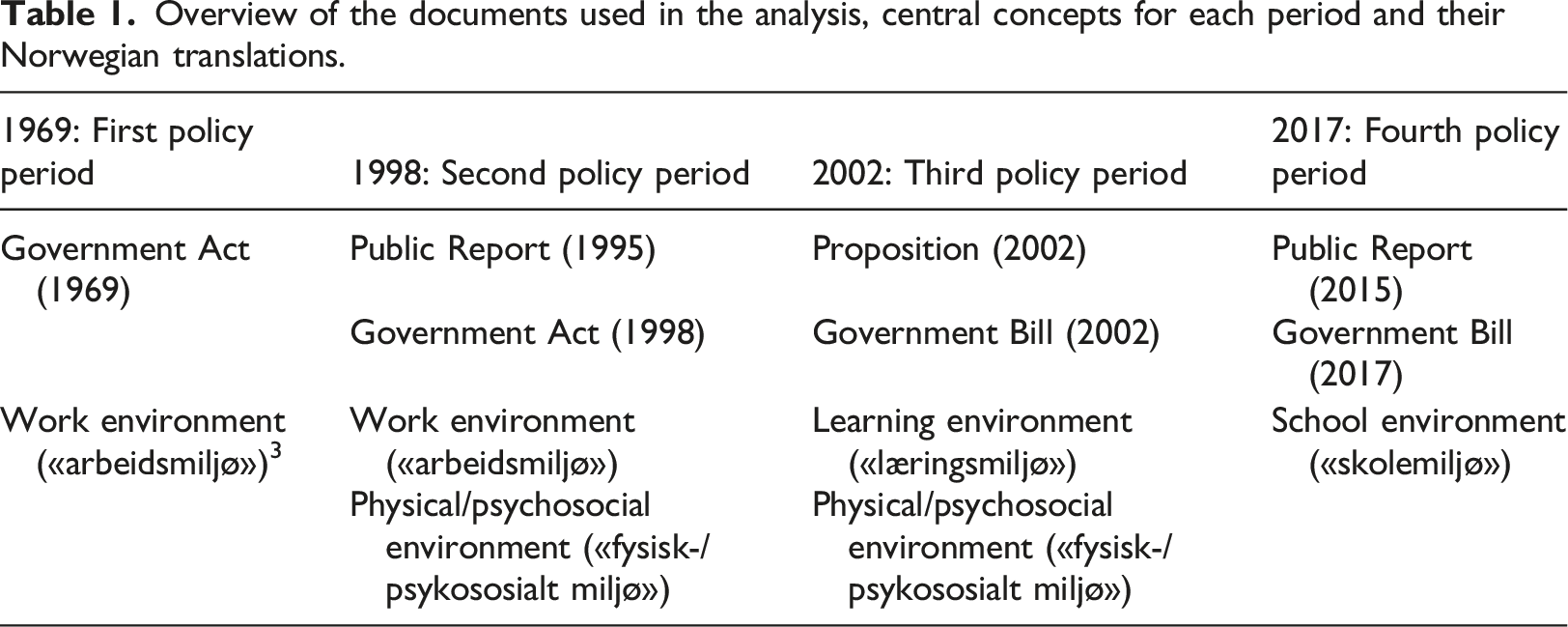
The present study on state policy and regulation followed the shifts during four periods spanning five decades (1969–2017). The analysis directs attention towards how the regulative vector concepts of the school environment have developed within a certain period, and across periods of policy, expressed through key documents and policy production.
Key documents that were identified were preliminary policies leading up to the four shifts in regulation (public reports), as well as the final legislation put into practice (education acts). Based on Scott’s (1990) criteria, seven documents were assessed and included in the conceptual analysis. Specifically, these included two public reports (Public Report, 1995, 2015), one proposition to parliament (Proposition, 2002), two legal statutes (Government Act, 1969, 1998) and two amendments (Government Bill, 2002, 2017). 2
The Act of 1969 covered compulsory education (years 1–7), while the right to upper secondary education was protected by a separate act, but this is not included in the analysis. Today, upper secondary education is a statutory right for all students, but there is no obligation to attend (Education Act, 1998; Eurydice, n.d.).
Results
First period: Students’ work environment and individual duties
Education Act, 1969
During an international wave of political and social unrest, the Compulsory Education Act of 1969 (Government Act, 1969) was passed in parliament. For the first time in Norwegian history, students’ right to a healthy work environment (‘arbeidsmiljø’) was ensured through §§16 (and 22) of the act. Paragraph 16 (‘On the working environment and on rights and duties for students’) states the following: ‘Effort should be put into creating a friendly working environment, including forms of collaboration for everyone connected to the school e.g., students, teachers and other personnel’. As expressed through the document, not only the school and teachers, but also students, are obliged to contribute to this so-called ‘friendly working environment’. This not only highlights that students have rights but also that they have duties in line with other school personnel to contribute to the work environment. Additionally, and in relation to the duties assigned to the school personnel, § 22, Section one states that ‘personnel should contribute to create a good school environment’, highlighting that schools and teachers have a more emphasised responsibility regarding this matter. Arguably, the responsibility for the personnel to cater to a positive school environment does not necessarily express students’ right to obtain a positive school environment.
The second important student responsibility, which is stated in the Education Act of 1969, concerns the so-called ‘learning responsibility’, namely, the responsibility to take part in regulated educational activities not necessarily organised by the formal school institutions (thus different from the ideals of compulsory school). However, and as stated in §13 ‘Right and responsibility for education’, it is as much a responsibility as it is a right: ‘Children and youths have the right and duty to attend compulsory school, if they do not receive equivalent schooling elsewhere’ (Government Act, 1969). It is important to note that even though certain rights in relation to the work environment for employees were regulated at this time, comprehensive working environment legislation was not introduced before 1977. Eventually – and together with various other sections of the law – students’ right to a good work environment was directly and indirectly regulated by the Working Environment Act; however, it primarily focused on the rights of employees (Government Act, 1977). As will be shown, the problems associated with this were addressed in the Public Report in 1995 and eventually also in the amendment from 2002 (Government Bill, 2002).
Second period of policy: Students’ work environment and collective duties
Public Report NOU 1995:18
The Public Report from 1995 focused mainly on the organisational and structural aspects of school, but the committee also suggested moving several paragraphs from the statuary objective to the Educational Act (Government Act, 1998). Regarding the work environment (‘arbeidsmiljø’) the report stated that the content in the existing regulations was to be kept in the statutory objective of the new Education Act (Public Report, 1995). However, what was simultaneously highlighted was the need to specifically investigate to what extent the Working Environment Act (Government Act, 1977) should continue to regulate the work environment for students. One of the main problems was that the work environment of the students was regulated by several laws in addition to the Educational Act (1998) and by a series of other governmental acts and regulations (e.g. health, planning and building).
In a regulation from 1995 titled ‘Environmental focused health care in kindergartens and school’, which has informally been coined ‘The children’s environmental law’, the demands regarding both the physical and psychosocial environment were highlighted. As a further illustration of the scattered rights of students concerning the different aspects of the work environment, this regulation is to be found in the Municipal Health Services Act (Government Act, 1991; 2011). Moreover, the Public Report (1995) referred to a public report from 1992 regarding environmental law in which it is stated that the representation of a student’s perspective should not be extended (Government Act, 1977). Thus, it became evident (1995, p. 225) that this matter had to be further investigated specifically, later resulting in the Government Bill in 2002.
Education Act, 1998
Largely, the new Education Act (Government Act, 1998) followed the overall evaluations stated in the proceeding Public Report from 1995. Hence, few important changes were made concerning the work environment for students. As proposed, regulations concerning discrimination, violations and bullying were sharpened but not included in the Education Act itself. Instead, they were included in its statutory objective. The rights of the students were still mainly centred on the right to receive education (also a responsibility) and only when there was specific reason for it, namely, the individual right to receive a special education (the latter not regarded as a responsibility per se). Subsequently, more than the act itself, what followed in the wake of the new regulation was the emphasised and urgent need to develop a section specifically catering to the needs of all the students to have a sufficient psychosocial environment (‘psykososialt miljø’).
Third period of policy: Learning environment and increased students’ rights
Proposition to Government Bill, 2002
As proposed in the Public Report (1995), the question regarding the work environment of students was adjourned to be closely investigated. The proposition regarding the Government Bill (2002) constituted one important document in the proceedings of the changes to the Education Act (Government Act, 1998). However, this proposition was followed by other important steps in the process, such as a draft of the law, which was presented by the Ministry of Education and Research in 2001 and distributed for an external hearing process. The draft proposed that the responsibilities for the school regarding the work environment be increased, but without strengthening the individual rights of the student (Proposition to Government Bill, 2002). The draft received critique partly because there was no proposal to secure students’ rights and partly because it mainly focused on the physical dimensions of the work environment. The psychosocial dimensions were, according to the report, regarded as having been sufficiently addressed in the current laws regarding, for example, bullying. The proposition suggested that the work environment of the students, described as the school environment (‘skolemiljø’), should be regulated in the Education Act (Government Act, 1998). Additionally, the psychosocial dimensions of the work environment were proposed as being included within this paragraph, thus assembling both the physical and psychosocial dimensions. However, the following is stated: When it is in the interest of the society that the students engage in school, it should also be the responsibility of the society to do their utmost to hinder that this engagement would harm the students. However, the school cannot in full control the behaviour of the students. Hence, it would not be realistic to legislate an individual right to a school environment free from bullying, violence, racism, and violations. (Proposition to Government Bill, 2002, p. 22)
Nevertheless, and regardless of this rather discouraging formulation, it is emphasised that there should be an explicit aim for the school to hinder this kind of behaviour and that there is the need to formulate concrete goals and systematically work towards those goals.
Amendment to Education Act, 2002 (Government Bill 2002)
In the proceeding discussions and in Government Bill (2002), it was regarded as impossible to secure the rights of the individual student. However, when the amendment was presented in 2002, the following could be found in §9a-1: ‘All students in compulsory schools and in upper secondary schools have the right to a good physical and psychosocial environment that promotes health, well-being and learning’. Rather efficiently, this illustrates that the Educational Act from 2002 not only emphasises the general, but also individual, rights of the students. Hence, this marks an important period regarding the legal rights in the Norwegian education system. The above quotation was an excerpt from the chapter, as introduced through the amendment, namely, §9a, which was coined ‘The students’ school environment’. The chapter contains nine paragraphs, one concerning the physical environment and another the psychosocial environment. Additionally, it is stated that if the students experience a shortcoming in either the physical and/or psychosocial environment (‘fysisk og/eller psykososialt miljø’), this will set in motion a special regulation, namely, an individual decision (‘enkeltvedtak’), which mandates the school to follow up on the problem. If it is not taken care of, the students have the right of appeal in accordance with the Public Administration Act (Government Act, 1967). Thus, the rights of the students were proposed as being ensured.
The school environment is a commonly used concept in both documents describing this fourth policy period, but it is interesting to note that the concept is closely associated specifically with the conditions of learning and what is described as the students’ learning environment (‘læringsmiljø’). The learning environment efficiently emphasises the specific conditions for students, namely, to ensure a good physical and psychosocial environment to learn within (Government Act, 1998, §§9a-2-3), here in relation to the employees who are expected to work (which is further regulated in the Work Environmental Government Act, 1977; 2005). Arguably, the concept filled the gap and defined the differences between the characterising conditions for students and ordinary employees. This might explain why the ‘learning environment’ became such an important concept in the aftermath of this amendment in everyday school rhetoric, as well as in other nationally initiated school development programmes, such as ‘Improved Learning Environment’ (‘Bedre læringsmiljø’) 2009–2014 and the ‘Centre for Learning Environment’, which is a partially nationally funded centre (Helgøy and Homme, 2014).
The fact that the earlier scattered laws regulating students’ work environment were assembled into one paragraph within the Education Act marked another important regulating shift, one highlighted in the Government Bill from 2002. Namely, the schools, which in Norway are under the control of the municipalities, would from now on be subject to school inspections from the state (Hall, 2017). Regular state school inspections were reintroduced in 2006 as part of a national quality assurance system and were gradually reinforced (Skedsmo, 2011). The inspection of schools regarding Section 9A was a key point of focus during the period from 2010 to 2013 and in later cycles of regular state school inspections.
Fourth policy period of policy: Further emphasis on student’s rights and the school environment
Public Report, 2015:3
In the Public Report from 2015, it was concluded that state policies and regulations were (still) not sufficiently warranted at the local level (Public Report). In this pivotal report, several shortcomings at the system level were highlighted: A. students’ rule of law insufficiently warranted, b. school culture lack of focus on zero tolerance towards harassment, bullying and discrimination, c. students’ and parents’ non-involvement in schools’ psychosocial environment, d. local school authorities’ and schools’ lack of systematic work towards improvement, and e. allocation of accountability in schools’ support structure being too diffuse. (Public Report, 2015: pp. 18–20)
The report finally projected several recommendations, among them the facilitation of a major, national investment in inclusive education, thus strengthening the rights of all students and demands from local school authorities and individual schools put forth in §9a of the Education Act (Government Act, 1998; Government Bill, 2002). As indicated in the title of the Public Report, the concept of the school environment became important, while concepts focusing on the more specific conditions of an environment for learning received a more peripheral position, at least explicitly. The committee stated that their ambition to facilitate a ‘secured psychosocial school environment’ was to realise Article 26 of the Universal Declaration of Human Rights (UN, 1948) and that the best interest of the child was a guiding principle for their work. The psychosocial school environment is defined as follows: …it is understood as the interpersonal conditions in school, the social environment and how the students and personnel experience this. The psychosocial environment is influenced by individual students, the student community and the attitudes, values and norm in school, which are influenced by internal and external factors, such as social, cultural, religious, economical, educational and health related conditions in a complex interaction between school, individual, family and society. (Public Report, 2015: p. 30)
Here, the committee clearly defined the psychosocial school environment as something much wider than the learning environment, which nonetheless is understood as being included as an important dimension within the school environment.
Amendment to Education Act, 2017 (Government Bill, 2017)
As seen, the universal principle of the best interest of the child was included as an amendment to the Norwegian Constitution (Government Act, 1814, §104), strengthening the individual rights of all children. In mid-2017, and in line with the recommendations in Public Report (2015), a major shift took place in the national regulation of primary and secondary education in Norway through Section 9A of the Education Act (Government Bill, 2017). This transition has multiple pedagogical and legal implications. A strict zero-tolerance policy towards bullying, violence, discrimination and harassment was introduced. Consequently, antibullying regulation led to a new household concept in the Norwegian language: ‘the (anti-)bullying law’. Thus, school authorities, school leaders and teachers must ensure that all students have an acceptable school environment (‘skolemiljø’), both psychologically and physically, within legal standards set forth in the regulation. The previously stated demand in the amendment from 2002 that an individual decision (‘enkeltvedtak’) be required to ensure a special legal right when a student’s psychosocial environment is being threatened was removed. From this time onwards, the students were not dependent on a specified legal right for their case to be processed. Instead, schools were obligated to treat any form of complaint with measures within 10 working days. Failure to initiate this process meant a breach of Section 9A, and all students would be granted access to directly complain to county school authorities, potentially leading to an on-site investigation. Each student’s subjective experience of their school environment would make up the basis of complaint cases, which may lead to an investigation by the respective County Governors’ Office responsible for inspection (Hall, 2019).
Finally, the emphasis on best interest of the child was furthermore intensified in state regulation through the recent National Curriculum (UN, 1989; Curriculum 2020b and 2020a are changed to Curriculum (2020)). As a core value, this also requires school leaders and teachers to a greater extent to stress this principle both in pedagogical leadership as well as in classroom teaching (Lile, 2021).
Discussion
The documents mapped in this study – both the different proceedings of laws and amendments and the laws and amendments themselves – can be considered as expressions of not only the actual but also the possible and virtual. As such, these documents are understood as texts directed towards the future, or rather, the not-yet-seen, through concepts in becoming (Deleuze and Guattari, 2012; Johansson, 2016). The development of the concepts, from work environment to school environment, via learning environment could be understood both as conceptual response to problems and as the unfoldment of life through cases demanding modifications of regulations. These concepts, in the documents materialised as rights, are defined as actualities, their temporal being, as well as their virtuality – thus having ability to become something else. In that sense, regulative vector concepts offer a way to map the flows modifying the concepts, as well as the events demanding the rights to be modified. Thus, the ambition for the following is to discuss the questions previously posed, namely: (1) If the concept of school environment is the answer, what is the problem to which it tries to answer? and (2) Based upon legal documents, which are the cases that demand modifications of these concepts and accompanying rights?
From scattered to unified rights? The rise of new problems
In the first regulations, the definition of the students’ conditions was regulated in several different laws, mainly through coordinates of the concept ‘working environment’. Arguably, the regulative vector concept of the work environment did not sufficiently answer the problems associated with the issues regarding students’ daily life in school, especially the fact that taking part in formal school is as much a right as a responsibility. When society expects children and youth to attend compulsory school, students and their parents should be able to expect that certain precautions are taken to ensure that the conditions regarding both academic and social aspects are adequate. This arguably highlights the accountability aspect in the public education system, as described by Biesta, 2021. When ‘work’ was replaced by ‘school’, and more specifically, ‘learning’, the focus was directed at the unique conditions of the school, highlighting that this differs in relation to the rights in a workplace. Here, the coordinates of the concepts changed, and thus the velocities of the flows defining the rights of the students. As a regulative vector concept, the learning environment could both be regarded as a result and a precondition of a functioning school situation (Federici and Wendelborg, 2013).
The conceptual travel within the regulations and polices exemplifies what might happen when the coordinates are changed, and the flows consequently take different directions. New tensions are produced, and new discussions regarding the boundaries of the concepts become actualised. The coordinates of the concepts, and their boundaries, are affecting the speed and velocity of the flows, making the concepts productive as well as powerful by directing focus upon what in a specific situation is important. This also highlights the shortcomings of a regulative vector concept, which inescapably and fully cannot embrace and define the context of the conditions of education. As illustrated by the mapping of the conceptual development within the regulations and policy documents through the last decades, boundaries have been re-drawn and flows have taken different directions, new problems have become actualised, demanding the creation of new concepts (Deleuze and Guattari, 1994).
Rights of the students, or rights of the teachers?
As earlier described, the students’ responsibilities to contribute to a healthy working environment, which was explicated by the Education Act from 1969 (Government Act, 1969), disappeared in more recent acts and amendments. Thus, the school environment is exclusively associated with the rights of the students, which is arguably in accordance with the Universal Declaration of Human Rights (UN, 1989) and is in the best interests of children. However, the changes in the concept’s coordinates, and the directions of flows, defining and securing the rights of the students has seemed to have led to a more insecure work environment for teachers. According to the current regulations, students who experience violation or bullying by school personnel are instructed to report this directly to the school principal, who, in turn, should report this to the municipality
Rights of the individual, or rights of the collective?
The individual right to a healthy school environment, which was ensured in the amendment in 2002 (Government Bill) and further strengthened in 2017 (Government Bill), marked an important regulative shift. This shift, from a collective to an individual right, which was wheeled by the conceptual movement from working environment into instead framing it as the learning or school environment, could be seen as way to handle the universal in the human rights and make it specific. At the same time as the flows modify the concept, the right becomes diverted and distributed, from defining the legal responsibility of the school to defining the individual right of the student. This shift is conceptually and rhetorically important, but it also has obvious administrative consequences which ultimately have impact on the conditions for the learning of the students.
In 2016, prior to the new amendment, 161 complaint cases regarding unfulfilled individual rights to a healthy school environment were opened nationwide. In the first 12 months since the 2017 renewal of Section 9A, the number of cases increased to 1,416 (UDIR, 2020). Thus, the conceptual changes and the modification which the strengthening of individual rights produce is obligation for the school to initiate measures within a short time span and access to a direct channel of complaint to county school authorities seem to have led to increased bureaucratisation within education. This has also produced a change in the working conditions for school leaders, as recently pointed out by Larsen et al., ‘School leaders experience [clear] tension between accountability within bureaucratic organisations and the autonomy of professional norms and standards’ (2020, p. 18).
Overview of the documents used in the analysis, central concepts for each period and their Norwegian translations.
Concluding remarks
The United Nations Convention on the Rights of the Child (1989), and the principle ‘the child’s best interest’, has since 2014 been adapted into the Norwegian Constitution (Government Act, 1814) as well as the National Curriculum of basic education (Lile, 2021). In this article, the legal operationalisation of this has been mapped through concepts securing the environment of the student throughout half a century, and specifically via the key concepts work environment, learning environment and school environment. Empirically, the travel of these concepts has juridically entailed a movement from collective to individual rights. At a glance, this movement could be seen as an addition of rights for the individual. However, and with inspiration in the philosophy of Deleuze which offers tools to problematise rights and specifically human rights (Patton, 2005; Deleuze and Guattari, 2012), the picture might be more nuanced, as will be discussed in the following section.
In this article, the concepts regarding the students’ work environment have been viewed as regulative vector concepts. These concepts were mapped, to trace the changes in the concepts longitudinal and latitudinal coordinates, and how the flows have become temporally stabilised or diverted, thus demanding new boundaries and the creation of new concepts. This has highlighted several tensions between rights, for example, between the rights of students and teachers, and between the individual and collective. It demonstrates that the quantitative addition of legal rights, as, for example, the securing of the individual students right to a healthy school environment, does not necessarily lead to an increased right in terms of quality – at least not in every sense. While the students’ individual rights are strengthened, for example, through the Government Bill in 2017, teachers might experience their rights as (unintentionally) threatened (Handal, 2018).
Additionally, the bureaucratisation and the juridification of school administration, is time consuming, and potentially, it directs focus away from the planning and organisation of the overall pedagogical activities. Hypothetically, the ambition to strengthen these rights might in fact be regarded to be against the ideal of the ‘best interest for the child’, as stated in the UN Convention (1948), as the teachers’ work environment is pervaded by a seemingly palpable fear of threatening the individual right to a healthy school environment in addressing the pedagogical and social needs of the collective. This highlights a tension between balancing individual rights with collective needs, which arguably always have constituted a pedagogical challenge. However, with the recent regulative and conceptual changes, this challenge is no longer merely pedagogical, but also juridical and arguably more complex to relate to since it aims to embrace the full school context of the student. Tensions between individual and collective rights, raise questions regarding how universal ‘universal rights’ actually have the ability to be, since it must be actualised though unique individuals, directly or indirectly thus demanding action potentially at the cost of the collective. This illustrates Patton’s critique of notions such as human rights for ‘belonging to everyone and no one in particular’ (2005, p. 205).
In the Nordic educational setting and with a historical backdrop, this case illuminates what becomes actualised when the ambition to incorporate universal rights in a national regulative structure, through concepts aiming to secure the well-being of all students. This study shows what Patton (2005) argues, namely, that the practice of law, and in this case the regulation of rights, is to be regarded as responses to specific cases which continuously demands modifications of the regulative documents – as well as the concepts defining such rights. Regulations and laws stabilise the flows, however, the specificities in life, in the cases, illuminate the limitations of both the concepts and the laws protecting the rights. From that perspective, this calls for continuously adjustments of regulations, wheeled by the encounters between specificities of life and the universal. In the case of this study, both the regulations and the concepts have been modified and changed multiple times. These modifications can be understood in at least two different ways. Either, in what could be regarded as a positivistic ambition, namely, as an expression for the conviction that there exists a perfectly suitable concept capturing the well-being of students in school, and that every modification of the concept and the regulations move closer to perfection. That is an ambition of stabilisation of flows. Or, which is an understanding more in line with the thinking of Deleuze and Guattari (1994, 2012), the modifications could be regarded as ambitions to be sensitive to the specificities of life as it unfolds, aware of the unescapable limitations in concepts as well as regulations, which demands them to be in movement – to be changed. In that sense, even though regulations can be understood as eternal and universal, the specificities of life force them to follow the flows, to not be fully captured. Regardless of how these modifications can be understood, the cases highlighted in this study, imply that there will be new shifts in both the concepts defining the rights of the students and the regulations protecting the same. As highlighted, these shifts are not only regulative, but also and unescapably ethical as the contexts and ramifications of educations are shifting, thus actualising new problems and questions regarding the educational practice (see, e.g. Buchanan et al., 2022). Evidently, this will have implications for school leaders and teachers who must relate to new amendments in regulation, inclining the need for updated competence and understanding of the range of these shifts as well as how to put such legal knowledge into practical action (Hall, 2019).
Footnotes
Declaration of conflicting interests
The author(s) declared no potential conflicts of interest with respect to the research, authorship, and/or publication of this article.
Funding
The author(s) received no financial support for the research, authorship, and/or publication of this article.
