



Abstract
This paper describes a research collaboration with Humber Museums Partnership, which explored family museum visiting and early language. Drawing from ethnographic observations and continuous audio recordings, this article examines how very young children make sense in museum spaces. We activate Deleuze and Guattari’s concept of the refrain (originally expressed in French as ritournelle, a little return) to analyse vignettes of children’s vocalisations and interactions across galleries, gardens, and play spaces. Counter to the dominant view of early language as relying on a linear “serve and return” between adult and child, we argue that refrains create fragile, rhythmic, and emplaced territories of sense making that exceed conventional meaning and representation. We propose that museums can foster an attention to these affective, embodied dimensions of expression as an important aspect of young children’s museum literacies.
Vignette: Waddle waddle As two-year-old Sasha and her mum search for their favourite penguin, Sasha’s mum asks “and what do the penguins do?” in a confident and firm voice, and Sasha answers immediately “waddle waddle”, in a loud voice with a slight sing-song inflection. Mother and daughter exchange this phrase back and forth a couple more times as they walk towards the penguin enclosure at Sewerby Hall -”waddle waddle”, “waddle waddle”. The exchange ends when mum utters “ah…waddle waddle” in a deeper, calmer voice which seems to mark the end of the exchange.
In this article, we pay attention to returning “little tune[s]” (Deleuze and Guattari, 1987: 363) such as the “waddle waddle” described in the above vignette. We examine how such little tunes unfold rhythmically, spatially, and precariously during young children’s explorations of museum spaces. The development of playful language practices or repeated refrains during daily routines is something that will feel familiar to many readers who spend time with young children. We assume “waddle waddle” is something that Sasha and her mum have referred to during or in-between previous visits to this local museum. In this sense, it intimately references Sasha and her mum’s frequent visits to and shared love of this space (Hackett, 2016). Repeated language practices like this can emerge and re-emerge in relation to place and through bodily experiences (Shannon and Hackett, 2024), creating connections across time and memory (MacLure, 2016; Wallis and Noble, 2022). While Sasha and her mum’s “waddle waddles” might at first resemble the kinds of back-and-forth parent/child interactions prized by child development literature, we argue that there is much more to early language (Hackett et al., 2021), and an over-focus on how words can be volleyed back and forth like linguistic tennis risks flattening the fragile sense making that unfolds between sounds, places and people. Here, we use the term “sense making” rather than “meaning making” to emphasise the affective, embodied dimensions of expression that occur in such repetitions. Deleuze (2004) wrote that sense lies at the frontier between inside and outside; between the noise and the agitations of the body, and the meanings conveyed in organized language. Importantly, sense always involves something that cannot be captured in words alone. What, we wonder in this paper, are the implications of these emplaced, fragile refrains (Deleuze and Guattari, 1987) - or “little tunes” - for how we think about young children’s sense making in museum spaces?
Context and background to the study
This article reports on a research collaboration between the authors and the Humber Museums Partnership (HMP), a network of museums and heritage sites situated across three local authority areas in the Yorkshire and Humber region of England: Hull, East Riding of Yorkshire, and North Lincolnshire. The partnership builds on previous collaborative work between members of the research team and HMP, which investigated the experiences of young children and their families during museum visits (Hackett et al., 2018, 2020). Commissioned by HMP, the current study extends our earlier work by focusing specifically on the roles of language and sound in shaping families’ museum experiences. Our work was motivated by the following questions; • How might public places like museums shape children’s language and literacy practices? • What role might HMP play in supporting children and families in this context?
In order to explore how young children’s encounters with museums, galleries, and outdoor heritage spaces might inform understandings of early language and its entanglement with place (Shannon and Hackett, 2024), we undertook collaborative, site-based research with families and young children across several contrasting HMP locations (see Figure 1). The methodology (described further below) combined ethnographic observation with audio recording, attending closely to children’s language, vocalisations, and broader modes of sense-making as they moved through and interacted with museum environments. Abi, David, and Christina (authors 1–3) made repeat visits to each site, meeting families recruited through HMP’s networks and gathering data via written field notes and continuous audio recordings on handheld audio recorders. In this article, we take up Deleuze and Guattari’s (1987) concept of the refrain in A Thousand Plateaus (hereafter, ATP) to explore three aspects of our data: rhythm, fragility, and place. The concept of the refrain is often invoked to explore stabilization and territory-making, downplaying the fragility that is core to Deleuze and Guattari’s exploration of the concept. Our analysis foregrounds this fragility: refrains are contingent, precarious, and always in danger of breaking apart. We argue this fragility is not a weakness but central to how children’s sense-making unfolds in museum spaces. Details of the museum sites, participants and data collected for each site.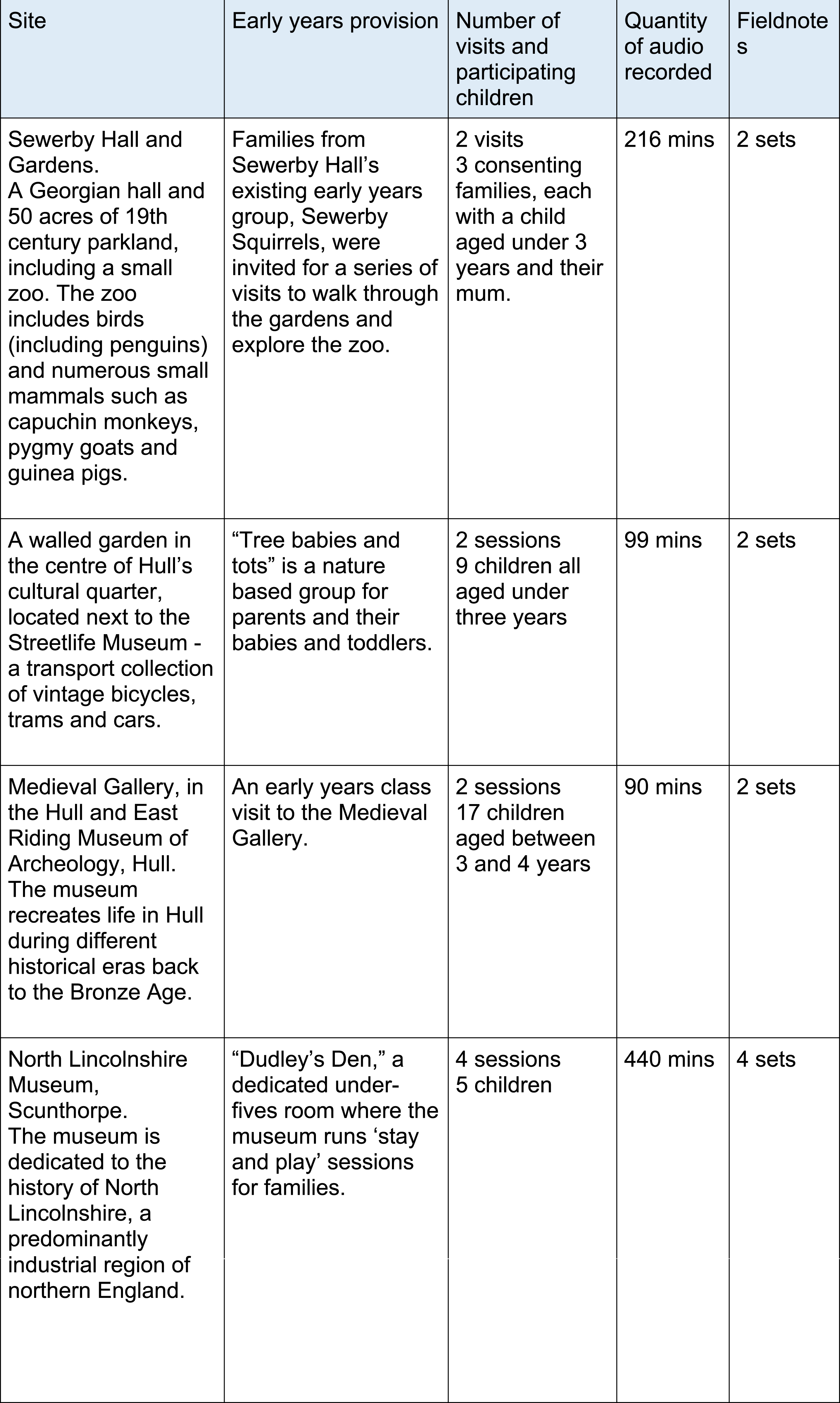
Methodology
Our methodology consisted of written observations and audio recordings of young children and families as they experienced and explored HMP sites, with a focus on language, vocalisations, and multimodal sense-making of the children. We made repeated visits with participating families to the museum sites. During each visit, one or more grown-ups carried a small ‘wearable’ audio recorder (we originally envisaged the children carrying these, however in practice they tended to be carried by parents/carers or researchers). As we explore later, these audio recorders captured whole soundscapes of human and more-than-human sounds, allowing us to resist privileging recognisable spoken words. Meanwhile, after each visit, the researchers created written fieldnotes, which were intended to supplement and nuance the audio methods.
Our fieldwork included indoor and outdoor spaces; the locations and numbers of field visits to each site are summarised in Figure 1.
The research received ethical approval from the Manchester Metropolitan University Ethics Review Board and adhered to BERA ethical guidelines. Parents gave informed written consent to being involved in the study. Importantly, it was made clear that families could still participate in the activity / provision without being involved in the research. In addition, because the children participating in the study were too young to give informed consent, their assent to participate on a moment-by-moment basis was privileged, through ongoing reflexivity and attention to children’s gestures and cues (Cocks, 2006; Dockett et al., 2009; Flewitt, 2006).
We sought consent to audio record children for analysis, and to quote anonymously. However, we did not seek ethical approval to reproduce sounds in publications or academic papers. As we explore later, this was both a deliberate ethical choice in relation to researching with very young children but also a methodological proposition: we wanted to explore the affordances of sound methods to register spoken utterances, un-spoken gestures, and the sounds of objects and the environment in ways that didn’t codify or sanitise them. This grappling with the articulation of sounds (human and more-than-human, including but not restricted to utterances), their felt affects and perceived meanings, and what this might mean for our understandings of early childhood literacies and language, is something we unpack in the next sections. Firstly, we do this by articulating a conceptual frame in which we understand language as material and relational. After that we go on to explore what this meant for our transcription, analysis and engagement in the soundscapes of early childhood museum encounters.
Language as material/relational
This paper builds on and contributes to scholarship that takes a posthuman view of language, one which operates beyond meaning and beyond individual volition (Hackett et al., 2021; Jackson and Mazzei, 2009; MacLure, 2013; MacRae and MacLure, 2021; Powell and Somerville, 2018; Thiel and Dernikos, 2020). A dominant view of early childhood language and literacies emphasises the intentional production of fixed subject positions by the bounded speaker: (who “knows who she is, says what she means and means what she says” (MacLure, 2009: 104). In contrast, a posthuman view of language pays attention to the non-verbal, affective and sensory forces ‘inside’ language (Deleuze and Guattari, 1987/2004; Kuby et al., 2019; MacLure, 2013) that have nothing to do with meaning or signification. These affective forces pre-exist individual volition; thus, a posthuman view of language runs counter to assumptions that language is the property of any one individual who is the ‘producer’ of their utterances. Instead, “expression is abroad in the world”’ (Massumi, 2002: 13). By this we mean, language emerges from and between human and more-than-human bodies (Dernikos et al., 2020; Gallagher et al., 2018; Thiel and Dernikos, 2020). This elevates the role of place, prompting us to consider how more-than-human soundscapes of museum spaces are imbricated in young children’s languaging and the relations that emerge.
Our project grappled with the difficulty of working primarily with sound. In recent years, educational research drawing on sound studies and utilising sound methods has proliferated (e.g., Gallagher, 2011; Gershon, 2013; Shannon, 2023; Wargo, 2018). Researchers are interested in the potential of sound to disrupt Euro-Western sensory hierarchies that privilege visual perception (Gershon, 2017; Shannon, 2021), as well as how sonic methods can challenge dominant developmental paradigms (Gallagher et al., 2018; Shannon, 2020) and interrogate power dynamics within educational spaces (Brownell, 2019; Dernikos, 2020; Gallagher, 2011; Shannon, 2022). The growing popularity of such approaches offers educational researchers alternative ways of knowing and engaging with the world beyond traditional ocularcentric methods (Feld, 1996; Pink, 2009; Springgay, 2011).
Vocalisations are of particular interest to us within this paper, as our audio data was replete with children’s vocalisations that were not easily recognisable as words, yet still appeared to be expressive (cf Muller, 2021). Galera and Poveda (2024) describe how agency and meaning emerge between and within actors, as grownups respond to babbling and vocalisations, arguing “families interpret infant actions in provisional ensembles” (p. 4). As such, meaning is contingent and negotiated. Likewise, Hackett, 2022 has argued against the assumption that young children’s vocalisations are merely not-quite words, instead examining what they do in their own right. Galera and Poveda (2024) agree that baby sounds “can be taken seriously as a mode of communication” (p. 11), upending our assumptions that recognisable words are always more communicatively effective.
In this article, we take the posthuman analysis of children’s vocalisations further, suggesting that refrains (or “little tunes”) involve distinctive modes of expression and relation - with other people and with the more-than-human world - that do not pass through conventional language use. Even when recognisable words are used, these do not refer to an existing state-of-affairs. For example, whilst Sasha’s “waddle waddle” in the introductory vignette does indeed begin with a conventional, referential use of “waddle” (i.e., to refer to what penguins do), in its subsequent iterations it no longer refers to a way of walking. Instead, the repeated utterings of “waddle waddle” can be understood as a refrain, acting to carve a kind of “inflatable, portable territory” (ATP, p. 320) that Sasha and her mother can occupy in companionate relation, without exchanging determinate meanings.
The posthuman nature of language as bodily, material, and pre-individuated began to become apparent as we analysed our continuous audio recordings of the children, their grown-ups, and the museum spaces they were entangled in. Our audio recordings were characterised by overlapping utterances, multiple points of attention and human voices woven into (often loud) more-than-human soundscapes that included wind, crunching gravel and the clatter of toys. As we raised earlier, our research grappled with the challenges of adequately representing and analysing spoken utterances, un-spoken gestures, and the sounds of objects and the environment in ways that didn’t codify or sanitise them.
Other studies employing continuous recording tend to ‘neaten up’ the audio into transcripts for analysis; whilst this can yield important findings, it is less well suited for working with the youngest children, where language is emergent and words wrapped up with other vocalisations and gestures. In addition, ‘neatening up’ transcripts to foreground words (or other noises and gestures that are easily articulated in words) will always privilege certain aspects of language, embodiment, and materiality over others (MacLure, 2013), therefore providing only one of many possible stories to be told about what happens between and amongst young children, place, and language. We found (not unexpectedly) that linguistic approaches to transcription emphasise recognisable words and were not a good fit when working with young children as they moved and played in museum spaces. Solutions such as transcribing everything phonetically, or multimodal transcription (in which video data is used to transcribe bodily movements together with gesture, gaze and sound) only partially solve the issue because they all work from a starting point of language as an individual endeavor (Hackett et al., 2021). As we have argued elsewhere; gestures, words and sounds produced by the children and by the place are inseparable and difficult to transcribe. This however is not a methodological inconvenience, but an important insight into the more-than-human nature of literacy and language practices. (Hackett, 2021, p.77)
Our experimentations with transcriptions illustrate how language is a collective endeavor, between numerous human and non-human bodies. These bodies shape sounds as they emerge, as well as how the sounds are ‘heard’ and taken up by the collective. A short vignette from David’s fieldwork in the North Lincolnshire Museum’s under-5s stay-and-play illustrates this. Vignette: Henry and the “ding bell” Henry (2 years, 6 months) is playing with the “ding bell”: a toy consisting of a large, rectangular piece of wood, with a metal rail coiling through, down which metal balls can be rolled. As the ball rolls down the rails, Henry flaps his arms and jiggles his legs, his whole body undulating with glee. At the end of the rails, the ball strikes a tiny metal bell. As time passes, Henry begins to say “ding” (or sometimes “bing”) after the bell sounds. “Ding! Ding bell.” As the game progresses, he begins to “ding” along with the bell in unison, and then even slightly before it. Henry’s 婆婆 (paternal grandmother) watches as he plays. At first, she encourages Henry to describe the colours of the balls, or to count them. However, as the game progresses, 婆婆 begins to join in with Henry’s dinging, cackling wildly each time she does. 婆婆 then starts to encourage him to put two balls down at the same time “Are you doing two together? Yeah! Do two together!” as she giggles along with him.
This vignette and our reflections on the difficulty of transcribing Henry and his 婆婆’s play came up time and time again as we returned to the data in the years since the fieldwork. Our attention to the more-than-human obviously complicated this, but even the task of transcribing children’s vocalisations was difficult. So often, even when we could accurately transcribe the words or phonemes children used, it didn’t capture the expressive dimensions of each vocalisation, while representing the pitch or intonation didn’t capture the milieu of surrounding sounds that changed the meaning moment-by-moment. These dilemmas are also evident in the vignette below, which comes from Christina’s fieldwork at the Hull and East Riding Museum. Vignette: “It’ll be alright.” At the very end of the nursery visit to the Medieval Gallery, the children walk through the rest of the museum on their way to the exit. Tired from the day, the children stretch out in pairs, some with nursery practitioners and parents holding hands. It seems a long way to the exit, and the voices of the adults carry over the hubbub: “J, come this way.” “Wow, what can we see here?” Out of the general hubbub comes an utterance that I only become aware as being a repeated phrase when it is repeated two more times: “it’ll be alright…..it’ll be alright”. These words are said very quietly, and they sound like they come from the back of the throat, squeezed out. I respond, “it’ll be alright”, my voice at first repeating the words with some of the expression of the child’s utterance, and then I repeat “it’ll be alright” with a more similar tempo to his. I ask the child, “are you getting a bit tired?” - to which no response can be heard.
Reflecting on the arrhythmic soloing often heard in Black Pentecostal devotional songs, religious studies scholar Ashon Crawley (2020) observes that: to try and recount the entire rendition through typed words would only be to falsify what actually occurred. The written word can’t really approach what happened live. Not at all. You would have had to have heard it. (p.209, emphasis ours).
Crawley here evokes a sense of indescribable “plentitude” (p. 45): “a kind of quality, that perhaps western logics have attempted to train us out of” (p. 45). He argues that this plentitude is found in lots of places: as evident in the final four movements of Steve Reich’s Music for 18 Musicians as in the singing and shouts of the church. Like Crawley, we found that our attempts to represent the “it’ll be alright” so often subtracted or even introduced (i.e., “falsified”) aspects of the experience: the qualities of solace and the ineffability of the words “it’ll be alright” in no way match the lived sensations set off by their uttering. The link with faith also allows us to think more about how this repeated utterance (possibly a phrase used by parents or carers to reassure the child in previous situations) functions like a prayer, providing, as we mentioned earlier, a ‘portable’ sonic thread that emerges from an emplaced body, but at the same time having the ability to collapse into other space-times. Where “waddle, waddle” seemed to produce a form of companionable walking and sounding together, the comfort of the “it’ll be alright” creed feels tethered to a familiar other not present: its ‘little tune’ producing some thread that anchors a distressed body.
In discussing these two vignettes, we have tried to express the felt-ness of the children’s sense making — the embodied dimension of expression that occurs in refrains — within the wider museum soundscape, and importantly how this felt-ness co-constituted what these literacies do, how they are taken up and, potentially, set something new into motion (either in the moment or later on). Coupled with the scholarship we outlined in the section above, the pull of the polyvocal more-than-human soundscapes captured in our audio recordings enables us to ask new questions about what ‘counts’ as language, outside a model in which the adult, abled human, as a bounded and agential individual, is the gold standard. In the next section, in order to continue this thinking, we turn to Deleuze and Guattari’s (1987) concept of the refrain.
The refrain in young children’s museum spaces
In what follows, we draw on French process philosophers Gilles Deleuze and Félix Guattari’s (1987/2004) exploration of the refrain in A Thousand Plateaus, translated by Brian Massumi from the French term ritournelle. Deleuze and Guattari’s aim in A Thousand Plateaus (hereafter ATP) was to challenge dominant, hierarchical, individualistic, and linear modes of thought. In so doing, they propose a range of concepts that provide a fluid, interconnected, and non-linear framework for understanding how meaning, subjectivity, and social formations emerge and transform.
The refrain can be thought of as marking a territory via expression. Deleuze and Guattari begin the chapter “1837: Of the Refrain” by providing examples of the refrain’s expression, including bird song, a housewife humming a tune, and birds turning over leaves to expose their pale underside. Thus, in addition to sound, refrains can take “optical, gestural, motor, etc.” (ATP, p. 376) forms, often intermixed and simultaneous rather than as separate categories: a mixture of these is found in our data. Deleuze and Guattari describe the refrain as “crystalline” because of the way it extracts heterogenous aspects of its wider surroundings (“it bites into them, seizes them bodily” ATP, p. 314) and brings them together. In her discussion of children in classrooms, MacLure (2016) demonstrates how strikingly children can seem to embody and illustrate territory making through expression (refrains) as, In the classroom video recordings, refrains come and go in the repetitive sounds, movements, word games, facial expressions, and gestures of children as they move through the classroom and the school day. (MacLure, 2016, p.177)
As we see in many of the examples in both MacLure’s (2016) paper and this current paper, the refrain is often invitational. It not only draws a territory, but also opens it up: passing between children, moving through the space, seeming to be multiply authored and outside of any one individual’s control. Thus, reading our children in museums audio data through the concept of the refrain is in line with our conceptualisation of language (outlined above) as material, relational and operating outside the bounded individual human and their pre-intended meaning making. Deleuze and Guattari indicate the non-representational nature of territorial refrains when they describe them as a “poster, placard” or “readymades” (ATP, p. 368, emphases in original). The refrain does not describe or represent the territory that it occupies, but rather announces it. It does not ask to be “interpreted” or parsed into its component parts.
Perhaps Deleuze and Guattari’s most memorable illustration of the refrain is the image of the child, whistling as they walk alone in the dark; feeling afraid, Deleuze and Guattari propose, the child’s whistling brings order to the chaos of the dark, as “one ventures from home on the thread of a tune” (ATP, p. 363). J’s repeated “it’ll be alright”, above, is a clear example of this kind of refrain. In the words of Deleuze and Guattari, it has become a “portable” territory that J builds around himself: “How very important it is, when chaos threatens, to draw an inflatable, portable territory” (ATP, p. 320). Importantly, however, the refrain is not a fixed or stable kind of order exerted on the dark by the child-as-master. Instead, the refrain contingently holds something together, as “it jumps from chaos to the beginnings of order in chaos and is in danger of breaking apart at any moment” (ATP, p. 362).
Deleuze and Guattari identify three (not necessarily sequential) aspects of the refrain: firstly, an apprehension of the chaos of the unknown; secondly, via expression, a contingent circle of order forms around a fragile centre; and thirdly, via this contingent circle, we find the possibility for opening out towards the future, through “different loops, knots, speeds, movements, gestures and sonorities” (ATP, p. 363). Each of these aspects are held together by the return or repetition of the refrain (as the title of our paper indicates). “Rhythm is the milieu’s answer to chaos” write Deleuze and Guattari. Consequently, there is something “repetitive, comforting, and rhythmic” (Merriman, 2024: 5) about the refrain. We are particularly interested in this paper in thinking about the temporality and spatiality of this repetition. Through repetition, the refrain can become attached to or evoke particular places, moments or relations: it can articulate connections across time and place through how and when it returns. As McCormack (2013) points out, whilst bodies and spaces influence each other, it is “a relation between things already in process” (p. 2), which requires attending to affective intensities between and around bodies. Importantly, “it is the difference that is rhythmic, not the repetition” (p. 365), whereby the “interplay of variations” creates the rhythm (Aránguiz, 2024). It is the rhythmic tempo of “it’ll be alright’ that allows a quiet whispering voice to create a moment that cuts through the loud more-than-human hubbub of the museum corridor. These rhythms—shaped in the relation between bodies, motions, and the differences between them—lay the ground for refrains to produce territory.
Refrains are territorial in the sense that they establish small, fleeting centres of organisation in the chaotic forces of their surrounding milieus. Refrains thus allow young children to anchor themselves in a place, while at the same time, establishing that place itself. This seems to us a very important part of early development. While adults may easily recognise and be able to name a place, a young child’s encounter with a place may be blurry and unfocused - a swirl of affects, sensations, movements and contours both familiar and unfamiliar. The many intersecting elements that make up a museum garden, say - plants, paths, mum, other bodies, gate, water, clothes, colours, smells, sounds (human and non-human, the sounds of one’s own breath) - may not coalesce into a place called “museum garden.” It may feel like being on the edge of chaos. The refrain works “to take something from chaos across the filter or sieve that has been drawn” (ATP, p. 311).
Like many of Deleuze and Guattari’s concepts in ATP, the refrain enables us to step back from the fixed, linear, or hierarchical systems that typically shape European thought, and instead think in more messy, processual, and connected ways. For example, for Merriman (2024) the refrain provides a more effective way to foreground “process and the dynamism of places” (p. 3), standing as a counter position to “a building-block view of the world” (p. 2) in which worlds are assumed to be built from separate material or semiotic components. In the next part of this paper, we draw on the concept of the refrain to explore three entangled aspects of our data: (1) rhythm, (2) fragility, and (3) place. We argue that the refrain offers a way of thinking through children’s sense-making moves—sometimes hesitantly, sometimes insistently, sometimes unintentionally—through dynamic patterns of variation, negotiation and creation of space, and fragile improvisations.
Much of what we present in this paper are small moments, temporary felt episodes, things that can easily be overlooked, including some that were in the moment, and were only rediscovered when we listened back through the audio recordings numerous times. As MacLure (2016) writes, Little episodes such as these seem so lightweight as to be scarcely noticeable—mere “fillers” in a child’s transitions from one educationally significant moment to the next. But they are everywhere in the recordings, and it is worth thinking further about what they might be doing, as they seem to me to have many of the characteristics of the refrain or ritornello. (MacLure, 2016, p.177)
Order, chaos, rhythm and the refrain
We explore how the refrain can temporarily hold things together — create “a circle around that uncertain and fragile centre” (ATP, p. 362) — by turning to a vignette of Abi walking with a family at Sewerby Hall and Gardens. Vignette: Walking to Sewerby zoo As we walk towards the zoo from the hall, 24 month old Sasha slips her hand into mine. “Is this cos you gonna show me? Be careful I don’t get lost?” I ask. We walk in companionable silence, and then Sasha begins to murmur “mmm mmmm” quietly to herself, and I seem to reply or respond “hmm mmm”. Sasha’s mum and I make small talk about the weather. Simultaneously, Sasha continues to vocalise “mmmmm-ahhhhh mmmm-ahhhhh mmmmm-ahhhhh”, and I seem to reply “yeeeee-ahhhhh” in a similar cadence to her vocalisations.
As a research team, we came to think of these collegial vocalisations during moving around together as ‘going along noises’. Deleuze and Guattari (1987) write about the importance of sonorous components to the refrain, arguing sound is particularly important because of its ability to mark out a space or a function without passing through language. Importantly, the fact that both adults (including the researcher) and children contributed to these noises, prevents us from thinking of vocalisations as the sole domain of babies and infants and enables us to think about what these “sonorous components” (ATP) are doing in the space. We could think of Abi and Sasha’s vocalisations, as they move across the grass together, as forming a contingent circle of order, holding something together during the journey to the zoo. In tentatively opening towards possibilities for proximity and intimacy between us as a group of strangers, sonorous components such as “hmm hmm” and “yeah yeah” seemed to work to offer some stasis, however temporarily. It is this temporary stasis, we argue, following the logic of the refrain, that creates a capacity for something new. In line with the third, opening-out aspect of the refrain that Deleuze and Guattari outline (above): “one opens the circle a crack, opens it all the way, lets someone in, calls someone, or else goes out oneself, launches forth” (ATP, p. 311). This also recalls Christina’s reflections on J’s “it’ll be alright.....it’ll be alright” and how it drew her in: while it may have started as a territorialising gesture to mark some territory amid (what we assume was) his tiredness, its repetition, with the consonants growing more marked each time, invited two further repetitions from Christina. “Mmmm mmm” and “it’ll be alright… it’ll be alright” are invitational, inviting others to contribute and be in relation with the new, fragile territories and futures being marked out. Such “invitations” need not be intentionally issued by the child of course; they need only to be open to being taken up by the other participant(s).
Fragility and the refrain
Deleuze and Guattari’s understanding of the refrain is, as noted, of something that creates a temporary kind of territory, “a territorial assemblage” (ATP, p. 312). To explore further what Deleuze and Guattari are proposing here, we turn to a vignette from David’s fieldwork in North Lincolnshire Museum’s stay and play. Vignette: 11 screams Someone, somewhere in the crowded room of toddlers and their grownups, starts doing the Jaws theme tune: “dun-dun… dun-dun…” Immediately, a child screams. Screams begin to erupt from different locations around the room and across the soundscape, a few seconds apart. “Don’t scream!” says one adult. “Stop copying!” says another. But the screamers do not stop. Instead, there are 11 screams in total, across at least two bodies copying each other, picking up the call and returning it. The last four screams seem to all come from a single child, where they fall into an evenly spaced rhythm, like a march, a little over a second apart, creating a slow, driving, pulse.
This vignette helps to illustrate the territorializing nature of refrains. The 11 screams marshal a kind of anti-chaos drawn from the virtual world of Jaws’ terror but also the unusually busy Dudley’s Den. The 11 screams constantly transform, getting taken up by different bodies in the room echoing one another (“Stop copying!”), before seemingly settling in one body as a steady pulsing. Thus, as with “mmm mmm” and “it’ll be alright,” screaming this kind of marshalling is invitational, in the sense that it creates fissures for contributing or being in relation with each other. As noted above, we do not intend to imply here an intentional or conscious invitation from any one individual. Indeed, the 11 screams themselves are not preconceived or designed by one individual, rather they are a relational act of collective expression thrown together in the moment, as bodies stir, sounds reverberate, the invitation is taken up. Although Deleuze and Guattari (1987) speak about the refrain as a hum in the dark that centres us and provides order in chaos, this is not about an individual that intentionally summons this calming motif. Rather, the emergence of the refrain is located in a desiring body that thinks-in-action as it encounters the forces of the material world.
Important within the concept of the refrain is the fragility of the order being created or marshalled. Referring back to Deleuze and Guattari’s (ATP) notable example of the child whistling in the dark; this is not an act that brings an overbearing certainty or a permanent kind of control to the situation. Instead, to re-quote Deleuze and Guattari “it jumps from chaos to the beginnings of order in chaos and is in danger of breaking apart at any moment” (ATP, p. 362). The song jumps from chaos to order; the fragility and contingency of the refrain, which is constantly in danger of breaking apart, is central to the concept. Rather than bringing order to chaos by fixing meaning and categorising bodily experience in a permanent way, the refrain offers a kind of contingent and temporary sense making, achieved by drawing connections, and holding things together. Alliances here are formed via “contagion”, in precarious assemblages that upset “filiations & classifications” (ATP, p. 241–242) as children enter into forms of sociality lying outside both conventional adult-child power relations, and representational language. As Youngblood Jackson (2016) puts it, the refrain is “a temporary congealing that is unstable” (p. 183). Just as quickly as the 11 screams gather their energy and marshal these connections, they die down and everyone moves on, a lone screamer carrying on until they too fall silent.
Place and the refrain
As we discussed earlier, refrains create fragile centres of organisation or stability within shifting relational spaces. These relations are not formed from representational or representable forms of communication, but from rhythms and variations. We suggested above that this may enable young children to establish themselves in places, by pulling together the familiar and unfamiliar, the physically present and the distant, and inviting others to join them in this expression. We explore the role of duration and intensity in these processes through the following vignette. Vignette: Seeing a ‘caaaaaar’ We continue to walk to the sounds of wind, of crunching gravel underfoot, and of a toddler who continues to murmur “hm hm, hm hm, mmm.” This movement, these vocalisations, the momentum of it, meets a new and surprising sight - a park electric utility maintenance vehicle parked up near the entrance to the zoo. ‘Caaaarrrr!’ a small child squeals with a rising intonation and sound of surprise. The rising intonation cuts through the soundscape of gravel and murmurs, grabbing everyone’s attention, and the adults affirm and agree that ‘yeah, it does look like a car, doesn’t it’. This moment is encompassed back into the soundscape, as the group continues to move. There is a murmuring on the audio recorder that seems to sound a little like ‘car, car’, before it slips towards ‘duh duh duh’.
McCormack (2013) describes affective spacetimes that are “sustained and transmitted across and between bodies at a distance”, arguing that refrains are important in the creation and maintenance of spacetimes. For McCormack (2013), “the refrain names the durational mattering of which affective spacetimes are composed” (p. 7). In this sense, the refrain transmutes and pulls together elements from different milieus (remember, “it bites into them, seizes them bodily”: ATP, p. 366), each of which reference different times and spaces. In this sense, refrains are territorializing because they, “draw out and draw together blocks of spacetime from the chaos of the world, generating a certain expressive consistency through the repetition of practices, techniques, and habits” (McCormack, 2013: 7).
In the vignette above, a child (or perhaps more than one child, it is difficult to tell) carves out a territory related (we assume) to a pre-existing interest in or connection with vehicles, an interest that exists is other spacetimes, and is pulled through to this one via the exclamation. In other examples from our data, a child exclaims on encountering a duck. These vignettes are of particular interest to us given the enduring focus on nouns and naming in discourses around early childhood literacies and language (Blum, 2015; MacLure, 2016). Dominant views of language tend to serve to extract the object from its milieu, creating a generalisable category of ‘duck’ or ‘car’ as language is assumed to progress from the concrete to the abstract (MacLure, 2013). Here instead in our data, we see how exclamations arise from and gather their energy within affective spacetimes, via refrains.
Refrains may therefore be important for children’s unfolding sense of place. These little “crystals of space-time” (ATP, p. 348) are artful assemblages, formed from heterogeneous materials and forces plucked from the surrounding milieus (in the vignette here, perhaps the rhythm of walking, resonating in bones and heartbeats, the crunch of gravel, the reiterated “hmmm”s that lie on the frontier of breath, noise and voice; the sudden incursion of the car…), re-arranged to become expressive. The refrain begins to mark place as a relation between past and present, “outside” and “inside” - between the surrounding environment and the child’s internal sensations and impulses.
We might think of these early encounters with/in place, not as the triumph of the “genius subject”, but as “affective encounters within a relational field” comprising “a myriad of agentive actors, dynamic actions and collective activities” (Kodalak, 2018: 403). Common-sense and psychological understandings of place often assume it is like a container. The relation between persons and places is conceptualised in terms of a human subject who is necessarily separate and distinct from the place that they find themselves “in”. Recognition of place, and the objects that it “contains” seems to depend on, for example, the ability to compare, retrieve, contrast, abstract, generalise, culminating in the linguistic triumph of isolating and cutting the (idea of) the car, or the duck, out of its multi-sensorial, time-entangling contexts. In contrast, the territorial refrains that build, or grow like crystals around the child, include the child as a component of the assemblage.
Implications and conclusions
Our study and the vignettes we have presented resist the idea that children’s language is best supported by a “serve and return” approach: a tennis metaphor, implying that early language develops best when volleyed back and forth between one human adult and one human child. Instead, what we’ve seen across these vignettes is the way the back-and-forth and to-and-fro is messier and less easily described, across multiple more-than-human bodies: a polyphony rather than a call-and-response. For example, 11 screams are echoed by multiple children, despite the best efforts of their grown-ups, before pulsating within a single child. In Henry and the “ding bell”, the complex more-than-human polyrhythm of the clatter-slap, the ding bell, and Henry’s own voiced “ding” (or sometimes “bing”) is woven through with 婆婆’s shifting and arrhythmic participation, encapsulating both repetition and variation. In each of the vignettes, children enter into forms of sociality that lie outside of adult-child relations as conventionally understood, and that often do not rely on, or even completely eschew, the representational aspects of language. Importantly, we have foregrounded the fragility of these socialities; as with the brief, contingent returns of the It’ll be alright and the 11 screams, an invitational fragility holds things together just long enough to draw something or someone in before breaking apart into new possibilities. Finally, our discussion emphasised the artful creation of affective space-times, such as Waddle Waddle and Seeing a Caaaar that draw together bodies, and spoken and un-spoken utterances, with, in, and across places and times, invoking past and present forms of sociality, movements and relations. Whilst different to the kinds of relation we are used to looking for as early childhood practitioners, these kinds of sociality are no more unwelcome for their unfamiliarity. Our final vignette, drawn from the end of David’s third Dudley’s Den visit, illustrates this. Vignette: Finn’s escape Finn (2 years, 2 months) hurtles towards the exit of the under fives room. His Daddy catches up, just as Finn reaches the other side of a glass island case filled with small bones and a long spine. Finn starts giggling, non-stop, as he runs to-and-fro around one side of the island. His Daddy tries to catch him, but Finn keeps the island inbetween them, so his Daddy never quite catches up. In the distance, the other children start singing ‘Wind the Bobbin Up’. “We’re not going to do Wind the Bobbin Up?” asks Finn’s Daddy. “Drawings!” demands Finn. His Daddy again suggests going to Wind the Bobbin Up, but Finn lets out a warbling shriek of protest. “Oh dear” says Finn’s Daddy, glancing at me (the visiting expert) from the corner of his eye. More chasing, more giggling. Finn’s Daddy once again suggests that it’s time to sing, but again Finn’s giggles transform into a howl of protest. Meanwhile, the children start singing the Bye-Bye Song, but Finn continues giggling and chasing, until he finally, firmly, flops down on his bottom: “I sit down!” he states. Now, the Bye Bye Song is over, and Daddy expresses that we’ve “missed it.” He tries to ease Finn up off the floor, whispering into his frustration. Finn again howls in protest and flops backwards dramatically. “Oh, careful!” exclaims Finn’s Daddy, dropping the microphone as he rushes to stop Finn’s head from slamming against the floor.
In this vignette, Finn’s Daddy finds himself caught up in a kind of sociality quite different to the serve-and-return often vaunted by speech and language therapists. Serve and return requires each party to find or frame something that can easily be returned, and because most adults are more familiar with spoken language, they often rely on linguistic responses: questions, repeating a spoken word, or sometimes even salvaging a spoken word from a child’s utterance where there might not have otherwise been one. Yet here, we see Finn’s Daddy caught between the word-filled singing in the Dudley’s Den, which he expresses wanting to return to, and the more complex, improvisatory refrain he is embroiled in with Finn, involving the island display, chasing, giggles, and various markers of protest (shrieks, demands, floppings-down, and firm, pointed sitting). Deleuze and Guattari, in describing their third aspect of the refrain, write that it “lets someone in, calls someone, or else goes out oneself… One launches forth, fashions an improvisation” (ATP, p. 362–363). There is something about the relative safety of the familiar words and rhythms of the Bye Bye Song and Wind the Bobbin Up that Finn’s Daddy might have wanted to return to. Not least, this might have been to do with David’s presence as the visiting expert: Finn’s Daddy might have felt under pressure to respond in particular ways in order to be doing the “right thing.” Yet, throughout the improvisation, Finn’s daddy accommodates and responds to each of Finn’s gestures. This calls after Crawley’s (2020) descriptions of collective singing in the Pentecostal church as “fundamentally invitational… constantly say[ing] to come in, eat, have fun, shout even if you don’t know how to, tarry, sweat with us” (p. 227). Despite “not knowing the words” of the more-than-human refrain unfolding around the island, Finn’s Daddy joins in anyway.
Finn’s escape shares certain characteristics with many of the other refrains we have discussed in this article: they are interest-driven, experimental, improvisational, aesthetic (i.e., expressive rather than functional), multi-sensory, unpredictable, unstable. They surge and fall away at speeds quite different from the stately, choreographed pace of adult-directed, serve-and-return talk, while achieving striking feats of collective action and sense-making, without recourse to conventional language alone.
To consider further what it might mean to foreground the aesthetic and expressive (rather than functional) within young children’s museum literacies, we might turn again to ATP and to Deleuze and Guattari’s discussion of the activities of the stagemaker bird. They write: The brown stagemaker… lays down landmarks each morning by dropping leaves it picks from its tree, and then turning them upside down so that the paler underside stands out against the dirt: inversion produces a matter of expression. (ATP, p. 315).
As quick small footsteps rhythmically pad down a museum corridor, or a little hand turns a fossil over in their palm, or sharp screams grate across the museum soundscape, we wonder what it would mean to take seriously these tiny moments or “matter[s] of expression” (ATP, p. 315), which are not necessarily about signification or meaning, but are events where seemingly insignificant elements of milieus become rearranged, become expressive. Where the pale underside of the leaves reveal a pattern. Where sense is made.
Our aim in delineating the creativity and the strange temporalities of these refrains is not to romanticize children’s abilities or to celebrate new arenas of competence, but rather to draw attention to modes of worldly engagement and expression that are perhaps still not well understood - partly because of the focus on conventional language in Western social scientific and linguistic studies of child development. In making the case for attending to multi-sensory sense-making, we are not at all arguing that representational language and conventional communicative competence are unimportant in children’s language and literacy development. Rather, we have called attention to the affective, multi-sensory “excess” of sense that resides in all language, and indeed gives language its liveliness (Deleuze, 2004). We suggest that museum spaces have a valuable role to play in engaging with young children’s capacities for sense-making as part of their developing literacies.
Museum education’s work with young audiences is replete with rich examples of work operating beyond the functional explication of subject positions, foregrounding instead aesthetic expression, bodily sensation and artistic production. We have in mind here, practice where museums have worked with artists and artistic approaches to connect young audiences and collections in less instructional or informational ways (Penfold, 2019; Wallis et al., 2025), creating instead open ended access to materials and spaces (Hill and O’Gorman, 2020; Howarth, 2020), and foregrounding the importance of hospitable spaces where families feel comfortable and multiple possibilities for responding therefore are opened up (Clayton and Shuttleworth, 2020; Cooke, 2020; McCall and Boycott-Garnet, 2018). Museum spaces are well-placed to engage creatively with the capricious yet entirely genuine interest that animates children’s refrains, and the multi-sensory forms of relationality that they enter into with objects, places and other people, including their family members. The potential for new encounters with different kinds of spaces and soundscapes are central, then, to conceptualising young children, literacies and museums, and to articulating the value of museum spaces to family visitors. What, we wonder, are the “lines of flight” (Deleuze & Guattari, ATP) that might lead from these pre-eminently affective, idiosyncratic, improvisational encounters to more mature modes of engagement with museum collections in later years?
Footnotes
Acknowledgements
With thanks to Humber Museums Partnership for funding this research, and especial thanks to Robert Chester, Lucy Cooke, Esther Hallberg, Georgina Simmons, Laura Smith-Higgins, Sally Toon for their contributions to the study.

Funding
The authors disclosed receipt of the following financial support for the research, authorship, and/or publication of this article: This research was funded by Humber Museums Partnership.
Declaration of conflicting interests
The authors declared no potential conflicts of interest with respect to the research, authorship, and/or publication of this article.
Open access statement
For the purpose of open access, the author has applied a Creative Commons Attribution (CC BY) licence to any author-accepted manuscript version arising from this submission.