



Abstract
This paper diffracts the work of Maria Lugones, Elizabeth Freeman, and Karen Barad to develop the notion of colonialities of chrononormativity. This diffractive reading is motivated by a desire to examine the way childhoods are a colonial inheritance, producing multiplicitous configurations of children that embody various un/just distributions of agency. That is, like the coloniality of gender (Lugones, 2007), the coloniality of chrononormativity re/produces the boundaries of acceptability around how childhood ought to be performed, as part of broader colonialities of power (Quijano, 2000). This work does not suggest that these colonialities are separable, recognising the entanglement of gender, capitalism, labour, disability, race, sexuality, age, and the reproduction of inequalities. Rather than colonialities diluting one another, we demonstrate how it is this very entanglement that produces the narrow parameters of normative childhoods, fosters hegemony, and affects intelligibilities. While mapping the boundaries of colonialities of childhood is productive, insofar as it resists the naturalisation of colonial taxonomies, we are more concerned with how tracing these entanglements allows us to attend to the im/possibilities of doing ‘childhood’ differently, affording different responses to what it means to become child.
Introduction
This paper diffracts the work of Maria Lugones, Elizabeth Freeman, and Karen Barad to develop the notion of colonialities of chrononormativity, which recognises that the chrononormative regulation of life stages in accordance with modern capitalist progress is a colonial inheritance. This diffractive reading is motivated by a desire to examine the way childhoods are part of this inheritance, producing multiplicitous configurations of children that embody various un/just 1 distributions of agency. That is, like the coloniality of gender (Lugones, 2007), the coloniality of chrononormativity reproduces the boundaries of acceptability around how childhood ought to be performed, as part of broader colonialities of power (Quijano, 2000). This work does not suggest that these colonialities are separable, recognising the entanglement of gender, capitalism, labour, disability, race, sexuality, age, and the reproduction of inequalities. Rather than colonialities diluting one another, we demonstrate how it is this very entanglement that produces the narrow parameters of normative childhoods, fosters hegemony, and affects what is (not) intelligible. While mapping the boundaries of colonialities of childhood is productive, insofar as it resists the naturalisation of colonial taxonomies, we are more concerned with how tracing these entanglements allows us to attend to the im/possibilities of doing ‘childhood’ differently, affording different responses to what it means to become child.
The article begins by examining the ‘origins’ of childhood as a distinct partition of chrononormativities (Freeman, 2010), recognising the ways in which the segmentation of human lifespans is a colonial inheritance. Subsequently, we address the work of Maria Lugones (2007), whose coloniality of gender inspired our thinking. Thereafter, we illustrate how an agential realist approach (Barad, 2007) enables us to think about colonialities as diffractive, entangled apparatuses. We draw on accounts of Global North/South childhood narratives, 2 tracing the boundaries of un/acceptable childhoods and attending to the sorts of young people who have been and/or continue to be excluded by these iterative colonialities. Jaramillo-Aristizabal draws from the experiences and knowledges produced within working children and adolescents (NNATS) movements in Latin America/Abya Yala. She looks at how working children are pathologized for operating beyond the boundaries of normative childhoods. Importantly, she engages with the contestation coming from within these organisations and the possibilities they offer for alternative doings of childhood. Pasley examines the ways in which trans childhoods have been produced in ways that perpetuate gender norms through constraints on children’s agency. Using speculative fabulation (Haraway, 2016), Pasley potentiates more response-able relationships with trans childhoods. They close (without foreclosing) by attending to how Te Ao Māori understandings of takatāpui offer im/possibilities for resisting colonialities of childhood.
While the injustices these examples depict cannot be resolved once and for all (Barad, 2017), given justice’s partiality, drawing from them allows us to illustrate the tensions that are negotiated at the boundaries of ‘un/acceptable’ childhoods. However, this paper is more concerned with attending to the im/possibilities for justice that are offered by these examples, recognising that hope always already haunts injustice (Barnard-Naudé, 2020). Though this paper only draws on two configurations of childhood, the disparity in these experiences embodies the multiplicitous ways in which the colonialities of chrononormativity can diffractively manifest.
Chrononormativity and the invention of childhood
Childhood is an invention that must be understood in relation to the fiction of normative, partitioned lifespans. That is, the very notion of a child requires that we understand human lives as divisible into chronological developmental stages. Rather than an inherent reality, this understanding of (life)time reveals itself as a politik designed to privilege particular ways of being in the world. Elizabeth Freeman (2010) names this privileged arrangement chorononormativity. She illuminates how normative time is construed as linear, chronological, progressive, and universal, authored by histories of colonial conquest and capitalist development. It defines how human lives, worlds, and history are organised and understood. In disciplines dealing with the human, such as medicine, law, and education, chrononormativity is enacted as ‘event-centred, goal-oriented, intentional, and culminating in epiphanies or major transformations’ (ibid., p.5).
Springgay and Truman (2019, p. 1) note that ‘[p]rogressive time is equated with humanist notions of freedom, rationality, peace, equality, and prosperity’ and that this particular figuration of ‘progress’ operates to disqualify bodies that exist outside normative constructions of time. For example, drawing on Turner (2018), Springgay and Truman (2019) recognise the historical erasure of Black subjectivity in dominant narratives, rendering Black bodies only recognisable as property. Likewise, Halberstam (2005) discusses how queer time marks the exclusion of queer people from normative life events, such as teenage romantic exploration, living free from violence, marriage, having children, growing old and experiencing normative death (particularly in the context of dying from AIDS-related causes). By contrast, the expectation that people will be born (to heterosexual, cisgender parents), live free from violence, grow up and explore their heterosexual attractions, fall in love, get married, buy a house, have children, and die of old age is construed as straight time (Munoz, 2007). Straight bodies and time are naturalised (appearing intrinsic, universal, and apolitical), privileging these versions of humanity. Likewise, particular versions of childhood are normalised in ways that operate to privilege particular children’s existences, while excluding others.
Liebel (2016) discusses how dominant designations of ‘childhood’ reflect the bourgeois protectionist model of childhood of the Global North. 'Children' are characterised as dependent and in need of protection and guidance, which ties into productions of citizenship that compel children to develop along chrononormative trajectories that fuel a global capitalist society (Cordero Arce, 2015a). That is, normative childhood demands children as ‘becomings, not-yets, citizens-in-the-making, developing, socialising, belonging to the world of play (not of work), immature, needy, vulnerable, dependent, incompetent, irrational’ (Cordero Arce, 2015b, p. 287). This normative child is constituted in opposition to the hegemonic figure of the adult, figured as complete, mature, experienced, ‘working (without play), social (as dictated by etiquette), independent, responsible, and especially, rational’ (Morales and Magistris 2018, p. 27, author’s translation). This duality is necessary to maintain childhood as subordinate; however, the image of the normative child is further constrained by its striation via corresponding social orders. That is, the entangled nature of normativities (Pasley, 2022) presume the child subject is also white, heterosexual, cisgender, able-bodied, and belongs to a middle-class family (Gill-Peterson, 2018). The naturalisation of these narrow childhood performativities requires the disenfranchisement and disqualification of other embodiments of childhood to define the boundaries of ab/normality and un/desirability (Britzman, 1995).
This is illustrated by the routine deficit framing and pathologisation of children who cannot, do not or will not conform to normative timelines. O'Dell et al. (2017a) show how certain childhood performativities, such as those of independent migrant children (Mahati and Palmary, 2017) and working children (O’Dell et al., 2017b), exceed the boundaries of and are therefore exterior to the category of childhood. Those children and others following non-normative trajectories are often presented as living lives that are 'underdeveloped' and in need of recuperation into Global North ideals. Similarly, Quinlivan (2002) and Aggleton et al. (2018) illustrate how gender and sexual minorities are often framed as automatically ‘at risk’, academically and otherwise. Cisheteronormative performance becomes the measure of success. Likewise, the framing of black, Indigenous, and people of colour (BIPOC) students as ‘hopeless’ is predicated on them not occupying normative childhoods, as marked by their cultures and the colours of their skin (Garlen, 2016). Woolhouse (2017) discusses how single mothers, working-class mothers, lesbian mothers or those of ethnic minorities are disproportionately blamed, not only for the developmental outcomes of their children, but also of their own poverty, despite overwhelming evidence of the inherited nature of class. By virtue of their (queer) sexuality, gender, disability, poverty, race, or simply being born in the wrong country, the vast majority of would-be-children are disqualified from childhood. As these ‘conditions’ set them up to fail to attain developmental milestones by the age they are expected to (i.e., to perform chrononormatively), they are recast as deviant or insufficient, and often face (medical, professional or legal) intervention (O'Dell et al., 2017a). Salt is rubbed on the wound as these dynamics are framed as personal failures, rather than systemic machinations. Moreover, by framing normative agents as ‘saviours’, implementing ‘remedial measures’ to ‘rescue stolen childhoods’ (Liebel, 2016), this narrative conceals the recolonisation of Other worldings, rendering non-normative ways of being im/possible. That is, in their effort to delete abhorrent childhoods, normative agencies reinstitute the very conditions that produce this segregation.
As we have alluded to, the notion of the child did not magically appear out of nowhere. Like the child must be understood as part of chrononormativities, ‘childhood’ must be understood as part of the modern/colonial project (Vásquez, 2013). Wallace (1994) argues that the invention of childhood was necessary to justify the domination of colonised peoples, presenting their inferiority (lacking or reduced rationality) as analogous to that of children. Because neither children nor colonised peoples could perform the figure of civilisation, they were denied full humanity (Pasley et al., forthcoming). Ashcroft (2001) draws attention to the ambivalence inherent in this construction of ‘the child’ and ‘the primitive’ as being ‘both inherently evil and potentially good’ (p. 36). Both ‘the child’ and colonised peoples had to be subjected to a formula of punishment and education, exploitation and paternalism, to overcome their wildness (state of nature) and achieve civilisation (rationality). Rather than following Wallace’s (1994) suggestion that the idea of ‘the child’ is prior and necessary to that of ‘the primitive’, we posit the co-constitution of these two categories. In fact, in the dawn of human sciences, the study (observing, measuring, taxonomizing) of colonised peoples emerged with that of children (Cannella and Viruru, 2004). Cannella and Viruru (2004) suggest that the imperialist invocation of ‘childhood’ has colonised children globally by studying them, defining them, and confining them to specific performativities, outside of which they cannot exist without being pathologized or disqualified.
Colonisation and childhood’s entanglement is particularly evident in the application of Recapitulation theory (Lesko, 2012), which posits that ontogeny (an individual’s development) recapitulates phylogeny (the evolution of a species). In these accounts, ontogenesis and phylogenesis run parallel, entangling human development from baby to adult with the ‘evolution’ of mankind from savage to civilised (Figure 1). Colonised people and children lay at the base of the ascendant line, representing their temporal anteriority in relation to the civilised adult man in a heroic narrative where rationality and civilisation emerge out of nature and the realm of necessity. Recapitulation theory. Extracted from Lesko, N. (2012).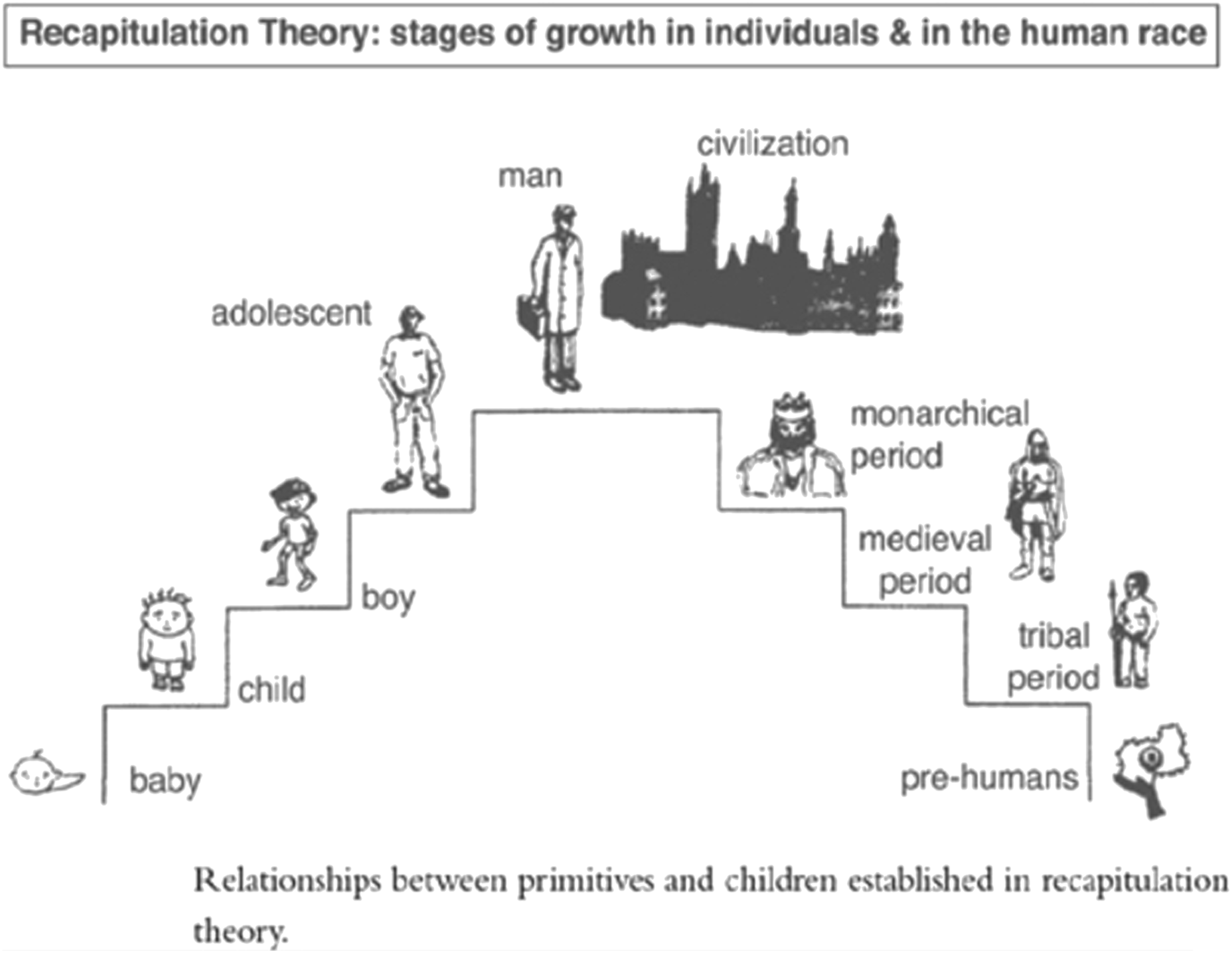
Recapitulation theory embodies chrononormativity as it enacts Western understandings of time as linear and progressive, and of development as stadial and event-centred. It suggests a universal path through which every human being and every civilisation transits over their development, with all deviations from that model deemed as abnormal (Lesko, 2012) and subjected to mechanisms that intend to redress them towards normality. This thinking played a key role in the propogation of developmental approaches to psychology (cf. Hall, 1905), which further operationalised this normalisation of development through the medical model (Foucault, 1963/1989).
The not-yetness of both children and ‘savages’ speaks to a futurity that is already teleologically determined. In the case of children, ‘developmental stages’ represent the progression of individuals from ‘nature’ into rationality/adulthood/civilisation. The ongoing biological essentialization of age, linking it to normalised ‘developmental stages’, enacts a world where paternalism and domination towards children continue to appear as natural and necessary (Gill-Peterson, 2018). This remains evident in early childhood education and care contexts, where notions of ‘developmental milestones’ and ‘developmentally appropriate’ practice are common (Malone et al., 2020). Despite the repeated critiques and debunking of developmentalism by childhood scholars from the 1980s (Walkerdine, 1993), developmental psychology continues to play an important role in the normative construction of childhood. Moreover, O’Dell et al. (2018) affirm that the primacy of developmentalism simultaneously constructs normative adulthoods, wherein only adults with certain ‘normal’ characteristics (such as employment, independence, marriage and parenthood) can claim adulthood, thereby proliferating ableist expectations. Just as chrononormativity sets the boundaries of acceptable childhood performativities, Crip Time (Kafer, 2013) describes how disabled bodies often violate chrononormative timelines, which leads to their pathologisation, denigration and exclusion. However, the boundaries that demarcate ableist subjugation simultaneously mark the im/possibilities these alternate temporalities offer for reimagining how chrononormativities and childhoods might be reconfigured. The following sections illustrate how these figurations of normative childhoods are colonial inheritances.
Entangled colonialities all the way down
Quijano’s (2000) coloniality of power speaks to how colonial classifications render Global North notions of childhood normative while denigrating other possibilities for becoming. Quijano (2000) discusses how modernity and colonisation propagated the fictitious category of ‘race’ to naturalise ‘difference’ as hierarchical and justify the domination of those construed as inferior. Colonialities embody the self-perpetuating dynamics that reinforce normativities, such as science, global capitalism, and neoliberalism. Lugones (2007) extends this critique by recognising the ways in which Quijano’s (2000) coloniality of power neglects the colonial co-production of race and gender, and how these categories fed into the internalisation of hegemony. In short, Lugones (2007) illustrates how the imposition of Western systems of binary, hierarchical renderings of sex/gender/sexuality and race, based on biological essentialism, allowed colonisers to exclude colonised peoples from notions of ‘civility’ and disrupt Indigenous social orders. Notably, the normative fiction of binaries is a colonial production, whereas our diffractive reading of colonialities recognises the multiplicitous differentiation of these binary essentialisations, such as child/adult (Ashcroft, 2001), coloniser/colonised (Ramirez and Pasley, 2022), or men/women (Oyěwùmí, 1997).
Lugones (2007) recounts how colonised people were excluded from ‘humanity’ by construing them as unable to perform the categories of man or woman, which were tied to whiteness. This is not dissimilar to how children are unable to perform hegemonic constructions of personhood. In the case of the colonialities of gender, white women were compelled to invest in patriarchal orders because the alternative was to be classified as inferior and incapable of inhabiting humanity, which was associated with colonised peoples who did not or could not abide by the etiquette of the colonisers. Even for colonised peoples who conformed, becoming similes of white men and women did not grant them the privileges of those they mimicked (cf. Oyěwùmí, 1997), only reinforcing the systems that rendered them inferior. Lugones’ (2007) critique of Quijano (2000) is that colonialities of power cannot be comprehended independent of these entangled categories of subjugation. We seek to build on Lugones’ (2007) critique by offering a sense of the ways in which chrononormativities are entangled with broader colonialities, which compose the normative (white, heterosexual, cisgender, middle-class, adult, male, able-bodied) subject. While adultcentrism has been critical for theorising the subjugation of children (Morales and Magistris, 2018), there is a need to account for the colonialities that reconstitute the striation of lifespans. Subsequently,
It is important to denaturalise (chrono)normative demarcations of the lifespan as they embody agendas that strip young people of their agency in service of normalising the (white, middle-class, cisgender, heterosexual, able-bodied, male) adult (Gill-Peterson, 2018). While adultcentrism subjugates children in general, inequalities are maintained by the production of a normative child against which all other children are measured. Subsequently, we contend that resisting the ab/normalisation of childhood is a matter of enacting justice. This paper seeks to render visible nuanced im/possibilities (both extant and speculative) for doing childhood differently, wherein children’s agency and political, social, and economic participation (or capacity for such doings) are recognised.
Childhoods as diffractive colonialities
This section addresses why and how agential realism (Barad, 2007) is used to extend Lugones’ (2007) colonialities of gender in service of our notion of colonialities of chrononormativity. It does so by first illustrating how colonialities are understood as entangled colonial hauntings that reproduce normativities. Thereafter, Barad’s (2007) notions of phenomena, apparatuses, and intra-action are delineated, including their more-than-human constitution, drawing on Pasley’s (2022) agential realist reading of normativity. These notions are used to convey how the multiplicitous configurations of childhood are diffractions of colonisation. By tracing the entanglements that reiteratively afford various childhood enactments – im/possibilities for becoming – this analysis of im/possibilities fosters nuanced responses to in/justice. Subsequently, the sections that follow depict the injustices that emerge with configurations of childhood that exist outside of the boundaries of (chrono)normativity, but also how these injustices simultaneously offer us a sense of how we might produce more just reconfigurations.
Lugones’ (2007) critique of intersectionality highlights Crenshaw’s (1989) neglect of the colonial underpinning of the multiple marginalisation of women of colour. Likewise, Quijano’s (2000) coloniality of power neglects the gendered dimension of colonial disenfranchisement. Understanding becoming as an iterative reconfiguration of relations, an agential realist (Barad, 2007) approach affords a sense of colonialities as ongoing reconfigurations that are haunted by the spectres of colonisation. According to a Baradian understanding of time, the im/possibilities that exist are constituted by the diffraction of what was (not), what might have been, and what will (not) be. Barad’s (2007) concept of spacetimemattering recognises that the materialisation of reality is an inherently temporal becoming. The marks that configurations leave cannot be erased, meaning that existence is always already haunted, but the relations that reconstitute these ghosts are open to ongoing renegotiation (Barad, 2017). This approach makes for productive thinking in the pursuit of reconfiguring relations with colonialities in the hope of fostering more just im/possibilities.
As outlined in the previous section, colonialities entail the production of hegemony through the normalisation of performativities, producing a world that privileges particular ways of being. Agential realism understands the relations that produce these hegemonic worldings as apparatuses, defining the boundaries of im/possibility. Apparatuses are composed of phenomena (Barad’s [2007] unit of existence) in relation, forming the co-constitutive elements of apparatuses. The coloniality of chrononormativity can both be understood as a phenomenon, entangled in broader worldings, such as other colonialities or pandemics, as well as an apparatus comprised of phenomena, such as race, gender, geography, healthcare, climate, and so on. Phenomena cannot materialise or be understood outside of relations as they are contingently produced, so cannot be understood independently. Each iteration of the world is composed by relations that afford certain possibilities at the exclusion of others and, likewise, im/possibilities around how these configurations might be responded to. Barad (2007) calls this iterative, contingent production of reality intra-action.
Contingency underpins Lugones’ (2007) critique of intersectionality and the coloniality of power, as neither multiple marginality nor power can be contended with at the exclusion of the relations that produce them. Agential realism further extends this appreciation of the contingency of colonialities, as the production of normative expressions of gender, life spans, race, and so on, is not simply discursive. A purely discursive approach limits reality to what is intelligible to humans, neglecting the agency of matter and the more-than-human (Barad, 2007). Reality’s contingency means that materiality and discursivity are always already implicated with one another, always already more-than-human, and are only comprehensible together-apart. Pasley (2022) therefore contends that norms must be understood as apparatuses of more-than-human, material-discursive relations, wherein the agency that affords capacities to respond is inequitably distributed in ways that seek to confine responses to those that reproduce normative im/possibilities.
As the previous section argued, while it is necessary to engage with the boundaries of normativity and to denaturalise the lives they privilege, we are more interested in the im/possibilities for difference that always already exist. This is not simply in terms of what else exists but also in terms of how more just worlds might be potentiated. The agential realist notion of diffraction (Figure 2) is crucial here as it illustrates the ongoing relational re/constitution of colonialities; multiplicitous configurations of childhood that are rendered im/possible in relation with chrono-colonialities. Like the figure of diffraction below (Figure 2), as the marks of colonisation materialise with ongoing iterations of relations, the spectres of colonisation re-emerge as multiplicitous colonialities and the possibilities they exclude; that is, interference patterns. Entangled with the materialisation of various colonialities, such as those of gender (Lugones, 2007), ableism (Ubisi, 2021), and class (Quijano, 2000), the multiplicitous im/possibilities of becoming otherwise always already exist. The configuration that operates to exclude other ways of being simultaneously defines the parameters for being otherwise. This is evident in apparatuses of queer time (Halberstam, 2005), crip time (Kafer, 2013), and the countless childhoods that do not conform to the parameters of chrono-coloniality (O’Dell et al., 2018; Liebel, 2016). This paper attends to the multiplicitous, more-than-human, material-discursive entanglements that constitute the politics of these diffractive possibilities for doing childhood otherwise. Illustration of diffraction and interference patterns (aka. the two-slit experiment).
Tracing these politics allows us to account for the responsibility we have for being open to these im/possibilities for difference. This is the basis of Barad’s (2007) ethics of response-ability. By tracing the entanglements that produce the im/possibilities of each iteration, accounting for the more-than-human material-discursivities that co-constitute what has (not) been and what might (not) be, affords nuanced capacities to respond. While the injustice of colonisation cannot be resolved (Barad, 2017), diffraction offers the possibility of reconfiguring relations with colonialities in ways that afford greater response-ability. While the impossibility of resolution means that justice is only ever partial (Derrida, 1994, cited by Barad, 2007), it also means that injustice is never absolute. Subsequently, we employ this agential realist approach to question how childhood might otherwise materialise in ways that resist chrono-colonialities.
Working children grassroots activism
In October 2021, children from different working children and adolescents organisations (NNATs) in Latin America/Abya Yala came together, virtually, with some of their adult friends and collaborators for the VIII International pedagogical conference of the Movement of Latin American and Caribbean Working Children and Adolescents (MOLACNATS), titled ‘Childhoods, work, protagonism, dignity’. MOLACNATS is the organisation that articulates various NNATs movements across Latin America and the Caribbean, with each of the regional organisations working locally to improve the living conditions of working children. One of the important aspects of the work of NNATs organisations involves challenging the social stigmatisation of non-normative enactments of childhood, from external sources as well as the internalised sense of marginality and inadequacy. While NNATs organisations are articulated around working children’s common struggles, working is not the only thing that defines these children and adolescents. Most of them also attend school and participate in educational and recreational spaces alongside their work and activist engagements.
However, we have made a pointed effort to avoid centring education in this discussion. Much debate concentrates on children’s in/ability to engage in formal education while working. We contend that this presents an effort to foreground the colonialities of chrononormativity when engaging with working children, whereby education is positioned as necessary to be considered fully human (Pasley et al., forthcoming). Formal education is not innocent in its disciplinary function and measures the child against normative boundaries of personhood (Foucault, 1979; De la Cadena, 2010). There are certainly many ways to learn and various decolonising approaches to education (Romero, 2016, 2018, 2019; Smith, 2012, 2017), but this paper is more concerned with understanding working children on their own terms, rather than evaluating their capacity to perform academically. We suspect that, rather than any genuine concern for their scholastic fulfilment, part of the anxieties around working children is that they operate outside of the disciplinary regulation that schooling imposes, which means they do not necessarily perform as ‘civilised’ economic units in accordance with the chronormativities that fuel global capitalism.
The phenomenon we currently label ‘working children’ has been a reality in Latin America/Abya Yala since precolonial times. In many Indigenous societies, traditional ways of organising life encompassed children’s contribution to community and different ‘productive activities’ from an early age (Dean, 2002). These ways of organising communal life continue to be a lived reality for various Indigenous and campesino (rural) communities across Latin America and the Caribbean (MOLACNATS, 2011). In those contexts, children are seen as important social agents, capable of contributing as much as anyone else to their communities, and having their contributions valued and recognised. For example, Montoya’s (2015) research on children working in a Colombian marketplace described how work enriched children’s lives in multiplicitous ways, including contributing to their families, learning skills, personal fulfilment, and socialisation. This included play with other child workers, which dissolves the conventional boundaries between work and play. In contrast to the International Labour Organisation’s (ILO) protectionist narrative, it was the enforcement of arbitrary age limits (via police) that impeded children’s quality of life, including the risk/fear of being taken away from their families.
With increased rural migration to urban centres (Durand, 2009), urban working children have increasingly populated Latin American cities, enacting childhood performativities that are deemed problematic by the governments and institutions that perpetuate normative models of childhood propagated by the Global North. It was in these urban contexts that the first working children’s organisations started emerging in the 70s and 80s, entangled with two important Latin American phenomena of the epoch: the Theology of Liberation and the spread of Popular Education, following the lead of Paulo Freire. Alejandro Cussianovich, a Catholic priest, participated in the foundation of one of the first NNATs organisations, MANTHOC, in Peru in 1976, aiming to address the economic marginalisation of working class Christian youth. Subsequently, similar organisations emerged in Bolivia, Venezuela, and Colombia.
As a transnational articulation of different NNAT’S movements, MOLACNATS allows children to enrich their national struggles through the experiences of other organisations, foster international solidarity, and combine their forces, demanding policy changes from governments and international agencies. For example, their international unionisation allows for a greater collective response to national or regional struggles (MOLACNATS, 2016). Crucially, these organisations resist the increasingly pervasive practices, by international agencies and NGO’s, that reflect the assumption that children of the Global South need to be ‘saved’ from the cruel realities of ‘underdevelopment’ and have their ‘stolen childhoods’ returned to them (Liebel, 2016). For example, NNATs organisations oppose the United Nation’s efforts to erase the possibility of working children’s existence via the ILO policing of child employment practices. One of the important topics of discussion during the MOLACNATS, 2016 International Pedagogical Conference concerned the stance of these organisations on the ILO campaign for the eradication of child labour, as 2021 had been declared the ‘International Year for the Elimination of Child Labour’ by the ILO. Such a blanket approach to the complex apparatus of working childhoods is problematic for an array of reasons (cf. Cordero Arce, 2015a, 2015b).
For decades, NNATs movements in Latin America/Abya Yala have resisted ILO’s policies around ‘child labour’ that conflate exploitative forms of child labour, which MOLACNATS readily condemn, and dignified children’s work, which they posit should not simply be measured by age (MOLACNATS, 2011). The conflation of dignified children’s work and exploitative child labour, embodied in ILO’s policies, is a product of protectionist paradigms of childhood. We are invested in children’s agency, so are inevitably opposed to their exploitation; however, this paper attends and responds to the ways in which children are defining these distinctions for themselves. Trusting their capacity to collectively make those distinctions is part of upholding their agency and enacting response-ability. On the other hand, ILO’s engagement with NNATs has not always been receptive or response-able. Though there had been some productive engagements of ILO with NNATs throughout the 90s, negotiations have reflected a decline in the ILO’s willingness to sincerely engage with them. This was particularly evident in ILO’s 2017 Global Conference on the Sustained Eradication of Child Labour, where the participation of NNATs Organisations was denied and people under 18 years of age were banned from entering the conference. As a result, NNATs organisations of Buenos Aires convened a Gritazo (Shout-a-thon) protest, with dozens of children and adolescents gathering outside the building where the conference was taking place to enact their protagonism, as citizens and political agents (c.f., Morales and Shabel, 2020).
Of particular note, in 2009, constitutional changes were enacted in Bolivia, whereby the prohibition of all children’s work was replaced by the prohibition of forced children labour and exploitation. This small shift was celebrated by Bolivian and other Latin American NNATs (Morsolin, 2009), as it recognised their existence and the possibility of living their lives as working children with dignity, rather than stigmatisation. The constitutional change also involved the reduction of the minimum age to work from 14 (as per ILO Convention 138) to 10 years old. Despite the fact that this was the result of negotiations with Bolivian NNATs organisations, the outcome was presented internationally as a major failure in the face of the ILO-mandated aims to eradicate child labour. Pressure on the Bolivian state from the ILO to revoke the change to the constitution was accompanied by threats (from the U.S in particular) to cut aid to Bolivia (Moloney, 2018). The ILO’s increasing pressure on sovereign states to criminalise all forms of child labour has had a major impact on NNATs. It has worsened the stigmatisation of working children and works against their efforts to have nation states recognise them, so that they too can be protected by the rights and laws that regulate working relations in their countries.
Liebel (2016) states that ILO policies perpetuate Global North convictions of their own (progressive and moral) superiority, while disenfranchising working and Indigenous young people. Simultaneously, it puts working children at greater risk of exploitation, given the illegal status of their work. One of the biggest challenges that working children face in their struggle entails the naturalisation of children’s dependence on adults. Agential realism’s recognition that phenomena are indeterminate outside of relations undermines the humanist essentialisation that preconceives children and adults in a dualistic relation that assumes the former dependent on the latter and excludes children from economic spheres and other means of responding to their worlds. In reality, these relations are not inherent or innate but are the production of a boundary-making process, made possible by colonial histories and the ongoing dynamics of adultcentrism. While distributions of agency continue to foster these inequalities, the iterative diffraction of relations mean that these dynamics remain open to reconfiguration.
A central aspect of the boundary making that renders children reliant on adults is the prohibition of work for children, as it is part of the apparatus that produces children’s material and economic dependence (Cordero Arce, 2015a). This disenfranchisement of children is analogous to that suffered by women in the past. Women were and children remain property – private, but regulated by the state – and consequently have reduced possibilities for responding to the world. By contrast, based on the struggle of working children in Latin America/Abya Yala, Liebel (2007) states: Work experience gives children an earlier independence, not only in the sense that they have money to spend, but also because they become sharp and capable of survival, and have the opportunity to feel capable and productive. In this way, they help to dissolve paternalistic subordination based exclusively on their age. Children who work are not freer than the children who do not work, but they experience an internal demand for respect, have a more influential role in society, and achieve more equal terms in their relationships with adults and other traditional authorities (p. 68)
Liebel’s (2007) statement resonates with one of the flagship concepts of the NNAT’s movement, ‘children’s protagonism’. The notion of protagonism argues for a vision of children and adolescents as political subjects, capable of contributing to and shaping society, and participating in the public sphere where decisions are made (Taft, 2019). Instead of suggesting that all work under the ‘minimum age’ is always harmful, as ILO contends, NNATs organisations account for the multiplicity of circumstances, local experiences, and ‘worlds’ in which work can be dignifying for children and their communities, helping them to achieve a protagonistic role in society. NNAT’s work highlights the possibilities for working children and what it means to be a child beyond the colonialities of childhood reproduced in ILO’s policies.
In tracing the entanglements that constitute childhood worldings, we account for how reconfigurations are haunted by the spectres of colonisation, attending to the coloniality of chrononormativity that demarcates ‘appropriate’ child spacetimematterings. Childhood, as a formative stage, is reproduced as a time of dependency and preparation for adult life, wherein adulthood is (normatively) performed as a stage of productivity, independence and completion (O'Dell et al., 2017a). Concomitantly, childhood performativities are entangled with and co-constituted by other normativities. For example, the erasure of Indigenous and campesino (rural) childhoods in Latin America/Abya Yala, where interdependence of family and community members regardless of age embodies other doings of time, growth and life trajectories, is inseparable from the dissemination of imperialist capitalism that leads to the degradation of Indigenous homelands. While it is impossible to account for all the phenomena that constitute childhood apparatuses, we employ diffractive analysis to read the multiplicitous becomings of childhoods through one another, attending to and speculating with the im/possibilities for more response-ably distributed agencies.
MOLACNATS provides an example of worlding alternative childhoods, taken up by children themselves. Through their collective action, these children defy Global North imaginaries of childhood as a life stage for play, school, innocence and absence of responsibilities (Morales and Magistris, 2018). Their collective worlding of working childhoods reclaims im/possibilities of enacting childhood in their local contexts, where their work is not a mark of ‘underdevelopment’ and deficit, but an activity that dignifies them and allows them to celebrate their contribution to their families and communities. Latin American NNATs organisations enact response-abilities that offer the possibility of more just worlds for children, in general, and children of the Global South, in particular. Moreover, these apparatuses of childhood provide examples of adults’ responsibilities to children’s response-abilities. Adults are integral collaborators in the process of resisting these normativities, enacting intergenerational solidarity and contesting the very nature of the adult-child duality. Tracing children and adults’ entanglement affords the recognition that the adultcentric dynamics of the worlds we exist in require this level of solidarity to truly reconfigure relations.
Trans childhood
Like us, Gill-Peterson (2018) contests the presupposition of childhood’s naturalisation or universality, yet recognises the particular boundaries that constitute trans 3 childhoods. Histories of the Transgender Child illustrates how the age of medical consent enacts a cut that infantilizes trans young people, depriving them of bodily autonomy and full personhood. The medicalisation of sex/gender are understood as the way in which phenomena, such as (trans)gender (Pasley et al., 2022) or intersex (Pasley, 2020), are rendered unintelligible outside of medical settings. This simultaneously pathologizes non-normative sex/gender and produces a sense of obligation to medical intervention, which operates to erase histories of trans childhoods by rendering non-medicalised figurations unintelligible. Subsequently, histories of ‘trans childhood’ are left unrecognizable, trans children are construed as perpetually novel subjects, and the futurity of trans liberation traps trans people in a perpetual state of ‘not yet fully human’ (cf. the colonialities of childhood and colonised peoples; Gill-Peterson, 2018). Echoing Lugones’ (2007) colonialities of gender, this medicalisation was founded on eugenicist notions of white plasticity, while BIPOC were figured as immutable, which has resulted in the overwhelming whiteness of the medical discourse of transsexuality (Stryker, 2009). While white trans children are used as the ‘raw material’ for justifying medicalisation, BIPOC trans children encounter exclusion and heightened vulnerability in the face of growing trans visibility. Snorton and Haritaworn (2013) unpack how this engineered inequality produces a necropolitics of trans BIPOC, wherein the violence they experience is exploited to justify protections for (white) transnormative subjects (Pasley et al., forthcoming).
These dynamics constrain the im/possibilities of trans subjectivity, reproducing colonialities of gender through this racialised apparatus. Situating the aetiology of transsexuality in ‘childhood’ allows developmentalist approaches to erase children’s agency, impeding their capacity to partake in the politics that they are entangled with and, therein, the object of (Amar, 2016, cited in Gill-Peterson, 2018). Children’s plasticity is exploited in service of erasing trans subjectivity as they are moulded into cisnormative figurations. Simultaneously, this operates to deny older transition by construing the limited plasticity of older trans people (i.e. those transitioning after puberty) as unacceptable because they cannot achieve cisnormative 4 embodiments of gender. In turn, this fosters transnormativities in healthcare and communities (Pasley et al., 2022). These dynamics privilege normative (binary, archetypal, white, able-bodied, heteronormative, etc.) expressions of transgender (Vipond, 2015; Pasley et al., 2022), and recapitulate trans lives in cisnormative terms. The privileging of such narrow boundaries of ‘trans’ means that the vast majority of more-than-cisnormative becomings are rendered illegible.
To reiterate, this paper understands these inclusions and exclusions in terms of interference patterns (i.e. in non-binary terms; Figure 2): configurations of relations that render certain trans childhoods impossible and, of those that are possible, whether they are visible or not. The realities that iteratively emerge are haunted by the ‘ghostliness of certain “impossible” children’ (Gill-Peterson, 2018, p. 11). These ghosts cannot be erased, as even their absence leaves marks, but nor are they foreclosed. The colonialities of chrononormativity materialise in these patterns of injustice, yet they are also open to reconfiguration. Enacting justice is only ever partial (Barad, 2017), but the possibility of more response-able configurations is always already present. We begin by reimagining Gill-Peterson’s (2018) example of the child, Vicki, through their recommendations for more just worldings. However, we also want to resist the notion that transgender justice is limited to futurity (or, for that matter, to US-centric examples). Subsequently, an example from Aotearoa New Zealand illustrates both the global impact of these colonialities and how these ghosts have already been attended to and response-ably reconfigured.
Vicki
Vicki was a 14-year-old trans girl from rural Ohio who originally wrote to Leo Wollman in 1968 (and later Harry Benjamin, in 1969) asking for support to transition. She sought out help to convince her unsupportive father to consent to her seeing a doctor about transitioning, while also seeking out a prescription for oestrogen. She described a troubled life, victimisation, dysphoria, and several attempts at suicide. Gill-Peterson (2018) highlights the tensions between the transsexual discourse Vicki employs to become intelligible to the doctors and the infantilising forces of developmentalism as she was told to wait until she had ‘matured’. In the wake of ongoing communication from Vicki, largely rebuffed by the doctors, it becomes clear that Vicki’s dysphoria manifests as weight gain, illustrating the agencies of growth that emerged from the delays the doctors instituted.
In the concluding chapter of Histories of the Transgender Child, Gill-Peterson (2018) surmises that the figuration of trans as ‘new’ enacts an erasure of the precedence of trans childhood. This misunderstands the temporal composition of trans becomings, trapping trans liberation in its own futurity. Beholden to futurity’s temporality of perpetual deferral, the trans child continues to be a figure through which anti-trans forces can focus their efforts to undermine any future at all for trans people, while simultaneously suggesting that they have no meaningful historical precedent. (ibid, p. 196)
Gill-Peterson (2018) argues that we must resist the forces that have supplanted trans children’s subjectivity with plasticity. Despite its indeterminacy, plasticity is too volatile to form the cornerstone of trans liberation from cisnormativities because it reinforces an aetiology that pressures trans children to justify their becoming in ways that cisgender children never have to. Inspired by a photograph of a young ‘cross-dresser’ taken by B, titled ‘Budding Transvestite?’, Gill-Peterson (2018) suggests that the aim should be to allow trans children to simply be, rather than existing as a means to an end or an aetiology for transness. To desire for them to exist in the world as they are. She contends that facilitating trans children’s enfranchisement entails cultivating a trans (medical) apparatus that takes seriously trans children’s subjectivities, bases medical care on their desires, and resists cisnormative models of trans becoming that reduce trans people to similes of cis/hetero embodiment. Ironically, this abandonment of the infantilisation of trans children via the practical dissolution of an age of consent erodes the boundaries of what it means to be a trans child, which highlights the fiction of this categorisation and the ways in which trans childhood was always already un/definable.
Reimagining Vicki’s experience through such an apparatus potentiates an array of im/possibilities. A world where Leo Wollman responds personally and promptly, asking Vicki to make an appointment for her and her father to come in, so they can understand the options available to Vicki. Inside the letter, perhaps a receipt for a blood test and a prescription for oestrogen. Maybe the schoolyard torment is inconceivable in this world. Maybe Vicki’s mental health is salved. If Vicki had already attempted suicide, maybe she never attempts again. Perhaps Vicki’s body, susceptible to weight gain, continues to enact its own agency, but this time the weight is distributed in a way that induces a love of her body. Perhaps her father’s learning turns him into her biggest advocate, allowing their relationship to flourish and for Vicki to feel loved unconditionally for who she is. She is wanted, just as she is. On the other hand, perhaps the letter that Vicki first composed is rendered impossible in a world devoid of transsexual discourse. We do not pretend to have answers to these possibilities or suggest that these injustices can be resolved; however, it is by considering these im/possibilities that we enable different responses to the world that has materialised and how we might reconfigure a contemporary Vicki.
Re/turning to Indigenous genderings
One of the limitations of Gill-Peterson’s (2018) account is its US-centrism; however, the diffraction of colonisation and its reiterative colonialities stretch around the globe. In Aotearoa New Zealand, Elizabeth Kerekere’s (2017) work takes up the mantle of takatāpui. This term was preserved in Williams' (1844) Māori-English dictionary and the story of Tūtānekai (written by Wī Maihi Te Rangaikāheke, 1849; translated by Grey, 1956/1971), whose protagonist of the same name had two loves, Hinemoa (a wāhine/female) and Tiki (a tāne/male). While the term originally referred to an ‘intimate companion of the same sex’ (aka Tiki), the term has since been reclaimed to incorporate all gender, sex, and sexual diversity beyond cisheteronormative framings. Integrally, this term recognises the inseparability of gender/sex/sexuality and being Māori, acknowledging the entanglement of these becomings. Rather than this being unique to Māori, this recognition appreciates the contingency of these phenomena as they co-constitute one another, reiterating Lugones’ (2007) entanglement of these categories. As such, Pākehā (white European New Zealanders) gender/sex/sexuality are likewise co-constituted by their colonial inheritances. This is important for recognising that Pākehā notions of sex/gender/sexuality are not exempt from being imbricated with the (Western) culture that produces them, resisting their reproduction as ‘natural’ via the colonialities of gender.
Tracing the entanglements of the takatāpui narrative, Kerekere (2017) likewise recognises that cisheteronormativity is a colonial inheritance and that the very framing of takatāpui as Other is itself a coloniality. Notably, while the Indigenous adoption of cisheteronormativities is often framed as conversion to Christian values, Kerekere (2017) suggests that contemporary Māori gender/sex/sexual conservatism emerged through the silences that were enacted to protect takatāpui from colonisers. Instead of a reiteration of colonial violence, queerphobia in the face of takatāpui visibility is understood to materialise as ‘an historical anxiety’ (p. 151), still bearing the marks of protection. This protectiveness intentionally rendered takatāpui unintelligible – safe from the colonisers’ punishment – yet fostered disconnect with the traces of takatāpui, rendering queer Māori an impossibility.
The reclamation of takatāpui entails a renegotiation of those relationships through te Ao Māori (the Māori world 5 ), replacing biological essentialism with a relational understanding of how takatāpui come to be through their whakapapa (genealogy 6 ). That is, gender’s decolonisation is not simply a speculative futurity, but is already being enacted. In te Ao Māori, all beings are connected by wairua (spirit). These relations tie people to their iwi (tribe), tupuna (ancestors), whenua (land), moana (waters), maunga (mountains), and atua (gods). These and more are all part of their whakapapa. In this way, gender/sex/sexuality are understood to be inherited from all that someone comes from or is constituted by. In this way, Kerekere (2015) makes clear that this means that takatāpui are always already part of the whānau (family). Nothing can remove them from their whakapapa. Moreover, their wairua imbues them with mana (agency), which gives them the inherent authority to explore and enact their mauri (life force), takatāpui or not.
Integrally, this relational ontology of sexuality/sex/gendering reconstitutes these phenomena in such a way that renders age irrelevant because rangatahi (children) are always already connected to their wairua. That is, it disrupts chrononormativities that constrain young people’s agency over their sex/sexuality/genderings. They always already have mana. This reconfiguration of colonialities also affords a greater capacity for Māori to embrace takatāpui; as Gill-Peterson (2018) suggests, to simply desire them to be. Furthermore, while this refiguration cannot erase the marks of cisheteronormative colonialities, it potentiates nuanced ways in which takatāpui might respond to a world that has rendered their being an ontological impossibility (Hayward, 2017, cited in Gill-Peterson, 2018).
To illustrate just one dynamic, in their short documentary on a young takatāpui activist’s engagement with Pride celebrations, Winter (2018) accounts for the way Kassie, a takatāpui activist, wrestles with trying to exist in relation to the Western parameters of ‘gender and sexual liberation’; a dynamic that often fails to make room for queer BIPOC folx (Mackley-Crump and Zemke, 2019). In other words, the whiteness of homo- and trans-normative narratives often seeks to dictate the terms of sex/sexuality/gendering engagement for takatāpui. Kassie laments that the request for Tīwhanawhana’s (the takatāpui-focused organisation) involvement in the Pride celebrations feels tokenistic and reduces Māori culture to ‘entertainment’, ignoring its fundamental role in defining takatāpui. On the day, the event was opened but there was no one to respond to the karanga (opening call). Tikanga (Māori customs and values) understand karanga as a reciprocal set of relations, but the (Pākehā) format of the day meant that there was no forethought to engage in this reciprocity. Subsequently, Kassie took the opportunity to respond themselves, singing a reply to the opening, and reconfiguring the event in ways that offered everyone involved renewed relations to tangata whenua (people of the land aka Māori). While this response cannot erase the marks of coloniality, it demonstrates that agency is distributed in ways that allowed Kassie to respond, diffractively reconfiguring the im/possibilities the event offered.
Un/becoming (Life)Times
This paper has diffractively read the work of Karen Barad, Elizabeth Freeman, and Maria Lugones together to produce the lens of colonialities of chrononormativity, which recognises the colonial inheritance of normative organisations temporality. In turn, this allowed us to think about how childhoods are reconfigured in relation to these colonialities, which constrain the im/possibilities for what it means to do childhood, as well as which childhoods get marginalised in the process. We began by examining the colonial invention of childhood that, like the colonialities of gender (Lugones, 2007) and power (Quijano, 2000), played a key role in the production and maintenance of normative subjectivities. These normativities not only reinforce an adultcentric world but also frame the boundaries of acceptable childhoods. Next, we demonstrated how a diffractive reading of these dynamics affords a more capacious means of engaging with the multiplicitous ways in which colonialities manifest and how they have been and might be reconfigured. Drawing on examples from working children’s organisations, trans childhood, and Te Ao Māori understandings of takatāpui, we illustrate the ways in which more response-able reconfigurations of the colonialities of chrononormativity and childhood are not only (always already) possible but are currently being enacted in multiplicitous ways by children themselves. Un/becoming childhoods reconfigure our entanglements with colonialities of chrononormativities, compelling a reimagining of how we (children and adults) might collaborate to cultivate worlds that proliferate more response-able (life)times.
Footnotes
Acknowledgements
And expresses their indebtedness to te ao Māori and those through whom they have come to better understand takatāpuitanga. Alejandra acknowledges Latin American NNATs organisations for inspiring her to re-imagine inter-generational relationalities and for bringing pride back for those whose childhoods or life-trajectories have been deficit-framed through multiple colonialities.
Declaration of conflicting interests
The authors declared no potential conflicts of interest with respect to the research, authorship, and/or publication of this article.
Funding
The authors received no financial support for the research, authorship, and/or publication of this article.
