




Abstract
COVID-19 has caused unprecedented challenges for the higher education community worldwide, one of which is that students have had to maintain their learning while dealing with the crisis conditions. However, a systematic understanding of students’ individual crisis management still remains absent despite its importance. The newly emerged and ongoing phenomenon has leveraged the role of crisis management in the context of education, which is even more essential with the forthcoming uncertain future. This study investigates factors related to students’ crisis management self-efficacy in higher education during the pandemic. Particularly, survey data were collected from 387 undergraduate students to investigate the effects of innovative behaviour and problem-solving skills on crisis self-efficacy. Structural Equation Modelling was applied to conceptualise and empirically test a model that examines the relationship between crisis self-efficacy and related factors. Moreover, the study aimed to assess the role of technology abilities in students’ crisis management self-efficacy and academic performance during the COVID-19 pandemic. The research results provided some compelling evidence for the positive effects of innovative behaviour and problem-solving skills on crisis management self-efficacy. This study also discusses some feasible implications for higher education policy and future research directions.
Keywords
Introduction
The world has been experiencing unprecedented crises owing to the Covid-19 pandemic, and higher education is no exception. The outbreak has driven radical changes in higher education operations, teaching, learning, and management (Salari et al., 2020; Xiong et al., 2020). During the pandemic, universities switched from face-to-face to emergency remote education (Ali et al., 2020), in whichmany institutions continue to teach entirely online or through hybrid models (Walke et al., 2020). As a result, higher education students had to resort to the online system without adequate preparation to succeed in their new learning environment since not all have sufficient self-regulating skills for online learning (Wandler and Imbriale, 2017). Recent studies (e.g., Xiong et al., 2020) indicated that they are considered a high-risk group due to the psychological and social impacts of the pandemic, and thus their life and learning have been impacted in various ways (Maheshwari, 2021).
A global study found evidence of changes in students’ social contact, support, and financial situation (Aristovnik et al., 2020) that more than half of students lacked a comfortable home-learning space. The campus closures reduced students’ accessibility to libraries and other resource supports (e.g., internet facilities, printers) (Aguilera-Hermida, 2020). In addition to the lack of time management and learning motivation (Aristovnik et al., 2020), some studies show that students have to deal with many mental health problems, such as increased academic stress, anxiety, and depression symptoms (Debowska et al., 2020; Salari et al., 2020). Evidence has shown consistent results in the context of Vietnam. For example, Van and Thi (2021) reported that in COVID-19 crisis, Internet access, social interaction, and learning motivation of Vietnamese students were most serious factors impacting their online learning. Students’ satisfaction was significantly lower compared to when students learned face-to-face (Dinh and Nguyen, 2020). Tran et al. (2021) also found that during this outbreak, nearly one-quarter of Vietnamese students were in a negative mood and had depression symptoms. Given the fact that this country is among few communist countries and has been famous for learning traditions (Van and Thi, 2021), research on how students adjust themselves in learning to achieve academic performance in crisis may be interesting and reveal some implications for the country’s educational policy prepared for future crises.
Self-efficacy has been emerging as an important aspect impacting students’ academic performance and well-being, particularly in crisis (Alemany-Arrebola et al., 2020; Cattelino et al., 2021; Fatmawati and Maryam., 2021; Khademian et al., 2020). Bandura (1977, 2006, 2013) has defined self-efficacy as a person’s ability to exert control over motivation, behaviour, and social environment. Research has suggested that it assists in reducing fear of failure, increasing aspirations, and improving problem-solving and analytical thinking skills with evidence. For example, Fatmawati and Maryam (2021) in an investigation into Indonesian college students reported a positive association between their self-esteem and problem-solving ability during the pandemic. Regarding mental health issues during the lockdown, Cattelino et al. (2021) found solid connections between self-efficacy and subjective well-being (positive attitude towards self, life, and future), which support students to face the new learning context and new emotional challenges. A few studies also recognised the crucial role of self-efficacy in reducing anxiety (Alemany-Arrebola et al., 2020) and stress management (Khademian et al., 2020). Indeed, self-efficacy belief stands at the core of social cognitive theory to understand and predict human behaviour (Bandura, 1977), which has been used across contexts in psychology and behaviour management (Gore Jr, 2006).
It can be seen that the positive association between self-efficacy and students' mental health was highlighted in previous studies. The evidence has been found to support the hypothesis that during the Covid-19 pandemic, while many students have problems with mental health, finding out the way to boost their crisis management self-efficacy could be an appropriate approach. Crises, by their nature, arise as a highly salient and unexpected event (Callahan, 1994). Bloch (2014) has suggested that crises can occur at global, organizational, and individual levels; however, regardless of the level of the crisis, the individual is directly affected (Mikušová & Horváthová, 2019). The recent studies on the global crisis caused by Covid-19 show that the well-being of individuals is critically endangered (AlHadi and Alhuwaydi, 2021; Knolle et al., 2021). Crisis management refers to the process of planning, organising, and regulating crisis (Park and Avery, 2019). Since most of the reviewed research focused on the potential effects of self-efficacy in normal times rather than exploring it during a crisis, there is an urgent need to understand perceptions of students’ crisis management to support their well-being and learning during the pandemic. This research pioneers in examining the factors contributing to students’ self-efficacy for crisis management.
Specifically, the current study investigates the effects of innovative behaviour and problem-solving skills on students’ crisis self-efficacy in higher education and how they influence the learning performance. Since learning and teaching were carried out through digital technologies during the pandemic, the role of technology abilities is also examined. This is crucial as the application of technology in higher education in Vietnam was still minimal, and education sector became “a big laboratory for e-learning” at the time of crisis (Pham and Ho, 2020). Therefore, this paper aims to investigate university students’ crisis self-efficacy and academic performance and their potential antecedents. In particular, the study aims to address the following research questions: (1) How do innovative behaviour and problem-solving skills affect students’ crisis self-efficacy? (2) What is the relationship between technology abilities and crisis self-efficacy for student performance during the pandemic? There have been conflicting results regarding the relationship between technology abilities and self-efficacy although a few studies addressed self-efficacy and academic performance in crisis. Therefore, the research findings contribute to the literature by providing empirical evidence regarding their relationships, which may give some in-depth insights into prospects for blended-learning and future crises.
The social cognitive theory was used as foundation to form research hypotheses to address the research questions. A field survey was conducted to collect data from six universities across Vietnam during the third wave of the COVID-19 pandemic. Structural equation modelling was utilised to analyse the structural relationships of innovative behaviour, problem-solving skills, and technology abilities to crisis management self-efficacy. The results of this study highlighted the importance of promoting students’ innovative behaviour and problem-solving skills and their role in the context of the COVID-19 pandemic.
Theoretical foundation and hypotheses development
Crisis self-Efficacy in higher education
Self-efficacy has substantially impacted research, education, and clinical practice (Alghamdi et al., 2020; Warden et al., 2020; Jackson, 2002). It is considered a subset of the social cognitive theory (Bandura, 1977), suggesting that perceived self-efficacy and outcome expectancies are two key determinants of human behaviour. The social cognitive theory explains that human behaviour could be determined by environmental (external social systems) and personal (cognitive) factors (Honicke and Broadbent, 2016; Lee et al., 2014). Among self-influence factors, self-efficacy has been recognised as critical in impacting human behaviours (Honicke and Broadbent, 2016). Self-efficacy refers to an individual’s belief in his or her ability to perform necessary behaviours to achieve specific performance attainments (Bandura, 1977, 2013). Research has revealed that self-efficacy impacted various outcomes in education, such as learning motivation and academic performance (Honicke and Broadbent, 2016; Putwain et al., 2013; Yokoyama, 2019; Warden et al., 2020). This research expanded the scope of self-efficacy to the field of crisis management to investigate its antecedents and effects on students’ academic performance during the pandemic of COVID-19. Accordingly, students’ crisis management self-efficacy indicates their capacity to plan, monitor, control, and reflect on sudden and unexpected events and their associated impacts as well as their crisis response strategies (Lee et al., 2014; Park and Avery, 2019).
There has been increasing evidence showing that self-efficacy contributes to explaining individuals’ behaviours and their adaptation to COVID-19 in higher education institutions (Baloran and Hernan, 2020; Biwer et al., 2021). For instance, Baherimoghadam et al. (2021) reported that individual self-efficacy impacted their online learning satisfaction during the COVID-19 outbreak. Self-efficacy may influence different aspects of human existence, including goals for which people strive, the amount of effort expended to attain goals, and levels of behavioural performance that are more likely to be achieved. In the context of crisis management, it could be argued that understanding and promoting students’ individual crisis self-efficacy could lead to greater support for their crisis management. In fact, prior studies have suggested that the development of creative problem solving could promote effective crisis management (Wooten and James, 2008). Furthermore, learning and teaching have been delivered mainly via digital means during the COVID-19 pandemic; the role of students’ technology abilities on their crisis self-efficacy are also examined. Therefore, this research proposed three antecedents of students’ crisis self-efficacy: problem-solving skills, innovative behaviours, and technology abilities. The relationship between students’ crisis self-efficacy and academic performance during the pandemic was also investigated. In the next section, we discussed the rationale for our proposed hypotheses.
Problem-solving skills
Problem-solving refers to the ability of students to identify and address problems by employing various skills such as searching information, making and testing a hypothesis, and working out an optimal solution (D’Zurilla et al., 2004; Erozkan, 2013). The underlying goal of problem-solving is to make changes for a better situation and concurrently maximise positive outcomes and minimise negative consequences (D’Zurilla et al., 2004). The COVID-19 pandemic could be deemed a catalyst for students’ cultivation of this skill. In communication research, prior studies have evidenced that interpersonal problem-solving skills significantly predict social self-efficacy (e.g. Erozkan, 2013). Research by Shim et al. (2019) suggested that if students have a positive problem solving-skill orientation, they will perceive fewer difficulties during a hard time. A crisis would bring unexpected events that force individuals to use more cognitive and emotional resources to deal with, causing difficulties and stress for them (Park and Avery, 2019). Hence, we argue that through attenuating the perceived difficulties incurred by the crisis, great problem-solving skills may enhance students’ belief in their capacity to solve the problems. As such, we propose the following hypothesis.
H1: Problem-solving skills and students’ crisis self-efficacy in the context of the COVID-19 pandemic have a positive relationship.
Innovative behaviour
Birdi et al. (2016) highlighted innovative behaviour as the ability of an individual to generate original and useful ideas and apply them to practice. In other words, the innovative behaviour of students manifests itself in their thinking process, creativity, evaluation, and ability to deploy abstract ideas to create expected outcomes. Research has reported that innovative behaviour and self-efficacy are positively related (Jaussi et al., 2007; Tamannaeifar and Motaghedifard, 2014). Students have to confront various mental health problems of stress, anxiety, and depression during the COVID-19 outbreak (Debowska et al., 2020; Salari et al., 2020; Tran et al., 2021), and individuals with high self-efficacy believe in their abilities to solve those problems successfully. In contrast, those with low self-efficacy could find it harder to address problems due to their perception that problems are harder than they really are (Tamannaeifar and Motaghedifard, 2014). People who perform innovative behaviours often have a high level of intrinsic motivation which triggers them to seek alternatives, engage in risk-taking, and expand their searching activities to have better decision-making (Acar et al., 2019; Gutnick et al., 2012). They also put more effort and show more persistence in dealing with difficulties (Acar et al., 2019; Gutnick et al., 2012) which are the qualities of an adapter to crisis (Park and Avery, 2019). Therefore, we propose that creativity and innovative behaviours enable individuals to believe in their ability to confront, respond to, and adapt to the crisis. In other words, that is their perceived self-efficacy. Following the rationale as discussed, we hypothesised:
H2: Innovative behaviour and students’ crisis self-efficacy in the context of the COVID-19 pandemic have a positive relationship.
Academic performance
According to Bandura (1977), self-efficacy refers to the perceived beliefs in an individual’s ability to execute action courses to attain desired outcomes. This personal trait proves to be beneficial to learners in adapting to unfamiliar academic environments (Alivernini and Lucidi, 2011), including virtual learning. In other words, better adaptability enables students to tackle uncertainty and produce appropriate responses to environmental challenges (Collie et al., 2017). This leads to a concern over whether students’ level of commitment and conviction in their ability to achieve academic success is a significant predictor of their learning performance. Research has consistently reported a positive relationship between students’ self-efficacy and learning outcomes and academic achievements (Aurah, 2013; Bartimote-Aufflick et al., 2016; Komarraju & Nadler, 2013; Rodriguez et al., 2017). Komarraju and Nadler (2013) posited that self-efficacy fosters students’ persistence to confront difficulties and enhances self-regulation, which is important in times of crisis. If students have a high level of crisis self-efficacy, they are more likely to be highly self-motivated and self-regulated; therefore, they may get better academic performance (Bartimote-Aufflick et al., 2016).
Similarly, in the time of the COVID-19 pandemic, students have confronted more anxiety disorders, stress disorders, and mental health problems from sudden changes in the learning and teaching system (Aqeel et al., 2021; Conrad et al., 2021; Zimmermann et al., 2021). In that case, their problem-solving skills may work to deal with uncertainty, thus attenuating the negative effects of the outbreak, particularly on their academic performance.
Technology has played a significant role in fighting the COVID-19 pandemic (Javaid et al., 2020), and enabled schools worldwide to operate during the period of lockdown. Digital technology has been widely used to assist remote teaching and learning, especially during the Covid-19 pandemic (Vargo et al., 2020). However, the effects of technology adoption on education during the pandemic have been debatable. Research supported the idea that the future of education may change in a positive way owing to the effectiveness of blended and distancing learning (Walke et al., 2020). Nevertheless, empirical studies also reported that during the pandemic, students’ motivation and engagement decreased (Code et al., 2020; Mulyanti et al., 2020). This study proposed that if students have a good technology ability, their distance learning may be easier and more effective than those with low technology ability. Thus, the following hypotheses have been formed:
H3a: Students’ crisis self-efficacy and their academic performance during the COVID-19 pandemic have a positive relationship.
H3b: Students’ problem-solving skills and their academic performance during the COVID-19 pandemic have a positive relationship.
H3c: Students’ technology ability and their academic performance during the COVID-19 pandemic have a positive relationship.
Technology ability
Against the backdrop of the COVID-19 pandemic and closure of universities worldwide, technology has served as a vital bridge to eradicate the physical distances and facilitate their fully online learning activities (Papouli et al., 2020). In their research on 156 university students, Warden and his research team unveiled that lower technology readiness entailed reduced self-efficacy (Warden et al., 2020). In other words, the technology abilities of students could be an antecedent to their confidence in embracing technology adoption. Research has found that when students’ technology ability was high, they were able to be more focused and engaged in distance learning in crisis (Limniou et al., 2021). Furthermore, in a study by Essel et al. (2021), digital competence had an indirect positive linkage with academic productivity and academic engagement, mediated by technostress. This could be explained by research findings by Aguilera-Hermida (2020) that students who had a technology competency before the forced distance-learning in crisis also had a high level of self-efficacy and belief in their academic success. In her research, a positive relationship between the use of technology and students’ self-efficacy was also found. Therefore, we proposed the fourth hypothesis:
H4a: Students’ technology ability and their crisis self-efficacy in the context of the COVID-19 pandemic have a positive relationship.
In low-income countries like Vietnam, while digital access inequalities are universal, and technology use among students still remains low (World Bank, 2021), they are supposed to overcome this obstacle by applying problem-solving techniques to advance their technology abilities for virtual learning adaptation. Some researchers have suggested that to improve information technology skills, problem-solving embedded in schools’ subjects approach could be of help (Eisenberg et al., 2010; Sitti et al., 2013). In a similar vein, Wen et al. (2016) claimed that problem-solving skill is one of the most critical factors to enhance technology ability. Indeed, great problem-solvers are those who good at detecting the core issues of problem by understanding its operating rules and how to fix it, which is fundamental of how machines and technology works.
Hence, we put forward the following hypothesis:
H4b: Students’ problem-solving skills and their technology ability in the context of the COVID-19 pandemic have a positive relationship.
In the context of abrupt emergency shifting to online learning, most students were not ready for this learning mode and showed great dissatisfaction (Maqableh and Alia, 2021). However, many students who are not really competent in using technology still show their endeavour to adjust and adapt to this new learning experience (Hussein et al., 2020). This could be seen as a sign of innovative behaviour to create and apply ideas into practice (Scott and Bruce, 1994). A high level of technology ability may enable students to use the Internet and aided learning tools more effectively, so that they benefit from more diversified sources of information (Nguyen and Kieuthi, 2020). Moreover, Aguilera-Hermida (2020) revealed that the use of technology significantly affected cognitive engagement which triggered knowledge absorption, concentration, and curiosity in the class. Therefore, having high technology ability could be conducive to students’ learning process and new idea generations in the pandemic. This rationale leads to a concern that whether prior technology knowledge and experiences of students appear to be a determinant of students’ intent to initiate and adopt new ideas to their practical learning contexts. Hence, the following hypothesis was proposed.
H4c: Students’ technology ability and their innovative behaviour in the context of the COVID-19 pandemic have a positive relationship.
Figure 1 describes our conceptual framework for this study. Conceptual framework of the study.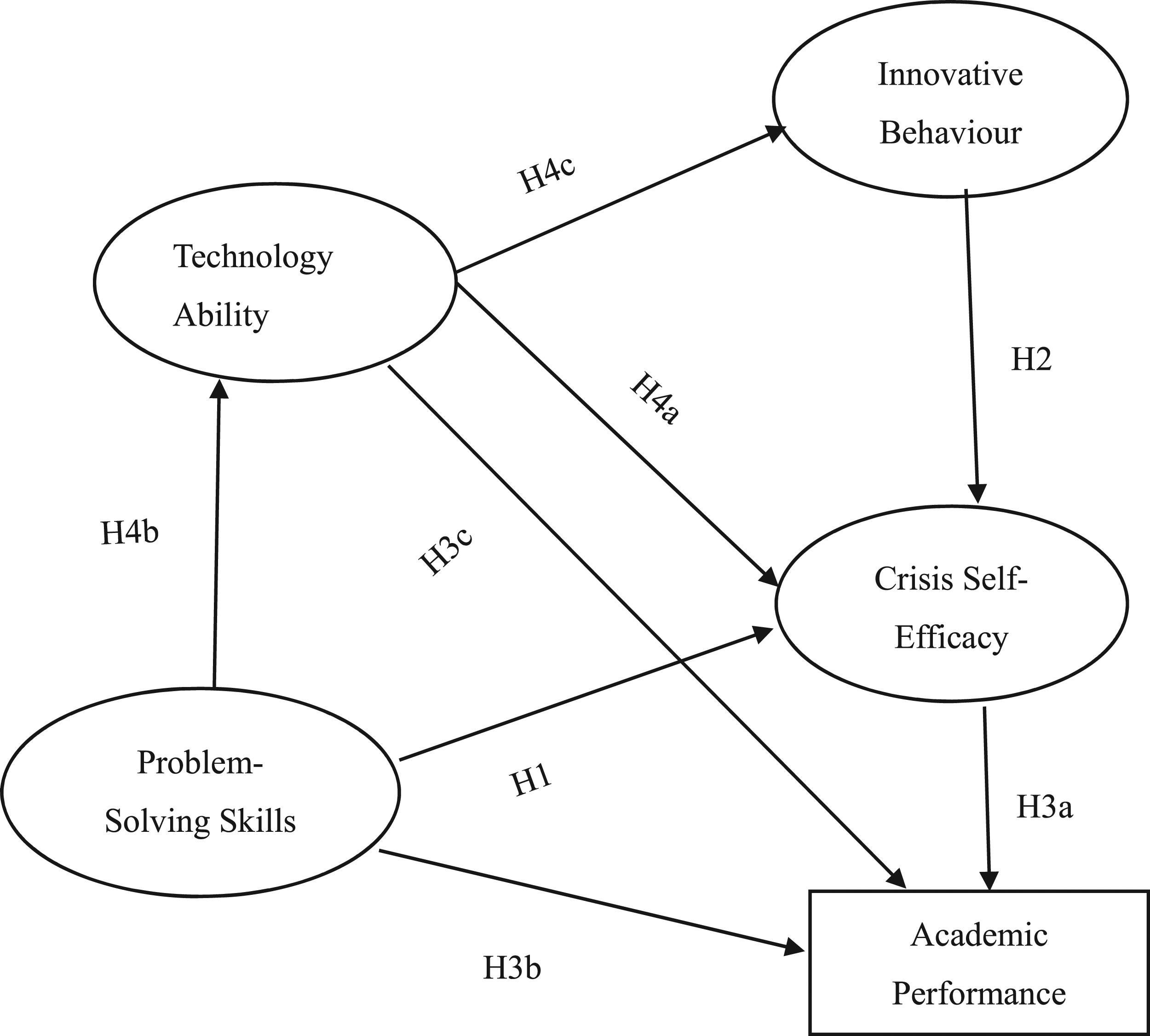
Research methods
Participants and data collection
The sample included 387 undergraduate students from six universities in Vietnam. The data were collected in the third wave of COVID-19 in Vietnam, from February 2021 to March 2021. We asked for support from universities’ student union and distributed online questionnaires and cover letters to participants through their systems. By answering and returning the questionnaire, respondents indicated that their participation was voluntary. Moreover, the consent by students were returned with their responses via our system. There were 65.4% females in the sample, and the mean age was 21.52 with a SD of 1.30. Students majored in different fields, from humanities and social sciences, engineering to technology. To increase the response rate, the institutions assisted us to send three reminders to potential participants via the email systems during 2 months.
Measures
To assess problem-solving skills, we adapted items from Dershem (2016). Sample item were “I collect, analyze, and organize information to find the best solution to a problem” and “I seek many sources of information to solve a problem in school or at work” Innovative behaviour was measured by scales developed by De Jong and Den Hartog (2010). We modified the scales to be suitable with educational context. Students were asked self-reported questions regarding their perceived innovative behaviour during the crisis. For examples, “In your study, how often do you (1) search out new working methods, techniques or instruments?”; (2) “make class members enthusiastic for innovative ideas?|” (3) “systematically introduce innovative ideas into class practices?”, and (4) “contribute to the implementation of new ideas?”. Students’ information technology ability was evaluated by instruments developed by Valtonen et al. (2017). Examples of questions are: “I can solve ICT related problems”; “I am familiar with new technologies and their features”. We measured the crisis self-efficacy of students by using items from Park and Avery (2019). Students were requested to report their crisis self-efficacy by answering questions, such as “I am certain I have the ability to take necessary action to protect myself during a crisis”.
Exploratory factor analysis results.
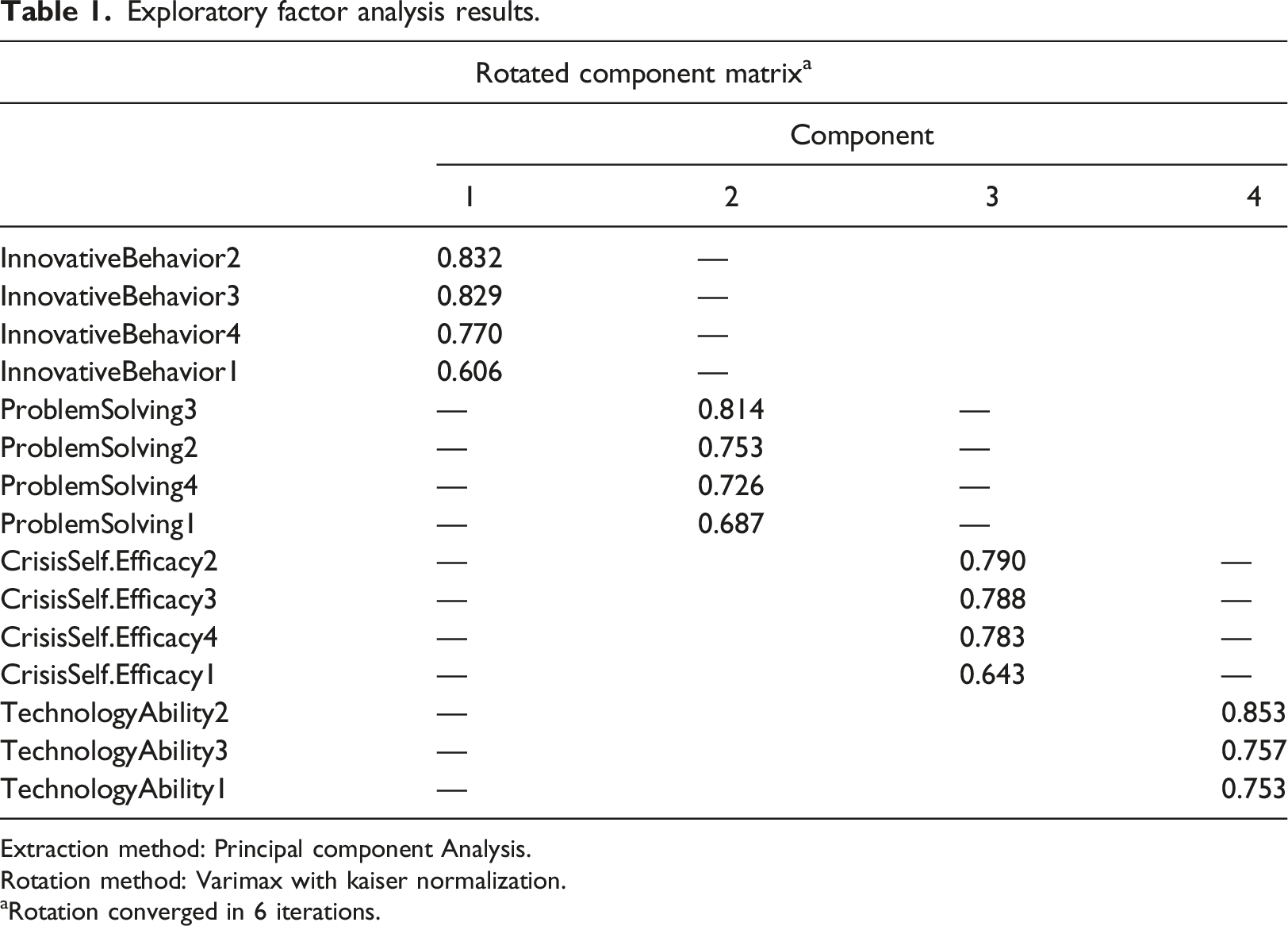
Extraction method: Principal component Analysis.Rotation method: Varimax with kaiser normalization.
aRotation converged in 6 iterations.
Data analysis
Mean, standard deviation, and correlations among variables.
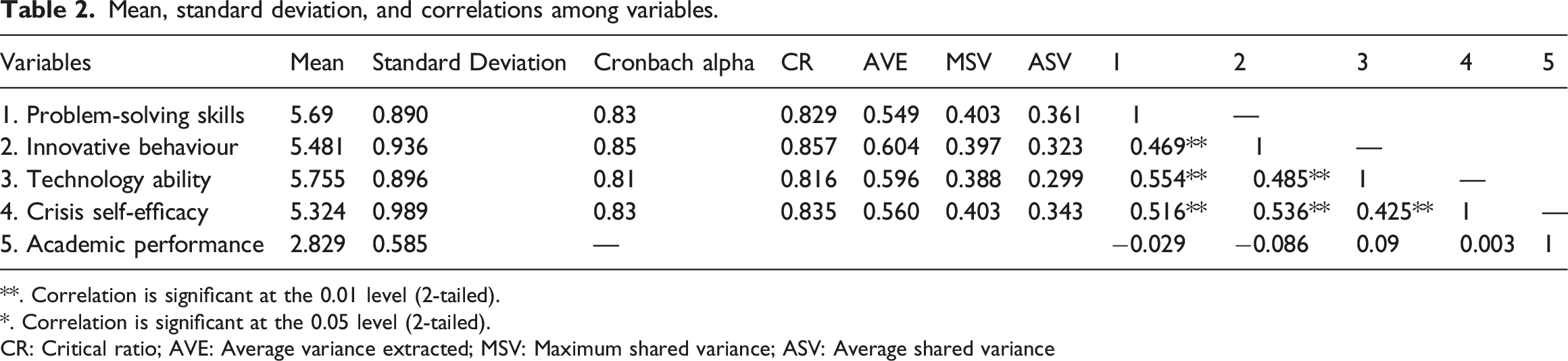
**. Correlation is significant at the 0.01 level (2-tailed).*. Correlation is significant at the 0.05 level (2-tailed).CR: Critical ratio; AVE: Average variance extracted; MSV: Maximum shared variance; ASV: Average shared variance
The pattern matrix from exploratory factor analysis was used to build a confirmatory factor analysis measurement model in AMOS. Composite validity (CR) of the scales was achieved when all critical ratios were greater than 0.70. The convergent validity was confirmed as all average variance extracted (AVE) was greater than 0.50. Discrimination validity was confirmed as no AVE was smaller than the maximum shared variance (MSV). Table 2 illustrates the results.
The measurement model had a satisfactory model fit with degree of freedom = 80, chi-square = 212.925, CMIN/df = 2.662, comparative fit index (CFI) = 0.953, Tucker–Lewis index (TLI) =0.938, incremental fit index (IFI) = 0.953, goodness of fit index (GFI) = 0.930, standardized root mean squared residual (SRMR) = 0.051, and root–mean–square error of approximation (RMSEA) = 0.066. According to Hu and Bentler (1998), all indicators indicated a good fit for the model, allowing us to proceed to structural equation modelling to check the hypotheses.
The structural model also presented a good fit (Hu and Bentler, 1998). Accordingly, degree of freedom = 93, chi-square = 249.540, CMIN/df = 2.683, CFI = 0.945, TLI = 0.929, IFI = 0.945, GFI = 0.923, SRMR = 0.064, and RMSEA= 0.066. An analysis of the 95% bias-corrected confidence intervals (CIs) from 10,000 bootstraps samples was also performed to examine the proposed relationships. SPSS and AMOS software was used to analyse the data.
Results
Mean, SD, and correlations among studied variables are depicted in Table 1. There are significant correlations among crisis self-efficacy, problem-solving skills, and innovative behaviour. Furthermore, technology ability significantly correlates to both problem-solving skills and innovative behaviour.
Hypothesis testing results.
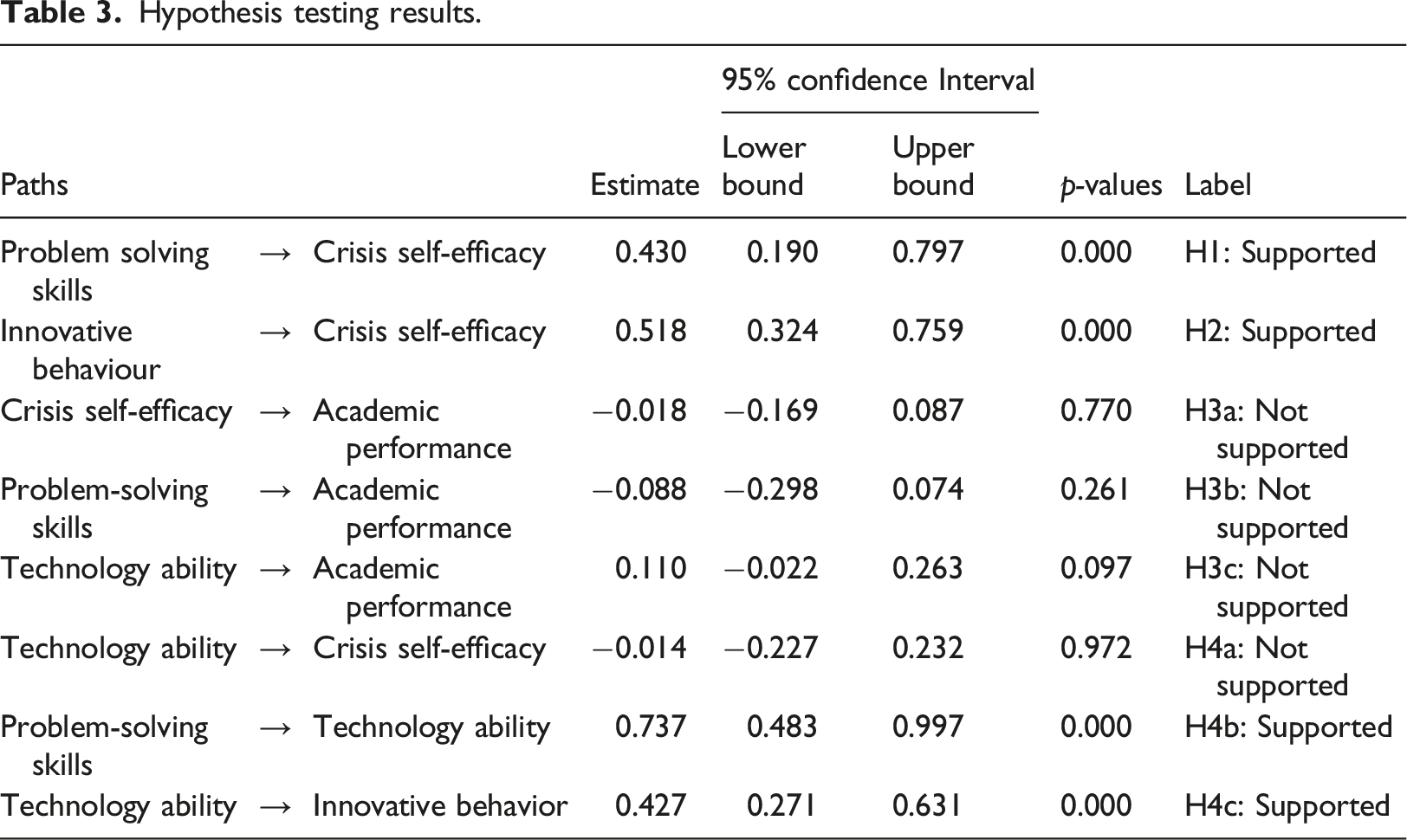
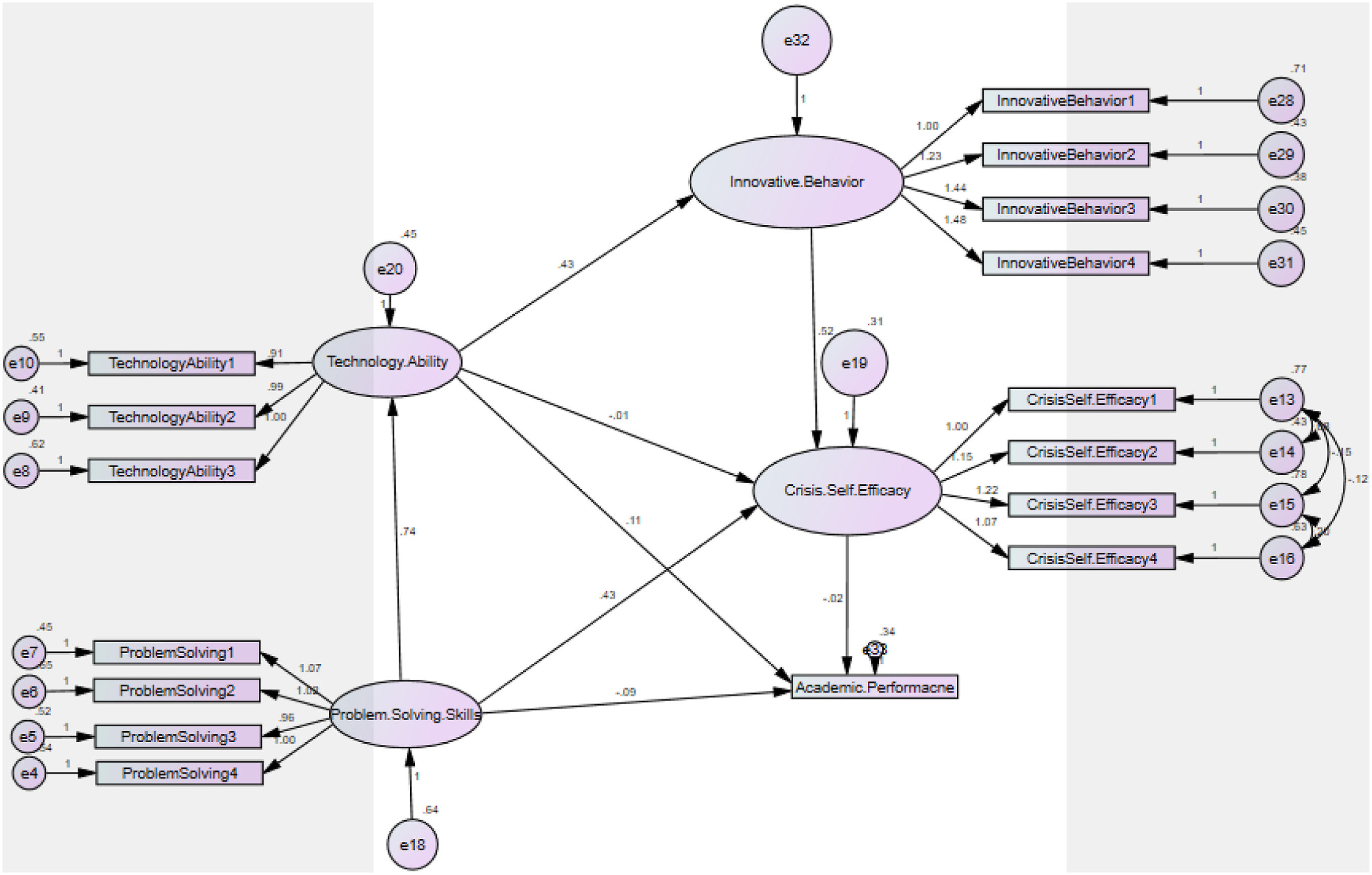
Structural equation modelling results.
Discussion and implications
Drawing on recent discussions of the COVID-19 pandemic crisis and individual crisis management issues (Debowska et al., 2020; Rogowska et al., 2020), this study presented a quantitative examination of innovative behaviour and students’ problem-solving skills as the foundation for their crisis management self-efficacy. In addition, the study set out to assess the influences of technology ability on crisis management self-efficacy.
The most obvious finding to emerge from the analysis was that perceived problem-solving skills significantly influenced the students’ crisis management self-efficacy. It affirmed our research proposition that there was a strong correlation between perceived problem-solving skills and self-efficacy under different circumstances, including individual crisis management. Previous studies have suggested that one’s perceived problem-solving skills can predict social self-efficacy (Erozkan, 2013). Our findings have evinced that this relationship also applied to individual crisis management self-efficacy, especially in the context of the COVID-19 pandemic. According to the research results, it is essential for students to acquire problem-solving skills and acknowledge those to perceive themselves as crisis self-efficacious, thereby being confident in facing challenges during the pandemic. In that regard, it can be argued that to respond to the pandemic, institutions should consider offering problem-solving skills training programs along with guidance and psychological counselling for students in order for them to acknowledge and evaluate their problem-solving skills.
Moreover, the present study was designed to determine the effect of innovative behaviour on crisis management efficacy. In the context of higher education, innovative behaviour is a relatively new concept yet plays an important role in high-quality education (Klaeijsen et al., 2018; Rahmawati et al., 2018). In crisis communication and management, innovative behaviour is even more critical as it benefits the solutions and strategies to act upon the unexpected and challenging circumstances during the crisis (Jaroensutiyotin et al., 2019; Sahin et al., 2015). This study confirmed that students’ innovative behaviour was associated with their crisis management self-efficacy. Hence, it could conceivably be suggested that promoting innovative behaviour could support learning and teaching during the pandemic crisis and leverage students’ abilities to overcome crises naturally. This finding has important implications for developing the institutional response plan for the COVID-19 pandemic.
Surprisingly, the results of this study showed that students’ crisis management self-efficacy did not significantly influence their learning performance during the pandemic. Previous studies evaluating students’ self-efficacy observed consistent results on its positive effect on learning performance (Chen, 2017; Jackson, 2002). Nevertheless, prior assessments primarily focused on academic or computer self-efficacy. In reviewing the literature, no data was found on the relationship between students’ crisis management self-efficacy and learning performance. It is possible that the effects of crisis management were not visibly observed in learning and teaching before the COVD-19 pandemic. The sudden pandemic and its prodigious impacts led to massive disruptions in learning and teaching worldwide, and, as a result, crisis management has become an imperative aspect at both organisational and individual levels. Accordingly, this study sought to determine the effects of individual crisis management self-efficacy on learning during the pandemic.
Contrary to expectations, this study did not find a significant relationship between students’ crisis management self-efficacy and learning performance during the pandemic. This result may be explained by the fact that teaching and assessments have also been greatly adjusted to support students during the pandemic (Slade et al., 2022). Another explanation may be attributed to the specific context of Vietnam during the time of data collection. While students’ crisis self-efficacy information was perceivably collected at one time, their academic performance was the result of the latest semester, in which they experienced a blended learning method. Thus, their crisis self-efficacy might strongly influence learning outcomes in the following semester. These findings may be somewhat limited due to the lack of qualitative evidence to explain the phenomenon. Notwithstanding, the findings indicated that different types of self-efficacy may have different impacts on learning. This finding broadly supports the work of other studies in this area linking different types of self-efficacy and learning behavior and performance (Ryan and Dzewaltowski, 2002; Schunk, 1989). Particularly, our results in this study demonstrated that crisis management self-efficacy differs from academic self-efficacy, and it does not significantly influence learning performance.
The second research question inquires about the role of technology abilities in crisis management efficacy. Since learning and teaching have primarily shifted to virtual learning due to social distancing during the COVID-19 pandemic, technology abilities have been essential for students to perform in the online learning environment (Beaunoyer et al., 2020). As such, it was hypothesized that students who lack technology abilities would face more challenges while adapting to the “new norms” during the pandemic; hence, they would have lower crisis management self-efficacy. However, the observed relationship between technology abilities and crisis management self-efficacy in this study was not significant.
Consistent with the literature, this research found that students’ perceived problem-solving skills are significantly related to their technology abilities. Prior studies have suggested that problem-solving is a major contribution to digital literacy, in which one could achieve essential technology skills and knowledge (Murray and Perez, 2014; Ozdamar-Keskin et al., 2015).
This is a rare study investigating antecedents and outcomes of students’ crisis self-efficacy while integrating their technology ability into the research model. Strong associations between students’ innovative behaviours, problem-solving skills, and crisis self-efficacy reveal the importance of these factors in crisis self-efficacy development. Moreover, although research supports the role of academic self-efficacy in students’ learning achievements and their satisfaction (Honicke and Broadbent, 2016; Putwain et al., 2013; Yokoyama, 2019; Warden et al., 2020), a significant relationship between crisis self-efficacy of students and their academic performance was revealed in this study (p-value = 0.097) which indicated that more effort is needed to investigate the nature of crisis self-efficacy and its outcomes. Crisis self-efficacy may have a foundation from the self-efficacy concept.
However, future research should consider other environmental factors, as when a crisis happens, all individuals’ resources, including cognitive and emotional ones, will be significantly affected. Furthermore, the findings related to the role of students’ technology ability during the pandemic also need to be properly interpreted. Accordingly, technology ability was related to students’ innovative behaviours, but its direct relationship with academic performance was insignificant. Perhaps, to achieve a high level of crisis self-efficacy and excellence in learning outcomes during the pandemic, internal factors (e.g., students’ problem-solving skills, innovative behaviours, and technology ability) are not sufficient, and joint effect with external (environmental) factors may generate better outcomes (Essel et al., 2021). Another possible explanation for this is that technology ability might help students access to learning more easily in the beginning of the pandemic, but the other students obtained sufficient technology ability to be inclusive in education after a while. As a result, the effects of technology ability were found insignificant to the students’ academic performance. Nevertheless, further investigation should explore this phenomenon in greater detail.
There are some practical implications to be noted. Higher education institutions are highly recommended to consider providing their students with training courses relating to creativity development and problem-solving skills to improve their crisis self-efficacy. This is not only helpful during the outbreak of COVID-19, but also supports them to prepare for future crises. Moreover, in addition to technology ability development, other factors, notably teacher support, may help maintain students’ learning outcomes when they are forced to take online courses during the pandemic (Nguyen et al., 2020). Finally, some other types of self-efficacy can be trained (Eden and Aviram, 1993; Hahn et al., 2011), and the possibility of crisis self-efficacy training courses might be explored and carefully considered.
Conclusion and future research directions
This study is not without shortcomings be noted. First, the sample size was relatively small; thus, the research findings may not be generalised. The data was cross-sectional, thereby limiting a conclusion about causal relationships among variables. Hence, future research may employ longitudinal research or experiment designs to confirm the investigated relationships. Moreover, except students’ academic performance, other variables were perceived by the respondents; therefore, social desirability bias might be incurred (Podsakoff and Organ, 1986). More research with objective data may be needed to fill this gap.
Despite its limitations, the study certainly adds to our understanding of students’ individual crisis management self-efficacy in higher education by highlighting the role of innovative behaviour and problem-solving skills in students’ individual crisis management self-efficacy during the pandemic. The current research is a rare one to investigate the crisis of self-efficacy among students in higher education institutions. The findings may be beneficial by better understanding students’ individual crisis management self-efficacy and putting forward some important implications for developing effective response plans to the practice of learning and teaching in crises. For example, innovative thinking development and problem-solving-skills interventions for students may be considered to enhance students’ crisis self-efficacy. The research findings raised some intriguing questions regarding the nature and extent of how individual crisis management self-efficacy influenced learning in different contexts. Several questions remain to be answered to better evaluate and further support their self-efficacy and abilities in crisis management.
Footnotes
Acknowledgement
We would like to thank Prof. Hong Bui (Director of Education Network, AVSE Global) for her valuable feedback in the phases of research design and collecting data. We would like to acknowledge the support of the Association of Vietnamese Scientists and Experts (AVSE Global). We also thank the enthusiastic contributions of all participants of this study.
Declaration of conflicting interests
The author(s) declared no potential conflicts of interest with respect to the research, authorship, and/or publication of this article.
Funding
The author(s) received no financial support for the research, authorship, and/or publication of this article.
