



Abstract
Active learning has emerged as a means of developing generic employability skills that enable students to prepare for an uncertain future. In this context, many universities have encouraged their instructors to practice active learning. While some scholars indicate challenges with adopting this approach, few empirical studies have examined perceptions of instructors related to its application. This current study addresses this research gap—how instructors perceive the issues regarding the application of active learning—by surveying 157 instructors from across numerous institutions in Japan. Identifying issues at the individual level is important because it can provide guidance for institutional managers and policymakers on the strategies necessary for effective implementation of active learning. While the findings of this study largely confirm those of the extant literature, they also revealed which issues are more pertinent than others. Japanese instructors did not adopt active learning because they were indifferent and reluctant toward active learning and prioritized students’ knowledge acquisition over application. We conclude with a discussion of the findings and suggestions to address the perceived issues in implementing active learning at all levels, using the theory of planned behavior.
Keywords
Introduction
Active learning (AL) approaches are becoming increasingly popular in global higher education institutions (Nguyen et al., 2019; Taylor and Ku, 2011), including in Japan, where AL emerged in a series of educational policy reforms in the late 2000s and the early 2010s. These included the introduction of the concepts of gakushiryoku (which refers to the generic abilities that university graduates should possess) in 2008, and Syugyoryoku (which literally means employability skills) in 2009 by the Ministry of Education, Culture, Sports, Science, and Technology (MEXT). This policy transition was arguably influenced by the Bologna Process—enacted in Europe from 1999 onward—which aimed to develop generic employability skills (Ogata et al., 2007). AL gained in popularity in Japanese higher education, particularly after its significance was emphasized in the comprehensive 2012 report on Qualitative Transformation of Undergraduate Education for the Future published by the Central Council for Education (2012), an advisory board to MEXT, and in the 2012–2015 national project entitled Improving Higher Education for Industrial Needs funded by MEXT (2012), in which 147 universities participated (Ito, 2017). This official report indicated that AL enhances positive attitudes toward and engagement in learning through student-centered learning approaches including group discussions, and both the report and the project promoted AL in an attempt to develop generic employability skills that fulfill the needs and demands of society, notably industry. In this policy context, numerous universities encouraged their instructors to implement AL.
Scholars such as Nakai (2015) and Uemura et al. (2019) point out that there are issues such as time constraints and large class sizes that prevent faculty members from fully adopting AL. Identifying these issues at the individual level is important because it can guide institutional managers and policymakers on the strategies necessary to effectively implement AL at both the institutional and policy levels. Although there have been studies examining factors associated with adopting AL in the Japanese higher education context, the findings have mostly been based on the authors’ opinions, experiences, or small empirical studies. Indeed, there have been few empirical studies that have examined issues that faculty members perceive when practicing AL (Hashimoto, 2018; Ito, 2017; Mori, 2017; Nakasono and Tanigawa, 2018; Sekita, 2017). Therefore, it is essential to identify and examine these issues by using a larger empirical study. The current study applies the theory of planned behavior to achieve this aim. In the following section, we review the existing literature on issues regarding AL in general and in the Japanese higher education context. Then, we explain the theoretical orientation based on the theory of planned behavior. Next, we describe the methodology used and the results, followed by the discussion. In our conclusion, we offer suggestions for how the issues can be addressed at individual, institutional, and policy levels.
Literature review
Active learning
Despite the proposal of a variety of definitions for AL (O’Grady et al., 2014), engagement is evidently a key defining feature of this concept (Chi and Wylie, 2014). AL emphasizes students’ active engagement in the learning process (White et al., 2016), typically through interactive cognitive activities (Misseyanni et al., 2018), entailing the “building, testing, and refining their mental models” (Michael, 2007: 43). This process of AL is associated with deep as opposed to surface learning (Peters, 2011; Revell and Wainwright, 2009; Tangney, 2014). Whereas surface learning is acquired through extrinsically motivated processes, deep learning occurs through an intrinsically motivated process of meaning construction (Golightly and Raath, 2015), entailing the acquisition of various transferable, generic skills (Levant et al., 2016; White et al., 2016) that can be used in different contexts, such as critical thinking (Hussain et al., 2007; Kane, 2004; Peters, 2011; Riley and Ward, 2017), problem-solving (Dadach, 2013; Rico and Ertmer, 2015), and communication skills (Kember and Leung, 2005; Laverie, 2006). These generic skills overlap with and can be developed into employability skills. Indeed, as affirmed by Drew and Mackie (2011: 44), “one of the most significant underlying reasons offered for the current interest in active learning is as a response to changing economic demands” and the need to develop generic employability skills.
Issues with adopting active learning
The following issues are commonly encountered when adopting AL (Michael, 2007): time constraints (e.g., it takes too much preparation and class time), large class sizes (e.g., there are too many students); reluctance to change the teaching and learning culture of both instructors and students (e.g., they are accustomed to the “chalk and talk” culture); the faculty members’ unfamiliarity with AL (e.g., they do not know how to adopt it); and difficulties with student assessment (e.g., the assessment criteria are difficult to identify).
Faculty members’ unfamiliarity with active learning and reluctance to adopt it
Some faculty members tend to respond negatively to AL (Kaynardağ, 2017) in part because they believe that it does not necessarily generate learning (Nakai, 2015) and/or AL posits them in a more peripheral teaching role (Drew and Mackie, 2011). In AL approaches, faculty members often serve as facilitators for student activities (Biase, 2019; Rico and Ertmer, 2015), granting control and shifting responsibility for learning to students (Drew and Mackie, 2011). As Kember (2009: 3) states, “deep-seated beliefs are hard to change, especially those central to a person’s role.” Therefore, a key challenge is convincing faculty members to change the way they think about teaching (White et al., 2016). Niemi (2002) notes that the faculty members’ unfamiliarity with AL is also an issue. Indeed, the reluctance may partially be attributed to the lack of familiarity with AL. University educators typically start teaching without receiving pedagogical training and are often unfamiliar with teaching/learning approaches such as AL (Nakai, 2015). Educators may be used to giving lectures and lack the facilitation skills necessary to manage group discussions, which often play a pivotal role in AL (Snyder, 2003). Hussain et al. (2007) note that faculty members tend to prefer familiar teaching methods (e.g., lectures) and sometimes resist adopting a different approach such as AL.
Priority given to students’ basic knowledge and skills
Instructors are concerned about a potential decline in students’ basic knowledge and skills’ acquisition resulting from using the AL approach (Peters, 2011). That is, under AL, instructors “might believe that they [students] are not building substantive knowledge and might therefore grow disgruntled with the course” (Fischer, 2019: 185). Faculty members may be of the opinion that students need to obtain basic knowledge prior to the introduction of AL. Machemer and Crawford (2007) note that students without basic skills tend to struggle with AL, because knowledge application requires basic knowledge to apply it in the first place.
Perhaps relevant to this, there is a perception that AL is unable to cover the entire curriculum, which may lead to a decline in basic knowledge acquisition (Hashimoto, 2018). Tsuchimochi (2017) notes that faculty members first have to help students acquire basic knowledge before leading them in active discussions. Without basic knowledge, he argues, students are unable to relate to the learning content or understand its significance. Given the importance of knowledge acquisition, faculty members appear to prioritize imparting basic knowledge to students, through lectures, over knowledge construction through AL. Due to the universalization of higher education in Japan (virtually everyone with the necessary desire and resources can go to college, regardless of their intellectual ability) and the diversification of university entrance processes, which now includes essays and/or interviews, in addition to written exams (Fukudome, 2017), the average level of academic ability of Japanese university students has been declining (Hoyashita, 2013; Mizokami, 2014; Yamauchi, 2018).
Time constraints
Some studies have identified time constraints as an issue (Graeff, 2010; Hussain et al., 2007; Machemer and Crawford, 2007). For instance, Riley and Ward (2017) explain that instructors feel additional time and effort are required in relation to preparation and in-class teaching if they are to adopt AL. Fischer (2019: 185) notes that educators have “express[ed] concerns that the method is labour intensive. It takes time to develop and run such exercise[s].” Some instructors feel pressured to prepare students for qualification exams, “with a fear that there will be insufficient time available to provide comprehensive curriculum coverage and/or to complete an examination syllabus” (Drew and Mackie, 2011: 461).
Research shows that when using the AL approach, staff tend to spend more time organizing groups to work in teams and managing class discussions than preparing lectures (Kamekura, 2016). Instructors claim that they have to cover substantial content, and thus find it unfeasible to use AL, which requires considerable time for students to think about and present their ideas and work. As the number of student activities increases with AL, the time available for imparting knowledge decreases (Nakai, 2015). Consequently, instructors feel that they are unable to provide knowledge that they consider essential.
Large class sizes
Large class sizes, which are quite common in higher education settings, are also mentioned as a constraint when adopting AL (Drew and Mackie, 2011; Revell and Wainwright, 2009). For example, it is not easy to lead group discussions involving hundreds of students or divide the students into smaller discussion groups (Nakai, 2015; Uemura et al., 2019). AL is more effective in smaller classes (Roman and Uttamchandani, 2018), for example, those with fewer than 50 students (Freeman et al., 2014). There are other pertinent issues in relation to large classes such as “free riders” (Hussain et al., 2007) and “social loafing” (Riley and Ward, 2017) because it is more difficult for faculty members to record the contributions of individual students (Doran et al., 2011).
Assessment difficulties
Since there are numerous possible answers to questions or solutions to problems in the AL context (Prince, 2004), assessment tends to be more complex and subjective than that used in conventional assessment methods, notably written exams (Rico and Ertmer, 2015). While students may look “active” during AL, their engagement level is difficult to evaluate (Kane, 2004). Simply keeping students active is not the goal of AL, and students’ cognitive processes still need to be assessed (Graeff, 2010). Tsuchimochi (2017) notes that AL assessment should examine changes in various aspects of students’ attitudes and level of engagement as well as their knowledge and skills because these qualities are considered crucial for future workplaces. However, attitudes and levels of engagement are difficult to measure because they are not always externalized. Mori (2017) notes that there is an underlying gap between the level of engagement and activities: students might appear to be active, but they may not be engaged in learning. Matsushita (2016) notes that AL is often conducted in the form of group work, but students’ individual responsibility is often unclear. Consequently, whether students are actively engaged is often subjectively determined by faculty members or the students themselves through self-evaluation.
Cultural barriers
There may also be cultural barriers in relation to the implementation of AL. That is, Asian students may differ from Western students in terms of learning styles because of a different classroom culture (Pham, 2011). For instance, Chan (1999) suggests that Chinese learners tend to avoid conflict and critical comments in part because Asian cultures tend to emphasize respect toward their teachers, and the students’ peers tend to refrain from offending them by criticizing their work in the classroom (Hussain et al., 2007). While studies in Malaysia and the Philippines have found that students in these countries can succeed in overcoming cultural barriers (Hussain et al., 2007), few have reached a similar finding in the context of East Asia. There have been few studies examining cultural barriers in relation to AL in the context of Japanese higher education, although Nakai (2015) points out that AL may not be suitable for Japanese students because they are generally quiet and obedient.
Various issues related to the adoption of AL have been identified in a review of the extant literature. However, the findings of these studies are often based on the authors’ opinions, experiences, or relatively small empirical studies using their own students’, universities’, or inter-university projects. The current study addresses this gap in the literature on the challenges of adopting AL.
Theoretical orientation
To address the issues identified with implementing or practicing AL, and to promote its use, we partially rely on the theory of planned behavior as a theoretical grounding (Ajzen, 1991). The theory of planned behavior assumes that perceived behavioral control, subjective norms, and attitudes play central roles in forming intentions, which will lead individuals to behavioral change. Perceived behavioral control is that which someone expects to have over their own behavior, including self-efficacy (the ease or difficulty of performing a behavior) and controllability (beliefs about the extent to which performance is up to the actor) (Ajzen, 2002). Subjective norms comprise descriptive or behavioral norms (what is actually done), and injunctive or social norms (what should be done). Attitudes comprise affective, behavioral, and cognitive components, including personal values, beliefs, and concerns, and are partly established based on awareness and knowledge (Ajzen and Fishbein, 1980). According to the theory of planned behavior, high levels of perceived behavioral control, subjective norms, and attitudes should strengthen a person’s intention to perform a behavior and increase their effort toward it (Ajzen, 2002).
We use the theory of planned behavior as the theoretical framework in the present study because, within this theory, intentions, comprising attitudes, perceived behavioral control, and subjective norms are assumed to capture the motivational factors that influence behavior. Positive attitudes toward and perceived behavioral control over a given behavior (i.e., practicing AL in this case) may motivate someone (i.e., faculty members) to intend to act on that behavior, while subjective norms may motivate someone to comply with the opinions of significant others (e.g., institutional managers and other faculty members) to facilitate the implementation process (Ajzen, 1991).
There have been a number of studies using the theory of planned behavior to identify significant variables that influence certain behaviors such as smoking cigarettes (Huisman, 2014), using condoms (Thomas et al., 2014), and donating blood (Williams et al., 2019), and promoting or preventing those behaviors by focusing on addressing significant variables. For instance, Yadav and Pathak’s (2016) study on consumers’ ethical consumption behaviors found that perceived behavioral control and attitudes were significant determinants of green product purchase intention, using the theory of planned behavior constructs. The same study suggested the importance of creating favorable conditions (e.g., availability of green products) to grant consumers perceived behavioral control and informing consumers how green products can benefit them to enhance their attitudes toward green product purchase. In the context of higher education, Ito and Takeuchi (2020) also used the theory of planned behavior to suggest how to promote the case teaching method at the institutional level by making the use of the case method a norm and providing support to faculty members so that their perceived behavioral control increases, thereby generating positive attitudes toward the use of the case method. As will be described later, this procedure could also be applied to promote AL.
Methodology
Method
We used a questionnaire-based survey featuring open-ended questions to examine the educator’s perceived challenges when practicing AL. Open-ended questions, rather than multiple-choice questions, were used to avoid having respondents provide random or thoughtless responses and to help us to examine how much the respondents understood about the issues. Open-ended questions are also suitable for exploratory studies such as this one (Beck et al., 2000). We first asked whether participants knew AL or not, whether they practiced AL or not, and, if they did practice AL, how this was achieved. As will also be described in the next section, we focus on the responses from those who did not practice AL.
Sample
University instructors were selected as our sample because they typically decide whether and how they use AL at an individual level. The survey was administered by staff members from a professional research agency who obtained data from faculty members teaching at university level throughout Japan. The agency recruited respondents through online advertisements targeting more than 10 million potential respondents, included in a pooled database. The qualifications of the potential respondents were periodically reviewed, and those who were no longer teaching at a university were removed from the database. The study was conducted in April 2019, and we received 412 responses. Of these, 51 were unaware of AL and 208 did not practice AL. That is, 157 respondents did not or could not practice AL while being aware of AL. The current research focuses on these 157 respondents: why they did not or could not adopt AL while being aware of AL.
Data analysis
Descriptive profiles based on general information about the respondents (e.g., sex and age) and the issues in relation to AL were first compiled from the collected data. Content analysis was then performed on the data. CA classifies written texts into categories through coding for analysis (Cohen et al., 2011) and enables quantitative data analysis to be performed through the detection of frequencies and patterns that indicate significance (Vaismoradi et al., 2016). In accordance with Erlingsson and Brysiewicz (2017), the process of content analysis was documented as follows. The text data was first divided into smaller parts called “meaning units,” which are any parts of the text that maintain meanings. In the current study, the responses to open-ended questions were divided into smaller meaning units. These meaning units were labelled by formulating codes, usually one or two words long, that described each meaning unit. Categories were then formed by grouping the codes that were similar in their content or context. The analyzed data was subsequently developed into illustrative categories of respondents’ understanding and practices relating to AL.
Reliability and validity
For inter-rater reliability, we first individually classified the qualitative data into the pre-set categories and then discussed any differences between them in an effort to establish consensus, as suggested by Saladaña (2016). The issues related to adopting AL are often interconnected and thus difficult to categorize. To minimize threats to the validity of the results, the processes of creating and/or deciding on categories were documented in the literature review. NVivo (version 10) was used to organize the collected data.
Results
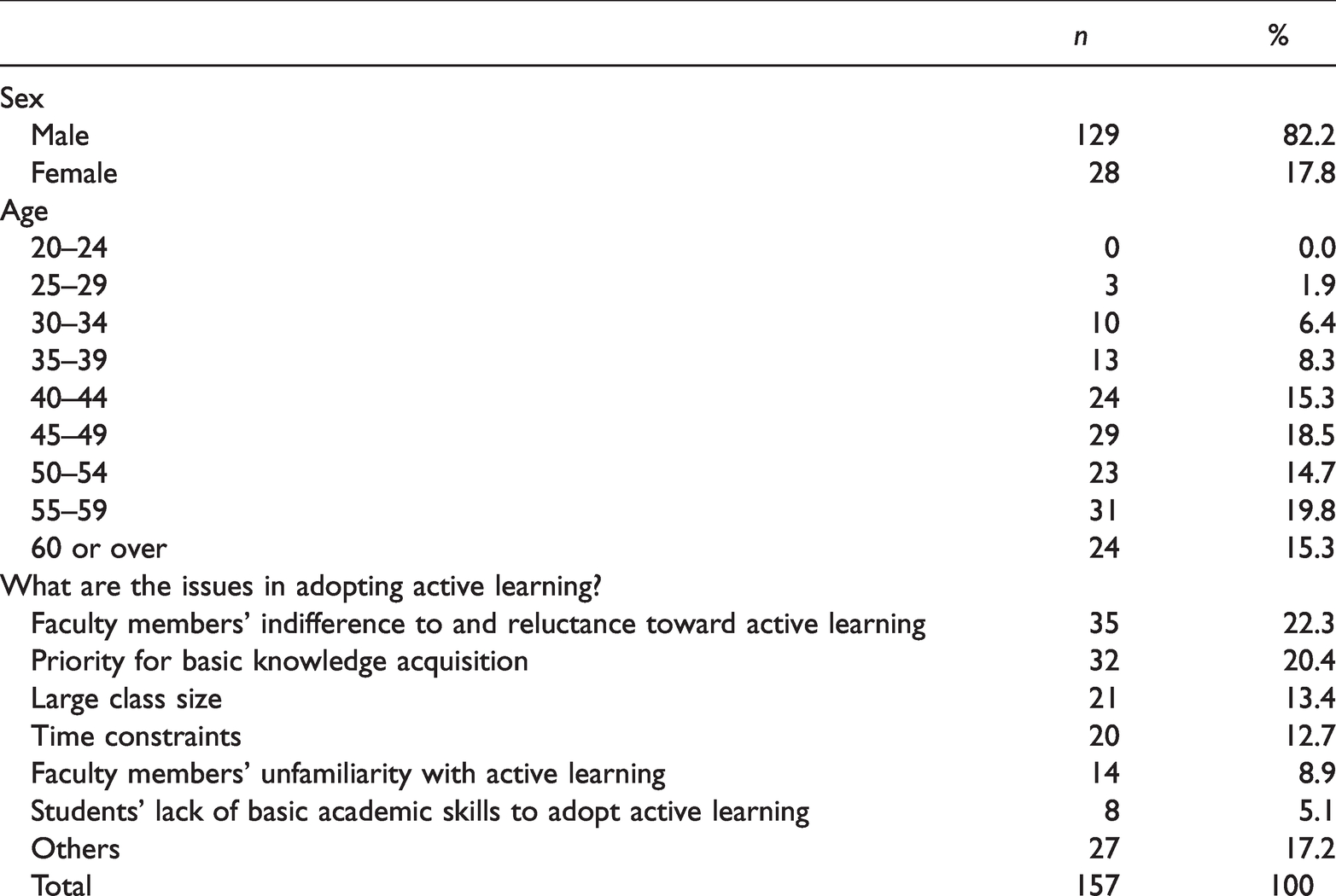
The issues that were identified were ranked in order, commencing with the most frequent response as follows: faculty members’ reluctance to adopt AL, priority given to basic knowledge acquisition, large class sizes, time constraints, faculty members’ unfamiliarity with AL, students’ lack of basic knowledge, assessment difficulties, and other issues (see Table 1).
Issues in relation to adopting active learning (n = 157).
Faculty members’ reluctance toward and unfamiliarity with adopting active learning
Thirty-five respondents reported that they were reluctant to adopt AL. One respondent said: AL is labour-intensive but not as effective as expected. Students may end up just playing around during the activities. (male, 61)
Another respondent concurred, saying: I had employed AL before, but I quit using it because students acquired only superficial understanding of the academic content. AL is detrimental for students who would like to learn deeply on their own. (male, 35)
In a further response, an educator agreed, saying: Employing AL just makes students feel that they somehow participate in the class, but they do not necessarily learn anything. I think that AL is a cunning way of killing class time by faculty members who cannot give good lectures. (male, 59)
Fourteen respondents reported a lack of familiarity with AL. One respondent said: I do not have knowledge about AL and need to study more about it. (male, 54)
Another said: I am not an education major and lack skills and knowledge regarding AL. (male, 41)
Other respondents expressed similar sentiments, saying: I lack the skills to manage AL. (female, 42) I do not know how to design the AL class. (male, 52 and male, 41)
Priority given to students’ basic knowledge and skill acquisition
Thirty-two respondents reported giving priority to students’ basic knowledge acquisition through lectures. One respondent said: Given that I teach science, I find lectures more efficient for teaching a large amount of learning content and information. (male, 60)
Another educator placed priority on basic skill acquisition, saying: In my class, students are supposed to acquire basic skills and not supposed to actively participate in activities. (male, 40)
Similar thoughts are evident in the following responses: Before knowledge application, students should start acquiring basic knowledge. (male, 63) I don’t find AL necessary for students to acquire basic knowledge. (male, 46)
In the same vein, eight respondents reported that students lacked the basic academic knowledge and skills necessary to adopt AL. This is evident in the following responses: I assume students cannot manage AL because of their lack of basic skills. (male, 40) Our university is low-ranked, and students do not possess enough academic ability to adopt AL. I find it meaningless to let students undertake discussions without basic knowledge. (male, 56)
Large class sizes
Twenty-one respondents reported large class sizes as a challenge when adopting AL. The following responses highlight the difficulties experienced: I teach a general education course with too many students to employ AL. (male, 52) I teach hundreds of students in my class and cannot manage to serve as a facilitator, so AL is not suitable for that. (female, 56) I teach too many students to adopt AL. (male, 59) I teach a lot of students in a large classroom. That is why AL is difficult to adopt. (male, 45)
Time constraints
Twenty respondents reported time constraints as obstacles to adopting AL. One respondent said: AL may be useful to develop thinking skills, but it takes too much time for students to come up with a valid answer. (female, 57)
Other educators faced similar challenges: I do not have enough class time for AL because there is so much information that students have to absorb through lectures. (male, 60) If we take time for in-class discussions, I cannot teach what I should teach. (male, 42)
Assessment difficulties
A few respondents mentioned difficulties in assessing the learning outcomes of AL. This is reflected in the following responses: Assessing AL is too complex. I cannot afford to do assessment. (male, 43) I cannot assess AL because I teach too many students at a time. (male, 44)
Other responses
Among other responses, structural and institutional barriers were mentioned: The structure of the classroom is inadequate for AL: students cannot do group work. (male, 45) The use of AL is discouraged at our institution. (male, 45)
One respondent mentioned a personal history of using the approach, but not labeling it as such: My teaching style already involved AL even before the term started being used. That is, I have been using AL without using the term AL. (male, 42)
Cultural barriers identified in the literature review were not mentioned by any respondents.
Discussion
Various challenges relating to the adoption of AL in Japanese universities have been identified. While most of the issues reported by respondents were also identified in the literature review, the current study highlighted those issues that were most frequently perceived among Japanese faculty members. Below, we address these issues in order, commencing with the most frequently mentioned issue.
Some respondents showed a reluctance to adopt AL, while others seemed unsure of the effectiveness of AL. While the negative perceptions of educators about AL may be caused by their lack of knowledge of or experience with this approach (Kember, 2009; Michael, 2007), some respondents reported that they had tried to use AL previously without success, while others claimed that lectures might be superior to AL for basic knowledge acquisition, suggesting that many respondents believe that teaching is a binary choice wherein they must choose either lectures or AL. This misconception may be common. Mizokami (2014) explains that even though AL should be encouraged, it is unfeasible for lectures to be totally abandoned. Nakai (2015) notes that lectures are one of the main teaching methods for basic knowledge acquisition, and AL should complement lectures. Perhaps, as Donnison and Penn-Edwards (2012) and Hashimoto (2018) explain, AL should be used to promote surface learning (knowledge acquisition) as well as deep learning (knowledge application).
Students’ lack of basic knowledge necessary to adopt AL was mentioned by respondents. As Sekita (2017) notes, in AL students aim to apply previously acquired knowledge in different contexts; thus, they first need to acquire that basic knowledge. His statement is justified, as AL is a constructivist approach in which knowledge is assembled by rebuilding prior knowledge (Biase, 2019). However, Nakai (2015) notes that knowledge acquisition can also be facilitated through AL. Students can gain knowledge by asking questions, explaining their thoughts, and teaching each other through active discussions. Kato (2015) echoes Nakai (2015) stating that humans cannot acquire substantial knowledge without having problems to address. Regardless of students’ knowledge, whether AL is useful for knowledge acquisition depends on how faculty members prepare their courses, given the learning needs of their students.
Some respondents found AL too time-consuming. While their concerns are valid, Michael (2007: 45) points out that the argument that AL is time-consuming, not allowing for all the material to be covered, “ignores the reality of what happens in all too many classrooms through lectures: great quantities of information are transmitted, and material gets covered, but little learning occurs.” Peters (2011: 480) also argues that AL “requires a greater amount of time to cover similar volumes of information but also produces a greater proportion of students demonstrating mastery of higher-level skills.” Educators should be reminded that teaching is time-consuming, and even more so for better teaching.
Some respondents reported that they teach hundreds of students at a time and thus cannot use AL. Hoyashita (2013) and Mizokami (2014) suggested using clickers, individual response devices operated by remote control that enable students to quickly respond to questions posed by instructors (Lantz, 2010), to enable large numbers of students to participate in classroom activities (Bertram Gallant, 2017). However, the management of clickers is also troublesome. For example, there are initial costs and possible loss of clickers to account for (Takeda, 2012). To create a better environment for AL, including a suitable class size and classroom structure, the efforts of individual instructors are insufficient, and institutional support is essential (Bertram Gallant, 2017).
Some respondents reported the complexity of assessing AL, especially in a large class setting. Since the provision of detailed feedback to every student is unfeasible, Nakai (2015) suggests that when faculty members teach a large class, instead of giving feedback to each individual, they select some representative reports or activities and discuss them in front of everyone. While this may be helpful, it does not solve all the problems, especially the difficulty in assessing group work. To avoid “free riding” or “social loafing,” instructors should, where possible, assess individual students rather than groups. While the use of various assessment tools should be considered, it is feasible to rely on exams in a large class setting.
None of the respondents mentioned cultural aspects as an obstacle to the adoption of AL, even though the characteristics of East Asian students in relation to the use of AL were identified in the literature review as a possible barrier (Chan, 1999; Nakai, 2015; Shieh et al., 2012). However, numerous respondents provided comments in relation to classroom culture, including the preference of instructors for a focus on basic knowledge acquisition and lecture-based teaching. Michael (2007: 46) argues that “reforming classroom practises to align them with a constructivist approach to learning requires not just learning new techniques but altering the culture of one’s classroom.” The discouragement of the practice of AL in an institution is an aspect of institutional culture. Institutions, as well as faculty members, should recognize the importance of educational environments (Johnson et al., 2007) and include such perspectives in developing institutional climates and curricula (Zepke and Leach, 2010).
Implications and suggestions
Some of the issues that have been identified in the current research can be dealt with by individual instructor’s efforts at the individual level (e.g., familiarizing themselves with AL), but others require institutional support. Takeuchi (2010) notes that AL will never be fully implemented unless (the management side of) the host institution takes initiatives to address the barriers to implementing AL. Findings from the current research indicate that these challenges at the institutional level include large class sizes and the institutional climate/culture (reflected in the response “the use of AL is discouraged by the institution”).
Here, the theory of planned behavior could be used to address some issues and promote AL. For instance, universities should organize adequate environments for practicing AL, such as adjusting class sizes and establishing infrastructures (e.g., AL labs that facilitate group discussions) so that instructors may experience more control over their teaching approaches. Universities should also make the use of AL an institutional norm by providing opportunities for instructors to share their experiences of using it. For instance, faculty development meetings or workshops could be a setting where practices, such as how to use and assess AL, are shared, which not only improve faculty members’ teaching skills but also develop an institutional culture that supports the use of AL.
These efforts may also be helpful in promoting the norms by showing the institution’s commitment (injunctive/social norms) to and peer instructors’ practices using AL (descriptive/behavioral norms). Changes in perceived behavioral control and subjective norms, as well as awareness and knowledge about AL, may positively influence instructors’ attitudes toward it (Shove and Warde, 2002). As the theory of planned behavior suggests, all these factors form intentions that lead to the use of AL.
However, as Takeuchi (2010) notes, many institutions seem to struggle with supporting instructors in adopting AL, as they often lack the financial, human, and technical resources necessary to provide an adequate environment for AL. In addition, especially in Japan, where individuals tend to follow what others do (Ito and Kawazoe, 2015), a single institution is likely to hesitate to implement something when others have not yet done so. Here, too, the government (i.e., MEXT) could, to some extent, elaborate on strategies to promote AL, based on the theory of planned behavior. Such examples include descriptions of AL in official documents (e.g., the aforesaid Central Council for Education’s (2012) report Toward the Qualitative Transformation of Undergraduate Education for the Future) and the implementation of a national-level project involving AL (e.g., Improving Higher Education for Industrial Needs, funded by MEXT). These initiatives by MEXT are to be commended because they may have helped foster injunctive/social norms (AL should be practiced) and, to a lesser extent, behavioral norms (AL is practiced). MEXT has also provided funding to help tertiary institutes implement facilities to organize and control the environment that facilitates the realization of AL.
These kinds of initiatives and support at the policy level may help to generate a positive atmosphere and attitudes toward AL at the institutional level. Nonetheless, some scholars argue that, especially since 2015, policy support has been either insufficient or inadequate for both faculty members and institutions. For instance, Asanuma (2015) questions the way AL has been promoted, not only at the individual and institutional levels but also at the policy level, as the government has not provided sound explanations of what AL is; why and how it should be practiced; or provided sufficient subsidies to enable institutions to create an adequate environment for AL. As a result, AL is often considered identical to mere groupwork (Ito, 2017).
This policy pendulum, without the formal leadership of MEXT, confuses instructors and institutions (Nakasono and Tanigawa, 2018), as indicated by their responses to our survey questionnaire, leading to the instructors’ lack of familiarity with AL (at the individual level) and AL not being practiced by universities (at the institutional level). Thus, the issue of AL should also be addressed at the policy level. If MEXT finds AL essential to improve teaching and learning to educate the nation, it should take initiatives and provide support, as happened in the late 2000s and the early 2010s.
The government and its affiliated organizations, such as MEXT and the Central Council for Education, should specify the definition of and practical procedures involved in AL, based on learning theories and evidence, instead of merely mentioning aims to promote generic employability skills and the use of random methods. Such policy efforts would also demonstrate their commitment to the adoption of AL. Only then could instructors and institutions fully dedicate themselves to addressing the issues related to AL and its successful implementation.
Conclusion
This study identified challenges faced when adopting AL and suggested that some of these issues, such as instructors’ reluctance to adopt or unfamiliarity with AL, may be addressed at the individual level. However, other issues should also be addressed at institutional and policy levels, partially informed by the theory of planned behavior. For instance, issues of large class sizes and discouragement of the use of AL are institutional issues. Meanwhile, institutions have struggled to adopt AL without appropriate financial, human, and technical resources. Therefore, policymakers should inform higher education institutions and instructors about what AL is and how it should be practiced. Appropriate support should be provided for its implementation if they choose to continue promoting AL in Japanese universities at the policy level.
This study has several limitations. First, the data was not randomly collected and may include some sample bias. However, as the data was collected from all prefectures of Japan and included a broad age range, we are confident that the sample likely represents the general population. Second, future research should undertake a deeper analysis of the findings. For example, some respondents may not have agreed with our categorization of the issues (e.g., one respondent reported that he uses AL without calling it such). To address these limitations, surveys using multiple-choice questionnaires should be conducted using a randomly selected sample. Future quantitative research combined with the current qualitative study will contribute to facilitating the increased adoption of AL by further elucidating the issues related to its adoption.
Footnotes
Declaration of conflicting interests
The authors declared no potential conflicts of interest with respect to the research, authorship, and/or publication of this article.
Funding
The authors received no financial support for the research, authorship, and/or publication of this article.
