



Abstract
Improving quality in initial teacher education in the framework of European initiatives entails a rather complex process as compared to that of higher education as a general study field. What adds to this complexity is the fact that teacher education continues to be treated as a national concern in all of Europe. This study provides evidence on features and tensions of translating European initiatives for improving quality in initial teacher education by examining the case of Kosovo. Findings from Kosovo, a small and ‘peripheral’ European context, can be of interest to contexts undergoing a similar transition. The study opted for qualitative research. The data was collected over three phases by conducting 15 interviews with six management staff and 28 interviews with 15 teacher educators. Findings build on debates concerning the future of European teacher education, demonstrating that tensions ensue between (external) European initiatives and (internal) local conditions that result in the mistranslation of transferred ideas into institutional practice. The loss in translation is attributed to contextual dynamics reflected at the macro-level (lack of ownership), the meso-level (fragmented organisational culture) and the micro-level (isolated individual and group cultures). The study concludes by endorsing context-oriented stakeholder-wide socialisation as a way forward for tackling and scaffolding local stakeholder tensions, contradictions and one-side approaches. Hence, context-oriented socialisation could address tensions by promoting local ownership, extending organisational culture and stimulating the development of collective values and cultures for a contextualised translation of European initiatives towards improving quality in initial teacher education.
Introduction
Reforming higher education (e.g. Enders and Westerheijden, 2014; Harvey and Williams, 2010) and teacher education (e.g. Caena, 2014a; Gassner et al., 2010; Zgaga, 2013) is considered a European policy priority. Two crucial European initiatives that developed the basis and accelerated the process for higher education and initial teacher education institutions (hereafter ITE) reforms include (1) the pan-European Bologna Process that started in 1999 intending to develop the EHEA and the (2) EU-led actions effectively launched in 2000 with the Lisbon Strategy (Curaj et al., 2015). The prevailing argument that pushed European higher education institutions to reform, ITE institutions included, was that only continuous, life-long education would ensure knowledge-society development (Grek and Lawn, 2009).
To understand European initiatives, underlying concepts need to be defined. According to Vukasovic and Huisman (2018), European initiatives can be broadly conceptualised in terms of (1) Europeanisation (vertical dynamic) and (2) Europe-assisted transfer (horizontal dynamic). Europeanisation is understood in terms of the convergence of national education systems with European formal and informal rules (Vukasovic and Huisman, 2018). In contrast, Europe-assisted transfer is understood as ‘a process whereby knowledge about policies, administrative arrangements, institutions, ideas and so on are used across time and/or space in the development of policies, institutions, and so on elsewhere’ (Bomberg and Peterson 2000: 10). Policy transfer is assumed to be a voluntary undertaking and emerges through informal or more institutionalised exchanges. This paper abides by the narrow definitions of Europeanisation as a top-down dynamic and policy transfer as intentional and voluntary (Voegtle et al., 2011), both to avoid concept stretching.
Most of the existing literature on Europeanisation and policy transfer is highly specialised in terms of focus. In the present paper, we discuss European initiatives for improving quality in ITE. In this context, such European models for convergence and transfers of policy (Steiner-Khamsi, 2014) aiming to support improvements of quality in higher education and ITE include but are not limited to: the Bologna Process action lines (political level), Tuning project (grassroots level), Erasmus programme and other initiatives (for instance: European teacher competence frameworks). Such European initiatives connect two comprehensive and significant horizons, including the Policy horizon (growing governmental and intergovernmental initiatives) and the Academic horizon (increasing the academic research and publications in the field of ITE). The synthesis of the European initiatives has resulted in a hybrid European agenda of instruments for reforming quality in ITE.
The literature on European initiatives in teacher education is wide-ranging (e.g. Caena, 2014a; Gassner et al., 2010; Hudson and Zgaga, 2017; Schratz, 2014; Symeonidis, 2021; Valenčič Zuljan and Vogrinc, 2011). However, ITE remains a recently developed study area within higher education (Hudson and Zgaga, 2008), and, as such, the issue of European initiatives for improving quality in ITE remains under-researched. Respectively, Zgaga (2013) explains the existing research gap with the argument that European initiatives influencing quality in ITE entail a rather complex and complicated process as compared to that of higher education as a general study field. Therefore, additional research is needed to understand the features and tensions of nation-states translating European initiatives for improving quality in ITE. This study aimed to narrow down this literature gap while examining the case of Kosovo.
Kosovo is a small and ‘peripheral’ European context. Initial teacher education in Kosovo advanced into a university-level degree in 2002. Until that time, ITE was the responsibility of higher pedagogical schools (i.e. HPS – teacher training institutions) located in five major cities throughout Kosovo. Before the ‘universification’ of ITE (Kaçaniku et al., 2019), teacher training institutions operated under the umbrella of the University of Prishtina (the largest university in Kosovo). However, each institution gradually developed into independent institutions operating under local Universities and became rather autonomous ITE institutions (Saqipi and Hoti, 2019). As of 2013, there are five ITE institutions in Kosovo with the Faculty of Education in Prishtina remaining the largest and leading institution in the country (Saqipi, 2019). All ITE institutions operate under Law no.04/l-037 on higher education in the Republic of Kosovo and exercise their autonomy of internal operations protected by the law and its sub-legal acts (Kaçaniku, 2020). Nevertheless, institutions are obliged to undergo institutional and programmes accreditations every five and 2 years, respectively – a mechanism that assures external quality of institutions (Kaçaniku, 2020).
Kosovo’s goal of joining the European family drove the country to harmonise policies and engage in continuous education reform (Saqipi, 2019). There was a need to align education policy with European benchmarks and reference points, including special attention dedicated to improving quality in ITE. Such initiatives resulted in ITE institutions implementing structural Bologna requirements as a vertical (top-down) dynamic (by aligning degree structures, engaging in quality assurance processes, fostering staff and student mobility and participating in international projects, etc.). Also, a few voluntary transfers of policy are found at the institutional level (Kaçaniku, 2020). However, there is limited scientific literature to document institutions and stakeholders’ experience with ITE policy development in Kosovo.
Kosovo remains at a relatively early stage in its development to provide quality ITE. European initiatives are implemented formally as changes to legislation and policy (Saqipi, 2019) and programmes structures and content (Kaçaniku et al., 2019). A major problem characterising the ongoing reforms is that ITE institutions have not examined in-depth the education system and contextual dynamics regarding choices for undertaking such reforms. Consequently, European policy transfers have been ad-hoc and inconsistent as a result of the absence of an intentional and structured process.
The present study examines the features and tensions of translating European initiatives for improving quality in ITE in Kosovo by exploring the journey from policy to institutional practice. The study addressed the following research questions: (1) How have the European initiatives been accepted, interpreted and implemented in light of improving quality in ITE in Kosovo? and (2) In what ways do contextual dynamics influence the translation of European initiatives for improving quality in ITE?
Theoretical framework
The understanding of policy uptake regarding contexts, stakeholders and processes is supported by the ecological-sociological paradigm (see: Bronfenbrenner, 1979). The ecological perspective in ITE represents an equilibrium setting for individual and collective opportunities for situated learning through mediation and adoption to understand the dimensions and processes of improving quality as guided by cultural, social and institutional parameters (Caena, 2014a). Niemi et al. (2014) consider an educational ecological perspective a frame of complex processes that interface across and within different dimensions and levels of society. In line with the ecological perspective, the broader ITE context is a wide-ranging organisational learning platform for working out and resolving contradictions among all local stakeholders in ITE quality improvement. In the context of this paper, the ecological-sociological paradigm is used as the basis for examining the features and tensions of translating European initiatives for improving quality in ITE in Kosovo.
Initial teacher education in the context of European initiatives
Initial teacher education at universities (including ‘universities of applied sciences’ in some countries) is a recently developed study area (Zgaga, 2013). Before the 1990s, ITE in Europe was rarely discussed as an issue of internationalisation or ‘Europeanisation’ within higher education (Hudson and Zgaga, 2017). The Europeanisation of teacher education widely spread with the introduction of European dimension programmes for schools in the 1980s following the formal developments in 1992 of Maastricht Treaty education and training (Grek and Lawn, 2009). However, the early 1990s are considered determining times for the whole of Europe’s ‘internal internationalisation’ in higher education in general and teacher education in particular (Hudson and Zgaga, 2008).
The process of ITE Europeanisation encouraged researchers to talk about the ‘European teacher education policy community’ (Hudson and Zgaga, 2008), a ‘European Teacher Education Area’ (Gassner et al., 2010) and the ‘European teacher’ (Schratz, 2014). From a policy perspective, ITE Europeanisation intends to support the equilibrium between national and overarching European structures and values (e.g. Madalińska-Michalak, 2020; Symeonidis, 2021; Valenčič Zuljan and Vogrinc, 2011). Although teacher education systems in Europe are firmly rooted in national histories and conditions, various studies have suggested that ITE across Europe has converged, showing that policy rhetoric and objectives for ensuring quality in ITE have been addressed (e.g. Caena 2014a, 2014b; Gassner et al., 2010; Symeonidis, 2021; Zgaga, 2013).
The analysis of European initiatives in ITE provided sufficient evidence to suggest that quality teacher education is considered a priority (Gassner et al., 2010). Starting from the high expectations for ITE stakeholders set by the Council of the European Union (2014), they are expected to improve quality in ITE in response to societal changes. Below we discuss such European initiatives for improving quality in ITE. Firstly, the Bologna blueprint is recognised to influence measures for academic comparability and compatibility that enables future teachers to achieve a European qualification and remove barriers to mobility (Schratz, 2014: 18-20). Secondly, the Tuning project has encouraged a common language and cooperation between institutions, countries and regions across the world on teaching, learning and assessment (Wagenaar, 2019). Thirdly, Teacher competencies framework(s) provide a better understanding of what kind of teachers are being developed as a basis for extending European teacher professionalism (Caena, 2014b). Fourthly, other initiatives influencing mobility and international cooperation have significantly influenced the advancement of cooperation across European countries through the Erasmus programme, Association for Teacher Education in Europe (ATEE), European Educational Research Association (EERA) and networks like Teacher Education Policies in Europe Network (TEPE), to name a few (see e.g. Hudson and Zgaga, 2017).
However, despite numerous European initiatives for harmonising the improvement of quality in ITE, a common conclusion of the reviewed studies is that there are meaningful differences at local and national levels (Murray et al., 2019). While the ‘surface convergence’ of European initiatives penetrates national ITE, there is persistent diversity underneath in national contexts (Heinze and Knill 2008). In theory, diversity is not negative – considering that European initiatives for quality ITE do not aim for uniformity (Schratz, 2014). Nevertheless, the convergence of European ITE systems implicates common issues and trends that can follow contradictory developments – that of compliance for uniformity or the prevalence of national and institutional autonomy to disregard transfer for quality improvement (Caena, 2014a). In this context, the problems with the European initiatives have reflected the contradiction between official transfers for quality ITE, while realising that numerous institutions have only managed to undertake cosmetic changes leading to backsliding in implementation (e.g. Werler, 2016).
Accordingly, although Gassner et al. (2010) recognise that ‘teacher education must have a special place in this newly-created European landscape’ (5), Zgaga (2013) claims that the Europeanisation of quality ITE is moving very slowly as compared to other study areas of higher education. While various fields have managed to harmonise the quality of their study programmes, achieving quality ITE still poses problems (e.g. Caena, 2014a, 2014b; Hudson and Zgaga, 2017; Symeonidis, 2021). Moreover, Caena (2014a, 2014b) has argued that, despite European level reforms influencing quality ITE (for instance: nation-states adopting teacher competence frameworks), tensions arise at national-level policy agenda, since in many nation-states, quality ITE is dominated by national policies and priorities. In addition, the influences of pre-existing knowledge, beliefs and contextual aspects are more important than a European-led agenda for improving quality in ITE (Caena, 2014a). In consequence, Zgaga (2013: 347) suggests that ‘teacher education systems still try to sail in the heavy seas of higher education, while balancing between academic and professional dimension’. In the same way, Hudson and Zgaga (2008: 38) argue that ‘the turbulent processes in higher education at large and in the global context are bringing further challenges to ITE as a specific area within higher education’.
Studies discussed earlier show that several countries experience challenges with the process of transferring European ideas into the local context due to resistance fostered by national traditions. Moreover, Zgaga (2013) argued that, in many countries, the Europeanisation and policy transfer efforts to reform ITE encountered immediate incomparability and incompatibility. Symeonidis (2021) explains that transnational policy actors hardly ever consider characteristics of national educational contexts, history and tradition and the specific features of the national systems. Hence, Schratz (2014) purports that implementing European initiatives for improving quality in ITE has a close bearing on countries’ vulnerability to ideologies of different stakeholders and national political influence.
Methodology
Participants, instruments and procedure
The study is situated within a qualitative research paradigm. Qualitative research enables researchers to immerse themselves in naturally occurring social phenomena by following ‘an interpretive approach to the world’ (Denzin and Lincoln, 2018: 5). It allows participants opinions to be flexibly represented and prompts issues that emerge beyond participants’ actions and behaviours that exist underneath their consciousness (Creswell and Creswell, 2018).
Participants’ characteristics.
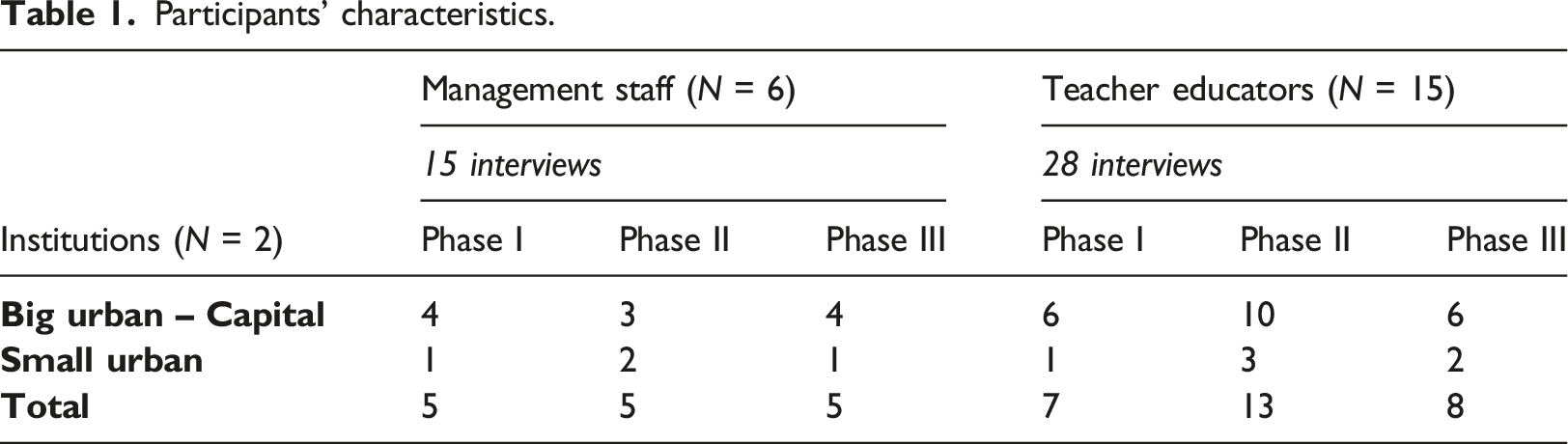
Denzin and Lincoln (2018: 10,001) suggest that although it is not possible to avoid structure in human encounters, it is certainly possible to provide a conversational structure that is flexible enough for interviewees to be able to raise questions and concerns in their own words and from their perspectives. Correspondingly, after opening with the research purpose and introductory script, my role was to guide the interview discussion but not to interrupt participants and occasionally ask for follow-up questions to confirm what was being discussed to better understand features and tensions of translating European initiatives for improving quality in ITE.
The first phase of interviews focused on a more general component concerning (I) participants’ understandings of quality in ITE. It aimed at examining teacher educators and management staff general perceptions regarding their involvement, approaches and actions towards understanding the process of improving quality in ITE. The second phase addressed (II) participant perceptions on the acceptance, interpretation and implementation of European initiatives to improve quality in ITE by also allowing data from the first phase of interviews to inform the second phase. This combination was purposely done to trigger participants in making connections between their understanding of the process of improving quality in ITE and the contribution of European initiatives to such efforts. The third phase addressed (III) participant perceptions regarding contextual dynamics that influence the translation of European initiatives in efforts to improve quality in ITE. The focus of this phase was to better understand the context and meaning of findings emerging from the first and second phases to achieve a synthesis of data collected in a broader research context.
The organisation of interviews followed structured interview schedules. Tailored e-mails were sent to each interviewee individually to schedule the interview appointment. Interviewees were granted the opportunity to thoroughly read and sign the informed consent before starting the interview during all phases. The majority of interviews lasted more than 1 h. All interviews were recorded and transcribed verbatim, totalling 263 pages (168 pages for teacher educator interviews and 95 pages for management staff interviews). The interviews were transcribed in the Albanian language. Only selected interview excerpts presented in the findings were translated and adapted to the English language.
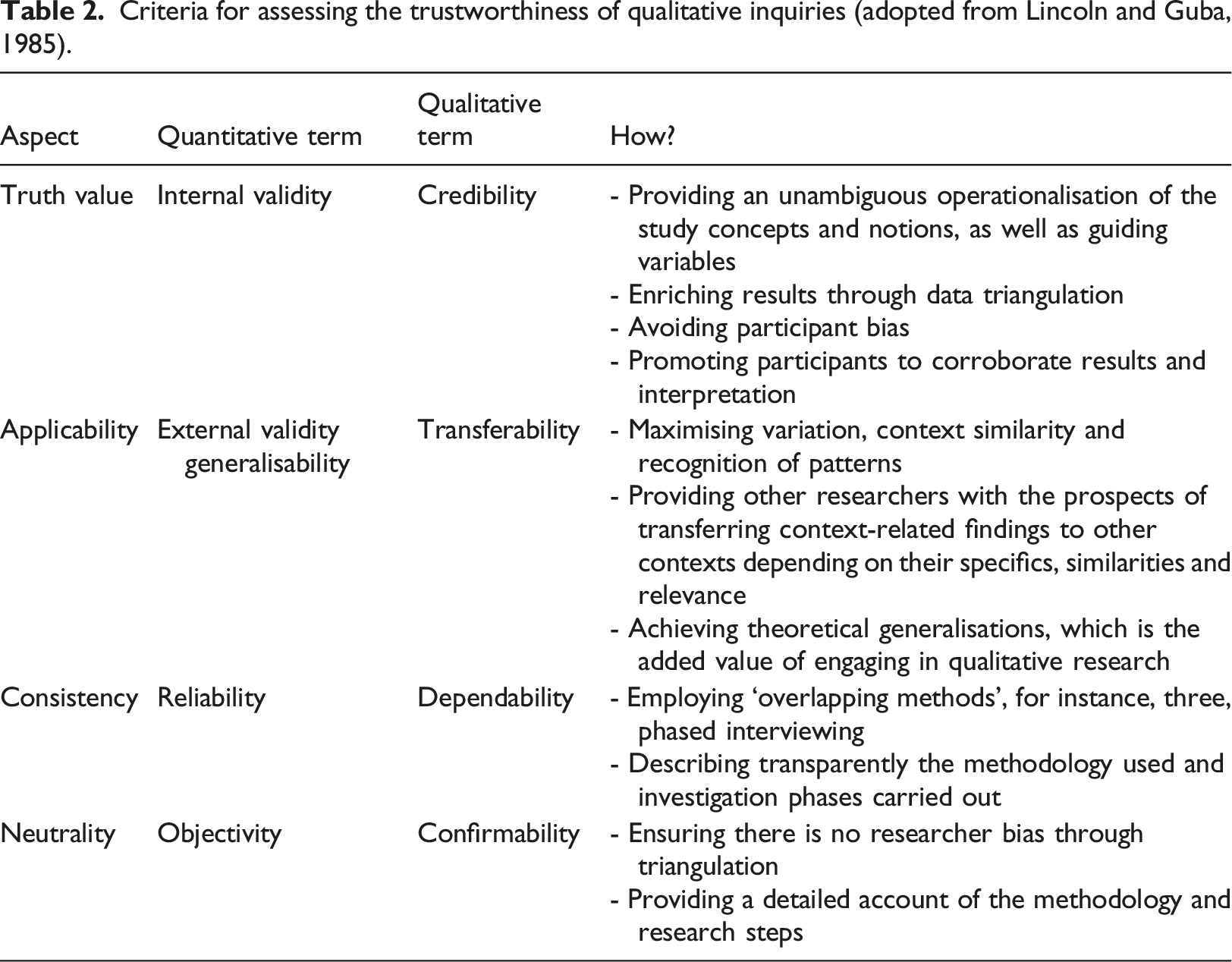
Quality criteria for assessing the trustworthiness of qualitative research
Criteria for assessing the trustworthiness of qualitative inquiries (adopted from Lincoln and Guba, 1985).
Data analysis
Data were analysed using thematic analysis. Following Nowell et al. (2017), research questions have been used to guide the thematic analysis. The thematic analysis followed Braun and Clarke’s (2006) six phases. First, familiarisation with data consisted of the triangulation of data sources from teacher educators and management staff interviews to ensure bias-free and data validity (Lincoln and Guba, 1985). The first step was to arrange and organise all the raw data as per data categories. Data for each participant were coded, and all information about the data collected were logged into an excel spreadsheet. The organised raw data was transferred to MAXQDA qualitative software for further data sorting and organising. At this stage, I have re-read the text several times to acquire initial insights and familiarisation.
Second, generating initial codes involved the identification of initial codes from the text. Nowell et al. (2017) have considered qualitative coding to be a reflection process in which researchers interact with data. As recommended by Braun and Clarke’s (2006), the data were given careful attention to generate insightful codes that have later emerged into themes. A code manual was also developed in which comprehensive definitions and example texts were presented. The coding manual ensured an organised approach to combining sets of data into a common analysis. According to Nowell et al. (2017), a coding manual is useful for novice researchers as it ensures a transparent trail of evidence for a credible analysis. In addition, MAXQDA ensured the organisation of coding consistent with data-relevant features throughout the text, enabling depth and sophistication of thematic analysis.
Third, searching for themes began with organising the identified codes into themes. The intention was to group codes into findings that are relevant to the research questions. The study used a data-driven inductive approach (Boyatzis, 1998) to enable an unstructured and interpretive stance when identifying the themes. Notes were recorded at all times about how codes have emerged into themes for auditing purposes and ensuring confirmability.
Fourth, reviewing themes proceeded with the revision of all themes and codes to ensure they form a coherent pattern. The validity of individual themes (see: Braun & Clarke, 2006) has been considered in terms of meanings connected with the entire dataset. This stage also involved debriefing sessions with other researchers as data auditors to vet the emerging themes. This included structured meetings with a clear presentation of initial themes followed by detailed justification from my side as to how themes emerged from data and initial codes. The data auditors are senior researchers and specialists in the field and have dedicated their time to providing critical feedback in different stages as deemed necessary. According to Lincoln and Guba (1985), external consultation powers a vetting process to confirm the credibility and validity of the analysed data.
Fifth, defining and naming themes generated direct themes that immediately infer the essence of the theme narrative. Braun and Clarke (2006) advise that researchers can confirm the refinement process of the themes by consulting with an external expert that knows the topic area well. As previously noted, I have continuously discussed the process with data auditors and have included data auditors’ feedback when required. This consultation process determined that the final version of the generated themes is clear and comprehensive. Subsequently, a detailed analysis for each theme was prepared to confirm a comprehensive picture that all themes transfer with respect to research questions. According to Lincoln and Guba (1985), this approach assures the transferability of the findings.
Sixth, producing the report confirmed the final themes. As Braun and Clarke (2006) recommend, the report represents a coherent, consistent and stimulating narrative. This step by step data analysis and how findings were developed are reported for ensuring the data is credible. The proper reporting process was also maintained by keeping a record of the entire methodological process as notes to ensure trustworthiness.
My role as a researcher through reflexivity
The researcher’s role is vital to the study outcomes as it fosters the creation of knowledge in qualitative inquiry. For me as a researcher to avoid potential problems with positioning and bias, reflexivity has been considered an essential component in this research. According to Cohen et al. (2018), reflexivity acknowledges that researchers are inevitably part of the researched social environment. Moreover, the role of reflexive researchers is valued as they contribute to their research by bringing their individualities, knowledge and experiences (Cohen et al., 2018).
For me as a researcher being reflexive would mean to recognise openly my role within research development and results. Instead of arguing my ability to entirely avoid my role, I openly acknowledge its research effects. In this study context, I am a researcher and a teacher educator in one of the initial teacher education institutions under study. As a teacher educator, researcher and consultant in the education sector in Kosovo, I bring insider knowledge and experience. I have been able to build a professional and collegial relationship and closeness with study respondents in both teacher education institutions. Knowing the participants of the study has been considered a strength of my study.
Although the researcher’s role in the study is valued, I needed to continually monitor my responses and interactions with respondents to avoid negative researcher bias. Accordingly, I have used the following strategies to ensure a non-biased interpretation of the results, namely: (i) by keeping a personal journal to depict my inner feelings regarding the process, and (ii) involving critical friends to examine the judgments. I used the journal to ‘officially’ record my observations during the process. We as researchers are allowed to wander throughout the process; thus, keeping a ‘documented wandering’ that encourages reflection made the process more recognised and transparent. In addition, involving critical friends as data auditors was done in all phases to address researcher positioning and avoid researcher bias. This aspect is explained in the data analysis section.
Findings
Findings are presented in relation to research questions. The first section reports four themes responding to the first research question showing tensions in improving quality in ITE in the frame of European initiatives. The subsequent section reports two themes responding to the second research question revealing the influence of contextual dynamics in translating European initiatives for improving quality in ITE. It is worth noting that there is no important difference between the findings of the two institutions (see Table 1). Data from all participants have strongly reflected all the themes’ development (as thoroughly discussed in the methodology section) and there are no cases of ‘most frequent theme’ as all are equally predominant.
Improving quality in ITE in the frame of European initiatives
Findings in this section reveal that efforts to improve quality in ITE are manifested with tensions between European expectations and local implementation in practice. Findings are grouped into four themes discussed in this section.
The tensions between external and internal quality assurance policy
Findings show reliance on external quality assurance policies for improving quality in ITE. However, policies and frameworks for improving quality at the internal/institutional level are practically non-existent. In the absence of an internal quality assurance policy, the only mechanism to ensure quality in ITE is limited to institutional and programmes’ accreditation as an external mechanism. (Teacher educator 2, phase 1)
The accreditation of programmes has been identified as the main framework that ITE institutions refer to for quality improvement. The findings highlight that European frameworks for quality assurance such as the Standards and Guidelines for Quality Assurance in the European Higher Education Area (ESG) are used as an externally driven policy for quality assurance. However, ITE has failed to contextualise such external frameworks for internal quality improvement. External quality assurance mechanisms are limited to quantitative instruments that are not discussed but exclusively used for formal accreditation purposes. Every two years, our institution is obliged to go through accreditation against externally determined standards that are based on ESG. Such standards have not been translated to the local context of ITE, which makes it harder for institutions to comply. The questionnaire remains the only formal instrument to collect feedback from students. Data are compiled into an institutional self-evaluation report, which is never reflected and discussed and, only used for accreditation purposes. Lack of human and financial resources remain a challenge. (Management staff 1, phase 1)
Although the process is managed by a single quality assurance officer, interviewees have stated that teacher educators are the main actors in this process. However, due to the lack of internal quality assurance policy and supporting mechanisms to manage the process, many teacher educators detach from the process. Hence, the following quote confirms that the process becomes a formal responsibility and is managed by a limited group of teacher educators due to a lack of staff ownership and institutional leadership practices. There is low support from teacher educators to contribute to the accreditation process. In such circumstances, random teacher educators’ end up filling the gap of negligent teacher educators. This raises questions about process credibility. The process turns into a formality of checking out the list of requirements as opposed to collective discussion and reflection for improving the quality in ITE. There is no staff ownership of quality assurance processes. (Department head 2, phase 1)
Management staff and teacher educators have stated that accreditation is translated as a mechanism for quality control that is implemented periodically. Accreditation continues to be treated as a formality that once the process ends, there is a discontinuation of quality assurance efforts. (Department head 1, phase 3)
The accreditation process revealed substantial divergence among teacher educator perceptions. Accordingly, further individualism and fragmentation, powered by different teacher educator cultures, is evident in how quality improvement is manifested. The accreditation process only managed to bring forward the many tensions between management staff and teacher educators, as well as teacher educators of different disciplines, which reflects the deep fragmentation powered by different teacher educator cultures. (Teacher educator 3, phase 3)
The tensions between European, national and institutional policy
The analysed data confirm vast inconsistencies between European policy transfers, nationally-driven teacher education policy and institutional policy and practice. Findings show that national policy on teacher education is tremendously influenced by European initiatives. However, such transfer of policy ideas is ad hoc and inconsistent stemming from the absence of nationally and institutionally driven processes for improving quality in ITE. In the last twenty years, our education system has faced frequent changes, which has disabled us to evaluate their impact. There is continuous external pressure from the European donor community to improve the quality in ITE, influencing a non-intentional transfer of European frameworks into the local context. National policymakers are very keen to accept such proposals formally and in an ad-hoc meaner, and include them in the main policy documents in a ‘copy and paste’ format. However, the policy transfer process faces more barriers between national and ITE institutions. This is because, ITE institutions are the main stakeholders for preparing future teachers and although the transfer might reach policy documents, it is always ‘up to’ teacher educators to implement or ignore such external expectations. (Teacher educator 15, phase 3) Policy transfer goes beyond alterations in policies and relates to the individual understanding of improving quality in ITE. We still lack standards tailored for national teacher education that correspond to European frameworks. Many inconsistencies and vast flexibility in the system has prompted a lack of policy understanding and implementation for quality ITE. (Teacher educator 11, phase 3)
When discussing tensions between European-national-institutional quality improvements, management staff attribute this issue to the existing human resources in ITE institutions. One threat to fully translating European initiatives for improving quality in ITE is that institutions depend on existing resources and one of the most problematic ones is the already hired teacher educators that do not transform. There are still many teacher educators that continue to resist any change towards quality ITE. (Management staff 3, phase 2)
Findings show the majority of teacher educators reject the idea of improving quality in ‘local’ ITE under ‘external’ European-inspired frameworks, which shows that some teacher educators remain true to their isolated tradition. Moreover, several teacher educators showed their resistance concerning ‘literal’ European initiatives for improving quality in ITE. The statement below indicates resistance to ‘external preferences’, which should not be the basis for local ITE quality improvement. I do not see how European frameworks can apply to the ITE Kosovo context. We have been preparing teachers since the 1950s and have established a teacher education tradition that does not correspond to and should not be based on external European preferences. At the end of the day, we are preparing teachers for the Kosovo context. (Teacher educator 8, phase 2)
The tensions between Bologna-inspired convergence and institutional practice
The implementation of the Bologna Process framework is seen as a structural building block for institutional quality improvement in Kosovo. At the start of the Bologna Process implementation, we as teacher educators had no idea what a syllabus is or how are we supposed to plan our lectures according to such structures and objectives. After intense training and coordination among staff, we have managed to transform our operations according to the Bologna provisions. (Teacher educator, 7, phase 1)
ITE developed as a standalone academic unit within the University of Prishtina in 2002, which was when Kosovo started to implement the Bologna objectives. In this reform context, a management staff member argued that it was not an internally driven incentive. Faculty of Education developed as a result of great external pressure, and reforming structures in ITE based on the Bologna objectives was no exception. However, there was no internal push or purpose to implement the Bologna Process. (Management staff 2, phase 2)
One aspect that should be emphasised is the fact that teacher educators prepared teachers before ITE moved to higher education. Consequently, interviewees discussed the existing resistance to restructuring institutional processes based on Bologna objectives. The Bologna Process was not always accepted as a dominant framework to restructure institutional practices. Many teacher educators at the beginning of the reform highly resisted the new planning. (Teacher educator 5, phase 1)
The tension between external Bologna demands and internal implementation was a reoccurring theme in discussions with the management staff and teacher educators. This aspect was emphasised to show the existing gap between achieving formal restructuring of institutional practices and the actual implementation of such provisions. Kosovo is an observer country that unilaterally implements the Bologna provisions. There is limited participation of Kosovo in European policy coordination conferences. This distances local stakeholders from raising problems faced in such conferences. This issue allows plenty of flexibility to local stakeholders as implementers to interpret and address structural requirements. The most problematic stakeholders are teacher educators that are not collaborative and follow individual preferences. (Teacher educator 3, phase 2)
The tensions between surface Europeanisation and programmes implementation
Findings show that although programmes have converged formally to resemble European programme structures, programme implementation is ad hoc and isolated to teacher educator practice. From a formality perspective, programmes have been restructured in line with Bologna action lines. Also, many programmes were reformed from European-funded projects. Consequently, many teacher educators noted that programme content (course description and learning outcomes) had been transformed according to competence areas within the European teacher education competence framework. However, a strong emphasis from participants was the lack of implementation of the reformed programmes. There is a general understanding that ITE is a national concern and should be organised according to the beliefs, backgrounds and experiences of teacher educators.
Although all courses are harmonised with the European teacher education competence framework, implementation remains a problem. Teacher educator values, backgrounds and the tradition of quality ITE influence programme implementation. Students are telling us that something else is presented as syllabus content and something else is being implemented. This poses an urgent need to reform stagnant teacher educators. (Teacher educator 15, phase 3)
Contextual dynamics in translating European initiatives for quality ITE
Findings in this section highlight that context remains an important variable in influencing the translation of European reforms for improving quality in ITE. Contextual dynamics that explain the mistranslation of European initiatives for quality ITE are grouped into two themes and discussed.
Lack of reform ownership and donor dependency
Discussion with participants has revealed that ITE reform’s weakest points remain the lack of reform ownership and donor dependency. There is a consensus among participants that ITE formal quality reforms are guided by Kosovo’s aims and values to join the EU. In the first years of ITE development, the international donor community initiated the reform with no discussion. Accordingly, the intention to join the EU is translated into formality-driven policy harmonisation that is maintained as an important value. Interviewees have stated that one reason for these frequent reforms is the desire to look good for the ‘European family’. Kosovo’s intention in joining the EU is a key factor in the reform process. We care about how to present ourselves to the international community as opposed to identifying a contextual approach to transferring European ideas for quality improvement. (Teacher educator 2, phase 1) Somehow I see the reform is done to be positively evaluated by the EU actors. Formalities have emerged with no real impact. (Management staff 3, phase 2)
Another pressing problem is that local experts are not leading the ITE reform. We have experts in ITE that have capacities for leading the reform. However, we deal with cases in which so-called external ‘experts’ take the leading role to improve quality in ITE, leaving local actors in the shadows. There is a lack of contextualisation of proposed reforms. (Teacher educator 1, phase 2)
Changes take time to absorb and frequent changes prevent the smooth translation of European initiatives. The issue reported by participants is that the need for change is determined by external actors that do not understand local needs and conditions. A problematic aspect is that external evaluators determine the need to make changes in ITE. We haven’t had the chance to ‘take a breath’ and process ongoing changes. Local actors should take ownership in critically evaluating external initiatives and internally managing improvement. (Teacher educator 12, phase 2)
Many initiatives for quality reforms remain donor-funded, which has created a donor dependency problem. However, participants noted that ITE needs to exercise a leading role to ensure the sustainability of donor initiatives for improving quality in ITE. This emphasis on ownership comes as a result of previous experiences with donor-funded projects that have failed to ensure sustainability. Donors helped our institution with capacity-building projects at various levels. However, once the projects end, we fail to ensure continuity of funded intervention. We should understand that teacher educators are the engine of ITE in Kosovo. They should work together to ensure the sustainability of such quality improvement initiatives. (Teacher educator 11, phase 2)
Fragmented and isolated organisational and individual culture
Findings have shown little or no indication of a consolidated organisational culture that is capable of managing a change process. ITE institutions are engaged traditionally in doing more of the same without any pressure for change and are resistant to European initiatives for improving quality. Teacher educators stated that institutional efforts are organised in an ad hoc manner. There is a lack of planning within institutional structures. There is no reporting mechanism other than formal end-of-month timesheets for teaching hours held. We report teaching hours held as an institutional formality. There is no institutional initiative to challenge us to improve our professional practice as staff. Everyone acts as they see fit and at the end of the month everyone is treated as equals based on teaching hours reported. (Teacher educator 3, phase 1)
Study participants have argued that professional collaboration is weak among institutional stakeholders, and staff only ‘formally’ collaborate when it is explicitly required. However, regarding informal collaboration, study participants stated that it is only present with the staff of similar beliefs regarding quality ITE. We usually do not miss formal meetings at the department and university levels since they are mandatory. Meetings are organised randomly and on an immediate needs basis. The topics discussed are generic and there is no planning for improving quality in ITE. We only collaborate formally and staff operate as isolated islands. Collaboration exists with colleagues of the ‘same culture’. (Teacher educator 7, phase 2) It is with regret that I consider some collaboration in our institution is done behind the ‘secret doors’ of the respective groups, and such behaviour shows a lack of institutional transparency (Teacher educator 4, phase 2)
The dominant organisational culture is unchallenging and lacks institutional drive, which has enabled individual and isolated staff cultures to flourish in promoting resistance to change. The institution promotes abundant flexibility and, as a result, limited staff professional development initiatives follow. Although teacher educators are expected to advance their academic rank every 4 years, no institutional-driven mechanisms that facilitate staff continuous professional development were reported. Professional growth is determined by individual teacher educators’ goals and values. When it comes to European collaboration, only individual and voluntary staff activity was noticed. Staff professional development is individually-based. We have two sides of the coin promoted within our institutional flexibility culture. On the one hand, we still have teacher educators who have not managed to get a doctorate for 15 years and use the same teaching approach from the moment they started working, while, on the other hand, we have staff who continuously publish, incorporate new teaching and learning practices, and that constantly strive to bring European projects to improve the quality in ITE. The fact that drastic differences in teacher educator practice have been ‘permitted’, it is safe to say that our institutional culture does not challenge us and allows flexibility for a variety of approaches that promote resistance to change. (Teacher educator 1, phase 3)
Discussion
Kosovo has undergone continuous reform through European initiatives in efforts to improve quality in ITE. European frameworks have been used extensively, showing that the process of improving quality in ITE in Kosovo is manifested through adopting external policies and frameworks. However, ensuring the proper translation and implementation of European frameworks into institutional context remains a challenge. Unavoidably, local stakeholder tensions and contradictions have led to Kosovo managing the process of translating European initiatives for improving quality in ITE as an isolated national concern. Findings build on debates concerning the future of European teacher education, which recognise tensions and contradictions when nations and institutions transfer European policy ideas and frameworks for improving quality in ITE (e.g. Caena, 2014a; Gassner et al., 2010; Symeonidis, 2021; Zgaga, 2013).
Drawing on Bronfenbrenner’s ecological systems model (1979), our findings (see Figure 1) show that tensions arise between external – European initiatives (characterised with the overemphasis of external policies and frameworks) and internal – local conditions (teacher education tradition, institutional stakeholder values, cultures and practices) that result in the mistranslation of transferred ideas into institutional practice. The loss in translation is attributed to contextual dynamics reflected at the macro-level (lack of ownership), the meso-level (fragmented organisational culture) and the micro-level (isolated individual and group cultures). The framework in Figure 1 offers new knowledge as a way forward for tackling and scaffolding local stakeholder tensions by endorsing context-oriented stakeholder-wide socialisation efforts. Framework for translating European initiatives for quality ITE.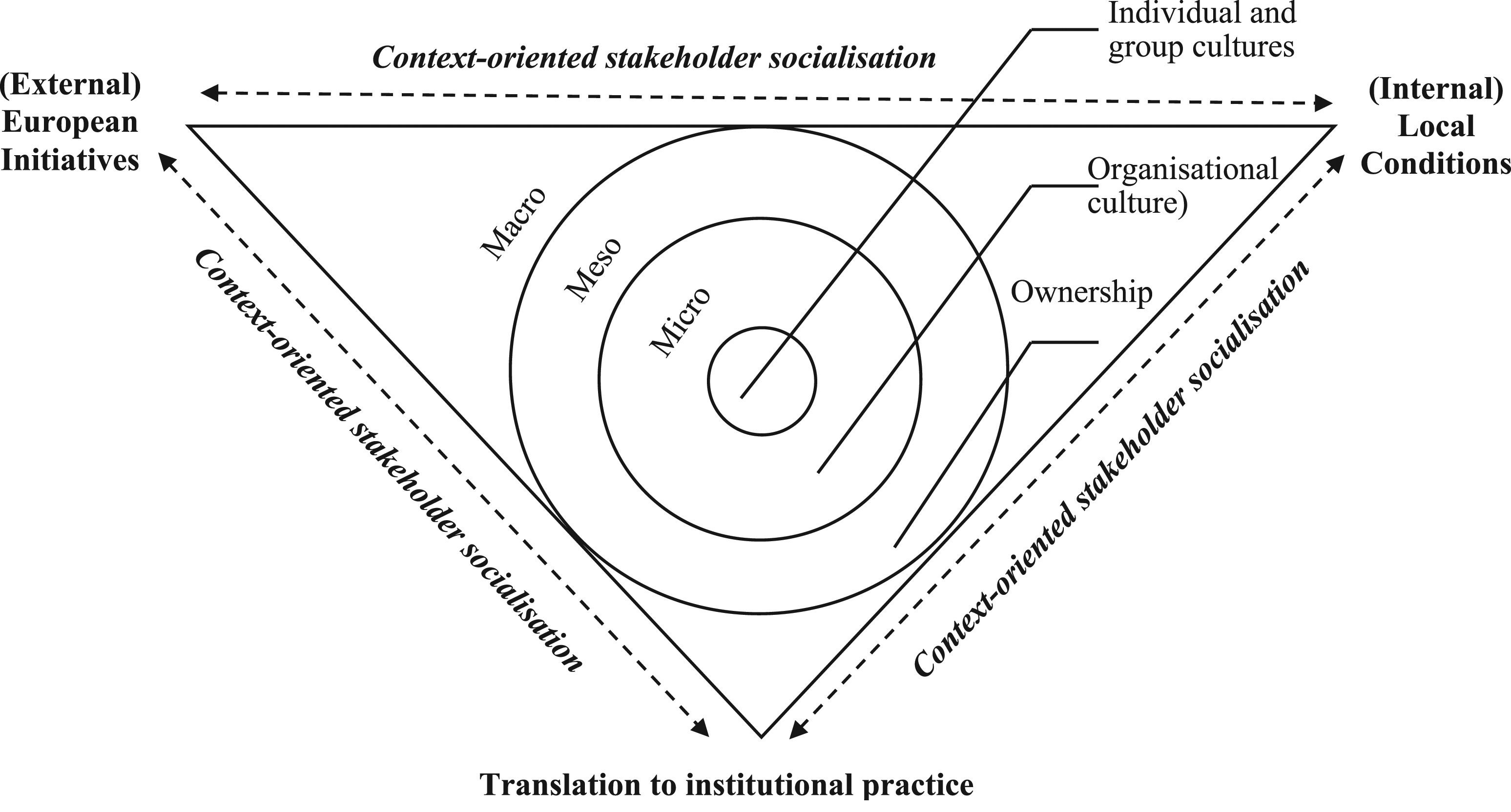
At the macro-level, our findings show a lack of stakeholder ownership during the process of transferring European initiatives for improving quality in ITE. In the literature, this problem is referred to as the European ‘core’ and ‘periphery’ dichotomy, which indicates the domination of some countries/structures over others when transferring policy ideas and frameworks into another context. In this paper, the European periphery refers to the neglected area of South-Eastern Europe and the Balkans (see: Zgaga, 2014), including Kosovo. Our findings showed that Kosovo’s decision to implement European initiatives for improving quality in ITE was not internally driven and local stakeholders have only exercised tertiary roles, resulting in stakeholder detachment of owning such process. As a result, ‘imported’ policies and frameworks were never discussed locally but were automatically placed into relevant policy documents as ‘copy and paste’ articles. This situation has resulted in the phenomenon of policy ideas remaining only at the policy documents level since it has triggered the most ‘orthodox’ national reformers to challenge deep resistance in the national and institutional environment. This is explained by a contradictory situation such that, on the one hand, the harmonisation of policies to European benchmarks is triggered by the important value of joining the EU structures, while, on the other hand, local stakeholders voicing the need to exercise a leading role by employing their autonomy and individuality. Consequently, findings confirm that the process of improving quality in ITE in the frame of European initiatives is faced with a dichotomy between (a) the phenomenon of transferring the European frameworks with ‘ease’ and ‘acceptance’ from European to national policy documents and (b) the phenomenon of high resistance triggered at institutional and individual levels in implementing such policies into institutional practice. Accordingly, we argue that contextual needs and dynamics influencing the policy transfer process should be studied in depth by fostering local ownership before importing European ideas into the local ITE context. Our recommendation is reinforced by Zgaga (2014: 1402) arguing that ‘the general policy principles that work well in central systems cannot be directly transferred to the specific situations of peripheral systems’ without detailed consultation and coordination efforts.
At the meso-level, our findings report a fragmented organisational culture in ITE institutions for managing the process of improving quality in the framework of European initiatives. Other studies also confirm that addressing quality in ITE through external initiatives depends on institutional culture and values upheld (see: Sursock, 2011). The missing organisational culture in ITE in Kosovo is driven by a deeply rooted administration culture that lacks strategic planning for improving quality in ITE. This has allowed individual stakeholder values to shape the limited and isolated implementation of external (European) quality assurance requirements into institutional practice. Concretely, this means that if the accreditation process is generally seen as a mechanism to improve institutional quality in higher education in Europe (see e.g. Enders and Westerheijden, 2014; Harvey and Williams, 2010), our findings show that ITE institutions mistranslate it as an externally driven periodic formality. Hence, supported by our findings, it is safe to determine the following mistranslations, which are powered by the dominant organisational culture, when ITE undergoes quality improvement: (i) external quality improvement is seen as the only driver for institutional quality practice, (ii) the purpose of external quality improvement efforts is limited to accountability, (iii) institutional quality improvement efforts are defined as periodic and not continuous activities, (iv) quality improvement processes are not owned by institutional stakeholders and (v) efforts to improve quality are limited to resource-dependency issues. To ensure institutional learning and extending organisational culture regarding quality improvement, our findings are in line with Caena (2014a) recommending that institutions and individuals should be involved in culturally mediated practices, which include the observation of the cultural artefacts and collaboration with colleagues to achieve the intended quality improvement outcome(s).
At the micro-level, our findings support the argument that isolated staff values and cultures greatly influence the translation of European initiatives for improving quality in ITE into institutional and individual practice. Our findings support the notion that individual and isolated staff cultures and values in implementing quality improvement are fostered by the excessive flexibility tolerated by the institutional culture. This means that flexibility has encouraged institutional stakeholders to translate European frameworks for improving the quality in any approach they understand or believe in. Certainly, ITE institutions and internal stakeholders remain the main stakeholders for improving quality in ITE, which means the translation of European initiatives depends on institutional stakeholder values and how these values are reflected in their practice. In this regard, our findings reveal that the majority of institutional stakeholders reject the idea of improving the quality in ITE supported by European frameworks. The tradition of preparing teachers in Kosovo is highlighted as an important context value. Deep resistance at the individual and group level assures that external preference in no way should be the basis for improving quality in ITE. Our findings are in line with Schratz (2014) who argues that European initiatives for improving quality in ITE have a close bearing on the vulnerability of national ITE to ideologies of different local stakeholders and national political influence. Thus, stimulating the development of collective values and cultures among ITE stakeholders is imperative to improve the existing gap between external policies and internal/individual values in improving quality in ITE in the context of European efforts.
Limitations and future possibilities
This paper is part of a larger study that only reports management staff and teacher educator opinions regarding features and tensions of translating European initiatives for improving quality in ITE in Kosovo. This study could be complemented by including student–teacher opinions, as well as study programmes analysis. Another research limitation could be considered that the study focuses only on ITE. Quality improvement in ITE in the context of European initiatives is linked to national policy and process on teacher education, as well as national curricula and schools. This study can be used to frame additional research that could be generalised to a larger population in European ITE systems, especially those faced with similar contradictions and tensions to make better links to broader teacher education change. Consequently, there is great potential for future studies in the field of advancing quality teacher education in the context of European initiatives.
Concluding remarks
European initiatives for improving quality in ITE in Kosovo, as well as other contexts with similar tensions, should be tackled through grassroots and context-oriented approaches. This requires stakeholder-wide socialisation efforts within European teacher education academic and policy horizons. Stakeholder socialisation is considered to be very effective in tuning individuals and group members’ perspectives regarding the translation of European ITE policies into national contexts (e.g. Hudson and Zgaga, 2017). For the policy horizon, we recommend a context-oriented exposure and involvement of local stakeholders to European ITE policy coordination mechanisms and platforms. As regards the academic horizon, a context-oriented stakeholder engagement could transpire via collaborative networks and conferences, international projects, and mobility opportunities, among others. This ensures collegial socialisation at different levels and moves local stakeholders beyond their ‘locality comfort zone’ when they observe cultural artefacts and collaborate with colleagues in ITE circles. Therefore, context-oriented socialisation could sustainably address tensions at the macro-level (by promoting local ownership), meso-level (extending organisational culture) and micro-level (stimulating the development of collective values and cultures) for a contextualised translation of European initiatives towards improving quality in ITE.
Footnotes
Declaration of conflicting interests
The author(s) declared no potential conflicts of interest with respect to the research, authorship, and/or publication of this article.
Funding
The author(s) received no financial support for the research, authorship, and/or publication of this article.
