




Abstract
Curriculum delivery in higher education is changing rapidly, notably in the area of online delivery. Initial Teacher Education (ITE) in Australia is no exception to this, and this article explores this growth with a particular focus on its implications for workforce planning for teachers. In this planning in Australia, ITE students are usually considered part of the ‘supply pipeline’ for the state in which their university is located. However, with online delivery, students could potentially be enrolled on the other side of the country (or the world) from the physical location of their institution. The data presented here show that of the growing cohort of external ITE graduates, a small but significant group resides outside of the state in which their institution of enrolment is located. This exploration of data highlights some new evidence which has consequences for teacher supply planning and offers insight to inform future teacher workforce projections.
Keywords
Introduction
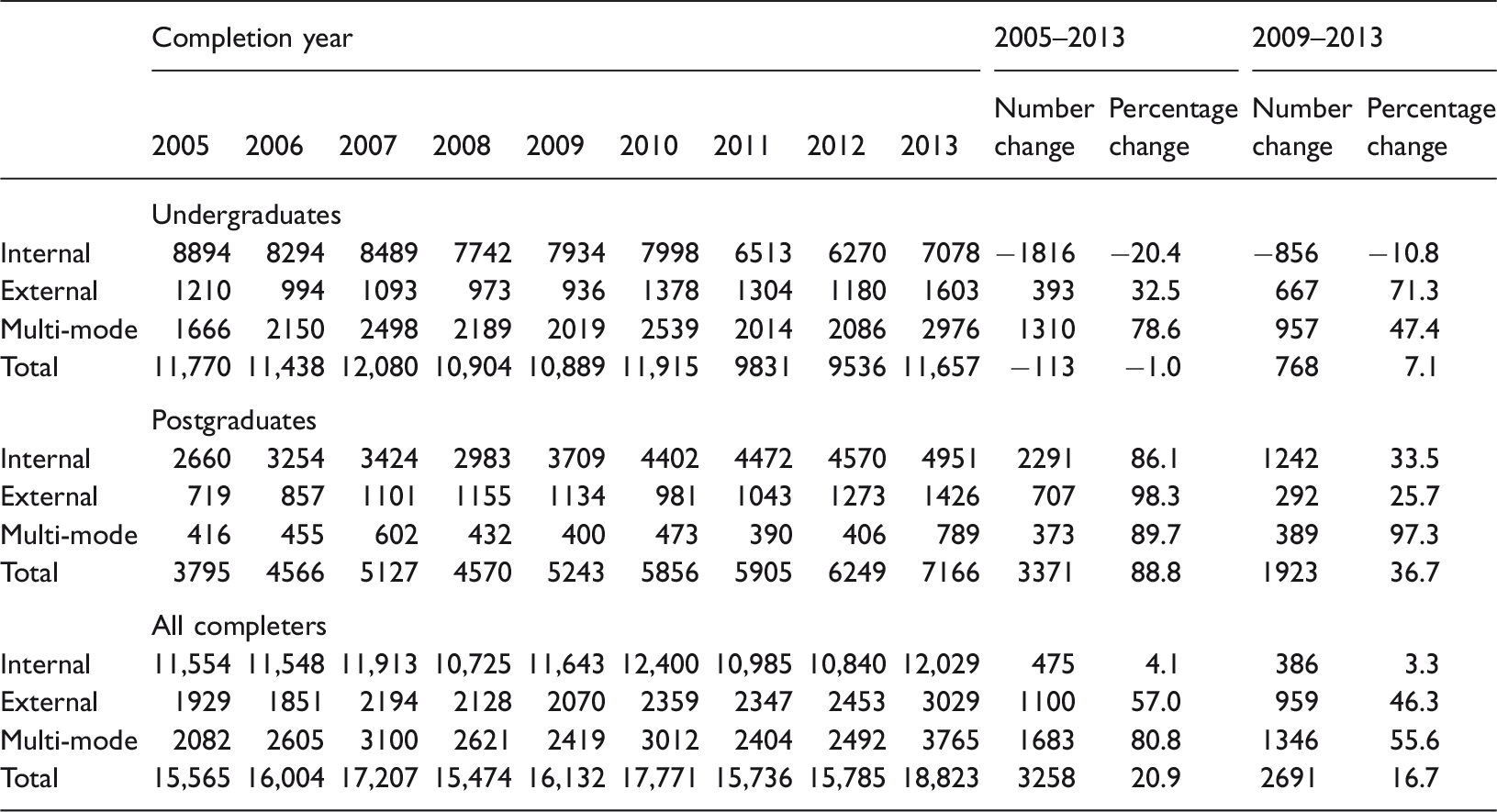
Curriculum delivery methods in the higher education sector are changing rapidly, with a significant movement away from traditional ‘stand and deliver’ style lecturing to a range of other methods considered both more engaging for students and also more accessible in the digital age (Collis & Van der Wende, 2002; Forsey, Low, & Glance, 2013). Utilising digital technologies to take the lecture theatre or tutorial room to the student is a growing focus for universities, and recent enrolment numbers show that Initial Teacher Education (ITE) is one particular area where growth in online provision is occurring, with external attendance almost doubling between 2005 and 2013 (Australian Institute for Teaching and School Leadership [AITSL], 2015).
This article focuses on the trend to online delivery from the perspective of teacher workforce planning. Traditionally in Australia, ITE students are considered part of the ‘supply pipeline’ for the state in which their university is located, as there has been an assumption that students live in the same state as their university and are most likely to seek employment in that state. With online delivery, however, students could potentially be enrolled on the other side of the country (or the world) from the physical location of their institution. This article offers a preliminary exploration of the extent to which this is occurring in Australia. It examines the following questions:
To what extent is the ITE student population in Australia now studying through online delivery, and how has this changed over recent years? and How many ITE students studying through online delivery mode are in a different state to the ‘home' of their university?
These questions are important for teacher supply planning for all state governments in Australia. If notable numbers of ITE students studying in universities in one state actually live in a different state to their university, the current methods for predicting supply by state will not recognise this and may therefore be inaccurate.
This article draws on data from the Australian Government that identifies enrolment numbers and recent change in this area, and provides insight into the extent to which online ITE enrolments are spread across Australia. This exploration of data is intended to help in forming a national understanding of this issue and preparing a foundation for further analyses in the future to ensure that state-based workforce projections for teacher supply take into account this important cohort.
The exploration of data in this article begins by providing an overview of the change in the number of students completing an ITE course in Australia between 2005 and 2013. The data focus on ITE completions by mode of study and qualification level. The analyses then explore the numbers of ‘External’ students (i.e. the online cohort) in more detail – looking at the figures by state and then investigating the extent to which online ITE completers are enrolled in an institution outside of their state of residence.
Background
Knowing where pre-service teachers reside is an important element of planning future workforce supply in Australia. The conventional method used by the two largest state governments in planning and projecting teacher supply has been to rely on survey data from university campuses largely within their state (NSW Department of Education, 2015; Victorian Department of Education and Early Childhood Development, 2012; Weldon, Shah, & Rowley, 2015). Other states do not publish any regular reports so it is not known how supply needs are planned and projected in states other than New South Wales and Victoria. The Australian Government Department of Employment (DOE) undertakes regular labour market research into teachers at the state level, primarily using an employer survey. This research does include additional sources. For example, the research into supply and demand in Tasmania did include reference to increased graduates from the University of Tasmania although the actual numbers are not cited (DOE, 2016).
Survey data collected from state-based universities in Victoria and New South Wales are necessary because the national data on ITE enrolments and completions contained in the Higher Education Statistics Collection (HES) is not able to disaggregate supply by subject area, which is of considerable importance in secondary schooling, as supply and demand in subject areas is far from homogenous (Weldon, McMillan, Rowley, & McKenzie, 2014). In addition, it is not possible to disaggregate the students whose study enables them to teach at either primary or secondary schools. However, as the reach of universities expand beyond their physical location and into the digital realm, there is a need to better understand the potential influence that online study may have in altering the assumptions previously relied on when using state-based data collection.
Teacher workforce planning forms an important aspect of public policy in Australia. Population data and projections from the Australian Bureau of Statistics (ABS) suggest that in the 10 years to 2025, the population of school-age children will rise by 15–25% in many states. In New South Wales, the figures equate to about 380 additional primary-level classes each year for 10 years; in Victoria and Queensland, that number rises to over 440 classes (Weldon, 2015). This is likely to have a direct impact on the requirements for teachers and schools.
However, little analysis to date appears to have confronted the issue for supply projections posed by the expansion of university education into an online presence. The AITSL (2014) observed that in 2012, 22% of pre-service teachers (6698) were studying ‘off-campus’, an increase of four percentage points from 2011 (18%, 5055 students). 1 The link between this fact and the implications for supply have only recently been considered (Board of Studies, Teaching and Educational Standards [BOSTES], 2014; Weldon et al., 2015). From what is available in the public domain, there is little to suggest that state governments are tracking this issue on a regular basis. Yet, upsurge in student population means that clarity around the numbers of teachers graduating from ITE courses by state is needed – and the growing numbers of online students suggest that using only figures from in-state campuses is likely to underestimate the pool of potential supply.
The lack of analysis into this issue is not necessarily due to lack of available data. This article presents some preliminary figures to demonstrate that some of the requisite data do exist at the national level – with a notable gap in the area of subject specialisation. The explanation for the lack of attention in this area to date is likely to be that the online presence of universities and the expanding delivery of courses ‘off campus’ has crept up on policy-makers relatively quickly in recent years. Hence, this article seeks to highlight the possibility for tracking distance ITE students and encourage further thinking about appropriate ways for accounting for this growing cohort when developing workforce supply models.
The time period covered in this article is one that represents a rapid rise in enrolments across all areas of study in Australian universities. A catalyst for this growth was the removal of ‘caps’ on the number of government-subsidised domestic students universities could enrol. The ‘Demand Driven’ funding system was announced in 2009 and implemented from the beginning of the 2012 academic year (Australian Government, 2009). Growth in the system began almost as soon as the announcement was made, with numerous studies detailing the rapid rise and the potential implications of this rise (Edwards, 2011, 2015; Edwards & McMillan, 2015; Kemp & Norton, 2014; Norton, 2013). A Review of the Demand Driven Funding System for the Commonwealth Government in 2014 highlighted that ‘Commonwealth supported undergraduate places in public universities increased by 22 per cent between 2009 and 2013, from 444 000 to 541 000’ (Kemp & Norton, 2014, p. 3). Universities, governments and policy-makers are still catching up with this sudden and rapid growth, a further reason why the issues in this article have not yet been thoroughly explored.
Method
Data
This article draws on data from the Australian Government Department of Education and Training’s (DET) HES. The HES consists of a range of enrolment data provided to the DET by all higher education providers in Australia (DET, 2015). The analysis here uses variables relating to the completion numbers for domestic ITE students by mode of study and state of residence.
The DET extracted relevant data from the HES and provided it in tabulated formats as specified by the authors. In accordance with departmental policies, any data cells with a count of between one and five students were ‘de-identified’ and provided with a ‘<5’ value. To allow for aggregation and other analyses, the ‘<5’ cells were converted by the authors to be values of 3. To examine the viability of applying this value, the amended data were cross-checked against larger aggregate datasets; however, no meaningful differences were identified at the level of detail reported in this article.
The data explored in this article focus on ‘completion’ numbers. That is, the number of students who complete a course (i.e. graduate with the qualification) in a given year. The focus on completions – rather than overall enrolments or course commencements – is to emphasise the specific workforce ‘pipeline’ coming from universities in each of the years explored. Further work exploring commencement or overall enrolment numbers would offer further insight into these issues, but detailing these has not been included in this article in order to focus the analysis and keep the article succinct.
Analyses
The analyses explore university student completion numbers in ITE courses from 2005 to 2013. These were the most recently available data at the time of compiling the article.
The data identify the ‘mode’ of student enrolment in three ways:
Internal mode of attendance (‘Internal’) – student studying on campus. External mode of attendance (‘External’) – student studying off campus including electronic based, online and correspondence. Online is the predominant form of study for this group. Multi-modal mode of attendance (‘Multi-modal’) – student enrolment involves a mixture of ‘internal’ and ‘external’ study.
The analyses in this article use ‘External’ mode completers as a proxy for discussion of the online cohort. Within the ‘Multi-modal’ group, there may be students who fit into the profile of the online cohort. However, due to the non-specific nature of the ‘Multi-modal’ definition, it was decided not to treat this group as part of the online cohort. As a consequence, it is likely that the data discussed here for the online cohort is an underestimate of the actual figures.
In the latter parts of the ‘Findings’ section, some analysis of student completions by home address is undertaken (aggregated at the state level). Calculations are made to estimate the proportion of external student completers who do not reside in the state of the institution they are enrolled in. This involved labelling completers as residing in the ‘same state as institution' or as residing in a ‘different state from institution'. In making this calculation, only students whose home state is known are included in the ‘different state’ grouping. Those students whose home state is ‘unknown’ are included in the overall denominator of this calculation. As a result, the proportions estimated in this section are likely to be under-estimates.
The authors emphasise that the information presented in this article represents only a small and initial exploration of the possibilities of utilising the HES for developing insights into the nature of supply based on the online cohort of ITE students. The limitations of this analysis are that this relatively small exploration may miss underlying nuances in the completion trends that may be apparent in a consideration of institution-level statistics, or further information relating to student characteristics. This analysis also only explores students up to completion of university, not the actual pathways they take beyond completion and issues such as whether these students actually enter the teacher workforce which are critical components of the overall development of workforce supply projections.
Results
The trend towards external enrolments
Completions from Initial Teacher Education degrees from Australian higher education providers, by qualification level and mode of study, 2005–2013, domestic students only.
Source: Australian Government Department of Education and Training (2015), customised data
To contextualise this change in the broader changes in university completions, Figure 1 highlights the percentage change between 2005 and 2013 in ITE completions and all university completions, by level of qualification (undergraduate or postgraduate) and mode of study. It shows that for external completion numbers, ITE courses have grown at about twice the rate of the average change in both the undergraduate and postgraduate levels. In fact, of all the change in external student completions in the higher education sector between 2005 and 2013, ITE courses accounted for about 30% of the total sector growth in undergraduate completions and 10% in postgraduate completions. This highlights the importance of exploring the external student group in ITE in particular – not only is the growth in this group of students substantial within this discipline, it is also notable from a sector-wide perspective.
Change in number of completing students between 2005 and 2013, ITE courses and all higher education qualifications, by level of qualification and mode of study. Source: Australian Government Department of Education and Training (2015), customised data.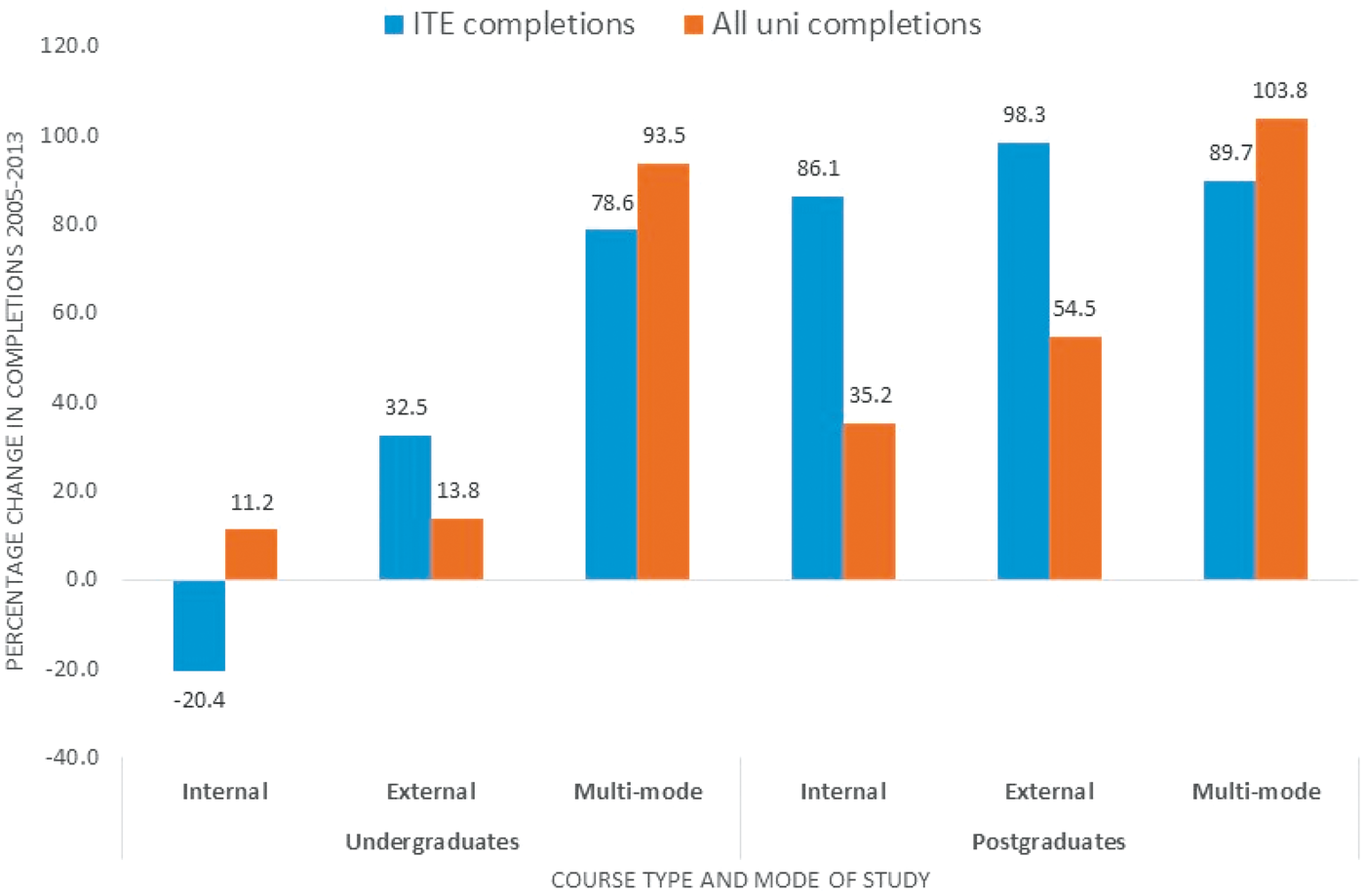
External ITE student completions – State of institution and state of residence
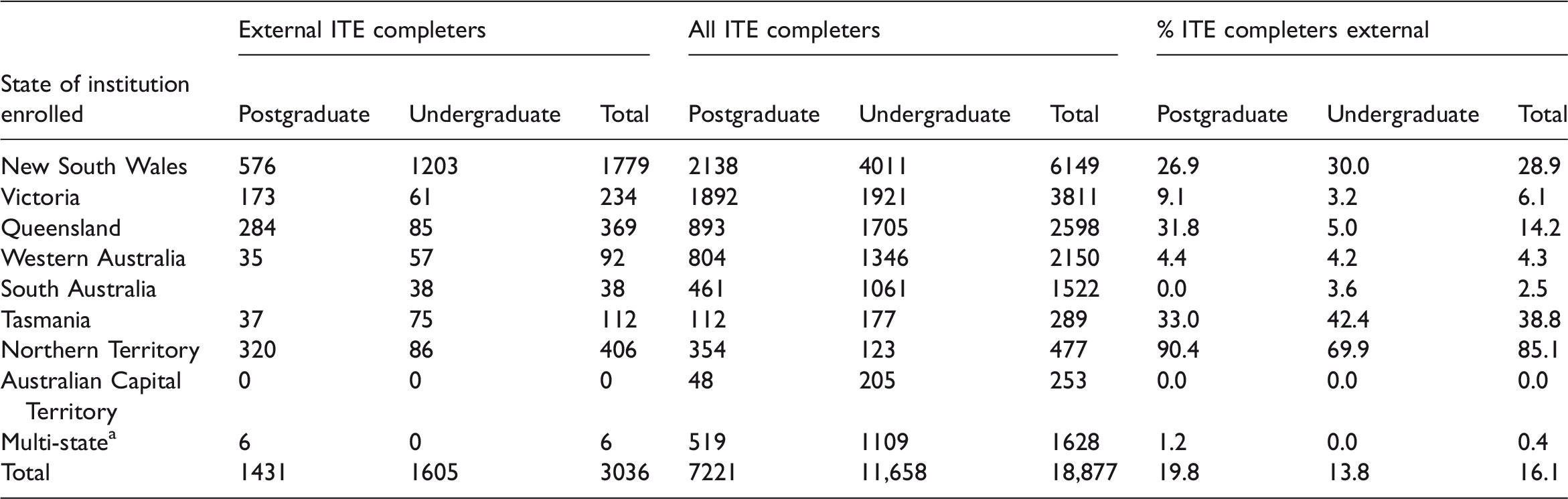
Table 2 focusses on external ITE student completions in 2013 and details the distribution of this group by the state of the institution in which students are enrolled. It shows that the distribution of external ITE completers among all ITE completers by state is varied, with Northern Territory (NT; 85.1%), Tasmania (38.8%) and New South Wales (28.9%) being the three jurisdictions with the largest proportion of external students among their ITE completer population. Figure 2 further highlights these differences by showing the relative share of external ITE completions within states by level of qualification.
Proportion of external ITE completions among all ITE completions from Australian higher education providers, by state of institution and qualification level 2013, domestic students only. Source: Australian Government Department of Education and Training (2015), customised data. Completions from Initial Teacher Education degrees from Australian higher education providers, External and All completions, by qualification level and state of institution, 2013, domestic students only Source: Australian Government Department of Education and Training (2015), customised data. Note: Due to de-identification requirements relating to confidentialisation of data, there are some minor differences between the totals in this table and Table 1. ITE: Initial Teacher Education. Institutions with campuses in multiple states and recorded in national data as not ‘belonging’ to any single state or territory.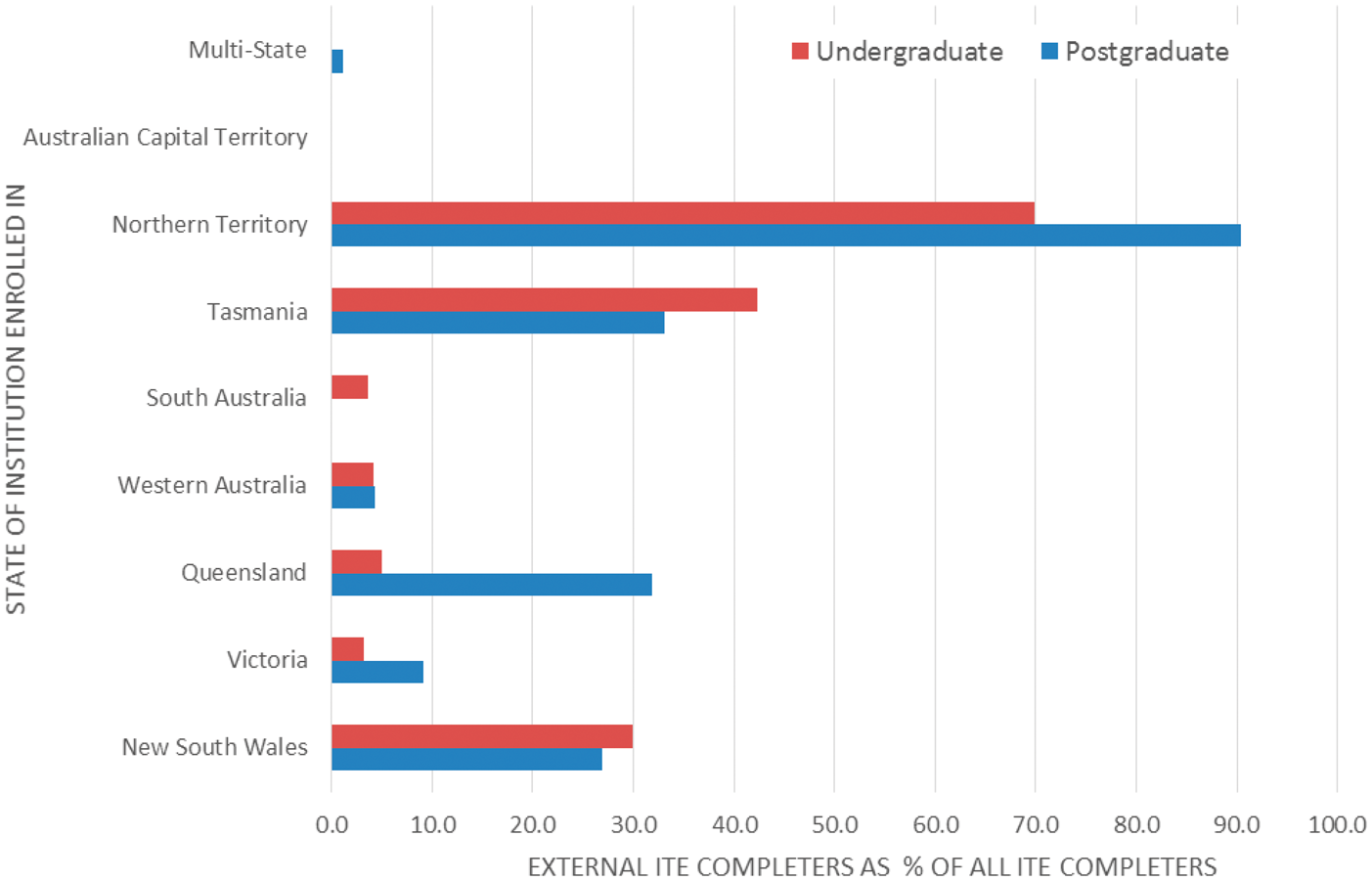
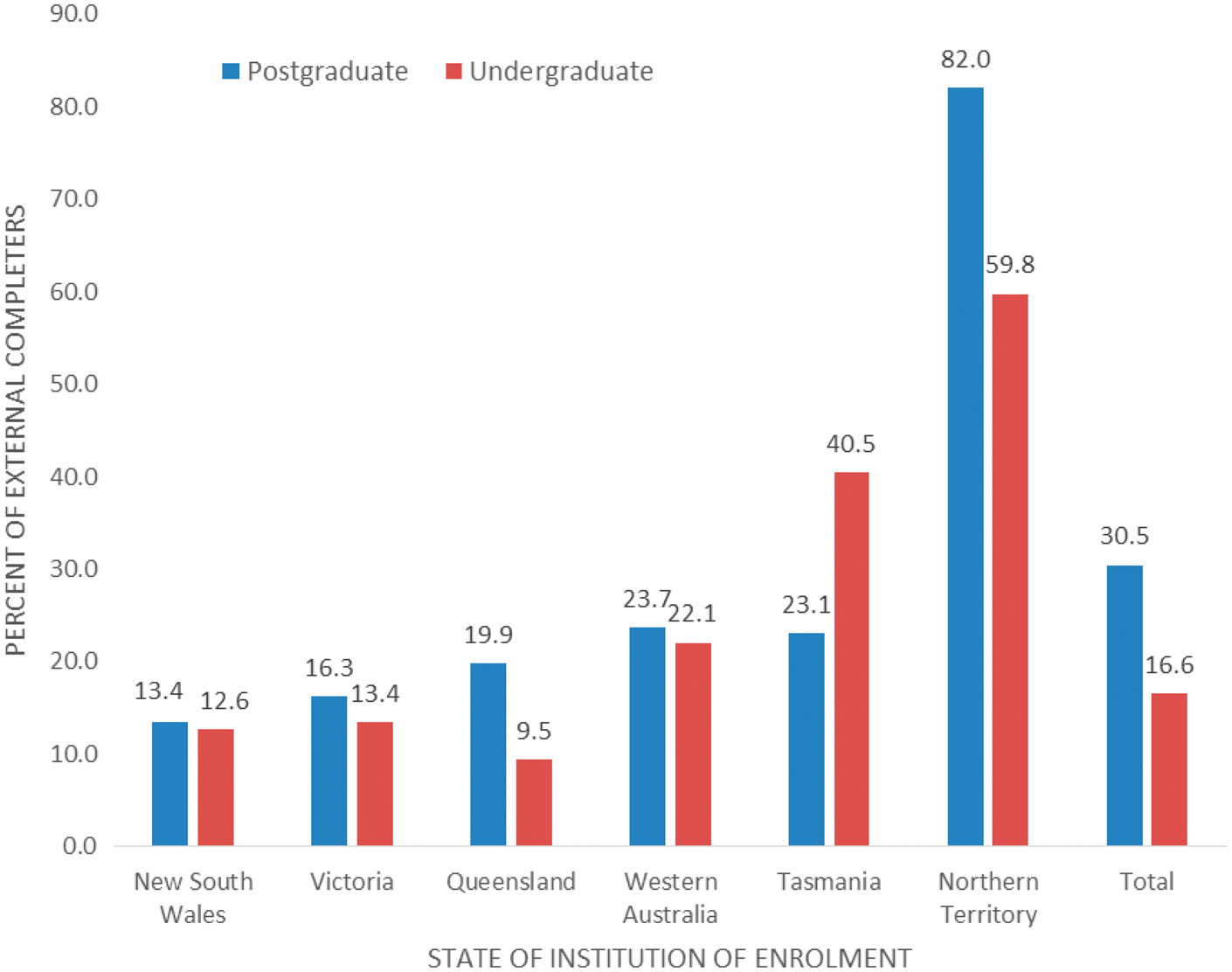
Figures 3 and 4 show the extent to which external ITE completers were residing outside of the state in which their institution was located. That is, the figures provide an indication of the group of completers for whom the traditional ‘supply pipeline’ workforce calculations are no longer applicable in an era of increasing external/online mode enrolment. The data here focus on graduates from ITE courses in 2013 who were enrolled as external students. Figure 3 shows that across this cohort, 22.5% of all external ITE completers had a home address in a different state to the one in which their higher education institution was located. This totals approximately 680 potential new teachers for the 2014 school year.
Proportion of external ITE completers living in same and different state to their institution of enrolment, by location of institution, 2013, domestic students only. Source: Australian Government Department of Education and Training (2015), customised data. Note: South Australia and Australian Capital Territory not included in this figure due to none, or very low numbers of external students, making calculations at this level unreliable for publication. Proportion of External ITE completers living in a different state to their institution of enrolment, by location of institution, and level of qualification, 2013, domestic students only. Source: Australian Government Department of Education and Training (2015), customised data. Note: South Australia and Australian Capital Territory not included in this figure due to none, or very low numbers of external students, making calculations at this level unreliable for publication.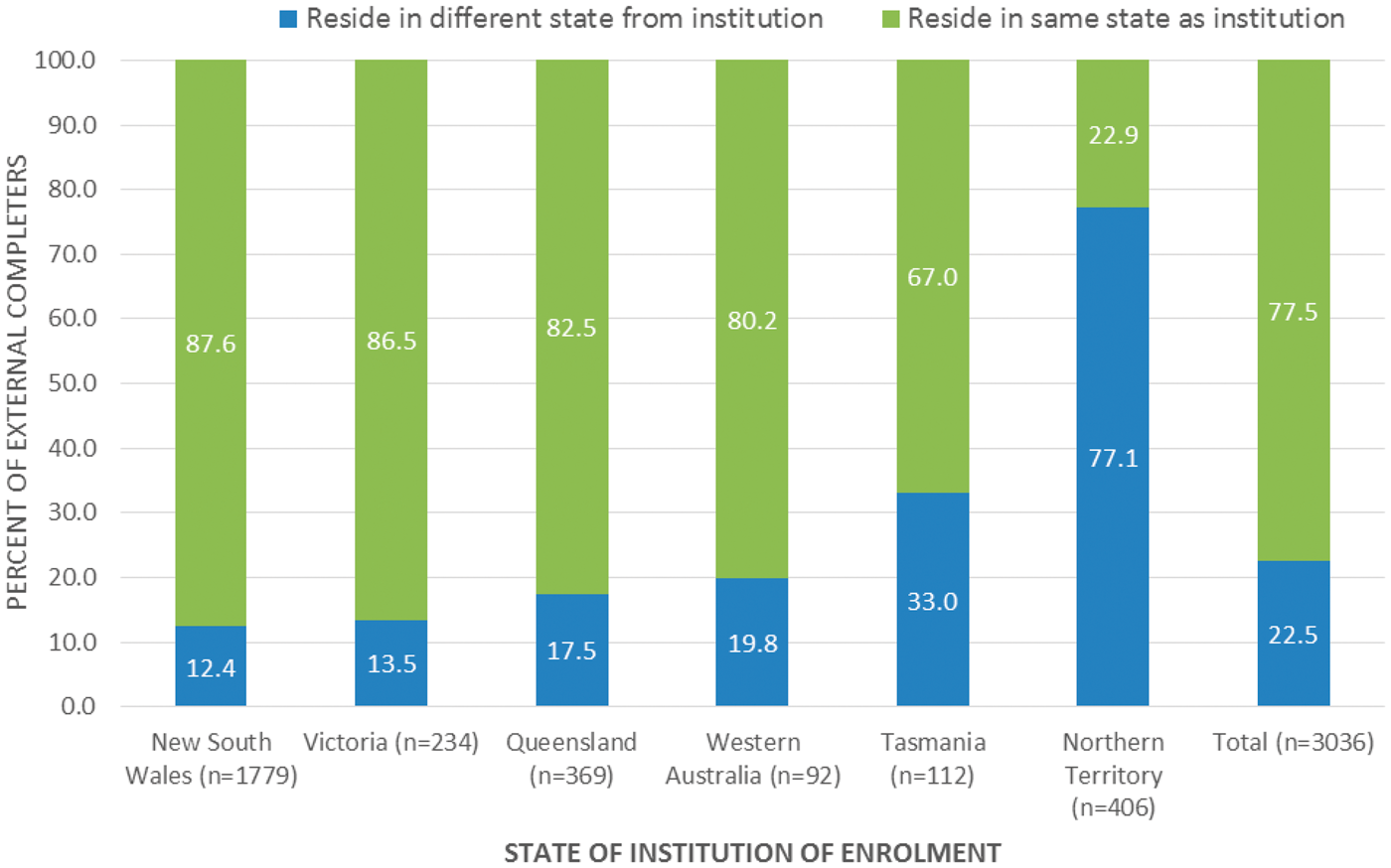
The figure shows substantial variation in the extent of ‘out-of-state’ completions across different states. The NT has a very high proportion of this group. Of all the external students completing an ITE course from a higher education provider in the NT, more than three quarters reside in a different state.
In the NT example, just under one-third of all external completers lived in South Australia, one quarter in Victoria and nearly 10% in New South Wales. Of the other states and territories, one-third of external ITE completers in Tasmanian institutions lived elsewhere, as did one in five of those enrolled in Western Australian institutions, and between 12.4% and 17.5% of those enrolled in New South Wales, Victoria and Queensland institutions.
Figure 4 examines the extent of ‘out-of-state’ external completers by qualification level. It shows that, across Australia, postgraduate completers are more likely than undergraduate completers to be residing in a different state to the institution in which they are enrolled, with 30.5% of external postgraduate completers being ‘out-of-state’ compared with 16.6% of undergraduate completers. This general pattern is similar within states, except for Tasmania in which the undergraduate cohort is more likely to reside outside of this state than the postgraduate cohort. The figures for the NT are again very high, with 82% of postgraduates and 59.8% of undergraduates enrolled in the state actually residing elsewhere. While these figures somewhat diminish the relative size of this issue for other states, the numbers being shown here for New South Wales, Queensland, Victoria and Western Australia should not be underestimated, with all these states recording notable numbers at both qualification levels that warrant further attention.
Discussion
The findings outlined in this article offer a new insight into the way in which supply for the teaching workforce will need to be approached in the future. Online delivery of higher education courses is growing and will continue to have an impact on the way in which supply into the teacher workforce occurs. Being able to monitor this change and to understand its potential impact is important for individual states of Australia – who have ultimate responsibility for the majority of teachers, i.e. those teaching in the government school sector.
Of these external students, a small but significant group is shown to be residing outside of the state in which their institution of enrolment is located. As such, basic supply forecasting that examines enrolment or completion numbers by university and then attributes these numbers to potential ‘supply’ for the teacher workforce in the state where that university is located is missing an important and growing element affecting future supply. This is likely to apply to the early childhood sector, which now requires degree qualifications for teachers, as well as to F-12 schooling.
The data show different levels of impact relating to this issue for different states in Australia, and the overall impact is still relatively modest. However, the trend data point to ongoing growth in the external cohort which suggests that this phenomenon should not be ignored. Extrapolating some of the data presented here into specific examples for some states helps to further highlight the implications of some of these findings. For example, within enrolments in NT higher education providers, among a total cohort of 477 ITE completers in 2013 – both online and on-campus – more than 300 were not actually living in the NT. For Tasmania, of 289 overall ITE completions, 37 were from outside of Tasmania. For a bigger state like New South Wales, there were nearly 6200 ITE completers overall, with at least 200 of them living outside the state. Looking at it another way, some states are benefitting from this growth more than they are losing, for example, external ITE completers who reside in Victoria but were not enrolled in a Victorian higher education provider numbered more than 200 in 2013.
The impact of this issue on different states is variable, but a closer monitoring of these numbers is important for all states and territories when it comes to planning and understanding issues of future supply for the teacher workforce. The figures in this article offer a snapshot of this situation over a short, but growing period of enrolments in higher education in Australia. Data not tabulated in this article also suggest that the prevalence of online enrolment in ITE courses is likely to continue to grow in the future with commencement numbers in this group more than doubling between 2005 and 2013 – far outstripping growth in on-campus or mixed-mode enrolments. Given the trend towards external/online enrolments, it is anticipated that the complexity of matching supply with workforce projections at the state level is likely to increase into the future.
Another factor in these calculations that has not been included here, but is potentially likely to further increase the numbers of ‘out-of-state’ completers each year, is the enrolment via ‘multi-modal’ mode of attendance. As stated earlier, this ‘mode’ generally involves a mixture of online and on-campus study. While currently the definition for being a ‘multi-modal’ student is relatively broad, there is a case for examining this group in a similar way to which the external mode completers have been analysed here. It may be the case that a small but notable group of this cohort is also ‘out-of-state’ and worth further monitoring as this particular mode grows as well.
Further implications arising from this initial analysis for building into future workforce projections also include examining this data by type of ITE qualification (i.e. Early Childhood, Primary and Secondary school levels) and by field of speciality (with focus on hard-to-staff fields like languages and mathematics). This second element is currently not collated at a national level and yet it is a key element in any consideration of the teaching workforce – especially in the secondary years.
Conclusion
This article presents a new analysis of trends in ITE that need to be better understood for future projections of the teacher workforce supply at the state level in Australia. It recognises the ongoing growth in online provision of higher education and the implications of this growth on the supply of teachers. This particular issue is of significant relevance to a profession such as teaching in Australia, where state-based planning, funding and allocation of teachers is central to the education system. This article makes no judgement on the merits (or otherwise) of online delivery of ITE, but simply aims to raise awareness of the fact that this mode of delivery is growing and it is necessary to understand the implications for supply within this context.
Using this analysis as a basic foundation, further exploration of external enrolments and completions in ITE qualifications into the future is likely to offer state governments in Australia a further tool for improving their monitoring and projections of the teacher workforce supply. Among other uses, these data could provide Australian governments with information to engage with universities outside of their state in order to provide a more accurate picture of future workforce supply.
Footnotes
Declaration of conflicting interests
The author(s) declared no potential conflicts of interest with respect to the research, authorship, and/or publication of this article.
Funding
The author(s) received no financial support for the research, authorship, and/or publication of this article.