



Abstract
When considering digital futures for universities it is the instrumentalising narratives developed by corporate ‘ed-tech’ which often drive the debate. These are narratives which, aligning tightly to marketisation, unbundling and other dominant ideological trends, describe a highly technologised, datafied and surveillant future for teaching. This future is often framed as an imperative, leaving university communities with the sense that a future is being designed for them over which they have relatively little control. This paper describes the theory, methods and outcomes of a project which set out to counter this tendency, using participative, co-design methods within a ‘top down’ policy initiative to envision an alternative future for digital education within our own institution.
Our starting point was that universities need to get better at crafting their own, compelling counter-narratives concerning the future of technology in teaching, in order to assert the agency and presence of the academic and student bodies in the face of technological change. In working toward this, we drew on recent thinking in anticipation studies in education and developed an original methodology for participative futures work within universities. The paper reports on the outcomes of this project, and its implications for the sector more generally, arguing that university communities can work to define their own digital futures through an emphasis on collectivity, participation and hope.
Introduction: owning the future
A problematic future for teaching is in the process of becoming normalised in universities, one driven by the anticipatory logics of technocorporations, the ideologies of marketisation determined by government policy, and the Western impulse for ‘trajectorism’ which narrates the future as ‘a cumulative journey from here to there…as natural as a river and as all-encompassing as the sky’ (Appadurai, 2012: 26). This is a future which rarely aligns with the idea of the university as a community of scholarship, or a site of civic and social purpose. Characterised by platform partnerships, pervasive analytics, datafication, scaling of student numbers, routinised surveillant practices, the hollowing-out of campuses and the delegation of teacher responsibilities to algorithms, it is a future imagined according to the values of growth, scale, ‘efficiency’ and progress toward a universal, global ‘knowledge economy’ (Facer and Sandford, 2010). This imagined trajectory for practice is often – in the discursive manoeuvres of corporate future-making – framed as more or less inevitable.
Such ‘future imperatives’ for teaching, as Ahlqvist and Rhisiart (2015) have suggested, push us away from understanding institutional decision-making around education as being based in shared values, toward a mode in which it becomes a ‘compulsive and mechanical reaction to external and abstract stimulus that appears as if it were a force of nature’ (93). Within such a context, it becomes necessary for communities of scholarship to take on the task of articulating confident, alternative imaginaries for the future of teaching in universities which re-introduce the values we want to teach and live by. This paper describes one such attempt which – in line with the focus of this special issue – developed participatory methods for building future-oriented practices and policies at our own university. The Near Future Teaching project ran from 2017 to 2019, taking its driving ethos from pro-privacy, pro-democracy movements which work against the surveillant, data-driven monopolies of ‘big tech’. In this sense the project might be seen as a form of institutional activism, in which access to institutional resources and decision-making was used to re-frame an existing cause, seeing the university as a site of civic and social purpose (Pettinicchio, 2012). This was a kind of ‘slow activism’, a term used by Page et al. (2019: 1317) to ‘get at the varying levels of speed required…when attempting to work at different levels of the sector to enact change’. Our work accepted that recalibrating digital education futures in universities will take time and involve action across many institutional and sectoral levels.
The aim of the project was to find ways to collectively imagine a desirable future for teaching, to identify and express the values that underpin this future, and work toward its confident articulation. Given the focus of the work was specifically in relation to digital education, the project grappled with the recognised difficulty, when considering technologised futures, to imagine scenarios which ‘do not reproduce current ideological trends or cede control and power to external, mostly corporate, stakeholders’ (Markham, 2020: 3). Our starting point was that universities need to get better at crafting their own, compelling counter-narratives concerning the future of technology in teaching, in order to reassert the agency and presence of the academic and student body in the face of technological change. In working toward this, we drew on recent literature which understands education futures in terms of critical anticipation and hope.
Before considering the theoretical framing and design of this project, however, it is perhaps useful to say something more about the futures our work aimed to counter. At the time of writing we are in the middle of the COVID-19 pandemic, one of the effects of which is a rapid intensification of societal dependency on networked services, platforms and media. This in turn is radically accelerating the anticipatory logics of ‘big tech’ power, surveillance and datafication best summed up by Klein (2020) as the ‘screen new deal’ – a ‘no-touch future’ being ‘rushed into being’ in which: for the privileged, almost everything is home delivered, either virtually via streaming and cloud technology, or physically via driverless vehicle or drone, then screen “shared” on a mediated platform. It’s a future that employs far fewer teachers, doctors, and drivers. … It’s a future that claims to be run on “artificial intelligence” but is actually held together by tens of millions of anonymous workers tucked away in warehouses, data centers, content moderation mills, electronic sweatshops, lithium mines, industrial farms, meat-processing plants, and prisons, where they are left unprotected from disease and hyperexploitation. It’s a future in which our every move, our every word, our every relationship is trackable, traceable, and data-mineable by unprecedented collaborations between government and tech giants (Klein, 2020).
When the pandemic kicked off, universities were faced with the need to radically re-shape their teaching methods, shifting these online in a matter of days as on-campus students returned home, university staff locked up their offices and communities locked-down. Longer-term planning for the coming academic year became focused on how to continue to teach – and recruit – without guaranteed access to campus teaching spaces. In this changed world, every faculty member became an online teacher, every student became a distance learner, and the very survival of some universities appeared to become entangled with their ability to manage the digital pivot. The creativity, expertise and commitment of faculty through this was evident and ensured universities’ ability to continue to function. However, this period has also seen an acceleration of our trajectory toward a highly technologised future for universities which is dependent on for-profit ed-tech and driven by the ideological convergence of datafication and marketisation.
Some use-cases of education technology during the pandemic have been controversial and high profile – for example student resistance to the surveillant operations of live exam proctoring which forces students to provide extensive personal information while also subjecting them to the gaze of strangers (Doffman, 2020), or the security and privacy violation lawsuits brought against the videoconferencing company Zoom (Cox, 2020). However, as Williamson (2020) argues, it is the less ‘spectacular’ technologies which have most effectively eased us further down the road toward dependence on for-profit digital education post-COVID. These are the learning management systems (LMS) and online programme management (OPM) partnerships which form the backbone of universities’ teaching infrastructures and, as Williamson (2020) suggests, it is their mundanity which makes them likely to be particularly significant.
Post-pandemic, the LMS market is currently predicted to grow by $12.5bn between 2020 and 2024 (Businesswire, 2020). Blackboard, Canvas, Moodle and their like are already used widely of course, but as Williamson points out we can expect further intensification and integration of the technologies of datafication within LMS over the coming years. These are technologies which, promising AI-enabled enhancement of student experience and engagement, feed off the data-exhaust of students – their log-ins, progression data, assessment results, attendance record, library loans and more. As this technology develops, the role of LMS providers shifts radically away from being a ‘digital backbone’ to becoming ‘active partners in pedagogic processes’: They act as providers of online learning scaffolding, as ‘recommendation engines’ for AI-enhanced ‘personalized learning’, and ‘digital campus’ or ‘dream course’ developers, utilizing their extensive and continuously updated data sets for teaching innovation, institutional outcomes enhancement, and measurable performance improvement (Williamson, 2020).
The growing OPM market is another key post-COVID trend highlighted by Williamson. These are private companies (examples are 2U, Pearson and Coursera) which partner with universities to create online degrees by providing the market research and technical infrastructure, supporting ‘content’ development and sometimes handling recruitment. They commonly bear the upfront costs of development, then take a substantial cut of the income – often around 60% (Carey, 2019) – from student fees. Projections of growth of the OPM market after COVID-19 is for an increase in value of around $13.3bn by 2025 (HolonIQ, 2021). OPMs are a key element of the trajectory of unbundling in higher education, in which core functions of the university are disaggregated and broken down into their component parts (for example the outsourcing of student support and assessment, the breaking down of academic work into para-academic service roles and so on) (Bayne et al., 2020; Swinnerton et al., 2018). As Williamson points out, the futures mapped out for universities by these marketised models are highly problematic. They include the prospect of the deprofessionalisation of academic teachers as development expertise is delegated to private companies, the day-to-day work of teaching is diverted to junior colleagues on precarious contracts, responsibility for academic decision-making in relation to student progress and wellbeing is shifted onto algorithms, and curriculum design moves from its base in the research expertise of academic teams to be force-fitted to platform digital templates. As the marketisation of higher education accelerates through unbundling, universities become fused to the platform models of corporations, and re-shaped by them (Czerniewicz, 2020).
Higher education has long been understood by those in power as an instrument for engineering social or political change, yet it is within the domain of educational technology that we see one of its starkest manifestations as an instrument for generating profit. The examples discussed here show how the current contexts (post- but also pre-COVID-19) for digital education in universities both feed off and ease-in narratives of a future driven by technology and framed by marketisation and unbundling. For Markham (2020), such anticipatory logic ‘flowing through everyday discourse around technologies, builds and reinforces a hegemonic ideology of external power and control’ which in turn work to ‘strengthen the dominant frames of inevitability and powerlessness’ [original italics] (3).
Our argument is that futures characterised by inevitability and powerlessness can be resisted if university communities develop methods for pushing-back on them from a strongly articulated values-base of their own. As Osberg (2017) reminds us, ‘the problem is, and always has been: who are those who creatively imagine the future? And, more importantly, who is excluded from such imagining?’ (10).
Critical anticipation
In developing the methodology and ethos of our own project to address this, Near Future Teaching, we drew on recent work in the field of ‘anticipation studies’, and in particular on research which has applied critical anticipation to education. Anticipation is described in the literature as a perspective on the future which shifts away from prediction and forecasting, to a more critical mode which foregrounds agency, criticality and reflexivity in the face of the unknowable. In their introduction to a special issue on anticipation in education, Amsler and Facer (2017: 1) describe anticipation studies as being ‘less concerned with the future as an object of study than [with] the emergence of new forms of time-consciousness and anticipatory practices which enable people to engage with ideas of the future as a resource to interrogate the…present’.
For Facer (2016), anticipatory practices open up ways to move beyond the dominant tendencies of the ‘future-orientation’ in education, which she sees as working to close education down as a space of possibility. Such tendencies, she argues, ‘treat the future variously as something that can be known, something that should be brought into being, and as something against which we need to defend ourselves’ (64). Her argument here is that there is a need for push-back among educational researchers, practitioners and students, in order that we can begin to craft more open future imaginaries that take account of unknowability and ‘radical possibility’. We need to take an affirmative, open position on the future which embraces its complexity, rather than one that closes the future down through prediction, colonisation or inoculation.
Osberg (2010) proposes that we approach this through a politics of ‘care’ and a logic of ‘emergence’ which ‘is not orientated towards control and closure (choosing what to do) but towards the invention of the new (putting things together differently)’ [our italics], in order that we might think about the future in ways that are non-instrumental and non-teleological (167). The ‘things’ that are put together when considering digital education futures specifically are necessarily a complex assemblage of the human, non-human, technological, organisational and infrastructural – the sociomaterial or socio-technical mix that Ahlqvist and Rhisiart (2015: 98) see as casting ‘the notion of future as a sort of hybrid object that is built on a primal tension between fluidity and fixity’. While – as an institutionally sponsored project to develop vision – there was an element of the ‘choosing what to do’ (Osberg, 2010) through Near Future Teaching, the project was conducted within a sensibility committed to ‘putting things together differently’ and to building a democratic imaginary for the future at our own institution. Its approach to the idea of the future was to see it as emergent, unknowable, sociomaterially complex and highly contested, and within such a context, to address the question posed by Osberg (2017: 12) in her essay ‘Education and the future’: ‘How should a common imaginary for the future be decided?’.
Near Future Teaching
We move on now to describe the context and adopted methods for the Near Future Teaching project, before we conclude with an overview of its conclusions and the preferred future it advocated.
‘Back office’: project context
Working within the broad framework of critical anticipation as described above, the project methods were collated by drawing on futures studies and co-design methodologies, framed by an emphasis on the institutional context within which the work took place. Such ‘institutioning’ is described by Huybrechts et al. (2017) as a way of repoliticising participatory and co-design approaches by recognising institutions as sites of change ‘rather than existing as inert backdrops’ (151). In our case, the institutional context for the work was the University of Edinburgh, one of the United Kingdom’s ‘ancient’, research-intensive universities, established in 1583 and now regularly ranked as one of the world’s top universities. Edinburgh is a large university with over 40,000 students and 15,000 staff, organised into three Colleges: Arts, Humanities and Social Sciences; Medicine and Veterinary Medicine; and Science and Engineering.
The university has a relatively long history of investment and innovation in digital education. Approximately half of its postgraduate taught students study on online, distance programmes of which there are currently more than 70, while close to 3 million learners are enrolled on the university’s free open courses. Acceptance of, and creative engagement with, online education is fairly widespread in comparison with many other research-intensive institutions. The university runs two main learning management systems (Blackboard Learn and Moodle) and has partnerships with three online learning platforms: Coursera, FutureLearn and EdX. It is also part of a ‘city deal’ consortium which in 2017 was awarded £661m by the Scottish and UK governments to ‘accelerate growth’ by developing data-driven innovation in the local region.
Within this context, Bayne took on an institutional leadership role in digital education in 2016, part of the remit of which was to develop a medium-term vision for the future of digital education at the university. Together with Gallagher, who was at the time a researcher in the School of Education, we set about defining the vision-making task as a participatory process capable of addressing the question posed by Osberg (2017: 12): ‘How should a common imaginary for the future be decided?’ [our italics]. Sensitive to Huybrechts et al.’s (2017: 151) claim that in describing participatory and co-design projects ‘academics tend to exclude “back office” institutional engagements from papers so as not to overload them’, we will give a brief overview of this important background to the project before describing the methods and process we developed.
Led by Bayne, with Gallagher as researcher, the project was supported by a highly creative project coordinator (Jennifer Williams) based in the university’s Institute for Academic Development, which provided and managed the project budget. Media production was supplied by the university’s Information Services Group (in the form of film and documentary-maker Lucy Kendra). The project had a formal status, belonging to the Senate Education Committee of the university, which established a task group (led by Bayne) to deliver it. The University Senate is the university’s highest level academic committee. The task group itself comprised 21 staff and students invited into the role either because they had a relevant leadership position, were doing relevant current research in digital education, or were representative of a particular area of the university (detail is available in the project final report; Near Future Teaching, 2019). This task group not only advised and helped shape the project, but also actively participated in design sessions and devised and led project events, connecting the project in multiple ways to their students, colleagues and disciplines in tangible ways. Over the second year of the project we worked with a small design and futures-thinking studio based in Glasgow (AndThen, led by Santini Basra) who worked with us on workshop design and facilitation, project synthesis and graphic design.
From all this, it will be clear that Near Future Teaching came from a position of strong organisational support, was well-resourced as such, and held a formal status within the university as an institutional vision project. It was also led by education researchers and practitioners of digital education (Bayne and Gallagher). While we were clear from the start that the project would find ways to articulate vision for digital education which was participative and not determined by technological change, the formal organisational purpose of the process was tacitly understood to align to the functions of ‘vision’ defined by Smith et al. (2005: 1506): mapping a ‘possibility space’, identifying ‘technical, institutional and behavioural problems’ for resolution, providing a frame and reference point, and creating a narrative for ‘focusing capital and other resources’. Its political impetus to foreground community, diversity and justice as a counter to corporatised models of ed-tech-driven ‘unbundling’ emerged through the process of participation and co-design with the university community.
Project design
In designing the project we drew on the structure and ethos of a piece of work conducted some years previously by Facer and Sandford (2010), which was commissioned by the UK Government to understand ‘possible future trajectories for socio-technical change’ in UK schools (76). This was a much larger project with a different sectoral focus, but in its critical understanding of educational technology, and its application of futures methods to develop vision and policy recommendations for education, it was an invaluable precedent for our own work. Our work took place over two years between 2017 and 2019 in four phases:
Scoping. We worked with staff and students across the university to co-define a set of core values which we wanted to drive digital education, and in parallel mapped projections of the key social, educational and technological trends currently converging on higher education. This phase spread across 18 months of the project. Scenario development. We developed a set of plausible future worlds upon which we tested the core values to develop a first iteration of vision and a preferable future defined by the institution itself. The scenario phase took approximately six months. Testing. We took the first iteration of the vision out to university students and staff, and to schools, to test and refine it. Finalising. The vision and associated objectives and actions were finalised and approved via formal university channels. The testing and finalising phases were completed in the final six months of the project.
An overview of the methods and process adopted during each of these phases shows how the participative, anticipatory design of the project took it from its initiation as a formal, institutionally sponsored, planning-oriented piece of vision work, into something more aligned to institutional activism which worked to re-claim community-defined futures.
Phase 1: scoping
The scoping phase of the project had two aims. First, to systematically connect with staff and students across the university, with the ultimate aim of surfacing the values that individuals saw as needing to underpin a desirable future for digital education. Second, to undertake a mapping of the key social, educational and technological trends converging on higher education in general and on our university in particular.
The first of these was particularly challenging, given the size of the university, the diversity of its community and the complexity of the issue we were interrogating. The approach we adopted was pragmatic, flexible and to an extent opportunistic: between January 2017 and April 2018 we organised 14 events designed to draw the university together around different forms of discussion related to the future of digital education. The events were deliberately diverse, with the intention being to attract as broad a range of individuals as possible, and to attach the project to initiatives, gatherings and groupings that were already in place. For example, we ran brainstorming workshops with first year undergraduates in their halls of residence, an interdisciplinary co-design event facilitated by the university’s Design Informatics group, virtual reality and digital manufacture events in our library maker-space, a discussion event with the student union Black and Minority Ethnic (BME) liberation group, discussion workshops on learning analytics, blockchain and internet of things, a ‘futures fiction’ creative writing session and more. We also connected with the library to run a ‘Near Future Library’ competition for students. The majority of these events were organised and coordinated by members of the project task group, notes were taken of the discussions by the core project team, and fieldnotes published in blog posts (all of these are available from the project website). 1 These events were attended by a total of 250 staff and students.
In parallel, we recorded a series of ‘vox pop’ interviews. We did these by attending university internal events and conferences on teaching-related themes and requesting 5 minute on-the-spot interviews from participants, by organising scheduled interview sessions to which people could sign up, and by taking a pitch outside university libraries and persuading students to be interviewed again on-the-spot. In this way we recorded 50 interviews with students and staff focused on their experiences, aspirations and value preferences for digital education. Interviews were thematically edited through several iterations and a series of 3-minute themed edits were made permanently available on the project website. 2 These were clustered according to commonly shared preoccupations such as ‘ways of learning’, ‘community’, ‘humans’, ‘distance’, ‘values’, ‘automation’ and ‘data’.
In March 2018, during a period of industrial action across UK higher education protesting pension cuts, working conditions and contract precarity, a group of students and some staff occupied a building on the central campus of the university, using this as a space of collective action to reassert the centrality of the student and staff community to the university, and their vision of education as ‘free, democratic and open to all’. The work of the occupation included a declaration of vision (Our declaration, 2018) and a collaborative document detailing the occupants’ demands for change (Changing the university, 2018). These constituted a collective articulation of a preferred future and following contact with the group these outputs were included in the data used during the scoping phase of Near Future Teaching.
In early 2018, the project core team was joined by AndThen, the design studio team who worked with us to synthesise and develop the project into its next phase. Together with AndThen, we took the various data forms collected during the community scoping phase (notes and records of events, outputs from the occupation and the vox pop interviews) and clustered them into themes using an affinity mapping approach. This is a method common in design-thinking (Scupin, 1997) in which large numbers of observations drawn from complex data sources are clustered in terms of shared intent, articulated problem or affinity (Martin and Hanington, 2012). These are then used to develop research-based themes – in our case the themes drawn from the affinity mapping were turned into a set of opinion cards which captured the first iteration of the Near Future Teaching values (some examples of these are shown in Figure 1). Each opinion card represented a particular research theme emerging from the affinity mapping process, with representative passages drawn from the data supporting that opinion.
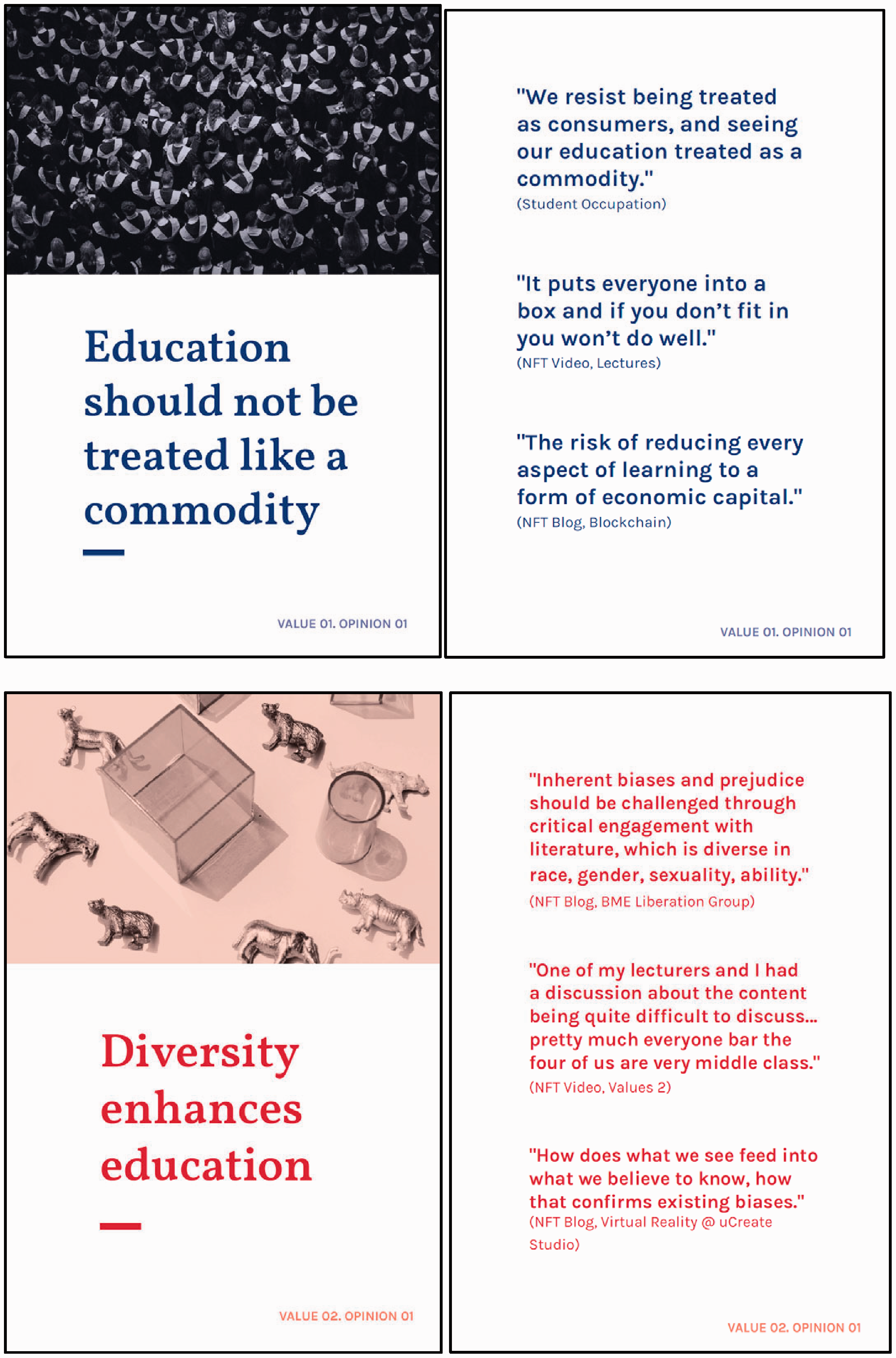
Four examples of the opinion cards generated through affinity mapping. All 20 cards are available on the project website 7 .
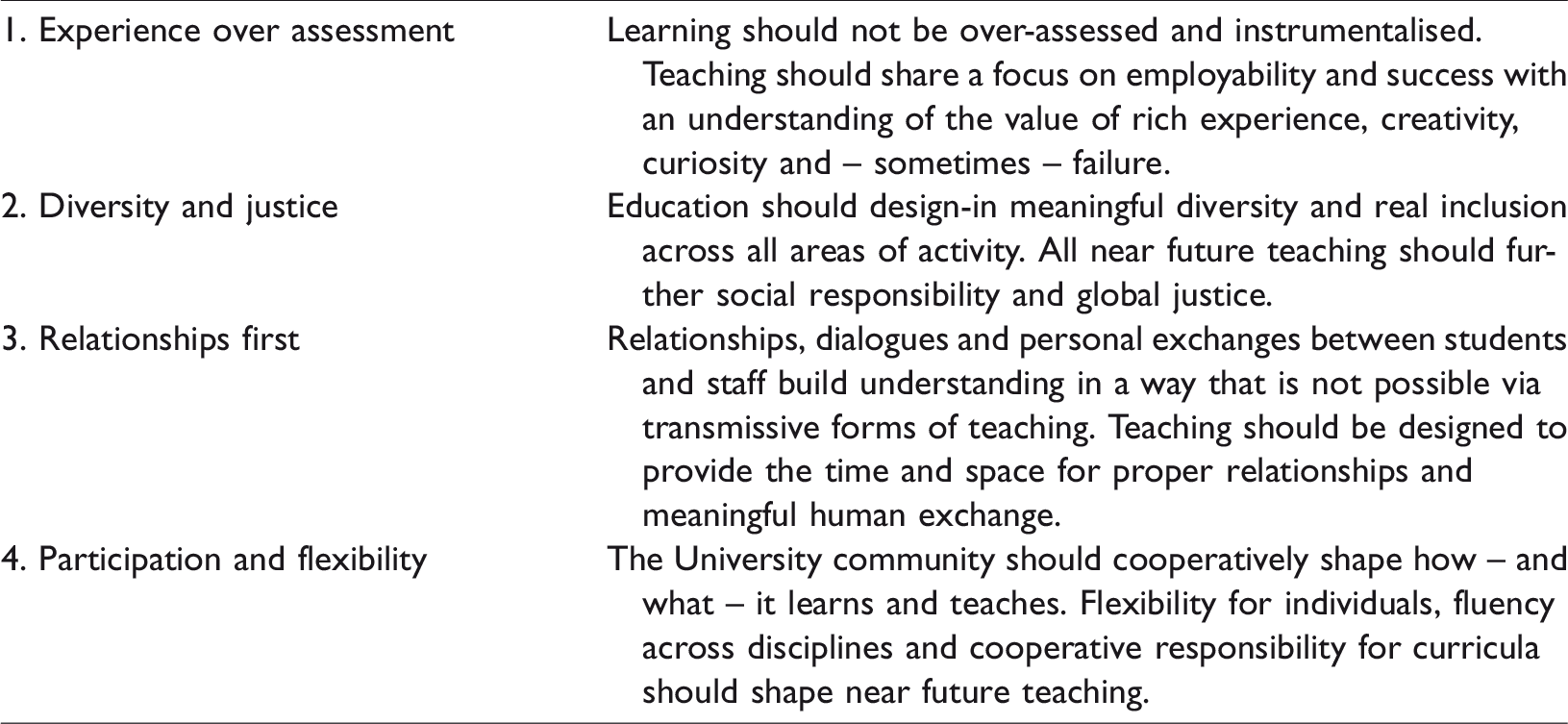
These opinion cards were used in the second phase workshops in which we worked intensively with the project task group to further refine and apply the core values. By the end of the project, these values had been synthesised as shown in Table 1.
The four underpinning values.
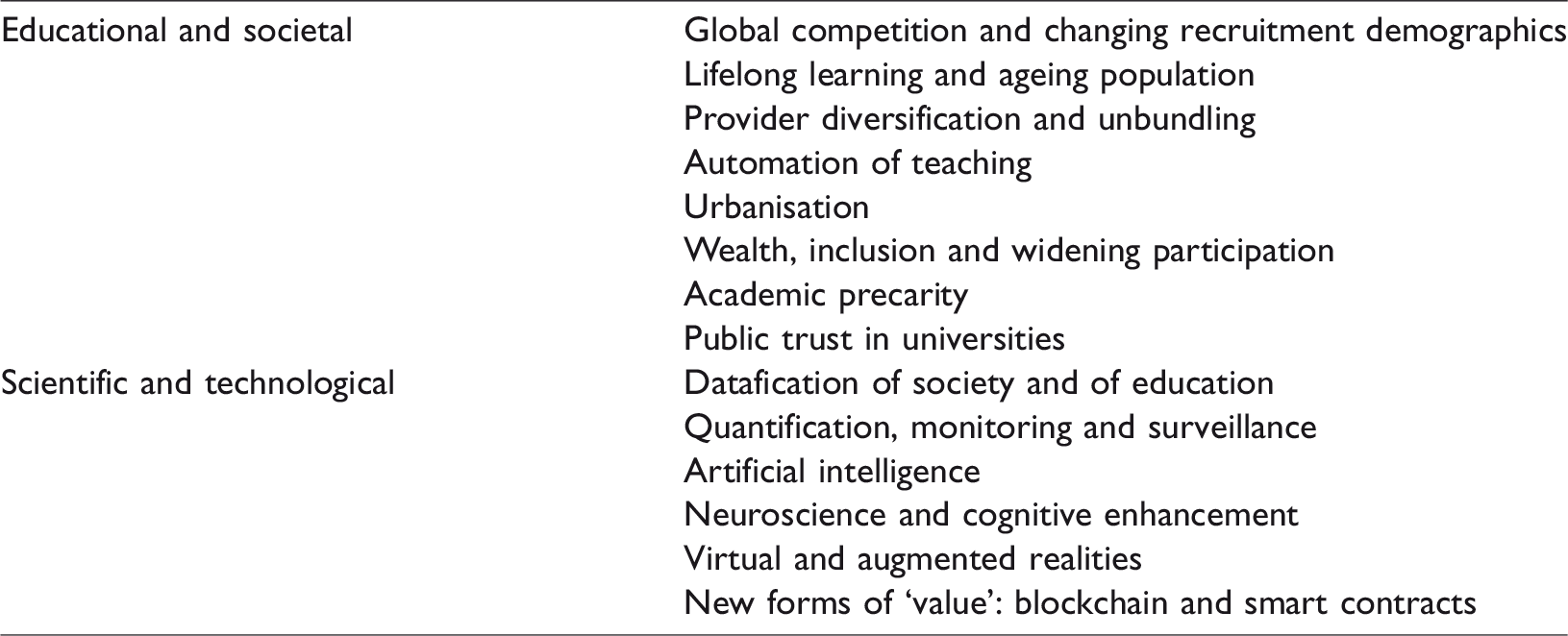
In parallel with this work to distil community values, we undertook a piece of desk-based research to synthesise the key social and technological factors which at that time (2018) looked most likely to impact the future of higher education teaching in our university. We published online two brief critical reviews (Gallagher and Bayne, 2018a, 2018b), mapping the trends applicable to the near future of teaching at our own university – the first focused on the educational and societal, the second on the scientific and technological. These are briefly summarised in Table 2.
Summary of the trend-mapping (the reports are available on the project website)
As the scoping stage of the project began to generate insights, these were checked and tested with our project task group. We also gave presentations on progress at our Senate Education Committee – the formal institutional ‘sponsor’ for Near Future Teaching, and the locus for cross-university senior colleague support, guidance and approval. The project, like every organisational vision programme, ran via a complex choreography of community engagement, formal governance, research expertise, design, institutional politics and advocacy – for Near Future Teaching the community element was strongly emphasised and prioritised.
Phase 2: Scenario development
The co-defined underpinning values and the trend mapping functioned as the structural pillars for the remainder of the project. In its second phase, however, the locus of activity shifted from the broad university community to the project task group. Incorporating 21 students, faculty and professional services colleagues at various levels of seniority from across the university, the task group took on the creative work of imagining, building and refining the prototype for our preferred future. This took place via two very intensive half-day workshops in which we worked on the data from the scoping phase to refine our values, and then built speculative future world scenarios through which we tested how the values might be applied.
Scenario-based approaches are a long-standing and commonly used method in futures projects (Varum and Melo (2010) provide a useful review), the aim of these being not to predict the future but to explore different forms it might feasibly take in order to provide speculative but realistic contexts for developing vision and strategy. In our case, we developed scenarios to provide context in which we could extend our values and the collective knowledge of our expert task group into a final set of aims, objectives and actions for the near future of teaching. Fieldnotes on the design and process of the two workshops through which we developed our four scenarios are documented on our project website, along with further detail and illustrations for each. 3 In Table 3 we offer a summary of the scenarios in their final form. These are presented as four future ‘worlds’, in each of which the university itself is differently articulated. The time horizon for each of these is deliberately unstated - they are intended to provide a provocative yet broadly feasible context through which the task group could understand how our underpinning values might be applied or challenged in different contexts.
Summary of the four scenarios.

In our workshops, the project task group defined a set of aligned teaching practices and sensibilities for each of these worlds – some preferable, others very much not – which we were then able to sift and refine as we outlined our final set of aims and objectives for the near future of teaching at our own university. Some examples of these aligned practices are shown in Figure 2 (the whole set is available on the project website). 4
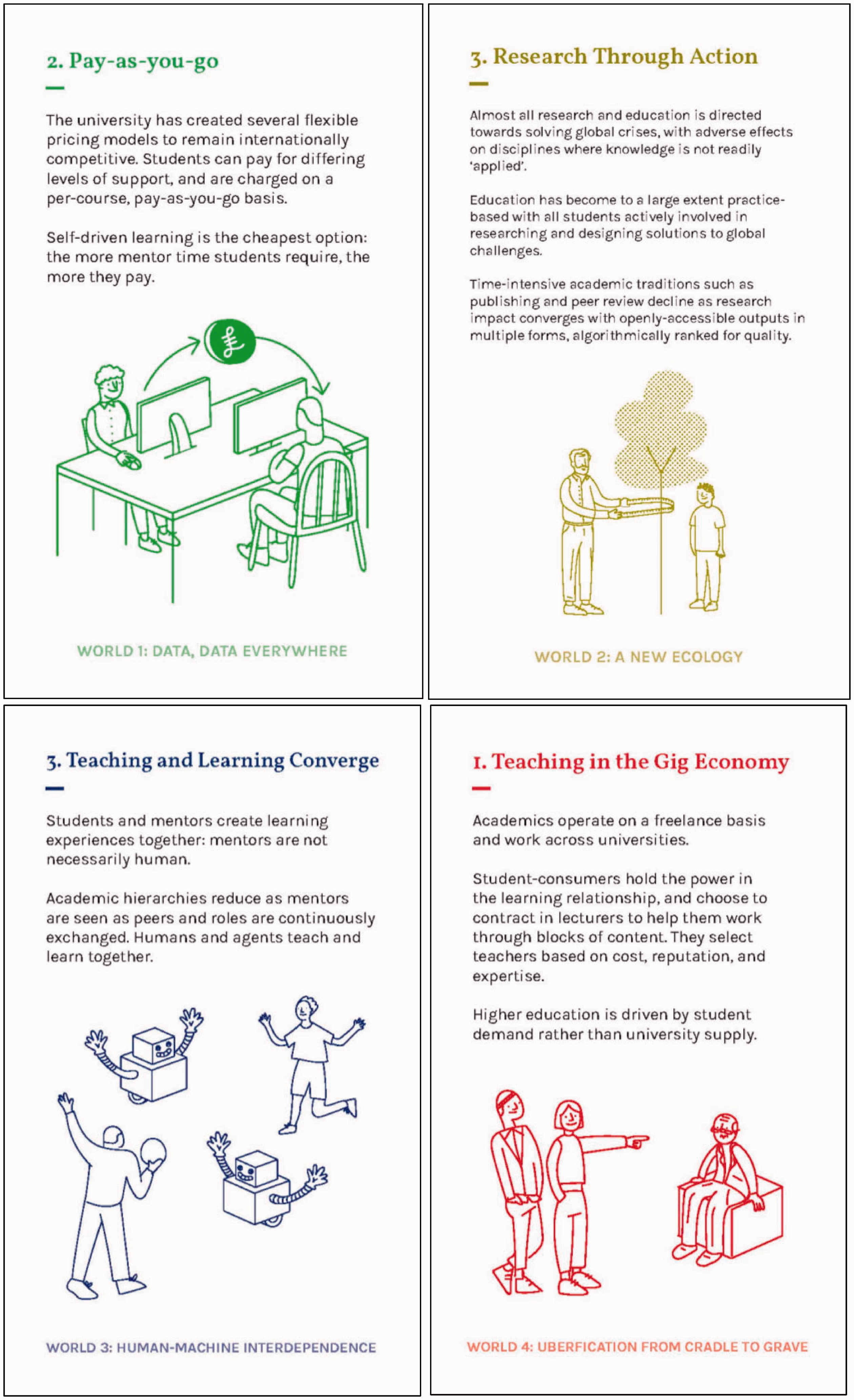
Four examples of speculative future teaching practices, one from each world.
Phases 3 and 4: testing and finalising
By the end of this second phase of the project, the core project team were able to work with the outputs of the two workshops to produce a draft vision and strategy, which we then took back to the university community for testing. This took the form of a series of short online and on-campus workshops with 40 students and 15 staff. In these sessions, the vision draft was interrogated and enriched using a participatory design approach which focuses discussion through use of ‘provotypes’ (see Boer et al., 2013) – ‘provocative prototypes’ which offer participants a quick way into topics that are generally speculative and intangible. 5 These were followed up by sessions in two schools (one primary and one secondary), during which 57 school students worked on our project outputs to refine them: we were keen to include perspectives not only from our own students, but from those who might join the university in the future. 6
The final output of this work was a co-designed vision for a future university in which teaching is clustered around six aims and clusters of objectives, summarised in Table 4.
Summary of the final aims and objectives.
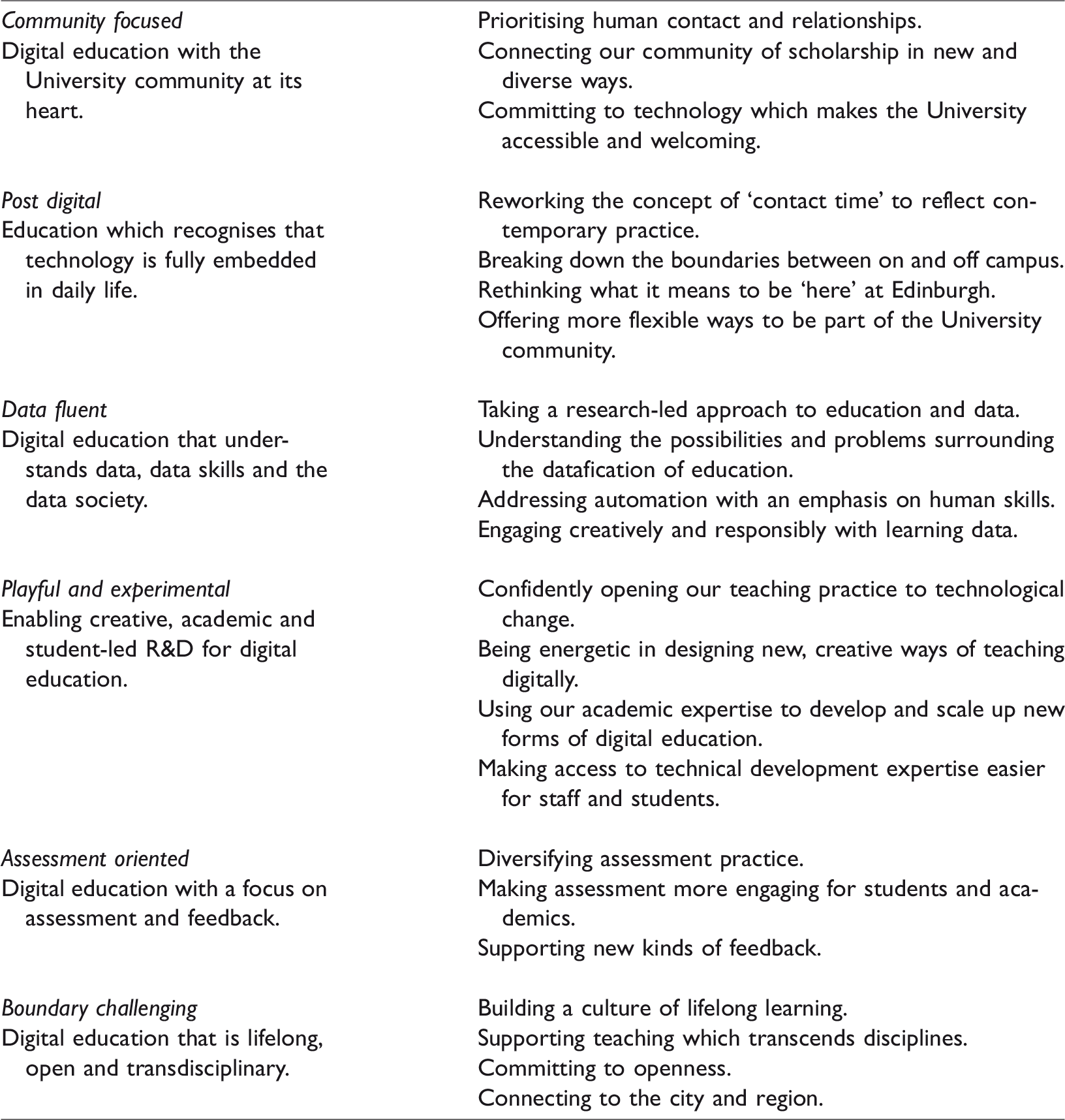
Expressed as a set of collectively agreed aims and objectives, the vision loses some of the messy richness of the project-in-process, but it does become actionable – a final part of the project was assigning short- to medium-term actions to each set of aims and objectives. These were then written up into the final project report, approved by the relevant university committees and published (Near Future Teaching, 2019).
The report was disseminated throughout the university, largely through the conduits of undergraduate and postgraduate teaching committees within a range of schools, as well as through a series of events and workshops both internally at the University of Edinburgh and externally at other universities and institutions. The various schools and discipline areas of the university were tasked with reflecting on these aims, objectives and outcomes and translating them into practice as they saw fit. Some of these outcomes are being actioned in subsequent research and teaching projects, and many of the core values have been used to structure institutional responses to accelerated moves online in the wake of COVID-19. We see this again as slow activism, with movements of varying levels of speed and at varying levels of the institution (Page et al., 2019) around adaptation and change.
Conclusion
When viewed alongside the four values which underpinned Near Future Teaching (Experience over Assessment; Diversity and Justice; Relationships First; Participation and Flexibility), what emerges from this work is a vision of a preferred future which is very different from the dominant imaginaries of the high-tech ‘universities of the future’ critiqued at the start of this paper. It offers a challenge to some of the techno-imperatives driving the deprofessionalised, unbundled, globalised and datafied higher education futures which are framed by governments and corporations as being in the interests of ‘scalability’, quality-enhancement and student ‘engagement’.
The future proposed by the Near Future Teaching project is co-defined by the university community itself. It is a future which places community and the relationships that define it at the heart of the way we teach, that emphasises openness to difference, the generative potentials of diversity, flexible and expansive student journeys, curriculum co-development, transdisciplinarity, playfulness, inclusivity and justice. We do not suggest here that we have ‘solved’ the problem of how we define and build a creative, participative and just future for teaching in universities, or even in our own university. However, we do believe we have made a good step toward understanding how collectively defined, preferable futures might be built and described with confidence by university communities. By defining and articulating a future we find desirable, we begin to build it.
Near Future Teaching put into action the idea of the university as a site of possibility, and of using the idea of the future ‘as a resource to interrogate the…present’ (Amsler and Facer, 2017). As a work influenced by the idea of anticipation, it choreographed past, present and future in the interests of a positive political mode for education: Politics entails more than simply the endless redistribution of power within an economy of the same, which is an economy of the past. Politics is also about envisioning better ways of doing things than are currently in the world. That is, it also attempts to take up an affirmative orientation to the future (Osberg, 2010: 165).
The Near Future Teaching project was political in its attempt to envision ‘better ways of doing things’, and in its attempt to see digital higher education futures as community-based, open and articulated through a set of shared values.
Footnotes
Acknowledgements
We would like to acknowledge the work of colleagues without whom this work would not have been possible: Jennifer Williams, Santini Basra and his colleagues at AndThen, Lucy Kendra and the many students and staff who contributed across the various project stages. Particular thanks to our task group colleagues Bobi Archer, Pushpi Bagchi, Luke Campbell, Sarah Cunningham-Burley, Tim Fawns, Judy Hardy, Sarah Henderson, Melissa Highton, Anouk Lang, Vanessa Ombura, Susan Rhind, Charlotte Rixten, Jen Ross, Michael Rovatsos, Michael Seery, Chris Speed, Jon Turner and Sanjna Yechareddy.

Declaration of conflicting interests
The author(s) declared no potential conflicts of interest with respect to the research, authorship, and/or publication of this article.
Funding
The author(s) received no financial support for the research, authorship, and/or publication of this article.