




Abstract
This article reports of an ethnographic study conducted in two academic research centers. The article is centrally directed at the role of digital technologies and devices in contemporary academic work, and more particularly at the role of the screen in the daily composition of this work. Three central questions are raised. First, which positional relations do academics need to uphold with the screen in order for the screen to be able to operate? Second, in which forms do these digital devices come into being? Third, which sorts of (in)compatibility between activities are established because of the mutual interplay between academics and screens? By adopting a relational, sociomaterial approach, the study gives an account of the established choreographies that are enacted likewise, provides an overview of the role and operations of the screen in contemporary academic work, and analyzes which sorts of time and space are generated likewise.
We are finding ourselves in a spacious reception area. We came here by taking the elevator to one of the upper floors of a huge building that houses a Social Sciences faculty. The elevator gives direct access to this area, adjacent to a room where the secretariat can be found. The secretary is talking with a colleague, telling how little professors realize that some requests are simply not that easy to fulfill. Except for this conversation, barely understandable because of the door that is almost shut, the area is noiseless. It contains some sofas and a couple of chairs positioned around a table. We quickly realize that we have not entered a commercial building: except for the markers that got us here, the area itself is hardly branded and totally abandoned. There is no welcoming receptionist to be found. There are, however, many paraphernalia that suggest we have entered a very particular, highly specific, place. For one, at least 15 posters are hanging on two walls, informing passers-by of ongoing lecture series the coming months, of different master programs that could be followed, of different sorts of activities – upcoming and already passed. The most discerning feature of this room, however, is situated at a wall that is devoid of any posters. Instead, two large book display cases are presenting different books written by the people who are housed in the corridor adjacent to this area. A glass panel prevents us from leafing through the books, so that we are only able to see covers, titles, and authors. At the other side of the hall, we find a large and colorful painting that has something to do with the work that is being done here. The size of both the painting and the cases causes visitors to be drawn to them, and makes these visitors inclined to give these presenting materials at least a superficial look, thereby conveying some impression of the work that is conducted by the people working in the offices that are found in the long corridor adjacent to this area. In this corridor, most doors are closed, and this is independent of whether someone is present or absent in the office. The only thing suggesting presence, apart from the occasional door ajar, is the artificial light that is sometimes lit, seeping through the frosted glass.
The corridor we are strolling through is the professional home of two research centers. These research centers are closely linked to each other in terms of the kind of research they are conducting (situated in the same discipline, but generally focusing on different topics), although they operate rather independently in that respect. In terms of education, the two centers are more interlaced: they are jointly providing an MSc program. Even though it probably never happens that all personnel are physically present at the same moment, each academic has her or his own personal desk. The professors in this corridor have their own office, whereas PhD students and teaching assistants are generally sharing a room with one or more colleagues. As a general impression, there are about 10 professors working in these research units and about 40 other members of the academic staff, comprising postdoctoral researchers, teaching assistants and PhD students.
The choreography of academic work
We came all the way here, to this upper floor of the faculty building, with a very general ethnographic research interest in mind: What is the role of the digital in what happens here, in this place, on a day-to-day basis? This interest is based on studies about (the nature of) daily academic work, where the digital often appears to be very decisive (e.g. Blin and Munro, 2008; Jerejian et al., 2013; Weller, 2011), but at the same time on the observation that the concrete specificities and working mechanisms of the digital are most of the time underexposed in such studies. 1 In this study, we will not approach the digital in terms of its impact and concomitant opportunities or drawbacks, but rather scrutinize this so-called ‘digital’ in terms of the specific operations and working mechanisms of specific devices (e.g. Decuypere et al., 2014; Ruppert et al., 2013; Sørensen, 2009). To that effect, in what follows, we are not going to talk about the digital as a general and neutral medium, but rather about the specificities and the concrete operations of the screen, as the prototypical device that is associated with the digital. This focus on the screen emphasizes that we do not seek to give any explanatory account of ‘the digital’. Instead, we approach the screen as an active device that performs particular operations (instead of neutrally transmitting/displaying some contents) that can be empirically investigated. Such an approach enables us to scrutinize not only how screens are used and deployed in academic practice, but equally how these devices themselves act and operate. Furthermore, this gives insight into which precise effects these devices, and the interplay of these devices with the academics present in a particular setting, generate. 2 In this sense, our approach will enable us to exhibit how screens are being made use of, but equally, and more significantly, the extent to which academics and academic activities are governed by and through such digital devices (Williamson, 2015).
With these two research centers as the setting this paper reports of the ethnographic study was conducted in close relation with the methodology adopted in other ethnographic accounts of academic life, the most renowned of which are probably Latour’s Laboratory Life and Science in Action (Latour, 1987; Latour and Woolgar, 1986). These studies were, however, more exclusively directed at the natural sciences and generally focused on how research in general and scientific facts in particular are constructed on a daily basis, thereby giving no explicit consideration to other scientific disciplines (the social sciences and the humanities) and to a large amount of what is equally being done at research centers nowadays (e.g. teaching, meetings with other faculty, etc.). If these other aspects of what academic work consists of are given attention in the literature, they generally focus on the meanings attributed to these aspects by the people involved in these activities (mostly academics or students) or on broad developments into which these activities can be framed (e.g. neoliberal doctrines imposing managerial thinking) (e.g. Lea and Stierer, 2009; Reynolds, 2010; Tuchman, 2009). This study, conversely, aims to scrutinize the often underemphasized aspects of daily academic work ethnographically into account as well, without adopting either a personal or a broad contextual point of view (Packer, 2011). To that effect, and similar to Latour’s studies, the article adopts a flat, sociomaterial, approach that does not privilege one particular activity (e.g. research) or actor (e.g. human) above the other (for overviews: Latour, 2005; Fenwick and Edwards, 2010). That is to say, before the actual conduct of the ethnography, we made no distinction between what is conventionally deemed to be an ‘academic activity’ and what is not. Rather, the locus of analysis was pragmatically chosen: the corridor shared by the two research centers. This corridor was the nexus of our observations, being both the point of departure and the point to which we returned constantly.
Based on a mutual consent between the first author of this article and the two heads of the research centers, we participated in different activities as they were taking place in the research centers for a period of three weeks (cf. Murphy and Dingwall, 2007). A further agreement was that only these activities would be followed that consisted of more than one person. Personal activities, conducted solitarily in one’s office (such as writing a paper, answering emails, or making a telephone call), were not observed. In concrete terms of methodology, we observed different activities by means of three different notebooks: one acting as a logbook of the observed events; one consisting of the observations (written down at the moment of happening and reworked/-structured at the end of the day), and one consisting of trials that sought to give preliminary accounts of what was observed. Furthermore, and equally in a sociomaterial vein, in the analysis that follows we make use of quasi-concepts: concepts because they seek to come to grips with what happens in a particular situation (and to provide an adequate account hereof), quasi-concepts because the concepts introduced do not aim to offer a generalizing explanation. Instead of imposing some kind of metalanguage on the settings observed, in what follows we present different academic practices by describing them with an infralanguage that aims to give an adequate account of the settings investigated, without having to resort to an explanatory or clarifying stance (Decuypere and Simons, 2014a; Latour, 2005, 2010).
In view of our general focus on operations and working mechanisms, in this article we present an account of the operations of the screen in daily academic work by describing different academic settings in terms of their choreography. The term has a long history, and is often invoked in order to comprehend social life in terms of movements and changes, instead of in terms of prefixed structures (Aronsson, 1998). Furthermore, the term is often deployed to analyze the social positionings of different actors, for instance the roles they perform in social life or how they act differently in public (‘on stage’) as compared to more private (‘backstage’) settings (Goffman, 1959). In this article, we equally adopt the term to refer to movements, changes and positionings, but do not exclusively focus on social interactions. Rather, we focus instead on how academic practice comes into being by the relational interplay between people and devices, and in doing so stress how choreographies present the way in which a particular academic practice comes relationally into being (Cussins, 1996; Gordon and Bogen, 2009). Actors (e.g. the screen, students, academics) are thereby not considered as atomic agents, but rather as being codefined by the relations they uphold with other actors (Decuypere and Simons, 2014b; Latour, 2013). In what follows, we will describe these settings by focusing on three choreographic dimensions. First, the scenery of academic settings: which relations do other actors have to uphold with the screen in order for both to be able to operate (a question pertaining to the positions of these actors)? Second, the roles adopted by the screen: how does the screen come into being in these settings (a question pertaining to its different performances)? Third, the script that runs through these settings: how precisely do the screen and other actors act upon one another (a question pertaining to moments in which different activities are conducted in an (in)compatible manner)? Each dimension, as a typical composition of relations between actors, presents different (types of) relations between the screen and other actors present in various academic settings, but equally the mechanisms that these relations generate. The term ‘mechanism’ is used here to indicate that we are not only interested in how precisely screens are made use of. Rather, we argue that specific ways of relating with the screen each time generate specific sorts of space and time (Felt, 2015; Galloway, 2012; Kittler, 1986).
Scenery: Actors and relations
Presentation settings
For now, we are following some academics of the research centers out of this corridor and move to several other places that they are heading to. More particularly, we find ourselves at several places where screens are deployed in order to display some things to an audience: we are at once attending some lectures, some conference sessions, a doctoral research presentation and some seminars devised for the students following the already-mentioned MSc program. In this first section, the contents of these activities do not matter. Even the contents of the screen do not matter for now. Rather, we are looking at the settings – as arrangements of interconnected entities – in which the screen is present, and at the relations of this screen with the other actors present in terms of their scenery. Where is the screen situated? How is it positioned in between, on top of, next to, …, other actors and, more particularly, how do these other actors need to relate to the screen in order for it to be able to operate?
Even though the scenery of the rooms in which we find ourselves is always different, the position of the largest screen is similar in all of these settings: fixed, and at the very front of the room. In the doctoral seminar, the largest screen is a huge monitor solidly anchored to the wall. In all other settings, the screen consists of a projection on the wall: as long as the projector does not transmit any signal, all we see are painted bricks or a blackboard. This implies that the largest screen of the room is in need of at least one smaller additional screen driving it: it might be a tiny touchpad unit, the screen of a laptop or that of a fully sized desktop. Equally the blackboard, as a non-digital and non-human actor, needs to be taken into account: should a blackboard be positioned over the place where the screen projects, we see that it is immediately shifted downwards, out of the way of the projection. Blackboard and screen appear, in other words, as counterparts in terms of what one can look at: in every event, between blackboard and screen, one has to choose. The two are never allowed to operate at the same time because they cannot be seen at once – except in the few instances where they have architecturally been designed in such a way that they are physically positioned next to each other. In all other cases, the blackboard gives way to the screen – until the rare moments where it is drawn into the screen: we then see a projection that, all of a sudden, no longer counts. That is to say, even though we see two visual logics literally overlap at such moments – a digital logic of projections overlapping an analog logic of chalk being written on the blackboard – only one has its say: the slow composition of questions, definitions, schemes, templates, and so on, on the blackboard. Something similar applies for the relation between light and screen: light (daylight or bulbs) is hardly ever allowed, and only when this light does not hinder the light that is emitted by the projector (the projections).
In order to become acquainted with which relations need to be present in order for the screen to be operable, we do not only need to look at these physical and techn(olog)ical sceneries, however. In each of these settings, there are equally (types of) characters involved; characters that equally (have to) relate to these screens in a particular manner. In the settings we find ourselves in at the moment – where presentation is a central feature – the first type of character is that of the academic up front (a lecturer, a presenting PhD student, and so on). Time and again, we witness that the screen is nothing without proper preparation. This is not only a matter of preparing one’s presentation by means of presentation software; it is equally a case of preparing everything that does not directly belong to this software space (most of the time in the form of a slideshow) of the presentation: different browser tabs (minutely set so that they display (only) what is being envisioned to display); movies (stored online or carried around by means of a nearly dilapidated VCR cassette); series of pictures (selected in advance); etc. Without the preparation of the academic (as teacher), the screen would have nothing to display, or to say this otherwise, there is a ‘before’ prior to the large screen starting its projections of what is found on the smaller screen. This ‘before’ stresses the observation that screens are not simply something one sits ‘behind’, as if they are only something to be looked at. Rather, being before the screen points to temporal aspects of a presentation, that is, to the preparation that needs to be effectuated before the presentation is conducted – both in the narrow sense of technical (connecting cables, dimming the lights) and in the broader sense of minute argumentative and aesthetic preparation, and in doing so ascertaining that the screen displays the right (that is, exclusively the intended) things. These preparatory actions imply that, during an activity of presentation, what is displayed is formatted on beforehand into a piece of presentation software and hence that during the presentation this format needs to be followed: a format of a concatenation of bulleted slides, for instance, implies that the academic needs to abide to this format, and hence that she becomes part of the format she has prepared before.
Furthermore, as soon as an activity of presentation starts (and hence, as soon as the format starts to act), the screen urges the presenting academic to be spatially before the screen. This is not only because of the importance of upholding a manipulating relation with the screen (i.e., being able to instruct the smaller screen with buttons and mouse), but equally of upholding a viewing relation with both the formatted projections and the audience. That is to say, during presentations the academic is constantly positioning her gaze between what is projected for the audience (by looking at the smaller screen) and this audience. In case this positioning of the gaze is being rendered difficult because of a change in the scenery, we immediately witness attempts to reestablish this twofold relation. At the conference, for instance, the small screen was positioned at the side of the room, cramped behind the participants of the workshop (Figure 1). Where should the presenting academic position herself in such a setting? At the front of the room, facing all participants, but not able to manipulate the screen? At the side of the room, being able to manipulate the small screen, but not able to face all participants? Somewhere in between? These academics didn’t know where and were all in doubt with respect to how to position themselves in relation to the two screens and the audience: some were standing at the small screen in order to command the concatenation of slides, thereby not addressing a part of the public; others were standing at the front, thereby being forced to appoint somebody as “human remote control” that was instructed by commands – as if one was touching some buttons of the keyboard – as “next one… next slide please… next… oh no, back to the previous”. 3
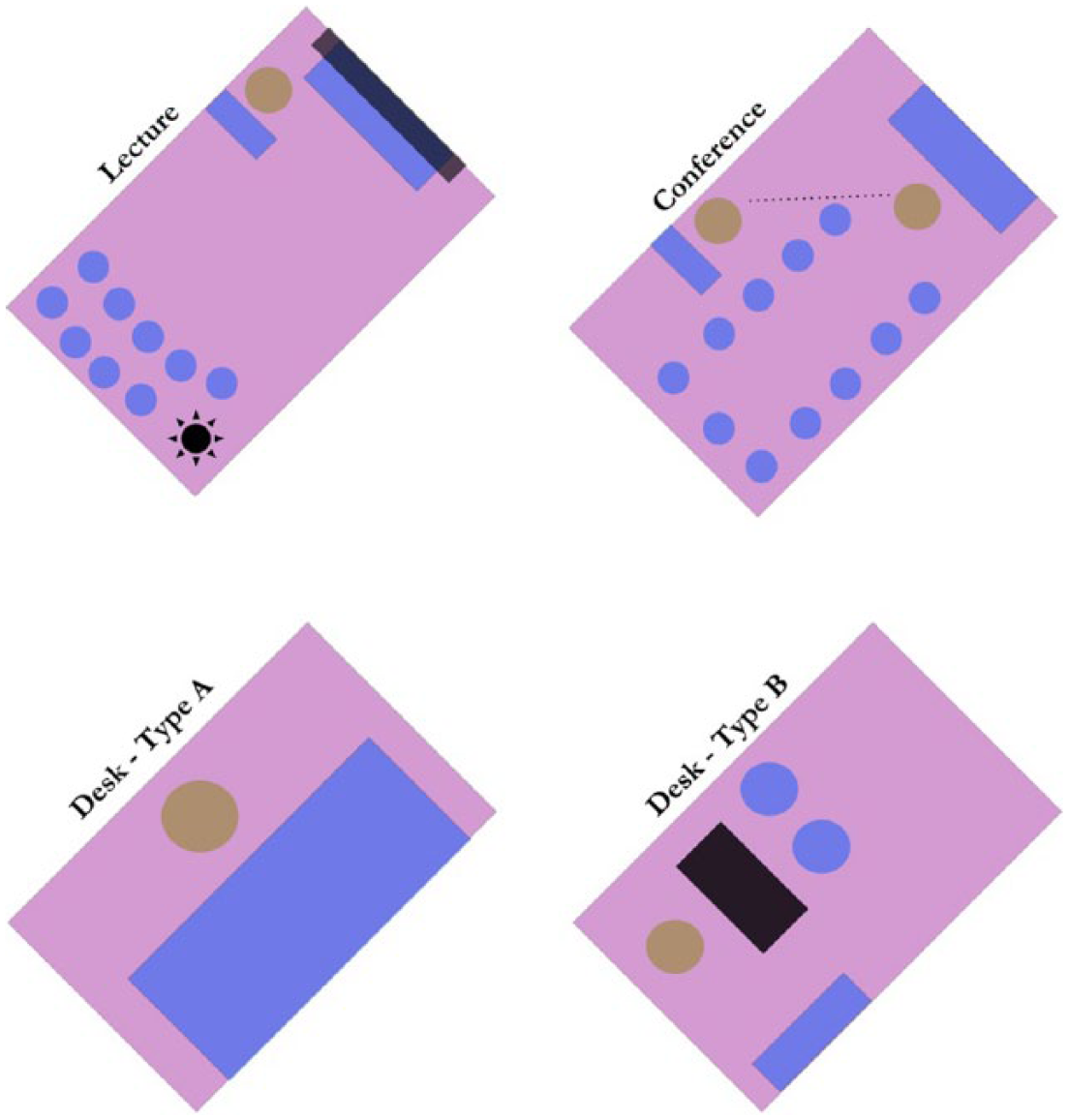
Sceneries.
The second type of character is that of the viewer-listener, who is addressed by the academic and the large screen up front (the audience). The position of these viewer-listeners is highly prepositioned: it is fixed by tables and chairs, and equally the position of their own devices (a small screen – laptop, occasionally a tablet or smartphone – or some paper) is mostly defined by the size of the table one is sitting at. The actors that constitute the audience cannot move, and neither can their devices: they are solidly anchored to fixed positions. As such, this points to being before the screen in another sense: the viewer-listeners are prepositioned as being before the screen. This positions themselves as much as it positions the academic up front, who constantly has to position her gaze between screen and audience.
Office settings
Even though the screen is highly prevalent in activities of presentation, its presence is naturally not limited to these settings. On the contrary, when strolling through the corridor, and peeking through some of the half-open doors, one quickly realizes that each (occupied) desk contains at least one screen. Let us remind the reader that we are not finding ourselves in a natural sciences laboratory, where experimental manipulation of several objects and/or devices is a core activity. On the contrary, the academics in these two research units – although they are physically hardly discernable as two distinct entities: not only are they sharing the same corridor, they are equally located in the offices in a quasi-randomly distributed manner – are committed to qualitative research, carried out of the research centers. In other words, for many researchers – and this especially applies for the doctoral researchers – the work to be done when present in the corridor chiefly boils down to “reading and writing”. Occasionally, the visitor can see a notebook with field notes or a book on the desks. But this does not constitute the common denominator of the materials found on these desks: books might be absent, but each occupied desk contains a screen of some kind. For most of the doctoral researchers, whose professional tasks mainly consist of “reading and writing”, the screen is generally positioned in the middle of the desk, in such a way that it dominates both this desk and the activities one can perform at this desk: viewing and interacting with (i.e., being before) the screen is made particularly easy by means of such positioning, but this equally implies that it is a lot harder to invite a visitor to sit in front of them (see Figure 1).
The sceneries of the offices of most professors, on the other hand, are materially arranged in such a way that there are either two desks to be found – one nearly empty, the other containing a screen – or that the screen is positioned at the side of the desk, thereby making room for possible visitors. In cases where a visitor (a colleague, a student, and so on) is welcomed, this absence of a screen between the two parties allows one to place something that is talked about (e.g. a paper with notes, a collection of brochures) in the middle of the table. Hence, whereas the architecture of rooms where presentation is the central feature or where doctoral students conduct their professional activities features a dominant screen, offices of professors are arranged in such a way that analog actors (paper, brochures, and so on) are given the opportunity to easily take a central position and the screen is positioned more peripherally (and hence, harder to look at). Having such a peripheral position does not mean that the screen is never adopted, however: it might, for instance, be consulted at the spot in order to retrieve some information (see below). In contrast to settings of presentation, then, and since being before the screen entails such significant spatial and temporal consequences, in most offices of professors the screen is arranged in such a way that it is positioned peripherally: temporally (in terms of being next to the core activity of having a conversation) as well as spatially (in terms of position), it is arranged in such a way that it stands besides the activity conducted. This implies that both the screen and its ‘before’ are turned away (the spatial before is being made peripheral), in order not to come into conflict with the ‘before’ of the paper, that is, with the positioning that is implied by the centrality of analog actors during a conversation.
In sum, these sceneries present the actors present in academic settings (screens, paper, (different sorts of) viewers, etc.) and the relations between these actors in terms of their position. Even though this is a rather narrow view that needs to be complemented with the two sections that follow, analyzing the agency of the screen likewise makes it clear that a complex array of relations needs to be created and sustained in order for the screen to be able to operate. In that sense, this section equally points to the mechanisms at work when a screen is present in the sceneries of academic settings, and this in terms of the enactment of a before the screen, in three different ways. First, a temporal before that requires the establishment of preparatory time and that leads to a formatted presentation (where preparatory time fuses with the time of the presentation), or precisely the establishment of conversational time (where one talks about something and where this something (e.g. paper) requires the screen not to be there, because the positioning of the screen conflicts with what one talks about). Second, a spatial before that requires to be physically before one’s screen in one’s activities of presentation (because of the prepared format) or precisely away from the screen when having a meeting (where a potential conflict between being before the screen and being before the paper is avoided by placing the screen peripherally). Third, a prepositioned before for the listeners-viewers whose positions are fixed and delineated, which equally implies that the presenter needs to position her gaze between this ‘predefined before’ of the listeners-viewers and the ‘before of the screen’.
Roles: Performance
In this second section, we focus on the different roles that the screen adopts during different activities. This is a question pertaining to the different performances of the screen in and through different academic settings. The roles presented here are focally directed at the interplay between the screen and the academic using this screen. That is to say, these roles focus on how the screen comes into being for the academic who is adopting the screen (and hence, not as much for a viewing public, for instance). Overall, eight performances became apparent (Figure 2). As we will argue, because we are focusing on the academic adopting the screen here, these performances do not come into being simultaneously, but often succeed one another within one and the same academic setting (i.e., one after the other):
Wall: The first performance of the screen is frequently found in activities of projecting, which largely occur in settings where presentation is a central feature. Through projecting, more particularly, the screen comes into being as a virtual wall on which something is put in order to make something public – often with the expectation for the viewer to gain some insight. Various conduits for establishing such relations are deployed; each conduit with a highly specific illustrating function: text in view of presenting a particular argument; figures in view of representing what was seen elsewhere (e.g. during the conduct of one’s research in the field); movies as balancing somewhere in between (that is, presenting something, but often with a representative aim). In settings that have more of a private character (e.g. a talk between a professor and a student who makes his master’s thesis under her supervision), this relation is often deployed by means of paper instead of the screen (see above, where we have explored this performance more fully in terms of its positional consequences).
Slate: This is a performance in which the screen exclusively appears as a device deployed for the effectuation of ‘work’. Most of the time, when the term work is mentioned in this corridor, it amounts to activities of typewriting. In settings where typewriting is the central activity, the screen appears as a slate which can be typed on or on which words/paragraphs can be wiped clean, rearranged, and so on. As hinted above, we often hear PhD students mention that this typing (together with reading) is “all they do” when they are in. Professors, on the other hand, most of the time generally and purposefully establish this specific relation between them and the screen on the outside of this corridor: here, they “don’t manage to get to their work”.
Frame: At certain moments, the screen appears as something that can be deployed in order to present oneself, one’s research center or one’s discipline in an aesthetic manner. As such, the screen performs as a frame that is drawn around certain contents in order to present oneself attractively to the outside of the research center: deploying an aesthetic lay-out to the cover pages of a newly devised series of working papers; making sure one publishes “attractive” and “appealing” contents online (seduction of prospected visitors by embellishing some content); ascertaining one’s texts have the proper keywords so as to be easily retrieved by search engines (technical seduction of search engines); etc. As such, in activities of presentation, academics think in terms of promotion and opportunities, or sometimes equally in terms of safeguarding; safeguarding not only the position of one’s research center in the faculty for instance, but equally one’s discipline, by means of aesthetic presentation.
Billboard: At some points, the screen performs as a billboard. On a daily basis, this performance is hardly noticeable because it is such a common one. The screen chiefly performs the role of a billboard in activities of exposing, and the concrete result of such exposure is that continuity between different digital elements is inaugurated. Examples of such exposing activities are putting logos and emblems on some content: putting a logo or an emblem on each slide of a presentation so that it recurs and recurs; presenting different ones in order to display all the organizations one is embedded in; etc. In doing so, slides are branded with a particular organization or institution, thereby placing an identifying claim on the content of what is being displayed.
Grid: During activities of exploring, the screen comes into being as a grid. Such activities are tightly linked to the deployment of the World Wide Web in general and of search engines in particular. In this form, the screen is used to navigate to several virtual places (pages/websites) of which the precise contents is often not known in advance, but to which the World Wide Web and search engines show possible directions (e.g. search results) by creating paths (e.g. the list and order in which the results are displayed) one can follow.
Memory: The screen equally performs as an external memory, and more particularly in activities where remembering is of central importance. The screen is then adopted as a prosthesis that is capable of retrieving information. This largely amounts to minute and exact details that, more often than not, come in standardized form and varying from different research budget numbers neatly put in a table to references to journal articles neatly put in a list and to appointments fixed in a schedule.
Window: In activities of looking, the screen comes into being as a window through which one can peek as if one were physically there. This is the case when some aspect of the world is being drawn into the setting, either by means of recordings (e.g. in the form of pictures or movies) or by means of a live stream (e.g. video chatting with Skype).
Sign: Lastly, the screen equally comes into being as a sign. This is a recurrent form, mostly to be found in settings of lecturing or in rooms where one is a guest. By directing the behavior of its users to particular wanted sorts (e.g. prohibiting any sort of activity as long as one does not enter the proper password) and away from undesired ones (e.g. prohibiting eating or drinking in a lecture room), the screen instructs its viewers to behave in some ways (and not in others).
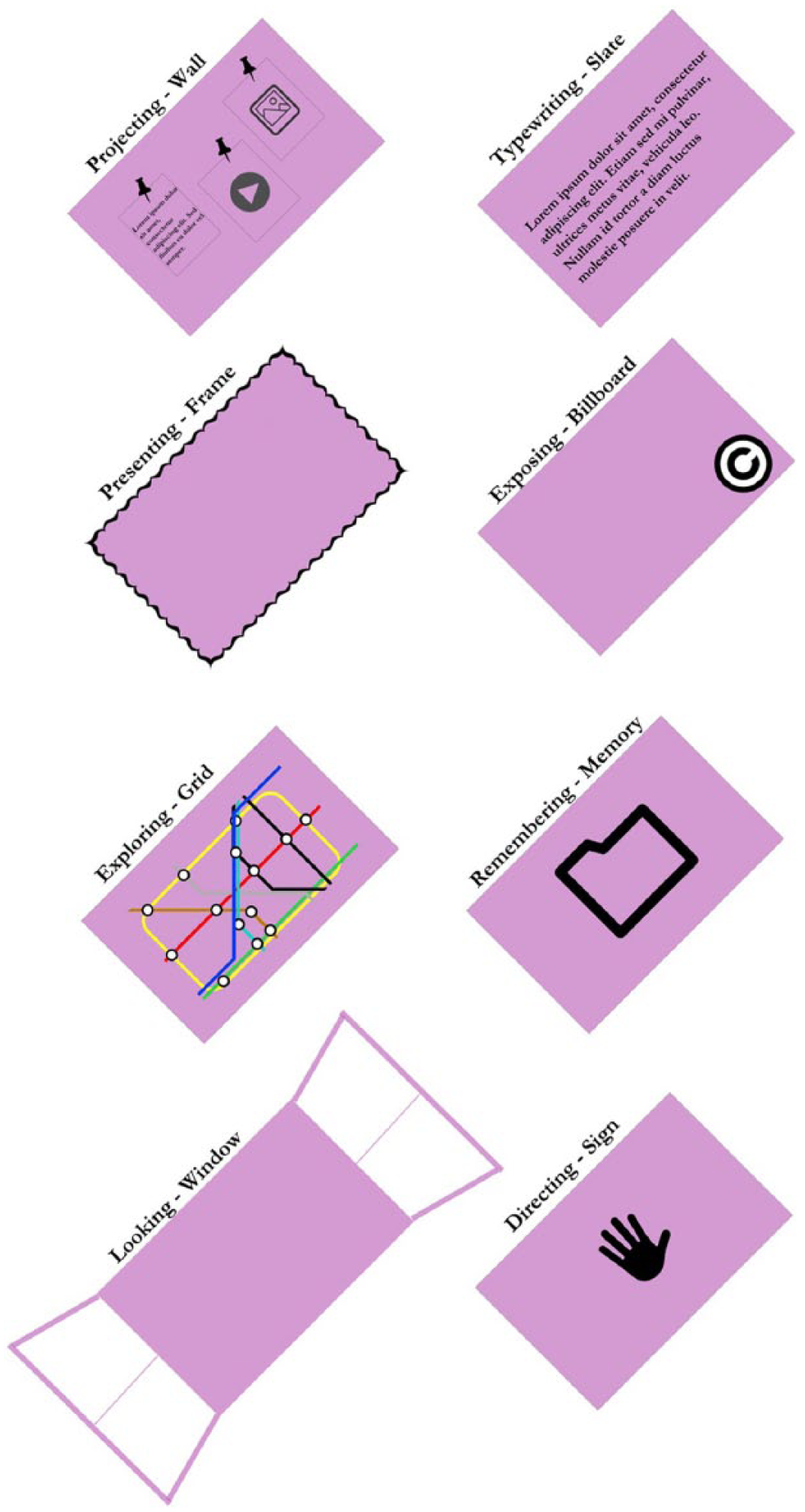
Performances of the screen.
This second dimension of the choreography gives an account of the roles performed by the screen in different academic settings, that is, on different performances of the screen that come into being by and through its specific adoption. These eight performances make clear why the screen is of such paramount importance in the conduct of many academic activities: not only because the screen is capable of taking up such multifarious forms, but equally precisely because it can take these forms in one and the same academic setting. In a setting where one prepares a slideshow, for instance, one can start by an activity of exploring (the screen then performs as a grid) in order to write some bulleted slides thereafter (screen as slate) that one embellishes thereafter (screen as frame) before eventually putting some logos on them (screen as billboard). In that sense, the screen acts as an obligatory passage point for many tasks in current academia – it can be a lot of different things – that has, as an effect, a tremendous amount of authority over the user – it can only be one thing at a time, and hence these concrete performances are in need of constant managing: first this, then this, then that. Temporally conceived, this enacts time as a constant switching between different activities: it is either one activity, or the other, or yet another, but there is no automatic transition between them. Rather, each activity is delineated from the other - one can search the internet or embellish a slide, but not at once. Spatially, these different performances enact space as being something multifunctional: albeit one has to process one activity after the other, they can all be effectuated in the same space, that is, before the same screen.
Script: (In)compatibility
The focus of this third section is on the script of academic settings, that is, the interplay between the screen and other actors. This interplay is approached here in terms of compatibility between different activities (when the screen and the human actors act and perform in a synergetic way and to such an extent that different activities are taking place at once) and of incompatibility between activities (when one type of actor is given the central position, thereby leading to dominance of one activity over the other). When do the screen and other actors operate in sync with one another? When are they out of tune?
Incompatibility
As argued, and for now we again find ourselves in more public settings, settings of presentation are often characterized by being ‘before’ the screen. This is not to say that this ‘before’ is always there, however: there are equally moments in which the academic up front breaks this relationship with the screen. These are no trivial actions: at the moment the academic physically detaches herself from the screen, most of the time she is about to make an important point or to bring in a central argument. This disconnection is a move towards the viewers, to which she comes physically closer and by means of which viewers are turned into listeners: by means of the academic moving to the fore and the voice that she uses at that moment, the audience is made attentive to some aspects that are consequentially rendered important. We see, in other words, how the academic brings movement (and her voice) into the setting in order to stress certain things. By doing so, the academic competes with the screen in order to grasp exclusive attention: she deliberately brings herself to the fore, thereby drawing the attention exclusively to herself and what she has to say. This constitutes an incompatibility between seeing and listening, where the academic puts emphasis on the latter by coming to the fore, and putting the audience exclusively before her (voice) (Figure 3).
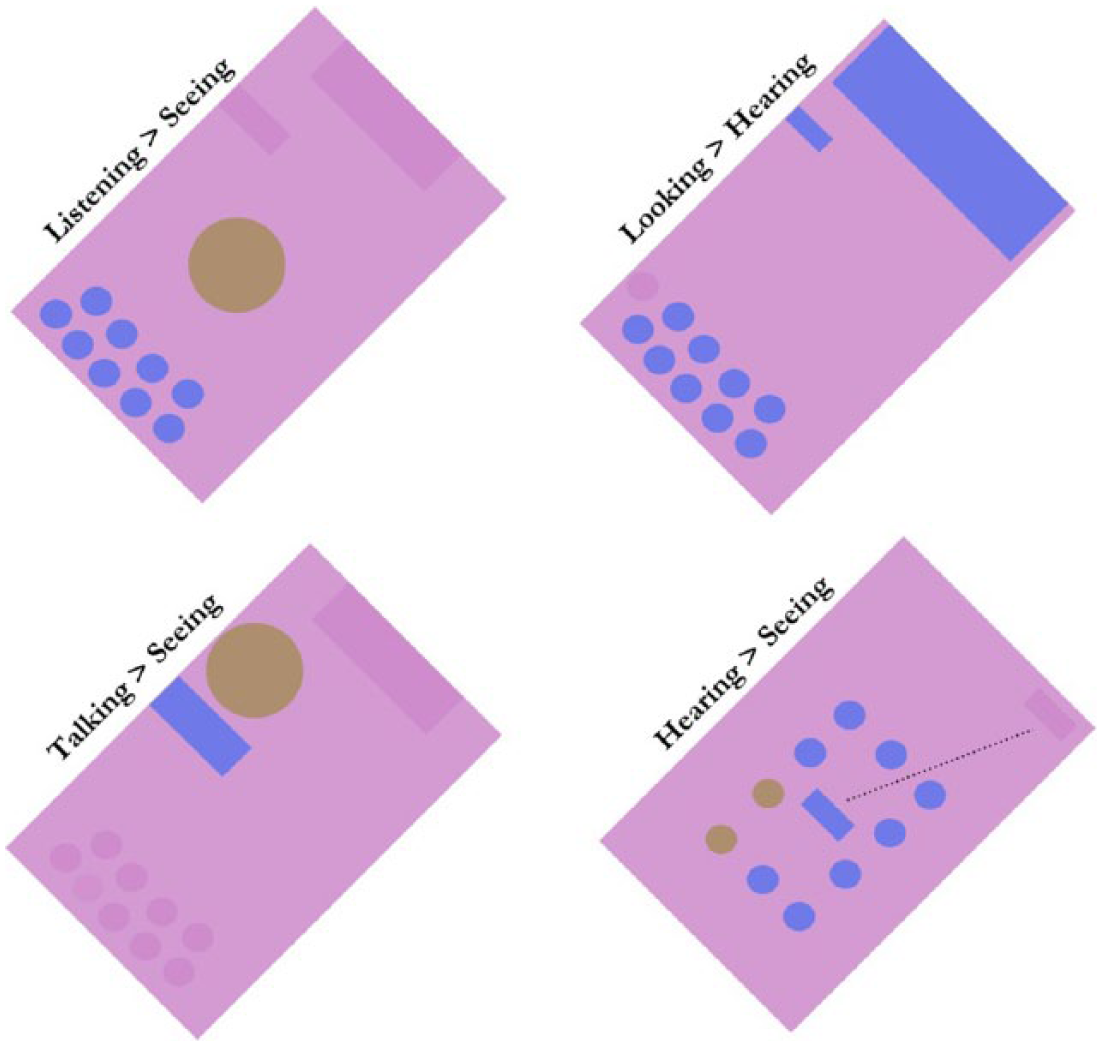
Moments of incompatibility.
Conversely, there are equally moments in which looking takes the upper hand of hearing. At such moments, the academic retreats and gives the floor exclusively to the screen. Again, these are moments where movement is a central feature: at moments where the contents of the largest screen start to move, the academic is often inclined to go away from the front of the room. In doing so, she transforms from a lecturer into a viewer: generally, she displaces herself either to the side of the room or takes a seat in the public of other viewers (behind the small screen and before the projecting one). But not only the academic is changing positions because of a moving screen. Students close their laptops (as if these are equally incompatible with the moving contents of the projections) and equally change their posture: they bend forward, and by doing so, almost exclusively direct their gaze towards these movements. In other words, as soon as the screen starts to move, it absorbs the possibilities of what can be done and who can do this: it is as if the possibilities of what can be done in a lecture room shrink to only one activity (displaying) and one active actor (the large screen). At such moments, where all human actors do not do anything except for looking at the screen, the screen is operating as a collectively absorbing device that takes the central position in the setting. This applies to even the most boisterous audiences – audiences of students that are afterwards portrayed by an attending academic as “behaving scandalously” – who then are equally and quasi-instantaneously drawn into the screen, absorbed by its movements. In both cases, where either the academic up front moves or where the projections start to move, the relation between the large screen and the other actors present can be interpreted in terms of an incompatibility between the activities of listening and looking: either the screen claims the central position, or the academic does – but they do not do it simultaneously.
Incompatibility between different activities is equally established at moments in which things do not go as planned, such as moments in which the relation between the small screen and the individual viewer is so intimate that the audience has no clue about what is being meant precisely. This happens, for instance, at the already-mentioned conference, where an academic is talking about his research activities while pointing to something on his screen, but where the audience gets to see a totally different projection. The presenter, unaware of this, continues with elucidating what can be seen on the screen – that is, with what can be seen on his screen. Consequentially, the public, seeing something completely different, has no idea what the presenter is talking about. The reader should bear in mind that this specific example is no side-effect of a traditional set-up, where an academic is presenting something with a projected screen in his back. On the contrary, most presenters opted to stand at the side of the room (and hence, before the smaller laptop screen), thereby equally having a clear view on the projecting screen without having to turn around. Because of this awkward positioning, this constitutes a good example, but largely, moments at which the relation between the academic and the smaller screen is so intimate that the academic loses track of the larger setting of her presentation (that is, that there is an audience that cannot know what she is pointing at, or what is being displayed on that smaller screen) are highly prevalent. These are moments where the academic is drawn into her own screen, that is, where the screen is operating as an individually absorbing device that, at these times, absorbs the academic alone. We see, in other words, that the relation between academic and screen is in some cases so intimate that it creates a particular (individually absorbing) space (a sort of zone) and a particular time (a sort of presentism where only the contents of the screen, here and now, matter), in such a way that one is presenting to the screen, rather than to the audience. In that sense, this does not constitute an incompatibility between listening and looking, but between talking and seeing, where one talks to the screen, but forgets to see (that is, take into account) the audience.
A last type of incompatibility occurs in more private settings, where neither many people nor a large screen are present. During a research seminar that took place in a meeting room situated in the corridor, for instance, someone who was ill stayed at home, but was attending this seminar virtually by means of Skype. She was projected on the laptop screen of one of the attendees (screen as window). This laptop was positioned at a corner of the table, visible for most of the attendees physically present and constantly projecting a moving stream of the room in which the sick student was. Yet, during the seminar the laptop was hardly looked at, and the (moving) screen did not receive any attention or consideration. At that moment, and despite such movement, the people who were physically present formed the focal point of the seminar setting, thereby rendering the person that was virtually present mute and obsolete. However, at the very moment the projected person started to speak, the sometimes quite lively discussion immediately started to falter – the spatiotemporal constellation of the physical seminar broke down – and everyone started to listen to this voice coming out of the computer – often resulting in long silences. This is a type of incompatibility between hearing and seeing: as long as one only hears speech of actors physically present, one forgets to see (that is, take into account) the moving screen.
In sum, incompatibilities can be purposefully established or not, but always imply that some other actors are not being related to (see Figure 3), and hence, that at some points, the screen and other actors present are ‘out of sync’ with each other. Being out of sync implies that either the human actors or the screen are given a central position, leading to competition between these actors and the screen (for attention) for instance, but equally to specific activities that take place (e.g. exclusive listening, looking, talking or hearing) and to specific sorts of time (e.g. presentism).
Compatibility
At other occasions, however, there are moments in which compatibility between different activities is established in such a way that the screen and other actors work synergistically together, that is, without one of these taking the central position over the other (Figure 4). Sometimes, for instance, the screen needs movement of the academic in order for it to be(come) sensible. These are cases where the screen and the human actors present in the setting start to cooperate in such a way that they need each other in order to make sense. We observed this, for instance, on an occasion where a map of a country was being projected and references were made to different districts of that country. Since the audience was not acquainted with this country, however, they did not have any idea about which part of the map the person in front was talking about; that is, where to watch precisely. This issue was overcome by moving the mouse over the district, thereby drawing a imaginary circle around the region the presenter was talking about. At such moments, the screen and the academic merge, creating an assemblage in which compatibility is established between showing and talking: both activities are overflowing into each other here, establishing a synchrony between the academic and the screen in such a way that it makes the mutual effectuation of these two activities possible.
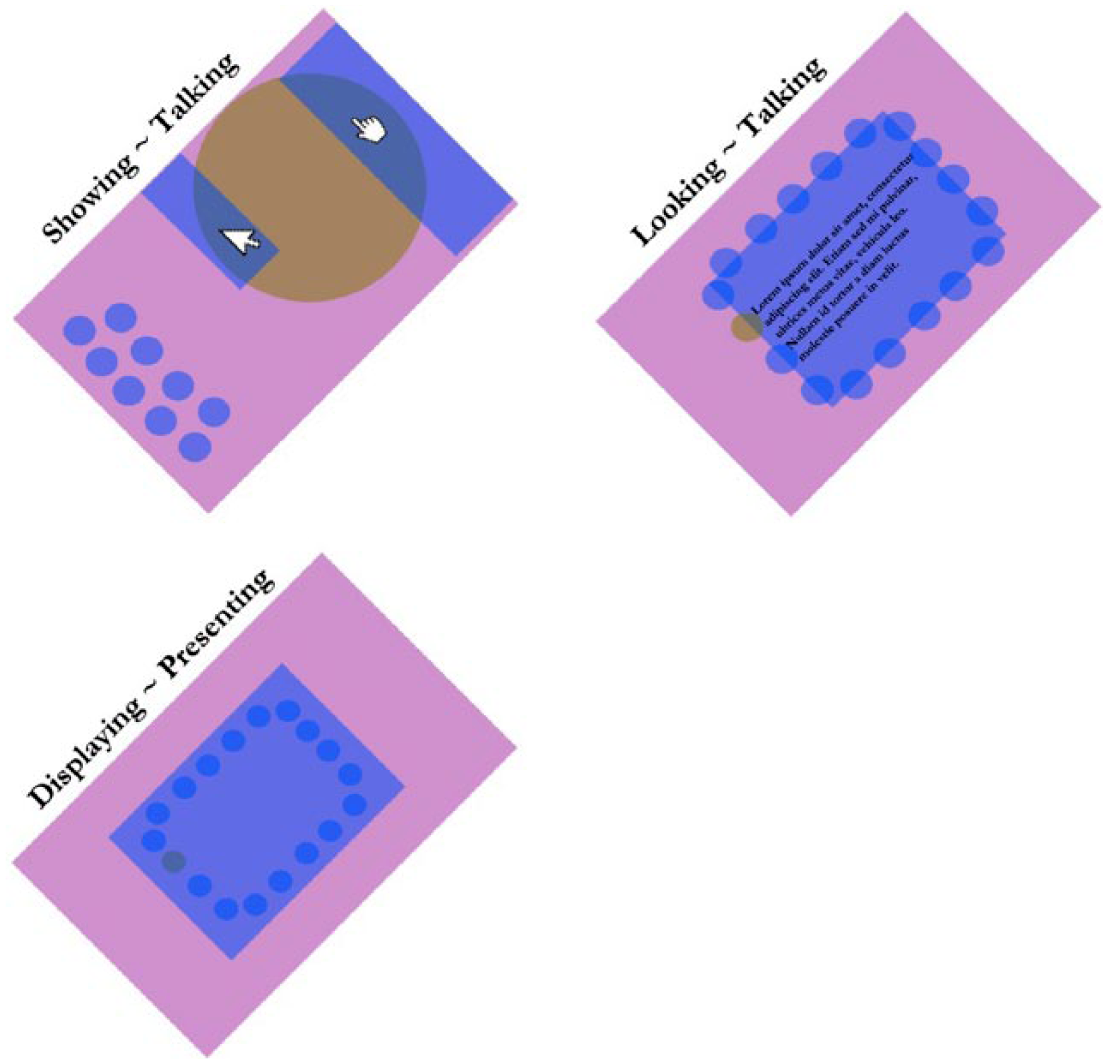
Moments of compatibility.
Such synchrony is not only being established between academic and projections alone, though. Let us, by means of example, now turn to an introductory course in which the theoretical assumptions of a very important person in the field – one of the “big names” of the discipline – are introduced. Through a couple of slides, where text is often accompanied by some pictures, the lecturer elaborates on a couple of general points. She announces that the purpose of today’s lecture is to get to the assumptions that are present in the work of this big name, and that the students will all have to disentangle these assumptions by means of one of the big name’s most famous definitions. “We are going to split into groups and will tease out different elements”, the lecturer says. By interacting with her own small laptop screen, she lets the large screen project the definition. It is different from most slides: there are no pictures here, just a plain white background. In the middle of the slide, in a huge font size, the definition is being projected. There is nothing more and nothing less to see than this definition. The screen is performing as a wall here, on which the definition is put, making these words public, sharing them with its viewers. The lecturer reads out the definition, slowly, word by word. Again, all of the students have directed their gaze at this slide show, although this time it is not moving at all. On the contrary, it is (just) a bunch of still-standing words. “And now”, the lecturer says, “this is your assignment”. A new slide is being shown, on which three bullets are present, containing three different subtasks that the students have to fulfill. Some students take a picture of this assignment with their smartphone (at that moment performing as a window), as if they sense what is going to happen. Indeed, the lecturer returns to the definition, which will be displayed during the whole course of the group work. The lecture hall is buzzing with noise, and although the screen is standing still, as if it were contained in a frozen state, students keep on looking to this definition. They equally start to point to this definition, and more specifically, to different words of it. This pointing is all over the room: it rolls like a wave through the different groups that have formed in the auditory. In this process, where a compatibility between looking and talking is forged and where what is referred to and who refers are acting synchronically, without one claiming authority over the other, the definition is transformed from an abstract set of words/concepts into a common reference space: it turns from a bunch of words into a space that can be pointed at, referred to, made use of. Moreover, such common reference spaces do not even need to be projected: in trying to convince other students or making a case for a particular proposition, the students equally point to pictures that are not displayed anymore, that is, through pointing, they make reference to something that is no longer visible; make these pictures present again; turn them into common reference spaces as well.
Compatibility is equally established by letting the screen make clear that something (a seminar, a conference presentation, a lecture, etc.) is (still) going on. Often, this is done by letting the screen continue its projections, even if what is projected has no relevance at all anymore: at many occasions, the screen is immediately put out of its standby position after it turns into a blue screen transmitted to the projector, or where the presenter, after seeing the traditional ‘End of slide show’-message, goes a slide back, so as to make sure that something is (still) projecting. At other moments, especially during discussions after a lecture or during seminars, the desktop (rather than the slide show) of the presenter was displayed, every time renewed so as to prevent the blue screen from being displayed (and in the rare cases where the blue screen did appear, the presenter quickly touched the mouse so as to revive the projection of the desktop). This equally applies for the attendees of such lectures or seminars: ostensibly, audience members with a laptop cannot stand it when their laptop screen turns black, even when one is not taking any notes at that moment. Ascertaining that the screen continues projecting, just for the sake of displaying something, shows moments of compatibility between activities of displaying and presenting (or for the students, between displaying and listening): just by touching a button or by slightly touching the mouse, the space and the time of the activity that is going on (a seminar at the corridor, a lecture, etc.) is invigorated and prolonged. Rather than pointing to a ‘before’, this points to a sustaining of the presence of an activity: just by being there and by being slightly touched upon, the screen is prolonging the time and space of a certain academic activity. As such, it enacts an immersive space which demarcates that the here and now (the temporal ‘during’) of an activity is not finished yet and thereby sustains and invigorates the temporal constellation of the present, that is, of the presentation.
The establishment of compatibility between different activities in moments at which the relations between the screen and other actors are synergistically ‘in tune’ with each other, are not confined to the lecture hall, seminars or conferences. We have seen such moments of relational compatibility between activities in more private appointments between professors and students, where both of them are discussing something (e.g. a note sent by the student) that is displayed at the side of the desk, thereby lively pointing to the screen or ascertaining that the screen displays what is being talked about (e.g. particular paragraph of a thesis); or in meetings with an administrator of the faculty, where the screen forms the middle of the conversation and where both the academic and the administrator point, refer, adapt, etc. what is to be found on the screen. In sum, rather than pointing to where such compatibility is being established, this section points to the observation that such compatibility between different activities in a variety of academic settings can be established, and that, at such moments, the screen and the human actors present in the setting are to be found in a synergetic situation. Consequentially, this leads to the inauguration of particular sorts of time (again, a form of presentism, continuing the ‘during’ of an activity, but this time on a collective scale) and space (e.g. a common space of reference; an immersive space) where screen and other actors synergistically act upon one another.
What screens do
In this article, we have given an account of how academic work is composed precisely nowadays, and more particularly of how the screen operates in the concrete effectuation of this work. By conceiving of the screen as an active device that performs particular operations, this study is situated within the broader field of sociomaterial studies in education, that investigate how different educational assemblages are composed precisely by both social and material actors and which relations, operations and mechanisms are at play in such assemblages (e.g. Fenwick et al., 2011; Landri and Neumann, 2014). As such, this article offers a further exploration of the field of digital studies that scrutinizes the agency of digital devices in educational practices. This field has focused already on specific pieces of hardware (e.g. Thompson, 2012) or software (e.g. Kittler, 2004; Sørensen, 2009) and on specific activities such as typing (e.g. Vlieghe, 2014) or (e-)learning (e.g. Friesen, 2011), but not exclusively on the operations of the screen as such.
Next to this contribution to the growing field of digital studies, this focus on the screen has the additional advantage that it enables us to come to a more profound understanding of some facets of academic practice that are increasingly being pointed at in literature about the current condition of the university, but that are difficult to articulate precisely. These facets all have to do with the intuition that the adoption of the screen in academic work has entailed some profound consequences, not only at the level of how academic work can be effectuated (e.g. working anywhere, anytime) but equally, and more significantly, at the level of what can be done during this effectuation. A first facet in this respect is the intuition of many that screens ‘do’ something and have some sort of agency of their own. It has, for instance, been argued that traditional practices such as lecturing, which constitute ‘a period of time when an individual holds the floor to deliver a sustained argument on a particular topic’ (Collins, 1998: 21), face for that reason increasing challenges: there is no longer an individual who exclusively holds the floor now, but this individual increasingly makes use of the screen in order to deliver a sustained argument. Additionally, over and beyond this screen in front, many students now have a laptop with them. This implies that there is equally a before their own screen, which might sometimes be in tension with the before inaugurated by the projecting screen in front or even with the ‘before the voice’ of the ‘before the notes’ one makes (Mueller and Oppenheimer, 2014). Whether the practice of lecturing has changed or not is a conclusion our analysis cannot lead to, but at the very least the script introduced concretely shows how the (agency of the) screen not only performs some operations in and on itself (creating common spaces of reference; sustaining the spatiotemporal constellation of the activity of lecturing or precisely enacting a here-and-now in which only what the screen displays counts, …), but equally makes the other actors present in the lecture hall do particular things: it absorbs either one individual or a collective; it leads to competition between the screen and the lecturer in view of attention, being looked at and being heard; and so on. As such, the screen indeed plays a decisive role – not only in what is being done in lectures nowadays, but equally in what can be done. Even more, the establishment of compatibility and incompatibility illustrates that digital devices not only make human actors do particular things, but equally that there are moments in which the screen and other actors are in tune or out of sync. At moments in which compatibility is forged, for instance, different activities start to overflow into each other in such a way that making a distinction between them is hardly possible. Incompatibility between different activities, on the other hand, does not constitute a detrimental or unwanted side-effect of adopting digital media in one’s activities, but is an additional manifestation of the more general observation that devices are not merely neutral objects or instruments to make use of. Such moments could especially add additional understanding to the impression that the screen has altered typical academic compositions such as a (physical) lecture: screens perform actions and operations over and above their intentional deployment, and as our analysis shows, such actions and operations are equally of focal importance. If we gain a better understanding of such actions and operations (absorption, competition, etc.), we do not only gain a better understanding of how academic work is currently being governed by the screen, but equally with respect to the general impression that certain things have changed by the abundant proliferation of digital devices in academic practice (Allais, 2013; Masschelein and Simons, 2013a; Stiegler, 2013).
A second facet that is often raised with respect to the adoption of the screen is that academics’ work has become increasingly fragmented and busy, consisting of a processing of one (shredded) activity after the other. In that respect, it is often argued that academic work is becoming more and more global. Often, such statements are uttered under the auspices of processes of increased bureaucratization, accountability, and marketization (Guzmán-Valenzuela and Barnett, 2013; Ylijoki, 2013). At the same time, however, academic work is perhaps equally becoming more and more local – at least when considering the localities generated by and sustained before the screen. As such, processes in the globalization of academic work, or (aspects of) Europeanization, could be addressed in terms of the constitution of new ‘mobile localities’ that are present potentially everywhere (that is, global), but at the same time extremely local (that is, before one’s screen). The analysis of the roles of the screen and its different performances, might equally be related to such impressions, but without having to invoke such overarching processes. Not only did it become apparent that each different performance requires a highly specific type of user (and hence, each time a different way of relating to the screen), equally we argued that different performances can be present in one and the same setting (and hence that the screen comes into being as an obligatory point of passage for the effectuation of many activities – Callon, 1986). However, despite this omnipresence and this ability to take up different roles, for the academic adopting the screen it can only take up one role at a time, thereby requiring a constant repositioning of this academic. This might offer an additional view on the ‘shreddedness’ of academic work: if each role requires a different sort of user, academics not only need to constantly manage the activities that make use of the screen and hence to constantly switch between them, but also need to change user roles (Decuypere and Simons, 2014a). 4 These observations have the additional importance that they point to the agency of the screen over and above the often analyzed aspects of growing interconnections and Europeanization of the European higher education and research space. Tools as e-mail or the internet have been of pivotal importance in their contribution to the process of the transmogrification of national education and research areas into a European one (Smeby and Trondal, 2005). Research has equally indicated that standards operate in a similar manner, for instance (Lawn, 2011). This analysis shows that there are other features of digital devices that are equally highly significant, but that are not always considered as determining. Perhaps we need not only to consider particular digital functions (e.g. interconnecting) or digital tools (e.g. e-mail) if we want to understand the processes that are shaping a European education and research space, but equally what screens concretely do on a day-to-day basis, thereby equally shaping highly specific types of users and mobile, yet very specific, localities (and hence, it might be stated, of highly specific types of academics): in standing so central in the effectuation of nearly all aspects of European academic work, the consequential authority of the screen that is enacted likewise means that there is no other option but to relate to the screen.
Third, it is perhaps precisely such aspects which have not been theorized enough and that are in dire need of attention: How to relate to the screen? This is not only a general technological question, but equally an educational question in and on itself, and pertaining to what could be called digital fluency: how to ascertain that the screen is deployed in such a way that it does not (only) lead to instrumental effectiveness, continuous distraction, or augmenting interconnection, but equally as a device that might be able to slow things down and generate attention and thinking? This educational capability of the screen of slowing things down has of course been stressed amply, but the theoretical and educational question as to how to be fluent enough in order to maximize this potential of the screen has perhaps not been explored and discussed enough. This is not so much a critical issue pertaining to the question whether ‘the digital’ should be adopted or not in contemporary educational practices, but rather to how to relate (adequately) to devices that continuously (attempt to) influence and govern us (Masschelein and Simons, 2013b).
Finally, and closely related hereto, another often heard and more general impression is that the university in general and the professional lives of academics in particular are effectuated more and more online, by being so often ‘behind’ or ‘on’ the screen. This is a point that is, of course, not in need of denial or discussion, and these dimensions of being behind or on the screen and their consequences have already been intensively scrutinized (e.g. Boon and Sinclair, 2012; Edwards, 2015; Hayles, 2012; Wolfe, 2007). However, this account shows that by formulating the observation likewise, many dimensions of the agency of the screen are not being fully captured: instead of enacting a ‘behind’ the screen, this analysis (and more especially the account given of the scenery of academic settings) equally demonstrates the importance and consequences of what plays before the screen, both in one’s office or at other locations, both spatially as well as temporally. This enactment of a ‘before’ by the screen sheds additional light at why it is that screens have so much authority in the making of daily academic work: because the screen enacts a before, and because we might not always be aware of the size and dimensions of this before, perhaps we are often already before the screen without fully realizing it. Yet, at the same time, this before opens up many new possibilities and opportunities to relate to what is influencing and governing us.
Footnotes
Declaration of conflicting interest
The author(s) declared no potential conflicts of interest with respect to the research, authorship, and/or publication of this article.
Funding
The author(s) received no financial support for the research, authorship, and/or publication of this article.