



Abstract
The paper employs the assemblage approach to unfold India’s 2009 education policy, the National Curriculum Framework, in order to uncover its multiple international, national or other links. In doing so, a deconstruction approach (as strategy, not as rationale) is applied, in order to uncover the policy text and what is identified as a construction and reconstruction of meaning. The contested notion of student-centred learning and its perspective is proposed as a solution to deal with the professionalism problem of Indian teachers and the criteria to develop teachers’ professional skills are closely analysed. As a result, it is not only student-centred learning that is apprised to be part of the National Curriculum Framework, but also its multiple versions, linked to local and global policy studies. In turn, this highlights the complicated nature of the policy. The multifaceted and manifold versions of student-centred learning are further unfolded through the assemblage rationale. Silent spaces (e.g. teachers’ voices, teaching evaluation methods, etc.) are observed in the policy text to accommodate the emergence of student-centred learning.
Introduction
The aim of this article is to apply the assemblage approach to unfold the Indian education policy ‘National Curriculum Framework’ (NCF) (National Council for Teacher Education (NCTE), 2009) so as to deal with the professionalism problem of Indian teachers. In addition, the deconstruction strategy (binary rationale) will also be employed because it helps to spot the gaps that appear inside and outside the policy text. I closely study the concepts of student-centred learning (SCL) and teacher professionalism as binary, examining their meanings and uses in the NCF 2009 policy, wherein SCL is proposed as a solution to deal with the professionalism problem of Indian teachers. The guiding research question is: what can the assemblage process (smooth and striated space) reveal from the NFC 2009 policy reform?
The article first explains some key concepts such as assemblage, smooth and striated spaces and binary rationale. The analysis section then presents how the policy text was analysed, organized into three sub-sections. The first, titled Deconstructing the binaries of the NCF 2009 policy, reveals the text of the NCF 2009 policy through two questions: (a) what is said in the NCF 2009 policy; and (b) what is unsaid. This section also discusses the notion of SCL in terms of how it is identified in and permeates the NCF 2009. I then further discuss it as a contested notion from within the policy text. In the subsequent part of the section, Reconstructing a binary of the NCF 2009 (SCL), the story of SCL is rebuilt. This is done by analysing SCL in light of key policy documents produced by transnational actors (Bologna Process Report 2009; Tomaševski, 2006; and UNESCO, 2005) as well as policy documents and education philosophies inherent in the local Indian context (National Policy on Education, Education Act, Yash Pal report on higher education and Gandhi’s and Tagore’s ideas on the philosophy of education). In the third sub-section, Re-reading the NCF 2009 policy as a process of assemblage, I argue that the assemblage approach can be employed to conceptualize the appearance of the notion of SCL and its multiple links. Most importantly, the assemblage approach provides fresh insight into unfolding policy text and its production rationale. Put differently, this study argues that the assemblage approach is an alternative way to examine education policy and enhance our understanding of policy production, using India as a case study.
Fundamental concepts
Assemblage
Assemblage is a central thought or notion in this study and a tool to examine education policy. This article mainly employs a pragmatic use of assemblage to retell the story of Indian policy. The notion of assemblage was first introduced by Deleuze and Guattari (1987a), and through closer observation, one can perceive overflows into many different fields and theoretical understandings, such as actor–network theory (ANT), global assemblage and DeLanda’s (2006) notion of assemblage. However, the first appearance of assemblage was defined as a process of arrangement, laying out and fitting together (Wise, 2012 p.91). It represents and comprises multiple connections in different structures, behaviours and spaces. For example, a map shows multiple entrances to the city centre or country; there is more than one single point or one single road. ‘It is multiplicity which is made up of many heterogeneous terms and which establishes liaisons, relations between them, across ages, sexes, and reigns – different natures’ (Deleuze and Guattari, 1987a p. 290-2091) Thus, an assemblage is a mixture of construction and extension of connections, what Wise identifies as a ‘becoming that brings elements together’ (Wise, 2012, p. 91). Most importantly, an assemblage appears when function occurs. In Deleuze and Guattari’s words (1987): Assemblage emerged when a function emerges; ideally it is innovative and productive [procedures]. The result of productive assemblage is a new means of expression, new territorial/spatial organisation, a new institution, a new behaviour or a new realisation. The assemblage is destined to produce a new reality, by making numerous, often unexpected connections. (Deleuze and Guattari, 1987, Cited from Livesey, 2005, p. 19)
Thus, assemblage is emerging, in process, and in vibrant webs of heterogeneous connections, which often engage and appear in new ways inside and outside the context. I read assemblage as a process of events, and I also observe it as a new method or way to carry out research, which allows one to sense a possible relation between thinking and ‘what to be’ thoughts, which gives some sort of logic or order, but no fixed direction or explanation. In short, an assemblage can be defined by its function and not by its form or identification. It is therefore something which can neither be pre‐assumed or pre‐determined, nor can it be put together into an order or into an already conceived structure. It is also not an accidental collection of things or behaviours because there is a sense that an assemblage could be perceived or expressed into some identity and can be observed through its own creation. Rather, an assemblage is a constant process of making and unmaking connections or constructions, wherein new elements emerge as cohesive structures.
Smooth and striated space
Smooth and striated space is another vital notion employed in my examination of the NCF 2009. It directly addresses processes in (social, political, geographical, biological) life, taken up in philosophy and art. If an artwork has a striated quality, then complex and dynamic expressions of the artwork can be considered smooth. Smooth space reveals the quality of multiple understandings, whereas striated space reveals the quality of the temporary establishment of certain notions or events. These concepts exist together in an assemblage process of making and unmaking but without influencing or shaping one another. To Deleuze and Guattari (1987), smooth and striated spaces are in a constant process of making and unmaking – in a mode of deterritorialization and reterritorialization. According to them, deterritorialization stands for territory of being, an object, or system, and reterritorialization stands for a new object, a new beginning. Coded space can therefore become a point of departure towards a new beginning or new understanding of space where a new configuration of lines and points of variation (or becoming) emerge (Buchanan and Lambert, 2006
Stratigos and colleagues provide an example of how smooth and striated spaces work. According to them, Deleuze and Guattari suggest that woven fabric presents many of the characteristics of striated space: the horizontal and vertical elements of the warp and weft are woven together, intersecting at right angles, the boundary of the fabric being constrained by the loom. The qualities of smooth spaces … Deleuze and Guattari describe as an anti-fabric involving an entanglement of fibres which is non-homogeneous and unlimited in every direction. (Stratigos et al., 2013: 266–267)
In short, smooth space holds the potential for multiple logics and links, such as the entanglement of fibres, whereas striated space has a quality of being established, in a given pattern and format, such as the horizontal and vertical lines of woven fabric. I will draw upon a similar rationale to examine India’s NCF 2009 policy document and map the SCL notion, which appears as fixed and stable (striated space). As the analysis will show, its links appears within and beyond India (smooth space).
Binary rationale
Binary rationale is another key concept for our analysis. It serves as a supporting thought to operationalize the assemblage approach. In fact, binary rationale appears in Deleuze and Guattari’s as well as Derrida’s works. To Deleuze and Guattari, a binary rationale means one notion always responds to another notion or everything is always in flow – construction, deconstruction, reconstruction of notions. To them, a binary is not only part of opposition logic, but also opens up multiple understandings. To this end, they give an example of how a book and tree show multiple links, going beyond opposition logic: … the book as a spiritual reality, the Tree or Root as an image, endlessly develops the law of the One that becomes two, then of the two that become four… Binary logic is the spiritual reality of the root-tree. Even a discipline as ‘advanced’ as linguistics retains the root-tree as its fundamental image, and thus remains wedded to classical reflection (for example, Chomsky and his grammatical trees, which begin at a point S and proceed by dichotomy). (Deleuze and Guattari, 1987: 5–6)
Deconstruction strategy and assemblage approach to analysing the NCF 2009
Something unstable, always heterogeneous, in which style carves differences of potential between which things can pass, come to pass, a spark can flash and break out of language itself, to make us see and think what was lying in the shadow around the words, things we were hardly aware existed. (Honan and Bright, 2016: 3)
By ‘shadow around the words’, Deleuze and Guattari highlight to us that language has silent spaces, which is also true in policy text. Uncaptured language can count as binary logic. In other words, the intensive use of language to all symbolic or simply signifying usages could be read as unformed expression (Honan and Bright, 2016). This is how the deconstruction strategy is applied to the reading of the NCF 2009 policy text.
Derrida (1982) points out that, in difference, the concept (signified by a word) is traditionally understood in contrast to other concepts, which in turn take on meaning in relation to yet other concepts. In this sense, the opposite meaning of a notion is seen as the departure point, wherein the binary meaning of the text is destabilized. Thus, deconstruction is not attached to signifiers (e.g. the written sign) of the text; rather, it uses oppositional logic of signifiers as a departure point to highlight gaps created in the text. This is what Adkins (2017b) calls ‘un‐decidability’, wherein there is always a condition of possibility and impossibility to further study binaries. Moreover, the deconstruction strategy does not represent the structure of language, but rather it often adds something new to the study by presenting new views of the text that are uncovered through deconstructing and reconstructing it. In fact, Adkins (2017b: 13) orients the text thus: What counts here is not the lexical richness, the semantic infiniteness of a word or concept, its depth or breadth, the sedimentation that has produced inside it two contradictory layers of signification (continuity and discontinuity, inside and outside, identity and difference, etc.). What counts here is the formal or syntactical praxis that composes and decomposes it.
In my reading of the NCF text, the deconstruction strategy and its application will not only create the conditions to study binaries in the text; they will also create the conditions to study impossible conditions, which are difficult to see in the text. The point is that the differences are natural in the policy’s text/language. Difference always exists in language and ordinary practice in everyday life. So, instead of embarking on an interpretation of the text or discursive logic of the text, deconstruction will enable an imagining of a space in the text through differences, which appear, both said and unsaid, throughout the NCF 2009 policy document. This will help to spot the gaps that appear inside and outside the policy text.
In addition to this, Deleuze and Guattari’s (1987b) thoughts on assemblage, presented in the fundamental concepts section, explain what smooth and striated spaces are. In summary, smooth and striated spaces comprise a mix, but they are still separate from each other, and Deleuze and Guattari (1987) provide some principles which can determine smooth and striated spaces, and two directions to define space and time. Smooth spaces are complex and unstable or unfixed, whereas striated spaces are stable or fixed. There are some principles that can be used to show the differences between them, but to me it is part of the assemblage machine process, wherein some data and content form and become stable, whereas other forms and content continue their journeys further. In other words, in an assemblage, when smooth spaces appear, they are known for their change quality, whereas when an assemblage reveals striated space, things are well known for their composed or organized quality: The striated is that which intertwines fixed and variable elements, produces an order and succession of distinct forms, and organises horizontal melodic lines and vertical harmonic planes. The smooth is the continuous variation, continuous development of form; it is the fusion of harmony and melody in favour of the production of properly rhythmic values, the pure act of the drawing of a diagonal across the vertical and the horizontal. (Deleuze and Guattari: 556)
In summary, the assemblage approach (smooth and striated spaces) is used to conceptualize, analyse and operationalize the NCF 2009 policy document, whereas the deconstruction strategy (binary rationale) is applied to read the NCF’s 2009 policy text. Both approaches will be combined because the assemblage (smooth and striated spaces) helps to find and understand relationships and the possibilities of reconsidering multiple spaces in policy as stable and smooth, whereas the deconstruction strategy serves the purpose of a systemic reading of the policy document as well as helping to highlight gaps in the policy text without any interpretation.
Examination of the NCF 2009 policy
Deconstructing the binaries of the NCF 2009 policy
The NCF 2009 policy appears to redesign Indian teacher education. In particular, it sheds light on the areas of teacher professionalization and SCL practices. The document is published by the National Council of Teacher Education, which is a well-recognized Indian governmental institution active in teacher education affairs, and it stretches more than 100 pages in length, with six chapters. There are three broad curricular areas that can be identified in this framework: (a) Foundations of Education, which includes courses under three rubrics, namely Learner Studies, Contemporary Studies and Educational Studies; (b) Curriculum and Pedagogy, including Curriculum Studies and Pedagogic Studies; and (c) School Internship, leading to the development of a broad repertoire of perspectives, professional capacities, teacher sensibilities and skills. Internship and practicum subjects form the curriculum for teacher education programmes across various stages, i.e. pre-school, elementary, secondary and higher secondary. These parts of the curriculum are interrelated and provide crucial training to teacher educators, according to the various needs of their pupils at the different levels. This area provides us with basic ideas, concepts and themes upon which the courses and curriculum are to be prepared (NCTE, 2009: 24). Nevertheless, the document’s preface mainly highlights the problem with regards to teachers in India. The concern presented in the NCF 2009 is that Indian teachers are unprofessional due to a lack of proper curricula and outdated teaching methods.
In order to examine the policy and its rationale, one needs to know what this policy actually stands for. Put differently, I ask the first question in uncovering meaning from the policy: what does the NCF 2009 say? In order to answer this question, I will first cite a few key sections. These excerpts will shed light on why Indian teacher education needs to be reformed and why new teaching practices must be adopted. Mainly, these quoted passages express that there is no effort made at the levels of diploma in teacher education, bachelor in education, or master in education that would ensure the acquiring of professional skills among teachers. The following text reflects this specific problem: ‘… there exist no programmes for the professional preparation of elementary teacher educators. Neither bachelor in education nor master in education programmes in their present form equip prospective teacher educators with the required capacities, sensibilities and skills’ (NCTE, 2009: 82). Therein lies the main rationale as to why the NCF 2009 policy reform is needed in Indian teacher education. The policy contends that the previous policies have de-emphasized teachers’ professional skills. Also, due to privatization and globalization, new challenges have sprung up in the teacher education arena (see NCTE, 2009: 4). In order to deal with such new challenges, Indian teachers require better professional skills. Therefore, the policy pronounces that there is an urgent necessity to rethink the way teacher students are being trained and organized in Indian society, and what kind of curricula are suitable to meet the challenges posed by globalization and privatization.
Therefore, to deal with such challenges, the Indian NCF 2009 policy introduces reforms. Moreover, the policy expresses an intention. It conveys the desire to rearrange teaching practices. The policy argues for reorganizing curricula in elementary, secondary and university teacher training schools, in order to enhance professional skills through new curricula and teaching methods. What is more, it re-articulates the problem of ‘the professional’ in Indian teacher education again and again throughout the document. The quotation below is from the first chapter of the policy. It strongly stresses that teachers are lacking knowledge and practice in professional skills at teacher training schools. Also, the curriculum, institutions and schools are said to be disconnected from the real lives of pupils and contemporary Indian society: There is now public acknowledgement that the current system of schooling imposes a tremendous burden on our children. This burden arises from an incoherent curriculum structure that is often dissociated from the personal and social milieu of children as also from the inadequate preparation of teachers who are unable to make connections with children and respond to their needs in imaginative ways. Teachers need to be creators of knowledge and thinking professionals. They need to be empowered to recognize and value what children learn from their home, social and cultural environment and to create opportunities for children to discover, learn and develop. (NCTE, 2009: 4)
As we have seen earlier, binaries often cover complexity – in this case, that the present teachers of India are maybe not bad or unprofessional, but rather just different in many ways. However, in order to legitimize a change, one needs persuasive power, achieved by constructing someone or something as ‘the’ problem. Here, the argument is that current teaching methods present a problem for all of India, or the whole world. That is indeed an attempt or an act of domination to divide a complex situation into two trenches.
Indian teacher education policy drew upon the binary rationale of the teacher professional for debate, which highlights the differences in the NCF 2009 policy text. This is a contradiction, which is deeply discussed and debated in the policy text. Plus, the SCL approach is proposed as a solution to deal with the professionalism problem of Indian teachers. This debate over unprofessional and professional meanings can be turned around and imagined as a binary. However, the point is that the differences are natural in the policy’s text and language. Difference always exists in language and ordinary practice in everyday life. So, instead of embarking on an interpretation of the text or discursive logic of the NCF 2009 text, deconstruction will enable us to imagine a space in the text through differences, which appear, both said and unsaid, throughout. It will help to spot the gaps that appear inside and outside the policy text as well as pave ways to deeper discussions on the hidden layers of the policy. Moreover, as we have seen earlier, deconstruction highlights the spaces in text through the identification of differences (both said and unsaid). Thus, ideas of unprofessional and professional with regards to Indian teachers are differences and points of departure to further delve into the meanings inherent in the NCF 2009 policy.
Observing silent spaces in the NCF 2009 policy
What is left unsaid in the NCF 2009 policy document? Or, to put the question differently, what are the silent spaces in the NCF 2009 policy? The silent spaces appear between the policy’s text and language, wherein the subject (teachers) is at the centre of the discussion, but unseen and unheard in the text. In addition, a new notion is adopted and recommended, but remains difficult to trace in the text. On the one hand, the SCL approach pops up in the NCF 2009 policy, wherein the professional binary is contested. Policymakers and the government have assumed teachers’ participation in the conversation while formulating policy. In addition, policymakers’ argument of how Indian teachers are lacking professional skills and what teachers need to do in order to improve their professional skills is clearly observed in the NCF 2009. The following underscores the NCF 2009 policy’s intent: This chapter gives concrete suggestions on how the education of teachers can be redesigned to focus on the learner, to provide a greater ‘space’ for the personal, social and professional development of the teacher and to equip him/her to evolve pedagogic approaches and create a learning environment that addresses the need of learners. Through the process of weaving theoretical knowledge across multiple disciplines with the student teachers’ own experiential realities and learners’ social milieu, teachers can be prompted to reflect, develop habits of self-learning and independent thinking. (NCTE, 2009: 24) [T]he urgency is to address ourselves seriously to examining the issues related to the preparation of teachers as well as to prune the theory, and practice of teacher education. (NCTE, 2009: iii)
Thus, the SCL and teachers’ silent spaces/binary clearly permeate the NCF 2009 policy. First, SCL is present in the NCF 2009 policy, but it is referred to as ‘Child Centred Learning’ (CCL) to cover up its direct relation with the globalizing binary of teacher professionalism (Pandey, 2011; Wang, et al., 2011). Second, teachers’ and teacher educators’ presence are presumed in the admission that there is a problem with teacher professional skills. Put differently, questions of what is unprofessional and professional with regards to the Indian teacher are discussed. But teachers’ presence and viewpoints are in fact missing. The NCF 2009 defines the Indian teacher situation today as problematic in a very simplified way, leaving out thousands of viewpoints from the actual teachers.
Attending to the silent spaces and the SCL binary, through the concrete example of teaching and evaluation
As elucidated above, the binary of SCL is presented in the NCF 2009 policy text. It appears at various points and can be traced throughout the entirety of the document. In light of that, the aim of this section is to understand the story of SCL through some concrete examples. The examples are taken from activities suggested by the NCF 2009, particularly with regards to transitions from traditional teaching practices to new teaching practices and old evaluation strategies to new evaluation strategies. In short, the SCL space indirectly appears in advocating new teaching practices and evaluation techniques.
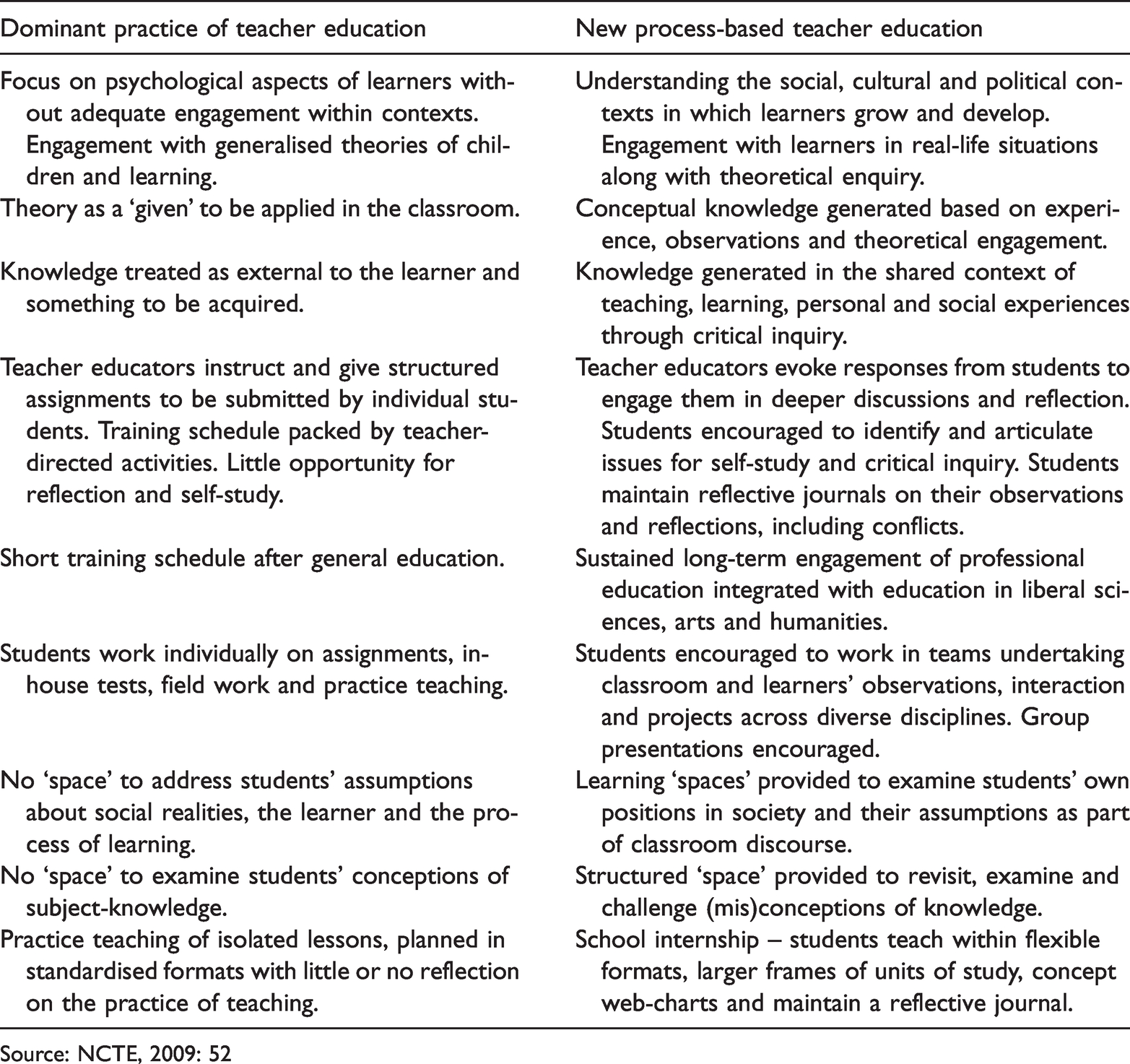
Dominant and proposed teaching practices and their binary shed light on the promotion of SCL in teaching methods. This is due to the fact that the SCL concept is loaded with specific meanings and practices, which are introduced in teacher training schools through new teaching methods. As a consequence, all Indian teachers now have to agree with the overall diagnosis of the Indian government: that there is a need to accept new teaching practices in order to enhance the teaching profession. Therefore, the next example about teaching practices (Table 1) highlights the shift of dominant and traditional teaching practice to new teaching practices.
Dominant Current Practice and Proposed Process-Based Teacher Education.
Source: NCTE, 2009: 52
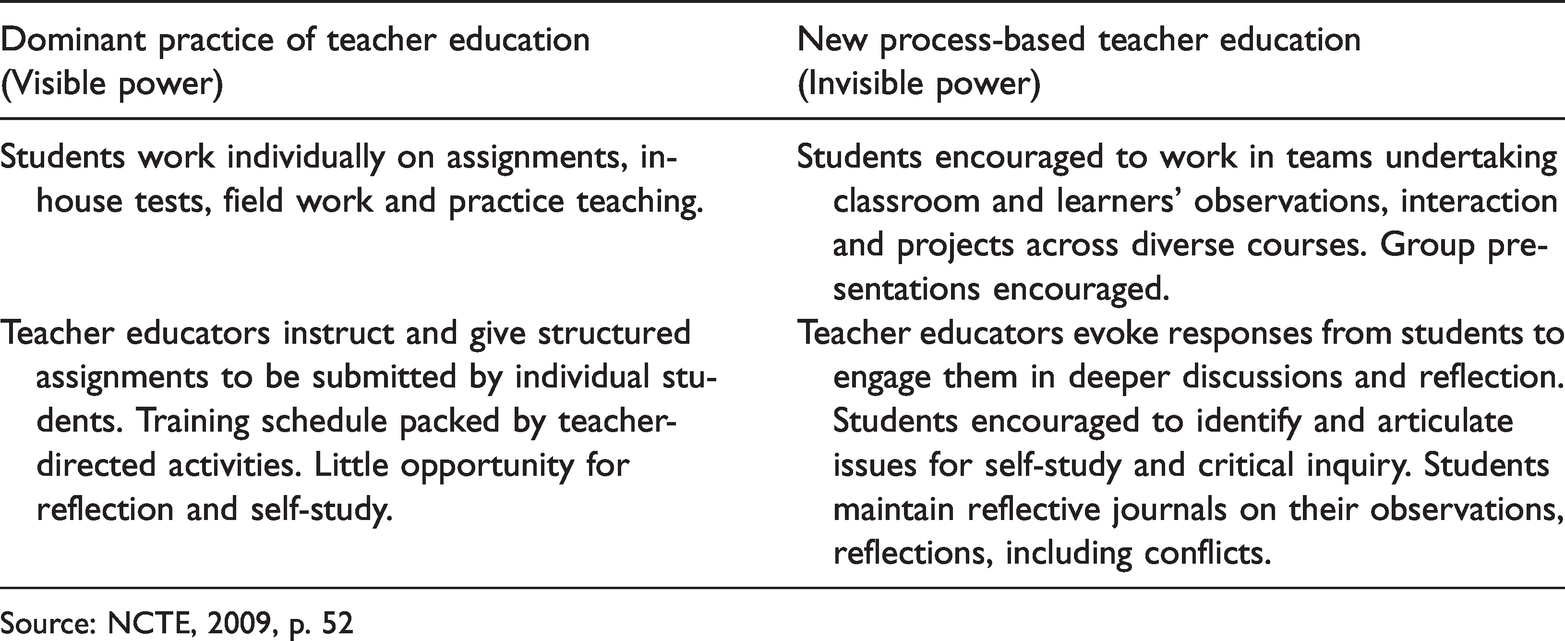
Table 1 illuminates the differences between old and new teaching practices in the NCF 2009 policy. Traditionally, students are used to doing their own assignments at home per their teachers’ guidelines and suggestions. Old teaching methods have fixed structures and guidelines to complete any assignment at home or school. Essentially, the teacher often plays the role of informer in the class and students have to jot down information and try to memorize it all for monthly and yearly exams. Also, evaluations conducted at the end of year and throughout the year are criteria used to elevate students to the next grade/class. In the case where students do not secure certain marks, they are then not allowed to advance to the next class. The NCF 2009 policy document, however, points out that traditional teaching practices are futile, and do not pay attention to each learner’s comprehension. Therefore, the NCF 2009 policy advocates new teaching practices. As shown in Table 2, the suggested teaching activities reflect the change.
Dominant Current Practice and Proposed Process-Based Teacher Education.
Source: NCTE, 2009, p. 52
Thus, the two new activities shown in Table 2 reveal a need to engage with students and learners in the classroom differently, as compared with the traditional approach. The activities recommended in the NCF 2009 policy indicate that learners have to be put in a new classroom situation, new activities need to be invented and new interactions with learners are expected. Traditionally, in India, teacher educators engage with student teachers through the lecture method, wherein the teacher always plays the role of informer. In teacher training schools, teacher educators’ old teaching method is a strict scheduled practice, in which students have less opportunity for reflection and self-study. However, the new approach suggests and argues that teacher educators and student teachers need to interact with each other and work in groups and teams; they should engage in group presentations, group fieldwork and observations. Plus, student teachers should be reflective, critical and participate during discussions.
As a whole, new teaching practices, teachers’ changed roles and learners’ changed roles all reflect the new model of Indian teacher training schools as well as SCL’s appearance through the NCF 2009. It is not just the adoption of SCL in the curricula that is promoted, but also the negation of old teaching practices, traditional values attached to the teacher’s role, and context and socio-economic history of the country. In light of these factors, there is more at stake than just upgrading Indian education to a more student-centred approach. Reorganizing teaching practices, rethinking the role of the learner, and the structure of teacher training schools are just a few examples of areas that will feel the effects of this change. The binary of old and new teaching practices can be observed as part of the SCL construction or emigration into the NCF 2009 policy. The SCL construction is an expression of the desire of the Indian government which can be observed, far from what teachers understood at an institutional level.
In a corresponding manner, the NCF 2009 policy advocates for traditional and non-traditional ways of evolution in teacher education schools and a new internship model. Since the teacher and teacher educator are now helpers in a classroom, students are not only listeners, but also become knowledge constructors – they are now active participants in meaning-making in the classroom. The following citation sheds light on these issues: A glaring weakness of existing teacher education practice is the restricted scope of evaluation of student teacher and its excessively quantitative nature. It is confined to measurement of mainly cognitive learning through annual/terminal tests; skill measurement is limited to a specified number of lessons. The qualitative dimensions of teacher education, other professional capacities, attitudes and values remain outside the purview of evaluation. (NCTE, 2009: 59)
In order to deal with the old evaluation techniques, the NCF 2009 policy advocates a teacher learning centre platform. In doing so, teachers and teacher educators can get an opportunity to conduct small-scale research in teacher training schools. Through evidence-based research, teachers get help to experience innovative ways of teaching techniques. Additionally, teacher learning centres will help teachers to understand new evaluation methods, which will then lead to improved professionalism and create SCL environments in classrooms.
Finally, there is a suggestion about assessment preparation. According to the NCF 2009, the assessment should reflect a pupil’s development progress, and every pupil should be noticed in the classroom by teachers who are able to explain in which aspect or area the pupil is progressing, and which areas need improvement. In other words, there will be a checklist reflecting each pupil’s progress. This is a shift from old evaluation techniques to a new evaluation method. Old ways of evaluation were not rendered irrelevant, but the new evaluation practice is presented as appropriate for our current context. So, the binary between old and new evaluation techniques creates space for the new evaluation technique.
The change from marks to grades is also noteworthy: ‘Qualitative indicators specific to each area of assessment need to be drawn up and initial allotment of marks should lead eventually to grades’ (NCTE, 2009: 60–61). This suggestion clearly presents a new way of conceptualizing evaluation. It is similar to the European Credit Test System (ECTS) model. These seem to be synonyms and related words, but understood differently in the NCF 2009 due to the influence of SCL. Moreover, a quality indicator is introduced to teachers so that they can conduct an everyday evaluation of pupils in the classroom through an observation technique. Hence, the first text excerpt in this section explains how the Indian teacher education evaluation system is inadequate, followed by the last excerpt, which proposes new evaluation techniques such as assessment observation, quality lists, grade systems, etc. All three activities suggested by the NCF 2009 represent a shift in teacher training schools and continued teacher education training. These activities replace the old evaluation methods, which are seen as totally outdated and futile, with new evaluation practices. Put differently, the binary between the old and new conceptualization of evaluation creates space for a new evaluation concept: the grade.
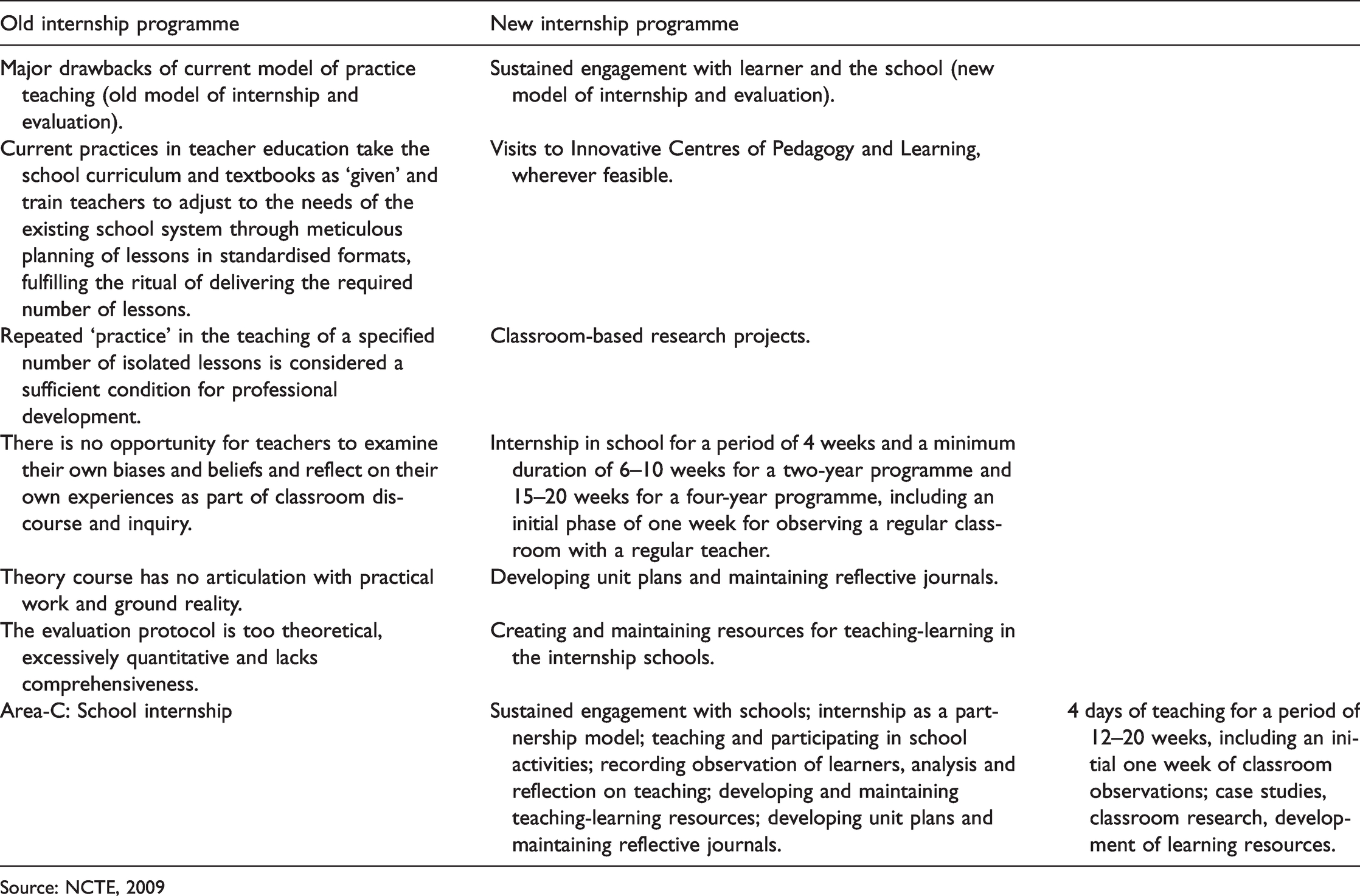
In addition to this, a new internship programme model is suggested. According to the NCF 2009, there were many drawbacks to the old internship model, and it was deemed out of date and out of touch with real life and student teachers’ experiences. The comparison table (Table 3) sheds light on the differences between the old and new internship programmes.
Old Internship vs New Internship Programme.
Source: NCTE, 2009
Table 3 explains the new model of internship. The old internship practices centred on repeated practice lessons, adjustment of teachers with text and so on. In contrast to this, the new model utilizes innovative centres for learning, classroom-based projects, a 6–10-week internship, reflective journals and creating and maintaining resources and increasing engagement with students. The change reflects a shift in practice and actual experience of student teachers at school, but it also sheds light on how other alternatives are being cut. In short, the binary between old and new internship techniques creates a space for the new internship model.
In summary, the above examples (new teaching methods and evaluations) provide insight into the promotion of SCL and its rise through binaries in the NCF 2009’s policy text. Changes are seen in the teaching method from teacher-centred to learner-centred through activities like teamwork, reflective activities, critical thinking and discussion activities at one end, and the adoption of a new evaluation system which stresses quality indicators, assessment and a grade system introduction at the other end. Moreover, the use of the internet, innovative thinking in organizing internships and reflective journals are additions to the old internship model. The contrast shown in the examples of teaching methods, evaluation and internship models denotes the old as unworkable; therefore, new teaching methods, new evaluation techniques and a new internship model are espoused. Hence, the SCL approach in the NCF 2009 is submerged in the policy text and one can trace it, as we have done above. But instead of saying that the SCL approach helps to improve learning, the NCF 2009 policy argues that it is strongly linked with teachers’ professional and unprofessional binary, so that it can be easily inserted into policy and easily accepted by teachers.
Nevertheless, the question still remains of how to conceptualize this unconscious adaptation of the SCL binary and its process in the NCF 2009 policy, or rather, how the smooth and striated space process can be mapped through the SCL binary. In this regard, the section below presents a deeper discussion on SCL’s emergence into the NCF 2009.
Reconstructing a binary of the NCF 2009 (SCL)
In the above sections, the SCL binary has been traced and its silent space has been noted in the NCF 2009 policy text and language. This section re-organizes the binary of SCL, looking at how the SCL and teacher professional binaries are contested in various transnational and national policies and reports, prior to them becoming part of India’s NCF 2009 policy. In this regard, I first look into the UNESCO policy and National Knowledge Commission (NKC) link, which seems to indirectly advocate the adoption of the SCL binary into the NCF 2009 policy. Then, I look into the National Policy on Education (NPE), the Indian Education Act and Gandhi’s and Tagore’s ideas of philosophy of education.
The NKC is a high-level advisory body to the Prime Minister of India, with the objective of transforming India into a knowledge society. It was established under Prime Minister Dr Manmohan Singh in 2005. The commission has given 300 recommendations in 27 focus areas in the years 2005–2008 and has submitted three summary reports to the prime minister, which have been combined with other recommendations into the 2008 report, Towards a Knowledge Society. This report provides in-depth explanations about concepts in the knowledge society, knowledge creation and lifelong learning discourses. All recommendations are mainly about education. Compared to UNESCO’s 2005 report, the most noticeably similar aspect is in their titles – NKC’s 2008 report is titled Towards a Knowledge Society, and UNESCO’s 2005 report is titled Towards Knowledge Societies. UNESCO’s report makes use of the word ‘societies’, which is a plural noun and therefore ultimately addresses all societies around the world, whereas NKC’s report makes use of the word ‘society’, which is a singular noun, yet echoes UNESCO’s intended deterritorialization, with a focus on Indian society. What is more, in inspecting both reports’ proposed recommendations, more similarities emerge. For example, UNESCO’s report asks, in chapter 4 ‘Towards lifelong education for all?’, why South Asia needs to reform its educational systems. For the answer to this question, I will cite a few paragraphs from the report, wherein a binary or opposition between South Asian and European education systems is presented. The selected quotations highlight how European systems perform better than South Asian systems and how the SCL approach has been a successful practice in Europe. Therefore, South Asia needs to adopt it, as the report claims: In the South, primary education statistics speak for themselves. In 2003, some 100 million children of primary school age, most of them in sub-Saharan Africa (40 million), South and West Asia (30 million) and the Arab States (7 million) were not enrolled in school. Of these, 55 per cent were girls. Whereas in Asia, with the rapid development of education systems, the number of out-of-school children fell by some 20 per cent in a decade (1990–2000) […] most of the educational research and proposals have focused, in recent decades, on new learner-centred approaches to education. These new approaches have taken over from the conventional model in which learners are often considered as the passive receptors of knowledge to which they have not contributed. On the contrary, one acquires knowledge not just by receiving it, but by actually constructing it. Knowledge is built up within a network of interactions with others (teacher, schoolmates, family, society, etc.). The teacher here is seen as a guide, a person who accompanies the learning process, rather than an authority imposing codified knowledge that the learner must simply assimilate or absorb. (UNESCO, 2005: 72–82)
Although India and other countries have different contexts, on this account, the NKC 2009 and the UNESCO 2005 reports on the knowledge society shared the same goals and vision. Most importantly, it is clear from the NKC’s report that UNESCO’s suggestions were accepted, or rather rearticulated and incorporated into the text. Now, if one looks into the NCF 2009 policy document, it is clearly mentioned that the policy is set up in line with NKC’s guidelines. Hence, the SCL approach is well promoted in the NCF 2009 policy, aiming to improve teachers’ professional skills. Likewise, in line with the Bologna 2009 report, Student-Centred Learning: A Bologna Process International Conference, whose intention is to strengthen elements from (National Team of Bologna Experts, 2009: 6), SCL is promoted for Europe’s higher education (HE) and teacher education: The concept of Student Centred Learning (SCL) extends beyond the classroom. As a matter of fact, the role of Higher Education Institutions (HEIs) is to stimulate a SCL approach by providing the adequate environment. There is no one-size-fits-all method in implementing SCL. Changes in curricula are also indispensable in order to ensure the effective implementation of SCL. (Avellino & Dimech, 2009, p. 8)
In short, the Bologna Report 2009 stresses the application of SCL in European HE because HE is facing challenges from the globalizing world and, therefore, HE learning processes need to be reorganized to meet such challenges. Here, the binary is that European HE is inadequate to deal with the challenges of globalization, so the SCL approach has to be adopted in order to enhance European HE. This binary exactly resides at the core of India’s NCF 2009 policy, reflecting a sense that the policy has multiple links. As we see, the Bologna Report 2009 highlights the significance of SCL and its relevance in European HE, and it also defines SCL as a future-promising teaching and learning practice among European nations. Similarly, the link or wording of SCL in the Indian NCF 2009 also appears as a promise to enhance teaching and learning professional practices in India.
Adding further complexity to the meaning that can be derived from the binaries in India’s NCF 2009 policy is the report The State of the Right to Education Worldwide – Free or Fee: 2006 Global Report (Tomaševski, 2006). This report argues for the right to free and compulsory education. The binary presented is that the Nordic education model of free education for all its citizens is an ideal one, whereas 170 non-Nordic countries’ models of education are not. Essentially, less developed countries are having problems providing free and compulsory education (universal primary education), which is ultimately seen as a human rights violation. Thus, the comparison between East and West (Nordic countries vs 170 less developed countries) in terms of the free provision of education for all pinpoints a hegemonic process. It also informs the notion of right to education in South Asia, and suggests that the right to education should be part of policy formulations since it will enhance children’s rights. The link to the global appearance of SCL resides in how the concept of a right to education is used in policy formulations across the world. It instructs teachers to be sensitive towards children’s right to education and to preserve it as a human right. In turn, we find this argument reflected in the NCF 2009’s policy formulation, wherein it reads: Critical awareness of human and child rights equips the teacher with a proactive perspective and a sense of agency. Respect for human rights cannot be seen in isolation from an analytical awareness of the contexts in which human rights are to be observed, starting from Constitutional Provisions (e.g., reservation and the right to education), and the institutional context, extending to the social, national and global contexts. Teachers also need to be aware of children’s rights, the role of the NCPCR in protecting these rights, rights for gender equality and their implications for social change. (NCTE, 2009: 30)
Overall, I reconstruct the SCL story from a global vantage point. In doing so, the promotion of the SCL binary (which is a core piece in the NCF 2009 policy) can be observed, detected in the UNESCO(2005), Bologna (2009) and Global (Tomaševski, 2006) reports as worldwide efforts to endorse SCL. The international reports mainly create a space within their reports through binaries. Put differently, on the one hand, we have the official policy languages; on the other, all the different discourses, binaries and stories competing to fix the policy language. More precisely, the argument is that SCL appeared in India’s policy due to its emergence on the global stage.
However, are there other explanations or narrations for SCL’s appearance in the NCF 2009? To answer this question, we must look into a few reports and social events in the Indian context, which argue that SCL is not a product of overseas influence, and that, rather, it is deeply rooted in ancient Indian practices, including those of the Indian philosophers Gandhi and Tagore.
First and foremost, a link can be observed in the NCF 2009’s policy formulation, as a continuation of India’s National Policy on Education (NPE) 1986 and its modification in 1992. The NPE 1986, NPE 1992 and NCF 2006 all concern teachers and their skills. Specifically, concern about teacher professionalism was expressed by the University Education Commission of 1948–1949: ‘People in this country have been slow to recognize that education is a profession for which intensive preparation is necessary as it is in any other profession’ (as cited in NCTE, 2009: 1). Similar concern was expressed in The Education Commission’s report (1964–1966). It professed in chapter 1, point 1.01, that ‘The destiny of India is now being shaped in her classrooms…’ (Ministry of Education, 1966: 1). This means that the teacher bears the weight of the responsibility to educate children as the future of India. It is therefore of utmost importance that the teacher acquires all necessary professional skills to help make each child’s future a promising one. Furthermore, the NPE 1986 emphasized: “The status of the teacher reflects the socio-cultural ethos of the society; it is said that no people can rise above the level of its teachers” (NCTE, 1986: V). This sentence emphasizes the importance of teachers and their contribution to school development. If the teacher’s social and cultural morals are committed, then it means teachers are the best people in a particular society, whose work cannot be compared with anyone else’s. The NCF 2009, NPE 1986 and the University Grand Commission (1948–1949) have been raising the question of teacher professionalism over the years and the NCF 2009 policy deals particularly with professionalism. So, the argument follows that there is no influence from overseas that developed the notions of teacher professionalism or SCL.
Second, the NCF 2009 and the SCL can be observed in the context of Indian High Court orders. In 2006, a law was passed called The Right of Children to Free and Compulsory Education Act. It was introduced to ensure that all children in India receive free and compulsory primary education: The Supreme Court [in India] has issued notices to the central and state governments [Indian government] regarding their obligation to ensure education for all children as the Constitution requires. The incentive was anguish because some 97 or 98 million school age children were still labouring. The case was lodged by a coalition of non‐governmental organizations, which have argued that elimination of child labour and free and compulsory education were two sides of the same coin. This necessitates integrating children’s rights in policy‐making and overcoming disjointed policies on education, labour, children and human rights. (Tomaševski, 2006: 133)
Third, the Yash Pal Report in The Committee to Advise on Renovation and Rejuvenation of Higher Education 2009 talked about an adoption of the SCL approach in HE and Indian teacher education, linking once again to the binary in the NCF 2009: The mode of transmission is also generally quite poor in terms of its pedagogic quality. The methods of teaching and evaluation used are not conducive to improving the ability of students for abstract thinking. […] The acquisition of knowledge shapes the learner’s mind and personality, as well as in the nature and productivity of the relationship between the learner and the teacher. (Yash Pal, 2013: 18–19) Setting up of Schools of Education in selected (30) university departments including the Regional Institutes of Education for breaking the isolation of elementary and secondary teacher education from the mainstream and integrating it with higher education. The Schools will have Centres for pre-service teacher education, curriculum research policy and educational development, learning and pedagogic studies, assessment and evaluation, professional development of teacher educators and teacher education curricula and teacher resource and academic support. (NCTE, 2009: 85)
In summary, the above analysis reveals that SCL appeared at both the global and local levels at the same time, in different forms. SCL, however, comes into form in a variety of ways, given different contexts. In other words, it is hard to identify one point that could give an unquestionably universal and clear explanation for SCL’s appearance since it must be contextualized, for example, through economic, gender and social issues, political efforts, social movements and so on.
Re‐reading the NCF 2009 policy as a process of assemblage
The above two sub-sections set the stage for discussions of the question raised in the introduction of this article: What can the assemblage process (smooth and striated space) reveal from the NFC 2009 policy reform? To answer the question, I explain the logic of the process of smooth and striated space in the re‐assemblage of the SCL notion.
The presence of SCL on the global stage exists in a smooth space, wherein the binary of a knowledge society from UNESCO’s 2005 report, the binary of enhancing HE from the Bologna Process Report 2009 process, and the binary of human rights inherent in the Global Report 2006 help to uphold the notion of SCL in European literature. Moreover, these reports attempt to stabilize the meaning and form of SCL. However, due to SCL’s smooth character, it found its way into European policy documents, but it equally overflowed into other countries, in what Deleuze and Guattari (1987a) describe as the transversing/contesting of smooth to striated space. From their perspective, what is important includes the ‘operations of striation and smoothing […] precisely the passages or combinations: how the forces at work within space continually striate it, and how in the course of its striation it develops other forces and emits new smooth spaces” (Deleuze and Guattari, 1987a: 500). Therefore, when SCL moves across various policies it actually works as a smooth space, whereas when SCL gets particularly defined in the context of a knowledge society, HE and human rights, then it striates a space/essential concept. However, the characterization of SCL as smooth and striated does not stop at that point but rather travels to other countries, specifically finding new ground in the Indian NCF 2009 policy context, wherein the binary and contradiction of Indian teachers’ professionalism and unprofessionalism uplift SCL. It appears that the Bologna Process Report, UNESCO, and the principle of the right to education ask for participation in the promotion of SCL at the global level. India, indeed, responds to the call for participation and follows similar guidelines as suggested by Europe, as a hegemonic influence. Indian policymakers mainly adopted and accepted SCL as a foundational new way forward, and stressed that the reason for doing so was because Indian teachers were lacking professional skills and facing privatization as well as globalization problems.
This transformation can be characterized as smooth. By considering it in an Indian policy context, the meaning and form of the notion of SCL start to stabilize, which sees a development into striated space with the argument that Indian teachers are unprofessional, at which point the NCF 2009 policy introduces SCL to elevate them. In other words, the binary always emerges in policy text because someone is in a process of excluding someone else and it appears because one wants to include other meanings in a given concept. Alternatively, the SCL can be identified at the edges of the NCF 2009 policy as smooth and striated space, since it presents multiple entry points and overlapping positions that can be observed with every changing or transforming to and from smooth/striated spaces. That, Deleuze and Guattari (1987a) argue, is the spirit of assemblage, which lies in the process of arrangement – to be in its organic nature of instability, which not only shows what it is but what assemblage can do (Deleuze and Guattari, 1987a: 4).
Conclusions
The NCF 2009 policy document is analysed using the deconstruction strategy, which is a tool to read and present the document as it appears. Next, the silent spaces or unsaid rationales in the document are unfolded in the light of the logic of smooth and striated spaces, in a process of assemblage. Most interestingly, the document appears to indicate India’s need to reform its education policy, but with a closer look, one can uncover other references, motivations and inspirations for the changes, especially with respect to the introduction of SCL (e.g. UNESCO’s 2005 report, the Bologna Process Report of 2009, the Global Report of 2006, and The Right of Children to Free and Compulsory Education 2009). Several external links and references were used to produce the NCF 2009 policy, despite its seemingly national focus.
In short, this study observed the document production as an assemblage since the various rationales travelled from different parts of the world (smooth space) and became part of the NCF 2009 policy (striated space). Importantly, the NCF 2009 policy’s intent and rationale for SCL did not stay static, but travelled to the state and regional levels, the university level, teacher training schools, and to individuals. In doing so, it created new spaces. It created new connections. In short, there are uncountable rationales and connections attached to the policy document. What assemblage connections create are ‘incorporeal senses’ (Alliez, 2006), because assemblage is made up of lines of segmentation and stratification as its dimensions, and lines of flight, or deterritorialization, as the maximum dimension through which its multiplicity undergoes.
Thus, acknowledging the multiple spaces and references of the NCF 2009 policy as well as the processes of the document without any predetermined logic, such as discursive, flows, culture, power, network, scales, structure, identification, systems, etc., teaches us that there will always be silent or unsaid lines in the NCF 2009 policy as it travels. This is especially true when the document encounters events. Therefore, an assemblage (smooth and striated spaces) opens up a new way of looking at policy documents as having a transversed (connective) character, which allows us to conceptualize globalizing education policies as a process of ‘reconfiguration, rupture and indeterminacy’ (Carney, 2016: 504–505).
Implications for future policy study
This study argues that the assemblage approach is a meaningful way to examine education policy and its various aspects. The challenge is that it has not been used to its full potential, but this article and the NCF 2009 policy case highlight its strengths. Most importantly, the assemblage approach and its usefulness need to be examined further at other policy levels, such as at the inter-organization level, to delve deeper into how it codes and communicates.
Footnotes
Funding
The author received no financial support for the research, authorship, and/or publication of this article.