



Abstract
The influence of neoliberalism on colleges and universities leads to conditions that make it difficult for students from low-income families to profit from higher education. It contributes to a less rigorous learning environment and to other consequences that harm various groups of people. This article focuses on how the corporate model that neoliberal ideology promotes leads universities to implement practices that prevent marginalized groups from benefitting from the higher education system. In addition, it mentions how these practices contribute to a less-than-optimal learning environment for many students and to other negative outcomes. Finally, it offers examples of different kinds of activism that can reduce the deleterious effects of neoliberalism.
Introduction
The USA has recently been plagued with an increasing level of racial unrest resulting from the injustices people of color too often experience. In addition to unacceptable treatment by the police, people of color have endured inequities in the public school system, preventing them from getting the education they deserve ( Morgan, 2018). Even when minority students from low-income families enroll in colleges and universities in an effort to enhance their chances for a better future, they face obstacles wealthier students typically do not encounter. The economic inequalities low-income citizens experience in America have increased in recent decades (Horowitz et al., 2020). These inequities have contributed to the rise of the protests people from all over the world have been exposed to in 2020.
One way to make American society more just for underprivileged students involves implementing policies that increase their chances to enroll in and graduate from an institution of higher education. Regrettably, the influence of neoliberalism on colleges and universities leads to conditions that make it difficult for these students to benefit from higher education. Academics have used different terms such as “the corporate university” and “the neoliberal university” to describe college campuses that function according to neoliberal ideology (Seal, 2018).
Definition and rise of neoliberalism
David Harvey described neoliberalism as a theory of economic practices based on the idea that well-being can be best attained through encouraging entrepreneurial freedoms in a society that promotes free markets, private property rights, and free trade. The state’s role in such a society is to create the structures needed for the proper functioning of markets and to generate markets in areas where they do not exist. If necessary, the state may pursue these goals by force. Once these goals are achieved, state intervention should be minimized (Harvey, 2007). Harvey mentioned that since the 1970s, a strong movement toward neoliberal thinking and practice has occurred in the USA and in other countries as well. The origins of this ideology date back to previous eras. For example, in 1947, a group of academics met in Switzerland and opposed all forms of socialism. Although some members of the US bourgeoisie supported this group, this movement had little effect on academic institutions and policy until the 1970s. And in 1980, with the election of Ronald Reagan, the influence of neoliberalism grew (Shumway, 2017).
One of the reasons neoliberal ideology influences institutions of higher education is that advocates of this approach hold important positions in education. People who promote this ideology also hold influential positions in central banks, treasury departments, and international organizations such as the World Bank. The impact of these organizations has enabled neoliberalism to become a powerful ideology with a strong effect on the way people today interpret, understand, and function in the world (Harvey, 2007). The rise of neoliberalism in the 1970s occurred as a result of the economic stagnation the USA was experiencing. After World War II, the USA prospered as Germany and Japan, two of its rivals, were rebuilding. The USA provided financial support for the economic reconstruction that helped these nations recover from the war. Some of this funding was used for industrial materials, including raw goods and machinery (Serafino et al., 2006). By the 1970s, these two countries had improved their economies. The USA, however, was experiencing a surge in oil prices and higher unemployment and inflation rates. The policies that had been implemented up to this point included labor protection and heavily regulated industries (King-White, 2018).
Economic elites and corporate leaders searched for a way to move the country forward and discussed various possibilities ranging from liberating corporate power to implementing policies that promote social democracy. By the 1970s, the ideology that became most popular involved supporting free trade and entrepreneurialism. This new approach created an atmosphere based on reducing tax rates on the rich, cutting welfare provisions, lowering funding for public programming, and creating policies that open global markets (King-White, 2018).
Effects of neoliberalism on higher education
After Reagan won the election for the presidency in 1980, he got Congress to cut taxes for the wealthy. Although Reagan’s tax and budget proposals were controversial, several factors led to their passage. First, Reagan received sympathy for his courage after he was shot, helping him gain more support for his proposals. Second, many voters approved of the tax cuts. Congress passed both his tax and budget bills after he promised to refrain from campaigning in the mid-term 1982 election against Democrats who voted for both his budget and tax bills (Cannon, n.d.).
Reagan had different views than those of Nixon, his Republican predecessor, regarding the expectations of government spending. Nixon’s most ambitious idea was the Family Assistance Plan, a new program designed to help the poor and to provide a significant economic boost to households with dependent children headed by a father or mother. Although his plan passed in the House, it stalled in the Senate (Garvey, 2013).
In contrast, Reagan demonized government, leading Americans to believe that it could not continue improving their lives. His domestic spending cuts created a new social policy designed to sharply curtail funding for public service employment, for the construction of subsidized housing, and for job training. Although Americans were experiencing a recession with the highest unemployment level in decades, the growth of the food assistance program had been stopped (Pear, 1982). The cut in spending under the Reagan administration meant there would be less support for higher education (Shumway, 2017).
Less funding for public colleges and universities
One outcome of the economy linked with neoliberalism is a transfer of risk from the corporate sector and government to families and individuals. This shift is associated not only with less funding for public education but with lower rates of healthcare access (Sakellariou and Rotarou, 2017) and fewer opportunities to receive guaranteed pensions (Shamash, 2018). As a result, between 1990 and 2010, public colleges and universities experienced a decrease in student funding, while the US inflation rate averaged over 2% per year. As Figures 1 and 2 show, harsher cuts occurred after the Great Recession of 2008, leading most states to experience more reductions in state support for higher education and to increases in tuition (Mitchell et al., 2017; Shumway, 2017).
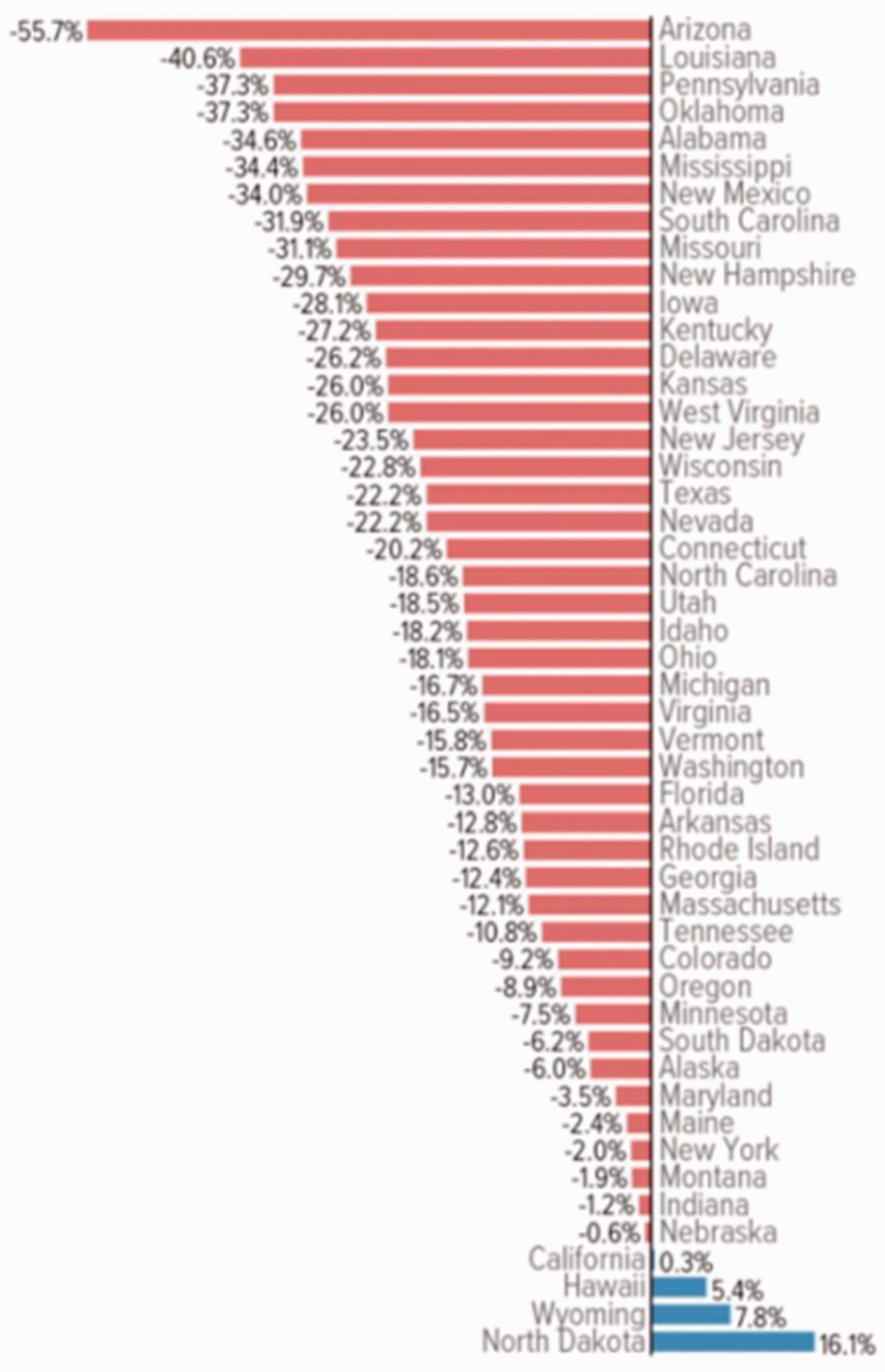
Percentage change in state spending per student, adjusted for inflation, 2008–2018. Source: Center on Budget and Policy Priorities (2018).
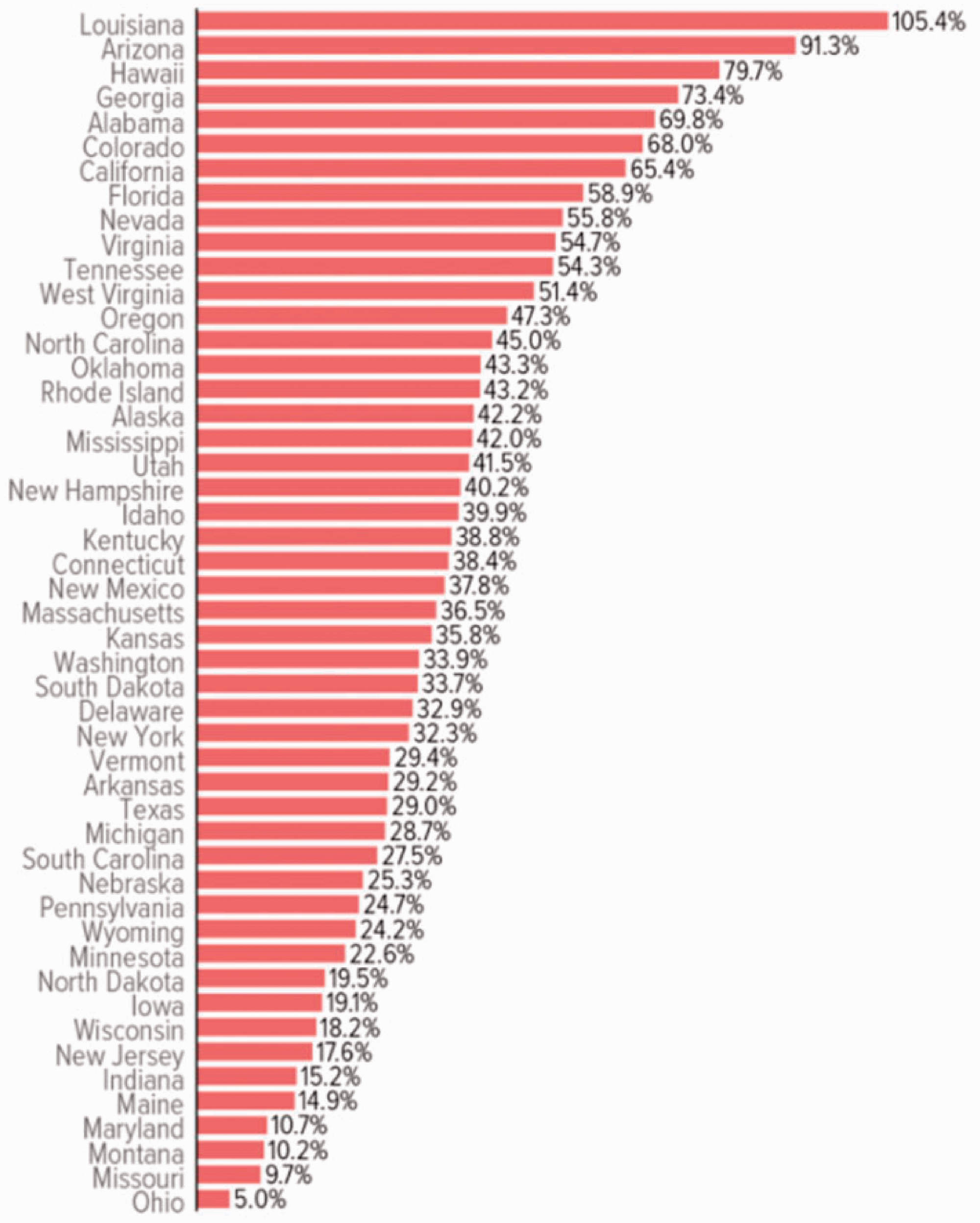
Percentage change in average tuition at public, four-year colleges, adjusted for inflation, 2008–2018. Source: Center on Budget and Policy Priorities (2018).
Harsh inequalities
The lack of funding for higher education led to a dramatic increase not only in college tuition but in student debt. After public support for higher education diminished, tuition more than doubled. Rather than complain about the cut in spending, many university executives allowed this to occur as long as they could raise tuition. These executives saw this trend as a chance to free themselves from the whims of state legislatures and to take advantage of the opportunities privatization might offer (Shumway, 2017).
While privatization may have been appealing to a significant number of university executives, it exacerbated socioeconomic inequalities. Students were encouraged to take out loans to pay for the surging costs of college. But those from low-income families were more likely than their wealthier peers to experience an enormous amount of student debt that could never be paid back. For these students, debt is a trap that functions as a form of control to keep them from gaining power (Chomsky, 2014; Maisano, 2012; Monbiot, 2016).
In the 1960s, student activism was viewed as a source of trouble, so there was a need to prevent it from erupting out of control in later years. In 1967, Ronald Reagan, serving as Governor of California at this time, expressed his disapproval for what was happening at some universities in a letter to the chancellor of San Francisco State College: How far do we go in tolerating these people and this trash under the excuse of academic freedom and freedom of expression?… Hasn’t the time come to take on those neurotics in our faculty group and lay down some rules of conduct for the students comparable to what we’d expect in our own families? (Reagan, 1967)
Neoliberal policies lead to inequalities because they redistribute wealth to the wealthiest and most powerful groups, thus reinforcing the gap between the rich and the poor (Giroux, 2014). Advocates of neoliberalism often refer to the ideas of Milton Friedman when offering their views on neoliberalism. Friedman, a Nobel Prize laureate, is frequently considered the leading economic scholar of the 20th century. He challenged the theories of British economist Lord Keynes, arguing that government should refrain from interfering with the economy and allow the free market to do its work. In contrast, Keynes believed that governments should help capitalist economies when appropriate (Noble, 2006). Friedman formed his ideas about the market during the Cold War. He believed that the communist system was oppressive, and that government was susceptible to corruption. His views appear to have prevented him from foreseeing how oppressive large corporations could be (Ng, 2018).
When universities function according to a corporate model, one of their goals is to cut costs and to increase the power of the trustees or the legislature so that they have more control of the labor force. The same process happens at corporations. To achieve this end, more temporary workers are hired. The ultimate purpose is to divide society so that a small group controls the wealth, while those outside this group live insecurely. Corporations use this approach based on the belief that when workers are insecure, they are more likely to serve their supervisors passively and less likely to go on strike, ask for benefits, or request higher wages. At institutions of higher education, some of the cheap and vulnerable employees consist of adjuncts and graduate students (Chomsky, 2014).
One of the ways implementing neoliberal ideology contributes to socioeconomic inequalities is by creating fewer opportunities for socioeconomically disadvantaged students to attend elite universities. Graduating from a prestigious university creates stronger opportunities for economic success. Achieving this goal enables graduates of these universities to be perceived as elite students worthy of holding the highest-ranking positions. This perception helps these students to secure the highest-paying jobs (Shamash, 2018). Ivy League graduates, for instance, usually earn over twice as much as those from other institutions about a decade after starting college (Gerstmann, 2019). Since the 1960s, colleges and universities have generally become much more racially diverse (Shamash, 2018). In contrast, elite universities have experienced less racial and class diversity. For example, in 2017, The New York Times reported that African American and Hispanic students were more underrepresented at the top institutions of higher education than they were 35 years ago (Ashkenas et al., 2017). Over the past few decades, college degrees from elite universities have become more difficult to obtain. Stanford, for instance, admitted 12.5% of its applicants in 2001 but only 5% of applicants in 2015. This trend exacerbates class inequalities, leading student bodies at elite universities to be increasingly represented by wealthier students (Shamash, 2018).
One reason elite universities promote socioeconomic inequalities is that their admissions policies frequently reflect their interests for maintaining the status quo. A significant percentage of students who attend these universities gain admission not necessarily because they are the most qualified but because they belong to a prominent or wealthy family. This happens because many top colleges admit legacy students, those with a family connection to the university, at much higher rates than other students (Cooper, 2020). For instance, Harvard’s acceptance rate for legacy students was recently reported to be about five times higher than its acceptance rate for other students (Gross, 2019; Korn, 2018).
Elite universities may admit legacy students at higher rates based on the belief that this practice increases alumni giving. However, little evidence supports this belief. In fact, The Washington Post reported that seven institutions that discontinued their legacy preferences from 1998 to 2008 were found not to experience short-term losses in alumni giving (Selingo, 2017). The methods these universities use to admit students is controversial because it raises concerns involving racial and class bias. This concern led to a lawsuit filed against Harvard in October of 2019 for its alleged discrimination against Asian Americans. In previous years, some legacy students with lackluster academic records were admitted to prestigious universities (Gross, 2019).
High-achieving students from low-income families who go to an elite school have better chances of succeeding later in life. Their chances improve because these colleges usually have the highest graduation rates, but the colleges socioeconomically disadvantaged students typically attend have the lowest graduation rates. A Georgetown University study concluded that because the growth in wealth inequality since the 1980s is primarily due to the postsecondary education gap, increasing the percentage of low-income students at elite universities would advance equity dramatically in America (Carnevale and Van Der Werf, 2017).
Another approach that would alleviate socioeconomic inequalities involves making higher education free for low-income students. Such an approach was recently implemented in Washington. In this state, families making under about US$50,000 per year are eligible for free public college tuition. Although other states provide financial support, Washington’s plan is superior in several ways. First, it is less restrictive. Tennessee, for example, has a plan for low-income families, but it restricts eligibility to community colleges. Second, in addition to providing free tuition, Washington invests in hiring the personnel and the supports that will increase these students’ chances of completing college and getting a job (Hansen and Goldrick-Rab, 2019).
Poor learning environment
In addition to contributing to harsh inequalities, the corporate model leads to a poor learning environment. Since neoliberal universities function primarily in terms of their economic potential, these institutions are not interested primarily in knowledge production, but in revenue generation. And the ways these universities operate influence how American families think. For example, people have increasingly viewed going to college as a monetary investment that will yield a return rather than as an opportunity to attain the knowledge needed to function as a democratic citizen (Shamash, 2018). This trend contributes to an inferior education for students for several reasons. First, when universities hire more temporary faculty to cut costs, the most knowledgeable and skilled instructors do not necessarily teach the majority of students. Second, to maximize revenue, temporary instructors are often overburdened by being assigned to teach large classes while earning low salaries (Chomsky, 2014). Third, instructors cease to be evaluated according to their educational impact. Instead, they are evaluated primarily according to their ability to generate revenue. This outcome occurs because neoliberal universities emphasize the role of faculty as entrepreneurs, not as educators or researchers (Saunders, 2010).
The change in the role of faculty is not the only factor that contributes to a poor learning environment. Neoliberal universities have increased the tendency to regard students as consumers or customers of an educational product (Saunders, 2007). When students are perceived this way, they are more likely to be taught using an approach associated with decreased academic rigor. Saunders and Kolek (2017) mentioned that such a teaching style promotes the idea that the customer is always right. A customer orientation can enhance student success because it encourages teachers to be responsive to students’ needs. Since this approach prioritizes student satisfaction over learning, some scholars have regarded it as a less academically challenging method. Strong educators often challenge deeply held beliefs; however, such a style of teaching is antithetical to an approach that emphasizes teaching according to students’ preferences (Saunders and Kolek, 2017).
The idea of dealing with the public as customers who are always right grew stronger in the 1960s and 1970s when consumer advocates, such as Ralph Nader, criticized some of the practices of government agencies and businesses. In response, many corporations restructured themselves as market driven. As universities began to feel the effect of the consumer movement and to operate more like businesses, instructors began feeling pressure to teach according to students’ preferences. Unfortunately, it became evident that after this trend occurred, over-correction in one area compromised other critical aspects involving personnel, goals, and philosophy (McMillan and Cheney, 1996).
When students are treated like customers, they frequently expect an entertaining style of instruction that makes content fun to learn while keeping them awake. This expectation influences teachers to make learning simple and entertaining. Instructors sometimes feel pressure to be entertainers in part because the business model is designed to maximize income and minimize teaching responsibilities. Few faculty members would disagree that the environment for learning needs to be stimulating. However, an academically rigorous environment deteriorates when an approach based on student satisfaction replaces the pursuit of complex ideas (McMillan and Cheney, 1996).
Other negative outcomes
Harsh inequalities and a poor learning environment are not the only consequences associated with the influence of neoliberalism. One of the most notorious cases associated with the influence of the business model occurred at Penn State University and involved Jerry Sandusky, who was convicted in 2012 for raping young boys. The Sandusky case reflects the harmful impact of neoliberalism because it shows how the millions of dollars of revenue associated with many collegiate sports programs contributes to scandals. Sandusky was a coach for the Penn State Nittany Lions who used his position to rape minors. Although he abused children on the Penn State campus at least three times from 1998 to 2002, it took over 10 years to convict him. The reason it took so long appeared to be the university’s attempt to hide the details of his crimes to protect the revenue its football program generated (Giroux et al., 2018).
Other examples of practices designed to increase revenue rather than benefit society include the deals universities make with athletic apparel corporations. These deals occur with college sports teams when athletic shoe companies such as Nike and Adidas make contracts with universities. King (2012) found that at least 23 universities had full-program contracts with companies such as Nike and Adidas and that some of these agreements involved compensation in the millions of dollars.
Collegiate sports teams attract corporations like shoe companies because they can be used to create exposure to promote brand-name goods. Such corporations often have an interest in placing logos on athletes’ uniforms because doing so creates exposure to students, athletes, television audiences, and live audiences at games. Exposing students to brand names and logos is valuable because students constitute a large part of the market for the athletic apparel sold in university bookstores. Exposing television audiences and those attending live events provides tremendous marketing opportunities, since millions of people typically attend collegiate sporting events and watch them on television each year. In fact, it is believed that placing a logo on the uniform of athletes can be a more cost-effective method than paying for a 30-second television commercial slot (King, 2012).
Although contracts with shoe companies may seem harmless, these deals have hurt people. King (2012) identified several concerns with how these deals may be detrimental. For example, some corporations have been involved in exploitive labor practices. Allowing these organizations to profit as they participate in such practices encourages these companies to continue mistreating their workers. These contracts also contribute to a commercial environment at universities rather than make these places feel like educational institutions.
Another concern involves the disparagement clauses some contracts include that ban university members from criticizing corporations. These clauses raise concerns because they are at odds with the free flow of ideas on campus. Academic freedom protects freedom of thought, expression, and speech so that knowledge can flourish (Silverstein and Steinbuch, 2019). However, some corporations have attempted to make agreements requiring universities to take the appropriate steps to redress any remark a university member makes that disparages their organization. Such agreements are frequently criticized because they allow corporations to promote market interests by restricting democratic ideals on campus. Clauses that ban university members from making derogatory remarks about a corporation suggest that these individuals cannot express their disapproval even if a corporation participates in a controversial practice. Such agreements are unacceptable for many university members because some sweatshops that produce the apparel worn by sports teams have a history of treating their workers poorly. For instance, several decades ago, Nike faced strong criticism for its abusive labor practices (Lutz, 2015).
The colonization of space and the infiltration of employees’ workloads by corporations is a problem associated with neoliberalism as well. When universities make agreements with corporations, they are often required to supply public address system announcements, endorsements on electronic message boards, and radio advertisements. University employees, such as head coaches, are frequently obligated to spend some time serving as marketing representatives for the sponsoring corporations (King, 2012).
Collegiate sports programs that generate millions of dollars are undoubtedly associated with the aforementioned problems. But these programs can also benefit universities as a result of increasing revenue and creating the educational environment students prefer. The money sports programs bring in frequently supports other programs. And the educational environment these programs create is the kind that is frequently most appealing to students. Many of today’s students feel that sports are an important aspect of American society. And some university personnel believe that many students who are interested in sports are serious about academics (Pappano, 2012). Although some university members may view these aspects of big sports programs favorably, any positive outcomes resulting from these programs do not offset the scandals linked with collegiate sports teams. In addition to the egregious conduct previously mentioned, a succession of scandals involving college sports occurred in previous years, leading over 100 colleges and universities to be sanctioned, censured, or placed on probation by the NCAA (National Collegiate Athletic Association) (Vogel et al., 2019).
Resistance against neoliberalism
Neoliberal policies that affect educational intuitions can be interrupted (Apple, 2006). Some social movements aimed at maintaining the distinction between democratic values and market interests emerged in the 1990s (King, 2012). Some of this activism involved students, and some involved faculty and the general public.
Student activism
Student activism has led to improvements regarding the treatment of workers. In 2007, for example, The Michigan Daily reported that students at the University of California, Berkeley had participated in protests in support of factory workers in Indonesia. They were reacting to Adidas’ threat to lower production at a factory where workers were planning to create a union (Kroll, 2007). Such activism has been successful in gaining huge levels of attention toward the abusive practices of apparel companies. These protests have contributed to a higher level of accountability that would have been inconceivable when universities first made contracts with corporations for apparel (King, 2012). Since 1997, students have participated in protests against the unacceptable conditions workers in the apparel industry have endured (Featherstone, 2002). By 2001, the anti-sweatshop movement was reported to be the largest wave of student activism on campuses since students united in support of freeing Nelson Mandela by requesting universities to stop investments in South Africa in order to end apartheid (Dreier, 2001). The efforts organized by United Students Against Sweatshops (USAS), a student organization with chapters at many campuses, have influenced universities to cut contracts with various companies (Lynne and Gasper, 2012).
Faculty activism
In addition to student activism, faculty involvement in social justice causes can make a difference. But as a result of a large workload, fear of institutional retaliation, and the fast pace of the academic calendar, faculty members today have little desire and energy to participate (Bose, 2012). Despite these obstacles, many faculty members contribute to social justice issues by writing content anonymously or collectively. These documents are then published as fliers, public service announcements, or pamphlets. Faculty members also publish content in academic journals and books to raise awareness about human rights violations. Through instructional activities, they can contribute by teaching students a type of writing intended for general audiences that documents forms of social stratification and oppression (Bose, 2012).
Several examples of faculty members who have published content on university practices that harm people illustrate how this work can increase the awareness needed to create change. For instance, Christopher Newfield, a professor of English at the University of California, Santa Barbara, has written various articles for Inside Higher Ed that have exposed the deleterious practices associated with neoliberalism. In one of these articles, he mentioned the inferior learning environment many students are experiencing today by documenting how a student government leader felt. This student mentioned that she had been in large classes with as many as 800 people at the University of California, Berkeley and that very few professors knew her by name. The way this student felt reflects the skepticism many students have toward public universities. Students today are increasingly questioning whether these institutions can provide the attention they need to develop the skills the job market requires (Newfield, 2015).
In another article, Newfield discussed how public colleges have not been fulfilling their role of helping non-elite people develop the skills needed to succeed. He mentioned that since the Morrill Act of 1862, this role has been a public-good obligation which public colleges need to address. The Morrill Act of 1862 provided federal land grants for funding colleges in each state to create opportunities for more people who previously did not attend college. It focused on promoting practical education for the industrial classes. The second Morrill Land-Grant College Act was passed in 1890. The second act’s purpose was to provide more support for the colleges established under the first act (Brooks and Marcus, 2015). Newfield suggested several strategies for creating better opportunities for non-elite people, including providing budgetary reinvestment for less-selective public institutions so that students there can experience the same learning opportunities as those available at wealthier campuses (Newfield, 2016).
Peter McLaren’s work on critical pedagogy and resistance also provides insights on action that can mitigate some of the detrimental practices that neoliberalism promotes. McLaren is a professor in critical studies at Chapman University. Critical pedagogy involves the co-creation of knowledge by students and teachers to develop social justice programs for the purpose of changing an oppressive society. McLaren recently authored an article asking if the efforts designed to liberate the oppressed from exploitive practices are slowing down as a result of a long struggle that has lasted many decades. He answered this question in part by referring to the Chicago teachers who recently started an uprising. By doing this, he reminded readers how powerful critical pedagogy can be and concluded his paper by arguing that this form of pedagogy will survive and develop as the dangers associated with neoliberalism become fiercer (McLaren, 2020).
Another faculty member who has published content on the deleterious practices at universities is Marc Bousquet, a professor at Emory University. Bousquet has written articles documenting the mistreatment of adjuncts and students. He also published a book titled How the University Works: Higher Education and the Low-Wage Nation. One of the topics covered in this book is the low pay adjuncts earn. Bousquet mentioned that adjuncts teach a large percentage of classes at today’s universities, often gladly accepting this role while believing they could work their way up to a tenure track position. However, this belief contradicts what usually occurs. Even worse are the low wages adjuncts earn, wages that typically do not allow them to pay back their loans and make many of them live near the poverty line (Bousquet, 2008).
Bousquet also documented student participation with staff and faculty in a series of walkouts and strikes in response to tuition hikes, wage cuts, and layoffs. One protest occurred in 2009 when an estimated 5000 people took part in what was believed to be the largest demonstration at Berkeley since the 1960s (Krupnick and Oakley, 2009). At the University of California, Santa Cruz, protesters occupied the Graduate Student Commons and communicated through many media platforms. Their demands varied, ranging from lowering textbook prices to ending capitalism. And despite the protestors’ diverse demands, groups from all over the world expressed their support. These supporters included workers and students from Britain, South Africa, Croatia, and the USA (Bousquet, 2010).
The Black Lives Matter movement
Black Lives Matter (BLM) is a movement designed to resist systematic racism and violence against Black people. This movement started in 2013 in response to the death of Trayvon Martin and the acquittal of George Zimmerman, who was responsible for Martin’s death (Davies, 2020). The BLM movement has expanded considerably since it started. This movement became more noticeable in 2020 after a series of incidents involving the police and Black people. As a consequence of these events, BLM activists, many of whom are students, are urging colleges to disassociate themselves with the police (Dennon, 2020).
Students are not the only ones asking for reforms to be made regarding the ways police officers function in American society. Christy E. Lopez, a law professor at Georgetown University expressed her views about this topic in The Washington Post, mentioning that defunding the police should not seem as scary as people might believe. Advocates who believe in proceeding this way argue that the police should not be made to do things they have no desire to do, such as settling family disputes. Rather than fund the police for this purpose, they argue that society would be more equitable if the funds went to areas such as healthcare and other similar services (Leonhardt, 2020).
Although proposals to defund the police differ between cities, common themes exist regarding why doing so might benefit society. In addition to shifting more funds to areas such as healthcare, the funding can be used for housing and education. Advocates of defunding the police argue that improving these areas would reduce crime and violence. They feel this way because the current approach has not solved the injustices that continue to occur. Several cities have already made changes regarding how law enforcement reacts. For instance, in 2019, millions of dollars for mental health concerns were allocated to revamp the public safety system in Austin, Texas. Today operators answering 911 calls ask if fire, police, or mental health services are needed (Searcey, 2020).
Another problem that needs to be addressed involves the way university police treat Black students and other students of color. In 2013, campus security asked several female Black students at Vassar College for identification while they were doing their laundry (Chase and Suriel, 2020). In 2018, a Black graduate student fell asleep in a common room at Yale University as she was working on a paper. A White student called the university police after finding her asleep. The Black student, Lolade Siyonbola, made a 17-minute video of her encounter with police and posted it on Facebook. Many viewers protested to the way Siyonbola had been treated by the White student and the campus police (Griggs, 2018). Another incident involving two Native American brothers occurred at Colorado State when campus police removed the brothers from a tour for appearing suspicious (Chase and Suriel, 2020).
Conclusion
The influence of neoliberalism on institutions of higher education is associated with few positive outcomes and many negative consequences. This influence has contributed to reductions in state funding, lower levels of academic freedom, higher tuition costs, and student loan debt many students cannot pay back. Rather than prepare students to function as democratic citizens, the corporatization of American universities leads these institutions to focus on narrow job-training (Cole and Heinecke, 2020).
In addition to exacerbating socioeconomic inequalities, the use of the corporate model at universities has been criticized for contributing to a poor learning environment. Treating education as a process in which students are consumers similar to customers who purchase products from a business is problematic. The teaching process has traditionally been implemented through a hierarchical approach in which a teacher with authority interacts with students to educate them about the subject the instructor has studied extensively. This process becomes less academically rigorous when faculty members implement an approach that places more emphasis on teaching according to students’ preferences than on challenging deeply held beliefs. Although higher education in many countries is not free, treating it as an economic transaction between a seller and a buyer leads to perverse consequences (Lorenz, 2012).
Other ramifications can result from the influence of neoliberalism on universities. As the example involving Penn State showed, university members may even ignore criminal conduct to protect the revenue their sports programs generate. And students are more likely to view education primarily as a tool by which they can prosper economically rather than as an opportunity for enhancing their critical thinking skills. In other words, they are less likely to believe in learning for its own sake and more likely to view it as a form of the job training needed to secure a high-paying position (Deresiewicz, 2015).
University members can take action to mitigate the harmful effects neoliberalism has on society and on institutions of higher education. In 2013, for example, after encountering pressure from various universities, Adidas agreed to compensate 2700 Indonesian workers after they were laid off without severance pay (Yates, 2013). This type of action can influence policymakers to make the changes needed to reduce the inequalities students of color and other marginalized groups continue to experience at American institutions of higher education. If this kind of resistance grows, more deleterious practices associated with neoliberalism will likely end. Such a trend will lead to better outcomes for the majority of students at American universities and for society as well.
Footnotes
Declaration of conflicting interests
The author(s) declared no potential conflicts of interest with respect to the research, authorship, and/or publication of this article.
Funding
The author(s) received no financial support for the research, authorship, and/or publication of this article.
