




Abstract
This paper focuses on entrepreneurship educators as creators of an entrepreneurial learning environment in entrepreneurship education. Entrepreneurship education research has concentrated mainly on the subjects of education (i.e. the students) or on the content of learning, leaving individuals with a critical role in entrepreneurship education – the educators – without sufficient attention. In response, the research question for this study is: how do entrepreneurship educators create entrepreneurial learning environments in entrepreneurship education within higher education? The qualitative study draws on the principles of Vosniadou et al. concerning active learning environments by concentrating on interviews with entrepreneurship educators and documentary data. An entrepreneurial learning environment can be defined as a self-regulatory, co-created learning setting in which entrepreneurship students from different backgrounds learn in teams, as the findings suggest that educators emphasise adjustable co-creation within a ‘given’ format involving individuals with complementary skills working in teams. The study contributes to fulfilment of the identified need to understand the educator’s perspective, and to share the know-how and educational experiences of entrepreneurship educators. Practitioners can use the findings as a concrete tool for the creation of an entrepreneurial learning environment. They can learn from, adopt and develop the practices discussed when designing learning environments for their entrepreneurship students.
Keywords
This study focuses on entrepreneurship educators as creators of an entrepreneurial learning environment in entrepreneurship education (EE) within higher education (HE). The educator’s work is not merely to perform in front of the students and assess them at the end of the course; it also involves designing education in a way that will enhance students’ learning (Knight, 2002: 3; Ramsten, 2003: 23). Hannon (2018) explains that entrepreneurship educators are role models who play an influential part in shaping students’ current thinking and future aspirations. In a similar vein, EE scholars have noted the important role of educators as possible creators of opportune conditions for effective and efficient learning in entrepreneurship (Béchard and Grégoire, 2005; Lee et al., 2018; Neck and Corbett, 2018). However, EE research has focused mainly on the subjects of education (that is, students) (Gielnik et al., 2014; Michaelis et al., 2019; Piperopoulos and Dimov, 2015), or on the content of learning (that is, programmes, courses and intervention descriptions) (Fox et al., 2018; Gibb, 2011; Laukkanen, 2000). This has left the educators without sufficient attention (Hannon, 2018; Neck and Corbett, 2018). Further, scholars have recognised the need to share the know-how and educational experiences of educators in EE (Dominik and Banerji, 2019; Lee et al., 2018).
Scholars have argued that, to learn entrepreneurship, one must participate in entrepreneurship (Neck and Corbett, 2018; Neck et al., 2014). Consequently, the importance of entrepreneurial learning – which is a form of active learning that allows students to learn as real-life entrepreneurs through their own actions – has recently been hailed (Hahn et al., 2017; Lackéus, 2013; Man, 2007; Neck and Greene, 2011). This means that HE educators are challenged to create learning environments which meet academic requirements while simultaneously maintaining a reality-based focus and an entrepreneurial climate throughout the learning experience (Solomon, 2007). Moreover, these learning environments should be designed to be appropriate for heterogeneous student groups (Huang-Saad et al., 2020; Pardede, 2015).
Despite the requirements associated with cultivating innovative ways to introduce entrepreneurial approaches to education and learning (Higgins et al., 2013), many entrepreneurship educators lack educational expertise and do not understand the pedagogical underpinnings of the practices they have adopted (Béchard and Grégoire, 2005; Fayolle et al., 2016). In addition, the rapid expansion of EE has led to a point at which the educators as well as the students have heterogeneous backgrounds. Educators not only from the field of business but also with backgrounds in technology, psychology, art, music and engineering, among other fields, are being invited to develop and teach EE courses. Naturally, these various educators have different understandings of entrepreneurship, on which they rely when creating the learning environment (see Gibb, 2011; Kabongo and McCaskey, 2011). It is debatable whether EE activities remain closer to craft than to science, are driven by experience more than systematic teaching approaches, and whether they are too strongly guided by pedagogy rather than by actual learning objectives (Fayolle and Gailly, 2008).
In response to such dilemmas, the present qualitative study investigates the creation of an entrepreneurial learning environment from the educator’s perspective. To do so, it asks the following research question: how do entrepreneurship educators create entrepreneurial learning environments in EE within HE?
Learning environments in EE
Learning environments can be defined as settings in which students learn (see Frenzel et al., 2007; Veermans and Murtonen, 2017). EE often highlights the role of active learning, or learning in which students play a central role in their own learning processes (see, e.g. Gibb, 2011; Rae, 2012; Solomon, 2007). In EE, entrepreneurial learning is a specific type of active learning. Entrepreneurial learning allows entrepreneurship students to learn in a way similar to real-life entrepreneurs, and this has been identified as a prerequisite for the development of entrepreneurial competencies (see Hahn et al., 2017; Lackéus, 2013; Neck and Greene, 2011; Man, 2007).
This study draws on a framework of principles of active learning environments (Vosniadou et al., 2001). In their work on conceptual change, Vosniadou et al. (2001) form general principles of active learning environments based on previous literature (see, e.g. Bereiter and Scardamalia, 1989; Brown, 1994; Collins, 1996; Glaser et al., 1996) and assert that these principles are accepted by most researchers in the field of cognitive science. Active learning plays a central role in the work of Vosniadou et al. (2001) as well as in entrepreneurial learning in EE. Therefore, this study applies the principles of active learning as a framework through which to understand the process of creating an entrepreneurial learning environment in EE.
The principles of active learning environments set out by Vosniadou et al. (2001: 382) are:
To understand and structure an ongoing learning environment discussion in EE, a literature review was conducted. 1 The learning environment literature was structured with the assistance of the principles presented by Vosniadou et al. (2001), and Table A1 in the Appendix provides examples of how the authors’ general principles are manifested in the EE literature.
Principle 1 in EE literature: ‘Learning environments should support active learning and guide students towards the acquisition of self-regulated processes’
The majority of EE studies describe learning environments using the terms ‘novel’, ‘new’ and ‘creative’ (see, e.g. Chang et al., 2014; Gibb, 2011; Kuratko, 2005; Rae, 2012). In such cases, active learning is supported through activities such as roleplaying, pitches and competitions, management simulations, and fieldwork and experiments (Higgins et al., 2013; Honig and Karlsson, 2004; Kirby and Ibrahim, 2011; Walter and Dohse, 2012). The literature presents these active elements in contrast to more passive elements, such as lectures, videos, dialogue and readings, that do not support active learning (Walter and Dohse, 2012).
The reasons behind such a juxtaposition are clear. Through traditional/reflective methods, students remain passive and the teacher dictates the learning process. Through active methods, students must initiate and engage in the learning process themselves (Walter and Dohse, 2012). On the one hand, traditional and teacher-centred approaches follow the behavioural school of thought, wherein the focus is placed on observable and measurable aspects of behaviour and learning is achieved through reinforcement and repetition. Active methods and student-centred approaches, on the other hand, follow constructivism, which positions learning as a modification of cognitive structures (see Piaget, 1936). Constructivism builds on a learner’s prior knowledge as well as on how new knowledge is organised within that prior knowledge. In addition to the action itself, the role of metacognition – that is, the reflection on learning – is important in constructivism (Hahn et al., 2017).
Nabi et al. (2017) point out that, despite the call for more active learning, many entrepreneurship courses and programmes still follow behaviourism rather than constructivism. Despite the acknowledged importance of active learning, Fayolle and Gailly (2008) argue that there should also be room for ‘teaching’, a key method in traditional learning. In addition, scholars have highlighted the importance of incorporating theory into every learning activity (cf. Fiet, 2001; Higgins et al., 2013; Jack and Anderson, 1999), rather than merely ‘doing’ for the sake ‘doing’.
Potential challenges associated with implementing active learning have been extensively stressed in the EE literature. Researchers question whether entrepreneurship educators receive enough pedagogical training (Béchard and Grégoire, 2005), and thus possess sufficient skills, and whether a considerable amount of educators’ energy is diverted from their main tasks and taken up in defending unconventional pedagogical choices (Gibb, 2011). Recent studies have also highlighted resource-related issues such as funding and costs, infrastructure, the teacher–student ratio, institutional philosophies, and regulatory and accreditation requirements which educational institutes are expected to meet (Nyadu-Addo and Mensah, 2018; Refai and Klapper, 2016) and which might hinder educators’ work and the creation of entrepreneurial learning environments.
Principle 2 in EE literature: ‘The relevance and meaningfulness of educational tasks’
Vosniadou et al. (2001) perceive learning as an activity that occurs in a social and cultural context. It is argued that learned material is more effectively remembered and adopted when situated in real-world contexts, and when the educational tasks make deliberate use of students’ surrounding physical and social contexts (Vosniadou et al., 2001). Some scholars argue that the aim of EE is to draw students closer to the social practice of ‘being an entrepreneur’ (Pittaway and Thorpe, 2012: 23). In many EE articles, scholars highlight that, in facilitating students’ entrepreneurship, active, experiential and engaging methods in real-life contexts should be preferred (e.g., Chang et al., 2014; Hahn et al., 2017; Rae, 2012; Refai and Klapper, 2016).
The existing literature highlights the importance of the ill-defined and chaotic nature of educational tasks (Solomon, 2007), while at the same time asserting that each teaching model should be carefully built on a specific ontological and pedagogical hypothesis (Pittaway and Hannon, 2008). Importantly, entrepreneurship scholars point out that a one-size-fits-all model or a universal pedagogical EE recipe cannot be developed, due to course-related and contextual factors, and institutions must thus determine their distinctive educational tasks (Farny et al., 2016; Fayolle and Gailly, 2008; Kassean et al., 2015; Pittaway and Cope, 2007; Refai et al., 2015).
Because relevant and meaningful EE tasks are related to real-world contexts and practices, discussions are also being held about who should teach entrepreneurship. Scholars ponder whether entrepreneurship scholars with scarce or no practical entrepreneurial backgrounds are able to create relevant and meaningful EE tasks (Fayolle and Gailly, 2008; Pittaway and Cope, 2007).
Principle 3 in EE literature: ‘Learning is not an individual but rather a social affair’
Vosniadou et al. (2001) argue that students should be encouraged to work with other students and to learn from one another. Learning environments in EE are described as places where many teaching and learning activities are facilitated through collaborative work in groups or teams. Interdisciplinary programmes and courses are considered especially valuable in bringing students from different backgrounds together to exploit new opportunities and create enterprise activities (Lourenço et al., 2013; Nyadu-Addo and Mensah, 2018). Higgins et al. (2013) rationalise this social dimension by claiming that learning occurs through interaction and dialogue with others who possess differing perspectives and ideas, which can lead one to question one’s own practices by exploring alternative ways of acting.
The EE literature also highlights the importance of exposing students to the entrepreneurial ecosystem and communities of practice through, for instance, mentoring, coaching and interacting with actors beyond their fellow students (Gibb, 2011; Nyadu-Addo and Mensah, 2018). This approach suggests that alternative stakeholder groups from other faculties also play a highly important role in learning environments. Wang and Verzat (2011) assert that students tend to be more enthusiastic about and receive more pleasure from learning through adventurous experiences with individuals other than fellow students alone.
Principle 4 in EE literature: ‘Take into consideration individual differences’
Vosniadou et al. (2001) highlight that each student’s uniqueness should be respected. As such, teachers should understand each student’s strengths and weaknesses and should consider those elements when designing the learning environment to ensure its effectiveness. Discussion regarding individual differences is becoming increasingly important in the EE context, stemming specifically from EE’s rapid growth and expansion throughout all academic fields (Gibb, 2011; Kuratko, 2005). This discussion seems to revolve explicitly around two groups: first, heterogeneous student groups, wherein business- and non-business-focused students are perceived as fundamentally different from one another and, second, how to educate non-business-focused students and mixed groups of students (Kassean et al., 2015; Lourenço et al., 2013).
Scholars have also taken into consideration students’ varying socio-demographic characteristics, such as previous entrepreneurial experience and other previous experience and assumptions (Hahn et al., 2017). The development of an individual’s practical skills and attributes is one of the key objectives in EE (see, e.g. Chang et al., 2014; Hahn et al., 2017; Kirby and Ibrahim, 2011). In addition, educators must consider that some EE teaching and learning activities rely on a constructivist paradigm. Such a paradigm calls for personal involvement and reflection, according to the premise that each student is an active creator of his or her knowledge and that such knowledge is created by linking new information to prior knowledge. One can thus argue that individual differences are always implicitly taken into consideration when educators rely on constructivist paradigms.
Methodology
Study context
This is a qualitative study that reports findings from a venture development intervention in EE. The qualitative approach was selected to bring educators’ voices to the fore, as suggested by scholars (Hannon, 2018; Lee et al., 2018; Neck and Corbett, 2018). In order to respond to the research question – how do entrepreneurship educators create entrepreneurial learning environments in EE within HE? – the study focuses on educators’ perspectives on learning environment creation in a non-compulsory, Bachelor’s-level intervention in HE. The intervention was organised jointly by three Finnish higher education institutions (HEIs) – a university and two polytechnics – as part of a national Junior Achievement Young Enterprise programme.
During the intervention, students were expected to set up real businesses that would operate in real markets by ideating, validating, launching and running a new venture in multidisciplinary teams. The intervention used a fairly common format in ‘for entrepreneurship’ courses (see Rasmussen and Sørheim, 2006). The size of the teams varied from two to six students and some contained students from all the participating HEIs. The business ideas ranged from a design studio and webstore to embedded electronics. No prior studies in entrepreneurship were required, and so the extent of prior entrepreneurship knowledge varied considerably among the students – a common occurrence in multidisciplinary entrepreneurship courses (see Pardede, 2015). The majority of the 57 students who took the course were male, most were studying business or technical sciences, and the majority were Finns (but a handful were international students from different countries, including Germany, Peru and Bangladesh). The course was a 10 ECTS graded intervention that lasted 18 weeks. 1 ECT is equivalent to 27 hours of work, meaning that the students were expected to work a total of 270 hours for the course.
The course relied on team teaching in pairs, and the educators (four in total) represented all the participating institutions: two from the university and one from each of the polytechnic institutes. All four were equally responsible for the teaching and learning activities, and for designing the learning environment of the intervention. As there are no exact time allocations per course for educators in the Finnish HE system, the educators decided their time allocations individually. The educators from the university formed one teaching pair, and those from the polytechnics formed the other. The teaching pairs worked closely together throughout the course as they used an interactive form of team teaching (White et al., 1998): they worked together in pre-course discussions regarding course design, held regularly weekly discussions throughout the course, contributed to the meeting sessions and evaluation, and held post-course discussions after the course. The course was divided into similar afternoon and evening sessions to make it more flexible for students and to support learning across nearly 20 teams. The student teams decided at the beginning which sessions worked better for their own schedules. They worked for the whole time in the afternoon or evening sessions. The activities were similar in both sets of sessions: the main difference was language, with afternoon sessions held in English and the evening ones in Finnish. From the educators’ perspective, their roles and responsibilities were similar in both. The educators from the university were responsible for the afternoon sessions, while the educators from the polytechnics were responsible for the evening sessions. The educators from the polytechnics often took part in both afternoon and evening sessions, because they were willing to learn from the more experienced educators of this particular course. Both the university educators had been involved in the course for several years, whereas the polytechnic educators were running it for the first time during this study.
The learning philosophy of the intervention relied on a constructivist approach. The educators encouraged the teams to actively identify problems and suitable solutions on their own. Rather than acting as lecturers, the teachers acted as facilitators by posing questions to help the student teams find solutions by themselves. The teams dictated the major decisions of their venture development. The educators decided that the learning experiences of the students would be discussed and reflected on during the meetings, making the learning environment very learning-centred and interactive. They also decided that the meetings would be organised at the nearby premises of a local science park, so removing both themselves and the students from the traditional physical HE learning environment (e.g., large lecture halls and auditoriums). They considered the location to be an important part of demonstrating the ‘uniqueness’ of the course.
Collecting and analysing the research material
In order to understand how entrepreneurship educators create entrepreneurial learning environments, a qualitative research design was applied. This included interviewing the HE educators and gathering documentary data from their course planning materials. The interview material was used to understand the perspectives of entrepreneurship educators on the learning environment, while the course planning materials were used to understand the intervention’s structure and content.
In total, two course educators – representative of each teaching pair and labelled Educator 1 (E1) and Educator 2 (E2) – were interviewed using semi-structured interviews. The informants were selected on the grounds of their availability and willingness to participate in the interviews, as well as their authority in running this well-known course. As the learning environment design was undertaken by all four educators and in teaching pairs, the educators were able to discuss how they had made decisions about the learning environment. E1 worked as a researcher in a business school of a multidisciplinary university, and E2 worked as a lecturer in arts management at a polytechnic.
E1 had been involved in the course for 5 years. He had worked as a researcher in the field of entrepreneurship for the past 15 years, but the course was one of his very first teaching experiences. According to his account, an opportunity for him to run the intervention arose almost accidently. The concept seemed interesting, and when the previous course educator suggested that a rotation should be implemented, he was ready to step in with another researcher from the same university (to form the teaching pair). E1 had no pedagogical training experience or qualifications.
E2 was a new educator in the intervention, as was the other in his teaching pair. He had worked as a lecturer for the past 11 years at a polytechnic, and so had a substantial teaching background. He had been involved in some entrepreneurship activities at the polytechnic and considered himself a natural choice to run the course when the opportunity arose. E2 had complete pedagogical qualifications. Given their differing experiences, the informants complemented each other on paper.
The semi-structured interviews had four themes: the informants’ backgrounds, what the intervention was about, how the intervention was designed, and why the intervention was designed as it was. The informants were interviewed separately in their native language. The interviews lasted from 45 to 90 minutes, and each was recorded and transcribed. Documentary data concerning the course planning materials designed by the educators comprised: 1) a course guide, a planned schedule and marketing materials, making up 25 pages of a Microsoft Word document; 2) boot camp session slides, biweekly meeting slides and session assignment materials, making up 18 slides in total in a Microsoft PowerPoint presentation; and 3) a Microsoft Excel spreadsheet containing business numbers.
The course guide contained the course’s overall description (i.e., course content and a rough description of the methods used) and intended learning outcomes. The planned schedule contained the topics of the planned biweekly meetings. The marketing materials comprised the documents that were used to market the course to the potential students, while the boot camp (i.e., the starting session of the course) and biweekly meeting assignment materials contained the instructions for the assignments that guided each meeting. The Excel spreadsheet containing business numbers allowed students to calculate important numbers such as the breakeven point of their start-up.
The research materials – that is, both the interview and documentary data – were qualitatively examined following the steps of Braun and Clarke’s (2006) thematic analysis. Thematic analysis was chosen because it is a useful method for making educators’ perspectives visible in a structured manner. Braun and Clarke (2006) and Brooks et al. (2015) describe thematic analysis as a useful method particularly for examining the perspectives of different research participants, highlighting similarities and differences and crafting unanticipated insights. Thematic analysis is also useful in identifying key features from the data, as it requires a well-structured approach to data handling.
The research materials were first read carefully several times, and the initial thoughts and ideas raised by them were written down. This ensured that a complete view of the research materials was obtained. Second, the research materials were deductively coded into four categories, based on the principles set out by Vosniadou et al. (2001): 1. support of active learning and self-regulated processes; 2. relevant and meaningful educational tasks; 3. the social aspect of learning; and 4. individual differences. Third, the coded data in each category were reviewed and, in some areas, refined before the final key features were labelled in each category. Refining was needed especially to differentiate principle 1 from principle 2, and principle 3 from principle 4, as these principles seemed to come close to each other. Examples of quotations that provided evidence of how the learning environment was created by the educators are provided in the next section.
Results
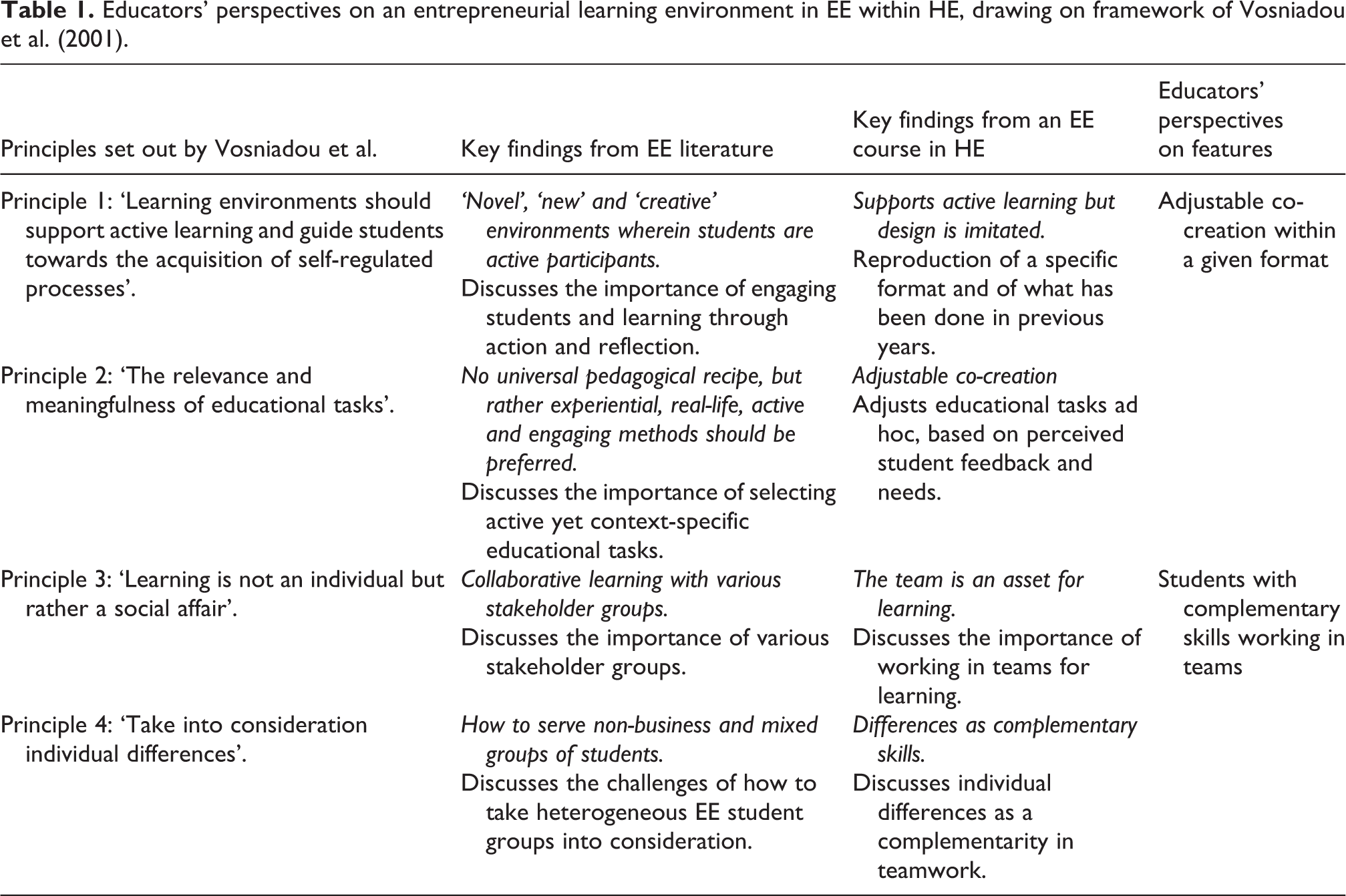
The findings of this qualitative study were structured according to Vosniadou et al. (2001) to demonstrate EE educators’ perspectives on the creation of an entrepreneurial learning environment. The findings show how the four principles of Vosniadou et al. (2001), as stated above, are identified in the research materials.
Entrepreneurial learning environments support active learning and self-regulation but are created through imitation
The research materials, including the interview and documentary data, clearly showed that the educators manifested the first principle of Vosniadou et al. (2001) in learning environment creation. The course planning materials confirmed that the learning environment was designed in such a way that the students could apply their existing theoretical knowledge of entrepreneurship in a real business setting, as this intervention encompassed many themes that may have been familiar from other entrepreneurship courses. Moreover, the educators instructed the students to set up businesses in multidisciplinary teams based on their own interests.
The educators designed the learning environment in such a way that the self-regulation of students played an important role. Although the course included a starting session (boot camp) and biweekly meetings, the educators designed it so that the main work would be completed between the meetings: ‘The actual magic happens in between the meetings’ (course marketing materials). This decision meant that organising and conducting work in teams outside the classroom and without tight, pre-set tasks required a considerable amount of self-regulation from each student. The interviews revealed that the educators believed the learning environment encouraged the student teams to determine their own particular way of proceeding with their business idea. E2 believed that the active and self-regulatory design provided an important and unique opportunity for students to consider their own capabilities in relation to their identified problems and solutions. This opportunity was not only related to the completion of the course assignment (i.e., setting up a business); E2 also identified it as a means for students to see themselves as potential actors and proactive problem solvers in real-life business situations. The educators also believed in the importance of enhancing students’ working life skills and their motivation to learn: I truly believe that students learn better by following a learning-by-doing approach, and one also accommodates the knowledge better if one finds the information her/himself. (E2)
The interviews revealed that, in their creation of an entrepreneurial learning environment that supported active learning and self-regulation, the educators reproduced history. This meant that they did not design the learning environment from scratch but used the way the learning environment had previously been designed as a starting point from which to build the course. E1, who had been involved in the course for years, brought up the role of imitation. He mentioned that when he had started as an educator on this course, he had observed and learned how the experienced educators at that time were conducting it. E2 further confirmed that he had followed in E1’s footsteps when running the intervention himself. The educators had clearly considered the overall course philosophy as something not to be changed; its value and functionality were self-evident and unchallenged. As part of a national Junior Achievement Young Enterprise programme, the educators were given free rein to implement the learning environment as they wished; the only aspects assigned by the organisation were the topic, some dates (e.g., when the national finals were held) and specific instructional materials.
Entrepreneurship educators use adjustable co-creation for relevant and meaningful educational tasks
The documentary data revealed that the meeting themes and tasks supported the course’s aim of setting up businesses in multidisciplinary teams (see Appendix, Table A2 for the meeting themes) and could therefore be considered meaningful and relevant. During the intervention, the educators briefly provided the students with basic information ‘about’ entrepreneurship and the start-up process. This included, for instance, activities that involved calculating relevant business numbers or deciding on suitable business models for the ventures.
The educators designed the 18-week course to begin with an intensive 7-hour boot camp session. They felt this type of longer session was needed at the beginning to allow the students to meet one another for the first time and team up to accomplish the course task. Because students were supposed to execute their business ideas in teams, the educators began the course with exercises to facilitate team formation and idea generation. Thereafter, based on the educators’ decisions, the course consisted of biweekly meetings and independent teamwork. During each meeting, the educators gave the teams assignments that were planned to guide their venture development. The assignments comprised various activities, such as idea generation and testing, business model generation and validation, and pitching and marketing, and were in line with the key meeting themes and pushed the entrepreneurial process forward.
The educators did emphasise the role of pitching throughout the intervention, as they saw it as a way for students to develop their presentation skills and to share how their business idea had progressed. The student teams also prepared themselves for the course’s national final, a pitching event at which teams from similar types of courses competed against one another at the national level. Preparing for the final may have been one reason for including regular pitching exercises in the course design, as the documentary data revealed the final to be a great experience for the most promising entrepreneurship teams: ‘The best teams from each university will compete in the national final in May’ (course marketing material). Naturally, the educators wanted their teams to succeed nationally, which had happened in previous years.
The documentary data further confirmed the active nature of the intervention, as the educators had decided not to employ lectures or exams: ‘The course does not have an exam or lecturing. How awesome is that?’ (course marketing material). On this point, E2 mentioned that the course tasks were not like ‘traditional’ lecturing, as the aim was to provide a real-life entrepreneurial experience for the students. The educators mentioned that they had designed the course to be ‘adjustable’, meaning that they had roughly structured the course and each meeting, but that the teaching and learning activities were decided just prior to each meeting. Additionally, the teaching and learning activities were subject to modifications during a session to allow better support of student learning and their entrepreneurial processes: I would call it “adjustable”…We want to be able to react to the opportunities and keep the door open if something interesting comes across. (E1)
This type of adjustable approach clearly elicited both positive and negative opinions among the educators. For E1, it seemed an important and fundamental way to act; however, E2, as a new educator on the course, struggled with the approach. He admitted that he did not have a firm grasp of the learning environment, which naturally increased his uncertainty as an educator, and asserted that the course required that he ‘throw himself into the process’, similar to the students. The course design seemed to rest on the shoulders of the more experienced educators, which naturally led to feelings of anxiety and insecurity in the newcomer. He mentioned that he would like to be more involved in the learning environment design in the future, even though he had, in theory, already had the chance to be more involved. Although E2 did not have a firm grasp of the structure of this venture development intervention, he clearly understood that the more experienced educators were really the ones responsible for designing the educational tasks. It was an aspect in which he was neither allowed nor able to intervene in too extensively; every detail had already been created, but he was not too troubled by this, considering that it would have required much more from him.
Entrepreneurship educators believe that the team is an asset for learning
The social aspect highlighted in Vosniadou et al. (2001) was thoroughly embedded in the learning environment by the students’ teamwork. The educators designed the learning environment such that no one could succeed without implementing the business idea as part of a team. However, they did not ponder or question the rationale for this social aspect in the creation of the learning environment.
Teamwork – specifically, multidisciplinary teamwork – was praised by the educators as an important aspect of the learning environment. The student teams were required to make multiple uncertain decisions to carry out their processes of venture creation. Making these decisions can be stressful for individual students, but, as E2 mentioned, ‘teamwork brings balance to this freedom’. It is generally easier to reach a conclusion and make a decision when the details are carefully discussed among team members. E1 confirmed that this process represented an important learning experience the students needed to face, as they overcame challenges together. In addition, E1 mentioned that discussion and co-learning between the teams had become increasingly important over the past few years: ‘Getting together is a great way to show and celebrate your achievements and of course to learn from each other’ (course marketing material). Further, E1 had witnessed the success of teamwork in previous years when the student teams had won national finals. This may have reinforced his beliefs about value of teamwork.
The teams acted as co-mentors for one another, and the biweekly meetings were designed so that they began with ‘team news’, which consisted of a half-hour session during which each team described what it had done and how it had proceeded in the venture creation process in the previous 2 weeks. Moreover, teamwork was considered a truly natural part of the learning process, and the educators perceived collaborative learning as ‘good’: Freedom to decide almost everything and find [one’s] own way of doing can be challenging for students. Working in a team helps to overcome the challenges. (E2)
Entrepreneurship educators assume individual differences to be complementary skills
The research materials demonstrated that the fourth principle of Vosniadou et al. (2001), individual differences, were visible in the learning environment. The educators, however, discussed the differences in terms of how they appeared but did not touch much on how they had specifically embraced individual differences in the creation of the learning environment.
The research materials illustrated the existence of individual differences among the students. Already, the educators represented different educational institutions, which might have eased the students’ concerns and encouraged them to approach the educators and seek help when needed. The course’s student population was also heterogeneous; some were from the polytechnics, where E2 claimed active learning was enhanced, while others were from traditional university programmes, where lecturing and independent studying were the most commonly used teaching methods. E1 stated that some students clearly considered that the entrepreneurial learning environment, in terms of the methods employed, seemed too strange, new and demotivating, and were thus unwilling to continue participating: Some students really enjoy the learning methods; some clearly are frightened. (E1)
Among a few clearly visible aspects considered during the learning environment design which related to individual differences among students was that the students were to operate in multidisciplinary teams; through teamwork, individual differences were praised as positive assets. A starting point for the learning environment design in this venture development intervention was that each team member’s complementary skills were expected to lead to more beneficial entrepreneurial outcomes: One of the most important aspects of the course is that the students come from different disciplines and they can concretely act and do things in multidisciplinary teams. (E2)
Educators’ perspectives on an entrepreneurial learning environment in EE within HE, drawing on framework of Vosniadou et al. (2001).
Conclusion, limitations and implications
The aim of this study was to respond to the following research question: how do entrepreneurship educators create entrepreneurial learning environments in EE within HE? The study sheds light on educators’ perspectives and experiences, as recently suggested by scholars (Hannon, 2018; Lee et al., 2018; Neck and Corbett, 2018). Further, it responds to the identified need to share the know-how and educational experiences of educators in EE (Dominik and Banerji, 2019; Lee et al., 2018). In addition, by bringing principles set out by Vosniadou et al. (2001) into the EE context, it provides a more detailed understanding of what constitutes an entrepreneurial learning environment. In responding to these various needs, the study offers novel insights into the realities of how entrepreneurship educators from heterogeneous backgrounds design entrepreneurial learning environments together. The aim was not to exemplify an ideal, one-size-fits-all best practice, but to portray the creation of an entrepreneurial learning environment realistically by noting the difficulties and challenges involved in this creative process while the educators made choices they believed would enhance student learning (Knight, 2002: 3; Ramsten, 2003: 23).
Based on the findings, entrepreneurship educators emphasise adjustable co-creation within a ‘given’ format and students with complementary skills working in teams in entrepreneurial learning environment creation. Further, the ‘entrepreneurial learning environment’ in HE can be defined as a self-regulatory, co-created learning setting, wherein entrepreneurship students from different backgrounds learn in teams. Theoretically, the findings illustrate the interconnectedness of the original four principles of Vosniadou et al. (2001), as they are merged into two features in the context of EE.
The findings reveal many issues and challenges that entrepreneurship educators should consider when designing learning environments, and warn us that entrepreneurial learning environments can be reproduced without significantly questioning existing practices (Farny et al., 2016). On the one hand, with regard to the ideal of EE being presented as ‘novel’, ‘new’ and ‘creative’ in the literature (Chang et al., 2014; Gibb, 2011; Kuratko, 2005; Rae, 2012), entrepreneurship educators may fail to demonstrate these qualities in actual implementations of EE design. On the other hand, educators may have deliberately considered the design and believe it to demonstrate an entrepreneurial learning environment. A learning environment can be at the same time well-tried for the educators but new to the students. The findings also imply that educators value other features of entrepreneurial learning environments more than the actual format.
In addition to the lack of questioning of existing formats, the entrepreneurial learning environment design revealed self-regulation and team-related issues. This study calls for a greater understanding of these issues in EE, and of how they can be overcome, as well as of how students’ entrepreneurial learning and team learning can be enhanced, as both can be rewarding but can also hinder learning. Further, the findings call for more detailed understanding of team-teaching and its related challenges in EE as these are particularly complex in multidisciplinary HE learning environments (Minett-Smith and Davis, 2020). Team-teaching can benefit from heterogeneity in the skills and backgrounds of educators, but it requires the capability to take advantage of them (Letterman and Dugan, 2004).
Despite its merits, the present study has some limitations. The article focuses on the educators’ perspectives on the creation of a learning environment they believe will enhance the skills and competencies of entrepreneurship students. As the study does not focus on outcomes or impacts, it would be interesting to examine students’ experiences with and learning outcomes specific to entrepreneurial learning environments, and so to determine the role of the learning environment in students’ overall learning. This could also clarify how the formal learning of students is comparable to the learning of real-life entrepreneurs. The article focuses on issues that were discussed in separate interviews or recorded in the documentary data collected from one HE course that had been in existence for several years. Discussion that occurred between the educators was outside the scope of the study. Observation of the learning environment design process would enable a deeper understanding of the associated educational underpinnings, or the lack thereof, and this constitutes a possible future research direction which might provide a more detailed appreciation of the design process and team-teaching, while further elucidating the work distribution among the educators. In addition, studying the learning environment design of a completely new course or in a different educational context might be a promising direction for further research.
The present study’s findings, which help to structure what constitutes an entrepreneurial learning environment from the educator’s perspective, should be of use in the design of future entrepreneurial learning environments. However, the findings also encourage a more reflective approach to EE to enhance students’ entrepreneurial learning.
Footnotes
Declaration of conflicting interests
The author(s) declared no potential conflicts of interest with respect to the research, authorship, and/or publication of this article.
Funding
The author(s) received no financial support for the research, authorship, and/or publication of this article.

Note
Appendix
Descriptions of meeting themes and tasks.
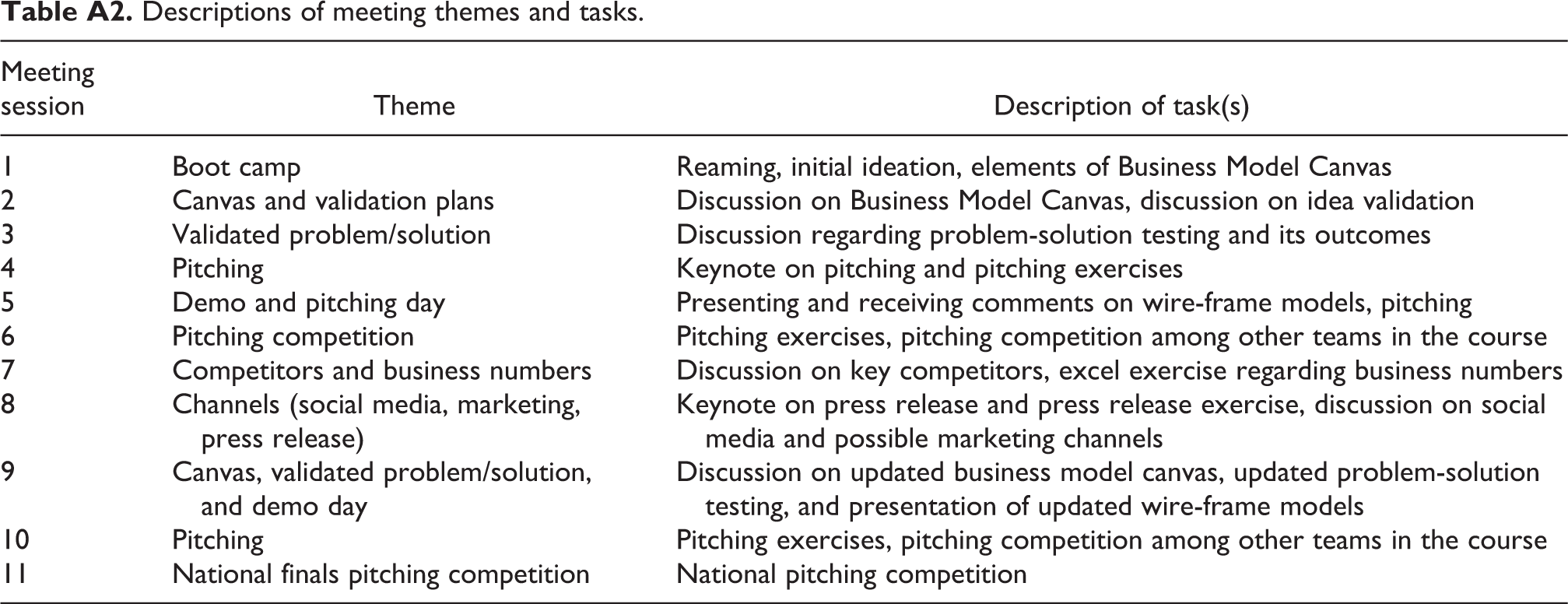
| Meeting session | Theme | Description of task(s) |
|---|---|---|
| 1 | Boot camp | Reaming, initial ideation, elements of Business Model Canvas |
| 2 | Canvas and validation plans | Discussion on Business Model Canvas, discussion on idea validation |
| 3 | Validated problem/solution | Discussion regarding problem-solution testing and its outcomes |
| 4 | Pitching | Keynote on pitching and pitching exercises |
| 5 | Demo and pitching day | Presenting and receiving comments on wire-frame models, pitching |
| 6 | Pitching competition | Pitching exercises, pitching competition among other teams in the course |
| 7 | Competitors and business numbers | Discussion on key competitors, excel exercise regarding business numbers |
| 8 | Channels (social media, marketing, press release) | Keynote on press release and press release exercise, discussion on social media and possible marketing channels |
| 9 | Canvas, validated problem/solution, and demo day | Discussion on updated business model canvas, updated problem-solution testing, and presentation of updated wire-frame models |
| 10 | Pitching | Pitching exercises, pitching competition among other teams in the course |
| 11 | National finals pitching competition | National pitching competition |