



Abstract
In 2018, Programme for International Student Assessment (PISA) introduced an assessment of global competence to equip young people with the skills, knowledge, attitudes and values to create “an inclusive and sustainable world” (OECD, 2018: 1). Throughout this article, we take the OECD seriously at their claims around inclusion. We look critically at the global competence framework to ask what PISA means by inclusion and trouble the idea that inclusion can function effectively within a global standardized assessment. We put Bernstein’s (2000) notion of recontextualization to work to demonstrate how inclusion takes on new meaning as it moves between each iteration of the global competence framework. We show how this recontextualization re-orientates inclusion from a social justice imperative toward supporting young people’s inclusion into a globalized market economy.
Introduction
In 2018, PISA introduced a global competence assessment to prepare fifteen-year-olds for “an inclusive and sustainable world” (OECD, 2018: 1). This focus on inclusion was so significant that the OECD’s framework on global competence was itself titled: Preparing our youth for an inclusive and sustainable world: The OECD Global Competence Framework (OECD, 2018). The 2018 assessment of global competence aimed to measure students’ knowledge, skills, and attitudes deemed necessary for building a more “just, peaceful, inclusive, and environmentally sustainable world” (OECD, 2018: 11). According to the OECD, global competence will equip young people with the skills, knowledge, attitudes, and values to achieve this inclusive future.
Despite these claims of inclusivity, how truly inclusive can a global standardized assessment be? What implications might this assessment have for youth in low- and middle- income countries, particularly those in vulnerable and marginalized communities? Throughout this article, we take the OECD seriously at their claims around inclusion. We look critically at this global competence framework to ask what PISA means by inclusion and trouble the idea that inclusion can function effectively within a global standardized assessment. Drawing on the Bernsteinian (2000) notion of recontextualization, we demonstrate how inclusion takes on new meaning as it moves between different iterations of the PISA global competence framework. We argue that the OECD’s narrow and economistic view of inclusion carries considerable potential to change the very meaning of the term, re-orienting “inclusion” from a social justice imperative and narrowing it toward supporting young people’s induction into a globalized market economy.
The OECD and the global power of PISA
The curious relationship between PISA, global competence and inclusion requires a deeper understanding of the organizational intent of the OECD’s administration of the PISA international assessment. Every three years, PISA international assessments assess the knowledge and skills of 15-year-olds in literacy, mathematics and science in member and non-member countries. PISA assessments have been implemented in more than 70 countries, however the PISA 2018 global competence assessment saw only 27 countries participate (OECD, 2020). The intent of PISA assessments is to create an “internationally comparative evidence base for educational policy development and implementation” (Wiseman, 2013: 304). Much has been written about the significant influence PISA has on the reconstruction of education systems throughout the world (Cobb and Couch, 2018; Sellar and Lingard, 2014; Wiseman, 2013). While it is not our intent to replicate this comprehensive account here, it is worth being reminded of the way that the OECD uses PISA data to examine, dissect and create a blueprint of successful school systems in a bid to remedy failing education systems (Münch, 2014). This has seen nations look to OECD policy recommendations to reform their own education systems in an attempt to “climb up” the PISA rankings (Wiseman, 2013). For this reason, PISA is regarded as “one of the most influential international comparative assessments globally” (Gorur et al., 2019: 302) and has cemented the OECD’s global influence in the field of education.
Given PISA’s seismic influence on global education reform, it is of interest that PISA 2018 has included an assessment of global competence. One must ask why, out of all the possible cognitive domains and fields, global competence was chosen to be included in PISA’s assessment program. This significance is further heightened by the fact that an assessment of global competence signals a notable point of departure from the OECD’s previous focus on cognitive subjects, such as reading, mathematics, and science. Aligning with a more recent shift within PISA’s program of assessment to measure a broader range of skills, the 2018 assessment of global competence establishes a “new dimension of the OECD’s education work” (Engel et al., 2019: 118) by assessing knowledge, skills, and attitudes toward global competence (OECD, 2018). The assessment of attitudes enters a new realm of possibility, raising questions about whether attitudes can be assessed and ranked, and how education systems might be reformed according to attitudes and values. The OECD believes that it can accomplish this, and their assessment of global competence offers an opportunity to establish its dominance within this new and emerging field (Engel et al., 2019).
So why, then, has the OECD taken such an interest in global competence? To understand this requires a closer look at the different and competing conceptualizations of global competence. As a phenomenon, global competence is ill-defined and highly contested. It emerged from within global citizenship discourse, having been used for centuries alongside related terms such as cosmopolitanism and global-mindedness (Oxley and Morris, 2013). There are two distinct and competing conceptualizations of global citizenship (Dill, 2013), which become known as global competence when transferred into the language of assessment (Auld and Morris, 2019). The first proposes a skill focus, aiming to equip students with skills to compete in the global knowledge economy. These skills include the ability to speak an additional language and adapt flexibly to effectively compete in a global marketplace (Engel et al., 2019). In other words, it prepares young people with the ability to broker deals and collaborate in multinational corporations. Here we see how global competence directly contributes to human capital development, and why the OECD has taken such an interest in accelerating its widespread implementation into education systems (Morgan and Volante, 2016). However, critics argue that this notion of global competence is both ahistoric and depoliticized, focusing purely on the cognitive domain of global competence while overlooking the cultural, historical and political factors that underpin a richer and broader conceptualization (Maxwell and Yemeni, 2018). For this reason, this narrow interpretation of global competence has been strongly rejected by a number of academics (Auld and Morris, 2020; Engel et al., 2019).
The contrasting perspective of global competence is founded on a global consciousness approach which promotes humanistic assumptions and values. This is achieved through developing an inclusive global orientation, cultural sensitivity, and empathy. It begins with critically reflecting on oneself to identify and challenge existing bias and stereotypes that may perpetuate discriminatory and exclusionary attitudes and behaviors. UNESCO has long advocated for this global consciousness approach by focusing on developing intercultural awareness and understandings (Deardorff et al., 2018). This dates back to a series of seminars held in the late 1940s and early 1950s through which UNESCO sought to promote discussion about the role of education in bridging long-lasting peace and cross-national understanding (see Kulnazarova and Ydesen, 2016). Interestingly, earlier research shows that the OECD’s own definition of global competence has changed over time, shifting away from a focus on global interdependence and intercultural sensitivity toward a more technical instrumentalist focus on skill development for the global knowledge economy (Auld and Morris, 2019). Given that global competence has emerged from within these competing discourses of global citizenship, it is not surprising that a singular definition of global competence has been difficult to achieve.
Until now, these opposing definitions of global competence have co-existed, highlighting the competing agendas that have underpinned the development of this pedagogic space. Yet, the OECD’s entry into these debates signals an important shift in the way global competence is both conceptualized and defined. Assessing global competence requires a clear definition. Because of this, global competence could only be included in the OECD’s suite of international assessments if the definition was “well-reasoned and exacting” (Engel et al., 2019: 172). While the OECD has no formal authority within the field of education (Ydesen and Bomholt, 2020), we demonstrate that this assessment of global competence has enabled the OECD to take an authoritative position within the illusive pedagogic field and define global competence according to its own mandate.
The politics of inclusion: Global competence and PISA
The pursuit of educational inclusion has become synonymous with the process of identifying obstacles that deny participation in learning. As Shaeffer (2019) indicates, this can entail identifying barriers to both access and equity, (exclusion from education) as well as barriers to educational quality (exclusion within education). Barriers such as exclusion by disability, or gender, are well established sub-fields within existing academic literature on inclusive education (Ainscow, 2005; Unterhalter, 2007). Conceptualizing inclusion as overcoming barriers to access and participation has led to the consideration of additional exclusionary factors such as wealth, geography and language of instruction (Shaeffer, 2019). As a broader politic of inclusion is embedded within academic literature and national and international understandings of inclusive education, exclusionary factors often intersect (Miles and Singal, 2010; Unterhalter, 2012). As an organization with the intent to promote economic development, where does an engagement with inclusion fit within the OECD’s mandate?
Given the OECD’s strong allegiance to human capital development (Morgan and Volante, 2016), it is curious that the notion of inclusion is overtly emphasized in the 2018 PISA global competence framework. In fact, the wording within the framework’s title – Preparing our youth for an inclusive and sustainable world: The OECD Global Competence Framework’ (OECD, 2018)––clearly indicates the OECD’s intent to prepare youth for an inclusive world by becoming globally competent. One reason for this unlikely alliance might be found within the OECD’s development of PISA for Development, or PISA-D. From 2021, PISA aims to extend the OECD’s sphere of influence into low- and middle-income countries, with the aim of having 170 countries involved by 2030 (Auld et al., 2019; Kaess, 2018). The PISA assessment of global competence has provided a way for the OECD to further legitimate this “new paradigm for development” (Auld and Morris, 2019: 678), and position PISA as the primary instrument to measure the Sustainable Development Goals (SDGs). Specifically, the assessment of global competence aims to measure SDG Target 4.7, which reads: By 2030, ensure that all learners acquire the knowledge and skills needed to promote sustainable development, including, among others, through education for sustainable development and sustainable lifestyles, human rights, gender equality, promotion of a culture of peace and non-violence, global citizenship and appreciation of cultural diversity and of culture's contribution to sustainable development. (United Nations, 2017)
The relationship between global competence, inclusion and PISA becomes more evident when considering the broadened conceptualization of inclusion within the SDGs. While the 1994 Salamanca statement (UNESCO, 1994) advocated for learners with disabilities and special educational needs to have regular access to education through the removal of barriers that inhibit educational and societal participation (Hornby, 2014), there has been growing recognition that barriers to educational access are experienced by a large number of children, not just those with disabilities and special educational needs (Shaeffer, 2019; UNESCO, 2020). The Millennium Development Goals (MDGs) focused on getting children into school, yet, in doing so, it became evident that a growing number of out-of-school children were excluded from education as a result of barriers to educational access and learning. Poverty, war, health, language, geography, religion, migration and gender all contributed to large numbers of out-of-school children. The SDGs aimed to respond to these concerns by charting a more inclusive framework for educational access. The result saw a broadening of the United Nations’ use of the term inclusive education from an emphasis on people with disabilities, to one that sought to remove all barriers to education in the SDGs (Shaeffer, 2019). The 2020 Global Monitoring Report Inclusion and Education: All means all (UNESCO, 2020) defines inclusion as “… a process, actions and practices that embrace diversity and build a sense of belonging, rooted in the belief that every person has value and potential and should be respected” (UNESCO, 2020: 11). From this perspective, inclusion for all children and young people is achieved by removing barriers “based on gender, remoteness, wealth, disability, ethnicity, language, migration, displacement, incarceration, sexual orientation, gender identity and expression, religion and other beliefs and attitudes” (p. 4). The Global Monitoring Report reminds us that inclusive practices benefit everybody and, to achieve this, the report recommends that inclusion should be responsive to the needs of learners (UNESCO, 2020). Inclusive practices may, therefore, look different from one class, center, school, region, and country to the next. This suggests that inclusion cannot be standardized, yet, the OECD proposes that it can.
So how, then, does the OECD conceptualize an “inclusive future?” And perhaps more to the point, how does the OECD believe that an assessment of global competence will achieve such an ideal? Below, we outline the methodology that guided this study before making the case that the OECD’s view of inclusion within its assessment of global competence moves toward a new form of inclusion, namely, one that eschews the established discourses to include youth within a global market economy.
Methodological considerations
Our study began by considering how the OECD framed inclusion within The OECD PISA 2018’s Global Competence Framework (OECD, 2018). Specifically, we asked: How is inclusion conceptualized in the OECD Global Competence Framework? How does the OECD maintain that becoming globally competent will create an inclusive society?
To that end, we conducted a document analysis of key global competence texts produced by the OECD to understand how the global competence assessment was conceptualized and developed over time. These texts include the first public draft of the Global Competence Framework: Global competence for an inclusive world (OECD, 2016); the final Global Competence Framework: Preparing our youth for an inclusive and sustainable world: The OECD PISA global competence framework (OECD, 2018); and the PISA 2018 Assessment and Analytic Framework (OECD, 2019), which provide details about the assessment design and analytic processes.
Our analysis involved two moves. In the first, we analyzed these documents thematically to identify notions of inclusion within the texts (Braun and Clarke, 2006). Documents were uploaded into NVivo software where memos were recorded on each document to report on emerging insights, themes and ideas. We employed an a priori approach to our thematic analysis, where themes were identified from Shaffer’s (2019) analysis of the barriers to inclusion, which included “exclusion by (dis)ability and special education needs,” “exclusion by geography,” “exclusion by language,” “exclusion by gender,” and “exclusion by wealth.” “Exclusion by wealth” refers to the exclusionary impact of poverty on both educational access and quality. On the other hand, “exclusion by language” recognizes the negative impact on learning when educational instruction is not provided in a child’s mother tongue. “Exclusion by geography” refers to the difficulty for children in rural, hard-to-reach and remote localities to physically attend school. “Exclusion by gender” acknowledges gender disparities, with domestic requirements in some cultures resulting in girls being less likely to attend school, while boys in other contexts are more likely to drop out of school to undertake employment for their families. Finally, “excluding children with disabilities and special educational needs” is recognized through the stigma, marginalization, and exclusion children with disabilities experience within education and society. These themes were created as nodes in NVivo, and each document was systematically coded according to these initial themes. This initial layer of analysis helped us to identify how the OECD conceptualized inclusion in their foundational public documents on assessing global competence, and whether it aligned with the broader conceptualization of inclusion, as outlined for instance in the SDGs. We also considered these conceptualizations across time, to determine if there had been a shift in the way inclusion had been conceptualized between the 2016 proposed global competence framework document (OECD, 2016) and the final 2018 global competence framework (OECD, 2018).
The second move in our analysis was theoretical, and involved putting Bernstein’s (2000) theory of recontextualization to work. Bernstein (2000) maintained that ideology and bias become embedded within educational transmission, when pedagogical concepts, such as global competence, move between different actors and fields. Through this shift, educational ideas take on new meaning, as underlying ideology recontextualize these educational ideas, subverting them from their original intent (Couch, 2018). Our intent in putting Bernstein’s recontextualization to work was to understand whether conceptualizations of inclusion have taken on new meaning when framed within PISA’s global competence documents. To do this, we identified additional themes, or nodes, based on the suggestion in previous literature that the OECD brings an economic lens to their conceptualization of global competence. These themes included “global knowledge economy,” “economy,” “global knowledge workers,” “preparation for work,” and “productivity.” The intent of this secondary analysis was to determine whether an economic imperative underpinned the OECD’s conceptualization of global competence and, if so, how the notion of inclusion was framed within this emphasis on human capital production.
Locating inclusion within the OECD’s definition of global competence
How is inclusion conceptualized by the OECD? And has this conceptualization changed over time? In exploring these questions, we were particularly interested in understanding whether there had been a change in the conceptualization of inclusion between the initial proposed framework (OECD, 2016) and the final document (OECD, 2018). Additionally, we considered whether this conceptualization of inclusion remained consistent in the PISA 2018 Assessment and Analytic Framework (OECD, 2019)––a key document which sets out a comprehensive framework for the PISA 2018 global competence test development.
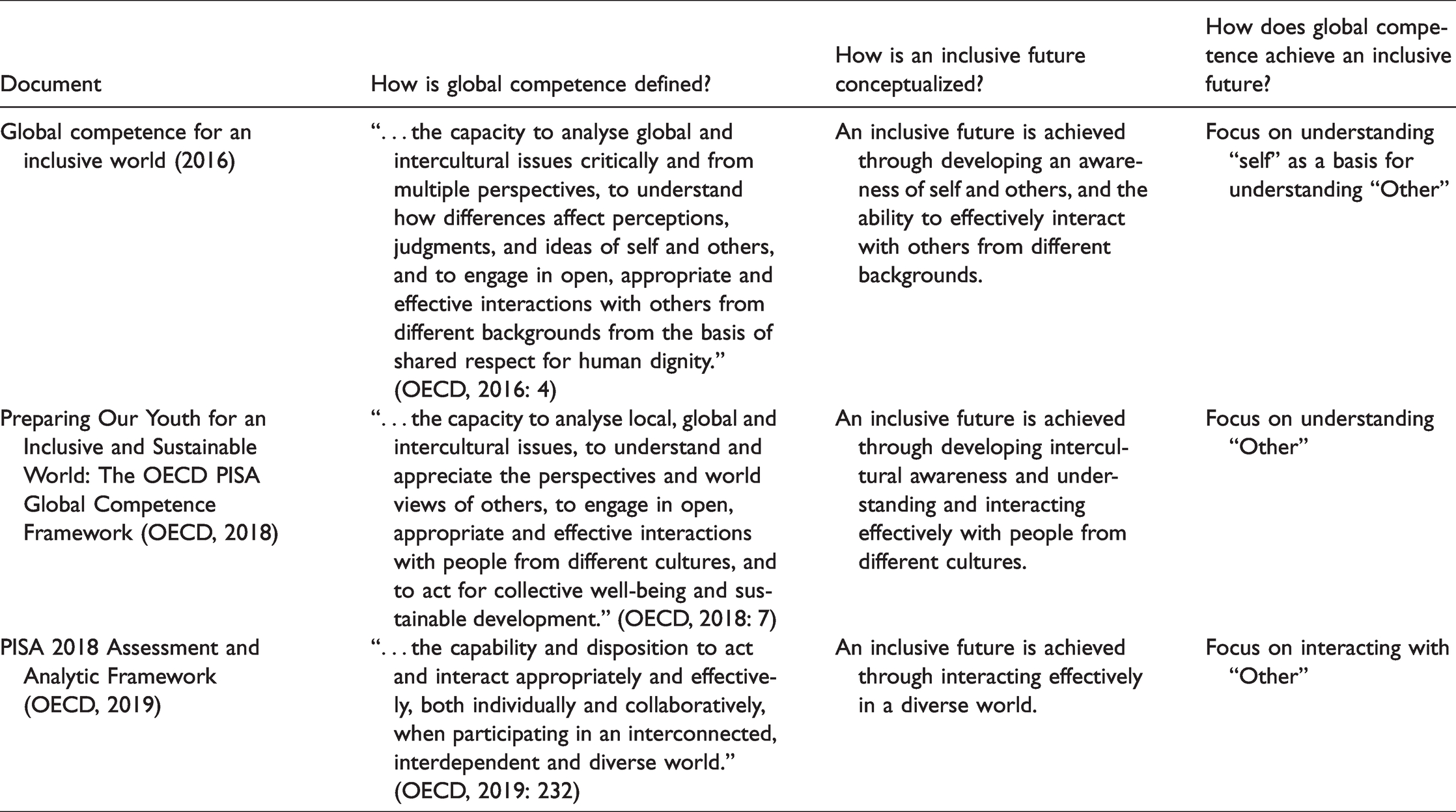
As Table 1 indicates, there is considerable variation in the definition of global competence between each of the key global competence documents. For example, the 2018 PISA global competence framework defines global competence as:
Definition of global competence and conceptualizations of inclusion in key global competence documents.
the capacity to analyse local, global and intercultural issues, to understand and appreciate the perspectives and world views of others, to engage in open, appropriate and effective interactions with people from different cultures, and to act for collective well-being and sustainable development. (OECD, 2018: 7)
This definition places a strong emphasis on the development of intercultural awareness as a proxy for global competence. Its exclusive focus on strengthening effective intercultural communication suggests that preparing youth for an inclusive future is solely dependent on their ability to understand cultural difference. This conceptualization accentuates the cultural “other” and heightens awareness of difference.
In contrast, the definition of global competence presented in the initial 2016 framework (OECD, 2016) encourages a more reflexive stance toward inclusion: Global competence is the capacity to analyse global and intercultural issues critically and from multiple perspectives, to understand how differences affect perceptions, judgements, and ideas of self and others, and to engage in open, appropriate and effective interactions with others from different backgrounds from the basis of shared respect for human dignity. (OECD, 2016: 4)
This earlier definition of global competence prompts young people to reflect on their own belief systems, bias, and prejudice as an important basis for understanding others. This conceptualization of inclusion acknowledges the critical importance of “self” as a basis for creating an inclusive future. This earlier definition extends notions of diversity beyond cultural difference, making space for this conceptualization to include exclusionary factors such as gender, [dis]ability, socioeconomic status, geography, culture, and race. The significant shift in the way inclusion is conceptualized indicates a distinct narrowing of the meaning of inclusion between the earlier 2016 draft framework and the final 2018 framework.
The narrowing conceptualization of inclusion continues in the PISA 2018 Assessment and analytic framework (OECD, 2019). This document, which informed the development of the PISA 2018 Assessment instrument, refers to global competence as … the capability and disposition to act and interact appropriately and effectively, both individually and collaboratively, when participating in an interconnected, interdependent and diverse world. (OECD, 2019: 232)
In contrast to the other documents, the PISA 2018 Assessment and analytic framework places greater emphasis on communication in a “diverse world,” rather than the ability to analyse intercultural issues from a range of perspectives. Once again, we see a shift. And this subtle shift is important, as the analytic framework foreshadows the construction of the PISA 2018 global competence assessment. Noticeably absent from this most recent definition of global competence is an intent to strengthen young people’s ability to “understand and appreciate the perspectives and world views of others” (OECD, 2018: 7), which was emphasized in the global competence framework. Across the definitions of global competence found within these three documents, there is a narrowing focus of global competence from enabling students to gain an understanding of self to create an inclusive future (2016) to gaining an understanding of difference to create an inclusive future (2018), to simply developing communication skills to participate in a diverse world (2019).
The dramatic change in the way inclusion is located within a definition of global competence between each of these three documents demonstrates a recontextualization of the notion of inclusion. In other words, inclusion has taken on new meaning as a central aspect of globally competent youth, as definitions of global competence have themselves shifted between the different iterations of the global competence framework documents. This narrowing of the way inclusion is conceptualized fundamentally changes the way that the OECD believe that global competence can prepare young people for an inclusive future, while also reshaping what we understand inclusion to be. In light of the existing discourses around inclusion, why might the OECD be recontextualizing the meaning of inclusion?
To answer this question, it is necessary to examine how the OECD believes globally competent individuals will create an inclusive society. Responding to this question requires returning to the 2018 global competence framework. In the opening page of the framework, the OECD asks, “why do we need global competence?” (OECD, 2018: 4). The answer? That global competence enables young people “to live harmoniously in multicultural communities” (OECD, 2018: 4). This argument is extended throughout the framework, maintaining that globally competent individuals are able to “examine local, global and intercultural issues” (OECD, 2018: 166) so they can “learn to participate in a more interconnected world” (OECD, 2018: 165). This emphasis on intercultural awareness extends to the policy questions that are used to shape the cognitive assessment and background questionnaire. For example, the guiding questions ask: To what degree are students able to critically examine contemporary issues of local, global, and To what degree are students able to understand and appreciate To what degree are students prepared to interact respectfully What approaches to (OECD, 2018: emphasis added)
Globally competent individuals are believed to “interact successfully and respectfully with others, and take responsible action toward sustainability and collective well-being” (OECD, 2018: 4). While acknowledging that education cannot be solely responsible for ending discrimination and racism, the OECD notes that “it can teach young people the importance of challenging cultural biases and stereotypes” (OECD, 2018: 5). Teaching global competence is therefore seen as an important foundation for creating an inclusive society.
Yet, missing from this conceptualization of an inclusive future is consideration for other barriers to inclusion, such as wealth, gender, geography, disability, and special educational needs (Shaeffer, 2019). While not completely ignored, there is a noticeable lack of robust engagement with poverty throughout the 2018 global competence framework. Poverty is mentioned only three times throughout the document, creating an inherent assumption that an inclusive future will be solely achieved through the promotion of intercultural awareness and understanding. This discounts the significant wealth-based educational exclusion experienced by billions of people around the world (UNICEF, 2015). This narrow interpretation may limit young people’s understanding of poverty and privilege, inhibiting their ability to gain a deep understanding and awareness of rising inequality through socioeconomic exclusion.
Noticeably absent from the OECD’s conceptualization of an “inclusive future” are people with disabilities and special education needs. No mention is made in the framework about how global competence will enable young people to reflect on their own and/or societal attitudes toward people living with physical, intellectual and/or emotional disabilities, nor does it consider the important contribution that people living with disabilities make toward creating an inclusive and sustainable future. This paradoxical silence is significant. It suggests that inclusion in a global world now excludes those to whom the concept of inclusive education was designed to include.
Barriers to accessing digital infrastructure is also overlooked in the framework. Students, schools and communities throughout the world are assumed to have access to the necessary digital infrastructure to “capitalise on digital spaces, better understand the world they live in and responsibly express their voice online” (OECD, 2018: 5). Noted as an important tool to shape “young people’s outlook on the world” (OECD, 2018: 5), digital technologies are promoted as a driving force to strengthen global competence development. What is missing from this proposition is an awareness of the economic and geographic factors that create a digital divide for millions of young people throughout the world (Cobb, 2018). The assumption that learning about the “world beyond” is possible through digital technologies, excludes the millions who lack access to these “new types of learning” (OECD, 2018: 5). Developing the kind of global competence proposed in this framework is therefore only accessible to those with sufficient digital infrastructure to become globally competent individuals.
PISA’s global competence framework further justifies its narrow conceptualization of inclusion by maintaining that “cultural awareness and respectful interactions in increasingly diverse societies” will reduce “indiscriminate violence in the name of religious or ethnic affiliation” (p. 4). According to the OECD, an inclusive future for global youth does not necessarily mean creating a society where barriers to societal inclusion are reduced, rather, it refers to a future that is free from intercultural conflict. Specifically, this appears to suggest that global competence can reduce violent extremism. This is a tall ask for an assessment framework but fits within the overriding paradigm through which the OECD conceives of an inclusive society. For instance, as our analysis demonstrates, learning about the “Other” appears from a Western-centric normative framing, a critique squarely leveled at the conceptualization of violent extremism, and the manner in which education has been enlisted in the fight to counter violent extremism (Novelli, 2017).
The OECD outlines four target dimensions of global competence (OECD, 2018: 7–8). To achieve these target dimensions, the OECD believes it is necessary to test young people to “provide a comprehensive overview of education systems efforts” (OECD, 2018: 5). This information is designed to provide “evidence-based decisions” to reform education systems, “curricula, teaching, assessments, and schools responses to cultural diversity in order to prepare young people to become global citizens” (OECD, 2018: 6). Indeed, PISA’s global competence framework explicitly states that this assessment will “help policy makers and school leaders create learning resources and curricular” in response to this “new perspective on the definition and assessment of global competence” (OECD, 2018, p. 7). Creating an inclusive society, it seems, is dependent on testing young people to identify their attitudes toward cultural diversity. This, for the OECD, will provide the necessary information for widespread educational reform which better prepares youth for the global labor market. Education for global competence can boost employability. (OECD, 2018: 5) Work readiness in an interconnected world requires young people to understand the complex dynamics of globalization, be open to people from different cultural backgrounds, build trust in diverse teams and demonstrate respect for others. (OECD, 2018: 5) Effective communication and appropriate behaviour with diverse teams are keys to success in many jobs, and will remain so as technology continues to make it easier for people to connect across the globe. (OECD, 2018: 5) Employers increasingly need to attract learners who easily adapt and are able to apply and transfer their skills and knowledge to new contexts. (OECD, 2018: 5)
Inclusion recontextualized
By locating notions of inclusion within the definitions of global competence, we find that the very meaning of the term “inclusion” has been recontextualized as it moved between each iteration of the OECD’s foundational documents on global competence. Bernstein’s (2000) notion of recontextualization theorizes how educational concepts, such as global competence, can take on new meaning as they move between different fields, actors, and contexts. Through this transmission, ideologies can become co-opted for alternative purposes. Cobb and Couch (2018) liken this to a “trojan horse” where a “seemingly innocuous or even positive notion obfuscates an alternative intent” (p. 40). Our study into global competence has revealed that the conceptualization of inclusion has changed over time, from an emphasis on reflexivity to better understand those from different backgrounds, to a focus on intercultural communication to strengthen interaction within the global marketplace. Despite the OECD’s claims that global competence teaches young people the necessary skills to create an inclusive and non-discriminatory future, our study revealed a narrowing conceptualization of what an inclusive future means, a future which aligns with the OECD’s intent to facilitate the acceleration of human capital development.
There are profound implications that accompany this recontextualization. For instance, despite the OECD’s intent to align PISA to measure progress toward the SDGs (Auld and Morris, 2019), a narrow and economic instrumentalist interpretation of inclusion fails to capture the broadening conceptualization of inclusion within the SDGs themselves (Shaeffer, 2019). Alongside the notable silence concerning people with disabilities, the OECD’s strong emphasis on developing intercultural awareness and communication as a proxy for global competence is evident. Moreover, Grotlüschen (2018) points out that no voices from the global south were represented in the development of PISA’s global competence. This is evident in the way that the global competence assessment focuses on prejudices and xenophobia, or ties into rhetoric around mitigating violent extremism, rather than promoting a form of globally competent youth who are able to locate local inequalities and successes within an understanding of their connections to global events and politics. This overt focus on intercultural awareness and understanding skews global competence toward a particularly narrow interpretation of an “inclusive future”––one in which young people are included into a global market economy. This conflation of “intercultural” with “global economic development” presents global competence as potentially congruent with established discourses of inclusion (Engel et al., 2019), when in fact they are two very different approaches.
Rather than framing intercultural competencies within what May and Sleeter (2010) refer to as critical multiculturalism, or one in which power dynamics are explored with the intent to address social injustices, the OECD’s emphasis on intercultural awareness intends to prepare young people with intercultural communication skills to participate in the global marketplace. Vaccari and Gardinier (2019) agree, maintaining that global competence focuses on the acquisition of a specific set of skills and abilities to contribute to economic and social productivity in a global society. Indeed, the PISA 2018 Assessment and analytic framework (OECD, 2019) clearly states that “educating for global competence can boost employability” (p. 166), a longstanding agenda for the OECD. The notion of a globally competent citizen has been used by the OECD as a substitute for its emphasis on producing global knowledge workers (Auld and Morris, 2019), thereby fulfilling the OECD’s “strong commitment to human capital theory” (Engel et al., 2019: 118). However, Grotlüschen (2018) questions how “global” global competence is, arguing that global competence focuses on a single notion of the globe that fosters “cross-national competition instead of international understanding” (p. 199). Because of this, PISA’s global competence may be more effective at generating intercultural competition, rather than genuine awareness and understanding. This brings the “alternative intent” (Cobb and Couch, 2018) of PISA’s global competence assessment to light. Indeed, Bernstein (2000) argued that biases are embedded in pedagogical transmission and pedagogical tools, such as PISA’s global competence assessment, and such tools effectively relay bias and ideological messages through the process of recontextualization. Our analysis demonstrates that the OECD’s overt focus on inclusion is mere lip service, concealing an underlying economic instrumentalist intent. This recontextualization belies the academic rigor found within existing discourses on inclusion. Such a recontextualization of inclusion through PISA’s global competence assessment fundamentally changes how inclusion is conceptualized, and who gets included within this “inclusive future.”
Given the OECDs strong influence on national and local policy responses, there are multiple and crucial questions that must be asked within national education systems. For instance, what might this recontextualized notion of inclusion mean for marginalized youth? How will ranking global attitudes and values toward competence create an inclusive future for young people, rather than promote assimilationist policies from the global north to the global south? Hacking (1986) argues that measuring human characteristics and/or dispositions can determine how a particular construct is understood and the resulting actions taken by society. This type of dynamic nominalism effectively creates individuals and the type of society that thinks, acts, responds and behaves in ways deemed governable. Elsewhere we have argued that PISA 2018’s emphasis on global competence functions as a mechanism to socialize young people into the particular kind of behaviors deemed necessary to function within a globalized market economy (Cobb and Couch, 2018). What then, for those students who are unable to achieve these normative benchmarks? How will countries respond and what might this mean for young people who sit outside of the OECD’s economistic normative framing of inclusion?
At their core, standardized assessments are highly exclusionary. They are “unable to take into account the particular backgrounds, experiences and abilities of students” (Shaeffer, 2019: 189). Nonetheless, PISA 2018 and its assessment of global competence is likely to lead to repercussions for countries, schools, educators, and young people who are labeled as having low, mid, or even high global competence (2019). Indeed, Vaccari and Gardinier (2019) argue that the OECD’s global competence assessment is unlikely to lead to “great inclusion and increased opportunities for marginalized populations” (p. 82). Those who do not “fit the profile and values of the Northern/Western national citizen” are likely to be excluded from being deemed a globally competent citizen (Engel et al., 2019). This conditional framing of inclusion requires the Other to “be otherwise than they are” (Stein, 2015: 248). From this perspective, the OECD frames difference as “something to be overcome” (Stein, 2015: 245), and suggests that this overcoming can be achieved through obtaining a certain level of global competence. This differentially positions who can obtain global competence, making global competence achievable for some, yet not the Other. This framing of inclusion also implicitly assumes that Western students can access Others’ difference, such as gaining knowledge about refugees, disaster, conflict and/or poverty, for their “own development or advantage” (Stein, 2015: 245). In this regard, students learn to position themselves as “benevolent actors” who impart “knowledge, humanity, resources, or rights to those they perceive lack them” (Stein, 2015: 246). This reifies their relative material advantage and implicitly communicates that they can solve the problems of the Other, while also reinforcing that the Other is incapable of “imagining their own solutions and futures” (Stein, 2015: 246). Because of this, PISA’s global competence assessment is likely to achieve the type of inclusive future that widens, rather than reduces, inequalities (Vaccari and Gardinier, 2019).
Conclusion
By bringing an educative frame of inclusion into conversation with OECD’s imperative to promote economic growth, this study has shown how a narrow view of inclusion emerges. This recontextualized view of inclusion is almost solely concerned with including the individual into the global market economy, and fails to acknowledge a more robust and holistic conceptualization of inclusion, and of what an inclusive future might mean. We have raised important questions about the future of the OECD’s work in the area of global competence, and caution governments against making widespread reforms on the basis of such a fundamentally flawed and narrow conceptualization of global competence. While we have drawn on Shaeffer’s (2019) framing of inclusion throughout this article, we acknowledge that this conceptualization of inclusion could be expanded to include ontological and metaphysical forms of exclusion. We encourage future research to consider ontological and metaphysical conceptualizations of exclusion and consider how this underpins the OECD’s work on global competence. Looking forward, we advocate that academics engage in further critique of current conceptualizations of global competence by bringing a post- and decolonial lens to this work. Indigenous perspectives of global competence are needed to challenge the OCED’s conditional framing of inclusion (Stein, 2015). Furthermore, additional research is also needed to consider wider implications of the 2018 global competence results, to ensure that those already excluded are not further marginalized by the results of this survey.
Footnotes
Declaration of conflicting interests
The authors declared no potential conflict of interest with respect to the authorship, research and/or publication of this article.
Funding
The authors received no funding for the research, authorship and/or publication of this article.