



Abstract
The STEM field has contributed significantly to the development of society because its findings result in new technology, which gives people more efficient tools and methods for a better standard of living. Postsecondary institutions have trained STEM field graduates through advanced curricula and learning environments. Compared to other academic fields, STEM requires more monetary support for research from the institution or the government because STEM research often requires expensive equipment installation or the introduction of new technologies. This paper overviews institutional support for STEM education and research by the regime of recent U.S. governments and examines the characteristics of R&D (research and development) expenditure. The results indicate that the R&D expenditures of the STEM field show continuous support for the different type of institutions, regardless of governments over time. However, they have tried to diversify the R&D investment by the type of R&D field and institutional type. Even though the government has tried to increase the total size of R&D expenditure through various resources, they still need to consider the equity and diversity issues for even further R&D investment strategies. A further research direction would search for the detailed action and strategies to support the STEM field according to their types of support or expectation.
Introduction
Postsecondary institutions have broadened their academic offerings and social responsibility through the development of internal structures, and the curricula address multiple needs such as governmental social, economic, and policy agendas. Specifically, those in specific fields, such as national science, engineering, and other applied sciences in academic institutions, have been able to make significant social contributions based on advanced technologies or creative scientific findings.
The term “STEM” refers to the four academic areas including science, technology, engineering, and mathematics. Compared to other academic fields such as humanities, the STEM field requires more coursework based on logic, mathematics, and other complex scientific methods. Because of the difficulty of the coursework, students pursuing a STEM major require supplemental instruction to accomplish reasonable educational outcomes (Peterfreund et al., 2008; Adedokun et al., 2013). Besides, the field requires more monetary investment to support academic research as a pipeline for minority students on campus (Peterfreund et al., 2008).
When students of different backgrounds encounter an identical learning environment in the STEM field, students’ educational outcomes appear differently according to their race, gender, and previous academic preparation (Price, 2010; Soldner et al., 2012). The postsecondary institution has a responsibility to deal with the successful course completion, and cognitive interactions have a significant effect on external supports including monetary benefits. The government recognizes the importance of investment in the STEM field, and the Obama administration pledged a sizeable amount of federal expenditure to fund the hiring of more STEM instructors (Piro, 2010). The governmental support R&D, which refers to the activity institution, contributes to innovation and introducing new products and services that have affected organizational functions and long-term financial planning over time. This increase in both financial support and interest leads the institutions to provide support for multiple STEM components and motivates individual faculty or professionals at research universities. Increased funding can also remove barriers to educational innovation, and first-line instructors including faculty members can play a significant role in STEM innovation (Porter et al., 2006).
The purpose of this study is to provide information about current trends in R&D investment in the STEM field at the institutional level and compare it between two different types of U.S. administrations. The two successive governments (the Bush administration and Obama administration) came from two different political parties, Republican and Democratic, and have carried out different policies. These administrations represent different political parties that have different policy directions, and the difference can be expected to affect the characteristics of institutional support for the STEM field. This study outlines the effective policy execution for sustainable STEM field development and highlights internal advancement on campus as well as external growth based on the investment.
This study examines the prior findings of STEM field funding and analyzes the current trend of expenditures by the institution in detailed areas. This research is intended to aid higher education researchers who are interested in R&D investment in the STEM field in higher education and provide multiple perspectives through statistical findings. This is also connected with government support strategies for STEM, in which policymakers determine the proper level of financial support for institutions.
This study poses two research questions: What is the difference in R&D expenditures of the STEM field by institutional characteristics and R&D type between U.S. governments? What is the difference in R&D expenditures of STEM by field of study between U.S. governments?
How federally financed indicators affected R&D expenditures
This study highlights the R&D investment trend between two regimes and examines the relationship between R&D investment and educational indicators at the institutional level. This provides some implications on how policymakers develop long-term planning for institutional support in higher education based on equity and equality.
Conceptual framework
Institutional support for the STEM field
Practical research experience is considered to be one of the most important aspects in developing the learning mechanisms necessary in the STEM field, and this academic experience affects graduates’ continuous study as a pipeline for an advanced level of research (Pende et al., 2010; Slovacek et al., 2011). Faculty give students academic guidance, which motivates them to continue their studies. This mentor–mentee relationship enables students to improve their research skills and facilitates the entire research climate of the institution with positive external administrative supports. Institutions also create strategies to increase academic diversity in STEM fields because the intervention of campus members from multicultural backgrounds improves the academic atmosphere of the STEM field (Kuklinski, 2006; Tsui, 2007).
Institutions consider the specific characteristics of STEM fields that need support through the proper administrative direction. For example, various financial aid policies, such as the Meyerhoff scholarship programme, improve students’ possibility of educational attainment (Carter et al., 2009). The Meyerhoff scholarship is intended to increase the number of underrepresented minorities who earn advanced degrees and get research careers in STEM fields and provides diverse research experiences for better educational outcomes in that area. (Carter et al., 2009; Maton et al., 2012). The connection between an internship and an academic learning process helps first-year engineering students educate and motivate themselves in different ways as well (Chesler et al., 2013). Institutions that offer undergraduate research opportunities for students have better educational performance compared to their counterparts, and research-familiar academic climates boost degree completion (Eagen et al., 2010). Meanwhile, institutions can use more qualitative and informal evaluation processes since different assessment strategies increase the access of STEM for minorities (Green et al., 2006). In sum, institutions support collaborative environments for students, which enables students to continue the study of the specific STEM field. The institutional investment for R&D of the STEM field has specific intentions to support internal members in the programme and it may come from diverse necessities such as the state educational agenda, college reputation, and other external needs.
The status of R&D investment in the U.S. administrations
Although federal supports are essential to improve sustainable STEM field research, there is little research on the connections between specific political regimes and STEM support. As preliminary research, this paper investigated how specific regimes support the STEM field based on descriptive information. But the specific legislative action and federal policy affect the size of supports for the STEM field and the training of future STEM fieldwork is necessary to maintain national competency in the global market (Kuenzi, 2008). To meet the growing concerns about the STEM field support, diverse enactment and federal funding are considered and government divisions are enacting affairs for the STEM field.
With the announcement of the American Competitive Initiative, the Bush administration increased the R&D investment by more than 50% to $137 million. It included 300 grants for schools to implement research-based academic curricular, financial support for 10,000 scientists, and support for job seekers, low-income students, and others (White House, 2006). Continuously, the Obama administration showed “the educate to innovate initiative” for STEM education programmes based on the billions of additional federal funding (Burke and McNeill, 2011). President Obama announced his policy direction to support the STEM field like this:
One of the things that I’ve been focused on as President is how we create an all-hands-on-deck approach to science, technology, engineering, and math … We need to make this a priority to train an army of new teachers in these subject areas, and to make sure that all of us as a country are lifting these subjects for the respect that they deserve (Third Annual White House Science Fair, April 2013).
Even though both administrations have tried to encourage the STEM field through financial support, the external environment around them could distinguish a difference between them. George W. Bush is a Republican who served twice as president of America and America was exposed to many safety issues including drastic terrorist attacks such as the 11th of September. The tension around national safety is aimed more toward defending themselves or to handling foreign policy with more sophistication including the war against terrorism. The political circumstances and war -related expenses enable the government to handle foreign policy initially however, the effective resource allocation in government was not easy (Risen, 2006; Rubin, 2015). White-dominated cabinets, and traditional conservative views for diverse educational issues hamper public interests in providing diversified support. On the other hand, the following African American Democratic president, Barack Obama rooted in his Muslim background carried out his campaign in a different way (Ribeiro, 2013). He focused more on an anti-war position and considered more domestic issues such as health care, education, and other urgent internal problems. Obama administration delivered hopeful messages about educational justice, individual growth, and demand-centred education system (Au, 2009). This reflected the vision of an equitable education foundation for America and relevant policies have supported it.
Literature review
On the relationship between institutional characteristics and R&D investment in STEM
The institution plays an important role in helping the formulation of cognitive development through various services, which inspires STEM students to develop research skills (Hunter et al., 2007). The different type of institutional support for the STEM field makes the members in the department decide specific career paths differently. The structural differences for student support in STEM differ by the institutional type or mission and this depends on the characteristics of different student cohorts (Hurtado et al., 2011). Institutions have several options including scholarly communication to prepare upcoming curricula for prospective students in the STEM fields and provide training programmes for minorities (MacLachlan, 2006; Maton et al., 2012; MacPhee et al., 2013). Minority students also learn scientific identity or self-efficacy through collaborative research experiences with other campus members (Hurtado et al., 2010), and institutional support for the research environment allows the students to focus on their research interests. Crisp et al. (2009) investigated the effect of several institutional or individual factors in earning a STEM degree in Hispanic serving institutions. They found that the role of the institution is integral to determining the students’ earning a degree through the initial introduction of gatekeeper courses. The institution can encourage students to pursue a career in the STEM field based on various administrative supports and help students decide their careers after graduation. The influence of the institution on STEM field students interacts with other influential campus members and functions as an important external factor on students’ future career paths.
On the relationship between field of study and R&D investment in STEM
There are rare studies about the relationship between the field of study and R&D investment in the STEM field although the field of study in STEM varies and a deep understanding of the subcategories is required. This could come from the complexity of the subjects or the expert in the department is more deeply engaged in the experimental study. However, students in the detailed area of STEM fields develop their unique scientific identity through a diversified academic climate and programmes. Students interact with different internal members of the department and develop their future career paths. The graduates from different fields of study in STEM do not have many chances except to change their career or experience involuntary unemployment (Carnevale et al., 2011). The specialization in the STEM field requires investment in the unique area or equipment and sometimes the investment is intertwined with specific policy support. For example, the current interest in renewable energy accelerates commercial production and explores possible technological advances with substantial financing (Rajagopal et al., 2009). The new idea and innovation encourage people to follow their interests and the interested masses allow policymakers to invest public support in their entire welfare. Wiesenthal and his colleagues pay attention to the relationship between the level of R&D and low-carbon energy technologies (Wiesenthal et al., 2012). The result shows that the significant investment in the field is intertwined with the regional policy needs and reflects different stakeholders such as different industries.
Methodology
Data
This paper uses data from the Higher Education Research and Development Survey (HERD). The data includes the primary source of R&D expenditure information for U.S. colleges and universities. This survey collects R&D expenditures by several fields of research and sources of funds. The National Science Foundation has the authority to manage the survey data, and the National Center for Science and Engineering Statistics surveys the foundation. The survey gathers institutional R&D expenditure information annually, and some data provide the historical trends over decades, reflecting the historical change of federal expenditures. The data have several categories by the source of funds, institutional type, R&D field, and other geographic distributions.
Figure 1 describes the trend of total R&D investment in STEM fields in institutions over time. The growth of the R&D expenditures for STEM in institutions has been remarkable and recently the movement has become relatively stable when considering past increases. According to Hourihan (2013), the federal government expanded the R&D budgets at the National Science Foundation (NSF), the National Nuclear Security Administration (NNSA), the Office of Science in the Department of Energy (DOE), Veterans Affairs (VA), and the Department of Agriculture (USDA) with the federal surplus and a loosening of Congress’s position on discretionary spending limits at the time. During the Obama administration, the federal government started to diverge the funding for agencies and missions, with the instruction to cut discretionary spending including R&D investments.
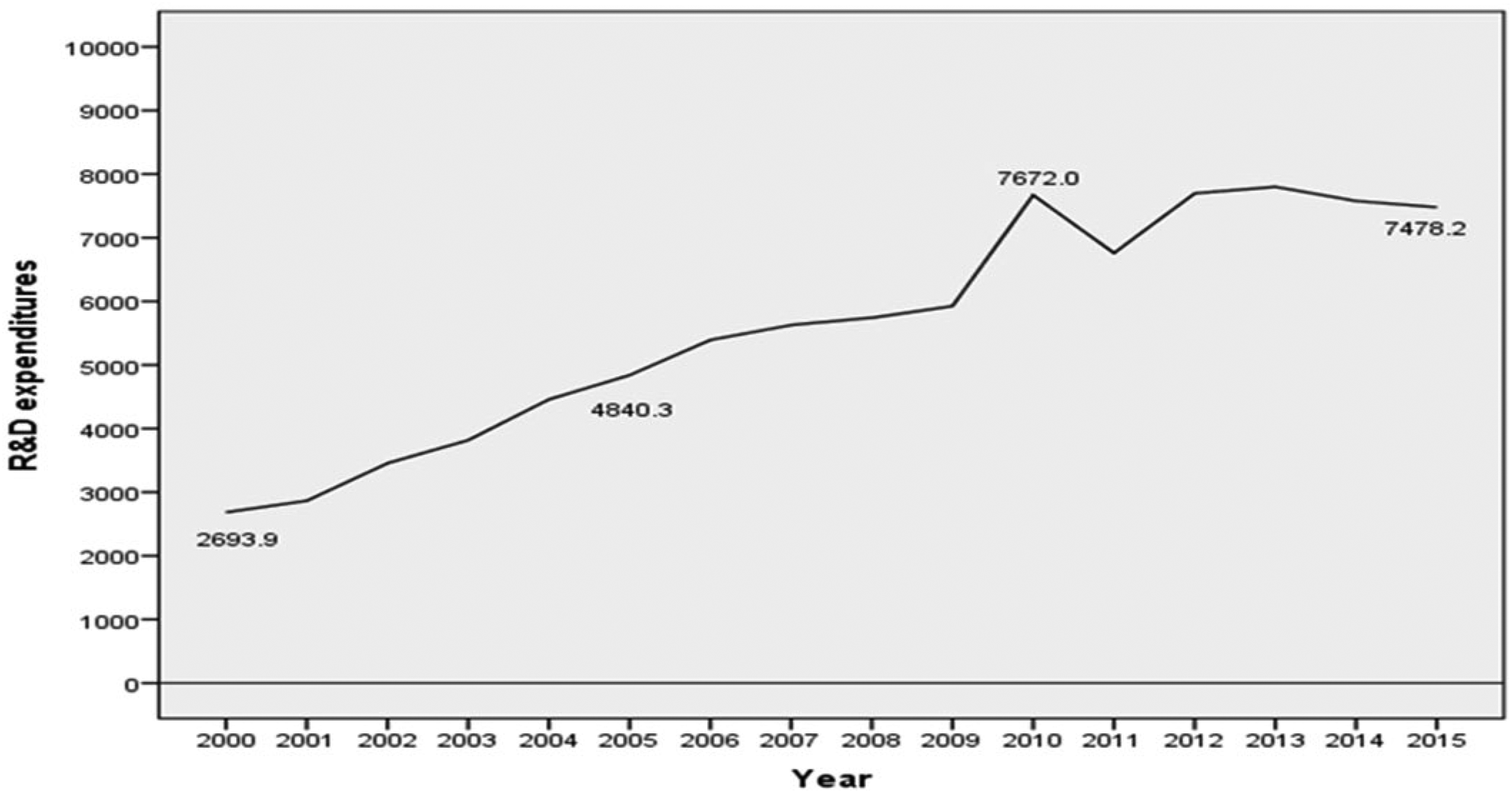
The descriptive statistics of R&D investment in STEM fields at institutions (2000–2015) (units: millions).
This study considers the fixed periods, from 2001 to 2018, which mostly reflect two different federal administrations with some information about the period of the Trump administration. The Republican Bush administration maintained federal power from 2001 to 2008, and the following Democratic Obama administration held office for the next eight years. The comparison between the two governments provides useful policy implications for further research. Table 1 shows the R&D expenditures by the source of funds between administration.
Comparison of Governments by Source of Funds in STEM R&D investment (unit: millions)
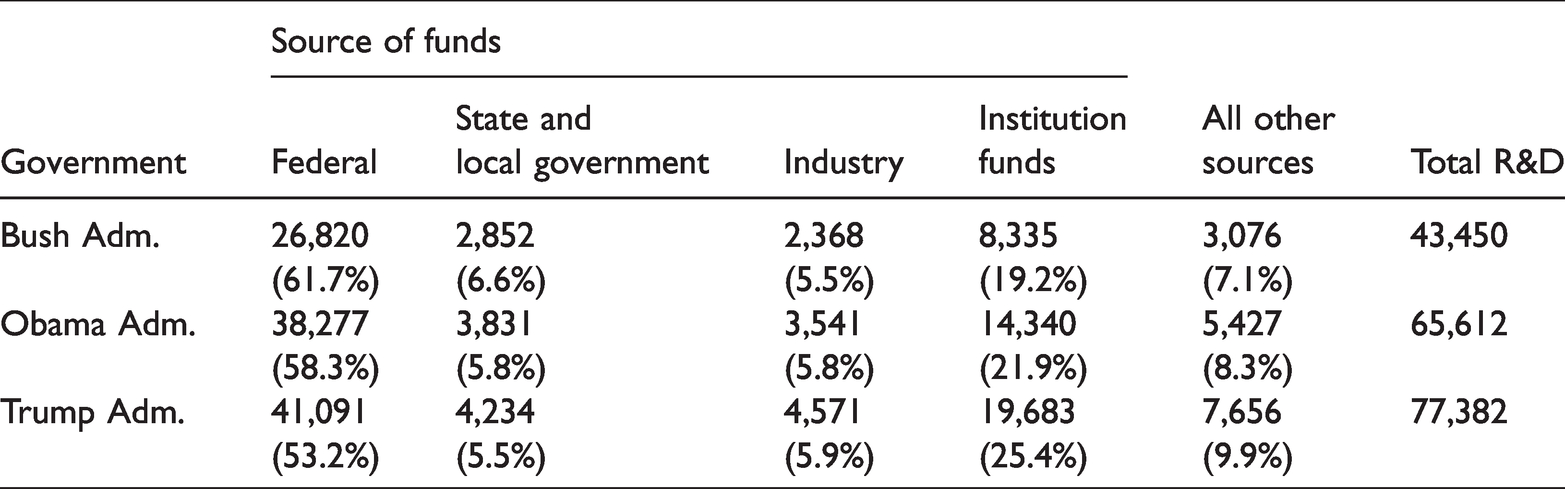
According to the continuous increase of total R&D investment, each government has supported more STEM R&D investment over time. However, the trend is slightly different since their proportion of federal funds has declined (61.7% in the Bush administration to 53.2% in Trump’s). Instead, they have accelerated the R&D investment as an institutional fund (19.2% in Bush administration to 25.4% in Trump administration) and all other sources (7.1% in Bush administration to 9.9% in Trump administration), which means they have tried to diversify the ways to support STEM fields with external resources.
Method
This paper uses the analysis of variance (ANOVA) and t-tests to compare each indicator and administration. Through these methods, this analysis shows the differences among group means and the variances by specific institutional variables over time. With the comparison of both periods, this analysis gives simple fixed effect regression results to show the relationship between R&D expenditures and certain educational indicators.
Results
The difference in R&D expenditures of the STEM field by institutional characteristics and R&D type between U.S. governments
Table 2 shows the comparison of R&D investment by institutional type and R&D type between U.S. governments. The results show that the Obama administration significantly increased financial support for public and private institutions together compared to the Bush administration. The trend continues until the recent Trump administration. Interestingly, the financial support for HHEs drastically increased in the Trump administration, even though the R&D investment for HBCU was not significantly changed at the same time. In terms of the background of the Obama administration, the strong support for HBCU was expected, although it still has increased compared to the Bush administration. The investigation of the Trump administration’s financial supports for HBCU and HHEs is not easy toevaluate atthis moment due to the lack of timely data. It will be necessary to check the long-term trend later. While the investment for basic science has steadily increased over time, the recent decline in investment in applied science shows up in the Trump administration.
Comparison of R&D expenditures by institutional type and R&D type (unit: millions)
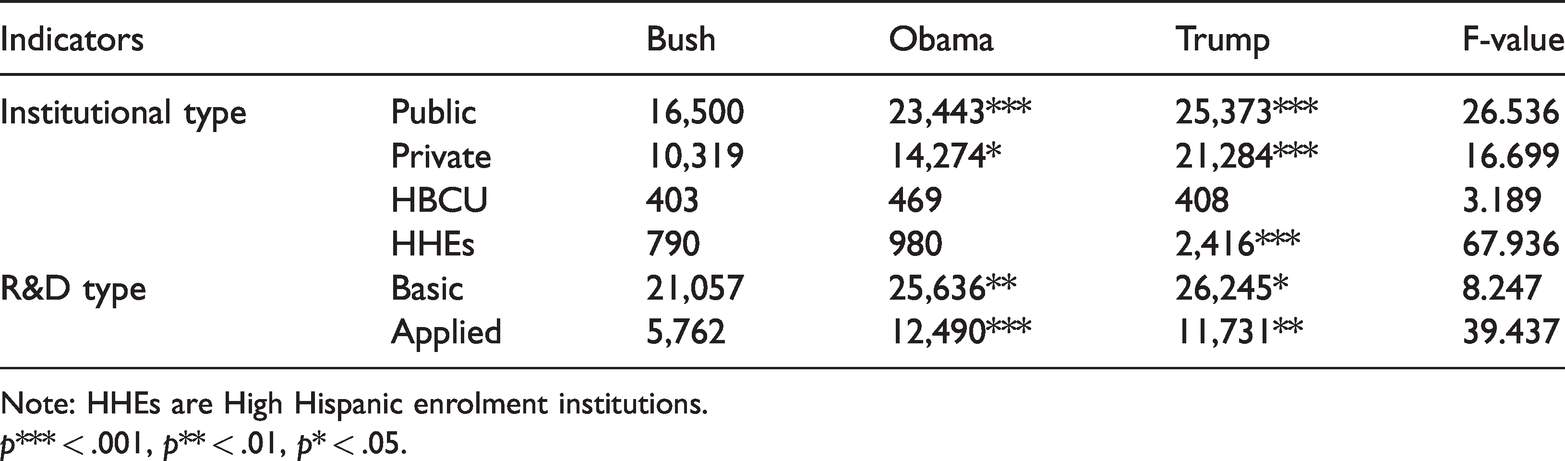
Note: HHEs are High Hispanic enrolment institutions.
p*** < .001, p** < .01, p* < .05.
The difference of R&D expenditures of the STEM field by the field of study between U.S. governments
Table 3 indicates the result of the comparison of the field of R&D expenditures through the ANOVA analysis. This study predicts the ratio of R&D investment is different by each field of study even though the total R&D expenditure has increased over time. It is intended to overview how each government focuses more on specific fields in STEM.
Comparison of the R&D expenditures by field of study
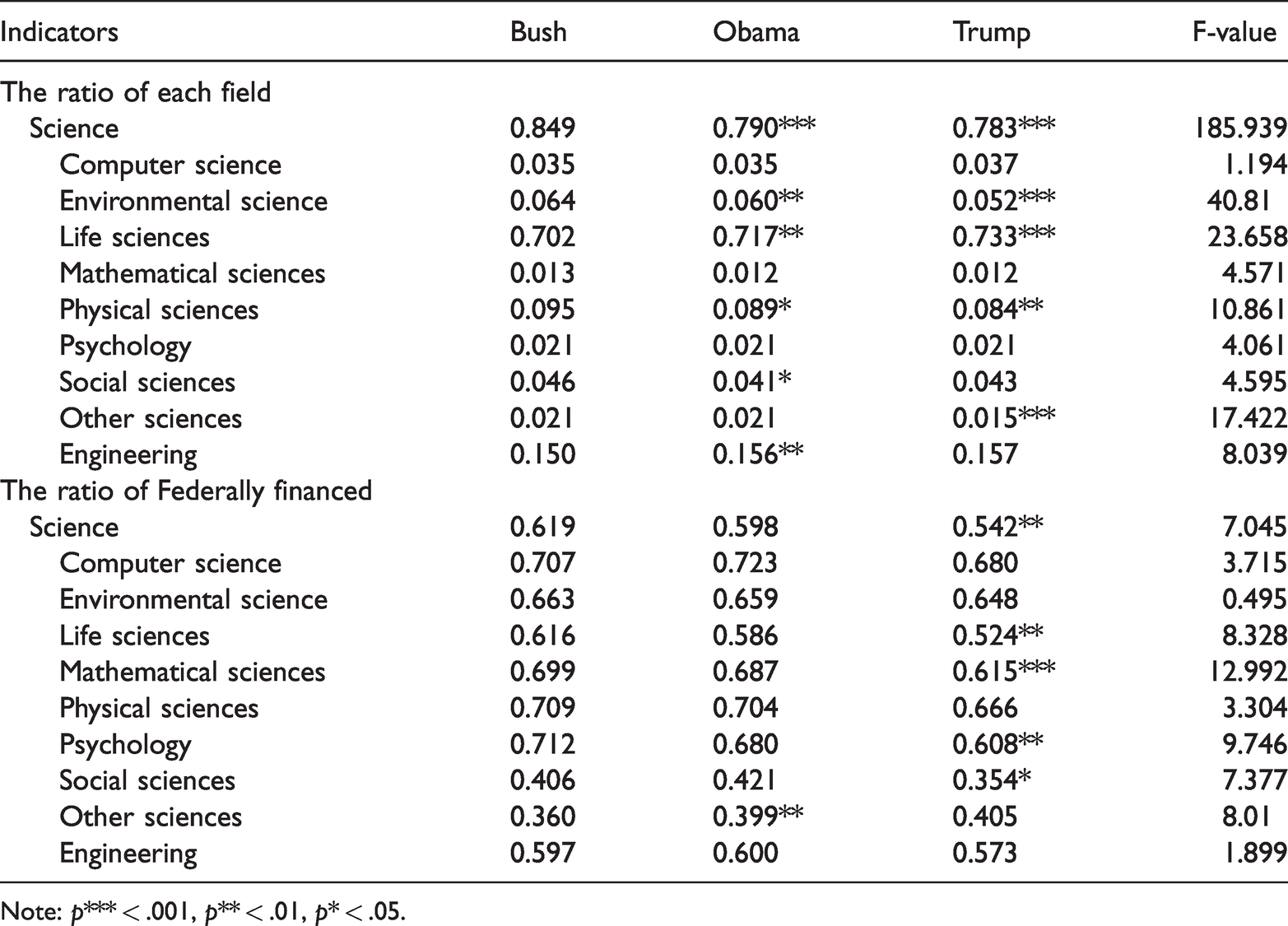
Note: p*** < .001, p** < .01, p* < .05.
The result shows that the proportion of science among total R&D investment has decreased over time and instead, the government tends to support provide more support to the field of engineering. While the proportion of environmental science and physical science within the field of science has decreased, the growth in life sciences is remarkable. That result implies that even though the size of R&D investment has increased, the weight of financial support between subcategories has been generated at the same time. The ratio of federally financed R&D investment has not changed much according to the different type of administration. However, recently the Trump administration has tried to make a change to the pattern of federal financing in the STEM field. To be more specific, they have significantly decreased the proportion of investment for science among the total R&D expenditures and this reflects the entire decrease of subcategories within that field. The proportion of federally financed R&D investment to engineering has also decreased even though it is not statistically significant. This implies that the Trump administration has changed the amount to invest in the R&D field and other approaches such as collaboration with the private sector can be considered. Also, the government may transfer the saved R&D money into other sectors such as business, or construction.
On the relationship between total R&D expenditure and relevant indicators of federal investment
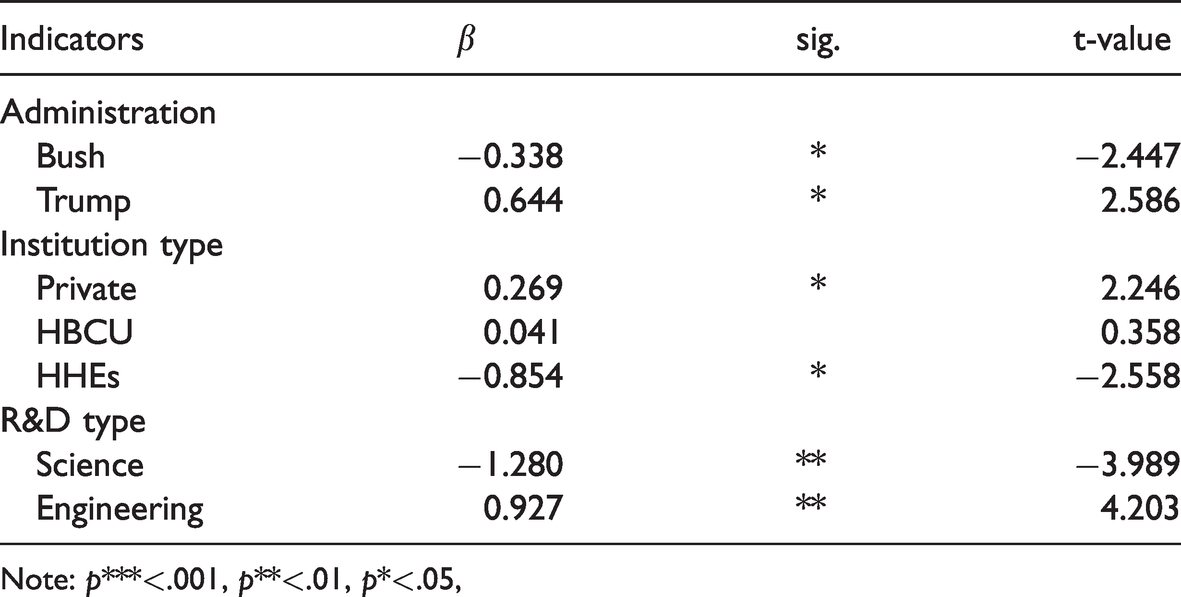
To discern the relationship between R&D expenditures and the relevant indicators based on federal support, this analysis includes simple regression results, seen below (Table 4). The reference group is the period of the Obama administration (2009–2016). From the statistical results, this study confirms the trend of the continuous increase in R&D investment. Interestingly, the increased ratio of federal financing for HHEs is negatively related to the growth of total R&D expenditure and the direction of financial support for private institutions is the reverse. Interestingly, the increase in the proportion of federally financed R&D investment in science and the proportion of federally financed R&D investment in engineering conversely affects the change of total R&D investment.
Result of the relationship between R&D expenditures and federally financed indicators
Note: p***<.001, p**<.01, p*<.05,
Also, federal support and other non-equipment areas have a significant relationship with the total R&D expenditure. The findings support that total R&D expenditures differ by institutional type, which implies that more equitable federal support for institutions is required to create a more equal research environment.
Discussion
What is the difference in R&D expenditures in the STEM field by institutional characteristics and R&D type between U.S. governments?
Federal STEM education policy concerns diverse issues that are related to STEM education as a whole and tries to broaden the participation of underrepresented populations such as minorities (Gonzalez and Kuenzi, 2012). At the postsecondary level, it centres on the support of remediating students in STEM majors. In line with previous discussions, the findings for the R&D expenditures of the STEM field shows continuous support for the different types of institutions, regardless of governments over time. Even though the R&D investment record of the Trump government is relatively less than the other two governments, the growth of R&D investment is lower than in the Obama administration. This may cause different outflows around the Trump government such as defence, business, and other sensitive international controversies. However, the administration still has strong support for HHEs as well and this trend confirms the continuous strengthening of the STEM workforce based on minority-serving institutions (National Academies of Sciences, Engineering, and Medicine, 2019).
What is the difference in R&D expenditures of STEM by field of study between U.S. governments?
While the size of R&D expenditure for postsecondary education is still increasing over time, the weight of each department in the STEM field is different from the administrations. Compared to the Bush administration, the Obama administration decreased the proportion of R&D expenditure in science and increased the proportion of R&D expenditure. This reflects the probability of diversification for STEM financial support and the significance of the changes depends on how policymakers assess the policy rationale behind STEM education (Gonzalez, 2012). The federal support for STEM education considers the awareness of the diversity and challenges in the local communities (Finkelstein, 2010). The interaction between the public and science is important to meet external needs and to hear external voices. The diversification of STEM investment reflects the trend of federal strategies. The trend of federal financing indicates the government has tried to decrease the financial burden for STEM investment with the growth of the expenditure size. This confirms they have acknowledged the importance of STEM investment for national growth as well as found an alternative way to provide financing from other resources such as the private sector. The tendency is remarkable under the recent Trump administration.
How do federally financed indicators affect R&D expenditures?
With the continuing trend of increasing R&D expenditures, the growth of private schools and the decline of HHEs indicate the probability of commercialization around the R&D expenditures across governments. Even though the government has tried to increase the total size of R&D expenditure through various resources, they still need to consider equity and diversity issues further and even the R&D investment strategy as a whole.
These findings provide several implications for federal policymakers and institutional leaders. Government plans to distribute their internal resources to each sector including higher education. The specific environmental factors and political direction affect resource distribution strategies. In particular, the tendency of each decision-maker and internal agreement of government officers drives federal support in a certain direction. These actions reflect social needs, as well as external changes over time and STEM fields have responded to the policy streams. Meanwhile, the institutional support from the government should have sustainable outcomes and a certain level of returns that the government expected. With these expectations, supportive action requires a comprehensive understanding of different fields, institution types, and other relevant components in the higher education system. The policymakers should more equitably distribute resources for R&D in the STEM fields with deep consideration of institutional characteristics. Institutions that have minority students have fewer funds to allocate to STEM R&D investment. The institution can provide a more acceptable federal R&D investment plan beyond the pursuit of equality among institutions and this will help the institution increase the competence of the STEM field in higher education. Institutional leaders should create a more research-friendly academic climate for potential campus members who are interested in R&D in the STEM fields. The student researchers and faculty members who want to develop their skills benefit from external monetary support as well as the research environment of the institution. Looking to the future, multiple efforts and administrative supports should be combined to further the development of STEM fields. For the current Trump administration, this study recommends continuous support for the STEM field because of its growing interest in practical needs as well as the importance of academic performance.
Conclusion
This paper analyzes the trend of institutional R&D investment in STEM by employing data from the national higher education survey. The results show that the size of R&D investment in the STEM fields is significantly different by institutional type, and the trend of the investment for each field of study diverges according to the characteristics of the field. The Obama administration tended to provide more financial support, compared to the Bush administration, and tried to diversify the weight of the financial support by the field of study. Regardless of government regime, this result shows that minority-served institutions including HBCU in the targeted period have difficulty getting more financial resources and the size of funding is still stable even though the total size of R&D expenditure is increasing over time. While the growth of R&D investment was distinguishable before the global monetary crisis around 2009, the federal government has actively engaged in the distribution of available national resources according to the different characteristics of each administration since then. The entire size of R&D expenditure has been maintained through monetary redistributions as well. Also, the federal support may be related to the surroundings of each government and the policy priorities in the government can vary. Further research could search for the detailed action and strategies to support the STEM field according to their type of support or expectations. Those combined intentions from the government reflect the style of support to the institution.
Footnotes
Declaration of conflicting interests
The author(s) declared no potential conflicts of interest with respect to the research, authorship, and/or publication of this article.
Funding
The author(s) received no financial support for the research, authorship, and/or publication of this article.
