




Abstract
We propose a framework of 29 Future School Elements that can be used to consider future models of schooling which we have organised across three pillars of pedagogy, policy and structure. We seek to position the framework within a futures approach to policy making that allows for greater diversity by providing a design logic that can be contextualised, is more pluralistic and can be shaped by a greater number of voices. The findings from our modified Delphi study involved an expert panel who examined the counterfactual research question ‘What if compulsory schooling was a 21st-century invention?’ Consensus statements were formed by the expert panel by rating items based on impact and equity. We explore ways in which utilising a foresight approach can provide a means to reshape future models of schooling in a meaningful and contemporary way that takes account of some of the challenges and forces that have prevented change.
Introduction
Across the world this year young people are graduating from secondary schools who well and truly have lived their entire lives in the 21st century. During their youth, society has seen the invention of the smartphone, Facebook and YouTube. In their first years of life, global geopolitics was redefined based on the attacks on the Twin Towers in New York and recently we saw the first 3d-printed almost fit-for-purpose heart produced. Their final year of school has been interrupted by the first global pandemic in a century that crashed the global economy. They have watched and many have been part of a renewed movement to challenge structural racism across the world.
Society is currently facing turbulence which includes areas of rapid change. As part of the Compton Lecture at Massachusetts Institute of Technology, Thomas L. Friedman (2018) described society being ‘in the middle of three giant accelerations’ involving rapid developments in technology, changing markets and the reality of climate change. There is a need to adapt to: (a) technology which is changing at a rapid rate (Friedman, 2018; Trilling and Fadel, 2009); (b) globalisation that is expanding the interconnectedness of people and economies across the world (Friedman, 2018; Trilling and Fadel, 2009); and (c) the imminent dangers from climate change (Friedman, 2018; Trilling and Fadel, 2009). These changes across the world ‘are reshaping social and economic life in powerful ways and putting a premium on learning faster, and governing and operating smarter, across the globe’ (Friedman, 2018).
The rapid pace and amount of change across many aspects of society has not necessarily been mirrored in changes to the design of schooling. In most cases, schools look and act the same as they have for more than 100 years. Even in places where new school buildings have replaced obsolete physical structures and imbedded new learning space designs, some teachers are resurrecting the walls and reformatting classrooms into rows of desks deliberately rearranged by the new school designs. Within this context there are two challenges for future models of schooling.
The first challenge is that schooling has been resistant to change. Elmore (1996: 15) argued that ‘the core of schooling remains relatively stable in the face of often massive changes in the structure around it’. Challenges include the ‘ritualistic’ (Law, 2014: 350) nature of teaching. Self-interests preventing change include companies who are currently making money out of curriculum support (Law, 2014; Trilling and Fadel, 2009), or families and authorities who believe they are in an advantaged position under current systems which they do not want to put at risk (Law, 2014). A lack of alignment between system and classroom means that even ideas that are adopted as concepts of change may not lead to significant difference in practice (Bingham and Burch, 2019; Elmore, 1996; Law, 2014; Lee and Hung, 2016). To be effective, change needs to occur at both a policy and practice level (Elmore, 1996; Harris and Jones, 2019).
Secondly, as well as efforts to redress longer-term equity challenges within current schooling there are also further challenges as change occurs within society. Addressing the treatment of a range of equity issues including socio-economic class, gender and ethnicity remains a focus for change and redress (Young and Diem, 2017). At the same time as these historical challenges persist, contemporary challenges to be faced include the reduction in the power governments hold over multi-national corporations (Hargreaves and Shirley, 2009; Trilling and Fadel, 2009) and the ethics and potential impact of artificial intelligence (Luckin, 2017; Trilling and Fadel, 2009; Tucker, 2017).
Designing a logic for future schooling
The purpose of this paper is to outline a design logic for future schooling that can: (a) challenge the resistance of current schooling models to change; and (b) contribute to redressing historical and contemporary equity challenges faced by schooling. Our research approach has taken us to many of those who research, speak and blog on topics related to the future of schooling. These individuals include some of the world’s leading change agents as well as current practitioners and policy makers, to whom we posed a counterfactual research question: ‘What if compulsory schooling was a 21st-century invention?’ We implemented foresight approaches to design a future-focused response.
Peter Drucker asserted that ‘the greatest danger in times of turbulence is not the turbulence; it is to act with yesterday’s logic’ (1980: 226). A metaphor to respond to these challenges with new logic is to adopt a ‘jazz orchestra’ mindset towards governance, in contrast to a ‘chess game’ mentality (Ansell et al., 2017). The latter might be considered more reflective of traditional approaches to governance where there is a set number of options or combinations of options to choose from. With a ‘jazz orchestra’ mindset, ‘problems and solutions tend to be interdependent with the consequence that there is no exhaustively described set of potential solutions, as for instance in chess’ (Ansell et al., 2017: 295). With a ‘jazz orchestra’ mindset there is flexibility to respond to high degrees of uncertainty, including through improvisation based on planning and anticipation (Ansell et al., 2017). A capacity for improvisation is a key feature of a ‘jazz orchestra’ mindset, including increased flexibility and fluidity in decision making and planning, which supports responding to a rapidly changing world. At the same time as being able to respond to the turbulence of change, the orchestra maintains rules and structures (Ansell et al., 2017) to provide order.
Counterfactual thought refers to ‘mental representations that are explicitly contrary to facts or beliefs’ (Neal and Mike, 2009: 16). Counterfactual thinking is a way of responding to a rapidly changing world that is highly reflexive ( Giddens, 1991 ; Jenssen, 2010). One of the strengths of counterfactual thinking is that it provides an opportunity to consider multiple futures, including how varying approaches might impact on equity outcomes for different societal groups (Holm et al., 2013; Selwyn and Facer, 2013; Williamson, 2013). A counterfactual question is framed by a ‘What if …?’ statement designed to encourage consideration of possibilities beyond the constraints of historical ways of doing things, in this case schooling.
Foresight approaches extend organisational planning beyond insight or hindsight. While it is not possible to accurately predict the future using foresight approaches, anticipation of the future already exists in the present (Miller, 2018) and there is an interplay where people’s thinking about the future can influence the change they would like to foster. Foresight is an action-orientated policy design process (Amanatidou, 2017) that can provide organisations, including governments and inter-government organisations (Dreyer and Stang, 2013; Jenssen, 2010; Schmidt, 2015), with a ‘continuous high-quality, coherent and functional forward view’ (Slaughter and Riedy, 2009: 11). Foresight utilises participatory approaches (Amanatidou, 2017; Miller, 2018) and supports the setting of priorities as well as policy implementation (Georghiou and Keenan, 2008) as part of designing solutions.
Policy design involving foresight (Van der Steen and Van Twist, 2012) focuses on the underpinning logic that can be applied across contexts, including supporting the interplay between local and universal contexts (Warnke and Heimeriks, 2008). Foresight approaches impact on policy development by highlighting a complexity view that moves away from a linear understanding of policy development (Ansell et al., 2017; Miller, 2018; Warnke and Heimeriks, 2008). In the case of schooling, Bingham and Burch (2019) argue that there is a tension with improvement and narrow reform policies because they can add to the level of incoherence in schools as different change ideas are layered on top of current practice and other change ideas. They argue that researchers and policy makers should develop an environment for reform which embraces complexity and acknowledges that schools are required to be ‘ambidextrous’ (Bingham and Burch, 2019: 405) as they continue to maximise the value of current strategies whilst seeking ways to innovate.
The foresight approach emphasises the social shaping processes of innovation that are as relevant as any technical changes (Warnke and Heimeriks, 2008). As a way of responding to current changes within society, foresight provides a way to develop a ‘set of beliefs about the way schools ought to be’ (Schlecty and Cole, 1992: 47) that can be used to envision schools and systems by considering which policies, programmes and procedures encourage or discourage these beliefs.
The Three Pillars Approach
Some departments of education in the world promote a process of ‘future focused’ schools. They point out that space, technology or pedagogy are available for use by school leaders as drivers for change. However, Bingham and Burch (2019) highlight the problem with this approach: As educational reform initiatives and policies have multiplied and layered, policy-makers have struggled to develop policies and initiatives that can survive the ideological bombardment to which schools are often subject, as well as the subjective interpretations of the individuals who translate policy to action … Put simply, while policy coherence is a kind of holy grail in education research, policy complexity is the reality that practitioners (and researchers) face. (406)
Following our review of the literature we identified four areas to frame our data collection. These were: (a) purpose of schooling; (b) role of teacher and learner; (c) physical design of schooling; and (d) system design. Through the methods described below (see Methods section) we transformed our collected consensus statements into three ‘pillars’ which frame the presentation of our results. The Three Pillars Approach consists of: (a) pedagogy; (b) policy; and (c) structure (Cuban, 2013; Van der Steen et al., 2013). We consider that these pillars frame the results in a way that best provides advice that can inform policy makers and practitioners.
We share a set of 29 Future School Elements (FSE) that we organise through the Three Pillars framework. We propose that this framework provides a conceptual design logic that can be used to develop futures for compulsory schooling that can align practice, institutional focus, the aspirations of communities and the voice of learners. Our framework seeks to leverage complexity (Bingham and Burch, 2019) as part of offering a policy solution to develop future schooling models.
Being ‘futures literate’ (Miller, 2018) provides benefits. Such benefits include being ‘better able to detect and attribute meaning to novelty and complex emergence’ (Miller, 2018: 66) which can support the development solutions which are resilient. This resilience and response to complexity is likely to be evident in models of schooling that are pluralistic (Ball et al., 2011; Bingham and Burch, 2019) and contextualised (Ball et al., 2011; Barber et al., 2010). By using futures approaches in our research project we demonstrate how researchers can ‘use-the-future’ (Miller, 2018) to develop responses to a turbulent world and a schooling system resistant to change. The framework developed through our research provides opportunity for policy makers and practitioners to engage with a futures framework that can change thinking about their current and desired models of schooling.
Pedagogy
The first pillar in our framework is pedagogy. Any change to compulsory schooling only becomes meaningful when it impacts on the work in the classroom between teachers and their students. Decisions about pedagogy to be adopted will impact the quality of teaching and learning (Cuban, 2013; Darling-Hammond et al., 2017) and the potential for school improvement (Harris and Jones, 2019).
Marton (2014: 32) summarises one of the key challenges for reframing pedagogy: ‘There are pressures on the teacher to help the students meet the demands of the system, and this diminishes the space for learning in the sense of developing more powerful ways of seeing the content of learning.’ There is a need to be explicit about the degree to which a system seeks to pressure from above for improvement versus enacting policy aimed at supporting the empowerment of teachers to develop powerful learners and address issues of equity.
Policy
The second pillar in our project is policy. Effective systems of schooling and the related government policies encourage sharing between teachers (Darling-Hammond et al., 2017; Hargreaves and O’Connor, 2018; Harris and Jones, 2019) and between policy makers and practitioners (Darling-Hammond et al., 2017). As Darling-Hammond et al. (2017) argue: ‘Beyond teachers’ work in classrooms … educators must learn how to redesign schools and education systems to support (changing goals of schooling). Governments must reconceptualise how they think about education, the role of schools, and what and how students are taught’ (8).
To create a new paradigm in the relationship between practice and policy there is also the need to consider the role of student voice (Welton et al., 2017) and equity areas such as socio-economics, gender, sexuality and race (Young and Diem, 2017). Examples could include ensuring all policy explicitly takes account of students (Ball et al., 2011); involvement of students in designing future classrooms and schools (Mulgan, 2008); more attention to plurality (Ball et al., 2011; Bingham and Burch, 2019); and consideration of how policy is enacted within various roles across a context (Ball et al., 2011; Barber et al., 2010).
Structure
The third pillar in our framework is structure. Structural change can be associated with negative, top-down change that does not fully accommodate the connection between policy and practice, often leading to limited change (Cuban, 2013). To be successful, structural change needs to connect policy and practice (Cuban, 2013). Structural change should embody a view of schools, not as complicated contexts, but as complex adaptive systems (Biesta, 2015; Bingham and Burch, 2019; Cuban, 2013; Robinson and Aronica, 2015; Van der Steen et al., 2013). Biesta (2015) acknowledged that education systems often seek to reduce complexity to create ‘closed deterministic systems’ (205) as part of simplifying the system through a focus on ‘technical knowledge’ (207) but goes on to argue that ‘there is a tipping point … (where) … complexity reduction turns into unjustifiable control’ (205) that limits positive change. The alternative is to create ‘open social systems’ (Biesta, 2015: 205) which promote improvement through growth of ‘cultural knowledge’ (207) and the embracing of complexity.
Designing an effective structure in a complex context includes understanding that ‘effects is not so much about studying causes, but about understanding the loops that emerge out of initial policy interventions’ (Van der Steen et al., 2013: 564). At the same time, changing other aspects of teaching, learning and assessment does not lead to fundamental shifts in schooling if the design of schools inside the traditional structures is maintained as it has been for decades.
Methods
A Delphi methodology is an iterative process (Geist, 2010; Landeta and Barrutia, 2011) that collects feedback from experts (Aichholzer, 2009; McIntyre et al., 2010) and does not allow one person or some people to dominate a conversation (Geist, 2010; Klenk and Hickey, 2011; Steinert, 2009). The main features are that experts are anonymous to other participants, there is controlled feedback from the researcher back to the participants during each round, and results are collected in order to provide a statistical group response (Geist, 2010; Landeta and Barrutia, 2011). The Delphi process is a foresight approach that can be a ‘source of strategic intelligence’ (Aichholzer, 2009: 254) to investigate future oriented and complex problems (Engels and Kennedy, 2007; Landeta and Barrutia, 2011; Scapolo and Miles, 2006; Steinert, 2009).
In our research project a modified Delphi process (Geist, 2010; Landeta and Barrutia, 2011) was used to collect data from the expert panel over four rounds. Participants were given one month to complete each round. The use of a modified Delphi approach provided scope to utilise the benefits of a classic Delphi (Skulmoski et al., 2007) and extend the purpose from identifying areas of consensus to include dissensus and other questions set by researchers (Diamond et al., 2014; Landeta and Barrutia, 2011; Steinert, 2009; Yau and Chiu, 2015). In our research project, Round 3 of the process captured consensus (and dissensus) statements that related to both impact (desirability) and/or improving equity. Round 4 provided an opportunity for participants to develop individual scenarios for their preferred future using the elements from Round 1.
The focus of this paper is the consensus statements identified in Round 3 and how they can be organised to create a framework for future models of schooling to inform policy and practice.
Participants
We examined the research question from a broad range of perspectives by seeking input to the expert panel (Aichholzer, 2009; McIntyre et al., 2010) from thought leaders, policy makers and practitioners on topics related to compulsory schooling. The expert panel included academics, practitioners and policy makers. As well as expertise from within schools, it included expertise in areas such as physical design, policy making and a wide variety of research topics such as Indigenous ways of knowing, equity, assessment and pedagogy. The criteria for inclusion included seeking a cross range of participants in terms of gender, geographical and cultural backgrounds.
The sampling strategy included purposive sampling (Coolican, 2009) that considered expertise that was related to current practice and/or related to investigating future practice.
The selection of experts to be invited was developed using various approaches, including: identifying experts through a review of the literature (Hsu and Sandford, 2007; Madrid, 2013); a review of people on lists of bestselling books in their field, TED talks, editorial boards (Wester and Borders, 2014); a search of relevant government committees or inquiries.
A network sampling approach (Trotter, 2012) using social media, including Twitter, Academia.edu and LinkedIn, was also utilised to extend the list of experts. Further, as experts were identified and then followed on social media, other experts in their field were identified through consideration of shared posts and the following of people who discussed topics relevant to the current research.
Finally, snowball sampling (Streeton et al., 2004) provided the opportunity for participations to share the invitations to participate in our project with other relevant experts.
The expert panel formed for Round 1
Four hundred and twenty invitations were emailed out to possible participants, and 45 participants (53.3% female, 46.7% male), covering all 4 areas of focus, accepted involvement in the project by completing Round 1. Participants came from Oceania (68.9%), Europe (17.8%) and North America (13.3%). Three of the people who participated did so as a result of snowball sampling.
Twenty-six participants (57.8%) were academics working in a university, college or educational institute. This included 10 professors (3 were professor emeritus or equivalent) and 4 people who lead educational institutions or worked in senior leadership positions in educational institutions.
Eight participants (17.8%) worked in educational policy. These participants included two ministers of education, two people working in senior Ministry positions and four directors of schools.
Eleven participants (24.4%) were educational practitioners. This group included six school practitioner leaders. All practitioners had over 10 years’ teaching experience with almost all having experience characterised by being invited to present to groups of teachers outside their school.
Data collection
The expert panel examined items through the lenses of overall desirability (impact) and equity. As well as asking ‘what could be different’ we also asked the expert panel to consider ‘what might be lost’ if compulsory schooling was a 21st-century invention. Zhao argued that researchers typically collect ‘evidence to prove or disprove the benefits or intended effects of products, programs, policies, and practices’ (2017: 1) rather than examining the ‘side effects’ (Zhao, 2017) of educational research. In our research, asking the latter question provided an opportunity to examine current benefits of schooling, thereby adding to the former question that is focused around exploring what should change.
Participants were asked to respond in relation to: (a) the purpose of compulsory schooling; (b) the role of the learner and the teacher; (c) the physical design of a school; and/or (d) the system of schooling. The statements from Round 1 were distilled by the lead researcher into item statements about how things could be different and item statements about what might be lost.
A total of 1013 statements were provided by respondents in Round 1 of our research project. For each of the four areas, participants had the opportunity to provide up to five responses about how things could be different and five responses about what might be lost. Participants could choose to complete responses for one or more of the four areas. Overall, 662 (65.4%) of the collated statements offered ideas about how things could be different and 351 (34.6%) statements offered ideas about what might be lost. Unlike the response by participants to the ‘what might be different’ section, only a few respondents completed the five possible responses per section for ‘what might be lost’. Some participants chose not to include a ‘what might be lost’ response whilst other typical comments stated ‘none’, ‘nothing’, ‘can’t think of any’ or ‘very little’.
We distilled the responses from Round 1 into 215 statements comprising 152 (70.7%) comments about how things could be different and 63 (29.3%) statements about what might be lost for use in Round 2. These responses were utilised in Rounds 2 and 3. The percentages show that the statements distilled by the researchers were in similar proportions to the statements offered by the participants in Round 1.
In the second round, participants were asked to rate each item in terms of desirability (impact) on a 9-point Likert scale, equity on a 9-point Likert scale and level of deviation from current practice (or innovation) on a 3-point Likert scale. The items remained grouped under the four topic areas and participants could choose which section(s) to complete.
In the third round, participants were provided with an opportunity to consider the collated responses, including the median score for the 9-point Likert scales and mean for the 3-point scale. Participants were able to change their second-round responses based on the collective results if they chose. The results from Round 3 were analysed to identify statements where consensus (or dissensus) was achieved.
At the end of Round 3, there were 22 statements (10.2%) where consensus was reached for both desirability (impact) and equity, 48 statements (22.3%) where consensus was reached for desirability (impact) and 45 statements (20.9%) where consensus was reached for equity (see Supplemental material for complete list of statements).
In the fourth round, participants were asked to build one or more scenarios using all 215 statements distilled for use in Round 2, along with the shared ratings from the expert panel for each statement. To create a scenario, participants chose which items they would: (a) include in each scenario; or (b) exclude in a scenario. Participants also created a heading or metaphor that best described the scenario.
In total, 17 individual scenarios were developed by participants that were subsequently distilled by the researchers into 5 overall scenarios based on an analysis of the individual scenario headings to identify emergent categories and then common statements used. The overall scenario themes were: (a) Purpose and Values; (b) Equity and Excellence; (c) Teacher and Learner; (d) Learning Precinct; and (e) Curious Learner (see Supplemental material for complete list of scenarios).
Data analysis
At the end of Round 3, collated responses for the 9-point Likert scales were analysed for each element to identify statements where consensus had been agreed. The measure for defining consensus on the 9-point Likert scales was set as a priori using the ‘Rand criteria … No more than two ratings outside of a three-point range including the median. Valid if rated as 7+ without disagreement’ (Diamond et al., 2014: 405). This has the advantage of allowing consensus to be found in the mid-range of the Likert scale rather than just at the extremes.
Statements where consensus was achieved with a rating of between 7 and 9 on the 9-point Likert scales were distilled into Future School Elements (FSE) using a general inductive approach (Thomas, 2006). Each FSE was developed by the researchers to summarise a group of consensus statements formed by the expert panel. Each FSE describes how compulsory schooling could be different (‘what if’) and what aspects of current schooling should be valued into the future (‘what might be lost’). The latter was reframed into ‘what to keep’ statements as part of developing the Future School Elements.
The Future School Elements and the consensus statements linked to each FSE have been organised across the Three Pillars framework featuring pedagogy, structure and policy. Within each pillar we have grouped elements according to those to keep from the current history of compulsory schooling as well as those elements which can be used to reframe future compulsory schooling.
The tables in the Findings section present the Future School Elements for each of the three pillars. The group of consensus statements by the expert panel are listed with each FSE to allow for both an overview and in-depth sharing of ideas that form the framework.
Limitations
A counterfactual study is similar to a factual study in terms of the quality in logic, development of arguments and connections between cause and effect (Lebow, 2009). Some researchers raise concerns about the lack of investigation into the Delphi methodology, including risk of poor reliability and validity (Engels and Kennedy, 2007; Steinert, 2009; Tapio, 2003), risk of oversimplification in the questions (Klenk and Hickey, 2011; Tapio, 2003) and variability in execution of the processes (Geist, 2010).
A number of approaches were utilised in our research project to enhance the quality of application of the Delphi methodology. This includes enhancing internal validity through member checks (Engels and Kennedy, 2007) which was necessary for several items at the end of Round 1 to ensure the meaning of the distilled statement was accurate. Checking external validity, particularly transferability and applicability to real life (Engels and Kennedy, 2007), was a focus of analysis for researchers at the end of Round 1. This involved developing the most effective statements which balanced capturing the essence of participants’ statements and achieving succinctness for Round 2 statements as these would be the foundation for the second to fourth rounds. Ensuring auditability (Engels and Kennedy, 2007) was established through tracking and documenting processes that are confirmable and show the processes to be dependable. Given that one of our project aims was to determine consensus, the measure for consensus is set as a priori (Diamond et al., 2014). The number of rounds was predetermined rather than the alternative option to wait until consensus is achieved (Diamond et al., 2014).
Some argue that the objective of a Delphi approach seeking consensus about an unpredictable future misdirects the approach: Delphi groups often identify and trace many plausible paths into the future but they cannot determine which is most likely to occur. Thus, the method errs when it encourages experts to reach consensus on the latter rather than fully articulate the former. (Lempert et al., 2003: 18)
One of the potential weaknesses in the Delphi techniques described in the literature is the selection of experts (Aichholzer, 2009; McIntyre et al., 2010; Skulmoski et al., 2007; Tapio, 2003). This includes risk of bias in selection (Tapio, 2003) and a potential optimism bias from experts (Aichholzer, 2009). There is also evidence of dropout by experts throughout the iterative process (Aichholzer, 2009).
The participant numbers across the four rounds of our study are provided in Table 1. Whilst there is no clear minimum number of participants in a Delphi study, 10 is considered a reasonable amount (Akins et al., 2005; Shariff, 2015), with expertise being seen as a factor which can counter lower sample sizes (Akins et al., 2005). Sample size relates to two aspects. The first is about having a large enough sample to generate enough ideas (Shariff, 2015), Round 1 for our study. The second relates to the number of responses for determining consensus (Rounds 2 and 3 in our study). Whilst there were no concerns with the former with over 1000 statements provided in Round 1, some sections/statements in Rounds 2 and 3 did have fewer than 10 respondents as experts were able to choose which sections they completed. Although the high level of expertise within the expert panel assists in ameliorating low responses, sections with fewer than 10 respondents are noted in the Results section. Individual statements and subsequent distillation of the Future School Elements, where consensus was established with a rating of between 7 and 9 and fewer than 10 respondents, are noted with an ^ if it occurred in a section related to Desirability (Impact) or * if it related to the Equity section.
Participation rates (attrition) by the expert panel across the four modified Delphi rounds.

Results and discussion
The findings are organised using the three pillars of pedagogy, structure and policy.
Pedagogy
The fundamental relationship between a learner and a teacher remains an essential feature of supporting the increased empowerment of the learner within compulsory schooling (Table 2). A teacher’s personalised pedagogy is profoundly at the core of future-focused teaching and learning. In addition, pedagogy is the basis for supporting learning. A teacher’s role should be diversified.
Future School Elements and consensus statements from expert panel relating to pedagogy.
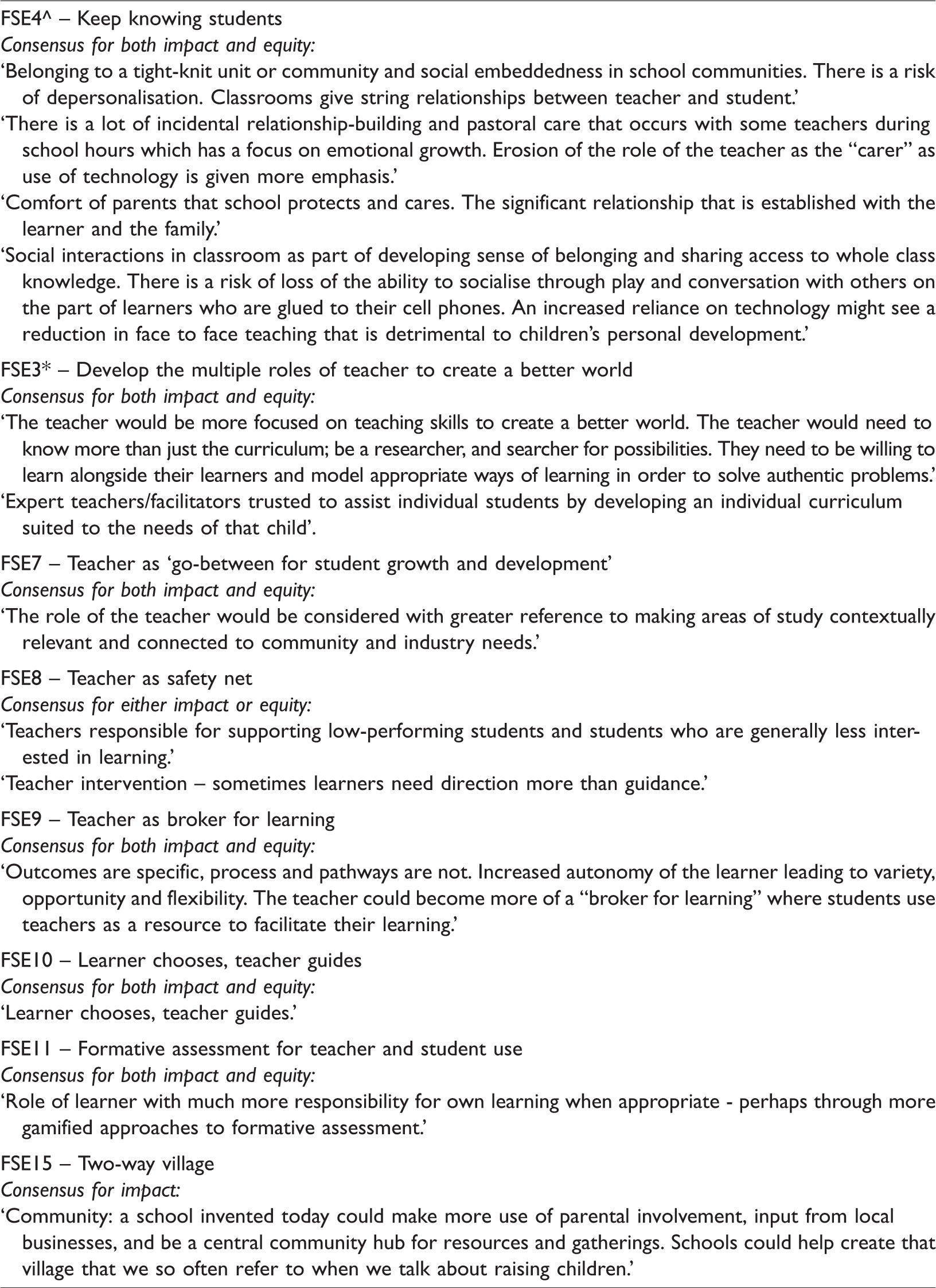
A teacher’s role should continue to include provision of specialist knowledge and expert curriculum knowledge. The role of teacher should include increased provision of individualised support for learners that might be in the form of providing ongoing mentoring, guidance along an educational pathway, or brokering learning activities that are specific to the learner. Finally, the role of teacher would have responsibility for providing a safety net for students who are disengaged or struggle inside or outside school.
In contrast to traditional approaches, this pillar of our framework emphasises a learner as the starting point, rather than a class or cohort. The key relationship between a teacher and a learner is developed by enhancing the role of teacher to provide individual support for a learner. This may require some reorganisation of the role for some or all teachers (for some or all of the time) beyond a simple ‘one teacher to one class’ ratio. The focus of schooling is developing ‘powerful ways of seeing the content of learning’ (Marton, 2014: 32) through provision of curriculum experiences. This would also include brokering of experiences (inside or outside the school) relevant to the individual student. The obligation to provide a safety net ensures that standards set by the system are addressed if a problem is identified but the major focus is on unleashing the maximum learning possible for each child to achieve quality teaching and learning (Cuban, 2013; Darling-Hammond et al., 2017; Marton, 2014). This approach contrasts to current approaches that seek to create targets through high stakes assessment (Nichols et al., 2012; Zhao, 2017) in an attempt to improve averages (Rose, 2016) rather than create success for all.
Structure
In relation to structure (Table 3), there was recognition from the expert panel that schools remain institutions that hold the trust of society and that there are practical benefits to an intensified physical space to provide resources to support learning.
Future School Elements and consensus statements from expert panel relating to structure.
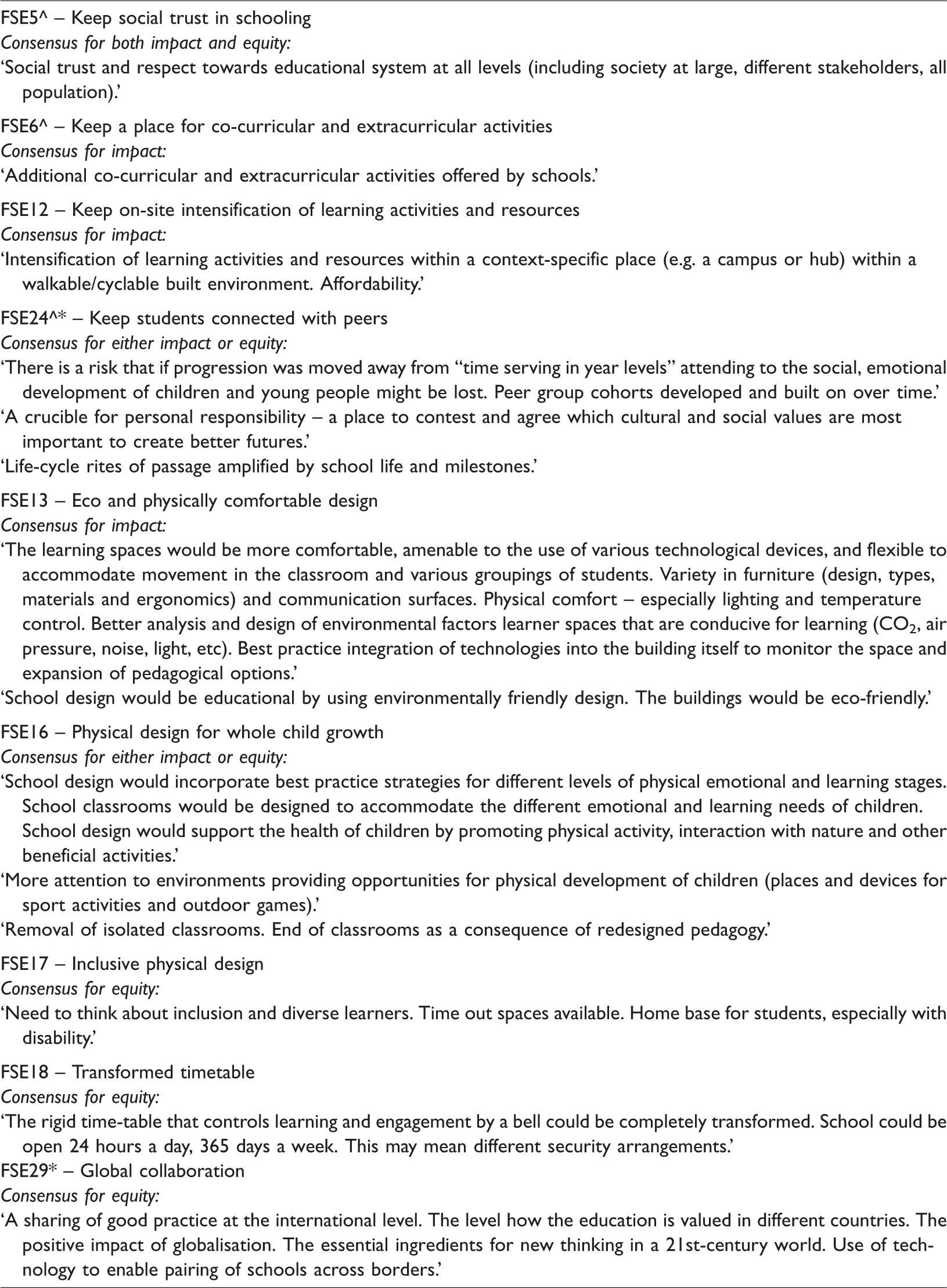
Physical spaces would be designed to meet higher ecological and comfortability standards. Physical spaces would also be designed to better support the holistic development of students through deepened connections to their peers, local community and the global community. The current concept of the learning timetable would be transformed and there would be increased opportunities to support lifelong learning processes, complemented by opportunities to utilise assisted technology tools including in the area of assessment.
This pillar of our framework challenges top-down approaches (Cuban, 2013) to change by increasing opportunities for stakeholders to be involved in the development of solutions for their context. This includes ensuring that the design of physical settings caters for those who are the intended users by focusing on the purposes of schooling, meeting the full range of learner needs, and addressing increasing societal ambitions regarding the environment. A number of the Future School Elements identify areas of complexity (Cuban, 2013; Robinson and Aronica, 2015; Van der Steen et al., 2013) to be foreseen as part of transforming the traditional structure of schooling by opening multiple options for how ideas can be translated into action.
Policy
In relation to policy (Table 4), compulsory schooling would remain a human right. Learning would be valued as an end in itself, and the work of teachers would be valued in terms of their role in society, demonstrated through high levels of trust and autonomy.
Future School Elements and consensus statements from expert panel relating to policy

The purpose of schooling would have an expanded focus on developing multiple literacies that support human development for life as a citizen within a democratic society that seeks to reduce equity gaps and eliminate inherent discrimination. The system would be less hierarchical with enhanced learner voice integral to setting the directions for future schooling and more responsive to the local community. There would be increased ways for assessing quality of student work and multiple pathways for students to follow.
This pillar of our framework maintains a systems leadership approach but compresses and redesigns the connections between the various levels (Darling-Hammond et al., 2017; Harris and Jones, 2019; Hargreaves and O’Connor, 2018; Mulgan, 2008; Welton et al., 2017). This includes broadening the purposes of education and increasing the involvement of students, teachers and community to articulate how these purposes are enacted. There are greater opportunities for models of schooling to be developed that are pluralistic (Ball et al., 2011; Bingham and Burch, 2019) and contextualised (Ball et al., 2011; Barber et al., 2010). This provides increased opportunity to address equity issues (Young and Diem, 2017) and cater for all students (Ball et al., 2011) by responding to the complexities of schooling across contexts.
Conclusion
Many scholars (Abbott, 2010; Robinson and Aronica, 2015; Trilling and Fadel, 2009) have argued that the design of compulsory schooling in the western world is a construct of the industrial revolution that needs to be significantly redesigned, transformed or revolutionised for the 21st century.
In the same way that we can anticipate the future rather than predict it (Miller, 2018), there is no single utopian model for future compulsory schooling. Instead, we can reframe the assumptions and logic in a coherent, holistic manner which will provide a concept design from which we can iterate.
In the last 40 years, policy makers led by business leaders, textbook and testing firms and think-tank organisations developed and implemented large-scale high-stakes assessment schemes linked to local, national or international standards (Hargreaves and Shirley, 2009). These assessments were developed to ‘raise the floor’ of student achievement and used ‘carrot and stick’ incentives and penalties to motivate school leaders and teachers to focus on improving outcomes linked to these standards (Nichols et al., 2012; Zhao, 2017). These initiatives came on the back of fear from many in public office and in the policy sector that schools (particularly government schools) have not done enough to promote basic literacy and numeracy skills of learners (Nichols et al., 2012; Zhao, 2017), favouring instead a curriculum of ‘fluff’. Simultaneously and with an emerging knowledge base behind them, a new generation of critics of the current system began to promote the notion that the design of schooling itself (Hargreaves and Shirley, 2009; Trilling and Fadel, 2009; Zhao, 2017) was the culprit in lower than desirable student achievement. They cited emerging technologies that promote automation as a threat to anyone currently working in low-level jobs across the world (Darling-Hammond et al., 2017; Trilling and Fadel, 2009). They propose that a focus on basic literacy and numeracy alone protects those at the top from a more equity-based approach to conceptualising schooling (Darling-Hammond et al., 2017; Zhao, 2017). They point to the obsolescence of most kinds of basic skills work in a machine-based world (Trilling and Fadel, 2009). They talk about future-focused skills and promote learning approaches not as easily assessed at scale in the same way as basic literacy and numeracy (Trilling and Fadel, 2009; Zhao, 2017).
It is in this light that our research project has utilised an expert panel to identify consensus across many ideas about how schooling could be redesigned when posed with the counterfactual question ‘What if compulsory schooling was a 21st-century invention?’ The distillation of consensus statements by the expert panel into Future School Elements makes visible a set of ‘anticipatory assumptions’ (Miller, 2018) as part of being future literate. Our research project demonstrates ways to ‘use-the-future’ (Miller, 2018) in order to consider decisions made in the present whilst anticipating the future (Miller, 2018). Foresight and other participatory futures approaches provide a way to achieve policy development which can harness complexity and align with practice.
Our results are a starting point that might be used to reframe the conversation globally about a new phase in thinking about teaching, learning and leading. What do the experts agree upon and may we do more of that as soon as possible? And we believe it starts with a question not an answer. ‘What if …?’
Supplemental Material
sj-xlsx-1-pfe-10.1177_1478210320965020 - Supplemental material for Using the future to transform the design logic of schooling: Consensus statements from an expert panel
Supplemental material, sj-xlsx-1-pfe-10.1177_1478210320965020 for Using the future to transform the design logic of schooling: Consensus statements from an expert panel by Jason McGrath and John Fischetti in Policy Futures in Education
Footnotes
Acknowledgements
We thank the anonymous reviewers for their feedback, comments and suggestions.
Declaration of conflicting interest
The author(s) declared no potential conflicts of interest with respect to the research, authorship, and/orpublication of this article.
Funding
The author(s) disclosed receipt of the following financial supportfor the research, authorship, and/or publication of this article: Jason McGrath is a doctoral student at the University of Newcastle, supported through an Australian Government Research Training Program Scholarship. John Fischetti received no financial suport for the research of this article.

Supplemental Material
Supplemental material for this article is available online.
J
References
Supplementary Material
Please find the following supplemental material available below.
For Open Access articles published under a Creative Commons License, all supplemental material carries the same license as the article it is associated with.
For non-Open Access articles published, all supplemental material carries a non-exclusive license, and permission requests for re-use of supplemental material or any part of supplemental material shall be sent directly to the copyright owner as specified in the copyright notice associated with the article.
