




Abstract
In this descriptive study the aim is to analyze the Hungarian educational policy history and event-chain of the comprehensive and post-comprehensive project. As a structuring framework this paper used the historical landmarks and the different institutional arrangement models (governance types and power distribution models). Accordingly, three landmarks and policy cycles have been identified, which are connected to political and social turns in Hungary. The first is the period of massive centralization and egalitarianism from the mid-1940s to the mid-1980s. The second period has to be counted from the acceleration of educational transformations, the political turn and transition times from the mid-1980s till 2010, whilst the third cycle is formed by recent policy developments. This paper’s overarching aim is to give an overview on the political, social and economic contexts of educational policies, and the key actors of comprehensive common school and policy impact. The term ‘comprehensive school’ is addressed in terms of its structural–curricular, political and cultural meanings. Accordingly, an analytical framework was developed, which is a combination of political (interest-groups/actor-centrism), cultural (ideological/interpretive framework) and structural-functionalist (social demand, ecology of the schools) explanations.
Keywords
Introduction
The history of the comprehensive common school is a history of political transformations, paradigmatic shifts and expansion of education in Hungary. It is a competition between the policy communities of selective, elitist and democratic, mass education and their educational models (integrated versus diversified) rooted in different ideologies and policy perspectives.
Most of the scholarly accounts on emergence and decline of comprehensive schools address the issue as a ‘political’ or ‘structural–curricular’ problem. The former is placing the emphasis on such issues as centralism/decentralism, social and economic policies, promoting and opposing actors, and power distribution between actors on different levels of policy-making (central, local and institutional), while the latter emphasizes institutional configuration, institutional/program types and levels, admission, selection, content etc. In this study on comprehensive and post-comprehensive school projects in Hungary, these perspectives will be combined. The overarching aim of this paper is to give an overview on context of educational policies (political, social and economic), key actors of comprehensive common school and their consequences on the educational system. In this process the analysis will be structured according to the policy event-chain and landmarks in the Hungarian educational system. For the analysis of comprehensive school history an analytical framework has been developed, which is a combination of political (interest-groups/actor-centrism), cultural (ideological/interpretive framework) and structural-functionalist (social demand, ecology of the schools) explanations:
(1) The analysis of institutional arrangement (polity), politics and policies of comprehensive and post-comprehensive school: (a) the political and social context of the educational system; (b) the nature of educational governance; and (c) the content and key factors of educational policies.
(2) The analysis of the educational policy effects and transformations in Hungarian society: (a) the changes in the school structure, curriculum and selectivity; (b) the social composition of the schools and inequality in education; and (c) the efficiency and achievement of different schools and social groups.
Based on this framework, three landmarks and periods in the history of Hungarian comprehensive schools have been identified. These landmarks are connected to political shifts in Hungary.
(i) Centralism and egalitarianism – the comprehensive era (1945–1985). In the 1950s and 1960s the school served as a social policy instrument of attaining social justice and equality of education followed by an expert belief in the strong state and political power to realize these objectives. These policies were focused on the equally accessible public knowledge through the general school (the comprehensive institutional type) and uniform curricula. The disappointment generated by the implementation of the egalitarian project, changing social and economic structure, and the policy expert generation change have resulted in an incremental shift in educational policies which was marked by the emergence of post-comprehensive and post-egalitarian projects. This shift has its roots in the decline of the communist regime (the decline of the so called ‘Kádár regime’ named for János Kádár, the General Secretary of the Hungarian Socialist Workers’ Party) started in the late 1970s.
(ii) Pluralism, marketization and decentralization – the post-comprehensive era (1985–2010). This was the period between 1985 and 2010 – after the turning-point in the mid-80s. In the 1980s, Hungary switched from centralism of education to decentralization, from a highly state-controlled system to gradual marketization. The growing local autonomy of institutions created diversity in institutional types, structures and curricula (showing the officially non-existent social, cultural, ethnic and value cleavages). The political transformation started a rapid re-organization of society, which heightened the gap between social classes while decreasing the solidarity between groups, and increased the income inequalities. These social and economic changes with free school choice resulted in a strongly stratified and selective educational system. Due to these changes, the comprehensive school and egalitarianism entirely lost their social support. In both local and central educational policies the egalitarian, democratic school was replaced by the ideal of efficient and effective schools.
(iii) Re-centralization and de-marketization in education (2010 and after). The government change in 2010 has triggered a wave of re-centralization and top-down reforms in public education. Most of the change initiatives directly or indirectly have to be considered as governance reforms, and as attempts of power redistribution between actors. After 2010 a reform chain took place – as a part of public administration reform – that stirred up old conflicts and contradictions between the dominant educational policy interpretive communities and frameworks. In this debate the most important cleavage unfolded around centralism versus decentralism. The clash of centralizing and decentralizing powers is visible in every current educational policy debate. Here some of the educational policy developments directly connected to the post-comprehensive project can be summed up, but at the same time it should be considered that the effects of these changes should be evaluated only after at least one decade of use, even if some researchers and experts are trying to make elaborate forecasts. In sum, any change initiative could be analyzed after at least one decade, if this paper is to demonstrate a comprehensive picture about the policy process (from agenda setting through program formulation and decision-making to implementation and evaluation).
Prior to examining in detail the emergence and decline of this school type and policy ideal the meaning of comprehensive schools should be defined, and the level of comprehensivity achieved in Hungary should be assed. The so called ‘general school’ (általános iskola) is the Hungarian comprehensive common school which was designed for students in the 6–14 age group who progressed through the eight grades of this single institution. The comprehensivity level – as for institutional types – ends up at lower-secondary level (ISCED2). For many decades in expert discourses and policy-making, the creation of the upper-secondary common school for ages of six to 18 in a single institution was also present. However, this model was never formally implemented on the systemic level, but only in small experiments and through curricular changes. If the aim of educational policies regarding the comprehensivity and democratization of education is taken into consideration, several attempts at implementation are discovered, which will be examined throughout this paper.
Centralism and egalitarianism – the comprehensive era (1945–1985)
The design and introduction of comprehensive schools
As an analytic device three different periods have been identified, which allows the multiple influences on the creation and development of the comprehensive school to be separated. The first analyzed historical period will be that between 1945 and 1985. Accordingly, the year 1945 in Hungarian political life has been identified as a critical juncture, but with the assumption that this is a methodological choice since in the educational policies regarding comprehensive education continuity in views and goals definitely can be recognized. As Pornói (2013) shows, despite the entire decapitation of old political and professional elites and the rejection of many elements of their educational and cultural policy, the integration of different school types and curriculums into the comprehensive school remain on the agenda. Clearly, to some extent wrapped into different socialist–egalitarian ideological and professional arguments, the universal goal was the elimination of old elites’ cultural monopolies and the creation of new elites.
Introducing a new school type into the educational system and implementing school structure reforms as a top-down initiative with the political aim of facilitating social mobility, changing the power structures and challenging status quo generates conflicts, projects some level of failure; this is so even in totalitarian states, where the education is directly controlled and the bottom-up actors are conceived as passive executives of the central goals. However, it can be assumed that the implementation failures and the internal policy debates over comprehensive secondary school were hidden from the public.
The introduction of the general school was the most important school structure reform in public education in the last seven decades. Never again has any (socialist or post-socialist) government seriously attempted to make the issue of universal school structure reform part of its educational policy agenda, trying instead to resolve the emerging problems and social demands through the expansion of secondary education by means of curricular changes, where the political aim and the power redistribution was not so visible. Since the 1970s the formation of school structure has, in fact, been realized by initiators from the bottom – the parents and pedagogues – through such phenomena as cream-off, curricular and structural alternatives and specializations.
In the mid-1940s the public education structure had an elitist, selective and fragmented character, with various sustaining actors, such as school types (in primary and lower secondary level the primary, folk and civil schools, and the traditional eight-year Gymnasium) and curricula. The Hungarian system had a dual structure with two educational tracks, where the traditional, prestigious eight-year high school dominated the scene. The track for the majority was designed especially for the working class and peasant students, which came from primary schools (grades 1–4), folk schools (formally grades 5–8, but in fact only grades 5–6) and civil schools (grades 5–8). The last two types were accessible mostly in larger urban settlements as a single school, whilst in the rural areas usually only the first four grades and grades 5–6 were available (the compulsory school attendance ending at 12 years of age). This track was a dead-end in that it gave the understanding that only the vocational schools were open to those students, not the traditional academic side (entrance to the Gymnasium from folk and civil schools was possible with supplementary study and examinations). The educational track selection point was at very early ages (10 years) after completing the first four grades. The second track has been dominated by the middle and higher classes. Only roughly 5% of children from working and peasant classes entered the academic track during the first decades of the 20th century (Fehér, 2000). The eight-year high school was of two types: the traditional Gymnasium with classical, humanistic curriculum, and the modern school with a curricular focus on sciences and technologies. This school hierarchy system reflected the social and territorial inequalities. The socially selective high schools were continuously the object of criticism, especially by the so-called ‘popular movement’ that desperately attacked the institutional arrangement and attempted to construct an open, democratic alternative institution in adult education.
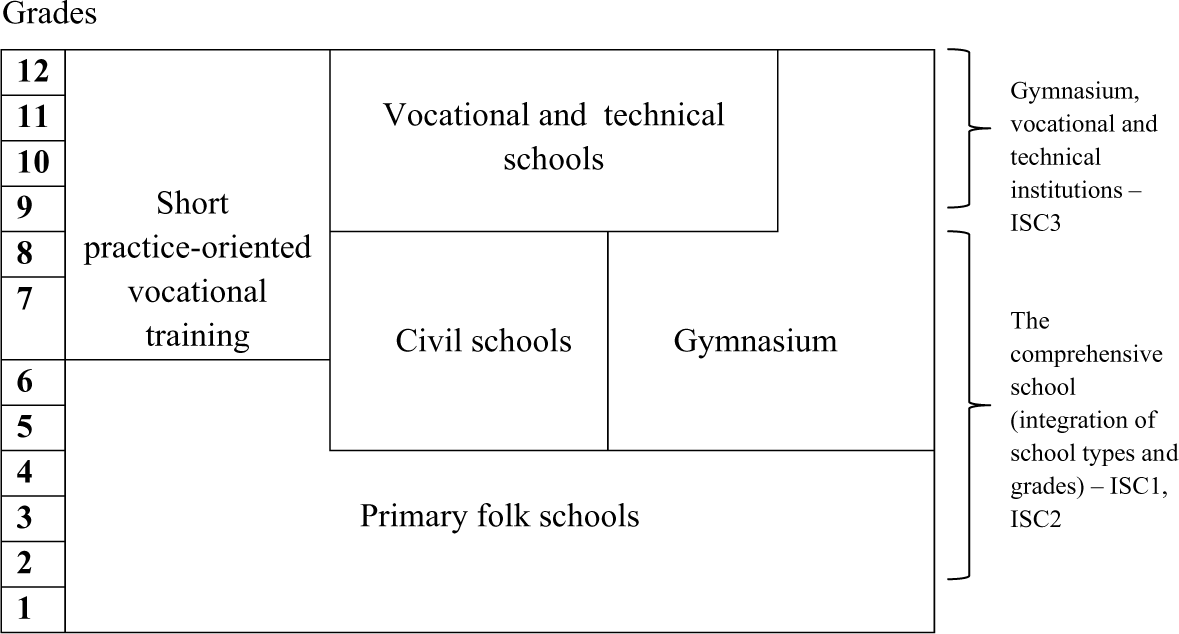
The structure of education in the 1940s and after which introduced the comprehensive schools.
The horizontal integration through introducing a comprehensive new school type was on the policy agenda for decades, and was intensively debated before 1945 (raising suggestions like these: 1918, creating a new school type; 1927, upgrading of civil schools; 1934, the creation of comprehensive high schools; 1940, upgrading of folk schools; and 1945, comprehensive upper secondary school) (Kelemen, 2007), but it was never able to present itself as an issue which deserved political decision. At that time, except for a small professional minority, the comprehensive school lacked strong political support and faced rejection on the part of elite teachers.
During these decades numerous unresolved problems of the educational network and unsatisfied social-political claims toward the public education accumulated. The following construction-problems can be identified from the contemporary professional and political discourses: fragmented and scant institutional network (both state and private); lack of modern curricula; lack of skilled professionals meeting the educational needs of non-traditional students; an absence of permeability between school types and educational tracks; little opportunity for further education for the masses; early school choice; and missing political engagement to undertake the financial and human resource costs of expansion.
Right after the Second World War, it was the consensus of the political elite that the state-model should be modernized. The central aim was to construct a modern, civil democracy, where the principle of ideological pluralism prevailed (after 1948 all of the pluralist views were swept away) (Pukánszky and Németh, 1996); the aim of modernization and democratization dominated the country. Into this climate was placed the political aim of democratizing the educational system and expanding the access to education (free public education for all). As that time’s expert generation believed, the ideological and political climate after the 1945 turn in Central- and Eastern Europe was ideal for top-down restructurings (strong executive power as a tool for the implementation of professionally matured reform programs). This was the great coalition of expertise, politicians and central bureaucracy to implement the ‘general school’, which was designed to offer uniform literacy by the same curriculum and textbooks to the age group of 6–14 in a single institution regardless of their ability and social class. The curriculum of grades 5–8 was similar, but not the same as in traditional high schools (reduced expectations). In any case, the general school gave access to upper-secondary high schools (traditional, academic track) and to vocational school courses.
In the government’s hand the institution served as a tool of social policy to attain equality and social justice for the oppressed by proclaiming class peace, while quietly carrying on class war. The introduction of general schools at the systemic level had two main reasons. According to the professional arguments the expansion and integration of secondary schooling was realizable only with these changes, whilst the influencing actors attempted to break the domination of the traditional, elitist Gymnasium and the power of privileged classes (ideological–political reason) (Forray and Kozma, 1992).
Sáska (2007) adds that the creation of the new organizational form can be interpreted also as the professional and social mobility ambition of primary school teachers who were fighting for similar rewards and prestige as professionals from the Gymnasium. In contemporary terms this was the class conflict between low status primary school educators and privileged high school teachers. The integration of the primary schools into a single institution and emergence of larger demand for higher qualified teachers have offered for these groups the upward mobility on the social and professional hierarchy. Consequently, among supporting actors a teacher’s group (forming an oppressed class also) was present, which was ideal in the hands of the central power to be used for political purposes. The system-level change generated teacher supply inefficiencies. Thus the next political step was the expansion of teacher education. At first, the government attempted to fulfill this goal at universities (dedicated for upper-secondary school teachers), but the hostile reception finally induced the decision-makers to create a new institution in higher education (teacher training colleges).
Implementation, failures and developments
Implementation faced some difficulties. It was begun under the umbrella of communist universal restructuring which marked the reception of school reform, since the radicalism in other areas generated rejection and resistance even toward the comprehensives. For example, the students of traditional eight-year high schools began to be considered as general school students, which they felt as a stepping back especially in prestige; the execution of compulsory school age was implemented aggressively which caused resistance; the eight-year church-related high schools boycotted the reform as private institutions. Because of political inefficiencies there was a large lack of physical facilities, personnel supply and pedagogical tools which meant that goals were often only formally implemented (Forray and Kozma, 1992; Kelemen, 2007).
In addition, the equality-oriented political actors took several steps to improve access to education, especially for adults. The most important intergenerational mobility facilitating initiatives were:
Working people’s schools: lower- and upper-secondary level complementary education for adults with incomplete educational level as after-hours or correspondence training.
Specialized matriculation examinations (correspondent to the Baccalaureate). In higher education quotas for lower classes were introduced. Soon it became clear that the political aim of improving the entrance to higher education for students of working class and peasant origin had failed since the members of these groups did not have the required certificates for application. To resolve this situation, a specialized Baccalaureate for working class and peasant origin students was established. The curriculum was built as a short-cycle study for one year (later two years) based on lowered high school subjects and according to the chosen higher educational field of study.
Expansion of the adult training forms at higher education institutions: these after-hours and correspondence programs were especially designed for those who had acquired the certificates at working people’s schools.
Even with these initiatives and administrative regulations the target groups remained in severe disadvantage, which phenomena, after the renewal of critical sociology, was registered by many studies (e.g. Ladányi, 1994). In addition, from statistical reviews the political turn after 1956 can clearly be identified. Sáska (2007) compared the equality-oriented educational policies and the higher educational performance of different social classes of two decades (1950s and 1960s). He states that in the 1950s the decision-makers made several attempts to expand the access of working and peasant classes which resulted in some moderate formal results (higher entrance). After 1956 the communist regime practiced a reconciliation policy with the middle-classes and intellectuals that resulted in abandoning the strict class-policy in secondary and higher education. This shift is clearly visible in statistical data: in the 1960s the middle-class and intellectuals reconquered their place in higher education (their percentage increased from 27.2% in the academic year of 1953/1954 to 61.1% in 1969/1970 between full-time students), while the lower classes lost it (their percentage decreased from 58.7% to 38.9% in the same academic years).
The implementation of general schools has not fulfilled the political expectations as after a few decades the strap on schools began to loosen the gap between original political aims, and the institutional level reality gradually became deeper. It was not possible to study the real impact and results, or if it was, then the Party and central administration hushed it up. This happened with the most important study (Andor, 1980, 1981) on comprehensive school reform in those times, although its discussion of the failures of the socialist state was a breaking down of taboos.
The general school, implemented by a centralized socialist state, means the rejection of any kind of pluralism and alternative in the system, which finally has contributed to its decline (Kelemen, 2007); in the 1970s and 1980s with the mouldering of the communist regime, the integrative power of comprehensive schools also weakened. The unequal power distribution between actors and lack of professional–institutional autonomy from the Party and educational administration made them the main enemy of the pedagogues and reformers, which groups (still in socialist frameworks) began to fight for the recovering of institutional and individual autonomies. This development was very influential, in that it has strongly influenced the educational policy debates, interpretive frameworks and problem-image of actors until now.
In the 1970s the demolition of the illusionary monolithic, homogenous society was already beginning. Some developments and reform debates in education served as an articulation of existing social and political cleavages, even if in the official language this was hidden. The most important symbolic steps in the deconstruction and weakening of comprehensive schools were:
Creation of experimental schools, allowing curricular experimentation.
Curricular specializations in individual schools.
Renewal of critical social science (such research topics as: hidden curriculum; inequalities; and disadvantage).
With the organizational integration of Gymnasiums into general schools the early age selection points and cream-off were formally eliminated, but in the 1970s under the umbrella of ‘elective courses’ they were gradually infiltrated again into schools, especially to the urban and high prestige institutions where the cream-off made sense and met the interests of educators. Also an important deviation was from the central equality-oriented goals (the crossing of educational district borders by the middle classes and educationally conscious families) which created institutional hierarchies and homogenous schools. These educational hierarchies mirrored territorial inequalities (e.g. flight from villages to towns, from towns to cities, and in cities from the periphery to the center). Another development challenging the monolithic ideas was the restarting of curricular experimentations (progressivist and reform pedagogy), firstly only to small extent, but in the late 1980s it became a real movement. The experimental school became the synonym of alternative schools, where the initiators were concerned with the ‘alternativization’ of the whole system as a way towards reforming the system, but without involving the Party. Intentionally from the top, reformers tried to reverse the direction of the reforms with the support of bottom-uppers. In addition, there was a rapid spread of Tyler’s curriculum theory (political consequences: the focus on need of individual children versus community goals; and state versus teacher control over curriculum) among experts that has to be considered as anterior to the later paradigmatic shift. The studies on the hidden curriculum approach should be also mentioned (the official curriculum opposed to real practice) (Báthory, 2001; Sáska, 2007).
As stated by Báthory (2001), the dominant reform ideas from the 1980s were autonomy, decentralization and alternativity. This period can be characterized by growing independence (from the Party), and activity and participation in controlling the educational processes by bottom-up actors. Some expert concepts (e.g. structuring education by program levels rather than institutional types) and decisions (the educational law from 1985) clearly were the antecedent of public education reforms from the 1990s. Obviously, the elaboration these concepts was determined by the strong western orientation of experts and reformers of that time (e.g. the educational developments in Great Britain and Sweden served as models).
The political lens can be added to the escalating problems in the school structure, especially at upper-secondary schools. The secondary school is that institutional type for which social demand was rapidly growing, but from the 1960s, in fact, it was omitted from the political agenda. Clearly, during this time the political tensions concentrated on this level of education (Forray and Kozma, 1992). Motivated by their high financial costs and conflicting interests of some factions (e.g. traditional high schools, lobbying of the heavy industry), the structural reforms were stopped in 1965. Finally, the peak of the demographic wave was aimed at that time toward vocational training, but this has not resolved the long-term problem (Halász, 2000).
Pluralism, marketization and decentralization – the post-comprehensive era (1985–2010)
The prelude of political transformations
Within a few years of the political turn during 1989/1990 the transformation of the educational system proceeded more rapidly. As can be argued, the political decline has been followed by the weakening of comprehensive schools. In education the educational law from 1985 was the most important step from which currently the transformation of education is counted. As the key figure in this transformation – Ferenc Gazsó – states: “…the basic concept of the law has been entirely adequate to a pluralistic, multiparty societal arrangement…This law has not been made for the state socialism. This was a European style educational regulation” (Báthory, 2000: 3).
The law officially declares the collective (institutional) and individual (teacher) autonomy that makes sense in the context of increasing the level of ‘local decision’. In addition, it strengthens the decentralization already in course, which means that it legitimates the new system of power distribution and their provision, with ever increasing influence over educational process and institutional decision-making of bottom actors (e.g. organization of school boards, electing the head teachers, constraining the influence of local educational administrations, etc.). In this perspective the greater local autonomy is in direct correlation with the higher performance of the system (Báthory, 2000). The power-distribution game has been taking place between the Party, its administration (both central and local) and teachers; however, one of the most important actors – the local councils – stayed away from the bargain.
The autonomy and decentralization functioned as a centrifugal power generating fragmentation and pluralism which articulated the existing diversity of Hungarian society, but still in a socialist framework. As a result of this very important social movement, socially, territorially and ethnically segregated educational areas emerged. With the conquest of decentralization, autonomy and marketization the schools have regained their control over the enrolment and selection policies that proved to be the most effective attack against system-level comprehensivism. As some contemporary accounts registered (Halász, 1991; Lukács, 1992; Liskó, 2006), those political forces became more active which were interested and aware of assuring for their children the advantageous social position. In order to realize this they were interested in the lowering of the comprehensive schooling age, to educate their child separate from the disadvantageous groups and to introduce more rigid and early selecting points between levels. These interest-groups have articulated a high preference for the 4+8 and 6+6 secondary system (ISCED 2 and ISCED 3).
The comprehensive schools and the political transformation
The political transformation of 1989/1990 started the shift from a one-party system to a multiparty system (the most important educational interests and values received parliamentary representation), planned economy to market economy (the market values and ideals in education), and strong political-bureaucratic control of the ‘hyperdecentralized’ arrangement (CERI, 1998; Sáska, 2007). In educational policy and administration a more power-balanced, multi-actor system with a consensual type of policy-making emerged, but one that by its relatively hidden mechanisms distorts toward the interest-articulation of pedagogues (corporativism) and middle-class parents. The policy-makers and experts preferred, as a tool for influencing the educational system, the intervention through content control.
As this paper has shown, in the mid-1980s the school structure policy was liberalized and decentralized, when the educational law allowed for the change of internal structure to individual schools (1985), the traditional eight-year Gymnasium to be restored (1988) and the announcement of the pluralism of maintainers (state, local government, churches, non-profit organizations). These decisions started a wave of individual school restructurings, when general schools expanded upwards and high schools downwards which generated a diversified structure (4+8, 6+6, 8+4), but more importantly curricular pluralism. Formally the vocational education starts at 16 years (the compulsory school age), but informally after these developments the school/educational track choice age has been reduced to 10 and 12 years. The institutional configuration was composed from these types: four-year primary schools; eight-year general schools; six-year high schools; and eight-year high schools. The landscape of vocational schools was also modified both in structure and by content (e.g. according to the World Bank reform). On this plural basis the competition between institutions has been increased, which is especially noticeable when comparing eight-year general schools with the structure-changing institutions (the latter siphoning off the students from the former).
The comprehensive school affected by the demographic changes (decreasing of the age-groups) gradually became expensive (Halász, 2000; Lannert, 1999), especially for smaller settlements (low student percentage/high costs). Thus in the vertical differentiations and decline of comprehensives the new perspective of cost-effectiveness has become a vital contributor. With the introduction of a divided system based on educational levels rather than institutional types, many expected the raising of effectiveness and permeability (Halász, 2000). However, there were conflicting processes with regard to the permeability: (1) the curricular and program level diversification diminished the mobility between institutions and program types, whilst (2) the internal differentiation of school portfolios (mixed profiles of academic and vocational programs) allowed the mobility between different tracks inside the school.
In addition, due to the political, social and demographic changes strong competition, stratification and hierarchization between schools emerged – a real fight for the students – where the most effective institutional strategy was the upward and downward expansion, but this was not an option for all schools. Most of the comprehensive general schools were not able to compete with them and the flight of families was hindered. Until the late 1990s, due to these developments almost one-third of comprehensives became considerably smaller: few parallel classes; and maintenance of fewer grades (e.g. only primary level) (Lannert, 1999). As such a fragmented institutional network with small schools and narrow portfolios is expensive, a rationalization and institutional integration movement took place, supported especially by the local and central government due to financial tensions and deterioration of quality of education.
In the 1990s important changes were generated by the curricular reform: namely, the introduction of a National Core Curriculum. This initiative had as a secondary goal to weaken the rigid structure of education and to move the structuring power of institutional types to levels with the introduction of ‘educational cycles’ of 6+4+2/3 (six years of basic education, four years of general subject education, and two to three years of vocational and general education). It was clear that the top-down structural intervention was outdated in order to introduce further comprehensivation, but that the influence of a new national curriculum could aid that process. The educational cycles of the three-tier structure when placing the emphasis on educational levels weaken the status of school types, but more importantly make the general education two years longer (compulsory general education till 16 years) and slightly reduce the curricular heterogeneity between schools. Though the comprehensiveness at upper secondary level through a new school type was not realized, but by content it has been implemented. There was a pressure on general schools to establish two additional years to the eight, but rarely was this realized in smaller settlements where this had little relevance. It needs to be added that the National Core Curriculum did not fulfill the hopes invested in it, especially because of a resistant traditional structural arrangement and the low regulative capacity of the framework.
From the late 1990s the local and central educational policies were marked by the economic considerations and financial restrictions, and these times have lost ground for the focus on quality and quality management in educational policies. In 1998 the decision-makers made some attempts to control the further fragmentation in school structure while introducing curricular modifications, limiting the local-institutional autonomy and increasing the central control over education. As a part of these policies the comprehensive general school type has been strengthened (Balázs, 2003).
As has been listed above, at the system-level various problems accumulated and competed for political attention. In the mid-1990s and again in 2007 the comprehensive middle-school offering the fulfillment of 12 grades and diverse program-types in a single school again was placed on the educational policy agenda. The agenda-setting process followed the traditional, inside initiation way and top-down aspect: problem-structuring and agenda-setting by experts; starting professional work on resolutions; and offering a proposal for decision-making. As in many other cases, this project never managed to get past the decision-making level, and only some policy principles and tools were able to seep through to political decision-makers.
The comprehensive school project from 1997 (called KOMP-project) has been based on seven years of expert work. The proposal legitimated its policy answers as a response to the diverse problems and issues raised in the different levels of the educational system (universal reform). In fact, the system-level reform was wrapped into the introduction of a new school type: the comprehensive middle-school. The policy program of these schools has combined the educational and cultural principles of value pluralism with internal and student-focused differentiation; it has also sustained the market-oriented, decentralized status quo, especially a high emphasis on further advancement of institutional and pedagogical autonomy. Under this policy umbrella – in terms of experts’ expectation – can be resolved most of the social (equality of opportunity), economic (effectiveness and efficiency) and political (governance) problems of public education with special focus on opening as many doors as possible to higher education. A new arrangement represented a radical shift with deep cultural revolutionist ambition from selective to comprehensive system, from selective school to open-door school and from between school differentiation to internal differentiation.
The experts have recognized that most of the problems can be traced back to regional–local and ethnic inequalities. Accordingly, in their perspective the system-wide reforms are not only economic and social, but also regional policies. Thus, the impact of regional–local inequalities on policy programs has to be addressed (the settlement type and size, ethnical and social composition highly influence the implementation of any policy). In the KOMP-project and its successors these issues were planned to be resolved through strengthening the school districts and organizing them in a comprehensive way (Lóránd, 2010).
The educational policies of effectiveness and efficiency are more successful because these are better supported and they correspond to the existing political mood and ideology. These have spread rapidly between the top actors and have been able to manage to be turned into decisions. Such policies had and have strong national and international promoters, and have been shown to be capable of structuring the public and political opinion in Hungary until current times. Between influential, top actors (politicians, experts, top-bureaucrats and representatives of international organizations) arose a consensus on the preference for the market-oriented approach, which led to a whole reconsideration of roles in education. Such international organizations as the World Bank (through loans) and the OECD (through expertise, expert networks and international measurements) played a key role on promoting the elements of neoliberal ideology. In the emergence of these policies in education, which are placing high emphasis on such principles as effectiveness and efficiency, the rising costs of expansion and economic downturns have contributed to, and at the same time represented a good legitimation basis. Even the policies addressing the inequalities in education and the elements of comprehensive education have been discussed in this framework.
Inequalities, achievements and school structure
In transition times the social solidarity between the social groups has decreased (Halász, 2006); accordingly, Hungarian society has not shown much interest toward the comprehensive schools (Baranyi, 1997). When and where it was possible the middle and higher classes left the comprehensives in the lurch. The transformation functioned as a centrifugal power. As Halász (2006) argues, after the political transformation the educational developments in Hungary were determined by the social and economic context – especially, by the growing income inequalities, low level of solidarity between groups associated with the rapid social restructurings, and the conceptualization of the school choice as a civil right. Most of the studies in the late 1990s showed that the majority of people preferred the early selection, strong competition in examinations and the emergence of an elite sector, and in addition the social differences reflected by the educational system have been considered not only as natural but desirable (Halász, 2006).
As Havas (2002) states, the Hungarian school system after transformation is not only selective but segregative, which phenomena (through direct and indirect mechanisms) hit especially the Roma minority. The most important segregating forces are identified in the institution of the school choice (continuously under attack by critical social scientists), the high decisional autonomy of local actors and the lack of solidarity in society. Those parents who are more conscious educationally are committed to take the burdens of educating their children out of school districts since they receive better services, higher further education and career chances. To these forces can be added the institutional interests of cream-off where the real competition is for students of better social status and achievement. These students represent savings in financial and human resources, low levels of problems and stress, more success and a stable institutional future. However, the strategy of cream-off was only opened for those urban schools that were in a better situation after transformation and in a good location (center). These are now the schools of the middle classes from where the lower classes and marginalized groups were sidelined. In the last decade the white and middle-class flight has affected not only the urban but also the village schools, increasing the number of students who shuttle from village to town and to neighboring village (Havas and Liskó, 2005 cited by Keller and Mártonfi, 2006; Kertesi and Kézdi, 2005).
The international measurements (such OECD and IEA studies as PISA, PIRLS and TIMSS) gave a new impetus for the policy discussions on proper educational arrangement, governing principles, roles, structure and culture. As in other countries, the PISA study has the main influence on structuring and governing educational policy agendas. Its first results not only proved the previous national measurements (National Assessment of Basic Competencies), but in international comparison have confirmed the highly selective and segregative aspect of the Hungarian educational system. From these results unfolded a system where: (1) inequalities between schools and school types are among the highest on an international level; and (2) student achievement is most influenced by parents’ educational level between participative countries. There is little added value (efficiency) or high reward for parents’ educational level.
The student achievement measurements on national and international scales contributed to the emergence of evidence-based educational policy, and strengthening the connection between policy research and practice. The educational policy frameworks mainly were dominated by the search for an effective school model: interpretation and elaboration of the notion on different levels of education. The warning results served as a good referential platform for new models. Also they were the most successful tools in influencing the real practice at school level. Clearly, the feedback from large-scale measurements affected and generated the renewal at the curricular–methodological level (starting the shift from traditional literacy and theory-based content to competence and practice-oriented learning); the new test contents transmit new curricular development demands toward the schools. The entrepreneurial terminology, the notions of quality, effectiveness, efficiency and accountability gradually began to dominate the daily talks and structured most of the policy discussions.
The expert study entitled ‘Green Book’ (Zöld Könyv, 2008) had been developed in an evidence-based policy fashion and represented a large professional collaboration for the renewal of Hungarian public education. The main policy arguments were lined up from the OECD databases, and it presented itself as a search for a competitive system in European and global contexts. Education appears in the role of a driving force for economic development. As it is argued, bringing Hungary up to the level of the developed countries will be made possible by reforming the public education system with special emphasis on strengthening the connection between economy and education. From the individual expert studies a ‘universalist’ approach for reform of education is unfolding. It is being considered again to take on to the political agenda all levels and problems of public education from pre-primary education through comprehensive general and middle schools to vocational education. Even if this ‘universalist’ education project claimed to tear education away from the party-political context (considering it as professional and national issue) it would have been washed away by the political turn from the late 2000s, because only a few elements were able to survive.
Re-centralization and de-marketization in education (2010 and after)
The changes since 2010 have to be overviewed because, in short, it seems that this turn will mark the educational policy frameworks for the long-term due its stable political support. The landmark here is defined by the government change, but many aspects of renewal can be traced back to the beginning of economic crisis. The transformations in the polity, politics and policy of education since 2010 can be understood and interpreted through the political, social and economic ideal models of the new government, and a reaction to the economic crisis ripening during these years. This context has politically favored the re-invention of social and economic roles of the state, and also fueled a renewal of the belief in an active, strong state.
In new governmental rhetoric education is a public service (but envisioned in a new managerialist fashion) and an instrument for the national economic development. The main goal is the creation of a new middle class with competitive competences and knowledge. This seems to be a shift from neoliberal terminology: de-marketization of education; re-building and re-strengthening the role of the state in education; calling for a value-driven education; new national literacy; and higher (intellectual) demand toward the students. The problems behind the reform aims are diverse: reference to the deterioration of education; loss of teacher reputation; low transparency; high degree of functional illiteracy; weak moral education; proliferation of curriculums; lack of usable knowledge; and competences in employment.
According to the governmental rhetoric the educational governance must be reformed in a centralistic fashion: (1) because of the unstable financial capacities of local governments and diminishing quality of education; (2) in order to gain higher control over education and using it for realizing political–economic goals of the government that were impossible to attain in a highly decentralized system; and (3) due to the imperfect relation between education and the world of work. The interest groups from industry and economy proved to be the most successful actors in placing their priorities on the political agenda.
The new institutional arrangement has as a general goal the improvement of efficient endorsement of government’s will over the system. In this perspective the introduction of the new bureaucracies, constraining of bottom-up actors’ influence, and re-strengthening the traditional dichotomy of administration and decision-making have as a purpose the enhancement of educational policy implementation. The re-centralization of education or more correctly the strengthening of central control over education is taking place through the next generation of governance 1 reforms:
Changing governance of education. The government introduced new central and local administrative and financing organizations, for example, the Klebelsberg Institution Maintenance Centre at central level and as a de-concentrated institution the regional school inspectorates. The latter is an extended, regional-level hand of the Klebelsberg Institution Maintenance Centre that fulfills both administrative tasks and professional control over schools. In addition, there is under elaboration the transformation of quality management, where the local quality assurance will be replaced and supplemented by uniform evaluative, performance-based systems and professional counseling at national level. These steps are interpreted by their opponents as a re-bureaucratization of education, which in the long-term would be detrimental to the quality, competition and innovation in education.
Growing financial centralism and opting-out. As a resolution of the unstable budgetary environment of local governments the opting-out from local to state- or church-maintenance for the schools has been made possible, which means especially wage financing from the central budget. This started a large opting-out wave in Hungarian public education. As some critics argue, with this decision not only the institutional autonomy was reduced, but also the control of the local community over schools.
Higher curricular centralism and some level of standardization in content. The new power has revised the Core Curriculum, carried out some level of standardization, expanded the central control (in more detailed style) over content and nationalized the textbook market (reducing the number of utilizable textbooks). Additionally, a high preference has been given – at least at the rhetorical level – to some subjects (e.g. science, mathematics and technology) that are seen to correspondence with the economic goals.
Strengthening the corporative interest articulation of pedagogues. A new organization (National Teaching Body) for the centrally appointed, paid and evaluated teaching profession has been established. This organization represents the professional, corporative interest articulation of pedagogues in contrary to the political one (teachers’ trade unions). It was introduced as a step forward to stronger professionalization: a new promotion system (performance indicators, peer-review evaluations); more rigorous selection; and extended study time in teacher training.
With regard to the comprehensive project it is important to mention the reduction of compulsory school age from 18 years to 16 years, introducing full day programs in general schools, the shift to dual vocational education (with reduced curricular expectations and study time), constraining the school choice and the control of the local community over institutions (as an indirect effect). In addition to the above mentioned recent developments some long-term changes can be mentioned such as the conquest of evaluations, evaluative bureaucracy and accountability policies (standardized tests in measuring the student achievements, using of performance indicators as a financial and administrative tool etc.).
The re-centralization has been interpreted by its opponents as a critical factor in the further deterioration of quality and achievements in public education. Since the 1980s the assumption regarding the positive effect of institutional arrangement (pluralist, decentralized, consensual) on quality of education has determined the political and expert views on education. The shift from this perspective incited the passions of some opponents. As Kozma (2014) argues, the centralism entirely fits into the historically emerged institutional arrangement and administrative culture in Hungary, but at the same time is a reminder that the reintroduction will have high costs regarding the participation, active role of the bottom actors and the innovative and creative capacity of institutions.
Summary
The comprehensive school project is a political and cultural issue (conflicting powers, actors and interpretive frameworks), and it should be discussed as such. The history of the comprehensive common school is a history of political transformations, paradigmatic shifts and expansion of education in Hungary. A competition between the policy communities of selective, elitist and democratic, mass education and their educational models is rooted in different ideologies and policy perspectives. This project proved to be both success and failure (a compromise or incremental change). Formally, many goals were achieved with the implementation of comprehensive schools (the main tool in the hand of educational expansionists), but in reality the stratification of Hungarian public education culture never disappeared, only having been weakened for short periods. This paper has shown that the causes can be traced back to the domination of selective school culture and ineffectiveness of re-culturation ambitions of top-down actors, at least, when the goal of the comprehensive school project had political will beside it. Clearly, the Hungarian developments of comprehensive schools are not an exception but are an experience of European countries and can thus be interpreted in the context of the European traditions.
Footnotes
Declaration of conflicting interest
The author declares that there is no conflict of interest.
Funding
This paper was supported by the János Bolyai Research Scholarship of the Hungarian Academy of Sciences.