




Abstract
While many studies on external accountability forms have illustrated the impact on the prevailing conceptions and values about the nature of school organizations, still little is known about the active role of school leaders as sense-makers who deal with conflicting accountability demands. We argue that while multiple external accountability forms driven by policies often manifest in apparently conflicting ways in school organizations, recent findings suggest that some school leaders have come to understand and adapt strategically and reconcile these logics in practice over time. In this article, we seek to highlight the institutional complexity that school leaders face when attempting to make sense of, interpret reconcile and/or counterbalance competing accountability demands from multiple and incompatible logics while considering their schools’ needs and conditions. We develop a conceptual framework that unpacks the intersection of the institutional complexity triggered by multiple institutional logics and school leaders’ sense-making about reform. This framework could illuminate how and why the multiple logics in the institutional environment shape and are being shaped by school leaders’ sense-making in the complex policy implementation processes that lead to different policy outcomes.
Problem statement
Scholars across various traditions have examined the impact of external accountability on school organizations. Many macro-analytic studies have focused on how policy demands structure local implementation processes. These studies illustrate how external accountability and standards work to reinforce the loosely coupled school organizations by tying these external pressures to the technical core of schooling (Datnow et al., 2013; Sherer and Spillane, 2011; Spillane et al., 2011). They show how external accountability has changed organizational norms and culture around instruction by redirecting school actors’ attention towards the standardization of instruction, transparency and monitoring of performance. For example, school leaders have been shown to use standards and test scores to align instruction with high-stakes policy (Sherer and Spillane, 2011; Spillane et al., 2011), to concentrate instructional efforts and gauge performance in language arts and mathematics (Spillane et al., 2002) and to reallocate teachers’ time in mandatory weekly workshops (Anagnotopoulos and Rutledge, 2007). These studies also focused on the increasing and overlapping external accountability demands from state governments, districts, school boards, school councils and communities, and how these demands conflicted with the more established and taken-for-granted logics of school organizations (e.g. school characteristics, student population, teachers) and professional accountability (Marks and Nance, 2007; Shipps and White, 2009). They have stressed, for example, how standardized tests undermine higher academic standards by limiting teachers’ decision-making authority over instructional methods ( McNeil, 2000 ), limiting innovation and risk-taking, and fostering attention to compliance with standards at the expense of students’ instructional needs (Hall and Ryan, 2011).
Other micro-analytic studies have focused on how school leaders made sense of, interpreted and acted upon the increasing external accountability demands and tensions they created at the local level (Gonzalez and Firestone, 2013; Shipps and White, 2009). Such studies identified some of the important tensions perceived and experienced by school leaders between their schools and parents’ expectations and between their districts and parents’ demands. Shipps and White (2009) illustrated how principals’ experience with the market accountability expectations induced by parental pressures conflicted with their schools’ internal accountability towards educational goals in terms of the grading policies. Gonzalez and Firestone (2013) indicated how school leaders used ‘customer metaphors’ to talk about parents’ expectations for their children and how these expectations often diverged from the district standards and performance metrics. These studies also showed how some school leaders’ perceptions of conflicts and tensions reduced over time, suggesting that they internalized external accountability expectations using a moral code to balance the multiple accountability demands (Gonzalez and Firestone, 2013) and learned to navigate, adapt and respond strategically to tensions and apparent conflicts (Shipps and White, 2009).
While many studies on external accountability have focused on how high-stakes tests and standards changed the prevailing logic, conceptions and values about the nature of school organizations and practices, little is known about the active role of school leaders as sense-makers who deal with and attempt to reconcile the increasing and conflicting accountability demands. We seek to provide an important yet overlooked starting point for understanding how the macro-structure of multiple accountability demands can work not only to influence school leaders (i.e. constraining their decisions and actions), but also how school leaders can interpret, prioritize and mobilize these logics in ways that enable them to reconcile and/or counterbalance them in their everyday work. In this article, we seek to highlight the institutional complexity that school leaders face in attempting to make sense of and interpret the competing accountability demands from multiple and incompatible logics, while attending to their schools’ needs and conditions. Specifically, in this article we propose a conceptual framework that bridges the concept of institutional logic from neo-institutional theory (Thornton et al., 2012) and the concept of schemas from sense-making theory (Spillane et al., 2006). In this framework, we argue the combination of macro-analytic traditions (i.e. institutional complexity and logics) and micro-analytic traditions (i.e. sense-making) can help to illuminate how school leaders’ decisions unfold in complex policy environments. We describe how the combination of these conceptual perspectives can help to unravel the interplay between agency and structure by looking at school leaders’ agency through the lens of sense-making and the macro-structure of accountability as an assemblage of competing institutional logics inside schools. First, studying school leaders’ schemas is key in understanding how and why some school leaders exercise agency by focusing on how and why they understand, prioritize and act upon the multiple external accountability demands including the tensions, contradictions and contestations that go on inside schools on a daily basis. Second, institutional logics and their associated resources enable and constrain school leaders, resulting in a mix of accountability demands. The concept of multiple institutional logics provides a window into how different logics convey different rules, norms, beliefs and practice that create structural tensions and trigger institutional complexity. We maintain that the combination of sense-making and institutional logics will allow researchers to better understand how and why some school leaders are able to reconcile or counterbalance the multiple accountability demands, while others in similar situation struggle with the contradictions leading them to reproduce the status quo. This conceptual framework could, thus, shed light on local implementation processes and explain some of policy responses and outcomes, especially in terms of the idiosyncratic and variable responses of school and district leaders that are often reported in implementation research.
Conceptual framework
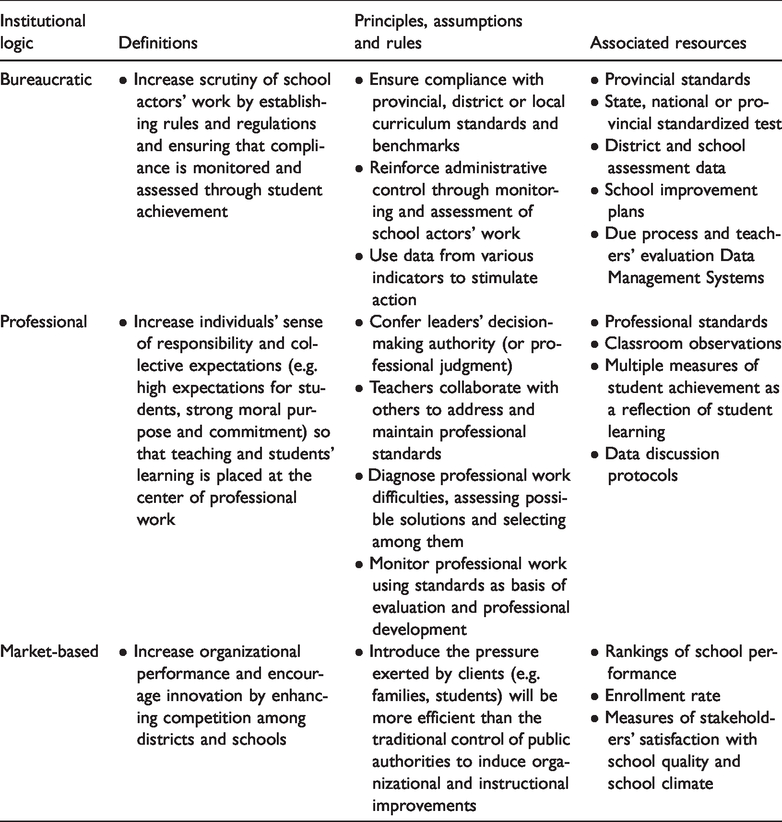
We begin by situating our study at the intersection of policy implementation, neo-institutional and sense-making fields. Drawing from neo-institutional theory, we conceptualize accountability as a broader set of institutional logics that serve as a new managerial ideal to solve the issues of incoherence and loose coupling often seen as forms of ‘disorganization’ that limit improvements (Hallett and Ventresca, 2006). The concept of ‘institutional logic’ (see Table 1) also allows us to describe the multiple institutional logics and their associated resources that are diffused, coexist and compete inside schools, and that abet the production of ‘institutional complexity’ (Bridwell-Mitchell and Sherer, 2017). The concept of ‘schemas’ allows us to examine the agentic dimension of institutional logics that manifests in the underlying micro-processes whereby school leaders construct, make meaning, contest and deal with contradictions as they attempt to understand the multiple logics underpinning accountability demands in contemporary education systems (Ball, 1993; Weick, 1995). In so doing, we seek to provide a conceptual framework to support empirical research on how school leaders’ decisions are shaped by multiple logics while they make sense of competing demands from their environment (see Figure 1).
Analyzing accountability forms, and their related resources that can enable or constrain school leaders’ sense-making.
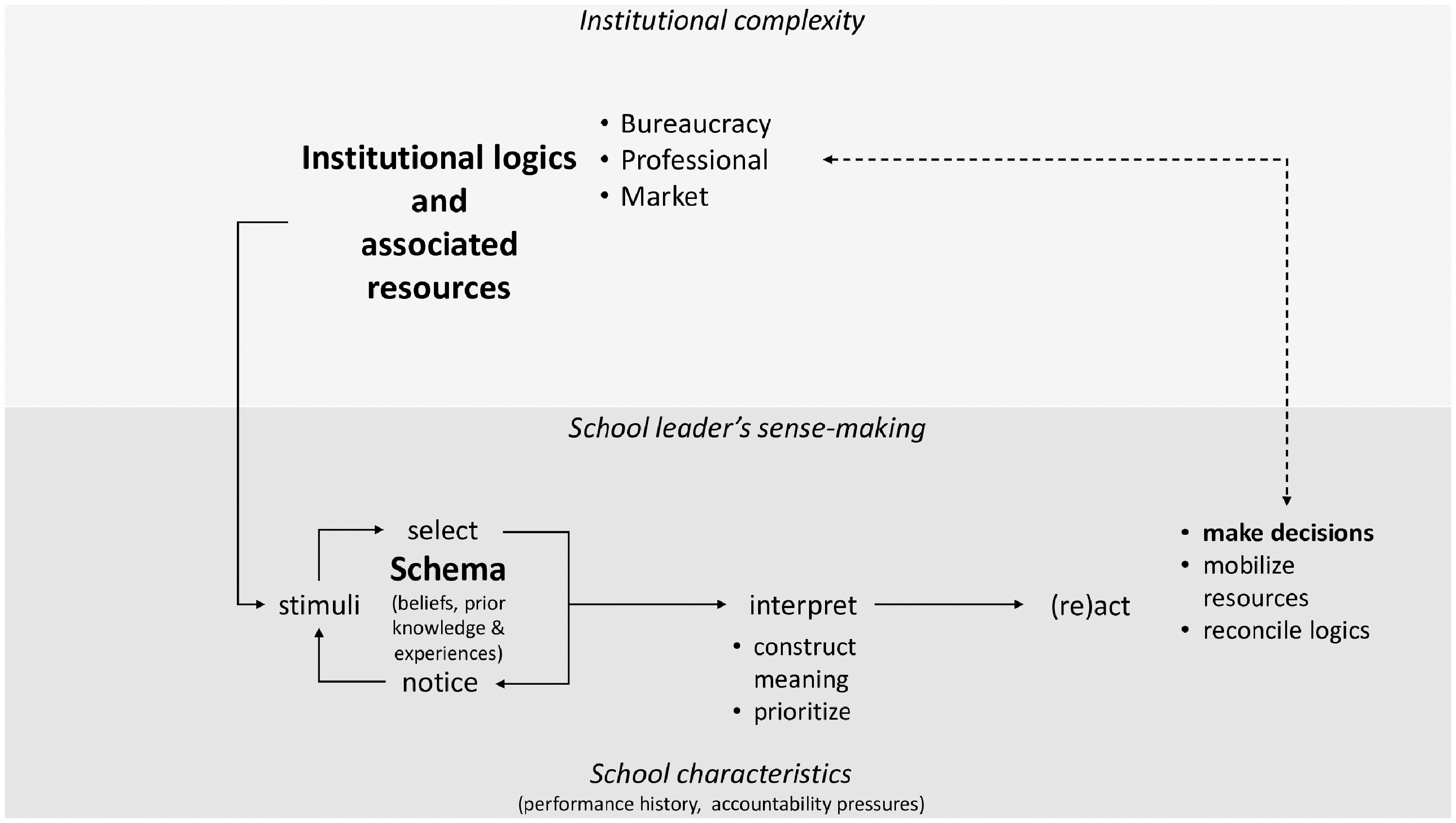
The interplay of the multiple institutional logics and school leaders’ schemas during policy implementation.
Accountability forms as institutional logics
Some studies have used the concept of institutional logic to study how the ascendance of the ‘new’ logic of accountability interacts with the more established and taken-for-granted logics of local autonomy and professionalism in schools (Lowenhaupt et al., 2016). These authors emphasize how accountability proposes a fundamental shift in the norms, values and practices in education. In other words, accountability represents more than ‘a natural and technical response’ to issues related to governance and policy (Power, 1996). Consequently, wider institutional changes instantiated by accountability as a logic in education aimed at aligning school practices with outcomes – standards and test scores – represent an institutional logic that contrasts with a previous logic that focused on means and processes.
As illustrated in neo-institutional studies, the coexistence of logics inevitably arises during the early stages of policy implementation where a dominant logic has yet to become institutionalized (Cloutier and Langley, 2013). However, in some educational systems, accountability has reached advance stages of implementation, institutionalized in schools’ norms and routines and internalized in school actors’ values, beliefs and practices (Knapp and Feldman, 2012). While researchers may no longer overtly observe accountability as a new logic, the neo-institutional lens reminds us that school leaders may still deal with these tensions that have become the tacit and taken-for-granted institutionalized rules and expectations to guide their decisions and actions. Therefore, omitting this important dimension as part of the implementation in studying new policy, program or reform may limit our understanding of the complex policy environment.
Neo-institutional scholars have described how historical patterns of values, beliefs, norms and practices inherent in different institutions structuring society tend to manifest in conflicting ways in organizational settings (Freidland and Alford, 1991; Meyer and Rowan, 1977). Thornton and Ocasio (1999) conceived these historical patterns as ‘logics’ associated with five key institutions, notably markets, states, bureaucracies, families and religions. This concept of institutional logic refers to the socially constructed patterns of assumptions, values, beliefs, rules and practices that shape leaders’ decisions and actions (Thornton and Ocasio, 1999). Logics provide the organizing principles, ‘raw materials’ and ‘guidelines’ for action by which schools leaders and teachers ‘produce, reproduce and provide meaning to their social reality’ (Hallett and Ventresca, 2006: 213). In other words, institutional logics shape the way school leaders interpret and respond to ongoing developments in and around their organizations (Suddaby and Greenwood, 2005).
In education, some policy implementation studies have stressed how institutional logics and their associated resources convey meanings that shape school leaders’ interpretation of a policy, reform or program (Hallett and Ventresca, 2006; Woulfin, 2016). They explain how resources embodied in and expressive of logics take on different meanings and are used differently by different actors in different situations. Seen this way, resources serve as carriers of different institutional logics – that is, assumptions, rules, beliefs and values. For example, Woulfin (2016) examined the interrelationship of three categories of resources (policy, instructional and research-based) as carriers of logics. The author showed how these resources carried different logics exposing teachers simultaneously to two competing conceptualizations (i.e. theories, philosophies and practices) of reading instruction.
This suggests that attending to the institutional logics that capture leaders’ attention may also contribute to unpacking the institutional complexity of their decision-making with respect to new policies, programs or reforms given the complex policy environments in which they work and the specific characteristics of their organizations. However, school leaders do not necessarily attend to all of the resources circulating in their organizational contexts. They respond to resources they pay attention to, but frequently in idiosyncratic ways (Thornton et al., 2012). Consequently, institutional logics arise out of leaders’ interactions with different resources and their attempts to make sense of and attend to certain of those resources in their environment. The logics conveyed through the variety of resources circulating within and outside schools may frequently be fraught with tensions or contradictions.
Institutional complexity
We aim to expand on the literature that has viewed accountability as an institutional logic by suggesting that accountability is pluralistic in nature within educational systems. Consequently, accountability can also be conceptualized as being influenced by different institutional logics. While accountability can be understood as a means ‘to answer a constituent, superior, or customer for one’s performance, primarily by reporting and/or justifying procedures and results’ (Firestone and Shipps, 2005: 83),it carries different forms and assumptions about the nature of improvement, the amount of organizational and technical improvements expected and the outcomes anticipated in educational systems (Ben Jaafar and Anderson, 2007). Thus, there is no single way to operationalize accountability because its nature redefines the numerous relationships between school leaders with different stakeholders. These relationships depend on different elements: (a) who is accountable to whom for what (ex: parents, policymakers, district leaders, colleagues); (b) how the accountability process is accomplished; and (c) to what end. Consequently, different accountability forms coexist within schools. While several typologies of accountability have been provided in the literature (Garn, 2001; Leithwood, 2001; Ranson, 2003), we seek to highlight the accountability forms that have been studied to date in relation to institutional complexity and the underlying institutionalized assumptions, norms and values they convey inside schools.
Table 1 (see below) offers a conceptual tool to examine the macro-structure of multiple accountability demands that convey logics and are institutionalized in varying ways in schools’ routines and practices. These accountability forms also provide an illustration of the potential institutional complexity school leaders face while making decisions.
The concept of institutional complexity thus provides an analytical lens by emphasizing the pluralism that coexists in organizations as a source of complexity (Cloutier and Langley, 2013) and the competing demands that may explain how and why school leaders are influenced and pushed in many directions by the established institutional logics. As a result, institutional complexity can be understood as the incompatible prescriptions from multiple institutional logics that school leaders face at the school level. These incompatibilities include the incongruous pressures and conflicting potential courses of action that they face and that may complicate their decision-making processes (Greenwood et al., 2010).
Recent studies have illustrated, through the lens of institutional complexity, how higher education administrators strive to render more compatible in practice the multiple institutional logics manifesting in apparently conflicting ways (Canhilal et al., 2016; Nordstrand and Pinheiro, 2016). Some have stressed the important role that administrators play in their organizations in mediating the multiple, seemingly conflicting logics, sometimes using certain logics to reinforce existing ones while counterbalancing others. For example, Nordstrand and Pinheiro (2016: 156) illustrated how, in adapting to system-level reforms inspired by new public management principles, administrators in Norwegian universities emphasized academic freedom, democratic decision-making and knowledge as a public good (beliefs and practices comprising a long-standing ‘professional logic’) to counterbalance the newer ‘logic of the marketplace’ that encourages the exploitation and commodification of universities’ assets, and a ‘bureaucratic logic’ featuring increased regulation and control through indirect means such as quality measurement and reporting systems. The authors concluded that administrators were increasingly expected to broker and mediate these different logics while also resolving tensions by taking into account the collective goals of their organizations and being respectful to the needs, aspirations, values and identities of the professional academics working with them (Nordstrand and Pinheiro, 2016).
Recent studies in education have also begun to tackle issues related to institutional complexity in policy implementation processes by attending to the influence of school characteristics on teachers’ interpretations of this institutional complexity (Bridwell-Mitchell and Sherer, 2017; Diehl, 2019). They showed that school actors’ interpretations of institutional complexity are dependent on the characteristics of their schools. Bridwell-Mitchell and Sherer (2017) examined the extent to which the institutional logics associated with school characteristics, such as performance history and accountability pressures, had an effect on teachers’ interpretations of said logics. The authors indicated that the effects of the institutionalized environment resulted in the prominence of some logics (e.g. professional, bureaucracy and market) being associated with school characteristics over others in teachers’ interpretations of instructional reforms. They showed that teachers who felt less pressure and whose students had the highest standardized test scores were most likely to emphasize market and professional and bureaucracy logics. Bridwell-Mitchell and Sherer (2017) also indicated that teachers in middle-tier-performance schools felt a relatively high degree of institutional complexity. Diehl (2019) explored the nature of institutional complexity in schools by attending to the ways in which teachers negotiated different logics during local reform efforts, more specifically professional learning communities. The author showed, for instance, how teachers perceived the logics of professional, bureaucracy and community as enabling them to create trust in their relationships through sharing materials or advice with their peers. Diehl (2019) pointed out how the new professional-bureaucracy logic reinforced teachers’ existing professional understanding and avoidance of new practices and structures that are not associated with a new logic.
These studies have shown the influence of school characteristics on the prominence of some logics over others within schools. Results suggest circumscribing the nature of the policy environment (e.g. accountability pressures from districts and states) in which schools operate in order to examine how it shapes school leaders’ interpretation of different logics. It also highlights the need to understand the school characteristics (e.g. performance history, type of school, teachers’ demographics, student diversity) in order to analyze the extent to which the patterns in logics reflect institutional complexity (Bridwell-Mitchell and Sherer, 2017; Diehl, 2019).
School leaders’ sense-making
Educational organizations are not only sites that instantiate institutional logics and their related resources; they are also filled with people who actively engage in meaning-making, negotiating and contesting their respective understandings, most relevant in this case being with respect to institutional logics and resources (Coburn, 2001; Hallett and Ventresca, 2006; Weick, 1995). Scholars working with neo-institutional theory have recognized the importance of this micro-level activity in understanding administrative and organizational behavior and have referenced sense-making theory as a way of better understanding it (Thornton et al., 2012).With this in mind, we outline below a framework to understand how school leaders make sense in light of institutional logics and their associated resources available in their contexts.
First, we describe the social cognitive process involved in individuals’ construction and negotiation of meaning in order to make clear for themselves (sense-making) and others (sense-giving) complex, and sometimes ambiguous or contradictory situations (Lessard and Carpentier, 2015), as they try to understand the connections among complex, unclear, confusing messages, and their situations (Weick, 1995). Understanding that sense-making originates first with an individual experience, some studies have focused on how school leaders’ schemas, or worldviews, affect their sense-making process (Coburn, 2001; Dulude et al., 2017; Hill, 2001; Spillane et al., 2002). Schemas designate how individual ‘knowledge is encoded about the social world, representing associations of expectations about people and social situations’ (Spillane et al., 2002: 394).
According to Spillane et al. (2006), sense-making refers to the cognitive process in which individuals through their schemas ‘must use their prior knowledge and experience to notice, make sense of, interpret, and react to incoming stimuli – all the while actively constructing meaning from their interactions with the (organizational) environment’ (49). To this, the authors added the social aspect of the cognitive process by suggesting that ‘an individual’s situation or social context fundamentally shapes how human cognition affects policy implementation’ (Spillane et al., 2006: 56). In this view, sense-making is understood as a social cognitive process highly dependent on identity (Day et al., 2005; Geijsel and Meijers, 2005),beliefs (Day et al., 2005; Drake, 2006), experiences (Drake, 2006; Geijsel and Meijers, 2005) and emotions (Geijsel and Meijers, 2005; Schmidt and Datnow, 2005), which explains the unlimited number of meanings constructed about a particular policy demand. School leaders’ implicit, taken-for-granted schemas inform how they notice and select stimuli from their environment and come to make sense of, interpret and act upon organizational issues (Dulude et al., 2017). Consequently, school leaders rely on their beliefs, prior knowledge and experience to notice, select, interpret and prioritize some logics over others. However, as illustrated in previous research, some school leaders have relied on their personal code and sense of accountability towards students, while others have internalized external accountability expectations to balance the conflicting accountability demands (Gonzalez and Firestone, 2013; Knapp and Feldman, 2012). This suggests that we consider not only how school leaders understand accountability expectations and internalized ethics for themselves, teachers and students, but also how their definition and understanding of professional accountability come to shape what they notice, select and prioritize in their environment based on their understanding.
Figure 1 illustrates the interplay of the multiple institutional logics (e.g. macro-structure) related to accountability and their associated resources with school leaders’ sense-making (e.g. micro-level activity) in the policy implementation processes. When school leaders make sense of, interpret and use different logics diffused through available resources, they rely on their beliefs, prior knowledge and experiences to notice the stimuli, and select and use the associated resources that often aim to guide them in this process. For example, imagine the Education Ministry has sent new instructional materials (e.g. curriculum guidelines) to teach high school students about gender identity and sexual diversity. In this case, leaders are first left to make sense for themselves how to present and guide teachers in implementing this new resource (referred to in Figure 1 as the ‘stimuli’). In this process, school leaders will rely on their schemas (e.g. beliefs, prior knowledge, experiences) including their sense of professional accountability and will also be influenced by the school characteristics (e.g. how much pressure is felt to increase test scores in ‘core’ subject matter, such as literacy and numeracy). School leaders’ attention to test scores in numeracy and literacy may come at the expense of implementation of the new curriculum if they interpret that instructional efforts and time should be focused on meeting the core subject matters standards. While the leaders’ sense-making is still at the micro-level at this point, understanding how other institutional logics also influence the school priorities may provide some insights about the potential tensions or contradictions leaders face. For example, some parents may not believe that schools should attend to issues of gender identity or sexual diversity, whether for instrumental, religious or cultural reasons, and they may threaten to pull their children from the school. At this point, market and bureaucratic pressures may mount on leaders to sustain enrollment all the while complying with the Ministry’s new orientation, affecting how they make sense of and interpret the new curriculum resources and their implementation process. This brief scenario signals how the proposed framework can allow for an analysis of the institutional complexity of implementing this new instructional material all the while school leaders attempt to make sense of and reconcile or counterbalance the multiple accountability demands (e.g. market and bureaucratic). In turn, this kind of analysis can also help unravel how and why school leaders are able to implement local initiatives while others in similar situations struggle with the contradictions leading them to reproduce the status quo. This perspective enables researchers to explore the internalized accountability expectations of school leaders and how their schemas (e.g. beliefs, experiences and knowledge) make them choose to act or not based on multiple logics. Consequently, looking at how multiple and perceived incongruous institutional norms, values and practices associated with multiple forms of accountability shape school leaders’ interpretation and priorities based on their school characteristics and policy environment also inform us about the institutional complexity they face. This also suggests that examining the multiple institutional logics related to accountability forms and the prominence of some logics over others that may trigger institutional complexity in which school leaders have to grapple and make sense of, interpret and reconcile and/or counterbalance different logics will enable or constrain them in the policy implementation process.
Implications for research and practice
Through the emergent conceptual framework presented in this paper, we sought to gain a deeper understanding of how the macro-structure of institutional logics can work not only to influence school actors (i.e. enabling or constraining their actions), but also how elements of the macro-structure are interpreted, reconciled and/or counterbalanced by school leaders in the local implementation processes leading to certain decisions. We argue that a multifaceted conceptual framework combining institutional logics and individuals’ schemas may allow researchers to capture the institutional complexity of policy implementation in a pluralistic, evolving institutional environment, including how school leaders as sense-makers deal with competing demands in their decision-making processes.
We contend that such a framework provides two significant conceptual contributions to the fields of educational administration and policy implementation. First, the concept of institutional logic illuminates how new policy demands are implemented in institutional environments where a variety of other implicit and taken-for-granted rules, norms and resources may come into contradiction with one another at local levels. Neo-institutional theory reminds us that school leaders’ sense-making is situated in institutional and political arrangements that provide norms, rules and definitions of the environment that both constrain and enable their decisions and their actions (DiMaggio and Powell, 1991; Scott and Meyer, 1991). Following this perspective, for example, school leaders’ decisions represent multi-layered and complex institutional changes that can produce, reproduce and/or challenge the established institutional norms, assumptions and rules of the organizational culture and question how and to what end different resources should be used for improvement. Consequently, institutional logics provide ‘the raw materials and guidelines’ that school leaders use to produce, reproduce and/or challenge the very institutions in which they are embedded (Hallett and Ventresca, 2006).
Second, we contend that studying school leaders’ sense-making is also key in understanding the institutional complexity they navigate on a daily basis while attending to multiple policy demands. A focus on sense-making processes provides a micro-level understanding of how school leaders attend to, interpret, shape and mobilize resources associated with different institutional logics, while attempting to reconcile, balance and/or counterbalance those logics in their decision-making processes. Because school leaders’ responses to institutional and policy demands are not simply robotic, a research emphasis on policy outcomes often does not provide a complete picture of the processes that give rise to both intended and unintended outcomes. In short, this sense-making framework can also be understood as an entry point to illuminate school leaders’ agency. As others would agree (Ball, 1993; Weick, 1995), such agency manifests in the underlying micro-processes whereby administrators construct, make meaning, contest and deal with contradictions as they attempt to understand the multiple logics underpinning policies in contemporary education systems.
Footnotes
Declaration of conflicting interests
The author(s) declared no potential conflicts of interest with respect to the research, authorship and/or publication of this article.
Funding
The author(s) received no financial support for the research, authorship and/or publication of this article.
