



Abstract
Keywords
Introduction
Since the 1990s, public school districts in the United States have been undergoing a transformation from systems of mass public schooling to instructionally focused education systems (Peurach et al., 2019; Spillane et al., 2022). Whereas systems of mass public schooling emphasized universal access and delegated to teachers much of the organization and management of classroom work, instructionally focused education systems attempt to work out the specifics of curriculum and instruction throughout all classrooms and hold leaders and teachers accountable for what students learn (Peurach et al., 2019). Put differently, 3 decades of standards-based reforms and demands for measurable outcomes in the name of quality and equity have resulted in a tighter coupling between policy and school district administration, on the one hand, and school leadership and classroom teaching, on the other (Fusarelli, 2002; Mehta, 2013; Meyer & Rowan, 2006).
The press for rigorous, standards-based curricula and performance accountability from both the federal and state levels has inspired a vast body of research, particularly since the turn of the twenty-first century. Numerous studies have analyzed the effectiveness of accountability policies in improving student achievement and school performance (e.g., Dee & Jacob, 2011; Hunter, 2019; Reback et al., 2009). Scholars have also investigated the influence of performance accountability on the behavior of teachers and school leaders (Anagnostopoulos & Rutledge, 2007; Booher-Jennings, 2005; Knapp & Feldman, 2012; Ladd & Zelli, 2002; Rutledge, 2010; Spillane et al., 2002). Still others have studied the influence of standards-based reforms and performance accountability on the content of curriculum (e.g., Au, 2007; Dee et al., 2013; Rock et al., 2006). Notwithstanding this wealth of research on achievement impacts, teacher and principal behavior, and curricular content, we still know relatively little about how district-level administrators lead curriculum in the context of the decades-long shift from systems of mass public schooling to instructionally focused education systems.
Indeed, at the conclusion of a systematic and comprehensive review of 205 studies of school district redesign since 1995, Peurach et al. (2019) indicated that much of the available research tended to focus on targeted interventions or on “what works”—the types of interventions or policies that improved instructional practices or effectiveness—revealing little about the specific dynamics of the organization and management of curriculum and instruction in school districts. One of the key contributions of Peurach et al.'s (2019) review, however, was a typology of today's instructionally focused education systems. According to these scholars, evidence from studies of district redesign pointed to the emergence of four patterns of school district organization and management in response to the press for standards-based instruction and accountability, namely: managerial, market-driven, federated, and networked education systems. In describing these patterns, Peurach and colleagues were careful to note that they constituted ideal types—one should not expect to encounter any in its pure form—and that they served mainly a heuristic purpose for further research.
Ultimately, Peurach et al. (2019, p. 58) called for more studies investigating “patterns of instructional organization and management that emerge within and among” public school districts as they continue to transform into instructionally focused education systems. Moreover, given the preliminary nature of their typology and the ongoing transformation of public school districts, Peurach and colleagues welcomed the use of “other analytic approaches” (p. 61) that might enhance our understanding of the organization and management of instructionally focused education systems. After all, they noted, American public school districts are, in many ways, still in the midst of a transformation that began with the systemic reform efforts of the early 1990s (Smith & O’Day, 1991)—yet the outcome of these shifts is hardly monolithic: This is not a moment in which some new, ‘one best system’ appears to be emerging. Rather, it appears to be a moment of divergence, exploration, and variety, bounded by institutionalized patterns of organizational management, emerging logics and new understandings, and local affordances and inventiveness. (Peurach et al., 2019, p. 61)
Our study constitutes one attempt to begin to describe such emerging logics.
In what follows, we adopt the interpretive framework of institutional logics to identify the beliefs, values, and attitudes informing curriculum leadership in a large public school district that, in 2008, began in earnest to redesign itself as a standards-based system. Further, we investigate the way district curriculum leaders made sense of the multiple demands associated with these logics of curriculum leadership. This study grew out of a larger case study focused more generally on this school district's culture of curriculum leadership. While analyzing data for the original study, we were struck by the variety of tensions and contradictions we found among the beliefs, values, and attitudes that district administrators, principals, and teachers attributed to the district's approach to curriculum leadership. In our efforts to understand these tensions and contradictions more deeply, a return to the research literature proved fruitful: We recognized that the school district may have been coping with multiple, and at times incompatible, logics of curriculum leadership. We then returned to the data, guided by the following research questions: What are the logics of curriculum leadership in a large public school district? How do district-level leaders make sense of these logics and their demands?
In the next section, we provide a brief review of research concerning how educational leaders have responded to an institutional environment of performance accountability in recent decades. We then introduce the interpretive framework of institutional logics and its application to the current study, focusing specifically on the phenomenon of competing logics—what Greenwood et al. (2011) have called institutional complexity. Following an explanation of the case study methods we used to investigate the logics of curriculum leadership in one large school district, we present the findings of our investigation, identifying three logics of curriculum leadership and various tensions among them. The article closes with a discussion of the wider implications of logic multiplicity in curriculum leadership.
Review of Literature: District-Level Curriculum Leadership
Our literature review provides a synopsis of scholarly work focused on district-level curriculum leadership from the early twenty-first century to the present. The studies we have included portray varied and, in some cases, contrasting findings. Although researchers have reached a diversity of conclusions, the body of work regarding district-level curriculum leadership during our era of focus depicts a noteworthy evolution in analytical approaches used to investigate and characterize curriculum leadership.
One recurring message in the literature has been criticism of school districts as centralized bureaucracies that exercise problematic authority over teachers and school-based leaders (Trujillo, 2013; Ylimaki, 2012). For example, Mehta and Fine (2019) asserted that “districts were created a century ago in a command and control, compliance-oriented model that is antithetical to modern learning” (p. 393). With a similar tone, critics of accountability and standards-based reforms have alleged that scripted curricula, high-stakes testing, and other reforms have limited teachers’ use of professional judgment (Au, 2011). Firestone and Cecilia Martinez (2007) illustrated this notion in their study of three school districts’ implementation of a math curriculum reform. Here, the authors found that the districts mandated obedience to instructional and sequencing guides. As one teacher lamented, “you’re supposed to do exactly what the book asks you to do” (p. 16).
Although some scholars have suggested that in the landscape of high-stakes accountability, school districts have adopted controlling, centralized, tightly-coupled models of curriculum leadership, others have drawn disparate conclusions. Some researchers (e.g., Fusarelli, 2002; Honig et al., 2010; Spillane & Burch, 2006) have noted that dualistic conceptions of district-level leadership—as controlling or supportive of autonomy, as centralized or decentralized, or as tightly or loosely coupled with classroom instruction—not only failed to describe the reality on the ground, but also provided little guidance to practicing administrators who are faced with the challenge of leading large-scale improvement. Fusarelli (2002), for example, noted that the image of loose coupling tended to ignore the many intricacies of school systems—the fact that “parts of the system remain coupled and closed as well as loose and open, thus capturing the organizational complexity of schooling in the USA” (p. 563). Spillane and Burch (2006) similarly asserted that “complex patterns of both loose and tight coupling exist within the American educational system” (p. 89; emphasis in original). Continuing this trend, Honig et al. (2010) suggested that a binary view of centralized (emanating from the district office) or decentralized (devolved to individual schools) leadership “unproductively dichotomizes the problem confronting school district leaders” (p. 117), and that both centralized and decentralized approaches were needed. Each of these publications advised that scholars move beyond dichotomous or dualistic explanatory frameworks when studying district-level curriculum leadership.
Recent contributions by Peurach et al. (2019) and Spillane et al. (2022) indicate that the call for more nuanced analyses has been heeded. Peurach et al. (2019) used a typological framework to describe the redesign of educational systems in the high-stakes accountability era. They identified four types of educational systems, each with a distinct “theory of action” (p. 49) for organizing and managing instruction: managerial, market-driven, federated, and networked. In managerial systems, the central office assumes the most responsibility for instructional infrastructure, with district leaders formally specifying instructional resources, giving specific guidance for practice, and emphasizing accountability for “bottom-line results” (p. 51). District leaders in managerial systems also work on “cultivating understanding and buy-in among teachers, families, and community members” (p. 51). In contrast, market-driven systems shift control of educational infrastructure to the school level and support parental choice among a portfolio of differentiated approaches in each school. Federated systems espouse a “more balanced distribution of design activity between the central office and schools” (p. 52). In a federated system, the central office may constrain, but would not standardize, the approaches across schools. District-level leaders are focused on “supporting schools’ use of centrally developed resources, holding schools accountable for working within centrally devised constraints” and often operating “participatory leadership team[s]” that include teachers and other stakeholders (p. 53). This participatory work “goes beyond building buy-in and soliciting input” (p. 53). Lastly, a networked system champions authentic collaboration between the central office and schools to establish a district-wide approach. While the expectation of a uniform approach is also emblematic of a managerial system, the networked system balances “faithful implementation” with “school-level discretion” (p. 54). Networked systems value continuous improvement via collaboration “with positive adaptations fed back to the central office for potential use, district-wide” (p. 54). Although Peurach et al. cautioned that these four types were not intended to be definitive, their framework marked a clear evolution beyond dichotomous characterizations of district-level curriculum leadership. In fact, as noted in our introduction, the Peurach team called for researchers to continue investigating the complexities of instructionally focused education systems using “other analytic approaches” (p. 61).
A study by Spillane et al. (2022) seems to have aligned with Peurach et al.'s (2019) recommendation. Using an analytic framework of organizational legitimacy and sensemaking in their study of the leadership of six school systems in the U.S. from 2016 to 2018, Spillane et al. (2022) investigated how system-level leaders responded to ongoing pressures to redesign their organizations as instructionally-focused education systems. Although Spillane et al. did not attempt to classify each system as one of Peurach et al.'s four types, they illustrated specifically how leaders struggled to increase instructional coherence in their systems while “managing multiple, competing pressures in their institutional environments” (p. 568). According to Spillane et al., in their attempt to demonstrate organizational legitimacy, system leaders “‘mirror’ or ‘signal’ back to their diverse stakeholders their values and expectations for schooling” (p. 571). However, given the pluralistic institutional environment of school systems, leaders must make sense of “localized puzzles” (p. 571) and determine how to respond to pressures that are sometimes in tension with one another—for example, demands for high test scores, on the one hand, and demands for equitable educational practices such as culturally responsive pedagogy and attention to student well-being, on the other.
Tensions between performance-related legitimacy and attending to the quality of instruction and students’ experiences were also referenced in the work by Peurach et al. (2019). We claim that the overlap in their findings is noteworthy. Peurach et al. asserted that public school districts working under pressure to deliver outcomes must also concern themselves with providing high-quality student experiences—such districts, they argued, are faced with a challenge of “addition without subtraction” (p. 47, emphasis in original). The authors went on to contend that outcome-related pressures have incentivized some districts and schools to respond symbolically to accountability and demands for research-based approaches without discernible impacts on instruction in individual classrooms. Empirical evidence of tension between a focus on outcomes and an emphasis on experiences has been discussed in other studies of district-level curriculum leadership. As one example, a key finding from the multi-year Middle-school Mathematics and the Institutional Setting of Teaching (MIST) study was that in some instances, “leaders tend to hold members of different role groups accountable for developing practices that are at odds with each other” (Cobb & Jackson, 2011, p. 24). In subsequent publications, members of the MIST research team reiterated their findings of mixed messages about supporting “ambitious practices” or improving scores and recommended in one case that “district leaders address the tension that principals reported between improving the quality of instruction in the long term and raising students’ test scores in the short term” (Cobb et al., 2013, p. 335). Illustrating the problematic nature of this conflict, scholars from the MIST team later asserted, “a minority of districts is responding to accountability demands by attempting to improve the quality of classroom instruction” (Henrick et al., 2014, p. 499). Potential incompatibility between prioritizing outcomes or classroom experiences may serve as one example of what Peurach et al. (2019, p. 46) described as an “exacerbated” degree of “incoherence and turbulence in macro-level educational and accountability infrastructures.”
Scholars disagree on whether improving test scores and improving instructional practices are mutually exclusive leadership endeavors. Hunter (2019), for example, conducted a quantitative study that found a positive association between middle schools facing sanction (i.e., from failure to meet “adequate yearly progress” targets) and the ensuing level of quality in middle grades mathematics instruction. Other scholarship, however, has suggested that while accountability policies may succeed in influencing leaders and teachers to focus on improving schoolwide test scores (Rutledge, 2010), they do not necessarily lead to changes in the way teachers understand student learning and the causes of student course failure (Anagnostopoulos & Rutledge, 2007). Thus, as Anagnostopoulos and Rutledge (2007) found, programmatic efforts to avoid policy sanctions can remain entirely separate from teachers’ efforts to understand students’ academic struggles and address such struggles through better instruction.
Our interest in the present study, however, was not in determining whether aims to improve student achievement and instructional practices are inherently conflicting or complementary. In either case, system leaders must make sense of the various demands and pressures emerging from the institutional environment. As Peurach et al. (2019) argued, the “essential task for local educational leaders is to ‘craft coherence’ by identifying, understanding, and working among these many influences and interests—possibly competing, possibly complementary, possibly extraneous” (p. 47). Thus, our aim was to understand how the leaders of one large suburban school district engaged in this work, how they made sense of the demands of multiple logics of curriculum leadership.
Our investigation also aligns with Peurach et al.'s (2019) call for further studies that generate “vignettes of actual public school districts” that may serve as cases depicting or related to their four “ideal types” of instructionally focused education systems (p. 61). Peurach et al. noted that “there is much more to be examined,” and that they would “welcome” criticism of their typology and the use of “other analytic approaches” that may contribute to a “more elaborate typology” (p. 61). Spillane et al. (2022, p. 588) similarly noted that researchers should “expand their methodological repertoire” in their study of instructionally-focused education systems; they also recommended further study of “suburban education systems as a unique (and under-researched) context.” We respond to these calls with our use of an interpretive framework of institutional logics and institutional complexity to understand the constellation of assumptions, values, beliefs, and norms informing curriculum leadership in a large suburban school district.
Interpretive Framework: The Institutional Logics Perspective
In order to understand a school district's culture of curriculum leadership, we applied several concepts from the institutional logics perspective, a sociological framework that attempts to explain individual and organizational behavior in the context of the constraining and enabling effects of institutions (Friedland & Alford, 1991). Thornton et al. (2012, p. 2) defined institutional logics as “the socially constructed, historical patterns of cultural symbols and material practices, including assumptions, values, and beliefs, by which individuals and organizations provide meaning to their daily activity, organize time and space, and reproduce their lives and experiences.” Logics can be understood as sets of normative expectations that shape or prescribe organizational behavior and sensemaking on a daily basis, but because logics themselves are socially constructed, they can be altered over time by social actors (Haveman & Gualtieri, 2017). Thus, one benefit of the institutional logics perspective is that it not only explains organizational behavior in relation to taken-for-granted assumptions and cultural belief systems, but it also addresses the long-standing question of how individuals and organizations can change in the context of institutions that are said to constrain their cognition and actions (Thornton et al., 2012).
A foundational principle of the institutional logics approach is that society is composed of a system of institutional orders that “shape individual preferences and organizational interests as well as the repertoire of behaviors by which they may attain them” (Friedland & Alford, 1991, p. 232). Thornton et al. (2012) explained that each of these orders—family, community, religion, state, market, profession, and corporation—has its own logic, its set of norms, practices, and meanings that precondition people's behaviors and sensemaking in various domains of social life. In the logic of the market, for example, it is normal for individuals and organizations to act according to self-interest, to compete with each other, and to set goals and devise strategies based on a calculation of costs and benefits (e.g., impact on share price or some other performance measure). Other logics have different sets of acceptable behaviors and sources of legitimacy. The logic of the state, for example, is oriented toward the legal regulation of human activity for the common good, and such regulations gain legitimacy on the basis of democratic participation. Still other norms guide action within the professional logic, where individuals’ behaviors are deemed legitimate based on personal expertise and membership in professional associations.
Crucially, in some situations, the logic of one institutional order will contradict that of another (Friedland & Alford, 1991). For example, while it is appropriate in a capitalist market to act on the basis of one's self-interest or to claim authority based on the number of shares one owns in a corporation, the same behaviors may meet disapproval at a family dinner table simply due to the incompatibility of norms across these two institutional contexts. In other contexts, practices or norms of different institutional orders may be somewhat compatible. The leaders of a public school district may use a state logic in some situations—for example, using democratic decision making as a source of legitimacy—while in others they may adopt a corporate logic and issue goals or objectives from the top of the management hierarchy. Problems may arise, however, when leaders use a corporate logic in a situation that, according to teachers or parents, should have called for a state logic of democratic participation.
It is important to emphasize that the institutional orders are macro-level (societal-level) models of ideal types; thus, at the meso-level of organizational fields and the micro-level of individual organizations, we should not expect to find any of the societal-level institutional logics in its pure form (Thornton et al., 2012). Rather, specific fields and organizations will likely incorporate hybrids, combinations, or subsets of societal-level logics (Thornton, 2004). Lounsbury et al. (2021, p. 267) noted that the logics of societal-level institutions are “at least partially decomposable,” which is to say that they can be mixed and matched to some degree within a field or organization depending on goals and needs. For example, Glazer et al. (2019) found that newly-formed charter schools in a state-run turnaround district in Tennessee simultaneously exhibited elements of market, state, and community logics—three logics that were often in tension. Whereas the logic of the market granted the charter schools autonomy from state regulations concerning curriculum, human resources, and budget allocations, the logic of the state placed non-negotiable demands on student performance and enrollment procedures. The schools also evinced a community logic in their responses to parents’ and local leaders’ advocacy for shared governance and engagement with community interests.
Another key principle of the institutional logics approach is that logics are historically contingent (Thornton & Ocasio, 2008). In other words, depending on broad societal or field-level dynamics, the influence of a given logic can change over time or vary in different historical periods. Thornton and Ocasio (2008) noted, for example, the rise in prominence of market logics since the late twentieth century in contexts such as public management, higher education publishing, and health care. In this time period, we have also seen the influence of market and corporate logics in PK-12 public schools, where policy actors have imported from the business world a variety of management strategies and practices (Cuban, 2004), including the constellation of business-inspired reforms known as New Public Management (Anderson & Cohen, 2018). Yet the transposition of logics from one institution to another can present significant challenges in organizations, particularly when the demands emanating from different logics are competing or incompatible to some degree. In their study of the organization-level logics within the Los Angeles Unified School District, for example, Marsh et al. (2020) found tensions between what they called an academic logic and a professional logic in some of the schools: while the former supported uniform curricula and assessments, the latter suggested that teachers should have curricular and instructional discretion within their own classrooms.
The phenomenon of competing logics within a field or organization has given rise to a distinct stream of research focused on what Greenwood et al. (2011) have called institutional complexity. As they have noted, typically, organizations face multiple logics that may—or may not—be mutually compatible…. To the extent that the prescriptions and proscriptions of different logics are incompatible, or at least appear to be so, they inevitably generate challenges and tensions for organizations exposed to them. (p. 318)
Despite these challenges and the resulting conflicts, Greenwood et al. (2011) pointed out that it is not always the case that one logic wins the day and forces out the other competing logics; rather, it is possible for multiple, competing, and even relatively incompatible logics to remain and coexist within an organization or field for a long period of time. In these situations, the prevailing logic of an organization is not so much a coherent set of principles and practices as a “truce”—an agreement that allows contradictory logics to coexist with relative stability (Suddaby & Greenwood, 2005, p. 60).
Scholars of institutional complexity are thus interested not only in whether multiple logics within an organization conflict with each other, but also in “the degree and the sources of incompatibility” and how organizational leaders manage their coexistence (Greenwood et al., 2011, p. 333). Our study of district-level curriculum leadership logics followed this line of inquiry, directing attention to the nuances of logic interactions and organizational responses.
Method
This study was a secondary analysis of data we collected for a qualitative case study about the culture of curriculum leadership in a large public school district in the Western U.S. The Haggerty Public School District (pseudonym) was a large suburban school district with approximately 50 schools across several counties. We selected Haggerty to serve as a “representative or typical” case (Yin, 2009, p. 48). According to NCES (2020), over 85% of students in the United States attend traditional (non-charter) public schools. Furthermore, 55% of students are educated in school districts with more than 10,000 students (NCES, 2014). Therefore, we selected a public school district with more than 10,000 students consisting of mostly traditional (i.e., non-charter) public schools for this study. Haggerty also approximated the average demographic make-up of all public school students in the U.S. (see Table 1) and its performance was the most typical within its state's tiered accreditation system (neither among the lowest nor the highest performers).
District Characteristics.
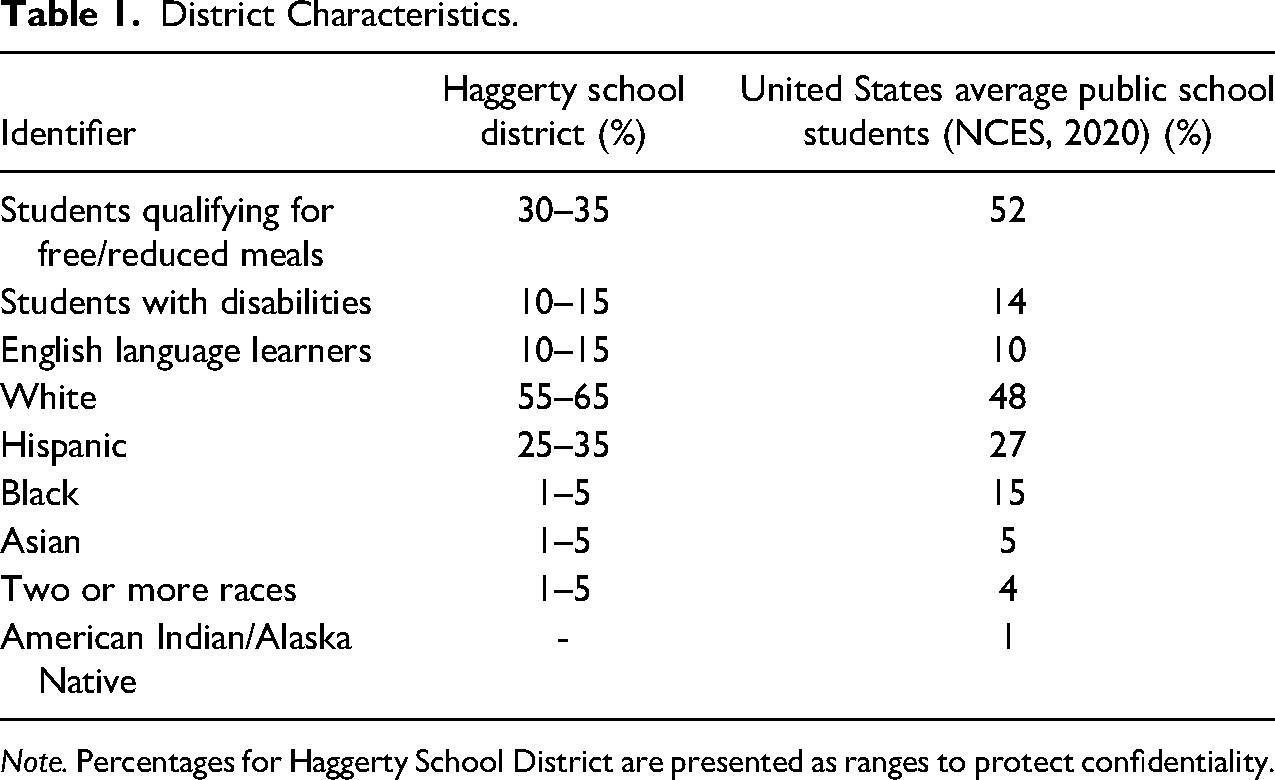
Note. Percentages for Haggerty School District are presented as ranges to protect confidentiality.
The state where Haggerty was located employed an accountability system that included yearly ratings of each school and school district across four levels of performance. These levels were based mostly on student achievement in English language arts, mathematics, science, and social studies and student growth in English language arts and mathematics. For high schools, other indicators (e.g., graduation rate) were also included. Schools or districts earning ratings in the lowest level were met with prescribed responses from the state department of education while those in the second lowest level were provided optional supports. All schools and districts submitted yearly improvement plans detailing their strategies to support student growth and achievement. Aside from plan submission, there were no state-level mandates for schools and districts earning ratings in the top two levels. Haggerty's district rating at the time of data collection was in the third tier (i.e., second highest rating level). None of the schools in Haggerty were rated within the lowest level and only two schools were operating with ratings in the second lowest level.
Although the school district was the primary unit of analysis, the study had an embedded design as the curriculum leaders were central subunits within the case (Yin, 2009). The participants for this study were selected by purposeful sampling. Creswell and Poth (2018) advised that “the culture-sharing group must have been intact and interacting for long enough to develop social behaviors of an identifiable group that can be studied” (p. 91). For a school district to be selected, we decided the superintendent and the primary curriculum leader needed to have been together for at least 2 years. In Haggerty, the assistant superintendent of curriculum, instruction, and assessment had worked in district-level curriculum roles for 7 years and the superintendent had been leading the district for over 10 years. Each of the district-level curriculum leaders is introduced (names replaced by pseudonyms) below:
Casey Darnell had been the assistant superintendent of curriculum, instruction, and assessment for the past 2 years. He had served in various district-level curriculum leadership roles (e.g., executive director of curriculum) for the previous 7 years. Before working in the central office, Mr. Darnell was a secondary teacher, assistant high school principal, and elementary principal in the Haggerty district. Gary Watson was in his 13th year as the K-12 math curriculum coordinator. He taught high school math in the Haggerty district before assuming this position. Oliver Adams was the K-12 science coordinator. Mr. Adams had served for 8 years as the science coordinator and worked in a role supporting STEM education in the district before becoming the coordinator. Cameron Edwards was the secondary ELA coordinator. He was a teacher for an innovative school in a northeastern United States metropolitan area before joining Haggerty in a central office position. He then worked on a project for the United States Department of Education before returning to Haggerty in the coordinator role. Mr. Edwards was in his 4th year in the position. Susan Barnes was the elementary English language arts (ELA) coordinator. Ms. Barnes worked as a teacher and instructional coach before shifting into the coordinator position, which she had held for 2 years. She had been in the Haggerty district for 20 years. Patricia Neil was the K-12 social studies coordinator. She taught for 7 years in the district before taking on that leadership role and had been the coordinator for the past 6 years.
While the assistant superintendent and the five district-level curriculum coordinators were a focal subunit of this study, we also collected data from interviews with teachers and school principals to more thoroughly describe the district-level curriculum leadership's values, beliefs, and attitudes. To be chosen, these participants needed to have a minimum of 2 years of experience in the district. School-based participants represented each of the district's eight “feeder systems” and included three principals (elementary, middle, and high) and 12 teachers (four elementary, four middle, four high) who had served on district-level curriculum committees or held leadership responsibilities within their schools. We used pseudonyms for all participants. An overview is shown in Table 2.
Overview of School-Based Participants.

Data sources consisted of semi-structured interviews of 21 participants conducted during the 2020-21 school year and documents related to curriculum leadership. Each interview lasted 45–55 min and focused on participants’ perceptions of the district's beliefs, values, and attitudes about curriculum. We used the same questions for the district leader interviews and the teacher and principal interviews. That is, our line of inquiry with teachers and principals was focused on the beliefs, values, and attitudes of the district culture of curriculum leadership as opposed to those held by each individual. Gaining the perspectives of these school-based participants, rather than relying solely on the statements of central office leaders and official district documents, enhanced the trustworthiness of our findings regarding the prevailing district culture in Haggerty.
Adapting a framework designed by Joseph (2011) for investigating curriculum as culture, we generated interview questions in alignment with domains such as visions, history, students, teachers, content, planning, evaluation, and dilemmas of practice. For example, to address the domain of history, we asked, “What forces or events have influenced the current district-level beliefs, values, and attitudes about curriculum?” Addressing the domain of planning, we asked questions such as the following: “How is the curricular content planned and organized?” “Who has the power to make decisions about what will be taught in the classroom?” To understand relationships between planning and practice, we asked, “What are some benefits or advantages of this approach to planning and implementing the curriculum?” “What problems, dilemmas, or challenges do teachers face when they work within this approach to planning and implementing the curriculum?”
Following each interview, we conducted an initial round of coding in order to identify topics for further investigation and pertinent documents to collect. These documents were used for two purposes: to verify discrete information such as definitions of terms and for additional detail to confirm data from other sources (Yin, 2009). As one example, we analyzed “instructional unit plan” documents that articulated the scope and sequence (i.e., learning progression) for each core subject area in each grade level. Beyond the unit plans, we examined Haggerty's documentation of its guiding principles related to curriculum leadership. We also referenced the final report from a state review of the district's curriculum completed in 2008.
To analyze the data in the original study, we used two cycles of coding: a hybrid approach combining descriptive, in vivo, and values coding methods, followed by pattern coding to generate themes (Saldaña, 2013). For this secondary analysis, we added a third cycle based on the “pattern inducing” method of analyzing institutional logics qualitatively (Reay & Jones, 2016, p. 449). Reay and Jones (2016, p. 449) have explained that in this approach, “researchers must immerse themselves in the data, examining and categorizing text segments to reveal the existing underlying meanings and thus identify patterns of behaviors and beliefs associated with particular logics.” Thus, after we produced patterns of meaning in the first two cycles of inductive coding, we drew upon institutional theory to associate these patterns with elements of the societal-level institutional logics (Thornton et al., 2012). Finally, we categorized the data into organizational-level logics of curriculum leadership, each of which drew from elements of one or more societal-level logics. For example, we identified a “logic of participation” in Haggerty that illustrated certain values, beliefs, and attitudes described within the societal-level logics of the state and profession (Thornton et al., 2012).
The trustworthiness of our study was enhanced by triangulating evidence from different sources (interviews and documents) and gathering data from participants that may have held different perspectives (e.g., district subject-area coordinators and classroom teachers). Furthermore, we completed member checks with interview participants and had three peers review the methodology and findings. Our conclusions were bounded by the time and context of the study. Although we selected the Haggerty district because it approximated the demographics of public school students nationwide, there are many other types of districts that have distinctly different demographics, settings (e.g., rural, urban), and accountability circumstances, and there are other types of organizational forms in public education, such as charter schools, charter networks, and portfolio model districts. As a limitation, we do not suggest that our findings are generalizable across district types and organizational forms or varied community and state contexts; rather, they contribute to the theoretical propositions related to institutional complexity and the use of institutional logics to investigate such complexity at the micro-level of a single organization.
Findings
We found evidence of three distinct logics in the curriculum leadership of the Haggerty School District: logics of uniformity, participation, and performance. In addition to demonstrating the role played by each of these logics in Haggerty's curriculum leadership, we will point out a variety of tensions within and among them, arguing that the multiple and somewhat incompatible logics of curriculum leadership gave rise to the school district's institutional complexity (Greenwood et al., 2011) and a series of mixed messages concerning what district leaders expected of school personnel.
Logic of Uniformity
Throughout our interviews and document analyses, it was clear that the Haggerty culture of curriculum leadership emphasized uniformity and standardization, values associated with the societal-level logic of the corporation (Thornton et al., 2012). Within the corporate logic, “knowledge and expertise are embedded in the routines and capabilities of a hierarchy,” not in individuals making independent decisions and applying their personal expertise (Thornton et al., 2012, p. 55).
Haggerty's logic of uniformity could be traced back to 2008, when central office leaders requested a comprehensive appraisal from a team assembled by the state department of education. While not required by the state, the appraisal indicated that the request was a “proactive measure” prompted by the district's failure to make NCLB's Adequate Yearly Progress requirements for the 2006-2007 academic year. Although completed 12 years before we conducted our research in the district, the review was still referenced as having a strong influence on district curriculum leaders’ beliefs, values, and practices. Science Coordinator Adams emphasized, “it was 2008, but man, [the assistant superintendent] still talks about it, about every meeting.” He continued, “every little thing we’ve done in our curriculum department came out of that review piece.” Secondary Principal Moore, who had been in the district only since 2015, also referenced the report and recommendations: “This [report] is like the district folklore.” The state's review team had produced an 82-page report that included dozens of recommendations, one of which was that Haggerty “synthesize a viable standards-based curriculum.”
Assistant Superintendent Darnell referenced this recommendation, noting, “we committed many years ago to being a standards-based district, not a standards-referenced [district].” He elaborated on what it meant to be a standards-based district: There's been a lot of time spent either at the national level, certainly, or even at the state level of building that articulation of skill sets that build upon each other from year to year with the idea of here's what a graduate from Haggerty should know and be able to do. And so that really guides a curriculum now organizing around topics, picking resources to go with it. And our real fidelity is actually to the standards.
The district-level curriculum coordinators also emphasized the academic standards. Math Coordinator Watson specified that the standards defined “what” should be taught, and he explained that “in our system, we don't add more content to it… we just basically adopt the content standards.” Elementary ELA Coordinator Barnes asserted, “we’re really, really committed to stressing the importance of standards-based instruction…. Curriculum leadership is always based on the guidance of the standards.” This mindset was evident also in comments made by principals and teachers. When asked what values were tightly held in the Haggerty district, elementary Principal Tipton responded, “I think standards-based is tight.” Elementary teacher Norton agreed: “all of our focus is based on the state standards.”
Haggerty's commitment to uniformity extended beyond fidelity to the academic standards. Assistant Superintendent Darnell illustrated the overarching values and beliefs of the district's curriculum leadership by stating, “of course we believe in a guaranteed and viable curriculum.” He also shared, “our superintendent is very much a systems person” and explained that “we are not site-based [school-based] in our curricular decisions.” He added that his role was to get “everybody on the same page.” According to Darnell, guaranteed meant that “there's a scope and sequence and there's a vertical articulation of skills and people know about them.” Viable, he explained, meant “that teachers have the time to do it, they have the skill set to do it, i.e., professional training to do it, and they have the tools to do it.” Darnell also pointed out that “it's about not having our teachers have to create curriculum or decide what kids need to know and be able to do…. We have that guaranteed and viable curriculum, so they don't have to spend their time doing that.”
One mechanism used to advance the guaranteed and viable curriculum in Haggerty was the standardization of curricular materials. Haggerty conducted a curricular adoption process for each core content area every seven years. The selected materials were then expected to be used in all schools throughout the district. A specific example of the link between materials and the culture's belief in standardization was provided by Math Coordinator Watson. “We do one size fits all,” he noted. Elaborating, he shared, “This is the program we’re doing for the wealthiest SES school to the most impacted Title I school we have in the district.” Watson continued, “we believe that these materials are good for all students, regardless of what school you attend in our system,” and “we believe that every student should have this common experience leaving our system.” After making these statements, Watson added, “there's a little bit of a virtue-signaling there, but yet we can communicate that as a message.” Elementary Principal Tipton similarly indicated that uniformity supported a standardized experience: So, whether you’re at school A or you’re at school B, or you’re at school C, you know, those are very different schools, but the kids have the same opportunity for the same experience, as far as exposure to content and skills… and we don’t water it down in one school versus in another. We keep the same standards for everybody. It feels very, it can feel top-down to some people, I think, but at the same time, it's also holding us accountable for making sure that our curriculum is aligned and that we’re on the same page with everybody else.
Reinforcing the importance of using the adopted curricular materials, Darnell and Watson made it clear that teachers were not to replace the adopted resources with their own preferred materials. “We allow teachers to supplement, not supplant, but supplement,” indicated Darnell. Explaining this distinction, Watson said that a teacher might use “another activity to help meet those standards better than the adopted materials,” but the “very, very, fine line is when you get to a replacement.” This message seemed to be received at the school level, as several of our school-based participants confirmed the importance of fidelity to the adopted resources. Echoing Darnell and Watson, high school math teacher Arnold commented, We refer to it [the adopted resource] as the primary text. I don’t want to say we have to use it, but we have to use it. But that's sort of our core content. And then we’re allowed to supplement it with pretty much whatever we want.
Elementary Principal Tipton expressed her support for uniformity of materials as well: “We’ve really been trying to keep people close to what the curricular resources are supposed to be and use it.”
According to Elementary ELA Coordinator Barnes, the adopted materials were to be used uniformly across the district because they were based on solid research evidence. She stated, for instance, “there's an actual science behind how we teach students to learn how to read,” so we should be “leveraging the instructional resource” and relying “heavily on the research to guide our decision-making around what are the sound practices that we need to see happening in all of our classrooms for both teachers and students.” The logic of uniformity was thus predicated on the assumption that some resources are objectively better than others, and so all students should receive their benefits.
Although teachers had some freedom to supplement the adopted materials with additional resources, curriculum leaders’ comments suggested that the materials ultimately dictated much of what teachers did in the classroom. Math Coordinator Watson explained, “we ended up focusing more on the instructional resources as a way to organize content in curriculum as opposed to kind of designing our own.” While Watson noted that other districts might allow teachers to adjust the adopted materials, focusing the curriculum on “broad ideas,” or doing “some morphing,” he asserted, “we don’t necessarily go that route.” Watson explained that the adopted materials had a “mathematical story” to tell, and that he asked that teachers “keep that story tight, please don’t deviate from that order, please don’t deviate from that sequencing, because we do have some mobility in our school district.” Coordinator Barnes expressed a similar focus on using the resource to guide the approach within elementary ELA. She explained that the “scope and sequence for skills across a school year looks like this in whatever program it is” and added that the “lesson level” is also “guided by the instructional resource.” Furthermore, she noted that they “trust and rely on” those resources “quite heavily.” Using the adopted resources to determine instructional pacing and to set the scope and sequence was not limited to mathematics and elementary ELA. Similar to Barnes and Watson, Science Coordinator Adams shared that the “unit breakdown” and “proposed length of study of each unit” were all “based on those materials we have available to us.”
Logic of Participation
Although Haggerty's leaders expressed a strong commitment to a “one-size-fits-all” curriculum, it would be inaccurate to suggest that teachers in the district were mere functionaries in a command-and-control bureaucracy. Rather, a logic of participation was also influential in Haggerty's curriculum leadership. District and school personnel emphasized the key role that teachers played in the selection and ongoing development of the uniform curriculum. Moreover, district leaders expressed their aversion to strict mandates in the management of curriculum. In valuing teacher voice and craft knowledge, Haggerty's logic of participation reflected a blend of elements from two societal-level logics: the state logic's use of democratic participation as a source of legitimacy and the professional logic's reliance on the authority of a network of practitioners (Thornton et al., 2012).
The logic of participation was especially evident in descriptions of the curricular adoption and development process, which Social Studies Coordinator Neil called a “more grassroots” approach. This logic emphasized the role teachers played in helping to choose new curricular resources, piloting them in their classrooms, and developing the guiding documents that defined the scope and sequence of instruction throughout the district. Haggerty's policy was to have each core content area undergo a formal process of curriculum review every seven years. To initiate this process, the curriculum coordinator for the content area would recruit a “leadership team,” a group of teachers and school administrators (ideally one representing each school) to evaluate the existing curriculum, select a new curriculum by vote, and develop the scope and sequence documents and unit plans for the new curriculum. The teachers on the team would then pilot the new curriculum in their classrooms for an entire school year, experimenting with the unit plans and suggesting any revisions of the materials they thought were necessary. Science Coordinator Adams noted that the leadership teams were also “instrumental in designing the PD [professional development] piece to prepare their colleagues to make that transition the following year to those materials.” Emphasizing the participatory nature of this process, Adams pointed out, “the big thing that I stress is that everything we do is—is made by teachers for teachers.”
Calling attention to the importance of teacher voice, Assistant Superintendent Darnell referred to the leadership teams as the “big we” and shared that “the curriculum department plans the curriculum in collaboration with the teaching staff.” According to Darnell, this collaboration would continue after a new curriculum had been implemented district wide. He noted that the leadership teams would meet periodically throughout each school year to discuss their experiences with the resources and unit plans, and that these discussions would, at times, result in system-wide changes. For example, Darnell recounted a time when kindergarten teachers reported that the phonemic awareness component of the adopted curriculum was not rigorous enough. “They were right,” Darnell acknowledged, further explaining that “we listened to them and [are now] using a program to supplement our program that we use in elementary.” Social Studies Coordinator Neil also discussed her openness to ongoing adjustments and additions to unit plans based on teachers’ input, indicating that she was “constantly adding.” Such adjustments were encouraged in science too: Coordinator Adams explained that he had recently made each unit plan “a living document” on the district's learning management system so teachers could “add and contribute in real-time.”
In some ways, the logic of participation in Haggerty supported the logic of uniformity. Darnell made this clear when he described his commitment to curricular uniformity and the role teachers played in it, noting, “we’re going to get on the same page, and that's something I don’t back away from, but… you [teachers] can help decide what that page is.” On a practical level, Darnell suggested that teacher participation made it more likely that teachers would use the agreed-upon curriculum and contribute to its ongoing improvement: “If you want teachers to follow the curriculum, to work with it, to make it better as you go on… I want them to be a part of it.”
Indeed, a number of teachers we spoke with shared this instrumentalist view of teacher participation—namely, that participation was important because it promoted uniformity. As Middle School ELA Teacher Olliver explained, “that's why we have done the work around the curriculum map—so that people could be within those parameters… to get a little more streamlined.” Similarly, Elementary Teacher Fanning captured the effectiveness of participation as a strategy to promote uniform implementation of curriculum: I think the plus is that the curriculums are being chosen by teachers, which is great because they get a voice in that. And I definitely feel like those voices are heard. I trust our literacy program because my teammate helped choose it, and she piloted, and she knows it. If I’m like, I don’t get this, what am I supposed to do? She can explain that to me. And since I’ve done the math, they’ll come to me for math.
Fanning trusted and supported the adopted curriculum at least in part because her colleagues chose it. And on a practical level, her colleagues who participated in its selection and piloting could help her make sense of it and use it. Fanning also implied that teacher participation served the purpose of communicating district-wide (uniform) expectations—what she was “supposed to do.” Here, we see how a logic of participation lent the adopted curriculum both legitimacy and bureaucratic efficiency.
Consistent with the logic of participation and its implication that the legitimacy of a curriculum derived in part from teachers’ input, district leaders seemed to go out of their way to insist that they avoided top-down approaches to curriculum leadership—as if to disavow any traces of a corporate logic. As Assistant Superintendent Darnell noted, “we mandate very little in our district.” Science Coordinator Adams likewise commented, “We’re not really the curriculum police,” echoing a phrase that Darnell and Math Coordinator Watson also used in their interviews. So while curriculum leaders certainly valued bureaucratic uniformity, they demonstrated an aversion to overtly enforcing it: “If they choose not to use [the adopted resources],” Social Studies Coordinator Neil explained, “I’m not going to tell them to use them.”
In a similar vein, Elementary ELA Coordinator Barnes chose her words carefully while describing how she had worked to persuade teachers to use the adopted resources: “I don’t want to use the term compliance—because compliance doesn’t make me feel very good. Compliance makes it feel a little bit militant, but I would say trust, trust in a program.” Instead of forcing a program on teachers, Barnes indicated her preference for a gentler, less directive approach. For example, when teachers asked her if they could substitute a text from outside the adopted program, Barnes noted that she would begin by saying, “let's talk about what is informing that decision.” She would then remind them that the text from the program was selected based on its alignment with the standards and explain that it was important to “hold tight to what we have in our suite to support instruction… It's not always like a hard-core no. No, it's an invitation to think about, let's talk about what we’re basing that decision on.” Although Barnes wanted teachers to “hold tight” to the adopted resources, her participatory approach was to include teachers in discussion rather than simply telling them what they could and could not do. Math Coordinator Watson also described a preference for discussion over directives, noting that if a teacher supplanted the adopted materials “completely on [their] own… we might have a conversation, but we don’t want to be viewed as the curriculum police.”
Logic of Performance
Pache and Santos (2010, p. 459) distinguished between logics that “exert pressures at the functional level, requiring organizations to adopt appropriate means or courses of action,” and logics that prescribe “which goals are legitimate to pursue” (p. 459; emphasis in original). Whereas Haggerty's logics of uniformity and participation prescribed certain courses of action in curriculum leadership and implementation, its logic of performance specified the ultimate goal for schools: high performance on state-mandated tests and other measurable indicators, such as graduation rates, that affected schools’ accreditation ratings. Rooted in the societal-level logic of the market, in which an organization's legitimacy derives from its measurable results and status among competitors (Thornton et al., 2012), Haggerty's logic of performance placed a premium on quantifiable outcomes and outward appearances.
Earlier we noted that despite Haggerty's logic of uniformity, curriculum leaders tended to avoid any expression of tight mandates or top-down control; rather, they relied on a logic of participation to instill in teachers a sense of curricular ownership and a collective trust in the materials that their colleagues had vetted and selected. Yet district leaders also indicated an awareness that curricular uniformity sometimes broke down. Math Coordinator Watson, for example, noted that he knew of “a couple of middle schools” that “curate [their] own thing” and did not use the adopted materials. “We don’t come down on them heavy-handed…. We just don’t want to be the punitive police if they’re getting good results,” Watson explained. If, however, a school's performance was lagging, Watson said coordinators would change their tune: I would say we would start sniffing and looking really hard at how folks are using materials and what instruction looks like if their accreditation rating puts them in a place where they need support…. So, the one perception is we think everyone's following the order of unit plans—but we really find out what that looks like if we need to do district walkthrough teams because a school, in terms of performance, is in trouble.
District leaders thus avoided micromanagement and tolerated some diversions from uniformity—but only insofar as a school maintained respectable performance ratings. School personnel, such as Elementary Teacher Norton, agreed: “Nobody steps in unless you hit a catastrophe or something, you know, you hit bottom.”
Haggerty's logic of performance was especially apparent when we asked participants about goals of curriculum in the district. Principals and teachers consistently indicated that the district's culture of curriculum leadership legitimized goals related to measurable outcomes more than goals related to democratic purposes of education (e.g., focus on solving societal issues, development of collaboration skills). When we asked Secondary Principal Young what he perceived to be most important in Haggerty, he answered, “graduation rate.” Elementary Teacher Tiller shared a more expansive view, but one no less focused on quantifiable results. The district, he noted, was “concerned about numbers, statistics, data, test scores, and how they look from the outside.” When we asked Middle-Level Science Teacher Varner to share her perceptions of district-level beliefs concerning the purpose of education, her first statement was blunt: “they want numbers to look good.” Comments such as Tiller's and Varner's revealed the close relationship between quantifiable results and outward appearances, illustrating Ball's (2001) contention that, in performative cultures, performance entails at least two meanings: one performs not only in the sense of producing measurable outcomes, but also in the sense of producing an image or a display—performing as on a stage.
Participants also noted that specific tests, such as the SAT, played an important role in identifying the skills that the district-wide curriculum should emphasize. High School ELA Teacher Rollings described an uneasy balance in his subject area: I think our district curriculum [for secondary ELA] is about choice and about finding your place in the world. But we’re also super data-driven. So, our SAT scores matter. And if we live and die by test scores, sometimes those are the skills we value … I would also say at a district level … it's within the confines of the skills needed to graduate. So, it's driven by graduation rates.
Rollings's comments alluded to some degree of tension within a curricular approach that valued student choice and identity development while also calling for emphasis on specific, testable skills. Assistant Superintendent Darnell and Science Coordinator Adams similarly mentioned the influence of the SAT. Darnell shared that he and his team “do look at the SAT data to see how we’re doing,” and he indicated that “we made adjustments off that to our curriculum.” One of those adjustments was described by Adams: “We really took a look at what was the best sequencing for our high school subject areas and content areas for the ACT at the time, and now the SAT.”
Haggerty's logic of performance was also apparent in what several participants saw as the district's disproportionate emphasis on preparing students for a traditional college education. For High School Math Teacher Arnold, this emphasis was unambiguous: “The big district push is college, college, college, college, college, everybody has to go to college.” Although Arnold said he appreciated this focus, he and others felt it created an imbalance with too little attention dedicated to career and technical pathways. The emphasis on college-readiness, participants said, was tied to the district's concern for image and measurable results. As Secondary Principal Moore noted, “sometimes, when you live in a world where the district is looking at accolades, and we’re looking at metrics of achievement, it's easy to lose sight of” other ways of preparing students. Moore noted that although Haggerty valued “technical programs” and other types of training for students, “sometimes that can get lost in the competitive noise of trying to say, this is what we’re doing to prepare our students for the next level.” Moore's comments provide another glimpse into the way Haggerty's logic of performance reflected the broader societal logic of the market and its focus on metrics, status, and competition.
Logic Tensions and Mixed Messages
Although the logics of uniformity, participation, and performance were prevalent among participants representing three levels of the organization—district leaders, principals, and teachers—the data also indicated a number of tensions within and between the logics. In fact, the logics of curriculum leadership in Haggerty were sometimes incompatible, at times contradictory, producing a variety of mixed messages and an institutional complexity that remained largely unacknowledged among leaders.
Tensions Between Uniformity and Participation
Earlier we noted that Haggerty's logics of uniformity and participation were compatible insofar as the latter lent legitimacy to the former—that is, leaders believed that teachers were more likely to use the uniform curriculum if they knew that their colleagues had had a hand in selecting and developing it. Rather than overtly mandating uniformity, curriculum leaders in Haggerty used participative leadership to generate teacher commitment to the uniform curriculum and its related resources. Yet the data also revealed tension between leaders’ deep commitment to a uniformity logic, which valued a standards-based guaranteed and viable curriculum, and their logic of participation, which tended to eschew any notion of top-down control. On the one hand, teachers were expected to implement the district-wide unit plans with “fidelity,” which Haggerty's documents defined as “delivery of curriculum and instruction in the way in which it was designed to be delivered.” As Math Coordinator Watson said of the unit plans, “we’ve laid this out for you—here it is. There's no guesswork.” On the other hand, because the logic of participation entailed a “no mandates” approach to curriculum leadership, Watson claimed that expectations were “pretty loose, actually. There's a way that we think it should probably happen, but then there's also an alternative reality of here's what happens…. We give teachers an incredible amount of autonomy.” Social Studies Coordinator Neil similarly acknowledged that “a lot of what we do is kind of loose.” Teachers, who were on the receiving end of these messages, sensed the ambiguity: As Elementary Teacher Fanning put it, “it's almost something that you kind of wished it was one way or the other. Like, ‘you have to teach this,’ or ‘we’re going to trust you to do your best.’ And sometimes it's somewhere in between.”
Our data suggested that the logic of uniformity tended to outweigh the logic of participation in Haggerty, particularly in the tested subject areas of math and elementary ELA. In these subjects, curriculum leaders’ commitment to standardization within the logic of uniformity competed with notions of professionalism and practitioner expertise that were embedded in the district's logic of participation. The coordinators of math and elementary ELA both defined curriculum as the standards themselves and noted that a key role of teachers and principals on the curriculum leadership teams was to help select a package of standards-based instructional resources that would guide daily lesson planning in classrooms across the district. Once this product was chosen and purchased, teachers were expected to implement it as its designers had intended. As Watson explained, “there's a mathematical story that's unfolded and those materials are trying to tell a story.” If leaders and teachers change that story, he said, “we lose coherence very quickly because now we’re trying to chop up somebody else's story and put it in a different order.” Watson thus implied that practitioner participation on the curriculum leadership team was not an opportunity for asserting practitioner authority; it was a matter of selecting an external authority—an instructional resource—and remaining faithful to it.
In elementary ELA, Coordinator Barnes conveyed a similarly constrained logic of participation. Although she facilitated a leadership team in order to “onboard teacher voice” and “take input from the experience of the practitioners,” she stated clearly that once the team had selected the instructional resource for district-wide implementation, they were expected to “trust the resource, trust the curricular guidance, because it's based on research and experience.” For example, when teachers doubted the appropriateness of a certain text in the instructional resource, Barnes said she would remind them that the publishers “go through a process of ensuring text complexity. They go through the process of ensuring that it is the right level of text for when we say ‘grade-level text.’” Barnes's remarks here revealed an incompatibility between the logic of uniformity's allegiance to standardized instructional resources and the logic of participation's value of practitioner expertise. In Barnes's view, teachers should have some voice in the adoption process, but ultimately, they were to defer to the expertise of the publishers. In both of these tested subjects, the logic of uniformity thus tended to hollow out the logic of participation, reducing it to the leadership team's selection of a packaged resource that, theoretically, would foreclose much of what teachers decided in their classrooms on a daily basis.
An Alternative Version of Participation
It is noteworthy, however, that the logic of participation manifested rather differently in the tested area of secondary ELA, where Coordinator Edwards and his leadership team had recently voted unanimously to introduce a new approach to curriculum adoption. Unlike in the other subjects, where leadership teams selected ready-made instructional materials from a publisher every seven years, Edwards explained that “two years ago, we started the process of building our own secondary ELA curriculum and resources.” Applying Wiggins and McTighe's (2005) “backward design” approach, Edwards and the teachers on the leadership team began by deciding on the essential questions and themes for each quarter of each grade level. From there, the team designed summative assessments and a series of “smaller tasks and experiences” that would support students’ engagement with the essential questions as well as the content standards. The team also built in a review and revision cycle to enable continuous development of the teacher-created resources. Elaborating, Edwards explained that “rather than… ask somebody else what we should be doing every seven years, every other year or so, we ask ourselves, ‘what's working and what's not working for our kids—and for our teachers?’” Edwards thus drew a sharp contrast between his subject area and the others. In secondary ELA, the logic of participation entailed substantial reliance on teachers’ expertise.
Furthermore, the new approach in secondary ELA valued choice—both for teachers and students. While the essential questions, themes, and quarterly summative assessments were uniform throughout the district, students could choose from a variety of texts for their independent readings, and teachers could decide on the specific texts they would use for whole-class instruction. Teachers could also design their own smaller tasks and learning experiences that built up to the summative assessments, or they could simply use the bank of tasks that the leadership team had developed—as long as they ensured that students had a specified number of opportunities to practice and demonstrate their learning. Edwards noted that the bank of tasks might be useful for newer teachers, for those who “don’t know what to do,” or for those who want to “maintain compliance.” But, he said, others may want more choice: “If you look at those assignments and say, ‘I want to alter, edit, revise what you’ve given me here,’ that's fine, do that—so long as the standards and experiences stay the same.” In providing choices within a framework of shared goals, Edwards thus seemed to have found a balance between the logics of participation and uniformity.
Acknowledging that it took a great deal of preparation and capacity building to implement this new approach, Edwards said he was ultimately pleased with what he called “the willingness of teachers to learn and play with new ideas when given the space.” We suggested to Edwards that this approach to teacher participation sounded different from what we had been hearing about the other subject areas, and we asked him how this difference played out in conversations among Haggerty's curriculum leaders. On this matter, Edwards explained that while he and his colleagues were in “alignment” concerning their beliefs about the kinds of learning experiences that curricula should provide, “I think that each discipline—[he paused here for four seconds]—necessarily has to approach it differently.” Edwards thus delicately acknowledged a contrast while implying that the sort of teacher participation that worked in secondary ELA might not be applicable across all subjects.
Tensions within Uniformity
For the other subject areas, while the logic of uniformity often took precedence over the logic of participation and its assumptions of practitioner expertise, district leaders and principals revealed tensions within the logic of uniformity itself. Indeed, they acknowledged many times that the “guaranteed and viable” curriculum that was central to the logic of uniformity was not viable. Assistant Superintendent Darnell noted that he had been trying for years to “narrow things down and finally get to that viable piece of a guaranteed, viable curriculum,” at one point admitting, “I don’t think we have enough time to get through everything. I really don’t. We give our teachers too much to do and our students too much to do.” Even Math Coordinator Watson, whose expectations of curricular uniformity seemed unequivocal at times, said, “there's clearly too much, clearly at every grade level there is too much.” In science, Coordinator Adams saw tangible evidence of overloaded curricula when, at the end of each school year, many elementary teachers returned their science kits in virtually brand-new condition. And as Elementary Principal Tipton claimed, “there's always too much in curricular materials. You’d be teaching kids 24/7 and never get through it all.”
Yet in the face of the realities of an unviable curriculum, district leaders exhibited a reluctance to prune the scope and sequence documents. Reiterating the importance of fidelity to the adopted instructional resources in elementary ELA, for example, Coordinator Barnes said, “there's an element of tightness there because what we say is that… what we know as an entire system, and then what the research will tell us, is that student achievement is significantly impacted by pacing.” Barnes also indicated that if students were not “as successful as we would want them to be… on the state assessment, the first question we ask is, ‘how far into your unit plans did you get?’” Middle School Math Teacher Martin recalled similar pressures from Watson: “Our math coordinator would be like… ‘where are you at on your pacing?’… ‘You need to get moving.’” Thus, whether or not the curriculum was viable, curriculum leaders seemed to suggest that it should be treated as such.
If the curriculum was supposed to be guaranteed and viable, yet leaders knew it was not viable, what did they expect teachers to do? Our data demonstrated only equivocation on this matter. Watson noted the following: We had always said ‘all standards, all students.’ That, that was the mantra from the Department of Education and what the law says. So, when we post these documents, everything's in there … whether we know it's doable or not, and that's where there's always this rub. There's the front-facing documents that have everything. And then there's the conversation we’re going to have about how you might want to really think about doing this. … We make assumptions that those things happen in schools.
Here, Watson implied that the posting of curricular documents was largely a matter of showing compliance with state policy; thus, site-based decision-making was necessary, even desirable at times—a view that accorded with the logic of participation. A few minutes later, however, Watson indicated that it was not the role of teachers to determine what content they should emphasize or de-emphasize. When we asked him to clarify whether he believed teachers were generally cutting content in order to make the curriculum viable, he answered: They are. I mean, and this is where I think we get to come in at the central level because, and not because we want to dictate, but this is part of the philosophy in my mind is, I would rather make this decision for you, so you can focus on the lesson planning and implementing good quality instruction as opposed to debating, ‘should I cut it or not?’
Notably, we saw how ambivalence toward uniformity sometimes reached teachers in the form of mixed messages. Middle School Math Teacher Gilmore, for example, said of the unit plans: By no means do you have to do everything that they’re saying. And I think the disconnect is in between people saying that and us actually believing it. You know, you give me this document, it sure looks like you want me to do everything in this document, but you’re telling me it's a tool. You know, it kind of sends a mixed message. Even during a good year, you don’t get it all done. So, let's just call it like it is. I can’t get all of this taught.
Curriculum leaders’ reluctance to “call it like it is”—to say unequivocally that school personnel should exercise professional judgment in implementing the unit plans—seemed to have something to do with the state-level policy pressures that Watson alluded to above, the expectation that all standards be taught. To a certain extent, then, coordinators’ contradictions reflected the untenable position that the state had placed them in: they were to guarantee the teaching of all standards despite their knowledge that it was virtually impossible to do so.
It follows, of course, that district leaders were aware that the “guaranteed and viable” curriculum was not guaranteed. Assistant Superintendent Darnell acknowledged that in a large district such as theirs, uniformity inevitably “breaks down” in some buildings, a fact borne out in our interviews of school-based participants, some of whom indicated that they themselves did not follow the district curriculum or they knew of other teachers or entire schools that did not. Middle School Teacher Olliver, for example, told us that while district leaders would “always” say, “if we’re going to implement this [curriculum], it has to be with fidelity,” she felt that fidelity was “a philosophy and not a fact.” She then shared that her daughter, who attended a different middle school in Haggerty, “doesn’t do anything that we’ve done as far as I can see.”
As Science Coordinator Adams noted, despite the work his leadership team had done to select standards-based instructional resources and develop district-wide unit plans based on those resources, “we still have people that… pretty much loosely go about their own way.” However, Haggerty's reluctance to be “the curriculum police” meant that district leaders stopped short of overtly requiring schools to adhere to the adopted curriculum—that is, unless their students failed to meet expectations on state tests. Adams believed that the “no mandates” approach had “its benefits” in providing teachers with some autonomy, but he also saw its “drawbacks”: It opens the door for some people to take that [autonomy] to an extreme. And then sometimes that's reflected in performance scores and things like that. And then we have to go in [and ask], ‘Are you using these materials?’ and that sort of thing. ‘Well, no.’ ‘And what are you using? And why not?’
The “no mandates” approach was thus contingent on performance, and as we noted earlier, curriculum leaders did not attempt to enforce uniformity on schools that were performing well. Leaders thus implied an awareness not only that the “guaranteed and viable” curriculum was not guaranteed, but also that it was not a necessary condition of high performance. Although they justified the uniform curriculum on the basis of rigorous standards, equality, student mobility, strong research evidence, coherence, and teacher participation in its selection—only a school's low performance would trigger leaders to mandate it, suggesting that the logic of performance was ultimately the dominant logic of curriculum leadership in Haggerty.
Discussion and Implications
As noted in our literature review, Peurach et al. (2019) and Spillane et al. (2022) recommended further study of district-level curriculum leadership using different interpretive or explanatory frameworks. Beyond studies specific to public education, organizational scholars such as Smets et al. (2015) have called for studies of institutional complexity to “transcend the predominant binary focus on logics as compatible or conflicting” (p. 933; emphasis in original). In alignment with these suggestions, our qualitative case study employed an interpretive framework of institutional logics to examine the nuanced relationships and interactions among the three coexisting logics we identified in the Haggerty Public School District: logics of uniformity, participation, and performance.
Although our analysis used a different framework from the typology advanced by Peurach et al. (2019), we noted distinct relationships between the four types of instructionally focused education systems they described and our findings regarding the Haggerty district. Peurach et al. (2019, p. 50) advised that the four types of systems were not likely to exist in “pure form,” but rather districts would be more likely to exhibit a “composite of different approaches to instructional organization and management in different contexts” such as grade levels, content areas, and levels of academic performance. Emblematic of this assertion, we concluded that Haggerty simultaneously showed attributes of three of their types: managerial, federated, and networked systems.
In managerial systems, the central office dictates instructional resources, provides specific guidance to schools, and holds schools accountable for outcomes. Haggerty's logic of uniformity and logic of performance exhibited similar characteristics. For example, in the spirit of uniformity, Assistant Superintendent Darnell clarified that their district was “not site-based [school-based] in our curricular decisions,” and he noted the importance of having “everybody on the same page.” Furthermore, Haggerty's ultimate focus on quantifiable outcomes—its logic of performance—matched the managerial district's emphasis on “bottom-line results” (Peurach et al., 2019, p. 51).
While Haggerty's logics of uniformity and performance seemed indicative of Peurach et al.'s (2019) managerial system, its logic of participation illustrated certain attributes of the federated and networked systems and leaders’ attempts to maintain organizational legitimacy with certain stakeholders (Spillane et al., 2022). In the federated system, district-level leaders support schools in their “use of centrally developed resources” and typically use “participatory leadership team[s]” that include teachers and other stakeholders in curricular planning (Peurach et al., 2019, p. 53). Similarly, Haggerty used leadership teams to select district-wide resources and develop instructional unit plans. Another feature of federated systems is that the central office may constrain, but would not standardize, instructional approaches across schools. On the surface, it would seem that Haggerty's affinity for uniformity was more indicative of standardization than constraint. However, the Haggerty culture of curriculum leadership exhibited a clear aversion to mandates, resulting in standardization being more symbolic than literal. Social Studies Coordinator Neil demonstrated this idea when sharing, “If they choose not to use [the adopted resources]… I’m not going to tell them to use them.” Neil's comment illustrated a tension—perhaps germane to federated systems—between the need to establish system-level coherence and the need to maintain organizational legitimacy (Spillane et al., 2022) among school-level professionals who expect a certain amount of autonomy.
Peurach et al. (2019) explained that a networked system balances “faithful implementation” with “school-level discretion” and values continuous improvement via collaboration “with positive adaptations fed back to the central office for potential use, district-wide” (p. 54). While Haggerty's culture placed more value on faithful implementation than principal or teacher discretion, the logic of participation did show multiple instances where teacher feedback was used as a mechanism for district-wide adjustments. In one anecdote, Darnell recounted how kindergarten teachers reported a gap in the adopted reading curriculum. He surmised that “they were right,” and the central office added a supplemental resource district-wide after listening to their concerns.
To summarize, Haggerty displayed attributes of three of the four types of instructionally focused education systems that Peurach et al. (2019) identified in their review. As the Peurach team noted, the types were “ideal” and unlikely to exist in unblended forms. Our findings supported that assertion. We claim that the degree of institutional complexity in today's instructionally focused education systems may be more aptly analyzed using institutional logics as an interpretive framework. Using this framework, we characterized the values and beliefs in the Haggerty Public School District and sought to understand interactions among plural, coexisting logics. We concluded that Haggerty's logics of uniformity, participation, and performance were both complementary and conflicting—and yet, despite the various conflicts among these logics, the culture of curriculum leadership in Haggerty seemed notably stable. Below, we draw from the institutional complexity literature to posit three potential explanations of this stability and consider wider implications for the role of district-level curriculum leadership.
First, Haggerty's curriculum leaders seemed to reduce the degree of incompatibility between the logics of uniformity and participation through what Smets et al. (2015) have called balancing. One way to balance competing logics is by “importing pertinent aspects of one logic into the enactment of another… in ways that preserve legitimacy with representatives of both logics” (Smets et al., 2015, p. 958). Similarly, Haggerty's curriculum leaders used the notion of shared leadership from the logic of participation to support the logic of uniformity. Importing from the logic of participation a value of teacher voice and a distaste for overt expressions of top-down control, district leaders were able to legitimize the prescriptiveness of the logic of uniformity. As Elementary Teacher Fanning put it, “I trust our literacy program because my teammate helped choose it.”
Second, Goodrick and Reay (2011, p. 402) have demonstrated how “multiple logics may coexist competitively for lengthy periods of time” through a mechanism they labeled segmenting. In these situations, “some aspects of work may be guided by one logic while others are guided by alternative ones” (Goodrick & Reay, 2011, p. 404). The suggestion here is that sometimes competing logics do not clash because they are kept rather separate from each other, prevailing over different practices in a single organization. As we shared above, Peurach et al. (2019, p. 50) alluded to this notion when they advised that “approaches to instructional organization and management” may vary across contexts such as different content areas or grade levels. Although the logic of uniformity in Haggerty generally seemed to outweigh the logic of participation, secondary ELA appeared as the exception that proved the rule. In having teachers collectively design the new curriculum from scratch and affording them choice in how they implemented it in their individual classrooms, secondary ELA employed a more expansive notion of professionalism in its logic of participation—contrasting notably with subjects such as elementary ELA and PK-12 mathematics, where teachers were expected not to deviate from the off-the-shelf curricular resources. Secondary ELA Coordinator Edwards noted that each subject area “necessarily has to approach it differently,” suggesting that Haggerty was able to compartmentalize varying notions of participation based on their perceived appropriateness in each discipline. Furthermore, such compartmentalizing may be more possible at the secondary level, where individual teachers rarely teach more than one subject area.
Third, as Besharov and Smith (2014, p. 366) have explained, when one logic is dominant and plays a central role within an organization, it sometimes “eclipses other logics, rendering them immaterial to organizational functioning” and moderating conflict among competing demands. In Haggerty, we found that the logic of performance played a rather dominant and central role, pushing the logics of uniformity and participation to the organization's periphery. The logic of performance was unique in that it appeared not to generate the kinds of ambiguity and mixed messages that we found in the logics of uniformity and participation. It was widely recognized among participants that a school's performance on standardized tests and other measures of achievement mattered more than its adherence to the teacher-selected uniform curriculum. Haggerty's culture of curriculum leadership thus illustrated Greenwood et al.'s (2011, p. 335) contention that even in settings where multiple logics coexist, there can be stability “so long as the relationship between the logics is well understood and predictable.” Participants indicated that if a school was performing well but its teachers were not using the district's curricular resources, curriculum leaders would leave it alone—this despite Haggerty's avowed identity as a standards-based district with a guaranteed and viable curriculum. “We just don’t want to be the punitive police if they’re getting good results,” Coordinator Watson said, clearly indicating that performance took precedence over uniformity.
As Peurach et al. (2019) and Spillane et al. (2022) postulated, Haggerty faced competing pressures and influences that may arise when an educational system works to become more focused on instruction. Like the system leaders in Spillane et al.'s (2022, p. 585) study, Haggerty leaders placed “concerns” regarding performance metrics in the “foreground” of their decision-making. One secondary ELA teacher made that evident in saying the “district curriculum is about choice and about finding your place in the world. But… our SAT scores matter. And if we live and die by test scores, sometimes those are the skills we value.”
The relative stability within Haggerty's culture of curriculum leadership reflects the possibility that, over time, competing logics can come to co-exist rather stably—notwithstanding their seeming incoherence and contradictions (Greenwood et al., 2011; Suddaby & Greenwood, 2005). As Suddaby and Greenwood (2005, p. 60) have argued, “institutions are founded on their ability to give meaning to contradictory experience. Any prevailing institutional logic represents a ‘truce’ or resolution, however temporary or durable, between contradictory underlying logics.” Here, we want to suggest that the logic of performance functioned in Haggerty as a truce, a sort of unspoken agreement, that held together multiple and sometimes contradictory values. While curriculum leaders desired teachers’ fidelity to a uniform, standards-based set of curricular resources and instructional strategies, their preference for participative leadership meant they did not want to mandate such uniformity. The logic of performance enabled Haggerty's curriculum leaders to monitor fidelity without using any overtly control-based leadership. Moreover, the logic of participation softened the edge of the prescriptive logic of uniformity. Haggerty's leaders were not the “curriculum police.” In this era of performance accountability, the results are the police. This, we contend, was the unspoken agreement in Haggerty.
Implications
Although the unspoken agreement illustrated the prevailing logic in Haggerty, it did not fully resolve tensions within the culture of curriculum leadership. Specifically, some actors in the Haggerty system had to reconcile the notion that the prescriptions advanced by the logic of uniformity were not, in fact, viable. In Haggerty, this sensemaking was left to individual teachers. Smets et al. (2015, p. 935) have noted that for practitioners in a number of fields, “competing demands are woven into the fabric of their everyday work and fluctuate with situational exigencies.” For teachers in Haggerty, one demand was to implement the instructional unit plans using the prescribed curricular resources at the prescribed pace. A simultaneous demand was to ensure student competency in the standards. At times, teachers indicated that they had to make a choice regarding which demand to meet. As Principal Tipton explained, the teachers in her building were often confronting the questions, “Where do you stay with the pacing guide and where do you decide, ‘we’re going to stick with this and we’re going to get it really solid before we move on’?” While district leaders indicated some awareness that these decisions were being made at the school level, they were loath to state directly and unequivocally that principals and teachers had the license to make them.
This type of decision-making is germane to teaching, but it likely generates more tension in a district that prescribes a “guaranteed and viable” curriculum that is not, in reality, viable. Such circumstances force the hand of the classroom teacher, whether or not curriculum leaders believe teachers should be making these decisions at the classroom level. Here, we want to suggest that curriculum leaders would do well to confront this reality openly, acknowledging that the exigencies of classroom life are incompatible with expectations of districtwide uniformity. This acknowledgment, however, would require a changing conception of the role of district curriculum leaders: Rather than advancing uniform resources and supporting fidelity to a prescribed instructional plan, leaders would have to shift toward building and supporting teachers’ capacity to make ongoing decisions regarding content, materials, and pacing. Spillane et al. (2022) recommended this type of shift when calling for school districts to move beyond working as “implementation agencies” and toward an emphasis on responsibilities like “supporting the development and enactment” of classroom instructional programs—that is, improving practices (p. 586).
Social Studies Coordinator Neil seemed to understand the magnitude of this potential transformation in the role. When we asked her about areas for improvement in Haggerty, she indicated that while the district's commitment to uniformity in curricular and instructional resources was “actually really, really good,” it also meant that leaders did not support teachers to make their own instructional decisions based on their students’ interests and needs. According to Neil, leaders and teachers needed to have “critical discussions” and “professional development” concerning this kind of classroom decision-making. Elaborating, she said, so it's a much bigger—all of a sudden my curriculum development job becomes a bigger job because it's not just giving you resources. It's how do we—how do we teach it and how do we teach it for this population of students compared to this population of students?
Neil imagined an alternative approach to curriculum leadership that seemed to resemble what Coordinator Edwards was starting to use in secondary ELA. Her remarks and Edwards's innovations suggested that some forces within Haggerty's curriculum leadership recognized the limitations of a uniformity logic. Further research in the district would be needed, however, to determine whether these forces begin to influence others on the leadership team, perhaps supporting evolution in Haggerty's logics of curriculum leadership. As Peurach et al. (2019) argued, the “essential task for local educational leaders is to ‘craft coherence’ by identifying, understanding, and working among… many influences and interests—possibly competing, possibly complementary, possibly extraneous” (p. 47).
The question of how institutional logics evolve within PK-12 organizations, and the roles that individual actors and competition among logics play in such evolution, would be fertile ground for future research. The study of institutional complexity in education is still an emerging body of scholarship, and our investigation has contributed a perspective on how one large school district managed a plurality of logics. More research is needed to understand how school districts respond to competing logics and to determine whether the logics of curriculum leadership we identified in Haggerty might be found in other school districts or different organizational forms (e.g., charter networks). To deepen our understanding of the challenges of system-level curriculum leadership, future studies might also investigate how an assemblage of field-level forces—including state departments, funding sources, textbook publishers, the academic research community, intermediary organizations, and social movements—influence logics of curriculum leadership at the organizational level.
Footnotes

Declaration of Conflicting Interests
The author(s) declared no potential conflicts of interest with respect to the research, authorship, and/or publication of this article.
Funding
The author(s) received no financial support for the research, authorship, and/or publication of this article.