




Abstract
Abstract
Recent policy developments in the early childhood (EC) care and education sector in Aotearoa-New Zealand have seen a shift in focus from children and play to learners and learning. While few would argue against learning as priority this article raises pressing questions about the ‘intended’ and ‘(un)intended’ consequences of this turn. We analyse national education policy reforms that have served to promote the construction of child-as-learner-subject, alongside moves internationally toward the learnerfication of EC services (Biesta, 2010). As a particular focus, we examine the legacy EC curriculum policy has drawn on from indigenous Māori discourses, as a complex entanglement of both possibility and risk. We focus also on how, in this policy context, an intermix of ‘old’ and ‘new’ curriculum priorities was playing out in one EC setting and how teachers sought to navigate the complex entanglement this effected in practice. On the basis of our analyses, we argue that the problem is not with learning as priority, but with the (school-referenced) narrowing of curriculum, the prioritising of homogenised predetermined outcomes and the ways in which children (parents and teachers) are being positioned in these particular constructions of learners and learning.
Introduction
When Ballard (2004) wrote of the impact of market ideology on the school sector in Aotearoa-New Zealand, he entitled his article ‘Learners and outcomes: Where did all the children go?’, and began it as follows: There was a time, not so long ago, when talking or reading about teaching and learning in schools meant that we spoke or read about children. Then the language of discussion changes and documents changed. Schools were suddenly full of learners (Ballard, 2004: 95).
As part of these developments the New Zealand (NZ) EC sector has undergone a succession of ‘rebrandings’. It moved from being known as Early Childhood Care and Education (ECCE), a title denoting a sector commitment to positioning care ahead of and inseparable from education (Haggerty and Alcock, 2016; Ritchie, 2014), to being referred to as Early Childhood Education (ECE), the preferred acronym of the Ministry of Education (MoE). In line with international trends, the sector has also been sporadically referred to as ECEC (Early Childhood Education and Care) – an acronym commonly used by the Organisation for Economic Co-operation and Development (OECD) in which education is positioned ahead of care (Campbell-Barr and Nygard, 2014). Now the term for the sector strongly promoted by the Ministry is the Early Learning (EL) sector, terminology that comes as part of a wider discourse of lifelong learning and in keeping with international trends.
This article traces the shifts in national education policy documents that have helped to align the EC sector in Aotearoa-New Zealand with the globalising agenda of lifelong learning. Our interest is in both exploring the extent to which such EC reforms have been economically driven and rooted in neoliberal thinking (Wasmuth and Nitecki, 2017), and bringing into frame some of the messy complexity increasingly noted as inseparable from this ‘ferment of activity’ (Ball, 2019: 747).
Proceeding chronologically, we focus on the three iterations of Te Whāriki, the EC curriculum, from the first draft version to the recent update (MoE, 1993, 1996, 2017a), and the just-released strategic plan that sets out policy directions for the EC sector in Aotearoa-New Zealand for the decade to come (MoE, 2019). In considering the specificities of the NZ policy response to the global priorities promoted through this era, we focus on key commitments initially identified by the EC sector and how these commitments have since fared. We conclude these policy sections of the paper by discussing how Māori concerns are taken up in EC curriculum policy, exemplifying this specificity and highlighting the entangled dynamics of risk and possibility.
In the latter sections of the article we turn our attention to the impact shifting policy priorities were having on an individual setting, the study kindergarten. Here, as in the sections focused on policy, we follow Torrance (2017) in paying particular attention to the way that change in public institutions tends to occur in ‘immanent incremental fashion’ and in ‘practice based accretions’ (Torrance, 2017: 81). We too are interested in the ways in which ‘almost without noticing it everything has changed’ (Torrance, 2017: 82). We consider both the interplay of intended and (un)intended effects and possibilities, and practices, which we see as put at risk by homogenising ways of constructing learners and learning, coming to predominate.
Our analysis of both the policy and ethnographic data uses Barad’s (2007) concept of entanglement as a means of examining curriculum priorities as relationally produced and a way into exploring what Haraway (2008a) refers to as the co-constitutive ‘redoing’ that relational entanglements can give rise to. Barad uses entanglement to refer to the way that phenomena, practices, events and individuals not only become relationally intertwined but ‘iteratively reconfigured through each intra-action’ (Barad, 2007: ix). According to Barad (2007: ix), ‘to be entangled is not simply to be intertwined with each other, as in the joining of separate entities, but to lack an independent, self-contained existence’. From this perspective curriculum priorities can be thought of as coming into being through multiple entanglements within and beyond the individual – involving phenomena near and far, now, then and yet to be, global orchestrations and local reworkings, the closely planned and the serendipitous. This is not to say that all forces and entities involved in such entanglements are equal in their effects. The intention in seeking to take account of the heterogeneous relations in play ‘is not to deny but to attend to power imbalances’ (Barad, 2012: 55). This can be thought of as having important synergies with the advice Ball (2019: 747) gives about approaching global reform activity by neither attributing it ‘too much rationality’ or ‘under estimat[ing] the underlying epistemic principles’.
Policy entanglements: Constructing a first-ever national curriculum for the NZ EC sector
The current policy push to have the EC sector in Aotearoa-New Zealand more aligned with school-sector priorities is not new. As Skerrett (2019: 494) suggests, Te Whāriki was always ‘in part … about the schoolification of the early childhood sector’. And indeed in 1990 when the government first proposed letting a contract for the development of National Early Childhood Curriculum Guidelines, one of its stated intentions, according to the draft curriculum writers, was obtaining ‘a clearer articulation of the early childhood curriculum in relation to school learning and beyond’ (Carr and May, 1993: 145). The concern of many in the EC sector was that national guidelines, following international trends, would end up as a ‘pushing down’ of the school curriculum and work against the much valued diversity of NZ EC services. The aim of the draft curriculum writers, with strong backing from the sector, was to develop guidelines that would ‘protect and promote early childhood philosophy’ (Carr and May, 1993: 172) and ‘emphasise New Zealand specificities’ (Duhn, 2008: 86).
Out of the ensuing and unusually extensive ‘grass roots’ development process a number of key commitments were reached. These included commitments to the inseparability of care and education, to the whole child and their wider wellbeing, to curriculum as relational and as involving parents and families in determining curriculum priorities. These were explicitly intended to counter a school pedagogy viewed by the EC sector of the time as ‘education without care, exclusion of families, timetables, adult-directed tasks, subject based curriculum, and a focus on the three Rs’ (Carr and May, 1993: 121).
Even more fundamental was a commitment that the curriculum would be bicultural. Such recognition of indigeneity was ground-breaking, nationally and internationally (Ritchie, 2014). Not only would Te Whāriki be the country’s first bilingual curriculum, providing ‘a curriculum alongside a curriculum’ for Māori-medium settings, but would include expectations for the greater uptake of Māori language and content within ‘mainstream’ settings.
Māori constructs provided powerful entry points for thinking differently about key aspects of pedagogy (Duhn, 2008). Such was the case, for example, with the Māori naming, Te Whāriki, a metaphor of curriculum as weaving. This was one construct, alongside others, helping form what Duhn (2008: 101) referred to as the openess of the Draft ‘toward considering heterogeneity’. The idea of curriculum as a woven mat providing space ‘for all to stand’ (Carr and May, 2000: 59), yet remaining able to be ‘different for every service, different for every centre, different for every child’ (Carr, 1993: 44) spoke strongly to a sector keen to hold its distinctiveness and maintain its internal diversity.
In drawing attention to the significance of Māori constructs in shaping the NZ EC curriculum document we want to take care not to overstate the status Māori interests have been afforded subsequently. The rhetoric of biculturalism has understandably attracted critique as having done little to address ‘the ongoing contestations and glaring inequalities’ Māori face (Bell, 2006: 263). Ritchie (2014) offers useful insight into the entangled workings of these bicultural/equity discourses in drawing attention to the way that a number of ‘bicultural’ policy measures looked upon as speaking to Māori concerns about equity simultaneously position ECCE as a means of countering greater welfare costs to the state. Such measures can be interpreted at one and the same time ‘as compensatory (remedying impacts of colonization) and/or as reflecting a monetarist neoliberal anxiety about future economic impacts of a large Māori and Pacific unskilled workforce’ (Ritchie, 2014: 102). The point we seek to develop in the course of this article concerns the need to better understand the relational entanglements in such policy developments and the need for closer critical scrutiny of the ‘redoing’ actually being effected. We return in upcoming sections to the question of how the concerns of Māori have fared in these policy entanglements and how in turn this ties into the conundrum of (un)intended consequences.
Global-local entanglements: Learning outcomes as a mechanism for ‘redoing’ education
In writing of the effects of the Global Education Reform Movement (GERM) on EC education around the world, Wasmuth and Nitecki (2017) highlight the pivotal role learning outcomes played in the push to standardise learning and teaching. For the EC sector in Aotearoa-New Zealand the initial move to an outcomes-based curriculum came as part of the shifts that occurred in the year-long Minstry ‘edit’ which shifted the draft version of Te Whāriki to the final 1996 version. This editing process saw the overturning of a curriculum based on opportunities that offered ‘more than one possible strategy or outcome’ and included activities ‘which did not have a defined outcome’ (MoE, 1993: 117) to a curriculum based on 118 pre-specified learning outcomes. At this point learning outcomes were framed as ‘indicative rather than definitive’ (MoE, 1993: 44). Nevertheless we would argue that this constituted a significant shift towards the now predominant framing of child-as-learner-product. The construction of children’s identities as learners was further strengthened by an increased emphasis on assessment, including the notion of learning outcomes as ‘learning dispositions’ (MoE, 1993: 44), a concept drawing on Claxton’s (1989) work in the UK, aiming to equip children with the skills, attitudes and ability to be ready, willing and able to learn (Carr, 2001).
Twenty years later the 2017 reworking of Te Whāriki ushered in further significant changes to the way learning outcomes were positioned. First was the increased leverage learning outcomes gained through a shift in framing from the 1996 curriculum that had positioned outcomes as ‘indicative’ rather than ‘definitive’, with each setting envisaged as developing its own priorities. Instead outcomes became ‘expressly designed to inform curriculum planning and evaluation and support assessment of children’s progress’ (MoE, 2017a: 22). A reduction in the number of learning outcomes from 118 to 20 further strengthened this assessment focus, with the stated intention of enabling teachers ‘to focus their learning on a manageable number of areas’ (MoE, 2017b: 7). While described by the Ministry as a measure intended to ameliorate the burdensome demand on teachers, an analysis of the curriculum narrowing brought about by the reduced number of learning outcomes raises questions over the ‘real’ intentions here. Examining the learning outcomes shows them being drawn into closer alignment with school-sector priorities. For example learning expectations are heightened in relation to literacy and numeracy. The 1996 curriculum expectation was that children ‘develop … familiarity with print and its uses by exploring and observing’ (MoE, 1996: 78). In 2017 the expectation becomes that children ‘[r]ecognise’ and ‘use’ print (and mathematical) symbols and concepts (MoE, 2017a: 25; our emphasis).
Examining what has been edited out of this communication section reveals further elements of narrowing. References to ways of attuning to the other and to listening are deleted. This includes, for example, references to verbal and non-verbal ways of being ‘responsive and reciprocal’ and ways of operating described as including ‘an ability to attend to the non-verbal requests and suggestions of others’ (MoE, 1996: 74). What remains is an almost exclusive emphasis on individual self expression and the verbal.
The shifts in these policy documents coming out of Aotearoa-New Zealand may well seem extremely modest when compared to the UK, the US or neighbouring Australia, where, for example, highly standardised school entry assessment measures have fast become a strongly embedded part of the education landscape. There are nevertheless transnational patterns to the shifts occurring (Wasmuth and Nitecki, 2017). For example the changes above are strikingly similar to those made to England’s early years foundation stage curriculum (EYFS) between its 2008 and 2012 iterations, i.e. with 69 learning goals in 2008, positioned as a section of guidelines for curriculum provision, becoming 17 standards in 2012, positioned as an assessment section with a list of items each child was to be regularly assessed against (Peach, 2015). There is transnational alignment also with the rationale offered for these English measures: ‘to support a smooth transition’ to school (Standards and Testing Agency, 2012)
In considering the turn to ‘lifelong learning’ in the EC sector in Finland, Karila (2012) highlights the way this discourse has been implemented across many countries as ‘the construction of educational continuity from early childhood … to … school’ (Karila, 2012: 588). Further comparisons of the 1996 and 2017 iterations of the NZ EC curriculum provide insight into the incrementalism involved in the process of constructing lifelong learning continuity in Aotearoa-New Zealand. The links constructed between the EC and school curriculum in Te Whāriki 1996 were positioned appendix-like at the back of the document, under the title ‘Te Whāriki and the New Zealand Curriculum’ (MoE, 1996: 94–98). School linkages in Te Whāriki 2017 were moved forward becoming centrally positioned ahead of sections on the ‘responsibilities’ of teachers and ‘Assessment planning and evaluation’. Retitled ‘Pathways to school and kura’ (MoE, 2017a: 51–58), this now prominent section includes the new expection that EC teachers ‘recognise and show how children’s early learning connects with the key competencies, values and learning areas of the New Zealand [School] Curriculum’ (MoE, 2017a: 58; our emphasis).
In summary, links between the EC and school sector have become narrower and tighter. Connections with the school sector have become more specific and alignments have shifted from the broader level of the EC curriculum strands or domains to the more closely prescribed level of learning outcomes. The EC strategic plan, which we discuss in the next section, further extends this move towards more closely specified compliance by proposing that curriculum learning outcomes be made mandatory. The rationale given circles back to the oft-repeated policy refrain of supporting ‘consistent curriculum implementation’ and ‘positive transitions’ (MoE, 2019: 24).
Setting future directions for EC in Aotearoa-New Zealand: A new strategic plan
The recently released ‘Early learning action plan 2019–2020’ (MoE, 2019), which sets out policy intentions for the EC sector for the next decade might have been expected to offer a much-needed rethinking of the economistic values driving the NZ early childhood sector. This strategic plan comes as the intiative of a Labour-led government elected in 2017 after campaigning on a platform decrying the failure of earlier neoliberal reforms. Thus, one of the new government’s first moves was to remove the national assessment standards in numeracy and literacy introduced into primary schools by the previous government. The new government was also quick to embrace the vision of promoting children’s wider wellbeing. Indeed the ‘government vision’ for the strategic plan, identified in the Foreword by Minister of Education Chris Hipkins, is of a ‘broader education system which puts the wellbeing of learners at the centre’ (MoE, 2019: 5; our emphasis). Yet an examination of the relative positioning of wellbeing and learning within the document shows it is learning rather than wellbeing that occupies the centre. The document is saturated with references to learning. While there are 17 references to wellbeing, references to learning/learn/learner/s number 396. Of the 19 times care is mentioned this is mostly only as part of the customary use of ‘care and education’ as a service category; references to play, outside of references naming specific services (playcentres and playgroups), number only two.
In the title of the strategic plan early learning is named as sole focus, a notable contrast to the previous strategic plan, which was more broadly titled a ‘Strategic Plan for Early Childhood Education’ (MoE, 2002). In addition, throughout the plan, the EC sector is referred to as the ‘early learning sector’, early childhood services are termed ‘early learning services’, early childhood service provision is called an ‘early learning system’, and as noted previously there is a proposal to mandate learning outcomes.
Biculturalism redone: Entanglements of possibility and risk in the policy turn to kaupapa Māori
In commenting on the anomalous way New Zealand’s first official curriculum seemed to swim against the political tide, internationally as well as nationally, British EC scholar Tina Bruce (1996: 11) dubbed it a curriculum in which ‘radicals have been allowed to speak’. Nowhere did this seem more so than in the document’s bicultural framing, welcomed as an inclusion and validation of Indigenous (Māori) epistemology (Ritchie, 2014). As explained by Tilly Reedy (1994), one of the two lead writer-coordinators reponsible for the Māori curriculum input: So we were all there at the beginning … we, as Māori were there at the designing stage – not called in to translate, as with other curriculum guidelines … not as an ADD ON as has been our lot in the PAST and even today, and not being subjected to bureaucratic control.
Kaupapa Māori, as described by a key founding proponent, is a critical, theoretical, cultural and political project intended to ‘allow Māori still to be Māori’ (Smith, 2012: 16). That is a project ‘focused on addressing Māori aspirations first and foremost’ (16), which aims to operate as ‘counter-narrative’ (19) to colonisation. From a critical kaupapa Māori perspective Māori constructs such as whakapapa (genealogy), manaakitanga (care/respect and generosity), wairua (spirituality), mana (integrity/power) and mauri (life force), which are grounded in ‘a relational orientation to others’ (Hoskins, 2012: 86), are valued as contrasting with and offering alternatives to the ‘self-positing’ autonomous individual predominating western educational discourse (Hoskins, 2012: 90). 1 Engaging with such Māori constructs can thus be viewed as helping open the way to alternative, more relationally based imaginings of curriculum.
Rameka (2014) suggests this is what eventuated with an EC kaupapa Māori assessment resource developed for Māori immersion programmes through kaiako (teachers) ‘challenging, critiquing, questioning, looking for fit, resisting, and transforming dominant perceptions of early childhood and assessment theory and practice’ (Rameka, 2014: 36). One of the kaiako in that development project described it as follows: It springboarded a whole lot of things … I think it gave realisation that we can be different, we can celebrate our differences … it allowed us to develop, to look at ourselves and say, did this suit us? Was the structure something we could work with? (Rameka, 2014: 37)
We would argue that the tensions between transformational possibilities, domestication and essentialism identified by these Māori scholars resonate with the trajectory of entanglement and redoing befalling a number of EC sector commitments discussed previously. We refer here to the commitment to plurality and the redoing of priorities seen to be at odds with particular narrowing and homogenising assessment-geared constructions of learning and learners, with a government agenda pressing for transnational alignment and coherence, and with the policy push for a seamless education system (Gibbons, 2013). We find important resonances here with points Deleuze (1992: 5) made in writing of the turn to lifelong learning, as the onset of ‘perpetual training’. In addition to noting the form-changing and sometimes ‘ultra-rapid’ workings of the governance-related processes in play, Deleuze (1992: 4) argues that even measures arising out of intentions to bring about greater freedom can themselves end up as apparatuses of control through the assemblages they became part of. In his words, developments that ‘could at first express new freedom’ ‘could participate as well in mechanisms of control that are equal to the harshest of confinements’ (Deleuze, 1992: 4).
The following sections consider how this strengthening policy emphasis on lifelong learning, assessment, learning outcomes and school alignment was impacting an individual setting and its day-to-day practices. It should be noted however that the fieldwork undertaken in this setting was carried out in 2013–2014, i.e. prior to the reworking of Te Whāriki (2017) and the 2019 Early Learning Action Plan. Even though the conditions and events featured in the following sections occurred prior to these particular policies it is still possible to discern ‘practice based accretions’ (Torrance, 2017: 81) that are consistent with the pattern of later policy developments.
Policy-practice entanglements: The study kindergarten
We draw here on the EC phase of an ethnographic study conducted by the first author which examined the curriculum and assessment priorities encountered by six focus children in their last six months at kindergarten (4.5 to 5 years old) and their first six months at school (5 to 5.5 years old). Data drawn on includes key policy and practice-related documentation, interviews and observations. Our discussion of a videoed episode of ‘everyday’ play involving two of the focus children also draws on feedback that teachers, focus childen and their parents were invited to provide on the video data that concerned them. The study received ethics approval from the university’s Human Ethics Committee and written informed consent has been provided to use the data and the visual image that has been included within the article. Pseudonyms are used to protect the identity of the participants.
For the purposes of this article we begin by examining the changing official expectations the kindergarten met with from the Education Review Office (ERO), the government body charged with evaluting and reporting on EC services and schools, and from the regional Kindergarten Association, the kindergarten’s managing body. We then discuss the ways in which the four-member teaching team were navigating these shifting policy priorities, what they saw as their own priorities, what they viewed as kindergarten priorities, and how day-to-day kindergarten priorities appeared to operate in practice for individual children and their families. For reasons of space we concentrate on only two focus children (Caleb and Sabal). We consider what priorities were identified for them from what teachers said in interviews and wrote in portfolios, together with related comments made by Caleb, Sabal and their parents. We conclude by discussing a videoed episode of Caleb and Sabal’s encounters with a marble-race and marbles, encounters we see as constituting something of a counter-narrative to the construction of learning as a planful, rational, future-focused, human-only enterprise (Leander and Boldt, 2012). Here we focus on aspects of these encounters which we argue may as a consequence be put at risk: the different sorts of possibilities generated by attending to the ‘here and now’ and the emergent, to diverse modes of being/becoming, and to moving beyond the notion of humans ‘as the measure of all things’ (Haraway, 2008b: 174).
Local policy-practice entanglements
An examination of the kindergarten’s three-yearly ERO reviews through the preceding decade showed a gradual but readily identifiable sidelining of a curriculum emphasis on play, diverse interests and supporting children’s choices. In place of the attention given in the two earlier ERO reviews to children’s actual curriculum experiences, teachers’ moment-to-moment interactions and responsiveness, and the opportunities afforded by the physical resourcing, the review section ‘Areas for improvement’ increasingly emphasised recording and planning children’s learning outcomes and strengthening consistency of their assessment documentation. Literacy, numeracy, ICT and science all featured more prominently as priority subject areas and a push to consider school-sector continuity was begining to emerge.
Policy and promotional documents of the kindergarten’s governing body, the regional Kindergarten Association, also showed considerable leaning toward ‘newer’ priorities. The stated aim of the Association’s ‘curriculum implementation’ document, given the Māori name Te Manawa (the heart/seat of affection), was ‘to truly celebrate and nurture the mana [identity, inner strength, integrity] of every child’ (Wellington Kindergarten Association, 2012: 7). Yet closer reading of the document suggested the focus was not so much what curriculum priorites could or should nurture children, but setting out for teachers procedural criteria for assessment, planning and evaluation. Child-as-learner was promoted as the all-encompassing priority, and learning (rather than children) was what teachers were expected to be continuously ready to recognise and respond to.
The association’s parent information booklet carried the title ‘Creating lifelong learners’, alongside references to ‘staying true’ to the Froebelian roots of the NZ kindergarten movement (Wellington Kindergarten Association, n.d.). A recently added section, ‘Continuity between kindergarten and school’, described the kindergarten programme as ‘actively’ supporting the school curriculum competencies (Wellington Kindergarten Association, n.d.: 16), and incorporated a Ministry-produced diagram from the 2007 school curriculum showing the five key competencies as ‘correspond[ing] to’ the five Te Whāriki curriculum strands (MoE, 2007: 42).
Day-to-day policy-practice entanglements
Day-to-day priorities in the kindergarten itself seemed to be a mix of ‘old’ and ‘new’. ‘Older’ EC commitments to curriculum activities being interesting and meaningful for children, and ideally often ‘led by’ them, operated alongside considerable teacher effort directed toward producing portfolio assessments that aligned with the discourse of lifelong learning and key learning dispositions. Children were ideologically viewed as needing to become persistent ‘plan-full’, ‘goal-setters’. Issues of school readiness and transition to school also featured more prominently.
All four teachers strongly emphasised the importance of supporting children in their interests and aspirations. In her interview, head teacher Clare stressed the importance of environments allowing children to follow their ideas, saying her foremost aim at kindergarten was ‘giving children choices and letting them know they’ve got choices’. Lucy spoke of the curriculum as ‘multi-stranded’ and the importance of it enabling children ‘to be, to be in lots of ways’. Zara and Elspeth highlighted the ‘freedom’ children were afforded; Zara spoke of children as ‘empowered to choose’, and Elspeth of ‘supporting children to find their way in to things they were keen on but unconfident in’.
All four teachers also identified a learning focus as beneficial. However, they also expressed reservations about aspects of the way in which they were expected to engage with this learning focus, and some aspects they actively resisted. Elspeth and Zara, for example, both spoke of appreciating times when they could be involved with children ‘as playmate’ and ‘just for fun’, but of also experiencing this as at odds with the expectation they maintain a constant focus on learning. Elspeth, having newly returned to EC teaching after a number of years away, said she struggled with the expectation that they connect everything back to learning dispositions. Clare was concerned that official expectations to regularise their documentation were pressing them to gear documentation toward external accountabilities and what the ERO expected. She felt this put at risk the purposes they valued documentation for: their own personal reflection, informing discussion amongst themselves and facilitating dialogue with children and families. Lucy spoke of assessment at their kindergarten ‘not ever being settled … always a work in progress’. Her view was that priorities needed to be contingent, a matter of ‘refining what works for individual children and their families and … for us’ and of needing to do ‘one thing in one instance then next time round something else’. There was, as she put it, ‘no one right way’.
Issues of school readiness and transition, preparing child-as-learner for school-as-place-of-learning were coming to feature more prominently in day-to-day kindergarten practice in a variety of ways. Seeking to have children gain familiarity with things that would be given priority at school, particularly literacy and numeracy, was clearly becoming a strengthened focus. This change was especially noticeable to Elspeth after her break from teaching. She spoke of feeling the need to be ‘more proactive’ about children’s transition to school, e.g. in encouraging children’s efforts to learn to write.
For Clare, identifying children who might struggle and finding ways to ease their transition had become a particular priority. She advocated introducing them to some of the concepts and language likely to be important in the New Entrant (NE) classroom, so that ‘it’s not so foreign’. She talked of using ‘whatever it takes’, giving as an example the use of colouring-in worksheets – a practice traditionally disapproved of by many NZ EC services as too focused on reproduction and potentially interfering with children’s own creativity. Worksheets were, however, to be done differently in an intra-mix with EC curriculum activities. For example, worksheets to help individual children become familiar with foundational concepts such as the mathematical language of shapes were incorporated into activities such as drawing and carpentry. Lucy stressed the importance of introducing literacy and numeracy concepts in ways that were ‘natural and meaningful for the children’. She explained that rather than resort to rote learning she looked for ways to build and consolidate these concepts by what she termed ‘taking it to them’, giving as an example having children count how many times they jumped off the outdoor climbing boxes.
Moves to have children gain familiarity with things that would be given priority at school were also manifest in the kindergarten’s emphasis on environmental print. Examples ranged from the indoor literacy table set up with what Clare described as ‘the things they might see in a classroom’, e.g. letter and number formation charts, through to a suitcase of pens and paper able to be taken outside, and the flip-boards and outdoor blackboard on which children were encouraged to write their name for turn-taking. Thus it seemed that teachers’ efforts to bring together ‘old’ and new’ priorities by seeking more EC ways of ‘doing’ school priorities were incrementally ‘redoing’ how kindergarten curriculum was done. Only to Elspeth, who had not worked in the sector for some time, was this incremental redoing striking. Otherwise it seemed that, in part at least, ‘almost without noticing’ things were changing (Torrance, 2017: 82), and not always in ways that were fully intended.
The intramixing of ‘old’ and ‘new’ priorities was also evident in the children’s porfolios. Sabal’s portfolio, for example, contained numerous entries documenting his passion for making things, a plethora of mixed-media creations comprising assorted collections sellotaped onto small pieces of paper and wood, small-scale puppets and props, and large elaborate constructions of creatures and machines. Sabal said in his interview that ‘making something’ was what he most enjoyed at kindergarten; his parents also spoke of his inventive creations as something they valued greatly.
In keeping with the increasing emphasis on assessment priorities, teacher commentary alongside such portfolio entries foregrounded the regularly sought, comparatively ‘new’ learning dispositions his concentration, perseverance and problem solving. The amplified focus on learning was seen in how Sabal’s portfolio now included once-scorned, school-focused worksheets. One titled ‘introducing the planning process’, advised Sabal to try to ‘draw his ideas’ beforehand; ‘basic shapes’ worksheets focused on learning to identify and name shapes, with an added note encouraging Sabal to use these shapes in his drawing.
Notable here also was the kindergarten’s established practice of encouraging family input into the children’s portfolios, a practice that had potential to bring the diversity of children’s lifeworlds outside kindergarten more ‘into frame’. Caleb’s parents, for instance, contributed regular multi-photo accounts of action-packed family holidays and special family events. One such entry, relating to Caleb’s whakapapa (genealogy) as Māori, was a 20-photograph record of a whānau (extended family) reunion on Caleb’s dad’s family marae (a customary focal meeting places for Māori familes/tribes/activities). Sabal’s portfolio contained only two photos, both of the family on holiday in India visiting Sabal’s grandparents.
A number of portfolio entries suggested considerable effort was being focused on teachers becoming attuned to children’s ways of being, doing, knowing and relating, what Davies (2014: 1) terms ‘the very specificity of each person’. This was in keeping with the commitment to plurality that teacher Lucy described in her interview as children being able to continue the modes of operating that were for them a ‘way into different ideas’. Several entries in Caleb’s portfolio, for example, were focused on how movement played a central role in his ways of being, doing, knowing and relating, foregrounding how absorbed he was by the movement of things around him and his own moving body. Writing in Caleb’s portfolio of his involvement in a sandpit tunnelling project, Lucy suggests Caleb can ‘just see’ that the configuration of pipes the others have put together is unworkable; she attributes this to Caleb being ‘such a visual plus physical learner he can kind of see in 3D’.
Lucy’s commitment to engage with such specificities also comes across in her interview as she seeks to qualify her comment that Caleb and Sabal are both very focused on ‘that 3D thing … seeing how things work’. Even if struggling to express this specificity in words, Lucy presses the point that matters of movement are not at the core of things for Sabal in the way they are for Caleb. As she puts it, Sabal ‘doesn’t see it in the same way as Caleb’, who is ‘able to see … in his head how it would turn around’. Lucy elaborates further with an example of the way Sabal approaches costume-making: He has these ideas … spends ages and ages making it … he gets it so that it works for him. It doesn’t have to look like everyone else’s … Sometimes these things are so lightly constructed, so delicate we have to bring him back in to [suggest] ‘add a bit more to make sure it will stay on you and not fall apart the minute you walk away’. He’s great. It’s enough for him. Happy to come back to an idea … work out ways to make it different. His natural way of being is so physical and based on being able to touch things and move them. I do think he might find that transition a bit hard … sitting down, being confined to an area, or a certain thing at a certain time. Not that he isn’t interested in doing all those things. Not that he can’t.
The videoed episode
The discussion of the videoed episode that follows further explores Caleb and Sabal’s ways of being, doing, knowing and relating and what it might mean to engage with these specificities. We use this episode as a way into considering the capacities that may open up for children through such diverse ways of operating. A key point of focus here is what becomes ‘bracketed out’ in the turn to constructions of learners and learning that revolve around future-driven, pre-ordained outcomes that overlook the body and that are concerned with a human-only focus. Our endeavour here, albeit small, is to ‘bring into frame’ considerations of affect, vitality and the body, together with a view of relationality that seeks to attend to the emergent and to ‘more-than-human’ as well as ‘human’ as world-making.
Focusing on the emergent rather than planned nature of the activity, and the role this played in the openings that unfolded, brings attention to the way that it is often the emergent quality of activity, a feature frequently found in children’s play and play-based curricula, that can help to foster an ‘openness to what might happen next … an awareness of oneself-in-relation [and] … ways of knowing differently’ (Davies, 2010: 60). Davies (2010: 60) describes this as a process of ‘emergent beings … differentiating selves in relations with others…opening themselves up to what they might come to know in an emergent series of interactions’.
Caleb and Sabal had seldom played together prior to this episode, though both identified having/making friends as an enormously important aspect of life at kindergarten (and school); so indeed did all six focus children and their parents. However this episode was not highlighted as significant in teacher feedback and the feedback Caleb’s mother gave on the video clip was that the children did not seem ‘to be getting anywhere’. Her comments referred to the way the marble-race structure Caleb and Sabal work on never appears ‘completed’, but rather was continually collapsing and being reconfigured. Yet crucially, if thinking with Barad’s (2007) concept of ‘intra-active becoming’, this seemed just the sort of co-constitutive activity enabling Caleb to be/become, as Lucy had put it, able to ‘just see’ how things moved. When Caleb moved into the marble-race area where Sabal was playing, and they each began exploring the marble-race structure assembled by a previous group of children, Caleb was immediately drawn into finding out how various pieces worked and trying out various possible marble trajectories. So much of what he did seemed kinetically driven. At one point, he managed to offset the structural instability of the marble-race by propelling it like a dance partner. At another, after much experimentation, he succeeded in placing a piece of the marble-race in exactly the right position – under, but not connected to, the main structure – to catch and cope with the velocity of the marbles as they came plummeting out. Not all his efforts were ‘successful’ and his tendency to move around a lot contributed to a number of structural collapses.
Sabal, whose interest seemed more to do with actually building something, appeared to contend with Caleb’s ways of approaching things with openness and at times a degree of forbearance. At one point, for example, he enthusiastically added a piece to the structure, as ‘a gun’, only to have Caleb comandeer it moments later, to begin testing out what it could do movement-wise. In the wake of the recurring collapses he frequently ended up in the role of ‘fixer-upper’.
Caleb, for his part, often seemed quite unaware of what Sabal was doing or how Sabal was affected by the way things were proceeding, though there was a point, after one collapse, when Caleb stopped for some moments to offer Sabal a concerned, apologetic ‘sorry’. There was also a degree of mutual tuning-in in their dealings with various structural collapses. They acted as you imagine they might on a boat in rough seas, scrabbling together to keep from completely sinking.
Events take a surprising turn when the marbles themselves command ‘centre stage’, circling round and round for a ‘norm-defying’ 19 seconds (please see Figure 1). At this ‘coming into being of something unexpected’ (Haraway, 2008b: 368), ‘something delightful and hilarious comes into play’ (Kind, 2013: 437). Caleb and Sabal look from one to the other, laugh, and drop to their knees to watch. These dynamics of becoming immersed together in the ‘acting back’ of the marbles fit with what Barad (2007: 185) describes as ‘part of the world making itself intelligible to another part’. Such (unintended) intra-active relationships cannot be specified in predetermined outcomes.
The marbles in rotation.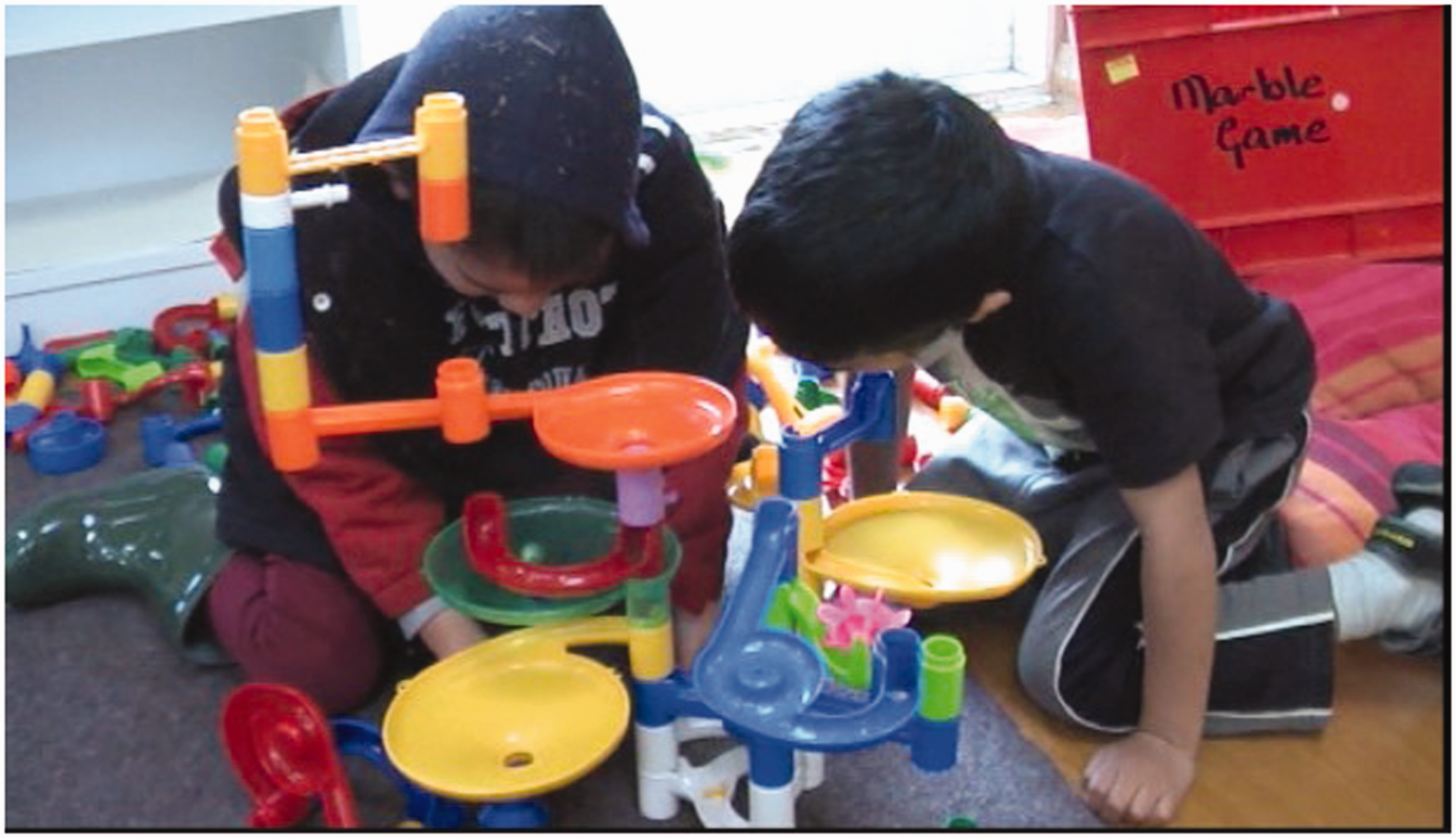
It is not possible to tell what Caleb and Sabal took from these events or, as Barad (2007) might say, how they became different beings through these encounters. Our impression of these events was that ‘what came to matter’ included a stretching of capacities that concerned human and more-than-human, capacities of the sort Thrift (2006: 144) describes in arguing the case for improvisation: ‘A sense of propensity of the situation … a continuous rearrangement of things in response to events … which requires all manner of spatial operations: linking, contrasting, separation, combination, tension, movement, alternation, oscillation, worked out in a series of different registers’. Braidotti (2009: 531) encourages us to think of such eventualities not in terms of established categories, but rather of encounters with anomalous and unfamiliar forces that ‘increase one’s capacity to enter into further relations and to grow’. This focus on the capacity to enter into encounters with others, of being open to being affected by the other, and being open to becoming different in one’s usual modes of being, is a focus we find glimpses of with/in Caleb and Sabal’s relations with each other as well as with/in their encounters with the marble-race. Such a focus renders problematic pedagogy that is overly vested in the predetermined.
Conclusion
Overall, this article speaks to the need to trace and critically examine the intended, (un)intended and shifting effects of the entanglements constituting policy and practice. Our focus on the curriculum priorities that have come to matter in the EC sector in Aotearoa-New Zealand has drawn attention to changes in terminolgy in the EC policy context that ‘can signal important mutations in the character of relationships – commercially, epistemologically, emotionally and politically’ (Haraway, 2008b: 135), and highlighted ‘practice based accretions’ (Torrance, 2017: 81) that have the potential to regularise and narrow the curriculum. In our analysis of these mutations we have explored the intra-active ways in which particular constructions of learners and learning are authorised and prioritised, and become part of the ‘always emerging conditions of the present’ (Rizvi and Lingard, 2011: 7).
Our discussion has revealed a complex mix of ‘old’ and ‘new’ policy priorities and foregrounded how, as new priorities are grafted on to the old, there is an incremental redoing of received ways of being, doing, knowing and relating. In and of itself, this is neither good nor bad; yet ‘everything is dangerous’ (Foucault, 1983: 232). While our analysis reveals promising pockets of radicalism, activism, resistance and push-back in both policy and practice, it has also shown up the conundrum that, over time, such endeavours carry both possibilities and risks: possibilities for new openings and risks of appropriation.
At the same time pressing questions still need to be asked about the intended and (un)intended effects of how a curriculum underpinned by EC sector commitments to care, plurality, diversity and openness, brought together with Māori priorities, is being ‘redone’ in a period of globalisation so as to become a curriculum preoccupied with school alignment and learning outcomes. What happens when even the youngest of children becomes tied to the identity of learner, first, foremost and sometimes exclusively?
Data from the study kindergarten highlights the importance of working against policies and practices that narrow curriculum priorities and predetermine outcomes for children as learners, at the expense of engaging with children and their lifeworlds with openness and genuine concern for what nurtures their wellbeing. The marble-race event focused on in the article, and other events in the wider study (see Haggerty, 2019), showed how conditions such as space, resources and time, and teachers committed to enabling children ‘to be, to be in lots of ways’ could operate intra-actively to not only allow children opportunities to engage with priorities that mattered to them, but opportunities to engage with the generative force of the ‘other’ (human and more-than-human) and the new. These, to us, are opportunities that should not be lost through a lack of critical attention to the ‘redoing’ of EC education being effected globally, or to the intended and (un)intended consequences of officially promoted discourses focused on bringing about greater continuity with school-sector priorities.
Footnotes
Declaration of conflicting interests
The author(s) declared no potential conflicts of interest with respect to the research, authorship, and/or publication of this article.
Funding
The author(s) received no financial support for the research, authorship, and/or publication of this article.
