




Abstract
In today’s digital society, people encounter a lot of information on a daily basis. This information should be understood by citizens in order for them to be able to properly engage in political issues, something the population of a healthy democracy does. Much of such information involves mathematics and fully comprehending it requires so-called quantitative literacy. All students should learn this as well as critical thinking at school. The article also discusses how abstract mathematics can indirectly be beneficial for democracy.
Introduction
In today’s digital society, people encounter a lot of information on a daily basis, some of which involves mathematics in one way or another. People actually understanding the information they encounter is a prerequisite for them being active citizens, which is a trademark of a healthy democracy. Just as literacy is needed to be able to read and understand texts, so-called quantitative literacy is needed to understand everyday situations involving mathematics. Moreover, people must not blindly trust authorities, but instead think critically and ask questions. Quantitative literacy as well as the habit of reflective thought can be taught during mathematics lessons at school. Later on, we discuss how it might be beneficial to remove some of the abstract parts of the mathematics lessons and make these available for people who will continue with mathematics-related studies at university. This way, most people would find their mathematics lessons more interesting and relevant to real-life issues such as democratic elections, while the more abstract-minded students could delve into abstract mathematics, which in the long run could also strengthen democracy.
Background on democracy
Etymologically the word democracy comes from Greek and means ‘rule by the people’. No universal definition of the word exists, though. Our first step towards putting words on what it actually stands for, will be the United Nations (n.d.), noting that Democracy, and democratic governance in particular, means that people’s human rights and fundamental freedoms are respected, promoted and fulfilled, allowing them to live with dignity. Reaffirming that democracy is a universal value based on the freely expressed will of the people to determine their own political, economic, social and cultural systems and their full participation in all aspects of their lives.
Democracy is thus clearly the least bad governmental alternative. However, young individuals growing up in well-functioning democracies have never experienced anything else themselves and may therefore take for granted their freedom and right to participate in political, economic, social and cultural ways in society. Most of the world population, however, do not enjoy the democratic way of life and even the most democratic countries of today used to historically be subject to authoritarian rule. Indeed, there will always be individuals who wish to seize more than their fair share of power and influence, and some of them will be highly skilled in the art of propaganda and persuasion. Today democracy is threatened by fake news online, and the development of moral algorithms for machines can compromise freedom. Democracy is therefore a fragile phenomenon which must be taken care of, to ensure its fruits for ourselves and future generations. Young citizens living in democracies ought to take a moment to appreciate this, as well as be given the possibilities and prerequisites to become fully fledged democratic citizens. This line of thought is in agreement with the following quote by Thomas Jefferson (1786: 151): ‘It is an axiom in my mind, that our liberty can never be safe but in the hands of the people themselves, and that too of the people with a certain degree of instruction.’
On desirable thinking
A well-functioning democracy involves citizens who are capable of being active participants. But prerequisites for proper engagement are the ability to understand situations, as well as possible future paths, and the ability to think about where each such path would lead. With this fulfilled, the population of a democracy is able to take political decisions, for instance support the continuation of democracy. To learn how to be reflective and contemplative citizens, young people should get instruction on this as part of their education.
As our starting point, we will use the book How We Think, in which John Dewey (1910: 7) defines reflective thought as ‘active, persistent, and careful consideration of any belief or supposed form of knowledge in the light of the grounds that supports it, and the further conclusions to which it tends’. Dewey (1910: 37–39) explains a model in which a complete act of thought is seen as five stages, namely: (a) the occurrence or identification of a difficulty or situation; (b) defining of the difficulty to make it precise and formulated in words; (c) the occurrence or formulation of a conceivable solution to the issue at hand; (d) the rational elaboration of the solution idea where the latter is investigated in further detail; and (e) the corroboration of the idea or at least the drawing of a conclusion.
That Dewey believes in the importance of students learning how to make wise decisions is clear; he writes ‘and if our schools turn out their pupils in that attitude of mind which is conducive to good judgment in any department of affairs in which the pupils are placed, they have done more than if they sent out their pupils merely possessed of vast stores of information’ (Dewey, 1910: 50). Indeed, a person with only facts and no critical thinking will neither be able to make use of those facts nor be good at handling new facts and thus be more inclined to be influenced by propaganda. Having stressed the importance of reflective thought, it should be noted that facts too are useful. Dewey makes an analogue that thinking without subject-matter is like digestion without assimilation of food. And I would say this is even more important in today’s society than in the past, due to so many people being part of the creation of new information and literature. There is a possible danger in new information being produced less carefully and skillfully, because such a trend may evolve into a vicious cycle. As Dewey (1910: 90) notes, ‘if the subject-matter is provided in too scanty or too profuse fashion, if it comes in disordered array or in isolated scraps, the effect upon habits of thought is detrimental’. Hence my conclusion is that whereas students most certainly ought to learn the art of critical thinking, they ought to learn also the value of statements being backed up by facts. It is this combination of knowledge of correct facts and critical thinking which is what Dewey and I want students to reach.
On school mathematics and democracy
Let us begin by taking a step back in time. Two generations ago, a clear minority of the population in Western countries completed high school and the ones who did were, statistically speaking, academically inclined and a decent proportion of them would go on to study science subjects at university. In view of this it arguably made sense to teach abstract mathematics, which is not readily related to everyday situations, as this prepares students for university studies involving mathematics. What has dramatically changed is that today a clear majority of the population completes high school. Often such students will never, or at least rarely, use abstract mathematics in their future careers. Speaking on behalf of mathematics educators, Kennedy writes that ‘if present trends continue, it is only a matter of time before our patrons see us standing at the chalkboard arrayed ignominiously in the emperor’s new clothes’ (2001: 57).
In other words, the natural question is why teach students knowledge they will never use, instead of teaching them something they’ll have use of. This is an exaggeration, though, seeing as the syllabi for mathematics courses in high school are not unchanged. Students have a say in what their mathematics lessons will look like, e.g. in today’s Norway there is a choice between mathematics courses 1P and 1T which, roughly speaking, are designed for students who will not, and will, study a mathematics-related subject at university, respectively. Nevertheless, there is still much truth in the following quote by Steen and Madison (2011: 4–5): ‘This entrenched model, designed to support science (aka STEM) disciplines, does little to help high-school graduates become quantitatively literate citizens.’ The meaning of quantitative literacy and why this is beneficial for today’s students will be our next focus below.
As they are analogous, we will look simultaneously at the meanings of literacy and quantitative literacy. One conceivable definition of literacy and quantitative literacy would simply be the ability to read and do simple operations with numbers, respectively. However, the concepts of literacy and quantitative literacy could be taken to include also the ability to understand and judge what is read and calculated respectively, as well as to use this information in various situations. As Mayes RL, Peterson F and Bonilla R (2013) note, the literature contains several different more or less overlapping definitions of the intertwined concepts quantitative literacy, quantitative reasoning and numeracy, each definition varying slightly from another in terms of width and scope. Here we will stick to the concept of quantitative literacy and take it to mean mathematics readily related to everyday situations, but in a wide sense including mathematical skills, understanding of how to interpret mathematical results and assess their validity as well as ability to appropriately use this in everyday situations, be it in one’s personal life or to arrive at political decisions about global issues. Using a wider definition makes sense since this stresses the importance in today’s digital world of people being able to wisely process the vast amounts of numerical information they meet in their workplaces and daily lives.
Steen (2001) illuminates that there is more than one viewpoint to use in order to grasp what quantitative literacy really is. One can, for example, look at the involved skills which today could be listed as arithmetic, data, computers, modelling, statistics, chance and reasoning. Quantitative literacy is intrinsically dynamic, though; what precise set of skills is included in quantitative literacy changes over time. As society progresses through the centuries, some of the skills alter; for example, knowing about computers was not relevant some 200 years ago. Next, it’s crucial – as Steen points out – to notice that quantitative literacy is taught in a proper context, in a real-life setting which is both appropriate and memorable. This is different from abstract mathematics, which can be taught in an abstract setting. It also takes us to an alternative way to look upon quantitative literacy, namely by considering its expressions, meaning the various situations where it is being used. Such situations could arise under umbrellas including, but not limited to, politics, science, professional life and personal finance. Again, since quantitative literacy is an evolving entity, a list of such umbrellas could also change over long periods of time.
Since we are focusing on democracy in this article, let us mention some concrete examples of how quantitative literacy can help people understand politics better. Firstly, the ability to understand a numerical statement and assess if it is reasonable or absurd; this requires knowing basic mathematics such as percent, knowing if the richest people in the world have millions or billions of dollars and being able to do rough calculations. However, we stress that it involves not only mechanical numerical skills but also mathematical understanding; for example when Donald Trump states that China is having its worst year in 59 years (McCarthy, 2019) this is wrong not only because 59 comes from nowhere, but also because he is talking about the rate of change of the GDP rather than the GDP itself. On this theme we also mention statistics; being able to read diagrams and understanding the idea of using samples to make predictions about populations, as well as understanding that creators of statistics may purposely present data in a way so as to make a certain impression on people who merely give it a quick glance and that interview questions may have been formulated in a biased manner. Secondly, basic economics knowledge; for example, grasping that the economy in a country may have been bad during a period of time not due to the political leaders at that time but due to a world recession. Thirdly, understanding of what happens if people act in their own personal interest. Two examples of this are:
1. Assuming a scientist would be willing to put in ten years’ hard work if it resulted in an invention and that society paid him/her a million dollars for the invention, then society buying inventions for a million dollars is not enough incentive to get the scientist to work as his/her expected value is much less than a million dollars since there is a good chance s/he’ll work ten years without making any invention.
2. A factory owner would not voluntarily buy expensive filters to stop pollution just from his/her factory, though s/he may happily agree to a law banning all factory owners from letting out pollution.
We reiterate that quantitative literacy is intrinsically connected to real-life situations and these are thus studied simultaneously. Hence quantitative literacy helps people understand real-life situations, for example taking decisions in democratic elections. Interestingly, one could also claim the converse is true: by contemplating decisions in democratic elections, one is most likely to encounter numerical situations and dealing with them automatically improves one’s quantitative literacy skills.
The fact that themes of quantitative literacy naturally occur in many subjects means that it can with advantage be studied also in interdisciplinary studies; examples of such studies that one will find in Norway are ‘public health and life control’, ‘sustainable development’ and ‘democracy and citizenship’. We are here reminded of the fact that the modern school has as its goal to give students not only knowledge but also more practical life skills.
Being quantitatively literate can thus be seen as a prerequisite to having the capacity to be a fully active participant in democratic processes. Studying quantitative literacy, or abstract mathematics for that matter, comes with an additional bonus, though – namely that students are encouraged to search for correct answers, for the truth. Students will likely not write out long mathematical proofs, but the principle is still there in that they are encouraged to understand a situation by themselves and to use their own judgement and logical thinking to come to conclusions. This habit of mind to question statements, to try and understand what they are actually saying and look at implications is very important for democratic citizens. Graumann (2005: 20) expresses this as: [Students must experience] that their own knowledge can mean emancipation from other people’s power. Presumably, already Thales from Miletos realized the emancipative character of mathematics (and Natural philosophy) and therefore searched for ‘proofs’; a fact which every thinking human being understands can’t just be swiped away even by a demagogue or despot.
Laissez-faire versus intervention
In the past, monarchs, the church, Nazis, communists, nationalists in democracies etc. have used oversimplified and even incorrect statements for their own benefit. Today, we have watchdog journalists doing investigations, people talk of ‘fake news’ and statements made by politicians such as Trump etc. are far from always true. And looking ahead, it must be stressed that even if a country is a democracy today, there will always in all countries be persons who are tempted to abuse their power. Therefore for the country to remain a democracy, its population must never cease to use reflective thought and engage in democratic decisions.
The purpose of the previous two sections has been to describe how education can help people become more quantitatively literate, and hence make a democracy healthier; in the words of Dewey (1916): A society which makes provision for participation in its good of all its members on equal terms and which secures flexible readjustment of its institutions through interaction of the different forms of associated life is in so far democratic. Such a society must have a type of education which gives individuals a personal interest in social relationships and control, and the habits of mind which secure social changes without introducing disorder. The most difficult kind of liberty to preserve in a democracy is the kind which derives its importance from services to the community that are not very obvious to ignorant people. New intellectual work is almost always unpopular because it is subversive of deep-seated prejudices, and appears to the uneducated as wanton wickedness. They must acquire knowledge now, so that they can enjoy the good life later on. One’s time as a child and adolescent appears as a period of waiting and education as a tool for managing adult life. From such a point of view, neither one’s time as child or adolescent nor the education have any value in themselves.
On attitudes towards schoolchildren
There are, of course, a relatively large number of things students simply should learn, e.g. reading, multiplication and the fundamentals of the social sciences and IT. And, as discussed in the previous section, it is arguably wise to have compulsory teaching segments in school for children during which they learn about handling large sets of facts and about improving their skills in reflection and critical thinking. Having said this, one can let children have some influence on what is included in their school curricula. Choices can be available. Already in early years, schools can include ‘students’ choice’ by which is meant lesson hours during which the students themselves can decide what subject they need or want to delve further into. And in later years, students can be allowed to choose if they are inclined to study the natural or social sciences, if they want an academic or practical direction and if they want to study many different subjects or dig deeper in a few.
Making students more inclined to reflect themselves and become more competent at critical thinking can be done within the framework of most school subjects. There are thus many possible opportunities for this in theory; however, if it is to be carried out in practice then teachers themselves need to be good at scientific thinking as well as at inspiring and helping their students to move towards this goal. Avoiding an authoritarian atmosphere in the classroom not only improves learning premises, but also trains young minds not to blindly trust what people say but to be inquisitive and question statements. Or in the words of Almeida (2010: 14): We must, at all costs, avoid convincing pupils about mathematical results on the basis of our higher knowledge and expertise – it is because the teacher said so – for then they are likely not only to learn superficially, if at all, but also critically accept inadvertent errors and misconceptions in text books and later from politicians.
Another aspect to consider is the development of more and more technological resources for education. Technology clearly opens up doors for better education in general. When this journey to slightly more computer-based teaching occurs, it is important to remember that all children, not just economically privileged ones, ought to be passengers. In the spirit of democracy, all children should have access to the internet etc. as well as learn how to wisely search for information online. In fact, learning how to make good use of the internet etc. is not merely something children must learn so as to be able to use technology to better learn the same things people learnt 100 years ago, but is also an important know-how skill in itself and hence an intrinsic part of today’s and the future’s school education.
On mathematics
In the upcoming discussion, we will use the two terms quantitative literacy and abstract mathematics. Quantitative literacy, which has already been described earlier, is thus related to everyday situations. By abstract mathematics, we will mean the part of mathematics which is not readily related to everyday situations. In abstract mathematics we consequently include both topics in pure mathematics such as number theory and axiomatic geometry as well as topics in applied mathematics such as genetics and quantum mechanics. Now consider Figure 1, which illustrates our division of mathematics contents.
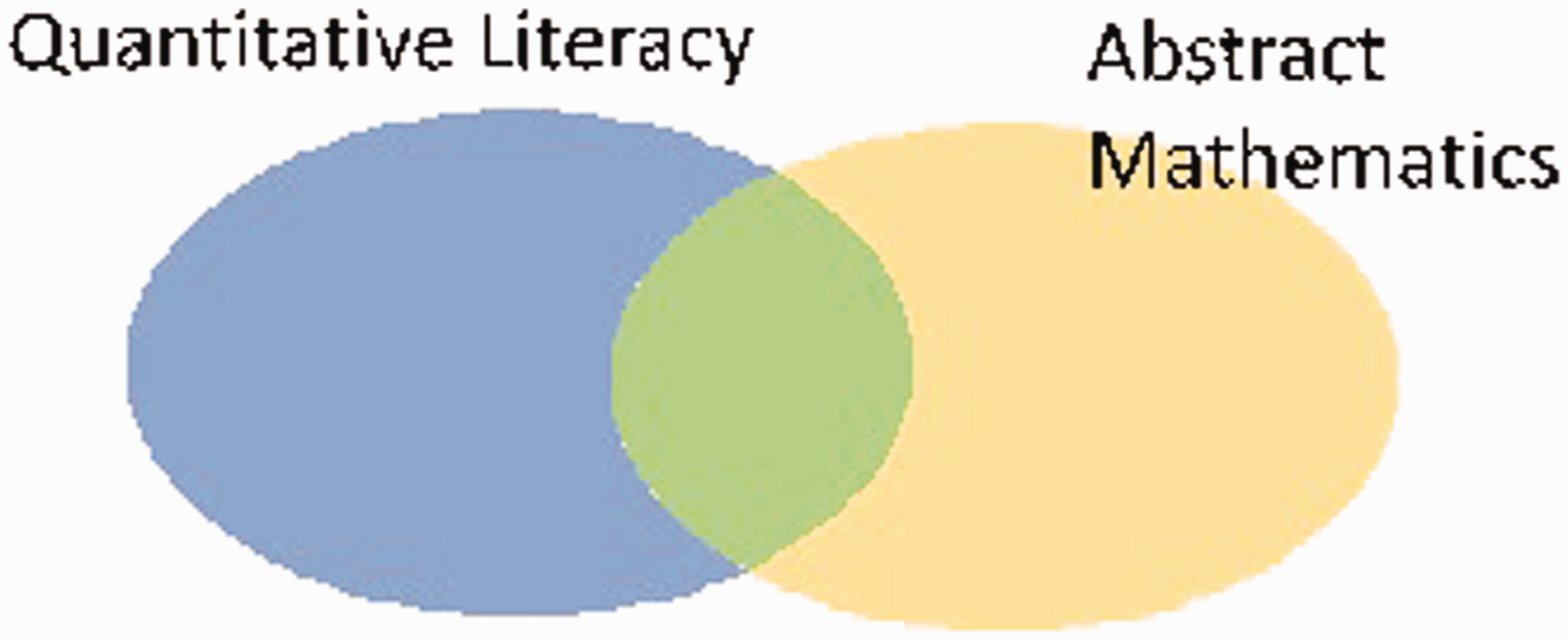
Illustration of our division of mathematics contents
The blue area represents the parts of quantitative literacy which are not in abstract mathematics, e.g. reading a news article and interpreting its numerical data content. The yellow area represents the parts of abstract mathematics which are not in quantitative literacy, e.g. calculus proofs. The green area in the middle represents any topic which is in both quantitative literacy and abstract mathematics, e.g. logic or mathematical problem-solving techniques as these could be useful to know both in everyday situations and in abstract mathematics discussions. It is important to notice that mathematical contents in the green region can be taught differently depending on the student body. Take for instance the result 2 × 8 = 8 × 2. A teacher of quantitative literacy may mention it after students investigate whether two spiders or eight humans have most legs, whereas a teacher of abstract mathematics at university may discuss how induction and Peano axioms can be used to rigorously prove that multiplication of positive integers is commutative.
In many countries nowadays, the school subject ‘mathematics’ is a mixture of quantitative literacy and abstract mathematics. If we take a closer look at Norway, which to some extent can be said to reflect trends in other Western countries as well, one can further examine the new school programme called Fagfornyelsen, to be introduced 2020. One of the general attitudes stressed there is that students should learn to be explorative and how to obtain new knowledge on their own (Utdanningsdirektoratet, 2017). An upside of this is that students may get more chances to improve at searching for and handling new information.
However, as a pure mathematician at heart, a part of me cannot help feeling sad when the overall mission of teaching students how to acquire information on their own and reaching insights through questions and discussions is pushed through at the expense of teaching mathematics per se most effectively. Long before I started school, I learnt about numbers simply because it was so much fun. Although the calculations did not really mean anything to me in real-life terms, I found it very intriguing to sit and try to do multiplication as fast as possible. It seems self-evident to me that if a preschool child can find value in such an abstract pastime then surely so can many people, if yet a clear minority of the population. If the abstract brings joy to the learner, then there is value in it. Furthermore, abstract mathematics can lead to benefits for society either immediately or in a future generation. We are, however, beginning to digress from the topic of democracy, so let us turn the focus back towards this.
I do not at all wish to neglect the importance of students learning the habit of being reflective and in the long run becoming good democratic citizens, but why not keep such sound and worthwhile goals while at the same time continuing the centuries-old tradition of having people who are keen on mathematics attend mathematics lessons where the primary goal is to learn mathematics? As mentioned, Norway offers high-school students a choice between mathematics courses 1P and 1T. Of course, this is not a black-or-white discussion – as our society arguably becomes more and more complicated, there may very well be a need to know some abstract mathematics also for students who will not study a mathematics-related subject at university. However, with a topic such as Pythagoras’ Theorem, the mathematics lessons can be geared towards everyday situations or towards abstract proofs. With this in mind, I believe that a clearer separation of quantitative literacy and abstract mathematics would quite possibly be better for basically all students. The students who do not enjoy mathematics would no longer have to struggle with abstract mathematics, which for these students might not only be difficult but also uninteresting as it does not readily relate to the real world. The time these students gain by not studying things they will never use and likely never learn properly, could be used to get a genuine understanding of quantitative literacy, leading to improved grades and self-confidence for these students. On the other hand, students who enjoy and excel at mathematics would be able to go through a quantitative literacy course rapidly, at a tempo which stimulates rather than bores them. Thereafter they could go on to the, in their opinion, interesting abstract mathematics course and hence be prepared for university studies.
This suggestion would make sense also from a point of view of personality types. Myers-Briggs Type Indicator (MBTI) is a personality theory which indicates how a person absorbs information and makes decisions, and more specifically the parameter whether a person is Sensing or iNtuitive. ‘Sensing types prefer “what is,” working with concrete information gathered through the five senses, while iNtuitives prefer abstract ideas, possibilities, and connections between facts’ and about 68% of the population prefer Sensing (Gallagher, 2013: 62–63). Sensors would likely find quantitative literacy appealing whereas iNtuitives likely would be attracted to abstract mathematics.
So far in this section we have discussed how quantitative literacy brings skills which are useful for becoming an active member of a democracy in today’s digital society, and mentioned that this as well as abstract mathematics can be offered to students. Next, we describe two ways in which the nurturing rather than suppression of pure mathematics also indirectly helps democracy. Firstly, mathematics forces one to use one’s brain and it is one of the best subjects for learning how to think logically. And logical thinking improves one’s ability to foresee the consequences of choices one makes, e.g. in democratic elections. Secondly, allowing young mathematically inclined students to delve in pure mathematics rather than putting all students in one mould of quantitative literacy is an example of giving abstract thinkers freedom, which should be done in well-functioning democracies. In fact, catering for this small part of the population is arguably extra important, as such persons in virtue of being particularly resistant to propaganda can play a key role in supporting democracy. I inevitably think of the book Brave New World by Aldous Huxley (1932). It describes a society in which people are conditioned by means of propaganda and medicines to be happy and content with their role in the society. The citizens enjoy a good standard of living and good looks (their physical bodies not ageing). Almost all of the citizens are blissfully unaware of what is going on, simply indulging in their materialistically happy lives. However, a tiny part of the population – typically members of the most intelligent ‘Alpha-Plus’ class – have a gut feeling of unhappiness and that perhaps everything is not quite as good as it seems to be on the surface. Hence, returning to our situation, whereas lessons for encouraging students to think critically are great, there is value in not insisting on that everyone ends up in the same mould, e.g. to allow mathematics enthusiasts to enjoy pure mathematics. It has value in itself and for democracy to allow these abstract thinkers to be just that – abstract thinkers.
On the importance of logic
As mentioned, quantitative literacy and abstract mathematics overlap to some extent. An important part of this intersection is logic. Logic is the study of inferences and laws of truths; it can be seen as one part of reflective thought. However, rather than debating the exact scope of logic, let us turn our attention to how it is useful not only for abstract mathematics studies but also for all citizens when dealing with everyday situations.
Indeed, as we will see below there are several types of real-life situations where logic can be helpful. By discussing such situations in, say, high school, students will better handle such and similar situations in the future. Moreover, exercises of this type improve their critical thinking in general, not to mention that they learn to take the time to think for a moment before jumping to conclusions. Logic would for most students best be taught using real-life situations and words instead of – or in case of mathematically interested students, prior to – abstract situations with ‘complicated’ mathematical symbols. Dewey (1910: 70) writes that ‘in many (probably the majority) the executive tendency, the habit of mind that thinks for purposes of conduct and achievement, not for the sake of knowing, remains dominant to the end’. A more hands-on approach with real-life examples would likely also make more students engaged and interested. But without further ado, let us have a look at some types of logic lessons which could be beneficial for students to go through.
One type of lesson is not to make deductions that are too rushed. Often people make overly rash generalizations; a person having gotten good healthcare in his/her country after an injury might claim that said country’s healthcare is good, while a person who is brutally robbed in a certain neighbourhood might state that most of its inhabitants are criminal. Another classic example where people have been known to jump to conclusions too hastily is when getting puzzled by the riddle: ‘A father and son are in a horrible car crash that kills the dad. The son is rushed to the hospital; just as he’s about to go under the knife, the surgeon says “I can’t operate―that boy is my son!”’ Another example: when contemplating whether to do an action or not, to realize that doing it would lead to a bad outcome and conclude not to do the action without considering that not doing the action might lead to an even worse outcome.
A second type of lesson is some specific types of logical situations. This could be avoiding self-contradictions, of which two obvious examples are ‘This sentence is false’ and ‘The barber cuts the hair of everyone who does not cut his own hair.’ It could be learning to appreciate symmetry: when contemplating an ethical dilemma such as ‘Can I do this thing to her or not’, you can ask yourself if you would like her to do said thing to you? However, a fallacy to avoid is to assume that B implies A simply because A implies B, e.g. ‘If it snows tomorrow then it’s minus degrees’ is true, whereas the converse ‘If it’s minus degrees tomorrow then it’s snowing’ is false.
A third type of lesson is that using logic helps with making correct deductions. For example, one may deduce that if UK goes for Brexit, then with high probability its trade will suffer, which in turn will negatively affect its economy. In democratic elections, it is important that people have realized and understood what it is that they are voting for in an election and that they realize what their vote actually will lead to.
A fourth type of lesson is to question not only inferences but also axioms, in practice claims made without any supporting proof. For instance, a king may have proclaimed that he was following God’s orders when attacking the neighbouring country and that to do this, the poor people had to pay more taxes. A person may here focus on that God’s will must be obeyed and that money must be raised to wage a war. Be that as it may, the point is that such a person did not question the king’s proclaimed association with God. Indeed, John Locke (1690: 287) writes the following about authority: The fourth and last wrong measure of probability that I shall discuss keeps more people in ignorance or error than do the other three combined … it is the practice of giving our assent to the common received opinions of our friends, our party, our neighborhood, or our country.
On cause and effect
People trained in critical thinking are prone to think things through, ideally double-checking their line of thought for logical fallacies, rather than making hasty decisions. Not only is it key, as mentioned, to realize the immediate consequences of one’s decisions, but one ought also to consider if there are long-term consequences. In fact, there may be times when one simply is unable to foresee long-term consequences and, in such cases, one must recognize this. Far too many times in history have people acted hastily. Smoking and even heroin were proclaimed to be healthy; Mao Zedong ordered the killing of millions of sparrows in 1958 without realizing that this would lead to billions of insects and hence all-in-all to worse crops; some people do not start thinking about the environment until the ozone layer and arctic ices are already severely damaged and wars are initiated though they are likely to lead to nothing but lots of deaths. And this sad list will not cease to lengthen unless critical thinking is strengthened. Moreover, Dewey (1910: 13) interestingly notes that ‘in elevating us above the brute, it opens to us the possibility of failures to which animal, limited to instinct, cannot sink’. Indeed, the more advanced our human technology becomes, the greater the conceivable damage. The world could quite possibly have ended for humans in connection with the Cuban crisis in 1962. People ought to actively think, imagine future scenarios and choose good ones for humanity, rather than allow future development to be driven by chance or even worse by selfish or criminal interests. This is particularly important in this digital era of ever-faster developing technologies. Who knows what sort of robots people – including dictators, not to mention petty criminals – could have in their possession in 50 years’ time? Already several decades ago, Huxley (1958) expressed a genuine fear that new technologies, although not evil in themselves, could be used for evil purposes. And technology is developing at an ever-faster speed. This is an extremely complicated and global issue. Through democratic governments we should try to ensure a safe future; but we really need to get wise by thinking, not by waiting and learning from future mistakes.
Furthermore, Artificial Intelligence (AI) deserves a special mention here. The reason this technological discovery is different from all previous inventions in human history is due to the possibility of AI creating more sophisticated AI, leading to an exponential and hence likely out-of-human-control development. This may sound unreal to some readers; but Google Brain has created an AI system which in turn has created an AI system performing better at doing its task than any human-made AI system (Sulleyman, 2017). Oxford philosopher Boström (2014: 26) defines superintelligence as ‘any intellect that greatly exceeds the cognitive performance of humans in virtually all domains of interest’ and means that solving the problem of control beforehand is an absolute priority. Stephen Hawking (2014) has expressed concerns about superintelligent AI: ‘I think the development of full artificial intelligence could spell the end of the human race.’ Needless to say, without humans, there is no democracy to speak of. Some say AI may prove to be the best thing in human history. Personally, I just hope it will not be the worst; students will hopefully leave school in the future grasping that AI is an important issue and having been trained by teachers to use reflective thought.
Conclusion
For a democracy to be safe and well functioning, its citizens need to be actively participating in society. A prerequisite for this is making sense of the large amount of information they encounter on a daily basis in today’s digital society, with an understanding of it which includes an ability to judge whether statements are reasonable or unreasonable fake news. To achieve this in the case of information of a mathematical nature, we need people to be educated in quantitative literacy, which concerns everyday situations and which consequently is useful to all citizens; putting more focus on this for students not interested in mathematics could increase their engagement and hence understanding of the lessons. As for high-school students who will go on to study a subject related to mathematics at university, they could have the option to study also abstract mathematics, which in the long run also could strengthen democracy.
Mathematics teachers can, however, help strengthen democracy not only through improving their students’ quantitative literacy. They can also teach students not to blindly trust authorities, but instead think critically and ask questions. Mathematics, in particular logic, encourages students to think and use logical and reflective thought. This is important from a democratic point of view as it is crucial that people understand what it is that they are actually voting for in elections and what the consequences of their choice will be. People foreseeing and understanding the future consequences of their decisions could for themselves and future generations be the difference between enjoying the fruits of democracy or humanity having ceased to exist.
Footnotes
Declaration of conflicting interests
The author(s) declared no potential conflicts of interest with respect to the research, authorship, and/or publication of this article.
Funding
The author(s) received no financial support for the research, authorship, and/or publication of this article.
