




Abstract
This study examines how videos may support participants’ learning in the Information and Communication Technology Massive Open Online Course (ICTMOOC) aimed to develop digital skills with pre- and in-service teachers in Norway and provides an insight into how teachers’ interactions with videos may contribute to enhancing their agentic capacity to learn and transformative digital agency. Analyses of participants’ interactions with the videos are located in the cultural-historical theory and draw on Galperin’s conceptualisation of learning processes.
The data consisted of 501 participants’ responses to the questionnaire administered to all pre- and in-service teachers engaged in the ICTMOOC in 2014–2018. Mixed methods were applied to analyse the data by providing quantitative and qualitative evidence about the processes of video use.
Findings reveal the patterns of participants’ interactions with videos: (a) seeking explicit information about how to engage in learning; (b) seeking assistance while engaged with the assigned tasks; (c) support to compare learning outcomes with the requirements outlined in the videos. In doing so, the videos provided orienting, executive and controlling support and might have contributed to enhancing participants’ capacity to learn in digital environments and their transformative digital agency. The majority of participants used videos for executive support and the learners preferred videos in the range of 5–10 min. By providing these types of support by the videos, a learning activity carries a new function as a tool for studying the essence of learning in digital environments.
These findings have implications for the design of videos in online courses. They also emphasise the crucial importance of awareness about the type of support videos provide to enhance participants’ learning in digital environments.
Keywords
Introduction
This study examines participants’ experiences of their use of videos in the Information and Communication Technology Massive Open Online Course (ICTMOOC) aimed to develop digital skills with pre- and in-service teachers in Norway. The study also provides an insight into how teachers’ interactions with videos may contribute to enhancing their agentic capacity to learn, and transformative digital agency. Massive Open Online Courses (MOOCs) have become a buzzword in education and, over the next 10 years, e-learning is projected to grow 15-fold, accounting for 30% of all educational provision (Lillejord et al., 2018). However, such a new form of educational delivery influences and challenges learning and teaching practices. On the one hand, MOOCs may also offer the possibility for innovative instructional designs to support self-regulated learning and enhance participants’ agentic capacity to learn (Bartolomé-Pina and Steffens, 2015). On the other hand, MOOCs are characterised by high dropout and low completion rates (Kennedy, 2014; Singh and Mørch, 2018). It has been argued that effective MOOC design is a key factor in combating these challenges (Conole, 2015), and videos have become a central element in the design of MOOCs and online courses (Bonafini et al., 2017; Evans et al., 2016; Guo et al., 2014; Hew, 2016; Reutemann, 2016; Rose, 2009). To engage in learning in MOOCs, participants should develop their understanding of how to go about learning in digital environments and enhance their agentic capacity to learn. Therefore, videos (together with other resources) might contribute to enhancing such a capacity with participants as they move forward as self-regulated learners in online environments to become increasingly competent users of their knowledge.
While unpacking the Vygotskian notion of the social situation of development, Edwards (2015) conceptualises learners’ agency as an ability to propel themselves forward recognising and responding to the demands in tasks and with increasing competence, repositioning themselves within a knowledge domain. This resonates with Mäkitalo’s (2016) understanding of learners’ agency as “the capacity of humans to distance themselves from their immediate surroundings and … to intervene in and transform the meaning of, situated activities” (p. 64, emphasis in original). In our context, this implies an ability of learners to engage in interactions with video resources in MOOCs to be able to utilise the support provided by the videos to resolve problem situations and propel themselves forward in their learning. In learning aimed at enhancing participants’ digital competence, Brevik et al. (2019) introduced the notion of transformative digital agency as competence to take initiatives and transform practices by selecting relevant digital tools. Transformative digital agency arises as a necessity when learners are placed in demanding situations involving challenges or a conflict of motives, thus creating a wish or need to break out of the current situation. In many ways, learning in MOOCs can be seen as a demanding situation involving challenges for the participants to understand how to engage in learning and how to utilise the available digital (video) resources to support their learning. Research on how videos may enhance participants’ agentic capacity to learn in online environments is still relatively scarce. This study addresses this gap by examining pre- and in-service teachers’ experiences about the types of support the video resources provided and the preferred length of videos. In additions, we attempt to outline the implications of the support provided by the videos for enhancing participants’ agentic capacity to learn and transformative digital agency.
Agency in learning to learn and transformative digital agency
Research defines learning to learn as metacognition: knowledge and awareness about one’s own cognition in general (Pintrich, 2002; Schraw et al., 2006), which, together with motivational beliefs and cognitive strategies, constitute self-regulated learning (Winne, 1997; Winne and Perry, 2000). It has been shown that good self-regulators do much better academically than poor self-regulators (Zimmerman and Pons, 1986) and students’ belief in their capacity to manage their learning provides power and enhances performance accomplishments (Bandura, 2001; Bandura et al., 1996; Zimmerman and Bandura, 1994).
To enhance students’ agentic capacity to self-regulated learning, Zimmerman’s (2002) earlier work has taken a broad perspective, outlining strategies such as goal setting, strategy use and self-evaluation. In doing so, he emphasised that mastery of these strategies is social in nature and can be learned from instruction and modelling by parents, teachers and coaches. Latterly he pointed to how learners' focus on how they activate, alter and, sustain specific learning strategies in social as well as solitary contexts is especially relevant for their development as learners (Zimmerman, 2008).
In line with Zimmerman’s attention to the social origins of students’ self-regulation, guidance has also been offered to teachers, to encourage them to develop self-regulated learners. Pintrich (2002), for example, argues that explicitly teaching metacognitive knowledge across different subject areas and contexts to facilitate its development with learners is needed and conceptualises self-regulated learning as “an active constructive process whereby learners set goals for their learning, monitor, regulate, and control their cognition, motivation, and behaviour, guided and constrained by their goals and the contextual features of the environment” (Pintrich and Zusho, 2002, p.64).
However, the evolvement of new educational environments (MOOCs) urges the need to understand how available (video) resources might enhance participants’ agentic capacity to self-regulated learning in MOOCs and their development as learners. In MOOCs, individuals must determine when, how and with what content and activities they engage (Milligan and Littlejohn, 2014). Studies examining learning in online environments have identified positive correlations between self-regulated learning behaviour and academic achievement (Azevedo and Cromley, 2004; Barnark-Brak et al., 2010; Serdyukov and Hill, 2013; Wang et al., 2013). By interacting with digital resources learners may develop their digital agency, which is transformative in nature (Brevik et al., 2019; Lund et al., 2019). The transformative nature of digital agency implies learners’ ability to transfer their interactions with digital resources into an opportunity for learning and development and, therefore, transformative digital agency is inherently connected with the learners’ agentic capacity to learn. Videos (and other resources) might contribute to developing participants’ understanding about how to engage in learning in MOOCs and, therefore, there is a need to examine the types of support video resources provide to learners.
Video resources in online courses and MOOCs
Videos in MOOCs, used both synchronously and asynchronously, can vary in the position within the course and in purpose, such as (a) introductory videos in which course instructors explain the course and its purpose, (b) animations with audio narration in which the course content is explained, (c) video lectures given to real students and (d) videos with built-in questions (Bonafini et al., 2017). In studies on the use of lecture videos, students report enjoying the videos and find their classes engaging (Choi and Johnson, 2005; Whatley and Ahmad, 2007). Through videos, information can be presented in an attractive and consistent manner (Yousef et al., 2014; Zhang et al., 2006) and visualise phenomena that are difficult to convey with texts or static pictures (Colasante, 2011). Guo et al. (2014) carried out, as the authors claim, the largest-scale study on students’ video engagement in MOOCs, using data from 6.9 million video watching sessions across four courses on the edX MOOC platform. Their findings show that shorter and informal talking-head videos and videos produced with a more personal feel could be engaging for learners. They found higher dropout rates in longer videos, re-watching sessions and tutorials rather than lectures. Like Guo et al. (2014), other researchers (Reutemann, 2016) found that talking-head videos are the most preferred by learners in four MOOC platforms (edX, Coursera, FutureLearn and Iversity). However, depending on the video style, students appear to interact differently with the course video materials. Kim et al. (2014) identified five student interaction patterns with videos: starting from the beginning of new material; returning to missed content; following a tutorial step; replaying a brief segment; and repeating a non-visual explanation. Videos can also provide a valuable context for learning and generate a common experience for students to discuss and reflect on concepts and ideas, as in anchored instruction (Bonk, 2011; Langset et al., 2018; Sherer and Shea, 2011; Singh and Mørch, 2018). By generating a common experience for learners, videos can enhance students’ engagement in collaborative activities and promote different learning styles (Calandra et al., 2006; Goulah, 2007; Greenberg and Zanetis, 2012; Pea and Lindgren, 2008; Zhang et al., 2006). For instance, time-anchored commenting interfaces allow learners to watch and exchange comments simultaneously, and thus transform engagement with videos from passive to active (Lee et al., 2015). In addition to different purposes, videos may also vary in length.
The length of the educational videos in MOOCs is a widely discussed topic. Some researchers argue that short videos are most suitable for educational purposes (Bonk, 2011; Guo et al., 2014). On the one hand, Guo et al. (2014) introduced a “six-minute rule” as an optimum length for videos in MOOCs. On the other hand, Lagerstrom et al. (2015) believe that the “six-minute rule”, valid for a MOOC environment, does not capture the video viewing behaviours of students in standard college courses, and how long students watch a video depends on how motivated the student is to study. Based on the data from single watching sessions, a rule of thumb for maximum video length in the range of 12–20 minutes is introduced (Lagerstrom et al., 2015).
Although the observations outlined here indicate that videos can be a powerful resource to enhance students’ engagement in learning, studies tend to lack detail on how participants interact with videos in online courses and how videos may contribute to the development of learners’ agentic capacity to learn and their transformative digital agency. The discussion on the preferred length of videos is also lacking consensus. We examined participants’ interaction patterns with videos by zooming in with the lens of a cultural-historical theory (Engeness and Lund, 2018).
Theoretical perspective
A cultural-historical perspective has been chosen to examine participants’ interaction patterns with videos in the ICTMOOC (Clarà and Barberà, 2013, Engeness, 2020). Vygotsky (1980) was the first to suggest that the source of learning and development of the human mind lies on the external (social) plane. Tools (material and linguistic) that mediate these activities are initially directed outwards, connecting the learner with the surrounding world and, by acquiring a particular meaning, transform into signs directed inwards, to the mental plane of the learner (Arievitch and Stetsenko, 2014). In our case, videos embedded in the ICTMOOC act as material mediational tools that connect learners with the public meanings that are valued in cultures. These cultures include contemporary digital software and its pedagogic potential. Vygotsky put particular emphasis on the quality of the mediational tools learners interact with and the effect these tools have on students’ learning and development (Arievitch and Stetsenko, 2000). The quality of video resources and understanding the types of support videos provide to learners would seem to be crucial.
However, Vygotsky did not explain how the specific qualities of tools affect students’ learning (Clarà, 2017). The cultural-historical scholar Galperin (2002) extended Vygotsky’s argument about the effect the qualities of tools may have on students’ learning by introducing three types of orientation. Galperin understood orientation as a way of structuring the learning process and utilising appropriate mediational tools and their pedagogic potential. He argued that orientation can be specific to solve a particular task, or it can be used in several learning situations. In addition, the orientation can be either supplied to learners in its final form ready to be used in a learning activity or it can be constructed by learners. The construction of orientation by learners can happen either by the method of trial and error or by using an approach offered by the teacher.
Based on these premises, Galperin identified three types of orientation: (a) incomplete, where mediational tools and the essential characteristics of the target concept are identified by learners through trial and error. In this case, learning happens slowly with many mistakes and is extremely sensitive to the slightest changes in the conditions of the learning activity. (b) complete, where learners are informed about all mediational tools that encapsulate the essential characteristics of the target concept. However, these mediational tools are specific and can be used only in one case, for example, when solving a particular problem. Learning happens quickly and with minimum mistakes; however, the transfer of skills and knowledge developed during such an activity is possible only when there is a close similarity in the problems and learning situations. (c) complete and constructed by learners following an offered approach aimed at identifying the essential characteristics of the target concept. By using an offered approach, a specific orientation can be constructed by learners suited to solve a problem. With the third type of orientation (complete and constructed by learners following an offered approached), learning happens quickly, with minimum mistakes and the skills and knowledge developed during the learning activity can be transferred to other learning situations. The students develop their understanding of how to go about learning, and their agency in learning to learn may be enhanced (Engeness, 2018; Engeness, 2020). These three types of orientation will be used as a lens to examine the types of support videos provided to learners in the ICTMOOC. Such use of Galperin’s theory is innovative and we are interested to explore whether the lens of the types of orientation will help in our analysis of the pedagogic potential of videos in digital environments. The following research questions are addressed. RQ1: What did the pre- and in-service teachers say about the types of support the video resources in the ICTMOOC provided and what length of videos was preferred by the learners? RQ2: What are the implications of the support provided by the videos for enhancing participants’ agentic capacity to learn and transformative digital agency?
Method
Participants and setting
Data collection was conducted through the questionnaire administered to all pre- and in-service teachers engaged in the ICTMOOC in 2014–2018. The pre-service teachers took the ICTMOOC as a part of their teacher training programme and the requirement to enrol in the course was a General Certificate of Secondary Education. 1 The in-service teachers engaged in the course to enhance their professional development and they were teachers from all levels in the education system: kindergarten, primary and secondary school teachers and teachers that work in the universities and colleges. The language of tuition in the ICTMOOC is Norwegian and the majority of the participants were from Norway and some were from Sweden.
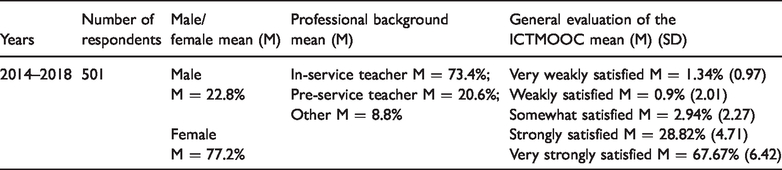
The questionnaire was administered online on the completion of the course and it aimed to examine participants’ experiences in the ICTMOOC. The questionnaire included the following: (a) general information about pre- and in-service teachers; (b) participants’ learning experiences in the ICTMOOC; and (c) teachers’ facilitating of the learning process in the ICTMOOC. The questionnaire included 22 questions; some questions applied a Likert scale from 1 to 5 and some questions required detailed qualitative answers. Table 1 shows the number of respondents to the questionnaire in 2014–2018, their background and their general evaluation of the ICTMOOC.
The number of respondents to the questionnaire in 2014–2018, their background and their general evaluation of the Information and Communication Technology Massive Open Online Course (ICTMOOC).
ICTMOOC
The ICTMOOC was first introduced in Norway in 2014. The course was developed by researchers and development specialists from Østfold University College. The ICTMOOC has the structure of an xMOOC, it is built in the Canvas platform and is aimed to enhance the development of digital skills with pre- and in-service teachers. Researchers define xMOOCs as courses that are institutionally focused, reliant on video lectures and provide automated assessment through quizzes (Bayne and Ross, 2014; Singh and Mørch, 2018), and all of these elements are present in the ICTMOOC. The ICTMOOC consists of 10 modules to be completed by the participants progressively over the course of 10 weeks.
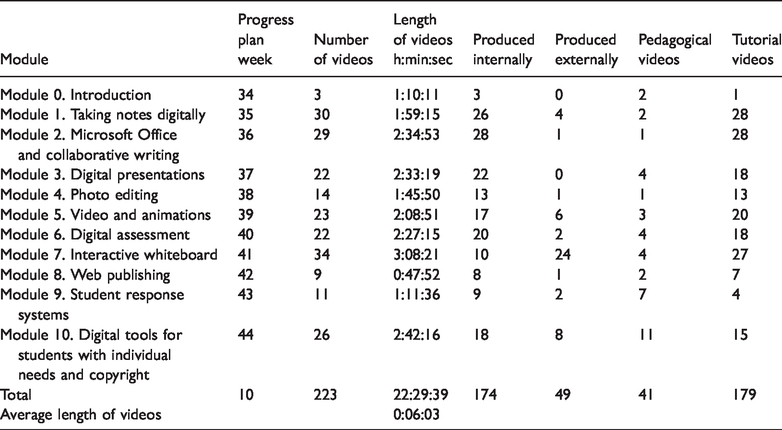
Each module contains textual information, videos, individual tasks and multiple-choice quizzes. In total, there are 223 videos in the course; 174 of them are produced by the course developers and stored at the YouTube Channel. A total of 179 videos are tutorials/instructional videos and 41 videos discuss the pedagogical aspects of the use of digital tools. The total length of all videos in the course is 22 h 29 min 39s, and the average length of a video is 6 min 3 s. The list of modules included in the ICTMOOC, the progress plan the participants are to follow, an overview of the videos and the length of the videos in the ICTMOOC are presented in Table 2.
Progress plan and the videos in the Information and Communication Technology Massive Open Online Course.
In several modules, students are expected to complete practical exercises to develop digital skills with the participants, give and receive peer feedback and submit examination assignments. A typical example of assignments included in the ICTMOOC is the task included in Module 3 Digital Presentations: Creating a PowerPoint (Figure 1).
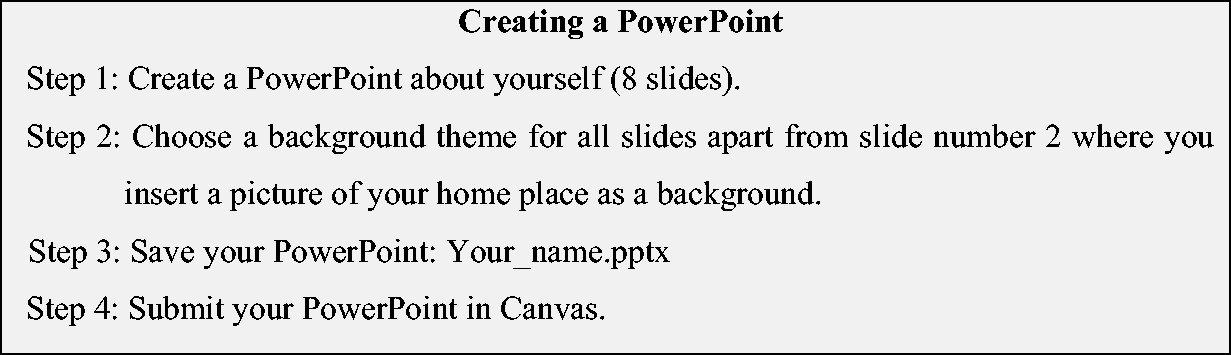
Assignment creating a PowerPoint presentation.
On successful completion of the ICTMOOC (evaluated to passed or failed), participants are awarded 15 ECTS (European Credit Transfer and Accumulation System) credits. Over 80% of students passed the ICTMOOC in 2014–2018.
Data and analysis
To address the research questions in this study, the following questions were included in the questionnaire administered to the participants in the ICTMOOC in 2014–2018. (11) What is your overall experience about the use of videos in the ICTMOOC? (Applied on a Likert scale from 1 to 5 (1 = “very weakly satisfied”, 2 = “satisfied”, 3 = “somewhat satisfied”, 4 = “strongly satisfied” and 5 = “very strongly satisfied”.) (12) What do you think about the length of videos in the ICTMOOC? (Applied on a Likert scale from 1 to 5 (1 = “too short”, 2 = “short”, 3 = “appropriate”, 4 = “long” and 5 = “too long”.) (13) What length of videos do you think is appropriate in the ICTMOOC? (Participants were to mark one of the suggested lengths: 0–2, 3–4, 5–6, 7–10, 11–15, 16–20, 21–30 and 31–45 min.) (14) How did you use videos in your learning in the ICTMOOC? (Participants were to provide detailed descriptive answers.)
The data consisted of 501 participants’ responses to questions 11–14. All responses provided by the participants were anonymous and voluntary. Mixed methods (Creswell, 2012) were applied to analyse the data by providing quantitative and qualitative evidence about the processes of video use.
To examine the preferred length of videos in the ICTMOCC, the participants' responses to questions 11–13 were analysed.
To examine participants’ interaction patterns with the videos in the ICTMOOC, students’ responses to question 14 were analysed qualitatively by following the steps of thematic analysis: (a) transcription of data; (b) coding of data; and (c) analysis of data (Castleberry and Nolen, 2018; Clarke and Braun, 2014). We imported the participants’ responses to NVivo 12 and conducted an initial open coding (Miles and Huberman, 1994) using an inductive approach in a thematic analysis (Clarke and Braun, 2014; Van Manen, 2016) without any predetermined categories (Patton, 2015). To uncover thematic aspects, the following approaches to coding may be applied: (a) a holistic approach that targets the underlying meaning of the entire text; (b) a selective approach in which one examines which phrases or statements are considered to illuminate the phenomenon being examined; and (c) a detailed approach in which all sentences are individually examined with regard to their significance to the phenomenon (Philipsen et al., 2019; Van Manen, 2016). In this study, a detailed approach was applied.
The codes identified by the detailed approach were presented either in the form of a descriptive label that directly described or was taken from the participants’ responses. Thereafter, the codes were put into context with each other to create themes. Clarke and Braun (2014) define themes as patterns in codes; they take the numerous pieces of related code to show a bigger picture of what is being portrayed. Therefore, the single codes from the open coding process were grouped into larger themes to represent patterns of participants’ interactions with the videos in the ICTMOOC. These themes are presented in Section 3.0 of this article. Once the themes were identified, they were examined through the analytic lens offered by Galperin’s types of orientation to begin to unpack how the available video resources supported participants in the learning process. To ensure reliability of the results, thematic analysis of participants’ responses was conducted by the research team.
Findings
Analysis of participants’ preferences about the length of the videos in the ICTMOOC
The analysis of participants’ preferred length of videos in the ICTMOOC starts by examining students’ responses about their overall experience of using videos in the ICTMOOC (Q 11: What is your overall experience about the use of videos in the ICTMOOC?) (Table 3).
Participants’ responses about their overall experience of using videos in the Information and Communication Technology Massive Open Online Course.
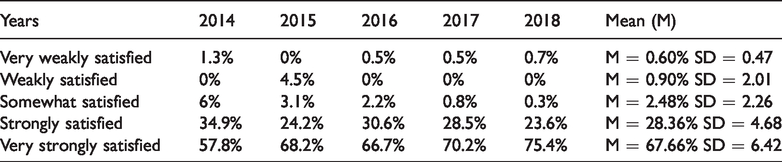
The data show that the majority of pre- and in-service teachers were very strongly satisfied (M = 67.66%, SD = 6.42) with the support the videos provided in the ICTMOOC.
Table 4 presents participants’ responses about their experiences of the length of videos in the ICTMOOC (Q 12: What do you think about the length of videos in the ICTMOOC?).
Participants’ responses about the length of videos in the Information and Communication Technology Massive Open Online Course.
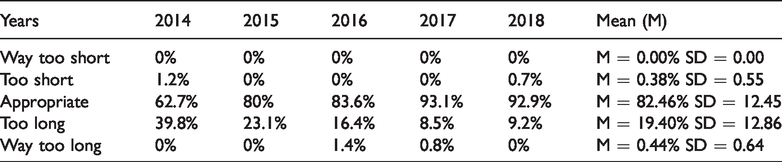
The data reflect that the majority of participants (M = 82.46%, SD = 12.45) considered the length of the videos (average 06 min 03 s) to be appropriate.
Table 5 presents participants’ responses about the preferred length of videos in the ICTMOOC (Q13: What length of videos do you think is appropriate in the ICTMOOC?).
Participants’ responses about the preferred length of videos in the Information and Communication Technology Massive Open Online Course.
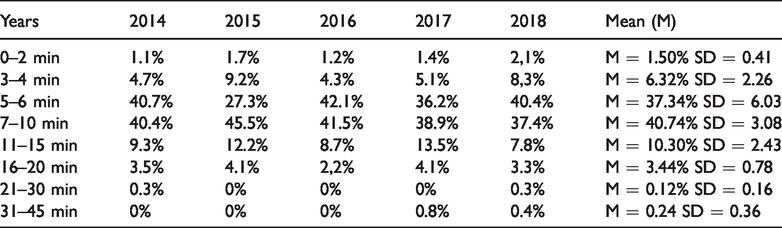
The data demonstrate that the students preferred the videos in the range of 5–6 min (M = 37.34%, SD = 6.03) and the videos in the range of 7–10 min (M = 40.74%, SD = 3.08). These findings indicate the need to examine the patterns of students’ interactions with the videos in the ICTMOOC qualitatively.
Analysis of participants’ interactions with videos in the ICTMOOC
The qualitative thematic analysis (Castleberry and Nolen, 2018; Clarke and Braun, 2014) identified four main themes that reflect the interaction patterns of the participants with the videos and the types of support the videos provided to the learners in the ICTMOOC. These themes are orienting, executive, controlling and other support. Estimated in NVivo 12, the percentage coverage of the types of support the videos in the ICTMOOC provided to the students is as follows: orienting support 18.12%; executive support 52.11%, controlling support 14.76%; and other support 15.01%.
The data highlight the differences in the percentage coverage of the type of support the videos in the ICTMOOC provided to the students: the videos provided more executive support than orienting, controlling or other support. In what follows, we examine the nature of these types of support in detail.
Orienting support
The students reported that they watched the videos before engaging in the assigned task (Figure 2).
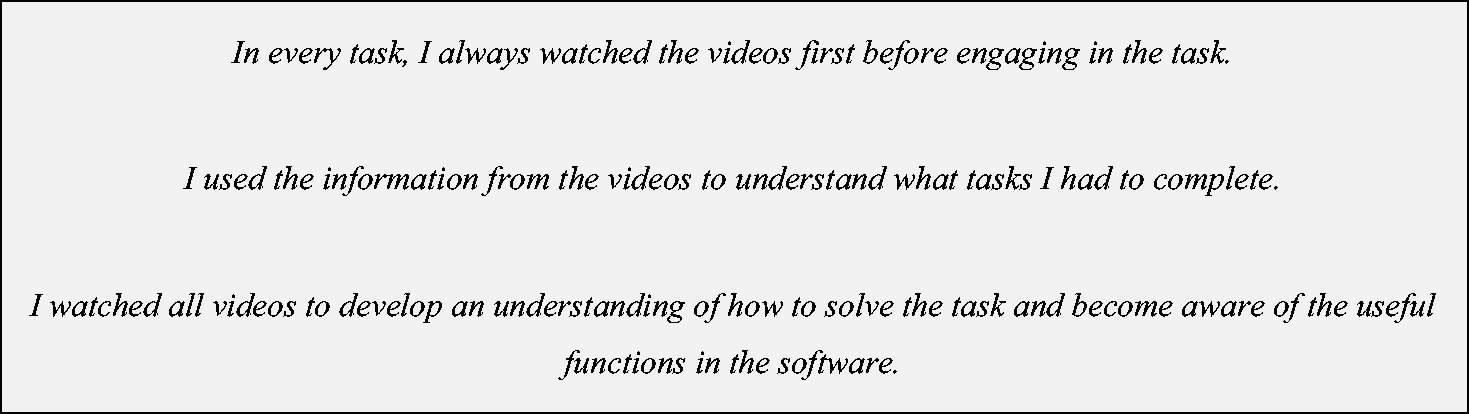
Participants’ responses about the orienting support of the video resources.
The participants indicated that they were seeking orienting support from the videos in the ICTMOOC: they were interested to find out which tasks they were to solve, how to engage in solving the tasks and the potential of the available software they were to use. By providing such support, the videos set up the learning process, introduced the tasks to the learners and revealed the potential of the available software.
Executive support
The students relied on the videos while completing the assigned tasks (Figure 3).
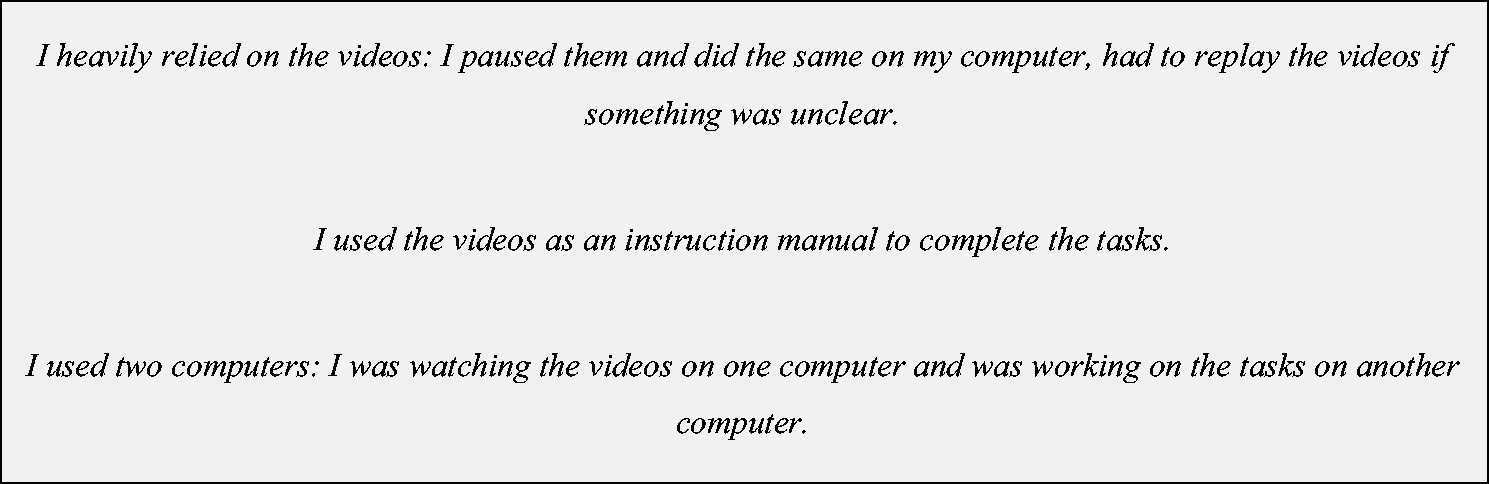
Participants’ responses about the executive support of the video resources.
The participants reported that the videos were used extensively to provide executive support to complete the assigned task: the students watched the videos simultaneously while working on the task by using either two screens/computers or by pausing the videos and replaying parts of the videos while performing similar steps to complete the task. In particular, the students emphasised that they appreciated the individual tempo they could learn at (Figure 4).
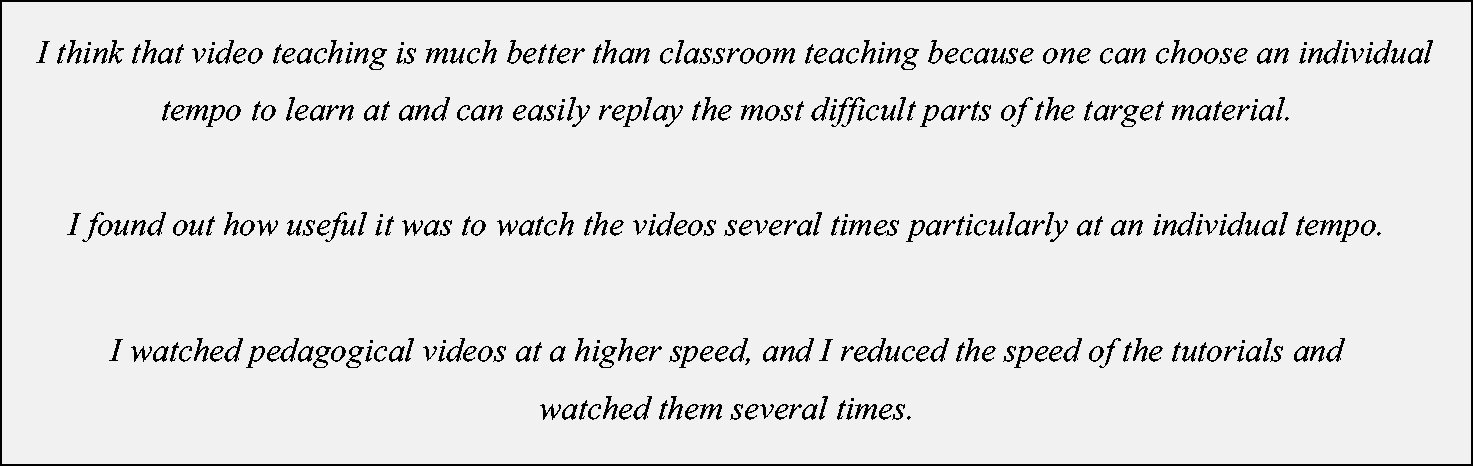
Participants’ responses about watching videos at an individual tempo.
The participants appreciated that their learning tempo could be adjusted to their individual needs: they were able to either increase the speed of the videos, pause the videos or replay the videos several times. In summary, the videos were used by the participants for close executive support to complete the assigned tasks while adjusting to the participants’ individual learning needs.
Controlling support
The participants reported that the videos were also used to compare the learning outcomes of the assigned tasks with the criteria outlined in the videos (Figure 5).
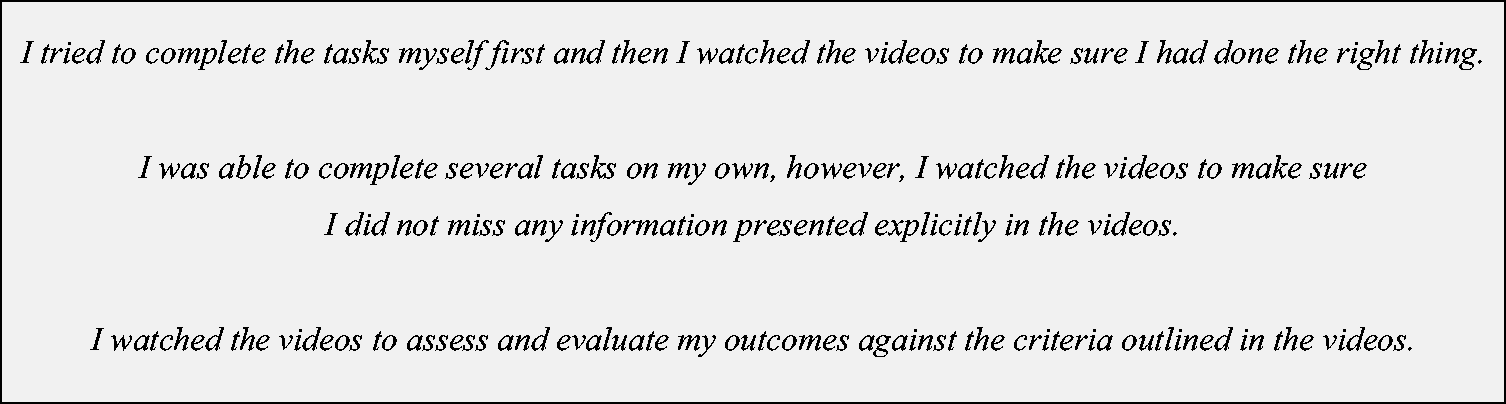
Participants’ responses about the controlling support of the video resources.
Several participants indicated that they watched the videos for revision and reflection purposes (Figure 6).
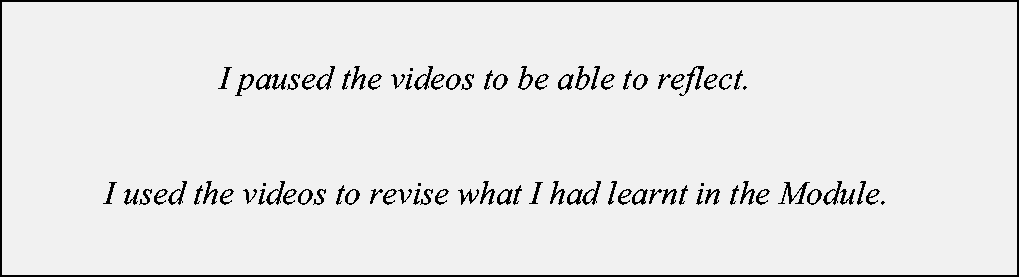
Participants’ responses about the use of videos for revision and reflection.
The videos assisted the learners to compare the criteria of the learning outcomes outlined in the videos with the outcome they achieved. In doing so, the videos helped the learners to clarify the required criteria, validate the outcomes of the completed tasks and structure their knowledge when revising and reflecting on the target material.
Other support
Although some responses of the participants provided valuable information about the use of videos in the ICTMOOC, these responses were given by individual participants and they do not reflect the patterns of responses provided by the students. However, by following a detailed approached to thematic analysis (Philipsen et al., 2019), these responses were also analysed by the research team and grouped under the theme “Other support”. For example, a few participants indicated that the videos in the ICTMOOC were used as a starting point to find other similar video resources available on the Internet (Figure 7).

Participants’ responses about the use of videos to find similar resources on the Internet.
Other participants explicated their positive attitude towards videos as learning resources (Figure 8).

Participants’ responses about their positive attitude to the use of videos in the Information and Communication Technology Massive Open Online Course.
In addition, some participants put in effort to compare the content of the videos with the textual information on the webpages (Figure 9).

Participants’ responses about the use of videos to compare the information on the webpage and the content of the videos.
Other participants indicated the need for updated software (Figure 10).

Participants’ responses about the need for updated software presented in the videos. ICTMOOC: Information and Communication Technology Massive Open Online Course.
To summarise, individual learners used the videos as a starting point to find additional resources available on the Internet and compare the information in the videos with the textual information on the webpages in the course. In addition, the videos may have fostered a positive attitude of the participants to learning in the ICTMOOC.
Discussion
The analyses performed in this study focused on examining the types of support videos provided to the pre- and in-service teachers, the preferred length of videos in the ICTMOOC and the implications of participants’ interactions with video resources for enhancing their agentic capacity to learn and transformative digital agency by addressing the following research questions: What did the pre- and in-service teachers say about the support the video resources in the ICTMOOC provided and what length of videos was preferred by the learners? And what are the implications of the support provided by the videos for enhancing participants’ agentic capacity to learn and transformative digital agency?
The patterns of support the videos provided to the participants are presented in Table 6.
Patterns of video support in the Information and Communication Technology Massive Open Online Course.
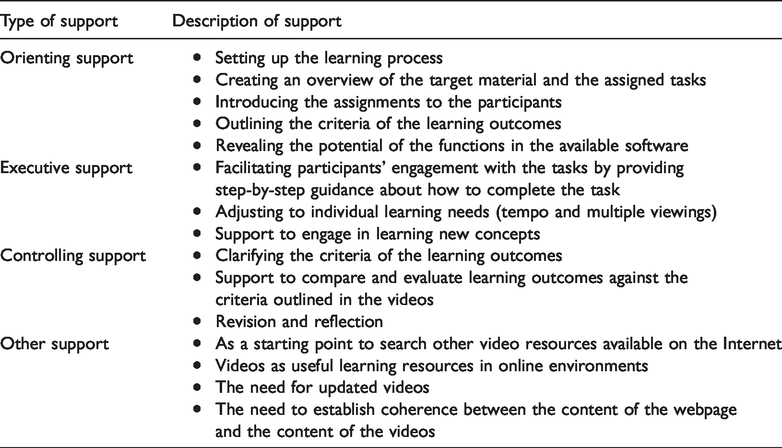
Firstly, the analyses of the types of support the videos provided to the learners revealed that the videos in the ICTMOOC: (a) created an overview of the target material and the assigned tasks, introduced the assignments, outlined the criteria for learning outcomes and revealed the potential of the available software; (b) assisted learners’ engagement with the assigned tasks by providing step-by-step guidance about how to complete the task and adjusted the speed of the learning process to the individual needs of the pre- and in-service teachers; (c) clarified the criteria for learning outcomes and assisted the participants in assessing their outcomes against the criteria presented in the videos. In addition, the videos were used as a starting point to search other resources available on the Internet and may have contributed to enhancing the positive attitude of the pre- and in-service teachers to learning in the ICTMOOC. These findings partly corroborate with the research about the purposes of videos in online courses (Bonafini et al., 2017) and extend them by specifying the types of support the videos in the ICTMOOC provided to the pre- and in-service teachers. The quantitative data showed that the videos provided more executive than any other types of support. This might potentially indicate that pre- and in-service teachers require more assistance and guidance when engaged in the assigned tasks aimed at developing learners’ digital skills.
Secondly, Galperin's types of orientation may serve as a cue to reveal how the support provided by the videos in the ICTMOOC might have contributed to enhancing the participants’ agentic capacity to learn and their transformative digital agency. From the perspective of Galperin’s types of orientation, the learners were engaged in the learning process with the third type of orientation: complete and constructed by learners following an offered approach. By providing orienting, executive and controlling support, the videos offered an approach showing how to engage in the learning process, complete the assigned tasks and validate the achieved learning outcomes against the criteria outlined in the videos. In doing so, the videos structured the learning process and might have enhanced the participants’ understanding about how to go about learning in the ICTMOOC, propel themselves forward as learners and enhance their agentic capacity to learn (Edwards, 2015; Mäkitalo, 2016; Pintrich, 2002; Pintrich and Zusho, 2002; Zimmerman, 2002, 2008). However, by interacting closely with the video resources, the learners might have demonstrated their dependency on the videos and the support the videos provided.
Thirdly, by providing orienting, executive and controlling support, the videos might have contributed to enhancing transformative digital agency with the pre- and in-service teachers (Brevik et al., 2019). Learning in the ICTMOOC and the need to solve the assigned tasks involved challenges to master new software or digital tools. In such a situation, the videos were utilised by the participants as mediating objects that helped the learners to engage with the target software and complete the assigned task. In doing so, the videos in the ICTMOOC might have contributed to transforming the learning and teaching practices of the participants and might have enhanced the development of transformative digital agency with the pre- and in-service teachers. The learners expressed their satisfaction with the videos: the majority of participants were very strongly satisfied with the videos and over 80% of enrolled participants completed the ICTMOOC in 2014–2018.
Finally, while the participants were very strongly satisfied with the use of videos, the majority of learners considered the length of videos in the ICTMOOC as appropriate (the average length of videos is 06 min 03s). Specifically, the participants preferred videos in the range of 5–6 min and videos in the range of 7–10 min.
To summarise, by providing orienting, executive and controlling support, the videos closely assisted the pre- and in-service teachers in their learning in the ICTMOOC and might have contributed to enhancing the pre- and in-service teachers’ agentic capacity to learn and their transformative digital agency. In addition, in the ICTMOOC the learners preferred videos in the range of 5–10 min.
Implications for the design of videos in online courses and directions for further research
There are several pedagogical implications for the design of videos to assist learning in online courses.
Firstly, the participants’ interactions with the videos in the ICTMOOC revealed the types of support the videos provided to the pre- and in-service teachers: orienting, executive, controlling and other types of support.
The second and perhaps more profound implication is that videos may affect participants’ learning in online courses. Students’ close interaction with the videos in the ICTMOOC and the specific need for orienting, executive and controlling support may have implications for the design of videos in online courses. This study, therefore, raises questions about the need for the course developers’ awareness of the types of support videos provide to facilitate students’ learning and their development as learners. The orienting, executive and controlling support provided by the videos in the ICTMOOC may reveal an approach as to how to engage and move forward in learning in online courses and, in doing so, may contribute to enhancing learners’ agentic capacity to learn. By utilising the orienting, executive and controlling support provided by the videos, learners master the essence of learning in online environments and a learning activity carries a new function: not as a studied object, but as a tool for studying the essence of the learning. By interacting with videos, participants develop their understanding of the nature of learning in digital environments, and their agency as learners might be enhanced. The fact that the videos in the ICTMOOC were mainly used for executive support to complete the assigned tasks indicates the usefulness of tutorials and pedagogic videos to enhance teachers’ transformative digital agency, which is needed in 21st-century classrooms within which digital technology is a reality. Also, the preferred length of videos in the range of 5–10 min might have implications for the design of videos in online courses.
The third implication is that Galperin’s pedagogical theory appeared to be useful as a lens to analyse the types of support the videos provided and reflect on the significance of this support for learning and the development of students as learners. We suggest that this approach may offer new pathways to the use of Galperin’s conceptual contribution in further research to examine educational practices in online environments. Further research will, therefore, benefit from a longitudinal study examining students’ learning with the third type of orientation to get an insight into the development of students' understanding of the nature of learning in digital environments and their capacity to be in control of their learning. The limitation of this study is that the analyses are based on the pre- and in-service teachers’ reflections about the support the videos provided in the learning process. Further research is therefore needed to examine the actual learning process of the participants in online environments.
These findings, therefore, inform practitioners, MOOCs, online course developers and educational video producers about the types of support videos may provide to learners in MOOCs and online environments. They also emphasise the crucial importance of practitioners’ awareness about the types of support videos provide to enhance pedagogy, students' learning and the development of students as learners.
Footnotes
Declaration of conflicting interests
The author(s) declared no potential conflicts of interest with respect to the research, authorship and/or publication of this article.
Funding
The author(s) received no financial support for the research, authorship and/or publication of this article.
