




Abstract
This is an article about abstraction, generalization, and the beauty of mathematics. We claim that abstraction and generalization in of itself may very well be a beauty of the human mind. The fact that we humans continue to explore and expand mathematics is truly beautiful and remarkable. Many years ago, our ancestors understood that seven stones, seven fish, and seven trees represent in some sense one entity, in this case all united by the number seven. That in itself is an abstraction. We will discuss abstraction and the different beautiful properties of mathematics in relation to some examples, where we describe the connection between algebra and geometry. Modern technological tools enable and encourage us to perform mathematical investigations of a kind that was once considered difficult.
Introduction
In many countries and in many publications about the teaching of mathematics, there is often emphasis on the realistic or concrete side of mathematics. There is a general claim that students should see the real-life usefulness of the mathematics they are learning. Abstract or pure mathematics is often considered to be far too complicated. It is an issue not only for students in upper secondary school or university while grappling with a particularly complex calculus problem it is a well-known fact that also teachers in compulsory school are dwelling on the shortcomings of many students when encountering abstract mathematics.
It is fascinating that many fields of mathematics emerged from the study of real-world problems long before their underlying rules and concepts were identified. The rules and concepts were then defined as abstract structures. Algebra, where letters and symbols are used to represent numbers and quantities in formulas and equations, was born from solving problems in arithmetic. Geometry emerged as people worked to solve problems dealing with distances and areas in the real world.
Think of the young child who says to their mother “Look mommy, I see a large triangle up there” while pointing to the roof of a house, using their index finger to draw a triangle in the air. The child has then, in our view, shown both abstraction and generalization.
The very process where we move from the concrete situation to the abstract scenario is known as abstraction and generalization. Via the process of abstraction, the underlying essence of a mathematical concept can be extracted. Via generalization we can use the concept and procedures from a specific example in other situations. Think of adding integers, fractions, complex numbers, vectors, and matrices. In different situations, the concept is the same but the applications are different.
We consider it essential for mathematics that we can lift ourselves from the special case and to realize that some mathematical relation is valid only for fish, for stones, or for people. The theorem of Pythagoras is probably valid also when humans have disappeared. We furthermore claim that when we are doing mathematics, we are in the area of absolute abstraction. If some abstract conditions are satisfied, then some other abstract conditions are also satisfied. We could view the process of generalization as the greatest of all gifts. To be able to see particular and seemingly disparate phenomena as a consequence of unifying and clear facts is something that is ultimately important and is sometimes not validated enough. There is a tendency sometimes to explore very particular notions, but only the unification of those notions shines a new light on the subject at hand and opens significantly new horizons. The foundation of the Pythagorean brotherhood and the mystical rumors about their rituals and influence offer some evidence that Pythagoras had sensed the possible importance of mathematics in the formation of science.
The growth of abstraction in mathematics provided disciplines like chemistry, physics, astronomy, geology, and meteorology with the ability to explain a wide variety of complex physical phenomena that occur in nature. Anyone who comprehends the process of abstraction in mathematics will be prepared to understand abstraction occurring in other subjects such as chemistry or physics.
When it comes to the beauty of mathematics, it seems that it is more related to the abstract part of mathematics. In our first example, we will explore connections between specific numbers and geometry, revealing new connections that possibly you, dear reader, might have overlooked or have not even seen before. We will use modern technology, for example GeoGebra, to help us do these explorations and thereby illuminate the strength of technology when working with abstract mathematical investigations—see Lingefjärd (2013).
Dynamic geometry
Dynamic Geometry Environments (DGE), such as GeoGebra (Hohenwarter, 2001), CabriTM (Laborde and Bellemain, 1993), or The Geometer’s SketchpadTM (Jackiw, 1991), include features that enable and constrain conceptions of mathematical ideas; our article investigates the possibility of linking geometry to algebra through a process involving DGE technology. While these DGE tools are increasingly complex, they nevertheless enable geometrical actions and therefore unwrap questions that one might not have asked without the availability of the DGE.
A DGE affords the user with the ability to drag parts of a geometrical object and, in the process, observe properties about the object that remain invariant and those that do not. In a DGE, the underlying principle is “to provide diagrams representing a set of geometrical objects and dynamical relations instead of a single static diagram.” The DGE itself therefore allows the user to perform investigations and to work with inquiry-based learning activities. The mathematics education community has strongly emphasized the importance of inquiry-based learning activities for promoting active learning on the part of students (Brown and Walter, 2005; Da Ponte, 2007; Jones and Shaw, 1988; Leikin, 2004; Silver, 1994; Wells, 1999).
GeoGebra is a free program and, at the time of writing, there are GeoGebra applets available for smartphones, iPads, and Internet connected computers. There are more than one million applets uploaded to the GeoGebra resources web site. The fact that GeoGebra has been translated into over 70 different languages and that users can decide what language to use is an important feature. In several senses, GeoGebra is a democratizing force within mathematics.
Some oddities of the number 7
It is a well-known fact that a week consists of seven days. “In six days God made the heaven and the earth, the sea, and all that is in them, but He rested the seventh-day. Therefore the Lord blessed the Sabbath day and made it holy.” Therefore, the creation story points out seven as a special number.
The Egyptians had seven original and higher gods; the Phoenicians had seven kabiris; the Persians had seven sacred horses of Mithra; the Parsees had seven angels opposed by seven demons, and seven celestial abodes paralleled by seven lower regions. The seven gods were often represented as one seven-headed deity.
The heaven was subjected to the seven known planets of our solar system; hence, in nearly all religious systems we will find seven heavens. An important cognitive ability within humans is memory span. Memory span often refers to the longest possible list of items (e.g., colors, digits, letters, and words) that a person can repeat immediately after a presentation in the correct order. Miller (1956) has shown that the memory span of humans often is approximately 7 ± 2 items.
According to the theory of biorhythms, a person's life is affected by rhythmic biological cycles which affect one's ability in various domains, such as mental, physical, and emotional activity. These cycles begin at birth and oscillate in a steady sine wave fashion throughout life. By modelling them mathematically, a person's level of ability in each of these domains can be predicted approximately from day to day. The emotional biorhythm model is a 28-day cycle. Here, too, the number seven plays a role.
Mathematically interesting connections
Obviously, the number seven plays a role in many different areas of human life. Within natural numbers we have the somewhat abstract division of composite or prime numbers. The number seven is a prime number, and Archimedes discovered its approximate kinship to the circle. He realized that a circle’s circumference can be bounded from below and from above by inscribing and circumscribing regular polygons and computing the perimeters of the inner and outer polygons. By so doing, he proved that
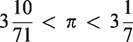
The first prime number that is not one more than a power of two is seven: thus, 2 = 2° + 1, 3 = 21 + 1, 5 = 22 + 1, and 7 = 23 – 1. A regular polygon with seven sides is the first regular polygon that cannot be constructed by traditional Euclidean methods using a straightedge and compass alone.
The repeating portion of the decimal fraction corresponding to 1/7 is 0.142857142,857 … Furthermore, we know that:
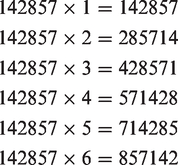
The same figures come back in different orders. We can also express 1/7 as a geometrical series defined as

Remember the ancient Egyptian and Archimedes approximation for π through 22/7 = 21/7 + 1/7 = 3.142857142857…
Given an integer k, a positive integer x is said to be k – transportable if, when its left most digit is moved to the unit’s place (i.e., ‘left to right’), the resulting integer is kx.
The integer 142,857 is 3-transportable since
Kahan (1976) proved that for k > 1 there are no such integers unless k = 3, and the 3-transportable integers all belong to one of the following two sequences:

Example 1
The following connection between algebra, geometry, and the fraction 1/7 was shown to one of us authors by the Swedish mathematician Andrejs Dunkels in a conference meeting in 1988. Dunkels challenged us to show that if we combine six overlapping pairs of digits in 142,857, and thereby get the following Cartesian points in the plane (1, 4), (4, 2), (2, 8), (8, 5), (5, 7), and (7, 1), these six points lie on an ellipse.
This fact was first pointed out in 1986 by Edward Kitchen, who encouraged readers of Mathematics Magazine (problem section) to prove the fact noted above. See Figure 1, which was constructed with GeoGebra. The problem is easily solved by Dynamical Geometry program (e.g., GeoGebra or Geometer’s Sketchpad), but in the October 1987 issue of the magazine, the problem was solved by hand by John C. Nichols, Thiel College, Pennsylvania.
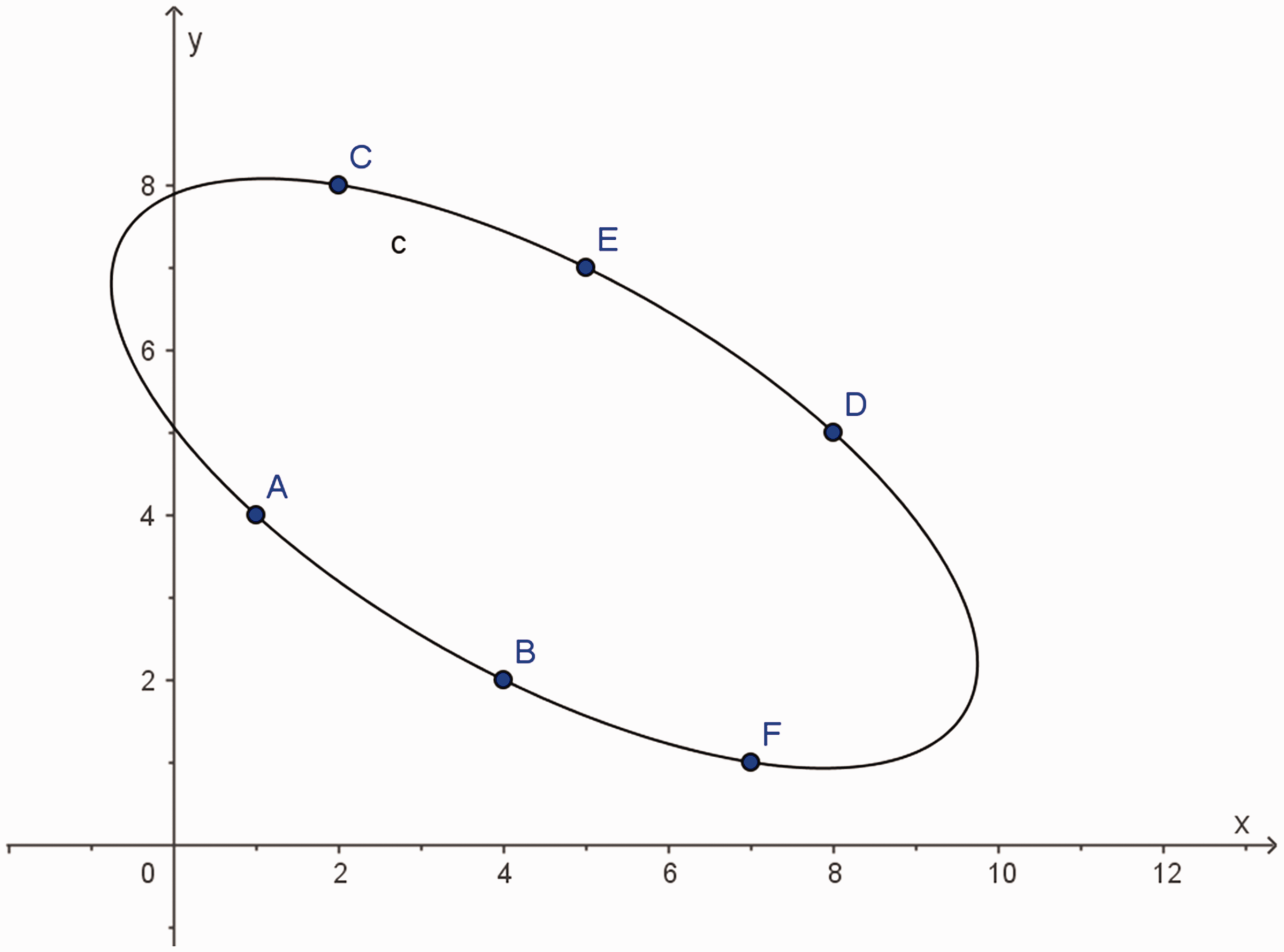
A 1/7 ellipse, where A = (1, 4), B= (4, 2), C = (2, 8), D = (8, 5), E = (5, 7), F = (7, 1).
It is a well-known fact that five arbitrary points satisfy a conic equation given by:

We have six coefficients to determine, but they are determined up to multiplication by a non-zero constant (that is, if the six numbers are scaled up by a common constant, we get the same conic), which means that five points determine the conic (provided that four of them do not lie on a line; if three of the points lie on a line, the conic is a union of two lines).
Its equation is:
The fact is, is that in the 1/7 ellipse, the sixth point, too, lies on the conic rests in a symmetric relation that holds between the six points; specifically, on the fact that 142 + 857 = 999, which yields the following relation: [1, 4] + [8, 5] = [4, 2] + [5, 7] = [2, 8] + [7, 1] = [9, 9].
What other reciprocals have the same qualities? What will happen, for instance, if we combine the points (14, 28), (28, 57), (57, 14) with the points (42, 85), (85, 71), (71, 42)? (These are obtained by taking 2-digit combinations from the decimal expansion of 1/7.) Likewise, it happens that these six points also lie on an ellipse—see Figure 2.
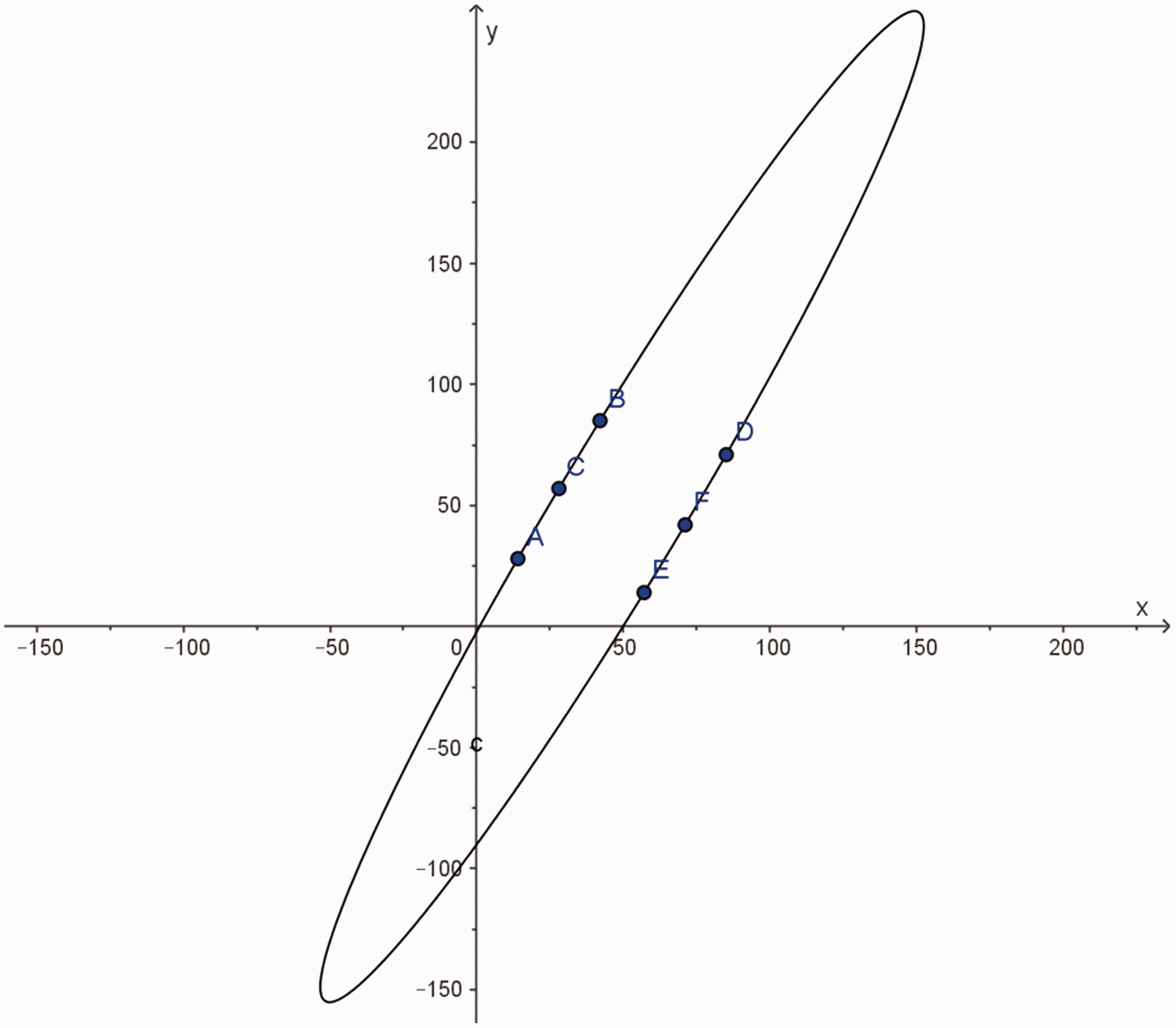
A variant of the 1/7 ellipse, with A = (14, 28), B= (28, 57), C = (57, 14), etc.
Its equation is:
Generalizing the question
The Shippensburg University problem solving group (1987) investigated all ‘period six reciprocals’ (i.e., those whose digital forms have a six-digit repetend, like 1/7) and found that reciprocals of 13 and 77 yield hyperbolas, the reciprocals of 39, 63, 91, 143, 273, 429, 693, and 819 yield ellipses, while the reciprocals of 21, 117, 189, 231, 259, 297, 351, 407, 481, and 777 do not yield a conic at all.
Mathpuzzle (December 2006) cited Chris Lomont: Out of curiosity, I found a lot more of these ellipses. One with more points is the 1/7373 ellipse, 1/7373 = 0.00013653… which gives seven points (0, 0), (0, 1), (1,3), (3,0), (3,5), (5,6), (6, 3) on an ellipse. To get 8 points on a single ellipse I found that the fraction 4111/3030303 works. I’ve yet to find more on a single ellipse. I’m unaware of any proof that can be done, although integer points on curves are much studied (http://www.mathpuzzle.com/25Dec2006.html).
Further, one might investigate the effect of considering not just single digits, but blocks of digits of various lengths (2, 3, …) for the coordinates. We found that the blocks of length 2 of several reciprocals, including 1/7, 1/13, 1/77, 1/91, and 1/819, yield conics but the blocks of length 2 of 1/7373 (period 8 reciprocal with seven points on a conic) do not yield a conic. Moreover, blocks of length 3 of the reciprocals 1/7, 1/13, 1/77, 1/91 yield the straight line y = −x + 999, whereas blocks of length 3 of 1/819 yield the straight line y = −x + 222.
For example, blocks of length 2 of 1/13 yield a hyperbola with the equation (see Figure 3; the caption shows how the coordinates of the points are computed):

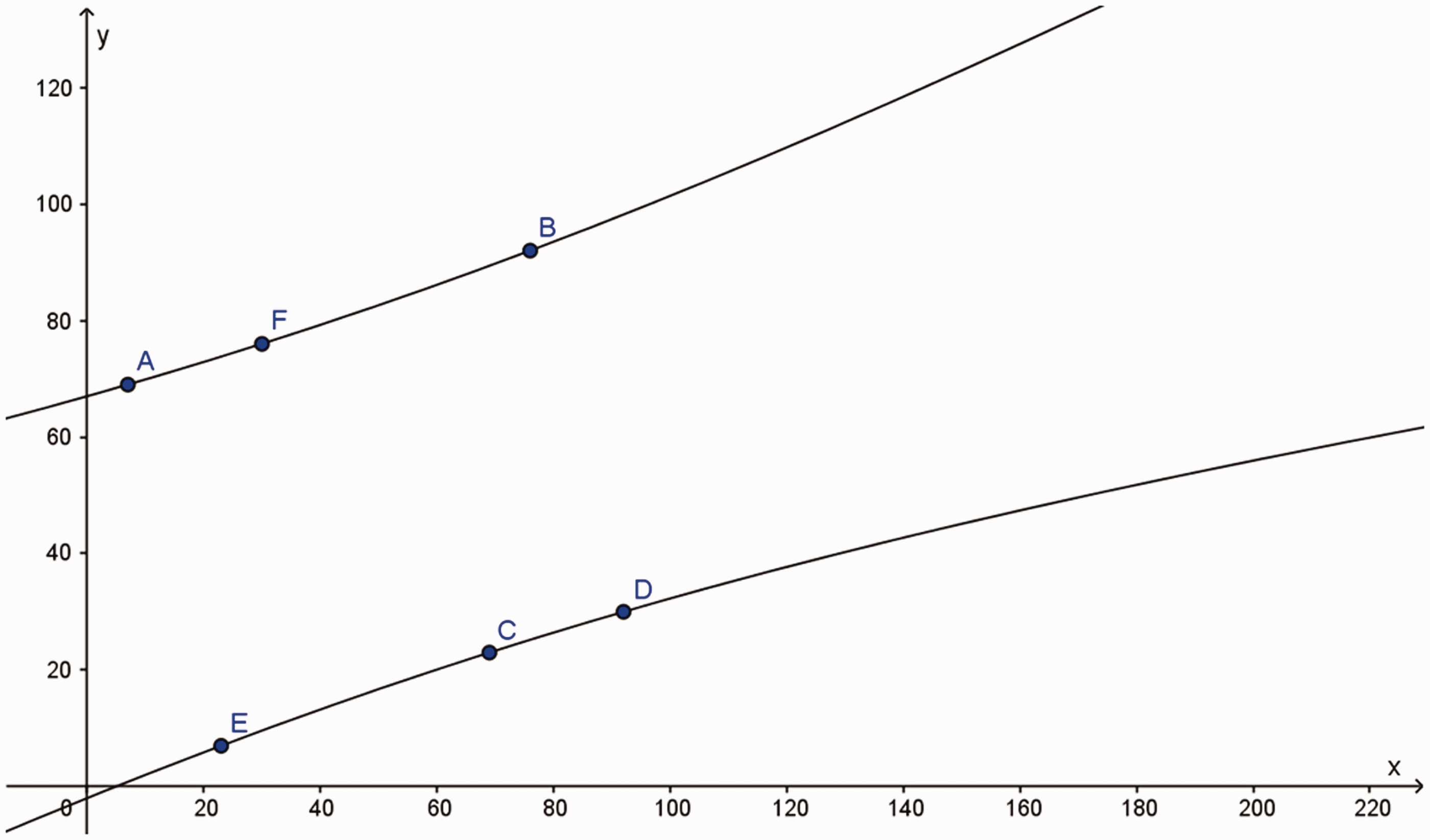
Points produced from blocks of length 2 from 1/13 = 0.076923…, yielding a hyperbola.
The centers of the conics of 1/7 and 1/13 are all located at (9/2, 9/2), whereas the centers of the conics connected with blocks of length 2 are located at (99/2, 99/2).
Analysis
One way to look at digital-conics is that if you have four numbers called a, b, c, d, then the six points are given by:

These numbers a, b, c, d will be on a conic with center in (d/2, d/2). The case of parabola, hyperbola, or ellipse depends on the values of a, b, c, d.
In the case of 1/7, we have that a = 1, b = 4, c = 2, d = 9, which is connected to the fact that 142 + 857 = 999 and, in a similar way, we have that:

This can be seen as:

If we go back to the example of the 1/7 ellipse, we see that the ellipse can be described as:

Also, other 6-tuples of numbers can be used—they do not need to be different. In addition, 112,332 with (a = b = 1, c = 2, d = 4) gives 6 points that are on the ellipse
If the pairs of triplets of a period six reciprocal lie on the same line, the slope must be s = -1. This follows from the fact that the first and fourth points have the same coordinates in reversed order: x1 = y4 and x4 = y1, which gives the slope
What happens if we multiply seven with 13 = 91? We have that 1/91 is 0.0109890109… which yields the points (0, 1), (1, 0), (0, 9), (9,8), (8, 9), and (9, 0)—see figure 4.
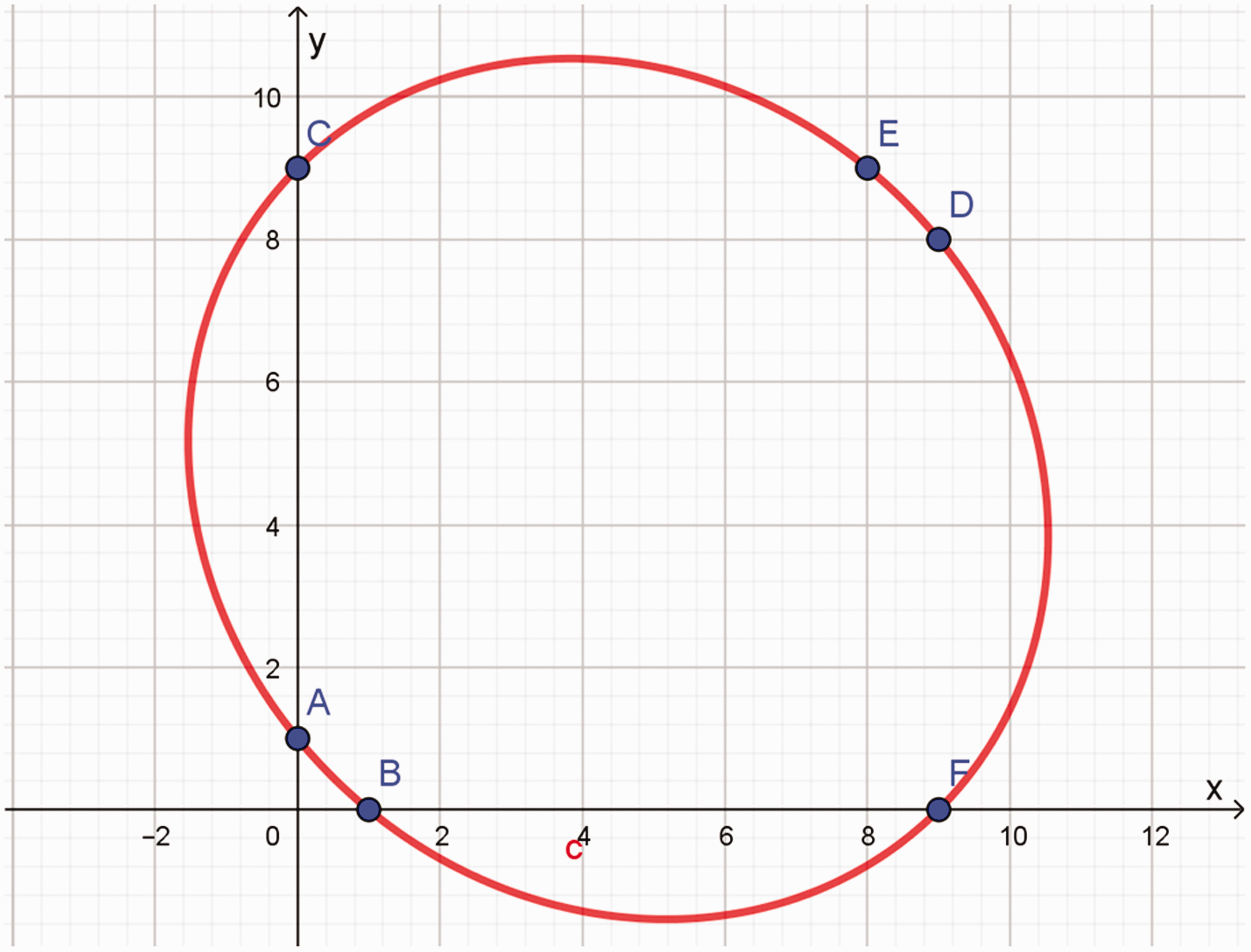
The ellipse built on the fraction 1/91, visualized by GeoGebra.
So far, we have worked mainly on numbers generating fractions. What if we ask the question from the other way around? For instance, is there a fraction 1/x with a cycle of length eight that will fit to an ellipse? It is possible to find that 1/73 = 0.01369863013 gives eight points (0, 1), (1, 3), (3, 6), (6, 9), (9, 8), (8, 6), (6, 3), (3, 0)? See figure 5.
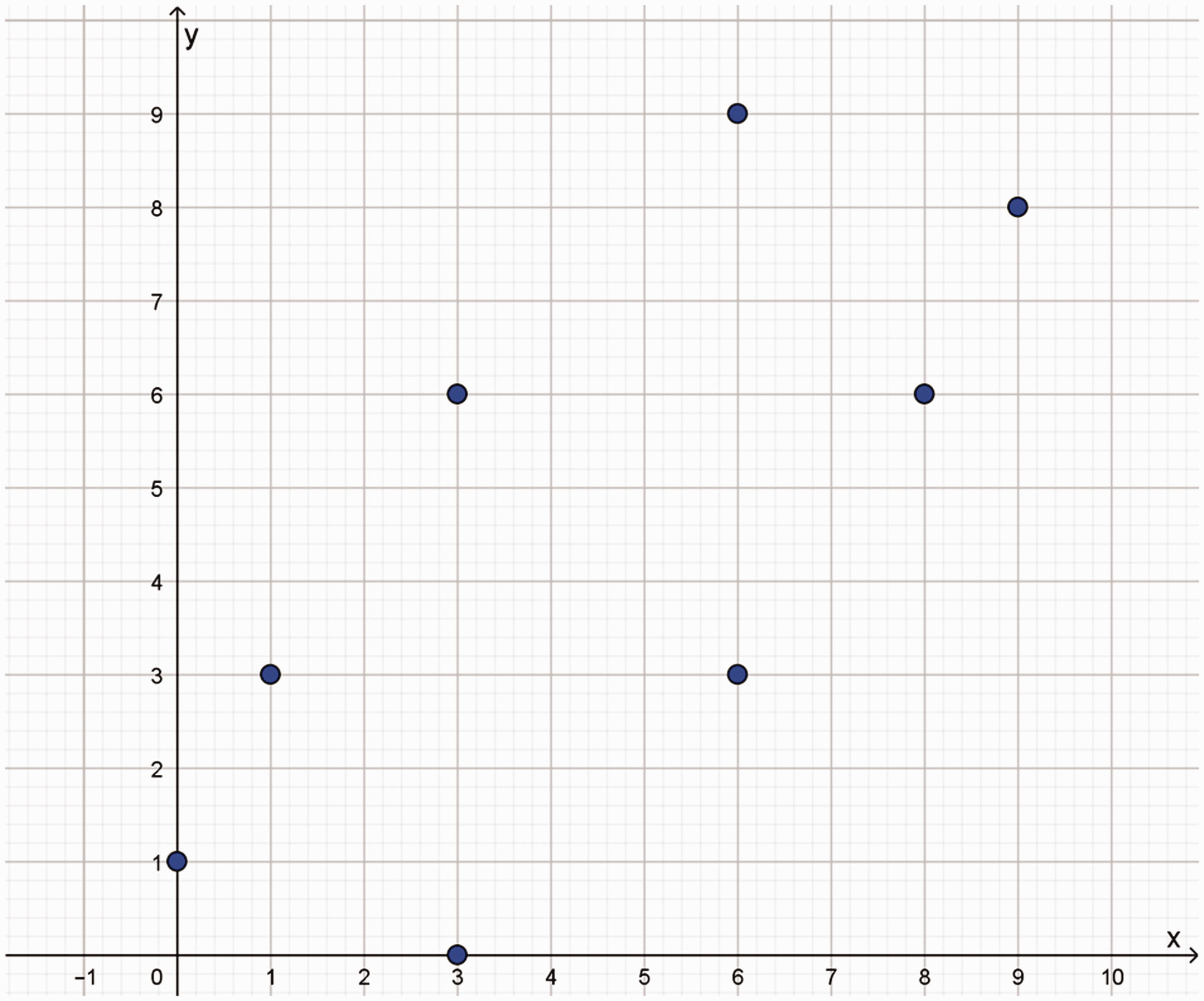
Points derived from the fraction 1/73, visualized by GeoGebra.
Once the points are visualized, we can actually see that they seem to be in an oval structure with the center in (9/2, 9/2). However, they are not all in an ellipse, which we find if we ask GeoGebra to fit a conic to the points. Here comes a difficulty: by omitting the points one by one, we finally see that if we omit the points (9, 8) and (0, 1) we get an ellipse that not only goes through the six remaining points, but also through additional integer points (0, 0), (1, -1), (8, 10), and (9, 9). This was found by carrying out systematic investigations. We call this a ten-point ellipse. The equation is:

The midpoint is at (9/2, 9/2)—see figure 6.
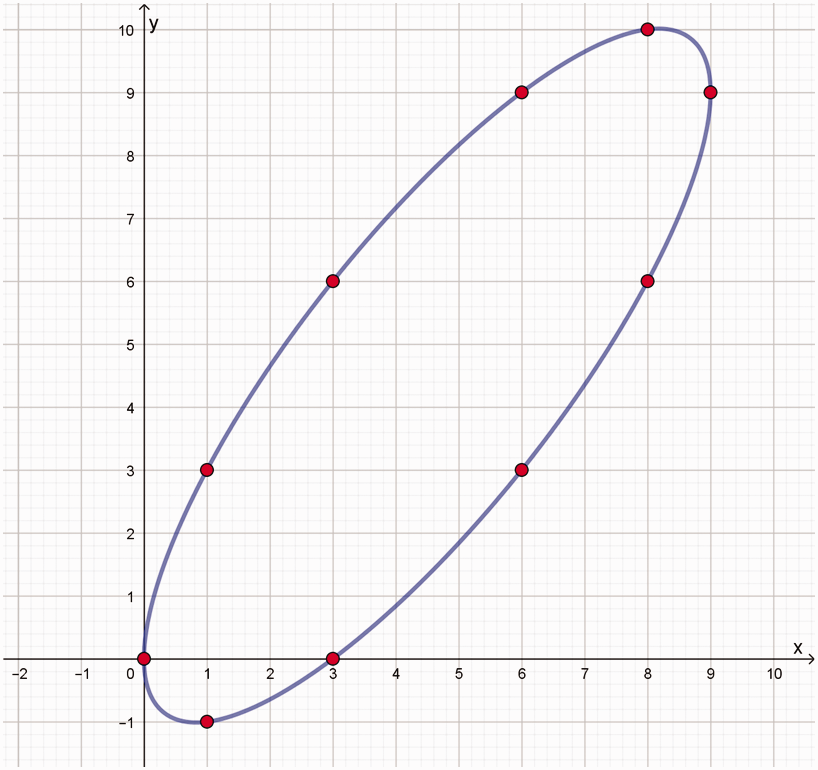
An ellipse partly derived from the fraction 1/73, visualized by GeoGebra.
One final ellipse before we leave you to your own investigations. In figure 7, you find an ellipse with 18 outspread integer points on the surface. Isn’t that and abstract mathematics beautiful?
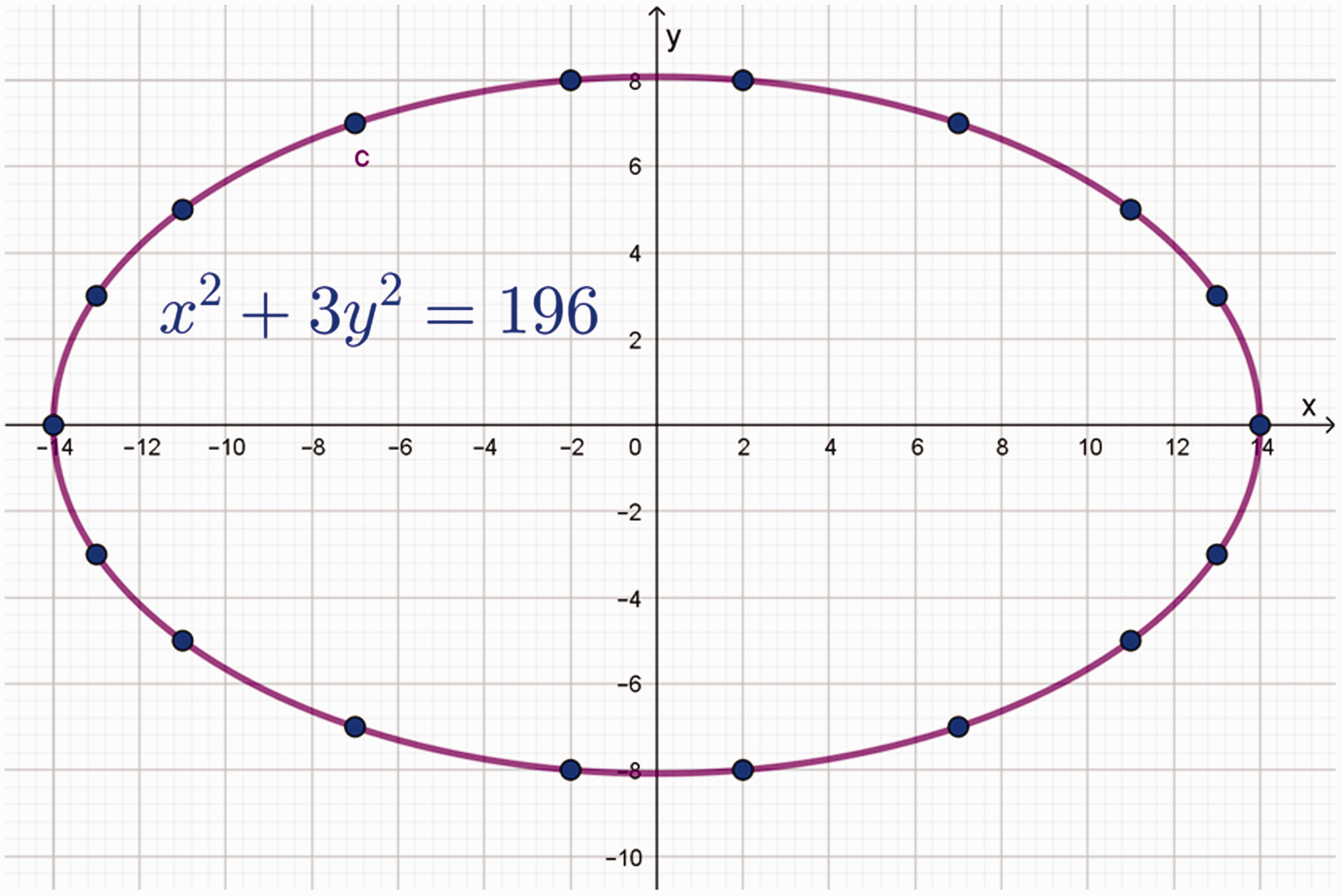
An ellipse with 18 integer points, visualized by GeoGebra.
Obviously, we can go in many different directions when we can investigate and visualize with technology. We leave further investigations within this realm to the reader.
Example 2
In our next example, we will go from geometry to algebra and mathematical modelling. Let us have a look at the following geometrical situation.
The history behind the following exploration is unfortunately not available to the authors at this time. You see two equilateral triangles in Figure 8. The side of the larger triangle has been divided into three equal parts in order to construct the inner, smaller triangle in a specific way. When measured, one finds that the ratio between the outer and the inner triangles’ area is exactly seven.
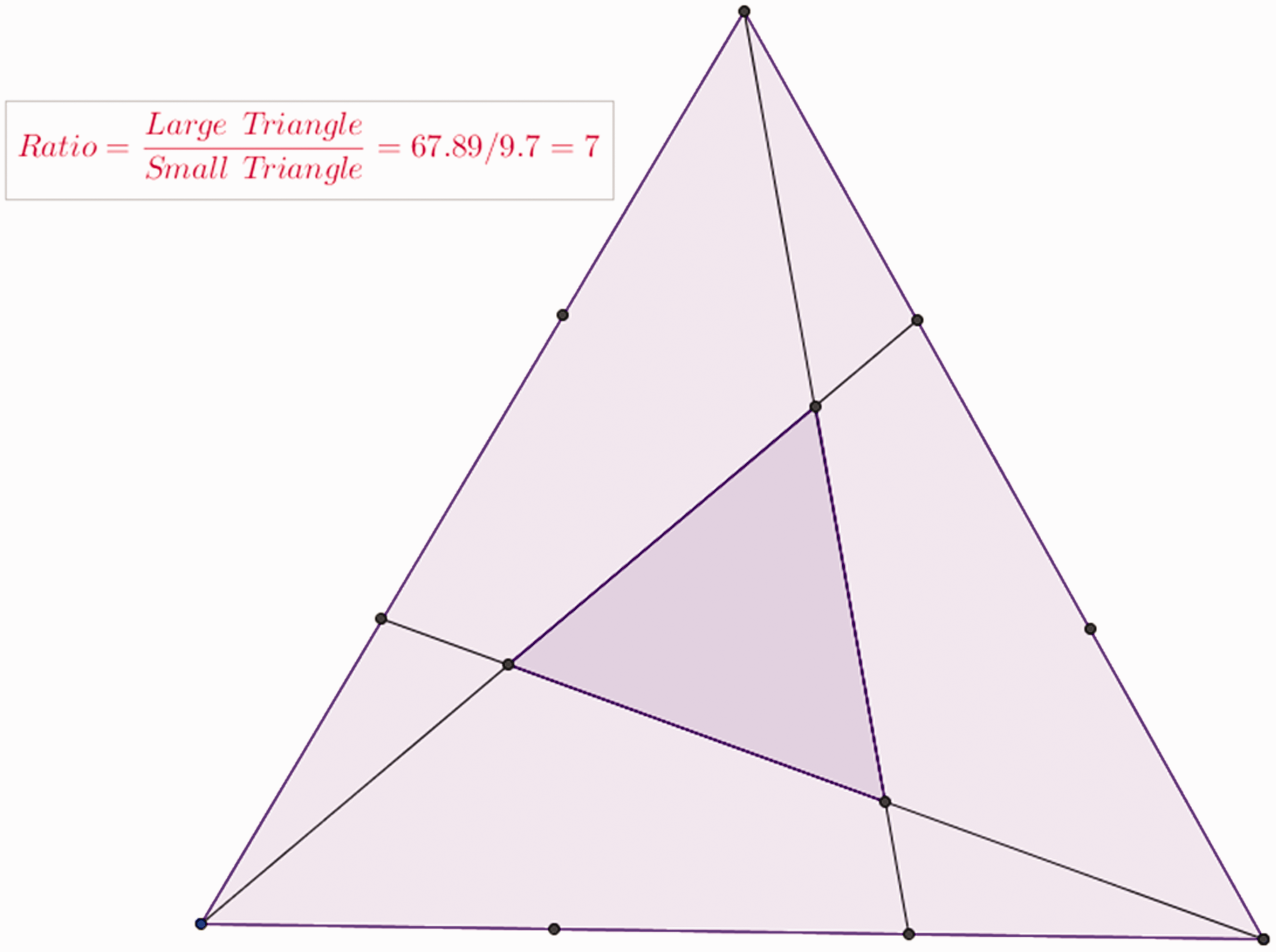
Investigation of the ratio of the areas.
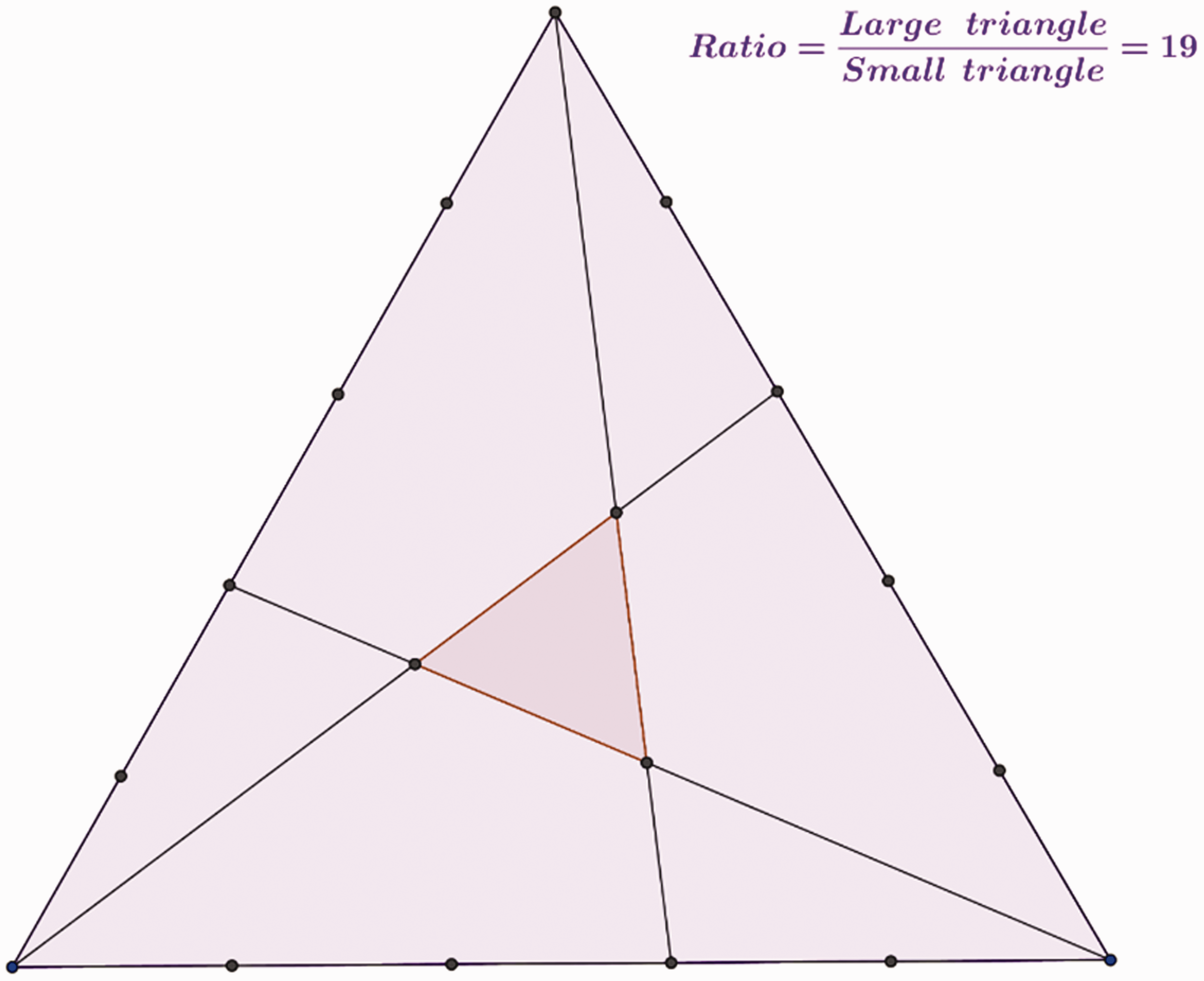
Further investigations of the ratio of the areas.
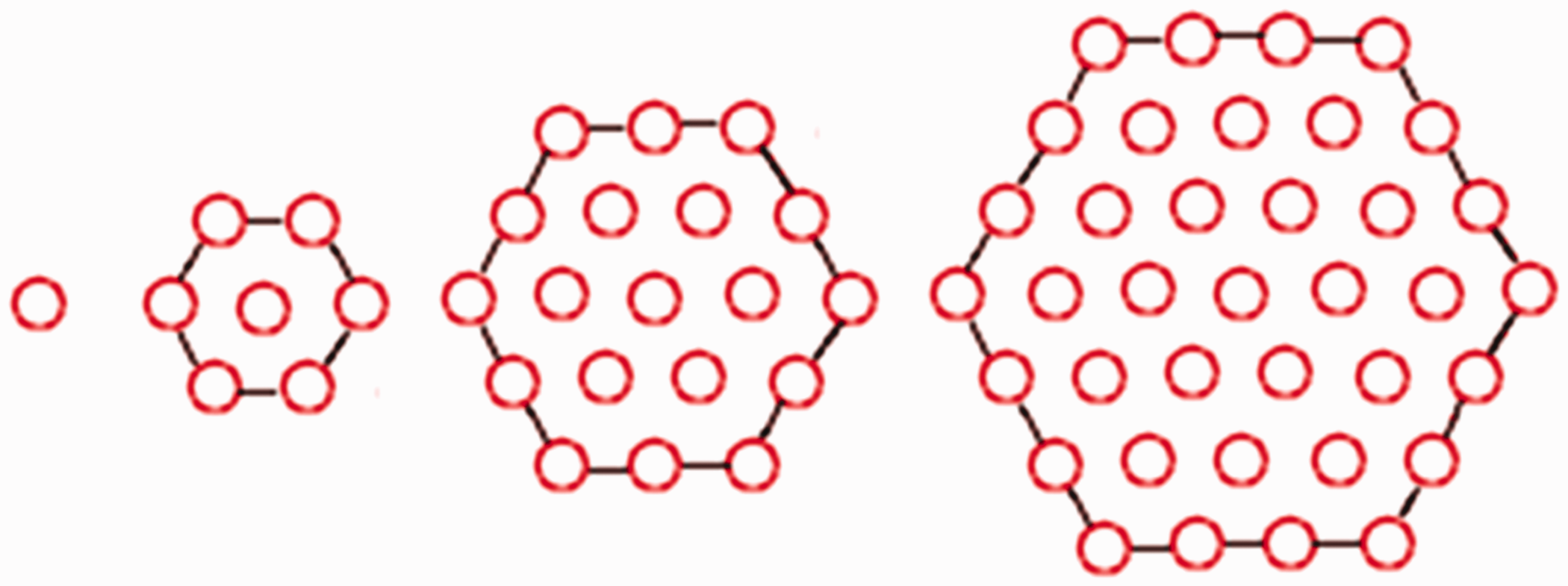
Hexagonal centered numbers from http://www.drking.org.uk/hexagons/misc/numbers.html.
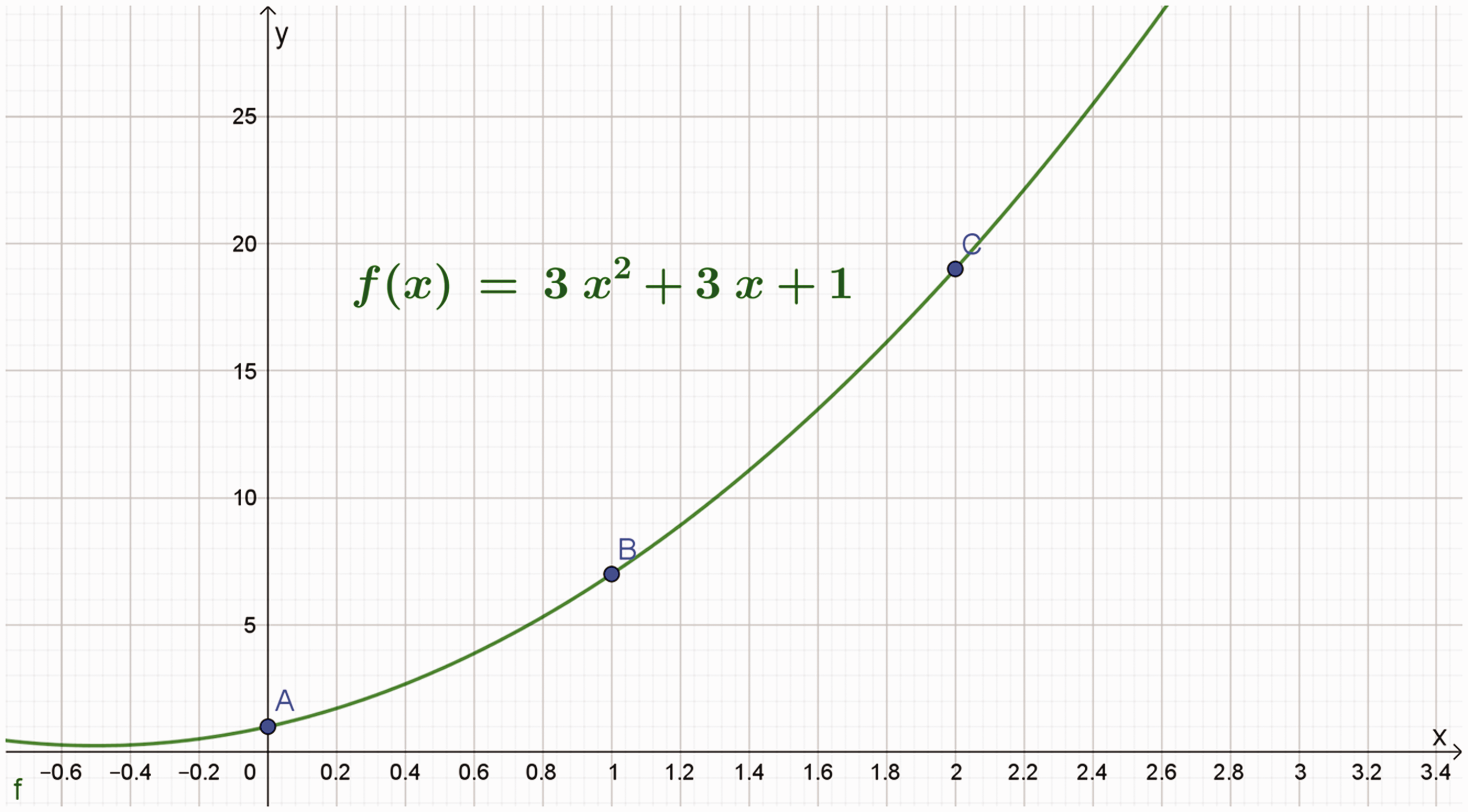
Modeling tools within GeoGebra.
The next step is to divide the outer equilateral triangles’ side into five equal sections and construct the smallest possible equilateral triangles inside. What will the ratio be now?
You see two equilateral triangles in Figure 8. See also Figure 9, Figure 10, and Figure 11. If we repeat the measuring and the procedure for seven equal sections, for 11 equal sections, or for 13 equal sections, what will we find? The activity is easy enough to start with, yet it appears to be both complex and rich and it is difficult to immediately see a clear relation or to find a final answer. One probably needs to get involved in the activity in order to find a structure to follow. The activity will promote many different types of responses.
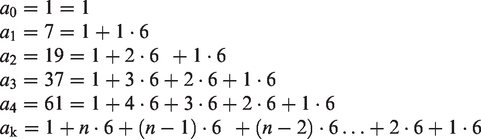
An equilateral triangle is divided according to 3,5,7,…, n parts where n is an odd number. Therefore n = 2k + 1 and k = 1, 2, 3…We start clockwise and take the shortest path with the first point, second point, and so forth. We measure the ratios which always seem to be a whole number, including 7, 19, and 37. Is there a pattern? When investigating the ratios 7, 19, and 37, it seems that the relations between these numbers have first increased with 12 and then with 18. Is it possible that next increment will be 24 and the ratio thereby 37 + 24 = 61?
If we do not divide any side of the outer triangle, the ratio will be 1. So we investigate 1, 7, 19, 37, 61 … ak, where a is the number and k is the serial number.
Simplifying the equation:

This discussion suggests that the ratio between the equilateral triangles will change according to the formula above, and this can be proved to indeed be the case: we have arrived at an algebra based formula here that we can simplify to 1 + 3·k(k - 1).
When searching the Internet with the numbers 1, 7, 19, 37, 61, 91… it becomes apparent that these numbers are called hexagonal centered numbers and they result from counting the number of spots making up a full hexagon:
We use the notation
The aim is to prove T(k) = H(m) for some k, m.
We thereby get:
We see that
Furthermore:
Finally:
QED
Obviously, there exists a connection between ratios of equilateral triangles areas and number theory. If we create a list of points as (0, 1), (1, 7), (2, 19), and so forth, we could also get a regression derived model in GeoGebra, as in the figure below.
If we, after having found this model, go back to our original first division of the triangles, and if we use congruency and the cosine theorem so that s and x denote the large and the small triangle respectively and that the triangle on which we apply the law of cosine has sides x, kx and (k + 1)x, then we can derive the following:

This can (since area scale is (length scale)2) be simplified to:

Conclusions
New technological artefacts obviously bring about new ways of interacting with geometrical investigations. Seymour Papert (1993: 23), in Mindstorms: Children, Computers, and Powerful Ideas, suggested that we humans should be using computers as an “object-to-think-with.”. He was envisioning new ways of learning mathematics. Papert suggested a change of the educational culture towards a more “personal, less alienating relationship with knowledge” (Papert, 1993: 177) where students and teachers create bonds when learning about learning—see Lingefjärd (2015).
Some mathematics teachers naturally see the potential of using dynamic geometry to explore mathematical terrain and to enhance inquiry-based learning experiences to students. Many teachers also refer to improvements in the classroom atmosphere, students’ increased motivation, and the efficiency of showing many examples at once as some of the reasons for incorporating dynamic geometry into their lessons (Lampert, 1993; Ruthven et al., 2005). The two examples we have shown in this article illustrate how the use of technological artefacts could bring about new conceptions of mathematical ideas in humans’ work. Our learning and understanding of mathematics may be enhanced by the activity of, and by the response from, the DGE.
A further issue when using a DGE is that of the DGE acting as an amplifier or a reorganizer of mental activity (Pea, 1985, 1987). When technology is used as an amplifier, it performs more efficiently tedious processes (that might be done by hand), such as computations or the generation of standard mathematical representations such as graphs. In this use of technology, what students do or think about are not changed but can instead be accomplished with significantly less time and effort and with more accuracy. For example, the use of a scientific calculator for computations while solving problems can make students’ work more efficient and freer from basic arithmetic errors. However, their activity and thinking is generally unchanged by this use of the calculator. On the other hand, when technology is used as a reorganiser, it has the power to shift the focus of students’ mathematical thinking. It supports looking for patterns, identifying invariances, or making and testing conjectures. Students can focus on developing insight rather than on drawing and measuring objects. Hopefully, the trend of digitalizing and programming can encourage students and teachers to do further investigations in different directions.
Footnotes
Authors' note
Thomas Lingefjärd is now affiliated with Gothenburg City Council, Sweden.
Declaration of conflicting interests
The author(s) declared no potential conflicts of interest with respect to the research, authorship, and/or publication of this article.
Funding
The author(s) received no financial support for the research, authorship, and/or publication of this article.
