




Abstract
This article considers the Sámi understanding of time and place in pedagogical settings. The study is based on research material gathered at Sámi schools and from teaching conducted in the Sámi language. These data were combined to develop a theoretical review of teacher education from a metatheoretical perspective. The research challenges schools’ pedagogical arrangements. Local contents of the study are an important part of the school syllabus, and this article suggests that they are closely tied to school educational arrangements. This study also suggests that, in Northern schools, the Sámi worldview and traditional knowledge should be closely connected to school practices. This means that the Sámi understanding of time and place should receive sufficient emphasis in school curricula. Schools could benefit from the open learning concept, such as modern curricula grounded in teaching that is phenomenon based. This could increase pupils’ motivation and sense of connection to the local area. With mediating structures – connected to multicultural educational contexts – such educational systems could be developed.
Introduction
This article addresses socialisation in the school setting within an indigenous context. School organisation is relevant to this topic as children socialise into and through the practices of a school’s organisation. It seems that schools all around the world are organised in the same ways, and these practices seem to be problematic (Cuban, 1993; Keskitalo, 2010). Specifically, time and place are understood hierarchically as separate entities, divided by hours and defined by pupils sitting alone, quietly, at desks in classrooms. This kind of system can be problematic for pupils with special cultural needs. It is likely that indigenous pupils could benefit from more open learning environments. Therefore, this paper seeks to construct an understanding of time and place according to the organisational logic of schools, those within in the sphere of influence of different local minorities and the indigenous Sámi people. In this region, there is an interesting intersection of national and local interests.
This paper seeks to discover what the Sámi, Arctic, or local Northern understanding of time and place mean in an institutional school setting. Sámi epistemologies, thinking and values should be considered when planning and implementing teaching and learning in a school setting. A pan-indigenous epistemology, or even a homogenous Sámi epistemology is not easily definable as indigenous peoples are heterogeneous in their geographical location, cultures, and epistemologies (Kuokkanen, 2009). Further, this paper attempts to address two research questions: How is Sámi education organised in a school? Further, how could it be changed to be more culturally sensitive? The answers could help promote the development of Sámi education systems, as the impacts of school practices on pupils are significant.
Criticisms of school culture
The first schools were reportedly set up in Athens around 600 BC. Buildings intended for educational use already existed in antiquity, and even these buildings reflect a modern image of classrooms and schools (Grue-Sørensen, 1966). Schools were developed by the Western church and then by national school systems. The concept of school is ideologically based on the needs of Western society; it has a long history that has been shaped by culture, and that is hard to change (Reeves, 2006).
According to a longitudinal study by Larry Cuban (1993), classroom stability develops from four teaching method reasons. Teaching methods go in and out of fashion based on educational trends. Schools represent a method of social control and reflect society’s socio-economic system. Today, societies are in constant change, and therefore school ought to transform its pedagogical practices, and methods. For example, in Finland the new national core curriculum for basic education that was introduced in autumn 2016 has emphasis on phenomenon-based learning taking place in various learning environments, such as from an in-school context into out-of-school settings and from divided and separate subject-based teaching towards learning holistically and actively through themes and projects.
Furthermore, Pigga Keskitalo (2010) explored in her PhD the slow transformation of school culture, for example, from teacher-centred into student-centred. According to Cuban (1993) firstly, teaching practices stress the students’ obedience and efficiency through, for example, examinations, grades, homework and teacher-centredness, preparing students to work effectively in a bureaucratic society (Cuban, 1993).
Secondly, the organisational models of schools and classrooms have encouraged teachers to adopt methods that have changed often just a little bit over time. These methods encourage social control. For example, teaching an entire class together encourages students to pay attention to the teacher and incites them to compete with other students. When teachers ask questions, only students with the correct answers are rewarded (Cuban, 1993). These kinds of activities do not encourage students’ own reflection. The teacher’s desk and the podium in front of students’ desks make all classrooms look the same, strengthening the teacher’s authority and ability to control student behaviour (Harjunen, 2011). Classroom architecture, compulsory education, age-divided classes and the division of the school day into lesson periods are control mechanisms that help teachers police pupils’ learning and behaviour. In the main classroom, pupils are supposed to listen to and follow the instructions of the teacher, who in turn needs to make thousands of decisions every day about the instructional content in order to maintain the students’ interest. The arrangement of desks into rows makes it easier for teachers to monitor the pupils. Teaching an entire class at once is a useful and effective way to present information. Lecturing, teacher questions and desk work are easy ways to encourage pupils to learn and to keep the group under control (Cuban, 1993).
Thirdly, the culture of teaching is rather stable and more or less unwilling to change. Teaching culture has been created by teachers; they created the model in order to survive in their work. New teachers have been influenced by their own teachers for decades before entering the profession. They tend to use the same approaches that they have been taught: classroom discussion, steered learning, homework, desk work and examinations are already familiar from their own memories of school. According to Cuban, it is easier for a teacher to use conservative teaching methods consistently than to make big changes to their own teaching. Such changes could include teaching small groups and planning student activities together with the students. These kinds of changes would redefine teaching methods peculiar to a specific school (Cuban, 1993).
Fourthly, teaching is based on a school’s education task, authority relationships in the classroom, the status of the teaching subject and the teacher’s understanding of childhood development. Teachers’ beliefs shape their behaviours. Thus, whether teachers are committed to informal education methods, student-centred, progressive teaching methods, or teacher-centred methods, these ideas shape the classroom and classroom activities, according to teachers’ ideas about teaching, pupils and the school (Cuban, 1993).
However, apart from the open learning pedagogical models are based on Célestin Freinet’s and Maria Montessori’s ideas (Freinet, 1975; Montessori, 1919). An open learning environment seeks to optimise flexibility of time, place, space, methods, organisation and content (Manninen et al., 2007). Open learning environments are rooted in learner-centred design principles and highlight activities and contexts that support the individual’s efforts to understand what he or she determines to be important. The term open learning describes a general educational design framework that allows students to make sense of problems individually using technology, scaffolding and other resources (Kim and Hannafin, 2004). Open learning environments stress student-directed or self-directed learning, and teachers provide guidance and support to help students productively engage complex, open-ended problems (Janet et al., 2016).
Methods and data
This article discusses previous studies (from 2001–2007) on culturally sensitive education (Keskitalo, 2010); the studies examined are described in this section. This article considers teacher planning, timetables, and the classroom as a physical space. In school, time is manifested through lessons and timetables. The pupils’ roles are determined by the use of physical space and through whether they work alone or in pairs or groups. This article also examines teaching methods used at school and the role of Sámi culture and local content in Sámi education.
Open learning is a relevant issue when rethinking the practices of school and pupils’ learning. Student teachers have to practise and construct their own educational philosophy, and their own experience may play a significant background role (Korthagen, 2001). In order to be able to change teachers’ and students’ practices, it is necessary to reconstruct pedagogical thinking. We can observe many ways in which issues involving place and space in school could be included in teacher education. These issues can be developed in a hermeneutical process since Sámi education is a young institution when functioning in a modern education setting.
Sámi schools as a learning space
According to Keskitalo (2010) research on challenges in Sámi education becomes entangled with macro and micro teaching and curricula. It seems that understanding place and space in a school is key when trying to rethink education. Indeed, schedules, physical facilities and working methods are important when developing teaching practices (Cuban, 1993). When planning Sámi educational learning environments, the Sámi ideas of place and space are the starting points. And this requires a paradigm change.
According to Keskitalo (2010), there are obstacles to implementing student-centred teaching methods in a school’s daily routine. Schools are organised based on subjects and 45-minute timetables, and they are teacher-centred. Curriculum itself creates these obstacles, as written curricula introductions, regulations, and subject contents are inadequate, and they depend on and support one another. Another challenge for teachers and schools is that curricular ideology is implemented in practice in the form of written demands. Namely, teachers spend lot of time planning according to detailed regulations. Schoolwork includes many aspects and tasks, so teachers lack time and resources to plan innovative teaching.
Despite innovative ideas, school does not always work as it is supposed to. School is a place where intergenerational transmission of knowledge can occur (Spindler and Hammond, 2006). In Sámi education, it is essential that cooperation with parents and a focus on local culture play a core role in the school. The teaching and implementation of traditional knowledge will require a rethinking of the concepts of place and time.
Many researchers have explored different teaching methods (Berthelsen, 1987; Rønning, 2011; Sigrun et al., 2012). A number of studies have criticised school’s way of organising teaching (Cuban, 1993; Illeris, 1974; Montessori, 1919; Øzerk, 1999; Piaget, 1978). According to critics, a school’s physical organisation, timetables and teaching methods should be connected to the local culture, and community understanding of place and space.
According to Keskitalo (2010), inadequate attention has been put on the use of classroom walls’ posters and other wall decorations as a linguistic learning output. According to Inker-Anni Linkola (2014), the linguistic landscape of Sámi education is narrow and is not part of the school’s pedagogical planning. Historically, bare classroom walls are affected by the teaching didactics highlighted in teacher education, such as in the 1930s. However, in teacher education before the 1930s it was highlighted that too much attention should not be given to trivial issues such as classroom walls so that pupils are able to study effectively (Paksuniemi, 2013). These norms and practices seem to be a permanent phenomenon in the institution of school. According to Merja Paksuniemi (2013), Herbert Zillerism significantly affected education in Nordic countries. This ideology is teacher-centred and promotes strictly organised classrooms. Bare classroom walls could harken back to the school’s historical connection to the church. The influence of strict Christianity and the Pietism movement can, perhaps, be seen in bare classroom walls. A preference for bare, clean classroom walls may be conscious or unconscious. Perhaps teachers fail to recognise the pedagogical and visual significance of classroom walls. Classrooms need to be visualised effectively so that pupils get linguistic input.
Cultural sensitivity in Sámi education
In an educational context, cultural sensitivity means culturally meaningful schools and teaching. The starting point is awareness of cultural differences and similarities and of the fact that they affect one’s values, learning and behaviour. When a school takes pupils’ different backgrounds and experiences into account, this increases the students’ sense of inclusion and safety. A sense of inclusion is important to the learning process, as it helps in learning new skills. Cultural sensitivity means respecting one’s own and others’ cultures and diversity. The identity of multilingual, multicultural people is flexible and diverse. Cultural sensitivity is realised when an institution’s planning, implementation, communication and behaviour account for another person’s or group’s cultural norms. Other cultures and diverse identities are respected and dignified according to the principles of human rights. Basically, cultural sensitivity means not judging anyone.
Crucially, the world has become more complex and diverse, so schools must consider the need for cultural sensitivity. Schools are increasingly affected by the shift from uniformity towards intercultural communication and the ideological emphasis on extensive cooperation in a range of contexts. The world is no longer considered to be built on one cultural (power) schema. This means that culturally relevant schools and education are being emphasised more and more. Cultural relativism means that events or actions can be explained through a specific cultural frame. Each culture is linked to a particular cultural map. This means that when a person lives in their own cultural frame, that person’s worldview and ideas are seen through that frame. Culturally relevant thinking helps people open their eyes to and recognise the world’s diversity, including things that they might otherwise consider irrelevant or take for granted. An essentialist approach to culture refers to the perception of unchangeability, traditionalism and distinctiveness. However, Homi Bhabha (2005) and Lawrence Grossberg (1997) speak of interculturalism, a ‘third state’ which describes the functioning of two cultures in the border zone and identity construction. In the third state, the question is not purely of either culture or group, but to apply for a place and create a new space between them. Questions about whether the individuals are more either or that, may direct them to the intermediate space and contribute to the idea of marginal hybridity.
Keskitalo (2010) explored how cultural sensitivity is demonstrated in the Sámi school curriculum and in school practices. A culturally sensitive school takes pupils’ backgrounds and experiences as a starting point in teaching (Hall et al., 2015). Local culture and the surrounding community in education are considered a value; such a school considers gender, the individual and the group, and positively reinforces students’ ethnic backgrounds. The school practices, educational content and learning materials promote the pupils’ holistic development. Thus, the Sámi background and multiculturalism are norms in school practices. Culturally sensitive education may be realised through the classroom culture and the teaching methods. Time, place, space and linguistics are some aspects of culturally sensitive education that merit closer inspection. Schools use play, themes and projects to implement an open learning environment on the level of the written curriculum.
A consideration of Sámi culture and intercultural/multicultural educational practices should be standard in Northern education and in locations that are in contact with the Sámi culture or the Sámi language in some way. Education must also take a position on multilingualism. Should everybody in regions with significant numbers of residents learn Sámi, regardless of ethnicity? The question applies not only to students, but to the entire community. If the goal is radical inclusive multiculturalism, then all kindergarten age children and primary school and high school age pupils and other students should study the Sámi language, no matter what their cultural backgrounds are. In this case, the Sámi language could be taught to pupils and students of all ages, from preschool to adult education. However, the unique characteristics of the Sámi language present special challenges for both language instruction and education in general. Also, in order to develop culturally sensitive schools, teaching methods must be considered. For example, 45-minute lessons, division of subjects, teacher-centeredness and pre-dictated teaching must be re-examined.
Crucially, currently the vast majority of Sámi children and youth are living in urban areas outside of the Sámi homeland. The alarming number of children growing up in cities and other areas outside the Sámi homeland area, sets different demands for in several ways. First of all, there is limited legislative protection for Sámi language teaching or Sámi education outside the Sámi homeland. In other words, neither the Sámi Language Act 1992 nor the Basic Education Act 628/1998 concerning Sámi education are valid in the Sámi homeland area and liminally outside it. These legislative constraints set in principle that Sámi children and youth in urban areas are in a significantly unequal position. Finnish national agency for education sets principals for Sámi language teaching outside the Sámi homeland area. Maximum two hours per week is given as a complementary teaching. (Opetushallitus, 2014.)
Towards inclusive spaces
Inclusion in education is defined by a flexible curriculum, cooperative learning, a variety of tasks and deliverables, varied teaching methods, varied methods of classroom control and an inclusive learning community. Inclusive education takes a human rights approach in which education plays an important role in promoting equality and preventing social exclusion. Inclusive education is difficult to analyse without a practical context, and truly inclusive thinking questions the entire culture of traditional schooling and demands significant changes in education (Sarivaara and Keskitalo, 2016). In the context of Sámi education, inclusion refers to curricula that are effective in a multiple context’s guiding document. To realise inclusion, instructional methods, school organisation and school environments should be reconsidered. In many remote schools, pupils may have to learn to function independently due to cultural reasons and because the local culture is tightly connected to teaching and learning. For example, traditional childrearing encourages self-directed learning (Aikio, 2010; Balto, 1997). So, pupils’ learning content and activities at school should be emphasised. In practice, this means that pupil-centred teaching methods are more compatible with traditional childrearing (and with Sámi culture) than teacher-centred ones. To shift to more pupil-centred methods, factors that facilitate changes in teaching methods must be rethought. Teaching supports learning – and learning is the most important thing that happens at school. However, socialisation, welfare, equality, diversity and community are other important areas in which students develop skills at school. Inclusive schools can be realised by developing learning environments collectively and school cultures structurally. Pedagogical practices need to be reconsidered in order to enable inclusive teaching (Lillejord, 2013; Nes, 2004).
School is a learning environment, and it incorporates time, a space and a place. Nowadays, the term learning environment is understood to mean more than just a school building. Curricula highlight the transition from the traditional, teacher-centred classrooms and teaching methods to different types of learning environments. In a culturally sensitive school, the learning environment should be various. The definition of learning environment has become more vide; learning is understood to consist of a place and space, a community and practice (Manninen et al., 2007).
Learning environment thinking brings general changes to teaching methods; inclusive methods emphasise student-centred, problem-based inquiry learning, social interaction, cooperative and collaborative learning, and learning transfer and networking outside the classroom and the school. It also means a change in the concept of learning that moves problem-based learning, communication, interactivity, and learners’ own constructions to the centre of education (Manninen et al., 2007).
A learning environment includes physical, social, local and didactic aspects. The physical learning environment is a room and a building. The social learning environment is defined by social interactions and group processes. The technical learning environment incorporates learning technologies. The local environment refers to learning spaces outside the school in the ‘real world’, for example, jobs, nature and urban centres. The didactic learning environment refers to the parts of the space that are specifically designed to support learning, such as educational materials, learning aids, and didactic and pedagogical aspects of teaching and learning at school (Manninen et al., 2007).
An educational space is usually made up of classrooms. In the classrooms, desks are usually arranged in a certain way, and the teacher’s role is highlighted by placing him/her in front of the traditional classroom, perhaps behind a podium. This structure remains the same from the first class at primary school through to university. Deviations from the basic model, such as auditoriums and larger halls, also place the teacher at the centre of students’ attention.
However, modern educational theories suggest that teaching should no longer be only lecturing to pupils or students; it involves cooperation and planning, and a variety of learning and evaluation situations play a bigger role than in the past. Teaching requires a more exploratory, experimental, observational and independent mindset. Also, modern technology is changing the environment of schools and classrooms (Manninen et al., 2007). These kinds of changes are called John Dewey’s approach to teaching spaces (Dewey, 1998 [1938]).
The Sámi concept of place is not limited by the walls of a building; it is free and connected to nature. An understanding of the organisation of space and place is an important part of Sámi social life. In mainstream culture, space and place are usually understood as, for example, architectural, physical, psychological or theoretical places. For indigenous people groups, the concepts of place and space consist of land and people. This conflict becomes a problem when indigenous peoples are forcibly brought into Western culture’s spatial perception of place – in other words, when indigenous places are colonised (Smith, 2012).
The Sámi concept of time is cyclic. In the past, time was measured by the sun’s rotation and observations of nature (Miggelbrink, 2013). In a simple, limited environment, the perception of time is dominant and counterproductive to necessary functions (Helander-Renvall and Kailo, 1999). Controlling time separates people from a cosmological understanding, and imperialist and colonialist time and rules are strange concepts for indigenous peoples (Smith, 2012).
According to Elina Helander-Renvall and Kaarina Kailo, in Sámi culture, knowledge is not a goal in itself; its value comes from use. This means that people join to create and spread knowledge (Helander-Renvall and Kailo, 1999). In this way, theory and knowledge are immediately applied in practice. Modern school can become inclusive of all students by incorporating project-based work, individual curricula, schedule-free schools, external evaluations and the teacher’s role as a supervisor rather than lecturer (Helle, 2011).
In modern schools, classes are divided by subject. This system has several ramifications, including timetables, teacher-centred teaching and classroom-centred learning. According to Frank Darnell and Anton Hoëm (1996), this is problematic in Sámi education as this kind of organisation forces a mechanical and linear worldview, rather than using schools to enhance indigenous peoples’ cyclic understanding of time. This then changes the Sámi worldview. The linear planning model for schools has been criticised (Reeves, 2006). Traditionally, indigenous people process information holistically, while in traditional schools, transfer of information is usually fragmented and authoritarian. Darnell and Hoëm (1996) urge questioning this method of education.
School schedules and teachers’ methodological skills affect how innovative methods are carried out in practice. According to Keskitalo’s (2010) observations, reasons for not using innovative teaching methods may include inflexible timetables or a lack of skill on the part of the teacher. Pupils also need to become accustomed to new teaching methods, and this can play a key role as well. According to Keskitalo, pupils are not used to study otherwise than how we currently operate. Furthermore, according to observation and previous research literature, it is evident that the students are not accustomed to take responsibility for their learning processes – unless they are not used to it from the earliest school days.
The aspect of integration addresses the context of project work. According to teachers who were interviewed, it is a challenge to meet the individual needs of pupils with different capabilities. Teachers tell that if the class is restless, the pupils are not able to take responsibility for their learning, and teachers make them study independently. Teachers emphasise that traditional teaching sometimes works better. Some pupils are more active due to blackboard teaching. These experiences have arisen over the years. The more the pupils are working with projects and group work, the more weak students are being left behind. Differentiation does not work. It is expected that the pupils are as independent as adults, but they are not. Teachers highlight that if a pupil is good at school, then he/she will take responsibility and search for the information independently and apply it. Teachers add that the weak students, and those who have a variety of problems, encounter problems due to the requirements of the curriculum (Keskitalo, 2010). It seems that teachers need a lot of knowledge and support to be able to work in demanding situations with heterogeneous pupils.
The use of different teaching methods and of different teaching content varies in different grades. This may be due to minimal teacher continuing education or to poor knowledge about pedagogical methods, as well as to the fact that teachers may be afraid to give students responsibility for their own learning. Lessons should also be differentiated for individual pupils in order to support their learning in the best possible way. Pupils should learn how to use different ways of learning and get used to them, so lessons are focused on practical applications, according to Åse Brinchmann-Hansen (1999).
Project-based learning can be used in all the grades in a primary school. For primary grades, projects should be simple and short. They should also include concrete activities or experiences, such as social or natural science projects, and should merge writing, problem-solving, reading and mathematics. In higher grades, pupils can conduct wider projects in order to keep in touch with concrete reality (Berthelsen, 1987). In higher grades, curriculum requires for independence and good learning styles (Øzerk, 1999). According to Keskitalo’s observations, project-based lessons seem to be few in practice. Teachers reported that they did not like project-based lessons because they created less-orderly classrooms (Keskitalo, 2010).
Project-based learning may not work if the method is not applied with enough specificity. Teachers should be aware of the pedagogical principles of the method and its educational possibilities. The projects can collapse, if the problems are not defined or understood as the basic principles. Projects should be problem-based, and they should be student-centred rather than teacher-centred. They should also be based on phenomena-based learning, rather than divided by subjects. Project learning is a lot of work for teachers and pupils, and both have to get used to this learning method. To ensure that projects are realistic, the pupils’ ages should also be taken into account (Berthelsen, 1987).
The Norwegian school system is built in such a way that technical, administrative and attitudinal factors hinder the implementation of project learning. The biggest obstacles are the division of lessons into subjects. Current evaluation systems and textbook-based learning also hinder project-based learning. It is possible that experiments with project-based learning will encounter resistance and cause conflicts. Also, the rigidity of the school system itself inhibits the implementation of project-based learning (Berthelsen, 1987).
Rituals at school
Teaching is also about the transmission of rituals: when repeated daily, rituals stick in pupils’ minds. According to Wulf (2010), rituals embody the best kind of human communication and interaction. Rituals are social events in which social activity creates rules and hierarchies. In schools, rituals maintain the school system, specifically within the classroom and at the student’s side. However, the importance of rituals is not sufficiently recognised in the structures of communities. Keskitalo (2010) highlights the importance of rituals to the school community.
Time, place and space also build rituals. A ritual is a rite of transition from one age to another or from one status to another, such as baptism, confirmation or a proposal. Traditional Sámi rituals include, for example, naming, greeting, courting, weddings and burials. These are examples of large or distinctive rituals (Lauhamaa, 2009). According to Keskitalo et al.7 Christoph Wulf (2010), rituals determine who will be included or excluded. Rituals may also reinforce stereotypes. Today’s society is developed and includes members of many different cultures. Therefore, there are micro-level rituals whose meanings are not as clear as in the traditional rituals that are obvious and easily recognisable.
In the everyday life of school, rituals appear at various events and transitions. School lunch is one example of a ritual, because it appears every day similarly, day after day. According to Keskitalo (2010), when dining begins pupils go wash their hands. Then one of the students will notice that the clock position of the dining time is already in progress. Norwegian schools do not serve meals, so students pack their lunches. There has been discussion of offering free hot meals at schools, but so far, it has not been implemented. One reason is the expense. Norway has expressed interest in the Finnish model of the free hot meal at school. In Finland, schools began to serve meals during the nation-building process of the 18th century. At that time, free meals were used to motivate Finnish children to attend school, thereby promoting widespread education (Paksuniemi, 2013).
Keskitalo (2010) defines timetables, desk arrangements, and other scheduled events such as breaks and opening the school in the morning as rituals. These rituals are followed to maintain the system. They are also crucial factors in preventing school enculturation that removes Sámi culture. School schedules also repeat school practises. The question is about seeing critically the school system, in which pupils have been socialised (Niikko and Havu‐Nuutinen, 2009).
Rituals are also designed to raise children who are active, law-abiding citizens. They can also provide pupils with a sense of security. They likewise function as signals: learning activities will begin here and now. Closed teaching models are represented by locked classroom doors, which require children to learn to wait, and wait patiently, until the teacher arrives to unlock them. Queuing references teachers’ unwillingness to allow superfluous noise in school hallways. According to an interview, teachers lock classrooms to protect school property when locking the classrooms: in their school, they keep doors locked, so that all stuff would remain in place (Keskitalo, 2010).
Such rituals accustom pupils to the ideas that they must be controlled and that teachers do not trust them or expect them to follow rules that have been collectively agreed on. Such controlling rituals may teach pupils not to take responsibility for their own behaviour. A core idea in Sámi pedagogy is the autonomy and responsibility of the children, and these ideas should be incorporated in school from the very beginning. To reinforce Sámi culture at school, closed rituals such as queuing and waiting should be abandoned, and school spaces should be kept open. In this way, pupils would be acclimated into rituals which support their own culture.
The Sámi funds of knowledge
The Sámi curricula stresses that Sáminess is a substantive part of the learning content within Sámi schools. Pupils learn about the local flora and fauna, about the local environment, and about the Sámi culture, customs, sources of livelihood and way of life. The active role of the pupil in the learning process is also emphasised in the Sámi curriculum. Concrete experiences, the local environment and the family are key topics in Sámi education. Asta Balto (1997) calls them factors which have been and still are typical of a Sámi education. According to Balto (1997), traditional Sámi culture is grounded in the Sámi family and focuses on the parents’ approach to raising their children. The Sámi way of life, adult involvement, indirect raising, well-established social practices, and family and relatives also play an important role. For instance, raising a child involves storytelling, promoting the child’s independence and helping the child develop a relationship with nature (Balto, 1997). Many researchers have also identified these elements as characteristics of good pedagogy, including such as Jerome Bruner (1996) and Dewey (1998 [1938]). Therefore, co-operation, conceptualisation, functionality, the learner’s active role and construction of knowledge are important factors in Sámi education.
In pre-Christian Sámi culture, the concept of time was centred on the sun and connected to observations of nature. When the school functioning becomes one-dimensional and limited, the perception of time changes, and seeks to dominate and control behaviour (Helander-Renvall and Kailo, 1999). In order to incorporate the Sámi concept of time in Sámi schools, lessons should be arranged flexibly, and 45-minute lesson blocks should be eliminated. Secondly, the eight seasons of the Sámi people should be utilised (Rasmus-Moilanen, 2014). In traditional occupations such as reindeer herding and fishing, sustainable development and a flexible way of thinking are a necessary starting point (Helander-Renvall and Kailo, 1999). Highly structured educational methods may distance pupils from these traditional ways of life.
The core elements of the Sámi fund of knowledge include the idea that knowledge alone has no purpose, but rather, it finds value through practice. Individuals directly take part in the collaborative creation of knowledge and its dissemination. For example, cabins, fireplaces, Sámi tents and real-life work situations can become the settings for scientific seminars where knowledge is discussed, negotiated and spread (Helander-Renvall and Kailo, 1999).
Indigenous Sámi epistemology appears in stories, discussions, reflections, negotiations, memories and experiences. Knowledge is also processed in a variety of real-life contexts. Traditionally, this process occurs without formal scientific activities (Helander-Renvall and Kailo, 1999). The application of indigenous Sámi epistemology to schools means that knowledge is not owned by the authorities; rather, it is collectively owned. The indigenous approach to knowledge includes one’s values and worldview. The challenge lies in the question of how one’s relationship with nature can be included in education. Indigenous peoples also emphasise the importance of experience, sociability and a holistic approach to knowledge acquisition. Knowledge comes directly from the local environment (Kuokkanen, 2009).
School practices are connected to Eurocentric perceptions of time, space and knowledge, which differ from the corresponding insights of the Sámi people. In Eurocentric societies, time is commonly understood as linear, while the Sámi people understand time as cyclic and as connected to the seasons and related tasks. The Eurocentric perception is connected to a school’s physical location, whereas the Sámi approach to space emphasises a connection to nature and local community. For example, the Sámi have a rather strong bond to specific places, which can be reflected by including local place names in work at school. The Eurocentric concept of knowledge is often authority-oriented, as demonstrated through teacher-centred pedagogy. In schools, the concept of information is often based on authority, which is reflected in teacher-centeredness. The Sámi approach emphasises the collective understanding of knowledge, which results from negotiations.
Keskitalo (2010) explored the relation between Sámi education and socialisation at school. However, the processes of socialisation and enculturation are not balanced in Sámi schools. Based on the study’s findings, Keskitalo developed the mediating structures model, which could facilitate the implementation of the educational objectives of the Sámi curricula. Current school schedules, physical arrangements and learning methods socialise pupils for the needs of modern national state society. This may reduce the enculturative impact of Sámi children at school practises. The mediating structures model must be accompanied by a hermeneutic circle in order to avoid naturalism and romanticising the problem (Caffrey and Francis, 2006). Thus, it connects the past, present and future debate. Central to this socialisation and enculturation are the concepts of place, time and knowledge. On a general level, Keskitalo’s (2010) model illustrates how classroom teaching, school book and teacher-led instruction, and strict schedules dominate formal education. The challenge is to more closely integrate the Sámi concepts of time, place and knowledge into school practices.
Figure 1 illustrates the hermeneutic circle that is necessary in Sámi schools; this circle connects traditional and modern educational systems. Without this hermeneutic circle, the Sámi school ideology could become naturalistic and romantic. Hermeneutics is a school of topical philosophy (Fuller, 1978), and a hermeneutic circle can be used to discuss past, present and future issues in constant cycle. School schedules, physical arrangements and teaching methods relate to a greater whole. As Rauna Kuokkanen (2007) says, a paradigm shift is needed. According to Kuokkanen (2007) and Nils Oskal (2007), the ontological and epistemological foundation of Sámi culture is different from that of the dominant culture. School knowledge has to pay attention seriously to epistemological issues. Education of teachers is the key factor in this sense.
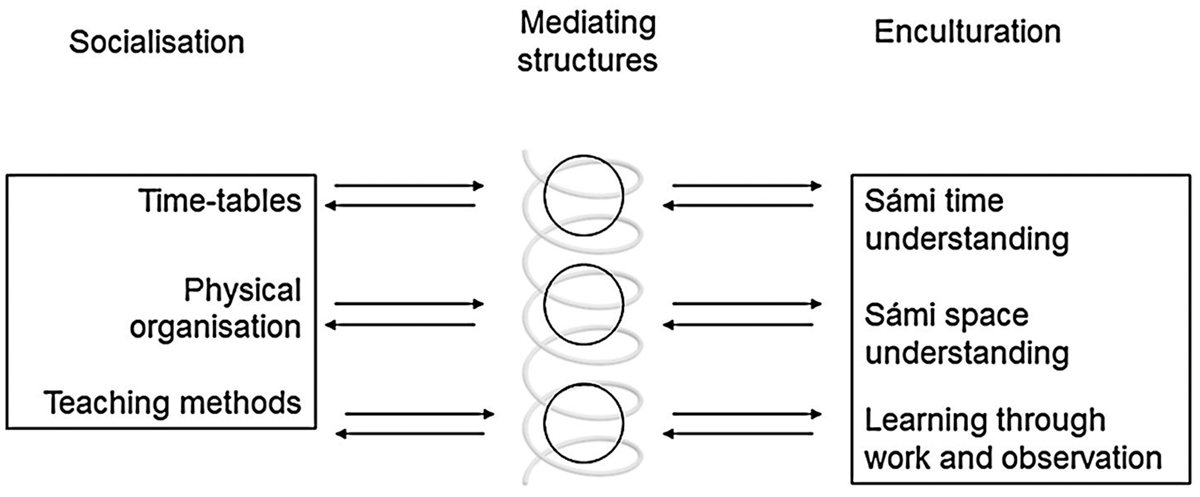
Space and time in Sámi education (Keskitalo, 2010: 219).
Discussion
The challenge of implementing a Sámi curriculum lies in national educational ideologies, which often exclude ideas for reforming pedagogy. According to Sylvi Stenersen Hovdenak (2004), the newer curricula reforms are both neoliberal and neo-conservative at the same time. He states that neo-conservatism appears in schools through strong state supervision. Such schools then prioritise skills that address the macroeconomic wishes and needs of the state. Neo-conservatism can be seen in curricula that emphasise content with detailed curriculum connections. Neoliberalism, in turn, is seen in market-oriented educational policies. Under neoliberalism, at the macro level, educational systems are seen primarily as a tool for economic growth, and at the micro level, schools serve students as clients (Hovdenak, 2004). Both of these philosophies limit the development of Sámi schools in Norway, because Norwegian schools are founded on the state’s point of view and emphasise the majority of inhabitants and their objectives.
With decolonisation, it is possible to develop new visions and practices regarding the construction of knowledge and the organisation of education (Mohanty, 2003). Pedagogical practices should maintain alternatives and exclusion should be shattered. The cultural and theoretical limits mixed with knowledge, value and power are always competing with appearance in education and social reality. It is therefore important to develop the ability to resist these forces. We need analytical methods that shed light on the effects of racism and sexism, and of the legitimation of colonial and ethnocentric practices and structures (Giroux and McLaren, 2014). The inclusion of indigenous knowledge systems requires a review of the structures of space and place. Moreover, there is a significant growing number of Sámi children and youth growing up in urban surroundings. Thus, urgent research activities are needed in order to explore, for example, their life worlds, linguistic situations and the needs for Sámi education. Further, the research should also be targeted on the parents’ generation so that their values and visions dealing with Sáminess and Sámi language, can be explored.
Footnotes
Declaration of conflicting interests
The author(s) declared no potential conflicts of interest with respect to the research, authorship and/or publication of this article.
Funding
The author(s) received no financial support for the research, authorship and/or publication of this article.