



Abstract
This article examines why the government in England has signed the country up to taking part in the OECD’s new international assessment known as The International Early Learning and Well-being Study (IELS). The article highlights the role of IELS as a technology of neoliberal governance. Looking forward it considers how IELS may open up new business opportunities and spaces for profit for businesses in England and elsewhere. At present, IELS is a fledgling product, but it may in time further add to the explanatory and governing power of the OECD to steer national policy makers towards a homogenised educational future defined by the organisation. IELS is run and managed by the National Foundation for Education Research (NFER), a national not-for-profit research organisation. The article explores how this same not-for-profit organisation also won the remarkably similar early childhood English Baseline Assessment 2 worth £9.8 million. Finally, the article examines the possibility that, in the future, if IELS were to develop, the edu-business Pearson might be interested in IELS to add to its existing interests in global data governance for profit.
Introduction: IELS in England
The International Early Learning and Well-being Study (IELS) is an international large-scale assessment of 5-year-olds. Its aim is to measure and compare performance in participating countries for early learning ‘domains’ that include emerging literacy, emerging numeracy, self-regulation, empathy and trust. The first round of assessments took place in autumn 2018.
IELS has been proposed, initiated and implemented by the Organisation for Economic Cooperation and Development (OECD). OECD has stated that IELS will produce ‘internationally comparable data that will enable countries to compare the relative strengths and areas for development in their own ECEC [early childhood education and care] systems with those in other jurisdictions’ (OECD, 2015: 103). England is one of three countries participating in the initial round of assessment, and the English Department for Education (EDfE) has echoed the OECD’s rationale by stating that IELS: ‘will enable the (English) department to robustly compare our policies and performance to other countries … and will facilitate our assessment and development of early years policy’ (DfE, 2017: 1).
In fact, only three countries are participating in this first round of IELS (Estonia and the United States, in addition to England), which is towards the lower end of the OECD’s initial expectation of three to six countries taking part. The great majority of OECD member states have chosen to sit this one out, though the OECD doubtless hopes to recruit more if and when a second round of IELS is launched. The countries that are participating are not only few in number but very disparate in nature in terms of both their size and form of government and also in policy (for example, compulsory school age is 5 in England, 6 in the United States and 7 in Estonia, meaning 5-year-olds may be in very different settings), not to mention differences in pedagogical thinking and practice. These rather strange bed fellows have led Moss and Urban (2018: 4) to comment that: There is no theoretical rationale, no rhyme or reason, for the inclusion of Estonia, England and the United States, and consequently no point to comparing them. To what substantive questions can this decontextualized comparison of test scores from an arbitrary collection of three countries provide answers? What policy issues can the study illuminate? What can anyone learn from this? So from a comparative perspective, [the first round of the] IELS makes no sense at all – except as a precursor exercise, designed to promote a much larger second wave study.
Why is England participating in IELS?
As already noted, the great majority of OECD’s 36 member states declined to participate in the first round of the IELS, and the study, once knowledge of it began to leak out, has been the subject of sustained and wide-ranging critique (Moss et al., 2016; Moss and Urban, 2018). Yet despite this, and despite also being in the midst of a period of sustained austerity that has squeezed government spending, the EDfE decided to participate in IELS and pay in excess of £3 million as the price for doing so. Neither is its rationale for doing so, as quoted above, particularly convincing. How can England ‘robustly compare’ its policies and performance in such a perfunctory study, based as it is on a simplified evaluation of children’s learning, no input on policy or other important pedagogical context, and the participation, at least initially, of just two other, very differing countries? How, in any case, would such comparisons produce meaningful and actionable conclusions? Given, as Moss and Urban (2018: 4) note, that ‘from a comparative perspective, the IELS makes no sense at all’, we can ask ‘what’s going on?’
It seems other reasons for participation must be sought. More promising, perhaps, is to see participation in IELS as the furthering of a larger national education agenda. In the case of England, that agenda has been the implementation of a neoliberal project, for which England has served as ‘a social laboratory of experimentation and reform’ (Ball, 2017: 3), dating back to the 1988 Education Reform Act passed by the government of Margaret Thatcher. Since then, a succession of neoliberal measures has shaped education policy, including parent choice of schools and the concomitant creation of a market place of autonomous, competing schools – so-called academy and free schools, similar to charter schools in the United States, severed from any relationship with local authorities and instead in a direct contractual relationship with the EDfE. By January 2018, nearly half of all English pupils (47%) were being educated in these schools (NAO, 2018).
Public policy only adopted ECEC as a priority issue in 1997 (with the election of a Labour government), before which the sector had been neglected over decades by successive governments. In these circumstances, a large private ‘childcare’ sector, consisting of private (mainly for profit) nurseries and childminders had emerged to fill the policy vacuum. Post-1997 governments built on this situation, encouraging more private provision and the creation of a more effective market in services. An entitlement to part-time early education was introduced for 3- and 4-year-olds, but provision of this entitlement was extended from primary schools, which had been the main providers previously of such education where available, to all ‘childcare’ services that met certain conditions. The 2006 Childcare Act placed new duties on local authorities, including securing sufficient childcare by conducting ‘childcare sufficiency assessments’ and managing the local childcare market. This reflected the government’s commitment to marketisation and parent choice, while various government-funded studies have sought to improve the workings of the ECEC market, most recently in a study conducted in 2015 by the accountancy and professional services corporation Deloitte (DfE, 2015).
In both compulsory schooling and ECEC (but also in higher education), the UK government has encouraged diversity of and competition between providers, opening up provision to the market place. But at the same time government has sought to impose increasing uniformity of content and outcome through strong central governing of providers; this has been facilitated by England being, in the words of a senior civil servant, ‘almost the most centralised developed country in the world’ (Agbonlahor, 2015). Using this power, the UK government has imposed a detailed national curriculum, first on schools (from 1988) and subsequently on ECEC services (from 2008) and the Early Years Foundation Stage (EYFS). This has been complemented by the introduction of a national inspection system, the Office for Standards in Education, Children’s Services and Skills (OFSTED), again first for schools (from 1992) and subsequently for all ECEC providers (from 2015).
A third component of this centralised control is drawn from New Public Management (NPM), described as the ‘neoliberal form of governance’ (Vabø, 2009). A key principle of NPM (Hood, 1991) is defining explicit standards and the measurement of performance in relation to these standards. From 1991, following the introduction of a national curriculum, the UK government has developed a system of high stakes testing for schools, Standard Attainment Tests (SATS), to assess the attainment of pupils against the National Curriculum at ages 7 and 11 years. These national tests are meant to provide evidence of the performance of schools in achieving curricular standards, evidence that can be used by both inspectors (when rating a school’s overall performance) and by parents (to enable them to better exercise choice between schools). SATS are followed by a national system of examinations for 16- and 18-year-olds.
Younger children have not been omitted from the burgeoning regime of performance assessment. To understand this regime, it is helpful to delineate the border between ECEC and primary school. The age for compulsory education in England is 5 years, but most children enter primary school earlier, on a voluntary basis, between 4- and 5-years-old; the first year in primary school is known as Reception, followed by Year 1. In other words, children enter primary school and compulsory education at an early age, compared with most other countries.
The Early Years Foundation Stage Profile was introduced in 2012, intended to assess children’s achievements at the end of their Reception year (i.e. the first year in primary school), usually at age 5 years, in relation to the early years curriculum; currently, children are assessed by teachers, on the basis of observations, against 17 early learning goals, each child being rated on a 3-point scale for each goal. At the same time, the government introduced a ‘Phonics Screening’ test, at the end of the first year in compulsory school (around 6 years), to assess whether individual children have learnt ‘phonic decoding’ to an expected standard.
But this has not been enough. The UK government has wanted to introduce a standardised assessment for 4- to 5-year-olds, that is when most have just entered reception class in primary school. The aim has been to establish a measure of performance at the start of primary schooling, to ‘enable us to create school-level progress measures for primary schools which show the progress pupils make from reception until the end of key stage 2’ (DfE, 2018). This measure, or ‘Baseline Assessment 2’ will be ‘an activity-based assessment of pupils’ ability in: communication, language and literacy [and] early mathematics skills’, with the possibility of including self-regulation. The plan is to introduce this new assessment in Autumn 2020, with a national pilot the preceding year (DfE, 2018).
This is not the UK government’s first attempt at a national Baseline Assessment for 4 and 5-year-olds. That was in 2016, and the policy was then withdrawn after considerable resistance from the education community and evidence that the methods offered by three different test providers produced incomparable measurements. Undaunted by this experience, the government is determined to try again with Baseline Assessment 2.
It is in this context of extensive national testing of standards, with increasing attention paid to young children, that the decision by the EDfE to participate in IELS should be viewed and understood. IELS adds to a growing web of measurement, its particular contribution being to enable government to assess performance at the end of the early childhood period against that of other countries (in the same way PISA does for 15-year-olds) and so determine what if any interventions are required to improve performance. In this way, it treats early childhood education as if it were a purely technical practice, adopting a vision of comparative education as ‘a technical process modelled on industrial benchmarking, in which the outcomes have been determined, and the aim is simply to engage in the global war for talent by learning enough from [our] competitors to beat them at their own game’ (Auld and Morris, 2016: 226). The approach embodied in IELS is ‘part of a broader drive to position policymaking as a technocratic exercise, to be undertaken by an elite band of experts who are immune to the influence of politics and ideology’ (Morris, 2016: 9). Of course, for this benchmarking role for IELS to work, it will require the study to continue and expand, so the EDfE’s participation in the first round can be seen as a long-term investment, with pay-back to come later.
IELS compares a sample of English services with those in other countries; Baseline Assessment 2 compares all schools within England. Both, therefore, are measures of performance against predefined standards to facilitate management. These two new assessments for 5-year-olds have many other similarities. Both are being implemented by the same organisation, the National Foundation for Educational Research (NFER), discussed further below; both have a shared timeline; both cover the same four domains’ content (self-regulation, emergent literacy and numeracy, and Social and Emotional Learning, SEL); both use digital tablets to collect data. These two interwoven assessments can be viewed as interconnected ‘relatives’ within a transnational ‘fast policy’ context, and there may be a ‘rolling conversation’ between these similar policy initiatives (Peck and Theodore, 2015: 5). They argue that policymaking has been ‘debordered’ and that ‘learning from, and “referencing”, distant models and practices is now commonplace’ so that ‘policy decisions made in one jurisdiction increasingly echo and influence those made elsewhere’ (Peck and Theodore, 2015: 3).
What both IELS and Baseline Assessment 2 also exemplify is the central role for data and statistics in neoliberal governing, what has been termed ‘datafication’ and ‘dataveillance’, that is the collection and analysis of data on children to ensure compliance to prescribed standards and targets (Bradbury and Roberts-Holmes, 2017). Comparative educational data, whether the comparison is between schools in the same country or between schools in different countries, has become an important way to govern teachers, schools and nations as ‘a neoliberal logic of control fits neatly with the ways that individuals are “made up” by data’ (Lyon, 2014). This ‘tyranny of numbers’ (Ball, 2015) describes the increasing importance of data in the every-day lives of those working in the education of young children (Bradbury and Roberts-Holmes, 2017). A study of three English early childhood settings reports on this phenomenon, with the teachers describing: [h]ow they were increasingly subjected to the demands of data production … For the early years teachers in this study, the focus of assessment data was the concept of constant progress through the Early Years Foundation Stage [the early years curriculum in England]; everyone must be tracked to ensure they are moving forwards. This requires ever more detailed data, to show the incremental progress of the children. Where do you stop with it because there is so much of it! Health data, education data, family support data and well-being data and to be perfectly honest I just can’t cope with that much data all the time! So I have put people in place who can manage that data.
Recognising the impact of standardised assessment on the subjectivities of both teachers and children adds a further understanding of neoliberal governing. Such assessments increase the ability of managers to control teachers and children directly, by providing evidence of performance, that is as defined by managers. But it also enhances self-governing by teachers and children, as they themselves strive to improve their own performance, a process described by Foucault (2010) as ‘governmentality’, by which he means how subjects come to embody a dominant discourse, expressed in the outcomes assessed in standardised testing; doing so, subjects govern themselves according to the beliefs, assumptions and goals of the discourse. As Dahlberg and Moss (2005: 18–19) explain: Governmentality [therefore] refers to the way in which people and populations come to be governed or managed not through external coercion, but by more subtle and more effective practices. These practices work directly on us, steering us towards desired behaviour. But they also work through us, acting on our innermost selves, reaching to the innermost qualities of being human: our spirit, motivations, wishes, desires, beliefs, dispositions, aspirations and attitudes. So though we are directly governed, the most important effect is that we govern ourselves – conduct of our own conduct – in ways that conform to the dominant regime. This will to govern becomes the more apparent if we consider the wider context of OECD’s growing global web of measurement, of which the IELS is (for the moment) just one small part. At the centre of the web is PISA, the Programme for International Student Assessment, the well-established and well-known international assessment of 15-year-olds now spanning over 70 countries and regions. PISA has in turned spawned the ‘Pisa-based Test for Schools’, ‘a student assessment tool, used by [individual] schools to support research, benchmarking and school improvement’ (www.oecd.org/pisa/pisa-basedtestforschools/), and PISA for Development, ‘which further develops and differentiates the PISA data-collection instruments to produce results that better support evidence-based policy making in middle- and low-income countries’ (www.oecd.org/pisa/aboutpisa/pisa-for-development-background.htm). Then moving up the education age range, there is the ‘Assessment of Higher Education Learning Outcomes’, ‘a feasibility study for assessment of higher education outcomes that will allow comparison between higher education institutions across countries’ (www.oecd.org/education/imhe/theassessmentofhighereducationlearningoutcomes.htm). Nor does OECD stop at higher education. There is also a ‘Survey of Adult Skills’, conducted in more than 40 countries, and which ‘measures adults’ proficiency in key information-processing skills – literacy, numeracy and problem solving in technology-rich environments – and gathers information and data on how adults use their skills at home, at work and in the wider community’ (www.oecd.org/skills/piaac/). And finally, at least for the moment, coming down the road is ‘The Study on Social and Emotional Skills’, another international survey that ‘assesses 10 and 15 year old students in a number of cities and countries around the world, identifying the conditions and practices that foster or hinder the development of these critical skills’. A Field Trail is due this year (2018), with the Main Study in 2019 (www.oecd.org/education/ceri/study-on-social-and-emotional-skills-the-study.htm).
In summary, it has been argued that the comparative statistics and data produced by IELS and national systems of assessment are central to enabling ‘the technocratic embedding of routines of neoliberal governance in the everyday life of the school and the classroom’ (Peck and Tickell, 2002 in Ball, 2017: 23). It has been shown how these assessments entrench competitive and managerial neoliberalism within England’s education of young children, constructing ‘a vast statistical apparatus through which this domain could be inscribed, visualised, tabulated, modelled, calculated’ (Rose, 1999: 33). Datafied products such as IELS ensure that early education is highly visible, observable and therefore governable (Roberts-Holmes and Bradbury, 2017), joining other datafied products such as the Early Years Foundation Stage Profile, the Phonics Screening Check and Baseline Assessment 2, to govern pedagogy and dominate teachers’ work with increasing effectiveness.
Implementing IELS in England
As well as introducing greater competition and private sector styles of management into public education, neoliberalism also seeks to open up the sector to private enterprise, what has been termed edu-business, and the profit motive. The field of testing, national and international, has already provided openings for such penetration, as will be discussed shortly. The contention of this article is that IELS, in the future, may provide further business opportunities, although these are yet to be realised in its early stages of development.
In England, both IELS and Baseline Assessment 2 are being conducted by NFER, with ambitions to grow. NFER’s contract for implementing the first wave of the English IELS is worth £1.6 million, somewhat overshadowed by the £9.8 million contract it has gained to run the remarkably similar English Baseline Assessment 2 at the same time. It is maintained that NFER was able to ‘learn from policy failures and learn to exploit opportunistic openings’ (Peck and Theodore, 2015: 29), such as the UK government’s first failed attempt in 2016 to introduce a national Baseline Assessment, using this policy failure as a learning opportunity to ensure its success in winning the contract for the new national English Baseline Assessment 2.
NFER is a ‘not-for-profit’ research-based organisation. However, Ball (2012a: 2) argues that there has been a ‘blurring of boundaries and distinctions’ between such third sector not-for-profit organisations and for-profit edu-businesses. Here the traditional binary categorisations are no longer useful or applicable as ‘traditional lines and demarcations, public and private, market and state, are being breached and blended in all of this and are no longer useful analytically as free-standing descriptors’ (Ball, 2012b: 86). Williamson (2016) refers to hybridised organisations, such as NFER, as ‘policy innovation labs’ that straddle both the public and the private sectors. Cross-sectoral organisations such as NFER, with their multiple allegiances and affiliations, are able to ‘face both ways’ towards the public and private sectors (Higham, 2014: 417). By being located at the interstitial space between the public and private sectors, such ‘policy innovation labs can operate as socially responsible philanthropic research-based organizations and as profitable social entrepreneurial edu-businesses at the same time’ (Roberts-Holmes and Bradbury, 2017). Hogan et al. (2016: 244) refer to such companies as being ‘neo-social’, that is, they are able to both meet their social responsibilities and make a profit.
For the moment, though, IELS has not attracted large edu-businesses. But if the study continues and expands, drawing in more countries to ongoing rounds of assessment, it may open up business and profit opportunities that will prove attractive to major international corporate businesses like Pearson, the world’s largest commercial edu-business with a portfolio of $8.2 billion in 80 countries with 40,000 employees (Riep, 2017). Pearson Inc. was involved in PISA 2015 and won the bid to develop the frameworks that defined what were measured in PISA 2018. This PISA 2018 ‘frameworks’ partnership between Pearson and PISA/OECD has been described as ‘a strategic door-opener for Pearson’ (Sj⊘berg, 2017). Specifically this strategic partnership involves joint OECD/Pearson: [i]nternational panels of experts in reading, maths and science, global competence and survey design to define and understand what students should be equipped with towards the end of compulsory education in order to deal with the world of work and further education in the 21st century. (OECD and Pearson 2014)
Additionally, the OECD wishes to use algorithms to predict from IELS data produced by 5-year-old children to the PISA data produced by 15-year-old children: In time, the [IELS] information can also provide information on the trajectory between early learning outcomes and those at age 15, as measured by PISA. In this way countries can have an earlier and more specific indication of how to lift the skills and capabilities of its young people. (OECD, 2015: 103) Our international experts also provided very accessible and popular insights into the (PISA) surveys, reinforcing our reputation as the leading expert in international education surveys. The year culminated in NFER being commissioned by the DfE, Welsh Government and Department of Education (Northern Ireland) to form the National Centre for the Organisation for Economic Co-operation and Development’s (OECD) PISA 2018 in England, Wales and Northern Ireland. (NFER, 2017: 9)
Critics have noted that Pearson’s global commercial dominance ‘presents a challenge to arguments about the necessity of high quality public schooling to a democratic society’ (Hogan et al., 2016: 256). This is because Pearson utilises datasets paid for out of the public purse, such as PISA, ‘to build a global education policy consensus efficacious to their business interests’ (Lingard, 2015). Pearson, wary of such criticism, is keen to rebrand itself as not simply being a commercial edu-business for profit, but rather as a caring and responsible education company and so has a corporate social responsibility (CSR) agenda (Hogan et al., 2016). It has been argued that Pearson’s CSR helps to justify its profits through ‘the economization of its social responsibilities’ (Hogan et al., 2016: 245). In a similar way, Sellar and Lingard (2014: 923) note the OECD’s ‘economisation of education policy’, which now includes IELS run by NFER. With its careful branding and narrative designed to appeal to the early childhood education and care community, NFER also ‘moralises’ and legitimates reductive baselining of children whilst at the same time building its market name.
Williamson (2017: 15) contends that sociotechnical projects, such as IELS, are constructed within a relationship between the ‘software space’ of algorithms produced by commercial actors, the ‘economic space’ of investment, funding and finance, and the ‘political space’ of educational policymaking and governance, as shown in Figure 1.
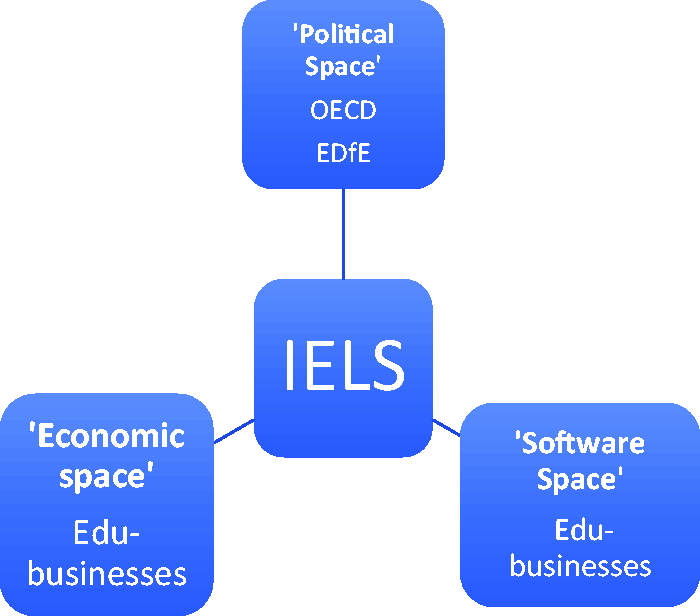
Relationship between IELS and the software, economic and educational ‘spaces’. (After Williamson, 2017).
This collaboration between policy makers, big business, academics and data companies enables projects such as IELS to become embedded and routinised. Through a digitised and datafied IELS, the education of young children may become further opened up as an attractive space for digital edu-business profit and its associated competitive ‘disruptive innovations’ (Ball, 2017: 113). Furthermore, IELS may potentially open up further business opportunities in the future, by the provision of ‘solutions’ to the problems it identifies (Ball, 2017: 113).
Kitchin (2014) argues that businesses have a continuous need to locate, create and exploit digital opportunities, making the future prospect of a ‘datafied’ product such as IELS operating on a global scale an attractive proposition. Were this to happen, if IELS were to take off after its initial hesitant, small-scale operations, then edu-businesses such as Pearson, not so far directly engaged in IELS, may want to seek partnerships with organisations, such as NFER, who have acquired expertise by participating in earlier stages of development. In this respect, a recent connection between NFER and Pearson may prove to be significant.
Given the OECD’s and Pearson’s global governing and commercial power, it is worth noting NFER’s as yet small but ambitious global strategy, which is to ‘seek out opportunities and partners … to build our reach and reputation as experts in educational assessment, both nationally and internationally’ (NFER, 2017: 114). As part of this strategy, in 2016 NFER appointed a ‘Development Adviser’, Alastair Wade, who had previously worked as the International Director for Pearson Venture markets. Pearson Venture aims to attract and invest in companies focused on improving low-cost private education, particularly in the emerging markets of the global South (Mance, 2015). Wade ‘brings to NFER a deep understanding of the market within the education sector’ and his job description is noted to include the following: [d]rive organisational growth in accordance with their [NFER’s] business strategy, cultivating a pipeline of research projects that align with NFER’s vision around how they can have the most beneficial impact on the education sector … and to expand NFER impact and reach in the international space, becoming a major player in global educational debates. (Society, May 2016 emphasis added)
Conclusion
IELS forms part of expanding and increasingly dense webs of standardised educational measurement, webs that are both national, spun for instance by the UK government, and international, spun inter alia by OECD. In both cases, national and international, these webs of standardised assessment of performance are an integral part of neoliberal governing, applying measures of performance as the basis for managing diverse situations – a market of competing schools in England; a market of competing countries globally. For the UK government, participation in IELS holds out the prospect of comparing domestic performance against other countries. This will complement the within-country performance assessment of the Early Years Foundation Stage Profile, Baseline Assessment 2 and the Phonics Check (and other items of data).
Such standardised assessments – national or international – have opened up new business opportunities for the private sector, whether not-for-profit or for-profit, as the work involved in developing and implementing tests and analysing test results is contracted out in the form of lucrative contracts. Commercially driven assessment or testing instruments such as IELS have become increasingly normalised in the governing of education. At present, IELS is a fledgling product, but it may in time further add to the explanatory and governing power of the OECD to steer national policymakers towards a homogenised educational future defined by organisations. In considering the future evolution of IELS, it is important to bear in mind both managerial and commercial drivers.
Yet, these drivers are not unstoppable. Foucault (2010) noted that where there is power, there is also resistance, so these concluding remarks recognise the international resistance and push back to IELS, with many sharing the view of Loris Malaguzzi, that ‘Anglo-Saxon “testology” … is nothing but a ridiculous simplification of knowledge, and a robbing of meaning from individual histories’ (Loris Malaguzzi, in Cagliari et al., 2016: 378), and the ranks of standardised assessments that have emerged in recent decades epitomise such ‘testology’. Many governments – including Northern Ireland, Scotland, Belgium, Denmark, Germany, Norway, Sweden, Japan and New Zealand – refused to participate in the first round of IELS (Moss et al., 2016). By engaging with ‘a politics of refusal’ (Ball, 2016), these governments have demonstrated that the OECD is in fact ‘fragile and open to challenge’ (Dahlberg et al., 2007: 33). Despite the seemingly unstoppable juggernaut of datafied governing and commercial products such as IELS, this article concludes that the evidence of resistance represents ‘an optimism of the will’ (Gramsci, 1929).
Footnotes
Declaration of conflicting interests
The author(s) declared no potential conflicts of interest with respect to the research, authorship, and/or publication of this article.
Funding
The author(s) received no financial support for the research, authorship, and/or publication of this article.