



Abstract
This ethnographic study, carried out in public kindergartens in Finland, traces the enactments of the societal roles of early childhood education. It highlights how the intertwining of governing tools and discourses related to early childhood education’s societal role participates in the formation of daily life in kindergarten. The concept of “imaginary” is used as an analytical tool. The study argues that intensification measures together with the individualistic rights discourse have substantially challenged the social justice agenda of early childhood education in Finland. Furthermore, it suggests that an ethnographic examination of the enactments of societal roles of early childhood education and the concept of “imaginaries” provide valuable insights vis-a-vis the continuing theoretical and political discussions concerning early childhood education policies and governance.
Introduction
This article focuses on the enactment of the societal roles of early childhood education (ECE) within the everyday life at public kindergartens in Finland. ECE policies around the world have evolved out of similar and multiple needs (Kamerman, 2000). The societal roles of ECE have shifted between securing the well-being of children, socializing children into society’s values, increasing school readiness and facilitating parents’ workforce participation (Penn, 2011). Although each country has unique issues in its national debate, a shared tendency is that public decision-making revolves around sometimes competing societal roles of ECE and a consideration of the best ways to govern it.
The formation of ECE institutions can no longer be understood without reflecting on the global context. The transnational era is marked by increased movement of people and flow of information (Deacon, 2007). Global interconnectedness has focused gazes on national economic competitiveness. Since capital investments are important for national economies, states have intensified public services, including ECE, in order to lower the taxes and employer costs and to tempt investors. This has created the transnational drift of reforms in the education field that use corporate management models as drivers of improvement (Sahlberg, 2011).
Early ECE policy research focused on mapping the different types of governance of ECE systems, policy choices that countries have made, and the discursive construction of policy documents (e.g. Dahlberg et al., 2007; Gibson et al., 2015; Kamerman, 2000; Neuman, 2005). Still, research has rarely investigated how ECE policy is practiced by people doing their everyday work. We need to know what policies survive from policy aims to practice in this transnational era of intensification, and how. This kind of understanding is important as internationally, on average, children enter institutional childcare at earlier ages than in previous eras and spend more time in them. It is important to consider what kind of ECE children receive, if the effects of ECE are carried forward years ahead (e.g. Vandell et al., 2010).
This article therefore poses the following questions: What societal roles of ECE are enacted in Finnish ECE? How can we better understand the formation of institutional ECE in transnational era? This is especially when different policy goals and views concerning the effective means of realizing them conflict with each other. In doing this, democratic decision-making concerning ECE and methodologies of ECE policy research can be advanced.
Framework for examining enactments of ECE policy
Examining institutional ECE imaginaries
Institutional ECE can be regarded as being very tangible, while fluid in its manifestations. Rather, ECE is constructed with regard to different socio-material relations. In what follows, I will explain how this premise was applied within the framework of this study.
First, the concept of “imaginary” that is used as an analytical tool requires explanation. It has multiple definitions (Castoriadis, 1997; Nespor, 2016; Taylor, 2004), but here, it is used as a theoretical term inspired by the work of Jessop (2010) and Ferraris (2013). In this study, imaginary means intertwining between (1) discourses on the societal role of ECE and (2) the governing artifacts that together have performative power—they are followed by acts. Institutional regulations are materialized in different governing tools. These tools, for example, curricula and cost-effectiveness measurement systems, together with teachers’ cultural understanding of the societal role of ECE through which teachers interpret the particular tool, govern the acts conducted in kindergartens.
The concept of “imaginary” aims to capture the fact that ECE is always futures oriented: The concept of education is meaningless without a view of a desirable society. For Jessop (2010), the concept of “imaginary” means a system that frames an individual’s experience of a complex world and guides collective calculation concerning the future. The imaginary of ECE answers therefore questions about what the role of ECE is in the construction of the desired society. The imaginary of ECE is, however, only a model that selects one of the many possible societal roles of ECE and defines means to achieve it. Models never reach the complexities of the world, and thus, governing tools have unintended consequences (e.g. Settlage and Meadows, 2002). Therefore, the connection between the intended society and the means for achieving it is somewhat imagined.
More simply, kindergarten teachers and policy makers have to make decisions that carry long-term consequences, but they cannot know fully what these consequences will be. This uncertainty cannot be harnessed by better models. Social processes cannot be forecast with accuracy since these forecasts themselves influence the future (Nespor, 2016).
The applications of the concept of “imaginary” in educational studies have taken the perspective of the culturally constructed role of education in building up knowledge economy or society more generally. For example, they have given examples of the role of governing instruments such as the European Quality Assurance Register for Higher Education and the ranking of higher education institutions U-Multirank in turning the imaginary of European higher education into a strategic tool for the economy (Jessop, 2008) and the role of standardized testing as determining the child’s position in the imagined future and reframing inequalitiesas differences in the kinds of futures toward which different groups of children areoriented (Nespor, 2016). Yet, among these studies, there are fewer inquiries examininghow imaginaries are produced in everyday actions. Rather, they have often concentrated on analyzing institutional texts.
Indeed, criticism has been voiced concerning the focus on texts and documents in studies on policies and institutions. The argument is made that policy analysis in education has a history of viewing policy as a hierarchical top-down process that is a series of lock-step procedures of development, adoption, implementation, and evaluation (Sutton and Levinson, 2001).Yet, hierarchies still provide important insights that need to be taken into account:
[T]here is a multiplicity of diversely structured, overlapping interscalar rule regimes operative in and across diverse policy fields. While these arrangements clearly influence what happens at the local scale, sufficient room often exists for local actors to modify the effects. Mahon (2009: 209).
So even when examining policies from the scale perspective, we can acknowledge that policy making not only takes place at different taken-for-granted levels of governance, it is also multi-layered. For example, in their study on the interpretation of child protection and safety policies in Australia, Singh et al. (2013) illustrated how policy enactment is a relational process of selecting and translating information from one context to another. In their case study, mid-level policy actors elaborated and defined key concepts of the Child Protection and Safety policies such as “inappropriate behavior” and “harm” in relation to their perception of both the original aim of these policies and teachers’ working context, knowledge and anxieties. Furthermore, these elaborations become re-interpreted when local actors translate them into actual practices in relation to their cultural understanding of the aims of these policies in the society and their own role in the chain of actors (Singh et al., 2013).
Therefore, it is important to interrogate both the national and local contexts of this study in order to understand institutional ECE. In what follows, I will introduce the policy and governance context of ECE in Finland.
Inquiry
The context of the study
Governance of ECE in Finland
The governance of Finnish ECE is twofold. Both the state and the municipalities have a role in ECE policies. On the national level, legislation sets binding regulations for ECE. The Act on Children’s Day Care (1973) governs the staff–child ratio and staff qualifications. The staff–child ratio for under 3-year-olds is 1:4, and was 1:7, for over 3- to 6-year-olds in full-day ECE, at the time of conducting this research.
The universal public services have been a common feature in the Nordic countries (Mahon et al., 2012). Consequently, Finnish law stipulates that municipalities must provide an ECE place for a child if parents wish it regardless of their work situation (Act on Children’s Day Care, 1973). The municipalities are responsible for arranging the ECE services. 1
Otherwise, the Finnish ECE system is decentralized. For example, the decisions concerning the division of labor among different occupational groups working in the sector are made in kindergartens (Hujala et al., 1998). Also, the National Curriculum Guidelines for ECE (Institute of Health and Welfare, 2006) that guide ECE for under 6-year-olds were not binding at the time of generating the present data. 2 Rather than setting goals for children, the guidelines set standards for environments and activities that address children’s holistic needs. Contrary to ECE for under 6-year-olds, the National Core curriculum for pre-primary education for 6-year-olds (National Board of Education, 2010) is binding. This aims to guarantee equal opportunities for children to begin school and to learn. There are no other binding national-level governance tools specifically for ECE.
Both the Core Curriculum for pre-primary education and National Curriculum Guidelines for ECE provide a basis for the local curricula drawn up by municipalities. Unit-specific curricula complement the local one. Moreover, more detailed ECE plans are made for every child individually.
Decentralization is often accompanied by a demand for accountability. A growing emphasis around the world is being placed on greater control through information systems. Internationally, this kind of governance has encouraged the “datafication” of pedagogy, so that performativity demands increasingly constrain kindergarten teachers’ work (Roberts-Holmes, 2015). Although decentralization has not yet led to the development of outcomes-based governance at the national level in Finland, municipalities use increasing amounts of quantitative data for outcomes-based governing purposes. The municipality where this study took place used such a measuring tool—a productivity matrix for governing ECE. The aim of the matrix was to use resources efficiently and manage ECE costs—to intensify ECE. There are signs of the increase in the use of these kinds of measurements in Finnish ECE (Karila, 2012; Paananen et al., 2015).
Also, different kinds of information tools were used for governing the ECE in the municipality. For example, in-service training was provided and the municipality had consultants for supporting children with special needs and for children needing teaching of Finnish as a second language.
Deliberation on ECE in Finnish policy making
Nordic ECE is perceived as being built on welfare and social justice (Karila, 2012). In Finland, the social justice deliberation has appeared, for example, in discussions concerning pre-primary education for 6-year-olds and in the National Curriculum Guidelines for ECE (Paananen et al., 2015). As well, the Nordic ECE views children as active participants influencing their daily lives (Sommer et al., 2010). For example, according to the National Curriculum Guidelines, children’s own views should be taken into account in planning, implementing, and evaluation of ECE. Thus, societal roles of ECE as fostering democracy and the rights of children are deeply embedded in Finnish ECE.
However, a considerable amount of Finnish ECE policy deliberation also concerns the needs of the labor market: According to Onnismaa (2001, 2010), Finnish policy makers have deliberated ECE policies by emphasizing adult and society centered arguments. Onnismaa (2010) suggests that this was because the key reason for the creation of childcare legislation in Finland was enabling women’s workforce participation. In addition to the arguments concerning workforce participation, the right of parents to choose the services they use has been at the core of Finnish ECE policy deliberation (Mahon et al., 2012; Paananen et al., 2015).
However, there is no research regarding how the societal roles of ECE are enacted in the everyday life Finnish ECE, or to what extent different kinds of governing tools shape the process and on what happens when different policy goals conflict with each other. The next section discusses the choices made to address these questions empirically.
Generating the data
Ferraris’ (2013) work on the ontology of social lead us to suggest that acts are the most fruitful entry point for examining the formation of institutional reality. ECE policies are carried out in the everyday activities of kindergarten that reflect the socio-material relations of governance. Exploring acts in ECE require an ethnographic research methodology. The examination begins from the everyday contexts and aims to investigate the discourses and governance tools that surround it.
The data consist of two parts: document-aided interviews of kindergarten teachers and the ethnographic material from one kindergarten group. These methods were used to “generate descriptions of what people do in their everyday lives” (DeVault and McCoy 2002: 755). The data generation of these two parts occurred concurrently, and the notions raised during the data generation guided the further steps of this study.
Document-aided interviews with kindergarten teachers
The first part of the study consists of a day-long self-documentation produced by 13 teachers, individual ECE plans for the children in their child groups (n = 118), and document-aided interviews with the teachers. The volunteering teachers were asked to document their activities in detail during the day. They were advised to write notes at work and complete the diary directly afterwards. Observation is a very typical activity in Finnish kindergartens, and the teachers had conducted observation activities earlier.
The weekday for the self-observation was selected for each teacher beforehand to ensure that every weekday was covered, but they were asked to set the date they would expect to be the most typical. Each teacher produced three to eight pages of text, for a total number of 60 pages.
The individual ECE plan of each child in participant teachers’ groups was collected. The plans included agreeing on the most important aims of the ECE of the particular child and on how the individual needs were taken into account. The parents’ written consent for using the ECE plans was requested.
Examining the practical arrangements that govern teachers’ work brings the institution into view (Smith, 2006). Following the theoretical underpinnings of this article, attention was paid to how the material artifacts for governing, intertwined with teacher’s cultural understanding on ECE, participated in teachers’ decision-making. The entry-level data, that is, teachers’ observation reports and ECE documents, led to second-level data—the discourses through which actions are deliberated over, and references to governance tools. For the mapping of the imaginaries, the teachers were asked to reflect on the diaries with the following questions in mind: Why was each act conducted, and was it based on some kind of agreement, guideline, policy or suggestion? To examine the interplay between imaginaries, the teachers were also asked to reflect on the acts reported in the diaries in terms of whether some activity or goal conflicted with, replaced or prevented another.
The length of the sessions varied from 52 minutes to 1 hour and 40 minutes, the average being approximately 1 hour and 20 minutes. In all, 17 hours and 20 minutes of audio-recorded data were produced.
Ethnographic material from Kindergarten group
To better understand the institutional context of ECE and to expand the data produced with the teachers, ethnographic data were generated. The ethnographic data generation took place in a group of 3- to 5-year-old children and four adults and it lasted from May to October 2014. The group is called in this article as “Little Dolphins.” Two of the group’s staff members worked as kindergarten teachers; the other two were nursery nurses. The total size of the group altered between 26 and 28 children during the observation period.
During this participant observation phase, I visited the group approximately twice a week at the beginning, and once for 2 weeks at the end of the phase. Since the study paid close attention to the governing artifacts, I attended the weekly meetings of the group when possible, and collected the minutes of the meetings, plans created and instructions provided for the staff. These documents were further discussed with the teachers of the group. The observation diary and documents were used to complement the interview data.
Data analysis
The transcribed interviews with teachers were analyzed in terms of how the participants deliberated on their acts and decisions (e.g. Fairclough and Fairclough, 2013), and what kinds of governing instruments, if any, governed their decision-making. All excerpts featuring such deliberations were selected for further examination. The kinds of material arrangements (for governing the daily life of the kindergarten) related to these moments were determined. The data were scrutinized in terms of what kinds of acts these inscriptions were related to, that is, what kind of imaginary constituted this interplay (Jessop, 2010).
Second, the episodes where teachers described conflicting imaginaries were selected, and the following questions were posed: What occurred in these conflict situations? In particular, which imaginary survived? The imaginaries that survived and those which faded in the conflict situations were juxtaposed with all imaginaries identified in the data. Finally, whether any patterns could be found in the interplay between the different imaginaries was investigated. The next section will illuminate the findings.
The interplay between ECE imaginaries
Imaginaries of ECE
Five different ECE imaginaries were uncovered in the data: (1) serving the needs of parents, (2) socializing children to adapt to the existing circumstances, (3) protecting the negative rights of the children, (4) building up the right to reciprocally constructed social space, and (5) building up social justice through inclusion. An example of each is given in Table 1. The different types of deliberation and material arrangements for governing that were part of the formation of a specific imaginary resulting in an act are listed in the table. Those related to the example are italicized.
Imaginaries of ECE.
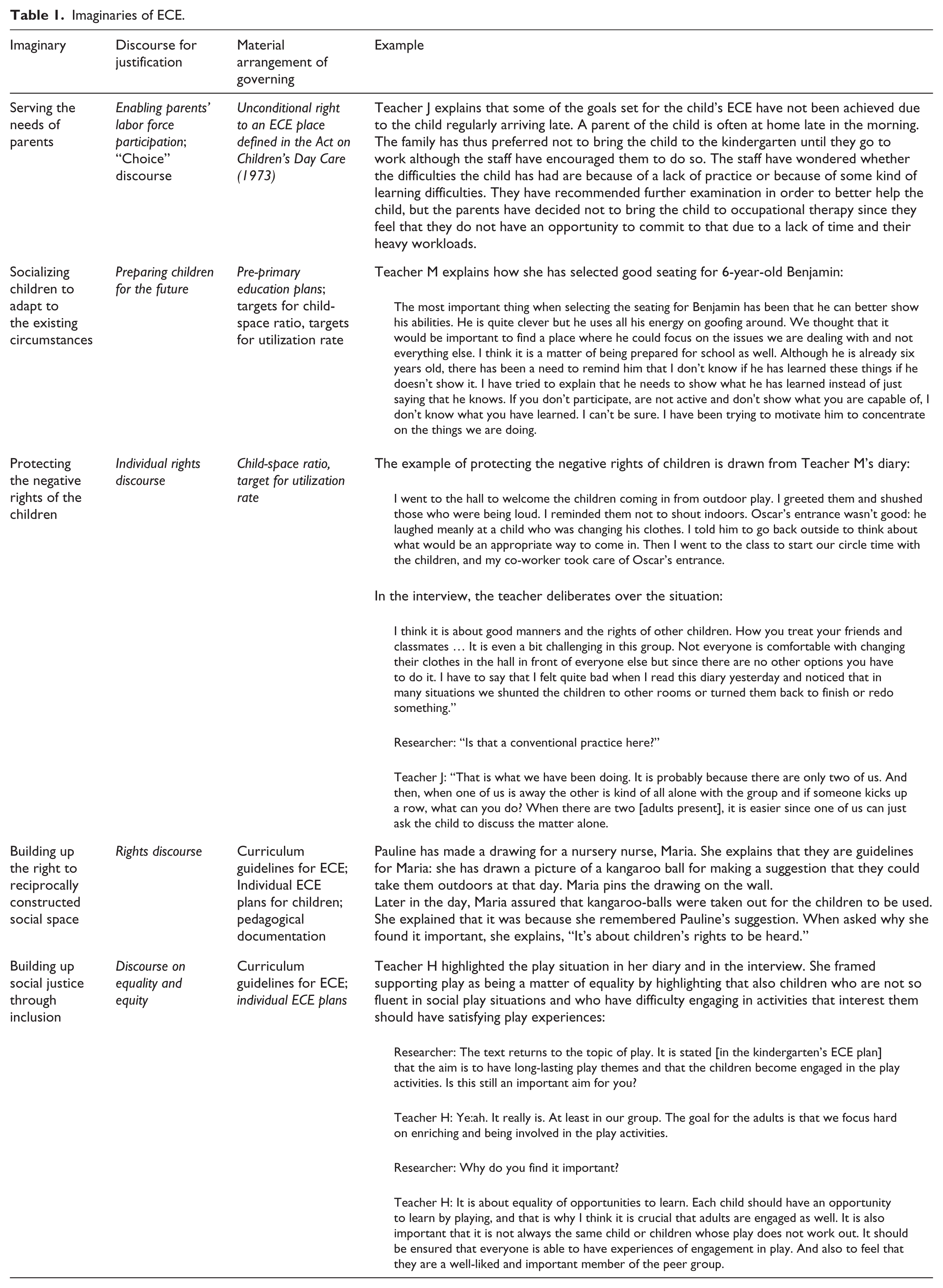
In order to illuminate how the imaginary is formed as a combination of the discourse and the material arrangement for governance, two examples are provided. First, the imaginary of ECE as serving the needs of parents, and second, the imaginary of ECE as building up the right to reciprocally constructed social space.
The imaginary highlighting the role of ECE as serving the needs of parents became visible for instance in the example dealing with Toni’s late arrival at kindergarten, in Table 1. The staff had been wondering whether the difficulties Toni was having in, for example, using mathematical skills in real-life situations were because of a lack of practice due to his regular lateness or because of a learning difficulty. The staff, drawing on the idea of the role of ECE preparing children for the future, recommended further examination to support him better according to their view of appropriate development. Yet, the parents decided not to take Toni to the therapy sessions provided by the municipality. Thus, the idea of the societal role of ECE as preparing children for the future materialized only as a suggestion and did not, in this case, form an imaginary.
Rather, the teacher deliberated on the situation referring to the parents’ working arrangements and their choice. In this particular situation, therefore, the imaginary of ECE ended up materializing as serving the needs of parents. We do not know whether the reason for the parents’ decision not to use the subsidized therapy was their difficulty combining work and family life as the teacher reported. Yet, the example resonates with the strong tradition of highlighting the right of parents to choose the services they use, which historically has been a hegemonic imaginary in Finnish ECE policy (e.g. Mahon et al., 2012): The discussions with the staff during the generation of ethnographic data revealed that The Act on Children’s Day Care (1973) that set obligation for municipalities to organize day care for all children was interpreted by local ECE authorities so that it was up to the parents to decide at what time child arrives and leaves kindergarten. The law ensuring unconditional right to ECE place for a child combined with the presumption of the ECE’s role as enabling parents’ workforce participation and the emphasis on the parents’ right to choose formed an imaginary of ECE’s role as a service for parents.
Another imaginary constructed ECE’s role as building up the right to a reciprocally constructed social space—fostering children’s opportunities to take part in planning their everyday life in kindergarten. The acts that were part of this imaginary were deliberated on the basis of individual rights. These acts were described when talking about individual ECE plans, pedagogical documentation or portfolios made with the children. In Table 1, there is an example of the imaginary. In the excerpt, the governance tool is made by a child: Pauline makes a suggestion concerning the daily life at the kindergarten with the help of the drawing. Later in the day, the nursery nurse assured that kangaroo-balls were taken out for the children to be used. She explained that it was because she remembered Pauline’s drawing. She deliberated the agreement by referring to rights: “It’s about children’s rights. They have a right to be heard.” This kind of combination of the rights discourse and governing tools that allowed leeway for teachers’ and children’s co-creation was visible in other occasions in the data as well. Together they formed an imaginary containing a view of capable children who need to be part of the decision-making in their everyday community.
Thus far this article has considered how, by following the acts of the teachers, the discursive-artifactual combinations guiding them, different imaginaries were uncovered. The next section unravels the tension between the imaginaries, and the decisions made in those conflicting situations. It outlines how the conceptualization of imaginaries as discursive-artifactual entities also helps in understanding the interplay between them.
How the imaginaries survived
This section illuminates which imaginaries survived and which faded when different societal roles of ECE conflicted and why. First, I will explain in what kinds of situations teachers found a conflict between different societal roles of ECE.
Most typically a tension involved municipality’s intensification measures. These measures were introduced as a result of the municipality aiming to use resources more efficiently and manage the costs of ECE services. As well, the increased number of children in need of an ECE place had influenced the organization of ECE in the municipality: Since there were not enough ECE places for the children, and the municipality had a legal obligation to arrange them, the municipality’s solution was to intensify the ECE.
Intensification measures were planned using information gathered with the help of an outcomes-based governance apparatus known as the matrix of productivity.
3
The indicators included in the matrix encompassed the costs of child day care, the number of staff sick days, the child–staff ratio, the utilization rate, parents’ satisfaction with ECE services, and the proportion of children needing to learn Finnish as a second language. Based on the output of the calculation conducted with the help of the matrix, officials and kindergarten managers could follow whether their “productivity” increased or decreased and where they stood in terms of “productivity” compared to the “productivity” of other kindergartens. The interviewees were familiar with the matrix of productivity and the indicator of the utilization rate, and they knew that they governed the work in kindergarten:
We discuss it [utilization rate] in our weekly meetings. Sometimes I feel that our manager even emphasizes it too much (Teacher V). Staff sick leaves play a huge role in it [the matrix]. In this area there are kindergartens where there are lots of sick leaves of the staff—Parents have given very good ratings for our kindergarten [when measuring parents’ satisfaction for the matrix]. It does not help, however—Parents’ satisfaction plays such a small role [in the output of the matrix]. It is all about counting euros (Teacher A).
The intensification measures that were based on the numbers provided by the matrix included (1) increasing the utilization rate, that is, the proportion of the average daily number of children in kindergarten compared to the legal maximum; and (2) increasing the number of both children and adults in kindergartens. As a result, the total number of children in all but one of the study’s child groups exceeded the child–staff ratios stipulated by law. Computational ratios varied between 1:5.5 and 1:8.5 on the days when teachers completed the diaries. Efficiency was examined monthly—kindergarten managers were accountable for meeting the binding goal for the utilization rate, that is, the number of children in relation to the number of adults, which for 2014 was 92.5%, set by the policy makers at the ECE committee appointed by the city council. Within the academic year that the data were generated, the utilization rate had risen by 1.2 percentage points (Paananen and Tammi, 2017).
Thus, for some groups, this meant that if there were days when many children were absent, they would not always take a stand-in, even if the number of children exceeded the official child–staff ratio, in order to reach the utilization rate goal. This was possible because the Act on Children’s Day Care (1973) allowed the provider to make temporary exceptions regarding the ratio.
The second intensification measure was introduced for securing enough ECE places: the number of both adults and children was increased in many kindergartens—instead of three adults, there were often four adults, and an equivalent number of children in the same group area. However, these groups of four adults had often been divided in two, and the use of different spaces had been staggered—for example, when one group was indoors, the other group was outside. One teacher describes the situation as follows:
Kindergartens here are full. For example, when it comes to the child-space ratio, this kindergarten was planned for 105 children. Since they [the city council] adjusted the child-space ratio, we should now have places for 120 children. In addition, they overbook the places [in order to reach the goal set for the utilization rate] because the families have days off from time to time. It means that we have 125 children here instead of 105 (Teacher A).
Both of these intensification measures produced an increased number of conflicts between different agendas in daily life of kindergarten.
In addition, those imaginaries that contained this outcomes-based governing system seemed to survive in situations where different societal roles of ECE were conflicted. When juxtaposing these imaginaries with those that survived in conflicts, it can be noted that both the imaginary highlighting the role of ECE protecting the negative rights of children and the imaginary of ECE socializing children to adapt to the existing circumstances strengthened. Let us take the imaginary of protecting the negative rights of children (Table 1) as an example. The example describes a conflict when Oscar comes in from outdoor play. The teacher describes how Oscar notices another child changing clothes and, according to the teacher, makes fun of him or her. The teacher considers this inappropriate and therefore sends Oscar back outdoors to reflect his behavior. She deliberates her act of sending Oscar back out by referring to the rights of others: “It is about good manners and the children’s rights. How do you treat your friend.” She also brings up the fact that there were only two adults, and they needed to be in separate places—if there had been another adult, it would have provided an opportunity to act differently:
I noticed [when reading the diary] that we sent children off quite often. I felt quite bad when I realized it. We send them off all the time—I think the reason is that there is only two of us. If one needs to be elsewhere you are quite alone with the group and if one kicks up a row what can you do? If there were more of us it would be easier. One could pull a child aside and be like: “We need to have a chat.” (Teacher M)
The intensification measures had increased working in groups of two adults (instead of three). Also, the staggering the use of spaces required that the division of duties between adults was clear: They needed to have an agreement on the responsibilities of each adult at any given time in order to ensure smooth transitions. This meant, however, that there was only a little leeway for making decisions based on teachers’ contextual evaluation. For example, it was not always possible to continue fruitful play, even if it would have supported meeting the aims set in the ECE plans, without interfering in the smooth operation of the other group and the aims set for its activities:
There is this tension that we have to … We have 1 to 1.5 hours to be indoors [for play and other activities in the mornings]. Even though they have wonderful and fruitful play going on, we can’t stay inside and continue it because the next group is coming in and we need to go out. Although we stagger [the use of different spaces], have a very good learning environment, and are a child-paced kindergarten, there are those preconditions that cannot be ignored. Sometimes it feels that it is kind of covered or hidden by saying that in our kindergarten you don’t have to do this and that, but when we really look close we can see that for sure you have to (Teacher K).
Thus, these intensification measures supported the occurrence of such situations as Oscar’s entrance: there was an increased demand for the children to adjust to the circumstances. Moreover, the discourses of individual rights (and the demand to concentrate on school readiness in some other occasions of the data) seemed to help teachers accept and deliberate on their increased role in socializing children to narrowing institutional demands. Intensification measures and the discourse of individual right to learn and emphasis on future skills together increased the expectations concerning the desired level of skills and development of the children—more waiting and adapting were expected from children.
Also, one of the reasons why imaginaries containing outcomes-based governing practice such as the matrix for productivity were resilient in conflict situation seemed to be that they governed the physical aspects of kindergarten life, such as the use of spaces rather than more abstract matters as some other imaginaries. Sometimes the teachers used this fact quite intuitively to manage their work.
For example, work distribution charts, written yard rules and calendars were used to produce inscriptions for staff actions to reify the imaginaries the teachers found important. By using these material arrangements, the teachers mainly aimed to strengthen the imaginary of ECE building up the right to a reciprocally constructed social space, or the imaginary of ECE building up equity and social justice through inclusion. The next excerpt illustrates the use of a shared notebook for planning:
We have had [in this kindergarten] two identical groups this floor from the beginning. We share some spaces and take turns using them also in the mornings. While some are outside the others are inside. We have felt that it is good to do the planning together. We utilize and apply the same plan in both groups—We have never cancelled the things we have planned. Even if some of the adults have not been here, we haven’t cancelled anything. Even when I have been absent [as a teacher] they have carried out the plan anyway. If I have not made a plan, the other teacher on this floor has probably done it. If she hasn’t done it, our nursery nurses are able to check the earlier plans [from the notebook] and see what we have done and apply something they feel they are capable of doing—It is important, because then all the children have the possibility to participate [since the whole group does not have the same activities at the same time] (Teacher A).
The teacher finds it to be important that the shared notebook makes it possible for all children to have similar kinds of opportunities for learning and participation. Imaginaries strengthened by utilizing material arrangements that made the imaginary more specific. They made imaginaries more durable and easier to square with other imaginaries.
Yet, by juxtaposing the imaginaries identified in the interviews with those that survived when tension arose between different imaginaries, it became clear that the imaginary of social justice most often faded when it clashed with other imaginaries. In the next excerpt, which illuminates this fading, a teacher describes days where there had been more children in the group than normal due to the intensification measures:
There have been days in which I wondered if I had even talked with each child [during the day]. It is terrible because they are so little, one should have time to play around with them. But it is not possible in these groups [since they are getting bigger]. This is not equality and you can’t talk about equity (Teacher I).
Another excerpt, where a common course of action in the case of a sudden sick leave is discussed, describes more clearly the decision-making in a situation where the imaginary of social justice fades:
You said that you are able to plan in such way that it does not affect your activities if someone [one of the staff] is missing. What kind of practices do you have then?
We have four small groups but usually they do not have similar activities at the same time. If we have sports, for example, there are two groups doing sports and the other two groups may then work together as well. So they do something together. Or separately.
So if someone is absent one adult is responsible for two small groups? Is it that one gives the instructions for both groups and then tries to navigate between them, overseeing and supervising both of them, or do the groups more likely work together?
Usually it is that one group is left playing something they choose and the teacher is more with the other group if we have planned something that needs more instructions and supervision. Luckily we have those glass doors, so you can see what is happening in other rooms as well. I think that is the most common course of action. No adult can play with one of the groups.
This is to say that, according to the interviewees, activities that were more teacher-directed were usually selected when the teacher needed to decide between engaging in different activities. The lack of teacher engagement in play due to conflicting aims repeatedly came up in the interviews. Playing is something that teachers feel can continue with minimum input from adults. However, being able to engage in play was also something teachers found very important in order to ensure equity. The importance of play was emphasized especially when speaking about children with special needs and about children whose social skills did not meet the expectations that kindergarten life and ECE as an institution had:
We [the staff] have emphasized the importance of an adult involvement in play to enrich and scaffold it.
Why do you feel it is important?
It is about equal opportunities. Every child should have equal opportunity to learn in play. That’s why I find it crucial. It shouldn’t be so that it’s always the one child [who does not have the skills emphasized in those situations] whose play does not work out. Everyone should have an opportunity to meaningful play with others. And have a feeling of belonging to the group and being important for the others.
Due to tensions between imaginaries, there were fewer situations in which the imaginary of social justice, for example, the adult involvement in play to ensure equity, was enacted. Since there seemed to be a disjuncture between (1) the kindergarten teachers actions as a response to governance practices and (2) their ideals, the feeling of being overloaded by conflicting aims shaped the teachers’ practices so that they more and more often focused on scaffolding the skills of those already doing quite well. At the same time, this meant that the children who did not meet the narrowing institutional requirements got more often negative feedback or were overlooked. The imaginary of ECE building up social justice through inclusion faded, while imaginaries of ECE protecting the negative rights of children and ECE socializing children to adapt to the existing circumstances strengthened.
Discussion and conclusion
Our data revealed that there are signs of a fading in the imaginary of social justice in Finnish ECE. The emphasis on social justice has been a characteristic of Finnish and Nordic ECE (Karila, 2012). One of the reasons the imaginary of social justice was regarded as being fading was the example of the lack of adult involvement in play. If children receive the support needed to participate in a peer group, they are likely to have friends. It safeguards children from social isolation (e.g. Kim and Cicchetti, 2010). Most often, the aims related to play came up when discussing the individual aims of children with special needs or children whose social skills did not meet the institutional expectations. Thus, the lack of adult engagement in play influenced them the most.
Moreover, the fading of the imaginary of social justice is related to the intensification measures that reduce the leeway teachers have for decision-making and that increase the number of situations where different aims conflict. This fading has taken place especially when it conflicted with the imaginary of ECE as socializing children to adapt to the existing circumstances or the imaginary of ECE as protecting the negative rights of the children. The intertwining of outcomes-based governing practices that intensified ECE and the discourse of individual rights and preparing to the future tightened the norms of socially acceptable behavior of children and thus influenced especially those who did not fit into these norms.
Studies of ECE governance have been concerned with the increasing regulation of the ECE, and particularly examined the discourses of accountability and quality (Dahlberg et al., 2007; Hatch and Grieshaber, 2002; Jones et al., 2014; Moss, 2014; Osgood, 2006; Urban, 2015). For example, Roberts-Holmes and Bradbury (2016) have argued that outcomes-based governance has the tendency to draw the societal role of ECE into an economic policy. There is an ever stronger tendency to govern ECE in a way that there is “one calculable rate of return on any investment” (Moss, 2014: 66). Statistical knowledge might have given both municipal administrators and kindergarten managers a sense of oversight regarding each kindergarten’s functional efficiency. This has led to pressure to meet the rising expectations of efficiency (Ball, 2003; Robinson, 2015).
This study has uncovered the way teachers reconstruct practices that they might otherwise view as questionable, and showed how intensification measures have narrowed the opportunities for teachers to make decisions. The managerial ways of governing ECE and the child-centered discourses that include the ideals of equity and democracy seem to fit uneasily together. It has been noted earlier that managerialism reduces opportunities for equity and democratic participation (Bartlett et al., 2002). This study supports these earlier studies and illuminates why this kind of outcomes-based governance may have unintended results and needs to be critically reflected.
In the present study, it seemed that imaginaries that governed the physical conditions in kindergarten daily life, such as the amount of space, were the most powerful. The imaginary highlighting social justice became visible especially when related to the ECE plans or pedagogical documentation. The reason it has faded, however, may be because the plans were not binding and did not govern the physical environments of kindergartens, contrary, for example, to those governing tools related to the imaginary of ECE facilitating workforce participation.
A number of studies have paid close attention to the intertwining between human/non-human actors and socio-material analysis, and have aimed to make visible the aspects of infrastructure that function ideologically (Fenwick and Landri, 2012). This study focused on a specific type of socio-materiality: the institutionalized reality of ECE and governance instruments. Without doubt, there are also other kinds of material artifacts involved in the formation of institutional ECE, but examining these intertwinings will be left for further studies. Still, the focus on intertwinings that contained governing instruments was successful in shedding light on how the discourses and material artifacts together constitute ECE imaginaries in the everyday life of kindergartens. Creating material devices helped teachers conduct their work to a degree that was significant for them in terms of ECE. The article has revealed the ways in which it is useful to analyze, on the one hand, the discourse that was used for deliberating on acts, and, on the other hand, the ways of governing ECE, in order to understand how certain imaginaries have strengthened while others have faded. By employing the concept of imaginary, a more nuanced view of the policy developments has been achieved. Imaginaries of ECE determine what features of kindergarten life are relevant for everyday decisions, and they shape the societal role of ECE. It can be concluded that examining ECE policies and governance from the micro-perspective is needed. Moreover, we need international research to further examine the kinds of imaginaries these governance arrangements and the discourses surrounding them produce in different contexts.
Footnotes
Funding
The author(s) received no financial support for the research, authorship, and/or publication of this article.