




Abstract
The Organisation for Economic Co-operation and Development (OECD) has a key role in driving educational discourse and global educational governance. Its comparative ‘Programme of International School Assessment’ (PISA) has explicitly linked the knowledge and skills of young people with the economic potential of countries. Through the International Early Learning and Child Well-Being Study (IELS), the OECD plans to extend its reach to early childhood education (ECE) by developing metrics to measure ‘quality’ in ECE. This focus gives weight to discourses centred around ideas of ‘what works’. The rhetoric derives from the principles that standards of learning and well-being can be improved by emulating notions of ‘best practice’ identified through comparative data.
This article uses the case of Portugal to illustrate the significant disconnect between the aims and pedagogies of ECE and the increasingly influential de-contextualised discourses concerning ranking, performance and outcomes, as espoused by the OECD IELS project. Using evidence from three diverse Portuguese ECE settings, we illustrate how conceptual understandings of democracy in each school closely reflected the individual school philosophies. We discuss how the dampening of localised realities, for example, through standardisation and de-contextualisation, could lead to a democratic deficit enabled by discourses which displace the purpose, complexity and subjectivity of ECE policy and practice.
Keywords
Introduction
After nearly half a century of dictatorship, which ended in 1974, democracy began to influence and shape all levels of public policy in Portugal, notably within diverse educational policies for young children. The nature of democratic education influenced and strengthened the development of diversity within early childhood education (ECE) policies and practices; the term ‘democracy’ essentially became embedded within the aims, pedagogies and curricular discourse throughout Portugal.
While the nature of ‘democracy’ is in itself ambiguous and contested, what is clear is that a new form of discourse is pervading education worldwide, driven by the idea that the gold standard is seeking ‘what works’, that is, what is measurable by performance on tests, and how this can be internationally compared with the ultimate aim of ‘sharing best practice’. The Organisation for Economic Co-operation and Development (OECD) is leading the way with its ‘Programme for International Student Assessment’ (PISA) which in 2015 tested and compared 15 year olds in ‘72 countries and economies’ (OECD, 2018a).
Since the inception of PISA the OECD has been expanding the programme beyond its original participants (member nations and a few others) to developing countries in the form of a PISA for Development (PISA-D) test, which was piloted in 2013; and via PISA for Schools, a test designed for administration by individual institutions who wish to compare their cohorts with those of the main PISA tests. A further expansion of PISA-style testing is now being developed for young children in the form of the International Early Learning and Child Well-Being Study (IELS), which will aim to test children’s skills across several domains at around the age of five to six.
While the IELS has not been directly linked by the OECD to the PISA programmes, its aims and rationale have close similarities to PISA, and the key personnel involved in designing the IELS have backgrounds in economics and quantitative research methodologies, indicating that a very similar approach is likely to be taken. The OECD is no stranger to ECE, having published a number of comparative studies aiming to understand early childhood education systems in diverse contexts, under the general title ‘Starting Strong’ (OECD, 2001–2017). However, to date none of these has involved direct and standardised testing in ECE providers across multiple states. IELS, in its pilot stage at the time of writing, takes ‘what works’ and ‘sharing best practice’ to a new level, with the potential for such discourses to become embedded in ECE pedagogies and curricula across national borders.
These discourses are heavily critiqued by authors such as Biesta (2007) and Alexander (2008) and, specifically in the context of ECE, contested by Tobin (2005) and Moss et al. (2016). Urban and Swadener (2016) also express their concerns and argue, in their important paper signed and supported by the academic network ‘Reconceptualising Early Childhood Education’ (RECE), that the nature of the data collected by the de-contextualised standardised assessment of children will not be consistent with the stated aim of the IELS of improving early childhood experiences for all. In this article, drawing upon evidence from Sousa’s (2017) study on Portuguese ECE, we outline discourses of democracy firmly embedded within Portuguese educational settings and compare these with the de-contextualised discourses concerning ranking, performance and outcomes surrounding the IELS project.
The article begins with a discussion of contesting discourses in ECE, followed by a focus on the specific nature and discourse of the IELS project in the context of the OECD’s other international testing programmes. We then turn to the case of Portugal, outlining the nature of the three ECE settings in which the qualitative research took place and the diverse characteristics of the discourses both in these settings and in the IELS project as described by official OECD documentation. Finally, we discuss the potential implications of the shift towards standardisation and de-contextualisation in ECE, both for such individual settings and for the field of ECE more generally.
Reviewing dominant discourses in ECE
The dominant discourses within the wide-ranging field of ECE have shown a marked shift over time, as evidenced by changes made by the OECD in the 16 years between its first ‘Starting Strong’ publication (OECD, 2001) and ‘Starting Strong 2017’ (OECD, 2017a). Starting Strong (2001) and Starting Strong II (2006) examined the diversity within contextualised realities of ECE services and practices across OECD member states. Reports such as these encouraged policy makers across the world to revisit their policies in light of children’s and societies’ ‘best interests’, generating a focus on investment in this level of education to overcome socio-economic disparities and thus promote equality of opportunities for children independent of their background. There was a clear understanding of children and early childhood services as socially and culturally constructed, subjective in nature and subject to contextual values and beliefs.
In contrast, more recent editions of this publication focus on framing ‘quality early years services’ and ‘key indicators’ on ECE profiles as objective and universal truths (e.g. Starting Strong III (2012), Starting Strong IV (2015), Starting Strong V (2017b), and Starting Strong 2017 (2017a)). This shift from contextualised and child-sensitive studies to the more quantitative and outcome-focused later studies has led to a greater focus on economic and psychological metrics with the aim of establishing ‘what works’ – not within particular contexts and realities, but for all.
These increasingly hegemonic discourses tend to be premised on the underlying assumption that there is one singular society, and that all children within it face the same ‘needs’ and ‘challenges’. Addressing these common challenges by means of transferable and context-independent ‘reliable information’ will, it is presumed, offer the promise of prescriptions which will improve the lives of ‘the youngest members’ of this society. Younger human beings are portrayed as those who ‘hold the key to society’s future’ (Ocampo, 2005: iv), and it is considered that, through appropriate intervention, children will develop ambitions, goals and aspirations which mirror those intended by society as a whole.
Within dominant discourses of early childhood, the perceived value of children tends to rest in their futurity and the contribution they can make as valuable adults (Cannella, 1997; Rinaldi, 2006). Saavedra and Camicia (2010: 34) state that, in such discourses, ‘we have the nasty and nagging habit of seeing children as potential but never recognising them for who they are in the moment’. These dominant discourses, which see the child as a means to an end, present a clear vision of what a future-modern-advanced society entails: a future which is achieved by economic and scientific progress, that can be created and shaped by intervention, and can produce and reproduce outcomes which can be measured.
Cannella (1997) asserts that this position limits, controls and oppresses children and labels them as a physically and psychologically distinct type of human being, less deserving of autonomy than adults. Saavedra and Camicia (2010) argue that there is ‘a scientific, psychological, sociological, curricular/pedagogical gaze’ that is projected onto children, and this could be extended to teachers, families and communities. This fabricated moral and educational obligation ‘to saving, improving, remedying, and changing the lives of children’, they claim, ‘blinds us (intentionally or not) to the complexity of the multiple realities facing not only children but also adults’ (Saavedra and Camicia, 2010: 30). Additionally, Polakow (1986) explains that The distortion of children’s needs into instrumental policies, together with the cold-hearted calculation of long-term profits to be gleaned from early education, has created a public consciousness of children as integers, as a category of investment, into which parents, educators, and federal bureaucrats selectively lay down their deposits, to be risked or reaped at future markets. (Polakow, 1986: 8)
Proponents of critical pedagogy such as Apple, Giroux and Freire argue that dominant discourses in education tend to be accepted without contestation or problematisation of how, why, where and who created them. For example, there is little acknowledment of whose voices have been heard and whose voices have consequently been silenced; nor questioning of who had the power to make decisions and who had been marginalised by the same. Apple (2013) identifies that Certain types of cultural capital – types of performance, knowledge, dispositions, achievements and propensities – are not necessarily good in and for themselves. Rather, they are made so because of specific taken for granted assumptions. They are often historically and ideologically "conditioned". (Apple, 2013: 46) [h]istorical, global, critical, indigenous, countercolonial, neoliberal, postcolonial, postmodern, feminist, racial, psychological, transnational, international, continued spectacle of violence, new and increasingly changing technologies, ethnic, linguistic, silencing, numerous literacies, play, assessment, and role of social services and social justice (Diaz Soto, 2010: 375).
Such differences in perspective reflect the tension between pedagogies focusing on the value of the child in its own right and those perceiving the child as a future unit of human capital. The Nordic pedagogies, as well as others such as Reggio Emilia, Te Whāriki and Movimento da Escola Moderna (MEM), share the common idea that ‘children should be children for as long as they need to’ (Kristjansson, 2006: 21). These approaches share a commitment to democratic values and respect for the child and to the different contextual practices which enable this to be expressed. For example, in Iceland, ‘the child is considered a democratic being’ (Einarsdottir, 2017: 65). In Portugal the child’s personal and social development is intrinsically connected to democratic life experiences within a perspective of education for citizenship (Ministério da Educação, 1997a). However, despite the ‘democratic overlap’ described here, democratic practices in Iceland and Portugal are as diverse as the contexts in which they are immersed.
Furthermore, there are many models of early childhood which remain invisible as they do not fit any of the dominant discourses. For example, Pearson and Degotardi (2009: 100) helpfully reflect on the exclusion from their philosophical framework of elements such as ‘the importance of learning from community elders, connections with nature and traditional knowledge’. Similarly, in this article we investigate pedagogies and aims of education from within particular contexts, acknowledging the existence beyond these of diverse lenses through which these issues could also be viewed. As Cannella (1997) contends, sometimes we are so embedded in our claims to truth that we end up, if not reinforcing dominant discourses, merely substituting one discourse for another; recreating dominance and marginalising those not represented. In the next section we explore the role of the OECD in relation to dominant discourses in education, and the specific focus of the IELS as a tool which aims to define and evaluate ‘quality’ in ECE.
The OECD and IELS
The role of the OECD as a driver of educational discourse, and as a player in global educational governance, has been widely explored and critiqued. For example, commentators (Grey and Morris, 2018; Sellar and Lingard, 2013, 2015; Sjøberg, 2015) have suggested that the OECD’s PISA programme of comparative international testing for 15 year olds contributes to a convergence of educational systems towards western models and an increasing tendency to view education in terms of ‘what works’, measurable by performance on international tests. ‘Best practice’, informed by an ‘expertocracy’ (Grek, 2013) and supported by data-driven ‘evidence’, is now the aspiration of policy-makers across many societies, highlighting an explicit desire to compete in a global ‘knowledge economy’. Within education, there are increasingly clear parallels with natural science, and particularly medicine, as ‘evidence-based’ education becomes the suggested panacea across all sectors.
Claims that educational attainment, measurable by PISA and other international large-scale comparisons, is directly allied to a country’s prospective economic success have been proposed by knowledge capital theorists Hanushek and Woessman (2008), and promoted not only by the OECD but also by the World Bank and other global organisations. For example, the OECD Director of Education, Andreas Schleicher, has stated in public on numerous occasions, ‘[Y]our education system today is your economy tomorrow’ (Coughlan, 2013). In a similar vein, introducing the IELS, the OECD states Children who participate in early childhood education programmes are better prepared for school and tend to perform higher academically. For example, results from the Programme for International Student Assessment (PISA) consistently show that children who attend preschool tend to score higher in reading at age 15 (OECD, 2017c: 9). Educational and learning processes which are not results-driven fall beyond the horizons of possibility. Moreover, the identification of children’s capabilities as a measure of the effectiveness of investments is to be seen in terms of a reduction of the complexities surrounding educational processes. (Wagner et al., 2016, authors’ translation, online)
While similar concerns were raised in England and the USA, for example by Moss et al. (2016) and Urban and Swadener (2016), English and US policy makers decided to take part in the IELS pilot, alongside Estonia. The controversy of the pilot project has not gone unnoticed (Pence, 2016; Roberts, 2018), but the UK organisation appointed to run the project described the process in the following optimistic terms. It will use fun activities to look at the social behaviour, empathy, memory and self-regulation of 5-year-olds, as well as their early skills in language, literacy and numeracy. It will also take into account other contextual factors including family characteristics, home environment and individual circumstances, based on information from questionnaires that parents and staff will be asked to complete. (NFER, 2017) The direct assessment will measure the four early learning domains: emergent literacy, emergent numeracy, executive function, and empathy and trust. Children will complete the assessment on tablets, within the presence of a trained Study administrator. The assessment will take approximately 15 minutes per domain, with two domains administered per day. (OECD, 2018b)
It is clear from this that elements of formal testing and subjective judgement will be considered as part of the project’s methodology. The extent to which these can be contextualised in the publication of results is unclear, however, leaving IELS open to the critiques put forward by the numerous sources identified earlier. In the next section, we explore the case of Portugal, a country which has not taken part in the pilot study but whose distinctly democratic forms of ECE help to expose the potential implications of the stated aims, pedagogies and methodologies espoused by the IELS project.
Portuguese ECE: aims and democratic discourses
The objectives of ECE in Portugal, as stated within official policy discourse, have for many years been centred on promoting ‘the child's personal and social development based on democratic life experiences within a perspective of education for citizenship’ (Ministério da Educação, 1997a: 14). Portuguese ECE guidelines ‘include the possibility of using various types of learning/teaching options and therefore, various types of curriculum’ (Ministério da Educação, 1997a: 22). Granting such autonomy contributes to the current diversity of services and practices responding to different contextual needs. This diversity extends to missions, purposes and pedagogies within different ECE environments.
Through an analysis of different discourses, based on empirical research by Sousa (2017) in three ECE settings, we lay the groundwork to help us examine some of the hypothetical implications for Portuguese ECE of the possible introduction of IELS. Portugal has, according to Arnold and Rodrigues (2015), one of the most disparate income distributions in Europe. The current levels of inequality and poverty in the country reveal a high number of poor households, particularly affecting children (Arnold and Rodrigues, 2015). This would appear to make Portugal an appealing setting in which to situate a large-scale study of children’s ‘future well-being’. Portugal is not part of the IELS pilot and shows no current intention of becoming involved, but does participate in the PISA programme and is therefore not antithetical towards such international studies.
Indeed, what makes Portugal a particularly interesting case is the clear focus on democratic engagement pervading policy and practice, recognised even at the level of supra-national networks. As noted by Brandão Rodrigues (2016), there is a clear sense of pride within government circles relating to Portugal’s contribution to OECD education initiatives. For example, at the ‘21st Meeting of OECD Network on Early Childhood Education and Care’ in Portugal in July 2017, the newly revised Portuguese ‘2016 Early Childhood Education Guidelines’ was presented, which included highlighting the broad democratic and participatory process that underlie its elaboration and the foundations and principles of early childhood pedagogy (Direção-Geral da Educação, 2017). In media coverage around the same time, the OECD also recognised Portugal as an example of good practice in relation to its educational approaches involving student voice. This focused closely upon a Ministry of Education project entitled ‘The Voice of the Students’ which aims to incorporate student perspectives in designing new school curricula in order to respond to a changing world (Viana, 2017). Such examples indicate a clear expectation in Portuguese education that democratic ‘production’ and enactment should emerge from confronting and contesting everyday life situations (Ministério da Educação, 1997a).
Sousa (2017) investigated three ECE settings in Portugal: one public, one private and one religious not-for-profit. Conducting observations and interviews with school leaders and staff members, she concluded that, despite being governed by the same national policies and curriculum guidelines, the three settings conceived democracy in ways which reflected their own diverse ideologies/missions, that is, organisational representations of democracy reflected the different foci of the different institutions. As Tobin et al. (1989: 8) argue in their study of preschools in three cultures, ‘clearly one preschool cannot be assumed to represent the preschools of a nation’; thus the findings of Sousa’s study are not assumed to be generalisable across Portugal or beyond. Nevertheless, the individual settings investigated by Sousa reveal a fascinating range of similarities and differences which help to reframe discourses relating to democracy and contextualisation within ECE.
Sousa’s (2017) research found that the public ECE setting emphasised democracy connected to a social dimension of contributing to the ‘public good’ by being primarily concerned with the standardisation of democracy within social structures and rules. The not-for-profit setting constructed an idea of democracy which emphasised the personal dimensions of the child, considering all aspects from the individual to the society. The private setting characterised democracy as communitarian cooperation and teamwork.
While the settings researched operated in different sectors (public, private, not-for-profit), this was only one of the aspects underpinning their diversity. Each setting had its own beliefs and practices which corresponded to its individual contextual realities. Sousa (2017) found a great variety of educational practices in the classroom and noted that educators adopted very different pedagogical styles which reflected their respective beliefs and preferences. One of the educators interviewed by Sousa (2017) highlighted the importance of contextualisation within ECE, linking it directly to democracy. …people who are removed from the day-to-day life of working with children are able to negate the possibility of children’s democratic living. Because, and this happens a lot in kindergarten, that is arriving and applying a recipe and collecting the results, without leaving space for the child to decide. Those schools that have working sheets and that the only task is colouring them, or an activity that the educator has decided that ‘is this way’ and doesn’t give margin to the child to say ‘no’ or to not explaining why not, or to argue, or to do it in another way, different from the one the educator had thought. An educator that doesn’t consider the hypothesis of learning with the children is automatically limiting this democratic living. ECE cannot be envisaged today as ‘adult-centric’… (Not-for-profit educator, author translation) … helping children to become responsible, free, solidary [1] and critical citizens, that learn what they want to know and also what we also transmit to them without them asking. (Public setting) … seek to develop children’s competences, their personal and social development for citizenship, for respect of/for the other and also for his/her own personal and cognitive development. (Public setting) … educating children in partnership with the families in a pedagogy based on the children’s freedom of choice. And for that reason we use a combination of various models, project work pedagogy, the Modern School [Movement] model, Reggio Emilia, all pedagogies that are based on learning starting from children’s interests and children’s choices. (Not-for-profit setting) Forming citizens conscious of what exists and what doesn’t exist, of reality; with a critical sense; capable of resolving problems; capable of being happy; of liking themselves… (Not-for-profit setting) It’s very much the participation of the child and the optimistic participation of the child. Creating an optimistic child, who is capable of participation in the society in which she is immersed, capable of giving her opinion, and of participating actively. (Private setting) … to have optimistic and happy children, who come to the school with willingness to learn and with willingness to know more, and not as an obligation. And this is what makes me get out of bed in the morning, that we are really here to support them, and not to ‘be’ that methodology that it’s Spring and we work the Spring, it’s Autumn, we work the Autumn. No! It is going [being guided] by the interests of the children and by what they want to know. (Private setting)
In the next section we compare these discourses with those presented by the IELS project materials, illustrating the tensions between them and subsequently exploring the potential implications of a move towards de-contextualised testing and standardisation of ECE policy and practice.
ECE in Portugal and the IELS: disconnected discourse
The IELS is in its pilot stage and the main source used in this analysis is the project website, which sets out the aims and proposed methodology for the study. In essence, the scope of the study is stated as follows. The Early Learning and Child Well-being Study takes a comprehensive approach to studying four developmental domains that are widely recognised as key early learning and development skills that early childhood education programmes strive to develop: Emergent literacy/language skills Emergent numeracy/mathematics Self-regulation, and Social and emotional skills (OECD, 2018b).
Comparison of discourses used in Portuguese ECE settings and those in OECD IELS documentation.
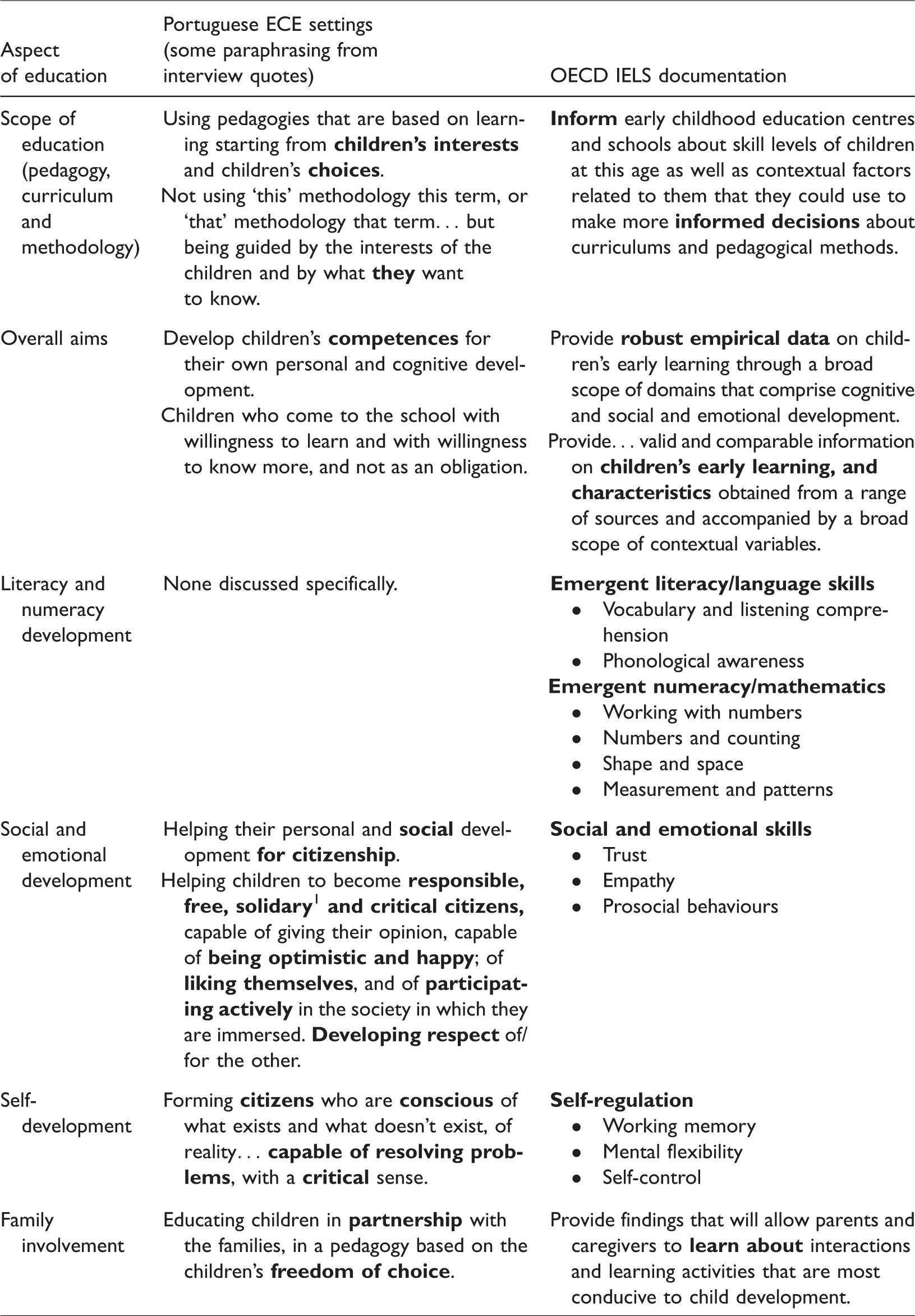
From Table 1 it is clear that there is a stark difference between the language used by Portuguese ECE educators to describe their work and the language used to describe the aims and ideal practices of ECE in the IELS documentation. In terms of scope of education, including curriculum, pedagogy and methodology, the starting point of both discourses is different. Portuguese educators emphasise pedagogy starting from the child’s interests and choices, while the IELS has pedagogy starting from the ‘expert’. This indicates a disconnect between considering the child as an individual who informs pedagogy, curriculum and methodology in the Portuguese discourses and considering the ‘adult expert’ as the knowledge base for the choices the institution should make within the IELS documentation.
Similarly, the overall aims of the Portuguese educators focus on the holistic development of the child within the contextual pedagogical processes in which they are involved. This conflicts with the aim of the IELS to produce robust, de-contextualised data about a group of children of the same age across multiple and diverse cultures and settings. In the specific area of domains of learning (literacy, numeracy and social and emotional development) the focus in Portugal is more informal and centred on developing competencies associated with democratic citizenship and critical thinking, whilst the IELS documentation provides a more formal locus aimed at developing specific, measurable skills. In terms of self-regulation, Portuguese educators give prominence to developing critical methods of collaborative problem solving, whilst the IELS documentation is concerned with the development of individual cognitive skills.
Finally, with regard to family involvement, Portuguese educators reinforce the role of families as partners in the educative process, identifying them as participants and fundamental stakeholders with agency to work with the child while respecting his/her freedom of choice in what and how to learn. In contrast, the IELS aims to provide information to parents about specific activities deemed to be ‘conducive’ to children’s learning and development.
Overall, Table 1 illustrates the divergence and disconnection between the two sources. Particularly interesting is the focus on the individual (with his/her valuable/quantifiable skills and competencies) promoted by the IELS documents. This individuality contrasts with the perception of the child as a competent social being in the educative process, a democratic citizen with agency and capacity for critical thought, highlighted in Portuguese ECE discourses. The values and purposes of ECE identified by the educators in Portugal were not related to learning that can be measured, whether in specific areas such as literacy and numeracy, or in less clearly defined domains such as well-being and self-regulation.
The comparison presented above highlights the divergence between the diversity and complexity manifested within educational practice in Portuguese ECE and the discourse presented by the OECD IELS project surrounding the idea of ‘what works’. In the next section we explore some of the implications of this divergence, including the dampening of localised discourses and the potential democratic deficit arising from standardisation and decontextualisation.
Potential implications of IELS in local ECE contexts
The disconnects between the discourses explored in the previous section could be perceived as an inevitable consequence of analysing discourses at two different levels of education: high level policy documents and the statements of educators working in the field. However, Sousa’s (2017) study demonstrates very clear links between the democratic aims of education as stated by the Portuguese Ministry of Education and the perceptions of educators relating to democracy in the classroom. It is evident from the changes made both in OECD documents such as ‘Starting Strong’ and policy shifts across the education sector in many countries that the discourses used within standardised comparative testing across ECE sectors can filter into classrooms and affect the ways in which educators perceive their work (Urban, 2014). In this section we discuss the ways in which the Portuguese settings could hypothetically be affected by the introduction of a testing programme such as IELS, as well as the broader implications of such a programme.
The three Portuguese settings discussed in this paper had different philosophies, missions and practices, and this diversity existed not only because they each responded to different contexts, but also because they involved and responded to the needs, values and beliefs of different people (educators, students, families, communities). While all the settings were informed by the same policies and curricular guidelines, what made them diverse was the people who ‘inhabited’ them. Each setting presented different practices because of the contexts in which they were immersed.
Comparing the IELS proposal with such diverse democratic practices in Portugal, it is clear that a concern with contextual complexities and realities of ECE practice is not part of the study’s remit. Failing to recognise such diversity within ECE practices indicates that as the IELS study is conceptualised and tested there will be no visible acknowledgement of the different ways of understanding the child and their realities and experiences which emerge from diverse socio-cultural and pedagogical contexts. The evidence presented in this article demonstrates that the values and norms of ECE practice in Portugal would not be captured by a study aimed at identifying factors contributing to the individual academic, social and emotional ‘well-being’ of the child. This could lead to a democratic deficit through the loss of semiotic complexity, by which we mean the different layers of complex realities, interpretations and symbolic relationships that result in a diversity of contextual practices.
The example of the diverse ECE provision and practice in Portugal highlights that a perception of ECE as universal constitutes a reduction of complexity that dismisses the existence of different paradigms, theories, pedagogies and purposes of and for education. It rejects subjectivity while narrowing the realities of ECE practice and encouraging a pedagogy of standardisation and compliance. Problematic binary discourses are created by comparative studies which ignore historical, cultural, social and pedagogical complexity and diversity, and whose objective is to generate and simplify generalisable policy messages at the expense of contextualised realities, transforming assessment into a political rather than educational device.
Discourses centred on performance, standards and outcomes inform public opinion and policy, and in the long term impact on services and practices by focusing on homogeneity, measurability and universality. A focus is placed on scientific evidence to provide universal truths that can be predetermined from childhood to adulthood. ‘Therefore, those who do not fit the assumed, very narrow, neoliberal model of identity are constructed as making “wrong” market choices and unjustly deemed as unable to benefit from a market-based economy’ (Salazar Perez and Cannella, 2010: 147–148). This in turn aligns with a modernist paradigm that feeds dominant discourses aiming to establish ‘what works’ and what ‘best practice’ looks like.
This model, we suggest, plays out most comfortably in societies which already subscribe to the Anglo-French early education model of early childhood, focusing on school readiness (Ringsmose and Kragh-Muller, 2017). In societies with a different view of childhood, for example the Nordic countries, the disparity between the dominant model of childhood (the social pedagogical model) and the measurable outcomes prioritised by IELS could, we argue, lead to a democratic deficit and a loss of contextualised forms of ECE.
The IELS is reductive in that it excludes not only approaches to ECE which do not fit the measurable model, but also reduces discourses to the binary through a series of exclusions at every level of the process. ECE settings are either included or excluded from the study; children within each ECE setting are either included or excluded; alternative (known) models of ECE are devalued and therefore excluded; and unknown and unseen models and discourses which do not correspond to the outcomes being measured are also excluded. The results of the study thus risk being predetermined to be self-referring and self-fulfilling: it may simply find what it is looking for and reaffirm its value. ‘Success’ is thus defined in terms of offering models for ‘improving’ ECE within the boundaries created by the study itself. Alternative and unseen models are dismissed as being valueless before the exercise has even begun, with serious implications for the ECE settings in which diversity and democracy are embedded and enacted.
Conclusion
In this article we have identified and analysed discourses underlying and justifying the use of international large-scale assessments in ECE, and used the case of Portugal to illustrate and explore the potential implications of the tensions between democratic discourses within ECE settings and the dominant discourses as espoused by the IELS. The analysis reveals a significant disconnect between these discourses, across a wide range of aspects of educational aims, scope and pedagogies. A stark example of such a disconnect is the focus on children as critical, conscious and collaborative citizens within the Portuguese ECE settings, contrasted with the IELS focus on the child as a human ‘in development’ with a series of individual characteristics that are desired, purportedly, for entry into the ‘knowledge economy’.
We argue that the IELS is characteristic of an increasing tendency to trust the views of ‘experts’ rather than practitioners, leading to a ‘medicalisation’ of educational research (Tröhler, 2015), a trend further advanced by the OECD’s explicit use of medical terminology (neuroscience, brain science) as it issues ‘prescriptions’ for the reform of education. Those who contest this discourse – ‘the only people who are opposing this … are people from pedagogy’ – are dismissed as opponents of ‘brain science’ and framed as backward-looking, resistant to progress and representative of an old-world order in which evidence was disregarded and ‘quality’ was not measurable (Schleicher, 2015). The additional imperative of national economic improvement is offered up as a potential reward for those willing to embrace the hard ‘evidence’ provided by the surety of large-scale international comparative data.
The role of the OECD as an international frame of reference has thus, over time, shifted from ‘documenter-advisor’ to ‘authority legitimiser’, with policy makers acting as ‘OECD users’. At the same time as encouraging young people to ‘learn to participate in a more interconnected world but also appreciate and benefit from cultural differences’ (OECD, 2017d, online), the OECD dismisses the influences of culture on the outcomes it chooses to measure: ‘these people [countries which have improved their PISA scores] don’t change their culture, they change what they do’ (Schleicher, 2015). This rhetorical device, appearing to open up the possibilities offered by cultural diversity while at the same time shutting them down as factors contributing to ‘success’, helps to contribute to the polarised and binary nature of debate around ‘what works’, allowing there to be only one ‘right answer’ in the form of identifiable best practice.
Alexander (2010: 159) points out what he calls ‘the absurdity of conflating … two definitions: … to equate early years as development with what a particular country or local authority offers by way of early years provision is clearly wrong’. Trying to identify the main elements of ‘best practice’ in universal terms means denying that there are multiple ways of learning, multiple ways of being and multiple ways of living. Within any education environment there are diverse opportunities to experience and develop, ‘these opportunities are as diverse in function, form, and purpose as the cultures and peoples they represent’ (Hisrich and Blanchard, 2009: 240). The stated purpose of IELS is to improve early childhood experiences for all children, but the dismissal by the OECD of alternative views of childhood which do not easily fit the neoliberal, western-centric discourses framed by economic imperatives has the unfortunate potential to do the exact opposite.
Footnotes
Acknowledgement
The authors would like to thank Professor Paul Morris for his support and guidance during the writing of this paper.
Declaration of conflicting interests
The author(s) declared no potential conflicts of interest with respect to the research, authorship, and/or publication of this article.
Funding
The author(s) received no financial support for the research, authorship and/or publication of this article.