




Abstract
Educational institutions have been among the most active social organisations responding to and facilitating processes associated with globalisation. This has primarily been undertaken through the attempts of schools and universities to ‘internationalise’ their student intake, staffing, curricula, research, and assessment systems. Amongst the many benefits associated with the promotion of ‘internationalisation’ is that it will provide students with attributes such as global citizenship, skills or competencies that will contribute to improving tolerance, respect and harmony between nations and cultures. Various nations and global agencies actively promote such goals and global citizenship is included in the United Nations’ Sustainable Development Goals. Positioned as a response to the Sustainable Development Goals, the Organisation for Economic Co-operation and Development has developed a metric to compare the ‘global competency’ of 15-year-old pupils, which was incorporated into the Programme for International Student Assessment 2018. We analyse the rationales for this decision, the conception of ‘global competence’ adopted by the Organisation for Economic Co-operation and Development and how these have changed since its inception in 2013. We also explore how it will be measured and how the organisation deals with what it describes as ‘the most salient challenge affecting PISA’. We argue: (i) the official conception of ‘global competence’ finally adopted was strongly influenced by the organisation’s quest to position itself as the agency responsible for monitoring progress on the Sustainable Development Goals, and then amended to match what could be easily measured; and (ii) although the organisation presents its global competencies using a humanitarian discourse, it is framed by its economic mission.
Keywords
Introduction
The Organisation for Economic Co-operation and Development (OECD) compares the academic performance of 15 year olds globally through its Programme for International Student Assessment (PISA), describing the assessment as ‘the world’s premier yardstick for evaluating the quality, equity and efficiency of school systems’ (OECD, 2012: 11). Table 1 shows the demographic coverage of its international large-scale assessments (ILSAs), which now include adults, 4–5-year-olds, teachers and university students.
Organisation for Economic Co-operation and Development (OECD) main international education survey.
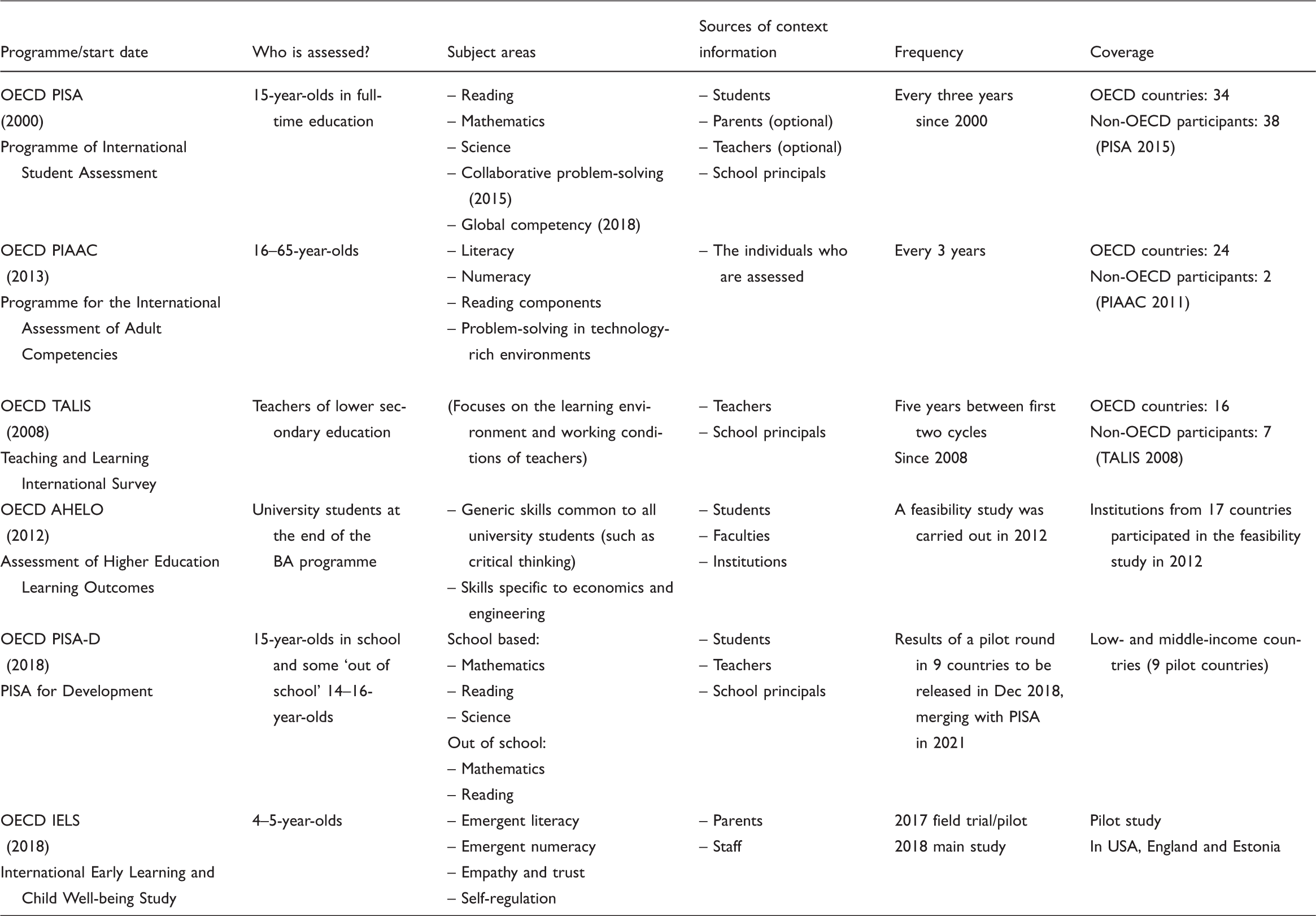
Through these ILSAs the OECD has exerted a significant but uneven influence on national education systems, often redefining the aims of schooling indirectly by encouraging the narrowing of curricula, and more directly by advocating the integration of its test components in local curricula and the transfer of policies and practices associated with high-performing nations. The tests are an exercise in economic internationalisation as their rationale has been based on the claim that future economic growth and survival of nations in the global knowledge economy necessitates improving the quality of human capital, as measured by PISA scores, and through the transfer of international/global ‘best practices’. Drawing on Woodward (2009), Sellar and Lingard (2013) refer to these processes of normalisation and knowledge construction as cognitive and epistemic governance respectively. Through these processes, the OECD’s testing regime has emerged as a powerful form of ‘internationalisation’ that has the capacity via comparative measurements to affect entire education systems from kindergartens to higher education. When extended to global competencies, the assessment has the potential to be used as a measure of internationalisation in schools, and to exert pressure for reform.
The OECD’s new paradigm for development (OECD 2011b; 2011b) is significant for this study, marking the organisation’s intention to extend its influence into developing contexts, with the stated goal of having 170 nations participating in PISA by 2030 (Ward, 2016). To pursue this new paradigm, the organisation unveiled its PISA for Development (PISA-D) initiative, which is currently being piloted and which will massively extend the OECD’s coverage by providing a gateway for low- and middle-income nations to participate in the regular PISA assessment from 2021 onwards. The OECD legitimated this move by positioning PISA (through PISA-D) as the primary metric for measuring progress on the UN’s Sustainable Development Goal (SDG) 4.1.1, which emphasised ‘inclusive and equitable quality education’ for secondary-aged pupils. Moving to position itself as the primary agency responsible for tracking progress on the SDGs, the updated OECD Learning Framework 2030 (OECD, 2018b) extends beyond the cognitive-economic focus of ‘education quality’ to encompass the non-cognitive dimensions highlighted in SDG 4.7: …the knowledge and skills needed to promote sustainable development, including, among others through education for sustainable development and sustainable lifestyles, human rights, gender equality, promotion of a culture of peace and non-violence, global citizenship and appreciation of cultural diversity and of culture’s contribution to sustainable development. (Target 4.7, United Nations Educational, Scientific and Cultural Organization (UNESCO), 2016: 20)
An extensive overview of the OECD’s agenda and goals was developed as an interpretive frame to guide the analysis. This process began with an initial literature review that analysed the OECD’s mission and agenda in education governance, primarily surveying relevant academic commentaries (e.g. Addey, 2017; Kallo, 2009; Sellar and Lingard, 2014). This was followed by an in-depth analysis of organisational documents detailing the extension of the OECD’s agenda in education governance through its ‘new paradigm for development’ (OECD, 2011a, 2011b, 2012, 2013) and the evolution and maturation of this agenda in the form of the OECD Learning Framework 2030 (OECD, 2016a, 2018a). These reviews were used to clarify the OECD’s shifting agenda and to provide a basis for interpreting its activities, including the decision to include global competence in the assessment, as well as its changing nature over time. To inform this interpretation, we undertook a further review of documents preceding the post-2015 discussions (e.g. UNESCO, 2012), the final shape of the United Nations’ (UN’s) SDGs (UNESCO, 2016) and reports that attempt to establish a framework for monitoring progress on these goals (e.g. UNESCO Institute for Statistics (UIS), 2016, 2017, 2018).
Within this frame, we conducted a thematic analysis of the key OECD documents relating to global competence that had been published since it first appeared in 2013, identifying key features and how they had changed or remained consistent over time (OECD, 2014, 2016a, 2016b, 2018a, 2018b; Reimers, 2013; Schleicher, 2016, 2018). This was pursued through an iterative process of independent coding, extension and then collaborative triangulation, before supplementing this with analysis from two scholarly articles that were brought to our attention as we were undertaking our review (Grotlüschen, 2017; Ledger et al., forthcoming). These two articles provided insights into the nature of the ‘global citizen’ promoted by the OECD and the actors involved in developing its framework, which we then situated within the interpretive frame guiding the analysis in this article. The structure of the article addresses sequentially the critical issues concerning the OECD’s measurement of global competence: why was it undertaken; how was global competency defined; who defined it; and how does the OECD overcome challenges inherent in measurement and comparison.
Tracing the shifting rationales and definitions over time in this way complements research that delves inside the PISA laboratory (Gorur, 2011), and which unpacks both issues associated with achieving comparability (Gorur, 2014, on equity) and the cultural assumptions embedded in measurements (Rappleye et al., forthcoming, on wellbeing). Our analysis reveals a process that is more ad hoc and opportunistic than the official portrayal, and, while the measurement was developed as part of the OECD’s aspiration to expand its influence in education governance (see Addey, 2017; Auld et al., 2019), there is a high degree of contingency to both its inclusion and the outcome. The decision to measure global competence complements the OECD’s Learning Framework 2030, which is allied to the UN’s SDGs, but is also in line with Schleicher’s (2018) recent assertion that PISA will be ready to evolve to accommodate new trends and ‘hot topics’, and to thereby ensure its continued relevance. The assertion indicates a significant shift in approach, with implications for how PISA is constructed and analysts’ ability to maintain its scientific credentials.
The three domains measured regularly by PISA (science, maths and literacy) have a far more established nature than global citizenship, which largely operates as a floating signifier and conveys a diverse range of meanings. Oxley and Morris (2013) identify eight different conceptions of global citizenship used in the literature, and there is also evidence that the concept is understood and represented in school curricula differently across nations (Goren and Yemini, 2017). Countries that are high in nationalism (e.g. USA, Israel, China) tend to frame global citizenship education as a tool for maintaining their status, whereas countries dealing with an influx of immigrants (e.g. Spain and Germany) try to frame it in more multicultural terms (Engel, 2014; Engel and Ortloff, 2009). In each of these settings local influences can be found to impact the way global citizenship education (and citizenship in general) is understood and received. A similar absence of uniformity is evident in how global citizenship is defined by the OECD over time and by different international agencies. For example, voices within UNESCO promote the SDGs from a far less instrumental perspective than the OECD (e.g. UNESCO Mahatma Gandhi Institute of Education for Peace and Sustainable Development (MGIEP), 2017).
We argue that the OECD’s conception of global competencies is an ahistorical and depoliticised entity, focusing on the cognitive domain through the measurement of pupils’ understanding. This is fundamentally in tension with the organisation’s quest to promote the ‘appreciation of cultural diversity’, as the model ‘global citizen’ ultimately sounds like a model OECD intern (OECD, 2018c) or member of the global middle class (Maxwell and Yemeni, 2018). We suggest the rationale for measuring global competencies has in its final form been driven by the organisation’s goal of legitimating and strengthening its role in measuring the SDGs through PISA-D, evidenced by its inclusion in the OECD’s Learning Framework 2030 (OECD, 2018b). Under the post-2015 banner of humanitarian assessment, the organisation has superficially aligned its definition with the UN’s SDGs but will use global competencies to support its core purpose; namely, to identify the causes of high performance on its assessments and to then promote policies and practices that might improve education-economic performance in other nations.
Surveying the OECD’s measure of global competence
Rationales
Between 2013 and 2018, a multitude of reasons for assessing global competencies were presented, but the overall narrative that runs through the documents is one in which the OECD portrays itself as responding to two exogenous forces. First, it is depicted as a necessary and inevitable response to the irresistible impacts of globalisation and technological change. Second, it claims it is undertaking the task in response to the demand of others (policy makers/educational leaders) who are seeking to address those impacts. Similar claims, that PISA-D and the International Early Learning and Child Well-being Study were developed in response to demand from stakeholders, were made despite evidence to the contrary (Auld et al., 2019). Here we survey the rationales that were given at each key stage between 2014–2018.
The first proposal that the OECD should assess global competencies was made by Fernando Reimers in a paper considered by the PISA Governing Board in 2013. Reimers emphasised ‘a world that is increasingly interdependent’, in which ‘people will have to negotiate how to adopt ethical and legal frameworks amidst cultural pluralism’, and in which ‘they will have to figure out their common humanity and their differences with others who come from different cultural and civilization origins’ (Reimers, 2013: 1). Ultimately, the rationale for ‘global education’ is presented as ‘preparing students to make meaning of their lives in [this] highly interdependent world’. Building on this, Reimers positioned global education as ‘the new civics of the 21st century’, claiming that ‘citizenship is embedded in a mesh of relationships that are global as well as local’ (Reimers, 2013: 1). Comparative research is then positioned as particularly useful for supporting this task, with the final inference: ‘building on the successful record of the PISA studies, [the OECD] is well positioned to assume a leadership role in advancing the development and implementation of cross-national assessments of global competencies of students’ (Reimers, 2013: 2).
Reimer’s (2013) paper was titled Assessing Global Education: An Opportunity for the OECD, raising the question of what this opportunity was, and why it was so timely. UNESCO has traditionally been viewed as the organisational carrier for civics education (Rauner, 1999), and earlier in 2013 Reimer had acted as an expert at the UNESCO Technical Consultation on Global Citizenship Education (2013), for which the rationale was: The Global Education First Initiative (GEFI), launched in 2012 by the UN Secretary-General, includes global citizenship education as one of its three priorities. Within UNESCO, education for peace and sustainable development is being proposed to be the overarching goal of its education programme for the next 8 years, with empowered global citizens as an objective. Work is underway through the Learning Metrics Task Force to define what is required to support young people become ‘citizens of the world,’ including learning outcomes and competencies. 1.1.3. There is a clear opportunity to include reference to global citizenship education in the post-2015 development agenda as part of the knowledge, skills and competencies that learners require in the 21st Century and beyond. (UNESCO, 2013: 2)
One year later, the 38th meeting of the PISA governing board (OECD, 2014) discussed the PISA 2018 Framework Plans, with global competence on the agenda. Reimer’s research is referenced, but only to note a history of efforts to define global competence, to confirm that those definitions are influenced by various contested and changeable values and then to identify some aspects of those definitions. UNESCO is mentioned only once, regarding surveys run by other international organisations, and there is nothing about either the Millennium Development Goals or the post-2015 discussions. The interest in global competencies takes the same starting point, emphasising the way in which ‘our learning, work and societal environments are becoming increasingly global, interconnected and interdependent’, and arguing that ‘students must leave school equipped with the attitudes, knowledge and skills to work and live in a global society and that educators must develop global competencies in themselves and their students’ (OECD, 2014: 6). These experiences are deemed ‘crucial for the growing number of students who will seek to pursue their further studies outside their home country’, and ‘to make a positive contribution to the global community’ (OECD, 2014: 6).
The rationale is, however, still framed by the organisation’s vision of the global knowledge economy, emphasising that ‘education needs to adapt its program and take account of what students will need in their future lives… [as] the requirements of the global knowledge required in the 21st century society go far beyond the traditional literacies’ (OECD, 2014: 6). The idea that global competencies are necessary for students to function as mobile knowledge workers is developed with reference to a framework developed by Pearson, a corporation that describes itself as 'the world's leading learning company. The OECD governing board states that Pearson's framework, ‘covers the attitudes, behaviours, knowledge and skills that students, by the end of formal secondary education, need to be equipped with in order to be successful in their future studies and employment paths’ (OECD, 2014: 6). A further departure from global competencies as ‘the new civics’ relates directly to the OECD’s quest to identify the ‘factors’ associated with high performance on its assessments: ‘To meet the demands of the 21st century we have proposed the following overarching framework (see Figure 1) to show how the different components of PISA 2018 will – in combination – enable interpretation of PISA outcome data and increase the likelihood of revealing causality’ (OECD, 2014: 7).
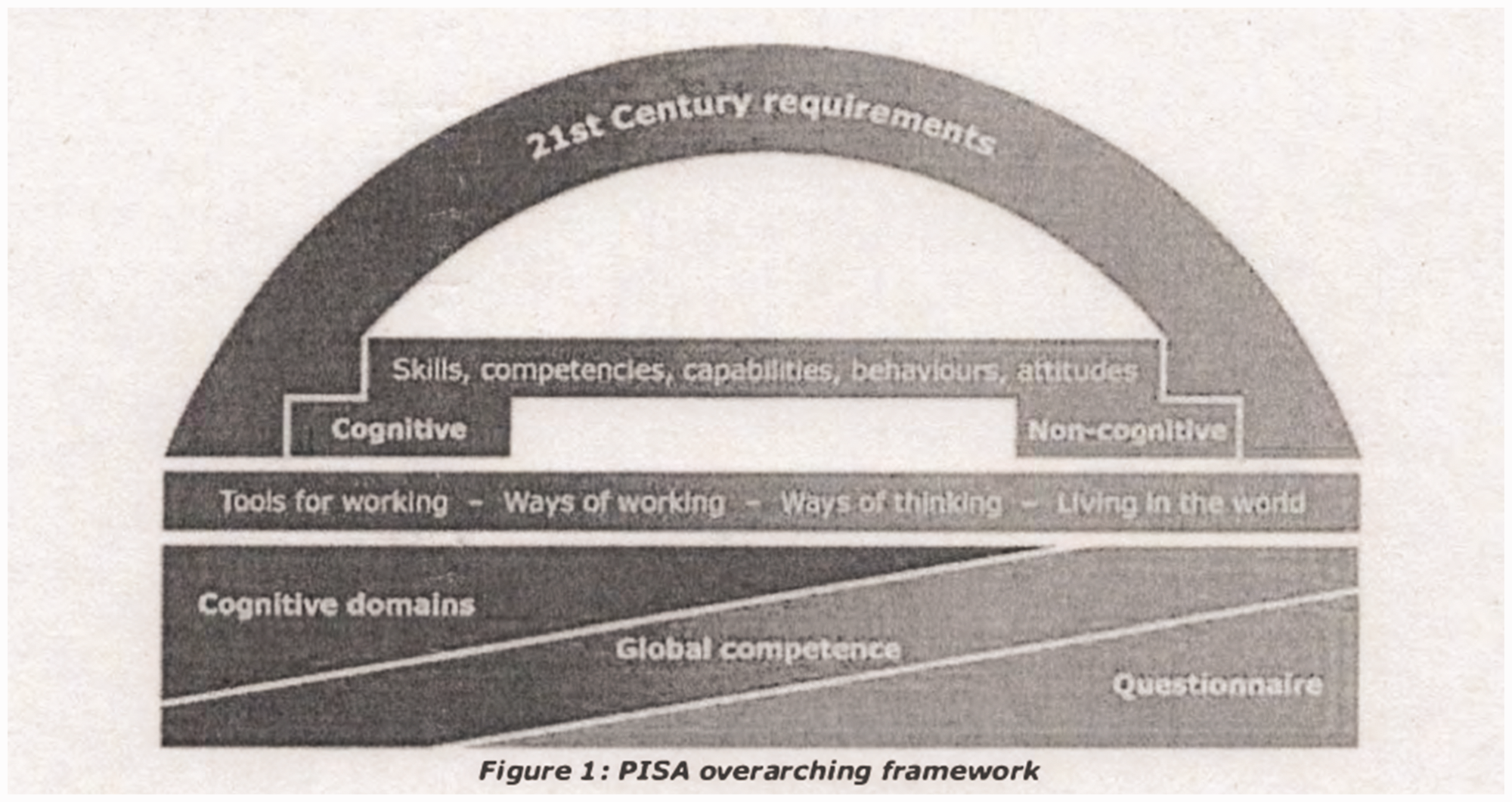
PISA 2018 overarching framework.
The report elaborates, ‘This model suggests that the purely cognitive and essentially non-cognitive form a continuum, from skills to behaviours and attitudes, from tools for working to living in the world’ (OECD, 2014: 7). After PISA had gone through several rounds, Schleicher (2009) conceded that it would not be possible to identify causal relations through PISA. The OECD (2012) sought to overcome the issue by ‘combin[ing] advanced forms of educational assessment with sophisticated survey research methods’ to identify an ‘extensive web of correlations’, which would in turn reveal the ‘range of factors that could conceivably affect that performance’ (OECD, 2012: 23). The rationale thus emerges that, by expanding the measurement into yet more domains, the organisation will ultimately get closer to identifying causality. Global competencies is thus an additional variable within the overarching schema of 21st-century requirements/skills, with the primary goal of cultivating knowledge workers for the global economy. That is, it was framed by the OECD’s long-established mission (to identify and advocate the causes of high education-economic performance) rather than by: (i) its new paradigm for development, (ii) anticipated post-2015 discussions, or (iii) demand from member (or non-member) nations.
Two years later, the basic claims regarding the global situation are the same, and Andreas Schleicher opens the foreword with a familiar economic framing: The more interdependent the world becomes, the more we rely on collaborators and orchestrators who are able to join others in work and life. Schools need to prepare students for a world in which people need to work with others of diverse cultural origins, and appreciate different ideas, perspectives and values. (OECD, 2016a)
Despite global citizenship’s inclusion under SDG4.7, there is no explicit mention of the SDGs amidst the rationales. The competencies remained situated within the OECD’s overarching framework, which aimed to combine ‘the purely cognitive and essentially non-cognitive’ into a continuum revealing underlying causal relationships, which would in turn be used to identify policy lessons and improve education-economic performance. The framework itself, however, was updated in 2016 as part of the OECD’s emerging Education 2030 Framework (OECD, 2016a: 2) (see Figure 2 below). The document emphasises ‘the need to find a new concept of growth’, one that ‘may not be a quantifiable concept, based solely on maximising economic gains, but a multidimensional concept that includes care for the environment and social harmony, as well as acceptable levels of security, health, and education’, and which covers ‘quantitative and qualitative indicators, including subjective well-being and quality jobs’, ensuring ‘the benefits of growth are fairly shared across society’ (OECD, 2016a: 1).
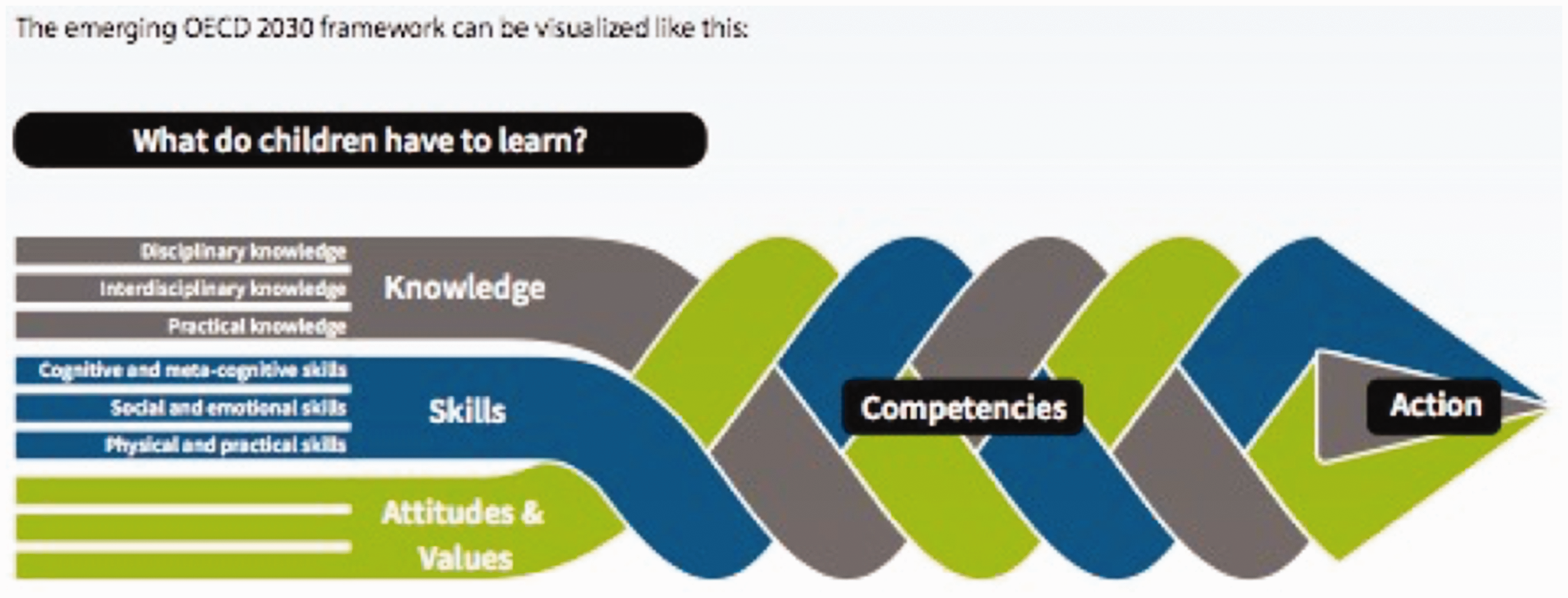
Education 2030 Framework.
Although there is no mention of the SDGs, global competencies/citizenship or sustainability in the framework presented in 2016, the OECD would later claim that its Learning Framework 2030 (OECD, 2018b) ‘contributes to the UN 2030 Global Goals for Sustainable Development (SDGs), aiming to ensure the sustainability of people, profit, planet and peace, through partnership’ (OECD, 2018b: 3). That is, the basic framework originally conceptualised under the OECD’s new paradigm for development was gradually extended to incorporate more aspects of the SDGs and thereby to align more closely with the UN-sanctioned agenda post-2015.
In 2018, the organisation found its final positioning. Gabriela Ramos opens the foreword by reiterating the two main rationales for GC identified in OECD (2016a). These relate to future knowledge workers and a plea for inclusivity: Reinforcing global competence is vital for individuals to thrive in a rapidly changing world and for societies to progress without leaving anyone behind… Citizens need not only the skills to be competitive and ready for a new world of work, but more importantly they also need to develop the capacity to analyse and understand global and intercultural issues… Together, we can foster global competence for more inclusive societies. (OECD, 2018a: 2) In 2015, 193 countries committed to achieving the UN’s 17 Sustainable Development Goals (SDGs), a shared vision of humanity that provides the missing piece of the globalisation puzzle. The extent to which that vision becomes a reality will depend on today’s classrooms….This has inspired the OECD’s PISA, the global yardstick for educational success, to include global competence in its metrics for quality, equity and effectiveness in education. PISA will assess global competence for the first time ever in 2018. In that regard, this framework provides its conceptual underpinning. (OECD, 2018a: 2) Educating for global competence can boost employability. Employers increasingly seek to attract learners who easily adapt and are able to apply and transfer their skills and knowledge to new contexts. Work readiness in an interconnected world requires young people to understand the complex dynamics of globalisation, be open to people from different cultural backgrounds, build trust in diverse teams and demonstrate respect for others. (OECD, 2018a: 5) A fundamental goal of this work is to support evidence-based decisions on how to improve curricula, teaching, assessments and schools’ responses to cultural diversity in order to prepare young people to become global citizens. (OECD, 2018a: 6)
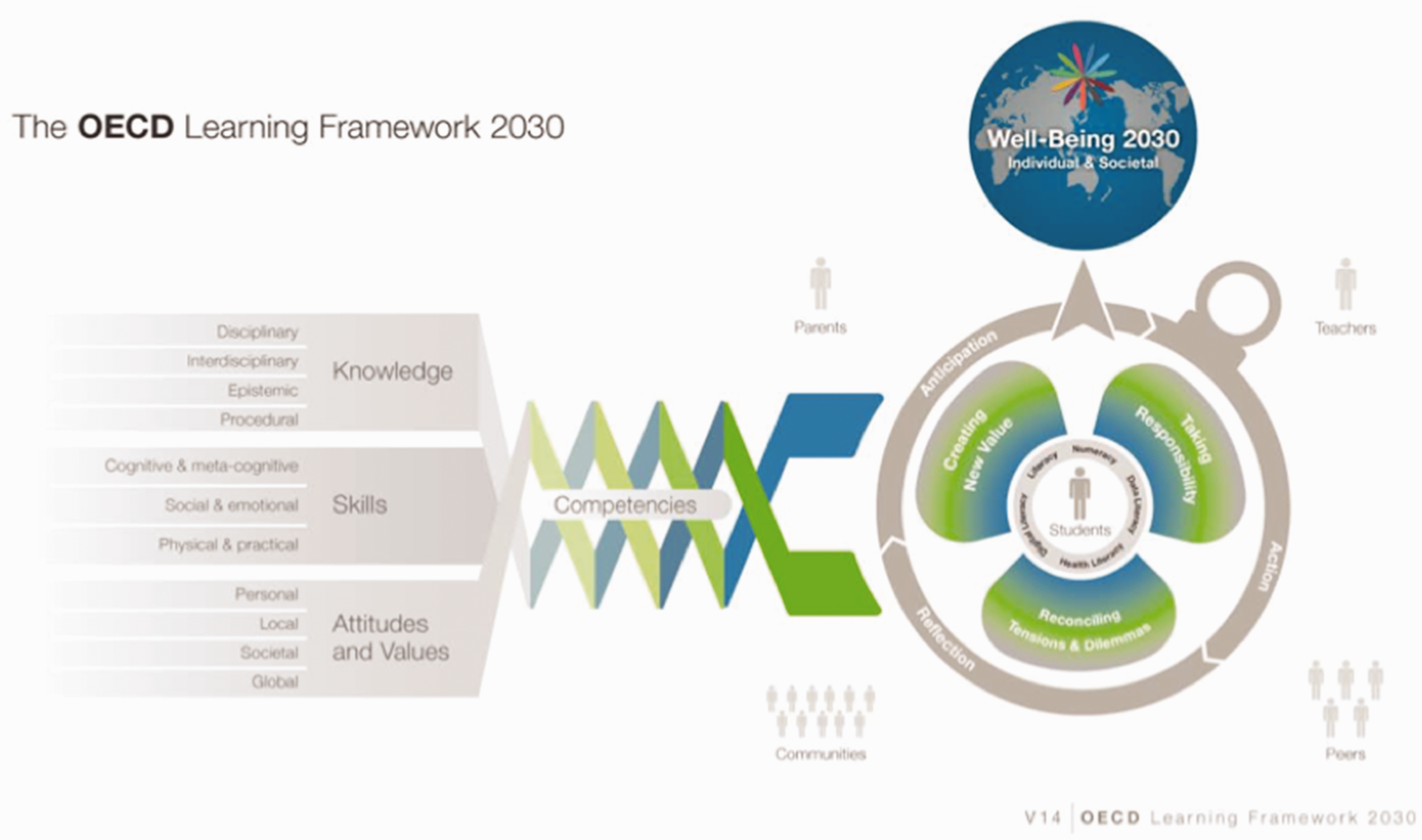
OECD Learning Framework 2030: Work-in-progress.
This shift in rationales is mirrored in the way ‘global competencies’ was redefined, which we explore below.
(Re)defining global competence
The definitions of global competence have varied over time and, while there are some common elements across the documents, a process of alignment with the SDGs is discernible, particularly in the final document. The definitions are summarised in the following quotations and discussed below: … the skills and mind habits to understand global interdependence, and to live with meaning and direction in contexts where global interactions increase exponentially. (OECD, 2013: 2) … the capacity of an individual to understand that we learn, work and live in an international, interconnected and interdependent society and the capability to use that knowledge to inform one's dispositions, behaviours and actions when navigating, interacting, communicating and participating in a variety of roles and international contexts as a reflective individual. (OECD, 2014: 9) … the capacity to analyse global and intercultural issues critically and from multiple perspectives, to understand how differences affect perceptions judgements, and ideas of self and others, and to engage in open, appropriate and effective interactions with others from different backgrounds on the basis of a shared respect for human dignity. (OECD, 2016a: 4) … the capacity to examine local, global and intercultural issues, to understand and appreciate the perspectives and world views of others, to engage in open, appropriate and effective interactions with people from different cultures, and to act for collective well-being and sustainable development. (OECD, 2018a: 7) …refine(s) this initial high-level definition of the construct. The GEG will do so as it continues its discussions of the knowledge, skills, attitudes, and behaviours that comprise global competence. (OECD, 2014: 10)
The final definition of OECD (2018a) contains two significant changes from the OECD (2016a) definition. First, the expectation that pupils are critical and reflect on their own perceptions of others was removed. Second, the quest for ‘human dignity’ was replaced by ‘to act for collective well-being and sustainable development’. The reasons for these changes are not specified but the focus on ‘understanding’ aligns global competence more closely with assessment, as understanding is more readily measurable than critical reflection. Similarly, the removal of reference to ‘respect for human dignity’ allows a focus on cognitive aspects (knowledge, skills and attitudes) and allows the exercise to avoid assessing ‘values’.
The direct references to sustainability and well-being introduced in 2018 follow the amended rationale and strengthen the OECD’s quest to assess the SDGs through PISA-D and its Learning Framework 2030 (OECD, 2018b). This can be interpreted as the evolution of its new paradigm for development, extending beyond the cognitive-economic focus into the non-cognitive aspects of education and aligning with the UN’s globally sanctioned agenda.
The nature of the global citizen
The OECD (2018a) divides global competency into four primary dimensions (knowledge, values, attitudes and skills) and then targets four primary rationales: to live harmoniously in multicultural communities; to thrive in a changing labour market; to use media platforms effectively and responsibly; and to support the SDGs. What emerges is a conception of global competence that is more akin to promoting intercultural tolerance and global sustainability. In terms of Oxley and Morris's (2013) analysis of the conceptions of global citizenship, the focus is on a cultural/social/sustainable conception rather than a critical or political one that requires active engagement. The result is a portrayal of the global as an ahistorical, depoliticised and fixed entity, which is to be accepted and understood as it is. The expectation is that schools should teach pupils about globalisation and provide them with the skills to adapt and fit into it. Any consideration that the world has been shaped through colonisation, subjugation and religious fundamentalism, inter alia, and that the barriers to human dignity operate both within and across nations and cultures is absent. Similarly, with specific regard to the OECD (2016a) document, Ledger et al. (forthcoming) comment: … (it) presumes that young people need to change to meet the world of the future, rather than suggesting that we should work systemically to construct alternative futures to meet the needs of the young…. Thus, young people must change to fit the predicted world, eschewing a world that should be changed to fit people (Ledger et al., forthcoming: 21) … a globally competent person feels confident and happy about travelling to other countries, implying that if one hails from a background where this is not a norm, and feels apprehensive about such new experiences, one is not globally competent… The ideal globally competent student has money to donate to charity, has a home in which they can host exchange students, has met people from many countries, and goes to a school which is able to offer exchange programmes. These variables essentially describe the habitus of a global elite, making it hard to see how a child from a lower socio-economic background and/or an attendee of a poorly funded local school could possibly score well on this scale. (Ledger et al., forthcoming: 24–25)
Further insights into the problems that the test faces are provided by the sample questionnaire items, many of which require pupils to express their extent of agreement/disagreement with statements such as these: Immigrants who live in a country for several years should have the opportunity to vote inelections. Immigrants should have the opportunity to continue their own customs and lifestyle. I want to learn how people live in different countries. I am interested in how people from various cultures see the world. I am interested in finding out about the traditions of other cultures.
Who was involved
The nature of the competent global citizen is best understood with attention to those involved in its construction. In this section we again draw on the detailed analysis developed by Grotlüschen (2017) and Ledger et al. (forthcoming), and supplement this with insights from Kraess’ (2018) analysis of PISA-D. The OECD (2018a) claims that the final framework is: …the product of a collaborative effort between the countries participating in PISA and the OECD Secretariat, under the guidance of Andreas Schleicher and Yuri Belfali. (OECD, 2018a: 1) Overall, the group never was very global; it never included countries which are less familiar with the English language than the former Commonwealth and Asian countries. There is no contribution from Latin America and Africa… Grotlüschen (2017); 8 The process documents from 2014 contain citations of theories on feminism, gender and sexual orientation as well as anti-racist and postcolonial theories (OECD 2014, 25-28). These references disappeared in the most recent brochure (OECD 2018). Theories of moral development and their feminist critique were removed. Citations regarding feminism, homosexuality, Latin Americans or People of Color perspectives mostly disappeared….Northern definitions of literacy, numeracy and global competence are spread over the globe and Northern hierarchies of high and low literacy, high and low global competence are counted in levels and numbers. Grotlüschen, (2017): 5 …despite OECD nominally espousing a version of global competency based on multiple perspectives and understanding cultural differences, (our) findings show evidence of an OECD conversation impoverished by a limited degree of diversity of scholars, publication types, backgrounds, and viewpoints … a mistake that runs afoul of the very purpose of educating for global competency. (Ledger et al., forthcoming: 33, 38)
Dealing with the challenges: science by streetlight
To identify and advocate ‘best practice’, the OECD has to endorse a series of problematic assumptions (see Auld and Morris, 2014, 2016). It must demonstrate that (i) the aims and outcomes of education systems are directly commensurable and are accurately captured by comparative assessment surveys (specifically, the conception of global competency). To be meaningful, the measure should have some greater significance, which was traditionally that (ii) systems’ performance on cross-national assessment surveys can be directly related to future competitiveness in the global knowledge economy (see Komatsu and Rappleye, 2017 for critique). This is now supplemented more broadly with regard to improvement on the assessment being central to achieving the SDGs and therefore collective well-being. To identify policy lessons, the OECD must assume that (iii) the causes of high-performance exert an independent, constant and predictable effect, are absolute and universal and therefore are readily transferable. In terms of locating causality within a specific aspect of society, to support the transfer of ‘better policies for better lives’, (iv) causality must be located within school systems’ practices and structures.
The foundations for bypassing these issues are laid in the construction of the measurement itself. It is illustrative of the OECD’s depoliticised perspective that the school and the family are identified as the sole sources of discriminatory behaviour, whilst no reference is made to national governments, the media or politicians.
3
In 2016, global competency was promoted because it would help ‘to counter the discriminatory behaviours picked up at school and in the family’ (2016a: 2). Two years on, the OECD (2018a) stated, ‘PISA will provide a comprehensive overview of education systems’ efforts to create learning environments that invite young people to understand the world beyond their immediate environment’ (OECD, 2018a: 5). Throughout, young people’s global competency is framed as wholly determined by the actions of schools. For example, the 2018 assessment is described as ‘the first comprehensive overview of education systems’ success in equipping young people to address global developments and collaborate productively across cultural differences in their everyday lives’ (OECD, 2018a: 38). Notwithstanding, the OECD notes that the Global Understanding Survey of Barrows et al. (1981) found: … only weak relationships between students’ educational experiences—coursework, language study or study abroad—and their levels of international knowledge. (OECD, 2018a: 22) The most salient challenge for the PISA assessment is that — through a single international instrument — it needs to account for the large variety of geographic and cultural contexts represented in participating countries … (OECD, 2018a: 21) ‘Culture’ is difficult to define because cultural groups are always internally heterogeneous and contain individuals who adhere to a range of diverse beliefs and practices. Furthermore, the core cultural beliefs and practices that are most typically associated with any given group are also constantly changing and evolving over time. However, distinctions may be drawn between the material, social and subjective aspects of culture. Culture is a composite formed from all three of these aspects, consisting of a network of material, social and subjective resources. The full set of cultural resources is distributed across the entire group, but each individual member of the group only uses a subset of the full set of cultural resources that is potentially available to them… Defining culture in this way means that any kind of social group can have its own distinctive culture: national groups, ethnic groups, faith groups, linguistic groups, occupational groups, generational groups, family groups, etc. The definition also implies that all individuals belong to multiple groups, and therefore have multiple cultural affiliations and identities. (OECD, 2018a: 8) However, related concepts exist in many countries and cultures around the world. One interesting perspective on global competence comes from South Africa and involves the concept of Ubuntu. There is much literature written about Ubuntu… meaning that a person is a person because of others. This concept of Ubuntu can be used to illustrate a collective identity, as well as connectedness, compassion, empathy and humility. There are other similar concepts to Ubuntu found in different cultures around the world including in indigenous cultures in the Andes and in Malaysia. Collective identity, relationships and context (as impacted by historical, social, economic and political realities) all become major emphases in other cultural discourses on global competence. (OECD, 2018a: 19)
In terms of developing the assessment, the OECD has positioned PISA as a reliable and scientific measurement. While this assessment and its cognitive-economic claims have been challenged (Komatsu and Rappleye, 2017), the organisation’s analysts have encountered even greater difficulty dealing with concepts such as equity and well-being. Gorur (2014) highlights how OECD analysts were well aware that if they wanted to present a coherent measure of equity they ‘couldn’t go in’ to the philosophical debate, and the diminished concept that resulted. Rappleye et al. (forthcoming) identify the cultural assumptions about the nature of self and other underpinning the OECD's conception of well-being and demonstrate how this in turn influences the subsequent ranking of ‘happy’ and ‘unhappy' schools.
In the case of global competencies the problems are multiplied, and just as the rationale and definitions had shifted over time to follow what should be measured, the aspects measured (i.e. the de facto definition) again simply follow what can be measured. The actual assessment largely does not attempt to measure the qualities stated under the official definition, and social skills and attitudes are limited to background information (values are not assessed at all – see below). Three domains of global competence are identified (OECD, 2018a: 22) and the methods of assessment are:
Knowledge – cognitive test and questionnaire Cognitive skills – cognitive test and questionnaire Social skills and attitude – questionnaire only
Values are included as a fourth domain in the framework but described as ‘beyond the scope of the PISA 2018 assessment’, which does not rule out the possibility that they will be assessed later. As noted above, however, the official definition of global competency is not actually being assessed as the organisation focuses on what is more easily measured. In so doing, the OECD provides an illustration of a classic methodological problem; namely the ‘street light effect’, which involves a tendency to search for an object where the lighting is best, not where it is located (Freedman, 2010). In this case the lighting is best if the focus is on assessing and comparing the cognitive domain.
A challenge of a more technical nature arises from the nature of the assessment items described above. Most 15 year olds will be able to discern the most virtuous answer from the questions and the tests may provide a good indication of national differences in their degree of compliance and willingness to provide the virtuous answer. A variant of that problem is recognised when it is explained that: people from some cultural backgrounds tend to exaggerate their responses to typical questionnaire items based on a Likert-type scale… whereas others tend to take a middle ground. (OECD, 2018a: 22) The responses to the questionnaire items will thus not be used to position countries and students on a scale. Instead, they will be used only to illustrate general patterns and differences within countries in the development of the skills and attitudes that contribute to global competence among 15-year-old students, as well as to analyse the relationship between those skills and attitudes and students’ results on the cognitive test. (OECD, 2018a: 22)
Conclusion
Our analysis challenges many of the basic claims made by the OECD. Contrary to claims that it was inspired by the SDGs, this rationale was stated long after the decision had been made to proceed and the development work had begun. The claim that the exercise was undertaken as ‘a collaborative effort between the countries participating in PISA’ is partly true, as the main participants were drawn from the USA and UK. However, these nations withdrew from participating in the measurement of global competence. The OECD’s claim that it has successfully devised a universal and accurate measure capturing the essence of both western and non-western views of global competence is not supported. On the contrary, we suggest that the OECD’s view of a globally competent student is one that is rooted in an elite western liberal tradition that privileges the privileged. In brief, it has failed its own assessment.
The OECD’s definition of global competence shifted markedly from 2014 and the final version was notable for its inclusion of ‘sustainable development’ and ‘collective well-being’. We interpret this as a late attempt by the OECD to position itself as the primary agency responsible for measuring and monitoring progress on the SDGs in education, extending its new paradigm for development through the OECD Learning Framework 2030. Unlike earlier OECD assessments, the move into global competencies is now promoted through a humanitarian discourse and is not framed primarily in economic terms, though many of the same assumptions regarding improved job prospects and future economic growth remain key aspects of the framework. As a one-off exercise, we argue its key role and significance is to legitimise the ‘conceptual underpinnings’ of its framework by demonstrating its capacity to measure global competence.
Dill (2013) argues that there are two competing features in global citizenship education: (i) a global consciousness that includes an awareness of other perspectives, a vision of oneself as part of a global community, and a moral conscience to act for the good of the world; and (ii) global competencies that include skills and knowledge for economic success in global capitalism. We suggest the OECD has adopted the language of the former in pursuit of the latter, but that the OECD’s agenda and assessments are in turn being reshaped by its decision to adopt this discursive theme. Caution should be exercised when the results of the assessment are released and the OECD proceeds to identify policies and practices associated with ‘global competence’. We anticipate that the OECD will present its assessment of global competence as the ‘world’s premier yardstick’ of internationalisation in schooling, recommending schools integrate PISA components into curricula to enhance students’ global competence.
Such a move will ignore the aspects of schooling (e.g. the promotion of instrumental and nationalistic values) that undermine the promotion of global citizenship and what goes on beyond the school gates (UNESCO MGIEP, 2017). Therein lies another conundrum: are global competencies such as tolerance, cooperation and interdependence enhanced by encouraging nations to compete with and outdo each other on a questionable metric?
Footnotes
Declaration of conflicting interests
The author(s) declared no potential conflicts of interest with respect to the research, authorship, and/or publication of this article.
Funding
The author(s) received no financial support for the research, authorship and/or publication of this article.