




Abstract
This paper offers a conceptual framework that combines Sen’s concept of capability and Bourdieu’s forms of capital to understand the generative mechanisms of educational advantage or disadvantage. The paper illustrates some ways that the Sen–Bourdieu framework can be applied to understand the Programme for International Student Assessment 2015 results and measures of educational contexts for Australia. The Programme for International Student Assessment 2015 results indicated that students’ socioeconomic background and student-level and school-level factors affect their educational performance. Guided by the proposed framework, the paper explains some of these effects and the contexts in which they occur. It suggests educational disadvantages are attributable to economic capital and other forms of capital within broader structural, representational and relational contexts of schooling practices. The implications for improving equity in education are to recognise forms of capital that enable or limit students’ educational capabilities, identify contexts and schooling practices in which such enablers or limitations occur, and improve opportunities as well as processes in schools in ways that secure students’ differences and uniqueness.
Introduction
Educational disadvantage is a significant factor in students’ educational outcomes. The 2015 Programme for International Student Assessment (PISA) report indicated that educational performances across all participating countries are associated with the background characteristics of students and mediating factors in schools (Organisation for Economic Co-operation and Development (OECD), 2016a). In this regard, educational disadvantage is seen as a lack of access to quality education and a lack of positive environment for learning experiences at school and at home. PISA 2015 concluded that ‘socio-economic status continues to have an impact on students’ opportunities to benefit from education and develop skills’ (OECD, 2016a: 39).
At the policy level, PISA 2015 has pointed policy makers to the need to attend to students and schools with lower socioeconomic background to improve their educational performance. In Australia, the policy debate tends to revolve around issues of improving access to schools and school participation for students from disadvantaged backgrounds. For example, the Gonski Review Reports (I and II) recommended a national needs-based and sector-blind school funding model to reduce the country’s identified performance gap between high and low socioeconomic status students and schools and declining PISA performance in the last decade (Commonwealth of Australia, 2017 ; Thomson et al., 2017). These recommendations underpin the acknowledgement that schools are not equitable in their distribution of material benefits, and that students are not equitably positioned to take up schooling practices because of different socioeconomic backgrounds. Thus, the aim of these policies is to redistribute resources by allocating extra funding to students on the basis of economic need to support increased school participation and achievement.
It is important to recognise that educational investments – public and private financing of schools – and their consequences do not occur in a vacuum. This is because educational disadvantages, which are symptomatic of socioeconomic disparities, are shaped by broader cultural, political and educational contexts in which students, families and schools operate (Keddie, 2012). This paper discusses these contexts from three aspects: (1) structural aspects refer to the overlapping structures of schools and school systems and the material consequences of interactive disadvantages that take place at the student, teacher and school level; (2) relational aspects refer to the cultural construction of student identities, their relations with schools, teachers and peers, and the consequences of participation in the classroom that further marginalise their disadvantaged socioeconomic background and; (3) representational aspects refer to students’ voice and educational values that may be erased if access to existing school systems and practices entrenches their marginalised experiences. Understanding these contexts gives us insights into how educational disadvantages that appear in socioeconomic differences actually come about. Is it the individual students’ cultural differences and uniqueness that put them in an educationally disadvantaged position? Or is it that they have to abort their cultures to conform with an educational system’s structures and norms that do not align with their personal values and marginalise their participation, motivation and outcomes? The paper underscores the idea of social justice as plurality: that human beings are different and unique (Arendt, 1958) and policies to improve social justice in education should be about protecting, securing and creating a space to disclose these differences and uniqueness.
This paper offers a conceptual framework that draws on Amartya Sen’s (1985b, 1999) capability approach and Pierre Bourdieu’s (2006b) forms of capital to understand the contexts (structures, relations and representation) in which educational outcomes may or may not be achieved. The framework aims to understand aspects in these contexts that act as conditions for students to perceive and take up educational resources in ways that they value (educational advantage), or conditioning students in certain ways that could limit their opportunity to take up resources and participate in schools in ways that they value (educational disadvantage). The framework posits that there is an intimate link between people’s ownership of capital and their capabilities; that is, people’s stock of capital can enable material resources to convert to capabilities. The relationship between capital and capabilities is proposed as follows. Bourdieu’s forms of capital (cultural, social, symbolic) are ultimately convertible to economic capital, which can provide a means to achieve positive educational outcomes (Bourdieu, 2006b). Economic capital can be the means to achieve educational outcomes, but it is the value (or worth) of the person’s owned capital (cultural, social, symbolic) in certain contexts (fields) in which they are being deployed that provides the person with the opportunity to achieve the educational outcomes that they value – educational capability (Sen, 1985b). Providing the means to students by way of additional economic resources, although important, may not always reduce educational inequality. Rather, we have to understand the contexts in which certain forms of capital can act, or not act, to convert a person’s resources to capabilities in order to understand contributing factors to educational inequality. As Sen (1985b) put it, knowing the ‘inequality of what’ is important for improving equality.
This paper offers an analytical approach to assess the contexts in which Bourdieu’s forms of capital enable or limit students’ participation and achievement in education as viewed through Sen’s concept of capability. The paper will illuminate the proposed Sen–Bourdieu framework through a discussion of the OECD’s PISA context assessment framework and some of its indicators in PISA 2015 for Australia (OECD, 2016b). The discussion highlights the importance of creating opportunities as well as processes in schools for students from disadvantaged backgrounds that account for their different stocks of capitals and situations. In offering policy implications, the paper views the role of education as promoting democratic citizenship in pluralistic societies (Nussbaum, 2006), rather than acquisition of knowledge and skills for economic productivity and competitiveness of individuals and societies as underscored by the OECD and current Australian educational policy frameworks.
The paper will first discuss Sen’s capability approach to provide a lens for understanding capabilities in education. Bourdieu’s forms of capital will then be introduced as conceptual tools to examine the derivation of opportunity and process aspects of Sen’s capabilities. The following section will illustrate some of the ways in which the framework can be applied to further understand the findings of Australia’s 2015 PISA results, particularly the OECD’s context assessment framework that underpins the survey questionnaire to teachers, principals, students and parents that supplement the PISA results. The paper concludes with some thoughts on social justice policies in education.
Sen’s capability approach
Sen’s capability approach is a general normative framework. Sen (1999) argues that the design of social policies and institutions, and the evaluation of wellbeing, inequality, poverty and justice, should focus primarily on people’s capabilities to function. Functionings are various combinations of ‘beings and doings’ of a person, such as working, reading, writing, being physiologically and psychologically healthy, being educated and so on (Robeyns, 2003). Functionings can relate to aspects of cultural recognition, for example, feeling respected in a school community; or representational aspects, such as having a voice in the school community; or structural aspects, such as being able to enrol in the local school; or material aspects, for example, having access to books or scientific equipment. For Sen, it is important to focus on people’s real opportunities to achieve functionings, which he defines as a person’s capabilities. In other words, capability is a potential functioning, and all the person’s capabilities together form a capability set, which represents his/her real or substantive freedom to be and do the things that he/she values being and doing (Robeyns, 2011). There are enormous variations in what people value and the ways in which they can convert their resources into doings and beings, which depend on the freedom that they have to derive what ends, and what power they have to convert resources into achievements.
The capability approach is appealing for designing and evaluating education practices and outcomes, particularly policies for social justice in education, in two ways. First, the capability approach considers that what people value in life is more important than the resources they have access to or the level of satisfaction that they are able to attain. This is because resources alone may present opportunity structures that can include or exclude different people, and the satisfaction that people can attain is dependent on their social, cultural, economic and historical contexts – what Sen refers to as adaptive preferences (Sen, 1985a). Second, Sen’s perspective of freedom allows educationists and policy makers to recognise and examine the diversity of people’s lives. At the heart of the capability approach, education plays a role in individuals’ wellbeing, their opportunities to acquire skills and knowledge and contribute to political and community life, and their openness to different cultures (Walker and Unterhalter, 2007). Being educated is a basic capability to aspire to because it is significantly important in itself, and also instrumentally useful in improving other capabilities and increasing the opportunity of one’s life (Sen, 1997).
Sen’s concept of capability allows for thinking about education in terms of the substance of a person, as beings, and the application of a person, as doings, through its emphasis on agency. Sen’s vision of agency is an individual who has his/her own goals, although such goals may also include others’ goals; he/she can make his/her own choices and actions, and is not a mere recipient of resources as inputs (Pham, 2016). Freedom and agency involve both an opportunity aspect – why an individual does or chooses certain practices, and a process aspect – how they go about doing and choosing what they do (Sen, 1999). In the context of improving educational equity, Sen’s view of agency puts to the forefront the potential of students from disadvantaged backgrounds in bringing about self-determination and resources that may (or may not) lead to empowering choices and actions. Furthermore, it allows for the identification of real opportunities to improve conditions for people to take up education, which are not limited to the circumstantial factors that people have to contend with. This is because the capability approach recognises that education does not take place in a vacuum. Social structures such as school sectors, selection of students, schooling practices and patterns of racial, economic and gender inequality are conditioning factors of student participation that contribute to uneven educational outcomes (Robeyns, 2008). Even for persons with good educational resources, a variety of other factors in family and community life influence their prospects. Thus, to understand how students from diverse backgrounds participate in schools and whether such participation can bring about real opportunities for them, we need to understand what students see as valuable about education, the opportunities that they see as available to them in the contexts where schooling practices occur, and how they respond to these contexts.
Bourdieu’s forms of capital
The appeal of the capability approach is its multidisciplinary character, which keeps in mind all the aspects influencing the lives of people involved, analysing the changes that education would bring about in their capability sets. The challenge of the capability approach is that it is difficult to apply in practice, in part because of its multidisciplinarity, and in part because of the conceptual tension between valuing, reasoning about a person’s values, and assessing their set of opportunities. 1 In this paper, Bourdieu’s (2006b) forms of capital are used as conceptual tools to analyse the contexts in which a person can (or cannot) convert material resources to functionings. First, Bourdieu’s concept of capital and the way it integrates with Sen’s capability approach is described. The following section will illuminate the workings of capital and capabilities in the specific context of Australia’s 2015 PISA results.
Bourdieu (2006b) identifies four forms of capital: economic (money and wealth assets); cultural; social; and symbolic. Bourdieu takes the idea of capital in the economic sense and employs it in a wider system of exchanges whereby assets of different kinds are transformed and exchanged within complex networks within social fields (Moore, 2008) – all forms of capital have currency in terms of economic value and people seek to gain advantage in the social fields based on their ownership of capital in those fields. Cultural capital exists as objectified through objects like possession of prestigious artwork; or embodied within the corporality of a person, for example, family upbringing; or institutionalised in the form of formal education (Bourdieu, 2006b: 106). Symbolic capital refers to goods or material resources that present themselves as worthy of being sought after in a particular social formation, and individual ‘practices’ are oriented towards maximising their material or symbolic benefits as they attempt to derive advantages in a social situation (Bourdieu, 1977: 187). For Bourdieu, symbolic capital includes cultural capital and other forms of capital such as linguistic capital (for example, English proficiency) or political capital (for example, belonging to a political party). The practices by agents in deploying these forms of capital, which result in enhancing their power positions in the field, legitimate the symbolic capital itself (Pham and Tran, 2015).
Social capital is defined by Bourdieu (2006b: 110) as an ‘aggregate of actual and potential resources linked to membership of a network of mutual recognition and acquaintance’. As with cultural capital, social capital is linked to economic capital and relies on mutual acknowledgement of members of the group in an unconscious way to constitute its organised practices, which then exerts a multiplier effect on the social capital that the person owns (Bourdieu, 2006b: 110). Thus, social networks are results of members’ investment strategies – individually and collectively – that aim to establish and reproduce these relationships that they can leverage (Bourdieu, 2006b).
According to Bourdieu (1977), people’s ownership of various forms of capital denotes their position within the social hierarchies of their groups. In the educational context, the value of these forms of capital and associated advantages is 'enactment of the rules, codes that are shared by members within the social group' (Moore, 2008: 105), which, in turn, constitute their dispositions towards academic achievement. Nash (2002) refers to this disposition as ‘educated habitus’ – the learned set of preferences or dispositions by which a person is oriented to the social world. It is a system of durable, transposable, cognitive ‘schemata or structures of perception, conception and action’ (Bourdieu, 2002: 27). Habitus is rooted in family upbringing and conditioned by one’s position in the social structure, which shapes individual agency and perceived opportunity.
People deploy their owned capital based on their habitus in the social fields that present the logic of people’s practices (Bourdieu, 1977). Individuals’ positions within a particular field are derived from the interrelation of their habitus and the capital they can mobilise in that field, which influence their decisions and behaviours in that field. Schools are fields in which students and educators occupy power positions based on their ownership of cultural capital, social capital and economic capital (Edgerton and Roberts, 2014). Seen from Bourdieu’s perspective, unequal values and attitudes about education and differences in cultural resources valued in the education system mean that students of different social origin are not equally positioned to benefit from equal access to education. Schools act as a social filter of privilege and exclusion in the sense that they select and socialise students on the basis of implicit social and cultural resources, or capital (Bourdieu, 2002).
Combining Bourdieu’s capital and Sen’s capabilities
Bourdieu’s capital and Sen’s capabilities are both underscored by agency and freedom, which provide a fruitful lens to understand students’ participation in schools and their outcomes. In this paper, Bourdieu’s forms of capital are used as conceptual tools to understand the contexts in which a person can perceive available opportunities and mobilise their resources to convert them to doings and beings (functionings) that he/she values (Sen, 1999). For example, how might a person’s personal biographies such as family upbringing, which act as cultural capital, be mobilised in schools, which connect them with cultural norms and expectations of the schools? How might their relations with teachers and principals cultivate the necessary social capital to enable them to interact with each other to gain advantage in classroom practices? How might their parents’ past education act as symbolic capital that permits their voice within the schooling policies and committees? How might their socioeconomic background provide them with the material resources that allow them to gain access to and participate in the learnings offered?
Even though Sen recognises that there are personal, social and environmental factors that convert material resources to capabilities, he does not specify the conditions and contexts in which these factors are derived. Bourdieu’s concept of capital can be useful for understanding Sen’s conversion factors in two interdependent ways. First, a person’s owned material resources: economic capital can act as a means to achieve functionings (Sen, 1999), According to Bourdieu (2006b), other forms of capital are translatable to economic capital so the former can also be used as a means to achieve functionings. Second, capital (cultural, social and symbolic) may convert material resources to capabilities if it provides the person with the opportunity or freedom to achieve functionings, but it may also limit the conversion of material resources to capabilities if it does not provide the person with the opportunity or freedom to achieve functionings. It is worthwhile understanding the contexts in which a person’s owned capital can enable resources to be converted to capabilities and the contexts in which it cannot. It must be noted that both Sen and Bourdieu emphasise that the contexts in which people live shape their values and goals for education. An analysis of contexts, thus, can provide insights into how people perceive opportunities and go about participating in schooling the way they do. Analysing contexts can allow us to scrutinise the processes in which these students participate in schooling practices and the kind of choices of curriculum, learning and teaching practices they are inclined to value and take up. On the other hand, we can examine whether the types of capital that students own predispose them to certain ways of learning that present them with different and unequal abilities to convert their resources to capabilities.
In integrating capital and capabilities in these ways, the analysis of educational inequality goes beyond the issue of resources to examine what students perceive as opportunities that they can reasonably grasp with the resources provided. This is important because, even if resources are provided to all, not everyone will perceive opportunities to take those resources equally. For example, their stock of capital may constitute certain dispositions to the resources provided, or their prior experiences of taking these resources may foster certain expectations about what they can do with such resources, or their surrounding networks such as family, peers, teachers or principals may promote certain goals that may not align with their own educational goals – all of which can construct educational disadvantage. The proposed Sen–Bourdieu framework extends the focus of inequality from resource distribution to examine relational aspects of students in the school environment (student–teacher relationship, student–school relationship, teacher–school relationship, or teacher–policy maker relationship) and structural aspects of schools (school systems and school structures). The next sections will illuminate how the Sen–Bourdieu framework can be applied to understand some of the PISA 2015 results in the Australian context that were surveyed in the OECD’s PISA context assessment framework.
Australia PISA 2015 – socioeconomic status and educational performance
At the individual student level, PISA 2015 indicated that students from lower socioeconomic backgrounds 2 performed lower than those from higher socioeconomic backgrounds (OECD, 2016a; Thomson et al., 2017). In fact, the difference between the highest percentile and lowest percentile of socioeconomic status was equivalent to around three years of schooling or one full proficiency level for Australia. In addition, the effect of socioeconomic background on performance in scientific literacy was higher in Australia compared with other OECD member countries (OECD, 2017).
At the school level, regardless of their own socioeconomic background, Australian students enrolled in a school with a high average socioeconomic background tended to perform at a higher level than students enrolled in a school with a low average socioeconomic background (OECD, 2016a). The amount of variance in performance between Australian schools attributable to socioeconomic status was lower than the OECD average; however, the amount of variance within Australian schools was greater than the OECD average (OECD, 2016a). These differences between and within schools mean the school that an Australian student attends matters in terms of educational outcomes. It should be noted that Australia’s fairness 3 indicator was lower than the OECD average, and lower than other countries that outperformed it in science literacy performance except for New Zealand, Singapore and Chinese Taipei (OECD, 2017). 4
PISA socioeconomic status refers to a person’s economic capital (Bourdieu’s notion of economic capital is wealth and economic assets), and distributes people into socioeconomic hierarchies (or socioeconomic percentiles in PISA’s terms). As noted earlier, PISA 2015 indicated that economic capital is a factor in explaining test scores across all literacy domains, at the student level and at the school level. For example, in Australia, independent schools had a proportionally greater number of students from high socioeconomic background than Catholic schools, which in turn had a far greater proportion than government schools. Independent schools reported higher than average scores across all domains, although, after adjusting for socioeconomic background, independent schools reported higher test scores than Catholic schools, suggesting that there are factors affecting performance other than socioeconomic background (OECD, 2016a). Government schools reported on average lower performance scores across all domains tested. PISA 2015 also shows that average performance differences between school sectors in Australia generally disappeared once student and average school-level socioeconomic background were accounted for (Thomson et al., 2017).
PISA context assessment framework
The OECD also measures contexts and calculates statistical correlation between these contextual measures and PISA test scores (OECD, 2017). For instance, PISA 2015 found that, at the classroom level, Australian students whose teachers adapt their instruction to their needs, knowledge and level of understanding performed higher than those who do not. Yet those who were in socioeconomically advantaged schools tend to have the former, while those in lower socioeconomic schools do not (OECD, 2016b). Another factor that PISA 2015 claimed affects test scores was skipping school (OECD, 2016b). In most school systems that participated in PISA 2015, students in socioeconomically disadvantaged schools were more likely to have skipped a day of school than students in advantaged schools. In Australia, student truancy, students’ use of alcohol or illegal drugs, or students intimidating or bullying other students hindered student learning. These phenomena occurred more in jurisdictions with higher proportions of low socioeconomic students and schools (Thomson et al., 2017).
At the school level in Australia, Thomson et al. (2017) found that the type of school (independent, government, Catholic), location, sources of funding, wealth, educational values and parents’ involvement impact students’ outcomes. Other non-economic factors associated with performance include time spent in regular science lessons or outside school. Again, these factors tend to occur more in schools with higher socioeconomic status.
These results indicate that there are other factors that contribute to achievement in schools besides economic capital, but they are also influenced by economic capital at the educational system level, school level, and at the individual student level. In other words, distribution of economic, social and cultural diversity within and between Australian schools influences the fairness of test outcomes and academic inclusion of students 5 (OECD, 2016b).
The implications of PISA 2015 for Australia’s policy landscape are undoubtedly about levelling educational differences that relate to differential economic capital ownership. The PISA 2015 results also suggest the applicability of the interdependent nature of Bourdieu’s forms of capital in enabling material resources such as economic capital to be converted to educational capabilities (see earlier discussion). The OECD’s PISA 2015 context assessment framework (Figure 1) that underpinned the context questionnaires to parents, students, teachers and principals 6 shows the contextual indicators that the OECD considers impact PISA test scores. This framework clearly suggests that the OECD is interested in measuring students’ engagement at school, disposition towards school and self-beliefs, and in gathering information about students’ backgrounds and the learning environment at school. However, these snapshots of context measures fall short of explaining how and why they are contributing factors to students’ access to school resources and practices, which the OECD considers inclusion, and their engagement in the process of schooling to produce differential performance, which the OECD considers fairness. Thus, the OECD’s (2016b) focus on resources in schools to improve educational disadvantage seems odd and without logic.
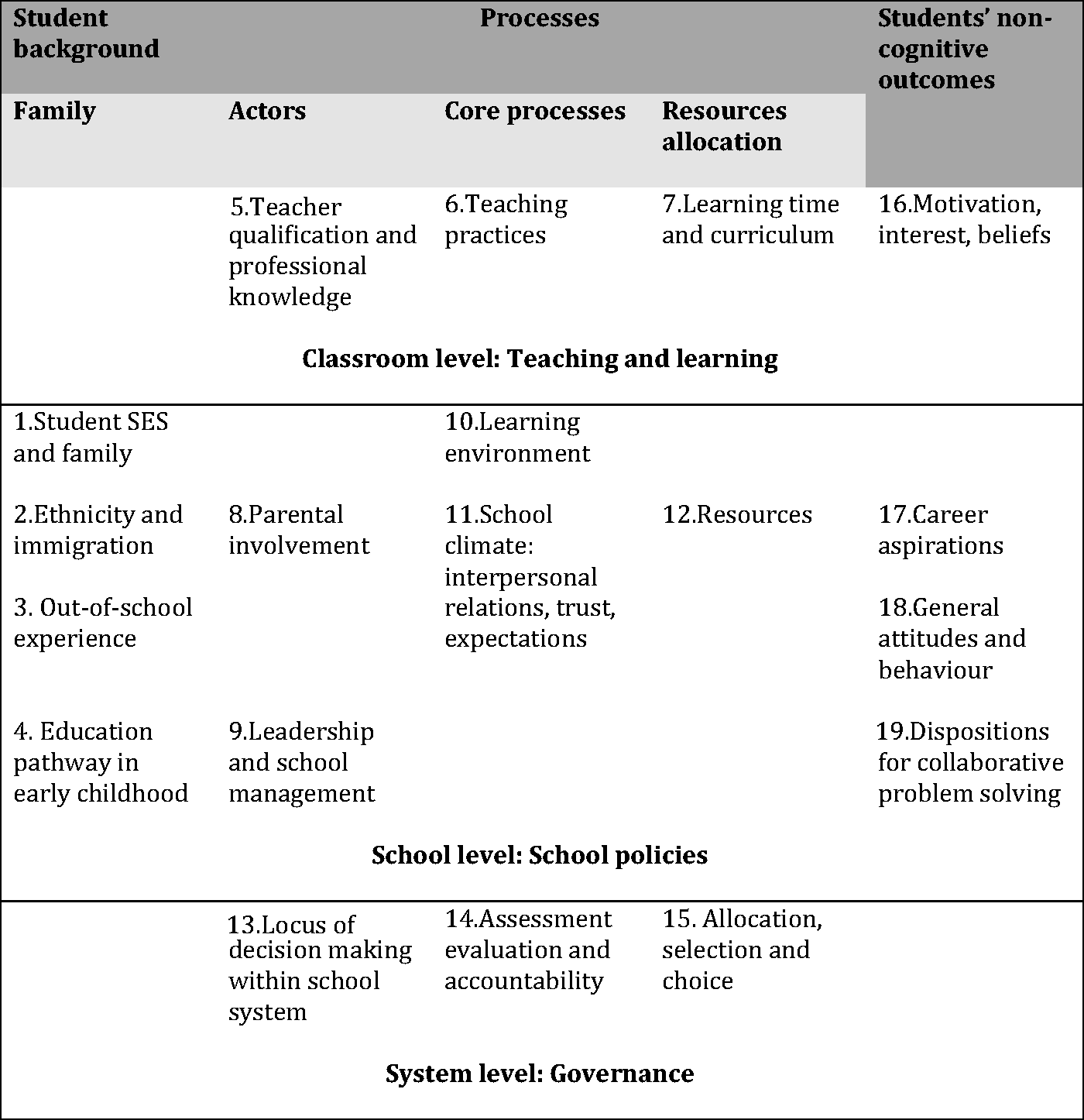
PISA 2015 Context Assessment Framework (adapted from Figure 6.2 ‘Modular structure of the PISA 2015 context assessment design’ [OECD 2017, p. 109]).
Furthermore, the issue of resources is centred around existing curriculum options and whether teachers provide support in these options. This seems detached from consideration of whether these options present real opportunities for students to take them up in ways that they value and that they can engage with effectively in their learning. Even though the OECD aims to address broader policy issues associated with PISA test scores through measures of context and non-cognitive outcomes (for example, students’ motivation, interest, beliefs, career aspirations, general behaviour and attitudes), it is not clear how and why lack of economic capital causes educational disadvantage, and how might increased resources could reduce disadvantage.
The PISA background questionnaires to parents, teachers, students and principals survey each of the 19 items in Figure 1. Items 1 to 4 (first column) measure background characteristics related to students’ family and students’ education. Items 16 to 19 (last column) measure non-cognitive outcomes of education and aspects of students’ lives, such as their attitudes towards learning, their habits and life inside school, and their interest, motivation and engagement. Items 5 to 15 (middle columns) measure the educational processes and resources on three levels: school system, school and classroom. These include educational processes of teaching and learning, human and material resources and the actors responsible for managing resources and processes.
The problems with the PISA 2015 context measures as a meaningful way to explain education performance are manifold. From a methodological perspective, cross-sectional presentation of test scores cannot capture students’ developmental processes underlying test performance. Although PISA 2015 acknowledges that the developmental processes that give rise to non-cognitive aspects such as attitudes, teaching and learning engagement are important in the opportunities and processes of education, the focus of a cross-sectional survey is not informative for understanding how these can be changed.
From a conceptual perspective, the OECD considers processes within the school system and at classroom level as measures in themselves, rather than looking at how the background characteristics of students may impact the way they participate in the processes, or that the processes within schools and classrooms may favour certain groups over others. This, too, is because contexts are measured at a point in time rather than evaluating contexts as processes that students take up and progress in schools.
The OECD also acknowledges that educational efficiency can be achieved if we understand the relation between outcomes and resources (OECD, 2016a, 2016b), but the simplistic ways that resources are presented at the school and classroom level do not help to understand how the allocation of those resources can translate students’ personal attributes into forms of capital that they can use and that are favourable for achieving cognitive (test scores) and non-cognitive (attributes, beliefs, motivations) outcomes.
Lastly, the OECD considers the importance of freedom and autonomy mainly at the school governance level, primarily the autonomy of principals, teachers and school boards in relation to curriculum, enrolment, assessment and resource allocation. It does not look at how these policies and associated practices provide students with real choices that enable them to access and participate in the school curriculum, enrolment, assessment and resources in ways that they can convert these resources within those processes to functionings that they value.
Applying the Sen–Bourdieu framework
The Sen–Bourdieu framework can be applied to address some of the shortfalls of the PISA 2015 context measures to understand the generative mechanisms of educational inequality as disclosed via PISA test performance. For example, we can analyse the background characteristics of students (items 1 to 4) in terms of students’ stock of capital, and how those forms of capital construct their perceived opportunities, their decision to take up opportunities (or choices) and their engagement in the schooling processes and resources offered in schools (items 5 to 15). We can interrogate how these forms of capital shape students’ aspirations and motivations (items 16 to 19). We can examine students’ participation in schooling processes in terms of deploying capital and the associated consequences in terms of cognitive and non-cognitive outcomes (items 10 to 11). As the PISA context assessment is wide ranging, analyses of empirical data other than PISA results are required to explicate the Sen–Bourdieu framework and its multidisciplinarity. Such analyses need to be multidimensional, multilevel quantitative analysis and modelling, supplemented by multidimensional qualitative studies to provide substantive insights into the forms of capital that enable or hinder students in accessing and participating in school practices and institutional structures, and whether those ongoing practices and structures privilege certain background characteristics while marginalising others. The remaining parts of this section illustrate some ways that the Sen–Bourdieu concepts can be used to guide the analysis of the schooling contexts (structural, relational, representational) at the three levels on which the PISA context assessment framework operates (student, school and school system). As the PISA context assessment framework covers a wide range of contexts, the discussion aims to be illustrative of the application of the Sen–Bourdieu concepts rather than a comprehensive analysis.
Student level
Students’ economic capital, as found by PISA 2015, contributes to positive academic performance in the following ways. More educated parents are able to provide a richer set of learning opportunities at home and more access to written materials for reading, travel and other resources that engage their child’s curiosity (Wilmms, 2006). They have high expectations for their children’s academic performance and interest in their school work, which, in turn, are converted to parental participation in school and in out-of-school tuition (Avvisati et al., 2014; Domina, 2005; OECD, 2011). Barone (2006) and Tramonte and Willms (2010) found that communications, discussions and cultural experiences within the family had a larger effect on reading-related achievement than did the reading materials in static forms. In other words, economic capital provides material resources that give students the means to achieve educational functionings. Associated with economic capital is embodied cultural capital of family resources, which may align parents’ interest and expectations with those of the schools’, which in turn lead to parental involvement with the schools (item 8) and position students with advantage (Catsambis, 2002; Desforges and Abouchaar, 2003; Lareau, 2002, 2011). Interestingly, PISA 2015 found that across education systems that distributed the parents’ questionnaire, parents of children who attend socioeconomically disadvantaged schools reported having participated in more school-related activities than parents of children who attend advantaged schools (OECD, 2016b), and that the performance of students tends to be lower for those that attend schools with higher level of parental contact with schools. These indicators, which captured only parents’ contact with the schools, suggest that there are other factors that impact the effects of cultural capital in the field that need further investigation.
Bourdieu’s linguistic capital is represented in the ethnic and immigrant background of students (item 2), which PISA 2015 views to be relevant in shaping experiences of students. On the one hand, this form of capital may foster the development of language awareness and facilitate the learning of additional foreign languages. On the other, lower competency in English, which is the language of instruction in Australia, can negatively affect learning in other subjects and in the long run be disadvantageous for students’ educational pathways. Linguistic diversity is a resource that students own, but whether they can mobilise it in schools depends on the linguistic capital of teachers, other students, and school curriculum and teaching and learning practices – the structural contexts. If students are not able to share their linguistic capital, or their linguistic capital is not appreciated, they can encounter barriers in the classroom, particularly if teachers do not have adaptive teaching skills required to deal with comprehension difficulties and likely cultural differences. In trying to mobilise their linguistic capital, students from ethnic backgrounds may have to adjust to unfamiliar cultural contexts at school (Bullock, 2018) and they may face discrimination (Perreault and Bourhis, 1999). In other words, the ability of students to deploy linguistic capital depends on whether their cultural diversity is recognised and appreciated by those around them.
Furthermore, the PISA 2015 results indicate that the educational performances of students from diverse backgrounds differ and are linked to economic capital. For example, PISA 2015 found that students from ethnic backgrounds on average performed worse than those with English as a first language. However, students from ethnic backgrounds who are in the top quartile of socioeconomic status performed better than their counterparts whose first language is English. They also have higher career aspirations. This finding suggests that linguistic capital may translate into embodied cultural capital that can be used effectively by some students, notably those with high economic capital. PISA 2015 found that educational aspirations vary between different ethnic groups regarding their quality and stability (Kao and Tienda, 1998; Mau et al., 2000) and can be a significant predictor of the students’ future educational attainment (Thiessen, 2007). In this regard, career aspirations (item 6) can be viewed as a process rather than a fixed point, because students are predisposed to certain expectations associated with family upbringing and prior experiences that are related to economic capital (Appadurai, 2004). This does not mean aspirations are symptomatic of students’ backgrounds, rather, they are mutable as students try to mobilise their cultural capital in the social field (Pham, 2018) 7 . To understand how linguistic capital may enable or limit students’ opportunities and participation in schooling practices, it is important to make visible the overlapping forces and processes in schools and how schools or teachers reward or penalise students in their deployment of linguistic capital in various situations.
School level
PISA 2015 measures teaching practices in terms of teacher support, the cognitive challenge that teachers provide to students, and the disciplinary climate (items 6, 10 and 11). These indicators can be understood through Bourdieu’s social capital, which constitutes teacher–student relations. According to Bourdieu (2006b), people mobilise their social networks to accumulate networks as part of a strategic investment to accumulate economic capital. Teachers’ education and training, expertise and attitudes to students – which are derived from their habitus – inform the quality of instruction, the structure of their teaching and the support and challenge they are willing to impart to students. These, in turn, shape the opportunities that they can provide students and the opportunities that students perceive as available to them - their real opportunities. For example, the implemented curriculum, assigned tasks and activities, instructional time, grouping, assessment and feedback are products of teachers’ education and training, as much as the school polices that inform the allocated learning time, extracurricular activities, and evaluation and assessment policies (OECD, 2016b) – both comprising the structural contexts in which students engage with teachers and the school.
Another example is the role of inquiry-based teaching practices, which PISA views as a positive effect on student learning, particularly students’ engagement in the cognitive dimensions of inquiry and teacher-led inquiry activities (Furtak et al., 2012). However, these practices should be examined in terms of students’ disposition toward such learning practices, rather than assuming all students would perceive opportunities for this type of learning in similar positive ways. As Edgerton and Roberts (2014) pointed out, some students enter school with dispositions that align well with the school expectations and teaching practices. They have the cultural capital that they can mobilise in ways that are congruent to classroom practices, which in turn will enable them to convert their resources (for example, prior knowledge, learning style) into academic achievement. For instance, middle-class families tend to engage more in reasoning, negotiation and talking as a form of discipline (Lareau, 2002, 2011). Students with such family upbringing are thus predisposed to teaching and learning practices that are oriented toward talking, discussing and problem solving, which are captured in item 19. It is therefore important to understand which forms of capital students have, and whether their ownership or lack of capital position them differentially to the schooling practices offered.
While PISA refers to teacher–student behaviours as the disciplinary climate (OECD, 2016b), the context framework speaks loudly of the cultural contexts and teachers’ and students’ values of education. The PISA context questionnaire results show a positive association between teacher support and educational performance for Australian schools (OECD, 2016b), which PISA 2015 suggests is attributable to interactions between students and teachers within a disciplinary climate. The question is: how does this form of social capital contribute to a disciplinary climate that provides the means or opportunity for students to achieve educational performance? A possible answer to this question is the intersection of cultural capital and social capital at the school level. For example, if the school recognises students’ linguistic and cultural diversity and permits their representation through parental involvement, these contexts can promote collaboration between students and teachers, school leaders and teachers, and parents and school (items 8, 9, 11, 19).
In addition, cultural capital shapes achievement orientation, shared norms, leadership, teacher morale and co-operation, professional development, high expectations and support for academic learning (Edgerton and Roberts, 2014). Parents who know what schools expect by being familiar with the school programmes and teaching and learning practices share with the schools a general appreciation of education and related values (Lareau and Cox, 2011). While cultural capital can be enhanced by accumulating social capital and vice versa, it must be noted that lack of cultural capital can create barriers if accompanied by lack of social capital. This may explain the reason behind PISA’s (2015) claim that Australian schools with low socioeconomic status did not have the teaching and learning practices or disciplinary climate that are conducive to educational performance, despite the lack of a statistically significant relationship between parent involvement and educational performance.
Cultural and social capital can be used to examine the extent to which students find a fit or match with their schools; whether they are recognised, valued and embraced by their schools. Such alignment is contingent on who the students are, their habitus, their experiences encountered outside and inside schools (Bourdieu and Wacquant, 1992; Núñez, 2014). The transferability of cultural and social capital in shaping opportunities and enabling processes of students’ agency suggests the need to understand how teachers adjust to students’ values and needs, students’ connection with other students and being part of the school community. The school culture influences students’ dispositions toward the values that are expected of them. Those that find their school climate to be an extension of home life experience a match between their norms and school norms – a habitus that is congruent with school standards and expectations (Edgerton and Roberts, 2014). For others, the school processes may represent a mismatch. The match or mismatch of students’ habitus with the school can encourage or hinder their ability to use their owned capital to convert material resources to achieve educational functionings that they value. In addition to knowing the forms of capital that can be used to convert resources to educational capabilities, it is useful to understand the cultural and social capital and habitus mismatch to explain the achievement gap between students within and between schools that PISA pointed to, particularly students with indigenous and ethnic backgrounds or those in rural and remote locations.
System level
PISA 2015 examines the governance process at the school system level by measuring the locus of decision making by the school board, staff and school leaders about admission, curriculum, allocation of resources and personnel (item 17). Leadership and school management (item 15) is emphasised in PISA 2015 with the assumptions that these governance indicators shape teachers’ professional development, define the school’s education goals and ensure that instructional practice is directed towards achieving these goals. While PISA 2015 acknowledges that research has shown that teachers’ perspective on leadership can differ from the positions held by school administrators, it is silent on the situational contexts in which these perspectives can differ and on the consequences for students’ learning opportunities. There are two aspects of school leadership that could help us to better understand PISA’s findings in relation to educational inequality. First, understanding how leadership operates at the school level and classroom level across the three sectors can help to identify the structural contexts in which students engage with the school. For example, analysis of students’ choice and choice options in the curriculum and enrolment in schools can shed light on their displacement or excessive mobility associated with poor school performance, particularly for students with special needs. Bourdieu’s symbolic capital can be useful to understand the perception of private schools in Australia as better schools, safer schools (PISA 2015), which results in parents' preference for private schools because of the symbolic capital attached to those schools. Kenway (2013) argued that selective schools and the private school system in Australia create a ‘ghetto’ movement whereby socioeconomically advantaged students flock to the private sector, leaving the rest in the public school system, which is least able to provide them with teaching and learning that meet their educational needs, and hence further disadvantages them.
Second, even though PISA 2015 focuses on teachers’ background and initial education and acknowledges the need to understand the multiple pathways leading to the teaching profession, professional development and its impact on quality instruction and teacher retention (OECD, 2016b), it does not explain how these forms of institutionalised cultural capital inform teaching practices and student achievement. The overall status of teachers is important because it affects the perceived attractiveness of the profession – a symbolic capital that can explain the type of people who choose teaching as a career pathway. In addition to the generally less specialised field of knowledge and postgraduate qualification that Australian teachers have compared with other countries such as Singapore, the United States, or Finland (PISA 2015), teachers in Australia generally do not have high status in the field or broadly in society, compared with Asian countries where education is much more valued, and teachers are more respected. These aspects inevitably shape the social relations and interactions between teachers and students and, as discussed in the previous section, affect how students engage with schooling and classroom practices.
Conclusions and implications for social justice policies in education
This paper offers a framework combining Sen’s concept of capability and Bourdieu’s forms of capital to highlight contextual factors that could mediate students’ access to and participation in schools. The paper has broadly illustrated how Bourdieu’s forms of capital can be used to understand the PISA context measures that relate to the PISA 2015 results for Australia. The paper suggests that the relationships between forms of capital (cultural, social, linguistic, symbolic) and their transferability to economic capital influence educational performance. Students’ stock of capital shapes their attitudes toward schools, participation in schools and behaviours in and out of schools. These forms of capital are representative of students’ habitus of family background and past experiences. From a capability perspective, capital constructs opportunities that students perceive are available to them and the means by which they make use of material resources. The extent to which these forms of capital help or constrain students in converting resources to educational capabilities depends on the school structures and schooling practices. For instance, schools that do not recognise cultural diversity may embed (whether intentionally or not) curricular materials and pedagogical arrangements in schooling practices that place individuals from ethnic backgrounds in unequal positions in their educational experiences (Bourdieu, 1977).
The Sen–Bourdieu framework has significant policy implications for improving equity in education. First, it offers expanded informational bases beyond socioeconomic categories to better understand the forms of capital that students own as conditions and conditionings of their desired doings and beings in different circumstances. In doing so, it considers the intrinsic value of students’ lives and backgrounds, and the plurality of their educational values and aspirations. These aspects of capabilities can then be incorporated in the design of policies and processes in schools and classroom practices.
Second, intersecting capital and capabilities allows for the possibility of improving equity beyond provision of economic capital (not to say that economic capital is not important), to providing students with the forms of capital that enable them to make choices that they can realistically access, and to deploy resources in ways that they value. It may also give us insights into ways to enhance students’ ownership of the types of capital that can improve their processes in agentic engagement with schools, and networks in schools, employment or civic activities. For example, if connections between peers are the social capital necessary to enable students from marginalised groups to interact with the class, the schools may consider a buddy system that pairs students from different social groups. If relationships with teachers provide students with the social capital necessary for them to engage with teaching and classroom activities, then additional student–teacher time should be afforded to these students, either in class or out of class. This would require concerted effort by the school as well as additional resources.
While economic capital is important, the extent to which economic capital works effectively to produce positive educational outcomes depends on the mobilisation of other forms of capital, and the contexts in which they are mobilised. As this paper has illustrated, inequality can arise from aspects of school structures, relationships between schools and students, teachers and students, and representation of students and their families in the school community. Disabling factors to educational achievement can also be embedded in curricular materials, pedagogical arrangements and learning experiences of students of different backgrounds, which tend to reinforce exclusion and inequality (Bourdieu, 2006a). If we are aware of the effects of these aspects in schooling practices, we can design capability-informed policies to address mechanisms of inequality.
Third, thinking about social justice through the lens of capabilities puts policy attention on the agency of students. This paper suggests that it is important to pay attention to the processes by which students take up learning in schools, and how such experiences may shape their perception and pursuit of future opportunities. Sen’s vision of agency in the capability approach emphasises not what people are and do, but that they are and do the things they choose as they see valuable. The policy implications for improving equity are to improve access to school by redistribution of resources, which is already at the centre of Australia’s policy debate (exemplified by the Gonski needs-based funding model). In addition, this paper suggests that it is important to provide curriculum and learning and teaching practices that are responsive to and inclusive of all students from diverse backgrounds and needs to provide them the opportunity (or freedom) to achieve learning outcomes with a sense of self-determination and agency. In this regard, the paper provides the ground for examining social justice in ethical ways by placing individuals’ participation in their society and their normative wellbeing at the forefront rather than looking at resources with the assumption that they will be accessed by all in similar ways with similar outcomes.
This paper has shown that understanding the dominant forms of capital and their interdependent links in enabling or disabling students’ capabilities is worthwhile in order to contribute to a fruitful and human-centred discussion about social justice policies in education. Much more work is required to achieve detailed and multilevel quantitative studies about accumulation of capital and capabilities to understand the dynamic effects of schooling practices and students’ dispositions to those practices within and across student groups. These studies must be supplemented with qualitative analysis of the social relations and structures in schools to identify and explain the generative mechanisms of educational inequality.
Footnotes
Declaration of conflicting interests
The author(s) declared no potential conflicts of interest with respect to the research, authorship, and/or publication of this article.
Funding
The author(s) received no financial support for the research, authorship and/or publication of this article.