




Abstract
This paper offers a critical examination of the nature of inequalities in relation to education and the pursuit of social justice. It argues that assessment of educational resources and measures such as school enrolment and educational achievement are limited in what they tell us about the injustices learners may experience. It is proposed that, drawing on Amartya Sen’s capability approach, we benefit from extending our evaluative space beyond learners’ achievements to encompass their freedoms to achieve. It is argued that attention should be paid to the relative value individuals place on these various freedoms. Furthermore, in order to deepen insights into the multiple factors influencing the development of learner values, and the unequal possibilities for realising their aspired valued achievements, the discussion also draws on key sociological concepts from Pierre Bourdieu. The theoretical synthesis leads to the introduction of the Sen-Bourdieu Analytical Framework, a conceptual model that illustrates the socially dynamic processes within which learners and formal educational systems are situated. The principal aims are to offer an alternative development paradigm and an expanded evaluative framework to inform local, national and international educational policy and practice.
Keywords
Introduction
A central concern of development agendas is how educational processes may contribute towards greater social justice. The United Nations (UN, 2018: 1) proposes that …education is the key that will allow many other Sustainable Development Goals…to be achieved.
1
When people are able to get quality education they can break from the cycle of poverty. Education therefore helps to reduce inequalities and to reach gender equality.
This paper argues that in evaluating present injustices in education we need to critically re-examine the evaluative measures that are being used. Typically dominant measures relate to school enrolment (access), literacy and numeracy achievements, examination performance, retention (experience) and progression to further education and employment (outcomes). Figures may also consider inequalities in educational participation and achievement related to social background, ethnicity, gender and so forth. 2 However, understanding of equity in relation to the opportunities individuals have, versus those they take up, is less well understood. Moreover, we lack understanding of the factors that contribute to the development of aspirations, the emergence of real (rather than imagined or aspired) opportunities, and the circumstances that lead to their foreclosure. Sen’s capability approach is drawn upon in this respect to present an alternative pluralistic framework of evaluation that extends beyond statistics regarding school enrolment, literacy rates, and numbers entering tertiary education and seeks to understand opportunities to achieve as well as the achievements themselves. The intention is to position the pursuit of equity in opportunity freedoms, and the development of those freedoms, as central tenets of a socially just development agenda. Understanding of the complex contributory social processes is augmented through the integration of Bourdieu’s sociology to conceptualise the ways that opportunity freedoms emerge unequally for different individuals and inequalities may be compounded in the uneven conversion of opportunities into achievements. Combining Sen and Bourdieu’s conceptual tools leads to the creation of the Sen-Bourdieu Analytical Framework, a model first developed by Hart (2012) to aid understanding of social justice in relation to widening participation in higher education in England. Here the framework is further developed in a broader international educational context. The ensuing discussion aims to consider the implications for accomplishing greater social justice through local, regional and global education policy and practices.
Amartya Sen and the freedom to pursue valued lives
Sen (1985) proposed a paradigm shift that broadens attention to include whether an individual has the real opportunity to achieve a valued way of living as well as focusing on the kind of resources that are at their disposal. Indeed, resources, or commodities, in themselves cannot guarantee that an individual will be able to achieve a valued way of living, although it might provide a possible means to doing so. Someone with a laptop and Internet access potentially has the means to communicate with friends or work colleagues in distant places. However, if they lack the skills to utilise the technology, or they are forbidden from going online, they may not be able to achieve the desired end. Flaws in evaluations of development based solely on resources led Sen to extend the dominant focus on primary goods as a means of assessing advantage, an approach strongly associated with the work of John Rawls 3 (Brighouse and Unterhalter, 2011; Rawls, 1971).
Applying Sen’s thinking to education, one might argue that the mere existence of a school (resource) does not guarantee educational success for a given individual. It depends on how well suited the resource is to an individual’s needs; for instance, if the language of instruction is not the one the learner wishes to be taught in, or they fear sexual harassment in school, then the system falls short. For example, Brighouse and Unterhalter (2011) have noted the way that lack of toilets and water in schools have a greater impact on girls’ attendance and Trani, Bakhshi and Biggeri have drawn attention to the low participation of disabled children in education in many countries (Trani et al., 2011). On similar lines, UNESCO (2017) recently reported that ‘across 28 EU countries youths with disabilities were on average twice as likely to be early school leavers’ (2017: 197). It is clear, therefore, that overall educational achievement and enrolment tell us little about the extent to which individuals have equal chances to flourish or the extent to which freedom to learn in culturally relevant ways has been ensured. Sen argues, once we shift attention from the commodity space to the space of what a person can, in fact, do or be (or what kind of life they can lead), the source of interpersonal variations in conversion can be numerous and powerful (Sen, 1992: 37).
So, in Sen’s capability approach, commodities may be converted into capabilities (well-being freedom) and then into functionings (well-being achievement). 4 The process is continuous and iterative with the possibility of developing new capabilities and functionings as time goes on. 5 In educational terms, commodities may include the availability of educational institutions and trained teachers. Capabilities could include the freedom to be educated by enrolling in one of these institutions and participating as a learner. The ensuing functionings might include the ability to read and write, which in turn could lead to the development of new capabilities and functionings. However, what may seem like a straightforward linear process is actually far more complex and ‘conversion factors’ may be at play throughout the process of an individual’s capability and functioning development. In order to understand these conversion factors further, and how they may contribute to increasing and decreasing educational inequalities, we turn to Bourdieu.
Pierre Bourdieu and insights into conversion factors
There are two key contributions that Bourdieu’s toolbox of sociological concepts makes to augment Sen’s thinking in relation to the conversion of commodities to capabilities and, in turn, capabilities into functionings. First, Bourdieu introduced the idea of different forms of capital rather than solely the economic form of capital used elsewhere. His conceptualisation of capital enriches the understanding of the body of commodities and resources that may be converted into what Sen terms, capabilities. Second, conversion factors are at play at all stages in the cycle, and Bourdieu offered the possibility of a deeper sociological theorisation of the interplay of these conversion factors than has hitherto been explicated. His theoretical work complements Sen’s capability approach by offering a more socially dynamic understanding of the conversion factors helping and hindering the development of capabilities. 6 Bourdieu’s contribution stems from his conceptualisation of the interactions of an individual’s habitus within fields of action. This offers a strong sociological framework, and importantly, a conceptualisation of power relations. Each of Bourdieu’s concepts of forms of capital, habitus and field is illuminated in the following discussion and connections are made with Sen’s capability approach to form the Sen-Bourdieu Analytical Framework illustrated later in Figure 2.
Forms of capital
Bourdieu argued that an individual’s social position is influenced not only by economic capital but also by other forms of capital including social, cultural and symbolic capital and his work is useful in considering social difference in more complex terms. ‘It is in fact impossible to account for the structure and functioning of the social world unless one reintroduces capital in all its forms and not solely in the one form recognised by economic theory’ (Bourdieu, 1986: 241). Economic capital may be generated through inherited wealth, family income or engagement in the economy for financial return. Social capital is accrued through social networks, the family and wider community interactions. Symbolic capital is manifested as individual prestige and authority (Bourdieu, 1986, 2009). Bourdieu also drew a distinction between acquired and inherited capital. He remarks, ‘the possessors of strong educational capital who have also inherited strong cultural capital…enjoy a dual title to cultural nobility, the self-assurance of legitimate membership and the ease given by familiarity’ (Bourdieu, 2010: 74).
Different forms of capital might also be leveraged from beyond the individual’s immediate family through wider community networks, agencies or the state. Hence, it is not easy to fix a person’s social position and potential simply by considering their level of qualification, amount of money in their bank account or the area where they live. Inherited capital may play out in educational contexts through family economic capital being used to secure children’s private education, individual tutoring or payment for extra-curricular activities, which in turn ‘purchase’ added status, kudos and confidence for the offspring. Thus one form of capital might be transferred from parent to child, before being ‘cashed in’ for new forms of cultural, educational and emotional capital deemed valuable in the child’s development in a competitive field. UNESCO (2017: 143) report that ‘children from the poorest households are less likely to experience home activities that promote learning’ and therefore may feel they are starting ‘behind’ their wealthier counterparts. Indeed at the harshest end of the spectrum capital transfer processes could lead to what may be viewed as a negative transfer of capital, for example where a family is destitute and reliant on children to support older and infirm members. In essence, Bourdieu’s forms of capital could be likened to currencies but where individuals may be in receipt of debt as well as ‘inherited’ wealth and where some will undoubtedly benefit more than others in terms of recognised and valued ‘currencies’.
Bourdieu’s concepts of habitus and field are also positioned as key to understanding the social complexity and inter-relationships of conversion factors in the Sen-Bourdieu Analytical Framework. Let us turn next to explore habitus and then consider the combined impact of habitus and capital on an individual’s experiences in different fields of action. This will lead onto further discussion of the mechanisms involved in converting forms of capital and converting capital into capabilities.
Habitus
Bourdieu introduced the concept of individual ‘habitus’ to describe the cultural and familial roots from which a person grows. Bourdieu explained that habitus ‘operates below the level of calculation and consciousness’ and that the ‘conditions of existence’ influence the formation of the habitus which is manifested in the agent’s ‘tastes’, practises and works, thus constituting a particular lifestyle (Bourdieu, 2010: 167). Habitus is constituted by an individual’s embodied dispositions manifested in the way they view the world. An individual’s habitus is developing from the beginning of life in relation to the social milieu of their home and family life. ‘The habitus is necessity internalised and converted into a disposition that generates meaningful practices and meaning-giving perceptions’ (Bourdieu, 2010: 166). In education this might mean, for example, that where a family has no history of education beyond primary or secondary level, the individual concerned may have a disposition that predisposes them to leave school early in line with familial traditions.
Bourdieu highlighted two key aspects of habitus, particularly relevant to understanding young people’s relations with the field of education. Bourdieu remarked that an individual’s position in terms of social relations in the field is influenced by their ability to perform in appropriate ways in a given environment (field) by alignment with the recognised ‘tastes’ or ‘preferences’ associated with that social space. In addition, the individual may benefit from being able to distinguish which of the tastes, practises and preferences of others are representative of the particular field. It is in the two capacities which define the habitus, the capacity to produce classifiable practices and works, and the capacity to differentiate and appreciate these practices and products (taste), that the represented social world, i.e. the space of lifestyles, is constituted (Bourdieu, 2010: 166). the traditionalism of family pedagogic action (PA) which, entrusted with the earliest phase of upbringing, tends to realise more fully the tendencies of all PA and is thus able, even in modern societies, to fulfil the role of a conservatory of inherited traditions; or in the inertia of educational institutions, whose essential functions always leads them to self-reproduce as unchanged as possible, like traditional societies (Bourdieu and Passeron, 2000: 32).
Field
Sen recognises that …the conversion of commodity-characteristics into personal achievements of functionings depends on a variety of factors – personal and social…in the case of achievements involving social behaviour and entertaining friends and relatives, the functioning will depend on such influences as (1) the nature of the social conventions in force in the society in which the person lives, (2) the position of the person in the family and in the society, (3) the presence or absence of festivities such as marriages and other occasions such as funerals, (4) the physical distance from the homes of friends and relatives, and so on (Sen, 1999: 17–18).
Bourdieu’s notion of ‘field’ is helpful in conceptualising conversion factors that may work to help and hinder individuals in achieving ways of living they have reason to value. For some, the field will operate in their favour where their tastes, preferences and position in the ‘game’ play to their advantage. In contrast, others may find themselves marginalised, ‘standing out’ or ‘a fish out of water’, negatively impacting on their potential for well-being achievement. 7 Mills (2008) has argued for the ‘transformative potential of Bourdieu’s theoretical constructs’. She suggests that ‘teachers can draw upon a variety of cultural capitals to act as agents of transformation rather than reproduction’ (Mills, 2008: 79). That is to say that if more teachers were to become conscious of the dominant role of educational institutions, and themselves, in privileging a cultural arbitrary, at the expense of non-elite groups, then they may be moved to act in more socially just ways. This may entail using their status, position and all other forms of capital at their disposal to work in favour of those disadvantaged by the system and to challenge processes that lead to symbolic violence and oppression. Let us consider further, then, the conversion of different forms of capital both by learners and the other individuals with whom they may interact.
The conversion of different forms of capital
An individual may be deemed more or less ‘well off’ or ‘advantaged’ dependent on their portfolio of economic, cultural, symbolic and other forms of capital. However, Bourdieu noted that this would overlook a crucial problem. Bourdieu argued that despite the fact that individuals from all walks of life may accrue cultural capital via education credentials, what mattered was their differential ability to convert cultural capital into other forms of capital. Hence, two individuals achieving the same qualification from the same institution may yield different ‘rates of profit’ from their ‘scholastic investment’ (Bourdieu, 1986: 243). This connects with Sen’s (1992) work on the variation in individuals’ abilities to convert resources into functionings (well-being achievement) or ways of living they have reason to value. This means that although learners, teachers and others may accumulate transfers of capital or develop their own capital (e.g. through education, employment), this does not mean they will be able to readily convert the capital into alternate forms.
The conversion of capital into capability
In considering the notion of advantage, from Sen’s capability perspective, Bourdieu’s forms of capital may be seen as commodities that might be converted into capabilities. Figure 1 incorporates Bourdieu’s forms of capital in this respect. Sen’s capability approach highlights a second crucial issue in determining a person’s advantage based on the accumulation of different forms of capital. It is necessary to consider the extent to which different forms of capital can be converted into capabilities; that is to say, the freedom to pursue ways of being and doing that the individual has reason to value.
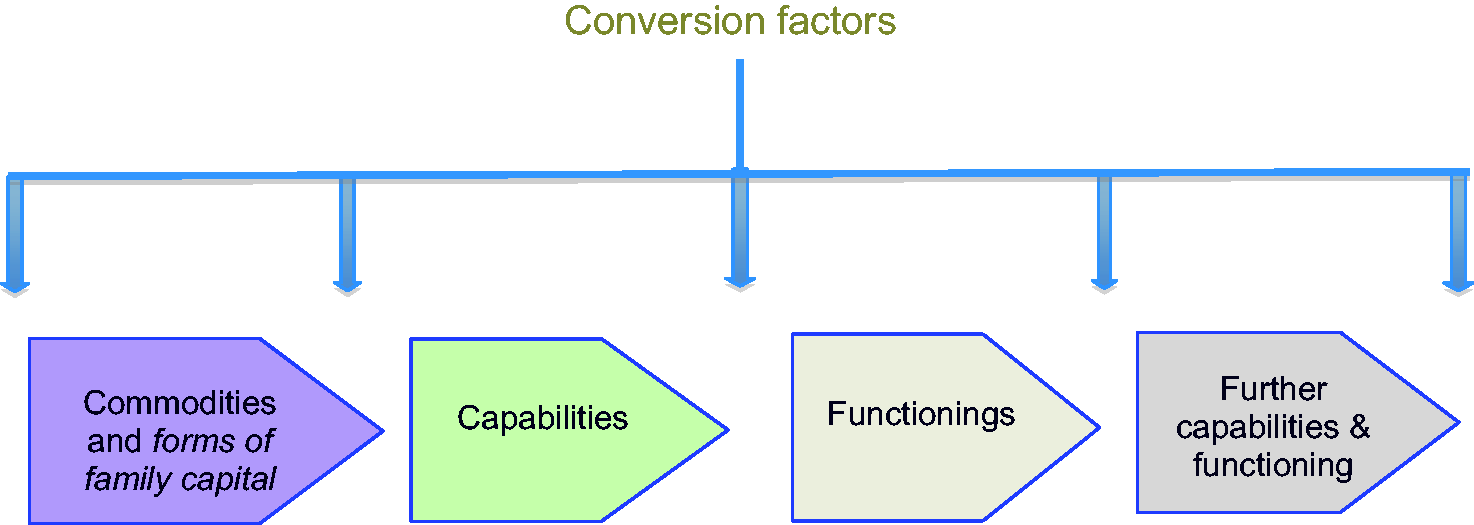
The process of commodity–capability–functioning conversion in Sen’s capability approach, including Bourdieu’s forms of capital.
Bourdieu theorised that capital may be accumulated through inter-generational transfers of different forms of capital from adults to their offspring. This was linked to the possibility of a family drawing on one form of capital in order to generate another form and transfer different forms of capital to offspring. For example, economic capital might be converted into cultural capital through the purchase of books and resources as well as participation in culture-rich activities. Marjoribanks later claimed that Bourdieu placed a strong emphasis on the amount and kinds of capital that, for example, an individual’s family had and how this allowed an individual to secure an advantage (Marjoribanks, 2002). However, Marjoribanks argued that family capital is not sufficient to guarantee the advantage of an individual. He argued that what was crucial was the combination of ‘capital volume and adult–child interactions’ and the opportunities an individual had to enable them to access the capital accrued within the family (Marjoribanks, 2002: 7). For example, a highly educated literate parent might pass on cultural capital through spending time reading with their child but a busy or disinterested, yet highly educated, parent might not (Marjoribanks, 1998).
Not all children are able to access family capital. For example, this is borne out by a study on the lives of children living and working on the street in Bangladesh (Serrokh, 2011: 181). The argument can be extrapolated to other fields such as school, community and so on. Hence, in order for a child to benefit from family capital (or school or ‘community’ capital) it is necessary for a process of transfer or conversion to take place. Thus it cannot be assumed that any or all offspring will benefit from their family’s capital. Regarding school achievement, Marjoribanks concluded: in families, the potentially valuable social capital related to a child’s successful schooling includes, (a) the amount and quality of interest, support, encouragement and knowledge other family members have about education and (b) the extent that such resources are transmitted to the child in interactions with family members. (Marjoribanks, 2002: 12)
Activation of capital
Even if an individual is able to accrue different forms of capital from their family, Laureau and Horvat (1999) have argued for recognition of the difference between the possession and activation of capital and shown that despite large volumes of economic, social or cultural capital, this does not guarantee the achievement of desired outcomes. For example, it is also necessary to learn how to apply different forms of cultural capital in different fields. Knowing when and how to deploy particular forms of capital, and being skilful and confident to do so, requires learning unwritten rules, and yet, is vital for maximising the activation of capital. Erickson has argued that in the private sector, ‘the most widely useful cultural resource is cultural variety[,] and social network variety is a better source of cultural variety than class itself’ (Erickson, 1996: 217).
Thus, there a two-stage process is required to convert the commodities of ‘family (and others) forms of capital’ into individual capabilities (Figure 2). The first stage requires the conversion of family (and others’) forms of capital into individual capital, as given in Figure 2(A). This might include, for example, giving offspring financial help towards their education, support with homework or access to informal learning opportunities. The capital may come from family members, but also other benefactors including the wider community (local/national/global), institutions (educational and non-educational), or a state (one’s own or another). The second stage requires the conversion of individual capital commodities into capabilities, as given in Figure 2(B). This can be understood as both achieving the capability to be educated through the respective finance, support, and access received as well as the consequent capabilities derived thereafter.
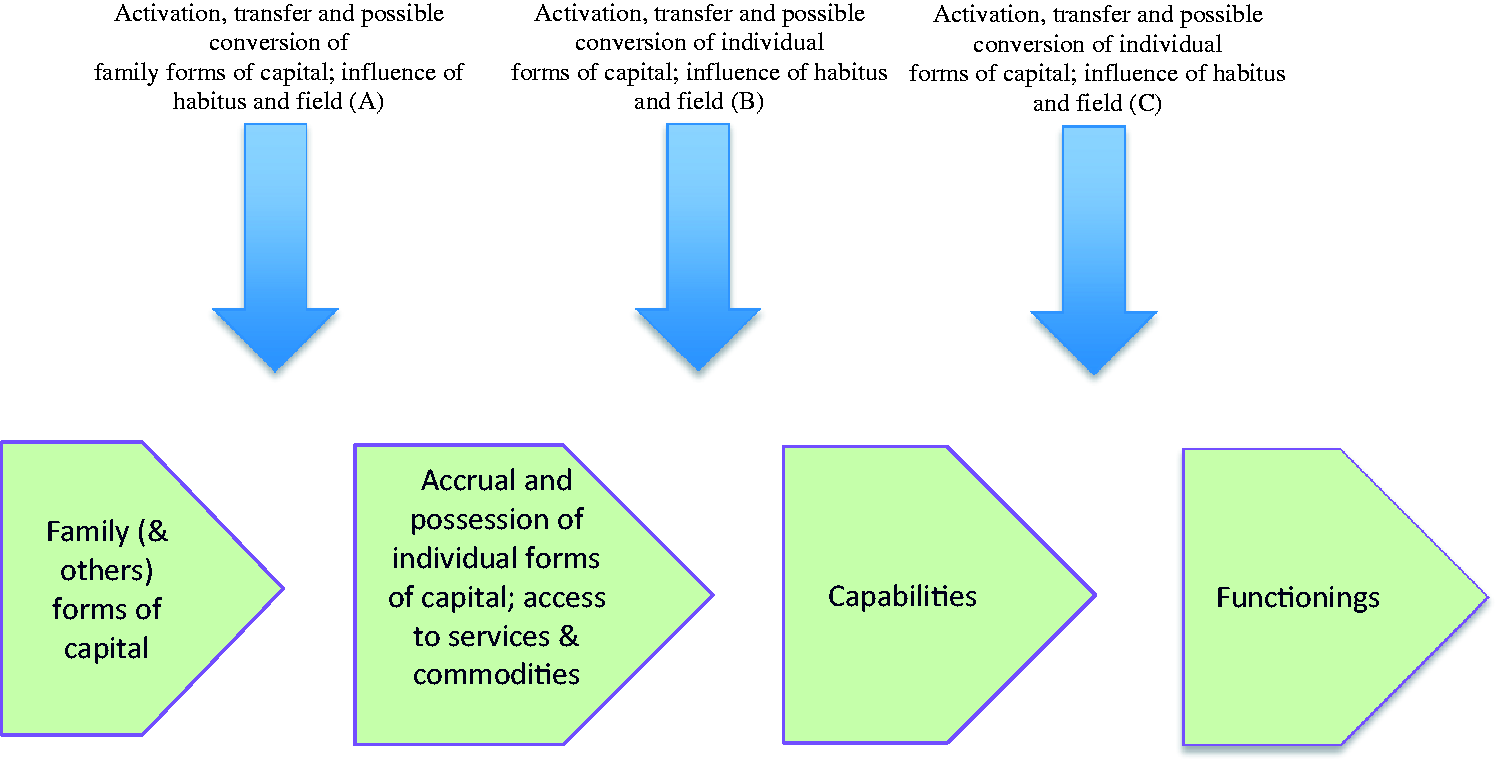
Sen-Bourdieu Analytical Framework, building on Hart (2012).9
At points (A), (B), and (C) there is potentially the need to convert one form of capital into another in order to ultimately develop a capability; for example, using family economic capital to pay for extra-curricular activities that contribute to a child’s cultural capital (attending art galleries, theatre trips, overseas residential experiences), which may later be converted into the capability to pursue a range of careers and to mix comfortably in different fields. Indeed, the individual will often need to exercise a degree of decision-making, within a social context, in order to determine which combination of capabilities is finally converted into functionings, as seen in Figure 2(C).
The individual may also choose to convert one or more forms of capital in order to impact on others as well as themselves. This has particular relevance for thinking about teacher training and school leader development in terms of the possible ways in which their individual, or institutional forms of capital may be transferred or converted in order to support students. For example, school funds might be used for additional activities perceived to build children’s cultural capital and to support the development of future capabilities. Significantly, Reay et al. (2001) have argued that ‘institutional habitus’ is mobilised differently for pupils related to how well they fit the dominant institutional culture. Greater awareness of this potential bias may help schools to reduce educational inequalities and to direct resources, and the transfer and activation of forms of capital, in ways that seek to benefit the most disadvantaged students.
Assuming an individual is able to successfully convert family (or others’) capital 10 into individual capital, the capability approach still questions traditional notions of advantage and thus highlights the importance of the freedom to achieve valued ways of being and doing as well as achievement itself. The concept of ‘capability’ helps to demonstrate that possessing individual capital is not an indicator of freedom to achieve well-being. An individual may be well-educated, rich and knowledgeable of perceived high culture but may not be able to achieve the valued functioning of being well-liked because they lack the ability or knowledge of how to use their capital commodities effectively to achieve this goal. Thus, despite a child’s growing capital portfolio, they may be unable or at least constrained in converting capital into capability. Let us turn now to discuss how the conversion factors work in combination and might impact on the three areas of educational access, experience and outcomes highlighted earlier.
Access to education
There are a number of common points where children need to access new learning opportunities, be that starting kindergarten, entry to primary or secondary schooling or transition to college or university. For children who move during their studies or have breaks due to illness, conflict, natural disaster and the like, there will also be times when re-entry to educational processes occurs. The problem is that not all children will enjoy equal opportunities to access quality learning opportunities. They may be limited by where they live, the cost of getting to school, school provisions and in some cases, the cost of tuition. They may not understand or feel confident to navigate application processes, especially for tertiary education. Transport options may be limited or dangerous, and in some cultures there may be social or economic barriers to participation in education. So although, in capability terms, the ‘resource’ of a school may be present in a particular locality, this does not mean that all children can ‘convert’ that resource into the capability for education. Hundreds of thousands of people worldwide live in extreme circumstances that impact on their health capability and their physical capability to attend and make use of educational opportunities. The UNDP reports that: One person in nine in the world is hungry, and one in three is malnourished. About 15 million girls a year marry before age 18, one every two seconds. Worldwide 18,000 people a day die because of air pollution, and HIV infects 2 million people a year. Every minute an average of 24 people are displaced from their home (UNDP, 2016: 5).
Experiences of education
Learners’ experiences of education will vary depending on their own psychological and physical state, their interactions with others and wider institutional and environmental constraints. In other cases, there may be in-country differences in educational experience due to school location with UNESCO reporting that, ‘computers in rural schools are less likely to be connected to the internet and, for example, in Colombia, the Dominican Republic and Mexico, computers in city schools are twice as likely to be connected’ (2017: 226). In areas experiencing conflict or natural disasters, children may be prevented from attending school for prolonged periods, buildings may suffer damage, and teachers may be absent. Children who feel a sense of entitlement to their education and who are taught in language codes that reflect their own tastes and distinctions will fare better than children who feel out of place and who do not recognise the cultural norms of their educational institution. Children who have the capability to ‘appear in public without shame’ 11 and are able to fit in with peers, for example, by having the ‘right’ trainers, mobile phone, taste in music and so forth, will have a different experience of education compared to their counterparts who lack these capabilities. The same applies in relation to one’s perceived ability and performance in school, the degree to which individuals experience feelings of affiliation, recognition, a sense of belonging and so forth. One can argue that access and activation of cultural, economic and symbolic capital can help to develop these capabilities. Thus, unequal distribution, and access to capital in all its forms will impact on inequalities in educational experience. For example, it is well documented in the United Kingdom, and elsewhere, that undergraduate student ‘experience’ is not homogenous across institutions or courses, and the lifestyles of students are socially constructed in power-laden contexts in which individuals experience different degrees of power and agency (Brennan and Osborne, 2008; Reay, 2010; Reay et al., 2009; Vignoles and Powdthavee, 2010).
Outcomes of education
Inequalities are evident in the transitions of young people from school and college to the wider world with similar conversion factors at play as those described above. Some individuals, despite their qualifications, may be perceived as ‘not fitting in’, for instance, because of a perceived lack of cultural capital. Some individuals may find it easier to secure work experience and job opportunities through family, school or university-related networks. Others may find it difficult to take up unpaid internship opportunities that may lead to prestigious job opportunities because they lack the economic capital to live without wages or to travel to where opportunities exist. Some inequalities are related to specific personal attributes such as race, gender, age and disability. For example, gender inequalities are prolific, with the 2016 Human Development Report indicating …in all regions women have a longer life expectancy than do men, and in most regions girls’ expected years of schooling are similar to those of boys. Yet in all regions women consistently have, on average, a lower Human Development Index (HDI) value than do men. The largest difference is in South Asia, where the female HDI value is 20 per cent lower than the male HDI value…there are 100 countries where women are prevented from pursuing some careers only because of their gender (UNDP, 2016: 5–6).
Sen’s capability approach offers some ethical principles to apply in approaches to developing and evaluating systems of education. Bourdieu’s sociological concepts provide an ideal partner to these organising principles by offering tools for in-depth analysis and understanding of the social context in which education takes place. Bourdieu’s ‘logic of practice’ offers valuable insights into the very physical movement of young people between family and education-oriented fields. The ‘game’ is played out quite visibly through these transitory movements of students to and from their homes and formalised places of learning. Bourdieu’s concept of ‘habitus’ opens a door of perception into the less visible world of agents’ minds and decision-making processes. Bourdieu has been criticised for being overly deterministic, identifying elements of the habitus as unconscious and the societal structures as enduring constraints leading to the social reproduction of inequalities between social classes. However, Bourdieu’s conceptualisation of game-playing in the field is dynamic rather than static. Perhaps more importantly, Bourdieu’s work offers us understanding of human action and interaction that allows the unconscious to become conscious. From this perspective, he indicates that through consciousness, resistance and struggle, changes are possible. The challenge is to decide whether the risk of consciousness, and the potential pursuit of change and resistance, is worth taking. This depends, at least to some extent, on whether policy-makers and practitioners are willing to support the struggle of young learners.
Conclusion
The discussion has aimed to expand the space for evaluating sources of injustice in relation to education by drawing on Sen and Bourdieu’s conceptual thinking. By considering Bourdieu’s forms of capital, we gain insight into the multiple sources of advantage that different individuals may be able to draw upon beyond the range of commonly understood commodities, good and services. We recognise that some individuals will be disadvantaged by their lack of access to different forms of capital or even by the burden of negative capital. In turn, Sen’s notion of capability expands our evaluation of a successful education system to include the extent to which individuals are able to develop the freedom to pursue lives they have reason to value, in addition to observing educational achievements. Capability theorists highlight the role of conversion factors in supporting and hindering the development of freedoms and achievements, and Bourdieu’s concepts of ‘habitus’ and ‘field’ allow us to understand the complexity of how these factors operate. This yields insights that may begin to inform future policy and practice to pursue greater social justice in and through our educational processes. Perhaps a key tension between Bourdieu and Sen is that Bourdieu seems more pessimistic regarding the static nature of structural inequalities and the limited power of individuals to eliminate their unjust effects. Bourdieu positions education systems as guilty parties in the perpetuation of a cultural arbitrary and as purveyors of symbolic violence 12 that serve to maintain and reproduce the status quo. That is to say, that certain cultural practices, knowledges, tastes and dispositions are embraced, at the expense of the subordination of others. Sen, on the other hand, recognises that without a pluralistic view of inequality that takes account of people’s freedoms as well as their achievements, we will not be able to adequately uncover the injustices many are subjected to, often without knowing. Sen’s position of seeking to reduce obvious injustices whilst accepting that perfect (transcendental) justice is perhaps beyond mortal reach offers a more optimistic view of individual and group agency. We may not be able to overcome all structural inequalities in one fell swoop but, rather than attempting to produce a perfect institutional structure (an infinite task), we may be able to make some progress by focussing on the lives people are actually living, and using this as the focus for reducing inequality (Sen, 1992, 2010). 13
The Sen-Bourdieu Analytical Framework deepens understanding of the dynamic social (and psychological) processes involved in the development of an individual’s capabilities and the possible roles of educational systems and processes in helping as well as constraining human flourishing. In synthesising the thinking of Sen and Bourdieu, an argument has been made for the importance of developing capabilities as well as considering the distribution of resources, encouraging policy makers and practitioners to strive to ensure that, as far as possible, individuals are free to choose a life they have reason to value.
Regarding practice, becoming conscious of the roles of educational institutions in the perpetuation of injustices and oppression is a first step on a long journey of development. Measuring inequality using Sen’s concepts of capabilities and functionings will illuminate pathways for addressing some of the most prevalent and deep inequalities that currently dampen individual aspiration and capability formation. Innovative pedagogies are called for that seek to work more collaboratively than competitively and that resonate with Friere’s notion of dialogic action (1996). In other words, the oppressed need to consciously become part of the resolution of the injustices perpetuated through structural inequalities, and the symbolic violence and cultural arbitrary foregrounded by Bourdieu and Passeron (2000). The development of educational curricula and pedagogical practices, drawing on a capability approach, are discussed in a growing number of texts (Boni and Walker, 2013; Hart and Brando, 2018; Walker, 2006; Walker and McLean, 2015). A key challenge is to think further about how to respond to the pessimistic picture emerging from Bourdieu’s analysis of social reproduction and oppression inherent in current educational practices.
Educational policy must go hand in hand with practice developments. Education policy has a dominant focus on the development and education of children and young people. This paper specifically avoided narrowing the discussion solely to children since there are huge numbers of adult learners too. Notwithstanding this, children are often positioned as vulnerable and in need of special protection, leading to paternalistic policies that assume children are unable to have autonomy or represent their own interests. This position has been disputed by several authors who instead assert children’s rights to have a voice in matters that concern them, according to their capacity and maturity, and who assert the potential of many children to exercise agency and practical reason (Ballet, Biggeri and Comim, 2011; Hart et al., 2014; Hart and Brando, 2018). The implications of the wider external constraints on the outcomes of education, for instance, related to employment discrimination, call for policies to be intersectional, operating across education, employment and other aspects of social, commercial, legal and political life. For example, employment practices need to be subject to better regulation and scrutiny with clear pathways for cases of discrimination to be legally addressed, without penalty to victims. Moreover, much work needs to be done to change culturally entrenched attitudes and dispositions that unfairly lead to disadvantage.
Finally, in terms of research, Bourdieu argued that …it is only by making a second break, this time with the illusion of the neutrality and independence of the school system with respect to the structure of class relations, that it becomes possible to question research into examinations so as to discover what examinations hide and what research into examinations only helps to hide by distracting inquiry from the elimination which takes place without examination (Bourdieu and Passeron, 2000: 141).
Footnotes
Author's note
Parts of this paper are reproduced from Hart (2012) Aspirations, Education and Social Justice – Applying Sen and Bourdieu (London, Bloomsbury Academic, an imprint of Bloomsbury Publishing Plc) with kind permission from the publisher.
Declaration of conflicting interests
The author(s) declared no potential conflicts of interest with respect to the research, authorship, and/or publication of this article.
Funding
The author(s) received no financial support for the research, authorship, and/or publication of this article.