




Abstract
The dominant discourse of teacher education is framed as the “construction of the problem of teacher education” (Cochran-Smith et al., 2013). From this neoliberal discourse came the push for more accountability, contributing to the promotion of a nationally scored standardized teacher performance assessment (edTPA). This article examines the impact of the assessment on those taking the elementary education edTPA in New York City, teacher educators and the teacher education curriculum. Based on survey and interview data from teacher candidates and faculty, there is a strong concern about the impact of the cost of the edTPA on economically disadvantaged teacher candidates and under-resourced schools of education. In many cases, teacher candidates were not encouraged to fight the neoliberal discourse but rather to “play the game” to pass a test. Because teacher educators felt it was their job to help their teacher candidates get certified, little resistance was found even among those who were not in support of the edTPA. In resistance to the standardization, teacher candidates were encouraged to be strategic, within the Pearson guidelines, in terms of their class size and composition as well as with the lessons that they taught. There were also accommodations made in teacher candidates placements to avoid testing grades or schools with a standardized curriculum; however, this potentially created new consequences with the avoidance of high-needs schools. Additionally, due to the intersection of the specific requirements of the edTPA and the mandated curricula, teacher candidates went outside the guidelines to pass the test. Furthermore, some teacher candidates decided not to take the edTPA and to get certified in another state or not to go into public education.
Neoliberalism and teacher certification
Neoliberalism is an ensemble of economic and social policies, forms of governance, and discourses and ideologies that promote individual self-interest, unrestricted flows of capital, deep reductions in the cost of labor, and sharp retrenchment of the public sphere. (Lipman, 2011: ch. 1, sect. 4, para. 1)
In education, neoliberal policies fall under the discourse of “reform.” Educational reform is enacted in the form of standardization, individualism, outcome-based accountability and free-market policies. By its very nature, teacher certification promotes these features. Over time, accountability in teacher certification has shifted from the sole responsibility of the teacher candidate to a joint responsibility with teacher education programs (TEPs) (Cochran-Smith et al., 2008). This change was apparent in the USA in the 1990s through the regulation of the content of TEPs, an analysis of teacher exams and the establishment of an accreditation body to develop and enforce national standards (Cochran-Smith et al., 2008). Currently, graduating from a state-approved TEP is only one requirement for the traditional pathway to permanent teacher certification in the USA. In New York State, in addition to other requirements, teacher candidates are required to pass three exams to become certified: one focused on content knowledge (Content Specialty Test, CST), another on meeting the needs of special-education students (Educating All Students, EAS) and a performance assessment known as the edTPA.
This paper will explore the neoliberal underpinnings of the edTPA and the consequences that further promote neoliberal practices and the neoliberal social imaginary, which accepts a market-based ideology as the normative practice of educational reform (Rizvi, 2017). The reader will be taken from theory to application, beginning with the concepts central to neoliberalism and then focusing on “educational reform” to solve the “problem of teacher education” (Cochran-Smith et al., 2013) and the specific “solution” of the use of the edTPA as an accountability mechanism. There will be a brief outline of the tasks in the edTPA portfolio, with specific details pertaining to the elementary education edTPA and an overview of the teacher accountability policies of New York and how this context contributed to New York becoming one of the first US states to adopt the edTPA as a high-stakes requirement for certification. The paper will conclude with an analysis of data from a study that focused on how the adoption of the edTPA was experienced by teacher candidates and teacher educators in New York City and its implications for schools of education, teacher education and the teaching profession in general.
The neoliberal social imaginary
Neoliberalism is not just “out there” as a set of policies and explicit ideologies. It has developed as a new social imaginary, a common sense about how we think about society and our place in it […] the power of neoliberalism lies in its saturation of social practices and consciousness making it difficult to think otherwise. (Lipman, 2011: ch. 1, sect. 4, para. 1)
The neoliberal social imaginary has changed how the government handles issues of social welfare. The responsibility has shifted with the interpretation of “democracy” as the promotion of a free-market economy. This practice promotes competition with the idea that the best product or the highest-quality service will remain. Although a free-market economy promises benefits for all, the result is power and profit for a few. As Chomsky (2011) explains, “Neoliberal doctrines, whatever one thinks of them, undermine education and health, increase inequality, and reduce labor’s share in income; that much is not seriously in doubt.” This inherently creates a restoration of class power because the purpose of neoliberalism is to accumulate capital for the wealthy through corporatization, privatization and the commodification of public assets rather than generating wealth and income for all (Bourdieu, 2010; Bourdieu et al., 1990; Harvey, 2005). When the government’s policies and actions focus on capital accumulation, it creates a neoliberal state which “reflect[s] the interests of private property owners, businesses, and multinational corporations, and financial capital” (Harvey, 2005: ch. 1, sect. 1, para. 7). For example, Pearson Education, the company that distributes and manages the edTPA, can create a monopoly over other competition. The UK-based Pearson Education has become such a dominant presence that it is “the world’s largest education company, with over 35,000 employees in more than 70 countries” (Pearson, n.d.). As Singer (2017: para. 2) explains, “Pearson Education [is] a leader in the neo-liberal privatization movement. Pearson has tentacles all over the world shaping and corrupting education in efforts, not always successful, to enhance its profitability.”
Additionally, the neoliberal social imaginary supports the idea of creating human capital. US education policy has always juggled tensions between labor market preparation and democratic citizenship, but the neoliberal turn marks a sharp shift to “human capital development” as the primary goal. In this framework, “education is a private good, an investment one makes in one’s child or oneself to ‘add value’ to better compete in the labor market, not a social good for development of individuals and society as a whole” (Lipman, 2011: ch. 1, sect. 9, para. 1). As Harvey (2005: ch. 3, sect. 1, para. 3) explains further, according to neoliberal theory “Individual success or failure are interpreted in terms of entrepreneurial virtues or personal failings […] rather than being attributed to any systemic property.” This ignores the role of social, cultural and economic capital in access to opportunity and achieving success (Bourdieu, 2002). With the theory of human capital comes a “demand for the constant production of evidence” (Apple, 2001: 188) to show one’s value, such as in an exam.
Neoliberalism and educational reform
Like other neoliberal policies, educational reform privileges those with power and money over those with experience and expertise, resulting in an educational policy “field.” As Bourdieu explains, fields contain “people who dominate and people who are dominated. Constant, permanent relationships of inequality operate inside this space, which at the same time becomes a space in which the various actors struggle for the transformation or preservation of the field” (Bourdieu, 1998: 40–41). Under the influence of neoliberalism, the educational policy field has become intertwined with a global economic policy field (Lingard et al., 2005). As O’Brien and Robb (2017) explain, “Current reforms are allowing certain wealthy and/or connected individuals with neither scholarly nor practical expertise in education to exert significant influence over educational policy.” This is evident in the per-diem hiring of “calibrated scorers” of the edTPA, whose evaluation of a short video clip and a portfolio takes precedence over a semester of observations by teacher education faculty and cooperating teachers.
The neoliberal dominant discourse of teacher education is framed as the “construction of the problem of teacher education” (Cochran-Smith et al., 2013). This discourse has led to a push for free-market competition among teacher certification programs (Apple, 2001, 2010; Lipman, 2011) through various measures of their teacher candidates’ readiness and is moving to analyzing the ability of graduates of schools of education to raise K-12 student achievement (Kumashiro, 2015). In fact, the Council of Chief State School Officers, the group that produced the Common Core State Standards, created a task force that recommended outcome-based accountability policies linked to licensure, program approval and data (Kumashiro, 2015). These policies include using K-12 student test scores of the graduates of a school of education to rate the effectiveness of teacher education programs. Collecting these data is challenging, so another strategy is to use certification exams to quantify teacher education effectiveness. Comparing across contexts has become easier with the promotion of a nationally distributed teacher performance assessment.
The theory behind outcome-based accountability is that, if incoming teachers are better tested, the country will weed out those teachers who will be ineffective, which will lead to greater student achievement as measured by standardized assessments. On the surface, this theory sounds reasonable, but when one looks at all the factors related to the validity and reliability of the edTPA and the other factors affecting student test scores (American Statistical Association, 2014; Berliner, 2015; Berliner and Glass, 2014; Bloom, 2013), it is an oversimplification of a complex issue. The theory ignores the political economy of schooling, the biases and flaws in standardized tests and how the tests are scored.
Tasks of the edTPA
The edTPA is a portfolio that evaluates teacher candidates’ planning, instruction and assessment. The teacher candidates also must show how they met the needs of English language learners, the Individualized Education Plan (IEP) goals for special-education students and any other group, such as struggling learners or gifted and talented students.
The elementary education edTPA is unique in that it evaluates two subject areas and consists of four tasks, rather than three, resulting in 18 rubrics rather than 15. The instructions for creating the elementary education edTPA are contained in a 64-page handbook. This document outlines the expectations for the portfolio to be created, consisting of 60–68 pages accompanied by no more than 20 minutes of video.
Tasks 1–3 make up the English language arts section, which consists of a “learning segment” on either comprehension or composition that must also have a reading/writing connection. Throughout the learning segment, teacher candidates are to assess their students’ progress and show evidence of students’ understanding of the “language function”, “essential literacy strategy”, “related skills” and “syntax or discourse” used. 1
Task 4 is focused on math and asks teacher candidates to analyze assessment data to plan a “re-engagement” lesson for a group of students based on a mathematical misunderstanding. A new strategy must be used that is tailored to meet the needs of the identified group of students. This lesson is conducted with a small group or with the whole class, depending on the assessment data. Teacher candidates must clearly teach mathematical conceptual understanding along with either procedural fluency or problem solving. After the re-engagement lesson, teacher candidates must use data to evaluate the effectiveness of their teaching.
In analyzing the edTPA, it is clear how the test is meant to train teachers for a data-focused mindset in their own classrooms. The edTPA states that teacher candidates are to “analyze student work from the selected assessment to identify quantitative and qualitative patterns of learning within, and across learners in, the class” (Stanford Center for Assessment, Learning and Equity, 2014a). The tasks and rubrics seem to privilege assessment over all other aspects of teaching, with 10 of the 18 rubrics in the elementary education portfolio focusing on some aspect of data collection, analysis or usage (Stanford Center for Assessment, Learning and Equity, 2014b).
The “problem of teacher education” and edTPA as a solution
As Cochran-Smith et al. (2013: 16) explain, “the [ed]TPA emerged from a context wherein the construction of the problem of teacher education was lack of accountability and standardization of expectations across programs and states.” This “solution” has been promoted not just by policymakers, but by the American Association of Colleges of Teacher Education (AACTE) in hopes to counter in hopes to “professionalize” teaching (Darling-Hammond, 2010; Darling-Hammond and Hyler, 2013; Peck et al., 2014; Stillman et al., 2015). Although this move is intended to shift the perception about the profession, it plays into the rhetoric that teacher education is failing to prepare teachers rather than considering other factors that contribute to teacher attrition and low K-12 student test scores, such as the political economy of schooling.
As the stakes rise
AACTE, in its intention to professionalize teaching, has stated the following as among the goals of the edTPA:
improve student outcomes; improve the information base guiding improvement of teacher preparation programs; and strengthen the information base for accreditation and evaluation of program effectiveness (AACTE, n.d.).
Additionally, AACTE explains that the edTPA was designed to make sure that teachers were “ready to teach, with the necessary skills needed to support student learning, from the first day they enter the classroom” (AACTE, n.d.). These all seem like positive goals; however, the intended purposes of accountability mechanisms in education can be easily corrupted when they become high stakes (Campbell, 1979; Nichols and Berliner, 2007).
Under these circumstances, teacher candidates and teacher educators experience tensions between the demands of the test and their own priorities (Lachuk and Koellner, 2015; Meuwissen and Choppin, 2015; Okhremtchouk et al., 2013). The pressure to pass can also result in an inauthentic representation of teaching (Henning, 2014; Lanham, 2012) and in “strategies disconnected to educational theory and practice” (Denton, 2013: 32) to fit what will earn a high score. Furthermore, teacher candidates can find it challenging to construct their portfolios honestly between the specific requirements of the exam and the confines of their student teaching placement (Madeloni and Gorlewski, 2013a). These tensions will be highlighted further below when the data from the study are analyzed. The high stakes of the exam have resulted in further privatization and commercialization in the form of tutoring services for the edTPA that claim to guarantee a passing score (Dover et al., 2015; Sawchuk, 2015). Not only does this privilege teacher candidates with the economic capital to afford such services; it also raises questions about unethical support in constructing the portfolios.
Context for the study
This study was part of a larger investigation of the experiences of New York City teacher candidates and teacher educators with the elementary edTPA. To provide an understanding of the context for the study, the following sections will include background on how accountability regimes function in New York State, a brief overview of the implementation of the edTPA in New York State and various actions taken in response to the implementation. The findings and discussion that follow focus on the role of neoliberalism in the implementation of the edTPA policy and the neoliberal outcomes or consequences of the edTPA.
New York education policy structures
Since education is a state’s right, structures for education policy vary across states. The New York State Board of Regents of The University of the State of New York was established as the head of the State Education Department in 1784 and is the oldest continuous state education system in the US (“Structure of the New York State School System: Legal Framework”, n.d.; Thomson Reuters Westlaw, 2017a). The Board of Regents is made up of 17 Regents, representing the various geographic areas across the state. It is led by the Chancellor, who is appointed (and can be removed by) the Board of Regents (Thomson Reuters Westlaw, 2017a). One Regent represents each of the state’s 13 judicial districts and four Regents serve at large. They are elected by the State Legislature for five-year terms. The Commissioner of Education is the Chief Executive Officer of the Board of Regents and the Chief Administrative Officer of the State Education Department, and carries out judicial functions (Thomson Reuters Westlaw, 2017b). The State Education Department carries out legislative mandates and Regents’ policies (“Structure of the New York State School System: Legal Framework”, n.d.).
Education accountability in New York State
Under the influence of the neoliberal social imaginary, federal policies and funding incentives have shaped state education reform. The No Child Left Behind Act (NCLB) of 2002, required states to use standardized tests to measure student performance and as a method of teacher accountability. In 2007, New York amended its teacher evaluation system with the adoption of Education Law Section 3012-b. “Section 3012-b was New York’s first step in developing a teacher evaluation system that linked teacher accountability to student performance, as it mandated teacher evaluations be based on analysis of student data and required a statewide evaluation system that linked teacher accountability to student performance” (Ciaccio et al., 2017: 2). Competition for federal Race to the Top (RttP) grants in 2010 increased the focus on data and standardized tests when Education Law Section 3012-c replaced 3012-b. This created an Annual Professional Performance Review (APPR), which required 60% of teacher evaluations to be based on classroom observations, 15–20% on local evaluations and 20–25% on state standardized test scores to measure student growth (Cacicio and Le, 2014; Moldt, 2016). Local evaluations are known as Student Learning Objectives (SLOs) 2 in most districts across the state and as Measures of Student Learning (MOSL) in New York City. According to the Reform Education Network (2014) created by the US Department of Education, New York is one of two states in the “minimum flexibility, more comparable SLOs” category.
In 2015, the value of testing was further promoted with the change to Education Law Section 3012-d that required 50/50 weighting between classroom observations and local evaluations and state standardized tests. The combination of opposition to this change and the state’s New York Common Core Task Force work on creating new State Standards (released in 2017 as the New York State Next Generation Learning Standards) resulted in the approval of a “transitional period” until 2019 to delay using state assessments as part of teachers’ APPR.
New York State’s response to NCLB and RttP created an environment of increased teacher accountability, a reliance on standardized test scores as a measure of student learning and teacher effectiveness, and the push for data-driven decision making in teaching. This perspective was paralleled in teacher preparation with the emergence of new teacher certification exams in 2013, including the Educating All Students test (EAS), the new Content Specialty Test (CST), the Academic Literacy Skills Test (ALST) 3 and the edTPA.
The edTPA implementation and New York State
In 2009, the New York State Education Department (NYSED) began working with Pearson on creating a state teacher performance assessment. In February 2012, New York State abruptly abandoned this idea when the edTPA become nationally available. The handbooks and rubrics were made accessible to teacher candidates and schools of education in New York in the spring of that year (D’Agati, 2012). New York then became one of the first states to adopt the edTPA as a high-stakes certification requirement after only one year of field testing, and it did so while requiring a passing score that was the highest in the country (Gurl, 2014).
Concerns about the rushed implementation were expressed by teacher educators across the state, with the United University Professions (the union for the State University of New York System) leading the charge (Greenblatt and O’Hara, 2015). This resulted in the NYSED providing a “safety net” for teacher candidates, which allowed teacher candidates who failed the edTPA to take the original written test that the edTPA “replaced.” This safety net has been renewed every year; however, there is a policy change set for June 2018, when a new passing score will be decided and gradually phased in over several years with a multiple-measures review for teacher candidates who fail but are within one standard deviation of the passing score (New York State Education Department, 2017).
The perversion of participation
With the tension mounting from the rushed implementation of the edTPA, the New York State Board of Regents (which approves education policy recommendations in the state) created an edTPA Task Force at its April 2014 meeting to “address problems with this new high-stakes certification requirement” and advise the NYSED (Professional Services Committee et al., 2014: para. 1). The edTPA Task Force was made up of members from the public and private colleges, P-12, the unions representing these organizations (UUP, PSC, NYSUT) and others appointed by the Commissioner of the NYSED (NYSED Office of Higher Education, 2014). The Task Force members met with representatives from the Stanford Center for Assessment, Learning, and Equity (SCALE), which created the edTPA, and AACTE. However, under former Commissioner John King, The Task Force, as constructed by [NY]SED, is more limited in scope than we [UUP, PSC, NYSUT] expected it to be after requesting its formation in April. It will not address important policy issues related to the use and implementation of the edTPA in New York State because those issues have been ruled out of bounds by [NY]SED. (Professional Services Committee et al., 2014: para. 3) the ability of the Task Force to arrive at a full set of recommendations that would ensure a quality teaching force was compromised from the outset by the political tone set by [NY]SED combined with the policy pronouncements of then-Commissioner John King […] we found great limitations in [NY]SED’s prescribed format for the group’s meetings and process. Several issues that emerged from productive group discussions addressing critical policy issues were ruled to be “outside the scope” of the Task Force’s work. In addition, Commissioner King openly censored the content of our work by refusing to allow important policy recommendations to be part of the group’s final report, by withholding data sets needed for the analysis of test scores, and by refusing to allow adequate time for completion of Task Force work. (New York State United Teachers et al., 2015: 2).
King’s statements support a neoliberal free-market and outcome-based accountability mindset. These members of the Task Force wanted to clearly communicate that they were concerned that their participation in the edTPA Task Force would be used “to justify an already determined political policy based in ideology and not in honest analysis and inquiry” (New York State United Teachers et al., 2015: 3) and that “the final recommendations, if and when issued, will be limited to implementation issues and not reflect the full range of issues and recommendations considered by task force members” (New York State United Teachers et al., 2015: 2). This document also communicated the concerns about the edTPA’s effect on “future diversity of the New York State teaching force” (New York State United Teachers et al., 2015: 3) and that the “edTPA imposes a standardized set of objectives that supplants existing curricula approved by faculty and by national accrediting bodies” (New York State United Teachers et al., 2015: 5).
Democratic dialogue
In January 2016, the NYS Board of Regents requested that the edTPA Task Force be reconvened to review the edTPA and the other certification exams (Board of Regents, 2017; McGrath, 2016). During the 18 months when the Task Force had not met, there were some changes in the members of the Board of Regents, and so in the tenor of the meetings themselves. As McGrath reported, “This time, members feel the task force stands to make a difference” (McGrath, 2016: para. 1). This change in climate was supported by the public forums on the edTPA that were held around the state by Regents Cashin and Collins. The forums were attended by other Regents, New York State Education Commissioner Elia and NYSED staff to hear from teacher educators, those who had taken the edTPA and other members of the public (New York State Education Department, 2017).
At one of these forums in New York City, David Bloomfield, Professor of Education Leadership, Law and Policy at Brooklyn College and the CUNY Graduate Center, addressed the influence of the neoliberal discourse and its effects. He said, in short, current certification testing and assessment requirements, sold to the public as a solution, are part of the problem. They discourage worthy candidates, are viewed by practitioners as sterile procedural protocols without practical worth, and enrich a powerful assessment industry without proven public benefit (Brooklyn Town Hall Meeting, 2015).
Additionally, for some teacher candidates, participation in research about their edTPA experience has been used as an act of resistance (Coloma, 2015). Through participating in a research study, teacher candidates can critique the edTPA, express their concerns and frustrations and have their voices heard by teacher educators, policymakers and advocates who could share their stories with a larger audience. The following sections of this article aim to accomplish this goal.
Research sample and methods
This study is part of a larger investigation of the experiences of elementary teacher candidates enrolled in schools of education and student teaching in New York City who took the elementary education edTPA from the first year of its implementation in spring 2013 until fall 2015. Teacher educators were also a part of the study. Teacher candidates who were earning dual certified were included in the study if they took the elementary education edTPA to become a certified teacher.
Experiences with the elementary education were the focus for several reasons. This portfolio has four tasks rather than three and 18 rubrics rather than 15, which creates additional demands during their experience. Additionally, as an elementary education teacher educator who supervises student teachers, the researcher has expertise with this portfolio, which aids in establishing rapport and understanding the terminology and nuances of this content Handbook. Finally, typically elementary school teachers tend to instruct the same group of students all day and in multiple subjects. Unlike those taking the adolescent education edTPA, elementary education teacher candidates cannot use one section of a class to try out their edTPA and the other section for their portfolio.
The researcher recruited participants by reaching out to teacher educators and administrators of schools of education via email. Recruitment took place in the spring and fall of 2015, although the teacher candidates may have taken the edTPA in a previous semester. Care was taken to contact as many teacher education programs that certify elementary education teacher candidates as could be found in New York City. Several Internet searches were made to find all the programs in the area. Emails of professors and administrators were found on the schools’ websites. On some occasions, email addresses were acquired through professional contacts. Additionally, professional contacts made announcements at CUNY-wide meetings of teacher education programs to inform faculty of the research project.
Ten schools of education in New York City (six public and four private) were represented across all participants (teacher candidates and teacher educators). Sixty-one teacher candidates were surveyed and fourteen teacher candidates were interviewed. Seven teacher educators from the colleges in the study were also interviewed to triangulate the data through their perceptions of their teacher candidates’ experiences with the edTPA. The teacher educators did not participate in the survey because of the nature of the questions in the survey, which asked about teacher candidates’ demographics, the support they received and their student teaching placements. All participants interviewed were given the same initial prompt: “Talk about your experience with the edTPA.” Interviews were conducted using an “informal conversational” approach. This is an unstructured interview in which the questions naturally emerge from the data collected (Tashakkori and Teddle, 2003). Teacher candidates were also asked to further explain responses from the survey.
The data collection procedures were piloted and feedback was given to improve the construct validity of the tool. All interviews were recorded and transcribed. Respondent validation and member checking occurred by allowing respondents to read the analysis drawn from their data and comment on it. Gathering a 14 interviews were conducted to allow for discrepant cases. This number is also 21% of the number of surveys gathered.
Qualitative data were coded using Saldaña’s (2013) methods. Structural coding was used to identify the sections of the interviews that related to the specific themes, and these sections were grouped together. Structural coding is considered a good match for open-ended survey responses and interviews across multiple participants (Saldaña, 2013). Then magnitude coding was done to quickly identify the positive, negative, neutral or mixed-feelings statements in the data. Values coding and versus coding were used to explore the values, attitudes and beliefs of the participants about the policy and how they revealed issues related to the tensions or issues of power. Additional a priori codes were used from information gathered from the pilots of the surveys and interviews, a literature review and the researcher’s experience of working with teacher candidates taking the edTPA.
The word “participants” was used when the data concerned both teacher candidates and teacher educators. Pseudonyms were used when sharing findings from interviews with teacher candidates. Teacher educators were labeled as Teacher Educator A–G. If the findings would lead to identifiable information, then general terms were used (college, teacher educator).
A descriptive analysis of the data sample is presented in Table 1. These variables were collected to get a sense of the teacher candidates’ personal capital. The data from the study show a large sample of those under-represented in the elementary education teaching force in terms of gender, race and socio-economic status. In this study, 13% of teacher candidates were male and 39.3% were people of color. In terms of socio-economics, 28% were on financial aid and 18% were the first in their family to graduate from college. Public school teacher candidates represented 60.7% of the population, which correlates with the percentage of public colleges in the study. Data were also collected to capture a sense of the capital and challenges faced in their student teaching placements. The average free lunch percentage for the elementary schools in the study was 52.13 with a standard deviation of 38.32. Class sizes averaged 26.34 students with a standard deviation of 4.30 and a range of 12–35. Within these classes, there was an average of 4.07 special-education students with a standard deviation of 3.86 and a range of 0–14, and 3.42 English language learners with a standard deviation of 5.59 and a range of 0–24. Furthermore, 49.20% of schools used scripted curricula, with 41.66% following them strictly or with only minor adjustments.
Weighted comparison of means, standard deviations and ranges on “placement level” variables for New York City teacher candidates who took the edTPA (n = 61).
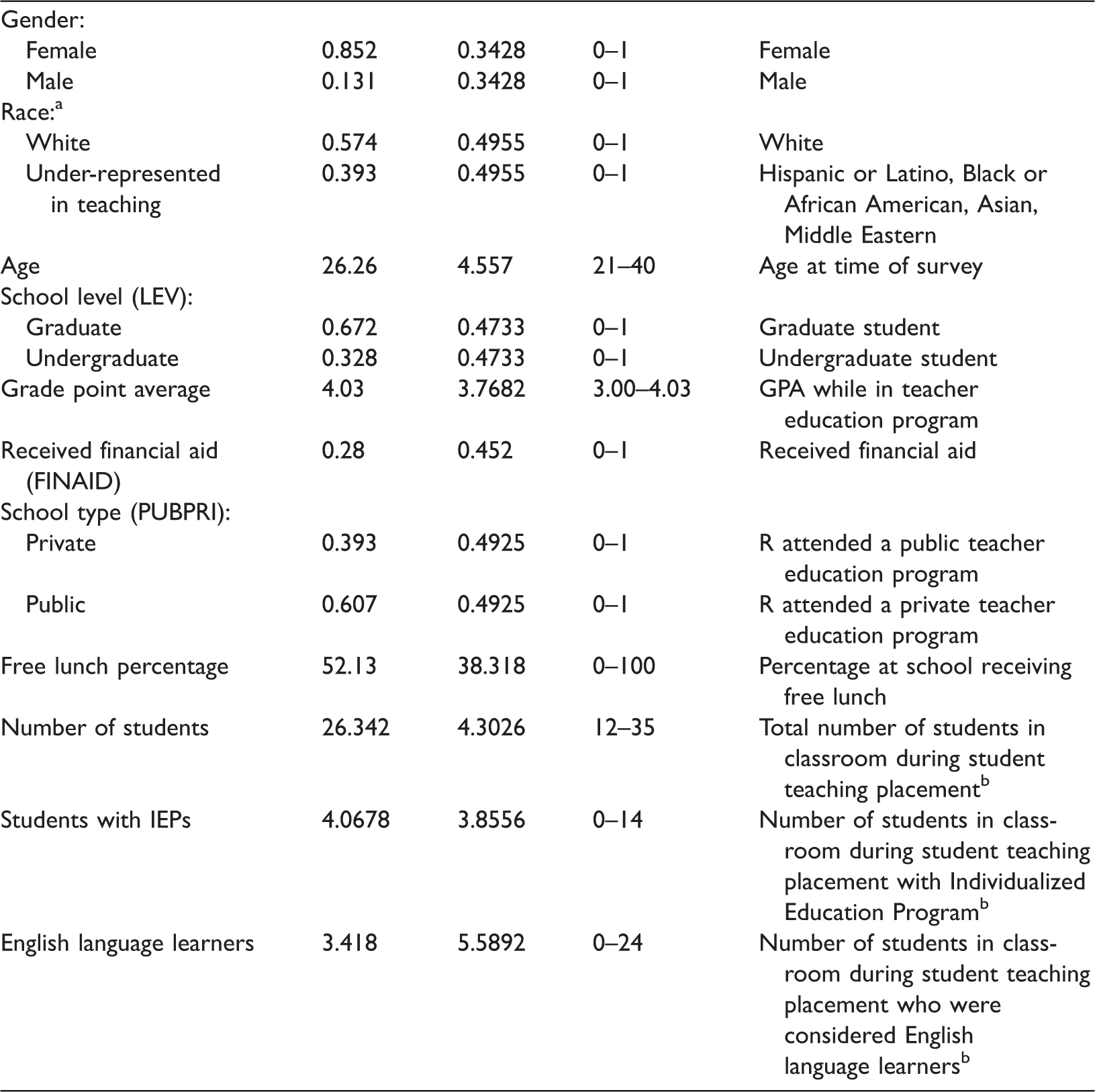
Note: aThere were no Native Americans in the study. Additionally, there were no respondents who identified as Native Hawaiian/Pacific Islander. Respondents who were mixed-race with White were counted in the under-represented category. Since the teaching force is primarily White, this designation was to represent any diversity present. bAn average was taken for those respondents with multiple placements.
It is important to note that the mean edTPA score was 59.26 (47 is passing and 57 is mastery level) with a standard deviation of 7.47 and a range of 32–71. This may be considered a limitation of the study, because few people who received low scores participated. However, it can also be a lens through which to analyze the data discussed in the following section.
Findings and discussion
The analysis of the data focuses on how the adoption of a high-stakes nationally scored certification test was experienced by teacher candidates and teacher educators and its implications for schools of education, teacher education and the teaching profession in general. Further implications for those in urban settings will also be discussed. The findings reported focused on those addressing issues of capital (Bourdieu, 2002). As a performance assessment, there are cultural, social and economic variables that influence the support during and challenges of the experience of taking the edTPA. These variables arise on the personal, school of education and student teaching placement levels, as will be explained further below.
Impact on those underprepared for college and English language learners
In this study, teacher educators shared their concerns that students of color, those underprepared for college and English language learners (ELLs) had more challenges during their edTPA experience than their counterparts. As Teacher Educator C shared, in terms of English language learners, they are really behind the eight ball. I’ve had several students who are English language learners that you can see in their writing that it’s much more difficult to decipher what they are trying to say, so it makes it more difficult for the rater.
Teacher Educator A concurred, saying, I also want to be explicit that for ELL teacher candidates, for teacher candidates of color, for teacher candidates of lower SES [Socio-Economic Status], or any combination of that, it is even more stressful because they are often underprepared in terms of their pre-K-12 experience.
Impact on economically disadvantaged teacher candidates
Many participants (teacher candidates and teacher educators) cited the cost of the edTPA as a challenge. However, one graduate student without financial challenges felt that the cost of the exams was something that went along with professional certification in any field. He compared the cost of exams taken by teachers to those taken by lawyers and doctors. This response highlights the neoliberal thinking embedded in the dominant discourse. It assumes that the burden of cost for education should be on the student, no matter what the economic class. What this teacher candidate was not considering is that those who can afford to go to law school or medical school are, for the most part, a group of economically elite individuals (Griffin and Hu, 2015; Sander, 2011). Additionally, a teacher’s starting salary is significantly less than that of a lawyer or doctor. These factors make the cost teacher of certification more substantial.
Teacher educators at public colleges were particularly concerned about the cost of the edTPA. They shared stories of their students not having room on credit cards for the fees or having to choose between having electricity and paying for an exam. As Teacher Educator B stated, “If students are not taking it because of the cost, that is already a bias.” Teacher Educator C explained, “For our students, that money is definitely an issue, and the costs of all of these tests is just becoming prohibitive.” In fact, since 2008 enrollment in teacher education programs has been dropping (US Department of Education, Office of Postsecondary Education, 2015), leading some to believe that the high cost of the exams has played a role (United University Professions, 2016).
Additionally, the time demands of the edTPA were very challenging for those needing to work while earning their degree. Michelle mentioned having to go from working 40 hours a week to 25–30 hours and eventually down to five hours to have more time for student teaching and to work on her edTPA. Another teacher candidate acknowledged, my experience of completing the edTPA was stressful because my plate was already more than full with a part-time job, student teaching, and my regular coursework. I wasn't able to focus on completing the edTPA until I finished my part-time job in early April (right before graduation).
Teacher candidates who do not have the time to write up their edTPA commentaries during the student teaching semester may end up delaying submission of their edTPA because they must return to full-time employment after graduation. Teacher Educator D explained, the problem is we have to get them to complete it, and I have folks who are great students, and they got most of it done and then they go off and they need to make money. They need salaried employment. When they are working again, in whatever field they were working in, they have a hard time finding the time to finish the edTPA. Once they are out of our grasp, it’s a little bit harder.
Impact on under-resourced schools of education
Teacher educators in the study explained that the state provided temporary funding for the initial implementation of the edTPA. Colleges used this money to purchase video cameras, to pay for the development of online modules and to hire faculty to run workshops or provide technology support. Teacher educators were concerned about how schools of education would be able to continue these supports when the funding was gone. Schools of education in this study either:
found money in their budget to continue the services; scaled back on the support on the assumption that professors were more knowledgeable about the edTPA and that curricular changes could provide enough support; or relied on faculty volunteers to continue the support without financial compensation.
In places where additional funding was not provided, teacher educators took on the burden and incurred additional stress. Teacher Educator A worked at a public college with a small teacher education program. She explained that there were only two faculty members to support twenty student teachers in completing their edTPA. This student–professor ratio resulted in her feeling that the edTPA support “became my whole life.” Teacher Educator A clarified further that often she was at her college until 10 p.m. and could have stayed later if not for the security guard asking her to leave the building so that it could be closed for the night.
Student teaching in the testing grades: When the mandate of one test interferes with completion of another
Until 2015, scores on the Common Core State Standards assessments were counted in New York State teacher evaluations (Disare, 2015). Even with the change in regulations, teachers have been living in a neoliberal social imaginary that places extreme emphasis on outcome-based accountability based on these tests and the free-market policies relating to employment decisions and school closures. Additionally, these scores are still publicly available for each school. Whether they count for individual teacher evaluations or not, teachers are still scrutinized for their students’ performance on these assessments at a local level.
Because the pressure is high for New York State teachers, much instructional time is spent taking practice tests, going over the answers and doing test preparation units in the months leading up to the state assessments. This leaves less instructional time. From first-hand experience of being a classroom teacher and supervising student teachers in schools in New York over the past 17 years, it is evident that principals and teachers shift their focus in the spring semester, and many classroom teachers are hesitant to give student teachers the responsibility of teaching lessons so close to the State Assessments which account for so much of their teacher evaluations. This is not only problematic for teacher candidates’ growth, but it also makes it challenging to find 3–5 days on which to teach consecutive lessons with a central focus.
In this study, taking the edTPA proved to be an additional challenge to the edTPA experience for those students teaching in a testing grade during the spring semester. Claudia, a teacher candidate in a dual language classroom, explained that preparing for and taking the state tests caused a huge interruption in the semester. For weeks, she was very limited on the amount of teaching she could do, which made it impossible for her to do her edTPA. Michelle’s situation was similar. She said that because her students were “stressed out” about the tests, it was hard to get them to focus. Additionally, even though her cooperating teacher was supportive, Michelle's certification exam became secondary to getting students to pass the state tests. Once the tests were over, teacher candidates had more freedom. However, another challenge emerged: for Christy, her students felt like the school year was over after the test, which made teaching her learning segment more difficult.
Teacher educators were aware of these challenges. They reflected on their teacher candidates’ ability to complete the edTPA with two weeks of the semester dedicated to testing, in addition to the weeks spent preparing for the tests. Teacher Educator A revealed, forget when it’s testing time. What we are finding out now is that edTPA needs to be taken in the fall, and you need to submit during the winter session because when it is testing time here … forget it. The principals and the teachers are saying the student [teachers] can’t come in. It’s just a lot. The schools are stressed out. I found the [edTPA] assessment tasks to be onerous, time-consuming, and of little benefit toward the development of my pedagogical practice. In fact, I felt the required tasks took away from my ability to focus on other dimensions of learning and modes of teaching that I sought to develop and practice. The high stakes of the test forced me to dedicate valuable classroom and prep time to completing the tasks for the sole benefit of an unknown and unknowable scorer.
Student teaching in an urban setting
It is known that in low-income communities where students are not scoring well on standardized tests, schools are more likely to have scripted curricula and students with a variety of special needs (Stillman et al., 2011). These aspects present challenges to passing the edTPA that are not taken into consideration. Additionally, there is a concern about scorer bias or lack of experience with or knowledge of culturally relevant pedagogy with urban students (Dover and Schultz, 2016).
Christy admitted that this reality was in the back of her mind. She said, “It was weird because I felt like maybe the scorer might be judging my kids because I would say, ‘They are in an urban environment. A low-income environment.’” She was also worried about her use of the vernacular to connect with her students. Although her language was appropriate, it was not always formal. She explained that, although her professors would have seen this as a positive strategy, she was not sure how the Pearson scorer would judge the decision. Even though Christy loved her student teaching placement, she admitted that “It may sound kind of bad, but I felt that if I wasn't in a ‘failing school’ I would have had an easier time with the edTPA.” This was due to having to explain how she was addressing the deep and varied challenges of her students and the standardized curriculum adopted.
Teacher Educator D had similar concerns. She explained, “We work with some of the highest-need poorest performing schools in the city, so some of those classrooms are not going to be ideal places where you can easily implement an essential strategy.” She went on to say, “It worries me that I don’t think those graders consider the fact that this isn’t going to look like a happy unicorn rainbow classroom all the time, and some of these classrooms are really tough classrooms.”
The challenges of the edTPA have the potential to deter schools of education and teacher candidates from student teaching placements where they are needed most (Conley and Garner, 2015; Madeloni and Gorlewski, 2013b; Tuck and Gorlewski, 2016). As Tuck and Gorlewski (2016: 201–202) explain, the edTPA disincentivizes teacher candidates from seeking student teacher placements in high-needs schools. Even worse, it may communicate to teacher candidates that they cannot get certification if they work in classrooms with students of color, English language learners, and/or children living in poverty. This impression, accurate or not, will surely have consequences for how newly certified teachers in New York State perceive these schools and classrooms.
As Dover and Schultz explain, the neoliberal imaginary calls for objective standardized assessment but “this argument fails to take into account the situated nature of effective teaching or the locally specific complexities that influence teaching and learning specifically in historically marginalized communities” (Dover and Schultz, 2016: 97). And while the qualifications of the scorers remain concealed, there is continued questioning as to the quality of a workforce that is willing to score portfolios for $75 for 2–3 hours of work (Dover and Schultz, 2016; Dover et al., 2015).
When the options are limited
In its high-stakes application, the edTPA privileges the judgement of distant and anonymous scorers over the localized knowledge of teacher educators and cooperating teachers. Despite that reality, this study found that teacher candidates were not encouraged to fight the imposition of a standardized performance assessment, but rather to “play the game” to pass a test. Because teacher educators felt that it was their job to help their teacher candidates get certified, little resistance was found even among those who were not in support of the edTPA. In some cases, accommodations were made in teacher candidates’ placements to avoid testing grades or schools with a standardized curriculum; however, this potentially created new consequences with the avoidance of high-needs schools.
Although at times subconscious, candidates demonstrated acts of resistance towards the edTPA. They used various tactics to pass, such as being strategic in terms of their class size and composition (as will be explained further below), as well as with the lessons they taught. Because so much was at stake, teacher educators encouraged their students to be strategic within the Pearson guidelines, but teacher candidates admitted to manipulating their portfolios to inauthentic representations of their learning segments.
If teacher candidates want to get certified in New York State, they cannot opt out of the edTPA. As a result, some candidates obtain certification in nearby states or to work at private, independent or Catholic schools, or change their professional goals and do not become teachers at all. In Adam’s case, he took and passed the edTPA, yet he decided not pursue classroom teaching. He explained, reflecting upon my experience completing the edTPA assessment impacted my decision not to enter into public education as a classroom teacher. I have studied in depth the role of such assessments in the top-down accountability model of education management and, more broadly, their disruptive function in education reform and privatization. My personal philosophical and ethical views about the importance of learning and education in a democratic society have led me to reject these high-stakes assessments and the authoritarian neoliberal ideologies and business interests that support them. Furthermore, I recognized that the kind of profit-motivated managerial control through “evaluation” that the edTPA represents would be a continuing feature of any career teaching in state-controlled education. Therefore, I decided that my time and energy should be directed in other areas of education that offer a greater degree of freedom for teachers and learners. [The edTPA] seemed kind of part of the narrative of “that it’s all the teacher's fault. And that it’s just a bunch of bad teachers and if we get rid of all the bad teachers then the education system will be wonderful.” Putting all the blame on the teachers created a tremendous amount of pressure. I felt I was really feeling the pressure because I understood that.
Teacher educators: Caught in the middle
Although teacher candidates in this study had various levels of opposition to or support for the edTPA, they all agreed that it was their job to help their students pass the test. Some of the teacher educators “appreciated the rigor” and were in favor of a performance-based assessment over a pencil-and-paper test. At the same time, many of these same teacher educators were acutely aware of the challenges posed and issues of inequity. These concerns were most adamantly expressed in comments about the amount of uncompensated work teacher educators had to do to support students to complete and pass the edTPA and for the teacher candidates with financial challenges or who were not native English speakers.
In addition to support services, those in charge of clinical placements had to consider whether their placements would allow teacher candidates the responsibility and flexibility to successfully complete their edTPA, considering the requirements of the exam. Teacher Educator G explained that he had discontinued working with some cooperating teachers because those teachers were not “going to allow them to do the edTPA.” These classroom teachers were not directly protesting the exam, but were either putting the needs of their students first or were worried about their own accountability systems. Teacher Educator G said that, although he was being more selective about his placements, he was seeing resistance from schools as well. He said, “I was just at the State conference last week, and there were people saying that there are some school districts that won’t let student teachers in their doors anymore” due to the edTPA.
Authenticity and a standardized performance assessment
Since most of the teacher candidates’ priority was to become certified to teach in New York State public schools, they had to manage the tension between the reality of their placements and the confines of the test. As one student teacher explained, the edTPA “requires you to ‘just play the game’ to pass.” Another teacher candidate, Tom, said, “You know what, I want to be a teacher, so I'm just going to shut up and do what they tell me to do. I literally went back at the end and added 30 more times of using jargon just to give them what they want.” Tom accepted the edTPA as a necessary requirement even if he saw the specifics of it as “mind-numbing.” During his interview, Tom made comments that were consistent with the neoliberal discourse, including his opinion that tenure protects lazy teachers and that the edTPA will be a good gatekeeper in identifying who is willing to put effort into the job. He explained, “I totally get why this is a good way to weed out those who don't really care and to just get people in the classroom who really are passionate about becoming a teacher.”
Claudia had a different perspective. Although she was in favor of a performance assessment over a paper-and-pencil test, she saw the flaws in the implementation of the edTPA and was strategic about completing her portfolio. She said, “I think ultimately you try to just tailor it to the rubrics, and it takes away from your student teaching, your actual practicum aspect, of learning to teach in the classroom.” She explained, “Just check your boxes and you just end up tailoring things. It’s out of context almost, and it takes away from the value of student teaching.” Claudia also realized that she should not include information about her most challenging students in order to simplify her edTPA portfolio. If she listed all their needs, she was responsible for proving she met them. With her certification on the line, Claudia chose her class composition wisely while still being within the Pearson guidelines. She reflected on this situation: “That didn’t make any sense because I learned so much from having to figure out the different kids and everything, but no one wants to run that risk with edTPA because there are so many moving parts, and you don’t know which bit you should be trying to satisfy.” Overall, Claudia found that the edTPA shifted the focus of the student teaching semester from an opportunity to learn to a time of “just getting through the edTPA instead of student teaching.”
Some teacher candidates had the flexibility to revise the lessons they were asked to teach before they executed them, but others did not. Many candidates were required to follow the lesson plans they were given without alterations. In some cases, this was due to schools strictly following a scripted curriculum or cooperating teachers who would not relinquish any control over their classrooms. These situations resulted in edTPA portfolios that did not accurately reflect the teaching experiences. Michelle shared that because the scripted materials did not focus on what was needed for the edTPA, she had altered her lessons to fit the test requirements. As Katie explained, her cooperating teacher told her exactly what she had to teach for her edTPA learning segment, but these lessons did not clearly “build on each other to help students make connections between the essential literacy strategy to comprehend OR compose text and related skills” (Board of Trustees of the Leland Stanford Junior University, 2016. Original emphasis). Because of this, Katie said, “I had to figure out how to write a lesson plan that would go with the one lesson that I taped. So, I wrote two other lesson plans that were basically fictitious because I had to prove that I was writing an arch of lessons when that wasn’t what I was allowed to teach.”
Other teacher candidates did not realize until after they had completed their lessons and were writing up the portfolio that they did not cover all the particulars of the test. After talking to her college’s edTPA Coordinator, Carla realized that her lessons did not “really align.” Then she admitted that, while working on it, she told herself “I have to tweak it to make sure […] I need to be certified. I need to make sure it works. So, I’ll make it work.” Carla’s friend had a similar issue and showed Carla her video. Carla told her, “It’s not that solid. You really don’t have anything, but, to be honest, you only have to present a section of your teaching. The rest…” Carla’s story shows how teacher candidates had to bend the rules of the edTPA or use the requirements in their favor to get certified.
Conclusion
As Cochran-Smith et al. explain, the “discourses of neoliberalism and outcomes are so ubiquitous in teacher education that they are no longer perceptible” (Cochran-Smith et al., 2013: 13). The neoliberal discourse has constructed “the problem of teacher education” and pushed for more accountability, which contributed to the promotion of edTPA.
A free-market system rests on the assumption that the strongest survive. However, this does not mean that the best teacher candidates are the ones who will complete the edTPA and pass. Those with the most capital have an advantage in the system and a greater chance of success. The costs of the edTPA are not only financial. Students for whom English is not their first language and those who are student teaching in challenging placements have other “costs.” The cost of supporting students taking the edTPA also unfairly burdens under-resourced schools of education.
Although few teacher candidates resisted the test outright by not taking the edTPA, these students had the option to be certified in another state or not to pursue a teaching career in public education. This action requires capital such as money to move to another state or access to transportation to commute. Additionally, typically, non-public schools do not pay as much as public schools. There are many students who do not finish their portfolios because they do not have adequate capital and support. The submission rate has become a strong area for concern and is an area for future study. Preliminary data suggest that returning to work after graduation, lack of confidence in writing skills and feeling overwhelmed by the specific requirements of the test (especially when the teacher candidate had to teach what she was told rather than create a learning segment designed for the edTPA) were challenges to completing the edTPA. These areas have additional potential to further the disproportion of underrepresented groups in the teaching profession.
Footnotes
Declaration of conflicting interests
The author(s) declared no potential conflicts of interest with respect to the research, authorship and/or publication of this article.
Funding
The author(s) received no financial support for the research, authorship and/or publication of this article.