



Abstract
This paper explores the policy, pedagogy, and practice affordances and constraints of teacher education as an environment to develop pre-service teachers’ antiracism commitments. Through critical analysis of interviews with pre-service teachers and teacher educators at three social justice-oriented teacher preparation programs, research findings indicate that the material consequences of passing the edTPA can lead pre-service teachers to deprioritize the antiracist or equitable frameworks that were emphasized in their program. The edTPA’s inattention to racism and antiracist practice signals an irrelevance to some pre-service teachers. These findings have implications for how teacher educators may approach the edTPA in social justice-oriented programs.
Introduction
A conceptualization of what makes a good teacher is embedded in each educational reform and teacher preparation is compelled to adjust to each new reform environment. From the evolution of normal schools as a fixture in university education departments (Labaree, 2008), to alternative routes of teacher credentialing that bypass formal teacher education altogether, the relationship between education policy, conceptions of teacher quality and professionalization, and teacher education are intimately intertwined. For the last 40 years, these routes to the classroom have been undergirded by the standards and accountability reform movement, which depends on standardized teacher assessment as an essential method of evaluating teacher quality.
In 1983, the United States National Commission on Excellence in Education released the monumental report A Nation at Risk: The Imperative for Educational Reform attributing the country’s lack of a competitive workforce to the “rising tide of mediocrity” in United States K-12 schools. This report initiated a wave of educational policy efforts, including the Clinton administration’s Education Act of 1994 and the second Bush administration’s No Child Left Behind initiatives, aimed at raising the bar of student performance through strict standards and assessment measures for students and eventually, teachers (Arends, 2006).
The rise of teacher testing, as a way to qualify teachers entering the profession, is intimately intertwined and reflected in shifting teacher education program expectations. Concerns around teacher competency grew as research on teacher education students found gaps between their basic skills and standardized test scores in relation to the higher scores of the average university student (Arends, 2006; Borman et al., 2009; Gitomer et al., 2021; Sato & Kempner, 2019). Standards and assessment advocates emphasized the importance of identifying the characteristics and behaviors of teaching that translated into greater student achievement on standardized tests. These features were considered to be what made a teacher most effective and thus teacher education programs were encouraged to develop curriculum and program policies that assessed these behaviors prior to graduation and licensure (Arends, 2006). Consequently, there was a push to create teacher assessments as a method of ensuring standardized teaching practices and consistent high expectations across teacher education programs. Eventually, teacher preparation was made to rely on these high-stakes assessments for pre-service teachers entering and exiting their programs. These assessments are considered “high-stakes” in that state credentialing systems require the successful completion of the assessments in order for teachers to enter the profession. Unlike traditional written question and answer exams, teacher performance assessments can include written analyses of planning, teaching and assessment practices, videos of teaching, examples of student work, along with written exams (Commission on Teacher Credentialing, 2020; Gitomer et al., 2021; Stanford Center for Assessment, Learning, and Equity, 2019b).
While performance assessments have been widely adopted, there are still many critiques highlighting the limits of these assessments. The California Alliance of Researchers for Equity in Education (CARE-ED) (2019) has repeatedly raised concerns, including that the current performance assessments do not assess social, cultural, or racial competence and the financial cost to take the tests deter potential teachers of color and marginalized teachers from entering the teacher workforce. CARE-ED researchers suggest that this has grave implications for the social and cultural competence of all students, especially for students of color who are less likely to see themselves racially and culturally represented in their teachers. Teacher assessments and credentialing standards are meant to maintain high expectations for teacher performance and quality, yet given the colorblind approach embedded in the use of high-stakes teacher performance assessments, the knowledge of communities of color is devalued and teachers of color are dissuaded from pursuing teaching professionally. In other words, a historical review of the relationship between policy and scholarly expertise regarding issues of race, racism, and equity in teacher education illustrates that the orientation of reforms aimed at enforcing standards and accountability are in conflict with the development of racial literacy and anti-oppressive pedagogical approaches so urgently necessary for current teachers. With evidence from a multi-tiered qualitative study, this paper examines how a cornerstone to the standards and accountability movement in teacher education, the TPA, can deprioritize an antiracist approach to teaching even when preparation programs center antiracism.
The data analyzed in this paper is a subset of a larger study that considered the nexus of policy, pedagogy, and practice by examining the perspectives of policy makers, teacher educators, and pre-service teachers. This paper attends primarily to the experiences of pre-service teachers completing performance assessments supplemented by teacher educators’ efforts at supporting PSTs to complete the TPA. It considers the role of state policy and teacher educators in creating critical learning environments for pre-service teachers in teacher preparation and asks how do teacher assessments, teacher education programs, and pre-service teachers represent and engage with antiracism in teachers’ work?
Background Literature
Development of the edTPA and CalTPA
The call for stricter assessment of teachers came as K-12 schools shifted toward a “rigid and rigorous” standards and assessments approach and thus teacher education needed to adapt and be able to prepare teachers to instruct students in alignment with the standards. At the time, there was little confidence in teacher education institutions to successfully and consistently prepare teachers to enter the workforce. Preparation was seen as uneven across institutions. Ultimately, the TPAs were a response to this unevenness and an attempt to provide stability to the teacher preparation system similar to other exams taken by professions on their way to licensure such as doctors, nurses, lawyers, accountants, and architects.
Teacher testing progressed from minimum competency and basic skills tests to the performance assessments used today. Performance assessment advocates highlight the role of teachers in these exams developed by teachers for teachers and approved by the National Board of Professional Teaching Standards. The initial Performance Assessment for California Teachers (PACT) used the NBPTS’s performance assessment as a model when the teacher performance assessment became a requirement for graduation in 1998. For many years the PACT was scored within each institution, rather than by an outside testing company. Developed by faculty and staff at the Stanford Center of Assessment, Learning, and Equity (SCALE), the edTPA grew out of the PACT as more institutions around the country began to use it and was operational for use across the United States in 2013 (edTPA, 2023; Sato, 2014).
In the California context, the CalTPA is an adaptation of the edTPA developed by the California Commission for Teacher Credentialing beginning in 2015 and operationalized in 2018. While the edTPA is modeled after the National Board of Professional Teaching Standards, the CalTPA closely adheres to the Teaching Performance Expectations, which are the standards that beginning teachers and teacher education programs are held to in California (Commission on Teacher Credentialing, 2016; California Educator Teaching Assessments, 2023). Participants in this study completed either the edTPA or the CalTPA, thus a brief explanation of each TPA is provided in the literature review. However, there were no noticeable differences in how the different TPAs functioned for the participants, consequently throughout the findings the assessment is referred to simply as the “TPA” to avoid confusion.
Structure of the edTPA and CalTPA
The edTPA is a performance-based, subject-specific assessment used by teacher preparation programs across the United States to measure the skills and knowledge of new teachers based on the National Board for Professional Teaching Standards (edTPA, 2023). As a performance assessment, teachers submit original materials rather than answers to specific questions. There is a handbook provided to teacher candidates through their programs that aids in guiding PSTs to successfully complete the assessment. The handbook includes very specific instructions on what to submit along with rubrics that represent how their submissions will be scored. There are three main tasks, planning, instruction, and assessment, each include between 4 and 9 steps suggested in the handbook along with 15 rubrics to refer to. Each rubric represents a question and displays five levels of completing the task. The portfolio includes written lesson plans, descriptions of students, videos of unedited teaching, and personal reflection on teaching practices and opportunities for improvement.
The CalTPA mirrors the edTPA in that it is a performance-based, subject-specific assessment where pre-service teachers submit written materials and video-recorded examples of their teaching. The CalTPA differs from the edTPA in its structure, which is made up of two instructional cycles: Instructional Cycle 1: Learning About Students and Planning Instruction, and Instructional Cycle 2: Assessment-Driven Instruction. Each cycle reflects four steps: (1) plan, (2) teach and assess, (3) reflect, and (4) apply. Cycle 1 centers the development of a content-specific lesson that addresses the diverse needs of three focal students, including the specific activities and instructional strategies that will support and consider their prior knowledge, assets and adaptations, and social emotional needs. Cycle 2 emphasizes the interaction between standards, assessments, and instructional decision making. Teachers illustrate their ability to provide and evaluate appropriate informal, formal, and student self-assessments for their three focal students (California Educator Teaching Assessments, 2023).
The cost of taking the edTPA or the CalTPA is $300 per assessment, which in most cases is paid by the pre-service teacher, however some programs pay the cost of the assessment for all their teachers or just for teachers in high need subjects (such as science). While completing a TPA is a requirement for credentialing in the state of California, teacher education programs may select which one to use. Programs may choose to have their students take the edTPA, the CalTPA, or a TPA developed by and for a specific program.
Debate Over the Use of a Standardized Teaching Performance Assessment
Several studies have examined the debate over the use of a standardized Teaching Performance Assessment in teacher education programs (Bastian et al., 2016; De Voto et al., 2021; Dover & Schultz, 2016; Gitomer et al., 2021; Ledwell & Oyler, 2016; Peck et al., 2014; Sato, 2014; Sato & Kemper, 2019). For example, Sato (2014) outlines the value assumptions that shape performance assessments and questions the face validity, content validity, and construct validity of the edTPA. The author concludes that the underlying conception of teaching that informs the edTPA is based on the framing of “teaching as a professional endeavor not only for the individual teacher but also for the field of teacher education” (Sato, 2014, p. 429). Furthermore, Sato suggests that while the edTPA does not specifically attend to issues of social justice or critical pedagogy, it does not punish teacher candidates who approach teaching with this framework. However, she also points out that teacher candidates and teacher educators who approach the teaching with a critical pedagogical conception of teaching may question the face validity of the assessment given its emphasis on predetermined learning goals and outcomes.
De Voto et al. (2021) posit that teacher education programs fall into two categories in their orientation to and implementation of the edTPA: edTPA as a tool for inquiry and the edTPA as a tool for compliance. De Voto et al. (2021) point out that those in the “edTPA as a tool for inquiry” category perceive the assessment as an “important lever for programmatic inquiry, serving to increase teacher education rigor, raise standards for teacher quality, and improve teacher education practice” (p. 43). On the other hand, those in the “edTPA as a tool for compliance” category consider the use of the assessment to be at odds with their programmatic mission and thus warrants limited buy-in to its implementation. Furthermore, organizational factors and individual views complicated the policy sensemaking process such that the authors found that programs implemented the edTPA either through active use, cosmetic compliance, or active resistance. The programs that engaged in cosmetic compliance or active resistance were mainly concerned with the high-stakes nature of the assessment, its lack of alignment with the program’s social justice mission, and the perception of its association with Pearson as a neoliberal tool to dismantle public education.
Similarly, Ledwell and Oyler (2016) found that while advocates of the edTPA tout its role as a quality gatekeeper to the teaching profession, a study of 12 programs in New York indicated that the edTPA functioned as an “impotent” gatekeeper where teacher educators counseled struggling pre-service teachers out of the program before even taking the edTPA. Furthermore, the study found that programs either marginalized or integrated the edTPA in their programming, with the majority of the programs refraining from significant curriculum changes citing paradigmatic conflicts over the edTPA’s conceptualization of the content of the field and concerns related to pedagogy. The authors suggest their findings “ought to give pause to edTPA advocates who have positioned this TPA as a panacea for the challenges surrounding the preparation of highly qualified teachers” (Ledwell & Oyler, 2016, p. 130).
As critical scholars suggest, one particular danger of using standardized assessments in any educational setting is that in the process of sorting and ranking, there is the possibility of systematic bias where historically marginalized populations end up being poorly ranked or sorted out altogether (Au, 2022; Sato & Kemper, 2019; Williams et al., 2019). In their review of teacher assessment from pre-service through in-service, Sato and Kemper (2019) note that “as teacher preparation programs in the United States strive to diversify their candidate pools, researchers are finding the screening effects of standardized tests disproportionately eliminate candidates from certain ethnic, racial, and language backgrounds” (p. 13). This assertion has been widely studied in K-12 testing (Au, 2022) and teacher testing suffers from the same affliction.
Williams et al. (2019) specifically examined the impact of the edTPA on teacher candidates of color in a study at an urban research university where the researchers considered edTPA performance and responses from a questionnaire regarding teacher candidates’ perceptions of difficulties in completing the edTPA and strategies for edTPA preparation. Findings demonstrated statistically significant differences between White candidates and candidates of color on edTPA scores and yet, candidates of color reported that they felt more prepared and that the edTPA was easier to complete than their White peers. The authors question the “quality of supports provided to candidates of color as they prepare for the edTPA” and raise concerns around the “biases (however unintentional) of program faculty in giving feedback to candidates on formative tasks prior to final edTPA completion” (Williams et al., 2019, p. 125).
Lastly, Tuck and Gorlewski (2016) posit that the adoption of the edTPA in New York State is an “example of what Sharon Patricia Holland (2012) has called ‘racist ordering,’ the constant attempt to align the world according to a particular racialized hierarchy” (p. 200). This racial ordering is evident in teacher testing and serves to limit the qualifications and credentialing of teachers of color. The authors assert that the lack of teachers of color in K-12 schools ultimately harms students of color, given research on the academic benefits to racial student/teacher matching (Coker-Kolo, 2014; Sleeter, 2001, 2016). Furthermore, Tuck and Gorlewski point out that the edTPA disincentivizes pre-service teachers from requesting placements in high-needs schools when there is a performance standard that the teacher is held to that is directly connected to the performance of the students. Ultimately, Tuck and Gorlewski advocate for Schools of Education to critically examine the policies and assessments they adopt and contend with antiBlackness and Indigenous erasure and social reproduction embedded in these assessments.
Ostensibly, at the root of requiring teacher testing is a concern for providing students with effective teachers by elevating the expectations for teacher performance. However, there is disagreement about what makes a teacher high quality and if those characteristics can accurately be assessed on a standardized test, thus, teacher education programs differ in how invested they are in the edTPA as an assessment. Importantly, what is lost and what is gained in the use of high-stakes teacher performance assessments must be considered. Critical educators who center equity and racial justice argue that standardized tests disproportionately filter out Black and brown teachers, who may have stronger ties to communities of color and relational skills that do not show up on a test. Additionally, the content of the assessment itself does little to address issues of race and racism, bringing it into conflict with teacher preparation programs that seek to develop teachers who prioritize social justice and antiracist frameworks in their teaching.
This Study’s Contribution
The ever increasingly diverse landscape of K-12 education, and the call by education scholars and activists to combat colonial, Eurocentric, systemically racist schooling patterns (Au, 2022; CARE-ED, 2019; Dover & Schultz, 2019; Kohli et al, 2021; Sleeter, 2016; Tuck & Gorlewski, 2016) demands that teacher education center anti-oppressive approaches in their preparation of future teachers. The literature presents a conflict between how critical teacher educators and scholars consider this necessity and how policy, standards, and assessments might include attention to race, equity, and justice. This study dives directly into this conflict by examining the relationship between policy and assessment regarding teachers’ knowledge of race, racism, and equity, and pre-service teachers’ reported practice in developing a commitment to antiracism and justice in education. Through critical policy analysis and interviews with teacher educators and pre-service teachers, this study illuminates the role of state assessments in teacher education’s efforts to develop antiracist teachers and contends with what it means to prepare teachers committed to antiracism and justice in the current politically charged context. By drawing attention to the connections between policy, pedagogy, and practice, this study contributes to scholarship that supports equitable and racially just educational policy and informs pedagogical practices of teacher educators engaged in liberatory, anti-oppressive teacher preparation.
Theoretical Framework
This inquiry is guided by the theoretical frameworks of critical race theory (Bell, 1970; Bonilla-Silva, 2003; Crenshaw et al, 1995; Delgado & Stefancic, 1995; Ladson-Billings & Tate, 1995; Omi & Winant, 1994) and perspectives from critical policy analysis (Apple, 2019; Diem et al., 2018; Dumas et al., 2016). Originating in legal studies and spearheaded by scholars of color such as Derrick Bell, Kimberlé Crenshaw, and Richard Delgado, Critical Race Theory (CRT) provided a radical alternative to traditional legal scholarship, which too often sidestepped issues of race and racism as a primary contributor to social and economic marginalization. In providing a definition of Critical Race Theory, Crenshaw identified Critical Race scholarship as unified in its efforts to “understand how a regime of white supremacy and its subordination of people of color have been created and maintained” and “a desire to not merely understand the vexed bond between law and racial power but to change it” (Crenshaw et al., 1995, p. xiii). Delgado and Stefancic (1995) describe racism’s “ordinariness” as a central feature of CRT. Rather than an aberrant event or group of people, CRT scholars posit that racism exists in mundane, everyday actions of individuals and systems, making it difficult to isolate and address. Critical perspectives were then integrated into educational scholarship, notably by Ladson-Billings and Tate (1995) who provided an analysis of school inequity using the lens of critical race theory. The authors lay out three propositions that are central to understanding social inequity in schools: “(1) Race continues to be a significant factor in determining inequity in the United States, (2), U.S. society is based on property rights, and (3) the intersection of race and property creates an analytic tool through which we can understand social (and, consequently, school) inequity” (p. 48). By illustrating the depth of institutional and structural racism in schools and schooling, Ladson-Billings and Tate have paved the way for many subsequent scholars to build off of these propositions, including many of the authors cited throughout this paper. For example, Bonilla-Silva (2003) develops a theory about race and inequity in the U.S. positing that whites have developed explanations for racial inequality that conveniently “exculpate them from any responsibility for the status of people of color” (p. 15). He goes on to describe that colorblind racism attempts to hide behind non-racial explanations: Whereas Jim Crow racism explained blacks’ social standing as the result of their biological and moral inferiority, color-blind racism avoids such facile arguments. Instead, whites rationalize minorities’ contemporary status as the product of market dynamics, naturally occurring phenomena, and blacks’ imputed cultural limitations. (Bonilla-Silva, 2003, p. 15).
This paper examines policy and interview data with vigilant attention to identifying colorblind ideology and its “subtle, institutional, and apparently nonracial” features. Additionally, the study relies on the connection between neoliberalism and race outlined by Omi and Winant (2014) where they asserted that the reliance of neoliberal policies on free market and choice suggests that everyone begins with the same resources and opportunities. This assumption ignores the long history of disenfranchisement of African-Americans and POC in the United States and instead adopts a colorblind perspective that promotes meritocracy as the road to success. Whites can avoid responsibility for discrimination or oppression by pointing to the policies, rules and regulations inherent in these systems that were made to be discriminatory. But because the system is deemed politically neutral, culture becomes the explanation for the failure of upward mobility of people of color.
Lastly, tenets of Critical Policy Analysis (CPA) provide ontological and epistemological foundations as well as the implications for critically investigating educational policy. Diem et al. (2018) identify that traditional approaches to education policy analysis assume policy is created in a vacuum and consequently give little attention to the role of power and ideology. Critical policy analysis’ response to these shortcomings is to focus on five concerns: (1) the difference between policy rhetoric and practiced reality, (2) the roots and development of the policy, (3) the distribution of power, resources, and knowledge, (4) social stratification and the effect the policy has on relationships of inequality and privilege, and (5) the nature of resistance to or engagement in the policy by members of nondominant groups (Diem et al., 2018, p. 4). Taken together, critical race theory and critical policy analysis provide a framework for unpacking colorblind ideology in the implementation of teacher assessments in teacher education and educational policy.
Methodology
Design
The research in this paper is drawn from a larger research study which examines how teacher education programs may facilitate the development of a commitment to antiracist engagement in its teachers. This investigation included a multi-prong exploration of the interaction among: (1) Policy—state and program policy documents that support pre-service teachers in completing the edTPA and CalTPA, (2) Pedagogy—the pedagogical strategies used by teacher educators, and (3) Practice—the experiences and expressed practice of pre-service teachers within the programs. By considering programs that purport to be driven by social justice and equity, this study focuses on programs most likely to have considered these issues and incorporated them into the pedagogical program. The nested look at these social justice oriented programs in context sheds light on how state assessment expectations influence program policy, how teacher educators are supported or constrained by policy structures when it comes to delivering an antiracist education and how pre-service teachers experience the environment of teacher education as space to develop racial consciousness and negotiate identity. Whereas much research tends to limit focus on just one of these areas, the goal of this project was to examine the connections between the three domains of policy, pedagogy, and practice.
This study uses a qualitative, multiple case study design (Bhattacharya, 2017; Creswell, 2014) as a way to focus on the conceptualization of antiracist engagement, or “a unique information-rich situation, concern, or problem” (Bhattacharya, 2017) within a “bounded system,” in this case, three teacher preparation programs that identify themselves as social-justice oriented and committed to creating educational equity. As a validity strategy, this case study utilizes data from multiple sources (interviews, focus groups, and policy document analysis) in order to provide a rich, thick description, and triangulate the analysis of antiracist engagement in teacher education (Creswell, 2014).
Site Selection
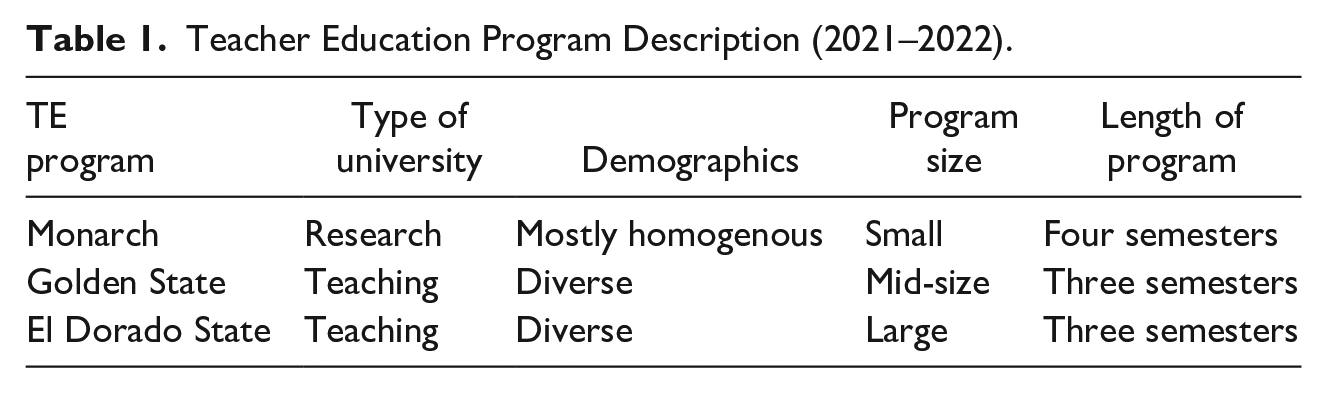
The literature suggests that most exploration of race and identity takes place in multicultural education and around notions of social justice (Ladson-Billings, 1995; Sleeter, 1996, 2001). Consequently, teacher education programs with a focus on justice and equity are an ideal environment to explore how teacher educators and pre-service teachers pedagogically engage in antiracist education within the constraints of teacher education policy and standards. This qualitative, multiple case study draws data from three teacher education institutions in one state—California. Within that one state policy context, three teacher preparation programs were selected based on their stated commitment to prepare teachers as change agents and social justice advocates and variation in institution type and size. Without giving too much detail in order to keep the programs anonymous, examples of the inclusion of social justice frameworks in the missions included a wheel displaying values of the program such as “engage students in critical analysis of social justice issues,” statements on preparing teachers and leaders to be agents of change, committed to social justice, equity, and inclusion in culturally and linguistically diverse schools and communities, and emphasizing core principles of equity, social justice, and care. The three programs served as representative of social justice oriented programs not only because these frameworks played an essential role in their mission and outcome statements and were touted as central to the curriculum by teacher educators in each program, but also because they were three of the largest providers of teachers in the area. The institutions include one research university and two state universities all within 150 miles of one another. Each teacher education program was embedded in a larger university. See Table 1 for a description of each program.
Teacher Education Program Description (2021–2022).
Data Sources and Collection
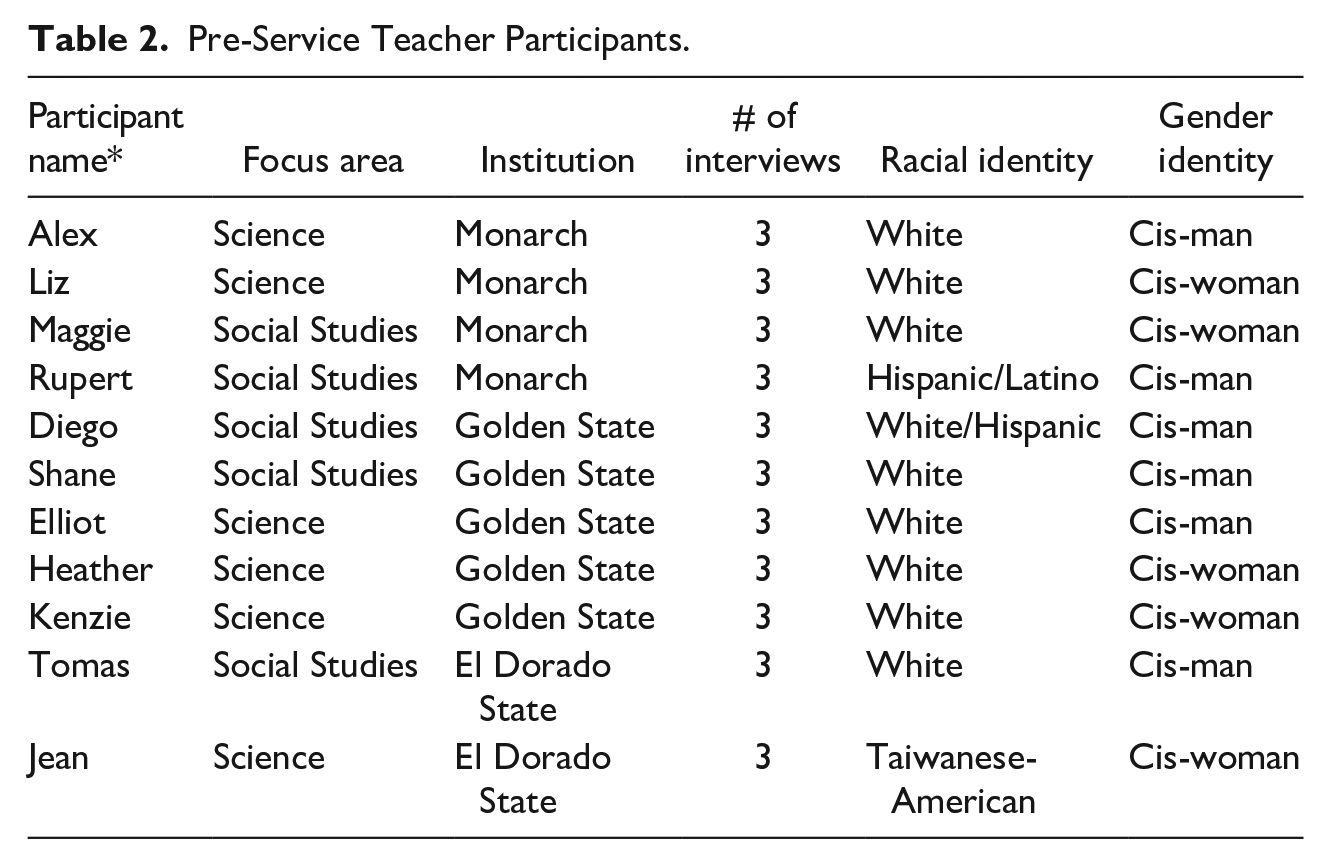
The larger study collected data from three sources: (1) virtual interviews with pre-service teachers, (2) focus groups and interviews with teacher educators, and (3) state and program policy documents and videos. This paper primarily focuses on findings from the interviews with pre-service teachers and state mandated teacher assessments, supplemented with relevant insights from the teacher educators interviews. Participants chose their own pseudonyms listed in Table 2 along with their reported demographics, focus area, and associated institution site. Interviews were conducted virtually through Zoom and lasted approximately 45 to 60 minutes each. Interview data was transcribed using audio transcription software, Sonix.ai, and transcriptions were uploaded to the qualitative data analysis software Dedoose.
Pre-Service Teacher Participants.
TPA as Policy
Teacher education programs in California are required to administer a standardized teaching performance assessment but can choose between offering the edTPA or the CalTPA to the prospective teachers (Commission on Teacher Credentialing, 2016). Because it is a national assessment, this paper focuses on a critical analysis of the edTPA which is applicable to a larger audience. The differences between the edTPA and CalTPA are not significant enough to differentiate between them throughout this paper but are briefly outlined in the literature review and findings. Throughout this paper, the author uses the term “TPA” as a broad reference to both the edTPA and CalTPA. Further analysis specifically examining the CalTPA and how the California’s Teaching Performance Expectations address race, racism, and equity and ultimately rely on whiteness as a norm, can be found in a critical textual analysis study conducted in collaboration with the California Commission on Teacher Credentialing (Vachon, 2022).
The TPA is a performance assessment, thus teachers submit original materials rather than answers to specific questions. There is a handbook provided to teacher candidates through their programs that aids in guiding PSTs to successfully complete the assessment. The handbook includes very specific instructions on what to submit along with rubrics that represent how their submissions will be scored. The three main tasks, planning, instruction and assessment, each include between 4 and 9 steps suggested in the handbook along with 15 rubrics to refer to. Each rubric represents a question and displays five levels of completing the task. The handbook outlines that Level 1 represents the “knowledge and skills of a novice not ready to teach” while Level 5 illustrates the “advanced practices of a highly accomplished beginner.” There are 25 points available in each task, resulting in 75 points total in the assessment. In the state of California, a score of 41 is necessary to pass in the social studies and science content areas, meaning that a pre-service teacher must score approximately a level 3 on each rubric.
Pre-Service Teacher Interviews
A total of 11 participants, 6 science and 5 social-studies pre-service teachers (PSTs) across the 3 university-based teacher education institutions were interviewed throughout their programs. There were two additional teachers from El Dorado State that completed the first interview but dropped out of the study due to either leaving the program or changing to another content specialization area (Special Education). See Table 2 for a list of participants and their reported demographics.
Pre-service teacher participants were recruited in consultation with administration and program faculty, working within their communication systems and practices. Pre-service teachers were interviewed three times: (1) at the start of their program, (2) half-way through the program after they spent substantial time in placements, and (3) as they completed the program and moved toward their first teaching positions. Each of the three interviews included questions that directly inquired about the PSTs’ experiences regarding race, racism and equity within their teacher education program, yet the main focus of each interview differed depending on the PST’s progress within the program. Due to themes that arose in analysis of prior interviews, in the third interview, questions centered on the TPA, how it contributed to PST development and whether the participants thought it addressed issues of race, racism, and equity. The multiple interview design of the study provided the opportunity for the interviewer to engage in a form of member checking with each participant in that the interviewer would review a summary of the prior interview(s) with the participant in order to allow them to clarify if any perspectives had been misinterpreted. In this way, the interviewer could check for accuracy in the depiction of each participant. Interview protocols for each of the three interviews are available in Appendix A.
Single-subject social studies and science pre-service teachers were chosen as a focus due to their potential difference in curricular and pedagogical experiences in their teacher education programs. Historically, positivist scientific knowledge has been considered objective truth. Even though feminist and critical race scholars have brought attention to the European, white male perspective embedded in scientific research (Barton, 1998), the traditional race-neutral approach in science education may lead science pre-service teachers to have fewer opportunities to engage in discourse on race, racism, and equity. Consequently, social studies teacher education may deal more directly with issues of race and racism due to preparation around teaching and discussing historical events such as slavery, colonization, and the Civil Rights Movement.
Data Analysis
This project relied on inductive analysis of the interviews and state and program policy. With guidance on qualitative data analysis from Creswell (2014) and Bhattacharya (2017), categories within the interview and document data were generated through open coding. Then, based on identified categories, selective coding was used to determine emergent themes. Bhattacharya (2017) posits that data analysis in qualitative research is always iterative rather than linear, which is reflective of the process in this project such that we returned to the data frequently in order to consider various categories derived from the data or driven by the research questions and theoretical frameworks. The completion of analytic memos supplemented this iterative process along with consultation and discussion of sensemaking of the data with colleagues and mentors.
Critical Policy Analysis
The critical analysis of the edTPA as education policy draws on the five concerns outlined by Diem et al. (2018) in the theoretical framework of this paper, with specific attention to the third concern, the distribution of power, resources, and knowledge, and the fourth concern, social stratification and the effect the policy has on relationships of inequality and privilege (p. 4). The analysis of the edTPA frames these concerns in tandem with critical race theoretical perspectives in order to highlight the power of the TPAs in considering which knowledge is essential (third concern) while analyzing its attention to issues of race, privilege, and equity (fourth concern).
Researcher Positionality
My interest in education and justice are rooted in my experiences of unpacking privilege and interrogating white supremacy. My most prevalent social identities include identifying and being perceived as white and as a cisgender woman. Embodying these identities include incurring their nuanced array of benefits and privileges as well as the structurally informed ignorance and violence embedded in them. Additionally, for the purposes of completing this study, my position as a PhD candidate and my involvement in the academy had implications for how I was treated by administrators, teacher educators, and pre-service teacher participants in this study.
Findings
These findings unpack requirements of the TPA as a teacher credentialing requirement by critically examining methods of preparation and content of the assessment while also exploring and connecting to perspectives of teacher candidates in three social justice and equity oriented teacher preparation programs. The findings from the policy analysis illustrate main concerns of the teacher educators and pre-service teachers in this study by demonstrating the neoliberal motivations of the assessment, the narrow technical expectations of the assessment questions, and the lack of attention to race and racism. Considered in the context of these concerns, the pre-service teachers studied received mixed messages between their social justice-oriented programs and the TPA regarding conceptions of a competent teacher. While the teacher education preparation programs placed a strong emphasis on critical reflection and antiracist engagement, the pre-service teachers describe the TPA as mostly devoid of a commitment to social justice and equity. The preservice teachers reconciled this conflict by choosing one source as a touchstone to measure themselves from, either their program or the TPA. While some of the teacher educators at these social justice-oriented programs attempted to subvert the TPA by framing it as a procedural rather than a formative step, for some of the pre-service teachers interviewed, the material consequences of passing the TPA (receiving their credential) led them to question or deprioritize the antiracist or equitable practices emphasized in their preparation programs. Because they are not a part of the assessment, these pre-service teachers deemed antiracist practices as non-essential to their pedagogical approach.
The findings unfold in two parts. First is a critical analysis of the edTPA based on the concerns around the distribution of power, resources, and knowledge, and the policy’s effect on relationships of inequality and privilege (Diem et al., 2018) focused by responses from teacher educators and pre-service teachers in this study. This analysis followed by a description of the responses from PSTs and teacher educators about how the TPA contributes to teacher preparation and addresses issues of race, racism, and equity.
Critical Analysis of the edTPA
Past research on the edTPA has noted the abundance of criticism of the use of the edTPA as an extension of neoliberalism (De Voto et al, 2021; Greenblatt, 2018). This was evident in this study as well when for example, a teacher educator who had gone through edTPA scorer training noted that “[The scoring is] kind of arbitrary” and that scorers “don’t get paid very much. They get like $30 per assessment. And then you get people [who] are literally doing it for the money and just pouring through them as quickly as they can” (Sofia, Program director at Monarch, November 4, 2022). When searching for resources and support materials for the edTPA, it is notable that the official handbook is only available through Pearson, which supplies it to accredited teacher education programs. However, there are a plethora of options of fee-based services such as tutors and YouTube tutorials that offer to help teacher candidates craft their responses and videos in order to get a “high score” on the assessment. In their examination of these entities Dover and Schultz (2016) critique the market-driven opportunism of TPA coaching, particularly “the ways in which the outsourcing of teacher evaluation undermines local accountability and invites the exploitation of both candidates and of teacher evaluation systems overall” (p. 100). The quality of these supports vary greatly and emphasize a decontextualized, narrow perspective on good teaching as a series of specific, standardized tasks. Given the fee-based system of these coaching options, there is little opportunity for these outside players to create a meaningful, evaluative experience, and rather encourage teacher candidates to simply provide the scorers with a product that will be satisfactory instead of considering the merits and areas of growth in their own teaching practices (Dover & Schultz, 2016). Furthermore, “scorers have no way of determining whether candidates’ portfolios are authentic representations of candidates’ daily practice, artifacts that have been shaped in response to generic recommendations found online, or products of interactions with fee-for-service TPA tutors” (Dover & Schultz, 2016, p. 102). In addition to the handbook provided by the program and the tutoring available from outside parties, the edTPA website guides pre-service teachers to a candidate support resource entitled “Making Good Choices.” This document further emphasizes the dichotomy that there are broadly accepted “good” and “bad” choices, rather than considering teacher candidates’ experiences in their localized context.
Pre-service teachers were especially apprehensive about finding exemplary moments to demonstrate the skills required for the edTPA. A description of specific examples from the edTPA aids in illustrating this concern. The instructions for each task of the edTPA and the rubrics measuring the responses are extremely specific, suggesting that the conditions need to be just right in order for pre-service teachers to capture moments on their videos that would receive an adequate score. The fact that these assessments are scored by outside entities divorces the opportunity for perceiving the lessons in their situated context. Similarly, as Tuck and Gorlewski (2016) note, “it disincentivizes teacher candidates from seeking student-teaching placements in high-needs schools” (pp. 201–202) because classrooms that don’t represent the ideal conditions for a pre-service teacher to illustrate their ability to facilitate learning could result in the PST failing the edTPA. Consider Table 3 which illustrates the example of Instruction Task 2, Rubric 6 measuring how the PST attends to the learning environment in their classroom by evaluating their materials in response to the following question: How does the candidate demonstrate a positive learning environment that supports students’ engagement in learning?
edTPA Rubric 6: Learning Environment.
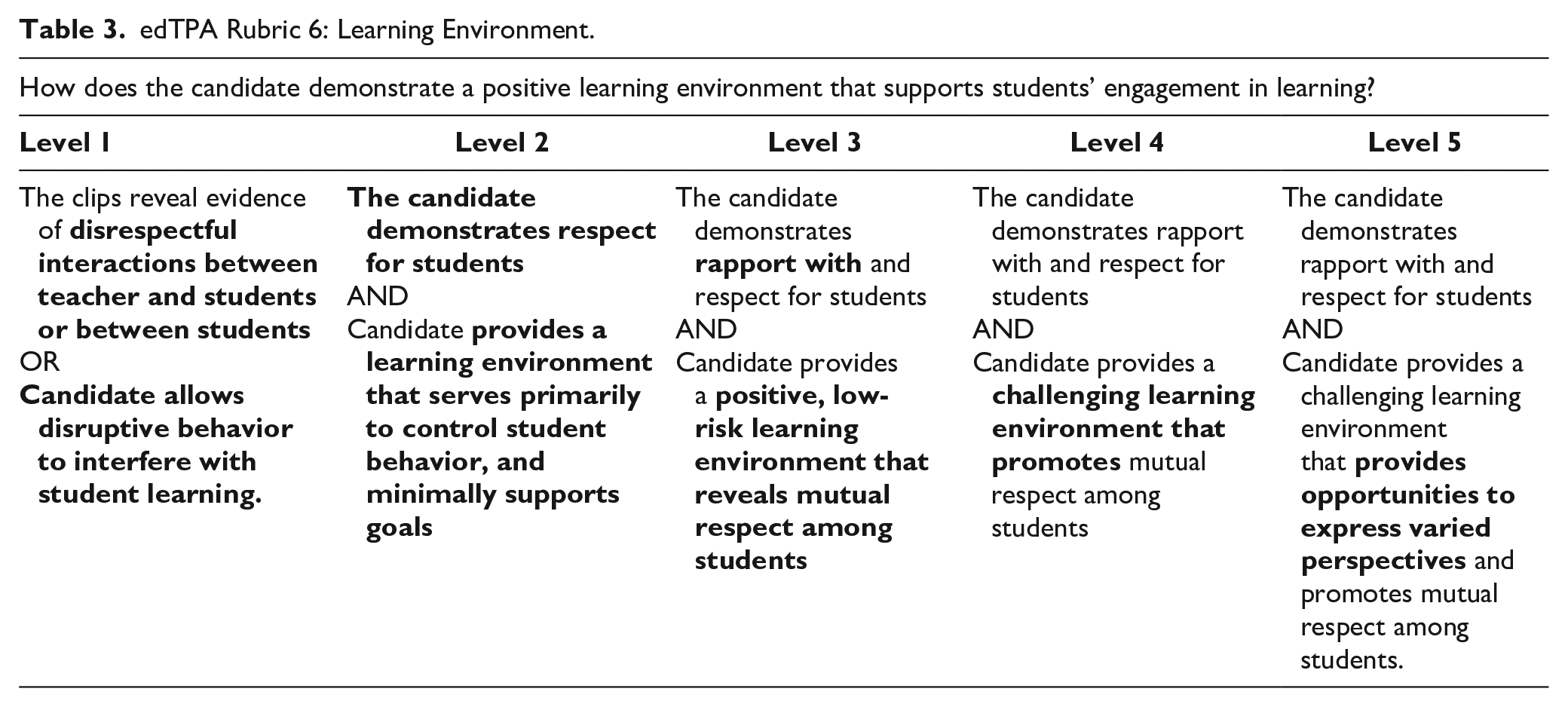
If the pre-service teacher’s video represents “disrespectful interactions between teacher and student or between students,” they would score at a Level 1, ultimately failing this rubric. What is deemed “disrespectful” should be considered through the lens of Omi and Winant’s (2014) “code words” such that terms or language which reference a norm or expectation function as colorblind “code words” but could easily default to whiteness (Omi & Winant, 2014). The use of these code words in the edTPA does not necessarily signify blatant intent around using racialized language or preserving racial hierarchy, yet the purpose and the implications of their presence remain important for analysis. By assuming a traditional neutral understanding of the term “disrespectful,” the edTPA relies on a white academic norm. This has the deleterious effect of suggesting that behaviors outside of the appropriate white academic norm are deviant and in need of remedy and underscores Tuck and Gorlewski’s (2016) point that the race neutral content of the edTPA and its scoring could “communicate to teacher candidates that they cannot get certification if they work in classrooms with students of color, English language learners, and/or students living in poverty” (p. 202). Without a deeper understanding of the circumstances and position of the pre-service teacher, an “objective” scorer may not be privy to the local and cultural norms present in a video where students could be regarded as disrespectful.
Lastly, teacher educators and pre-service teachers in this study were acutely aware of the omission of race and racism in the edTPA. Lucas outlined how teacher educators attended to this at El Dorado State: “We message to them that the rubrics on the TPA do not preclude you from doing these emancipatory practices. If you’re doing these emancipatory practices, you’re doing the things that are being asked of you on the TPA and more.” The word equity never appears in the edTPA handbook and the words race and racism only appear once in the social studies handbook glossary as a description of a “social studies phenomenon” which is described as an “Observable occurrence, circumstance, or behavior within the discipline of history/social studies (e.g., civil war, racism, revolution, civic engagement, rationality, crime, peace, poverty)” (Stanford Center for Assessment, Learning, and Equity, 2019a, p. 50). Instead, the word “cultural” is mentioned frequently. For example, in Rubric 3 illustrated in Table 4 measures how teachers use knowledge of their students to justify instructional plans.
edTPA Rubric 3: Using Knowledge of Students to Inform Teaching and Learning.
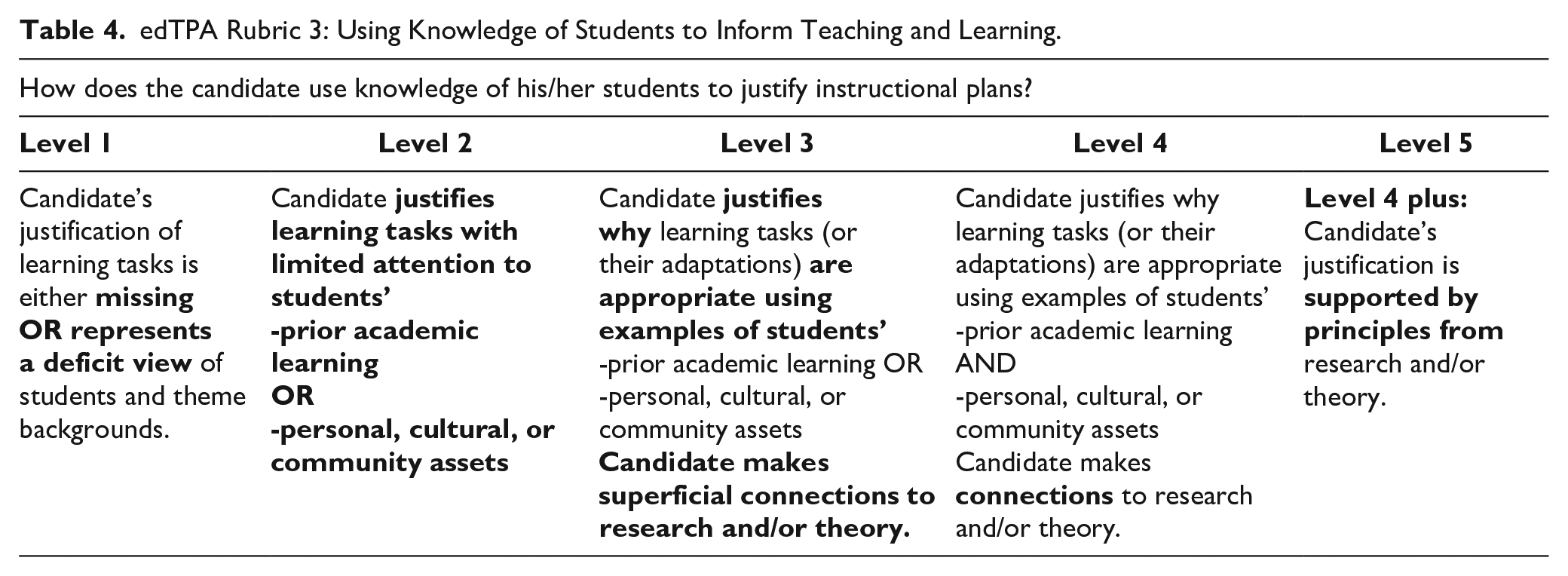
Referring to culture rather than racial or ethnic background provides a colorblind and more palatable nod to racial difference, ultimately sidestepping any reference of racial hierarchy and white supremacy. The omission of attention to race, racism, and equity also highlights that the assessment is not interested in teachers’ racial literacy or knowledge of systemic oppression.
In conclusion, situating this critical analysis of the edTPA in the current literature on high-stakes performance assessments illustrates how it promotes a one-size-fits-all approach to teaching and ultimately “favors those candidates willing to focus on narrow problems” (Dover & Schultz, 2016, p. 103). These examples serve as appropriate context for the mixed messaging provided to pre-service teachers by the values evident in the TPA and those espoused by their social justice-oriented programs expounded upon in the next section.
Pre-Service Teacher Orientation to the TPA
The pre-service teachers in this study confirmed the findings of the critical analysis of the edTPA in that they reported that the TPA did not significantly attend to issues of race, racism, and equity. They identified preparation for the assessment as very stressful and time consuming. For three PSTs in this study, reconciling the assessment with their preparation programs resulted in a reorientation in what they saw as foundational for becoming a teacher. This section explores the pre-service teachers’ orientation to the assessment, how it informed becoming a teacher, how it aligned (or not) with their teacher education program, and lastly, how it addressed issues of race, racism, and equity.
TPA as Complementary to Goals of the Program
Overall, pre-service teachers’ perceptions of the TPA fell into two large categories: complementary to or in conflict with the social justice goals of their teacher education program. Those who saw the program and assessment as complementary perceived an alignment between the two, a general agreement of purpose and message that reciprocally reinforced each in teacher education. However, those who experienced the program and assessment as in ideological and purposive conflict felt pulled in two directions. They resolved this conflict for themselves by orienting toward one and disregarding the other (See Table 5).
Pre-service Teacher Orientation to TPA and Program.
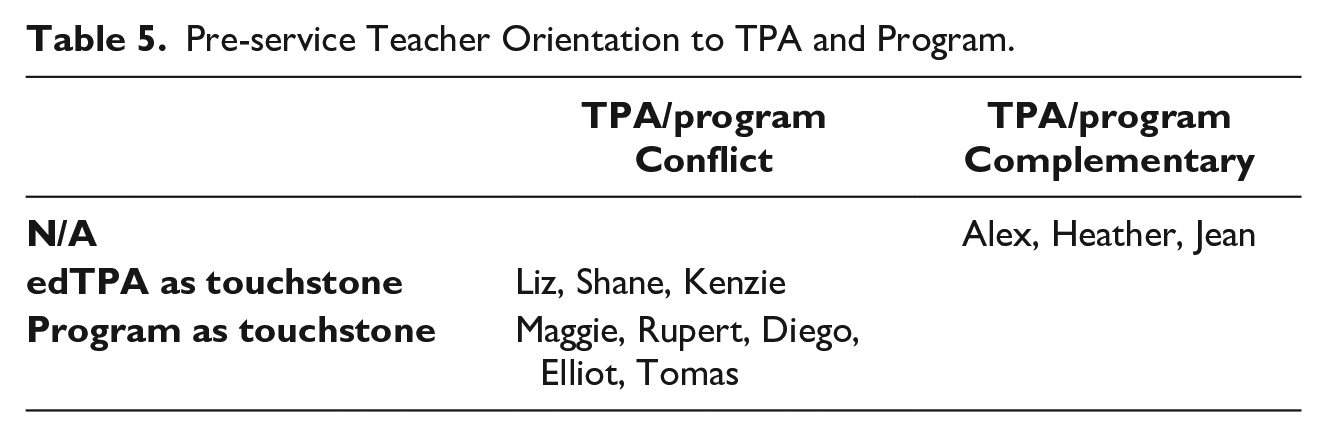
Only three teachers saw the goals of the TPA and the program as complementary. Alex and Heather identified the assessment as an opportunity to reflect on what they had been learning and putting into action throughout the program. Alex stated that it made him “hyper focused on the details of teaching to a level that I had never thought about” and made him ask himself “why exactly are you doing this exact thing for this exact student or this exact type of student?” Alex saw the goals of the program and TPA as aligned in his analysis of the educational needs of each of the students he selected for the TPA. It allowed him to be critically reflective of his teaching and expand his knowledge of the needs of all students in the classroom. Similarly, Heather described her assignments and class content as “geared towards setting us up for success with the edTPA” and it was clear to her how the TPA and the program were working in tandem to develop her skill set as a teacher. Alex and Heather saw the goals of the program and the TPA as well integrated and beneficial.
Jean also saw the program and assessment as complementing one another but mostly as she believed her program was contoured to the exam. She described the program as “teaching to the test” and posited that many of her courses and interactions with her supervisor were geared toward how to successfully pass the TPA. Jean discusses preparing detailed lesson plans for the CalTPA: It just felt more like irrelevant at work because I think the practical aspects of teaching is that you don’t write a fully fleshed out lesson plan for every lesson that you’ll have. . . This is the first time I’m realizing this, but it seems like the university program is preparing us to pass the test rather than gain the skills.
(Jean, Science PST at El Dorado State, June 30, 2022)
Both Alex and Heather identified the TPA as an extension of their experiences in the program and offering an opportunity to further reflect on their teaching and deepen their understanding of how to support students in their classroom. Jean saw the program and the TPA in alignment however perceived both to be inadequately preparing her to be a teacher. She found this ironic in that the program instructs teachers to teach more holistically, and yet she concludes that in the case of its own students, the program is not practicing what it preaches.
TPA in Conflict With Goals of the Program
Over two thirds of the teachers (8 out of 11) perceived the goals of the TPA as in conflict with the program’s goals, particularly regarding the approach to issues of race, racism, and equity. Because these eight teachers saw the program and TPA in conflict, it was necessary for them to use one or the other as a touchstone in which to measure themselves against in terms of what it meant to be a good teacher. Five of them used their program’s goals and values as a touchstone and the other three perceived the TPA as the authority on defining what was necessary to becoming a good teacher (See to Table 5 for the orientations of each pre-service teacher). Of the five teachers that oriented to the program as touchstone, Tomas, Elliot, and Rupert relegated the TPA as nothing more than a box to check off in order to be credentialed. And yet, they also saw it as a deterrent from their coursework as it took time and caused stress related to preparing for the TPA. None of them thought of the test as influential in their orientation to what was important in becoming a teacher. Tomas summarized his perspective on the TPA as “I think it’s just a hoop to get through, to be honest.” Elliot was irritated by how attention to the TPA took away from what he found important in his courses: So yeah, I felt like it was really distracting and I felt like the actual edTPA itself didn’t, like studying for it and preparing everything for it, didn’t feel like it was making me a better teacher. I really felt like it was more just kind of checking boxes.
(Elliot, Science PST at Golden State, June 30, 2022)
Rupert did not see the TPA as providing an accurate portrayal of his teaching. He stated: I just don’t think it’s a very great way of evaluating someone as a teacher just because it’s essentially just a mini snapshot of you in 2 to 3 days, maybe more if you have a 45 minute class. Like, I think everybody could have a good day or a bad day.
(Rupert, Social Studies PST at Monarch, June 24, 2022)
Rupert’s response here reflects the concerns outlined in the literature review and critical policy analysis (De Voto et al, 2021; Dover & Schultz, 2016; Tuck & Gorlewski, 2016) in that the instructions of the TPA are narrow and specific, divorced from the context of the classroom and disincentivizing a classroom that does not reflect “respectful” behavior. While Tomas, Elliot, and Rupert all shared the view that the TPA was a distraction and a poor representation of their teaching abilities, Maggie and Diego found the TPA to be particularly distressing and objectionable in its lack of attention to issues of race, racism, and equity. For Maggie, not only did the test essentialize approaches to teaching a diverse set of learners, it also was problematic in regard to equity in its scoring and financial requirements. She declared: How the edTPA talks about students is really upsetting. For the assessment category, it’s like, “How will support for this one English learner help all of the English learners in your class?” Like just kind of over generalizing students and having a super narrow view of success.
(Maggie, Social Studies PST at Monarch, July 7, 2022)
Diego found that in its lack of attention to antiracism and disrupting the status quo, the TPA was a racist assessment. He elucidated this in his third interview by stating: The edTPA itself does not appear to me to be concerned with issues of equity and race, from what I can recall, which to me does say in some ways that it is racist. . . We were not graded on our ability to be antiracist. So in a sense, they were not assessing us on whether or not we could challenge the status quo of education, which implies that this assessment is not interested in disrupting the status quo.
(Diego, Social Studies PST at Golden State, June 30, 2022).
Given the emphasis placed on social justice and antiracism in their program, these teachers identified the TPA as in conflict with those goals and chose to orient to the program, rather than the assessment, as the ultimate model for becoming a teacher.
Conversely, the conflict between the program and the TPA led three teachers to choose the TPA as a touchstone from which to measure themselves in their ability to become good teachers. Liz, Shane, and Kenzie all indicated they valued the results of the assessment more heavily than the evaluations from teacher educators in the program. Liz’s orientation to the TPA was profoundly influenced by the fact that she did not pass the first time around. When she first found out, she reported feeling “really insecure” about her teaching and frustrated with what she found to be contradictions around the program’s use of the TPA. She stated “It’s this really high-stakes assessment. And it feels like the program says don’t ever give your kids a high-stakes assessment and make it phenomena-based and all this stuff. And then the TPA is so the opposite of that.” In this critique, Liz implicates the neoliberal motivations of the TPA outlined in the policy analysis, which are at odds with her perception of the social justice motivations of the program. Then, at the end of the program, Liz reflects on how failing the TPA, before eventually passing it in a subsequent round, contributed to her experience in becoming a teacher: It just felt so horrible. I was so down on myself and was really like, “oh my God, the state of California doesn’t think I’m a good teacher.” Obviously, all my professors were like, no, it’s okay. This happens. But still it felt horrible. And then the second time resubmitting, it was just so stressful. Yeah. I don’t think it (the exam) contributed to my education at all.
(Liz, Science PST at Monarch, July 5, 2022)
Even though Liz states here that the TPA did not advance her education, it is clear by the emotional toll of failing the first cycle that the test held a larger sway over what she considered the right way to teach, perhaps even more so than the words and sentiments of her professors.
Kenzie strongly oriented to the TPA, identifying that the material for the TPA represented her “best work.” She acknowledged the difference in expectations of the TPA and her TE program, particularly in regards to the inclusion of aspects of social justice, and made a pragmatic decision in order to streamline her lesson plans by focusing fully on the assessment. She described this process in the following statement: [In the program] there is that social justice focus in our lesson plans. Unfortunately, it’s not an aspect that the edTPA graders are looking for. So in my lesson plan template, from this point forward, I’ve removed that section from my lesson plans.
(Kenzie, Science PST at Golden State, March 15, 2022).
Kenzie has deferred to the expectations from the TPA rather than the social justice focus of the program, thus placing her understanding of teaching in the hands of Pearson scorers rather than teacher educators in her program. Similarly, Shane also oriented fully to the assessment to the exclusion of his teacher education program. He viewed the TPA as the “idealized, perfect version of what being a teacher would look like.” He states that: Whenever I’m struggling or whenever I need a template or a mind frame, especially for an interview, I think back to the edTPA. (I tell myself) “not only did you pass the edTPA, you did very well. . . Just think of the edTPA if you want to be a better teacher. What is the edTPA asking for?”
(Shane, Social Studies PST at Golden State, July 18, 2022)
Shane valued the goals of the TPA and his positive performance on the assessment further bolstered his opinion of his own teaching, equating his sense of self as a teacher to his performance of the narrow, technical tasks required to pass the TPA. The perspectives of these conflict-aware and testing-oriented teachers, Liz, Kenzie, and Shane, are particularly concerning given that their conceptions of themselves as competent teachers is dependent on their performance on the TPA, an assessment tool which they also describe as devoid of social justice and equity commitments.
Discussion and Conclusion
Data from the larger study illustrated that the pre-service teachers reported identity shifts and broadened awareness of oppression which suggests the positive influence of the social justice mission and values of the teacher education programs and focused intentions and efforts of teacher educators in facilitating a teacher preparation environment focused on justice and equity. However, there were also barriers embedded in the standards and assessments of the programs that sowed confusion around the expectations for pre-service teachers and for some pre-service teachers, hindered their commitment to antiracist engagement. While past research has focused on the ways in which teachers who are more likely to take up antiracist teaching frameworks are siphoned out of the pathways to the teaching profession (such as teachers of color), this study illustrates how teachers who have only just starting to wrestle with antiracist perspectives can be disincentivized to utilize these frameworks because they are not valued in the high-stakes assessment necessary to pass to become a teacher.
When considering the underlying conception of the edTPA, Sato (2014) found that while the edTPA does not promote a critical pedagogical approach to teaching, it also does not dissuade teacher candidates from using a critical framework. However, the primary finding from this study contradicts this finding and suggests that factors necessary for the successful completion of the edTPA and CalTPA led pre-service teachers to feel disengaged with the antiracist framework of their program. The pressure to pass the assessments oriented them, instead, to those requirements (a professional conception of teaching) when considering what was necessary to be a good teacher (Sato, 2014). As suggested in the policy analysis, teachers needed an ideal classroom setting, without disruptions, in order to receive an optimal score, which suggested to pre-service teachers like Kenzie and Shane that they stick to learning goals and outcomes without introducing antiracist or critical pedagogical approaches. Even as pre-service teachers identified the TPA as mostly bereft of issues pertaining to race, racism, and equity, the high-stakes nature of the test, the fact that it was necessary to pass in order to gain a teaching credential, pushed some teachers to consider it as the main template and guide for how they should teach. This reliance on the test comes into conflict with the values of the teacher educators and the stated missions of the programs in this study, whose pedagogical frameworks intended to push beyond the boundaries of what was required in the TPA.
These findings have important implications for teacher education and policy. Teacher educators need to take active steps to counter and address the mixed messaging resulting from the disconnect between state policy and teacher education programs. State policy constraints can disrupt the social justice and equity mission of teacher educators. The requirement for pre-service teachers to complete state mandated assessment tests decoupled from the core commitments of teacher educators presents a conflict for teacher educators who also instruct PSTs to avoid “teaching to the test.” These research findings reveal that a high-stakes state assessment can hold greater authority than a teacher education program over defining what is essential theoretical and practical knowledge for new teachers. This has implications for teacher educators’ consideration of the TPA as not just an arbitrary assessment tool, but one that has the potential to reorient and disincentivize an antiracist and equitable approach to teaching.
Additionally, the findings from this study suggest two main recommendations for education policy. First, if we are to continue to have state standards and assessments for teachers, then they should require that teachers be racially literate and aware of the role whiteness plays in the continued maintenance of systematic oppression. With the same rigor as other aspects of “good teaching” that are represented in the standards and assessments of teachers, beginning teachers should not only illustrate their knowledge of issues surrounding race, racism, and equity in schooling, but should be able to demonstrate how to engage in antiracist actions in the classroom and school community. Second, the teaching profession should be centered in assessments of teaching practice. The TPA should not be a high-stakes assessment scored by outside scorers at a for-profit company and directly tied to the ability of beginning teachers to obtain their credential. Instead, teacher educators who are experts in the field of teacher’s work, should be responsible for deciding who is qualified to become a teacher. This is especially necessary for developing justice and equity-oriented teachers where pre-service teachers are evaluated in their local communities. Ultimately, policies and teaching standards premised on trust and respect for teacher educators will better support those educators in preparing just and equity-oriented social change agents.
This study underscores the significance of teacher education policy as a constraint, and possible facilitator, to developing antiracist teachers. While past research has primarily focused on unpacking individual pre-service teacher prejudice and resistance to antiracism, this research uncovered the ways teacher education standards and assessment policy can disincentivize an antiracist teaching approach. This study focused on three teacher education programs in one of the most politically liberal areas of the country where “teaching for social justice” is an accepted norm. Yet, even in programs where justice and equity are ardently attended to, assessments such as the TPA led some pre-service teachers to disregard the antiracist approaches of their programs in favor of the TPA’s race-neutral approach. These findings have implications for how policy influences teacher education programs far beyond the politically liberal boundaries of the Bay Area. In conclusion, systemic racism in American educational practice cannot be framed as only the problem of individual teachers, even though the action of many individual teachers can be part of the solution. Structural racism must be dismantled structurally.
Footnotes
Appendix A: Interview Protocol (Pre-Service teachers)
Acknowledgements
The last interview will focus on the PST’s overall experience in the program, how it drives their decision-making on where to look for a job and what their expectations are for themselves in their future classrooms.
Now that the program is over, I want to hear more of your thoughts around your experiences in the program and your plans for the future. Some of these questions may be similar to those I asked in previous interviews and feel free to reflect on how your perspective may have changed or stayed the same.
Declaration of Conflicting Interests
The author(s) declared no potential conflicts of interest with respect to the research, authorship, and/or publication of this article.
Funding
The author(s) received no financial support for the research, authorship, and/or publication of this article.
