




Abstract
Contemporary college student activism has been particularly visible and effective in the past few years at US institutions of higher education and is projected only to grow in future years. Almost all of these protests and demands, while explicitly linked to social and racial justice, are sites of resistance to the neoliberalization of the academy. These activists are imagining a post-neoliberal society, and are building their demands around these potential new social imaginaries. Based on a discourse analysis of contemporary college student activist demands, to examine more closely the ways that student activists understand, resist, critique, and offer new alternatives to current (neoliberal) structures in higher education, it is suggested that student activists might be one key to understanding what’s next for higher education in a post-neoliberal context. The activists’ critiques of the structure of higher education reveal a sophisticated understanding of the current socio-political, cultural, and economic realities. Their demands show an optimistic, creative imagination that could serve educators well as we grapple with our first steps down a new road. Using their critiques and demands as a jumping-off point, this paper offers the blueprint for a new social imaginary in higher education, one that is focused on community and justice.
Introduction and statement of the problem
Rolling back neoliberalism requires more than critique. It requires both a vision of what a post-neoliberal society would look like and some indication of how to work toward a post-neoliberal world. The pre-neoliberal welfare state fell short on this vision in terms of issues related to diversity, racial, gender and socio-economic equity and social justice. There is no going back, but only a re-envisioning forward. For two decades we have seen the rise in social movements opposed to the ideologies and policies of neoliberalism. We have also seen a rise in social activism about larger social issues dealing with neoliberalism, income inequality, and related topics on university campuses. In addition, there has been a rise in student activism related to the incursion of neoliberalism in higher education, related specifically to cuts in state support for public education and rising tuition fees, student debt, and issues related to racism and accessibility.
Current student activism is not just an exercise in critique; rather, it reflects a vision forged in a praxis of ideas and action, a solution to the effects of neoliberalism, reinforced by higher education, that transform individuals into isolated consumers who see themselves as powerless (Nelson, 2008, p. xiv). This means that we might look to current social movements to get some indications of possible destinations of a post-neoliberal society and first step toward that destination. In these social movements we can begin to glean what kind of post-neoliberal social imaginary will need to be developed. Student activism on campuses in recent years provides fertile ground for investigating these issues.
Contemporary college student activism has been particularly visible and effective in the past few years at institutions of higher education in the USA and is projected only to grow in future years (Eagan et al., 2015). Almost all of these protests and demands, while explicitly linked to social and racial justice, are sites (implicit or explicit) of resistance to the neoliberalization of the academy. These activists are imagining a post-neoliberal society, and are building their demands around these potential new social imaginaries. Building on a discourse analysis of contemporary college student activist demands that examine the ways student activists understand, resist, critique and offer new alternatives. To current neoliberal structures in higher education, we suggest that student activists might be one key to understanding what’s next for higher education in a post-neoliberal context. The activists’ critiques of the structure of higher education reveal a sophisticated understanding of the current socio-political, cultural and economic realities. Their demands show an optimistic, creative imagination that could serve educators well as we grapple with our first steps down a new road. Using their critiques, methods and demands as a jumping off point, we offer the blueprint for a new social imaginary in higher education, one that is focused on community and justice.
Neoliberalism and resistance at universities
Neoliberal ideology and unbridled capitalism are the scourge of our times. The disruption by neoliberal hegemony poses threats to the future of humanity. Economic inequality, environmental degradation, and the erosion of democracy are but a few of the symptoms of the widespread adoption and implementation of neoliberalism. Neoliberalism, at once an economic theory, a political ideology, and a set of policies, has had a totalizing impact on national cultures. Brown (2016) argues that it has converted all “non-economic domains, activities, and subjects into economic ones” (p. 3). It has reformed subjective identities into narrow market actors in a world of human capital. Individuals are transformed into a member of a firm and a firm itself, generating “intensely isolated and unprotected individuals, persistently in peril of deracination and deprivation of basic life support, wholly vulnerable to capital’s vicissitudes” (Brown, 2016: 3). Additionally, as Newfield (2011) argues, neoliberalism has engaged in the discrediting of social inequality by promoting discourses of political correctness meant to undermine the new, more diverse college-trained majority.
Perhaps nowhere has this been more clearly manifested than in the corporatization of higher education. Colleges, universities, and entire systems of higher education have become the target of neoliberal attacks from within and without. Universities, one of the last bastions of social critique and innovation, have come under full-scale assault through purposeful reductions in state funding, leading to the erosion of tenure and academic freedom, rising tuition costs and the indentured servitude of student loan debt, the implementation of academic capitalism and consequent corporatization of public universities (Giroux, 2002). Higher education is forced into a narrow job-training mission and away from its traditional mission of preparing citizens for critical participation in the democracy.
Colleges and universities continue to be sites for contesting significant social problems related to neoliberalism, such as inequality and racial discrimination. Student activism, considered to be dormant during the 1990s and early 21st century, has increased in the United States of America and globally, focused not only on social issues and access to higher education but also on what the university could be (Haiven, 2014). 1
A vision of the post-neoliberal
After the financial meltdown of 2007, pundits declared the neoliberal era had come to an end; that deregulated capitalism was unsustainable. They were wrong. Neoliberalism has proven to be more resilient for a variety of reasons but mostly because it is not simply a set of economic policies but also a set of normative ideals, or a cultural construct. A generation of policymakers and citizens has only known neoliberalism as “the common sense for conducting and evaluating policy” (Cahill, 2011: 487). However, some argue that the crisis of neoliberalism has opened up space to “…find within the present, elements of a more hopeful future, and to forge alliances that can leverage neoliberal capitalism’s failure into a different kind of world” (Carroll, 2010: 169). There are cracks in neoliberalism that reveal its dysfunctional effects and offer opportunities for resistance and change (Fear, 2015). However, challenging neoliberalism requires significant political mobilization and social movements (Cahill, 2011: 490).
In thinking about a vision of a post-neoliberal or post-capitalist world, contemporary student activism and college student protestors’ demands offer some inkling of what that might look like. First, they present a world in which the neoliberal approach, which transforms human beings and all matters social into market-based reasoning, is disrupted. The movements and demands represent what Wendy Brown (2015) calls sacrificial reasoning: “sacrifice” is a non-economic way of experiencing the world. The movements, in pushing back against austerity and cuts in funding revive a notion of Res Publica: of the people as a public body. The movements revive a sense of hope that things can get better, that there is an alternative to neoliberalism.
Second, the students' activism is a struggle for the post-neoliberal imagination and values (Haiven, 2014:149). It becomes a constant reminder that this struggle is about process rather than product or outcome. The protests over the purpose of higher education represent the spark of life within an institution coopted by neoliberalism: “These movements both call for and, in a small way, materialize an alternative social space where the radical imagination can flourish, where we can ask deep questions about the nature of society and ourselves, and where we can experiment with alternative forms of living” (Haiven, 2014: 150).
Connecting ideas and action
In taking the first steps toward reconceptualizing society, student activism and demands move us to consider non-economic identity. Neoliberalism is not only an economic theory related to class and income inequality but also an ideological and cultural construct that normalizes market-based thinking.
That we should salvage from the past the idea that opening up higher education beyond elites to public access was a major victory for democracy (Brown, 2015), but only a partially-achieved victory because the demands illustrate that the project of diversity on campuses is incomplete. We need to consider the role of race, diversity and justice in a post-neoliberal imaginary. As Brinkman (2000, cited in Fischman, 2009) states, neoliberalism is a reflection of the failure of liberal democracy which has been “mediated historically through the damaged and burdened tradition of racial and gender exclusions, economic injustice, and a formalistic, ritualized democracy, which substituted the swindle for the promise of democratic participation” (Fischman, 2009: 3).
The purpose of this study was to understand how recent student protests and demands reflect a critique of neoliberalism, indicate resistance to neoliberal takeover of higher education, and reflect a vision and an imaginary of moving beyond neoliberalism. It seeks to understand how the pre-neoliberal welfare state was exclusionary as well as democratizing, and how social theory is connected to social change. It asks what can be learnt about first steps and possible destinations of a post-neoliberal higher education. Specifically, the study seeks to shed light on the ways that contemporary student activist groups frame their demands, understand the current contexts of higher education (both at their institution and in solidarity with activist groups on other campuses), and construct understanding of and resistance to dominant neoliberal narratives on campus. This study thus contributes to the literature on campus activism by analyzing the most current discourses of student activist group demands. By mapping out what student activists are specifically asking for, one is better able to understand the implications of their requests. In addition, a discourse analysis of student demands provides for researchers to understand better the culture and social relations of activist groups and institutions of higher education. Since 2015, student-led campus protests have cut a swath across colleges and universities in the United States of America.
Context of the study: overview of recent campus activism and protests
In the USA, public and private research universities, Ivy League and land-grant institutions, and small liberal-arts colleges, from all geographic regions, have experienced student-led activism and direct action, culminating with protests and lists of specific demands (Ellin, 2016; Pauly and Andrews, 2015; Wong and Green, 2016). UCLA’s Cooperative Institutional Research Program (CIRP) annual freshman survey (Eagan et al., 2015) suggested that the rate of student activism on college campuses would only increase. For example, the 2015 CIRP survey found that, compared to past cohorts, incoming students “demonstrate stronger inclinations toward activism via intentions to join protests while in college” and “report substantially stronger commitments to engaging with their communities”, with an all-time high number of students indicating that “becoming a community leader” is an essential or very important life objective (Eagan et al., 2015: 8). Expertise and extensive use of social media and the Internet allow contemporary student protestors to disseminate demands, plan and execute direct action, connect with other protest movements (collegiate and national) and respond to national events more swiftly and efficiently than ever before.
While there has been a significant history of student activism on college campuses beginning in the 1960s (Broadhurst, 2014; Rhoads, 1998), the rise of neoliberalism beginning in the 1980s was also paralleled by a rise in activism that shifted from an anti-war focus to one on “improving higher education access and campus climates for underrepresented and marginalized populations” (Rhoads, 2016: 194). As Rhoads stated, “Indeed, racial issues, including the struggle for racial equality and opposition to difficult-to-extinguish racism, have come to play a central role in contemporary student activism” (Rhoads, 2016: 195). By Any Means Necessary (BAMN), which activated with regard to issues of affirmative action, and Occupy Wall Street, against income inequality, have both been related to protesting about issues related to the instantiation of neoliberal policies on college campuses.
Black activist and newly-minted professor Khadijah White illustrates how neoliberalism and the struggle for racial equality are connected through the university protest movements: I am also a member of the millennial generation – born after 1980 and coming to age in the wake of the greatest recession in America since the Great Depression. As new workers, this generation is faced with an economy that relies increasingly on more work for less pay, a fragmented and tenuous labour force, and education, healthcare, and housing debts that far outpace their earnings. Black millennials, in particular, still disproportionately bear the far-reaching consequences of the 2007 Great Recession. And as neoliberalism takes its toll on the operation, expansion, formation and cost of higher education, the hallowed halls of the Ivory Tower are also bearing the brunt of these intersecting societal and economic shifts. In their search for opportunity and success, millennials on campus have helped lead movements for economic and social justice ranging from the Occupy movement in 2011 to the Movement for Black Lives today. (White, 2016)
Recent student activism
Hunger strikes, sit-ins, walkouts, tent cities, silent protests at governing board meetings, occupations of administrative offices, teach-ins, and marches have been part of campus life at institutions such as Mizzou, Princeton, Purdue, Yale, Harvard, Duke, Georgetown, Occidental College, University of Cincinnati, Ithaca College and Amherst College (to name but a few). Specifically, this study encompasses 81 schools in North America (two of which are in Canada) where student activists have coordinated/participated in direct action protests and also submitted a list of demands to their institutions (see Table A.1 in the Appendix).
The inciting events that sparked individual campus movements/protests have varied. Some have been in response to incidents of campus racism or police brutality. Others have been in response to administrators’ clumsy attempts to address climate issues or have been focused on redressing perceived historical wrongs (re-naming buildings or spaces on campus, for example). In some high-profile instances, for instance the University of Missouri 2 and Claremont McKenna College, 3 upper-level administrators such as presidents, chancellors and deans of students resigned. In the case of other schools – such as Princeton University – administrators agreed to consider some demands, but others were rejected. 4 A detailed overview of every campus protest is beyond the scope of this article, but the outlines of what has transpired at many schools in the past year are crucial to understanding student and activist demands.
Narratives of campus protest and student activism
There are many well-reported narratives of campus protests from national media outlets (e.g., the New York Times, Atlantic Monthly, Huffington Post) as well as from publications with more specific audiences (student and local newspapers, public radio stations, and the Chronicle of Higher Education). Generally, the narratives begin with the protests at Mizzou that were heavily influenced by the Black Lives Matter movement which coalesced in Ferguson, MO after law enforcement killed Michael Brown, in August 2014. Although this is an oversimplification intended to fit a myriad specific individual campus protest movements, it does shed some light onto the major patterns that one can discern from the contemporary landscape of student activism. For the sake of this study, we highlight the major patterns that underlie recent protest movements: black activism and direct action.
Black activism and direct action
First, there is a strong connection between these direct actions on campus and national anti-racist initiatives like Black Lives Matter and the Black Liberation Collective. The recent incidents involving the killing of young African-Americans has had a significant impact on student activism “as colleges and universities throughout the country have witnessed a rise in student organizing to address racism both in terms of local campuses and the broader society” (Rhoads, 2016: 190).
Even if groups are not explicitly tied to Black Lives Matter (Jonathan Butler, the graduate student who went on hunger strike at the University of Missouri, was a veteran of the Ferguson protests), the rationale and demands are clearly influenced by national anti-racist activism. This is clear from the lists of demands analyzed in this study – for example, language related to demilitarization and institutional violence on campus and neighboring communities is evidence of an approach to racist incidents consistent with national activist groups’ (Black Lives Matter, Black Liberation Collective, etc.) broad, holistic understanding of systemic, structural racist violence. A related pattern is the focus on race and racism, even for intersectional student activist groups. Every document analyzed in this study clearly delineated an anti-racist agenda and accused institutions and institutional actors of perpetuating structural racism. The national demands that frame the list of student demands used in this study illustrate the underlying importance of direct action and black activism to the current student protest movements. In order to be included on the websites that host all of the student demands, groups had to submit their documents via email or web form. Anyone can access the lists on either thedemands.org or blackliberationcollective.org/our-demands. Figures 1 and 2 show how the demands are framed on each of the websites.
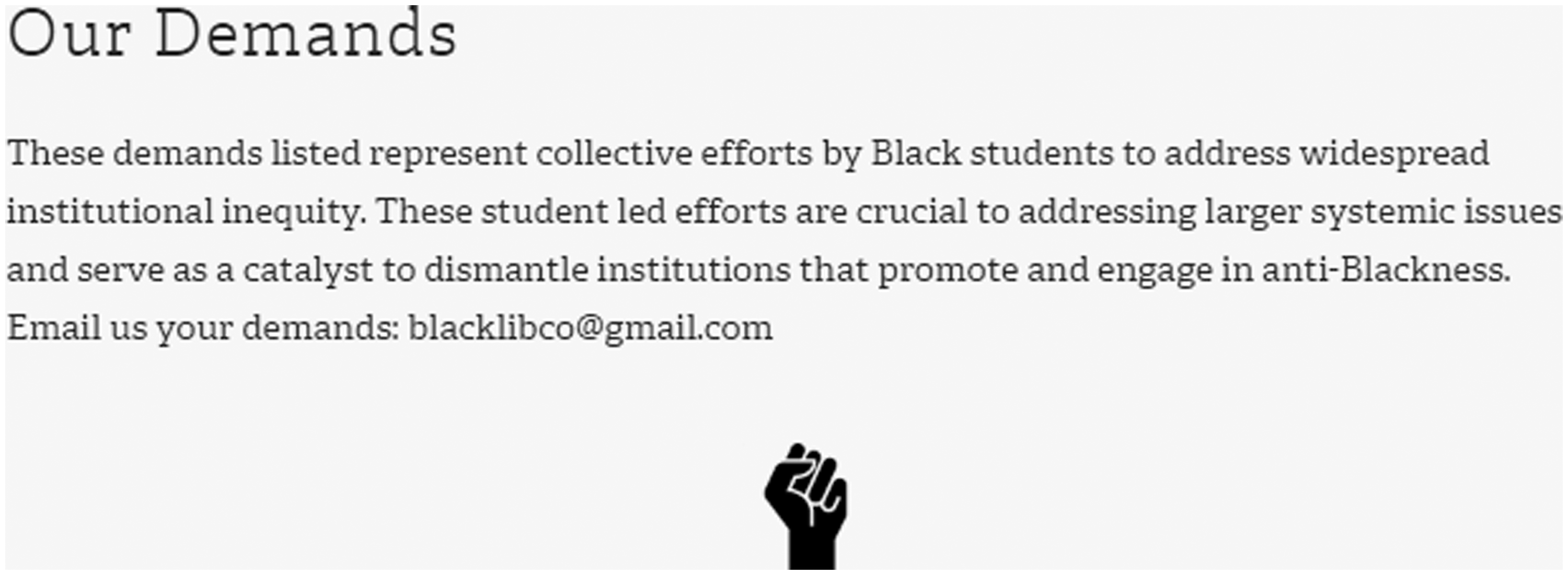
Through its introductory statement and imagery (raised fist), the Black Liberation Collective’s website frames the list of students’ demands as representing collective efforts by black students to address systemic racism and inequities.
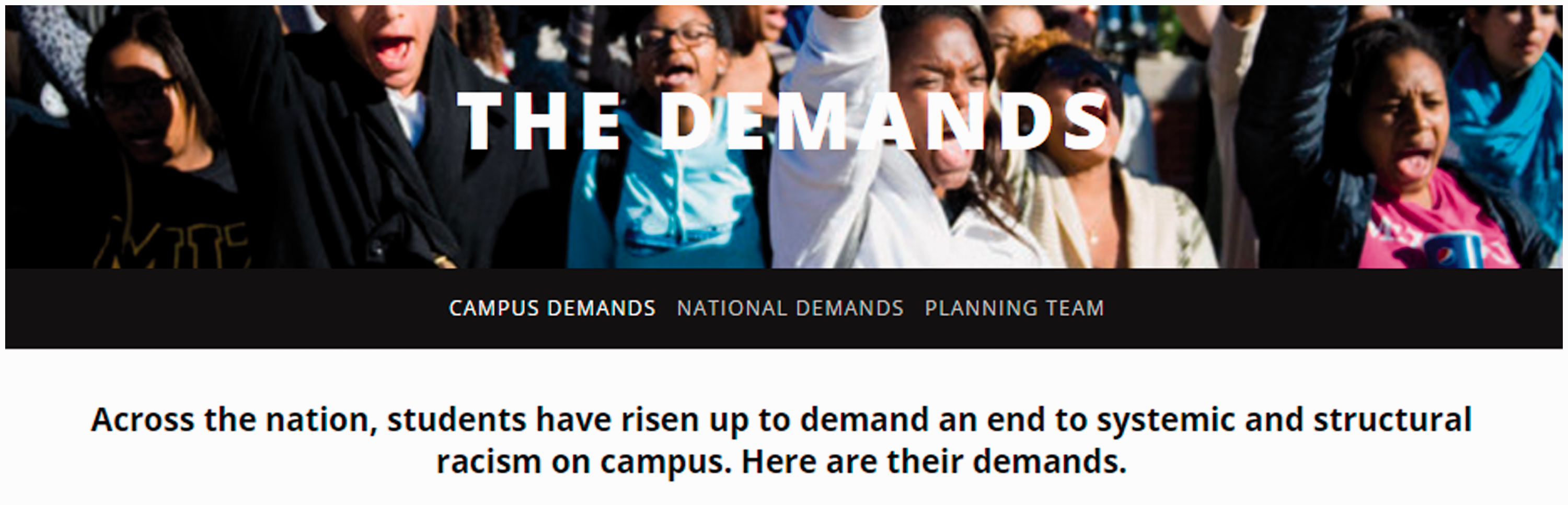
The Demands website (www.thedemands.org which includes exactly the same content and is an affiliate website of the Black Liberation Collective) also frames student demands in the context of Black activism.
Lastly, the lists of demands are prefaced by an overarching set of demands from the Black Liberation Collective: 1. WE DEMAND at the minimum, Black students and Black faculty to be reflected by the national percentage of Black folk in the country. 2. WE DEMAND free tuition for Black and indigenous students. 3. WE DEMAND a divestment from prisons and an investment in communities.
Brief review of the literature
Student activism and resistance to neoliberalism
Slocum and Rhoads (2009) highlight student and faculty activism in the academy as key tools for social transformation and resistance to neoliberalism. The vision here of the post-neoliberal university was one of social transformation in which the university is not centered on activities related to “immediate economic returns” (Slocum and Rhoads, 2009: 102). The university is focused on “social obligations” rather than revenue streams; it is envisioned as engaging in modeling individual behavior “suggestive of a more community-minded form of citizenship” (Slocum and Rhoads, 2009:102). The ethos of individualism and consumerism is replaced with one of “collectivism”. Students had a vision of the university connected to society and addressing society’s needs, a university divorced from academic capitalism and acting as an agent of social change. The vision of the university was connected to a vision of a “restructured society based on more democratic economic practices…more politically engaged citizens… .” (Slocum and Rhoads, 2009: 99). Activists held differing notions of the university’s role in intellectual transference. Some were focused on more theoretical ideas about neoliberalism and on providing alternative visions for economically marginalized citizens; others engaged in instrumental transference providing direct services to marginalized communities; still others viewed the transference in terms of collaborations between university and community social movements. They were seeking a stronger relationship between university and society. This vision of the university was the opposite of the neoliberal vision in that it was about creating a more democratic and emancipatory university, one that does not live in a glorified past of exclusivity but, rather, one that is more inclusive. Another vision includes a commitment to national and local problem solving as further resistance to the role of universities in serving the interests of globalization. Cabalin (2012) conducted research on student protests in Chile that rejected the competitive and privatized nature of the current system of neoliberalized higher education because of its effects on quality and equity. In doing so the students demonstrate that a new social imaginary is possible (Hickel, 2012; Monbiot, 2016). 5
Student activism in higher education has been a significant indication of resistance and rollback to neoliberalism, a reflection of a vision or social imaginary about a post-neoliberal society, and direction about moving beyond the pre-neoliberal welfare state that excluded groups of people and denied access to racial and ethnic minorities and low-income citizens (Carey, 2016).
Neoliberalism and activism centered on race, equity and access
In her examination of student protest at one university, Carey found that, “Habits of whiteness, and the ways in which they get (re)articulated through the lenses of neoliberalism and empire, are the very force against which students mobilized and fought in their sit-in protest at Prolutum in Fall 2014” (Carey, 2016). And again, as Robin Kelley (2016) observes, there lies a “tension between reform and revolution, between desiring to belong and rejecting the university as a cog in the neoliberal order. I want to think about what it means for Black students to seek love from an institution incapable of loving them – of loving anyone, perhaps” (Kelley, 2016). Diversity and inclusion become a checkmark that the university maintains in order to maintain the status quo, and perhaps this raises a question that haunts this project: is there another option? As the groups and activists organizing around the call of #BlackLivesMatter targeted the systematic disenfranchisement of Black people, it was inevitable that their attention would turn to university campuses, which are microcosms (and, in some cases, sources) of these larger societal trends. From inside academia, they began to mobilize around and explore the question of how to disrupt institutions that had been created, funded and organized primarily for the preservation of a white wealthy ruling class. (White, 2016)
Activism and the purposes of higher education
Activism is a vehicle for student learning about the democratic process, citizenship and leadership: scholars have argued that “an environment that supports activism is one that has greater integrity and reflects the democratic ideals embraced by the United States” (Kezar and Maxey, 2014: 31). Case studies of student activism in the late 1960s and early 1970s (in particular the period of 1969–1970) centered on three themes: racial unrest, demonstrations about academic and student life, and protests about US military policy (Astin et al., 1975). Rhoads (1998) argues that “[c]ampus unrest of the 1990s may be seen as democracy playing itself out in the truest sense, as marginalized peoples seek…a fair chance to achieve social, political, and economic opportunity” (Rhoads, 1998: vii). Principled student activism can be seen as citizen-engagement and an opportunity for meaningful, experiential citizenship education, and organized dissent on campus can be understood as students showing they have a deep understanding of democratic aims, processes and underlying principles (Hamrick, 1998). More recent scholarship (Tsui, 2000) suggested that activism and a campus culture of socio-political awareness builds critical thinking skills. What is unclear are the connections between recent student activism and protest at United States colleges and universities centered on racism, equity, and access, and resistance to and moving beyond neoliberalism.
Because case study research has been the norm for researching student activism and campus protest movements in the United States of America, there may be some value in considering a fairly broad swath of activism that has coalesced in the same time period and regarding the same issues. Additionally, a discourse analysis that involves a cross-section of contemporary student movements may provide for the identification of relevant patterns of meaning.
Conceptual and theoretical frameworks
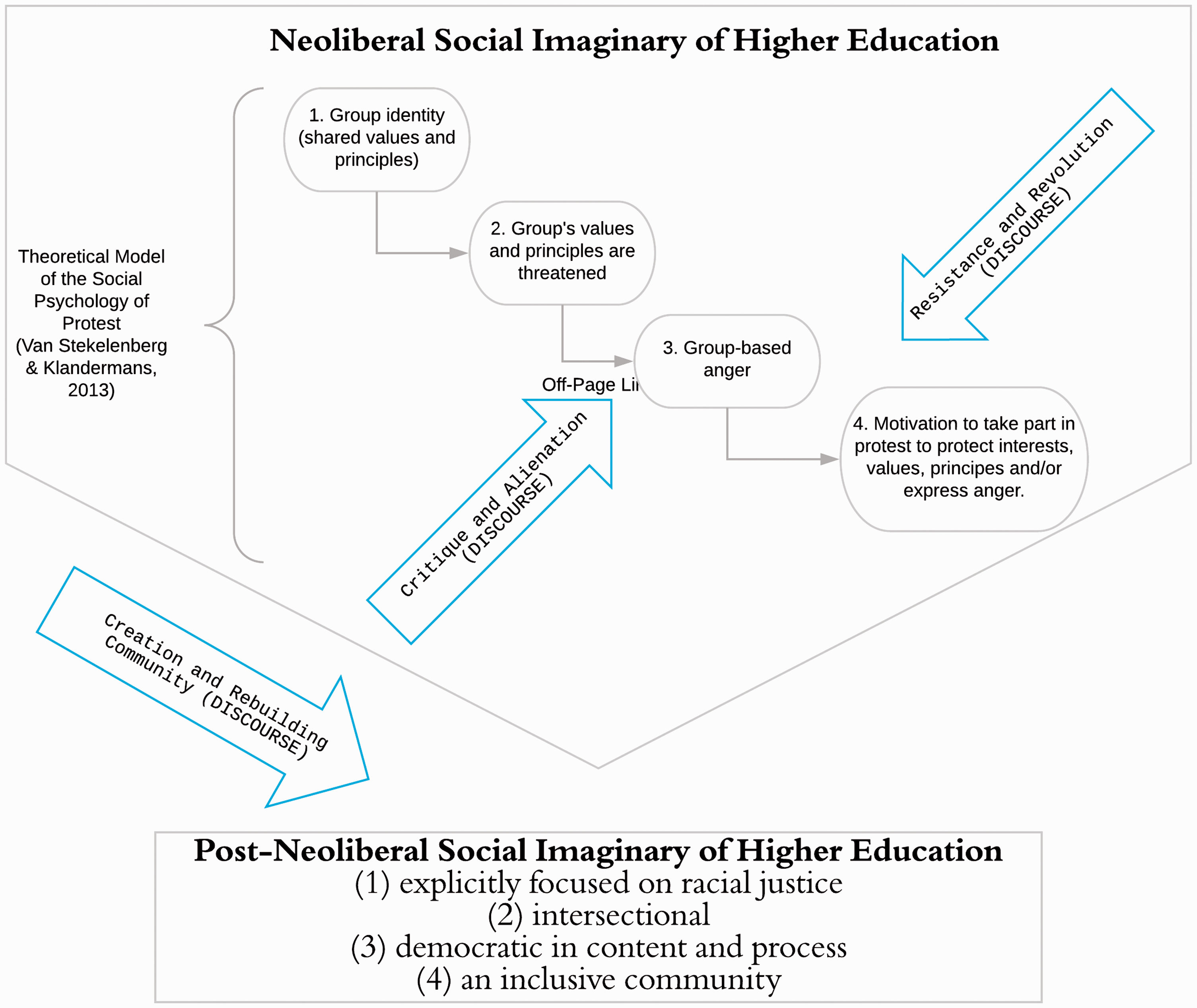
One conceptual framework for this study is Van Stekelenberg and Klandermans’ (2013) theoretical model of the social psychology of protest. The model integrates identities, grievances and emotions of protestors as an explanation for why they protest. According to this model, activist protestors must (a) identify as a member of a group with shared values and principles; then (b) feel that the interests of the group and/or principles of the group are threatened that leads them to feel (c) group-based anger to the point where they are (d) motivated to take part in protest to “protect their interests and principles and/or express their anger” (Van Stekelenberg and Klandermans, 2013: 897). This conceptual framework is particularly useful in categorizing the types of demands and from where they stem. Distinguishing between group values, group interests and group principles is one key to understanding the broad range of demands shared by activist groups. Additionally, understanding the way that these groups organize and construct their group identity is also crucial to understanding contemporary activism. Considering Van Stekelenbegy and Klandermans’ (2013) model of protest is key to understanding how student activists imagine a post-neoliberal society because of the concept of “identity”. In the neoliberal university, identity is defined in relation to students’ roles as consumers and potential members of the labor market. Thus when a student activist identifies as a group in which individuals are divorced from their market roles, students are rejecting the neoliberal university and circumscribing a new identity/reality/society on their university experiences. Another related conceptual framework is that of the neoliberal university versus the post-neoliberal university (Brown, 2015; Haiven, 2014; Risager and Thorup, 2016; Zuidhof, 2015). Table 1 provides an overview of the neoliberal and post-neoliberal universities’ social imaginaries: 6
Social imaginaries of higher education
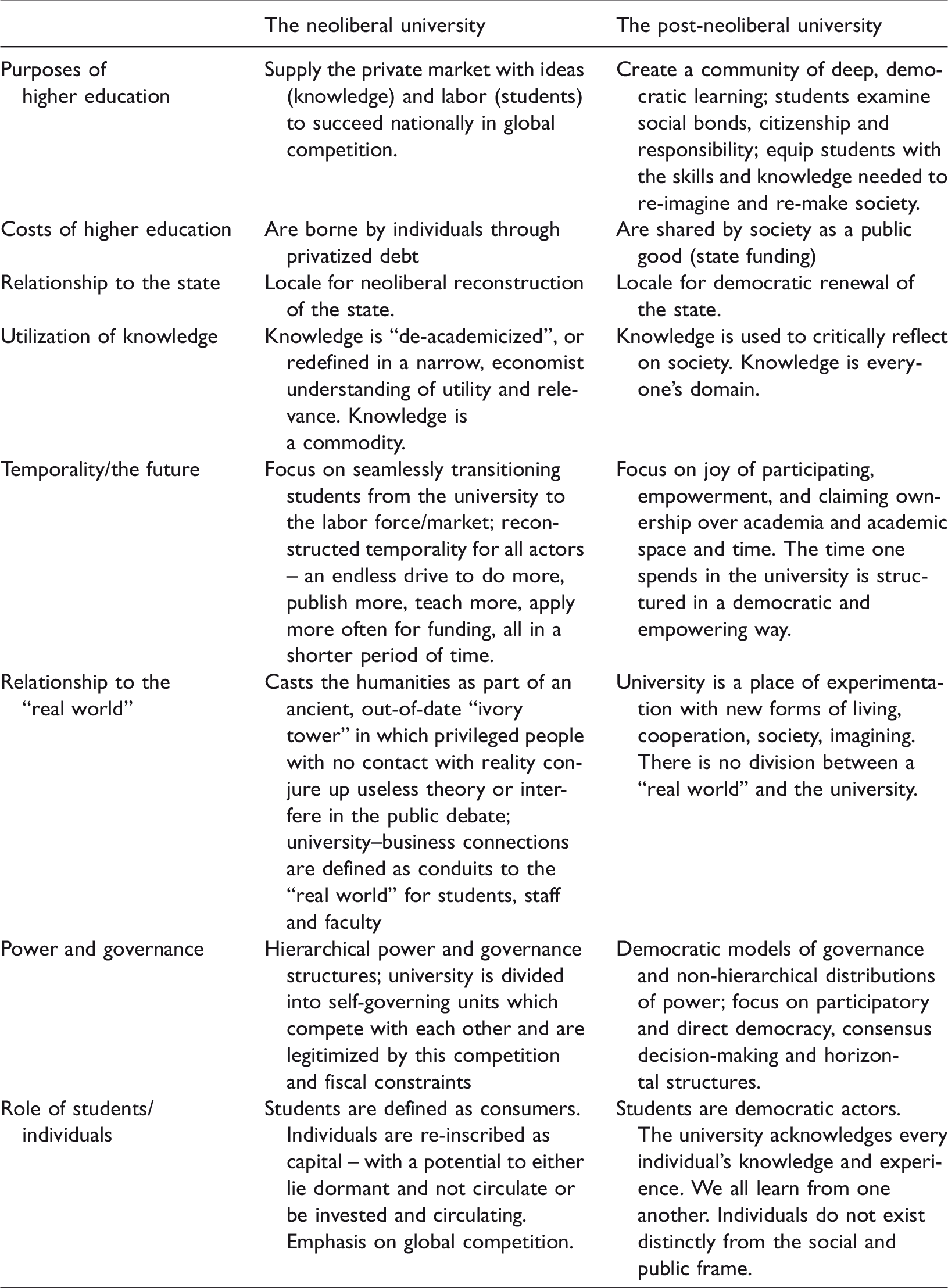
The contrast between the neoliberal university and the post-neoliberal university (or, as Risager and Thorup, 2016 describe it, “A Different University”) is a key framework in our discourse analysis and ultimate findings.
Research questions
This study was guided by the following research questions.
1. How do student activist groups frame their grievances and demands in the context(s) of contemporary neoliberal resistance higher education?; and 2. What does current student activism mean for the post-neoliberal imaginary?
Methodology
Discursive analytic approaches uncover the constructive effects of language and will provide for the investigation of the processes of the political and social construction of activist groups and group grievances (Chilton, 2004; Fairclough, 1995). By uncovering the specific ways in which student actors construct arguments, one may connect those arguments to the wider contexts of higher education. Heracleous (2006) argues that there are three dominant approaches to the study of discourse – interpretive, functional and critical: “not mutually exclusive, but analytically distinct” (Heracleous, 2006: 2).
This present study’s mode of inquiry will be mainly critical but also somewhat interpretive. In other words, discourse is conceptualized as communicative action constructive of social realities (interpretive) but we are also strongly-oriented towards considering discourse as “power knowledge relationships, constitutive of subjects’ identities of organizational and societal structures of domination” (critical) (Heracelous, 2006: 2). For this study, we use Fairclough’s (2003; 2005; 2010) method of critical discourse analysis (CDA) to “see” constructions of higher education in the demands of student activists.
Site and sample
This analysis is one part of a larger ethnographic study of contemporary student activism. “The Demands” (accessed via thedemands.org or the Black Liberation Collective’s website) were identified as a rich site of data and information for the study because of their explicit link to 2015’s major campus protests (especially Missouri) and because student groups were required to opt-in to share their demands. This suggested a willingness – even preference – to situate individual campus demands within the larger contexts of student activism. Additionally, an initial examination of the schools represented in the list showed that the final list represented a variety of institutional types and geographic areas (although concentrated on the US East and West Coasts).
Data collection and analysis
There were multiple phases of data collection to this discourse analysis. In the initial phase of document collection, we used demands compiled by the Black Liberation Collective (on the website www.thedemands.org). The list was last updated in December 2015. We cross-referenced the list of demands to each school and verified the documents as much as possible with each of the campus groups and schools affiliated with each separate set of demands. If it was not clear what specific campus group made the demands via the original website, the research team attempted to identify the group of activists through news articles, press releases, or information on relevant websites. In addition, as part of this phase of data collection the research team identified major characteristics of the school (using Carnegie Classification and information made available by the colleges and universities themselves) as well as whatever defining characteristics we could find of the activist group that wrote the demands – for example, one of the lists of demands came from a partnership between members of Black Students United, Voces Latinas and Students for an Inclusive Campus; while another came from just a group of interested students; and still another was specific to the Black Student Association. Fairclough’s CDA model (see Figure 3) posts three interrelated analytic processes tied to corresponding dimensions of discourse: text analysis, processing analysis and social analysis.
Fairclough’s CDA model posts three interrelated analytic processes tied to corresponding dimensions of discourse: text analysis, processing analysis and social analysis (adapted from Fairclough, 2001 and Janks, 1997).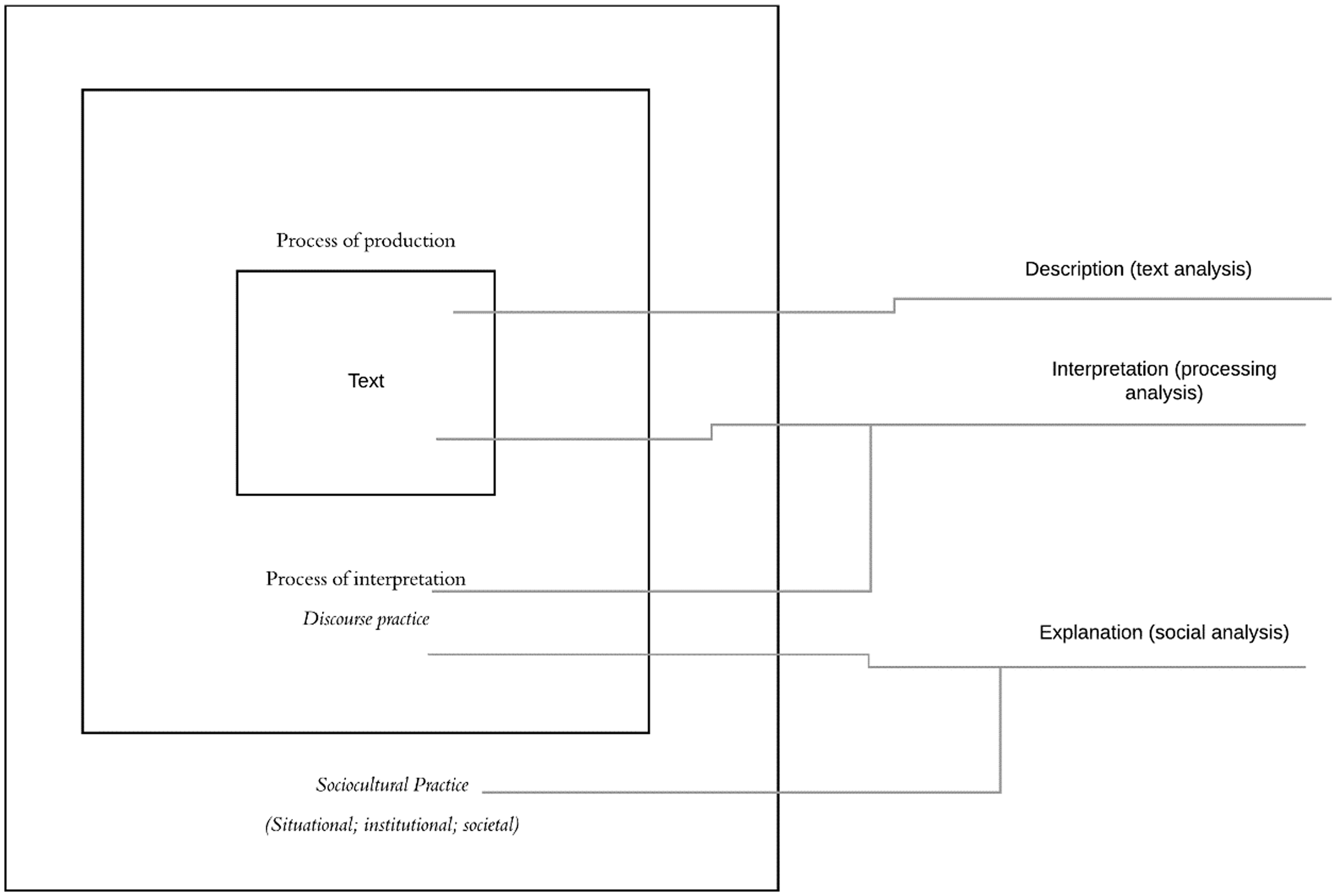
Limitations
This study is limited in scope and methodology. By relying on self-reported lists of demands through the Black Liberation Collective’s site, we may have missed critical actions and demands by student groups that were not aware of the site, or that chose not to participate but did circulate demands on their own campuses. Additionally, we have limited information only about how and by whom each of the student group’s demands were created. The demands show different levels of detailed engagement with policies and campus climate: the University of Virginia’s Black Student Alliance demands are 6300 words long, while Virginia Commonwealth University’s demands are expressed in 88 words.
Results
Three discourses related to the post-neoliberal imaginary emerged from this analysis: critique (alienation) of the current neoliberal university; resistance (revolution) to the neoliberal university; and creation (remaking/rebuilding) of an intersectional, inclusive community found in the imagined post-neoliberal university. Through their demands, student activist groups positioned themselves as agents of change consistent with these discourses (interestingly, these positions are sometimes incompatible with each other): outsiders, victims, change-agents, protectors, creators, leaders, insiders. They positioned institutions of higher education correspondingly within the neoliberal social imaginary: as a dangerous environment, as a flawed community, as hostile territory but also as a potential site of re-birth and revolution on a societal scale. These positions and discourses were evident throughout the lists of demands for each school and were also intertwined with each other. We would argue that an important finding, and one that differentiates the creative work of contemporary college student activists from the work of academics and researchers who consider similar structural issues and make similar critiques, is that these students imagine a post-neoliberal educational context imbued with a sense of racial justice, not simply class consciousness. Racial justice and intersectionality are integral to the discourse of these student activist groups, and the demands link issues such as the institutional marginalization of black and brown students to the corporatization of the university. Finally, we argue that the sophisticated understanding of contemporary college student activists of their institutions allows one to discern a blueprint for the post-neoliberal higher education sector. We synthesize our analyses of student activist discourse to propose the key cornerstones that would make up the foundation of this new social imaginary.
Three discourses: critique, resistance, creation
In the following section, we outline our findings from the discourse analysis. We focus on three discourses that surfaced from the lists of student demands: critique and alienation, resistance and revolution, and creation.
Critique and alienation
First, we address the discourse of critique. The discourse of critique of the neoliberal university is grounded in a sense of alienation and marginalization. While we found that this discourse placed demands in the context of larger structural, institutional and societal issues, the actual demands were focused more on meeting the needs of individuals. The discourse of critique of the neoliberal university positioned the students who were making the demands as outsiders or victims in an unwelcoming or dangerous environment. It is more descriptive and reactive than prescriptive and creative.
The discourse of alienation makes sense in the context of current student protests and in the United States of America (and US systems/institutions of higher education in general). If one accepts the premise that protests in Ferguson and the emergence of the Black Lives Matter movement influenced Mizzou’s hugely significant protests, which in turn sparked a flame on campuses all across the USA, one can also see how this discourse of alienation and marginalization is fundamental to the recent campus protests movements and the demands student activists have made. Consider data from the Atlanta University Center Consortium,
7
where the student group …wholly dedicates itself to the eradication of harmful practices that provide for the perpetuation of these grievances.
8
These harmful practices include but are not limited to: state violence against black and brown lives, such as police brutality, erasure and reconstruction of history, and allotment of resources; the exclusion of women, LGBTQIA, differently-abled, non-Christian, poor and neurodiverse or mentally ill persons in addressing public issues; and the upholding of respectability tactics in the wake of calculated, widespread targeting of black and brown persons. (Atlanta University Center Consortium)
Another group of students from Atlanta (addressing their demands to Emory University) demonstrate this same outsider/insider positionality, and anxieties about racial violence, as well as their commitment to black activism as they bring professors into the fold of their demands: Black professors when in non-traditional or traditional disciplines must not be abused by the overwhelmingly white academy. Professors, too, need protection for the violent, racist, and sexist incidents that they endure from their white colleagues in their departments. The violence Black students face on and off campus has documented negative effects on our physical, emotional and spiritual well-being. These are sources of stress and ultimately impede on Black students’ success, academic pursuit, intellectual developments and required resources.
In addition, about half of the times that word “violence” was used in the demands was in relation to sexual assault and gender-based violence – another facet of being alienated from broader institutional norms and culture, and another example of the student activists’ emphasis on intersectionality. 9
Resistance and revolution
The discourse of resistance and revolution positions student groups who made these demands as change agents in hostile territory. This discourse focuses more on structural and societal issues. It also provides the foundation for the discourse of creation of new communities.
Empirical evidence from all three discourses overlaps with this key finding. Specifically, AUC’s and Emory’s concern for community members and black professors situates the authors as protectors. A related pattern that emerged from the data was the focus on justice for communities “adjacent” to the traditional college or university, including actual neighboring communities (and the high schools within), classified administrative and custodial staff (contracted and not), and members of the academic precariat. The demands placed on UNC–Chapel Hill by its student activists – while incredibly specific, thorough (and idealistic) –nonetheless exemplify the subjectivity of protectiveness and resistance. We DEMAND a University and hospital-wide minimum wage of at least $25.00/hour that is commensurate with the living costs of downtown Chapel Hill plus full benefits for all workers regardless of temporary, permanent, part-time, full-time or contracted status. For a household with a single working adult and three children $32.86 is the full-time minimum wage required for a family to live decently in Durham/Chapel Hill. People should not be compensated for their labor so that they can merely get by, but so that they can thrive. We DEMAND that an increase in wages should never result in a cutting of hours. Workers must be paid enough to live, work, and care for family in Chapel Hill as white supremacist, patriarchal capitalism has made housing prices skyrocket and rendered the town unaffordable to one too many…We DEMAND that all workers at the UNC system & UNC Hospitals have the right to unionize and collectively bargain. We DEMAND that the UNC-System and UNC-Chapel Hill advocate for the right to unionize and collectively bargain for workers on a state and national level. We DEMAND a minimum compensation of $15,000 per course for all adjunct faculty.
This is also where Van Stekelenberg and Klandermans’ (2013) model is most visible. The social psychology of group protest is encompassed in each of the lists of demands. Student activists identify as a member of a group with shared values and principles – in this case, students define their “group” or community quite broadly. Furthermore, they define themselves and their group in direct contrast to neoliberalism, asserting human worth as something outside of their roles as cogs in the machine of the university. They then feel that their interests and principles are threatened, which leads to group-based anger and a motivation to take part in protest to protect their principles and express their anger. These steps can be easily seen in the discourse of resistance – they are tools for resisting the current state of their world and school.
Creation and remaking community
The last discourse – and most relevant for imagining a new society, post-neoliberalism – is one of creation and remaking community. The discourse of creation is grounded in the assumption (by and of student activists) that their flawed academic communities are worth changing, that they want to be insiders and leaders at their schools. These demands focused on the heart of a university community: the curriculum and the learning and living experiences. The discourse of creation and remaking community is also rooted in democracy and democratic processes (not simply democratic ideals).
One striking aspect of the language in the demands included in this study is the depth and breadth of knowledge of the academic and campus community and culture. Analytic coding based on structural levels (rules, goals, policies, the environment, technology) revealed that a majority of the actions demanded in the documents fell under this paradigm (507 instances, with every institution represented and an average of more than six instances per document). A surprising number of demands focused on issues such as departmental status, tenure-homes, and operational budget. An equal number of demands centered on transparency and accountability, via regular reports from administrators and actors within governance structures to student constituencies and bias reporting systems. The last major pattern within the structural paradigm was mandatory training and new curriculum requirements. Activists used a variety of terms to encompass training, including: racial competence and respect training; mandatory social justice workshops; critical racial sensitivity training; racial competency training; an intensive university-wide training structure…on how to interact appropriately with those from marginalized backgrounds; cultural competency training; mandatory inclusive consent training; equity training; anti-oppression training; mandatory intense inclusion and belonging training; and sensitivity training.
10
Beyond training requirements, the demands had an intense focus on new curriculum requirements for multicultural or ethnic students courses. Students at the University of San Diego offer an example: We demand that an Ethnic Studies course be a core curriculum requirement for all students. We also demand a rigorous reevaluation of the course that currently fulfill the core curriculum diversity requirement, led by a board comprised of faculty of color who would be compensated for this service. Commit to having Ethnic Studies 101 as a graduation requirement. The current multicultural requirement is not enough. The ethnic studies specific requirement will require students to learn about the importance of United States history in the context of social inequality and injustice, while emphasizing the often-overlooked histories of African-American people as well as the histories of other underrepresented groups in the United States. Ethnic Studies 101 is a critical course that teaches students the importance of diversity in the United States. Without taking this course, students are not sufficiently prepared with basic cultural competence skills to navigate the diversifying world. We are committed to working with the Faculty Senate and implementing this demand.
The symbolic frame of understanding organizations (Bolman and Deal, 2013) is also worth considering here. Student demands related to the myths, legends, symbols and heroes of their institutions were centered around “reclaiming” their school through removing, renaming, or offering guidelines for future naming/building opportunities. We posit that these symbolic demands – ranging from the removal of Confederate monuments to the renaming of an entire school – are another example of insiders using their status to become more inclusive. Discursively, demands that are based on the symbolic frame of colleges and universities are straightforward, as the following illustrate: Rename Calhoun College. Name it and the two new residential colleges after people of color. (Yale) Give a name to at least half of as yet unnamed residence halls and academic building in honor of social and political activists of color… (NYU) The official name of the office should be: Mary Jean Price-Walls Center of Diversity. (Mizzou) The immediate removal of Nathan Bedford Forrest’s name from Mifcrfddle Tennessee State University’s ROTC building. (Middle Tennessee State University) Name the new West Union “Abele Union” after West Campus architect Julian Abele. Erect a statue in honor of Julian Abele. (Duke) Change the name of Cutter-Shabazz Hall to Shabazz Hall. The building should celebrate Blackness and human dignity, not the legacy of Victor Cutter, who was a corporate dictator for the United Fruit Company in Latin America and the Caribbean. (Dartmouth)
Summary of results
Using these findings of the discourse analysis, we now offer some indications of a new social imaginary in higher education, one that is focused on community and justice. This discourse analysis of contemporary college student activist demands illustrates the ways in which student activists understand, resist and critique neoliberalism, and suggest some ideas about the post-neoliberal imaginary. Their critiques of the structure of higher education indicate a sophisticated understanding of the current socio-political, cultural, and economic realities. Their demands reveal an optimistic, creative imagination that could serve educators well as they grapple with taking the first steps toward this reality. Using the students’ critiques, methods and demands as a starting point, this study offers a potential blueprint for thinking about a new social imaginary in higher education, one that is focused on community and justice. We summarize below four outcomes from the analysis, and offer a graphic (Figure 4) that illustrates the ways that discourses inform the theoretical frames on which we based our analysis.
The new post-liberal social imaginary in higher education will explicitly focus on racial justice and racial equity and reparations. Student groups made these demands on many different organizational levels, from specific budget requests and calls for reparation via affirmative action to a focus on policing and criminal justice, as these demands from the University of Oregon and the University of Cincinnati illustrate: Commit to creating a Funding Resource and Scholarship initiative that is designed exclusively to support and meet the unique needs of students that identify as Black/African-American. The discourses of critique/alienation and resistance/revolution correspond to steps in the theoretical model of the social psychology of protest, but the creation/rebuilding community discourseis where student activists articulate a new social imaginary of higher education that is postneoliberal, justice-oriented, intersectional, democratic, and inclusive (adapted from van Stekelenberg and Klandermans, 2013).
The Diversity Excellence Scholarship is NOT enough.
Due to the state/national population imbalance, it is simply unfair for Black students to compete with low income white students and students who identify as Hispanic/Latino for the same scholarships. (University of Oregon)
The University of Cincinnati referred to individual cases of possible police misconduct: Open investigation in Grant, Starling et al. case as a hate crime beginning with IOA (…), Reopen investigation into the murder of Rick Dowdell (…). We also demand a recurrent substantial monetary allotment to go to all offices and initiatives that directly support and impact the recruitment, retention, and matriculation of Black students on this campus starting in the fiscal year 2017.
2. The new post-liberal social imaginary will be intersectional and focused on dismantling the kyriarchy, including issues related to living wage, actions against sexual violence:
The university has come to understand the importance of addressing social issues as a means of creating inclusive and safe communities. As seen through the “Can I Kiss You?” programming during orientation week and the campus-wide effort to implement training in relation to mental health, there is the capacity to prioritize large scale programming on anti-oppression. (Guelph)
At the University of Kansas student demands included: Remove all professors who assault, sexually harass, or engage in abusive relationships with students. Apply this policy retroactively as well, specifically to Dr. [name redacted by the Journal-World]. Immediate expulsion of those that commit sexual assault.
3. The new social imaginary includes a more democratic process of decision-making that includes diverse representation of students and faculty. For instance, at the University of Virginia student demands included:
Faculty and administrative search committees must be representative. Departments should not move onto the next step in the faculty search process until its initial applicant pool is at least as representative of each racial demographic as the national pool. The University should revamp its implicit bias and diversity trainings. Currently the diversity-training module that search committee members must complete is inadequate. It often refers to the federal mandates regulating hiring underrepresented minorities, implying that hiring minority applicants is at least in some part due to legal obligation and not out of the necessity for academia and scholarship to include diverse perspectives if it is to truly be excellent.
At Guelph University: Simply posting that there will be community consultations is ineffective as it fails to account for our existing alienation from the process as a barrier to participation. We wish to see proactive outreach to campus organizations that moves beyond tokenism, as well as the establishment of incentives to encourage students to actively be involved in this process. We expect to be involved immediately and for this underrepresentation to be addressed by 2016-2017
4. The new higher education will be an inclusive community – encompassing not only those who have access to it, but also those who work in it, live near it, rely on it as a space for the public sphere, etc. This community is set up to support all of its members, including supporting undocumented, first-generation students, African-American students; supporting community-engaged scholarship and research; tenure for underrepresented faculty; community relations and opposing gentrification, etc. For example, Washington University of St. Louis student demands included (our emphases):
• Revise curricula to require courses that address the social, political, economic, and history and landscape of St. Louis.
• Incentivize community-based participatory research on the St. Louis region for faculty and students by the establishment of awards or other forms of recognition for those whose research directly benefits our local community.
• Widen the pipeline to higher education for local K-12 students, many of whom attend schools with under-resourced college prep programs
• Revise protocol for future development on properties owned by the university in the greater St. Louis area.
Discussion
Contemporary college student activism has been particularly visible and effective in the past few years at US institutions of higher education and is projected only to grow in future years (Eagan et al., 2015). Almost all of these protests and demands, while explicitly linked to social and racial justice, are sites (implicit or explicit) of resistance to the neoliberalization of the academy. These activists are imagining a post-neoliberal society, and are building their demands around these potential new social imaginaries.
The overlapping discourses of alienation, belonging and resistance show that student activists occupy different positions (sometimes at odds with each other) in relation to their schools. Ultimately, however, an analysis of these recent demands from campus protestors shows that students are invested in their communities, and feel entitled to meaningful, respectful experiences and interactions on their campuses. They have a knowledge of their institutions (and higher education in general) that is impressive in its depth and breadth and they have expectations that are lofty but which embody a new social imaginary. They push back against the sense that neoliberalization and corporatization in the academy are inevitable and irreversible, and they embody critical thinking and civic engagement.
In doing so these activists are engaging in what Shahjahan (2014) refers to as “resistance as subversion”, “resistance as opposition”, and “transformational resistance” focused on new ways of being, knowing and doing in higher education. While faculty, staff and administrators may not be able to concede to all (or even the majority) of student demands, it would be a mistake to ignore or dismiss them. In making their demands, students are thinking about what could and should be, and translating those thoughts into concrete actions. According to Monbiot (2016), Those who tell the stories run the world. Politics has failed through a lack of competing narratives. The key task now is to tell a new story of what it is to be human in the 21st century. (Monbiot, 2016)
The student protests and demands discussed here remind us that, what peeks through the streets or in the occupied classroom…or in the day-to-day operations of the university itself, is not the privatized university, or even the “public university” of old, but rather the university to come, the university of the commons.(Haivens, 2014: 150)
Footnotes
Declaration of conflicting interests
The authors declare no potential conflicts of interest to exist with respect to the research, authorship, and/or publication of this article.
Funding
The authors received no financial support for the research, authorship, and/or publication of this article.