



Abstract
Teacher education is under assault from the corporatization of public education. There is evidence that reductive, essentialized/ing discourses of standardization and compliance exert intense pressures on teacher education, and a market-based, audit culture constricts conceptions of the “good teacher”. Despite the pervasiveness of neoliberal discourses, little is known about how student teachers experience increased corporatization in education, or about how they act rather than are acted upon in this context.
In examining these dynamics, we explore the following research questions: (a) How do student teachers make sense of neoliberal discourses in teaching? (b) How do student teachers experience the process of what Hammerness describes as “teacher visioning” in the context of neoliberal discourses? (c) What, if any, effect does visioning have on their responses to these discourses?
We draw on qualitative data including focus groups, interviews, and document analysis from a group of early childhood student teachers enrolled in a public teacher education program and placed in field sites around eastern Massachusetts. Based on our findings, we argue that teacher visioning can, under certain circumstances, serve as an impetus for student teacher resistance to neoliberal pressures.
Introduction
Teacher education is under assault from the corporatization of public education. Reductive, essentialized/ing discourses of standardization and compliance exert intense pressures on teacher education (Kumashiro, 2015), and a market-based, audit culture (Apple, 2005) constricts conceptions of the “good teacher” (Cochran-Smith and Lytle, 2006). Despite the pervasiveness of neoliberal discourses in education, little is known about how student teachers experience these discourses, or about how student teachers act rather than are acted upon in this context. In our analysis, we draw upon robust research around sensemaking (Spillane, 2004; Coburn, 2001, 2004; Weick, 1995) to explore the ways in which student teachers make sense of neoliberal forces in education. In addition, we employ the practice of “teacher visioning” (Hammerness, 2003), a process of examining beliefs about teaching and learning, to explore how student teachers might conceptualize their roles as agents in reproducing/resisting hegemonic discourses.
In examining the dynamics between student teachers’ experiences and neoliberal pressures on education, we address the following questions: (a) How do student teachers make sense of neoliberal discourses in teaching? (b) How do student teachers experience the process of “visioning” in the context of neoliberal discourses? (c) What, if any, effect does visioning have on their potential responses to these discourses? In responding to these questions, we examine data from a qualitative case study of eight student teachers in a comprehensive teacher education program in Massachusetts. Data sources include transcripts and field notes from focus groups, personal interviews with student teachers, and document collection.
Framing the study
Neoliberalism and teacher education
Much has been written about the institutionalization of neoliberalism in education, i.e. the adoption of a market-driven, entrepreneurial, competitive approach to solving social problems (Harvey, 2005; Apple, 2005; Sleeter, 2009; Weiner, 2007). Though a comprehensive treatment of neoliberalism in education is beyond the scope of this article, there is a wide body of research pointing to the implications of neoliberal discourses in education in general and teacher education in particular.
This scholarship points to a number of outcomes of the neoliberal project for public teacher education. For example, teacher education is increasingly pressured to prepare teachers as technicians with the goal of increasing student test scores. This is evidenced not only by the ongoing focus on student test scores (Anyon, 2005; Sleeter, 2009), but also by the pervasiveness of prescribed, scripted curricula (Achinstein et al., 2004; Kumashiro, 2015). Further, there is an ongoing minimizing of teacher professional knowledge and a shift towards equating teacher quality with standardized test scores (Cochran-Smith and Lytle, 2006; Sleeter, 2009). Parallel to this is the continual threat to teacher education as a whole and the creation of programs to shorten or bypass traditional teacher education programs (Darling-Hammond, 2000; Tamir and Wilson, 2005). Overall, one of the most significant effects of neoliberal pressures on teacher education is a challenge to the idea that education plays a central role in promoting social justice and democracy (Zeichner, 2006; Weiner, 2007). The shift away from the fundamental notion that education is a “public good” (Anton et al., 2000) has meaningful implications for students, teachers, and teacher candidates alike.
Student teacher sensemaking
Our study is informed by the well-established research on teacher sensemaking in education. Sensemaking theory (Spillane, 2004; Weick, 1995) posits that three key constructs interact to shape how teachers understand and respond to information, policies, and practices in education. The first construct, or individual cognition, represents the ways in which teachers interpret new information through their existing frameworks of understanding and experiences. The second construct, or situated cognition, addresses the established relationships and local cultures that serve as context for how teachers make sense of new information (Spillane et al., 2002). The third construct, or policy signals, represents the body of a variety of messages from policy documents (Stone, 2001). Teachers make sense of the ever-changing nature and conditions of their work through these three constructs.
Though the literature around teacher sensemaking is robust, we know relatively little about the sensemaking processes of student teachers, who are situated in multiple “enactment zones” (Spillane et al., 2002). In their role as students and as apprentice teachers in the field, student teachers operate in multiple professional settings. Each of these settings is governed by an individual local culture (Weick, 1995) that impacts their development (Lortie, 2002; Brody et al., 2010). It is crucial to consider how student teachers make sense of institutional practices and policies and the ways in which these are mediated through various lenses in university training and in their field sites (Hara, 2017).
Visioning
This study concerns opportunities for student teachers to inquire about the “primary questions of who they are and who they are becoming” (Stremmel et al., 2015: 158) as they learn to teach in neoliberal times. Therefore, we draw from Karen Hammerness’s (2001; 2003; 2006) framework of teacher vision, which she describes as “a set of images of ideal classroom practice for which teachers strive” (2001: 143). Visioning affords opportunities for student teachers to articulate their beliefs and to recognize how their beliefs manifest in their practice. Visioning also entails recognizing and reflecting on the gaps between articulated beliefs and teacher practice.
The process of visioning allows teachers to articulate the way that they feel about their teaching, their students and their school and helps to explain the changes they make in their classrooms, the choices they make in their teaching, and even the decisions they make about their futures as teachers (Hammerness, 2006, p. 2).
Methodology
This study employed instrumental case study methods (Creswell, 2013; Stake, 1995) by engaging with a phenomenon (student teachers’ understandings about neoliberalism and education and the impact of visioning on those understandings) within a contemporary context (student teachers’ experiences in their education program and public-school classrooms). Engaging in case study methods allowed us to “capture the richness, complexity, and dimensionality of human experience in social and cultural context” and convey “the perspectives of people who [were] negotiating those experiences” (Lawrence-Lightfoot and Davis, 1997: 3)
Participants
At the beginning of the professional practicum (student teaching) semester, we contacted 13 early childhood education majors (we refer to them as student teachers). Of the student teachers recruited to participate, 12 previously completed coursework with either one or both of us in our education methods courses. However, neither of us supervised any of the participants during their student teaching practicum.
At the onset of the study, 10 student teachers agreed to participate, though 2 participants were unable to continue with the study after the first focus group. Of the remaining eight participants, seven were enrolled in a traditional early childhood education program at a comprehensive liberal arts institution in Massachusetts and one was enrolled as a post-baccalaureate student, having previously completed an undergraduate degree outside of education. Seven of the student teachers, including the post-baccalaureate student, completed their education methods courses as a cohort while the remaining student teacher completed her education methods courses semesters before the others. In sum, the majority of participants experienced the same education coursework with the same professors prior to their professional practicum semester.
As required by the Department of Elementary and Secondary Education (DESE) in the Commonwealth of Massachusetts, student teachers completed approximately the first six weeks of their professional practicum in a public kindergarten classroom and the remaining nine weeks in either a public first or second grade classroom. All of the participants completed their professional practicum across four school districts in the outer suburbs of Boston.
Data sources
Focus groups
One way to engage in the production of insight is through the convening of focus groups, naturalistic settings in which the researcher is able to listen for content, emotions, and contradictions in a setting ruled by a particular set of social norms (Krueger and Casey, 2000). Given that focus groups are inherently social and semi-public, in this methodology the “talk” that emerges between and across focus group members, as well as the silences—what is not said—are key sources of data (Creswell, 2013).
Student teachers participated in two focus groups over the course of the study. The first, which convened in the days before the participants began their professional practicum, involved a discussion about student teachers’ encounters with messages about neoliberal pressures, in particular those dealing with compliance and standardization. Participants were also asked to articulate their understandings of these pressures in the contexts of their education coursework and field study placements. Further, student teachers discussed their current understandings about the climate of education in the United States and the extent to which they encountered messages about the politics of education in their coursework and field studies.
The second focus group convened at the conclusion of the professional practicum. Participants reflected on their student teaching experience and, in particular, the extent to which their own beliefs about teaching and learning materialized in the practices in which they engaged during the practicum. Student teachers also reflected on the process of visioning and the extent to which it emerged as a “consciousness of possibility” (Greene, 1995: 23) over the course of their practicum experience.
Document collection: visioning artifacts
Hammerness (2001) suggests that a teacher’s vision is “deeply individual, incorporating past and present, and neither wholly good or bad” (144). To that end, participants engaged in visioning independently over the course of approximately four weeks around the midpoint of their practicum experience. Drawing on Hammerness’s (2001; 2003) work, participants reflected on and articulated their beliefs about the following and what spaces informed their beliefs (education coursework, field study placements, or personal experiences): sights and sounds of the classroom, the role of the teacher, the role of the students, curriculum, and the relationship between classroom and society. The participants organized their beliefs and reflections on notecards and shared them with us. Data were compiled and used to inform both the final focus group discussion and individual interviews.
Individual interviews
The data that emerged from focus groups was shaped by the social norms and expectations of the group setting. Therefore, additional sources of data in this study were semi-structured interviews with student teachers. In-depth interviews are another way to craft faithful portraits of teachers, staff members, and parents (Fontana and Frey, 2000). The central foci of the interviews were awareness of and experiences with neoliberal pressures on teaching and teacher education, individual experiences with the visioning process, and self-reported views of the impact of visioning.
Data analysis
The questions in interview and focus group protocols were designed to underscore student teacher perspectives and opinions. Coding of focus group data, data constructed through the student teachers’ visioning experiences, and interview data was iterative throughout the research study, and took place in two separate phases (Emerson, Fretz, and Shaw, 1995). The first phase involved “open coding” in which the data was taken line by line in order to identify the range of possible themes and patterns that arose from transcripts of focus groups and interviews as well as the documents generated through visioning. The second phase involved “focused coding” in which the data was re-coded through the lens of specific topics of interest (in this case, student teachers’ understandings of neoliberalism and the relationship between teacher vision and understandings of neoliberal discourses).
Findings
Fumbling towards a definition of neoliberalism: teacher education and professional knowledge
Respondents described having a limited understanding of neoliberalism and its impact on education. Student teachers’ individual cognition around neoliberalism—that is, their existing frameworks of understanding—was limited in scope (Weick, 1995; Spillane, 2004). They associated this lack of knowledge to the absence of direct, explicit instruction around increasing pressures of neoliberalism on education through their teacher education coursework. While certain professors did situate pedagogical knowledge within the context of contemporary neoliberal movements in education or raised questions about increasing standardization in teacher education, respondents interpreted these instructional choices as individual rather than part of a larger, coherent vision held by the teacher education program as a whole.
Respondents who reported little professional training around market-based pressures on education and teaching found this silence notable; as Sam stated, I guess not speaking out against it is kind of telling us unconsciously that we should conform and just go with the flow, not recreate the wheel as they say, so if they’re silent about it, that tells us something, too.
Though respondents identified few examples of explicit instruction around neoliberalism in their coursework, they did experience significant pressures around standardized testing and teacher quality in their own professional training. Because the Commonwealth of Massachusetts requires all licensed teachers to pass multiple Massachusetts Tests for Educator Licensure (MTEL), the respondents’ teacher education program implemented a policy requiring all MTELs to be passed in order to begin student teaching. Students who passed their MTELs early were able to transition from classroom coursework to their student teaching practicum and therefore to graduation and licensure. However, students who failed to receive passing scores on all required MTELs prior to a deadline set by the program each semester would have to delay student teaching, and therefore graduation, until they were able to satisfy the MTEL requirement.
Respondents felt tremendous pressure around the MTELs, not only because of the implications for their progress to degree, but also because of the cost involved with taking and retaking the tests. Still, most students stated that they understood the need for teacher licensure exams as a whole. Melissa stated, “[…] Here is a bunch of questions that, like, basic knowledge that yes, you should know. I understand that, and you need some baseline where everybody can reach a goal.” While many students recognized the need for some theoretical benchmark assessment to gauge teacher preparedness, Melissa and her peers questioned the idea, implied by their teacher education program, that success on standardized high stakes tests such as the MTEL would equate to “good” teaching.
One of student teachers’ biggest concerns was around the impact that the MTELs had on their coursework and the pedagogical content knowledge put forth by the program. Emma, a student who struggled to pass MTELs and took an academic year off from school in order to earn money while studying for the exams, argued, Well, I don’t want to say they were teaching to the test, but, like, a lot of the stuff that we were learning was on the test. So, like, sometimes, like, in different classes, as a warmup, we’d do an MTEL prep question, or be like, oh, you are going to want to remember this for when you study for your MTELs. Like it wasn’t really like, oh, today we’re going to be doing MTEL prep. It was more like little reminders along the way, like, oh, you can use this for the MTELs. Oh, this would be good for the MTELs and blah, blah, blah, MTELs, MTELs, MTELs.
Compliance and coordination around delivering scripted lessons
In the context of limited formal professional training around neoliberalism in education, as well as a lack of exposure to policy signals from policy documents themselves (Stone, 2001), respondents gathered much of their insights from their experiences as student teachers in districts around eastern and central Massachusetts. Student teachers, situated in the two “enactment zones” (Spillane et al., 2002) of the university teacher education program and the practicum site, drew upon both settings and local cultures in their sensemaking processes. The primary way in which respondents experienced pressures related to neoliberalism in their student teaching experiences was through the standardization of curricula in schools and districts across the state. Each respondent in the study reported the use of curricular programs such as Engage New York, Fundations, Envision Math, etc., which varied in levels of prescriptiveness. Kristen described one program used in her student teaching placement as follows. So they got a two-inch workbook, lesson one through five. And then another two-inch workbook, lesson five, six through ten. In that workbook for each student, remind you there's, okay, so 18 students. There was the solve-and-share worksheet. There was the independent practice worksheet. There was the Gitlin homework worksheet. There was the reteach worksheet. [My district] has a calendar that they put out. So there's a team of teachers in first grade […] and they put this calendar together that says, the week of January 1st through the 8th or 7th, you will do math 3.6 to 3.9. You will do science units two, three, and four. So you had to kind of follow that guide through.
Respondents highlighted positive and negative aspects of adhering to scripted programs in their school sites, and a tension between the ease of using standardized programs and other competing interests. Sam stated, Planning is easier because the lessons are right there for you. The concepts are right there for you. But I guess, for me, it means, like it means that sometimes the kids will be less engaged and interested in what we're doing because it's not drawing on their interests. And maybe for a first-year teacher that's good, because you're not scrambling for ideas. Because you do have to build a lot the first few years. But I think it's a lot of, why did I have to go through this to go in there and push a button and say, here you go, kids, here's your worksheet. […] I'm like, where is your teaching? Where do you come in?
Re-examining the student teacher-supervising practitioner relationship
In addition to the influence of curricular standardization on instruction, student teachers described how the emphasis on accountability shaped their professional apprenticeship during student teaching. Student teachers in this study experienced a gap between what they expected from their mentoring relationship with their supervising practitioner and actual practice, and attributed that directly to the standardization in the curriculum. Rebecca recalled, We very rarely talk about my teaching practices […] at the end of the day, we don't spend a lot of time planning the curriculum, because it's all, I mean, for her, it's all in the book. We look it over, but we're not really like creating anything.
The theory-to-practice tension in the neoliberal age
The lack of connection between material learned in the university classroom and its potential application in the field site is a well-documented challenge in education (Zeichner, 2010). Respondents identified a disconnect between their professional training in their teacher education program and what they experienced in their student teaching placements. In particular, given the ubiquity of scripted programs, they felt that it was unrealistic to spend significant time learning to develop original lesson plans and units. Rebecca noted, I think one of the biggest surprises in student teaching was how few lessons I personally would be creating, just because we spent so much time in class creating our own lessons, that realizing, oh, well, I guess I'm just going to retype this book as my lesson plan, was kind of a little bit of a surprise. She was like, […] I don’t really get why you guys still have to do that anymore. Everything is so scripted for us now, she’s like, that is a little unrealistic. […] I’m glad that I can write a lesson plan really well and do it if I have to, but that’s like the one thing I wish we did in class was like be exposed to the more, like the scripted things. I think I got nervous as the [field placements] went on, because it didn't seem like the ends justified the means in a way. It seemed like there were a lot of logistical things you had to follow in the classroom, and it was very structured and standardized and things like that. […] I feel like […] you didn't see the reward of the interactions with all the kids that made all the standardization worth it.
Student teachers’ sensemaking takes place within a framework of multiple influences including personal prior knowledge and values, university coursework, and supervising practitioners. Respondents in this study who sought to make sense of the neoliberal pressures embodied did so in multiple educational settings, and in the context of multiple competing ideas about the role of standardization and compliance in teaching (Brody et al., 2010; Lortie, 2002). Because of the relative silence from their teacher education program around these issues, student teachers turned to their field sites for important messages about “good” and “legitimate” teaching.
Teacher visioning as a means to concretize beliefs
Approximately halfway through the sixteen-week student teaching practicum, the student teachers engaged in the process of teacher visioning (Hammerness, 2003, 2006; Squires and Bliss, 2004). We discussed visioning with the study participants as the articulation of beliefs that both shape and are shaped by the kinds of teachers they recognize themselves to be. As Squires and Bliss (2004) suggest, “all teachers bring to the classroom some level of beliefs that influence their critical daily decision-making” (756); engaging in the process of visioning created an opportunity for the student teachers to organize their beliefs about classroom practice. In doing so, they could then reflect on the extent to which their visions were made manifest in the practicum and how context shaped those visions. See Figure 1 for the beliefs that emerged in individual student teachers’ encounters with visioning.
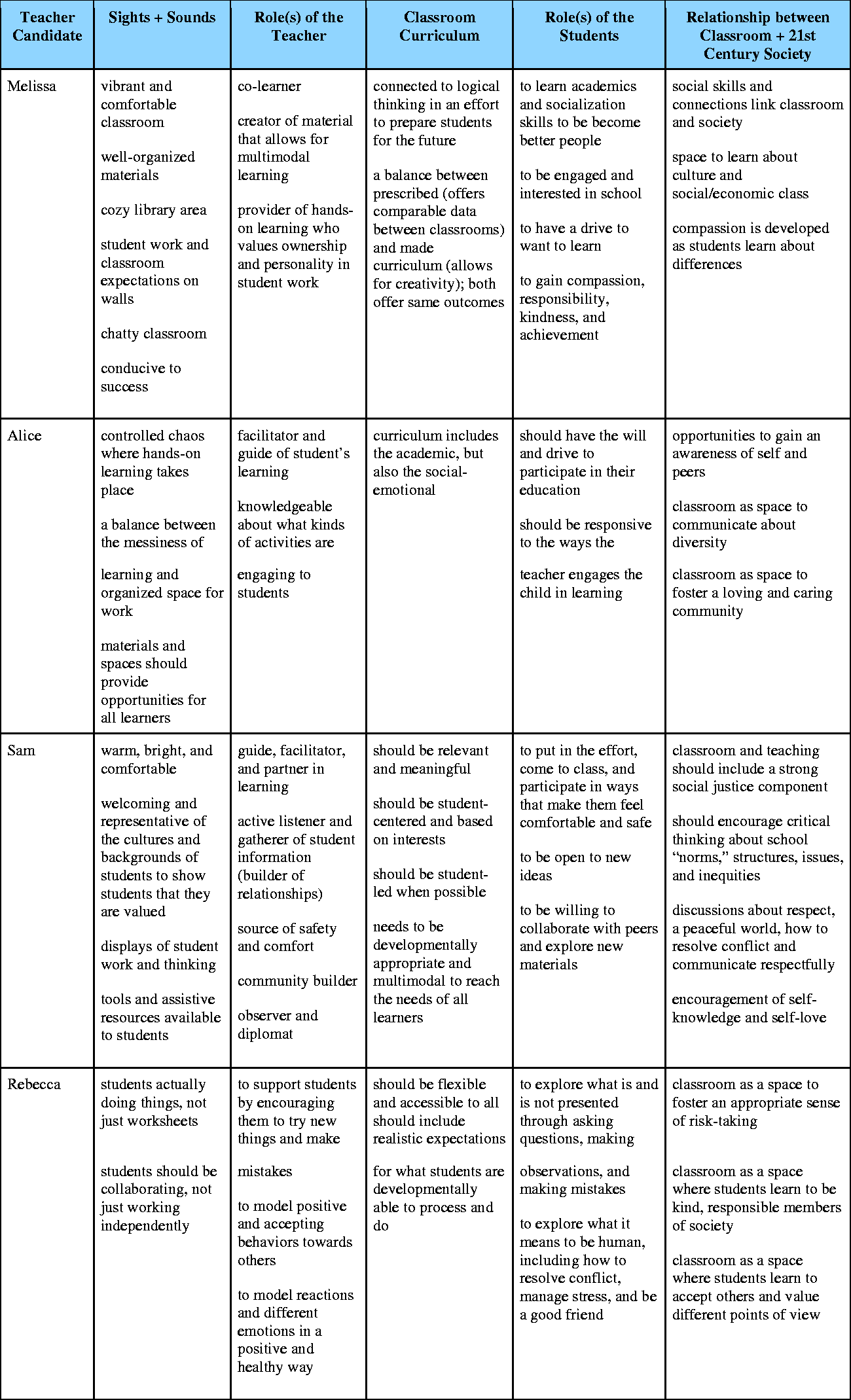
Teacher candidates’ beliefs articulated during visioning.
In the final focus group, the student teachers recognized the relationship between articulated beliefs and their own emerging teacher identities. R1: [Visioning] makes it more of a conscious thing … you’re not just going through the motions. You’re thinking about why you are doing things and what your beliefs are and the type of things that you want. [You’re thinking about] the type of things that you want to see happen in the classroom or the type of people you want your kids to be. It just makes it more conscious rather than not thinking about it. R2: […] This is what I’m going to do rather than just kind of floating around in my brain getting mixed up with everything else.
The student teachers described visioning as a helpful tool to hold teachers accountable for what they claim to believe, and how those beliefs do or do not manifest in their practice. Hammerness (2003) suggests that teacher visioning might serve as both “a guide for practice” and “a means of reflection, assessing and evaluating past practice” (50). The student teachers in our study recognized this potential as they described how explicitly articulating one’s beliefs makes one more inclined to reflect on the [dis]connections between beliefs and practice. Emma associated teacher visioning and the articulation of beliefs as a way to prompt thoughtful engagement with decisions she made in the classroom. She said, [Beliefs] are kind of just tossed in the back of your head, but having to sit down and think about it, I don’t even think I realized in the moment, but I was like thinking about it at school and being like, “oh, this is what I’m doing, this is actually aligned with my vision.” So it brought it more to the front of my brain and I was actually thinking about it more, which was good.
The student teachers described how explicitly articulating their beliefs during the process of visioning was difficult, in part because their beliefs had not previously been concretized in such a way. They also recognized that there were structural factors that made it more challenging to connect their pedagogical practices to their newly-articulated beliefs. As the student teachers experienced, teacher vision emerges in practice amidst contextual constraints and expectations for compliance. We describe below how moments of ideal vision were realized most frequently, it seems, when supervising practitioners or other evaluators were not in the classrooms with the student teachers.
Resistance in someone’s else’s classroom
While visioning served as a process in which to engage in articulation of and reflection on student teachers’ beliefs, it did not in itself provide an opportunity for student teachers to actively disrupt the neoliberal pressures they encountered in their student teaching experiences.
One of the challenges to the success of visioning was that the student teachers received powerful messages from their supervising practitioners about complying to standardization in their classrooms. Kristen described one exchange during student teaching that she found significant: There was this one teacher. She was like, “Well, I just want to do what they want. […] Just have them tell us what they want and we’ll do it.” But if it’s not important for your kids, you know, why do you have to do that?
A sense of obligation to practices that were deemed appropriate in specific contexts made student teachers question whether and to what extent their beliefs might align with the established school culture and whether realizing their beliefs in practice was even a reality given what was already happening in classrooms. R1: I think doing this also like showed me how hard it is to like keep your beliefs in a classroom. R2: Yeah. R3: Like, after doing this and like going into a classroom, I was like, ‘ah, I don’t know if I could fit all of these into it or if they would be accepted or permitted.’ R2: I think it’s easy to stray away and like go with whatever. R3: I definitely think so. R: …in first grade, [science] is just not talked about. I mean, we have a bin of little science books, which a lot of the kids like reading from, but there’s no explicit instruction in science. I: And that is disconnected from your beliefs about curriculum? R: Yeah, about teaching in general because, I mean, you teach math. You teach reading. And yeah, all of it’s important. Like, science is too. Kids kind of need to know about science. Well, it seems like my vision, especially with the social justice piece and that kind of stuff, takes a back burner in the classroom. So, I mean, for example, the election. I have a lot of kids who, well, maybe a handful of immigrant families and a lot of Spanish-speaking families, and the kids don’t like Donald Trump, you know? So rather than kind of go into Donald Trump’s character, anything like that which I think I might have done, we just kind of glossed over the election rather than what it might mean for them because kids are scared.
The challenges of resistance in an evaluatory setting
In addition to the overt messages they received to adhere to existing practices of compliance, the student teachers also described the notion of being in another person’s classroom as a constraint on the manifestation of ideal vision due, in part, to the surveillance of their practice that was tied to reviews of her performance as a student teacher. Alex said, because I’m in a co-teacher model, there was always one teacher there, so it was a lot of like pressure to like … like, I could just feel them like judging me the whole time making sure we stayed on topic and like it wasn’t too loud for their level and it wasn’t really my idea of what was working. It was theirs because they were there the whole time.
Indeed, in the final focus group, respondents discussed the sense of freedom that they felt and how they were able to implement practices more closely aligned with articulated beliefs when their supervising practitioners were not in the classroom. R: I kind of like being by myself. It’s kind of nice. I kind of like not having anyone in there [during takeover week]. R2: Because you can do what you want. R1: Yeah. R2: And [the students] can be a little louder, which I think if they’re doing their work, they can chat. That’s fine with me.
We recognize that expectations for novice teachers to resist neoliberal policies is no small thing as they are “especially prone to adopting instructional logistics embedded in state instructional policies and enacting practices that reflect their districts’ approach to instruction” (Achinstein and Ogawa, 2003: 32). Further, it would be naïve to ignore the fact that the outcome(s) of teacher resistance is not always positive: teachers lose their jobs due to perceived insubordination, move to school districts where there are fewer constraints on their practices—districts that tend to be more affluent with fewer students of color and emergent bilingual learners—or leave the profession altogether (Achinstein and Ogawa, 2003; Gitlin and Margonis, 1995; Sleeter, 2008).
One conception of teacher agency is to consider the capability of the individual to “make a difference” to a pre-existing state of affairs or course of events. An agent ceases to be such if he or she loses the capability to “make a difference”, that is, to exercise some sort of power (Giddens, 1984: 14).
The possibilities of visioning for teacher resistance
At the same time, visioning did seem to serve as an impetus for the exercise of teacher resistance for many of our participants. Respondents drew on their experiences with visioning to anticipate how they might respond to neoliberal pressures such as curricular standardization or high stakes accountability measures in their own classrooms. Kristen stated, I hope that there’s still a way to bring in what you need to bring in as a person, as a teacher, to make it valuable. I think that you have to figure out a way to tailor those scripts to make them authentic for teaching. I: How long do you think you have before you can start to say no? Kristen: I’m pretty verbal, so maybe the second year. I: Maybe year two? Kristen: Yeah, especially if I don’t believe it. Melissa: I think you can do both. I think you can have creativity and have things that are appropriate for a five- and six-year old and still have fun and still meet everything that needs to be met for report cards and standards. I: So when you say you think you can have both, does that mean you could make that structure work? Melissa: Yes … I think I’d be able to. But I also think you have to stand up for—if something’s not working or it’s just too hard, I think you have to say, “this just isn’t good for a six-year old.”
Much of the conversation around resistance that emerged in interviews with student teachers was grounded in their notions of what it means to be a “good teacher” and their efforts to cultivate and maintain their own teacher identities. As Britzman (2003) writes, “Learning to teach – like teaching itself – is always the process of becoming: a time of transformation, of scrutiny into what one is doing, and who one can become” (31). Visioning created opportunities for respondents in this study to identify and articulate their emerging beliefs, scrutinize their practice in light of these beliefs and to understand themselves as decision-makers and pedagogues who may or may not be satisfied with the status quo.
Discussion and implications for future research
This study reflects an introductory exploration of student teachers’ sensemaking around neoliberal pressures on education, and the role that visioning might play in the context of conflicting messages from teacher education coursework and their experiences in the field. We argue that it is crucial to explore the ways in which student teachers, the newest members of the teaching profession, conceptualize the impact of market-based discourses on their professional training and their practice in classrooms.
The data in this study suggests that the impact of privatization, standardization, and compliance in education has not necessarily translated into an awareness of these forces and their implications being integrated into teacher professional knowledge. Just as teacher education programs place limited focus on student teachers’ awareness around policy advocacy, for example, many of them omit an explicit treatment of the ways in which teachers might encounter and possibly respond to neoliberal pressures in their teaching practice. We note, too, that the traditional theory-to-practice divide that has been well documented in education has suffered further as teacher education programs continue to emphasize individual teacher professional choice over curriculum development and lesson planning, when districts and schools are increasingly adopting scripted curricula. The student teachers in this sample discovered over the course of their practicum experiences how neoliberalism influences the standardization of the curriculum, the definition of teacher quality and professional knowledge, and the future of teacher education itself.
Teacher visioning at the student teaching level has the potential to be a means of concretizing beliefs and keeping these beliefs at the fore despite a variety of essentializing and reductive pressures in education. Though the respondents in this study were clear in expressing the difficulty of integrating beliefs into practice, and indeed reported limited tangible outcomes of the visioning process on the daily practices of their supervising practitioners’ classrooms, we argue that “episodic vision” nevertheless represents meaningful and potentially transformative moments of critique and potential resistance. The student teachers in this sample discovered for themselves how visioning, that is, the identification and articulation of closely held beliefs, could serve as accountability and encouragement in ongoing efforts to bring their pedagogical practice closer to their ideals. In this way, we view teacher visioning at the student teacher level as a potential antidote to the neoliberal turn; however, we recognize that this is only possible under key necessary conditions.
In exploring what these key necessary conditions might be, we consider the question of the role of teacher education. We argue that it is the charge of teacher education programs to resist rather than to conform and replicate what is happening in schools in the name of preparing teachers to teach. We believe that one way we can support student teachers is to guide them in critically engaging with ideas around neoliberal pressures prior to student teaching. As our study indicates, student teachers recognized the effects of neoliberalism in their own experiences in terms of MTELs and evaluation, but did not conceptualize the neoliberal pressures as they directly impact on teachers’ experiences with curriculum in the classroom. Being explicit about the origins and effects of privatization, compliance, standardization, and a market-based audit culture might help student teachers enter student teaching better equipped to engage with and problematize those constraints. Given that student teachers find themselves in multiple enactment zones (Spillane et al., 2002), we argue that it is all the more important for the teacher education programs to provide a local culture that speaks directly to and provides student teachers with tools to address neoliberalism in education and its implications for teaching and learning.
Further, we propose that engaging in the process of visioning consistently throughout teacher education coursework, as well as during student teaching, might help student teachers ground their beliefs in theory and research. We imagine that student teachers might be better equipped to disrupt the status quo as it emerges in classrooms if they have articulated their beliefs in light of scholarship that describes authentic and equitable practices for both teachers and students. We believe that it is the role of teacher educators to create space for conversation about and inquiry around becoming a teacher in neoliberal times in order that student teachers begin to recognize themselves as persons with agency who as a collective might resist neoliberal pressures of standardization and compliance. In our courses, this materializes as conversations around the ways in which neoliberal policies inform our own practice and the ways in which we push back, as well as in-class visioning activities and extensive discussion about the relationships between teacher vision and the current educational climate.
In order for teacher visioning to be a catalyst for teacher resistance to neoliberal pressures to comply and standardize, the process should be extended to involve cooperation among teacher educators, student teachers, and classroom teachers. As Gitlin and Margonis (1995) describe, “individualism [poses] an obstacle to educational reform” (382). Likewise, Achinstein and Ogawa (2003) suggest that individual resistance can “weaken [teachers’] political impact, leaving them vulnerable and limiting the impact of their resistance” (57). In other words, in order for student teachers to disrupt the status quo, they must have opportunities to share their visions with others, to think with others about how their visions are informed by theory and research, and to imagine how the beliefs embedded in those philosophies might offer new ways of being and becoming in a classroom. Thus, the practice of collaborative visioning extends beyond reflection and articulation of beliefs to a form of “principled resistance” (52) or action with the potential to inform policy changes as student teachers collectively advocate for policies at the school, district, state, and national level that are, indeed, good for their students (Achinstein and Ogawa, 2003; see also Gitlin and Margonis, 1995).
Finally, teacher education programs should establish some common ground upon which student teachers can articulate and continually re-examine their beliefs as they progress through coursework, field studies, and student teaching. This might involve cultivating a shared vision among faculty that is made manifest in their encounters with student teachers. It seems to also involve ongoing reflection on the part of teacher educators as they consider the connections between their own beliefs and how those beliefs inform their practice and the extent to which they model that reflective practice with student teachers.
Footnotes
Declaration of conflicting interests
The author(s) declared no potential conflicts of interest with respect to the research, authorship, and/or publication of this article.
Funding
The author(s) received no financial support for the research, authorship, and/or publication of this article: