




Abstract
This study investigated language teachers’ visions for professional self-development, drawing on a central argument that there is an inherent connection between teacher identity and their professional vision. Eighty-six in-service Vietnamese English-language teachers participated in a guided six-stage procedure in which they articulated their visions for professional self-development, created and implemented action plans to actualise these visions and reflected on the impact of this vision-based practice on their identity and ongoing professional development. Findings show that teachers targeted four main aspects for development: refining teaching methods, enhancing English language competence, cultivating specific teacher traits and understanding and supporting learners. They also employed diverse strategies to actualise their teaching visions, falling into cognitive, affective, social and practice-based categories. Participants perceived the vision-based practice positively, citing benefits such as opportunities for self-reflection, increased professional confidence and more defined language teaching directions and goals. Some also pointed out challenges to actualising visions, mainly time constraints and their own lack of efforts to follow their action plans. These findings provide implications for language teachers and teacher educators regarding implementing and sustaining vision-based practices for language teachers’ continuous professional development.
Introduction
Recent years have witnessed a significant surge in attention to the empowering and self-renewing value of focusing on language teacher identity (LTI) in enriching teachers’ professional development (Barkhuizen, 2019; Morgan and Clarke, 2011; Pennington and Richards, 2016; Tajeddin and Yazan, 2024). This trend has led language teacher educators and researchers to increasingly integrate LTI components into teacher education (TE) through various approaches, ranging from activity-based initiatives (e.g. teachers composing language learning and teaching stories) (Canagarajah, 2020; Yazan, 2019) to course/programme-based efforts (e.g. teachers sharing narratives during TE and practicum courses) (Nazari and De Costa, 2022; Nguyen and Dao, 2019; Uştuk and Yazan, 2024). The current study aligns with this goal of pedagogising LTI and making identity work integral to language TE practices. Specifically, this study presents an identity-focused language teacher development initiative inspired by the identity-bound concept of language teacher vision (LTV), commonly defined as language teachers’ mental images of their desired future teaching selves (Dörnyei and Kubanyiova, 2014). English-language teachers followed a six-stage process to actualise their vision: examining their vision, creating and discussing action plans, implementing them, reporting activities and receiving feedback. The aim is to showcase how vision-based practices illuminate nuanced aspects of teacher learning and identity development, providing evidence for advancing identity-oriented pedagogies in TE.
LTV and LTI
LTV and LTI are strongly interconnected. At its core, LTV is rooted in the construction of mental images of an ideal or possible future self (Dörnyei, 2020; Higgins, 1987; Markus and Nurius, 1986), making it highly personalised and teacher-centred. This self-generated feature of LTV inherently links it to LTI, often defined as how teachers see themselves and their roles in relation to their professional setting and the society (Barkhuizen, 2019; Morgan, 2004). In fact, the connection between vision and identity has long been established in philosophy, psychology and cognitive science, and abstracted into the idea of ‘the Self as Mind’ (Dennett, 1991; Rzepka, 1986). This perspective suggests that the essence of an individual lies in their mental activities and capacities. In language education, this means that teachers’ visions of their future professional selves are closely intertwined with their broader identity as educators. Specifically, future self-guides (Dörnyei, 2020; Kubanyiova, 2015), such as personal ideals and teaching aspirations, have been shown to significantly shape language teachers’ professional identity and guide their pedagogical journey (Hamman et al., 2013; Kubanyiova, 2015, 2017). Additionally, the process of envisioning, as will be delineated below, requires teachers to rely substantially on their identity construction and be highly reflective and critical of their current and future selves (Dörnyei and Kubanyiova, 2014), thereby linking LTV strongly to LTI.
The Process of Actualising LTV
The process of actualising LTV involves sensory simulations of future teaching selves. This means that teachers’ envisioning of their desired teacher image often requires activating all senses, including visualising (seeing) new professional activities; hearing voices of themselves, students and colleagues during professional interactions; and feeling the energy of the envisioned selves and the envisioning process (Dörnyei and Kubanyiova, 2014). This sensory characteristic adds vividness to LTV, making it more than an intangible cognitive goal (Taylor et al., 1998). As such, LTV holds significant motivational power: a clear and vivid vision inspires language teachers to take action to improve themselves and their practice (Dörnyei, 2020; Dörnyei and Kubanyiova, 2014) and fosters commitment, perseverance and progress toward goals (Taylor, 2011), which dynamically contributes to the ongoing development of their professional identities. Additionally, this sensory aspect contextualises LTV, as teachers’ sensory-activated visions may vary depending on circumstances.
Furthermore, this mental simulation process requires planning and goal-setting (Taylor, 2011; Taylor et al., 1998). Along this line, Dörnyei and Kubanyiova (2014) proposed a framework to motivate language teachers through vision, focusing on two key aspects: ‘(re)igniting the flame of teacher vision’ and ‘guarding the flame of vision’ (124). Reigniting involves teachers developing a vivid desired future self-image and recognising the gap between this vision and reality, creating ‘creative tension’. Guarding involves teachers building resilience and sustaining hope to protect their vision from adversity. Notably, to (re)ignite teacher vision, Dörnyei and Kubanyiova (2014) suggested that teachers draw on their LTI, arguing that ‘understanding who we are’ provides ‘insights into who we want to become’ (125), further reinforcing the intimate link between LTV and LTI.
Another important aspect of the LTV process is the emphasis on sharing vision. Research in psychology has shown that sharing and communicating vision increase the likelihood of achieving it (Berson et al., 2015; Kohles et al., 2012). In education, by interacting and sharing their vision with colleagues, mentors and even students, teachers can establish a supportive network that promotes accountability and feedback exchange (Oude Groote Beverborg et al., 2020). This collaborative environment not only strengthens the teacher's commitment to their ideal image but also cultivates a collective culture of growth and development within the educational community (Vanlommel et al., 2023).
LTV in Language Teacher Learning and Development
Research on LTV frequently builds upon the concept of possible selves (Higgins, 1987; Markus and Nurius, 1986), exploring teachers’ ideal selves (hopes and aspirations), ought-to selves (expectations shaped by societal norms, institutional standards or professional obligations) and feared selves (apprehensions about potential professional identities). This body of work suggests that the presence or imagination of possible selves influences teachers in three main aspects: teaching motivation (Kubanyiova, 2009, 2012; Rahmati et al., 2019; Sahakyan et al., 2018), professional development choices (Hiver, 2013) and classroom practices (Kalaja and Mäntylä, 2018; Kubanyiova, 2015, 2018). Regarding teaching motivation, teachers’ specific ideal selves significantly influenced their motivation to teach, the selection of teaching methodologies and responsiveness to professional training (Kubanyiova, 2012). Additionally, the evolution of a feasible teacher self, which was a synthesis of ideal, ought-to and feared selves, heightened teaching confidence and motivation (Sahakyan et al., 2018). A positive relationship was also reported between LTV and teaching motivation, with strong motivation exhibited by those with a well-defined vision of their ideal teacher selves (Rahmati et al., 2019). As for professional development choices, teachers’ ideal and ought-to selves, particularly in English proficiency, drove their voluntary engagement in professional development (Hiver, 2013).
Furthermore, LTV significantly influences teachers’ projected and actual classroom practices. In Kalaja and Mäntylä’s (2018) study, pre-service Finnish English teachers’ ideal and ought-to selves closely resembled their envisioned ‘English classroom of their dreams’, including aspects like the physical environment, teacher and student roles, and teaching methods. Similarly, Kubanyiova (2015) found that a teacher's future self-guides significantly influenced her management of classroom interaction. In another study, Kubanyiova (2018) showed how the focal teacher's teaching practices aligned with her desired future self as ‘someone who is valued, appreciated, and loved’ (75).
The Current Study
Existing studies confirm that language teachers’ ideal selves (i.e. LTV) play a significant and often positive role in their learning and development. These studies highlight the personalised nature of LTV, as teachers drew heavily from their personal and professional identities when envisioning their future selves. However, most of this research lacks focus on practical implementation, neglecting to demonstrate how vision-based practices can be integrated into TE contexts to enhance teacher learning and development.
Some studies have utilised a vision-based approach to explore its impact on teacher learning and development, but they come with limitations. For example, Kalaja and Mäntylä (2018) illustrated how pre-service teachers envisioned the ‘English classroom of their dreams’ through drawings, yet this task occurred only once towards the end of a TE course. Kubanyiova (2015, 2018) employed ethnographic interviews and observations to uncover teachers’ envisioned selves, revealing deeply ingrained self-images rooted in implicit theories and socio-historical memory, often beyond conscious awareness (Kubanyiova, 2020). Although recognising the insightfulness of this implicit approach, we advocate for explicitly guiding teachers to articulate their desired teaching selves. Integrating LTV practices into language TE programmes arguably promotes the development of a robust teacher vision and enhances teachers’ awareness of the necessary conditions for a fully operational vision (Rahmati et al., 2019). Additionally, Dörnyei and Kubanyiova (2014) propose practical activities for motivating teachers through vision, yet do not showcase their implementation in a TE context.
Amidst the lack of practical implementations of LTV in language TE, the current study developed and implemented a vision-based practice procedure within a continuous professional development (CPD) programme for in-service English teachers in Vietnam. We aimed to explore how vision-based practice provides insights into nuanced aspects of teacher learning and development, as well as how it impacts teacher identity and professional development. Three questions guided the study:
What visions do Vietnamese English teachers have for their professional development? What strategies do they employ to actualise their visions? How does the vision-based practice impact their identity and ongoing professional development?
Methodology
Context
The study was situated within a year-long online CPD programme aimed at guiding language teachers to critically examine three core aspects of their professional identity: ‘being’ (self-understanding and aspirations as language teachers), ‘feeling’ (attitudes and emotional responses to teaching events) and ‘doing’ (pedagogy). This programme, supported by an international industry leader in English-language teaching (ELT) and Vietnam's Ministry of Education and Training, aimed to enhance the competence of English-language teachers in the country. Teachers collaborated in Teacher Activity Groups (TAGs), where they shared experiences and insights to improve teaching practices (Borg, 2019). Facilitated by teacher educators, nine monthly online meetings focused on specific aspects of the program themes. The vision-based practice was part of the ‘being’ theme dedicated to discussions and activities on teacher identity.
Participants
Eighty-six Vietnamese English teachers (75 females, 11 males) participated in the above-described CPD programme. Located in a Central Vietnam province, they taught across three levels: primary (Grades 1–5) (30 participants), secondary (Grades 6–9) (29 participants) and high school (Grades 10–12) (27 participants). Their teaching contexts varied, with 54.6% (47 participants) in urban or suburban areas and the rest in rural, remote or mountainous areas. Their ages ranged from 27 to 57, and their English teaching experience spanned 5 to 25 years. All participants had a BA or an equivalent degree in ELT, and 12 had an MA in ELT or education. Participation in the CPD programme was determined by the local Department of Education and Training, prioritising teachers with limited access to CPD opportunities in the past. They were organised into six TAGs based on their teaching levels: primary, secondary and high school.
The Vision-Based Practice
The vision-based practice was operationalised into six stages. Stages 1–3 ‘ignited the flame of teacher vision’ (Dörnyei and Kubanyiova, 2014: 124) by exploring teachers’ current and ideal selves, identifying discrepancies and creating action plans. Teachers then engaged in dialogues with facilitators to share their vision. Stages 4–6 focused on ‘guarding the flame of teacher vision’ (Dörnyei and Kubanyiova, 2014: 124) through implementing action plans, reflecting on vision practice and receiving feedback to revise plans for future self-development.
Teachers completed these stages over an eight-week period. Stages 1–3 occurred in the initial three weeks, followed by Stage 4 over two weeks, Stage 5 over one week and the remaining two weeks for Stage 6. Asynchronous teacher-facilitator interactions occurred mainly in Stages 3 and 6 via Google Classroom, where teachers uploaded their written work. The six stages form a cyclical process, wherein completing Stage 6 leads to a renewed teacher image, motivating teachers to add more elements to their ideal teacher self and initiating another cycle of vision-based practice. Figure 1 summarises this procedure.
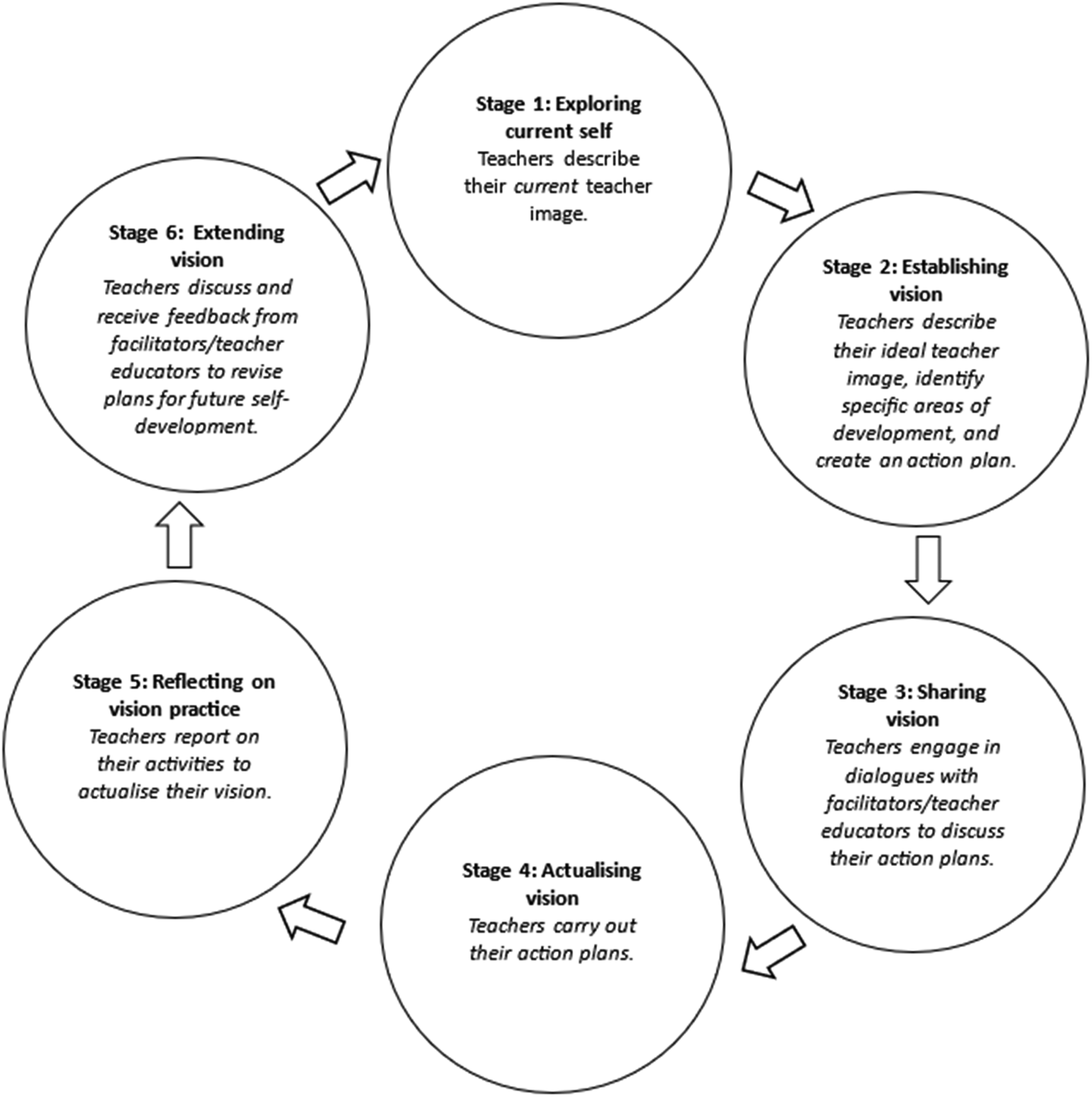
Vision-based practice for language teacher development.
Instruments
Data included teacher narratives generated during the vision-based practice, comprising descriptions of ideal teacher selves, action plans and reports on action plans, developed in Stages 1, 2 and 5, respectively. Each narrative (200–300 words) was composed entirely in English following narrative frames (Barkhuizen and Wette, 2008), which included sentence starters strategically designed to guide teachers in sharing their experiences coherently, aligning with the purpose of each stage in the practice (see Appendix 1). In Stage 1, teachers described their current teacher selves regarding various aspects: workplace, personalities, teaching and learning beliefs, teaching challenges, and feelings about being an English teacher. In Stage 2, portrayals of ideal teacher images were guided to evoke a vivid vision, encompassing sensory experiences like seeing (manifestation of ideal characteristics), hearing (interaction with students and colleagues) and feeling (emotions as they plan to achieve desired future selves). In Stage 5, the action plans’ reports centred on these sensory dimensions of teachers’ achievements. A total of 86 written products were collected from all participants.
Analysis
Teacher narratives underwent a six-stage reflexive thematic analysis procedure (Braun and Clarke, 2006, 2022). This approach aimed to identify, analyse and report common themes from the teachers’ narratives. First, we immersed ourselves in the narratives to gain understanding and note initial impressions. We then systematically coded meaningful segments of the data that captured key ideas related to each research question, using NVivo to organise these codes. For example, a portion of the teacher vision data was coded as ‘supporting learners’, ‘motivating learners’ and ‘understanding learners’ needs’. Next, we grouped similar codes into preliminary themes based on shared patterns. Using the data examples above, these codes were grouped into an initial theme called ‘Understanding and supporting learners’. The themes were then reviewed, refined and named through iterative discussions among the research team to ensure that each theme accurately reflected the data. The initial learner theme was finally refined as ‘Learner-oriented vision’ to align with other types of vision found in the data. Finally, the thematic analysis process was documented, and illustrative quotes were selected to exemplify each theme. Participant codes were used to identify quotes, with ‘T’ representing teacher, the second number indicating their assigned TAG, and the third number denoting the stage of the vision-based practice from which the teacher narrative was derived (e.g. Teacher 1 from TAG 1, whose quote is extracted from Stage 1 narratives, is abbreviated as T1-1, S1).
Researcher Positionality
All five authors served as facilitators in the programme, drawing on our extensive backgrounds as language teachers, teacher educators, and researchers with diverse experience in delivering CPD programmes. Engaging in researcher reflexivity (Consoli and Ganassin, 2023), we took several deliberate steps to ensure our roles as facilitators and researchers were critically examined throughout the design and implementation of the vision-based practice. First, we regularly reflected on our positionality and how our backgrounds and experiences might influence our interactions with participants and the guidance we provided. Second, we aimed to be empathetic colleagues during implementation, encouraging teachers to share their visions and personally engaging with them. We not only provided suggestions for refining their action plans but also connected with their envisioned selves by sharing our own teaching aspirations. Third, being mindful of power dynamics within our team, we held regular discussions among the research team to critically evaluate our approaches, considering whether our suggestions and interactions with the teachers were empowering or potentially directive. These mutual exchanges helped us better understand the complexities of each other's experiences, ensuring that our reflexivity was an ongoing and active process throughout the research.
Findings
Vision Ignited: Teacher Vision for Their Own Professional Development
Analyses of the participants’ descriptions of their ideal teacher selves (i.e. narratives in Stage 1 and 2 of the vision-based practice) showed that their focal points for development centred on four aspects: enhancing pedagogical skills, improving English language competence, cultivating specific teacher traits and gaining a better understanding of and supporting learners.
Pedagogical Vision
The area featured most frequently in the teachers’ ideal selves was their desire to enhance their pedagogical skills. Several participants expressed the need to improve their teaching methods, particularly in confidence and skills for delivering engaging lessons, incorporating technology and teaching multilevel classes effectively. I would like to use more creative methods in my teaching. Currently, I tend to replicate what I have learned before or rely a lot on methods outlined in textbooks. (T16-1, S2) I want to explore new teaching methods and adapt activities to meet the different proficiency levels of my students. (T1-5, S2) I aspire to incorporate new technologies into my teaching to deliver lessons. (T5-2, S2)
These pedagogical visions were linked to specific challenges in the teachers’ teaching contexts. Student behaviour and motivation presented considerable obstacles, as teachers grappled with ‘motivating reluctant learners’ (T4-2, S1), handling ‘diverse student attitudes’ (T16-1, S1) and managing classrooms in less-than-ideal circumstances, such as ‘a mountainous school with students exhibiting challenging behaviours’ (T14-5, S1). Language diversity also posed difficulties, especially for teachers working with ‘ethnic minority students for whom English is their third language’ (T11-1, S1). Coupled with these struggles was the issue of large class sizes, where ‘students have different needs, making it hard to tailor lesson content’ (T19-4, S1). These challenges collectively demonstrate a complex interplay between contextual concerns borne out of the participants’ teaching experiences, and their pedagogical aspirations.
Language-Efficacy Vision
Language proficiency was another recurring theme in the teachers’ future-oriented self-images. They emphasised the need to have ‘excellent English pronunciation, vocabulary, and grammar skills’ (T6-1, S2), and ‘perfect communication skills in English’ (T10-3, S2). Additionally, many participants pointed out the self-perceived gap between their current English competence and their ideal selves. They expressed concerns about ‘reduced practice and confidence in communication’ (T5-2, S2) and their ‘weakened English skills’ due to ‘primarily using classroom language’ (T6-1, S2). The challenge in maintaining language proficiency seemed to fuel the teachers’ vision of enhancing their English language competence.
Teacher Trait Vision
Participants also aspired to cultivate specific personal attributes that contribute to pedagogical excellence. They expressed a desire to be creative and flexible to ‘make lessons engaging and motivating’ (T3-2, S2) and ‘design and adapt materials better’ (T9-6, S2). Additionally, there was an acknowledgment of the importance of a sense of humour to ‘make lessons fun’ (T12-3-S2) and ‘better connect with students’ (T7-1, S2). Effective communication was also identified as a critical skill, extending beyond speaking to encompass active listening. The teachers envisioned themselves as ‘a good listener’ (T17-1, S2) to ‘listen to students’ problems and encourage them to study harder’ (T3-6, S2). Noticeably, patience emerged as a recurrent trait sought by several teachers, especially those dealing with young learners and large classes, where maintaining composure becomes imperative. Patience is the most important quality I need to develop. I teach at a mountainous school where students’ learning outcomes are poor. Many exhibit disruptive behaviours and lack interest in studying English. This situation often leaves me depressed and sometimes I can’t control my emotions. There are times when I easily get angry or ignore students who provoke my frustration and continue my teaching unenthusiastically. (T3-5, S2)
This excerpt highlights the teacher's introspective reflection on her challenging experiences as a teacher while envisioning an ideal trait she wished to embrace. It revealed that teachers’ ideal selves are intertwined with their current perceptions and awareness of their identity. Collectively, these ideal teacher traits accentuate a shared goal: through endeavouring to improve themselves, teachers strive for improved learning outcomes for their students and enhance their ability to effectively support them.
Learner-Oriented Vision
A final dimension that ultimately showcases the learner-centric nature of the teacher visions was their commitment to understanding and supporting their students. Teachers stressed the importance of ‘empathising with learners’ difficulties’ and actively assisting them in their studies (T15-1, S2). Many aspired to be more caring and understanding, aiming to comprehend ‘the needs and challenges faced by students’ (T16-1, S2). This desire for enhanced support and understanding originated from their concerns about being unable to attend to all students adequately. I find that sometimes I don’t have enough time to take care of the whole class. There are times when I leave some students behind. I really don’t want anyone to feel lost in my class, but 45 minutes of a lesson is way too short to take care of every single student. (T8-6, S1)
Guarding Vision: Teacher Strategies for Exercising Their Vision
To achieve their vision, participants reported employing various strategies, categorised into four types: cognitive, affective, social and practice-based. Notably, certain strategies were found to be utilised more frequently to attain specific vision types.
Cognitive Strategies
Cognitive strategies (reading, gathering and accumulating knowledge and information) appeared to be a useful means to fortify and advance the teachers’ pedagogical vision. The most cited source of reading was methodology books, which helped them ‘analyse what I’ve done well, what I haven’t done well yet and what I have never done’ (T3-4, S5), and ‘design lesson plans suitable for different levels of students’ (T1-6, S5). Furthermore, the teachers’ dedication to motivating learners was evident in their efforts to read resources on motivating students:‘I read short stories and articles to learn how to inspire students, especially those from poor families or are not motivated to learn English’ (T9-5, S5).T9-5's use of cognitive strategies, inspired by readings on motivating students in diverse conditions, not only helped him realise his pedagogical goals but also harmonised with his broader vision, particularly his genuine concern for less-motivated learners.
Furthermore, participants believed that a strong grasp of textbooks could improve their teaching methods. Some teachers dedicated time to study upcoming textbooks for the new school year, aiming to ‘identify similarities and differences between the new and old textbook’ (T10-1, S5) and ‘set goals and prepare lesson plans’ (T6-3, S5). Finally, they took advantage of online resources to ‘discover new English games’ (T8-2, S5), ‘watch sample lessons’ (T11-2, S5) or ‘learn new ideas for lessons’ (T6-3, S5).
Affective Strategies
Teachers frequently employed affective strategies, which include regulating emotions and attitudes towards learning and development, to achieve their teacher trait vision. They expressed a commitment to practising active listening, and fostering patience and empathy with their students. Efforts to cultivate patience involved trying to understand students before reacting to their language problems (T9-1, S5) and observing students’ non-verbal behaviour (T10-1, S5). Some engaged with literature on mindfulness to enhance their patience and listening skills (T2-1, S5). Techniques such as deep breathing (T6-2, S5) and using open-ended questions to invite students’ response were employed to manage anger effectively (T8-6, S5). To increase their level of empathy toward students, some teachers also reported ‘putting myself in students’ shoes’ (T3-4, S5) and ‘trying to interpret students’ disruptive behaviours with compassion’ (T9-5, S5).
Social Strategies
Teachers adopted several social strategies, including fostering meaningful communication with students and colleagues, to achieve their learner-oriented and pedagogical vision. With students, the emphasis was on building trust and understanding through regular communication, such as exchanging messages related to the learning content with students (T7-6, S5). Some reported making efforts to be ‘friendly with students’, inviting questions to assist them with difficulties in their studies (T5-6, S5). Others took a proactive approach by creating a study group on Facebook for students with low results and providing additional resources and guidance (T9-5, S5). In interactions with colleagues, teachers highlighted the need to connect and exchange knowledge during professional meetings to enhance pedagogical skills. They actively engaged with colleagues to exchange methods and ideas (T5-1, S5). Teacher collaboration also extended to digital platforms, with several participants participating in online groups to share materials and solutions to common teaching challenges (T7-3, S5; T3-4, S5).
Practice-Based Strategies
Teachers employed practice-based strategies, involving the application of new learning, to enhance both their language self-efficacy and pedagogical visions. For English competence, they dedicated daily time to activities like watching videos, practising listening and speaking, and memorising English conversations for self-practice (T10-1, S5). Additional approaches included regular viewing of English films, daily sound training (T5-1, S5) and self-directed efforts to improve pronunciation and grammar skills using online resources and language websites (T11-3, S5; T14-4, S5).
In pursuing their pedagogy-related vision, teachers adopted practical approaches to enhancing their teaching methods. They experimented with project-based learning to maintain student motivation and interest (T11-1, S5). Several teachers incorporated games, flashcards and interactive activities (T12-1, S5; T3-1, S5). Some researched and compiled materials, including funny stories and games, into a resource bank for lesson integration (T6-2, S5; T9-3, S5). Technological tools such as Quizizz, Kahoot and PowerPoint games were also employed by several teachers (T5-5, S5; T15-1, S5) to add vibrancy to their English lessons.
Impact of Vision-Based Practice on Teachers’ Identity and Professional Development
The vision-based practice was perceived positively by the teachers in several aspects. First, the envisioning process offered valuable opportunities for self-reflection. Initially, some participants had not explicitly formulated an image of an ideal English teacher. The act of envisioning this ideal teacher compelled them to assess their current teaching self critically: ‘I had never considered the image of an ideal English teacher before. When given the opportunity to contemplate this, I suddenly realised that I might not have been as effective a teacher as I had thought’ (T10-1, S2).T10-1's experience demonstrates how the vision-based practice revealed disparities between her current teacher self and the envisioned ideal. This realisation triggered a proactive response, leading to independent research, internet exploration and reading materials related to teaching methods and child psychology (T10-1, S5). This highlights the strong connection between her identity and vision, showing that a clear self-understanding fosters a well-defined and effectively enacted vision, which in turn strengthens teacher identity.
Another participant expressed the significant amount of reflection induced through the vision-based practice: There were several levels of deep reflection. When I asked myself ‘Who am I as an English teacher?’, it was like an existential question for me. It took me a long time to describe my current self. The ideal teacher image came more easily. I guess because I have a lot of ambitions for my teaching; there are many things I want to do to be a better teacher and help learners. In many ways, these envisioning activities helped me to be very reflective of my teaching life and philosophy. (T8-3, S5)
Enhanced professional confidence was another recurring theme. The fact that teachers endeavoured to carry out their action plans to achieve their vision brought about positive changes in their teaching practice and students’ learning, leading to a sense of achievement and joy. Specifically, participants expressed satisfaction with improvements in their teaching methods. T10-1 reported enhanced teaching skills through effective class management and improved interactions with students. This positive change made her feel not only excited but also confident about future teaching endeavours. Other teachers echoed similar sentiments, emphasising the joy and pride derived from creating a better learning environment (T11-1, S5), fostering a strong teacher–student relationship (T9-1, S5) and witnessing students’ progress and increased motivation (T5-5, S5). Overall, envisioning and implementing changes seemed to have contributed significantly to an elevated professional confidence among the teachers.
Furthermore, the vision-based practice contributed to shaping the teachers’ professional directions and goals. Through reflective exercises and action plans, teachers gained clarity regarding their career aspirations and instructional objectives: It [practising vision] helps me establish a clear direction and goal in my career, enhance my awareness of English teaching, and make progress accordingly. (T7-1, S5) Becoming an ideal English teacher can be difficult, but there are steps I can take to bring myself closer to that goal. (T4-1, S5)
Moreover, several teachers considered their interaction with the teacher educators during the vision-based practice conducive to their professional development. Their reflections highlight the transformative impact of dialogues with teacher educators on the actualisation of their visions. Through meaningful conversations, teachers received constructive feedback and suggestions from the teacher educators to make their action plan ‘clearer and actionable’ (T4-6, S5). The exchange of ideas also fostered a collaborative learning environment where teacher educators served as an empathetic peer and contributed guidance tailored to teachers’ needs: ‘I enjoyed receiving feedback and discussing my ideas/plans with the facilitators. It felt good to have someone to listen to my concerns and challenges. I felt supported and motivated to continue working on my plan’ (T5-5, S5). T5-5's reflection showcases the importance of mentorship and support in sharpening and sustaining teacher vision.
Alongside positive experiences, teachers reported facing challenges during their engagement in the vision-based practice. Although none had difficulties generating ideal future teacher selves, some expressed dissatisfaction due to time constraints during the two-week period of implementing their action plan (T13-1, S5). Similarly, T11-3 experienced displeasure, attributing it to limited time and distractions from other commitments. For others, the inability to follow through with their action plans led to feelings of shame and a recognised need for further improvement (T5-6). These accounts underline the importance of sustained effort on the part of teachers for the successful implementation of LTV and highlight the necessity for support from teacher educators and colleagues.
Discussion
The Strong Connection Between LTV and LTI
Findings of the present study reinforce a defining characteristic of LTV: its strong link with teachers’ professional identities. Most participants formed mental images of their ideal teacher selves through a critical evaluation of their current teacher identities, and were motivated by the discrepancies between their current and ideal selves (Higgins, 1987). For example, some teachers desired to develop patience after recognising that they struggled to control their emotions in challenging teaching situations. This process of gaining self-awareness enabled them to formulate ideal selves that were individualised and reflective of their professional identity (Fairley, 2020; Kubanyiova, 2020). These desired traits additionally demonstrate that the teachers had a profound sense of self-knowledge and awareness and a deliberate integration of individual qualities, values and ideals into their evolving teacher identities (Pennington and Richards, 2016).
The strong reliance on LTI is also evident in the strategies teachers used to guard their vision, which necessitatea combination of multiple cognitive, social, affective and practice-based factors. It has been agreed that LTI is shaped and reshaped cognitively, emotionally, socially and through practice (Barkhuizen, 2019; Nguyen and Dao, 2019; Yazan and Lindahl, 2020; Yuan and Lee, 2015). Findings of the current study therefore reinforce the idea that the process of building and guarding vision strongly aligns with identity construction (Pennington and Richards, 2016; Richards, 2023).
The Dynamism of the LTV Process
This study's findings also show dynamic characteristics of LTV. First, many of the teachers’ mental images were context-rich. Consistent with Hiver's (2013) findings with Korean teachers of English, our participants expressed a strong inclination toward enhancing their language proficiency, using terms like ‘perfect’ or ‘excellent’ to describe their ideal proficiency. This reflects a preference for native-like language abilities common among L2 English teachers across contexts, including Vietnam (Nguyen, 2017). Context also manifests itself in many teachers’ desires to improve themselves and their teaching techniques to overcome specific teaching and learning challenges, such as insufficient material conditions, large and multilevel classes and low learner motivation. In this regard, the focus on LTV implementation in the present study has contributed to shedding light on ‘who language teachers in specific sociocultural contexts strive to become, and what kind of learning environments they envisage for their students’ (Kubanyiova, 2015: 579).
Second, our findings demonstrate a broad spectrum of LTV, encompassing pedagogical, professional, personal and social dimensions. Previous studies on LTV have largely foregrounded teachers’ professional (Hiver, 2013) or pedagogical aspirations (Kalaja and Mäntylä, 2018; Kubanyiova, 2012, 2015, 2018; Rahmati et al., 2019; Sahakyan et al., 2018). This study contributes to enriching current understandings of language teachers’ desires for their teaching and professional development. Markedly, due attention was given to the personal and social dimensions. As participants emphasised specific teacher traits they aspired to acquire or strengthen, such as patience, care, humour and understanding, they depicted future-oriented self-portraits that are highly personalised and humanistic (Korthagen, 2017; Korthagen and Nuijten, 2022).
Third, LTV, as revealed in the present study, is highly learner-centred. A central theme in participants’ vision explicitly focused on understanding and supporting learners. Their vision in other areas (i.e. pedagogical skills, English self-efficacy and teacher traits) also ultimately aimed to empower them to better support learners. In all cases, learners were at the centre of the teachers’ vision. Although this finding may not be surprising, given that it reinforces the altruistic nature of teaching and teachers (See et al., 2022), it reflects the intricate connection between a teacher's sense of self and that of their students (Richards, 2023). In other words, who we are as teachers is invariably linked to who our students are (their characteristics) or will become (certain desired images that teachers hold about their students’ development), further highlighting the context-rich nature of LTV.
Teacher Strategies for Actualising Vision: Toward Development of a Vision Toolbox for Language Teachers
Participants reported employing various cognitive, affective, social and practice-based strategies to progress towards their ideal selves. These strategies were applied across the spectrum of their articulated LTV and seemed effective in enabling them to actualise diverse types of vision. These findings offer insights into the process of teachers achieving their vision and the intricate and comprehensive nature of language teachers’ continuous learning and enhancement of expertise (Johnson and Golombek, 2020). Moreover, building on the work of Dörnyei and Kubanyiova (2014), who explored strategies and toolkits for safeguarding the flame of vision, our study offers insights by identifying both parallels and additional strategies. The parallel strategies include implementing a safety zone/net to protect LTV through social strategies (i.e. teachers reaching out to colleagues and students), and the cultivation of resilience to sustain vision through affective strategies (i.e. teachers practising managing their emotions). Also, the study identified a range of other strategies (i.e. cognitive, practice-based). In this respect, our findings serve to expand the repertoire of vision-guarding strategies and enrich the vision toolbox available for language teachers. This toolbox could assist them as they navigate the challenges of vision development and preservation (Rahmati et al., 2019). It also potentially holds significant learning values for pre-service or novice language teachers, whose visions might not be fully crystallised.
Role of Vision-Based Practice in Teachers’ Identity Development and Professional Growth
Engaging in vision-based practices offered teachers valuable opportunities for reflection, refined their teaching practices and provided a clear trajectory for professional development. These findings reinforce the positive impact of identity-oriented work in language TE (Nguyen and Dao, 2019; Uştuk and Yazan, 2024; Valencia et al., 2020; Yazan, 2023). Additionally, they accentuate the transformative power of LTV (Dörnyei and Kubanyiova, 2014) in contributing to the development of stronger, more defined teacher identities. Furthermore, our study sheds light on the crucial role played by teacher educators in vision-based practices. Through dialogue and support, teacher educators helped create a safe space that safeguarded the participants’ vision. The collaborative aspect of vision-based practices is thus highlighted, further demonstrating that when visions are shared and effectively communicated, they gain greater momentum (Berson et al., 2015; Kohles et al., 2012). It is also worth noting that the visions of teacher educators are intertwined with those of the teachers, as their aspirations were likely conveyed and reinforced through their interactions with the teachers.
Finally, it is crucial to acknowledge the challenges teachers reportedly faced in actualising their visions, particularly in terms of time constraints and motivational barriers. In this regard, the study stresses the importance of strategic planning (Taylor, 2011) in both igniting and safeguarding vision, emphasising the need for proactive measures to support teachers to overcome challenges during the envisioning process.
Conclusion
This study demonstrates vision-based practice as a valuable tool that can be integrated into TE programmes to provide support for teachers in igniting and safeguarding their visions, thus further refining their teacher identities. The study also emphasises the critical role of planning and interaction between teachers and teacher educators in maximising the efficacy of such practices. Although we focused on the vision-based practice and its impact on teachers’ professional identities, we did not explicitly explore teachers’ life capitals (Babic et al., 2023; Consoli, 2022), or how their personal experiences interacted with their envisioned selves and vision-enactment strategies. Future research could use a case study approach with fewer participants, incorporating an examination of teachers’ life capitals to deepen the analysis and showcase connections between LTV, LTI and the intricacies of teachers’ lives. Observational and ethnographic methods could also be employed to address the reliance on self-reported data. Despite these limitations, the study provides some suggestions for TE practices. First, teacher educators can adopt the vision-based practice described in this study to guide teachers in igniting and maintaining LTV. We suggest a structured approach, encouraging teachers to delineate various facets of their vision and set achievable timelines. It is also crucial to emphasise the cyclical nature of vision-based practice, stressing that realising a specific vision may require multiple cycles, each potentially sparking new visions. Finally, sharing with teachers strategies for actualising visions, as revealed in the present study, can help them identify pathways to achieve and sustain ignited visions.
Footnotes
Acknowledgements
We would like to thank all the teachers we worked with during the Teacher Activity Groups (TAGs) project for sharing their stories and insights with us. Their passion for professional development has inspired us greatly. Our thanks also extend to colleagues at Manchester Metropolitan University (UK) and Hue University of Foreign Language and International Studies (Vietnam) - Richard Silburn, Anthony Picot, Marijana Macis, Caroline Collier, Oliver Sowden, Chau Nguyen, Ha Nguyen, and Quang Nguyen - for their excellent dedication and active involvement in the coordination, design, and delivery of the TAG sessions. Additionally, we thank Davide Guarini Gilmartin, Le Song Nga, Huyen Do and Lien Ta of the English Programmes team at the British Council in Vietnam for their feedback, guidance and wonderful support for our TAG project. We are grateful to the reviewers and guest editors of the special issue for their valuable feedback, which helped strengthen the manuscript. Any remaining errors are our own.
Funding
The authors disclosed receipt of the following financial support for the research based on which this article was written: This work was supported by the British Council through the UK/Vietnam Partnership for Teacher Activity Groups (TAGs).

Appendix 1
Narrative frames to facilitate vision-based practice, adapted from Barkhuizen and Wette (2008).