




Abstract
In this study we investigated the visions of 12 music teacher educators who teach pedagogical courses called instrumental pedagogy and classroom music pedagogy in three music academies in Finland, Norway and Sweden. The data were collected through individual, semi-structured qualitative interviews. Drawing on Hammerness’ concept of teachers’ vision we concentrated on the educators’ visions of good music pedagogy teaching, an ideal graduate, and visions of their subject as a whole, as well as how those visions can be extended to denote some characteristics of the teaching traditions at play. The results indicated that visions were personal and not necessarily consistent between educators or across institutions. Rather, they were strongly related to, steered, and limited by established teaching traditions. We suggest that vision might constitute a functional concept in music teacher educators’ reflections on their work and that clear programme visions should be formulated in music teacher education institutions through collective collegial efforts.
Introduction
Recent developments in the labour market for music teachers call for a broader understanding of the music teacher profession, requiring music teachers to establish themselves as versatile music workers at various levels and areas of music education (Graabræk Nielsen & Westby, 2012). This requires music teacher education to offer a variety of relevant courses. In addition it demands music teacher educators to guide student teachers in relating the learning outcomes of those separate courses to each other. It also necessitates that those educators keep themselves updated about labour market dynamics and adjust their teaching practices accordingly. We suggest that the visions (Hammerness, 2006) of music teacher educators play a vital role in the capacity of music teacher education to handle such challenges. Hence we studied those visions among 12 music teacher educators who taught courses in instrumental and classroom music pedagogy, called Musikdidaktik,
1
in three institutions of higher music education in Sweden, Finland and Norway. The research question was: What kinds of visions do music teacher educators express regarding ideals of good music pedagogy teaching, an ideal graduate, and the music pedagogy subject as a whole?
In addition to describing the educators’ visions, we aimed to indicate how those visions could be extended to denote some characteristics and manifestations of the various teaching traditions at play. This article, therefore, invites further elaborations to develop music pedagogy teaching in the academies, revealing potential areas for closer communication between the teaching traditions of instrumental pedagogy and classroom music pedagogy.
In Finland, Norway and Sweden qualification as a music teacher can be obtained at universities, teacher colleges and music academies. The present study focuses on music academies. Even if these academies are clearly based on the conservatoire tradition, they still educate music teachers as well as musicians. Here, music teacher education is undertaken as a concurrent education wherein student teachers acquire qualifications as a classroom and/or instrumental teacher. These qualifications necessitate instrumental skills training along with theoretical and practical teacher training.
The general approach to classroom music instruction rests in a broad orientation including rock and pop, world music and Western classical music. Instrumental music instruction is divided according to whether the student teacher’s main musical orientation is classical, folk or jazz/popular music.
At the core of music teacher education in Nordic music academies are music pedagogy courses. Music pedagogy includes structures and principles for the planning and analysis of music teaching, including planning–execution–evaluation models and concepts such as objectives, content, methods and assessment (Kertz-Welzel, 2004). On music pedagogy courses, student teachers are expected to learn how to teach music from a variety of practical, theoretical and philosophical perspectives (Nielsen, 2007). To address the plurality of possible future music teacher vocations, separate courses are offered in fields such as classroom music pedagogy, instrumental pedagogy, and choir and wind band conducting, to mention but a few.
Several studies have contributed to describing and understanding the teaching and learning within music academies. A number of these explorations have been directed towards the teaching and learning of instruments (Graabræk Nielsen, 2002; Holgersson, 2011; Kingsbury, 1988; Mills, 2002; Nerland, 2003; Nielsen, 2002). In addition, the teaching and learning of composition (Ferm Thorgersen, 2008), ear-training and music theory (Blix, 2009; Ilomäki, 2011) as well as music history (Unkari-Virtanen, 2009) have been studied. In making explicit a variety of existing teaching and learning practices, and hence opening them up to analysis and closer description, these studies contribute to a comprehensive overview of how those practices are framed by institutional cultures (Perkins, 2011) and the various discourses carried and disseminated by different instrument teachers. Furthermore these studies throw light on how students choose and monitor their learning strategies, how they relate to various kinds of knowledge, and how teachers and students conceive effective teaching. Indirectly, these studies also provide information about how such cultures, discourses, strategies, knowledge relations and conceptions connect to different teaching traditions. However, the question of how such different traditions influence the teaching of how to teach music remains to be addressed, and holds significant implications for the teaching of both instrumental, and classroom music.
Accordingly, we think it is important to acquire knowledge about the approaches instrumental pedagogy courses and classroom music pedagogy courses take by examining the assumptions, ideals and beliefs of the teachers who teach the courses. Here, the field of research in general teacher education affords fruitful perspectives not yet utilized in the research on music teacher education. We consider Hammerness’ (2006, 2009) notion of “teachers’ vision”, entailing teachers’ images of an ideal practice, to be a possible point of departure since it enables a holistic understanding of teaching (Shulman, 2006). Furthermore, we found the theoretical considerations about vision’s role and possibilities in teacher education as described by Darling-Hammond (2006) and Darling-Hammond and Bransford (2005) as fruitful points of departure.
The study is positioned within the field of research on music teacher education (Wing & Barrett, 2002) including works on how that education can be strengthened (Wilcox & Upitis, 2002), the challenges of music teacher education in specific countries (Hennessy, 2007; Johansen & Brøske Danielsen, 2012; Nielsen, 2008; Southcott & Joseph, 2010), the music teacher role (Webster, 2012), the visions of music teachers (Bates, 2011) and the mentoring of music teacher educators (Draves & Koops, 2011; Jacobs, 2008). Taken together, this rich scholarship on the education of music teachers indirectly throws some light on the goals and aims of music teacher educators. However, as indicated, earlier studies on goals, aims and visions appear to concentrate their interest on music teachers whilst studies focusing on music teacher educators have concentrated on dimensions such as mentoring. Hence, contributions addressing the aims, goals and visions of music teacher educators are still needed as part of a comprehensive ground of understanding as well as to improve music teacher education.
Music teacher educators’ visions
Drawing on Hammerness (2006, p. 1) we conceive music teacher educators’ visions to entail “images of an ideal practice” bringing together their hopes, cares and dreams with their understandings and also representing a reach for them that is within the realm of possibility. Shulman (2006, p. viii) notes that the concept of “teacher vision” can be understood as one important element of the quality of teaching and teacher education along with deep content and pedagogical content knowledge, practical skills of interaction and management, together with a high level of motivation. Furthermore, Shulman suggests that vision offers a different dimension—a comprehensive view to teacher quality. Visions embody and combine the things that guide and animate teaching and can be conceived as “reflections and integrations across the disparate dimensions that others argue and the key attributes of effective teachers” (Shulman, 2006, p. ix). In Shulman’s words, vision can be conceived as the consciousness of possibilities.
Drawing on the efforts of a number of scholars addressing teachers’ learning (Cochran-Smith & Lytle, 1999; Feiman-Nemser, 200l; Grossman, Smagorinsky & Valencia, 1999; Hammerness et al., 2005; Shulman & Shulman, 2004) we also see visions as part of a framework for teacher educators’ learning which can inform the education of music teachers. Hence, we suggest that new music teachers as well as student music teachers may best learn to teach “in a community that enables them to develop a vision for their practice” which is connected to “a set of understandings” about music, teaching, learning, and students’ “dispositions about how to use this knowledge; practices that allow them to act on their intentions and beliefs; and tools that support their efforts” (Hammerness et al., 2005, p. 385, original emphasis). Similarly, we assume that music teacher educators also develop visions for their practice and that those visions contribute strongly in shaping student music teachers’ learning by influencing the kinds of understandings, practices, tools and dispositions the educators would like their students to absorb and acquire. Student music teachers’ and music teacher educators’ visions are thus mutually shaped reflecting both student music teachers’ and their teachers’ understandings and beliefs entailing feeling, passion, commitment and personal investment in music teaching. As related to traits such as eagerness and sense of anticipation this also designates visions as vivid and concrete images of practice (Hammerness, 2006).
Hammerness notes that “[t]eachers use vision as not only a guide for the future and a motivating image of the possible, but also a means of looking back and reflecting upon past work and purposes” (2009, p. 3). As such, three features of vision—clarity, range and distance from reality—can be related to teachers’ identities and sense of success in their work. We anticipate these factors to take different shapes in instrumental teaching and classroom music teaching. Thus, vision may be conceptualized as a “reach” but one that is within the realm of possibility, enabling music teachers to measure progress and experience successes whilst remaining connected to the relevant teaching traditions in which their teaching is embedded. The ways in which vision is connected to a set of understandings, dispositions, practices and tools (Hammerness et al., 2005, p. 385), along with teachers’ use of vision as a means of looking back, make probable connections between vision and teachers’ practical teaching theory (Handal & Lauvås, 2000).
It is also important to understand the ways in which vision is different from other constructs that help us understand and study teachers’ images of and beliefs about teaching. For instance, teachers’ practical teaching theory differs from vision in constituting a broader ground for teaching and is not as visually clear and concrete as vision. Rather, being socially constructed within practices that are parts of teachers’ everyday work, practical teaching theory tends to be “relatively disorderly, contradictory, insufficient, inconsistent and to a large extent tacit” (Handal & Lauvås, 2000, p. 180). Knowledge cultures differ from vision and practical teaching theory in constituting the underlying “cultural stock” (Barth, 1993; Kamsvåg, 2011) from where the priorities of what to teach are derived. It entails that knowledge appears in cultural patterns within which it is manifested as ideas, competencies and skills that have their own origins and history, and is held together by a set of social relations between particular agents such as music teachers or music teacher educators who maintain and develop those patterns. Together with “practical teaching theory” and “knowledge culture”, “vision” can be seen to contribute to describing the teaching traditions of instrumental and classroom pedagogy. In this study, we focus on music teacher educators’ visions of music teacher preparation.
Method
To come to grips with the educators’ visions in detail and enable us to analytically draw connections between the expressed visions and the teaching traditions within which those visions might be embedded, we collected a variety of data. In the first stage of the project we analysed curricula and syllabuses for the subject musikdidaktik (Ferm Thorgersen, Johansen & Juntunen, 2010), and in the second stage we carried out interviews with the music teacher educators who taught those courses at each academy. In the third stage we will observe the educators’ teaching of those courses.
This article reports from the interview study. Its purpose was to gain detailed insight into the educators’ visions by offering possibilities for the interviewees to think out loud and construct knowledge together with the interviewer in the interview interactions (Kvale & Brinkmann, 2009). Sampling was carried out by attending to the ideal of purposeful selection. This was assisted by a maximum variation sampling strategy (Patton, 2002) in order to describe variation as well as to look for common traits that would be particularly interesting when emerging across that variation.
Hence we sought for institutions representing the Nordic model of educating music teachers within the frames of a music academy. With respect to variation we wanted them to be situated in three different Nordic countries. Within these academies we looked for educators who were particularly engaged in their teaching and able to verbally communicate their experiences and visions. Among these, we wanted educators who taught the most central courses of music pedagogy, differing between classroom and instrumental pedagogy. On the instrumental side, further variation was sought between those courses that were given most regularly and which included the largest groups of student teachers. Finally we wanted our interviewees to represent both sexes and various length of work experience. Access was obtained by contacting stakeholders such as the leaders of the music teacher education department in each academy, by personal contact and by email.
The final sample consisted of three music academies, one in each of the Nordic countries Finland, Sweden and Norway. Furthermore, 12 educators took part as interviewees, including one teacher of strings, piano, voice and classroom pedagogy in each institution, some in full-time and some in part-time engagements. They were 9 women and 3 men and had a range of work experience between 4 and 30 years.
A semi-structured interview guide was developed by formulating questions that would approach the research question from different angles. Inspired by Hammerness (2006), we focused on the interviewees’ ideals of good music pedagogy teaching, an ideal graduate, and the relevant music pedagogy subject as a whole. This was followed up with questions about how the educators perceived their visions as connected to the visions of their institutions and their colleagues as well as to different traditions of music teaching. The educators were interviewed individually in their institutions in interviews lasting for about 60 minutes each.
For analysis the interviews were audio recorded and transcribed in their original languages. To enable cross-case analyses between the different languages of the transcripts as well as researchers the transcripts were then translated into English. Further analysis complied with the principle of “meaning condensation” (Kvale & Brinkmann, 2009). The first four steps were carried out by each researcher attending to the transcripts from her or his own country. First, the transcribed interviews were read through to obtain an overview of the collected data. Second, the data were divided into ‘meaning units’, which were defined as specific units of text, either a few words or a few sentences with a common meaning. Third, the main concepts contained in the meaning units were identified. Finally, the concepts were sorted into various levels by constructing a hierarchy wherein lower-level concepts were sorted together under higher-level concepts.
Thereafter all three researchers took part in combining the concept hierarchy from each country with the ones from the other countries. This allowed for cross analysis of similarities and differences about the ideal teacher, good music pedagogy teaching, and ideals of the music pedagogy subject as a whole. The last stages of analysis included writing outlines of result descriptions according to a notion of the researchers as storytellers, or “narrative creators” (Kvale & Brinkmann, 2009, p. 137). The aim was to make the interviewees’ “voices heard” in ways that replace the function of pure quotations from the interview transcriptions. After such outlines were written, the three researchers compared them with the transcripts from their own country for final adjustments.
Ethical approval was obtained by attending to the various formal academic routines in each country. Participation in the study was voluntary. This was clarified verbally as well as in a note of information signed by participants and researchers. Here, the overall idea of the research was explained as well, together with granting the interviewees’ anonymity and the ability to withdraw from the study at any moment without further consequences.
Results
The robustness of our three interpretation categories was confirmed during the interpretation process and so was their suitability for eliciting the richness of the empirical material. Therefore we decided to keep them as the main themes in the results presentation and to restrict the focus to a few core issues of each. A key finding revealed that none of the institutions included in the study had an explicit vision of good teaching and that the music teacher educators’ personal visions were not necessarily consistent with those of their colleagues. These results support Hammerness’ (2012) recent findings in the context of Norwegian teacher education. One interesting finding of this study was how strongly the professors’ visions related to teaching traditions. Instead of challenging existing teaching traditions the visions seemed to be steered and limited by established traditions. The results as a whole are illustrated by Figure 1, which shows how the different dimensions of music teacher educators’ visions relate to each other.
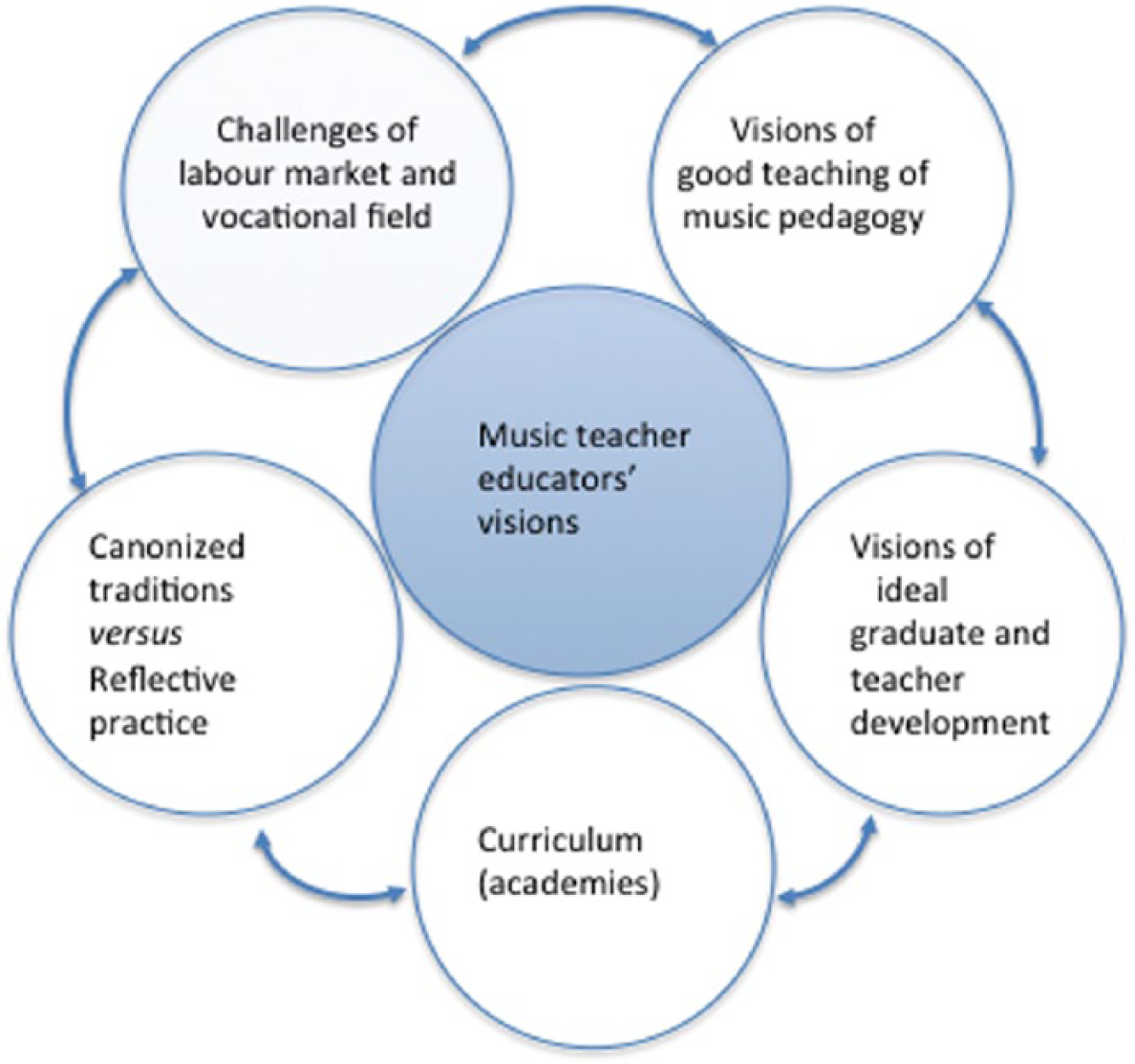
Music teacher educators’ visions.
Music teacher educators’ visions of an ideal graduate
The educators’ visions of an ideal graduate revealed a high degree of similar emphases on a series of traits, however, they also revealed difficulties in describing particular characteristics. This became particularly pertinent when focusing on features that differed from one field of pedagogy to another. Teachers of classroom music pedagogy noted that as every student teacher was seen as unique, defining a list of desirable attributes was problematic. This conception was stressed as important with respect to the challenges of a changing, pluralistic society.
With respect to common traits the Finnish and Swedish participants held that an ideal graduate should be curious and analytical, as well as independent. The Norwegian participant added that student teachers should develop the ability to organize their teaching according to the structure of music as a school subject, and highlighted active music making, listening and composition in this respect. The teachers wanted their student teachers to learn how to plan, run and evaluate music teaching. Furthermore, they pointed to the student teachers’ capacity to adapt their teaching and challenge their students according to those students’ preconditions for learning. Beside the roles of a general and an instrumental music teacher, the educators envisioned for the ideal graduate a wide array of music teaching positions such as school leaders, producers and project leaders. They also expressed visions that emphasized how the student teachers could realize these ideals. Relations between pedagogical courses and the practicum were highly valued, not least for the training of critical thinking and leadership.
The views of an ideal vocal teacher also corresponded strongly between the educators in the different countries. All of them valued a deep artistic knowledge including performance skills, and the acquaintance of a broad repertoire beyond one’s “own” style as a ground for meeting vocal students “where they are”. In addition they valued deep understanding of the voice as an instrument, including physical, anatomical, conceptual and linguistic areas of knowledge. The educators expected their student teachers to work in elementary schools, municipal culture schools, private institutions or as self-employed teachers. In Finland, though, the primary employment for voice students was seen to be as a professional singer rather than being an educator (or only supplemented by working as an educator). The perceived call for a broader understanding of the music teacher profession had influenced the curricula of music teacher education in Norway and Sweden, and in all three countries the content of vocal pedagogy seemed to be directed towards teaching singing at a rather high level.
The ideal piano teacher was seen as a skilled person who masters the instrument in at least one musical style and is able to teach it to students. Piano teachers’ competence should be broad and many-sided, including the ability to apply their knowledge to different student levels. Furthermore, such teachers were anticipated to guide and motivate musical learning in different settings, among which group settings were highlighted. The Swedish participant exemplified the broad competence required as being able to accompany different kinds of music, to sing and play, and to play in ensembles. The Finnish participant highlighted curiosity and artistic development together with pedagogical skills and knowledge; a balance that was also commented on by the Norwegian participant. The educators envisaged municipal culture schools, non-governmental organizations, and own firms, together with co-operation projects with general music education as realistic future vocational sites for their graduates. Their visions of how student teachers should develop the necessary flexible competence for operating in such a labour market also included visions of a well-suited curriculum of teacher education. That curriculum should include different ways of teaching and learning music, such as ear-training, co-play, peer support, singing, music presentation and group teaching along with philosophical approaches to music education practice.
The teachers of the strings pedagogy in Norway and Finland described the ideal string teacher as a performing musician who can handle several professional settings, has a personal relation to the subject content, and who is also able to teach. The Swedish interviewee described ideal teacher competence as apparent on two levels. The first level comprised practical, theoretical, systematic and analytical knowledge within the areas of music and education. The second level encompassed an internalized capability of innovation to engage in various teaching practices. The variety of future vocational arenas that they envisaged for their student teachers included performing and teaching in the private as well as public sector as well as collaborative work and entrepreneurship.
Some of the particular capabilities that came to the fore as part of the visions included recognizing different learning styles and the capability to teach accordingly, keeping in mind that every learner is different and seeing learning as a holistic process. Further, the educators highlighted the importance of knowing the structure of the music schools and their relations to the rest of the school system in each country in order to familiarize themselves with the future context of teaching. Also, the ability to “market” oneself and to argue for the importance of music and music education was considered essential.
Music teacher educators’ visions of good music pedagogy teaching
The educators’ visions of good teaching of pedagogy appeared to be consistent with and rooted in their ideals of teaching music in general: the ideals of general teaching constituted a guide for their teaching of pedagogy. The visions seemed to be more personal than shared and discussed at the academy. Still many concurrent ideas were expressed.
Across the countries as well as across the instrumental and classroom traditions, educators directed their attention to student teachers’ employability (see, for example, Johansen & Ferm, 2007) when teaching pedagogy. Hence, the musical and pedagogical competences that student teachers were perceived to need in their future profession, guided the educators’ teaching practice. Also, taking an inquiry stance and responding to one’s teaching practice with a reflective attitude were regarded as important elements of student teachers’ dispositions. In addition, the integration of practice and theory, also from other fields of knowledge, were conceived as being essential.
Deep and broad content knowledge (Shulman, 1987) was considered of primary importance for good teaching including, for example, mastering an instrument technically and knowing the standard repertoire. Good teaching was closely related to the relationship and interaction with learners and to instructional activities focusing on student experience and learning. Yet the learner-centred approach that “reminds us to think about learners rather than only about subject matter” (Bransford, Derry, Berliner, Hammerness & Beckett, 2005, p. 52) was understood in various ways. It was conceived to imply, for example, a teacher’s interest in their student’s learning and his/her experience, that teaching is shaped according to a student’s abilities, that teaching should offer tools for students to find solutions to problems themselves, or that the teaching situation feels secure and brings enjoyment. Several teachers from instrumental traditions emphasized the dialogical relationship between teacher and student, despite the fact that the instrumental teaching tradition is still largely described by scholars in the field as being based on master–apprentice relationships (Gaunt, 2009; Hanken & Nerland, 2011; Jørgensen, 2009). In addition, visions of good music pedagogy teaching were described as encouraging students to develop their teacher identities and to find their personal ways of teaching (Barnett, 2009).
In addition to the above characteristics, we identified the three specific categories of the empirical material. The first designated the educators’ notions of how their visions related to visions of good teaching in their curricula, departments and programmes. Along with those, visions about reflection- and research-based teaching together with ideal student teacher development were demonstrated.
Visions about research- and reflection-based teaching
To an increasing degree policy makers and teacher educators advocate that teacher education should integrate research (Graabræk Nielsen, 2008) and encourage a reflective attitude among student teachers (Quinton & Smallbone, 2010). In our study there was a wide range of responses to such priorities, altering between considering research and reflection highly important and integral to teacher training, to those regarding it to be insignificant and unnecessary. Among the teachers who emphasized the importance of research and reflection, there was a belief that student teachers should be enabled to see connections between theory and practice, to give deeper insights than, for example, learning to follow “teaching recipes” in instrument method books and “teacher guidelines”, and that research- and reflection-based teaching reveals connections between teaching and research. The valuing of research- and reflection-based teaching was connected to the reading of current research and theory and a subsequent strong motivation to base teaching on that.
The challenges of research-based teaching were described as including how to theorize from student teachers’ practical experiences and how to apply and develop student teachers’ writing and argumentation ability to teacher development. Further, involving their student teachers in the educators’ own research was conceived to enable them to independently search for and collect information and knowledge as well as to acquaint themselves with established theories. Educators suggested that research- and reflection-based teaching and learning is simply the best way to escape earlier approaches based on random and normative notions about “the only right way”. By adopting a research- and reflection-based approach, it was suggested that one can question and study systematically what is being done. This is necessary with respect to student teachers’ future obligations such as improving their students’ learning and the music education field itself, along with developing themselves as professionals. Despite their own awareness of the values of research- and reflection-based teaching, the educators felt that their institutions still had a long way to go in order to appreciate and implement reflective, research-based approaches within most of their subjects and courses.
Visions’ relations to curriculum, department and programme
Most music teacher educators felt that their department or the written curriculum of pedagogy lacked explicitly formulated visions of good teaching. They perceived their own visions as not always completely in line with the ones they perceived as being indirectly conveyed by their departments, and only a few felt that their visions were consistent with the visions of the current curriculum. Among the differences that were demonstrated some educators held that the curriculum vision of good teaching was not wide enough to cover the breadth of the future competence that they envisaged. For others the curriculum vision was too wide in relation to the time allotted for the course. Furthermore, not all agreed with the curriculum concerning the balance between pedagogical and subject knowledge.
The extent to which the music teacher educators saw their visions as reflected in the programmes identified some interesting differences between the countries. The Finnish educators felt that their visions were almost entirely absent from the programme. The Swedish educators thought that the programme mostly hindered their visions, since they were different from those articulated in the syllabi. The Norwegian educators were mostly satisfied with the situation, yet recognized some of the problems mentioned above.
The educators felt that their visions had very little influence on the programme content, if any, except when participating in the curriculum planning. However, the teaching practices that followed from the curriculum planning were perceived as open to influence from discussions and sharing ideas with colleagues.
The educators still felt somewhat isolated without much collegial support. They mentioned that they would benefit from discussions and sharing of visions among their colleagues as well as with the heads of the programme or department, which was absent from their current practice. However, opinions regarding openness in the sharing of their teacher visions among colleagues were dissimilar. Some educators thought the issue of sharing visions of good teaching was very delicate, and that some of their colleagues wanted to “own” their ideas and be recognized for them, certainly not to share them. Others thought the atmosphere among their colleagues was open enough for productive discussion and the coexistence of different views.
Visions of ideal student teacher development
The ideal process of development towards becoming a good music teacher was depicted as different blends of experiences, actions and reflections. Educational-musical competences related to working with different ages of students and genres of music, including theoretical as well as practical aspects, were expressed as being ideally developed through interaction with teachers and peers in the institution as well as the remote practicum and experimental groups. The most important part of such processes was perceived as related to the practicum, wherein student teachers are challenged and different models of teaching are practically experimented with.
Most of the educators thought that the best way to guide their students towards their visions of ideal teachers was through dialogic and reflective relationships, in a good atmosphere, where teachers and student teachers learn together. The educators’ task in this respect was expressed as getting their students to think and develop their own teacher-identities, developing their own visions and tools for their own development. The educators did not want student teachers to think or act the same way as themselves, or to use the models presented as content without any reflection upon them, but rather to dare to be different and to challenge traditions. They saw their task as to encourage student teachers to reflect upon their actions in practice verbally and in writing, individually and in groups, and to help them to see relations between, and mirror, different experiences and perspectives in each other. In particular, it concerned the experiences and perspectives that had dominated student teachers’ own music education. To connect and reflect upon what is covered in pedagogical courses in relation to their music teacher education as a whole was also seen as an ideal among the educators. One of the interviewees suggested that educators with different ideological views could be invited to teach in his course to satisfy this ideal.
The teachers of classroom pedagogy stressed the importance of offering student teachers experiences in a variety of musical genres and a corresponding variety of teaching methods and strategies to be able to develop broad conceptions of music teaching and learning. This in turn demands that student teachers get the opportunity to be active and take responsibility in varied situations in the practicum. Another important thing, the educators held, is to continually connect to what is waiting for student teachers in their coming professional life, both known and unknown (Barnett, 2004).
Music teacher educators’ visions of the music pedagogy subject as a whole
When seen together, the educators’ visions of an ideal graduate and good practice along with their opinions about how the study of pedagogy supported (or not) the achievement of those visions provided the foundations for developing their visions of music pedagogy as a whole. This included their thoughts about the traditional canon of music pedagogy as challenged by the ideals of research- and reflection-based teaching, along with challenges of the vocational field and the labour market.
One example of a vision of ideal practice entailed that teaching should be a collaborative process. This vision was conceived as supported by the pedagogical course curriculum in conveying collaborative teaching. Respectively, a vision about the ideal graduate characterized this person as a flexible professional with the ability to change and adapt one’s competence to existing as well as future alterations in the vocational field. Relations between visions of teaching as a collaborative process and of a graduate with operational change competence were then seen, in that the collaborative process of teaching presupposed and required change competence (Johansen & Ferm, 2007) to keep up with the continuous dynamics of the vocational field.
The ways in which visions of good practice and an ideal graduate were reflected in relation to music pedagogy and challenges of the vocational field, revealed visions about what functions music pedagogy could have in music teacher preparation. In turn, this was connected to visions of the further development of the subject along with its relations to the practicum, the vocational field, and the capabilities it should encourage in student music teachers.
By connecting knowledge about teaching and learning music with theoretical insights from other subjects in music teacher education and student teachers’ experiences in the practicum, a vision of music pedagogy emerged as constituting a hub within which all knowledge and experiences of music teacher education meet. One part of music pedagogy was envisioned as having an intermediating function between the remote practicum and the rest of the courses and subjects at the institution. Furthermore, it was pictured as a ground for student teachers’ reflections on their practicum experiences by affording a move from earlier, normative teaching principles to a descriptive-analytic research- and reflection-based ideal.
In fulfilling such assignments music pedagogy was envisaged as solely a slight deviation from the master–apprentice model, moving towards a more democratic teaching ideal. Whilst maintaining music interests as a central area of attention, this development was seen to encourage collaborative learning and the competence to work in teacher-teams along with recognizing that a good school is a school in change. Priorities like these were, in turn, connected to a vision of longer, more consistent periods for student teachers to stay in the remote practicum wherein the training situations would be representative of the actual reality of music teachers to a larger degree than hitherto, built upon an increased awareness of the demands and realities of the labour market and continual contact with music teacher practitioners.
Concluding discussion
Studying music teacher educators’ visions raises a question about if and how those visions can be perceived as indicators of the various knowledge and teaching traditions upon which pedagogical courses are founded. All in all, in our study the educators’ visions did not indicate clear distinctions between instrumental and classroom music teaching traditions or differences between the countries. Overall, the educators were broad in their understandings of the content and the ways in which the tradition could be further developed. Yet, it seemed that visions of teachers of instrumental pedagogy were quite instrument specific: across the three countries the visions of teachers of a certain instrumental pedagogy were similar, whereas the visions differed between the instruments. The educators’ reflective attitudes were also mostly directed towards and stayed within the instrument specific teaching traditions. It even seems that traditions limit the educators’ visioning ability. This finding warrants further investigation, particularly comparative studies between instrument specific traditions and national contexts. Not at least it should be important to investigate how this limitation of visioning has implications for the preparation of students for the multi-dimensional changing society in which they will perform their professional work. One risk can be that the traditions are conserved, which might build up frontiers towards some groups of potential pupils or youngsters who want to learn to play. One way of opening up the situation from a scientific angle could be to run action research studies where pedagogy teachers are forced to make visions beyond the limits of the tradition and imagine new border-crossing arenas for the profession toward which they educate student music teachers.
Based on this study it appears that within institutions for higher music education, educators generally lack arenas for sharing their experiences, thinking and ideas (Zandén, 2010). The innovative ideas and developmental work related to teaching, as well as experiences of these, are not shared but rather maintained as a relatively private resource to inform one’s own teaching and professional development. Sharing and publishing this kind of professional competence could create a new common resource for the teaching community, in turn enhancing the development of the whole teaching traditions involved (Harré, 1983; Unkari-Virtanen, 2009). The question is, who is responsible for offering time and tools for such discussions and developmental projects? Is it the headmaster of each institution? Is it the teacher him or herself? Could this theme be a part of mandatory higher education courses among teachers of pedagogy?
Music educators’ visions related to all three interpretation categories of our study somewhat reflected the awareness of the recent changes and current challenges in today’s music teaching practices and those of the labour market (McPherson & Welch, 2012); an issue recognized worldwide in professional training of musician and music educators (Weller, 2012). For example, the educators interviewed described their visions of an ideal graduate in relation to a changing, pluralistic society. They thought that the required practical, theoretical and research-based musical, educational and reflective skills could be combined in varied ways depending on the different situations in which and levels at which their students are expected to teach. The combinations of skills that are preferred in these various situations are in some cases defined by the tradition, and in other cases by visions about student teachers’ possible contributions to maintain as well as to change their future vocation in reflected ways. The educators’ visions about their graduates’ future employment form a broad picture in which, for example, municipal culture schools, general schooling, hospitals, non-governmental organizations and self-employment are included. On an overarching level the educators aimed to prepare their students for this pluralistic world, through promoting creativity, leadership, curiosity and reflexivity. But they also expressed limitations regarding the curricula they work within. They are not expected to send their student teachers to practicum fields like hospitals, private music schools or studios, or to include theories about how to start a firm and market it. So, there are some discrepancies between visions concerning the labour market and what the educators can offer their students as content in pedagogical courses.
The results of our study support Darling-Hammond and Bransford’s (2005) suggestion that vision plays an important role in teacher education. This is also true when they hold that prospective teachers need a clear vision of what it means to be a professional, without which the metacognitive reflection needed to assessing progress it difficult to achieve (see also Bransford et al., 2005, p. 76). By forming an image of a possible and good practice, student music teachers as well as their educators connect important values and goals to concrete instructional activities. Vision closely relates to and in a sense makes understandings of music and pedagogical content concrete. This applies to teaching, learning and students’ dispositions about how to use this knowledge; practices that allow them to act on intentions and beliefs; and tools that support teachers’ efforts, which are all seen as important components in learning to teach in a community (Hammerness et al., 2005). Moreover, by developing a vision of what music teachers do, what good music teaching is, and what the goals of music teaching should be like, student music teachers begin to build and identity that will guide them in their work, to rephrase Hammerness et al. (2005, p. 383). As can be seen, although the suggestions of Hammerness et al. (2005) are originally directed to general teacher education we suggest that vision can be fruitfully applied to music teacher education as well; offering, for example, a tool for critical examination of music teaching traditions and beliefs that so often (unconsciously) shape ideas and practices. Visions can help both student teachers and teacher educators within music education construct a concrete basis for developing and assessing music teaching and learning. A practical implication could be to introduce vision as a functional concept among educators in music teacher preparation. One step in such developing work might be to formulate clear programme visions at music teacher institutions through collective collegial work. Hopefully such collegial work could consist of visioning beyond the limitations of the traditions.
Footnotes
Funding
This research received no specific grant from any funding agency in the public, commercial, or not-for-profit sectors.