



Abstract
In post-socialist spaces, informal payments in educational institutions have often been at the centre of anti-corruption campaigns. A direct consequence, so far, has been that reforms in the public sector have largely been based on attempts to eradicate, or at least minimize, the phenomenon of informal payments. Ukraine is no exception. According to several independent surveys, educational institutions are second only to health care providers for the number of informal transactions recorded. While more than two in three of Ukrainians claim to have engaged with informal exchanges in the past 12 months, almost half of them has made an informal payment in an educational institution, be this a university or a school. The goal of this paper is two-fold. First, we explore the nature and relevance of the phenomenon of informal payments in the educational sector. We rely for this on quantitative studies showing how widespread informal payments are. Second, we provide an alternative explanation on informal payments by suggesting that they have an ambiguous function: while often regarded as a legacy of the socialist period, they can also be seen as a way to cope with an ineffective system that is mostly based on informal rules. By doing this we will provide some recommendations on how anti-corruption policies, and in general reforms aimed at decreasing the amount of informal payments in the country, could be improved.
Introduction: the ‘problem’ of corruption?
Corruption in Ukrainian higher education institutions is an issue that regularly makes the headlines of a variety of media outlets. 1 It is also a regular topic of conversation between ordinary people, who compare experiences or simply share modes of dealing with it. A taxi driver driving from Borispyl airport to Kiev once mentioned that he was sending his son to a university in Kherson because ‘it was cheaper to pay enrollment than in Kiev’. 2 When asked why his son would need a degree, he candidly answered that, with no degree, his son would not even be able to work in a shop.
This is not an isolated case. In post-socialist space, informal payments in educational institutions have often been at the centre of anti-corruption campaigns. A direct consequence, so far, has been that reforms in the public sector have largely been based on attempts to eradicate, or at least minimize, the phenomenon of informal payments (Stepurko et al., 2015a, 2015b). In Ukraine, according to several independent surveys (Kiev International Institute of Sociology, 2015; USAID, 2010), educational institutions are second only to health care providers for the number of informal transactions recorded. While more than two in three of Ukrainians claim to have engaged with informal exchanges in the past 12 months, almost half of them have made an informal payment to an educational institution, be this a university or a school (Novoe vremia, 2016).
Corruption in higher education institutions is perceived as a major problem in Ukraine, as in most of the rest of the former USSR republics. There is a wide range of reactions that this issue generates, and they are generally in between two extreme positions. The first one acknowledges the overall negative effect of corruption, suggesting that under-the-table payments, no matter how small they are, have the potential to undermine human and economic development of a country and should be condemned as a whole. In particular, to some scholars and analysts the routinization of give and take practices has undermined the current system, leading to institutionalized, widespread corruption that should be liquidated at once (Papava and Khaduri, 1997). Indeed, corruption in the country is reported at high levels: in 2016 Transparency International ranked Ukraine 130 out of 168 countries, at the same level with Nepal, Cameroon and Iran. Russia, Moldova and Belarus are seen as less corrupt (Transparency international, 2016). In addition to health care and education, corruption is widespread also in the judiciary sector, parliament and police (TORO Creative Union – Transparency International Contact in Ukraine, 2011).
The second, and opposite, view on informality does not deny the existence of these practices, but ascribes them to a wider framework in which absence of the state in some sectors or aspects of public life makes person-to-person interaction possible, and even useful, to overcome several dysfunctions in a system where the state is perceived as weak or not functioning (Polese 2016a, Williams, 2015).
Ukraine has been experienced serious issues with the profitability, or sustainability, of social and public policy sectors. In particular, education has been under growing financial and structural constraints, putting state employees in a very awkward position. On the one hand, educators do not have a respectable level of income, while, on the other hand, the conditions of their contracts, including zones of competence, criteria for positive performance assessment and conditions for sanctions, are rarely verbalized, negotiated and added as transparent dimensions of their work, let alone official ethical codes. By force of this ambiguity, personal and peer power, personal arrangements and connections (Polese and Stepurko, 2016a) are widely used assets to the point that organizational culture can be considered as an important factor in creating a favourable or unfavourable to bribery environment at the universities (Zaloznaya, 2012).
The words ‘bribe’ and ‘corruption’ are, however, too morally loaded terms to define the variety of situations present in the country. In addition to gifts or payments to teachers for better grades, informality encompasses a variety of practices providing a given school with items that the state fails to provide. This includes books, furniture, renovation of the class and school facilities, sanitary and hygiene products. For secondary schools, parents often ask teachers of ‘problematic’ subjects to provide additional classes to their students for remuneration. In higher education, fewer funds are collected directly for the furniture, books and renovation, but cash or favour exchange are used for buying better marks, passing exams and even buying diplomas, as well as gifts to the educators for work performed during bank holidays or exams. The above tendencies are seen to fuel several related mechanisms and attitudes, de facto normalizing the idea of informal payments and inviting schools to solicit informal payments as an alternative to catastrophic outcomes, such as when a teacher asks class parents to fix windows or their children will freeze (Lepisto and Kazimzade 2008).
Informed by critical literature on corruption and informality, this article explores the persistence of informal practices in Ukrainian higher education institutions. Following on from Granovetter’s argument (Granovetter, 1985) that corruption is socially constructed and embedded in social phenomena, we provide a post-economistic account on informal payments in Ukrainian higher education institutions to suggest that informality and corruption are, although springing from the same roots and overlapping to a given extent, distinct phenomena. Failure to acknowledge this distinction often leads anti-corruption campaigns to treat all manifestations of informality as evil to eradicate and thus divert efforts from the real aspects of informality that eventually damage state functioning. By doing this, we support the idea of the existence of ‘two informalities’ (Polese, 2016a), one mostly serving as a mechanism of redistribution of social welfare in case a system is not working properly and the other undermining the very survival of a given system.
The paper employs evidence recently collected through two national surveys, both implemented by the Kyiv International Institute of Sociology. The 2015 survey was conducted in December via omnibus bringing of nationally representative data (more than 2000 interviews, multi-stage stratified random sample). A multi-staged random probability sample was drawn in each oblast: in the beginning, sampling points were chosen in consideration of regional, urban/rural and ethnic characteristics; then, addresses/households per sampling point were selected using the random route method. Only one individual per household was interviewed. If the respondent refused or was unavailable to take part in an interview after two call-backs recorded in the fieldwork report, a replacing respondent was identified following the same procedure. The survey of 2012 was conducted in summer in three Ukrainian regions: Odesa, Kyiv and Lviv. 3 Representatives of households were included in the sample based on a cluster randomized sample. The route instruction for respondents’ selection was provided to all interviewers who worked for the research agency that performed a field study in accordance with the methodology developed by the researchers. The overall sample size is 611 respondents who are 18 years and older. The sample characteristics which are related to age, gender, place of residence and household income, were comparable to the regions’ national statistics.
Professional interviewers have collected data within face-to-face interviews based on a structured questionnaire. Face-to-face interviews as a data collection mode have numerous strengths despite the high costs because of the following benefits: they can ensure maximum representation of all stratums of the population, which is not achieved by telephone or online survey in Ukraine; it is possible to observe and note spontaneous reaction of the respondents and their attitudes towards the topic raised; the method allows longer conversation with respondents in comparison with other modes of data collection, not to mention higher response rates and greater openness of respondents when communicating face to face with the researcher.
The research instrument of both studies has been developed by the group of researchers who have the expertise in corruption and informal payments, while local researchers and a sociological agency took care of the proper Ukrainian and Russian wording of the questions. Previous studies suggest that informal payments and corruption is not a sensitive topic in Ukraine (Stepurko et al., 2013) and the public share openly their attitude and experiences, therefore, no special attention is given to sensitize the issue of corruption to the respondents.
The rest of the paper will explore the variety of informal practices and attitudes, unveiling the lack of a unanimous position on informality and outlining the ambiguities of corruption-related discourses in the country. By doing this, we suggest that informality springs from the necessity of two citizens to liaise without necessarily passing through the state, especially in a situation where the state seems to be part of the problem rather than the solution.
We are inspired in our approach by Gudeman’s idea of the economy being composed of two realms: ‘the market realm revolves about short-term material relationships that are undertaken for the sake of achieving a project or securing a good. In the communal realm, material goods are exchanged through relationships kept for their own sake’ (Gudeman, 2001: 10). We also refer to North et al. (2012: 5) looking at patron–client networks which are not just ‘distributors of spoils but also … essential institutions to bring about cooperation rather than violence amongst organizations’. In fact, informal redistribution of power through informal payments ascribes to an often too rapidly dismissed framework that Khan and Jomo (2000), North et al. (2009, 2012) and Wedeman (2012) framed in ultra liberal views on corruption (see, for instance, Leff, 1964) that have been too hurriedly dismissed with the utopian idea that development is a mere economic phenomenon.
Indeed, if the deeper social envelope of corruption, rather than corruption itself, is the factor behind long-run development (or under-development), tackling corruption head-on (as most development projects and programmes propose to do) may often be unnecessary from the point of view of development; in fact, it may sometimes prove counterproductive (Uberti, 2016a: 262).
We believe that ambiguous positions on corruption, and the incapacity to deal with it, is mostly the result of a lack of distinction between informality, that is the totality of transactions and operations happening beyond the state regulating them (Routh, 2011), and the sub-case of corruption. The rest of the paper is organized into three sections. In the next one we debate the distinctions between corruption and informality. The following section explores what is generally considered corruption, or corrupted practices, with regard to Ukraine and post-socialist spaces. Finally, we discuss the social and political role of informal practices and the duality (degradation vs social solidarity) of positions that can spring from one single transaction.
Corruption and informality are not synonymous
Corruption studies have informed a variety of debates in widely conceived development studies (Harrison, 1999; Laffont, 2006; Mauro, 1995; North et al., 2009, 2012, 2013; Palmier, 1983; Papava and Khaduri, 1997 Uberti, 2016a, 2016b; Wedeman 2012). In post-socialist spaces, there has been a strong tendency to equate informality and corruption with little distinction or analysis of the context where the informal transaction happens. Indeed, a number of scholars have been dealing with catastrophic visions suggesting that in the post-Soviet world the routine practice of ‘giving and taking’ under communism has often turned into institutionalized, widespread corruption (Miller et al., 2001; Petrov and Temple, 2004). These works have inspired empirical studies dealing with graft, bribing, their perception and the negative effects annexed (Čábelková and Hanousek, 2004; Heyneman et al., 2008; Osipian, 2007). Scholars have concentrated on classifications and perception of corruption, under the dominant assumption that corruption (often too broadly defined; for a debate, see Polese, 2014; Werner, 2002) has negative effects on a wide variety of aspects of a country (Osipian, 2008, 2009b; Ram et al., 2007; Rumyantseva, 2005). Emphasis on anti-corruption measures and remedies can be seen stemming from these assumptions and subsequent attempts to develop what Samson calls the anti-corruption industry (Sampson, 2010) applied to higher education issues in Ukraine and the rest of the former USSR (Denisova-Schmidt and Leontyeva, 2014; Denisova-Schmidt et al., 2015; Osipian, 2009a).
However, recent tendencies have sometimes contrasted this apparently monolithic view to provide a more nuanced view on informal practices in the country (Round and Rodgers, 2009; Round et al., 2008). They have been informed by ultra liberal positions (Leff, 1964, also mentioned by Uberti, 2016a), feminist and post-capitalist views (Gibson-Graham, 1998, 2008) and a social view on corruption (Granovetter, 1984). All these have helped to emphasize a non-materialistic functionalism of long-term relations (Kovács, 2014; Ledeneva, 1998, 2006; Morris, 2012, 2013; Morris and Polese, 2014a, 2016; Yalçın-Heckmann, 2014) that sees corruption as an oversimplification of a social and multi-layered phenomenon. It has also enabled scholars to move beyond a rational choice framework (Andreoni, 1988; Becker, 1976; Egbert, 2006) to deviate attention from the economic, or at least monetary, aspect of corruption to an individual-centred account (Haller and Shore, 2005) allowing us to explore its social and political significance (Hann and Hart, 2011; Malinowski, 1921; Mauss, 1990; Sahlins, 1978).
Literature on post-socialism has been particularly receptive to this approach (De Sousa, 2008; Holmes, 2006; Lambsdorff and Frank, 2010; Li, 2011; Millington et al., 2005; Negru, 2009; Polese, 2008; Rivkin-Fish, 2005; Stan, 2012), informing a number of sub-positions. Some have noticed that a ‘little corruption’ does not hurt anyone (Rasanayagam, 2011); others have looked at collective perception of corruption with locals who blame the system (Karklins, 2005; Stepurko et al., 2013). This suggests the existence of a double standard applied in most transitional societies and the former USSR is no exception, with subjective and (allegedly) objective morality often in conflict (Ledeneva, 1998; Lonkila, 1997; Polese, 2013; Wanner, 2005; Williams and Onoschenko, 2014).
Other, more functionalist, empirical studies on corruption in higher education illustrate the case where informal payments are largely acceptable and regarded as complementing, or even replacing, state funding in public schools (Lepisto and Kazimzade, 2008). 4 Miller et al. (2001) have unveiled the tendency, in a number of post-socialist countries, to offer university educators expensive gifts, or money, more than school teachers in a number of European countries. In post-Soviet Central Asia, there has been a tendency to justify informal payments on the ground of little state support to schools. The less the support, the more informal payments become acceptable (Johnson, 2008). Other studies have unveiled that, in addition to the possibility to purchase university diplomas or to pass exams one by one against payment of a given amount, the most corrupt aspect of higher education in Georgia are admission and selection procedures – this, in spite of ferocious anti-corruption campaigns implemented in the country (Janashia, 2004). This tendency ascribes to a general attitude towards informality that several post-socialist authors have illustrated. Lepisto and Kazimzade (2008) as well as other authors (Miller et al., 2001; Patico, 2002; Ramas, 2016; Salmi, 2003) found that the main reasons behind flourishing of informal practices is a basket including better education, more attention, better-quality schools, better grades, and teachers’ and salary augmentation, a thing that can help us nuance our vision of corruption and look for grey areas where it could be analysed in an informality framework.
The lieux of corruption in Ukraine
Ukraine, as one of the post-Soviet countries, has underfunded ‘social’ or ‘unprofitable’ sectors of its economy (in primus health care and education), but also the inefficiency of public expenditures and poor governance of public service provision is noticed. On the one hand, educators do not have a respectable level of official income (salary) and, on the other hand, the conditions of their contracts, including zones of competence, criteria for positive performance assessment and conditions for sanctions, are rarely verbalized, negotiated and added as transparent dimensions of their work, not to mention reference to codes of ethics.
Still, the vocabulary of informality is filled by a myriad of alternative terms (coercion, bribes, corruption, gratitude) that make the phenomenon morally sensitive to an external observer, even if in many cases it is locally considered a socially acceptable practice (Lepisto and Kazimzade, 2008; Polese, 2008, 2014).
Health care is possibly the worst sector with regard to levels of corruption (Polese and Stepurko, 2016b). In a recent survey, 69% of respondents reported having paid for health care services, with secondary schools coming just after (64%), followed by interaction with militsiya (51%) and higher education staff (49%) (Kiev International Institute of Sociology, 2015). At the micro level, 57% of representatives of secondary education institutes, 32% of health care workers and 23% of sanitary inspectors have reported offers of informal payments over several years. The education sector has a dual perception. It is reported as one of the sectors where informal payment offers have declined most rapidly. Still, accounts of informal payments for a number of services are still often demanded, directly or indirectly. Indeed, independent reports give corruption in higher education institutions (university and their educators) at 47%, with 44% of university undergraduate and graduate and 36% of high specialized schools students declaring themselves to be willing to fight this tendency.
Incidentally or not, both health care and education are the services where the state has a major role in organization and financing: most of the health care facilities, as well as schools, universities are owned by the state and individual service providers, are paid salaries (lower than industrial average in the country) (State Statistics Committee of Ukraine, 2016).
This, in our view, opens the perspective that mismanagement of state sectors generates informality; that is, practices and mechanisms helping to solve most of the idiosyncrasies caused by limited management capacity. These informal practices, often uniquely regarded as corruption, should be regarded as something to eliminate problems at once – something we do not necessarily agree with. Indeed, grounded on various debates considering the role of the extra-legal (de Soto, 2000), the legal-licit relationship (van Schendel and Abrahams, 2005) and the ‘non-monolicity’ of the state (Kasza, 2002) that is ‘peopled’ (Jones, 2007) and could simply decline its responsibility or competencies towards a given sector or geographical region (Davies and Polese, 2015a; Polese et al., 2014), a fair assessment of corruption and informality in higher education institutions should involve a critical distinction between informal payments and corruption as well as their origins and consequences.
The most widespread definition of corruption, used by a variety of actors, including the World Bank, is ‘the use of a public function for a private advantage’, whereas informality usually refers to activities that are not regulated by or visible to a state. In both cases, the state’s overarching framework falls short of explanations for situations where the state is not involved, for instance corruption within a private corporation or informality in a sub-structure, such as a church, or even an international organization, such as negotiations within the UN (Stone, 2013). However, the difference is that the use of the word ‘corruption’ assumes that the state (or the overarching entity) is present and functions properly always and everywhere. Informality starts from the denial of this assumption. We take as read that the state should be there, but, for some reason, it fails to perform according to the expected standards. For instance, in a recent empirical study on informal welfare, it has been suggested that informality is the grey zone between what the state promises (or claims to do) and what it delivers. If the state is in charge, symbolically, of some aspects, but does not perform, the private sector cannot take them – that is, cannot invade the competence of the state – leading to a void in governance structures that is filled by informal practices, as Figure 1 shows (Polese et al., 2014).
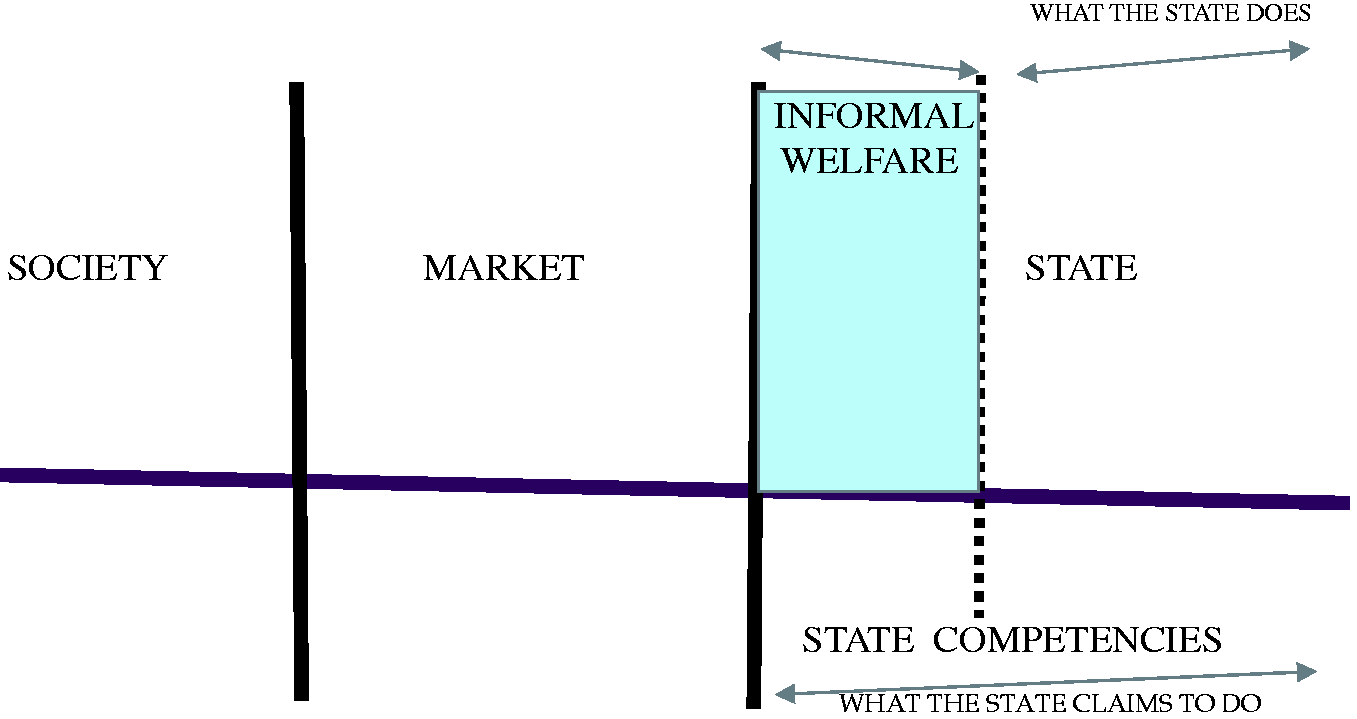
The relationship between formal and informal welfare (Polese et al., 2014).
What is the function of informality in higher education institutions in Ukraine? Are we talking of an economic phenomenon or there is more behind that? To answer this question, we should refer to the definition of informality that we are using here. Informality, for this article, refers to the area of activities that are not regulated by the state (Routh, 2011: 212). Important in this definition is the absence of the word ‘economic’, reflecting an emerging tendency of research of informality, especially in former socialist spaces, and to consider it beyond its initial economistic framework. Building on early Granovetter works (Granovetter, 1984), scholars of post-socialism have proposed a more holistic interpretation of the meaning of informality and its influence in various spheres of life (Helmke and Levitsky, 2004; Isaacs, 2011, 2013; Ledeneva, 1998, 2013; Misztal, 2000; Morris, 2011).
Indeed, recent research on informality has emphasized the existence of several grey areas, cases where the state is so ineffective that there is no other way to perform an economic activity (Davies and Polese, 2015a; Harboe, 2014; Knudsen and Frederiksen, 2015; Wamsiedel, 2016), or when the state forgets or forgoes regulation of a particular aspect of the society’s life (Humphrey, 2002; Jancsics, 2015; Millington et al., 2005; Smith and Stenning, 2006; Urinboyev and Svensson, 2013a, 2013b, 2014; Morris and Polese, 2014b). This is echoed in a variety of other works emphasizing non-monetary, but also intangible, aspects of the economic life of a society or an organization (North, 1990), often in a context where new institutional economics has shown further interest in non-traditional economic and monetary factors shaping institutional frameworks (Dixit, 2007; see also Acemoglu and Robinson, 2012) as well as the everyday (Henig and Makovicky, 2014; Kudva, 2009; Ranganathan, 2014; Stenning at al., 2010). However, the grey zone between these two foci has remained largely unexplored (Bayat, 2004; Hirschmann, 1970). In some respects, corruption can be seen as the gap between individual morality, allowing a certain number of transactions, and state morality that normatively condemns socially acceptable practices by promoting a different ethos (Gill, 1998). Van Schendel and Abrahams (2005) have operationalized this distinction into a matrix where legality and licitness (social acceptability) inform different practices and attitudes (see Table 1).
The relationship between legality and licitness (adapted from Van Schendel and Abrahams, 2005).

Informality permeates a large and extended variety of aspects in a state (Misztal, 2000; see also Polese, 2015). Starting from Table 1, it may be said that corruption is a particular case of informality where a practice that is socially acceptable is considered illegal in a given situation. If we assume that state morality and the state definition of legality is the ultimate criteria between what can and cannot be done, then informality and corruption are the same thing. In contrast, if we question the monoliticity of a state and its capacity to act impartially and effectively, always and everywhere, a thing that several empirical studies have widely demonstrated (Jones, 2007, Kasza, 2002, Putnam, 1995), then we have a variety of situations that can be located between legality and illegality. They are, in many cases, the only or best ways for citizens to replace or supplement the state (Davies and Polese, 2015b; Polese et al., 2014; Rekhivashvili, 2015) and normative approaches do not necessarily work best to explore them.
Informal payments, degradation and solidarity
In the 2012 survey that we commissioned to the Kiev International Institute of Sociology, we unveiled a negative attitude towards informal payments in higher education. Only 3% of the respondents considered informal payments to teaching staff as necessary, while 28.7% had a more fatalistic position, considering them a ‘part of the system’.
Negative attitudes, however, were prevalent. Only 9.3% of the respondents considered informal payments as the only survival option for university teaching staff and 59% saw it as a sign of degradation of the country. In a following question, informal payments were also associated with shame in 44.1% of the responses. Beyond the university environment, they were, however, considered by 38% as part of the system that helps survival.
The results illustrated in Figures 2 and 3, showing the different positions of the Ukrainian society on informality, can also be regarded as shedding light on the complexity and variety of informal practices. Informality in higher education includes a number of practices. From one-off and continuing payments for teaching and learning resources, to payments for expediting admissions or entry without meeting criteria (state exams), to payments for continuing enrolment while a student is actually in employment, to ‘logrolling’ – the disguising of non-merit-based admission by faculties admitting each other’s client students on a quid pro quo basis – and payments to teachers and other students for the completion of course work. The most extreme, but by no means unusual, example is the purchase of a degree by richer students sometimes without having ever attended a course.
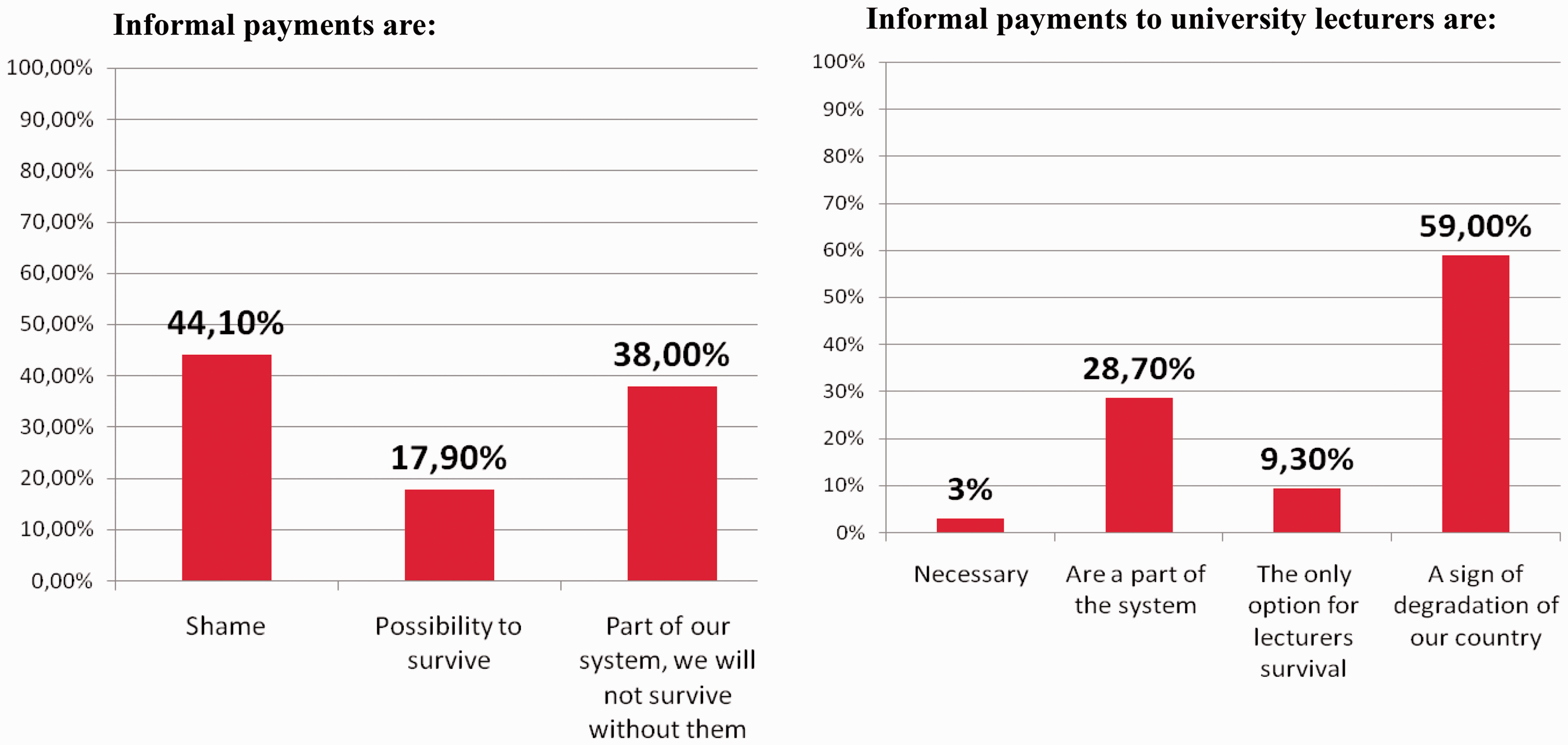
Perceptions of informal payments (source: KIIS/authors’ survey, 2012).
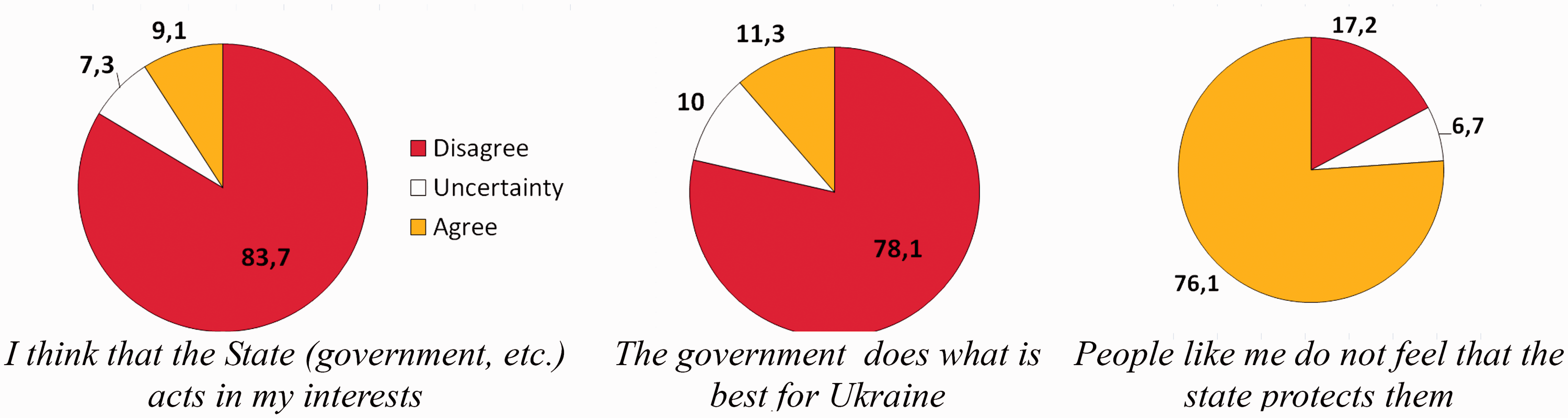
State trust in Ukraine (source: KIIS/authors’ survey, 2015).
Given the symbolic status of higher education, and the legacy of the Soviet culture, even for non-intellectual jobs a higher degree will be preferred. Because parents and students know that a degree is a competitive advantage, they will struggle to get into the best university that they can. This is also fomented by the insufficient availability, and possibly lower reputation, of technical and vocational education institutions. A demand for university education is met by a demand for higher incomes by the teachers. In some cases, teachers may not be keen on payments and still try to apply fair standards. It is then possible that they will be bypassed by a higher authority – an indication of the up-flowing rent-seeking endemic to the system existing in parallel to aspects of personhood pertaining to payments. Students mean income to universities so that a teacher repeatedly failing a student might get pressurized by the administration if they fear the student might drop out from that university altogether.
Some efforts have been made to fight these tendencies. The creation of the external independent evaluation (zovnizhnie nezalezhne otsiniuvannia – ZNO) was aimed at changing admission procedures in more transparent ways, by becoming a requirement for every student who wishes to enter a university. The 2014 Law ‘On Higher Education’ has been conceived to make universities more autonomous and possibly deal with informality issues at the local level, rather than implementing instructions centrally conceived. Finally, Prozorro – an e-system of public procurement – has been introduced in an effort to achieve more transparency when state funds are used.
In another recent survey, we discovered two tendencies that can help shed some light on informal practices and their meaning: nearly 84% of the respondents declared that they not agree that the state is acting in their interest, nearly 79% think that the current government is not doing what is best for the country and 76% do not feel that the state is protecting them (see Figure 2).
These results, and lack of trust towards the state, are contrasted by a growing trust towards fellow citizens, or at least a feeling of solidarity. Up to 100% of the respondents (in the regions of Vinnitsa, Ivano-Frankivsk and Kirovograd) declared that it is important or very important to help one other, and 84.1% believed that connections are crucial to gain access to services or information.
Can informal payments in higher education be interpreted as an expression of social solidarity? Would it be possible to state that citizens are unhappy with the fact that they have to pay – they find it a shameful practice, but still do it because they see it as a way to redistribute income to public workers that do not earn enough? First, we would suggest that informal payments in higher education institutions, although frequent, are not necessarily systematic. As reported by a former student, and confirmed by others, there are generally two ways of passing an exam. One could study hard and show that one had worked enough to deserve a good grade, or simply pay. Some teachers would require a payment in any case, even if you had studied, but this was generally the boundary between those who wanted a degree just to hang the certificate on the wall and those who were expecting to gain some real knowledge from their education (see Polese, 2008, 2014).
In the course of a previous study, one teacher reported that he regularly met students who needed to pass an exam simply because their major required that particular exam, but they had no real interest in the subject. In this case, he said, he might feel uncomfortable being the main hurdle between the student and their degree (and eventually access to the job market, which, without a degree, would be very difficult). He knew that, in a way or another, the student would find a way to pass, so did not see why he had to make their life harder than it was already. If the student, in exchange, wanted to offer a sign of gratitude, such as a bottle of brandy, he could not see anything bad in this gesture (see Polese, 2016b, 2016c).
Teachers are not always interested in student-originated income. Notwithstanding this, they might still face pressure from their administration not to fail students. A creative way of maintaining a professional ethic while reducing pressure from the administration has been to ask students to use the money they would employ as a bribe to buy extra books for the library. Several advantages to this approach were reported by one witty informant: 1) students who are not used to studying at least learn that there is a library, with available books, and go there at least once; 2) students have to learn which books are lacking; and 3) the library grows, offering more of a choice of books.
Ukraine is not the only place where multiple moralities co-exist, or where one can easily see a gap between state and individual morality – perhaps we should say moralities, since different individuals might ascribe to different moral codes. Within the same department, it is likely that most of the staff have found themselves in a situation where an informal payment or a gift was given. However, these same people will have their own ranking, looking up to those who take gifts or payments only in special cases and looking down to those who demand them as part of their daily routine, or even create situations where students feel pressure to pay. Other indicators are used to assess the morality of a colleague. Is the counterpart for the ‘service’ given before or after the ‘service’ itself? If students have to pay after the service, they are also relatively free to disappear after the exam, a situation possibly showing that the primary teacher’s motivation was not money. After all, the definition given by a friend and colleague still remains the best way to offer a teacher’s perspective: ‘If I receive it, then it is a gift. If I demand it, then it is a bribe.’
In a 1959 study on factory workers in the US, it was found that some firms would turn a blind eye on workers taking home some small items from the workplace (Granovetter, 1984). This was considered to be a concession to make up for low salary, or a perk of working in a particular environment that did not reward workers as much as they expected. This example can explain the perversity of the Ukrainian situation. Teachers are underpaid, but the state turns a blind eye on informal practices. Control is enforced, but mostly on institutions that are under the spotlight, with more peripheral educational institutions being more left to themselves and freer to distribute perks. In larger and more central cities there is, therefore, more control, which results in higher risks and people willing to risk their position only for greater amounts of money.
Conclusion
Thinking back to our taxi driver mentioned in the introduction, and his ideas on education, in the light of the points discussed in this paper, we can think of several ways to nuance the discourse on corruption in Ukraine. Given that a university degree seems to be more of a formal, or cultural, barrier than a professional one, our forecast is that he will eventually tick the box by somehow getting a degree and then start searching for a job through his network. The function of a higher education might be more the one of building a network than receiving knowledge. A survey informant reported: My daughter wishes nothing else but to get married so I enrolled her in a university. The goal would not be to get a degree. Rather, my hope is that through her social life she will eventually meet someone she likes. If I choose a good university, where educated people go, odds are that she will find someone good.
The question is, however, if universities are the right place and there is a need to spend so much money and time to get through this phase. Perhaps social or sport clubs, vocational education or other non-formal ways of learning, such as scouts or pioneer organizations, might serve the same function.
The point here is that the whole higher educational sector is built in a way that seems to foster informality and the use of informal practices. This, per se, is not a problem. However, bribing and informal payments do not only have ethical implications and endanger professionalism and academic values. They also increase scepticism about the whole system and towards the ruling elites and the state in particular (see the whole study in Polese et al., 2017).
A dysfunctional higher education sector erodes state legitimacy and runs the risk of alienating even more the state from its citizens. Now, citizens will survive somehow and so will the state. It is just easy to imagine that a happy marriage would work better than living separated under the same roof. Once again, the primary issue is not informality per se, but alienation and lack of interaction between those who should contribute to the state and the state itself. If the political elites do not realize this, let us hope that at least taxi drivers and their children will.
Footnotes
Declaration of conflicting interests
The author(s) declared no potential conflicts of interest with respect to the research, authorship, and/or publication of this article.
Funding
The author(s) disclosed receipt of the following financial support for the research, authorship, and/or publication of this article: This publication was possible thanks to generous funding from the EC/REA (ref: Caspian SEP-210161673) and DCU article publication scheme (2017).