



Abstract
This study focuses on exploring the issue of ensuring quality higher education in the conditions of Russia’s invasion of Ukraine. It synthesizes and analyzes literature sources, legal documents, secondary data, original (survey) data, and the author’s experiences with enhancing the quality of higher education. Using analysis of the legal documents, such as the National Doctrine of the Development of Education, the Law of Ukraine ‘On education’, and the Law of Ukraine ‘On higher education’, I study the legal framework for Ukrainian higher education. Using secondary data obtained from online sources, I find irrefutable evidence of mass destruction from Russian military aggression on educational institutions of Ukraine and the educational process in general, and specific initiatives from the Ukrainian state, Ukrainian universities, and international institutions to support the Ukrainian higher education system in wartime conditions. Using original data collected through surveys, I present first-hand information on the processes of changes in higher education in Ukraine under the conditions of Russia’s ongoing military aggression and the issue of ensuring quality higher education through the prism of the experience of students at the Ivan Franko National University of Lviv. Using the author’s personal teaching experience in the implementation of joint global classrooms, I analyze the possibilities of developed partnerships for motivating students and ensuring quality higher education in the conditions of war. Based on the analysis and synthesis of secondary data, I identify the main responses of the higher education system of Ukraine which enable it to maintain the quality of higher education as the realization of the Sustainable Development Goals during the war, namely (i) improvement and wider implementation of an online education system; (ii) organization of work of higher education institutions relocated from the occupied territories to territories controlled by Ukraine; (iii) support of international institutions; and (iv) partnership programmes with partner universities. The analysis of the results of the survey of students highlighted that the top priority of a Ukrainian university during wartime should be the safety of all participants in the educational and research process and high-quality education, and the most serious problems that create obstacles to ensuring the quality of education are the distressed psychological states of the participants in the educational process and organizational issues in the conditions of military aggression. By analyzing the experience of the implementation of joint global classrooms format, I also highlight that this format can be an effective additional measure in motivating students and ensuring the quality of higher education in the difficult conditions of war, and a developed partnership plays a crucial role in its implementation.
Introduction
In this paper, I investigate the issue of responses of higher education in Ukraine to dramatic circumstances and extremely difficult challenges of ongoing Russian military aggression. I focus on the issue of how Ukraine’s universities continue to ensure support and sustainable development of quality higher education in Ukraine and partnerships for the goals, demonstrating incredible resilience in difficult wartime conditions, and at the same time imparting practical lessons learned from Ukrainians’ tenacity that can be used by other countries facing existential threats.
The issue of ensuring inclusive and equitable quality education in the context of crises and military conflicts, as part of the agenda of the Sustainable Development Goals, is important for various societies. Therefore, these questions are the subject of serious scientific research. Thus, a series of case studies examining the role of universities in conflict situations is presented in the book Universities and Conflict: The Role of Higher Education in Peacebuilding and Resistance, edited by Juliet Millican (Universities and Conflict…, 2018). This book analyzes and highlights the role of higher education in general, and universities in particular, in conflict situations, using case studies from Europe, Africa, Asia, and the Middle East, namely Northern Ireland, Bosnia and Herzegovina, Palestine, Myanmar, and South Africa. Looking at a university’s tripartite functions (of research, teaching, and service) in relation to the different phases of conflict (pre-conflict, violence, post-conflict, and peacebuilding), the study draws together some of the key contributions a university might make in situations of instability, resistance, and recovery.
Milton examines the impacts of conflict on Syrian higher education, including effects on the educational factors of access, equity, and quality (Milton, 2019). The researchers also explore Syrian higher education teachers’ perceptions of their role as change agents in the reconstruction of post-conflict Syria (Akkad & Henderson, 2024). Habib investigates opportunities to revitalize the higher education system in Syria’s war-ravaged regions (Habib, 2023). Milton analyzes the role of higher education in post-uprising Libya in terms of its relationship with transitional processes of democratization and civic development (Milton, 2022). The researchers examine the work of university educators in Afghanistan and Somaliland, highlighting the challenges and opportunities they face working in conflict-affected societies, and explore whether and how higher education might support peace and development in conflict contexts (Kester et al., 2022). The researchers argue that higher education has the potential to act as a catalyst for effective and sustainable post-war recovery (Milton & Barakat, 2016).
On February 24, 2022, Russia’s unprovoked military invasion forced Ukraine to face similar issues. Wartime challenges, their impact on educational institutions in Ukraine, and the functioning of the education sector attracted the attention of researchers. Lokshyna et al. have investigated the issue of continuing educational processes in the wartime conditions, the motives for Russian attacks on educational institutions, the organization of training programmes, and the development of mechanisms to protect educational processes amidst hostilities (Lokshyna et al., 2022a, 2023). The researchers also study the effects of the war on essential characteristics of education, including the preservation of human rights in four educational settings: on Ukrainian territory, in occupied territory, in re-education camps in Russia, and in selected European countries hosting Ukrainian war refugees. They emphasize that war affected education, often causing the complete unavailability of education or providing low-quality educational services (Zamkowska, 2024).
The researchers also analyze how higher education has been managed in Ukraine right now, including an understanding of institutional resilience beyond physical resources (Gurenko, Suchikova, 2023). The authors focus on the transformative experiences of Ukrainian institutions operating under a ‘university without walls’ model in the context of war and displacement.
Challenges faced by the university community under occupation due to Russia’s full-scale war against Ukraine, particularly human rights violations and academic freedom, are analyzed (Tsybuliak et al., 2023). The study shows the practical adaptations implemented to navigate the effects of war, including the shift to a digital educational platform and the decentralization of the university structure.
There are studies devoted to the analysis of educational policy of the EU countries on the integration of Ukrainian refugee children into the European educational system in the conditions of a full-scale Russian invasion (Lokshyna et al., 2022b), including the pedagogical, psychological, and social aspects of educating Ukrainian youth in Polish schools (Pyżalski et al., 2022). In a broader context, researchers investigate the political role of the EHEA as the instrumentalization of its higher education cooperation initiatives as well as a platform for broader political cooperation beyond higher education for the promotion of peace in the European region (Kushnir, 2023).
Researchers have also analyzed the specifics of the organization of remote and hybrid learning in wartime conditions (Chykalova & Yukhno, 2023) and the use of media tools and educational services for video conferencing in the learning process (Huseinov et al., 2023). They assess the current state of e-learning organization and implementation in Ukrainian higher educational institutions during the war and examine students’ attitude towards the educational process during wartime (Matviichuk et al., 2022).
The existing research also provides valuable case-specific insights that can be used to develop more general solutions. In particular, Bugrov et al. analyze the experience of Taras Shevchenko National University of Kyiv in the resilience and innovation during times of war and political instability (Bugrov et al., 2023). The authors emphasize the importance of effective risk management, crisis communication, and psychological support for the academic community. Greshta et al. analyze the experience of National University ‘Zaporizhzhia Polytechnic’ in ensuring the continuity of digitally based educational services (Greshta et al., 2023). Based on their research, they have generated recommendations for countering threats arising under the influence of active hostilities. Novomlynets et al. analyze the experience of Chernihiv Polytechnic National University, which has been functioning under siege, bombing, and shelling, a loss of human capital, and the physical destruction of educational and research infrastructures (Novomlynets et al., 2023). Porkuian et al. study the experience of Volodymyr Dahl East Ukrainian National University (Porkuian et al., 2023). This university was forced to evacuate in 2014 from Luhansk to Severodonetsk, and in 2022 from Severodonetsk to Kyiv. Therefore, its experience is invaluable for assessing the acquisition of resilience and the development of sustainability thanks to human and social capital, which allows not only to face the challenges of the wartime but also to ensure the restoration of the system and its further development. Tsyos and Makaruk analyze the dedication of universities to their long-term academic role during the implementation of measures to resolve crisis situations in wartime based on the experience of Lesya Ukrainka Volyn National University (Tsyos & Makaruk, 2023).
Some issues aimed at researching the problems of sustainable development during the war and post-war period in Ukraine are also being developed. Ma et al. investigate the necessity of post-war renewal of university teachers’ potential in terms of sustainable development in Ukraine (Ma et al., 2022). Orzhel et al. analyze the prospects and necessary solutions to ensure the sustainable development of displaced universities during wartime and post-war recovery (Orzhel et al., 2023).
In the proposed study, the problems of ensuring quality higher education in Ukraine in the conditions of Russian military aggression are considered in the context of the Sustainable Development Goals adopted by the United Nations General Assembly in 2015, namely ‘Quality education’ (SDG 4), which focuses on education and aims to ‘ensure inclusive and equitable quality education and promote lifelong learning opportunities for all’, and ‘Partnership for the goals’ (SDG 17), designed to ‘strengthen the means of implementation and revitalize the global partnership for sustainable development’ (The SDGs in action, 2024; United Nations, 2024).
Background
Higher education in Ukraine has a rich centuries-long history and its own national traditions. Higher education institutions in Ukraine were established in the 16th century, and even then attracted students from all over the world. The oldest university was the Kyiv-Mohyla Academy, established in 1632. Now it is called the National University of Kyiv-Mohyla Academy, national research university. Historically, Ukrainian lands have been divided between foreign powers. Only after achieving national independence in 1991 did a unified and independent Ukrainian system of education start development. From this moment, the formation of the national system of higher education of Ukraine began on new legislative bases. The legislation provides for an entirely new qualitative level of training, increases in the academic and professional mobility of graduates, greater openness, democratic principles of teaching, and the integration of Ukraine’s higher education system into the global higher education structures. The Constitution of Ukraine of 1996, the Law on Education of 2017 (Law of Ukraine…, 2017), the Law on Higher Education of 2002 (Law of Ukraine…, 2002), and the Law on Higher Education of 2014 (Law of Ukraine…, 2014) constitute the legal framework for the Ukrainian higher education. Joining Bologna became an unquestionable success for Ukraine and a positive step towards integrating Ukrainian education into the European Higher Education Area. This took place on June 19–20, 2005, at the Fourth Summit of the Bologna process in Bergen (Norway).
The most striking result of Ukraine’s implementation of Bologna has been the adaptation of study courses to the two-cycle bachelor’s/master’s degree study system and the implementation of PhD degree programmes in Ukrainian universities. This significantly benefits the international mobility of Ukrainian students and helps Ukrainian universities develop partnerships. In 2006–2007, students at Ukrainian universities were integrated into a two-cycle graduate study system which corresponds to Bologna. The Bologna reform in Ukraine from 2006–2007 also led to the implementation of a European credit transfer system and the Diploma Supplement of the European Standard. With this Diploma Supplement, a qualification is more easily comparable abroad. These changes have contributed to the intensification of international academic mobility. Ukrainian students have benefited from this more and more. International students were also more motivated to study at Ukrainian universities. As an example, let’s refer to the data on the mobility of students from Ukraine to the EU and back under the Erasmus+ programme in the five pre-war years 2016–2020 (Ukraine in EU Programme Erasmus+, 2021). During this period, the number of participants incoming from Ukraine to EU increased from 1,684 to 2,450, that is, approximately 1.5 times, and the number of participants coming from EU to Ukraine increased from 686 to 1455, that is, more than 2 times. Some higher education institutions have already introduced joint degree programmes. Another important component of international academic mobility is partnerships that create opportunities for joint research and mobility of researchers.
The structural reforms were organically complemented by the reform of education management and administration. Ukraine has developed new mechanisms for rectors’, deans’, and department heads’ elections, generally for a maximum of two terms. Universities now have the right to manage their own revenues from education, research, and academic activities. The goal was to encourage private investment, fundraising, and creation of endowments and to dismantle the top-down Soviet model of university management. A separate governmental unit called the National Quality Assurance Agency, which is responsible for the development of regulations for the accreditation of educational programmes, license confirmation, and criteria for adherence of the European Standards and Guidelines for Quality Assurance, was created. New electronic systems for managing student admissions and state funding were implemented. I have analyzed this in detail (Zayachuk, 2020).
The strategic task of the educational policy of Ukraine, in accordance with the National Doctrine of the Development of Education, is access to the market of international educational services. Deepening international cooperation, the participation of educational institutions in international projects is considered a strategic task of educational policy in Ukraine (National doctrine…, 2002). Ukraine’s accession to Bologna was an unquestionable motivator. After the signing of the Bologna Declaration, Ukraine became part of the renewal process, which politically and legally found its consolidation in the new Law of Ukraine ‘On Higher Education’ adopted in 2014 (Law of Ukraine..., 2014), which brought the system of higher education of Ukraine closer to the requirements of the Bologna Process and education management reforms. The Law ‘On Higher Education’ laid a solid foundation for the development of partnerships to achieve goals, new opportunities for the development of higher education in Ukraine through active international scientific projects, international educational projects, and cooperation with international organizations (Ministry of Education and Science of Ukraine, 2021a). Before the war, we steadily increased the number of participants in such projects. We actively increased the number of students and teachers of higher education institutions who had acquired educational experience outside their native country and brought it back to their universities (Zayachuk, 2021).
Russia’s military invasion of Ukraine on February 24, 2022, changed everything. At that time, there were 281 higher education institutions in Ukraine (Cedos, 2022). By August 15 (the beginning of the new academic year), forty-three institutions of higher education had been damaged and five institutions of higher education had been destroyed by Russian shelling. In general, for all types of educational institutions, the picture is grim: 286 educational institutions were destroyed, 2,300 were damaged, 1,180 educational facilities are under occupation, 361 children were killed, and 711 children were wounded (Censor.net, 2022b; Osvita Ukrainy, 2022). And statistics change every day, and for the worse, because the war is ongoing.
According to the Office of the Prosecutor General of Ukraine, as of February 24, 2023 (after a year of war) because of shelling and bombing, the situation looks like this: 461 children have been killed, 927 children have been injured; 3,151 educational institutions have been damaged, 440 of them have been destroyed; and 167 professional pre-higher and higher education institutions have been damaged and 24 of them have been destroyed. These data do not include complete information on areas where active hostilities are taking place (Office of the Prosecutor General of Ukraine, 2023).
As follows from the data obtained, Russia’s war against Ukraine brought Ukrainian universities into completely new realities and forced them to face numerous challenges: to survive; to adapt to new conditions; to not lose hope for further development; to maintain the quality of educational services provided; and to preserve scientific potential. Below, I show how, in my opinion, Ukrainian universities have largely managed these challenges.
Methodology
The study is based on a review of the literature; secondary data obtained through the web pages of the Ministry of Education and Science of Ukraine, the Office of the Prosecutor General of Ukraine, and the web pages of the international initiatives to support the Ukrainian higher education system; analysis of documents; a survey of students; and the author’s personal teaching experience.
The literature review covers higher education in times of war from case studies throughout the world. I analyze, systematize, and generalize the literature sources on the issue of ensuring quality higher education in Ukraine in the conditions of wartime challenges and raising civil society in the post-war period from the perspective of stated Sustainable Development Goals.
I also analyzed relevant government documents, such as the National Doctrine of the Development of Education, the Law of Ukraine ‘On education’, and the Law of Ukraine ‘On higher education’ to characterize the legal framework for Ukrainian higher education. For this purpose, I analyzed relevant documents related to the strategic tasks of educational policy of Ukraine (National doctrine…, 2002). I also analyzed relevant documents related to the legislative bases for the formation of the national system of education (Law of Ukraine…, 2017) and the national system of higher education of Ukraine, including the foundation for the development of partnerships to achieve Sustainable Development Goals (Law of Ukraine…, 2014).
I analyzed the web pages of the Ministry of Education and Science of Ukraine and Office of the Prosecutor General of Ukraine to get secondary data, including statistical data on the number of children who were injured as well as the number of educational institutions damaged and destroyed by Russian shelling.
I also analyzed the web pages of international initiatives set up to support Ukrainian higher education. They show the defining role of partnerships in achieving the goals of preserving and ensuring the quality of education and research. I examined relevant web pages related to Erasmus+, ‘Horizon Europe’ programme, the Bologna Hub Peer Support II Project, Solidarity with Ukraine: 4EU+ for Ukraine, the MSCA4Ukraine Fellowship Scheme, and the Researchers at Risk Fellowships Programme. I looked particularly at the issue of flexible procedures for international projects and the capacity to adapt project activities in accordance with the challenges of war time in Ukraine. For this purpose, the role and features of these programmes were analyzed, along with statistical data on participation in some of them.
Surveys were used to obtain empirical original data. Questions aimed to explore the processes of changes in higher education in Ukraine with an emphasis on the issue of the quality of higher education in Ukraine, and the role of partnerships for achieving goals in ensuring this quality. The survey was carried out through the prism of the experience of students at the Ivan Franko National University of Lviv. The study included 74 Ukrainian students, and data was collected between May and December 2023. This allowed for an analysis of the results obtained during the period of complex challenges caused by Russia’s ongoing full-scale invasion of Ukraine. The survey was conducted online.
Before they agreed to take part in the survey, I sent students information about the project. I explained that the focus of this research is the issue of the quality of higher education in Ukraine under the conditions of Russia’s ongoing military invasion in the context of the main achievements during the entire period of state independence, as well as the resilience of Ukrainian universities to crisis phenomena. I also explained that I wanted to learn first-hand information and would like to ask them about their personal experiences. The questions were about their vision of challenges for Ukrainian universities caused by Russia’s military invasion and the processes of changes in higher education from the students’ points of view. I was interested in the problems that create obstacles for ensuring the quality of higher education nowadays, the organization of educational processes at the university, the priority of the work of a Ukrainian university during wartime, issues of students’ independence, issues that should be included in the long-term plans of Ukraine for the post-war period, and the role of partnerships for achieving goals in ensuring the quality of higher education.
I requested participation by email, using snowball sampling. To boost participation, a follow-up email was sent 2 weeks after the initial email. I wanted students to be assured that the questionnaires were anonymous, and that it was not possible to identify questionnaire participants, and that no personal data was collected. This survey was voluntary, and it included an introduction that said, ‘No personal data is collected; participants, by answering the questions, imply consent; you can leave the questionnaire at any time without giving a reason’. I explained that the data obtained through the survey would be used for scientific purposes only.
Empirical data were analyzed, and the most prominent patterns were determined in the conditions of complex and unpredictable situations. Then a theoretical analysis of the identified patterns was carried out.
The study is also based on the author’s personal teaching experience in ensuring quality higher education from the perspective of the achievement of Sustainable Development Goals, based on a developed partnership. The context of the implementation of new formats of educational activity is presented through the implementation of a joint global classroom. Global classroom is an international interactive online class where students at different universities, while at their home university, studied together, shared and co-created deliverables, and communicated online in a friendly atmosphere and multilingual environment. To be certain, it motivated students and integrated all participants in the educational process. The author shares her personal experience of implementing the joint global classroom for students of the Faculty of Philology of the Ivan Franko National University of Lviv and students of the Faculty of Arts of the University of Manitoba, Winnipeg, as part of a seminar on pedagogy. I believe that the global classroom format contributes to the achievement of the goals of sustainable development in maintaining and ensuring educational quality and further developing professional and personal skills of students. Partnerships, moreover, play a decisive role in the implementation of educational programmes, especially in wartime, when it is important to increase the educational and scientific potential of Ukraine and cooperate with international partners.
Results
Based on secondary data I have obtained from open sources and the results of my own research by surveying students, I concluded that the main factors that enabled Ukrainian universities to ensure continuous quality higher education in Ukraine in the conditions of Russian military aggression are (i) improvement and wider implementation of an online education system; (ii) organization of work of higher education institutions relocated from the occupied territories to territories controlled by Ukraine; (iii) support of international institutions; and (iv) partnership programmes with partner universities. The following sections discuss these findings in more detail.
Improvement and wider implementation of an online education system
After February 2022, the educational process in Ukrainian higher education institutions stopped for some time. But as early as March 14, 2022, it began to recover. Ukrainian universities managed to use the experience they gained during the COVID-19 pandemic quite effectively, quickly switching to online learning. However, it should be emphasized that in the system of higher education of Ukraine during the ‘COVID’ academic years, there was no systematic transition to distance learning as the ‘new normal’; instead, Ukrainian universities hoped that with the lifting of quarantine restrictions, education would return to ‘business as usual’.
Destroyed institutions of higher education in Kharkiv, Zaporizhzhia, Mariupol, and other Ukrainian cities cannot be rebuilt instantly. But their students must continue their studies. Therefore, many efforts are being made to improve online education systems and academic mobility within the country (Censor.net, 2022a). In fact, it allows us to apply an individual approach depending on the circumstances of the teacher and students.
For the most part, the educational process took place remotely in synchronous and asynchronous modes. Synchronous classes meet together online, while asynchronous classes are run from learning management systems like Moodle or Google Classroom, using email or messengers (Nikolaiev et al., 2022). This made it possible to solve problems related to the fact that many students and teachers found themselves displaced or in difficult circumstances: in occupied and unoccupied territories, out of contact, displaced within the borders of Ukraine, or abroad. Thus, the system of online education and its improvement became an important factor in the adaptation of the system of higher education of Ukraine to wartime conditions.
However, here it should be added that during the winter of 2023, there were fewer opportunities to hold classes even online because massive rocket attacks led to the destruction of critical infrastructure and the absence of electricity, Internet, and mobile communications for much of the country. This is an extremely difficult challenge, even for distance education.
Organization of work of higher education institutions relocated from the occupied territories to territories controlled by Ukraine
Another response used by Ukrainian universities to adapt to the realities of war was the relocation of higher education institutions from the occupied territories to territories controlled by Ukraine and the organization of their work in a new location. To do this, Ukrainian universities used the experience gained by displaced higher education institutions during Russia’s military occupation of the Donetsk and Luhansk regions of Ukraine, starting in 2014. As of 15 August 2022 (the beginning of the new academic year) since the beginning of the Russian aggression, 42 universities and 94 colleges and technical schools from the east and south of Ukraine – Donetsk, Luhansk, Kherson regions, and part of the Zaporizhzhia region – have been relocated to safer regions of Ukraine (Ministry of Education and Science of Ukraine, 2022). Now they don’t work within their walls but have maintained their institutional identities. Universities are displaced to 16 cities of 14 regions of Ukraine. More than 54,000 students studied, and more than 7,000 teachers worked in these displaced institutions (Ministry of Education and Science of Ukraine, 2022; Nikolaiev et al., 2022). In most cases, the relocation is considered temporary, and after Ukraine’s victory, it is planned that the universities will return to their cities.
The displacement of universities takes place in one of two formats: ‘minimal’ or ‘extended’. The ‘minimal’ format involves the departure of the university administration to the territory under the control of Ukraine, while teaching takes place using remote technologies. The ‘extended’ option of displacement involves not only moving the administration to another place but also some of the teachers and students and often involves providing the university with additional educational buildings (Nikolaiev et al., 2022).
Support of international institutions
International institutions played an important role in the adaptation of Ukrainian higher education institutions to the realities of the war. There are many specific initiatives from international institutions created to support the Ukrainian higher education system at various levels – national, institutional, and individual. This shows the role of partnerships to achieve the goals in preserving and ensuring the quality of education and scientific research and the further development of professional and personal skills of students, necessary for raising national economy and civil society in the post-war period. Among them are the following: Erasmus+: 2021–2027, ‘Horizon Europe’ programme, Bologna Hub Peer Support, Solidarity with Ukraine: 4EU+ for Ukraine, MSCA4Ukraine Fellowship Scheme, the Researchers at Risk Fellowships Programme of the British Academy, and others.
Erasmus+: 2021–2027
Ukraine is partner country within Erasmus+. Erasmus+ strategy is built to contribute to the realization of Sustainable Development Goals, to foster closer cooperation between higher education institutions, and to strengthen international cooperation in education, which is extremely important for today’s Ukraine. The content of its initiatives is the following: flexible procedures and exceptional measures for obtaining grants for academic (credit) mobility to support Ukrainians, opportunities for short-term study/practice or internship/teaching, participation in trainings and volunteer initiatives abroad, the opportunity to adapt the activities of cooperation projects in accordance with the challenges of the state of war in Ukraine, additional opportunities of the Jean Monet competition, and the possibility to involve Ukrainian universities as associated partners from the European University Alliances (Ministry of Education and Science of Ukraine, 2021b; Erasmus+…, 2024).
‘Horizon Europe’ programme
Ukrainian scientists received support for the implementation of scientific projects under the ‘Actions of Marie Skłodowska-Curie’ programme of the ‘Horizon Europe’ programme (Marie Skłodowska-Curie Actions, 2022). In addition, the President of the European Commission, Ms. Ursula von der Leyen, during a briefing within the framework of a joint meeting of the Government of Ukraine and the EU College of Commissioners, announced that the EU will help create and finance the work of the Horizon Europe Office in Ukraine until the end of 2027. The work of the Office will contribute to the integration of Ukraine into the European research area, as well as strengthen the development of our country within the framework of the Ukraine Recovery Plan (Office of Horizon…, 2023).
Bologna Hub Peer Support
Building on the achievements of the project ‘Bologna Hub Peer Support’ (2020–2022), the main objective of the project ‘Bologna Hub Peer Support II: Developing and Updating Study Programmes: Innovation, Internationalisation and Digitalisation’ (2022–2024) is to continue to foster the implementation of the Bologna key commitments and the application of the Bologna tools at higher education institutions throughout the European Higher Education Area (Bologna Hub…, 2023).
Solidarity with Ukraine: 4EU+ for Ukraine
This is a joint project with Ukrainian universities which was developed to foster flexible education paths, provide access to the European Education Area, and strengthen research and didactic potentials of Ukrainian universities. The programme is financed by the Polish National Agency for Academic Exchange (NAWA). Its kick-off meeting took place on April 5–6, 2023, at the University of Warsaw and online (Solidarity with Ukraine…, 2023).
MSCA4Ukraine Fellowship Scheme
This new dedicated fellowship scheme provides support to displaced researchers from Ukraine. This support enables displaced researchers to continue their work at academic and non-academic organizations in EU Member States and Horizon Europe Associated Countries, while maintaining their connections to research and innovation communities in Ukraine, helping to safeguard Ukraine’s research and innovation system, and the freedom of scientific research at large. The MSCA4Ukraine Fellowship Scheme is funded under the EU’s Marie Skłodowska-Curie Actions, implemented by Scholars at Risk Europe, the Alexander von Humboldt Foundation, and the European University Association (MSCA4Ukraine, 2023).
Researchers at Risk Fellowships Programme
The Researchers at Risk Fellowships Programme was established by the British Academy and Cara (the Council for At-Risk Academics), with support from the Royal Academy of Engineering, the Academy of Medical Sciences, and the Royal Society. The priority of the Programme is a response to the Russian invasion of Ukraine. The Programme covers the natural sciences, medical and health sciences, engineering, humanities, social sciences, and the arts. Researchers and innovators supported through this Programme can take up temporary fellowships at UK institutions, continue their research, enhance their skills, and build long-lasting collaborative links with UK counterparts. The Researchers at Risk Fellowships Programme supported 177 Ukrainian academics to relocate to the United Kingdom, partnered with over 70 different UK-based host institutions (Ukrainian academics…, 2023).
Partner programmes with partner universities
In the difficult time of the war, more and more international partner programmes which aim to support Ukrainian universities are appearing. We need to think about how to effectively use these opportunities and these partnerships for achieving the goals of sustainable development.
I will give an example of the Ivan Franko National University of Lviv, Ukraine, my home university. At the beginning of March 2022, on the initiative of the International Office, special exchange programmes were launched for university students who were forced to leave abroad (Lviv University…, 2022). Thanks to this initiative, and with the financial support of partner universities, thirty-two students and forty-eight members of the academic staff of Lviv University received full funding for studies/training during the 2nd semester of 2021–2022 at many higher education institutions in Germany, Spain, and Lithuania. In the 1st semester of the 2022–2023 academic year, 117 students and 14 academic staff members became participants of academic mobility programmes within the framework of special exchange programmes between Lviv University and European partner universities.
There are many other programmes that support Ukrainian scientists and students from universities in Germany, Poland, Lithuania, etc. I want to give an example of one of them, namely fully funded scholarship scheme for graduate students from Ukraine launched by the University of Oxford and its colleges for the 2022–23 academic year (University of Oxford, 2022). Applicants had the opportunity to apply for full-time, 1-year courses in a broad range of subjects. Within this scholarship scheme, 26 scholarships were offered to graduates who are ordinarily resident in Ukraine, for admission to postgraduate courses (masters).
Ensuring quality higher education during the war from the point of view of students as participants of the educational process
In the research points presented above, the results obtained and synthesized from data of open sources are given. In order to supplement them and check the assessments, I conducted my own empirical study of changes in higher education in Ukraine under the conditions of Russia’s ongoing military aggression from the point of view of students as participants in the educational process involved in the university system. The research was conducted by means of a survey. It involved 74 Ukrainian students at the Ivan Franko National University of Lviv and lasted from May to December 2023.
A list of questions was developed to identify, from the point of view of students, the priorities in the work of a Ukrainian university during wartime, the issue of ensuring quality higher education from the perspective of stated goals of sustainable development, the role of partnerships for achieving goals in maintaining and ensuring this quality, and the further development of professional and personal skills of students.
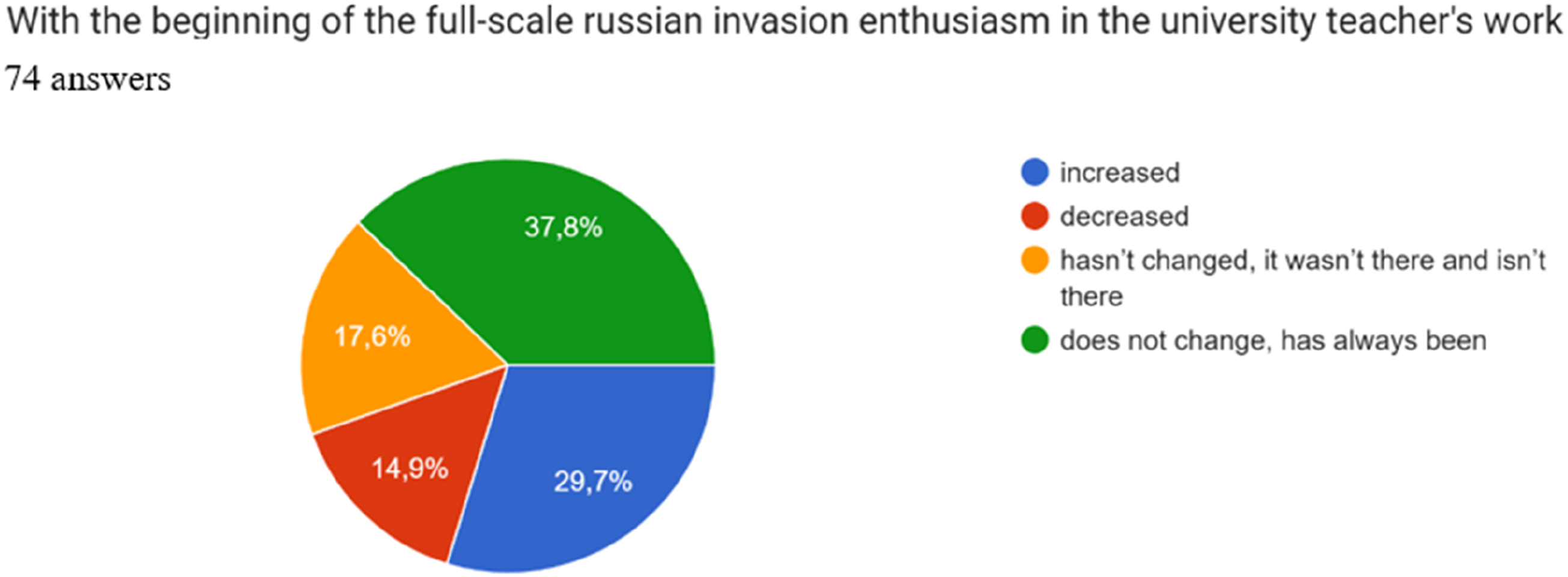
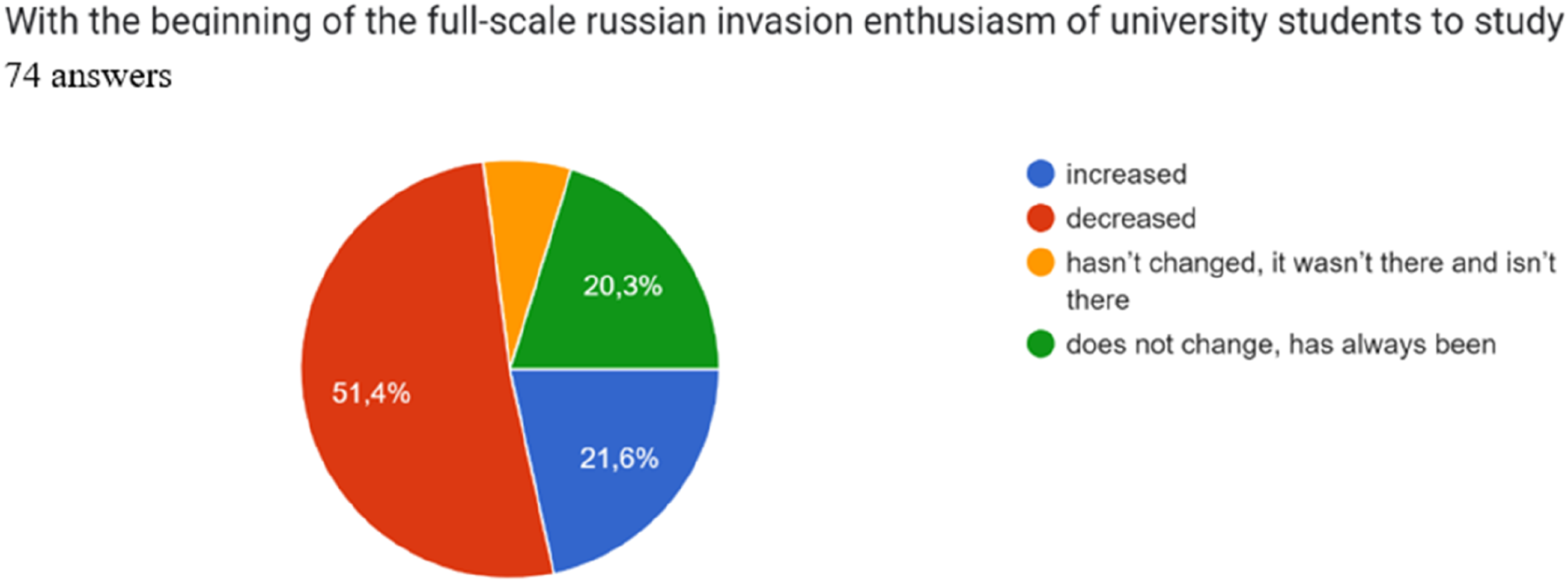
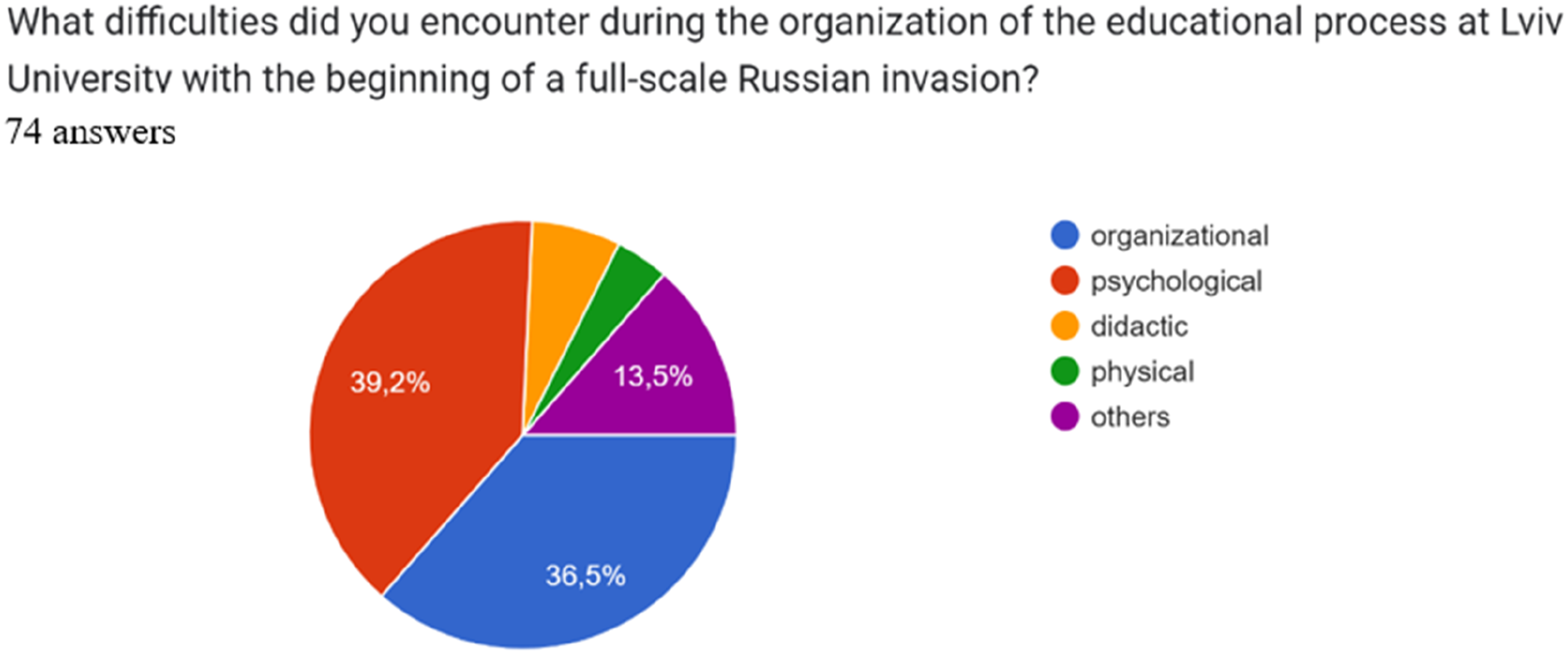
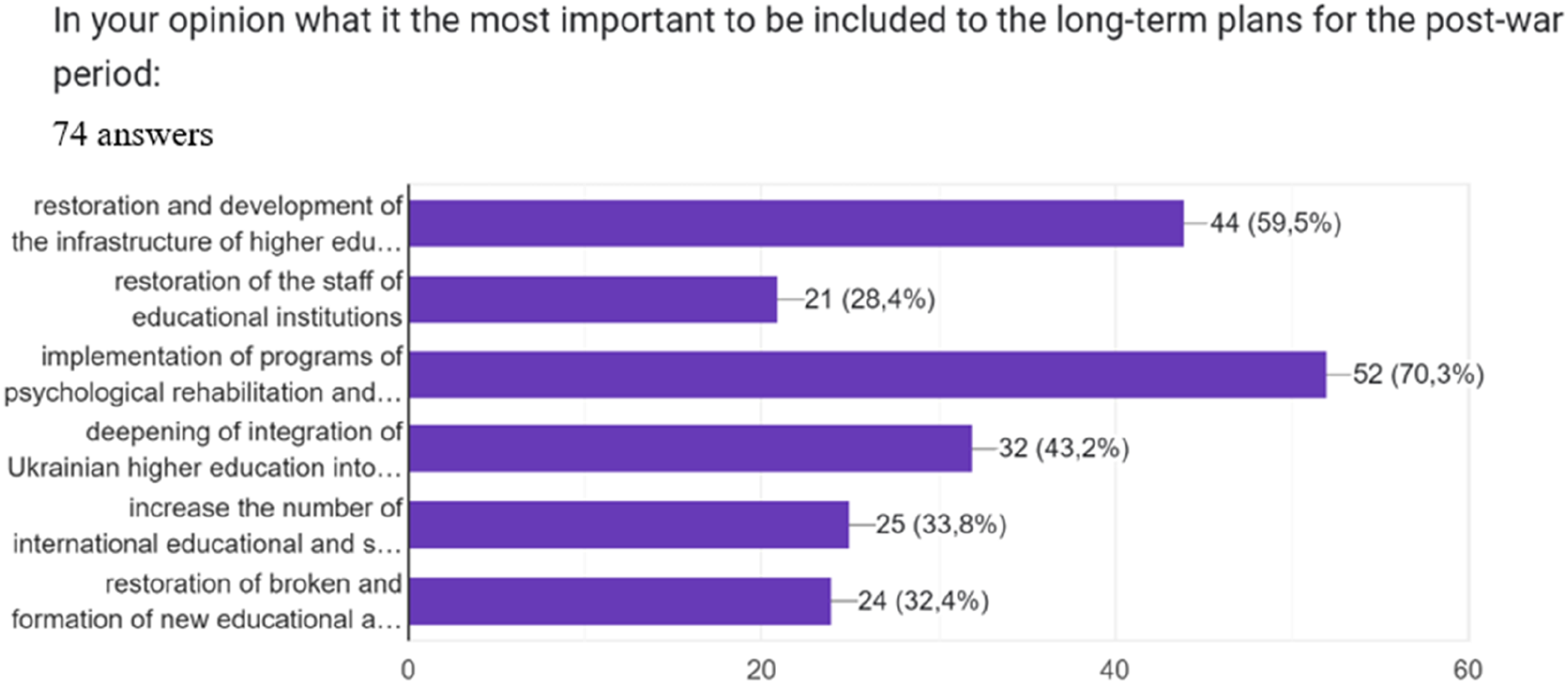
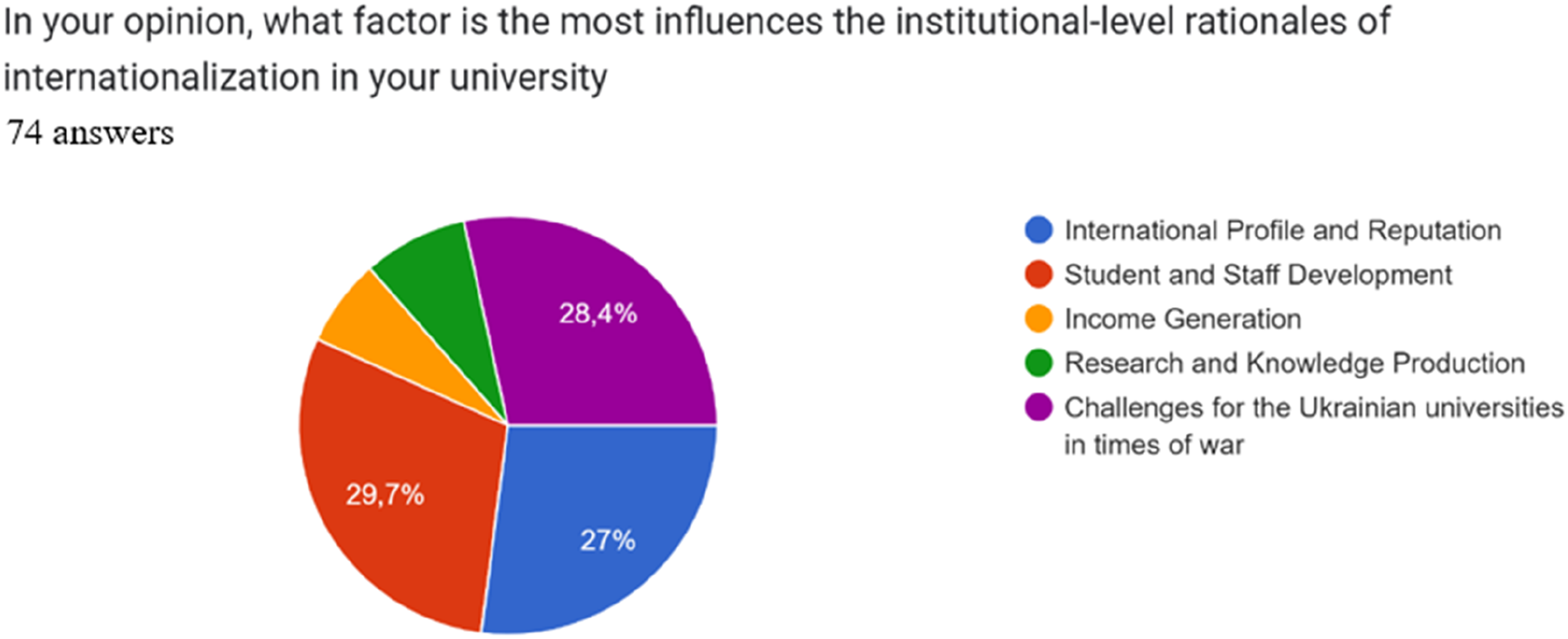
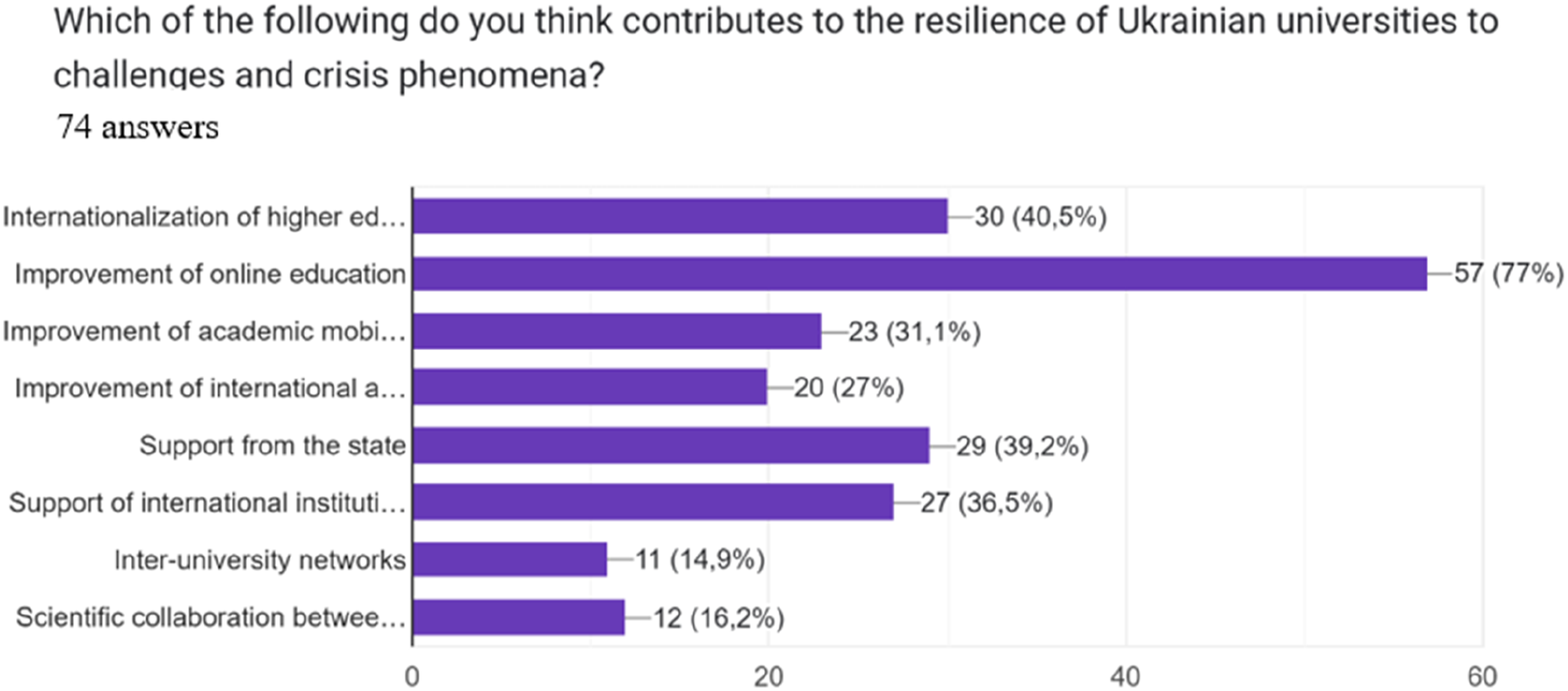
Emphasis was placed on two groups of questions. The first group of questions concerned the priorities in the work of a Ukrainian university in the conditions of Russian military aggression and psychological changes among teachers and students. The second group of questions related to students’ assessments of the difficulties in organizing the educational process in the conditions of a full-scale Russian invasion; the most important issues, in the students’ opinions, for inclusion in the prospective long-term plans of Ukraine for the post-war period; issues of internationalization of higher education; and the resilience and sustainability of Ukrainian universities in the face of challenges and crisis phenomena. Some of the obtained results, the most important for the problems analyzed in this study, are presented in the diagrams of Figures 1–7. Priority in the work of the Ukrainian university during the wartime (image developed by the author). Enthusiasm in the university teachers’ work with the beginning of the full-scale Russian invasion of Ukraine (image developed by the author). Enthusiasm in the university students’ study with the beginning of the full-scale Russian invasion of Ukraine (image developed by the author). Difficulties during the organization of the educational process with the beginning of a full-scale Russian invasion (image developed by the author). The most important issues to be included to the long-term plans of Ukraine for the post-war period (image developed by the author). Factors of the institutional-level rationales of higher education internationalization (image developed by the author). Ensuring the resilience of Ukrainian universities to challenges and crisis phenomena (image developed by the author).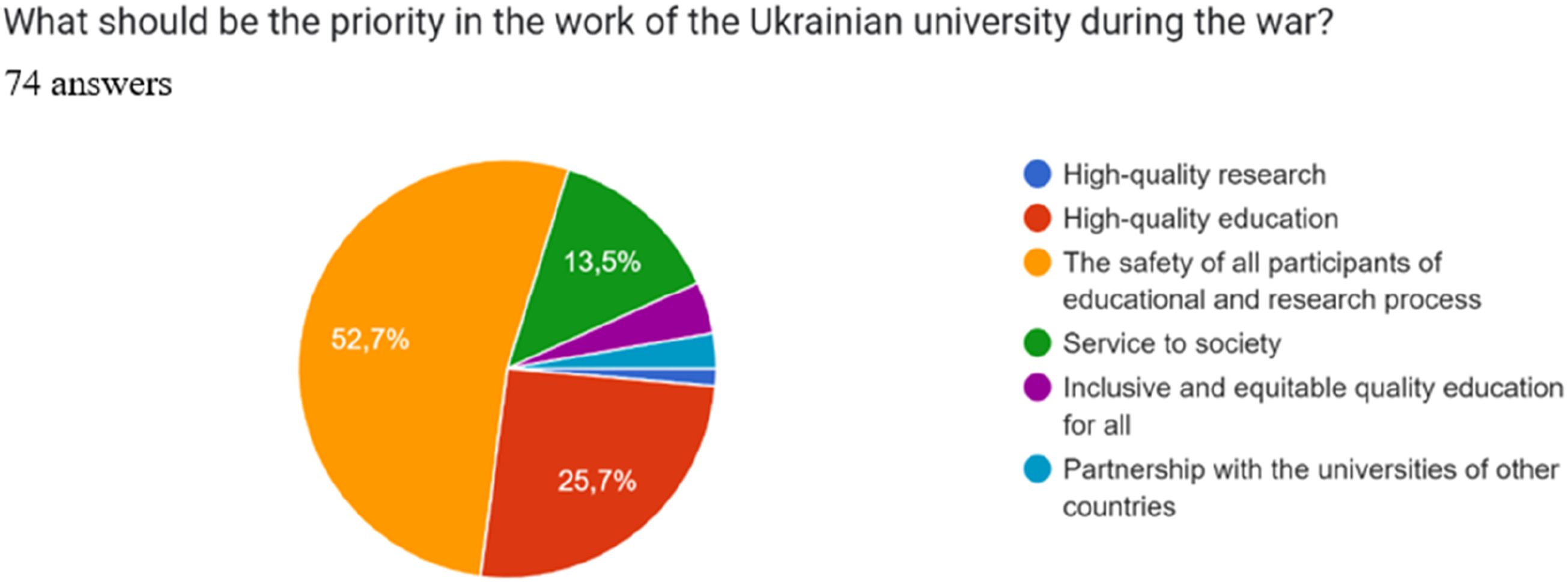
As we can see from the data in Figure 1, most of our students, namely 52 %, consider the safety for all participants of educational and research process to be the priority of the work of a Ukrainian university during the wartime, 25 % of students consider high-quality education to be the priority, and 13 % consider that service to society is important. The priority for safety is obvious in the current wartime conditions. The other two positions show the contribution that the university, under difficult wartime conditions, makes to ensure quality education as well as to ensure its ‘third mission’, societal development.
As for the psychological impact, as a measure of which I chose the change of enthusiasm in the university teachers’ work and university students’ study significant differences can be very clearly traced here. Thus, the majority (37.8%) of the students who took part in the survey believed that with the beginning of the full-scale Russian invasion of Ukraine, the enthusiasm of Ukrainian university teachers to fulfil their professional duties and ensure the educational process has not changed. In addition, almost a third of respondents (29.7%) believe that their enthusiasm has even increased. And only about one in six respondents (14.9%) believe that this enthusiasm has decreased (Figure 2).
At the same time, more than half of the surveyed students (51.4%) believe that the enthusiasm of university students to study has decreased, and an approximately equal but much smaller number believe that this enthusiasm has not changed or even increased – 20.3 and 21.6%, respectively (Figure 3). This once again confirms the idea that the professional educational activity of a university teacher is an important component in achieving the stated Sustainable Development Goals. The current situation imposes an even greater responsibility on the university teacher, who must be involved not only in the educational activities of students but also help them psychologically.
As we can see, the above view is also confirmed by the survey data presented in Figure 4. Students believe that the difficult psychological state of the participants in the educational process is one of the most serious problems that create obstacles for ensuring the quality of education (39.2% of respondents). A slightly smaller number (36.5%) consider organizational problems of the process of quality education in the conditions of military aggression to be the most serious problem. In total, this is a vast majority (more than three-quarters) of the respondents.
Considering the students’ assessment of the difficulties during the organization of the educational process with the beginning of a full-scale Russian invasion (Figure 4), their assessments of the most important issues for inclusion in the perspective long-term plans of Ukraine for the post-war period, shown in the diagram of Figure 5, seem reasonable. Note that when answering this survey question (this also applies to the diagram in Figure 7), students could choose several of the most important issues in their opinion from the proposed answers, unlike the questions presented in the previous diagrams.
Thus, more than 70% of the surveyed students believe that the most important issues that should be included in the long-term plans of Ukraine for the post-war period is the implementation of programmes of psychological rehabilitation and adaptation for participants of the educational process. Also, more than half of the respondents (59.5%) consider that one of the most important tasks is restoration and development of the infrastructure of higher education institutions destroyed by Russia’s armed aggression. It is also significant that the next issue after these two, according to the students, is that the government of Ukraine should pay attention to deepening of integration of Ukrainian higher education into the European higher education and scientific space after victory in the war (43.2% of respondents).
In deepening the integration of Ukrainian higher education into the European higher educational and scientific space, an important role belongs to the internationalization of higher education, the institutional-level rationales of which, according to the students, are justified by the needs for the student and staff development, as well as the challenges for the Ukrainian universities in times of war (Figure 6).
The internationalization of higher education, along with support from the state and international institutions, is also considered by a large part of the surveyed students (40.5%, 39.2%, and 36.5%, respectively) to be the basis of the resilience of Ukrainian universities to challenges and crisis phenomena (Figure 7). But a majority of surveyed students (77%) consider online education and its improvement to be the most important factor that allows ensuring this resilience and sustainability (Figure 7).
Joint global classroom as a tool for ensuring quality higher education based on a developed partnership
In the context of the response to new global higher education realities, which require the implementation of new ideas, new formats, and new motivating educational activities, I would like to share my personal teaching experiences in practical implementation of the results of the internationalization of higher education, which is based on a developed partnership, to ensure quality higher education, motivate students, integrate all participants of educational process, and achieve Sustainable Development Goals. For this goal, one of the programme strategies of internationalization at the institutional level was implemented, namely the Joint Global Classroom.
The global classroom is an international interactive online class where students at different universities, from different countries or even continents, while at their home university, gained global experience, studied together, and communicated online in a friendly atmosphere and multilingual environment. E. Tsui defines the global classroom as a collaborative online international learning environment and a learning space that fosters co-learning, collaboration, sharing, and co-creation of deliverables among its participants. The global classroom offers a refreshing and impactful learning experience for all participants and can help students acquire much-needed skills in the 21st century, enhancing their communication, critical thinking, collaboration, and presentation skills (Tsui, 2023).
I believe that the global classroom format contributes to the achievement of the goals of sustainable development in maintaining and ensuring educational quality and the further development of professional and personal skills of students; and partnerships play a decisive role in its implementation, especially during wartime, when it is important to increase the educational and scientific potential of Ukraine and cooperate with international partners. Therefore, I implemented and have continued a series of international online interactive classes, launched during the COVID-19 pandemic for students at the Ivan Franko National University of Lviv, in cooperation with colleagues from the University of Manitoba (Winnipeg, Canada). On April 20, 2022, I organized the global classroom in collaboration with a long-time research partner, Iryna Konstantyuk from the Department of German and Slavic Studies at the University of Manitoba, as part of a series of international interactive online classes (Faculty of Pedagogical Education, 2022). The global classroom was organized with the participation of the students of the Faculty of Philology of the Ivan Franko National University of Lviv within the seminar on pedagogics, and the students of the Faculty of Arts of the University of Manitoba, who study Intermediate Ukrainian. Class was held in the form of open dialogue, in a friendly informal atmosphere and multilingual environment, and students, while in their home universities, studied together, communicated online, and found positions for future educational cooperation after the victory of Ukraine.
Discussion
The analysis above allows us to highlight the following. During the period of independence since 1991, Ukraine has made significant efforts to raise its higher education system to a new level of quality, meet prerequisites for joining the European higher education space, and develop international research projects that help achieve democratization and the goals of sustainable development of society. The movement towards transparency and cooperation has been steadily increasing. To illustrate this, it is enough to look at the data about the mobility of students from Ukraine to the EU and back under the Erasmus+ programme in the pre-war years, presented in the Background section.
But the sustainable development of society is challenged in warzones. Therefore, all the positive results achieved in the previous period faced the threat of damage and destruction by Russia’s barbaric military invasion of Ukraine on February 24, 2022. As mentioned, in the first days of the invasion, this caused a stoppage in the work of the system of education, which temporarily paused providing educational services at all. But it quickly began to recover. In a short time, less than 3 weeks, the main answer to the question of how to continue fulfilling educational missions in new circumstances was found. This applies to both those who remained in their pre-war places of residence and to those who were forced to move to safer areas of Ukraine or abroad. The online learning system became a very helpful resource. Ukrainian universities were well prepared to make use of online learning and used experience gained during the COVID crisis to the full extent. However, war has affected educational delivery more than COVID. The occupation of part of Ukrainian territory, constant threats of missile attacks on the territory that remains under Ukrainian control, and the destruction of the educational, communication, and energy infrastructure significantly complicated the organization of the learning process, even online. But most students had been involved in the educational process virtually, and thus, the higher education system, in accessibility and continuity, was preserved. This is probably what explains why online education and its improvement emerged as the most important factors for ensuring the resilience of Ukrainian universities to challenges and crisis phenomena. It was ranked first among all factors by the majority (77%) of students who participated in the survey (Figure 7). This allows us to highlight that Ukrainian universities correctly and reasonably responded to the challenges of Russian military invasion, and their experience can be useful for other countries facing existential threats.
Preservation of higher educational institutions located in temporarily occupied territories was another factor that played a very important role in the adaptation of the higher education system in Ukraine to the realities of the Russian military invasion. Their preservation, to one degree or another, became possible due to their relocation to territories controlled by Ukraine. This provided an opportunity both to preserve the potential of highly qualified teaching staff and to ensure the continuation of education for many students within their home educational institution, working not within the universities’ own walls but with its own institutional identity in another territory. This is especially important for students, according to our survey, as they called the psychological state of students and teachers the most serious obstacle to ensuring the quality of education during wartime.
One more factor that made it possible to ensure quality higher education in Ukraine in times of war is the global developed partnership. In the conditions of wartime Ukraine, partnerships took diverse forms. First, these are specific initiatives from international institutions that were created to support the Ukrainian higher education system at various levels (analyzed above). International partner programmes had and still have a significant positive impact. As a part of a global partnership that promotes joint learning, collaboration, sharing, and co-creation of deliverables among its participants, I also consider joint international online training and the organization of an educational space in the form of a global classroom.
Concluding our discussion, I summarize the main messages that follow from the results of the survey of the Ivan Franko National University of Lviv, which lasted from May to December 2023, during the period of Russian full-scale invasion of Ukraine, after more than a year of war. First, let’s pay attention to the students’ answers to the question about enthusiasm in the university teachers’ work with the beginning of the full-scale Russian invasion of Ukraine. More than two-thirds of respondents answered that it remained the same, or even increased (Figure 2). In our opinion, this clearly shows that during a full-scale war, Ukrainian higher education institutions, finding themselves in the epicentre of hostilities and suffering from attacks and bombings by the Russian army, give a confident and clear response to this new situation, maintaining a constant commitment to their long-term academic role. At the same time, more than half of the surveyed students believe that university students’ enthusiasm to study has decreased since the beginning of full-scale Russian aggression (Figure 3). Only every fourth student considers high-quality education to be a priority for the work of Ukrainian universities during wartime (Figure 1). The largest number of respondents (39.2%) consider the difficult psychological state of the participants in the educational process as the most serious problem that creates obstacles to ensuring the quality of education (Figure 4). Thus, we must state that the issue of quality education in the conditions of war goes to the second position from the students’ point of view. The issue of safety for all participants in the educational and research process comes to the first position. Most of the surveyed students, namely 52 %, consider this issue to be the priority of the work of a Ukrainian university during wartime (Figure 1). Obviously, this is a natural decision – you first need to survive. What should be done as a priority then, after the war, according to the students, follows from their answers to the question – what is the most important to be included to the long-term plans for the post-war period. More than 70% of the surveyed students believe that it should be the implementation of programmes of psychological rehabilitation and adaptation for participants of the educational process. Almost 60% of the respondents consider restoration and development of the infrastructure of higher educational institutions destroyed by Russia’s armed aggression to be one of the most important tasks. Further, 43.2% of respondents consider deepening the integration of Ukrainian higher education into the European higher education and scientific spheres to be an extremely important task after victory in the war. This clearly shows the desire of the young generation of Ukrainians to achieve Sustainable Development Goals, specifically ‘Quality education’ and ‘Partnership for the goals’ that are being so barbarically destroyed by Russia’s military invasion.
Conclusions
Russia’s full-scale military invasion on February 24, 2022, and the war it has been waging against Ukraine since then have caused enormous damage to all areas of human life in Ukraine, including the educational process. In the research, I provide irrefutable evidence of the mass destruction of educational institutions, and the educational process in general, in Ukraine. I also highlight the efforts that Ukraine is making at all levels – national, institutional, and individual – to minimize the consequences of the destructive impact of Russia’s military aggression on the educational process and to ensure sustainable development of inclusive and equal-access quality education in Ukraine in times of war.
The research identified the main tools that Ukraine used to show resilience. Among them, most importantly, was the improvement and wide use of the online education system. Relocating higher educational institutions from the occupied territories to the territories controlled by Ukraine also proved successful. In conditions of war, the higher education system of Ukraine is working to ensure the stability and continuity of learning and teaching, to create safe conditions for teachers and students, and to support those who were forced to leave for relatively safer regions of Ukraine or abroad. I also place special emphasis on the importance of support from international institutions and partnership programmes with foreign universities as part of the Sustainable Development Goals agenda in the context of partnership for the goals. I listed and analyzed specific initiatives of international institutions initiated to support the Ukrainian higher education system at various levels, in particular those begun as part of the EU’s response to the Russian invasion of Ukraine.
Analysis of the survey data of students from the Ivan Franko National University of Lviv, which I held at the time of Russian aggression in Ukraine from May to December 2023, allowed me to determine the priorities of Ukrainian universities during wartime. From the point of view of students, as participants in the educational process, the top priorities were the safety of students and staff and ensuring continuity in quality education. Students reported that the most serious obstacles to ensuring quality education were the psychological states of participants and organizational issues caused by the military aggression. Analyzing the experience of classes in the joint global classroom, I show that this format can be an effective additional measure in maintaining interest and ensuring the quality of higher education in the difficult conditions of war. A developed partnership plays a decisive role in its implementation.
I am also confident that the practical experience gained by higher education institutions in Ukraine under the conditions of Russian military invasion can be useful for other countries facing existential threats.
Footnotes
Declaration of conflicting interests
The author(s) declared no potential conflicts of interest with respect to the research, authorship, and/or publication of this article.
Funding
The author(s) disclosed receipt of the following financial support for the research, authorship, and/or publication of this article: This work was supported by the British Academy and Cara.
