




Abstract
For those who focus on the role of education in international development, the approach to education governance of school-based management (SBM) has been the primary means by which the participation of community members has been incorporated into the provision of education. However, while SBM is a well-known approach to governance that has become a global education policy, in that it is widely promoted, adapted, and implemented, a trend that stands out—and which is addressed in this paper—is the use of, and reference to, SBM in work on conflict-affected contexts (CACs). Indeed, there has been insufficient attention directed at understanding how SBM is advocated in these contexts. Our intention is to use the present paper as a point of departure for further discussion on issues that arise in relation to the intersection of SBM and CACs. With that in mind, we seek to characterize the extent to which international organizations espouse support for SBM, particularly when it comes to its applicability in CACs; to review the rationales that are invoked in favor of this governance model, again with a focus on CACs; and to highlight important areas for future research.
Keywords
Since at least the 1980s, “participation” has been a buzzword in international development (Leal, 2007). One significant boost for the idea of participation came from the World Conference on Education for All in 1990. The resulting declaration from this conference emphasized that governments, organizations, the private sector, local communities, and families should all work together in the provision of education (Bray, 2000). For those who focus on the role of education in international development, the approach to education governance of school-based management (SBM) has been the primary means through which the participation of community members has been incorporated into the provision of education (Edwards, 2012; Edwards and DeMatthews, 2014). However, while SBM is a well-known approach to governance that has become a global education policy, in that it is widely promoted, adapted, and implemented (Barrera-Osorio et al., 2009), a trend that stands out to us—and which we wish to address in this paper—is the use of, and reference to, SBM in work on conflict-affected contexts (CACs).
To our minds, there has been insufficient attention directed at understanding the ways in which SBM is advocated in these contexts. Our intention is to use the present paper as a point of departure for further discussion on issues that arise in relation to the intersection of SBM and CACs. With that in mind, we seek: (a) to characterize the extent to which international organizations espouse support for SBM, particularly when it comes to its applicability in CACs; (b) to review the rationales that are invoked in favor of this governance model, again with a focus on CACs; and (c) to highlight important areas for future research. The first two sections of the paper address each of the first two purposes, while the final section points to a range of issues that scholars and practitioners should consider going forward when it comes to conceptualizing, researching, and implementing SBM in CACs.
However, before proceeding, it is important to address the issue of terminology, particularly so because both of the key terms in this paper—SBM and CAC—can refer to various phenomena. For SBM, we find the definition provided by the World Bank to be useful: While some programs transfer authority only to school principals or teachers, others encourage or mandate parental and community participation, often in the form of school committees. Most SBM programs transfer authority over one or more activities. These could be: budget allocation; the hiring and firing of teachers and other school staff; curriculum development; the procurement of textbooks and other educational material; infrastructure improvement; and the monitoring and evaluation of teacher performance and student learning outcomes (World Bank, 2007: 3).
1
Importantly, this definition highlights school committees, which are often the primary vehicle through which SBM manifests. This definition also indicates the wide range of tasks that could be transferred to, or emphasized under, SBM arrangements. In addition, in that this definition includes an emphasis on community participation via school committees, SBM is taken to encompass community-based management, which was particularly popular in the 1990s and that focused more exclusively on community management of schools and teachers via school councils made up of local parents who were responsible for hiring and firing teachers, among other things (Edwards, 2018). 2
For CACs, our definition is adapted from Novelli et al. (2014) in that our usage of the CAC terminology refers to those contexts and countries that have been affected by civil conflict or war. In order to identify CACs, we referred to the list included in UNESCO (2011: 138), which notes country contexts where violent conflict was present during 1999–2008. 3 Given that this list does not extend before 1999, we supplemented it, based on the review by Edwards and DeMatthews (2014) of SBM in the post-WWII context in developing countries. Lastly, we also referred to those countries where there are “peace-building” and “peace-keeping” missions, according to the 2016 “Harmonized List of Fragile Situations,” produced by the World Bank. This latter source was useful in that it provided an indication of CACs beyond 2008, the year up to which the UNESCO (2011) source extended.
In terms of methods, the findings presented in the sections that follow were generated by systematically searching for the names of key multi- and bilateral organizations together with the phrases “school-based management” and “community-based management.” The organizations included in the search are those known to be integral actors in the field of global education policy (Jakobi, 2009). 4 We also searched for the Inter-Agency Network for Education in Emergencies (INEE) as well as the Global Coalition to Protect Education from Attack, and the Global Facility for Disaster Reduction and Recovery, because of their relevance to the focus of this research. In our searching, we downloaded and reviewed all documents related to organizational policy and strategy in addition to publications and project documents related to SBM. Our search was broader than the findings reported here; as such, the present paper is seen as the first output of an ongoing research project.
Support for SBM in CACs from international organizations
As noted above, SBM has been a preferred education reform in the field of international development for many years, but particularly since the 1990s (Daun and Mundy, 2011; Edwards, 2012). It is thus not surprising that a range of multilateral and bilateral organizations support this reform in one way or another. Taken together, the collective support given by these organizations—and the extent to which SBM is implemented around the world—make it a global education policy. Table 1 summarizes the findings regarding support from international organizations for SBM generally and SBM in CACs specifically.
International organization Support for school-based management
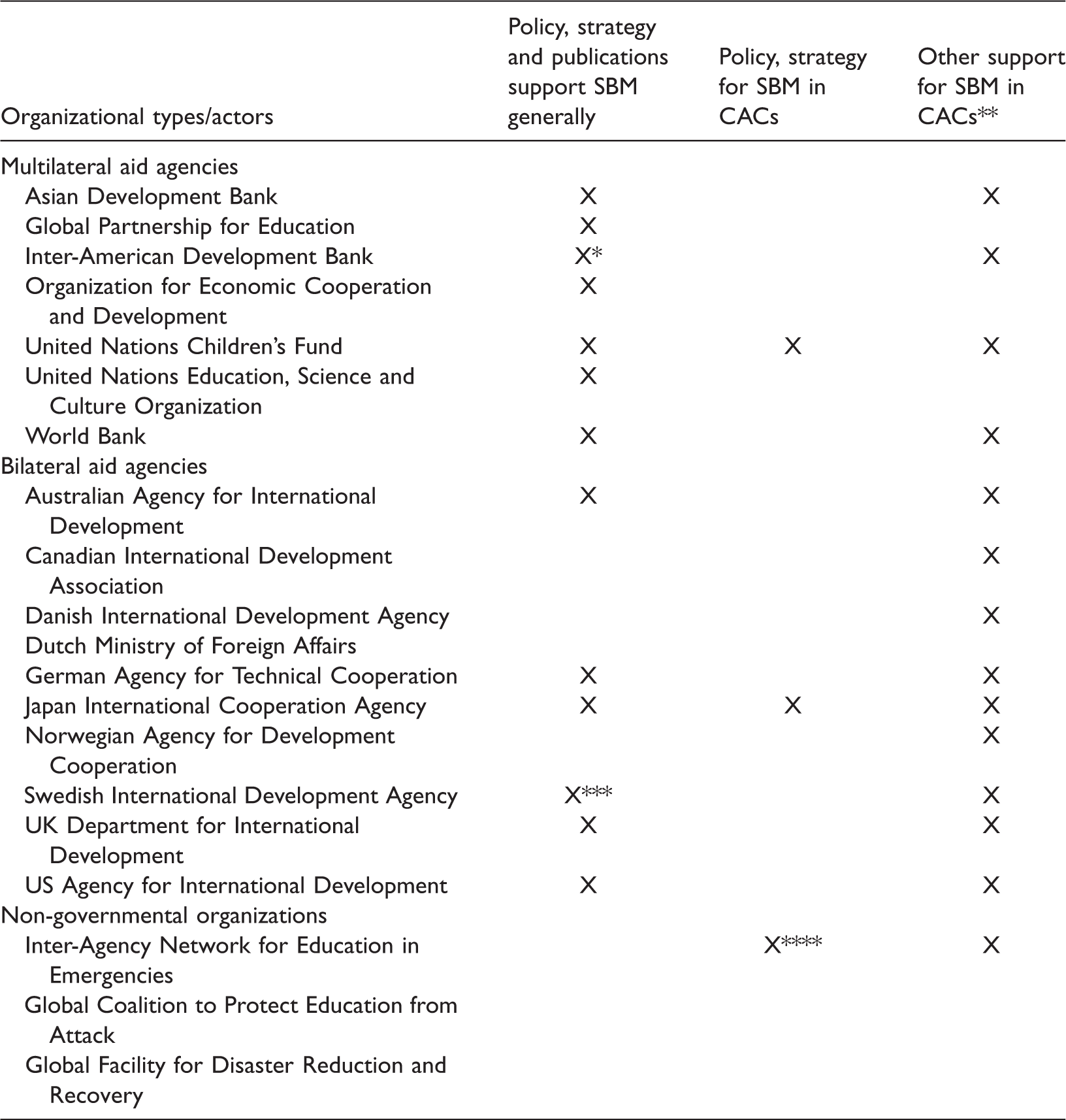
Note: *Indicates that general support is stated in a policy or strategy document, as opposed to other form of publication. **Other forms of support in CACs include research on SBM in CACs; publications that address SBM in CACs; and SBM project implementation, financing, or technical assistance in CACs. ***This organization has provided funding to UNESCO to support a SBM publication. ****Refers to the INEE minimum standards.
Source: Authors.
To gain a sense of the global nature of SBM’s prevalence, consider the following examples. First, when it comes to explicit statements of policy or organizational strategy related to SBM, there are many influential actors that can be mentioned, such as the World Bank (2005), the Inter-American Development Bank (IADB, 2000, 2014), the UK Department for International Development (2001, as cited in Daun and Mundy, 2011), the German Society for International Cooperation (Bergmann, 2002; GIZ, n.d.), and the United States Agency for International Development (USAID, 2011). Other international organizations, while they do not include SBM as a policy priority, contribute to the high profile of this governance strategy by producing (or contributing to the production of) research and numerous publications about it, including the Global Partnership for Education (Simao et al., 2014); United Nations Education, Science and Culture Organization (see, e.g., Abu-Duhou, 1999; Caldwell, 2005; de Grauwe, 2004; Shoraku, 2008), the Organization for Economic Cooperation and Development (OECD, 2013), the Australian Agency for International Development (Parandekar, 2014; Westhorp et al., 2014), and the Swedish International Development Agency (Abu-Duhou, 1999).
Perhaps the most prominent international organization in the global education policy field—the World Bank—not only includes SBM in its policy but has also produced an extensive array of publications related to this reform (Edwards, 2012), in addition to supporting its implementation in practice. On this last point, it stands out that 48% of World Bank projects during 2001–2005 and 78% of projects during 2006–2009 included funding for SBM (World Bank–IEG, 2010). If nothing else, there should be no doubts about the status of SBM as a global education policy.
With the above in mind, the question becomes: What can be said about the promotion of SBM in CACs specifically? Here, what first needs to be said is that none of the international organizations mentioned previously suggest that SBM should not be implemented in CACs. Put differently, SBM is seen as being relevant to all contexts. In practice, then, international organizations are open to supporting SBM in non-CACs and CACs alike. Indeed, as Table 1 shows, there are many (n = 11) international organizations that do not have an explicit policy for supporting SBM in CACs, yet they can be found to contribute to SBM in these very contexts in one form or another. These forms of support are noted in the furthest right column in Table 1 and include research on SBM in CACs; publications that address SBM in CACs; and SBM project implementation, financing, or technical assistance in CACs. Future research should not only systematically map where, within and outside CACs, key multi- and bilateral organizations engage with SBM, but should also detail the forms of support provided and with what impacts and implications.
At present, however, we note that there is a subset of three international organizations that do show support for SBM in CACs specifically. The Japanese International Cooperation Agency (JICA) is one example. The position paper for this organization on international cooperation in education states, “JICA will support building a quality learning environment through SBM programmes in countries and regions affected by conflicts for many years including refugee-hosting countries” (JICA, 2015: 15). JICA has realized this commitment by supporting SBM in such CACs as Cote d’Ivoire, Nepal, Philippines, and Yemen (not to mention additional non-CACs).
The most prominent organization to support SBM in CACs is the United Nations Children’s Fund (UNICEF), a fact that should come as no surprise given that UNICEF has a focus on education in emergency settings. A recent report by UNICEF indicated that, in 2015, it dedicated US$321 million to supporting education in emergency settings; the same report states that, with UNICEF support, there are 62 countries that have achieved functional school management committees, though not all of these countries are conflict-affected (UNICEF, 2016). With regard to the intersection of SBM and CACs, UNICEF has supported this approach in at least Bosnia and Herzegovina, Cambodia, East Timor, Ethiopia, Haiti, Indonesia, Iraq, Kosovo, Myanmar, Nepal, Nigeria, Palestine, the Philippines, Sri Lanka, South Sudan, Syria, Thailand, and Yemen.
The primary approach through which UNICEF articulates SBM is known as “Child Friendly Schools,” which focuses on incorporating “the concept of Child Rights into classroom practice and school management” (UNICEF, 2006: 1). There is an emphasis in the guiding principles for Child Friendly Schools on enabling “student, family, and community participation in all aspects of school policy, management and support to children” (UNICEF, 2006: 1). As of 2015, Child Friendly Schools represented the largest part of UNICEF’s budget, accounting for US$127 million (UNICEF, 2016).
One must also mention the link between SBM and the INEE. This network is not a funding agency but, rather, it creates standards and guidelines for the provision of education in emergency settings. INEE (2010) cautions against SBM without a nuanced and holistic understanding of the local context while also issuing “good practice guides” on community education committees (INEE, 2003a)—which, in their formulation, include school management committees—and on community participation in the development of education programs (INEE, 2003b). 5 The fact that INEE focuses on community participation should not come as a surprise, because community participation is a “minimum standard” for education in emergencies and post-conflict settings (Anderson et al., 2006). Moreover, as Anderson et al. (2006) noted in their review of the INEE standards, “community participation is a well-accepted principle, and is part of most organisation’s own standard sets,” a comment that leads to the question of what rationales are employed in order to justify SBM.
Rationales for SBM in CACs
Political scientists have discussed decentralization in relation to CACs. They note, for example, that decentralization: (a) can alleviate conflict by providing political channels through which issues can be resolved; (b) can lead to greater local control over matters that affect the lives of individuals and thus can give assurances to minority groups that their concerns will be addressed; and (c) can entail the provision of resources to local governments in order to address those concerns (Murshed et al., 2009; Siegle and O’Mahony, 2006). 6 However, for our purposes what stands out about the literature from political science is that scholars focus on decentralization in the sense of federalist government or decentralization to regional, state, district, or municipal levels. 7 Neither the community or school level, nor the role of education, factors into how political scientists discuss decentralization in CACs. 8
In contrast, in the field of international development there are many organizations that focus on the role of education and the community, but without situating this discussion in relation to conflict. The World Bank has, for the most part, been one such actor;
9
it has also been a leader in the area of SBM. Since the 1980s the World Bank has continually looked for ways to incorporate communities and schools into the governance of the education sector, as part of its belief that central control is inefficient, ineffective, and lacks accountability. Over time, this organization has produced an incredible number of publications on decentralization generally and SBM specifically (Edwards, 2012). A publication from 2007 on guiding principles for SBM summarizes a range of rationales for SBM. As this publication states, SBM can lead to:
More input and resources from parents (whether in cash or in kind); More effective use of resources, since those making the decisions for each school are intimately acquainted with its needs; Better quality education, as a result of the more efficient and transparent use of resources; A more open and welcoming school environment, because the community is involved in its management; Increased participation of all local stakeholders in decision-making processes, leading to a more collegial relationship and increased satisfaction; and Improved student performance, as a result of reduced repetition rates, reduced dropout rates and (eventually) better learning outcomes (World Bank, 2007: 2).
Although, as the World Bank (2007) notes, the reasons for pursuing SBM are many, this organization has primarily tended to focus in its publications on the potential of SBM to lead to improved outcomes (e.g., higher student achievement) as a result of community-level participation and accountability in school management (Edwards, 2012): SBM is also discussed, albeit to a lesser extent, as being more efficient than centrally-controlled schools (Edwards and Klees, 2015). Perhaps the most well-known example of the World Bank’s approach to SBM is the World Development Report 2004, which focused on “making services work for poor people” (World Bank, 2003). In the education sector, the World Development Report 2004 portrayed SBM as the primary means for improving services, because it represents a “short-route” to accountability in that citizens can participate directly in their schools through school councils, which (ideally) are able to hold teachers accountable for the education of their children. The short-route of accountability contrasts with the long-route, which requires participating in longer, slower, and further-removed political processes in order to improve education (World Bank, 2003).
In their policy statements, other international organizations share the focus of the World Bank on outcomes and accountability. Examples include the Inter-American Development Bank (IADB, 2000), the UK Department for International Development (2000, as cited in Daun and Mundy, 2011), and the US Agency for International Development (USAID, 2011). One international organization that adopts a different perspective, in part, is the German Society for International Cooperation, that emphasizes SBM’s promise for garnering labor and donations from communities (as does the World Bank) as well as for engendering greater commitment to education from parents, more support for student learning, enhanced democratic decision-making, and greater involvement in political processes at other levels (GIZ, n.d.).
With regard to an explicit focus on SBM in CACs, there are again three organizations of relevance: JICA, UNICEF, and INEE. Beyond working on SBM in CACs, it is also clear that these organizations discuss SBM differently; that is, in ways that do not discuss SBM primarily in relation to teacher accountability, student achievement, and system efficiency, as the World Bank does. While JICA’s policy on SBM in CACs was quoted in the previous section, we note here that JICA conceives of SBM within its broader approach to supporting education in development, labeled “School for All.” This approach was announced in 2010 and entails a focus on holistic improvement of the learning environment by combining …measures for quality improvement (teacher education, lesson studies, and textbook provision), safe and conducive learning environments, school-based management, schooling for community, and inclusive education. (Yoshida, 2015: 62)
For JICA, SBM is thus one strategy for achieving inclusive and quality learning environments, with these environments themselves being one way of achieving inclusive and peaceful societies, which is the overarching focus of JICA (2015).
UNICEF is the second organization of relevance, given that it also focuses explicitly on SBM in CACs. Not unexpectedly, UNICEF’s approach to SBM is embedded in its own approach to development that underscores the rights of the child (as stated in the 1989 United Nations Convention on the Rights of the Child) and that entails a greater focus on equity. As noted earlier in this paper, UNICEF’s work on SBM is embodied in the model of Child Friendly Schools, which strive to be proactively inclusive; academically effective and relevant; healthy and safe for, and protective of, children; gender-responsive; and actively engaged with, and enabling of, student, family, and community participation in all aspects of school policy, management and support to children (UNICEF, 2006). The ultimate goal of Child Friendly Schools is not only to “equip children with basic learning skills but also to enable them to take control of their lives and to promote justice, democracy, peace and tolerance” (UNICEF, 2007: 66). Within this vision, SBM—through school management committees—is seen “as a gateway to helping communities sustainably assure the quality learning environments of their own children” (UNICEF, 2016: 4), as well as a way that “the most vulnerable groups and communities can be given a voice in school management and decision-making processes” (UNICEF, 2016: 66).
Finally—and unsurprisingly—the INEE is focused on how to address education in contexts of crisis. Broadly, education in emergency situations can help to address …the psychosocial needs of children and adolescents affected by trauma and displacement, the need to protect them from harm, and the need to maintain and develop study skills and disseminate key messages such as how to avoid HIV/AIDS, landmine awareness, environmental education and education for peace and citizenship. (Sinclair, 2001: 1)
Given the dire contexts for which INEE guidelines are developed, the approaches to education encouraged by INEE necessarily focus on how to mobilize any and all resources, how to make progress quickly, and how to build capacity and trust along the way. Accordingly, the rationales for community education committees highlighted by INEE—and summarized in Table 2—clearly respond to these larger issues. As can be seen, rationales given by INEE for SBM include its potential for building trust, promoting common interests, ensuring culturally sensitive education, serving the most marginalized, developing local empowerment, mobilizing local resources, contributing to the capacity for advocacy, and learning how to protect community members, among other reasons.
INEE rationales for SBM
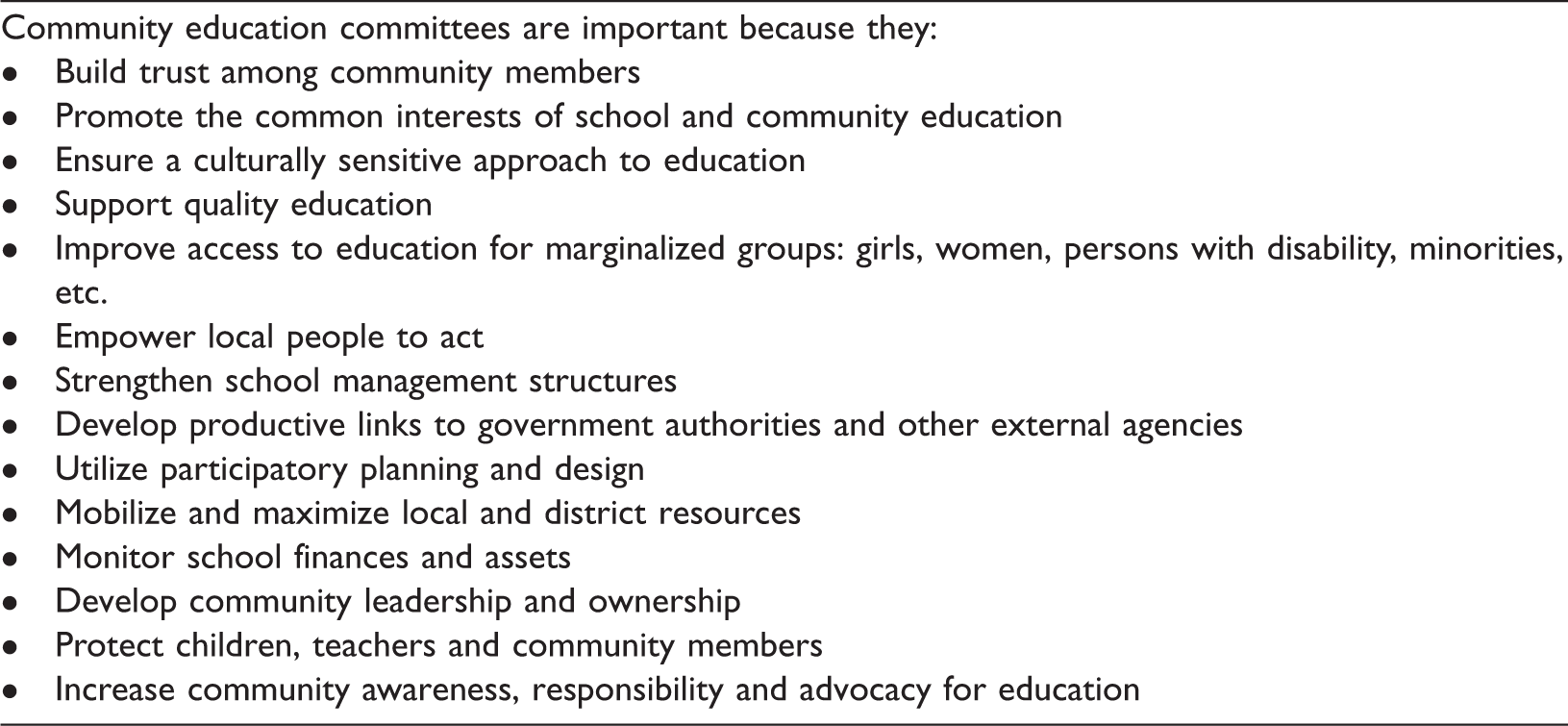
Source: INEE (2003a).
Discussion and conclusions: An agenda for future research
In characterizing the support of, and the rationales given by, international organizations for SBM both generally and in CACs, this short paper raises a number of questions and points to a number of issues that we would argue need to be further investigated. First, as suggested earlier, there needs to be a systematic analysis of project- and country-level support for SBM in CACs, the form the support takes, the kinds of SBM models implemented, and with what impacts and implications. This analysis, together with a more general review of studies on SBM in CACs, should also endeavor to identify and to hypothesize the conditions under which the implementation of SBM in these contexts leads to various outcomes, intended and otherwise. The analysis suggested here is important in light of the extensive support for SBMs in CACs indicated in Table 1. As noted there, many international organizations lack an explicit organizational policy or strategy that singles out SBM in CACs as a priority, but they still support SBM in these contexts (e.g., through technical assistance, through general budget support, through pooled funds, through multilateral trust funds, through research, and through publications). A key conclusion is that support for SBM in CACs is much greater than meets the eye: many organizations do not advertise their support for SBM in CACs and do not engage with it in ways that are easy to identify. Further research is essential for clarifying the extent and nature of the work of international organizations in this area. As part of this endeavor, scholars should be attentive as well to those organizations that were not included here, especially influential non-governmental organizations, to understand better the role they play vis-a-vis SBM in CACs.
Second, scholars need to further examine rationales to determine whether the rationales stated in global publications and in general policy and strategy documents are the same as those invoked in project and national documents. This is because, as has been shown in the case of the World Bank, the reforms advocated in public documents by international organizations do not always reflect the reforms or rationales invoked when working with counterparts at the country level (Mundy and Menashy, 2014; Verger et al., 2016). Moreover, and as with other discussions of global education policy, a relevant question is whether the rationales offered by international organizations in their general publications are consistent with the needs of the country contexts in which international organizations work. The flipside of this suggestion is that scholars need to understand the rationales and incentives of national actors for SBM in CACs. For example, while national actors may be attracted to the political sciences rationales for decentralization in CACs (see beginning of section above on “Rationales for SBM in CACs”), other reasons include enhanced political legitimacy—important for post-conflict contexts, where politicians have been shown to turn to credible global policies (Komatsu, 2013)—as well as the need (or desire) of governments to shift part of the responsibility for management to the community level (particularly in contexts of low central government capacity and low resource availability). By means of this research it would be interesting to determine if certain rationales (as promoted by dominant organizations) are driving the pursuit of SBM in CACs.
Third, subsequent research needs to note differences in design, because SBM models can vary significantly. This is especially true given that more recent forms of SBM in CACs experiment with different foci, such as, among others, the “room to read” program by USAID, school clusters, “community based education” in Pakistan, parents’ councils in Yemen for addressing gender-based violence, education management information systems for SBM, and school grants in Indonesia. Some of these examples may arguably shift away from SBM and may border on broader notions of community-based development that might not reflect the functions typically associated with SBM. As part of this focus on SBM models, scholars should be attentive to those designs that are extractive (in that they only serve to siphon resources and labor out of the community), those that are punitive (in that they use school councils to “hold the teacher accountable,” that is, to blame the teacher for outcomes that depend on much more than teacher attendance and teaching quality), and those that are genuinely empowering for the community and that contribute to their capacity building.
Furthermore, this research must consider how SBM models respond to the nature of CACs. Indeed, even for such organizations as JICA and UNICEF, which have an explicit focus on working in CACs, it is not clear how their SBM models respond to the needs of CACs. SBM is seen as being one component of working towards inclusive and peaceful societies, in the case of JICA, and towards the realization of justice, democracy, peace, and tolerance, in the case of UNICEF, but the details of the models supported are largely unaddressed in the policy statements and general publications of these organizations. 10 We must also ask about the implications of the implementation of different models, particularly when, as in the case of Yemen, there are three international organizations simultaneously implementing projects with SBM components (Yuki and Kemayama, 2013).
Extending point three, along with noting the differences in SBM models, research should also be attentive to the contradictory roots of the SBM policy, which reflects the contradictory impulses of decentralization, of which SBM is often a sub-component (Edwards and Klees, 2015). 11 That is to say that SBM has roots in both neoliberal and more equity-based approaches to education. The neoliberal argument is often underpinned by two desires: the first desire is cost-efficiency. Here, SBM is about reducing the central costs of education by passing some on to local government and eventually to local schools. The danger is that those that can least afford to contribute labor and resources are often pushed to do so, whether that be building schools, paying salaries or working for free. The second desire relates to neoliberal SBM advocate also being driven by a deep concern with the power of organized labor—for example, teacher’s unions—and these advocates wish to weaken the unions’ control or influence in the education sector. Both desires underpin a model that might work to the detriment of equity possibilities over efficiency. While these outcomes might be seen as negative in non-conflict contexts, their effects could be even worse in conflict contexts—where these types of reforms might exacerbate inequalities, regional differences, and exacerbate tensions between the state and teacher’s unions at a time when national reconciliation and coming together should be the objective. In these ways, neoliberal SBM might actually increase conflict.
In contrast, decentralization and SBM ideals are also rooted in ideas of local empowerment, community participation, recognizing difference, etc. These impulses could lead to precisely the kinds of practices that might support contexts recovering from conflict, particularly where conflict is driven by inequalities linked to ethnic, linguistic, socio-economic, or religious differences. In other words, these types of reforms might allow marginalized communities to feel as if their ideas/beliefs/values are being reflected in the local management of schools. The point here is that the devil is in the details; it is not about being for or against SBM, but what type of SBM is being considered, who is it benefitting, and so on. This is tricky in the sense that you might have national agreement for SBMs, but the impulse pushing the reforms is very different according to the constituency—and we should never forget that power is highly uneven amongst and between these constituencies.
Finally, on this point, researchers should be careful to unpack what is meant by “local” participation, since this notion can be invoked without clarity about who is thought to be involved. There are many local actors ranging from the poor, to local elites, to religious leaders, to political actors and organizations, etc. As with politics at other levels, the local level is a stratified space, with the implication again being that we must consider where the power lies and what that means for who gets represented or who is able exercise influence.
The fourth issue relates to evidence. As a global education policy, SBM has become a policy that is discussed in the abstract. However, in order to improve policy and practice, scholars and professionals must be aware of the details of those cases that are held up as examples, in order to make more informed decisions about program design, not to mention the validity and applicability of SBM as an approach. As one example, consider the case of the “Education with Community Participation” Program (EDUCO) in El Salvador. This program has, since the 1990s, been a key referent for advocates of SBM, particularly because it was an extreme form of SBM that gave the authority for hiring and firing teachers to parents’ councils at the community level. In addition to representing an extreme form of SBM, the program was also extensively evaluated by the World Bank; and, since their production, these evaluations have continued to be cited (and no fewer than 369 times; see Edwards, 2018) as evidence of the positive effects of SBM on student achievement and repetition as well as on teacher attendance. However, a critical review of the EDUCO evidence base has shown that we cannot be sure of any of the claims or interpretations made in the World Bank studies with regard to EDUCO’s impacts (Edwards and Loucel, 2016). Importantly, beyond raising the issue of evidence around SBM, the case of EDUCO also highlights the ways that international organizations can influence the reform agenda in CACs and post-conflict contexts, an issue to which scholars should direct their attention in other cases as well (Edwards, 2015; Edwards et al., 2015). Stated differently, when researching SBM in CACs we must be attentive to the ways in which international organizations can shape the political context and the reform agenda, and thus can facilitate the introduction or advancement of SBM, in addition to studying the policy, program, or project characteristics that focus on SBM specifically.
Finally, future scholarship should seek to clarify the connection between CACs and SBM. There are many countries that are classified as CAC, but the presence of SBM may not be related at all to the fact of conflict or crisis. SBM may have preceded the crisis or may be implemented in areas unaffected by the crisis. That is, the implementation of SBM may not be connected to or affected by global trends or the involvement of international organizations; or, where it is, it may not intersect in any way with the context that is affected by conflict. Equally, it is well-known that crisis-affected contexts are often heavily influenced by the agendas of the organizations that assist in pre- and post-conflict reconstruction (Edwards, 2017; Verger et al., 2016). The point here is to look critically at the co-presence of SBM and CACs, to ensure that any conclusions drawn about their relationship are meaningful.
Although there is much work to be undertaken, we hope that the present paper helps to address foundational questions related to SBM and CACs, and that it points the way toward next steps.
Footnotes
Acknowledgements
We wish to express our gratitude to the two anonymous reviewers for their helpful suggestions, the use of which improved the original article.
Declaration of conflicting interests
The author(s) declared no potential conflicts of interest with respect to the research, authorship, and/or publication of this article.
Funding
The author(s) received no financial support for the research, authorship, and/or publication of this article.