



Abstract
Current strong emphasis on literacy and numeracy in New Zealand educational policy, as elsewhere, reverberates in different ways in institutions charged with children’s and adults’ learning. A common response is to locate literacy and numeracy centrally in programmes aimed at preparing children for and enhancing adult participation in 21st century life and work. These agendas overlap in preservice teacher education. Preservice teachers enter Initial Teacher Education (ITE) programmes as adult learners engaged in building literacy and numeracy capability for teaching across the curriculum, working with student achievement data and administrative tasks, aspects of which may also be useful in their wider lives. These activities involve making judgements that require critical thinking, another key policy focus in New Zealand and internationally for children’s and adults’ learning. This article explores meanings of ‘critical’ in the context of mathematical thinking in ITE programmes. Given that mathematically based arguments can have both helpful and harmful consequences for humanity, we propose that development in preservice teachers’ capacity for critical mathematical thinking is crucial. In these times of significant global change we advocate for development of the kind of critical mathematical thinking that facilitates teachers working actively in pursuit of a socially just and sustainable world.
Keywords
Introduction
The context for this article is the New Zealand Government’s prioritising of literacy and numeracy across the education system from early childhood to tertiary levels (Ministry of Education, 1996, 2007; Ministry of Education and the Ministry of Business, Innovation and Employment, 2014), but given the focus internationally on these aspects (OECD, 2016a) we expect the argument to be of wider interest. The rationale for this focus on literacy and numeracy is expressed in terms of the need for all New Zealanders to be able to participate fully in a rapidly changing knowledge-based society. Fuelling the call for action were the results of the Programme for International Student Assessment (PISA), which showed a fall in New Zealand children’s average score in mathematics, reading and science since 2009, and a decline relative to the other Organisation for Economic Co-operation and Development (OECD) countries (May et al., 2012). Further, results showed a larger proportion of New Zealand students with low performance in mathematics and science than in earlier surveys. That is, more students were below PISA proficiency Level 2, considered ‘the baseline level at which students begin to demonstrate the competencies that will enable them to participate actively in life situations’ (May et al., 2012: 6). Results were similar in 2015 (May et al., 2016). The introduction of National Standards in reading, writing and mathematics in Years 1–8 (Ministry of Education, 2010) and the requirement for literacy and numeracy achievement to be demonstrated in the National Certificate in Educational Achievement (the New Zealand secondary school exit qualification system) reflects the New Zealand Government’s intent to address such concerns.
At the same time, and relatedly, there is concern about low levels of literacy and numeracy in the adult population, as measured in the 2006 Adult Literacy and Lifeskills Survey (ALLS) (Satherley et al., 2008). Improving adult literacy and numeracy has been one of six strategic priorities in the New Zealand Tertiary Education Strategy since its inception in 2002 (Ministry of Education and the Ministry of Business, Innovation and Employment, 2014; Tertiary Education Commission, 2002). Showing some improvement on the 1996 results following significant infrastructural development, the ALLS results still indicated that around half of New Zealand adults (aged 16–65) had low numeracy skills and lacked functional numeracy, indicating the persistence of this phenomenon. Furthermore, around 37% overrated their numeracy skills (Satherley and Lawes, 2009). In the most recent survey, average literacy proficiency had improved slightly but remained unchanged for numeracy (OECD, 2016b). Initiatives across the compulsory and tertiary sectors (Ministry of Education, 2007; Ministry of Education and the Ministry of Business, Innovation and Employment, 2014) pay a good deal of attention to the centrality of literacy and numeracy and make clear that the development of high levels of literacy and numeracy are crucial for economic and social wellbeing in the 21st century. They also recognise critical thinking as an essential competency for learners of all ages.
One place children’s and adults’ literacy and numeracy learning and teaching overlap is in preservice teacher education. Preservice teachers enter their Initial Teacher Education (ITE) programmes as adult learners preparing to become teachers of children and young adults. As adult learners they will vary in the depth and breadth of their knowledge, skills and confidence in the different curriculum areas in which they will teach, and in the literacy and numeracy demands of these different learning areas (Falk, 2006). Indeed, as adult learners they are likely to have spiky literacy and numeracy profiles (Williams, 2003). This means, for example, that they may be proficient at spelling but not grammar or they may be able to add whole numbers but not decimals. In addition, they may not feel confident, or may be overconfident, of their existing literacy and numeracy skills and knowledge and about their capacity to learn what they will need to know as teachers (Satherley and Lawes, 2009). For certain, they will need to be able to employ a range of mathematical thinking skills when teaching across the curriculum, in working with student achievement data and for classroom and school management and administration tasks (Goos et al., 2010; Means et al., 2011).
Alongside literacy and numeracy, the capacity for critical thinking is recognised as crucial for 21st century learners and citizens (Partnership for 21st Century Skills, 2015). At its most fundamental, critical thinking may be defined as ‘self-guided, self-disciplined thinking which attempts to reason at the highest level of quality in a fair-minded way’ (Elder, 2007). This focus is evident throughout the New Zealand education system where ‘thinking’ is one of five key competencies that are to be integrated across all learning areas and levels of education (Ministry of Education, 2007: 42). In the New Zealand Curriculum (NZC) (Ministry of Education, 2007) this focus is evident in the vision statement and principles and in the learning area descriptions as well. Throughout, links to the values statements that embody excellence and fairness (Ministry of Education, 2007: 10) are interwoven. For example, in the social sciences learning area for Years 1–13, students ‘explore how societies work and how they themselves can participate and take action as critical, informed and responsible citizens’ (Ministry of Education, 2007: 17). Thus, being a critical thinker constitutes another space where an overlap in children’s and adults’ learning and teaching occurs. Preservice teachers needing critical literacy and mathematical thinking abilities in their future roles as teachers also need to know how to develop critical thinking in their students and how to apply critical thinking in the choices they make and the actions they embark on daily in their classrooms. At the same time they will be applying, or needing to apply, critical mathematical and literacy thinking as learners themselves and as citizens (Partnership for 21st Century Skills, 2015).
This article is a reflective piece that arose out of a study (the Mathematical Thinking and Reasoning in Initial Teacher Education [MARKITE] research study) that aimed to understand and develop preservice primary teachers’ mathematical thinking by highlighting its role across the breadth of a teacher’s work and their programme. The aim of the article is to consider what might be meant by ‘critical’ in mathematical thinking in ITE and to offer our perspective on what is important to include, given the contemporary societal context. The article is related to and informs the research project. Beyond this local purpose, the article contributes to the international conversation about how, why and what kinds of mathematical thinking ITE programmes might seek to develop in preservice teachers (e.g. Leder et al., 2015; Madinach and Gummer, 2013). We draw on relevant literature to first discuss the broader context in which ITE takes place. Next we present meanings of ‘critical’ from the literacy and mathematics education literature and share our conclusions on a useful and useable understanding of the meaning of the term in relation to mathematical thinking. We then explore the implications of our interpretation for adult education, and for programmes for preservice teachers. Finally, we observe the links of our construction of critical mathematical thinking to the strategies we are employing in the MARKITE research project. We will report later how this focus plays out in reality. Before we discuss the broader context, we describe the MARKITE research project in which our scoping of the meaning of ‘critical’ in mathematical thinking for ITE is located.
The Mathematical Thinking and Reasoning in ITE project
The MARKITE project follows a subgroup of preservice teachers as they complete their qualification. The research focuses on how preservice teachers utilise and benefit from activities embedded across the courses in their ITE programme and from resources provided that have been specifically designed to support their independent self-regulated learning. The project aim is to contribute to understanding the systems required to assist preservice teachers in their development of the mathematical thinking and reasoning needed for the various aspects of their professional role: teaching and using mathematical thinking across the curriculum, analysing and using student achievement data to inform teaching and using mathematical thinking for administration. We point out that our meaning of the term ‘mathematical thinking’ encompasses statistical thinking. Statistics has long been included as part of the mathematics learning area in New Zealand, with this inclusion made explicit in the 2007 national curriculum, where the learning area was named ‘Mathematics and Statistics’.
In thinking about the project we took note of Schoenfeld’s (1992) view that learning to think mathematically means, firstly, developing a mathematical point of view: valuing and being disposed to use the processes of mathematisation and abstraction. Secondly, it means developing competence with mathematical tools and using them for ‘mathematical sense-making’ (p. 335). Seen this way, mathematical thinking, then, involves both disposition/s and knowledge whereby people are willing and able to draw on mathematical processes and ways of thinking to make sense of the world, solve problems and enhance daily life. It traverses working with data or having the ‘data literacy’ (Watson, 2011) that is increasingly required by teachers for assessment purposes and being able to use mathematical thinking across the curriculum and for administration. The working definition of mathematical thinking and reasoning developed for the MARKITE study therefore has three dimensions: (1) mathematical competence for teaching and using mathematical thinking across all of a teacher’s professional role (teaching, data literacy and administration); (2) confidence in selecting, accessing and using the mathematics appropriate to a particular situation (e.g. applying the mathematical processes that will give a reliable insight into or summation of the particular kind of data the teacher is working with); and (3) critical awareness of the mathematics embedded in a range of contexts and activities and its relevance to the preservice teachers’ own mathematical thinking and learning needs. Within the MARKITE project, the meaning of ‘critical’ became a point of discussion with clarification needed in order to illuminate what matters in ITE and what may be less important in a crowded curriculum, a dilemma faced by ITE programmes everywhere. More than an issue of practicalities and pragmatics, this was an issue concerning the ethical consequences of teaching inextricably linked, as Tesar (2016) points out, with beliefs about education and policies that shape education systems.
The broader context of Initial Teacher Education in which mathematical thinking is taking place
Our consideration of what ‘critical’ might mean in mathematical thinking in ITE sits at an intersection between the role mathematical thinking plays in our lives, the big issues all of humanity faces, including a changing social and economic environment, and the skills that are thought to be needed by citizens in the 21st century.
Whilst society’s heavy reliance on mathematics has long been recognised (e.g. Skovsmose, 1994), the mathematics education community has sought to highlight the role mathematics plays in daily local and global life, in the economic, societal and environmental changes that are occurring, and in how the world – and the changing world – is understood by citizens (e.g. Barwell, 2013; Barwell and Suurtamm, 2011). Barwell and Suurtamm (2011) have observed, for example, that our understanding of climate change is almost entirely mediated by mathematics. More generally, Atweh and Brady (2009: 270) point out that there is ‘a significant amount of mathematical thinking behind most day-to-day decisions that people make’.
However, the role mathematics plays in our day-to-day lives may be difficult to detect. For example, we may not be aware that mathematical modelling is used by airlines in their booking practices, although we might notice the effects, such as cheaper fares and/or inconvenience to travellers booked on oversubscribed planes. With more serious implications for society, we may be unaware of the mathematical understandings behind the development of new weapons of war (Greer and Skovsmose, 2012). Drawing on such examples, Skovsmose (1994) points out that mathematics has ‘formatting power’ (p. 43); that is, mathematics shapes how we see things and what happens in society. In Barwell and Suurtamm’s (2011) view, ‘recognising that mathematics is powerful yet invisible suggests that mathematics education needs to equip the citizens of this society with a critical awareness of the role of mathematics and its effects’ (p. 4). In an age when mathematics seems essential for everyday participation and the wider allocation of opportunities and resources, a questioning stance in relation to its role in the social and political world seems fundamental to the notion of informed and critical agency within a democratic society.
Taking such viewpoints on board, many governments agree about the kinds of abilities and dispositions that will support social and economic inclusion and participation in the changing world of the 21st century (Dede, 2010). These are summarised by Cobo (2013) as critical thinking; the ability to search, synthesise and disseminate information; creativity and innovation skills; collaboration skills; contextual learning skills; self-direction; and communication skills. We would argue that the capacity and inclination required relies at least in part on mathematical thinking as we have defined it in the MARKITE project.
Internationally, there are concerns about teacher content knowledge in mathematics (Schmidt et al., 2007). Research has shown that primary student teachers generally enter teacher education with a limited range of mathematical experiences and show very little evidence of connected thinking that recognises the place and role of mathematics (Chen and Mu, 2010; Witt et al., 2013; Young-Loveridge et al., 2012). This has led to jurisdictions either raising the mathematics qualification entry and/or exit requirements for ITE programmes (Means et al., 2011). For example, in the UK since September 2013 prospective teachers are required to pass professional skills assessment in mathematics before gaining entry to an initial qualification for teaching in schools. In New Zealand, for example, the Education Council has required mathematics assessment on entry for new master’s level exemplary ITE programmes and is exploring raising entry levels in mathematics for other programmes (Education Council, 2016).
We are of the view that schools are the place where most people have the opportunity to learn about mathematical thinking and, potentially, about critical mathematical thinking. We think that all people need to be not just mathematical thinkers but also critical mathematical thinkers in their daily lives to fully participate in the economy and society and to achieve social justice. Therefore, teachers need critical mathematical thinking specifically for their job. The mathematics involved across the breadth of their professional roles needs to be visible to them so that they can use it to help others; they need to be able to critique its implications so that they model a critical approach to children who, in turn, will need this in their lives. Preservice teacher preparation in their ITE for all their mathematics-linked roles is therefore crucial in both the short and long term.
Meanings of ‘critical’ in educational contexts
The notion of ‘critical’ in educational contexts encompasses ideas of critical thinking, criticality and critical awareness. Scriven and Paul (1987: 1) define critical thinking as a ‘disciplined process of actively and skillfully conceptualising, applying, analysing, synthesising, and/or evaluating information gathered from, or generated by, observation, experience, reflection, reasoning, or communication, as a guide to belief and action’. In addition, it involves an evaluation of these processes. Having undertaken an analysis of definitions, Kompf and Bond (2001) similarly conclude that critical thinking involves problem solving, decision-making, metacognition (thinking about thinking), rationality, rational thinking, reasoning, knowledge, intelligence and also a moral component. Critical thinking is therefore associated with habits of mind or dispositions, specific actions and judgement.
As critical thinking may be viewed as involving skills alone separate from values (Paul, 1995), a strong articulation of their inseparability and the particular values on which the notion of critical thinking is founded seems essential. Critical social theory contributes a particularly overt moral imperative in viewing critical thinking as ‘the commitment to the social and political practice of participatory democracy’ (Raiskums, 2008: 110). With this commitment, the critical thinker demonstrates willingness to ‘imagine or to remain open to considering alternative perspectives’, ‘integrate new or revised perspectives into [their] ways of thinking and acting’ and to ‘foster criticality in others’ (p. 110). Raiskums (2008) uses the term ‘criticality’ to suggest habits of mind or dispositions for critical thinking within a moral frame. ‘Criticality’ is therefore a term that might be alternated with the term ‘critical thinking’ when this is defined from a strong critical social theory perspective, which we adopt in this paper. This stance is important, because societies face new and growing challenges that will further strain educational systems that already fail to achieve equitable outcomes for all (Gutierrez, 2013).
We narrow our focus to discuss the meaning of ‘critical’ in literacy and mathematics education contexts next and then observe their overlap.
Meanings of ‘critical’ in literacy education
There are multiple and competing meanings of what critical literacy is (Cho, 2014; Luke, 2012; Vasquez et al., 2010). However, common ground can be found in their ontological and epistemological foundations in social constructionism and its relationship to critical theory. Literacy may be thought of as socio-cognitive, technologically mediated practices utilising sign systems to construct, comprehend and disseminate meaning (e.g. Siegel, 2006). As such, it may be thought of as activity based around texts or what people do with texts (Barton and Hamilton, 2000). It has technical, cognitive and individual aspects but is a primarily social practice (Furness, 2012; Gee, 2008). Texts, in this meaning of literacy, refer to sign systems (Siegel, 2006) or modes of representation (Kress and Jewitt, 2003), of which there are many. They include written and oral linguistic texts as well as image, gaze, gesture, movement, music and sound (Kress and Jewitt, 2003).
In educational settings, a fundamental tenet of critical literacy and goal of critical literacy education is awareness that text is not neutral (Luke, 2012; Roberge, 2013; Vasquez et al., 2010). All text is created from ideological positions or perspectives and is responded to from within the ideological positionings and discourses that people have experienced. Critical literacy education aims to help students understand this tenet and then be able to unpack implicit and explicit messages in text, interrogate all kinds of texts, reflect on their conclusions about such text and ‘take responsibility for becoming informed about the issues [the] text addresses’ (Vasquez et al., 2010: 266). Such analysis makes it possible to consider how texts and the contexts of their formation might be changed. This process has the characteristics of ‘disrupting the commonplace, interrogating multiple viewpoints, focusing on sociopolitical issues and taking action, and promoting social justice’ (Cho, 2014: 678). It is a complex process contingent upon students’ everyday relations of power and their lived struggles (Luke, 2012). Critical literacy therefore is ‘not a spectator’s sport’, but rather it is about agency and taking action (Vasquez et al., 2010: 266). This means ‘the teaching and learning of literacy are not culturally or politically neutral endeavours’ (Bloome and Green, 2015: 21). Comber (2015: 364) makes the following comment: Given that many schools serve increasingly diverse communities, have responsibility for educating students in continuously changing digital and communication technologies, and address escalating pressure to lift and sustain measurable standards on high stakes, it is harder, but more important than ever, to keep equity frameworks in the foreground.
Meanings of ‘critical’ in mathematics education
Unlike critical literacy, where the one widely used term has many meanings, the notion of ‘critical’ in mathematics is associated with several terms, each associated with different lines of research and theory. The following three are commonly occurring terms that reflect the main lines of thinking to be found in the mathematics education literature: ‘critical mathematics’, ‘ethnomathematics’ and ‘the politics of mathematics’.
Critical mathematics
Built on critical theory-derived ideas of critical education more generally, Skovsmose’s (1994) classic notion of critical mathematics brings social context and mathematics together, enabling recognition of the social and ethical effects of the uses of mathematical thinking. His framework for critical mathematics involves mathematical knowing (e.g. knowing the ‘within’ mathematics procedures and thinking with which mathematicians work) and technical knowing (knowing how to construct and use mathematics tools), which work together. The third part of the framework – reflective knowing – is a meta level of knowing, building on mathematical knowing and technical knowing, augmenting these knowledges with critical awareness of the broader effects of mathematics and of its social and ethical consequences. It is regarded as essential, as the other two kinds of knowing are thought insufficient for awareness of social and ethical consequences (Barwell, 2013: 12). As Barwell and Suurtamm (2011: 5) observe, ‘students can use mathematics as a tool for critical investigation as they draw on all three forms (of knowing)’. Thus, ‘students make mathematical sense of the world, while maintaining a critical, reflective orientation towards these mathematisations and the insights they bring’ (Barwell and Suurtamm, 2011: 5). Skovsmose has called this kind of reflection and insight ‘mathemacy’, the goal and defining element of which is political, as ‘mathematical knowledge can be used in order to influence society’ (Skovsmose’s ‘formatting power’; Alro and Johnsen-Hoines, 2010: 15). In this conceptualisation of critical mathematics, the political dimension of mathematical thinking is inherent in the recognition that mathematics and its uses have social effects and ethical consequences.
Ethnomathematics
D’Ambrosio’s similarly classic concept of ethnomathematics brings together ideas about culture and ideas about mathematics – each of which is in itself multifaceted – enabling recognition of mathematics’ dynamic character in relation to culture from which it cannot be separated (D’Ambrosio, 2006; Favilli, 2006). Barton (2006: xi) points out that ‘much human activity has, from the earliest times, been mathematical in form’ and, yet, this dynamic has competed with ideas of mathematics as above and/or separate, ideas essentially political in nature. This exacerbated the dominance of Euro-defined mathematics and the rejection of other knowledge systems for explaining and living in the world (for example, ways of dealing with space and time; D’Ambrosio, 2006). D’Ambrosio and his colleagues are of the view that, in the face of large-scale social and environmental concerns around the welfare and wellbeing of people, social relations, security and the preservation of natural and cultural resources, there is a need for mathematics to reconnect with human values and ethics. Ethnomathematics contributes a strong socially, culturally and historically located view of mathematics and its purposes akin to the view of literacy as social practice offered as critique to the predominant skills-focused traditional approach. In considering our view of mathematical thinking, both critical mathematics and ethnomathematics were relevant but we sought more emphasis on political action.
The politics of mathematics
Frankenstein (2014) is very clear on the political nature of mathematics and how important a critical approach is in relation to mathematical thinking and its uses for understanding and addressing social issues and injustices. She elucidates four goals of what she terms ‘criticalmathematical literacy’, by which she means ‘mathematics as a tool to interpret and challenge societal inequities’ (2014: 1). The goals of criticalmathematical literacy are (1) understanding the mathematics, (2) understanding the mathematics of political knowledge, (3) understanding the politics of mathematical knowledge and (4) understanding the politics of knowledge. To help students understand the mathematics of political knowledge, Frankenstein shares a letter from socialist Helen Keller to a suffragette in which Keller posits ‘What good can votes do when ten-elevenths of the land of Great Britain belongs to 200,000 people and only one-eleventh belongs to 40,000,000 people?’ Students explore Keller’s main point and why she sometimes uses fractions and sometimes whole numbers. To help students understand the politics of mathematical knowledge, Frankenstein draws on the US Census Bureau’s introduction of an ‘alternative poverty line’, which prevented 3.6 million people from receiving welfare support, whilst at the same time the Joint Economic Committee of Congress argued that ‘updating the assessment of household consumption need … would almost double the US poverty rate, to 24 percent’ (Cockburn, 1989, as cited in Frankenstein, 2014: 13). Students learn that ‘statistical descriptions do not simply or neutrally record what’s out there’ (Frankenstein, 2014: 13). The political nature of the uses of mathematics and mathematical thinking is emphasised in this conceptualisation, which focuses on action for social change rather than simple recognition of influence.
Atweh and Brady’s (2009) notion of a ‘response-able’ mathematics education provides a complementary interpretation of the sociopolitical turn in mathematics education. Noting that concerns about social justice have been part of mathematics education for several decades, Atweh and Brady (2009) focus on ethical considerations. They support Noddings’ (1993) view that ‘the challenge is not only to produce competent mathematicians and mathematics users but to promote “the growth of students as competent, caring, loving and lovable people”’ (Atweh and Brady, 2009: 269). Their concept of ‘response-ability’ highlights ‘the ability to respond to the demands of our own wellbeing as well as to respond to the demands of the Other’ (p. 269). A socially response-able mathematics education enables students to function as effective citizens in the world, to understand how the world works in order to change some aspects of it and, beyond this, to create the world in a new way. The moral/ethical aspect of political action is at the forefront of this call for the use of mathematics to effect positive social change.
The meanings of ‘critical’ for teachers of literacy and mathematics
Turning to how the ideas of critical literacy and critical mathematics might be enacted within classrooms, an overlap can be clearly seen in Watson’s (2009) four-resource model for critical numeracy and Luke and Freebody’s (1999) four-resource model for critical literacy. The questions posed by Watson in bringing a critical approach to numeracy reflect actions posed by Luke and Freebody in the context of literacy from a critical stance. Two clear points of synergy are evident. The first is that critical literacy and critical numeracy share common agendas. Both aim for understanding of the technical aspects (code-breaking/de-coding), sociocultural sense making (meaning maker/meaning-making), the use of mathematical or language-based texts (text-user/using) and the application of critical thinking (text critic/analysing). Secondly, and more specifically, both assert that critical thinking has to be conscious as in the description of a text critic (critical literacy) and the use of questions to guide analysis (critical numeracy).
Gutierrez (2013), in calling for a sociopolitical turn in mathematics, asserts that key shifts towards this orientation involve recognition of ‘knowledge, power and identity as interwoven and arising from (and constituted within) social discourses’ (p. 40) and ‘mathematics classrooms as part of larger social and political histories’ (p. 61). In this case, teachers’ goals for students move beyond the acquisition of mathematics skills to understanding the genesis of mathematics knowledge and its role in political life. For this, knowledge of mathematics, pedagogy and learners is not enough. Teachers also need to know how mathematics works as a political tool both within education and in society and how to support their students to become critically aware and agentic mathematical thinkers. Provocatively, Gutierriez proposes teachers need to know ‘how to use creative insubordination to buffer themselves from mandates that are not in the best interests of their students’ and to find networks of like-minded educators who share their emancipatory vision (2013: 61). This step seems crucial in a world in which we are confronted by challenging social, economic and environmental issues, including the danger of a two-tiered educational system and society (Comber, 2015).
Our meaning of ‘critical’ in mathematical thinking for Initial Teacher Education
Following our review of the literature related to the notion of ‘critical’ in the context of mathematical thinking and mathematics education, we are of the view that critical mathematical thinking involves knowledge of mathematics, the disposition to use this knowledge in an ethical manner for social/political action and the capacity to recognise when it is useful and/or is being used. Our orientation is strongly influenced by our New Zealand context, where the vision statement of the NZC articulates the desire that young people develop into confident, connected and actively involved lifelong learners. As lifelong learners, the aspiration is for them to be ‘literate and numerate’, ‘critical and creative thinkers’, ‘active seekers, users and creators of knowledge’ and ‘informed decision-makers’ (Ministry of Education, 2007: 8). Collectively, these elements constitute high-level, critical thinking. In combination with other elements of the vision statement, such as ‘contributors to the wellbeing of New Zealand: social, cultural, economic and environmental’, these elements suggest the presence of a moral positioning, as is present in critical social theory. This dual interest in learning and societal wellbeing for all citizens is reinforced in the principles that provide the foundations for curriculum decision-making. These principles include ‘cultural diversity’, ‘inclusion’ and ‘community engagement’ (Ministry of Education, 2007: 9). It is clear the NZC supports a critical orientation. Irrespective of the entry point – the vision statement, the principles, the values, the key competencies or the learning areas – ideas about criticality are encountered. Furthermore, coherence across the elements serves to reinforce the value placed on the development of capacity for critical thinking and action in students. This means that teachers need to understand what critical thinking is, be able to be critical thinkers themselves, and be able to develop critical thinking in students. This applies to all teachers at all levels, including teacher educators.
In adopting this view we recognise that people need to be able and willing – confident and competent – to use their knowledge of mathematical procedures, concepts and ways of thinking to make sense of the world and enhance daily life. In taking this approach we also acknowledge that people need to recognise when mathematical thinking is being used – to recognise its role in formatting how we understand activities and issues. We affirm that although critical mathematical thinking has individual cognitive aspects, it is simultaneously a social, relational and political activity as people engage with others and their agendas. For teachers, our contention is that we need to consider the critical mathematical thinking they need across the breadth of their role – for teaching children across the curriculum, using data to inform their teaching and undertaking administrative tasks. This breadth of uses links them with their students, their students’ families and communities, with other school staff and with educational authorities and institutions. Importantly, our view acknowledges that the mathematical thinking required of teachers is socially and relationally ‘situated’ by the local school context and by wider community and policy agendas.
Given that the framing and formatting power of mathematics can be hard to detect, hindering recognition of the mathematics teachers know and are using, critical awareness is an important dimension of being ‘critical’ in mathematical thinking as we conceptualise it. Our view of critical awareness emphasises being able to recognise aspects of activities and contexts that may not appear mathematical at first glance but in fact do involve or are underpinned by mathematical concepts. It involves reflection, by which we mean being able to analyse the use of mathematical concepts in the various contexts of our lives, being able to ask questions about the effects of this use on people and their lives and being able to analyse these effects from within a democratic, social justice-oriented framing. Critical awareness that includes recognition and reflection relies also on people recognising they are values-based actors – their actions are shaped by and reflect the values and beliefs they hold. Critical awareness supports agency and the ability to take action from a position of political understanding. For teachers, this agency can occur through their use of mathematical thinking with critical awareness in their immediate roles with children, families and communities, as well as in their wider personal and professional relationships and activities locally and across the globe. All of this means teachers need to be able to identify their own values and those of their communities and society as part of appreciating how action is underpinned or informed by mathematical thinking and how this action may or may not align with what they wish to work towards as teachers.
To summarise our view, the critical mathematical thinking preservice teachers need to develop comprises awareness of mathematical concepts and thinking as socially and politically located (‘critical awareness’) and capacity and inclination to take action where mathematical thinking might contribute positively to a more socially just world (‘critical action’). In order to be critically aware and then to take critical action, they first need knowledge and recognition of mathematical concepts and thinking (‘awareness’). These aspects are set out next. Our notion of the nested nature of the critical dimension of mathematical thinking is summarised in Figure 1.
Components of critical mathematical thinking for Initial Teacher Education.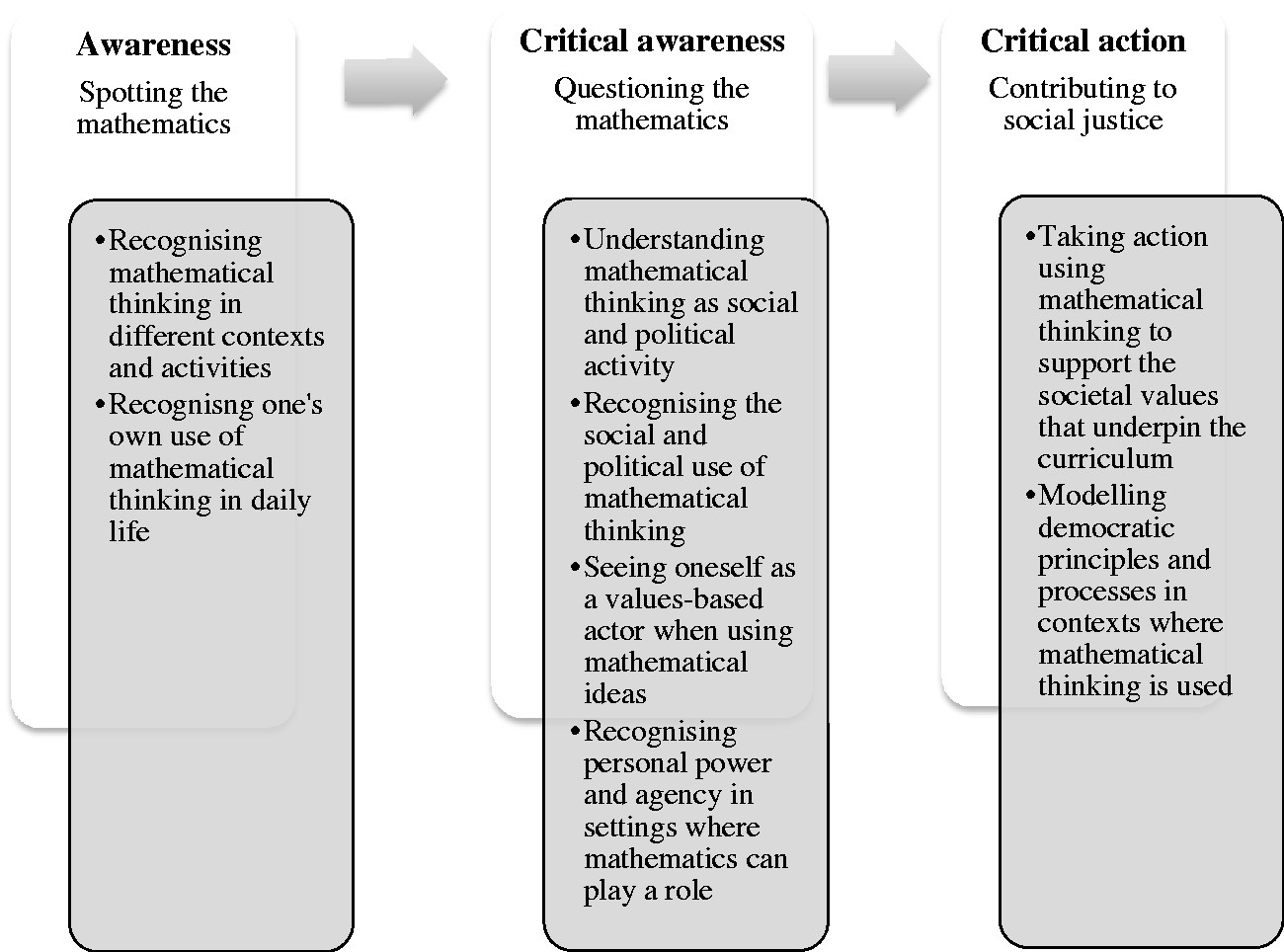
This progression acknowledges that recognising mathematical concepts when they are obscure as well as when they are overt is an essential basis to them contributing to the potential for action. Recognising hidden mathematics implies both a level of knowledge of mathematical concepts and procedures and an understanding of one’s limits. It makes clear that a pre-requisite for applying a critical lens is a recognition of the social and political nature and consequences of activities involving mathematical thinking, along with the role the individual can play in shaping the outcomes of mathematically oriented activity. We are advocates of social justice-oriented critical mathematical awareness and action that enables a contribution to a more socially just world.
We now set out the implications for ITE of our construction of ‘critical mathematical thinking’.
Implications for Initial Teacher Education
Accepting the proposed components of critical mathematical thinking for ITE as useful and useable focuses attention on what needs to be included in ITE and what might be less important. We consider ITE needs to support preservice teachers to:
understand the mathematics they will need as teachers; understand the mathematics of political knowledge; understand the politics of mathematical knowledge; understand themselves as values-based actors who can be agentic through the use of mathematical thinking in local and global contexts.
In addition to their personal knowing, preservice teachers will need to:
understand their role in helping others to be agentic through modelling critical mathematical thinking.
Approaches that support these understandings in preservice teachers are relevant for all teachers of all learners. What is at stake is the ability of people to fully participate in society. Preservice teachers, as adult learners in their ITE programme who will go on to teach the next generation of young learners, have a multi-level purpose and responsibility to be critical mathematical thinkers: for their own sense-making of and participation in the world and for their emancipatory work with citizens of the future. This means that what happens in their ITE programmes matters. For preservice teachers, the identified components of critical mathematical thinking, and the opportunities for the kinds of learning that seem necessary to develop it, supports the programme-wide approach currently in use in the MARKITE research project (Cooper et al., 2017). It is difficult to see how preservice teachers could gain the breadth of experiences that would facilitate their awareness of both the invisibility and the formatting power of mathematics with a more limited focus. A broad understanding of the role of mathematics in how society works and the issues of the day appears in different ways and nuances across ITE programmes as a whole. It is therefore essential that teacher educators work together to support the development of and provide opportunities for critical mathematical thinking in their students. Supporting preservice teacher learning of this kind would then be a truly cross-curricular endeavour, repeatable and transferable to school classrooms where future teachers can support children to become caring, ‘response-able’ and creative citizens who can engage with societal issues in a critical and informed way.
Concluding remarks
Literacy and numeracy are currently the focus of a good deal of attention in education at all levels. Along with literacy and numeracy, critical thinking also has primacy. ITE is one location where children’s and adults’ literacy and numeracy learning and teaching come together. Mathematical thinking is important for teachers across the breadth of their roles including, increasingly, in using data to inform teaching. Realisation that mathematical thinking is not just an individual, cognitive activity but is always also a situated and social activity places a responsibility on teachers and those who teach them to understand the role of mathematical thinking in shaping the social world and vice versa. It requires recognition that mathematical thinking has a political character and impact beyond the mathematics lesson. Supporting adults and children to be critical thinkers with and of mathematical ideas requires a willingness to engage with the big mathematical ideas and big societal issues. It requires a willingness to cultivate those values and actions that allow the power of mathematics to be used in pursuit of a socially just and sustainable world. We recognise this as a simultaneously difficult and essential task for teacher educators requiring, as Gutierrez (2013) has signalled, the need for the kind of ongoing systemic support our larger project aims to develop. We believe it is important for all teachers to bring a critical approach to mathematical thinking across their roles, although this will play out differentially according to context. The current policy focus on literacy and numeracy must go hand in hand with deliberate preparation of preservice teachers for the ethical nuances of their professional role.
Footnotes
Declaration of conflicting interests
The author(s) declared no potential conflicts of interest with respect to the research, authorship and/or publication of this article.
Funding
The author(s) disclosed receipt of the following financial support for the research, authorship, and/or publication of this article: The research reported here was supported by the Teaching and Learning Research Initiative (Project Number 103365) from the New Zealand Council of Educational Research (NZCER).