




Abstract
Despite the importance of initial teacher training, no primary education courses in South Korean universities provide a compulsory course in gifted education and elective courses are limited. Individual in-depth interviews with seven lecturers of gifted education courses were conducted to elicit their opinions about initial teacher education in gifted education. The lecturer interviewees suggested that there should be more of an emphasis on gifted education in initial teacher education programs. They also emphasized the importance of practical teaching experience with gifted students. The expansion of initial teacher education in gifted education in South Korea has the potential to improve preservice teachers’ understanding gifted students, ultimately improving the outcomes of this population.
Introduction
Preservice teacher training in gifted education has been both under-researched and undervalued globally. This situation is especially concerning in South Korea, where the availability of gifted programs is declining, and teacher nominations hold the most weight in the identification process. Therefore, teachers must have a strong understanding of giftedness to provide the most appropriate education for their students.
The number of South Korean students identified as gifted students and provided with formal gifted education programs has rapidly decreased since 2013 (Korean Educational Development Institute, 2023). In 2013, 121,421 students were in formal gifted education programs, and by 2022, the number had dropped to 72,518, which is a 40.28% decrease (Korean Educational Development Institute, 2023). Considering that the total number of primary, middle, and high school students in South Korea has decreased from 6,481,492 in 2013 to 5,275,054 in 2022, which is an 18.61% decrease, the 40.28% decrease in the number of students in formal gifted education programs is dramatic. The number of gifted education centers declined from 3,011 in 2013 to 1,486 in 2022, a 50.65% decrease (Korean Educational Development Institute, 2023).
Gifted education centers in South Korea provide formal gifted education programs and are run by the local office of education of a city, several universities and national research centers, and the government-chartered institute (Lee et al., 2016). The sudden drop in the number of identified gifted students and gifted programs in South Korea is related to budget cutbacks. This downsizing of gifted education programs and funding means that gifted students are deprived of their right to an appropriate education. This goes against Article 2 of the Promotion of Education for the Gifted and Talented Act of 2000, which calls for the provision of gifted education for gifted students so that they can realize their full potential. This decline in formal services also makes training in gifted education even more crucial, as teachers may be identifying and working with gifted students who might be in their general education classrooms, since formal programs may not be available.
Teachers of gifted education programs in South Korea are in-service teachers who have finished a 60-h professional development program (Choe, 2016). The professional development program is provided by local district education offices, universities, and gifted education centers (Choe, 2016). The program covers the definition of giftedness, identification of gifted students, gifted education pedagogies, and gifted program evaluation methods (Choe, 2016). A 120-h advanced professional development program also covers domain-specific gifted education, such as math or science gifted education, and how to develop gifted education programs (Choe, 2016). Even though the professional development programs cover gifted education in detail, the programs are optional. Thus, teachers who do not participate in the program remain untrained.
Review of the Literature
Several studies have sought to measure preservice teachers’ attitudes toward gifted students and their education (Plunkett & Kronborg, 2011; Troxclair, 2013). These researchers reported that the preservice teachers tended to have misconceptions about gifted students and lacked understanding of gifted students’ special needs. Most researchers attributed the results to egalitarian beliefs or a lack of confidence in teaching gifted students due to the scarcity of undergraduate course offerings in gifted education. This may affect both their perceptions and their abilities to identify and support gifted students in their classrooms.
Increased Importance of Teacher Nomination in South Korea
The identification of gifted students for formal gifted education programs in South Korea comprises multiple steps: a teacher recommendation, a creative problem-solving task, and an interview (Seoul Metropolitan Office of Education, 2022). Students who consider themselves gifted and hope to gain entrance to a formal gifted education program initially recommend themselves for the program via the Gifted Education Database (GED) website run by the Korean Educational Development Institute (Seoul Metropolitan Office of Education, 2022).
The self-recommended online application goes directly to the student's homeroom teacher and the teacher's recommendation is sent to the school committee of recommendation for gifted education programs (Seoul Metropolitan Office of Education, 2022). The committee selects a small number of students from the cohort recommended by their homeroom teachers for the gifted education programs (Seoul Metropolitan Office of Education, 2022). Although the identification process may vary, all processes for the identification of gifted students include a teacher recommendation (Seoul Metropolitan Office of Education, 2022). This means that all primary school teachers in South Korea are responsible for identifying gifted students. However, the research literature suggests that teacher nominations are subjective and can be erroneous, as high achievers are more likely to be nominated rather than gifted students (Kornmann et al., 2015). In order to accurately recommend gifted students to the gifted programs, teachers need to have knowledge about gifted students, including an understanding of their traits and specific educational needs, as well as methods of identification (Siegle et al., 2010; Speirs Neumeister et al., 2007).
The teacher's own perspective of what it means to be gifted is crucial in the observation and nomination process for gifted programs (Siegle et al., 2010). According to a study by Speirs Neumeister et al. (2007), teachers tended to overlook gifted students’ strengths and potential when they did not have a full understanding of the characteristics of gifted students or were unsure about the concept of giftedness. A lack of knowledge about gifted students and the uncertainty about the standards for nominating gifted students can lead teachers to develop their own perceptions of giftedness and select those students who then fit their perceptions (Pierce et al., 2007). This can lead to teachers identifying only high-achieving and well-behaved students as gifted over those with potential but with other difficulties, such as a learning disability or physical disorder (Neihart & Betts, 2010).
Importance of Teacher Training in Gifted Education
There is a small body of research confirming that teacher training in gifted education can support teachers in understanding gifted students. This training can lead to more positive attitudes toward gifted education and enables teachers to develop teaching strategies to meet the needs of gifted students (Berman et al., 2012; Kronborg & Plunkett, 2012; Lassig, 2015, Rowley, 2012). Lassig (2015) conducted a study of 126 Australian primary school teachers to identify whether teacher training in gifted education affected their understanding of gifted students and their attitudes toward them. The teachers who had training in gifted education had a better understanding of the specific needs of gifted students, showed more positive attitudes toward supporting them, and were more aware of the difficulties which gifted students may encounter.
The importance of teacher training was also found in a study conducted with Turkish teachers. Tortop (2014) identified that 30 Turkish in-service teachers’ self-efficacy in teaching gifted students had improved after only 1-week-long intensive teacher training in gifted education. The program covered the definition of giftedness, social-emotional development, and motivation of gifted students, as well as, how to mentor gifted students. Tortop found a significant increase in teacher self-efficacy in teaching gifted students after participation in the training.
Lack of Teacher Training in Gifted Education in Asian Countries
With fast socioeconomic development in the twenty-first century, the aims of gifted education in Asian countries have been focussed on managing human resources with prospects for the nation (Chan, 2018; Dai & Kuo, 2016). Under such policy, many Asian countries have a stronger focus on the academic achievements of students, especially in math and science, rather than understanding the affective and cognitive traits of gifted students (Dai & Kuo, 2016; Roy, 2017). This strong focus on academic achievement led to teachers’ indifference to the socioemotional development of gifted students (Dai & Kuo, 2016; Roy, 2017).
As a result, teacher training that includes information about gifted education is lacking in many Asian countries, which potentially could lead to the teachers’ lack of understanding of gifted students (Al-Hroub, 2023; Le et al., 2024; Roy, 2017). Some gifted students struggle with emotional difficulties such as anxiety, depression, or perfectionism, their socioemotional development is not always aligned with their intellectual development, and there are quite a few underachieving gifted students (Blaas, 2014). Gifted education in teacher education could be helpful for teachers to understand the traits of and identify various gifted students.
Lack of Course Offerings in South Korea
The number of training courses in South Korea is insufficient for the number of teachers being trained. The number of South Korean teachers of gifted students in 2014 was 27,263 at its peak, however, it had decreased to 18,340 in 2022 which is a 32.73% decrease (Korean Educational Development Institute, 2023). In contrast, the total number of primary, middle, and high school teachers in South Korea has increased from 430,509 in 2014 to 441,796 in 2022 which is a 2.62% increase (Korean Statistical Information Service, 2023). Thus, the drop in the number of South Korean teachers of gifted students is considerable. Additionally, training about gifted education is also optional, so teachers who hold negative views about gifted students are unlikely to participate in the training (Lassig, 2015). Hwang (2011) and Lim (2009) suggested that initial teacher education in gifted education at the undergraduate level could be an alternative, however, none of the universities in South Korea that offer a bachelor's degree in primary education provide a compulsory course in gifted education. A few offer an elective course in gifted education, while other courses offer content embedded within a special education course (Choe, 2016).
There are 13 universities that offer a 4-year undergraduate degree in primary education in South Korea and only 7 out of the 13 universities offer gifted education course(s) for preservice primary school teachers. Moreover, the gifted education courses by the seven universities are offered either as an elective course or only to a certain class in certain subjects in universities called a National University of Education. Ten of the 13 universities are called a National University of Education, only specialize in primary education, and have around 13 teaching specializations in subjects such as math, science, and special education. The Korean National University of Education is exceptional in that it offers secondary and special education, in addition to primary education. There are 11 gifted centers for gifted primary school students among the 13 universities and 5 out of 6 universities not offering gifted education courses for preservice teachers run a gifted education center (Busan National University of Education, 2023; Cheongju National University of Education, 2023a, 2023b; Chinju National University of Education, 2023; Chuncheon National University of Education, 2022, 2023; Daegu National University of Education, 2023a, 2023b; Ewha Women's University, 2022, 2023; Gongju National University of Education, 2023a, 2023b; Gwangju National University of Education, 2017, 2023; Gyeongin National University of Education, 2023a, 2023b; Jeju National University, 2021, 2023; Jeonju National University of Education, 2023a, 2023b; Korea National University of Education, 2023a, 2023b; Seoul National University of Education, 2021, 2023). The number of universities that offer gifted education courses is less than the number of universities that run gifted education center (see Table 1).
Gifted Education Course Offerings in 2023 (Primary Education Major in South Korea) and Gifted Education Centers Attached to the Universities.
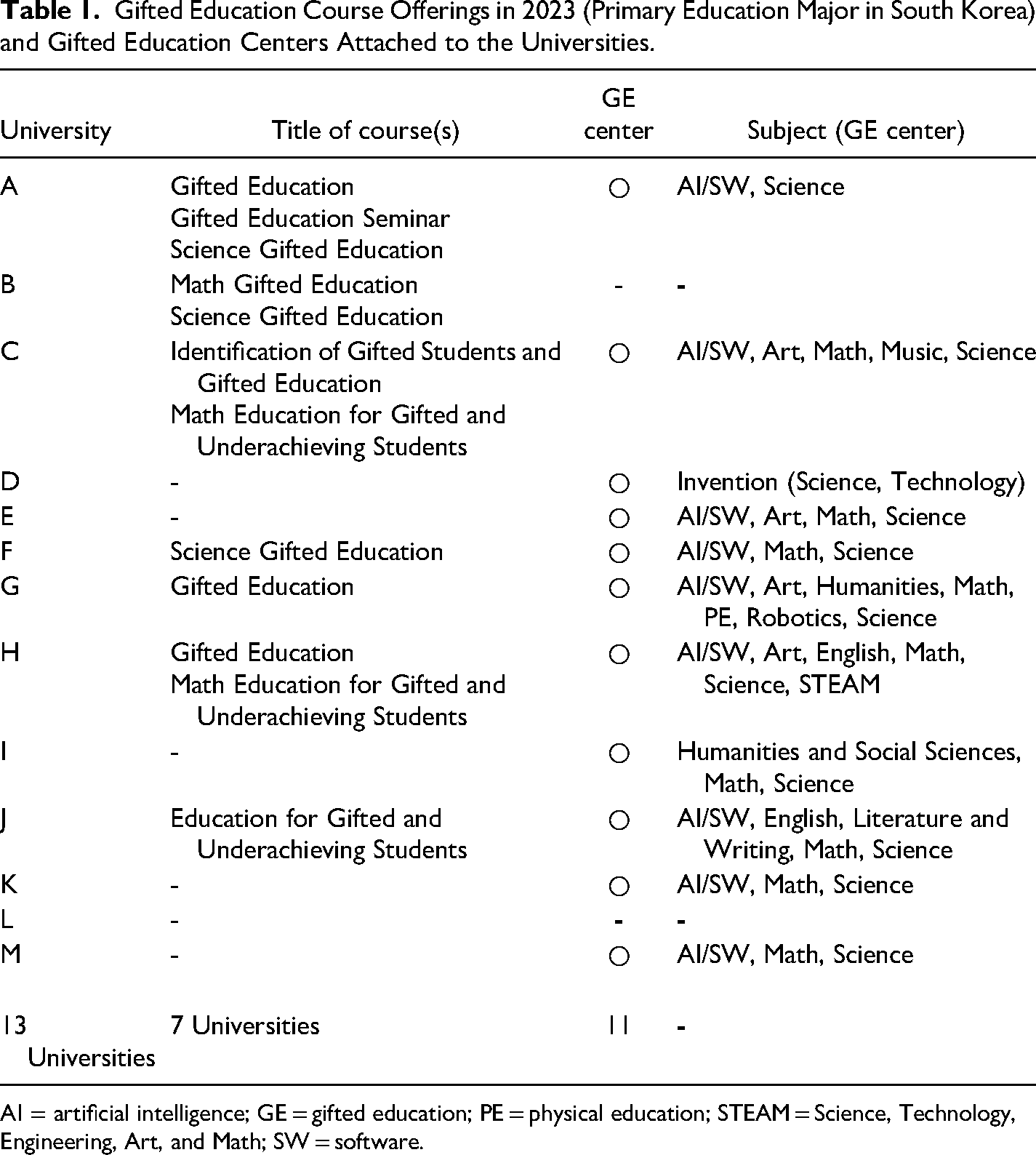
AI = artificial intelligence; GE = gifted education; PE = physical education; STEAM = Science, Technology, Engineering, Art, and Math; SW = software.
There is some evidence in the international research literature that teachers have been critical of the lack of undergraduate coursework which prepares them to work in gifted education (Curtis, 2005; Fraser-Seeto et al., 2016; Nowikowski, 2011; Taylor & Milton, 2006). Educating preservice teachers about gifted students is important because their lack of knowledge could affect their attitudes toward the students in negative ways. According to Hudson et al. (2010), teachers’ negative attitudes established early in their careers are not likely to improve when their subsequent teaching experiences are affected by a negative bias. Therefore, it is likely that, if these future educators are not offered gifted education courses in university, their indifferent or negative perceptions of gifted students will remain as such until they become teachers.
Despite the importance of initial teacher education, the number of gifted education course offerings in South Korea is insufficient. The perspectives of the lecturers of the gifted education programs on the current initial teacher education in gifted education were explored and their opinions on what they considered important for preservice primary teachers to learn about gifted students was identified. Through the interview process, suggestions for improvements to initial teacher education in gifted education in South Korea were highlighted.
Aims of the Study
The aim of the current study is to explore university lecturers’ perceptions to suggest ways in which gifted education in the initial teacher education curriculum in South Korea could be improved. University lecturers’ perceptions are considered necessary, as they drive course content.
The study was guided by the following research questions: RQ1: What are the perceptions of university lecturers about current initial teacher education in gifted education in South Korea? RQ2: What are the suggestions university lecturers have about current initial teacher education in gifted education in South Korea?
Method
The study reported here was the qualitative part of a mixed-methods study that the first author conducted as part of her PhD studies. This involved semi-structured, individual interviews with lecturers who had taught South Korean fourth-year university students in primary education. Individual interviewing is known to offer more in-depth details by interviewees than focus group interviews (Guest et al., 2017). The method puts more emphasis on the individual interviewee's thoughts, feelings, and perceptions on the topic (Guest et al., 2017).
The authors applied for and received ethics approval for the study from their institution and the Korea National Institution for Bioethics Policy. Thirteen universities that offered a Primary Education bachelor's degree program in South Korea were invited to participate. Of the five universities (Universities A, B, C, D, and E) that agreed to participate in the overall study, three of them (Universities A, C, and D) consented to participate in the lecturer interviews.
Significance of the Qualitative Individual Interviews
As a part of the first author's PhD thesis, the individual interviews of this study were conducted with lecturers who taught gifted education, along with focus groups with 13 South Korean preservice teachers who were in their fourth year in primary education (Woo, 2020; Woo et al., 2023). To increase the reliability and validity, and to reduce the bias of the data from the qualitative component of the research process, researchers often seek to collect data from multiple sources (Fusch et al., 2018). By interviewing the lecturers of the gifted education program working with the preservice teachers in this study, we aimed to include a different point of view so that more could be understood of the phenomena.
Despite the importance of initial teacher education, there could be reasons why the universities offering programs to preservice teachers do not offer much in the way of gifted education courses to undergraduates. By interviewing lecturers who teach the gifted education coursework, their perspectives on the current initial teacher education in gifted education were explored and their opinions on what they considered was important for preservice primary teachers to learn about gifted students were identified. Through the interview process, suggestions for improvements to initial teacher education in gifted education in South Korea were highlighted.
Participants of Individual Interviews
For the individual interviews, the first author tried to contact all lecturers who taught courses that included gifted education content at the three universities that provided institutional consent. It was not possible to contact the lecturer who had taught “Math Education for Gifted and Underachieving Students” at University C, as the math education office of University C declined to contact the external lecturer, as they had already left at that time. Except the external lecturer, all of the seven lecturers agreed to participating in an individual interview. Individual face-to-face interviews were conducted with six lecturers, except one lecturer (LA2), who chose to answer the interview questions via e-mail. The data from the one lecturer was not as rich as the data from the other lecturers because the first author was not able to prompt the lecturer to elaborate on her responses via e-mail (Bowden & Galindo-Gonzalez, 2015).
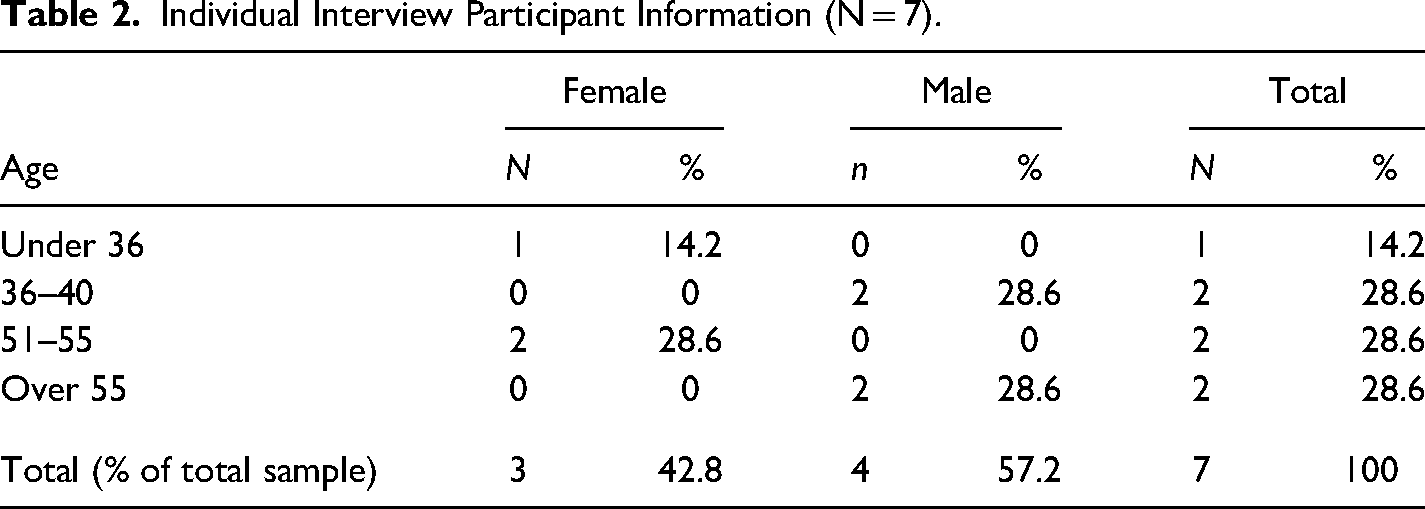
Individual interviews were conducted with five lecturers from University A, and one each from Universities C and D. Three lecturers were female and the other four were male. There was one lecturer whose age was under 36 years, two were 36–40 years, another two were aged 51–55 years, and the other two were over 55 years of age. Two out of the seven had previously taught students at primary or secondary school. The total years of teaching at a university ranged from one to 20 years. See Table 2 for individual interview participant demographics.
Individual Interview Participant Information (N = 7).
Data Analysis
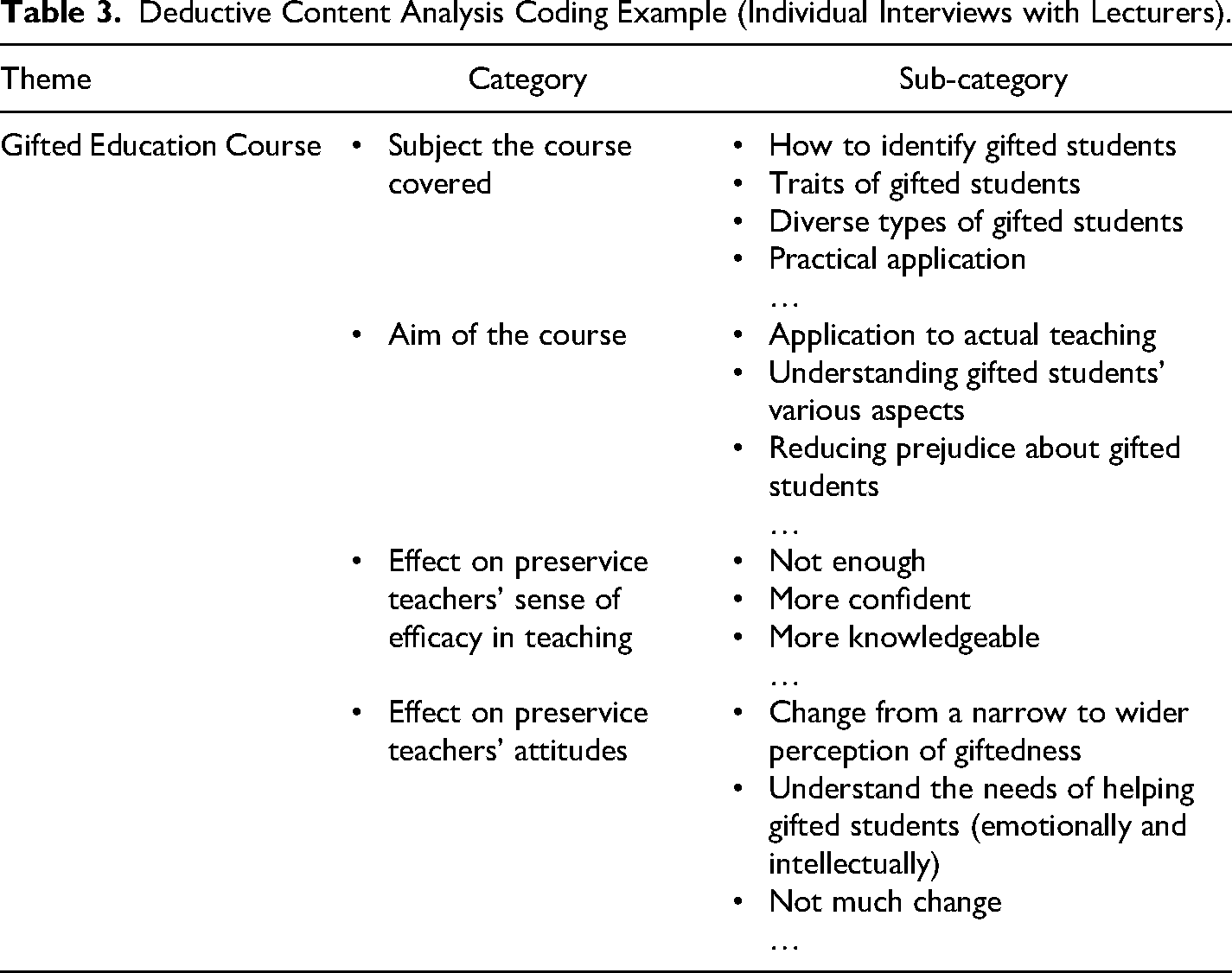
Deductive content analysis was adopted for analyzing data from the individual interviews. Deductive content analysis uses preconceived categories and researchers analyze the data according to previously formulated categories (Kyngäs & Kaakinen, 2019). This method is especially useful when testing existing theories or hypotheses (Moretti et al., 2011). In deductive content analysis coding, a researcher develops structured analysis matrices according to relevant research or a theory (Kyngäs & Kaakinen, 2019). In the initial stage of the coding process, structured matrices were generated with three-phased categories: theme, category, and sub-category.
The themes were extracted from the interview questions and the categories were derived from the results of the quantitative survey portion of this study or relevant research results. Even before conducting interviews and coding, some of the sub-categories were expected according to the results of the previous quantitative survey, as there was a statistically significant difference in the mean scores of South Korean preservice teachers’ sense of efficacy and their supportive attitudes toward gifted students between those who had and had not taken a gifted course in gifted education (Woo, 2020). Hence, the first author asked the lecturers many questions related to the gifted education course they taught and two of the questions asked the lecturers’ opinions about the effect of the course on preservice teachers’ confidence and their attitudes toward gifted students.
The main theme that emerged during data analysis was “gifted education course” and two of the categories were the “effect on preservice teachers’ sense of efficacy in teaching” and the “effect on preservice teachers’ attitudes” (see Table 3). One of the sub-categories that emerged was expected from the survey results: “effective but not much.” Some of categories and sub-categories were added if the answers of the participants did not fit any predetermined categories or the answers were from follow-up questions.
Deductive Content Analysis Coding Example (Individual Interviews with Lecturers).
Trustworthiness of the data interpretations was ensured via investigator triangulation and member-checking. Investigator triangulation means having at least two researchers working on the same study providing diverse observations and opinions (Archibald, 2016). The authors of this study had regular meetings to discuss the validity of the interview questionnaire and coding methods. The translated coding was reviewed by the coauthors of this study, who are experts in education fields and native-English speakers. They reviewed the structure of the coding by checking whether a theme appropriately included the categories and sub-categories. This collaborative process is used to prevent bias in the data coding (Connelly, 2016).
Member checking enhances the credibility of qualitative data or results (Birt et al., 2016). The checking process requires the participant to review the transcription of their interview or analyzed results (Birt et al., 2016). All interviews were audio recorded and transcribed by the first author. The transcriptions of the individual interviews were sent to all participants, who were asked to review the transcription and inform the first author if there were any inaccuracies, omissions, or commissions. Three out of six individual interviewees confirmed that the contents of the transcription were identical with what they had said during the interview. None of the participants raised any queries regarding the transcription.
Results
The first author conducted in-depth, individual interviews with six lecturers who taught gifted education and one lecturer, LA2 chose to answer the interview questions via e-mail. The participants were asked about their curriculum content, their opinions about the effect of their lectures on preservice teachers’ sense of efficacy and attitudes, and about initial teacher education in gifted education offered by universities. The main themes that emerged from data analysis were: (a) gifted education courses, (b) effect of the course on preservice teachers’ attitudes toward gifted students, (c) opinions about compulsory gifted education coursework, and (d) suggestions for gifted courses in initial teacher education.
Gifted Education Courses
Universities A, C, and D only offered primary education programs. The interview participants taught preservice teachers about gifted education at these universities. Among the seven individual interview participants, five were from University A, one was from University C, and one from D (see Table 4).
Gifted Education Lecturers.
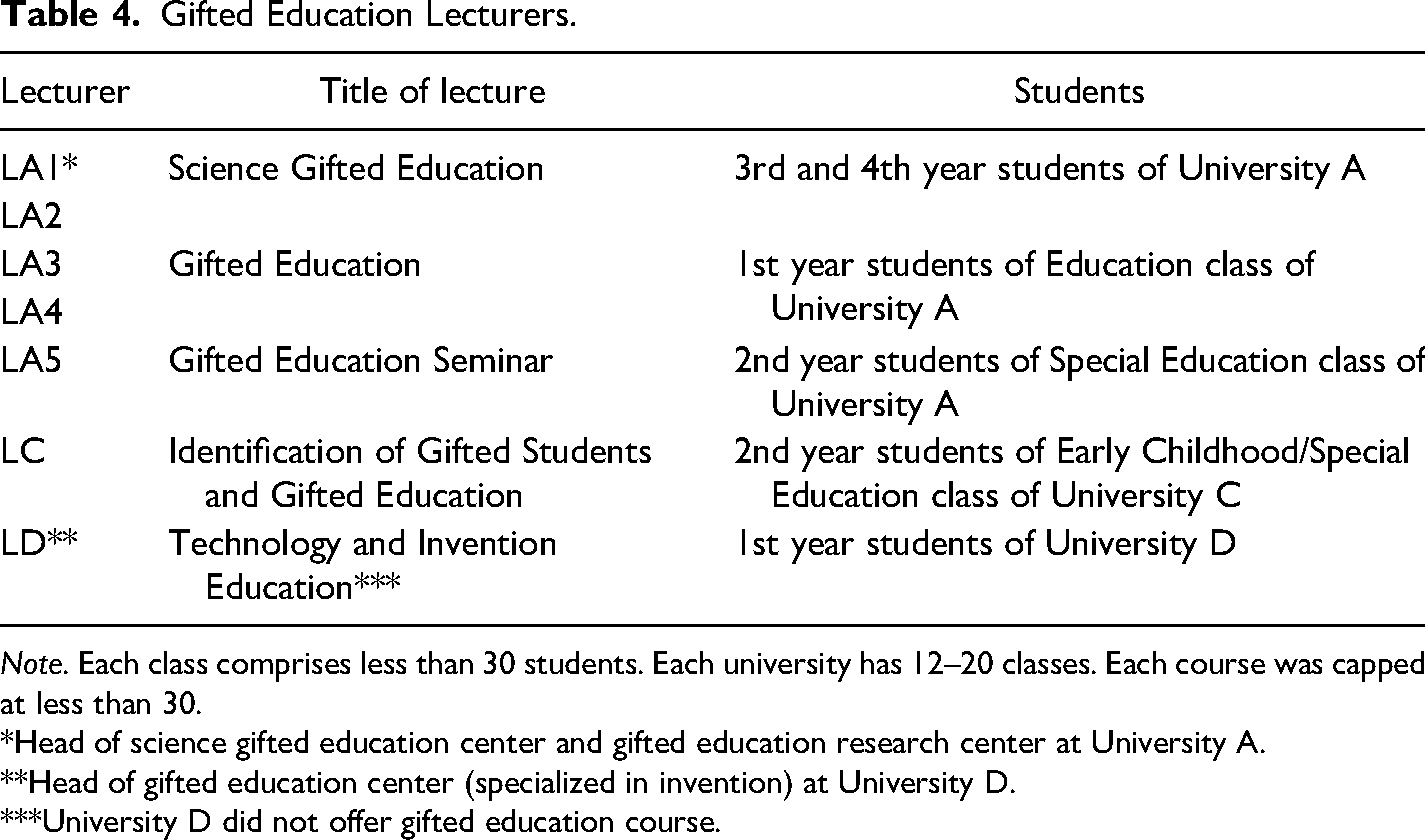
Note. Each class comprises less than 30 students. Each university has 12–20 classes. Each course was capped at less than 30.
*Head of science gifted education center and gifted education research center at University A.
**Head of gifted education center (specialized in invention) at University D.
***University D did not offer gifted education course.
As University D did not offer a course in gifted education, an interview was instead conducted with a professor who was the head of the gifted education center of the university. He admitted during the interview that he briefly covered gifted education too, even though the title and the main subject of the course was Technology and Invention Education (see Table 4).
The aims of the gifted education courses were mainly: (a) assisting preservice teachers in implementing gifted education in the classroom, (b) helping preservice teachers understand gifted students well, and (c) teaching advanced knowledge. Four out of seven lecturers mentioned “implementation of gifted education” as the goal of the course. LA5 explained that his students were interested in teaching gifted students but also had reservations: I found that my students were interested in gifted students, and they were thinking a lot about “what should I do for gifted students?” On the other hand, they also looked scared of teaching gifted students. They were like “what can I do for gifted students when I meet them?”, “can I identify them and send them for gifted education programs?”, “before sending them to a gifted education centre, what can I do as their teacher?” They had these types of fear.
Four lecturers hoped the course had helped preservice teachers understand gifted students, especially the difficulties that gifted students might encounter, such as perfectionism or feelings of isolation. LA3 explained that there are many difficulties gifted students go through, but also many misconceptions about gifted students. According to him, one of the misconceptions is that “gifted students are highly exceptional,” thus, he tried to address the fact that this misconception hinders gifted students from developing their talent. LC also said she had stressed that the emotional needs of gifted students should be met and that there are diverse types of gifted students.
Lastly, two out of seven lectures responded that teaching advanced levels of subject knowledge was one of the goals of their lecture. LD believed that teachers can only teach well when they are knowledgeable about the subjects they teach and their teaching strategies. LA1 who taught science gifted education also stressed the importance of knowing advanced scientific knowledge when teaching gifted students because gifted education in science currently comprises over half of the total gifted education subjects in South Korea.
When asked about the topics the gifted education course covered, their answers varied: (a) identification of gifted students, (b) cases and traits of gifted students, (c) counseling gifted students, (d) gifted education curriculum, (e) implementation of gifted education, (f) gifted students’ difficulties, and (g) gifted education in general.
Three lecturers said they had preservice teachers find cases of gifted people and deliver a presentation to the class explaining why they believed they were gifted. The lecturers added that this practice makes preservice teachers think of the definition of giftedness, difficulties that gifted students may experience, and diverse gifted students in different subjects. Another lecturer also said she had her students deliver a presentation at the end of the course about their opinions on cases of gifted education curriculums used in actual teaching. The four lecturers believed the practices would help preservice teachers apply theories to practical teaching.
Lecturers’ Opinions About the Effect of the Course on Preservice Teachers
Possible Effect of the Course on Preservice Teachers’ Sense of Efficacy in Teaching Gifted Students
All seven lecturers admitted that a gifted education course could be somewhat helpful for preservice teachers’ sense of efficacy in teaching gifted students. LD explained that those who had taken his course became more knowledgeable, which in turn affects their confidence positively. However, the other six lecturers thought that taking just one course is not enough to boost one's confidence: It's of course better than not taking this course because the cases of many gifted students are introduced during the course and the students (preservice teachers) think together about a better way of teaching the gifted students then it would be helpful in teaching gifted students. However, it's not enough. Because it's 2-h lecture for 13 weeks. Too short. The course cannot go deep, so it just covers gifted education in general. (LA1)
During the interview, LD, the head of the gifted education center of University D, mentioned that he had a plan to give an opportunity for the students in his “Technology and invention education” course to visit the gifted education center so they could observe classes for gifted students. The reason was that University D did not offer a gifted education course and LD believed that meeting gifted students would be helpful for preservice teachers’ teaching efficacy.
A follow-up e-mail was sent in the following year to LD asking whether his students went to the gifted education center, and how they found the experience. According to him, the students did visit the center as a part of the course, and they were impressed to see how the curricula were different from that offered to students in general, and the high level of knowledge that the gifted students learned. He believed that the experience was somehow helpful for preservice teachers’ teaching efficacy and wished to continue the visit to the gifted center in the future.
Possible Effect of the Course on Preservice Teachers’ Attitudes Toward Gifted Education
All of the seven lecturers answered there was a change in preservice teachers’ attitudes toward gifted students and their education after taking the course. The most frequent answer was that the preservice teachers understood gifted students better after taking the course. Five lecturers answered their students did not initially know much about the traits of gifted students, or the difficulties that gifted students go through such as feelings of isolation and perfectionism. LA5 added that after understanding the needs of gifted students better, his students then admitted that gifted students also need help and support.
The second most frequent response was a change in preservice teachers’ views on giftedness and gifted students. According to four lecturers, preservice teachers who had attended their lectures held misconceptions about gifted students such as: gifted students are the ones who get good grades, they have high IQs, and are just smart and socially isolated or awkward. After taking the course, however, LC believed that the preservice teachers learned that there are various types of gifted students, and the spectrum of giftedness was wider than they had previously thought. LA1, LA3, and LA4 also shared the same experience: Gifted students I think of is… they are a bit more excellent than regular children. They are not exceptionally superior to other students, but they are good. And… I think the views of my students on gifted students changed this way as well. (LA1) I feel like the students used to think gifted students are extremely exceptional but after the course, they include more students in gifted students’ group. (LA3) The TV program “finding gifted”… provides us with a lot of information, but it also gives us a certain image (prejudice) of gifted students like “gifted are genius or prodigies” From that, my students change their perspectives on gifted students to “OK, gifted students are those who I can meet in the classroom and gifted education is what I’m going to do.” (LA4)
Despite the positive change in perspectives on gifted students, LA3 answered that some of his students still stuck to their original perceptions on gifted students such as “gifted students are always extremely smart” even after taking the course. LD explained that having an experienced teacher who has taught gifted students teach novice teachers as part of professional development had a significantly greater effect on preservice teachers’ attitudes toward gifted students.
In conclusion, most of the lecturers thought their course had a positive impact on preservice teachers’ attitudes toward gifted students and gifted education. The lecturers thought the effect on preservice teachers’ attitudes was bigger than on their efficacy in teaching gifted students. However, some of them still believed taking a course was not enough to change one's attitude toward gifted students.
Opinions About Compulsory Gifted Education Coursework
The lecturers were mainly supportive of a compulsory gifted education course. LA5 refuted the view that preservice teachers did not need a course in gifted education, as they would only encounter a limited number of gifted students: Even though the percentage of students who access gifted education is only 2 to 3% now, that doesn’t mean that those students are the only gifted students. It's up to our view and how we identify gifted students. It can be 10% or 15%, depending on the way we identify. So, we need to educate preservice teachers to have the ability to identify more students as gifted students, so better for gifted courses to be compulsory. It is not realistic to make gifted education a compulsory course. Students with a major in primary education have to take courses in 13 different subjects…and those are already overwhelming. Almost impossible. (LA2) The special education course is compulsory. That's only possible because it's forced by the law. It couldn’t have been done if it was done by professors’ agreement. To make gifted education a compulsory course, nearly 130 professors and lecturers of our university have to agree on that, so it's nearly impossible. (LA4)
LA3 answered that his students always complained about the enormous workload, thus he was not too sure whether a gifted education course could be compulsory, even though he was fully supportive of a mandatory gifted education course. LA4 suggested that the current compulsory special education course needs to cover more gifted education than it does now: I don’t understand why the course “understanding students in need” only covers underachieving students or students with disabilities. Gifted education should be included in the course. If it covers gifted, then all of our students will learn about gifted education.
In conclusion, most of the lecturers agreed that a gifted education course would be helpful for preservice teachers to understand gifted students better, however, they understood that it could not be compulsory, due to the complexities of the degree.
Suggestions for Initial Teacher Gifted Education
The seven lecturers shared their diverse suggestions for initial teacher gifted in South Korea. They expressed opinions about both the content of gifted education courses and the system of initial teacher education in gifted education. LA2, LA5, and LD wished a gifted education course could give preservice teachers more practical teaching opportunities so they could apply what they learn from the course in the classroom. LA5 admitted the limitations of a lecture-based gifted education course and stressed the need for actual experience in teaching gifted students. …I would like to bring my students to a gifted education centre and let them observe how the centre teaches gifted students and learn how gifted education programs run so they can learn to apply this in the classroom.
Interviewees LC and LA3 wished that there were more gifted education courses on offer. They thought that a two or three-hour lecture per week in a semester is not enough to change preservice teachers’ perceptions on gifted students. LC hoped her students could take two gifted education courses; one in their second year and another the following semester or year so they can learn enough about gifted education. LA3 hoped that the compulsory special education course would cover gifted education more if offering more courses in gifted education was not feasible.
LC was concerned about the lack of consistency in gifted education courses. There were often changes of lecturers of gifted education courses at University C, so LC felt there should be clear guidance for gifted education lecturers. LC admitted that every lecturer has different teaching styles, but believed that there should be a common structure in the syllabuses: Looking at syllabuses of this course that previous lecturers used, what they taught were so different from each other. The teaching subjects of this course were dependant on each lecturer…. If a lecturer this year says, “this is important” and a lecturer next year says “no, that's important”, it's confusing and has to change.
In short, the lecturers recommended a gifted education course that focused more on practical teaching, so that more students could be identified as gifted students, more gifted education course offerings, a set curriculum to encourage consistency, and the course title, “gifted” education was changed to something else which could have sounded more like education for students with additional needs.
Discussion
This article reports the qualitative component of a mixed-methods study conducted as part of the first author's PhD studies. In the survey conducted before the individual interviews of this study, the mean score of South Korean preservice teachers’ sense of efficacy and their supportive attitudes toward gifted students of those who had taken a gifted education course was higher than those who had not taken a course; however, the effect size was small (Woo, 2020). In the follow-up focus group interviews with 13 South Korean preservice teachers, they wished there had been more gifted education course offerings and additional practicum placements that focused on teaching gifted students (Woo, 2020). The results of the survey and the group interviews were aligned with the results of individual interviews with the lecturers of this study.
The lecturer participants of this study shared that their gifted education lectures were somewhat helpful for preservice teachers to understand gifted students better but not enough. The lecturer interviewees recommended an expansion of course offerings in gifted education, special education courses covering more gifted education contents, and more opportunities of practical experiences of meeting gifted students. There are many studies that support the lecturer participants’ argument.
Lack of Coverage of Gifted Education in Initial Education
In South Korea, none of the universities that offer a bachelor's degree in primary education provide a compulsory course in gifted education (Choe, 2016). Article 6, Clause 2 of “Detailed Criterion for Teacher Qualification for Preschool and Primary, Secondary, and Special School” states “Special education courses must include a “gifted education” chapter in the syllabus” (Detailed Criterion for Teacher Qualification of 2019). Despite the South Korean law, among the 453 South Korean preservice primary school teacher participants who stated that they had taken a special education course in a survey in May to June 2018 before conducting the follow-up interviews, 382 (84.3%) preservice teachers answered that the special education course either did not cover gifted education at all (n = 259, 57.2%) or gifted education content was less than 10% of the course (n = 123, 27.1%) (Woo, 2020).
In the literature, many teachers attribute their lack of knowledge and understanding of gifted students to the paucity of education provided during their preservice teacher training (Nowikowski, 2011). This finding is consistent among a number of other international studies and was a central factor that influenced teachers’ confidence when teaching gifted students and developing their attitudes toward them (Berman et al., 2012; Fraser-Seeto, 2013; Plunkett & Kronborg, 2011).
In Australia, Plunkett and Kronborg (2011) have argued that the impact of gifted education courses on preservice teachers is limited, due to very few Australian universities offering gifted education courses. They found the attitudes of preservice teachers significantly changed after they took a course in gifted education with many of the preservice teachers stating the course was helpful in understanding the traits of gifted students, in changing their misconceptions about gifted students, and in increasing their positive attitudes toward them. Most had a strong opinion about the need for universities to offer compulsory gifted education courses.
In the United States, Nowikowski (2011) investigated the curriculum of seven universities located on the east coast. Courses in gifted education were patchy, with only one university offering a compulsory gifted education course to special education majors. At two other universities, gifted education was offered as an elective course. At the four other universities, gifted education was embedded as a topic or topics covered within a mandatory special education course only available to education major students.
Influence of Initial Teacher Education
Influence of Initial Teacher Education on Teachers’ Sense of Efficacy
In this study, four out of seven lecturer interviewees said that just taking a course would not be enough to boost preservice teachers’ sense of efficacy in teaching. Two lecturers believed what matters most to preservice teachers’ sense of efficacy in teaching is the actual experience of teaching rather than sitting in a lecture. All the seven lecturers, however, believed that their lecture somewhat helped preservice teachers understand gifted education better, learn basic knowledge about traits of gifted students, and the possible challenges that gifted students might encounter.
There are studies about the effects of initial teacher education on preservice teachers’ sense of efficacy. Bannister-Tyrrell et al. (2018) surveyed 100 preservice teachers in Australia to see if there was a difference in preservice teachers’ perceived knowledge and competence in teaching students with exceptionalities according to the preservice teachers’ experience of taking a course about either inclusive or special education, behavior management, or gifted education. According to the researchers, students with exceptionalities include students with physical, cognitive, or learning challenges, gifted students, and twice-exceptional students who have both challenges and gifts (Bannister-Tyrrell et al., 2018). The survey mean scores of perceived knowledge and competence in teaching students with exceptionalities of those who had taken a course were significantly higher than those who had not taken a course.
Lancaster and Bain (2010) found a positive effect of a course on preservice teachers’ sense of efficacy in teaching which is combination of lectures, workshops, and actual teaching experiences. They surveyed 36 primary education major students in their second year from a regional university in Australia to see the effect of an inclusive education course and applied field experience on preservice teachers’ sense of efficacy in teaching. The course consisted of a one-hour lecture and a two-hour tutorial for 13 weeks, and the duration of their teaching practicum was 11 h in total, one hour per week. The preservice teachers discussed during their tutorial what they had learned from the lecture and how to apply the knowledge to their actual teaching in an inclusive classroom. What is more, they applied their knowledge and practice during their practicum. The researchers found that the preservice teachers’ sense of efficacy increased significantly after they took the inclusive education course and their applied teaching experience.
The results of the current study and other literature suggest that coursework could affect preservice teachers’ sense of efficacy in teaching gifted students positively. However, the effect could be minimal if there was no opportunity to apply the knowledge and teaching skills in real classroom settings. Nevertheless, currently, gifted education course offerings for primary preservice teachers in South Korea are not only limited, but the chances of a preservice teacher meeting and teaching gifted students are also scarce. As confirmed in the survey research conducted by the first author (Woo, 2020), preservice teachers’ sense of efficacy is related to their attitudes toward students. Teachers’ attitudes are crucial for teachers to provide productive and supportive learning environments for gifted students (Bartley, 2014). Teacher education in gifted education could lead to a positive influence on teachers and essentially on gifted students.
Influence of Initial Teacher Education on Attitudes Toward Gifted Students
The interviewees of this study believed taking a gifted education course would be helpful for preservice teachers to understand gifted students better, but it would be better if there were opportunities for more practical experiences. All seven lecturers stated that they could see somewhat positive changes in the preservice teachers’ attitudes toward gifted students and gifted education throughout their course. According to the lecturers, the two main changes in their students’ attitudes toward gifted students and gifted education were (a) better understanding about gifted students’ cognitive and emotional needs and (b) a broadened concept about giftedness. The lecturers explained that before taking the course, their students used to think gifted students would not need extra help or would be good at everything, and only those who were exceptionally talented would be gifted students.
In addition to taking a gifted education course, the lecturers interviewed in this study agreed that it would be better if preservice teachers could take a gifted education course and meet gifted students. This combination has been reported by preservice teachers to be helpful in gaining confidence in teaching gifted students but also to understand gifted students’ needs and traits of gifted students (Watters et al., 2013). Watters et al. (2013) conducted an open-ended survey with the preservice teachers who enrolled in the course called “Understanding and Educating Gifted Learners” at a university in Australia in 2011. The coursework covered traits of gifted students, teaching strategies, curriculum models for gifted learners, and diverse types of gifted students. In addition, the course included a visit to a primary school that had run a gifted education program, a workshop with the school staff, interviewing gifted students, and having conversations with the parents of the students. The preservice teachers shared that they had gained more knowledge about gifted students and confidence in teaching them via the combined coursework and school visit.
Opinions About Initial Teacher Education in Gifted Education
According to Geake and Gross (2008), teachers with stereotypical negative attitudes toward gifted students are less likely to participate voluntarily in professional development training in gifted education. Therefore, providing a compulsory gifted education course for preservice teachers would be a good way to include every preservice teacher with positive or negative attitudes toward gifted students to learn about the students better before teaching them in the classroom.
Many lecturer interview participants of this study answered “I wish it was” when their opinions were sought about a compulsory gifted education course. Although the lecturers were positive about the influence of a gifted education course on preservice teachers, they were skeptical about making a gifted education a compulsory course. According to the lecturer interviewees from University A, common consent is required by the university lecturers to make a certain course compulsory. Lecturers from University A felt that getting common consent by lecturers would be nearly impossible as the preservice program is already heavy with compulsory courses, adding another would be viewed as unreasonable.
Due to the difficulty of making a gifted education course compulsory, some of the lecturer interviewees suggested a more realistic alternative, to ensure the current compulsory special education course, which is required by law or the local office of education, includes more gifted education content. Presently, it is stated by law that a special education course is compulsory for undergraduates who major in education, and the syllabus of the special education course should include gifted education (Certification of Teachers Regulation of 2019). Special education and gifted education do share a common purpose which is to educate students with special needs.
Conclusion
In conclusion, a gifted education course can positively affect preservice teachers’ attitudes toward gifted students and gifted education and could be more effective when the course provided with the opportunity to teach gifted students. By taking a gifted education course, preservice teachers can learn about the needs of gifted students, differentiated curriculum, and the challenges gifted students might encounter, as well as how to teach them. The preservice teachers could then apply what they learned if an opportunity was given.
It is suggested from the results of the study that more initial teacher education in gifted education should be provided in South Korea so a greater number of preservice teachers could have opportunities of learning about gifted education including traits of gifted students, gifted students’ difficulties, and how to identify gifted students. The expansion of initial teacher education in gifted education will help preservice teachers to understand gifted students better and ultimately positively influence gifted students.
Implications
Importance of Initial Teacher Education
Many studies have identified that initial teacher education has a positive effect on the attitudes of preservice teachers toward students (Lautenbach & Heyder, 2019; Sharma & Sokal, 2015; Swain et al., 2012). The lecturer interviewees who had taught gifted education courses stated that many of their students had shared the positive effect of the lectures on the student teachers’ attitudes toward gifted students. Therefore, it is meaningful that the importance of initial teacher education in gifted education was stressed by the lecturer participants of this study.
Importance of Actual Teaching Experience
The lecturer interviewees emphasized the importance of practical teaching experience with gifted students adding to taking a course in gifted education. The positive impact of the combination of practical teaching experience and coursework on preservice teachers has been found in other studies (Choy et al., 2014; Sokal et al., 2013; Taliaferro et al., 2015).
In particular, Bangel et al. (2010) found the positive impact of gifted education coursework and a nine-week professional experience placement on preservice teachers’ sense of efficacy in teaching gifted students. In conclusion, it is suggested from this study and other literature that more teaching experience in gifted education is needed for preservice teachers’ positive change in teaching efficacy and attitudes toward gifted students.
Recommendations
For future research, comparison research on lecturers’ opinions about initial teacher education in gifted education can be explored in other cultural contexts. There has been research conducted in Asia about the effectiveness of in-service teacher training in gifted education (Cheung et al., 2022; Tran et al., 2021), however, none of those researchers interviewed lecturers who taught preservice teachers gifted education to ask their opinions about the gifted education component of initial teacher education in Asian contexts. Further qualitative research about initial teacher education in gifted education is suggested to replicate, enrich, and/or extend the results of the current study. Finally, extending this research to include the impact of precarious faculty on curriculum consistency, quality, and perception is recommended.
The main recommendation regarding practice would be to include more gifted education content in special education preservice teacher education courses, more elective course offerings in those programs, and provide preservice teachers with more opportunities to meet, teach, and interact with gifted students. Despite the reduction of gifted education in South Korea, initial teacher education is provided by universities. Twelve out of 13 universities that offer primary education majors run gifted education centers attached by the universities. University D runs a gifted education center, but they neither provide a gifted education course, nor practicum opportunities. Practicums for preservice teachers at the gifted education centers can be arranged by the universities or preservice teacher can visit and meet gifted students as a part of a gifted education course.
Limitations
Data Collection
Among the seven lecturer interviewees, five (71.4%) of them were from University A and the other two were each from Universities C and D. As University D did not offer gifted education, the first author alternatively had an interview with the professor who was the head of the gifted education center of the university. Although University C offered two elective gifted education courses, both courses were taught by external lecturers. One external lecturer interviewee confessed that the lecturer of the course changes quite often, it was her second semester teaching the course, and she has now left the university.
Interviewing the lecturer of the other course was not possible, as the school office was unwilling to contact the former external lecturer for the reason that the lecturer of the course changes nearly every year. The first author managed to interview all of the five lecturers who taught or had taught gifted education at University A. However, the five comprised 71.4% of the whole lecturer interviewees, which also could have weakened the representativeness of the lecturer sample.
Lack of Prior Studies on the Topic in Asian Context
One of the purposes of reviewing existing studies in the early stage of a thesis is to contextualize the study and find gaps in the literature, emphasizing the importance of the study (Paltridge & Starfield, 2020). The literature is also used to support the findings and claims of the study in the Discussion chapter (Paltridge & Starfield, 2020). The lack of prior studies on initial teacher education in gifted education in the South Korean or Asian context was one of the reasons this study was conducted, but also limited the comparisons between this study and the literature with the same cultural context.
Footnotes
Declaration of Conflicting Interests
The authors declared no potential conflicts of interest with respect to the research, authorship, and/or publication of this article.
Funding
The authors received no financial support for the research, authorship, and/or publication of this article.
