




Abstract
Neoliberal forces since the latter part of the 20th century have ushered in greater devolution in state schooling systems, producing uneven effects on the working conditions of teachers, commonly the largest segment of the public sector workforce. Within this context, this paper examines secondary teachers’ working conditions as they relate to the restructuring of the professional landscape that school choice reforms bring. Drawing illustrations from a qualitative study of teachers’ working experiences in the lowest socio-economic status schools, through the ‘middle band’, to the most prestigious and affluent in a metropolitan city in Australia, this paper finds that teachers develop skill-sets that are context specific, creating possible ‘lock-in effects’ within but also between sectors. Moreover, various work arrangement issues seem to reinforce the lock-in effects by making changes between sectors risky and unattractive. We postulate that inter- and intra-sectoral differences, which are exacerbated through school choice processes, have the potential to reinforce and deepen the lock-in effects on teachers, with possible consequences for their future career mobility.
Introduction
Schools are not only places for students and learning, but also places of work for a large group of professionals, namely teachers. The daily work of teachers reflects the composite effects of broad changes in society relating to the role of market competition, managerialism and performance management. As such, the working conditions and employment relations of the public sector and the wider workforce are being reshaped along neoliberal lines, although with somewhat different ‘translations’ in different national contexts (Carlgren and Klette, 2008; Connell, 2009; Klenk and Pavolini, 2015; Robertson, 2012).
Public sector professionals, such as teachers, are claimed to be key actors in society today, in knowledge-intense organisations and as ‘tools’ in developing society (Bourgeault et al., 2009; Brock et al., 2014). Comprising one of the largest occupational groups in the world (Sweeney, 2012), teachers are often described as having a pivotal role in transforming children into democratic citizens, and turning political decisions into practice (Lipsky, 1980; Vinzant and Crothers, 1998). Although the conditions surrounding professionals’ work affect the results attained, few studies of professional work take the employing organisation, or workplace context, into consideration (Bowden and Marton, 2004; Muzio et al., 2008; Svensson, 2008). Indeed, the outcomes of professionals’ work are highly dependent on the conditions surrounding it (Svensson, 2008). In addressing these matters, the wider research project upon which this paper is based was conducted with the aim to explore the relationship between school choice and teachers’ working conditions. In the analysis of the resulting interviews, context, such as level of educational advantage (seen here as an aspect of teachers’ working conditions) was found to impact on the skills these teachers developed, which seemed to create a kind of lock-in effect for these teachers, keeping teachers either within a specific sector or even specific contexts within that sector. Whilst the purpose of the broader research project is to examine working conditions in the context of school choice on a general level, the purpose of this specific paper is to discuss how current choice-based approaches to education impact on teachers’ mobility both within and between sectors, and the lock-in effects which, we postulate, may relate to this.
There are relatively few studies of teachers’ working conditions as they relate to school choice; the choices of students and parents have been more thoroughly examined (e.g. Campbell et al., 2009; Parding, 2011). Indeed, as Forsey (2010a: 53) asserts, in the context of Australia ‘little if any attention has been given to the choices made by the providers of educational services’. It is claimed that Australia leads the world in the size and scale of subsidies for the private school sector (Caldwell, 2010; Connell, 2009), indicating that Australia is a useful example of a current choice-based system. Indeed, school choice policies can be said to reflect the broader societal and global trend towards privatisation, competition and individualisation (e.g. Hursh, 2005). These circumstances indicate a need for studies of teachers’ working conditions as they relate to changes in the education landscape.
In laying out discussion of lock-in effects, we first present a background, including coverage of the conceptual framing of the study. Second, we convey the policy context in which our empirical data are situated and the methodological considerations, and present findings concerning lock-in effects associated with work content and work arrangements, whereby participants felt it was harder to move between their current and other potential places of work. We conclude that such lock-ins hold increasing significance given the effects of current school choice policies and outline areas for further research.
Background and theoretical framework
An abundance of literature covers teachers’ working conditions as they relate to governance changes in general (cf. Robertson, 2012). However, there has been less focus on teachers’ working conditions in relation to the current context of choice, competition, marketisation and privatisation (Lundström and Parding, 2011). This is especially true from the perspective of the diversified labour market and its implications (Gavin and McGrath-Champ, in press). Below, we outline previous research relating to teachers’ working conditions and school choice. Whilst the overview is not intended to be comprehensive, or cover the entirety of previous research, it illustrates strands of thoughts of relevance to this specific paper. In doing this, we draw upon literature which may not identify itself as being concerned with ‘working conditions’, yet nevertheless arguably is. There is considerable slippage within the sizable and long-standing body of literature on teachers’ work between the related concerns of work itself – such as pedagogy – and concerns regarding the conditions within which this work takes place (e.g. Ball, 2003; Connell, 1985; Considine, 2011; Hargreaves, 1994). One contribution of this paper is to clarify these related but distinct areas of study, as well as augment substantively the latter category, much of which has been quantitative in nature (e.g. Ladd, 2011; Pogodzinski, 2014). In this paper, ‘working conditions’ are considered as inclusive of any externally imposed factor which impacts, or has the potential to impact, the experience of work – such as, significantly for the argument of this paper, the level of advantage of the student body in a school.
In much of the literature on the conditions of teachers’ work as they relate to school choice, there is a clear normative tone. Proponents Chubb and Moe (1988, 1990) for example, argued that private schools would promote school autonomy and through this ‘enhance [their] own organizational well-being’ (Chubb and Moe, 1988: 1068). They claimed this was beneficial for teachers as it gave them greater influence over their work and thereby higher work satisfaction. Another early proponent was Hoxby (2002: 883), who also saw school choice as positive for the teaching profession, as it would ‘[raise] the demand for teachers who make extra effort and assume responsibility’. On a more current note, Sweeney (2012) has claimed that neoliberal approaches can be empowering for teachers in achieving better working conditions through their unions. In the context of Australia, advocates of marketisation and greater school autonomy (e.g. Caldwell, 2015) assert benefits for school performance, but side-step the effects on teachers’ employment and working conditions.
There are less positive views too. This seeming policy epidemic (Ball, 2003) has been argued to construe teachers as technicians (Connell, 2009). In addition, whilst school choice advocates have claimed that choice assists in diversifying education by opening up innovative practices, Lubienski (2006) shows that current choice policies have rather resulted in standardized, traditional practices. Brennan (2009) argues that the current situation draws teachers’ work into a deep market milieu, which involves a strong emphasis on evaluation of teachers and their work, development of standards and management techniques. Teachers today must ‘teach to the test’, thus narrowing learning and suppressing the development of critical thinking capabilities (Beder, 2009; Levinson, 2011). Walsh (2006) goes so far as to argue that the relationships between teachers, students and administration within schools have been seriously damaged.
Previous research in the context of Sweden concerning school choice and teachers has also pointed to tensions arising in their work. Lundström and Holm (2011) demonstrate the influence of market competition on teachers' work, affecting their professional identity. Other research (Lundström and Parding, 2011) shows how the introduction of school choice in Sweden has introduced a new logic 1 for teachers to juggle: the logic (norms and processes) of the market. If teachers had previously identified with values based on the logic of their profession, and had to some extent identified with, and necessarily complied with, the logic of the bureaucracy, now – due to the introduction of school choice – teachers have to juggle a third logic, that of the market. Lundström and Parding (2011) showed how teachers are situated between the three different values-based logics, resulting in clashes.
Meanwhile, other research contributes to our understanding of where teachers teach and why. While not focusing specifically on school choice, Forsey (2010b: 78) argues that teachers are ‘located within a cultural milieu that shapes, but does not determine, their choice and behaviors.’ Forsey's argument– that teachers prefer to teach students who are ‘like themselves’ – is complemented by economic research which indicates that teachers prefer to teach close to home, and in contexts similar to those where they went to school themselves (Boyd et al., 2005).
Fitzgerald and Rainnie (2012) propose that the general shift in state policy frameworks towards marketisation has not only occurred in distinct waves of implementation (Brennan, 2009) but has also included distinct sub-processes whose intensity and configurations have displayed a differentiated evolution and uneven geographical development within specific regulatory apparatuses. The effects on teachers' working conditions, the nature of the teaching labour process and the attendant institutional logics are situated within, and influenced by, their inherent geography and history.
This brief overview indicates that there have been changes in teachers' working conditions which may arise from the effects of neoliberal ideals in general or specifically from expanded school choice. The current study aims to contribute greater insight regarding these issues.
The Australian policy context
Australian schooling is globally significant for the extent to which the state meets the cost, not only of public (here referred to as ‘government’) schools, but also of private and often religious-affiliated schools 2 (here, referred to as ‘non-government’). Government schools are nearly entirely government-funded. State-level and federal-level governments additionally provide approximately 80 percent of funds to the highly systematised Catholic sector schools and 45 percent of funding to Independent schools, though this proportion does vary greatly (Gonski, 2011). Together, Catholic systemic schools and Independent schools make up the non-government schools available in the Australian schooling market. Approximately two-thirds of students attend government schools, and the remaining one-third, non-government schools (Campbell and Proctor, 2014: 213, 261). In this variegated educational landscape, constitutional authority for schooling is a state-based responsibility, although the national government exerts increasing influence through funding and policy.
In the state of New South Wales (NSW), differentiation between schools has increased rapidly since the 1980s. This has included the creation of additional government and academically ‘selective’ schools as well as government ‘specialist’ schools for those with creative or other talents. In fact, between 1988 and 2010 there was nearly a ten-fold increase in the number of schools classified as non-comprehensive government secondary schools (Considine, 2012). These schools attract high-performing students, largely drawn from the middle class, and today are widely criticised for creating a ‘residualisation’ effect in the remaining comprehensive government high schools, which accept all students (Campbell and Sherington, 2013; Vickers, 2004). Augmenting this is a sizable and heterogeneous group of non-government schools, including a large systemic Catholic sector – generally relatively ‘low-fee’ – and an ‘Independent’ sector. Independent schools often have religious affiliations, and it is in this sector that the most elite corporate private schools in the Australian market are situated. These schools recruit heavily among the financially better-off, a demographic that commonly maps onto academic success.
Furthermore, the city of Sydney – the most populous city in Australia, and where these interviews took place – is a highly diverse city which “encompasses a variety of socially cohesive regions”, in part related to real estate values and “concentrations of certain ethnic groups and communities” (Campbell and Sherington, 2013: 119). Such divisions in the city have meant that, as in many large metropolitan areas, it has long been important “where one lived and where one was schooled” (Campbell and Sherington, 2013: 119). Both government and non-government schools have, in various ways, responded to these differences of demographics and locality (Campbell and Sherington, 2013). ‘Choice’, then, now exists along numerous dimensions: government/non-government; elite non-government/non-elite non-government; religious/non-religious; specialist/non-specialist; as well as across different government comprehensive schools – and so on.
It appears, however, that ‘choice’ is largely the preserve of those (middle and elite classes) with the capacity to exercise social and intellectual capital towards selection (Campbell et al., 2009). The socio-economic geography of the particular state contributes to the differences between the intra-metropolitan high, medium and low socio-economic areas, which elsewhere also stem from the effects of remoteness and rurality. Such social segregation Australia-wide is now somewhat summarised by the Index of Community Socio-Educational Advantage (ICSEA) available on the My School website (www.myschool.com – a website created in order to assist parents in ‘choosing’ the ‘right’ school for their child or children). In this paper, referring to a school as ‘advantaged’ or ‘disadvantaged’ reflects its level of ‘socio-educational’ advantage as reported via the ICSEA. The average rating is 1000, with a score below this categorising the school as disadvantaged, and above, as advantaged (though actual ratings are not given in this paper, in the interest of protecting schools’ anonymity). This measurement is not based in a direct sense on parents' wealth but rather on their occupation as well as school and non-school education levels. In addition, the measure takes into account school-level characteristics related to location and proportion of indigenous enrolments (ACARA, 2015).
The Australian context is a unique, yet generally accurate representative of the transnational Global Educational Reform Movement (GERM) (Sahlberg, 2015). Indeed, additional to the above focus on encouraging choice through the creation of differentiated marketplaces, there have also been recent moves to devolve schooling across the states (Gavin and McGrath-Champ, in press). The GERM is also evident in the introduction of teaching standards and the publication of the results of standardised testing (which test only ‘literacy’ and ‘numeracy’) on the My School website. Our focus in this paper on the effects of choice and competition between schools for teachers as workers is thus situated within a broader sweep of reforms which resonate internationally.
Methodological considerations
This paper reports interview findings from an empirical set of data drawn from a larger cross-national (Australian and Swedish) research project on teachers’ working conditions as these relate to school choice processes, including competition, marketisation and privatisation. A concern raised regarding studies in this field is that they are often based on ideological positions. To address this, Macpherson et al. (2014) suggest that ‘we need to be open to what the evidence might tell us, and that this evidence must be contextualised’. Along the same lines, Cribb and Ball (2005: 115) emphasise that: ‘it is important to look beyond broad ideological questions to consider the effects of privatization on the nature of the services provided’. Responding to this relevant concern, we started with a deliberately inductive, exploratory interview study, which aimed to uncover how teachers in a variety of school contexts depicted their working conditions, together with whether and how different types of schools yielded different responses to school choice. A further aim was to identify the enabling and constraining factors related to the effects of school choice. The distinctive results that emerged revolve around teachers’ working conditions in relation to lock-in effects created by the specificities of workplace context, including the particular schooling sector the teacher is located within.
The 23 Sydney-based interviewees reported on in this paper were both female and male, and ranged from being early-career (with the least experienced participant being three years out of their teacher education) to being very experienced (one participant had worked as a teacher for over 30 years). All participants had worked in their school for at least three years, and about a third had spent their entire working lives within the one school. Interviews each lasted about an hour and were audio-recorded before being transcribed verbatim.
The interviewees were situated at schools in very different contexts, from disadvantaged schools to those patronised by the most affluent and privileged clientele. This included both government and non-government schools. Our initial aim in this study was to delve into the range of contexts available in NSW – various levels of socio-educational advantage, across different sectors, with different student populations and in different locations, to capture teachers’ experiences of their working conditions in the system as it exists today. While we were aware of the effects of residualisation in disadvantaged government schools, and the probable impacts of choice upon them, through the process of analysis, it became clear that context as related to socio-educational advantage was an important factor for the work of all teachers. Hence, here we organise our findings accordingly. The workplace contexts accessed in this study can be categorised as follows: (a) the disadvantaged government school context; (b) the advantaged government school context; (c) the advantaged, mid-fee non-government context; and (d) the elite, highly advantaged, high-fee non-government school context. In the disadvantaged government school context (a), schools tend to be non-selective and may be single sex or, more commonly, co-educational; the disadvantaged schools in this study were all co-educational. These schools are often residualised, catering to high levels of complex need. In the advantaged government school context (b), parent and community employment is often concentrated in trades and semi-professional occupations. While the material, social and cultural resources of the families comprising such a school are greater than those of the disadvantaged context (a), the schools themselves (which may be depicted as being in ‘leafy, green’ suburbs) generally do not attract the additional ‘hardship’ funding for which disadvantaged schools are eligible, meaning that the physical school infrastructure is not necessarily superior. Within the non-government sector, there is significant diversity, and it spans a wide spectrum of advantage and disadvantage, although generally with much higher levels of advantage than the government sector. For our sample, schools in categories (c) and (d) had religious affiliations, and included both single-sex and co-educational contexts. The advantaged, mid-fee non-government context (c) represents what is commonly sought by families whose children attend mid-market private schools: specifically, Christian ethics and values, as well as a stronger sense of ‘discipline’ (Campbell et al., 2009). The elite, highly advantaged, high-fee non-government context (d) is characterised by single-sex schooling, abundant teacher and physical resources, individualised academic support, state-of-the-art facilities and wide provision of specialist programs across numerous learning domains. Our sample reflected all of these features.
This multi-sectoral coverage was designed to enable a wider, more contextualised view of how teachers depict their working conditions in relation to school choice. Maximising the diversity in the sample ensured that the complexities in the many different local contexts would emerge. For anonymity, the names of schools and teachers are omitted. Given that sector and school context type are the focus, we refer instead to the workplace context of the interviewees.
As an exploratory interview study, the intention was to keep an open approach. The interviews were semi-structured, while interview themes were deliberately kept ‘wide’ and included identity as a teacher, working conditions, employing organisation and competition. Interviews were recorded and transcribed systematically to allow thematic analysis (Gibbs, 2007). At an initial stage, analysis-themes, such as working arrangements, organisation of work, content of work, collegiality and conditions for professional development, each containing several sub-categories, were identified. In the next step, analysis of the interview-data revealed information about lock-in effects both within and between sectors. This is elaborated in the Results section.
As the paper is built on qualitative interviews with individual teachers and their respective experiences, it supports generalisations that are analytical in nature (Yin, 1994), meaning that the results may have applicability in other settings similar to the one specifically examined in this study. Indeed, as noted above, school choice policies are found throughout the western world today (Sahlberg, 2015). Whilst translations of school choice policies differ (Klenk and Pavolini, 2015) the underlying imperative is similar, and thus the results of this study may be relevant in other settings.
Findings
The implications of school choice in terms of the lock-in effects for teachers, both within and between sectors, are presented here. In the analysis, a picture of the school as being very much locally situated emerges. The empirical findings that contribute to this are presented below: first, context-specific skill sets; and second, working arrangements.
Work content: The development of context-specific skill sets
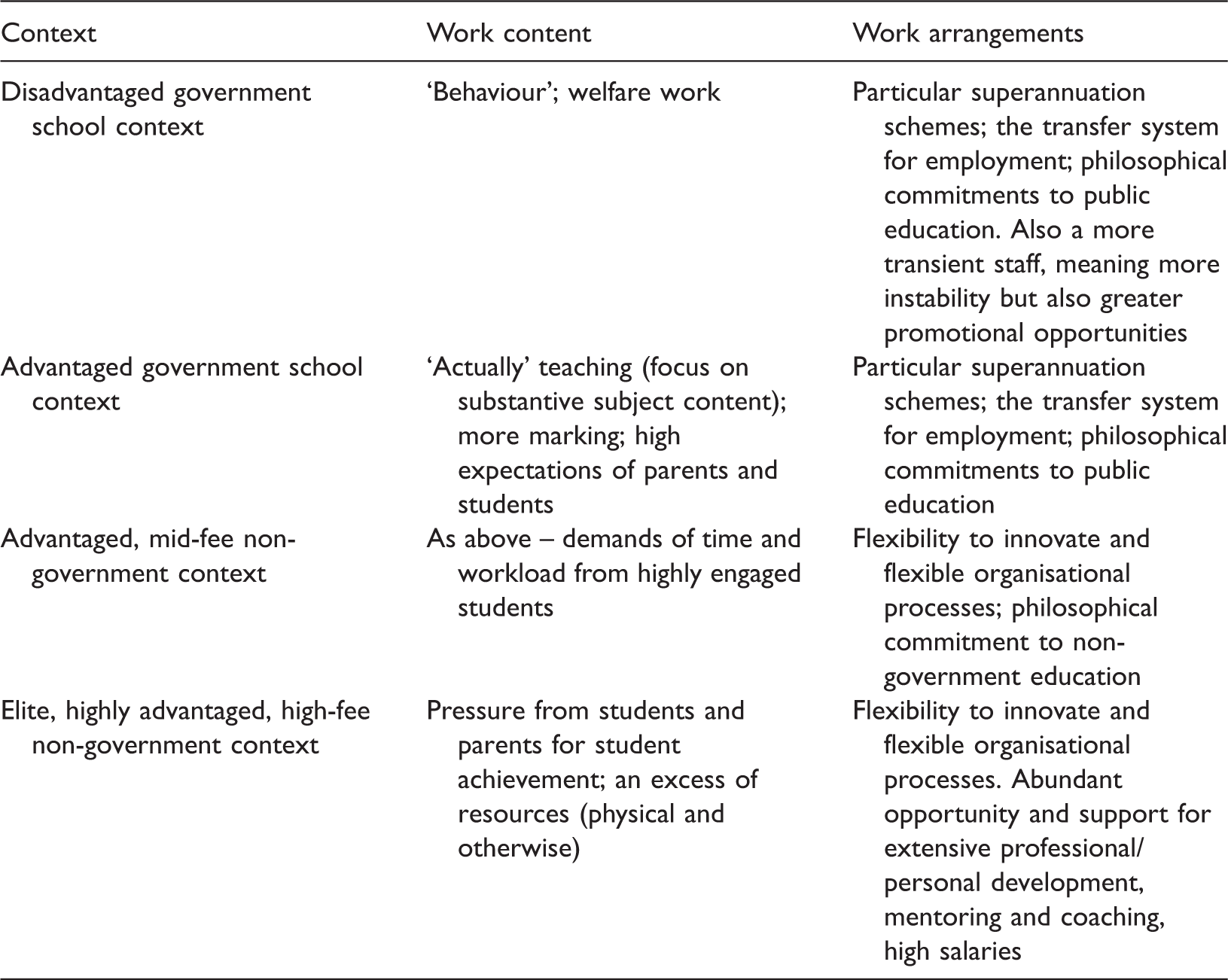
The interviewees from the disadvantaged government school context in our study conveyed high work intensity with constant juggling of behavioural issues, which was felt to disrupt pedagogical matters. In this context, the job was described in terms of other welfare sector professions, such as social work, police-work, counselling and welfare officer work. This experience was expressed as follows by one of the interviewees from a disadvantaged government school: Being in this environment where it's low SES [Socio-Economic Status], obviously there's a lot of welfare issues, we become more like counsellors and parents and you name it, because that opportunity is not offered at home.
In the advantaged government school context, the content of the job contrasts with that in the disadvantaged context. One interviewee from a single-sex school, who had transferred from a disadvantaged context, described how her job now (as opposed to previously) is ‘actually’ about teaching and learning. ‘It's probably the biggest one [benefit] for me, that I’m actually working with students who I feel want to learn’. At the same time, this interviewee felt she was required to change her teaching practice, indicating that the job, as these teachers interpreted it, was indeed shaped by the student body and is thus highly context-specific. Whilst the job was found to be stimulating and satisfying for this interviewee, teaching such students was also felt to bring accompanying pressures, in particular a higher pedagogical workload and intensity. Another participant commented: This school is actually a dream to teach at, but along with that comes an even increased workload, because if you say to the [students] at this school, do [an assignment], they'll do it.
In the non-government sector, in the advantaged, mid-fee private context, a similar picture to the advantaged government school context emerged. Teaching here lacked the overt and substantial behaviour management component evident in the disadvantaged context. The apparent extent of student engagement in learning tasks meant that both teachers and students experienced distinct challenges in juggling competing tasks. Teachers faced significant demands of time pressure and workload.
In the elite, highly advantaged, high-fee non-government context which was also single-sex (a common feature of many schools in this sector), the interviewees described their job as very intense, with highly motivated students, and pressures from both students and parents to gain high grades. One of the interviewees described her workplace context as characterised by ‘competition, everyone is very competitive […]’. At the same time, a picture of a highly supportive work environment shone through. The way in which the content of the work is perceived can also be linked to the resources available. There are examples from the affluent private sector in our sample (geographically located in the older northern, eastern and inner suburbs) of almost an excess of resources available, both physically and in terms of support from colleagues and professional development. One of the interviewees from a non-government, high fee school depicted the conditions for carrying out her job as follows: My department is fantastic; I have all the resources that I could possibly want…. Because they constantly offer me opportunities, they are constantly trying to challenge the teachers with all sorts of international and national guests and training, and they are just so focused on teacher development…. Over the years I think I have gotten pretty good at that [working with disadvantaged students], and so I've had opportunities to apply for selective schools and I thought, I don't think I could be as valuable to those kids as I could be here. A teacher is not a teacher.… A teacher in one context can be so different to a teacher in a different context, and it's that sort of skill set, a very distinctive skill set that [one] has, that emerges and develops from the context of who you are teaching in what circumstances, and then that…becomes sort of your…key asset.
The data analysis indicates that a teacher learns how to be a teacher in a specific setting. In other words, teachers develop context-specific skill-sets, dependent largely on the relative advantage or disadvantage of their students. This finding relates to the issues of choice, competition, marketisation and privatisation, as school choice processes have created a diversified education arena, in which different sectors and different geographical locations attract different groups of students. There are two interesting issues related to this. First, it seems that teachers develop context-specific competencies, which may be applicable and useful in their current context, but which they themselves see as context-bound, making it potentially difficult to change employment contexts. Second, from a longer perspective, this may contribute to an increasingly divided teaching force, where ‘islands’ are created. Next, we consider working arrangements.
Working arrangements – reinforcing skill-set lock-ins
The context-specific skill-sets discerned above may be reinforced and compounded by practical issues that make it difficult, and to some extent risky, not only to change between sectors, but even within sectors. That is to say, teachers were not only tied – locked-in – to their workplace contexts by the specific skill-sets they developed there, but also by particular workplace arrangements such as superannuation (pension) schemes, transfer systems, employment security/insecurity and career progression. Although work content is clearly distinguished by the four contexts, the picture is less clear-cut when it comes to working arrangements.
In the government school workplace context, several working arrangement issues, including superannuation schemes, the sector's ‘transfer system’
3
and having a tenured position meant that the interviewees were likely to remain in the government education system rather than swap to a different working context. Further, some interviewees had philosophical reasons (a valuing of state-funded, free education) for working in the government sector. These teachers commonly expressed a strong disinclination to change sectors. Even so, there were also practical issues that influenced their decisions to remain in the government system: But because I am also in a superannuation scheme, even from a practical side, there are a lot of disincentives for me to move on, so I would have to think very carefully about it from that point of view…. The actual transfer system in the public school system and the security of tenure, it's a big plus. It seems to be a very transient region [western/south-western], where a lot of people work, then move on. A lot of people are given jobs straight out of university into this region because there is a need, because people are leaving. There tends to be quite young head teachers here at this school, compared to other schools, younger deputies, and even principals in the region tend to be quite young because of the transient nature. So there are always positions to be filled.
In the mid- and high-fee advantaged context lock-ins were different, because they related more to potential for loss of perceived opportunity or favourable working conditions and arrangements. In the mid-fee context this included such factors as perceptions of flexibility to innovate extensively and flexibility also in school structures and management processes plus commitment to non-government (most usually Catholic) education. In addition, within the high-fee context, very substantial opportunities for professional development, mentoring and coaching plus high salaries contribute to teachers' reluctance to swap sectors.
Summary of lock-in factors.
Discussion and conclusions
From these initial empirical investigations, this paper has identified the themes of content of work and working arrangements as central to the issue of teachers’ working conditions in relation to school choice. This has been demonstrated through the development by teachers of skill-sets that are distinctly context-specific, and which create lock-in effects within and between sectors. Moreover, while there are likely never simple or single reasons why teachers stay or move between or within school sectors, our findings indicate that working in a school with a particular population of students as a condition of work and/or particular work arrangements may have an influence on teachers, and that the significance of this may well be exacerbated by the effects of school choice processes which further drive such differences. Key dimensions in this appear to be the prevailing socio-educational characteristics of the school: this research supports Forsey's (2010b) finding that teachers feel they can ‘actually teach’ (that is, focus on substantive subject content and instruction) in middle-class contexts. Teachers in Considine's (2012) study of teachers’ work in government secondary schools in NSW seemed to discern similarly. In a highly segregated system, concentrations of social class are increased, and this may to some extent explain the teachers’ reported and potentially limiting focus on ‘behaviour’ in the disadvantaged context, where they were working with higher concentrations of disaffected students excluded by the norms and practices of what is arguably a middle class institution – the school. Accompanying this is the school sector and the associated type of employer, as various working arrangement issues also reinforce the lock-in effects by making changes between sectors risky and thus unattractive. The result is a teaching profession that is becoming increasingly diversified, where different schools and different places create very different conditions under which teachers work. There are also indications that teachers not uncommonly stay in their own ‘pond’, returning to teach in the area, or even the same school, in which they grew up, corroborating research by Boyd et al. (2005) about the geographical, social and cultural preferences of teachers. However, as this project did not use a life history methodology, this is one area in which the current findings could be extended, with a deep and detailed approach to teachers’ career trajectories. Forsey (2010a) has looked at such questions, but only of those who have switched sectors. Finally, there was a clearly articulated sense of its being in the character of some regions to have a more-or-less transient teaching population. This raises questions about the extent to which lock-in effects operate for teachers in disadvantaged school contexts, and whether they contribute to teachers’ willingness to stay in particular schools, or even perhaps in teaching more broadly.
While entrapment-type elements were the most evident lock-ins in disadvantaged sectors and schools, advantaged and non-government school sectors were not free of lock-ins. These were couched in terms of potential loss of opportunity, entitlement or privilege, or dimensions that these teachers had come to value even though they may not originally have been factors that attracted them to the school: organisational flexibility; high-level professional/personal development; and high salaries.
The research reported in this paper points towards avenues for further research. There are indications in our empirical data that interviewees chose their workplace context rather early, sometimes even as a reflection of their own schooling, corroborating Boyd et al. (2005). It would be relevant to examine further whether and why teachers stay in the sector of their own schooling, or conversely, the reasons for change. Another direction for further studies would be to focus on the organisation of work, including the concept of collegiality. Changes relating to the organisation of teachers' work can arguably affect the possibility for such interactions. For instance, one study found that when conditions challenged intra-professional relations, the possibilities for professionals to collectively build a knowledge base and to use collegiality were lessened (Jansson and Parding, 2011). The arguments presented in this paper indicate that future studies of teachers' work in relation to school choice would benefit from consideration of temporal and spatial dimensions. Lastly, comparative studies of welfare sector professionals – such as teachers – and their working conditions are needed. There is concern over the micro-focus, single-profession and/or single-country studies of professional work and the insufficient general account of occupational change (Adams, 2015; Faulconbridge and Muzio, 2011; Muzio et al., 2008). Comparisons between nations and between professions are both key facors, and qualitative studies are of special interest: Brannen and Nilsen (2011) point out that many of the existing comparative studies are quantitatively based. Whilst it is difficult to make cross-national comparisons (Forsey et al., 2008), we concur with Burau (2007) that it is also constructive, allowing examination of both similarities and, conversely, differences across contexts.
This paper has explored the perspectives of teachers from a range of schools in a highly differentiated secondary education system in one Australian state. We found that the job of teaching is very much tied to specific local demographics. We contend that the experiences articulated by our participants have been exacerbated by schemes of school choice, which drive divisions between schools and the students who attend them. This has led to lock-in effects, which we argue have the potential to limit the occupational versatility and therefore mobility of teachers, perhaps increasingly so.
Footnotes
Declaration of conflicting interests
The author(s) declared no potential conflicts of interest with respect to the research, authorship, and/or publication of this article.
Funding
The author(s) disclosed receipt of the following financial support for the research, authorship, and/or publication of this article: This research received funding from FORTE, 2013-0177 and STINT, 2013-5450.