



Abstract
Many studies indicate that the teaching profession is influenced by social, cultural, economic, and political forces. In this article, we used Standing's theory of precarity to explore economic, social, and political challenges experienced by Polish physical education (PE) teachers. The purpose of this research was to explore the working conditions and perceptions of the profession among Polish upper-secondary school PE teachers. Data were collected using in-depth interviews with 37 participants and analyzed using a blended approach (i.e. inductive–deductive). The findings showed that PE teachers experienced difficulties associated with the marginalization of their work and manifestations of precarity typical for all teachers in Poland, namely poor working arrangements. PE teachers declared feelings of anomie and alienation as a result of uncertainty and, at times, anger, mainly due to the political factors affecting their work. Thus, this research also presented the direct entanglement of PE teachers in national-level politics. Participants expressed feeling powerless, out of control, and not prepared for the ongoing changes resulting from the political context in which they found themselves. The utilization of Standing's theory highlighted how neoliberal practices concerning the labour market reinforced the challenges faced by PE teachers, diminished the prestige of the teaching profession as a whole, and impacted the attitudes of PE teachers towards their work. Further, this research confirmed that the experience of precarity can be highly heterogeneous, underscoring the importance of examining local contexts to understand the complexity of the precarization process in education.
Introduction
Recently, a variety of problematic experiences have been identified among physical education (PE) teachers worldwide. For example, PE teachers experience a sense of marginalization and isolation (Ensign and Mays Woods, 2017; Ferry and Westerlund, 2023; Richards et al., 2018; Whipp et al., 2007) and often do not enjoy the same status or prestige as teachers of other subjects (Bizet et al., 2010; Mäkelä et al., 2014, 2015; Walters et al., 2024). PE is frequently considered less significant than other subjects, particularly in terms of its necessity to students’ education and future careers (Hardman, 2008). Compounding these perceptions, Kougioumtzis et al. (2011) reported low salaries, lack of support and few career opportunities for PE teachers. Research has also highlighted inadequate resources for conducting classes, resulting in difficulties in implementing the curriculum or lowering motivation (Kougioumtzis et al., 2011). Taken together, these factors can diminish PE teachers’ sense of professional control. These issues are significant since many teachers communicate feelings of mattering as influencing the importance of their work (Gaudreault et al., 2018). When teachers feel they do not matter, it can contribute to burnout, attrition, or turnover, which can ultimately result in teacher shortages (Blankenship and Coleman, 2009; Gaudreault et al., 2018; Mäkelä et al., 2014, 2015; Richards et al., 2014b).
The working lives of PE teachers have been considered using diverse theoretical frameworks, namely occupational socialization theory (Ensign and Mays Woods, 2017; Gaudreault et al., 2018; Mäkelä et al., 2014, 2015; Mellor et al., 2020; Richards et al., 2014a), role theory (Richards et al., 2014b), structuration theory (Lux and McCullick, 2011), and the quality-of-life model (Whipp et al., 2007). While diverse structural, interpersonal, or individual challenges faced by PE teachers have been documented through this work, it is only recently that they have been interpreted through precarity theory.
Precarity serves as a contemporary framework to analyze the complexity of the lived experiences of PE teachers from a critical perspective (Kirk, 2019). For example, Gonçalves et al. (2022) demonstrated that PE teachers experience precarity characterized by being overburdened with work, receiving low salaries, and lacking resources necessary for conducting lessons. These working conditions led to feelings of being marginalized, isolated, and unsupported. The use of precarity theory helped Gonçalves et al. (2022) show that these feelings did not solely stem from the meanings ascribed to PE in the school community and the relationships among school staff; they also arose from labour market conditions and changes induced by neoliberal forces in education.
The purpose of this research is to explore the working conditions and perceptions of the profession among Polish upper-secondary PE teachers through the lens of precarity. Given the influence of social, cultural, economic, and political forces on teachers’ work, it is crucial to consider the contexts of this work. Politically speaking, Poland is a post-communist country with a brief democratic tradition (since 1989), consequently grappling with characteristics that are often distinct from Western economic and political issues. In addition to relatively few examples of the use of precarity to study PE teachers’ work, the vast majority of existing research on PE teachers’ lives has concentrated on English-speaking or Western European contexts. We argue that there is a general lack of knowledge regarding the work of PE teachers from Central and Eastern European countries. Thus, the results of this study can add further insight into the situation faced by PE teachers globally.
The Polish context
Polish upper-secondary schools (for students aged 15–19) require three 45-minute PE classes per week, led by qualified PE teachers holding a master's degree (equivalent to ISCED level 7). The goals of PE are outlined in the core curriculum, aiming to prepare students for lifelong physical activity and equip them with skills to maintain their health. The core PE curriculum for upper-secondary school comprises four parts: physical development and fitness, physical activity, safety in physical activity, and health education (Czarniecka et al., 2019).
Poland has its own traditions of PE that date back to the 18th century. The greatest influence on the development of PE came from the Gymnastic Society (Sokół), which popularized sports, gymnastics, and a healthy lifestyle among Polish youth. Sokół contributed to the establishment of many sports clubs and the development of Scouts groups. The society operated during times of partition and in the interwar period after Poland regained independence, but was banned by the communist authorities after World War II. Nowadays, PE teachers receive training both at universities and higher vocational schools. PE teacher education (PETE) programs are designed by institutions based on the European Qualifications Framework (EQF) and Polish Qualifications Framework (PQF). Many Polish teachers face similar situations to PE teachers elsewhere in the world, particularly in terms of continuing professional development (CPD) (Hardman, 2008; Hardman et al., 2013). For instance, a previous Najwyższa Izba Kontroli (NIK: Supreme Audit Office; 2010) report indicated that many principals did not ensure adequate CPD for PE teachers. As with all teachers in Poland, PE teachers face low salaries and many extracurricular classes are cancelled due to a lack of financial resources (Hardman, 2008). Another issue faced is the lack of real national representation of PE teachers in professional associations (Czarniecka et al., 2019).
The delivery of PE classes in Poland was audited by the NIK (2013) based on a representative sample of schools in 2008. The audit revealed that in a quarter of the schools, the mandatory number of hours for PE classes was not met and group sizes were not adhered to. Furthermore, in over two thirds of secondary schools, not all requirements of the new core PE curriculum were fulfilled, preventing the full attainment of educational objectives, particularly the promotion of a healthy lifestyle and interpersonal and social skills. The report also highlighted that PE holds a relatively low ranking among students and is perceived as unappealing. The United Nations Educational, Scientific and Cultural Organization report on PE (Hardman et al., 2013) also emphasized that Poland was similar to other countries in the region, citing insufficient funding for facilities, equipment, their maintenance, and teaching materials.
Recently, the Polish education system has faced political threats and adverse measures. Thus, the situation of PE teachers described above has been experienced by teachers across Poland. Rates of job satisfaction for teachers are amongst the bottom 20% for all workers (Kazimierczak and Bulkowski, 2023). According to results from the TALIS study (Malinowska et al., 2015), Polish teachers highlighted unsatisfactory salaries, low professional prestige, work overload, and job insecurity as being particularly problematic. Six other areas were also reported: poor working conditions, poor relationships with parents or guardians of students, a lack of development prospects, low authority among students, occupational health hazards, and poor workplace relationships.
Many current problems faced by teachers in Poland have resulted from poor relations with the Ministry of Education. In 2016, major educational reforms were initiated, with one of the major changes being the abolition of lower secondary schools (gimnazja). The reforms were implemented despite opposition from unions, non-governmental organizations, and teachers themselves. Since these reforms, there have been ongoing issues around teacher shortages, salaries, school structures, and generally poor working conditions. For example, the Polish Teachers’ Union (Związek Nauczycielstwa Polskiego (ZNP)) estimates that there is currently a shortage of up to 40,000 teachers (Nowosielska and Otto, 2022). Within this overall shortage, there is a particularly low number of young teachers (Malinowska et al., 2015). A primary reason for these shortages is low salaries. Currently, novice teachers earn just over the national minimum wage, at a rate that is close to half of the overall national wage for workers in Poland (ZNP, 2023).
The reforms from 2016 led to a nationwide teachers’ strike in 2019. The government did not meet teachers’ demands, proposing only a minor salary increase in exchange for additional working hours, while speaking negatively about teachers in state-run media (Merzyńska, 2022). Despite initial support from members of the public, their sentiments quickly changed.
The abolition of gimnazja 1 in 2016 led to structural consequences for the wider educational reform, which continues to affect schools today. For example, in 2022–2023 there was an oversupply of students applying to upper-secondary schools. As a result, in major cities, there was a shortage of school places for some students. In Warsaw, after the first round of upper-secondary school admissions, there was a shortage of places for 14,500 children (Warchala-Kopeć, 2023). These changes have led to an increasing number of Polish children (and their parents) seeking education in non-public schools or through homeschooling. This situation has reinforced the parents’ conviction of a crisis in the Polish school system.
Theoretical framework
The concept of precarity and the notion of the precariat as a newly emerging social class was introduced by Guy Standing (2014a, 2014b) and has been applied to PE by Kirk (2019). This concept was formulated to characterize a set of particular work conditions and the associated living conditions for workers in the Global North. The increasingly difficult living conditions are viewed as a consequence of tumultuous economic changes associated with the spread of neoliberal ideology (Standing, 2014a).
The precariat can be characterized through three dimensions. The first dimension is distinctive relations of production, understood as unstable labour arrangements (‘flexible’ labour contracts, temporary jobs), and lack of occupational identity or narrative (Standing, 2014b). The absence of guidelines for actions in the labour market, combined with a lack of control over one's time due to multiple jobs and the constant need to adapt to changing work conditions, leads to continuous stress and a state Standing (2014b) termed the ‘precaritized mind’ (p. 23). The second dimension is distinctive relations of distribution and income security (Standing, 2014b). Presently, due to the increasing prevalence of tasks that are unpaid but fall within the scope of professional work, compensation for that work is decreasing. Additionally, the precariat does not benefit from non-wage forms of remuneration. The third dimension is a distinctive relation to the state (Standing, 2014b). The precariat loses various kinds of rights (social, economic, or cultural) or must struggle to maintain them. Examples include difficulties in unionizing or increasing dependency on frequently changing regulations over which workers have decreasing influence. This is why Kirk (2019, p. 20) writes about the precariat as a dependency because the fate of a member of the precariat ‘is in someone else's hands’. These dimensions lead to uncertainty and produce a sense of deprivation and a combination of anxiety, anomie, alienation, and anger (known as the four A's) (Standing, 2014a).
Although the precariat was primarily associated with the Global North, it is not limited to a specific geographical location, and the experience of precarity is highly heterogeneous. Representatives of many professions and individuals from various social classes, with different educational levels, ages, or genders, can be classified as part of the precariat, although almost no one wants to admit to belonging to this class (Kirk, 2019; Standing, 2014b). Difficulties in generalizing this concept also stem from experiencing precariousness in professional work due to employment instability or feelings of alienation, anomie, unmet expectations in one's job, or due to the inadequacy of one's education for the performed tasks.
Clearly, education (and by extension, teaching) is entangled in rapid changes resulting from marketization and privatization as consequences of the free market economy, and hence, processes of precarization. Perceiving education as a service rather than a public good and shrinking state funds allocated to public education reinforce social inequalities, affect the quality of education, and impact the curriculum (Kirk, 2019). According to Kirk (2019), such a situation can have various consequences, such as experiencing the marginalization of students whose parents lack specific economic and cultural resources to provide the best (often paid) education.
Mindziak (2016) used precarity theory to show that many teachers in Ontario, Canada struggled with the precarization of work, suffering from the inability to secure full-time, permanent employment. High competition in the job market made them uncertain and anxious about their chosen career path and they experienced frustration (Mindziak, 2016). Due to periods of unemployment, they often engaged in other professional activities and volunteer work, which hindered control over their own time and development as teachers. They also engaged in seeking an occupational identity to counter their current status as marginalized workers. Nevertheless, at times, they needed support from partners, family, or the state to sustain themselves (Mindziak, 2016). Although the labour context in Ontario contrasts with that in Poland (highlighting the heterogeneity of precarity globally), this example shows how precarity can reveal different sources of stress on teachers in different contexts.
Similarly, work by Marzano et al. (2015) on Italian teachers and Seifert et al. (2007) on teachers of adults in Quebec identified difficulties arising from part-time jobs and uncertain working conditions. Italian teachers felt uncertainty due to the temporary nature of their work. They functioned under temporary logics, and their professional experiences were linked to contingency (Marzano et al., 2015). Meanwhile, Seifert et al. (2007) highlighted that atypical work contracts of teachers of adults had a psychological impact but also affected work content and psychosocial working conditions. This also affected the individuals with whom the participating teachers worked. Melville et al. (2019) emphasized difficulties in professional learning practices for a part-time teacher in a school in Ontario, Canada. Part-time work prevented paid training despite the teacher's willingness to improve, hindering a full understanding of the implemented reform.
Kirk (2019) emphasizes the need to analyze the experience of precarity in the context of PE. Although teachers’ experiences of precarity have been described in several studies, other than Gonçalves et al. (2022), there are few works that focus on the PE teaching profession, despite PE being a marginalized subject (Gaudreault et al., 2018). We seek to build on the work of Gonçalves et al. (2022) by analyzing Polish PE teachers’ experiences of precarity.
Methodology
A qualitative approach was used, involving individual in-depth interviews with 37 PE teachers. The interviews were conducted as part of a larger research project titled ‘Gender in PE practice in Poland’. The research project received clearance from the Scientific Research Ethics Committee of Józef Piłsudski University of Physical Education in Warsaw, Poland (SKE 01-37/2021).
Participants
All participants at the time of the study were employed in public upper-secondary schools. They worked in 19 different schools, both upper-secondary and technical. Due to concerns expressed by some participants about the possibility of being recognized, and to ensure confidentiality, the specific locations of the study are not disclosed. The study included 20 male teachers and 17 female teachers. The inclusion criterion for the study was a minimum of 3 years of full-time work experience in a school. The average age of the participants was 46.4 years, with women averaging 45 years and men averaging 47.7 years. Only seven PE teachers had less than 10 years of experience, with an average tenure of 21.3 years for male teachers and 17.4 years for female teachers. Among the participants were four individuals working full-time in schools while simultaneously being retired. Due to the shortage of teaching staff, it often happens that teachers who are already eligible for retirement continue to work in schools, filling gaps in the workforce while simultaneously supplementing their not-very-high pensions.
Data collection
Initially, participation was offered to teachers who had been involved in other stages of the research project, and subsequently, additional participants were recruited through snowball sampling. The interviews were conducted by Authors 1 and 2. Interviews took place both in person and via Microsoft Teams, and were recorded and later transcribed verbatim. They were conducted in Polish; only the sections used in this study were translated into English. The interviews lasted between 46 minutes and 2 hours and 32 minutes (average 63 minutes). Some teachers were more elaborate than others with their responses, which resulted in the varying duration of the interviews.
The interviews involved several components. They began with several ‘ice-breaking’ questions, inquiring about participants’ reasons for choosing teaching, their sporting background, work experience, and number of schools they worked in, before focusing on questions about working conditions, perceptions of the teaching profession, relationships with colleagues, parents, and students, as well as implementation of the curriculum. Subsequent questions addressed other employment undertaken by teachers aside from teaching, potential plans to leave the profession, and opinions on the 2019 teachers’ strike.
Data analysis
Collaborative data analysis (Cornish et al., 2014) was employed. Initially, the research material was independently analyzed by the first and second authors. The interviews were read multiple times, and descriptive codes were generated. The codes were then compared, differences in interpretation were discussed, and an agreement on the understanding of the codes was reached. Hence, the first step of the analysis was inductive. Higher-level categories were then established based on theoretically-oriented categories. The identified categories pertained to precarious working conditions, lack of control over professional work, and feelings of marginalization, alienation, anomie, and anger regarding participants’ work. Such an analytical approach can be considered ‘blended’ (Graebner et al., 2012) – the initial inductive approach allowed for being ‘open’ to the data, while in the later stages, the focus was directed towards theoretical categories.
Several strategies were implemented to ensure trustworthiness. Firstly, the larger research project involved a 5-month period of observing PE classes at a single upper-secondary school. Subsequently, interviews were conducted with students, parents, headteachers, and PE teachers. Although this study presents only the results of interviews with PE teachers, the year spent in the school facilitated a profound understanding of the school environment and its issues, including perceptions of teachers, contributing to data saturation and prolonged engagement. In our case, prolonged engagement also denotes significant time dedicated to analyzing research materials. Another strategy employed for ensuring trustworthiness was peer debriefing. The third author, who was not involved in the research project, was engaged in the peer debriefing process. Additionally, we identified three non-conforming cases that differed from the general patterns of responses. Although participants’ responses displayed a high level of consensus, we observed discrepant opinions about the working conditions of PE teachers. For example, one female PE teacher had no complaints about working conditions and believed that any inconvenience was compensated for by interaction with students. She also did not experience challenging emotions related to work conditions. The remaining two participants believed that those opting for the teaching profession should anticipate the offered working conditions and seek alternative solutions, such as pursuing other professions (Lincoln and Guba, 1985).
Results
The results are presented in three parts. First, we describe how the profession of PE teachers is perceived, utilizing statements from PE teachers themselves. Second, experiences of precarity among Polish teachers are outlined (however, this is not necessarily specific to PE classes). Third, we discuss the profession of PE teachers in relation to the 2019 teachers’ strike and the government's attitude toward the teaching profession. A visual overview of the key findings is presented in Figure 1. After each quote, we identify the participant number, gender and age. For example, P1-F45 is Participant 1, Female, aged 45.
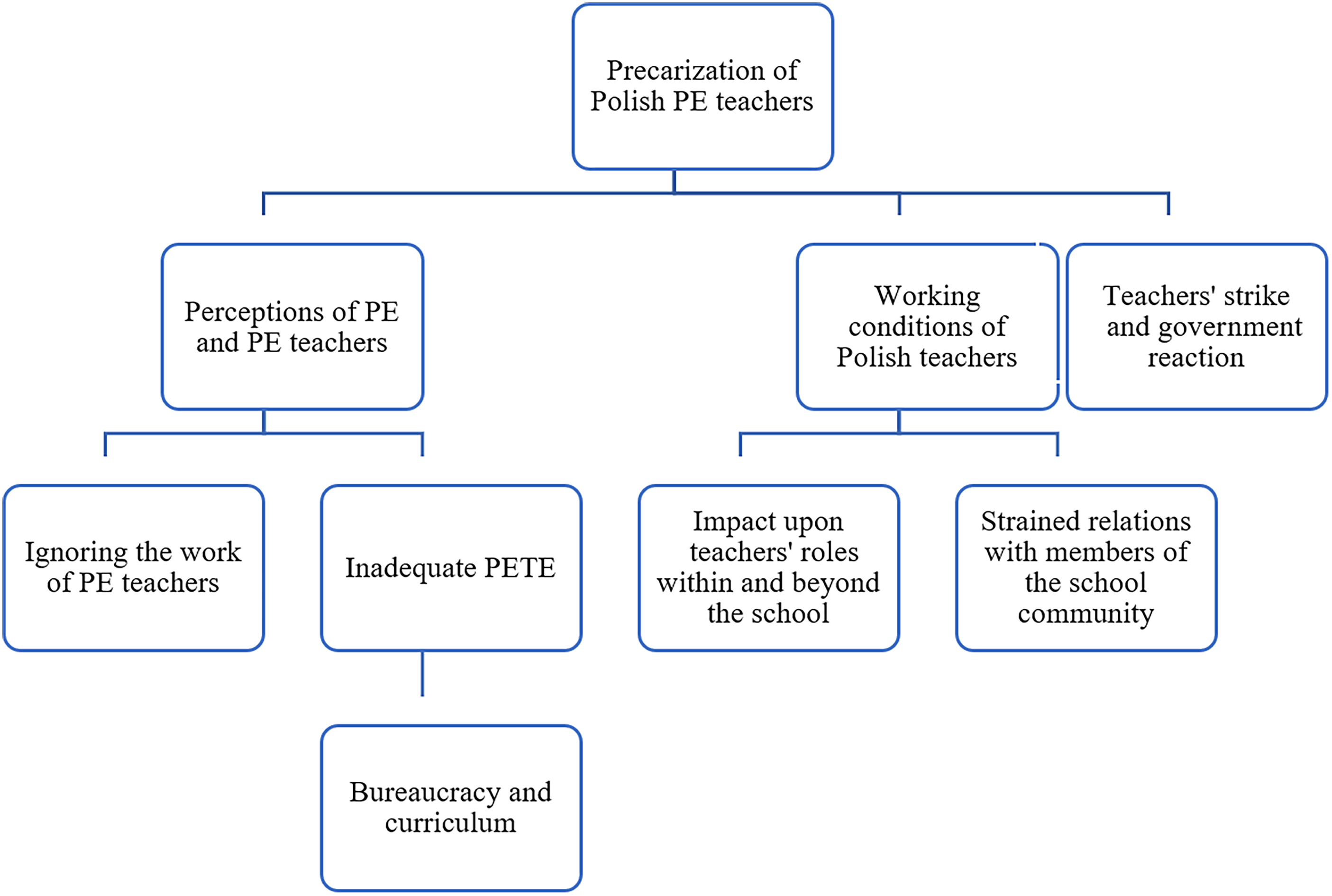
Thematic map of key findings.
Perceptions of PE and PE teachers in the school environment
Most participants asserted that PE teachers are perceived differently than other teachers. They noted a prevalent belief that PE teachers have an easier job because they do not prepare students for exams or assess homework. Thus, it was assumed that PE teachers do not make as much effort as other teaching staff: Some people who do not like PE think that it is unnecessary, that it is a waste of time, because it would be possible to spend this time on studying (P1-F45)
Similar to the Canadian PE teachers in Bizet et al. (2010), Polish PE teachers often deal with depreciation of the subject by students and the rest of the teaching staff at school. Participants reported that such statements came from teachers of other subjects as well as from administrators. Exceptions came when the principal was a former PE teacher. The participating PE teachers indicated that they were treated as a ‘necessary evil’, ‘inferior class’, ‘outclassed’, or ‘lower rank’. Several participants cited instances where students would miss a lesson or prepare for school exams during a PE class. The use of the gymnasium for purposes other than PE also prevented PE teachers from performing their duties. Participants described their efforts to ensure that PE was taken seriously, opposing both the exclusion of the gymnasium for PE classes and the dismissal of students. Their stance surprised teachers of other subjects because they assumed that managing students during PE classes or using the gymnasium was normal and unproblematic. Thus, changing the perception of PE required time and active engagement.
Ignoring the work of PE teachers
Beyond perceiving PE as less important, the sense of alienation among PE teachers was linked to a misunderstanding of their specific challenges and difficulties. For example, participants mentioned that due to the belief that they have an easier workload, they are expected to take on additional tasks, such as supervising students during exams or taking on administrative tasks. Several highlighted that, unlike teachers of other subjects, they must be more attentive to students’ safety. Injuries frequently occurred during their classes compared to other lessons in the school, leading to additional stress. Although injuries are common during physical activities, participants noted that teachers of other subjects were unaware of the risk of injuries to students and the stress that PE teachers experienced as a result.
Participants also described how other teachers were unaware of the responsibility that falls on PE teachers regarding sports tournaments or school trips. They asserted that, especially during school trips, they have a huge responsibility for students and difficulties in balancing trips with their personal life. Other teachers seemed unaware that sports tournaments involved changes in working hours, payment from personal funds for travel to tournament venues, and continuous substitution for absent PE teachers.
Many participants also stated that PE teachers often have a better rapport with students and this was overlooked by the rest of the teaching staff. Students frequently approached them seeking advice and support. While such tasks sometimes posed a challenge, teachers proudly emphasized that they were perceived by students as those who maintained close contact and spent considerable time resolving students’ problems.
Another difficulty experienced by some participants was the inadequate infrastructure for conducting lessons. Some believed the conditions for conducting classes and necessary materials were sufficient but others claimed that they frequently lacked adequate resources: In winter, it is not great because we only have a small gym and there used to be a larger gym, but now they have taken it away for classes because the classrooms are overcrowded, and they needed a regular classroom. We only use parts of that gym when nothing is happening there, right? (…) We do not expect the impossible. The mats are already old. When I started working here, they were already like this, and they are still the same (…). I have a different perspective now because I do not want to fight anymore. I say, two more years of work, and that is it, right? I will not work anymore after that. (P31-F65)
Inadequate teacher education
Some participants indicated that their PETE studies did not adequately prepare them for the profession. They emphasized that they were unaware of the frequent changes faced by teachers, such as changing student needs and issues, declining skill levels, administrative challenges, and difficult working conditions: Oh, it is weak what happens at the university, aside from sports classes, general teaching, etc… When you come to school, there is such a collision with how children, how young people behave at school, right? (P11-M46)
Bureaucracy and curriculum
Many participants believed that the amount of paperwork consumed time that should have been dedicated to the students. The issue of bureaucracy led several participants to be critical of the curriculum. Several suggested it was developed by individuals who had not worked in Polish schools and did not understand their reality. Respondents felt that PE teachers had no influence on the curriculum document, suggesting their opinions were not valued by curriculum developers. Several circumvented this by making their lesson plans comply with the curriculum on paper (yet teaching different content to the plans). Alternatively, they completely ignored the curriculum. As one participant stated: I mean, in school, there's often this sense of helplessness, in my opinion. We don't have real influence on anything. (P37-M28)
Working conditions of Polish teachers
The problems of marginalization, alienation, and misunderstanding are compounded by broader issues faced by all Polish teachers related to poor working arrangements such as low wages, diminishing professional prestige, and a lack of respect from students, parents, and parts of society. The respondents unanimously pointed out that the teaching profession is increasingly undervalued in Polish society: I think the teaching profession is generally perceived very negatively nowadays. Slackers, parasites, right? They have all the free time, do nothing, and still rake in money. They have vacations all the time, right? It's also a matter of those social groups being incited against each other by an old rule, divide and conquer, and the PE teacher, in particular, an unqualified teacher, just sits in a corner, drinks, and makes money. I think that is the stereotype of a PE teacher. Or they throw a ball and do nothing. (P6-M51)
Of these factors, low wages was a key issue. Due to low wages, most participants took on additional jobs to sustain themselves. Exceptions were retirees and some female PE teachers who stated that due to parental duties or their spouse's good job, they did not need additional employment. PE teachers often worked in multiple schools, coached in sports clubs, or had various jobs unrelated to their trained profession. Most claimed that the extra work did not affect their performance at school but did limit their family and personal lives. As Standing (2014a) suggested, taking on multiple professional tasks to earn a decent living makes it difficult for teachers to control their time effectively.
Impacts upon teachers’ roles within and beyond the school
The described poor working arrangements can lead to a vicious circle, as explained by the PE teachers. Some participants noted that due to low earnings and low prestige, PE teaching is less frequently chosen by young people and is deemed unattractive. The lack of recognition and comprehension of their professional work can lead to a sense of alienation. This, in turn, can enhance feelings of anomie or exclusion in society. Standing (2014b) states that the precariat suffers due to the lack of a professional narrative and prospects for social mobility. Consequently, their professional identity weakens. In this study, some participants no longer admitted their profession to new acquaintances. One participant said she no longer admits she is a teacher, while another claimed he was viewed by family members as someone who ‘has not succeeded in anything in life’.
Some participants described remaining in teaching because it provides stable employment and teachers’ insurance. According to Billingsley (1993), in uncertain or economically challenging times, teachers are more inclined to remain in school rather than seek new opportunities outside the school environment due to such perceived benefits. Undoubtedly, due to the COVID-19 pandemic, and the war in Ukraine, teachers may have viewed their school jobs as a safe option during difficult periods. However, their decision to stay due to insurance coverage resulted in minimal engagement in school work, and finding professional fulfilment outside the school, often as coaches in sports clubs. There was potential to earn more money in a sports club than in a school, but in Poland, those working in the sports industry are mostly self-employed and responsible for personal insurance premiums. Teachers, however, have insurance covered by the school, making work in sports clubs highly attractive. This situation negatively impacts the assessment of teachers’ work by parents and society at large, as participants were aware. Such teachers were termed ‘ZUS workers’ (ZUS is the abbreviation for the Social Insurance Institution). This created tension around their work and professional identity, as they may see themselves primarily as coaches rather than PE teachers – a problematic element that has been highlighted for decades in the PE teacher socialization literature (Lawson, 1983). Negotiating both roles creates challenges in developing a strong professional identity: You must have heard, I call this group ‘a group of teachers not only of PE’. I created a group of ZUS employees. Teachers who are employed full-time or part-time so that we have paid ZUS and work after school, and at school, they gather strength for what we do in tutoring, in sports activities. (P13-M58)
Strained relations with members of the school community
The declining status of the teaching profession was apparent in participants’ interactions with some members of the school community. They described the attitudes of parents and students towards teachers’ work, highlighting an increasing demand from parents and a lack of respect for teachers due to their earnings: You can even feel it most at meetings with parents, that they look at the teacher where they regard the teacher with great leniency due to their salary. (P26-F31) I do not think I'm the only one who feels that a teacher is the biggest shit society has ever seen! This is how we are perceived! (…) Our parents sometimes tell us what we should do! (P10-F35)
Participants highlighted that negative perceptions were influenced by beliefs regarding teachers’ periods of leave (winter and summer holidays) and short working hours (18 per week in Poland). They expressed feeling labelled as lazy with little acknowledgement of their work beyond conducting lessons: So, contrary to appearances, it is very hard work, even though some people think that there are only 18 hours. 18 hours are a basic job, which some people do not even have when it comes to small towns. Most of us work full-time or even overtime jobs or grab several jobs at different schools to make the salary higher (P24-F32)
Standing (2014b) stressed that representatives of the precariat are often anonymous and cannot see a way out of their situation. Their anomie is understood as passivity but results from despair. PE teachers are perceived by society as ineffective and unable to cope on their own in the new economic conditions. They are seen as not working much, although they usually need more than one job to sustain themselves, which, in turn, leads them to spend many hours at work. The pessimism regarding the future of schooling that affects them is perceived as dependence on the state and laziness.
All of these factors make it difficult to maintain their professional identity and generate a lot of uncertainty about the sense of practising their profession. During the interviews, it was voiced that respect and recognition are received only by teachers who have established a reputation for providing tutoring and preparing students well for the matriculation exam. Parents enrol their children with these teachers well in advance, and these teachers earn a good income outside the official school system. PE teachers do not receive such respect because their subject is not a matriculation exam subject, which deepens their sense of irrelevance.
A sense of frustration prevailed among the vast majority of respondents. PE teachers with long experience expressed a clear opinion about the deteriorating status of the teaching profession in society; they also more often pointed to the problem of teachers not fulfilling their duties well. They seemed to be more concerned with the negative functioning of education. They pointed to the problems of ageing teachers and were therefore worried about the ‘collapse’ of the system since young people do not want to become teachers: I mean, I am for something very radical. I mean, I think it will fail quickly, because how long can a pensioner work, right? This is first, so the people will crumble, and there will certainly not be a large influx. (P9-M68) Well, I perfectly understand that teachers are frustrated with how much work and energy they put into teaching and raising children and young people. And I would very much like it to be adequately paid, although I do not defend all teachers. As an insider, I also know that there are people who shouldn't work, who are tired, and overworked. (P29-M35)
Teachers’ strike and government reaction
In 2019 the national teachers’ strike highlighted teachers’ unacceptable working conditions. While many participants supported the strike, several felt sadness and resignation: You know what? I would love to get away from here, as far away from this country as possible, if I could. This is a very, very bad life experience. And I do not hide that the way we were treated, I would say dirty, even rotten during the strike. What a traumatic experience it was for us, like a campaign of the authorities and all these internet trolls, those offensive things that were said about us … I cried with my students during the strike. They came to me and cried, they said, ‘How can you be an adult and behave like this?’ They are high school graduates. And it was a terrible experience! (P2-F42) Well, morally, I am quite beaten up. My psyche has been somewhat devastated. I probably have not recovered from all these events, from 2019. Moreover, it accumulated because over the past several years, the previous Minister also stirred up quite a commotion. Very poorly, very poorly! And when I talk to teachers with more experience, it is exactly the same. (P13-M58)
The respondents had varying opinions about preparation for the strike and the methods chosen. Some argued that it lacked radicalism and was too short-lived. Others believed that the timing during exams was inappropriate, and the strike itself was poorly organized. Moreover, certain teachers indicated that the strike led to divisions among the teaching staff. The government's decision to withhold salaries during the strike exacerbated the situation, reinforcing existing divisions that still persist in some schools. This systematic undermining of unity among teachers reinforced a sense of alienation. Consequently, the professional group of teachers was weakened, rendering them less capable of advocating for improved working conditions.
Negative media narratives appearing in state-run media also led to reduced support for striking teachers. These narratives focused on the supposedly high earnings of Polish teachers and the minimal number of hours they were required to work. It was also alleged that the strike was not an initiative by ‘ordinary’ teachers but was concocted by the ZNP, whose leadership aimed to profit from it. Teachers’ responses revealed anger towards the prevailing situation: Well, I felt disgusted, appalled by these statements, because most of them were simply lies, which meant that it was simply antagonizing us teachers. (P16-F39) Because with our salaries, with everything, with how we're treated by the authorities, such thoughts would come. But I'm already over 50, and I wondered, what am I supposed to do in my life now? I don't know. Going to work as a manual labourer or something, well, I am a bit too old for that. I will probably stay in this school. Unless I go to a sports club somewhere, but even from just a sports club, one will not survive. (P6-M51) I never thought I would be wondering about doing something else in life. But increasingly, I am beginning to think about it because, working two jobs in school, I can barely keep up with everything, right? But it comes at the cost that I can not spend much time with my own children because I am always at school. (P27-F49) They seem to want to plow through the Polish education system. That is how it seems to me. We will reach a point where only wealthy people will be able to afford education, just like it used to be. Those who have money will have access to education. There will be private schools, and the rest will attend basic, underfunded institutions. (P36-M51)
Discussion and conclusions
This study explored the working conditions and perceptions of the profession among Polish PE teachers through the lens of precarity (Standing, 2014a, 2014b). It highlights the slipping into the precariat of Polish PE teachers.
Among the main findings, participants experienced difficulties associated with the marginalization of PE teachers’ work and manifestations of precarity typical for all teachers in Poland (poor working arrangements). The status of PE proved to be an additional demotivating factor for teachers. Participants perceived themselves as less respected than teachers of other subjects and experienced alienation. PE was perceived as non-intellectual and insignificant to students’ development, hence suffering from a lack of recognition of its importance. Moreover, some participants experienced poor conditions that hindered conducting classes. They stated that higher education did not prepare them for work in schools. Also, PE teachers felt they did not have an influence on shaping the curriculum and often lacked the means to implement its objectives.
In turning to Standing's (2014a) theorizing, participants experienced (in various ways and combinations) the four A's: anxiety, anomie, alienation, and anger. Participants declared feelings of anomie and alienation as a result of uncertainty and, at times, anger, mainly due to the government's response to the 2019 teachers’ strike. Gonçalves et al. (2022) presented teachers’ reactions and proactive strategies in response to their experiences of precarity. Yet, this research shows that many Polish PE teachers stand in stark contrast, with many using school as a place to fulfil other professional tasks, wait for retirement, or just observe the situation with embarrassment. This situation may be related to the excessive workload (a second job is a necessity in the school environment), which impedes critical reflection and actions aimed at improving their situation.
Overall, participants experienced manifestations of precarity typical of both the Global North (low wages, lack of respect/recognition for their work, inadequate funding for public education) and the Global South (sometimes poor working conditions) (Gonçalves et al., 2022; Kirk, 2019; Marzano et al., 2015; Melville et al., 2019; Mindziak, 2016). At the same time, this research confirms that precarity can be highly heterogenous, underscoring the importance of examining local contexts to understand the complexity of the precarization process in education. For example, although teachers in studies by Marzano et al. (2015), Mindziak (2016), and Gonçalves et al. (2022) and the present study all experienced precarity, they did so differently due to multiple contextual elements. Simultaneously, the utilization of Standing's theory allows us to perceive how the working conditions of teachers influence the societal perception of their profession and impact the attitudes and emotions of the teachers themselves.
Unlike PE teachers in many other countries (Kirk, 2019), Poland can be characterized by high job stability for teachers. Due to teacher shortages, employment uncertainty is not a concern for the Polish respondents, yet Standing (2014a) indicated that employment uncertainty (working on short contracts, lack of employment continuity) is one of the main afflictions of precarity. However, the presented research findings reveal that while the participants appreciate employment stability, it is not sufficient for a positive assessment of their professional conditions. Low teachers’ salaries lead them to seek additional work to sustain themselves, causing difficulties in managing their time. This was a decision that teachers seemed to be making out of financial necessity rather than any uncertainty about their role. Additionally, low income contributed to the declining status of the profession and a lack of respect for teachers, which, in turn, led to difficulties in maintaining professional identity by teachers themselves and generated a lot of uncertainty about the sense of practising their profession. Ultimately, this strengthened their sense of anomie and resignation. Previous studies indicated the marginalization of PE teachers within the school environment (Ensign and Mays Woods, 2017; Ferry and Westerlund, 2023; Hardman, 2008; Kougioumtzis et al., 2011; Lux and McCullick, 2011; Mäkelä et al., 2014, 2015; Whipp et al., 2007); however, the low position of PE teachers in Poland stemmed, at least in part, from entrenched power relations and hierarchy within the school setting. Utilizing Standing's (2014a) theory allows us to perceive how neoliberal practices concerning the labour market reinforce the challenges faced by PE teachers and diminish the prestige of the teaching profession as a whole.
PE teachers’ experiences are contingent on the current political situation, demonstrating that studying the professional experiences of a particular group is linked to specific temporal events and may undergo relatively rapid changes. Micropolitical issues within schools are crucial to PE teachers’ work (Richards et al., 2014a), and this study demonstrates the translation of macro-level policies into the work of PE teachers. Therefore, this research emphasizes that the direct entanglement of PE teachers in national-level politics often leads to a sense of loss of control and purpose in their profession. The research also serves as an example of the ongoing politicization of public education and its current use for political purposes. Participants pointed out the possible consequences of this situation but seemed powerless in the face of its effects.
Kirk (2019, p. 55) asked: ‘How well prepared and supported are teachers if they themselves experience precarity and, thus, stress and burnout?’ Our participants felt underprepared for the ongoing changes resulting from the neoliberal approach to education and the current political context. Perhaps efforts should be made to ensure that future teachers during their education will acquire greater knowledge of the socio-cultural-political factors that may condition their work. This potential knowledge could provide them with tools for a broader understanding of changes in contemporary education (including the precarization of the system) and potential forms of collective resistance to unfavourable changes. It could also reduce the levels of anxiety (typical of precarity) and lack of control and/or meaning in their work. Participants appeared unprepared for their own experience of precarity, alienation, or anomie in the workplace. Hulme and Menter (2014) emphasized that during financially challenging times, it is essential to prepare teachers for changes in working conditions. This can be achieved through inclusive and collaborative teacher development programs aimed at easing entry into the profession, or through local partnerships to manage budgetary constraints. We concur with this statement. At the time of writing, a new Polish government has been recently elected, suggesting the situation may be subject to changes.
To conclude, we argue that the described changes occurring in the broader teaching profession and deteriorating working conditions in Poland had a particularly strong effect on PE teachers, increasing their precarity. Due to the lower status of their subject, PE teachers may have less occupational power compared to other teachers and thus experience less control and influence on changes within their profession (Kougioumtzis et al., 2011). In Poland, this is evident, for example, in the lack of their own representation in trade unions. Nobody represents the voice of PE teachers – although their problems may differ from the rest of the teaching staff. Simultaneously, the belief in the limited importance of PE in school and its distinctiveness from other school subjects may result in poor infrastructure used by teachers or a curriculum that does not reflect real-world needs, thereby overlooking its significance as an issue. For this reason, PE teachers may find it difficult to gain allies – such as parents or school management – in the struggle for better working conditions and the quest to be free from precarity.
Footnotes
Acknowledgements
The authors express gratitude to all the teachers who agreed to participate in the study and shared their opinions and often challenging experiences with the researchers. We would also like to thank the two reviewers and the editor for their support and assistance in improving this article.
Declaration of conflicting interests
The author declared no potential conflicts of interest with respect to the research, authorship, and/or publication of this article.
Ethical considerations
The research project received clearance from the Scientific Research Ethics Committee of Józef Piłsudski University of Physical Education in Warsaw, Poland (SKE 01-37/2021).
Funding
This research was funded on the whole by the Polish National Science Center, grant number: 2020/39/D/HS6/01422. For the purpose of Open Access, the author has applied a CC-BY public copyright license to any author-accepted article version arising from this publication.
Statements and declarations
Not applicable.
